
The Tycoons: How Carnegie and Rockefeller Built America
#437 The Tycoons: Carnegie, Rockefeller, Gould & Morgan
The brief
Charles R. Morris's book The Tycoons compares how Carnegie, Rockefeller, Gould, and Morgan each built the post-Civil War American economy. Carnegie cut costs and scaled steel, Rockefeller out-managed rivals in oil, Gould mastered railroad finance, and Morgan tried to impose order, together creating the infrastructure that let consumer brands like Procter & Gamble emerge.
In the archives of American business history there is a set of photographs that most readers never see. They are not the familiar portraits of white-bearded tycoons glaring out from boardroom walls. They show Andrew Carnegie at thirty, John D. Rockefeller at twenty-five, Jay Gould in his late twenties, long before any of them had built the companies that would define an era (04:01). The young faces matter, because the book behind this episode, Charles R. Morris's The Tycoons, is not really a biography of old men. It is an account of what four ambitious people in their twenties and thirties did with a country that had just finished a war and was in a hurry to become something else.
By the time Abraham Lincoln died in 1865, Carnegie, Rockefeller, and Jay Gould were already moving. J.P. Morgan, born wealthy, was the outlier, quietly learning banking inside his father's firm (00:00). Lincoln himself had diagnosed the national temperament a few years earlier: Americans, he said, "think we discover and invent and improve faster than any European nation" (03:17). Morris treats that line as a thesis. Americans of this period were not smarter than their European counterparts. They were simply less attached to guilds and cartels, and far more willing to let a market tear itself apart and rebuild. Carnegie, Rockefeller, and Gould are the three who did the tearing. Morgan spent his career trying to stop them.
Four Different Machines
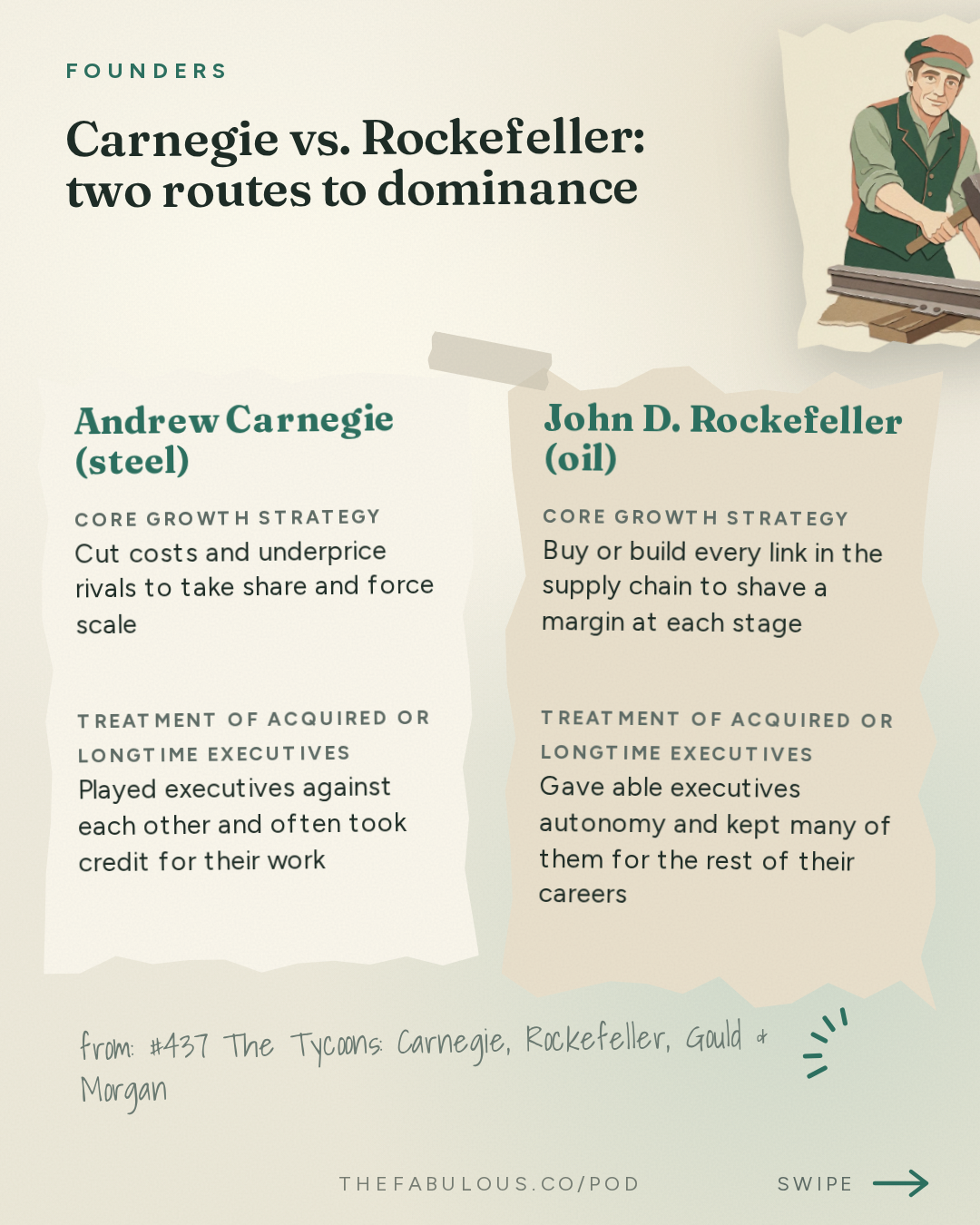
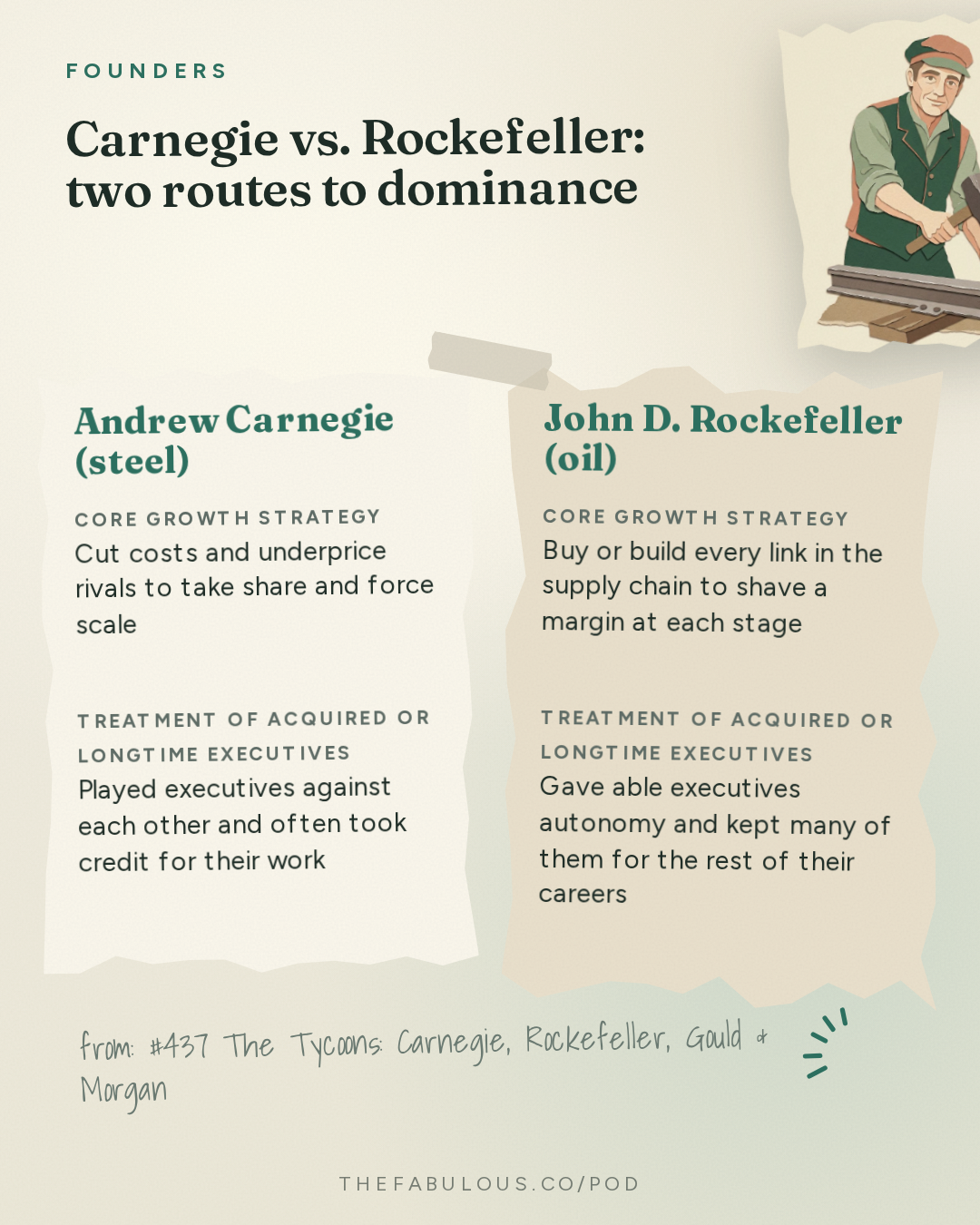
Carnegie's method was the simplest to state and the hardest to execute. Cut costs, take share, gain scale, and profits will take care of themselves (01:20). He ran his first railroad division on the same logic: when stalled cars blocked the line, he had them burned to clear traffic (07:54). Morris generalizes this into something close to a worldview.
"Focus on an objective, then cut brutally through any conventions, competitors, or ordinary people who stood in your way." (Charles R. Morris, The Tycoons, [08:17])
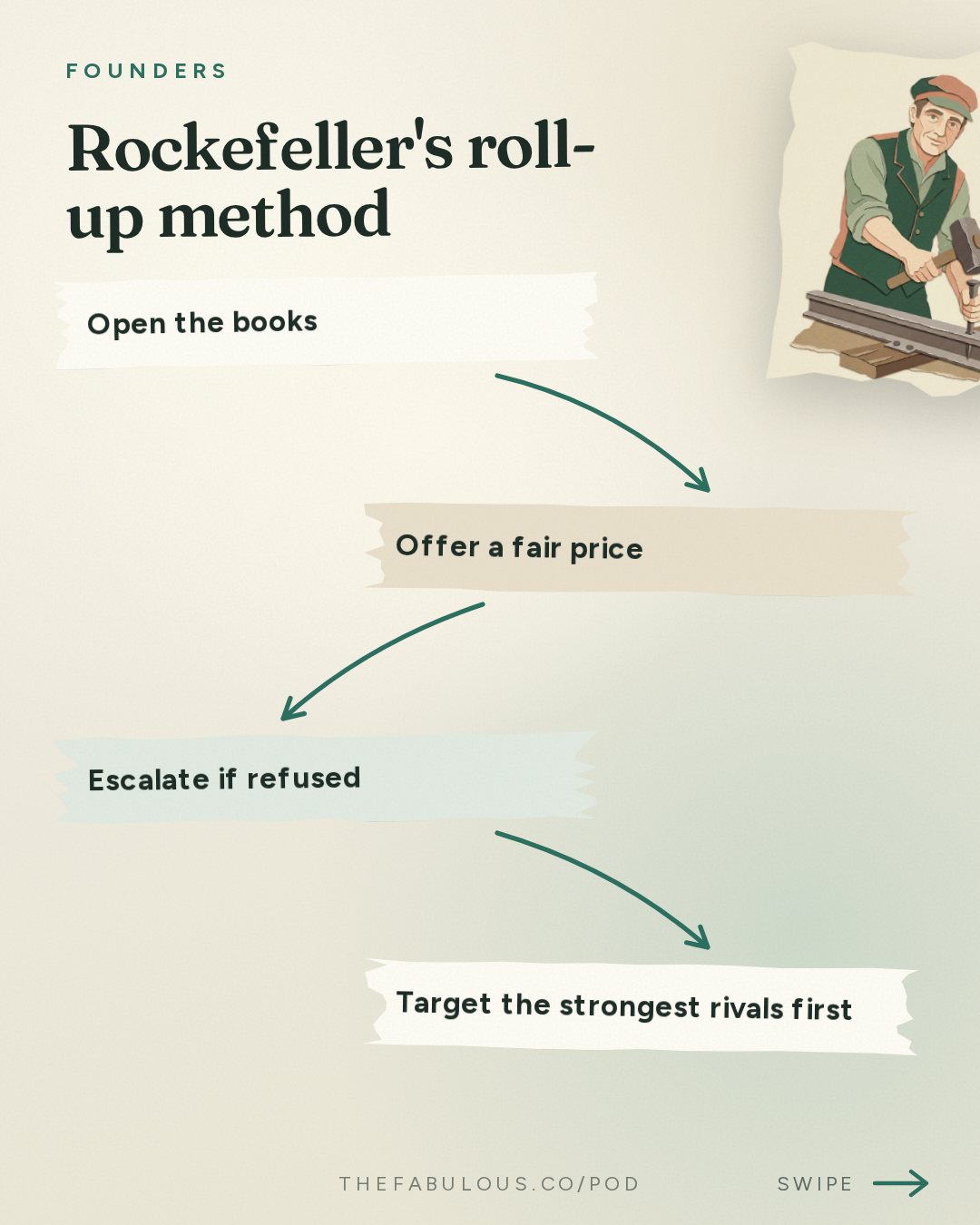
Rockefeller's method looked gentler and was, in a way, more unsettling. He rarely destroyed a rival outright. He opened his books to a target, let the man see the numbers, and let him conclude on his own that competing further was pointless. If the target refused a fair offer, Rockefeller unleashed what Morris calls total blazing warfare, attacking price, supply, and transportation until the holdout folded, at which point the original fair offer was still on the table (14:09). By twenty-six, Rockefeller already ran one of the country's largest and most profitable refineries, in Cleveland (04:41). When his partners tired of his pace and threatened to dissolve the firm, he called their bluff, had the dissolution notice published before they expected it, then outbid them at auction for $72,000. A single year later, that refinery's sales hit $1.2 million (12:44, 13:00).
Jay Gould worked a stranger instrument: the public security itself. Left by his father at thirteen with a pile of clothes and fifty cents (17:37), he grew into what one legal scholar called probably the most successful litigant in American history (18:22). Railroads, Morris notes, made up roughly 80 percent of the entire stock market's value at one point (15:58), which meant a man who understood leverage inside a railroad's finances could move markets that dwarfed most industries. Gould's war with the much older and far wealthier Cornelius Vanderbilt over the Erie Railroad shows the method. Vanderbilt slashed cattle-shipping rates to a penny a head to crush Gould's business, only to discover Gould had quietly cornered the cattle market and was profiting from Vanderbilt's own price war (27:56). Gould kept the Erie. He also, Morris admits with some bafflement, had a strange streak of self-destructiveness, often launching a new fight the moment an old one was won (17:13).
Morgan is the counterweight to all three. He inherited his trade from his father Junius, inherited a reputation for discipline rather than invention, and spent his career trying to impose order on an economy he believed was tearing itself apart. His own words on the subject are blunt: he detested "bitter, destructive competition that always led to demoralization and ruin" (20:39). Where Carnegie, Rockefeller, and Gould wanted more motion, Morgan wanted less.
Rockefeller's real advantage was that small efficiencies compounded. He built his own barrel plant, his own pipelines, his own hauling operations, and skimmed a margin at every stage, so that even his competitors' shipments, carried in his tank cars, quietly fed his profits: in Morris's words, "the accumulation of minor efficiencies at so many points gradually amassed into a crushing profitability advantage" (33:15). Carnegie arrived at a version of the same insight by a different road. He had what Morris describes as a conversion on a bond-selling trip to England in 1872, where he toured a new steelworks and decided steel, not railroads, was where his capital should go for the next thirty years (36:20). At that point he had $2.1 million in assets on paper but under $5,000 in cash (38:02). He then adopted railroad-style cost accounting, tracking labor, waste, and furnace idle time by the month, at a time when rival steelmakers had no real idea what their own products cost to make (40:13). He plowed every dollar of profit back into bigger plants and newer equipment for twenty-five straight years, never easing off the way British steelmakers did once a boom made them comfortable (39:29). When he sold his company to Morgan in 1905, his personal cash fortune ran to roughly $250 million (38:27).
The two men's habits with people were just as different as their balance sheets. Rockefeller never held a majority stake in Standard Oil. He led because his executives believed he was smarter than they were, and he kept talented people around for decades by giving them real authority (47:03). Carnegie, by contrast, played his executives against each other and took credit for their work; his treatment of his longtime partner Henry Clay Frick was harsh enough that a biography of their partnership is simply titled Me, You, and Hell. Morris's verdict on Carnegie's remote, irritable style is one of the sharper lines in the book.
"He might have been easier to live with, but he would have been a less successful tycoon." (Charles R. Morris, The Tycoons, [42:05])
What the Railroads Made Possible
The last stretch of the book turns from the four men to the economy they left behind, and this is where the argument becomes more than a business biography. None of the four tycoons ever intended to build the ground that other companies would stand on, Morris argues, but that is what their railroads, pipelines, and steel mills became. His example is Procter & Gamble. In 1879 a factory worker left a soap churn running too long and accidentally produced a bar that floated. The company risked $11,000 on an advertising campaign for the new soap, called it Ivory, and within a decade was selling more than thirty brands, competing with Colgate and Palmolive nationally (48:14). None of that was possible without the freight lines, steel machinery, and coal-fed plants the tycoons had already built for entirely different purposes. No banker financing railroads and steel mills had imagined building infrastructure for scented soap, but that, Morris writes, is what the infrastructure turned out to be for.
The book's final turn concerns money itself. Before this period, only railroads routinely raised capital in public markets, because only railroads needed to spend millions before earning a cent (51:57). Rockefeller mostly financed Standard Oil's growth internally and used bank loans only for short-term cash flow. Carnegie guarded his independence from investment bankers almost as jealously. Morgan's role was narrower than either man's operating genius, but it was the role that held the system together: he mediated between competing private companies the way European banking houses had once mediated between competing governments, lending and withholding capital to head off fights that would have wasted it. Different players, Morris writes, same game.
What stays with a listener afterward is less the size of any one fortune than the variety of ways four very different temperaments solved the same problem: how to get big, fast, inside a country that had almost no rules yet for getting big. Carnegie attacked through cost and scale. Rockefeller attacked through efficiency and quiet acquisition. Gould attacked through markets and leverage. Morgan tried, mostly without success, to make the other three slow down. None of them would have called the others friends. All four, in Morris's telling, are still underneath the floor of the modern economy, whether or not anyone standing on it today knows their names.
Ask this episode anything
Pod's AI answers from the episode itself, with the minute mark so you can hear it yourself.
Or start with one of these
Ask this episode
Pod's AI listens to the whole episode to answer, and points you to the minute it comes from.
The rest of this answer, and any question after it
Answers come from the episode itself, never from a summary of it.
ContinueKey takeaways
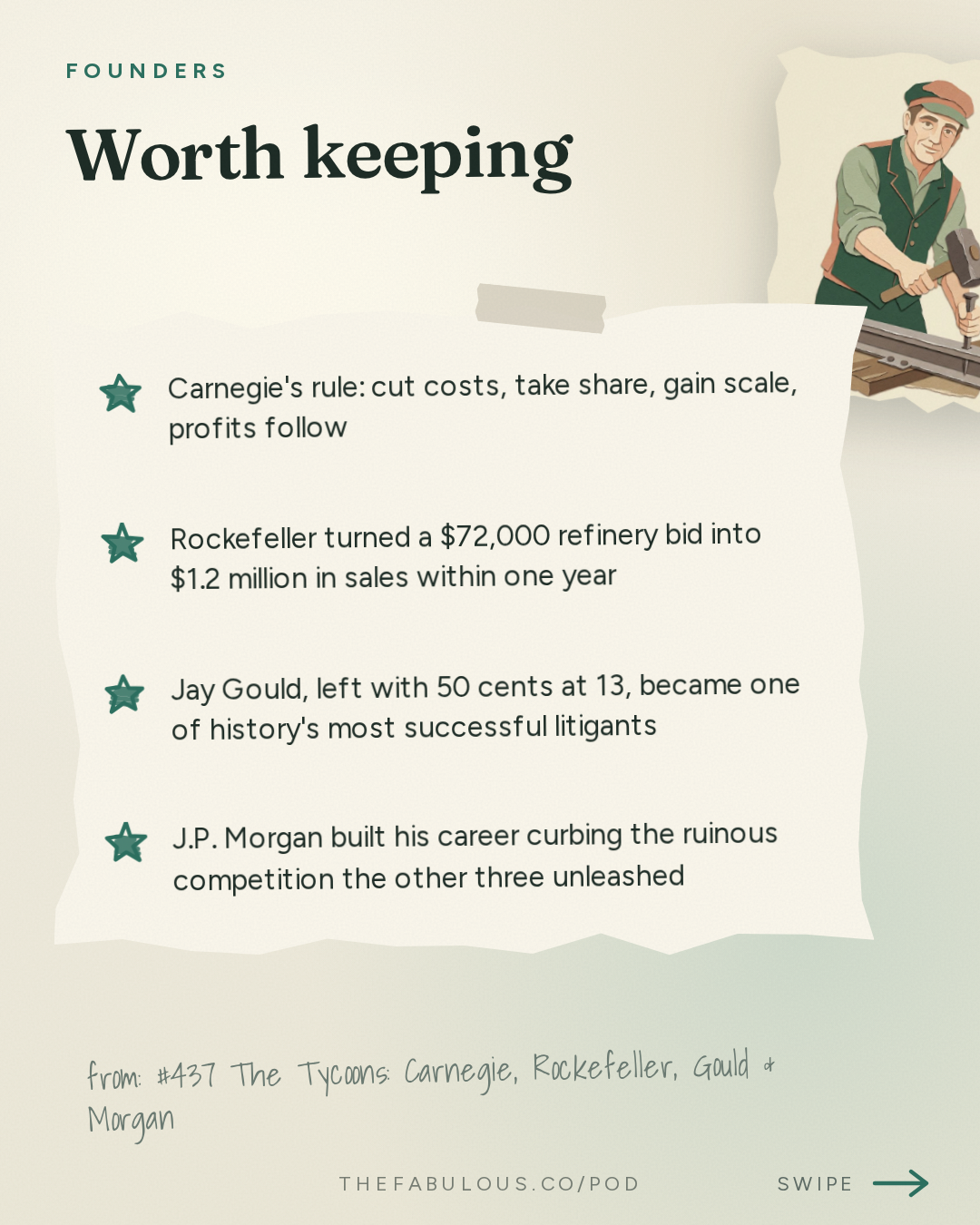
- Carnegie's rule: cut costs, take share, gain scale, profits follow
- Rockefeller turned a $72,000 refinery bid into $1.2 million in sales within one year
- Jay Gould, left with 50 cents at 13, became one of history's most successful litigants
- J.P. Morgan built his career curbing the ruinous competition the other three unleashed
- Railroad infrastructure from these tycoons later let brands like Procter & Gamble scale nationally
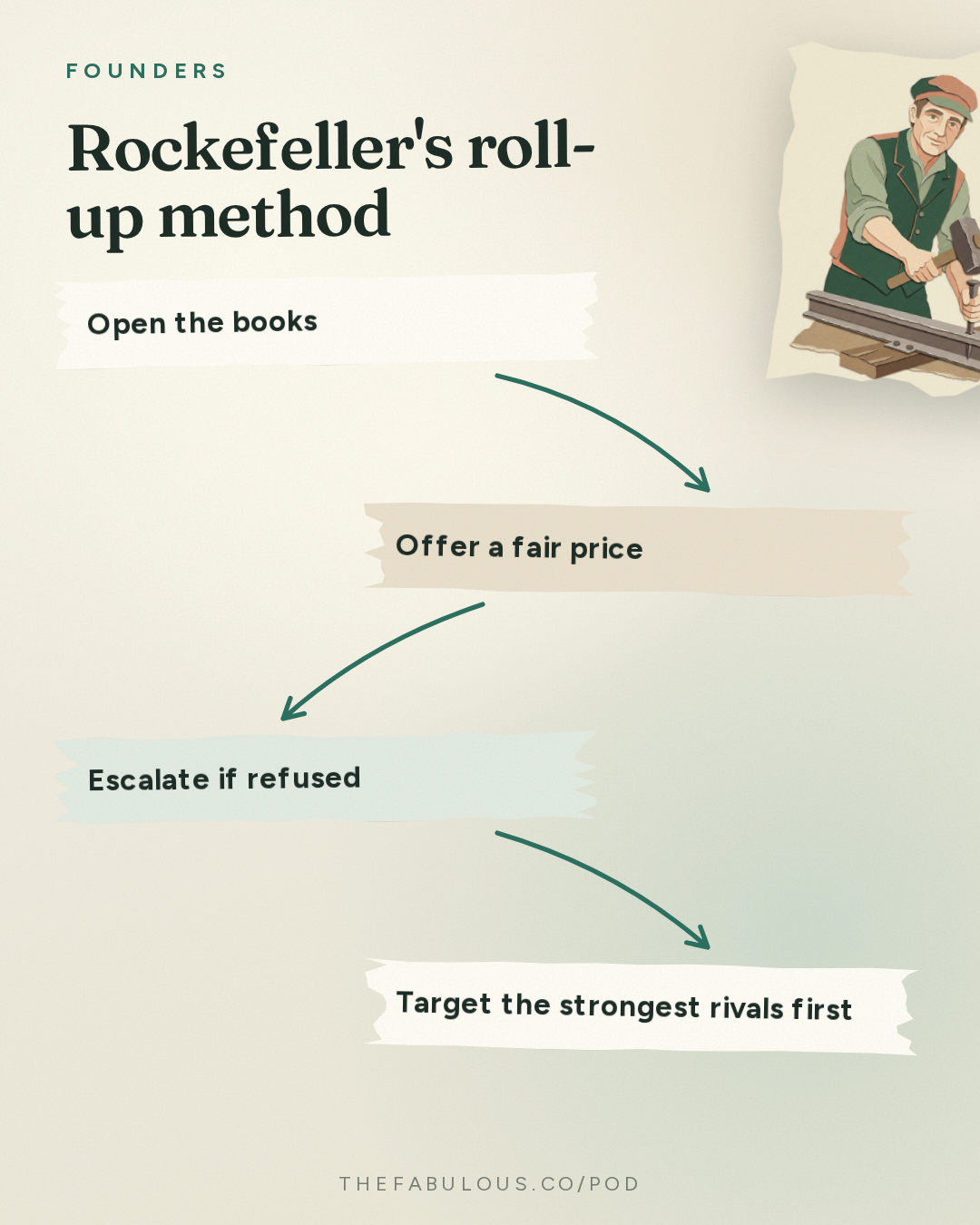
The episode in cards
By the numbers
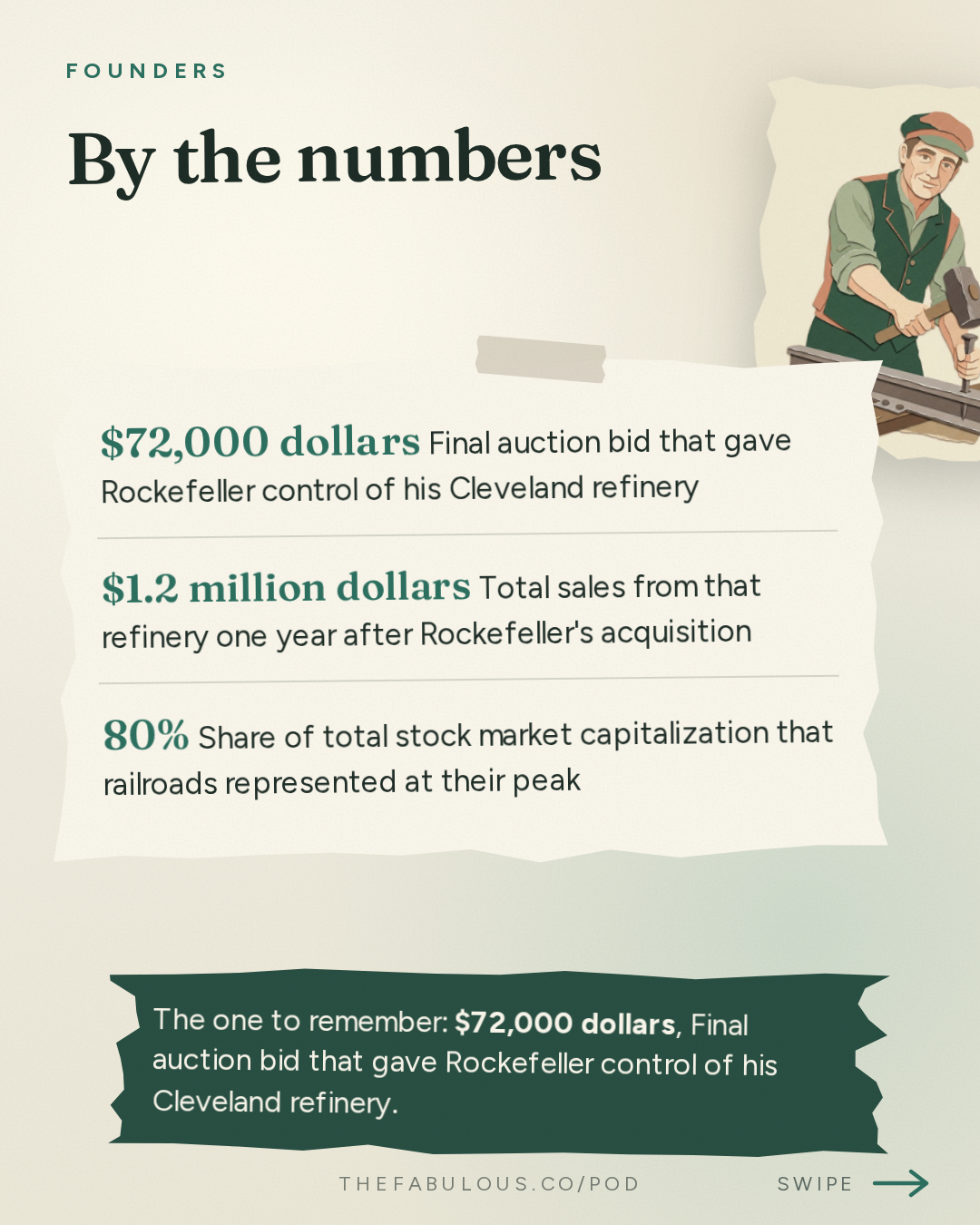
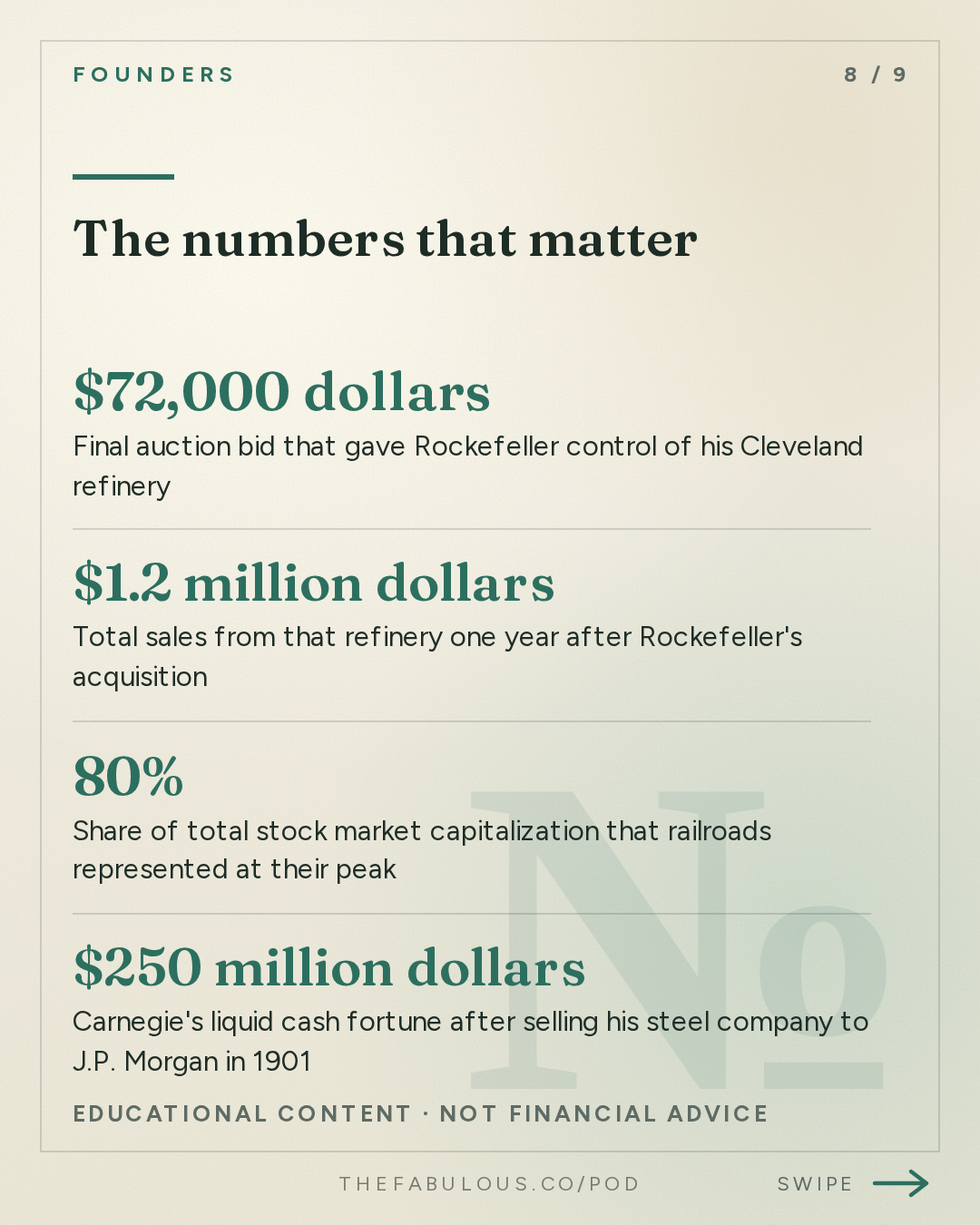
- $72,000 dollars Final auction bid that gave Rockefeller control of his Cleveland refinery
- $1.2 million dollars Total sales from that refinery one year after Rockefeller's acquisition
- 80% Share of total stock market capitalization that railroads represented at their peak
- $250 million dollars Carnegie's liquid cash fortune after selling his steel company to J.P. Morgan in 1901
- $11,000 dollars Procter & Gamble's initial ad spend risk that launched the Ivory soap brand
In their words
“Cut costs, take share, gain scale. Profits would take care of themselves.”
“Focus on an objective, then cut brutally through any conventions, competitors, or ordinary people who stood in your way.”
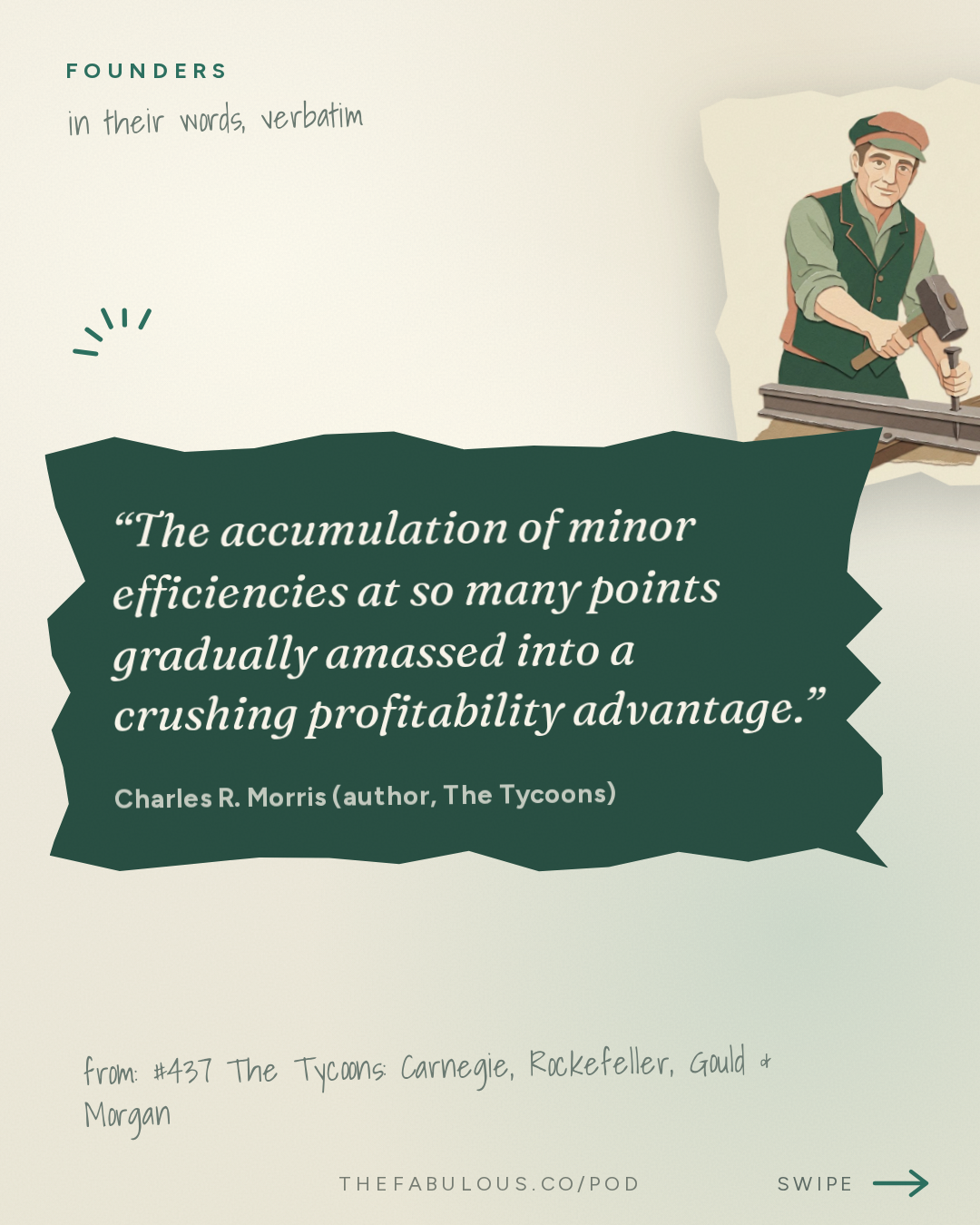
“The accumulation of minor efficiencies at so many points gradually amassed into a crushing profitability advantage.”
“He might have been easier to live with, but he would have been a less successful tycoon.”
“Rockefeller's style was not to destroy good men or good companies, but to enlist them in his cause.”
Protocols
-
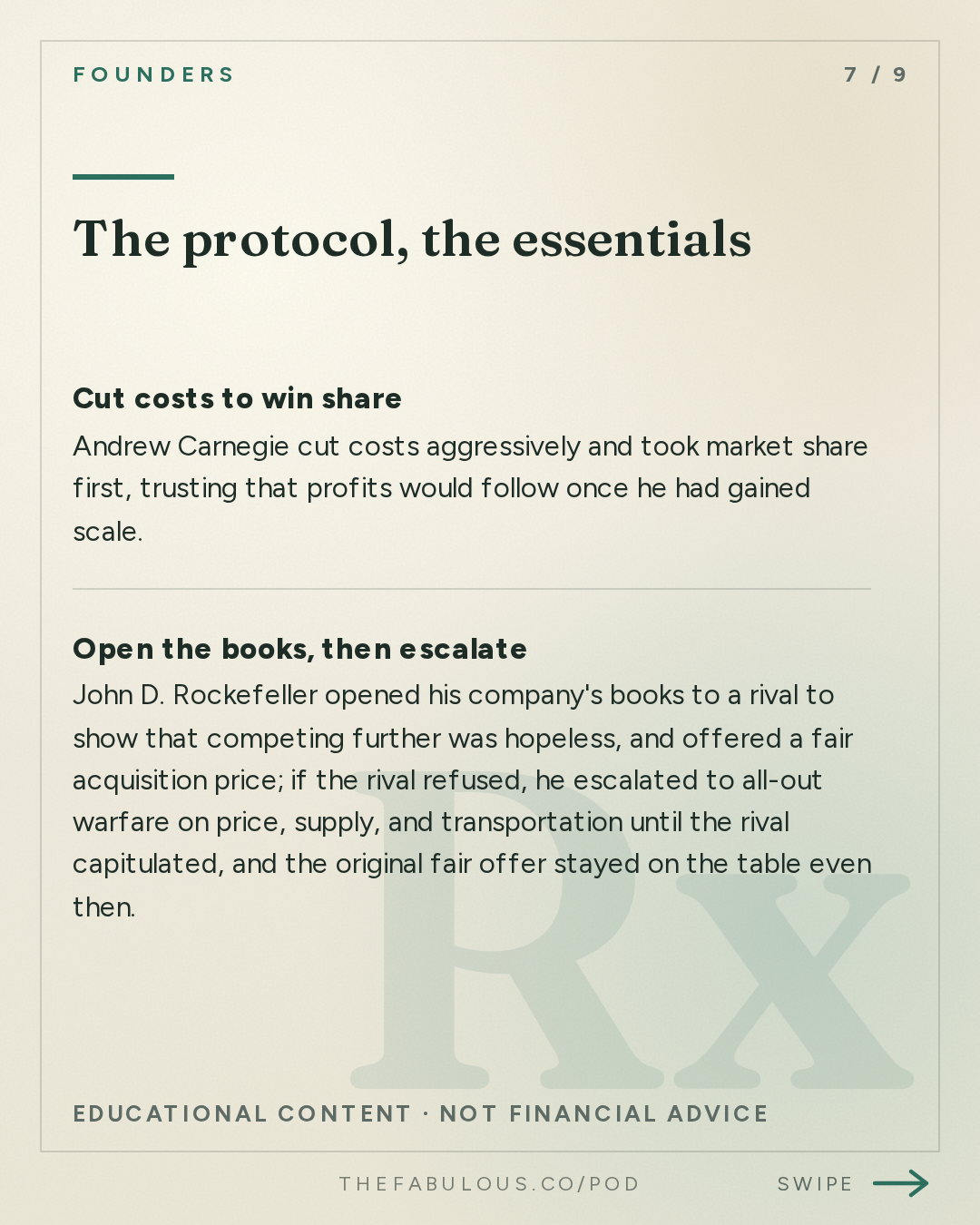
Cut costs to win share
Andrew Carnegie cut costs aggressively and took market share first, trusting that profits would follow once he had gained scale.
Applied continuously across his 25-year steel career
-
Open the books, then escalate
John D. Rockefeller opened his company's books to a rival to show that competing further was hopeless, and offered a fair acquisition price; if the rival refused, he escalated to all-out warfare on price, supply, and transportation until the rival capitulated, and the original fair offer stayed on the table even then.
Applied to each acquisition target during his oil roll-ups
-
Overpay to save time
Rockefeller often paid more than a target business was worth, because closing a deal quickly mattered more to him than squeezing the last dollar of price, and speed let him move to the next acquisition sooner.
Applied per deal during the Cleveland refinery consolidation
-
Attack the strongest rivals first
Rockefeller targeted the most powerful and technically advanced competitors first in a regional roll-up, reasoning that once the strongest players joined him, smaller firms would follow without a fight.
Applied at the start of each regional consolidation
Questions this episode answers
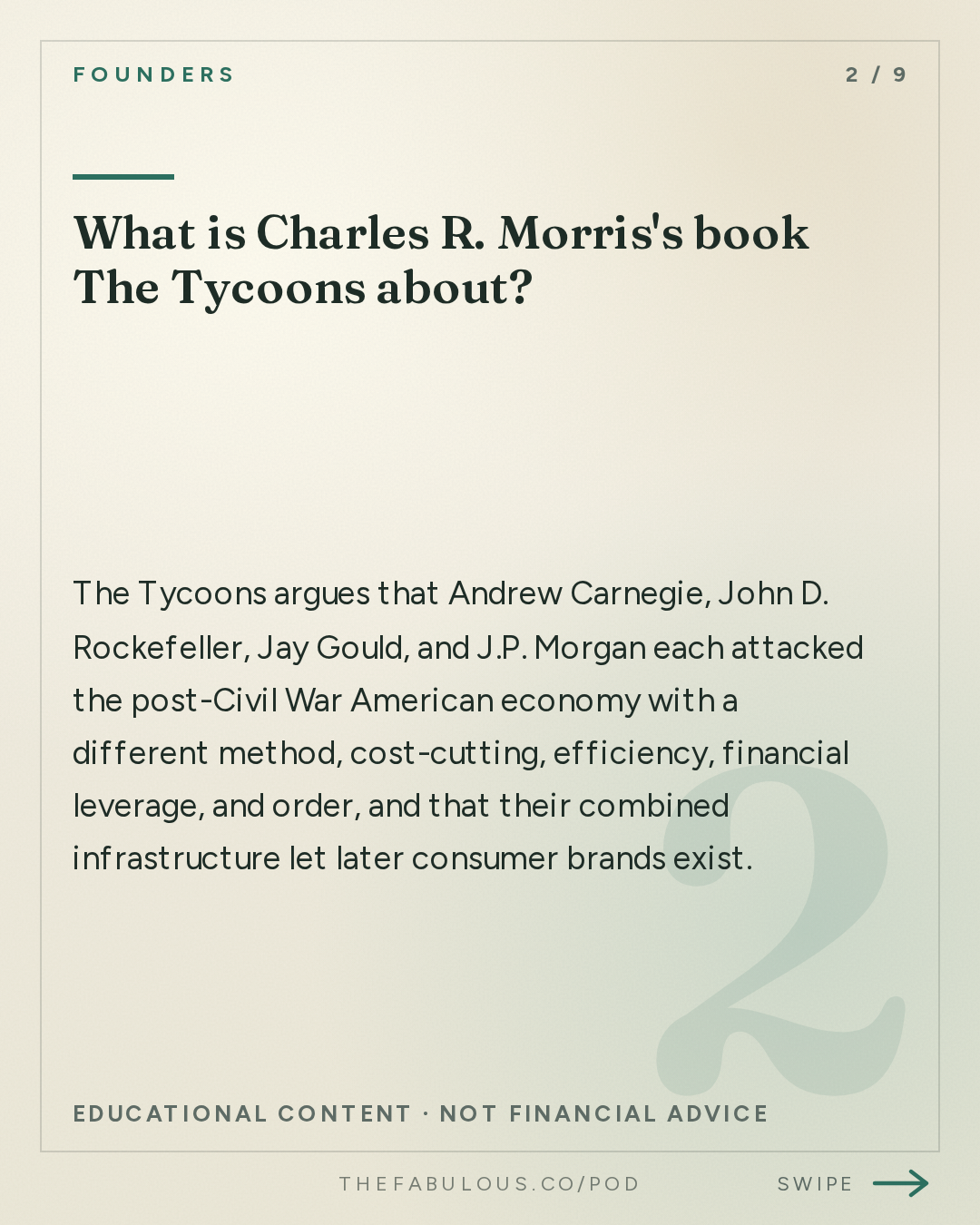
What is Charles R. Morris's book The Tycoons about?
The Tycoons argues that Andrew Carnegie, John D. Rockefeller, Jay Gould, and J.P. Morgan each attacked the post-Civil War American economy with a different method, cost-cutting, efficiency, financial leverage, and order, and that their combined infrastructure let later consumer brands exist (02:13).
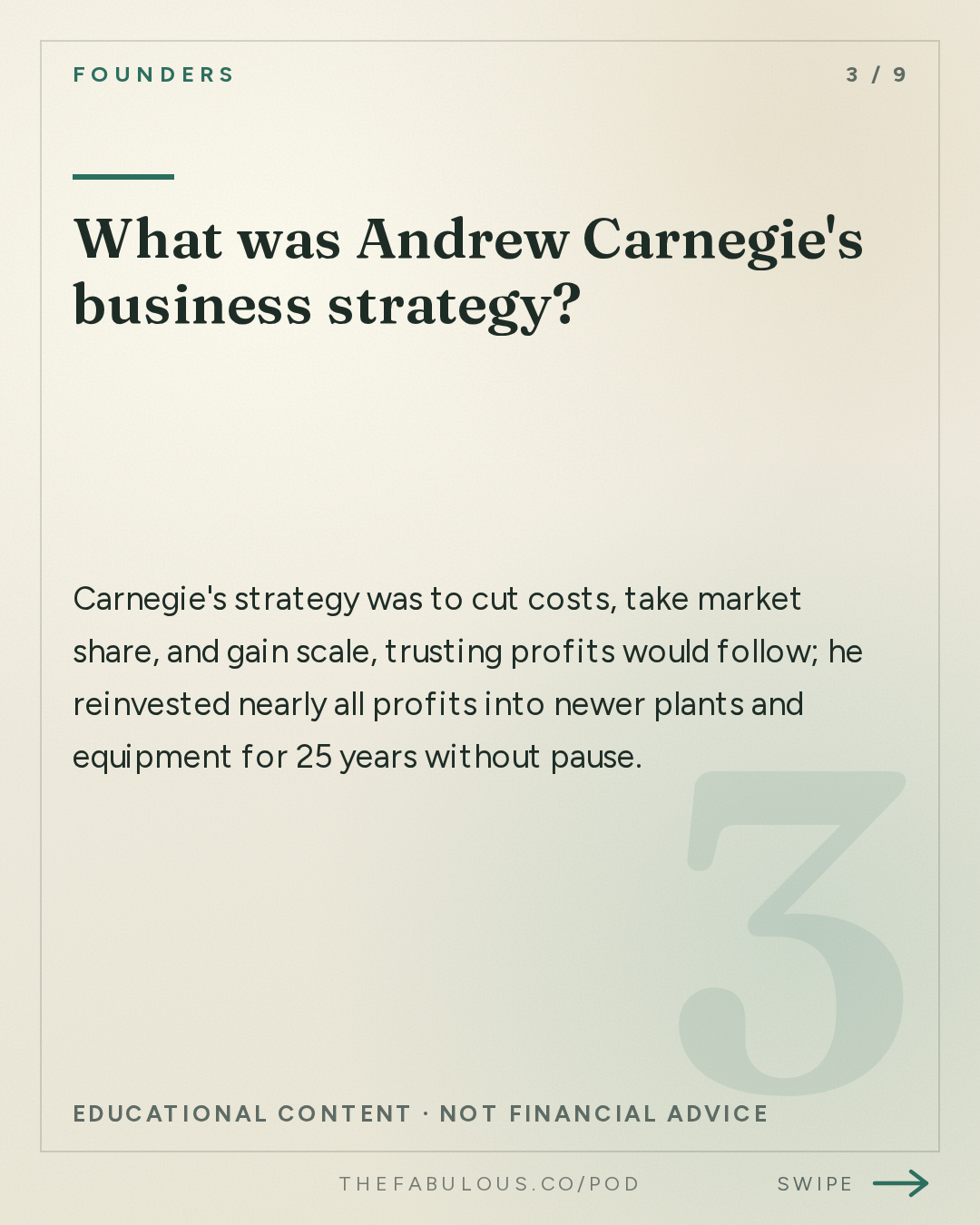
What was Andrew Carnegie's business strategy?
Carnegie's strategy was to cut costs, take market share, and gain scale, trusting profits would follow; he reinvested nearly all profits into newer plants and equipment for 25 years without pause (01:20, 39:29).
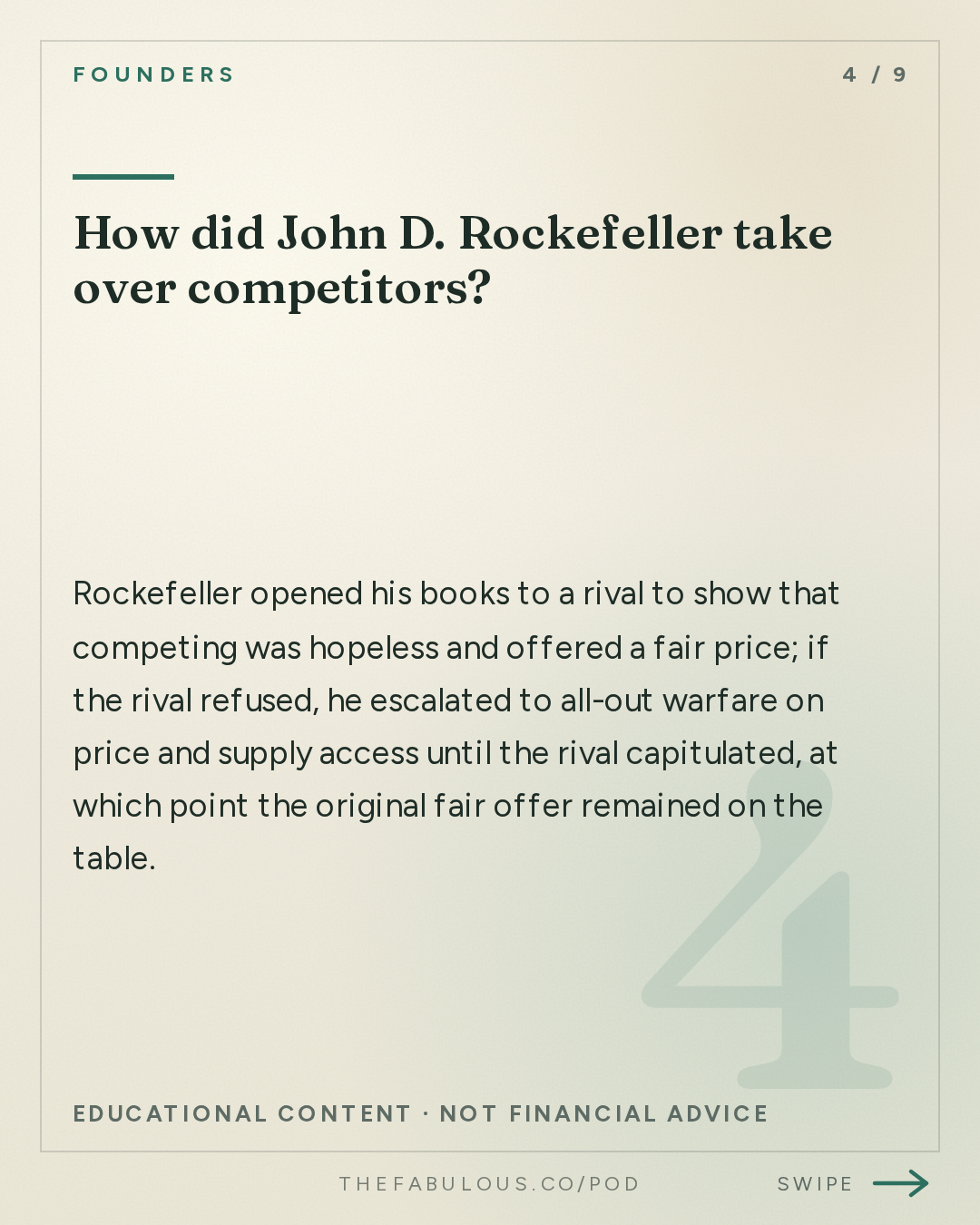
How did John D. Rockefeller take over competitors?
Rockefeller opened his books to a rival to show that competing was hopeless and offered a fair price; if the rival refused, he escalated to all-out warfare on price and supply access until the rival capitulated, at which point the original fair offer remained on the table (14:09).
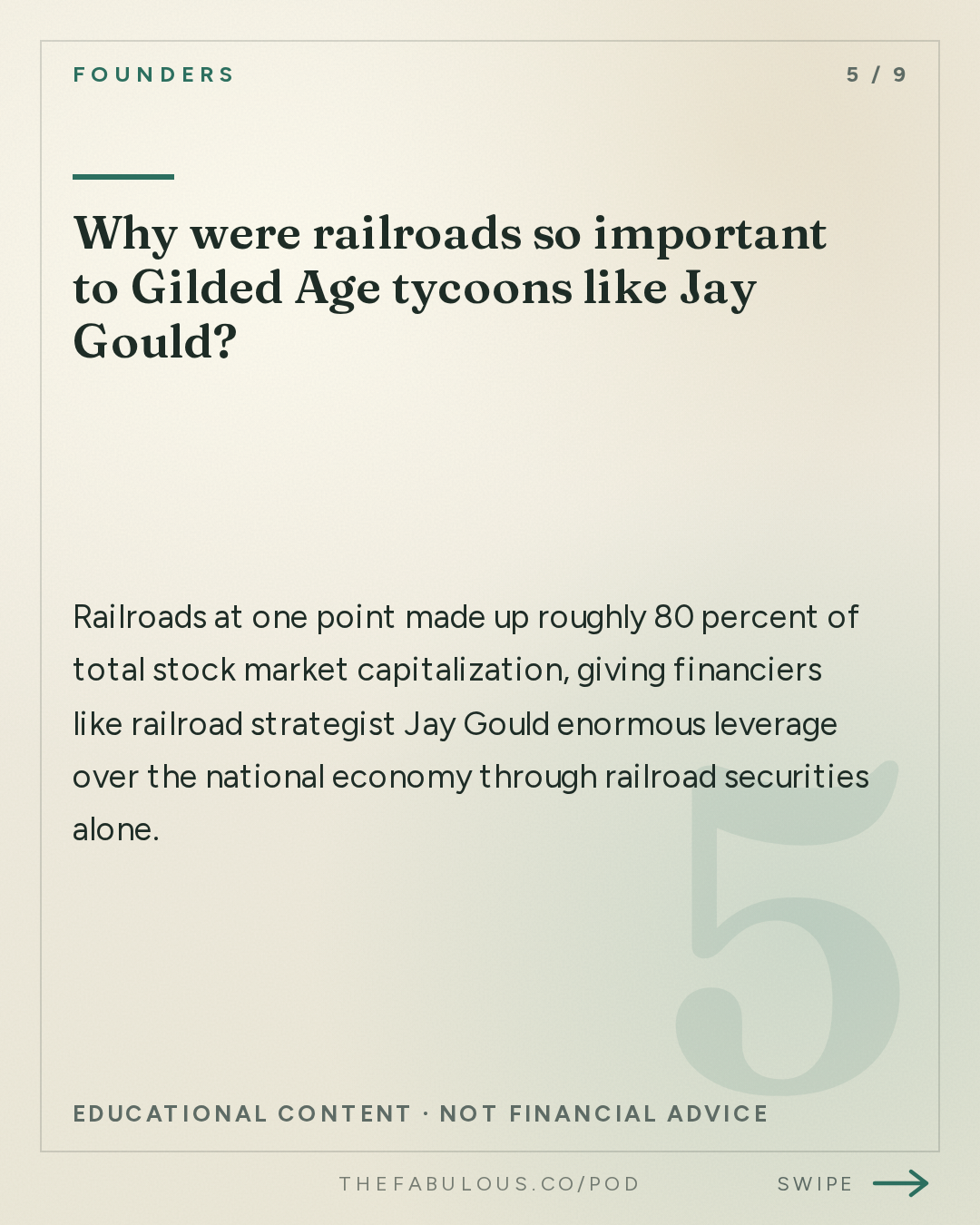
Why were railroads so important to Gilded Age tycoons like Jay Gould?
Railroads at one point made up roughly 80 percent of total stock market capitalization, giving financiers like railroad strategist Jay Gould enormous leverage over the national economy through railroad securities alone (15:58).
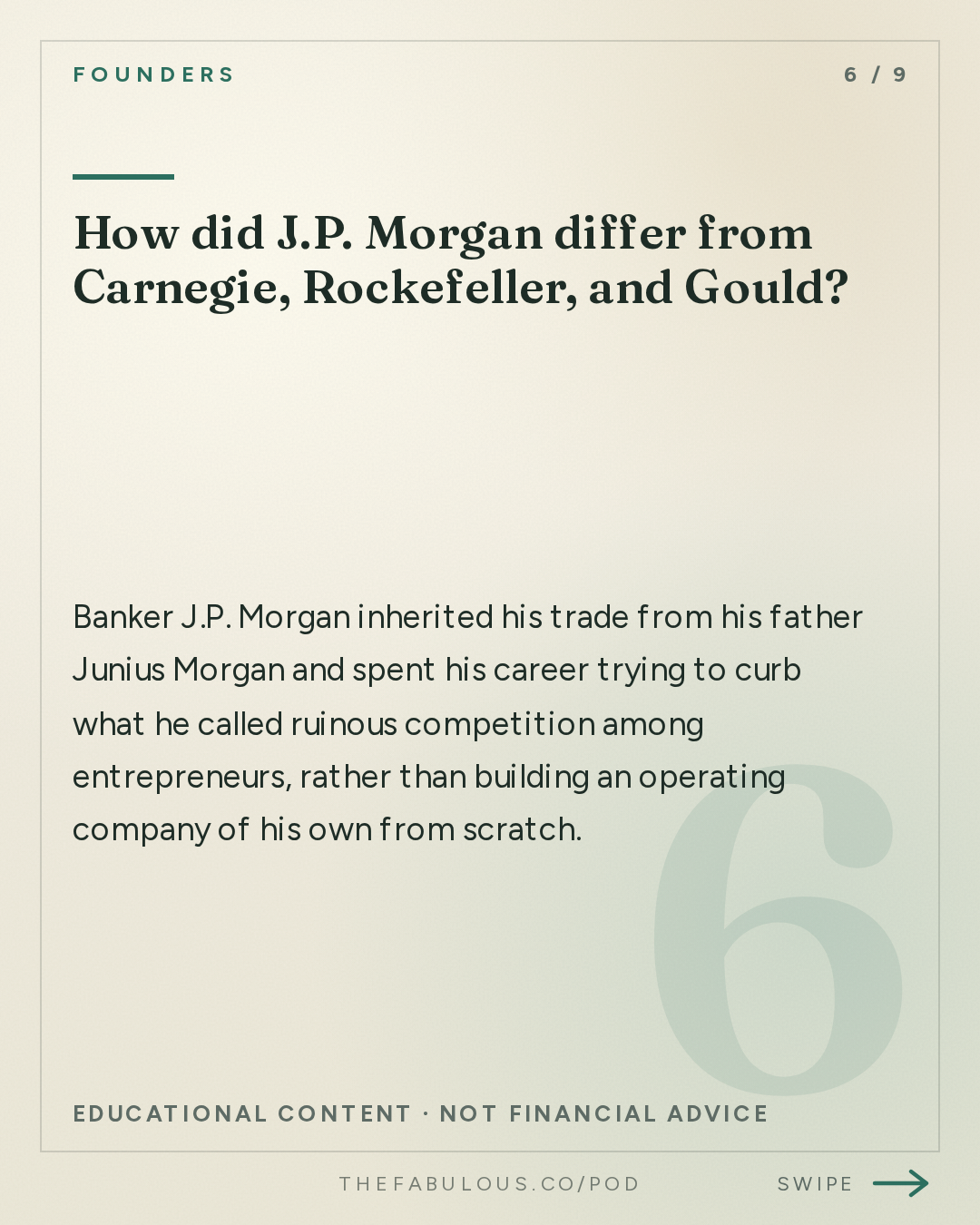
How did J.P. Morgan differ from Carnegie, Rockefeller, and Gould?
Banker J.P. Morgan inherited his trade from his father Junius Morgan and spent his career trying to curb what he called ruinous competition among entrepreneurs, rather than building an operating company of his own from scratch (00:55, 20:39).
What does the book say enabled consumer brands like Procter & Gamble?
The book argues that the railroad, pipeline, and steel infrastructure built by the four tycoons let later consumer brands emerge; Procter & Gamble risked $11,000 on an ad campaign for Ivory soap and became a national brand within a decade using that infrastructure (48:14).
The full read, in cards
Go deeper
- The Tycoons: How Andrew Carnegie, John D. Rockefeller, Jay Gould, and J.P. Morgan Invented the American Super Economy — argues the four men's different operating styles together built the post-Civil War American economy
- Me, You, and Hell — chronicles Carnegie's partnership and eventual falling-out with Henry Clay Frick
- The House of Morgan — history of the Morgan banking family, crediting Junius Morgan with shaping J.P. Morgan's disciplined style
Mentioned
Andrew Carnegie · John D. Rockefeller · Jay Gould · J.P. Morgan · Charles R. Morris · Tom Scott · Henry Clay Frick · Cornelius Vanderbilt · Standard Oil · Procter & Gamble · The Tycoons
More from this show and category
Ari Emanuel's Roll the Calls, Summarized
Ari Emanuel's memoir Roll the Calls traces his rise from a dyslexic mailroom assistant to the billionaire founder of Endeavor. It shows how rage, relentless phone volume, and a 1994 near-fatal car accident drove him to found Endeavor, merge with William Morris, and buy the UFC and WWE before Endeavor was valued at $13 billion.
Jeremy Stern's Mark Zuckerberg Profile Explained
Mark Zuckerberg has modeled himself on Augustus Caesar for decades, fighting what journalist Jeremy Stern calls the dictator's dilemma. Stern's profile shows how Zuckerberg counters corporate isolation with raw data and MMA training, building a $1.6 trillion empire of 3.6 billion users while insisting he will never stop.
Sam Walton's Core Business Strategies
Sam Walton built Walmart on four simple habits: cost control, copying competitors, small-town focus, and constant willingness to change course. He lost his first store over a missing lease clause, learned to fly a plane to scale faster, and copied ideas from JC Penney and Sol Price on his way to becoming America's richest man.
How Michael Bloomberg Built His Business Empire
Michael Bloomberg was fired from Salomon Brothers in 1981 with a $10 million severance, and he used it to build the Bloomberg Terminal into a data and media empire. Drawing on his memoir, Bloomberg by Bloomberg, the episode traces his sales training, his refusal to plan more than a few steps ahead, and his rule that business fights should never be fair.
