
Ari Emanuel's Roll the Calls, Summarized
#436 Ari Emanuel's Autobiography
The brief
Ari Emanuel's memoir Roll the Calls traces his rise from a dyslexic mailroom assistant to the billionaire founder of Endeavor. It shows how rage, relentless phone volume, and a 1994 near-fatal car accident drove him to found Endeavor, merge with William Morris, and buy the UFC and WWE before Endeavor was valued at $13 billion.
Most success literature treats anger as a problem to manage. Ari Emanuel, the Hollywood agent and dealmaker who built Endeavor, treats it as fuel. His memoir, Roll the Calls, opens with a quote about work from a nineteenth-century actor, director, and producer, but elsewhere makes an argument for rage: that it clarifies a problem before it ever solves one.
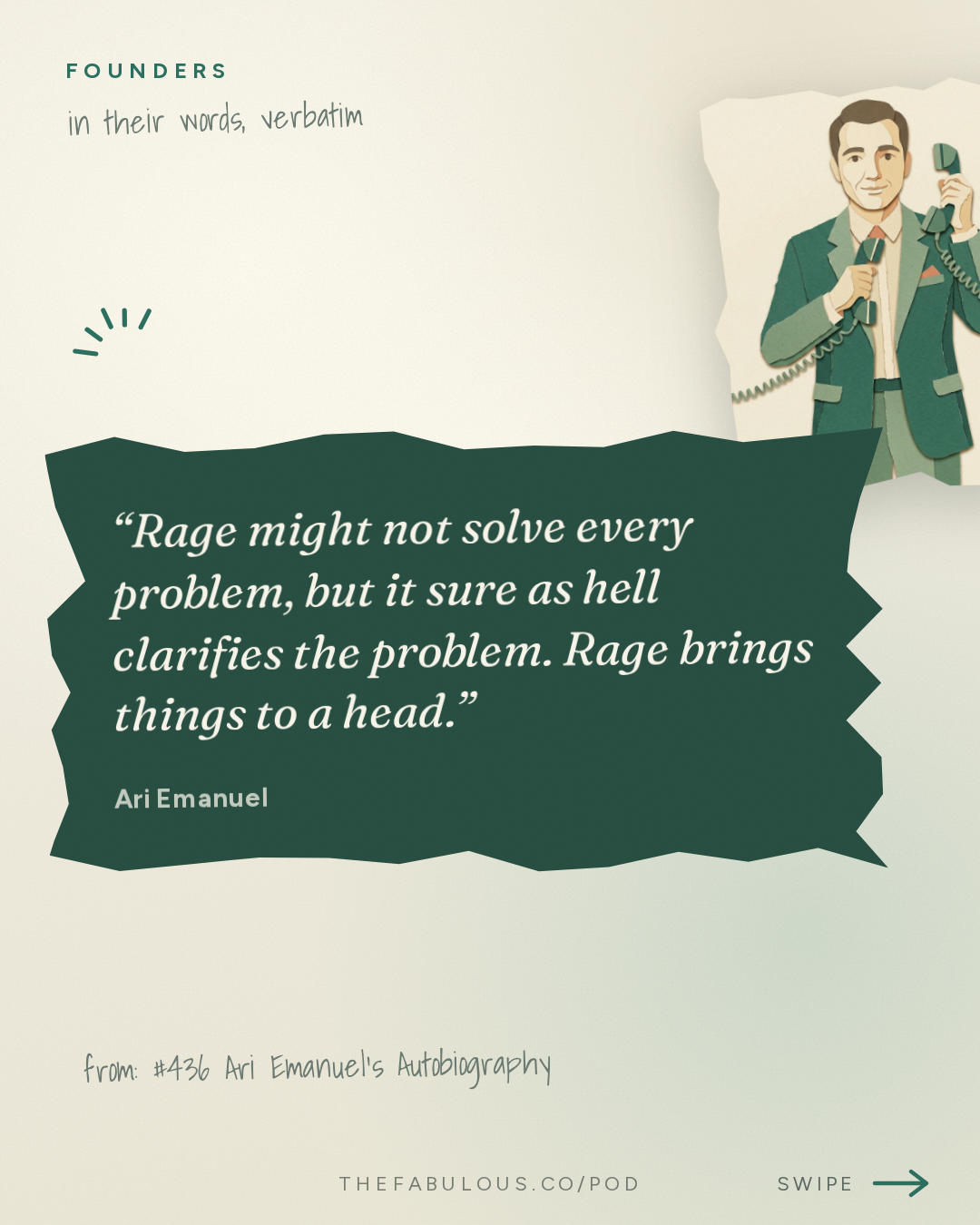
"Rage might not solve every problem, but it sure as hell clarifies the problem. Rage brings things to a head." (Ari Emanuel, [00:00])
The book traces four decades of a career that started with a job Emanuel did not understand and ended with him owning the company that bought UFC, WWE, and IMG. Along the way it offers a blunt theory of why he worked the way he did: he could not read easily, he got angry about it, and the anger never fully left.
Emanuel was diagnosed with dyslexia, a learning difference that makes reading difficult, as a child. Before the diagnosis he says he was "a bundle of self-loathing, anxiety, and rage" (03:59). After it, the feelings stayed, but at least he had a name for them. That tension between humiliation and drive runs through nearly every chapter: a man who struggled to read wound up representing the people who write the scripts and the books.
His first job, at 24, was assistant to a talent agent named Robert Lance. He had no fixed hours and no real idea what an agent did. What he learned instead was a method: sit in on every phone call your boss takes, because the assistant's seat is, in his words, an "invisible audience" (07:16) where secrets and power get passed along. He also learned, by watching his boss lose a star client to a rival, that the entertainment business runs on persistence as much as talent. The rival who stole that client was Michael Ovitz, soon to become the most powerful agent in Hollywood and, eventually, a man Emanuel would study and chase.
The Math of Rage
To get into Ovitz's agency, CAA, which at its peak represented something like 90 percent of Hollywood's talent (12:56), Emanuel needed a mailroom job he was told he was too old for at 26. So he called the man in charge of hiring four or five times a day, then started leaving recorded messages late at night. His reasoning was simple.
"If you arrive at your desk every morning and find 11 messages from somebody, the same somebody who left 11 messages yesterday, you've got two options: call the person back or call the police." (Ari Emanuel, [14:46])
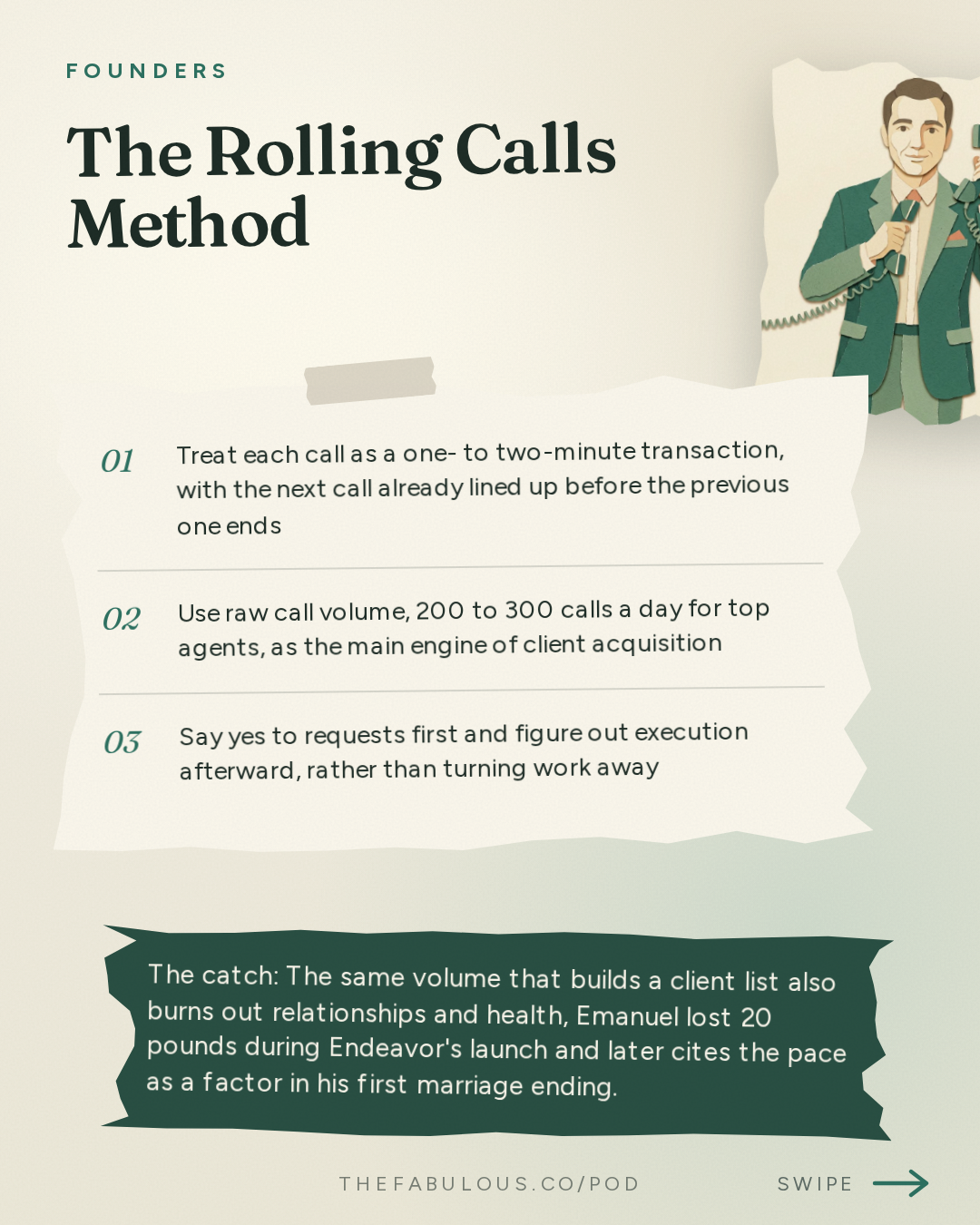
Ten days of that got him the job. The same math, scaled up, became his career. Elite agents, he says, were placing 200 to 300 calls a day (24:44), each one kept to a minute or two so the next call could start the moment the last one ended. He called this rolling the calls, the phrase that became the book's title. The logic is almost mechanical: in a sales business, volume itself does a lot of the work.
Underneath the call volume was a specific business trick Emanuel learned at CAA called packaging. Instead of negotiating one deal for one client and taking a single 10 percent commission (20:10), an agency could bundle an actor, a director, and a producer together and sell the whole package to a network. The agency gave up the upfront fee and instead took a small percentage every time the show aired. A flop cost the agency nothing extra. A hit that ran for years, or became a rerun classic that aired for generations, turned into what Emanuel calls a river of cash flowing for the rest of an agent's life (20:28). Packaging is why agencies started wanting to own franchises, not just represent the people in them, a shift that pushed Emanuel toward buying entire companies later in his career.
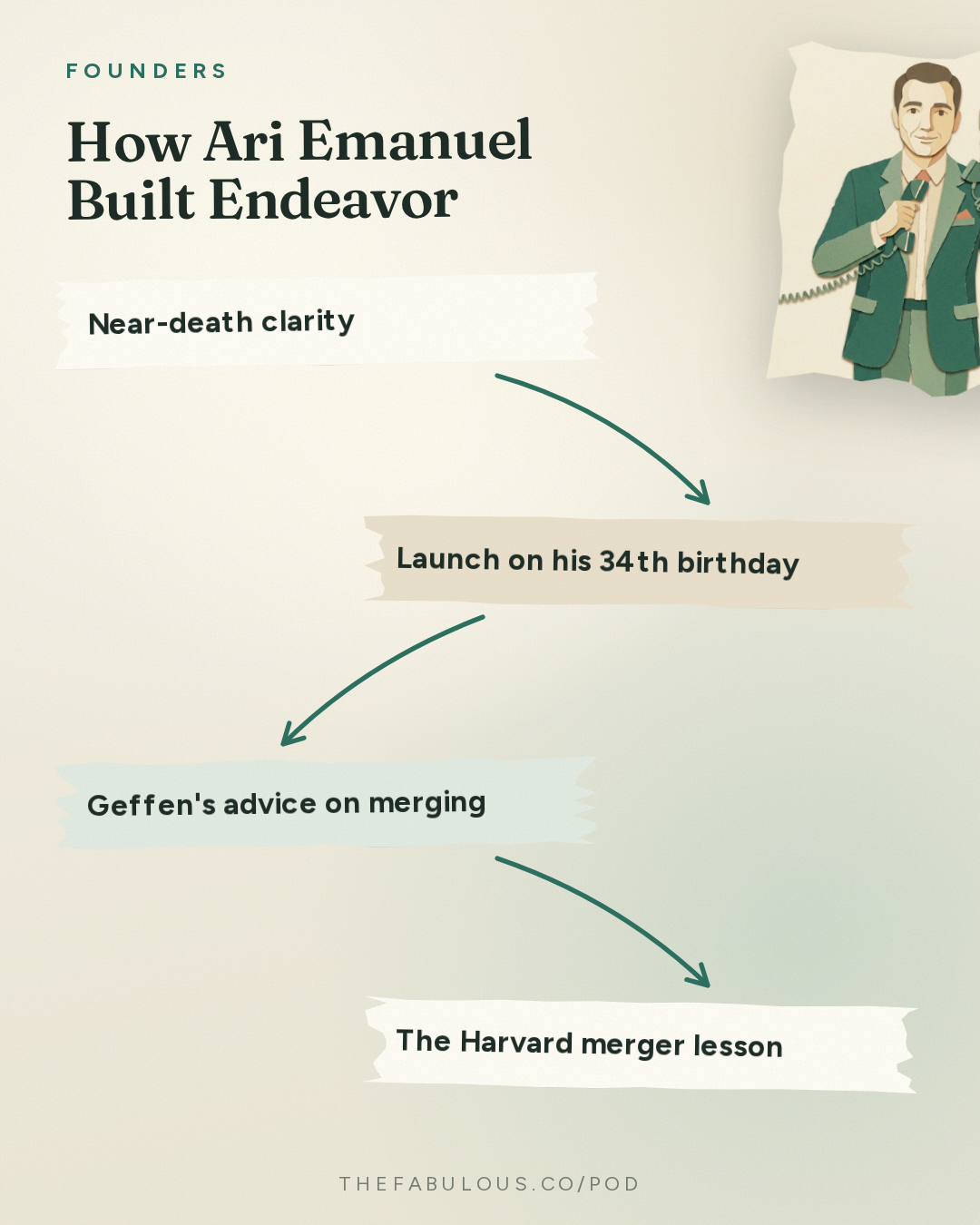
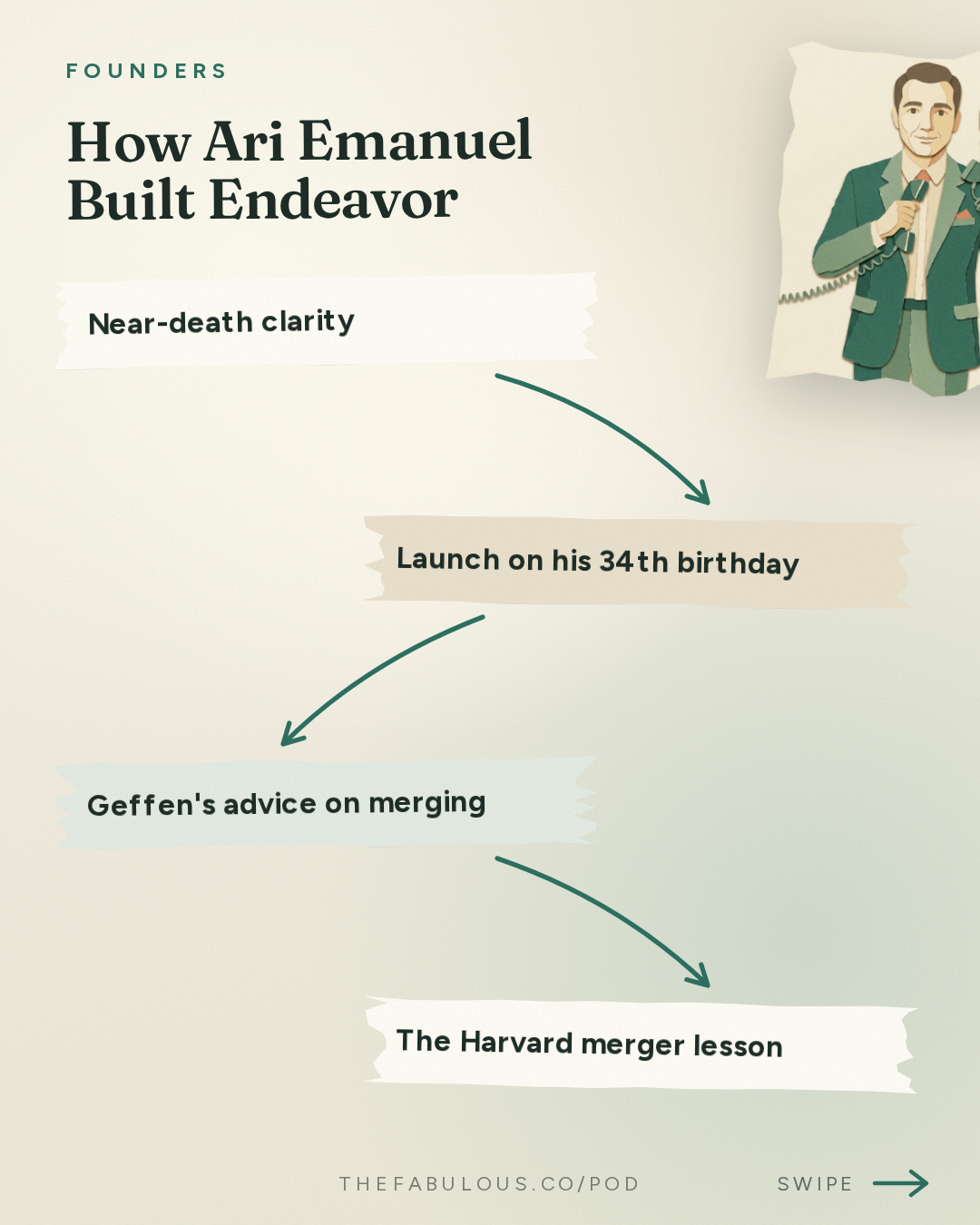
The turn toward ownership did not come only from ambition. In 1994, at a crosswalk in Los Angeles, Emanuel was hit by a pickup truck (30:03). He did not know if his spine was intact. Lying in the street, he says he moved from gratitude that he could still feel his limbs to regret, not about stepping off the curb, but about how he had spent his life up to that point.
"Life is not a dress rehearsal. Everyone says this, but few act on it. Opening night is right now." (Ari Emanuel, [31:24])
Five days later he was back at his desk, telling his assistant to roll the calls again. Months after that, with a job offer worth $1,000,000 a year on the table (32:04), he turned it down and launched his own agency, Endeavor, on his 34th birthday (33:05). The early days were threadbare: four founders on borrowed office chairs, a travel policy that meant sleeping on a friend's floor, and a habit, born from the cost of cell phone minutes, of hanging up on calls without saying goodbye, mid-sentence if necessary (35:42). That tic, started to save money, stuck around as his signature style for decades.
What a Merger Actually Is
Endeavor's biggest strategic problem, a decade in, was size. The agency business had a hard ceiling, and only the largest firms were going to survive what Emanuel calls a coming technological earthquake (40:21). The fix was to merge with a bigger rival, William Morris, a decision so unsettling that Emanuel sought outside judgment. He called David Geffen, the media executive known for cutting straight to the point, who told him the choice of partner barely mattered (41:57). The only real mistake, Geffen said, was sitting still.
Before closing the deal, Emanuel also sat with a Harvard Business School professor who specializes in mergers, who gave him a rule he repeats as settled fact for the rest of the book.
"Every merger is really just one company swallowing the other. The rest is spin." (Ari Emanuel, [43:16])
Emanuel took the lesson literally. He leaked details of the stalled negotiation to a Hollywood gossip site to destabilize William Morris's leadership, then agreed to terms that let the other side keep the merged company's name and chairman title, only to later push out two of its senior partners for a $44 million buyout (56:15). The agency that came out the other side went on to buy IMG for $2.4 billion (58:32) and the UFC for $4.2 billion (46:54), in both cases after first signing the business's leader, UFC president Dana White, as an individual client. The same pattern played out with WWE founder Vince McMahon, who became a client years before Endeavor bought his company too.
The costs of this pace show up plainly in the book. Emanuel lost 20 pounds during Endeavor's launch from stress alone (33:47). He describes a breakdown after the IMG deal that left him unable to move for three days (58:55). A friend, he writes, told him the fix was not to stop working but to accept that nobody can always be on the field (59:15). He also says each win produced less satisfaction than the last: taking Endeavor public in 2021 felt good but not like the peak he expected, because by then he already knew the feeling would not last.
"The highs never last. No matter how high, they just never last." (Ari Emanuel, [63:24])
Three years later, Silver Lake, the private equity firm run by his longtime advisor Egon Durbin, took Endeavor private again at a $13 billion valuation (67:30), up from $350 million about a dozen years earlier. Emanuel describes a round of golf with Durbin at Augusta National right after, a small victory lap before he left early to chase a client he had been trying to sign for years. The book ends there, not at a finish line but back on the phone, which is the point. Rage got him into the business. The habit of chasing the next call is what kept him in it, long after the anger that started it had, by his own account, mostly burned off.
Ask this episode anything
Pod's AI answers from the episode itself, with the minute mark so you can hear it yourself.
Or start with one of these
Ask this episode
Pod's AI listens to the whole episode to answer, and points you to the minute it comes from.
The rest of this answer, and any question after it
Answers come from the episode itself, never from a summary of it.
ContinueKey takeaways
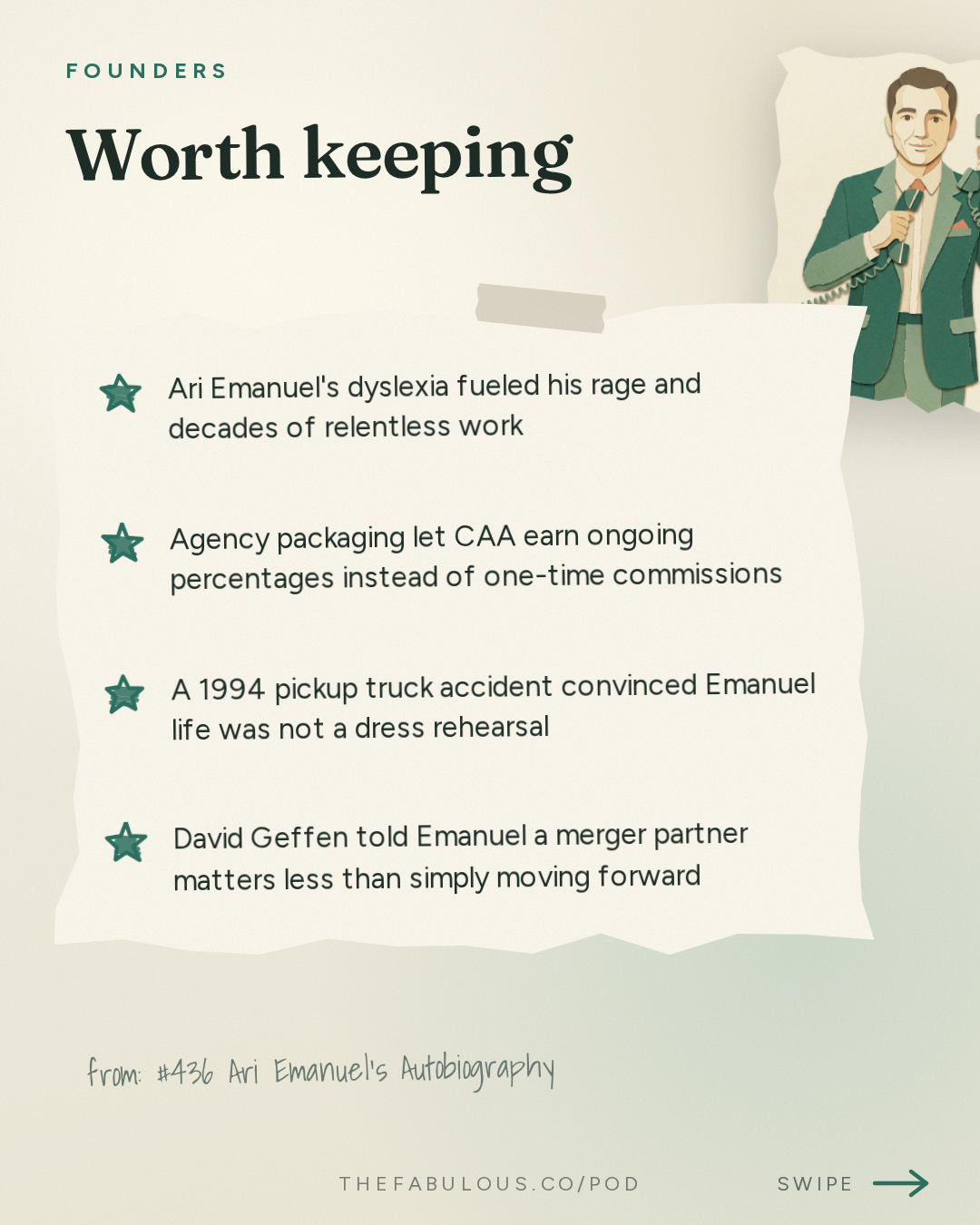
- Ari Emanuel's dyslexia fueled his rage and decades of relentless work
- Agency packaging let CAA earn ongoing percentages instead of one-time commissions
- A 1994 pickup truck accident convinced Emanuel life was not a dress rehearsal
- David Geffen told Emanuel a merger partner matters less than simply moving forward
- Endeavor grew from $350 million to a $13 billion valuation when Silver Lake took it private
The episode in cards


By the numbers
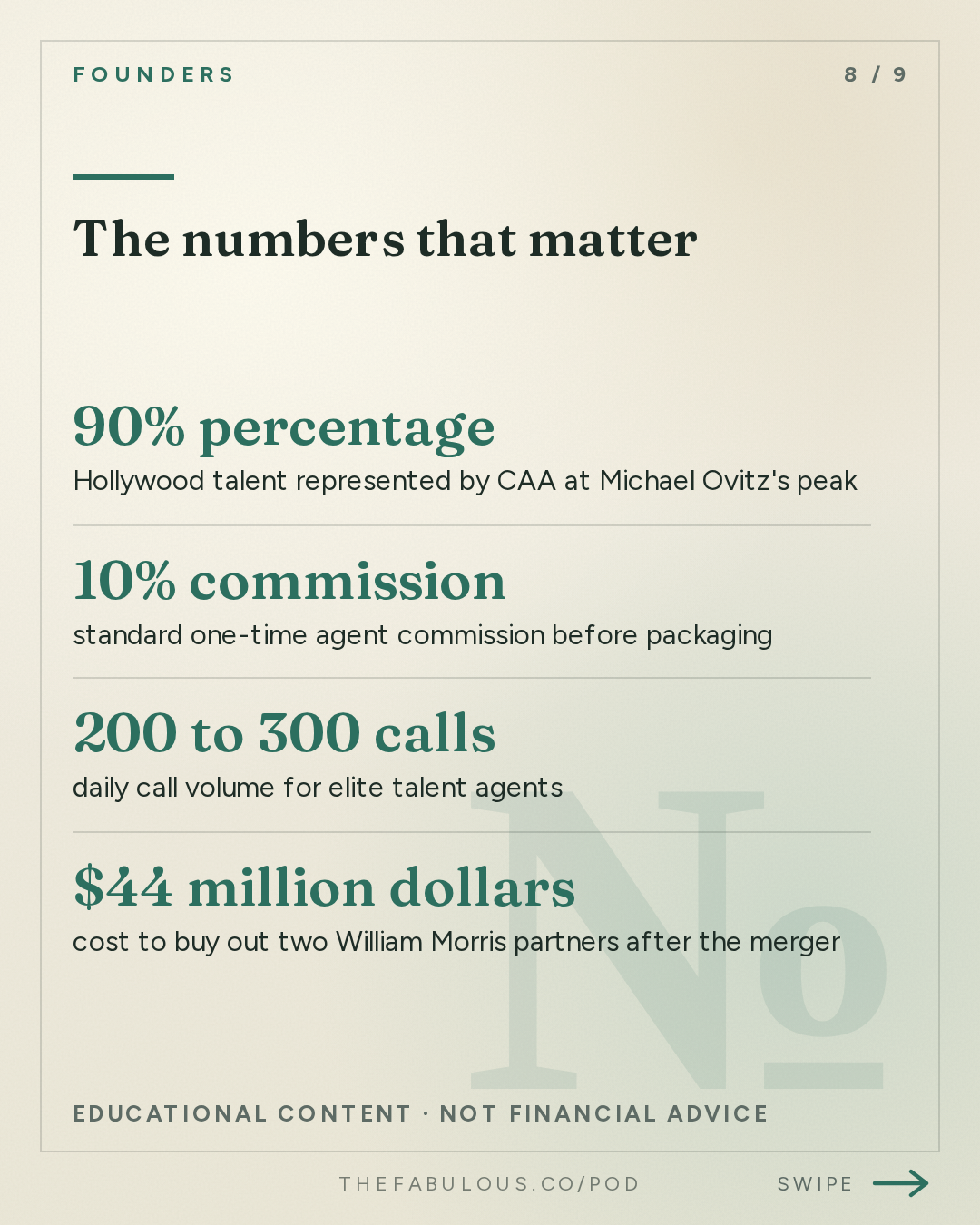
- 90% percentage Hollywood talent represented by CAA at Michael Ovitz's peak
- 10% commission standard one-time agent commission before packaging
- 200 to 300 calls daily call volume for elite talent agents
- $44 million dollars cost to buy out two William Morris partners after the merger
- $4.2 billion dollars price Endeavor paid to acquire the UFC
- $13 billion dollars Endeavor's valuation when Silver Lake took it private
In their words
“Rage might not solve every problem, but it sure as hell clarifies the problem. Rage brings things to a head.”
“If you arrive at your desk every morning and find 11 messages from somebody, the same somebody who left 11 messages yesterday, you've got two options: call the person back or call the police.”
“Life is not a dress rehearsal. Everyone says this, but few act on it. Opening night is right now.”
“Every merger is really just one company swallowing the other. The rest is spin.”
Protocols
-
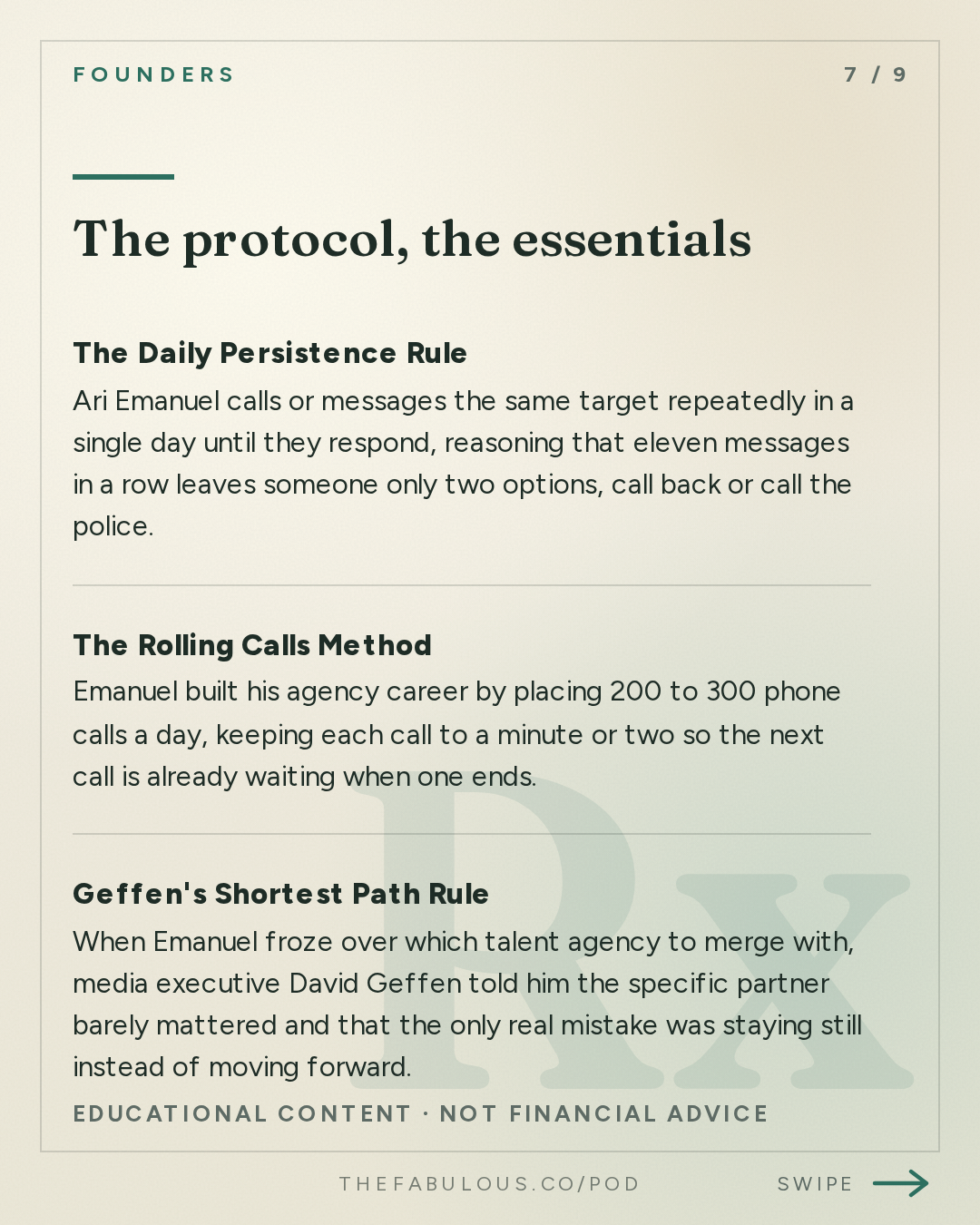
The Daily Persistence Rule
Ari Emanuel calls or messages the same target repeatedly in a single day until they respond, reasoning that eleven messages in a row leaves someone only two options, call back or call the police.
Several times a day until the person responds
-
The Rolling Calls Method
Emanuel built his agency career by placing 200 to 300 phone calls a day, keeping each call to a minute or two so the next call is already waiting when one ends.
200 to 300 calls per day
-
Geffen's Shortest Path Rule
When Emanuel froze over which talent agency to merge with, media executive David Geffen told him the specific partner barely mattered and that the only real mistake was staying still instead of moving forward.
Applied once, at a single high-stakes decision point
-
The No-Goodbye Habit
Emanuel ends phone calls without a goodbye, sometimes mid-sentence, a habit that began to save cell phone minutes early in Endeavor's history and then became his permanent style.
Every phone call
Questions this episode answers
What is Ari Emanuel's memoir Roll the Calls about?
The book traces Ari Emanuel's rise from a dyslexic 24-year-old talent agent's assistant to the founder of Endeavor, the company that acquired UFC and WWE. Emanuel frames his own rage and nonstop phone volume, sometimes 200 to 300 calls a day, as the driver of that rise (24:44).
How did Ari Emanuel get his start in Hollywood?
Emanuel started as an assistant to talent agent Robert Lance at 24 with no idea what an agent did, then called the hiring manager at CAA multiple times a day to land a mailroom job he had been told he was too old for (14:46). He treated the assistant's seat as an invisible audience to learn the business from listening in on calls (07:16).
What is talent agency packaging?
Packaging is when an agency bundles an actor, a director, and a producer and sells them as a set to a network, taking a small ongoing percentage of the show's revenue instead of a single 10 percent commission (20:10). A hit show running for years, or decades as a rerun classic, turns that percentage into long-term recurring income (20:28).
How much did Ari Emanuel's Endeavor pay for the UFC?
Endeavor acquired the UFC for $4.2 billion, a deal that followed years of Emanuel first signing UFC president Dana White as an individual client before buying the whole organization (46:54).
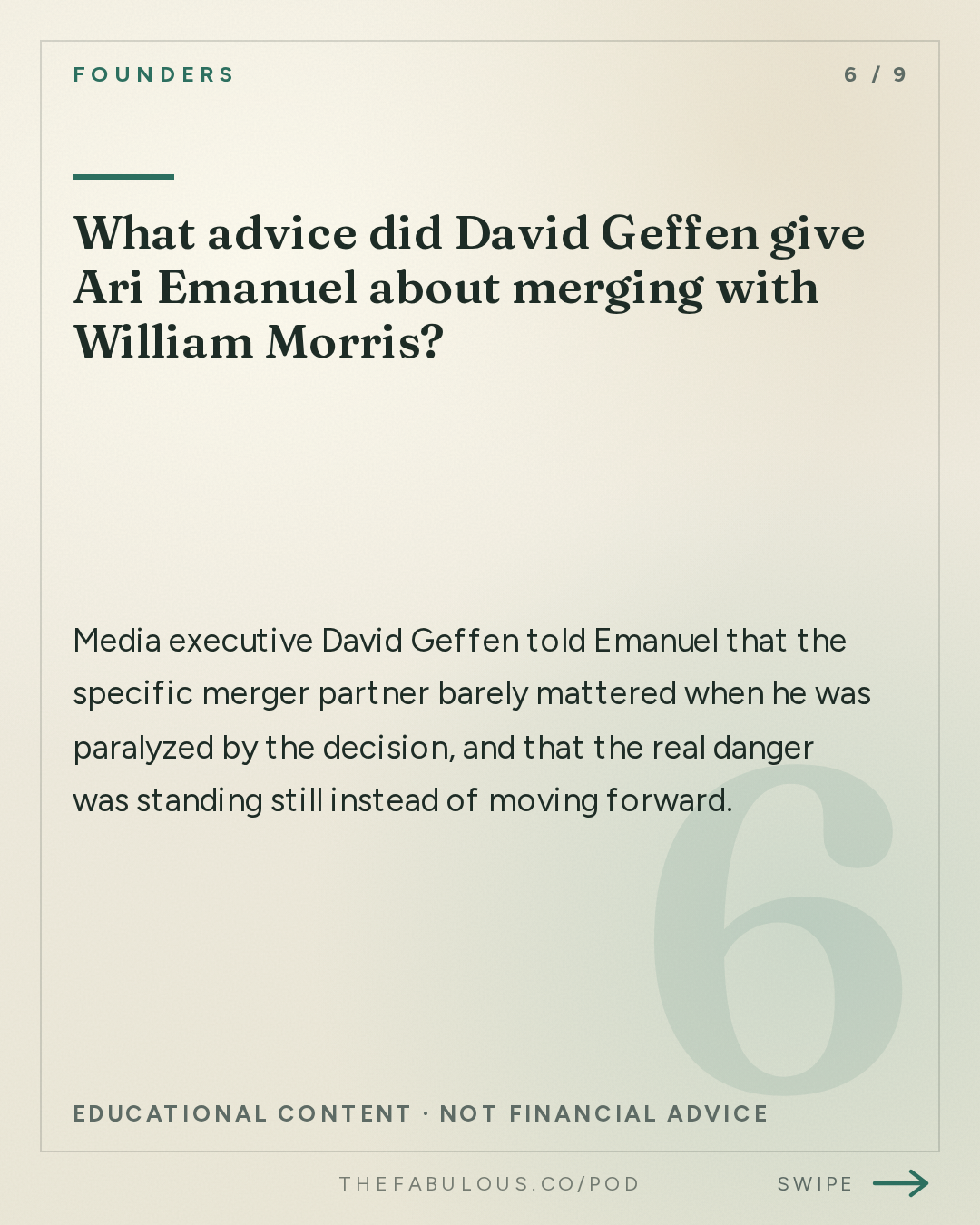
What advice did David Geffen give Ari Emanuel about merging with William Morris?
Media executive David Geffen told Emanuel that the specific merger partner barely mattered when he was paralyzed by the decision, and that the real danger was standing still instead of moving forward (41:57).
What is Endeavor worth today?
Private equity firm Silver Lake valued Endeavor at $13 billion when taking it private in 2024, up from about $350 million roughly twelve years earlier (67:30).
The full read, in cards

Go deeper
- Roll the Calls: A Memoir — Ari Emanuel's autobiography detailing his rise from mailroom assistant to Endeavor's founder
- Who Is Michael Ovitz? — Michael Ovitz's own memoir, referenced for its account of founding CAA and inventing packaging
Mentioned
Ari Emanuel · Roll the Calls: A Memoir · Michael Ovitz · Who Is Michael Ovitz? · CAA · William Morris · Endeavor · Vince McMahon · WWE · Dana White · UFC · David Geffen · Silver Lake · Egon Durbin · Marc Andreessen · IMG · Entourage
More from this show and category
Jeremy Stern's Mark Zuckerberg Profile Explained
Mark Zuckerberg has modeled himself on Augustus Caesar for decades, fighting what journalist Jeremy Stern calls the dictator's dilemma. Stern's profile shows how Zuckerberg counters corporate isolation with raw data and MMA training, building a $1.6 trillion empire of 3.6 billion users while insisting he will never stop.
Sam Walton's Core Business Strategies
Sam Walton built Walmart on four simple habits: cost control, copying competitors, small-town focus, and constant willingness to change course. He lost his first store over a missing lease clause, learned to fly a plane to scale faster, and copied ideas from JC Penney and Sol Price on his way to becoming America's richest man.
How Michael Bloomberg Built His Business Empire
Michael Bloomberg was fired from Salomon Brothers in 1981 with a $10 million severance, and he used it to build the Bloomberg Terminal into a data and media empire. Drawing on his memoir, Bloomberg by Bloomberg, the episode traces his sales training, his refusal to plan more than a few steps ahead, and his rule that business fights should never be fair.
What The Mind of Napoleon Teaches Founders
Napoleon Bonaparte's private writings, collected in the 1955 book The Mind of Napoleon, reveal a leader who planned obsessively then acted without hesitation. Drawing on the book's maxims, the episode extracts his rules for decision-making, propaganda, and building projects in useful stages, arguing they still work for founders today.
