
Chung Ju-yung: Born of This Land Summary
#440 The Most Inspiring Autobiography I've Ever Read: Born of This Land: Chung Ju-yung
The brief
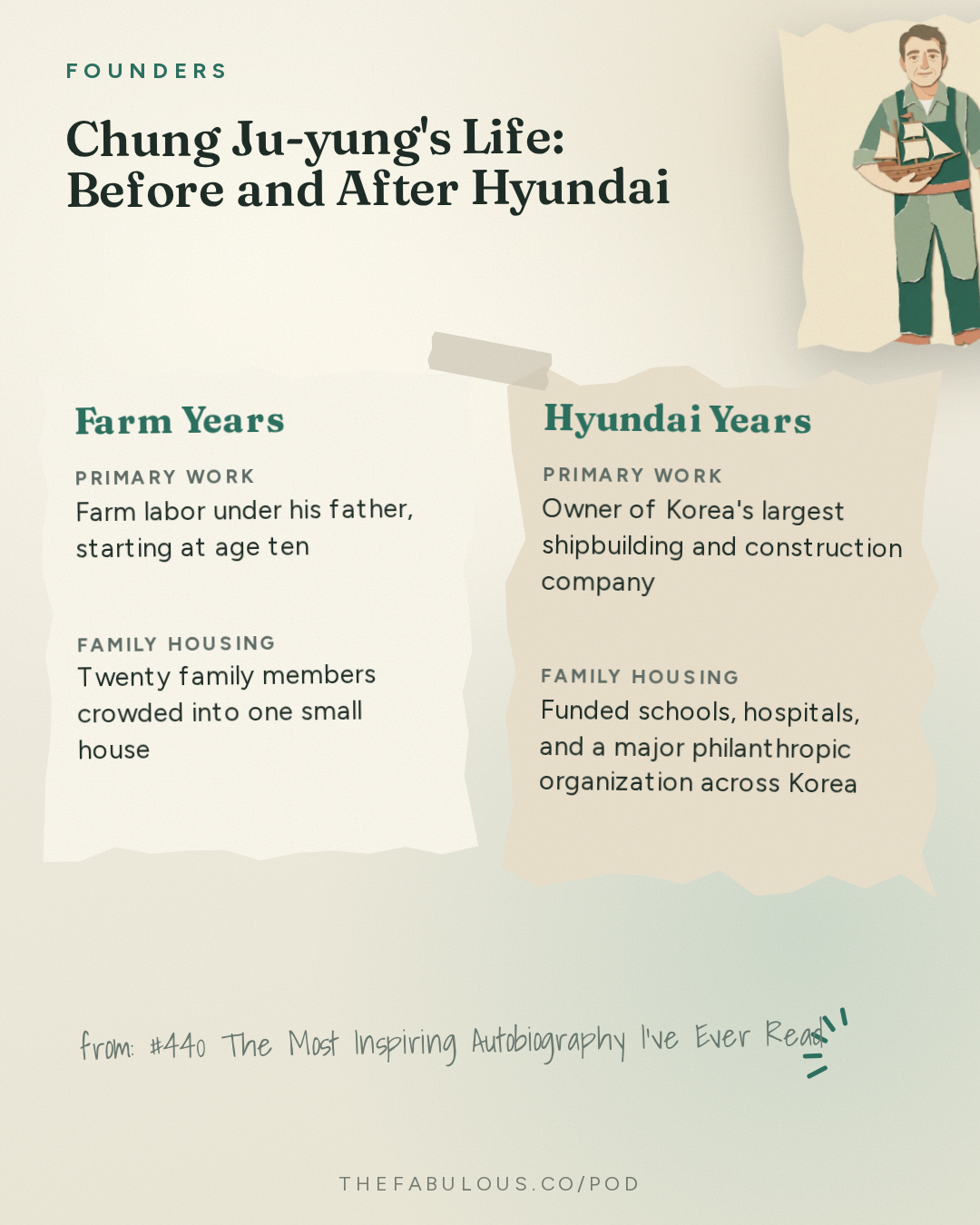
Chung Ju-yung, the founder of Hyundai, rose from Korean farm poverty to become his country's wealthiest man through relentless work and unconventional financing. He ran away from home four times, built a rice shop into an empire, and sold ships from a shipyard that did not yet exist, using the purchase order as collateral for the loan to build it (38:20).
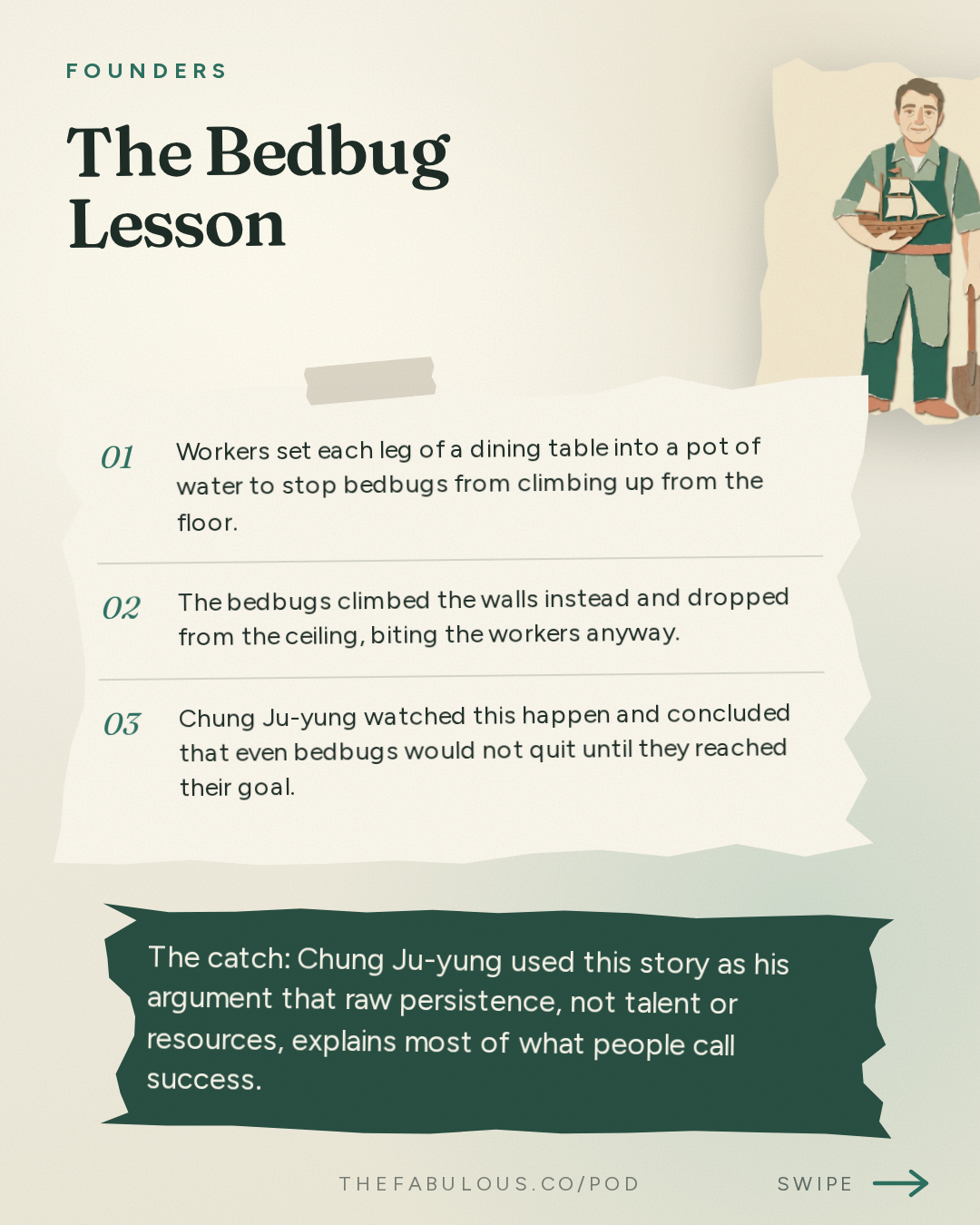
In a bunkhouse crawling with bedbugs, a group of Korean laborers once tried a simple fix. They set each leg of their dining table into a pot of water, so nothing could climb up from the floor. It worked, for a night or two. Then the bites started again. When the men finally stayed up to watch, they found the bedbugs climbing the walls and dropping from the ceiling onto their bodies (22:10). One of those laborers was nineteen years old, sleeping far from the family farm he had run away from. He never forgot what he saw.
"Even bedbugs think long and hard and use every bit of energy they have to achieve their goal, and ultimately they succeed. I'm no bedbug. I'm a man." — Chung Ju-yung [23:13]
That laborer was Chung Ju-yung, who went on to found Hyundai and died, decades later, as the richest man in Korea (02:33). His autobiography, Born of This Land, is the subject of this episode, and the host calls it the most inspiring autobiography he has read (02:13). The book earns that praise less for tidy business lessons than for the plain, repeated fact of a man who kept working past the point where almost anyone else would have stopped.
For years Chung was known in Korea as "the bulldozer," a nickname meant as an insult. It painted him as an uneducated man who dug first and thought later (00:00). He rejected that reading of his own life. Before any big move, he said, he spent enormous time thinking, analyzing, and planning every detail. The speed came after the planning, not instead of it.
"If I hadn't first sat down and planned everything out, the Hyundai Group of today could never have existed." — Chung Ju-yung [00:26]
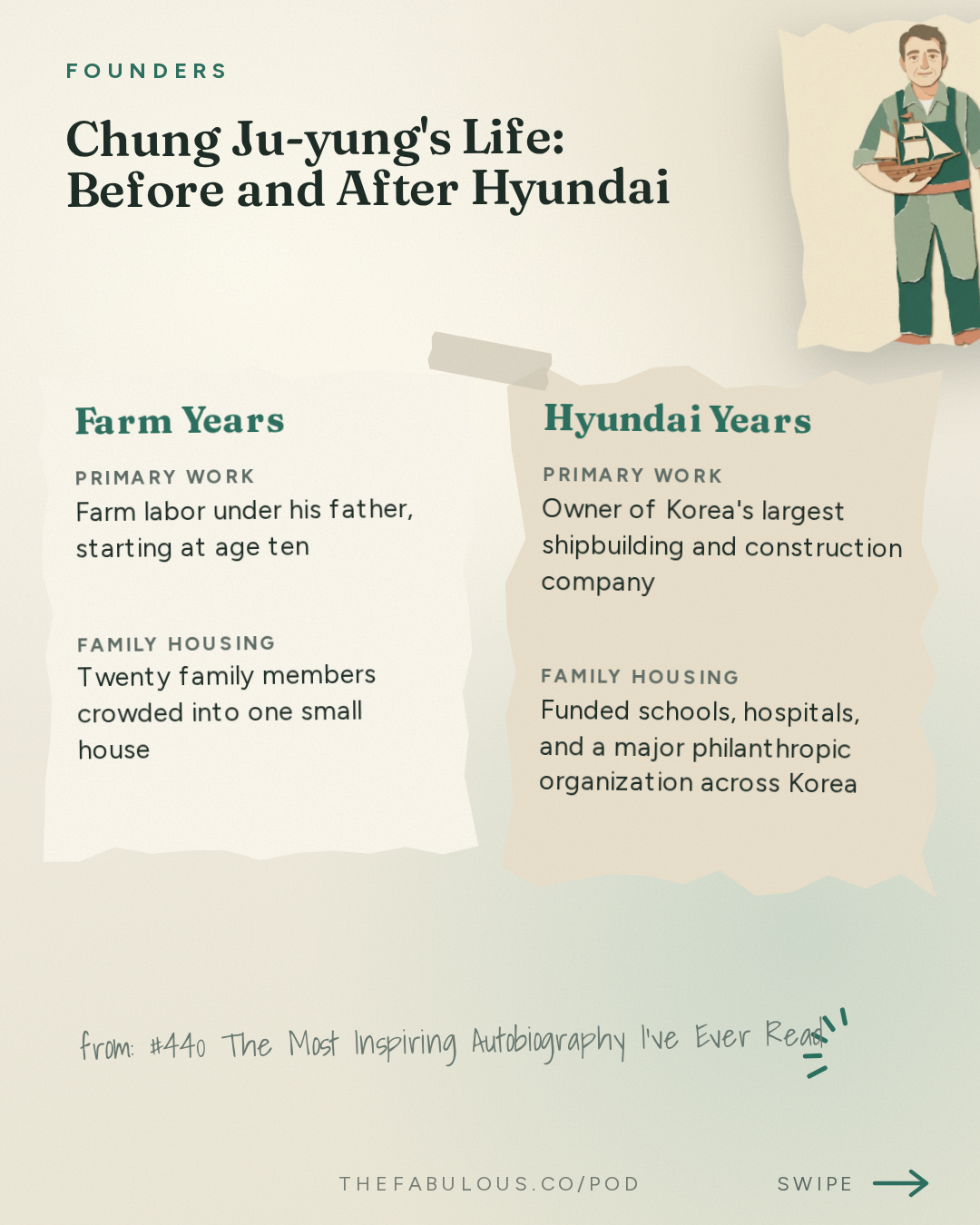
The planning had to compensate for everything else he lacked. Chung's only formal schooling was three years of traditional Confucian study at a village school and three years of elementary education, ending around sixth grade (04:42, 05:02). His father's entire net worth, as Chung described it, was a healthy body and a diligent character. The family was so poor that after hard winters they survived on tree bark (14:45). Even bathroom habits were dictated by poverty: human waste was the household's main source of fertilizer, so everyone had to save it (14:20).
Chung ran away from that farm four times. The third attempt ended with his father finding him at a bookkeeping school in Seoul and begging him, in tears, to abandon "this stupid dream" and come home to support the family (11:41). Chung went back, and then, at nineteen, left a fourth and final time (15:55). He took any job he could get: hauling stone, working as an errand boy, laboring on another farm just to avoid starving. Eventually a rice shop hired him as a delivery boy, and he was thrilled, mainly because the job came with one free bag of rice a month (17:03).
What happened next is the clearest early picture of how Chung worked. He showed up first every morning, swept the entrance, and poured everything into a job that was, by his own account, nothing compared to farm labor. "Half measures, compromises, cutting corners, or being realistic do not exist in my world," he wrote (18:07). Three years in, his annual pay had risen to twenty bags of rice, enough to impress the father who had once called him a nobody (17:49). Two years after that, the shop's owner offered to sell Chung the business outright. At twenty-four, the delivery boy was the owner (18:52).
The rice shop did not last. Japan's wartime government requisitioned it, along with every other rice shop in Korea, just two years after Chung took over (19:18). He pivoted to an auto repair garage with two friends, which then burned to the ground. He borrowed money from a private lender to start over, running the new shop without a license because licenses were reserved for manufacturers, which meant he spent each morning pleading with a local police chief not to shut him down (20:36, 21:14). The business survived. Then the Japanese government absorbed that one too, in a forced merger that was a takeover in all but name (23:57). Chung was twenty-nine and, for the only time in his life, unemployed.
He rebuilt again after the war, this time moving into construction almost by accident. Delivering a bid one day, he watched a construction company collect a contract payment far larger than anything his repair shop earned. He was pulling in roughly three hundred to four hundred thousand won per contract; the construction firm was making up to ten million won on a single job (26:14). The math, not any grand vision, is what pulled him into an industry he knew only from working as a laborer on building sites.
"Success is ninety percent determination, ten percent confidence. I reminded myself of this every time I start a new project." — Chung Ju-yung [27:09]
Financing the Impossible
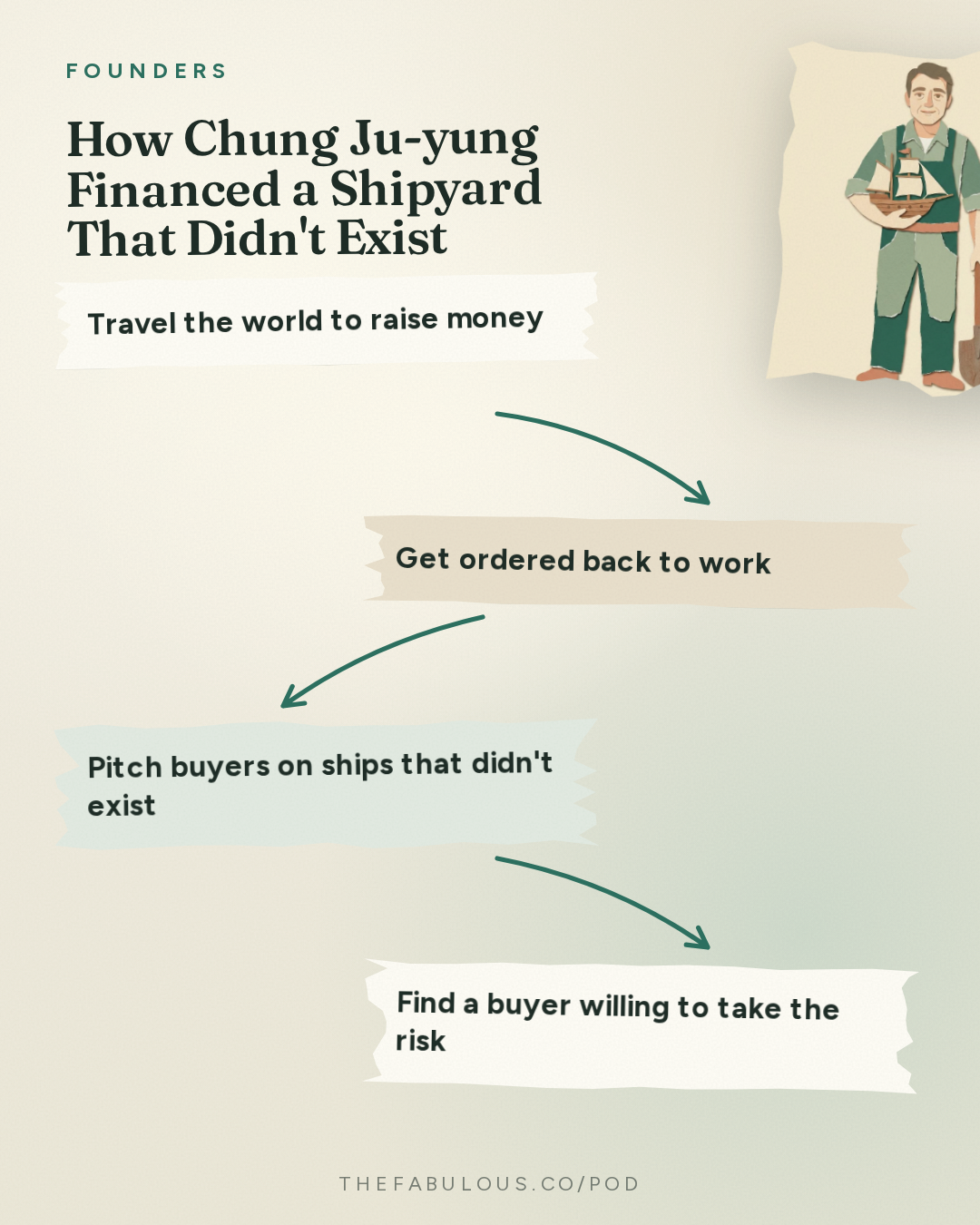
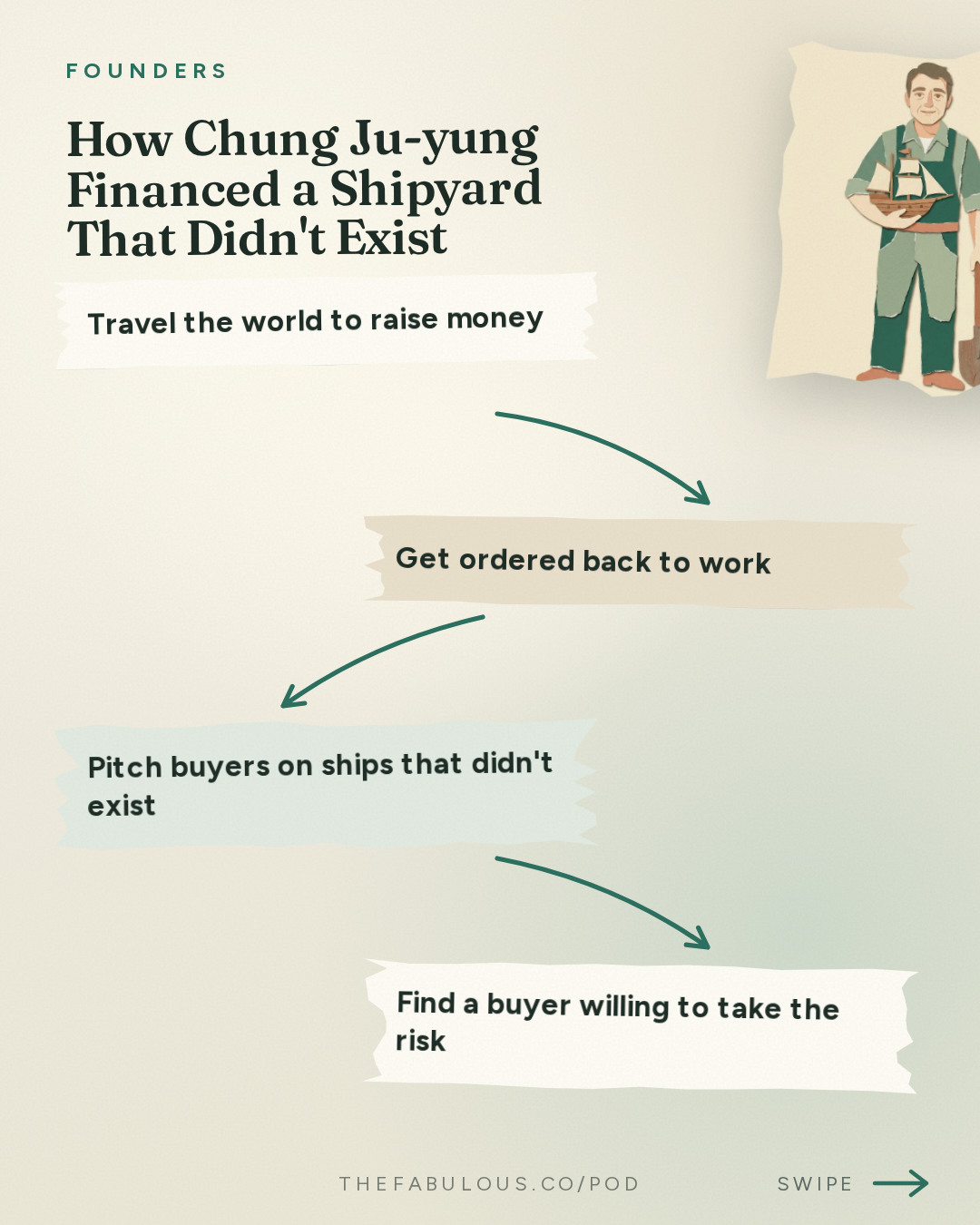
That formula was tested hardest by Hyundai's shipyard, which is the most improbable chapter in the book. In the early 1960s, Chung decided Korea needed its own shipbuilding industry, despite never having built a ship (34:19). He traveled the world looking for financing and was turned away everywhere; Japanese and American lenders mocked Korea's lack of shipbuilding technology (35:49). Chung told South Korean president Park Chung-hee he was giving up. The president refused to accept it, ordering him back onto a plane to try again (36:09).
With no shipyard and no loan, Chung tried a different move: he went looking for buyers willing to purchase ships from a shipyard that did not exist yet. "If you agree to purchase our ships, I'll go get a loan, build a shipyard, and get you your ship," he told them (37:45). Most people thought he was insane. Eventually he found a Greek shipping magnate named Livanos, the brother-in-law of the shipping tycoon Aristotle Onassis, willing to buy two ships at a steep discount (38:20). Chung used the signed purchase order and its 1.4 billion won down payment as the collateral needed to secure a bank loan, then used that loan to build the shipyard that would eventually produce the ships. It is close to the financing trick the American shipping magnate Daniel Ludwig used decades earlier, when he convinced Standard Oil to sign a long hauling contract, then took that contract to a bank as collateral to buy his first tanker (38:58). Chung had never built a ship. He had built a loan out of a promise, which is a different kind of engineering.
The man running that operation had firm ideas about how power should look inside a company. He refused a proposal to install a separate elevator for executives, calling the idea an expression of "the inflated sense of superiority held by executives who expect different treatment from their workers" (43:02). When he saw workers laying new carpet for his visit to a construction site, he asked them to stop, pointing out that the company's own motto hung on the wall: diligence, frugality, affection (43:22).
"After luxury comes corruption. I have never seen a country prosper with a leader who enjoys luxury." — Chung Ju-yung [43:41]
Diligence as a Philosophy
The last third of the book drops the business narrative almost entirely and turns into a set of maxims from a man in his eighties looking back. The clearest one concerns time. "Someone once said that time is a form of capital provided equally to everyone," Chung wrote. "I couldn't agree more" (09:26). Wealth, status, and education vary by birth. Hours in a day do not. His argument is that the gap between people is mostly what they do with that evenly distributed capital.
He returns often to the idea that a poor man has to work ten to twenty times harder than a rich man to get anywhere, because he starts with none of the advantages money buys (33:33). He also insists that positive thinking is not a decoration on top of hard work but a precondition for it: a person who sees only obstacles will stop before trying. Near the end of the book he offers a short, almost mechanical theory of a good life: be diligent for a day and you sleep well that night; be diligent for a month and life visibly improves; be diligent for years and the results are undeniable to everyone (44:52).
What makes Born of This Land land harder than most founder memoirs is the ending Chung chose for it. He did not close with the size of Hyundai or his standing as Korea's richest man. He closed by estimating that ninety percent of his life had been full of joy and meaning, including the decades of near-starvation, burned-down shops, and government seizures (06:30). The math of his life was brutal. His account of it, somehow, is not.
Ask this episode anything
Pod's AI answers from the episode itself, with the minute mark so you can hear it yourself.
Or start with one of these
Ask this episode
Pod's AI listens to the whole episode to answer, and points you to the minute it comes from.
The rest of this answer, and any question after it
Answers come from the episode itself, never from a summary of it.
ContinueKey takeaways
- Chung Ju-yung built Hyundai with only six years of formal schooling, relying on reading and direct experience instead
- He ran away from his family's farm four times before leaving for good at age nineteen
- He financed Hyundai's shipyard by selling ships from a yard that did not yet exist, then used the buyer's purchase order as loan collateral
- His personal formula for success was 90 percent determination and only 10 percent confidence
- He refused to buy struggling companies, insisting every Hyundai business be built from scratch like a farm cleared by hand
The episode in cards
By the numbers
- 90% % of success share of success Chung Ju-yung attributed to determination rather than confidence
- 20 bags of rice Chung Ju-yung's annual salary at the rice shop after three years, up from his starting pay
In their words
“If I hadn't first sat down and planned everything out, the Hyundai Group of today could never have existed.”
“"Even bedbugs think long and hard and use every bit of energy they have to achieve their goal, and ultimately they succeed. I'm no bedbug”
“Success is ninety percent determination, ten percent confidence.”
“After luxury comes corruption. I have never seen a country prosper with a leader who enjoys luxury.”
Protocols
-
Shorten the Time
Chung Ju-yung tried to shorten the time needed to finish any task, treating speed as the surest sign of improvement, and he planned every detail in advance so the speed did not look reckless.
Applied to every project he started
-
The Determination Formula
Chung Ju-yung told himself that success is ninety percent determination and only ten percent confidence, and he repeated this formula at the start of each new venture to leave no room for doubt.
At the launch of every new business
-
Finance the Impossible
Chung Ju-yung found a buyer willing to sign a purchase order for ships from a shipyard that did not yet exist, then used that signed order and its down payment as collateral to borrow the money needed to actually build the shipyard.
Used once, to launch Hyundai's shipyard in the 1960s
-
Daily Diligence Compounds
Chung Ju-yung recommended staying diligent every single day, arguing that one diligent day earns a good night's sleep, a diligent month visibly improves life, and diligent years build achievements everyone recognizes.
Daily, sustained over years
Questions this episode answers
Who was Chung Ju-yung?
Chung Ju-yung was the founder of Hyundai, who grew up on a poor Korean farm and died decades later as the wealthiest man in Korea (02:33). His autobiography, Born of This Land, traces that path from farm labor to running one of the world's largest construction and shipbuilding companies (02:13).
How did Chung Ju-yung finance Hyundai's shipyard without money?
Chung Ju-yung found a buyer, Greek shipping magnate Livanos, willing to sign a purchase order for two ships from a shipyard that did not exist yet. He used that signed order and its 1.4 billion won down payment as collateral to secure a bank loan, then used the loan to build the shipyard (38:20).
What is the bedbug story in Born of This Land?
As a young laborer, Chung Ju-yung watched bedbugs defeat a trap his bunkhouse had built, using pots of water under table legs, by climbing the walls and ceiling instead (22:10). He took it as proof that persistence alone can overcome an obstacle, telling himself that if a bedbug would not quit, neither should he (23:13).
What is Chung Ju-yung's 90/10 success formula?
Chung Ju-yung said success is ninety percent determination and only ten percent confidence, and he repeated this formula to himself before starting any new business to rule out doubt (27:09). He treated it as a personal discipline rather than a general business rule.
Did Chung Ju-yung have a formal education?
No. Chung Ju-yung's formal education stopped after three years of traditional Confucian schooling and three years of elementary school, ending around the sixth-grade level (04:42, 05:02). He said he learned the rest through voracious reading and direct experience running businesses.
The full read, in cards
Go deeper
- Born of This Land: My Life Story — Chung Ju-yung's autobiography, written in his eighties, covering his rise from farm poverty to founding Hyundai
- The Invisible Billionaire — biography of shipping magnate Daniel Ludwig, cited as a parallel for financing a ship purchase using a contract as collateral
- Finding the Next Steve Jobs — Nolan Bushnell's book, cited for the line that Steve Jobs had one speed, go, compared to Chung's own relentless pace
Mentioned
Chung Ju-yung · Hyundai · Born of This Land · President Park Chung-hee · Livanos · Daniel Ludwig · Standard Oil · Nolan Bushnell · Steve Jobs · The Invisible Billionaire · Finding the Next Steve Jobs
More from this show and category
Eiichiro Oda's Work Ethic and Daily Schedule
Eiichiro Oda built the best-selling manga in history, One Piece, with over 600 million copies in circulation, by refusing to delegate almost anything. For 15 years he slept three hours a night and drew every moving element himself. His method echoes Steve Jobs and Jeff Bezos: one imagined reader, a fixed ending, total personal control over every detail.
James Garfield: Destiny of the Republic Summary
James Garfield rose from poverty to the presidency through relentless self-education, becoming college president by age 26. He was nominated by his party against his will in 1880 (17:50), then died 79 days after being shot in 1881, killed not by the bullet but by doctors who probed the wound with unsterilized fingers (30:21).
The Tycoons: How Carnegie and Rockefeller Built America
Charles R. Morris's book The Tycoons compares how Carnegie, Rockefeller, Gould, and Morgan each built the post-Civil War American economy. Carnegie cut costs and scaled steel, Rockefeller out-managed rivals in oil, Gould mastered railroad finance, and Morgan tried to impose order, together creating the infrastructure that let consumer brands like Procter & Gamble emerge.
Ari Emanuel's Roll the Calls, Summarized
Ari Emanuel's memoir Roll the Calls traces his rise from a dyslexic mailroom assistant to the billionaire founder of Endeavor. It shows how rage, relentless phone volume, and a 1994 near-fatal car accident drove him to found Endeavor, merge with William Morris, and buy the UFC and WWE before Endeavor was valued at $13 billion.
