
Buying vs Renting Nvidia GPUs for AI Startups
20VC: How to Build Your Own Data Center & Why Every Startup Should Do It | How ElevenLabs Leapfrogged Us: What I Learned | The AI Talent War: How Your Hiring Process Needs to Change with Cliff Weitzman, Speechify
The brief
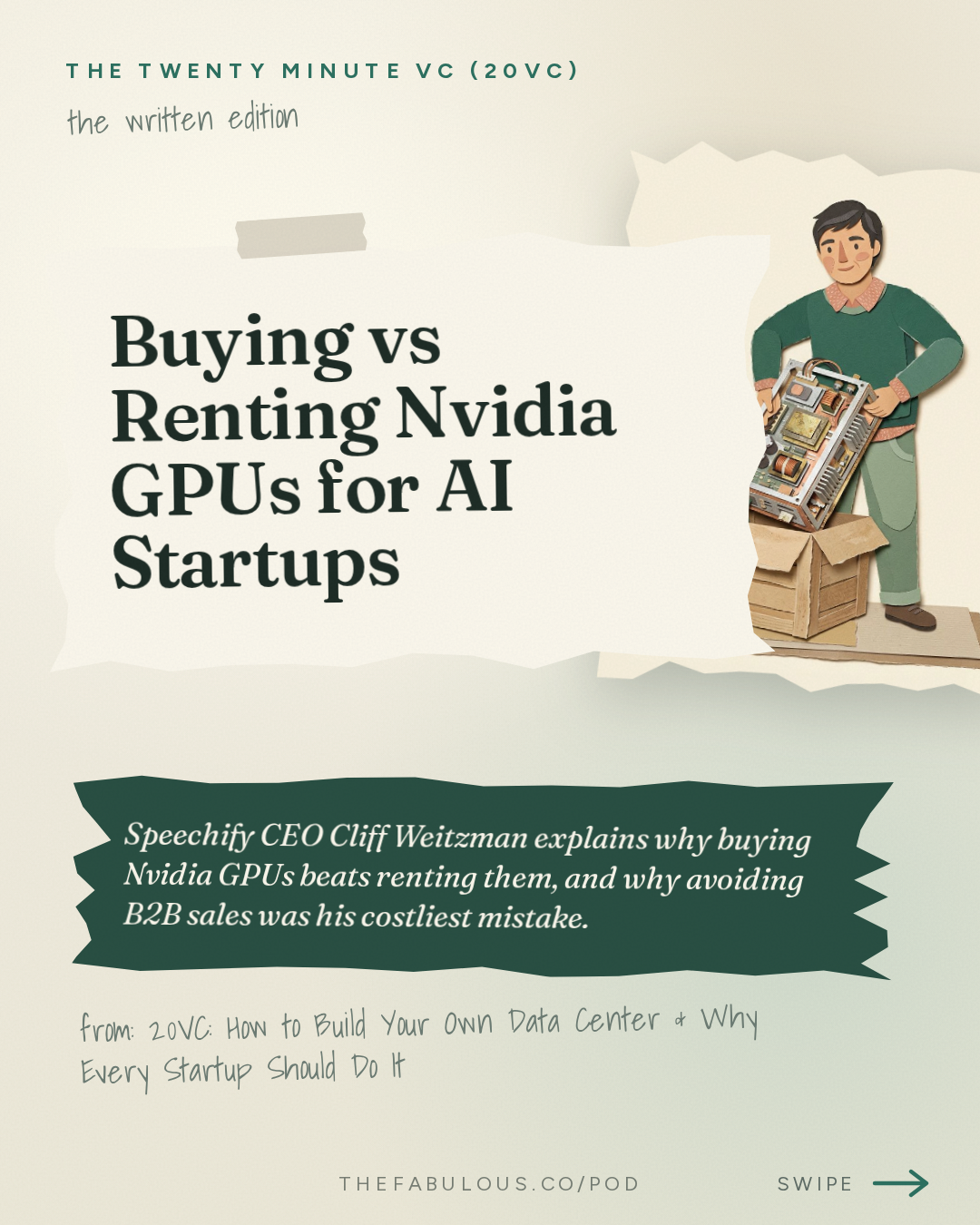
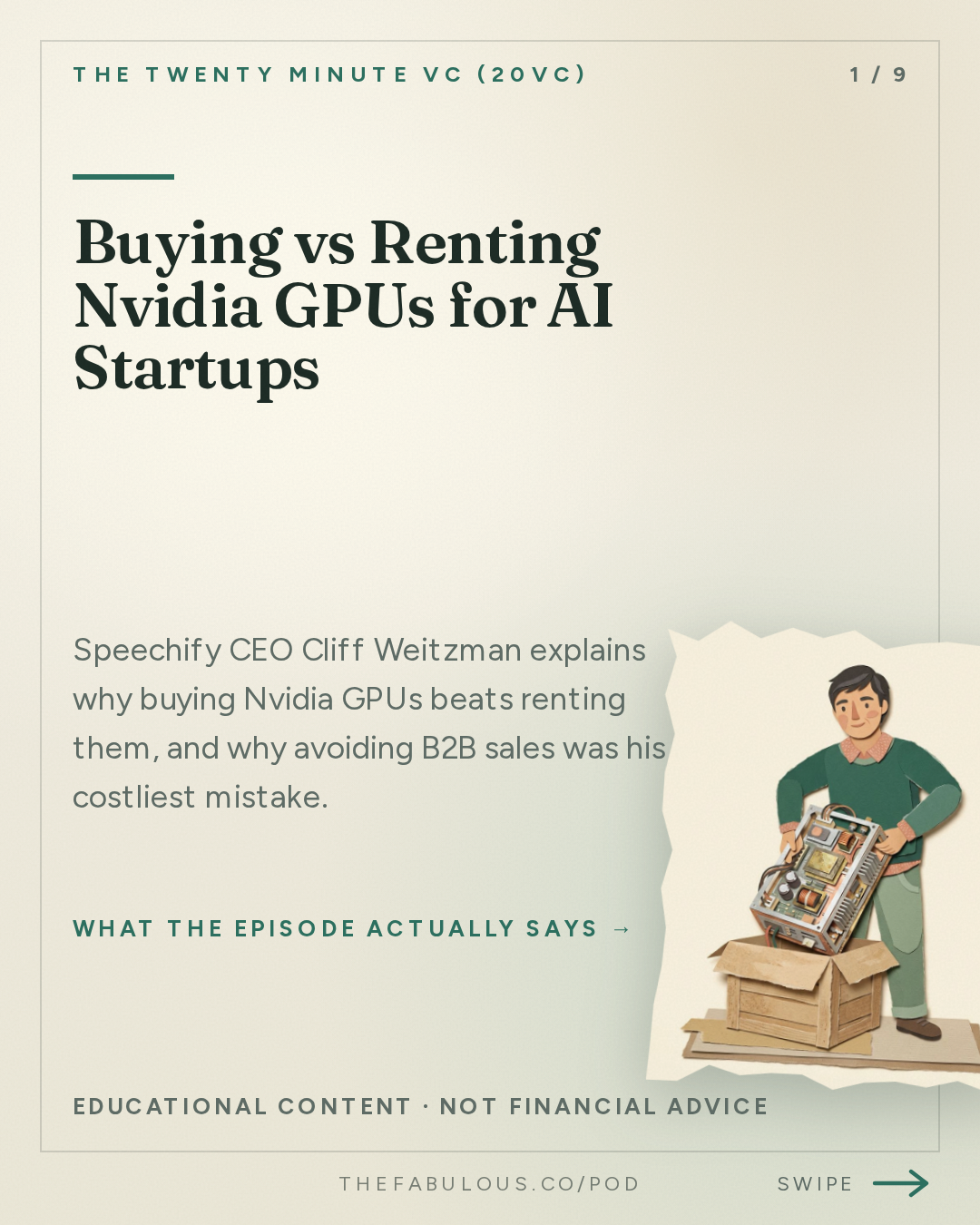
Speechify CEO Cliff Weitzman explains why buying Nvidia GPUs beats renting them, and why avoiding B2B sales was his costliest mistake. He also details hiring CTOs as engineers, $15 million pay packages for elite AI researchers, and treating software engineers as quality testers for AI-generated code.
Cliff Weitzman, founder and CEO of the text-to-speech company Speechify, pays Nvidia's hardware partners an extra $100,000 per month to get the chips four months earlier than everyone else (03:46). A GPU, short for graphics processing unit, is the chip that trains and runs AI models. Paying a premium to jump the line sounds like the kind of decision a company makes when it has more money than sense. Weitzman's explanation is a basketball analogy about ownership and access.
"Well, that sucks. You want one that you can go to whenever you want to. In fact, you want a hoop in your house." - Cliff Weitzman [04:27]
The point is about friction. Speechify used to rent GPUs, and Weitzman noticed his engineers rationing their own experiments because every hour on a rented chip showed up as a cost the company would notice. Renting turns compute into something an engineer has to justify. Owning turns it into something an engineer just uses.
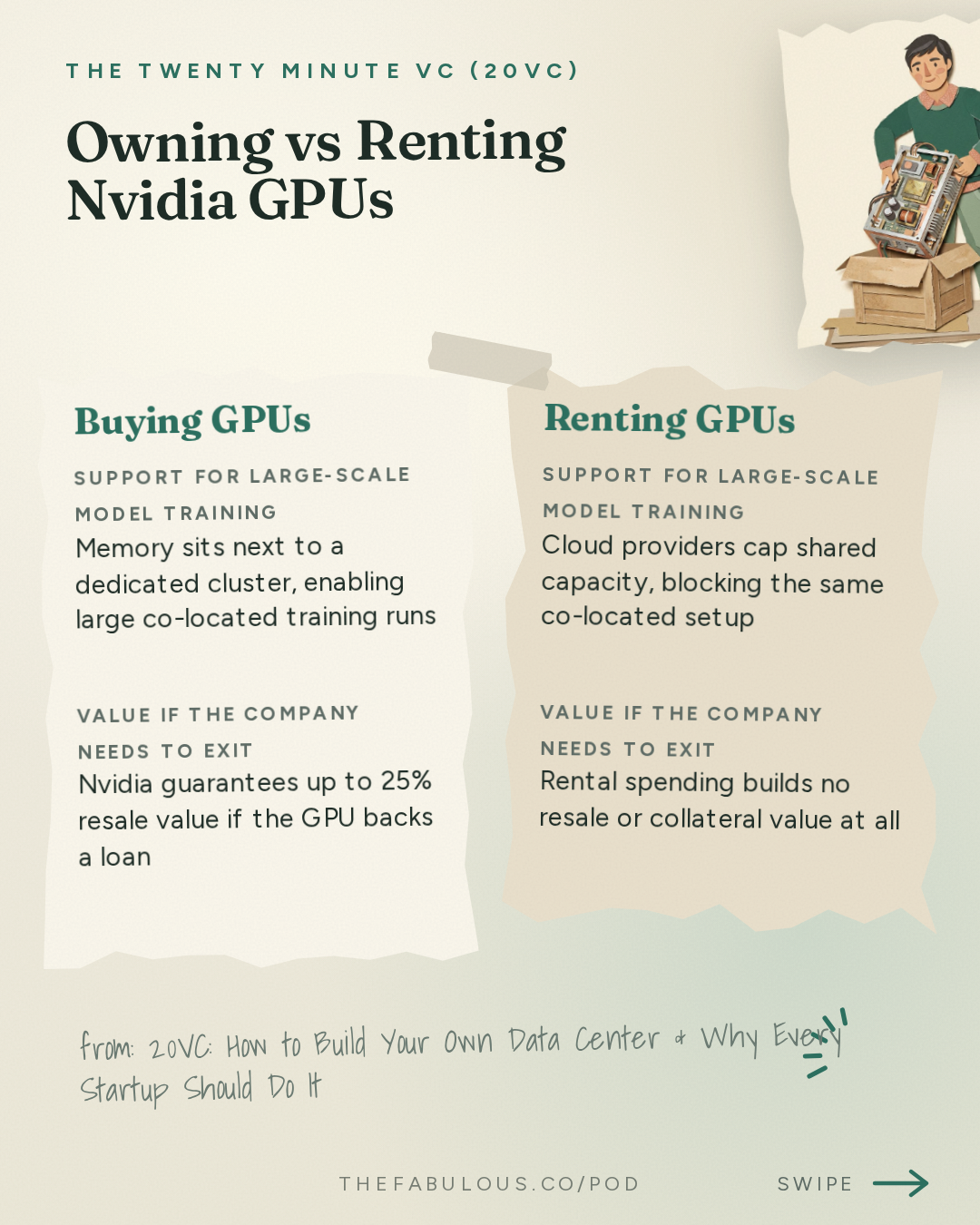
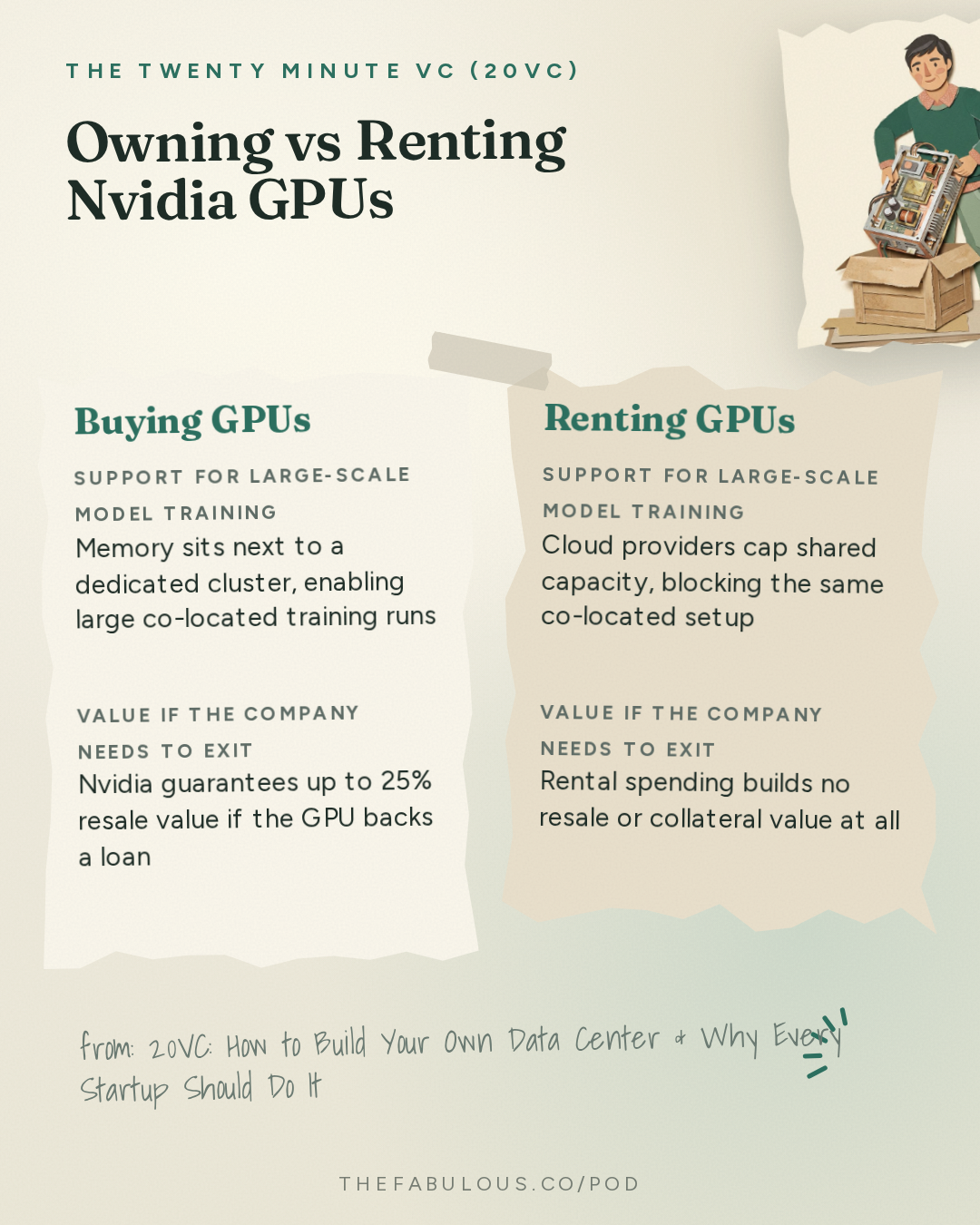
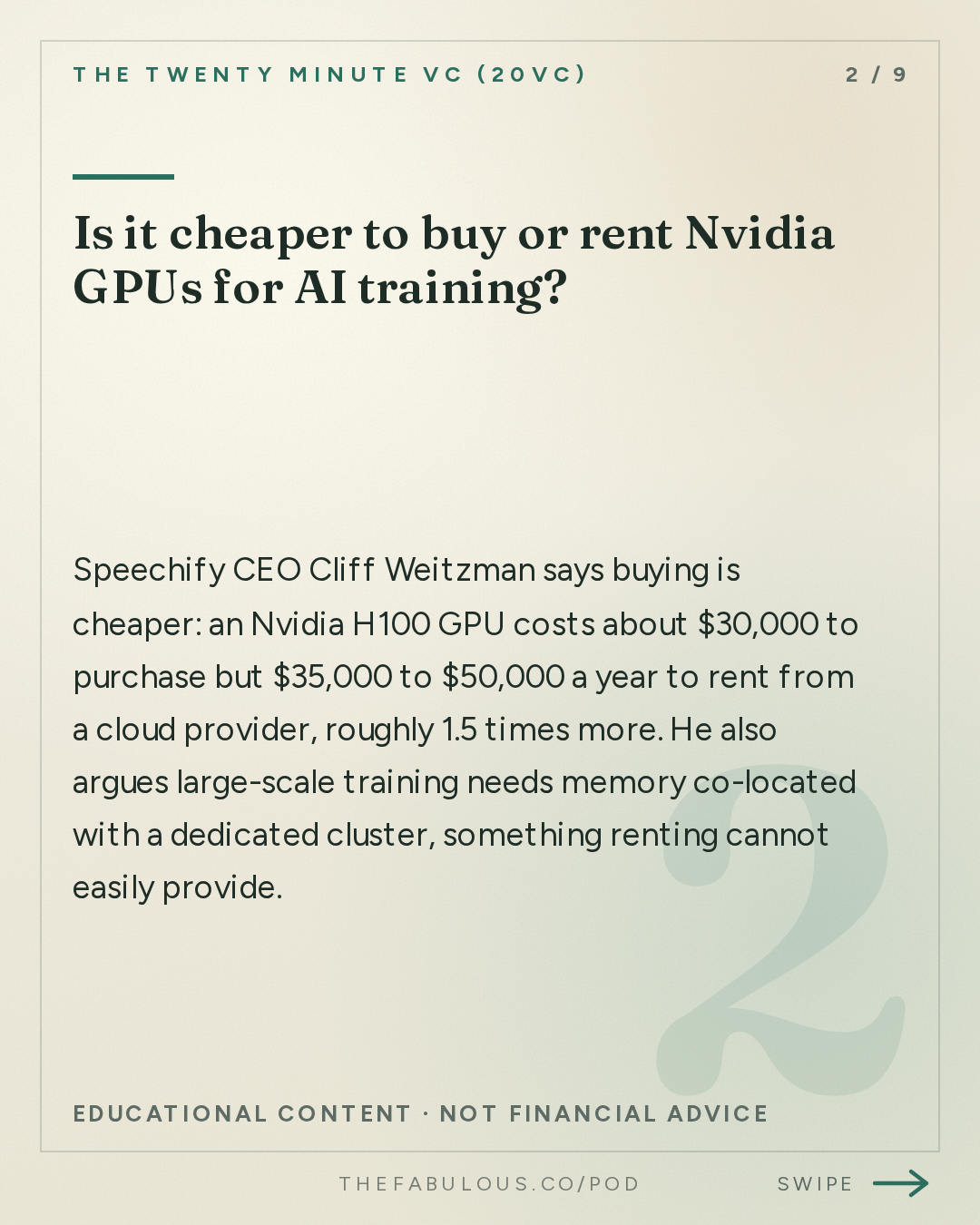
The math behind that decision is more concrete than the metaphor suggests. An Nvidia H100 GPU costs about $30,000 to buy outright. Renting the same chip from a major cloud provider, at roughly $3.50 to $5 an hour, adds up to $35,000 to $50,000 over a year, which works out to about 1.5 times the purchase price (06:07). The hardware carries a three-year warranty, but Weitzman expects it to keep running well past that, since a GPU sitting in a climate-controlled data center takes none of the wear a car engine takes on the road (12:39). Large-scale model training adds a second reason to own rather than rent: training needs a big memory pool sitting right next to a large cluster of chips, and cloud providers will not build that configuration for a single tenant the way an owned cluster can (06:32).
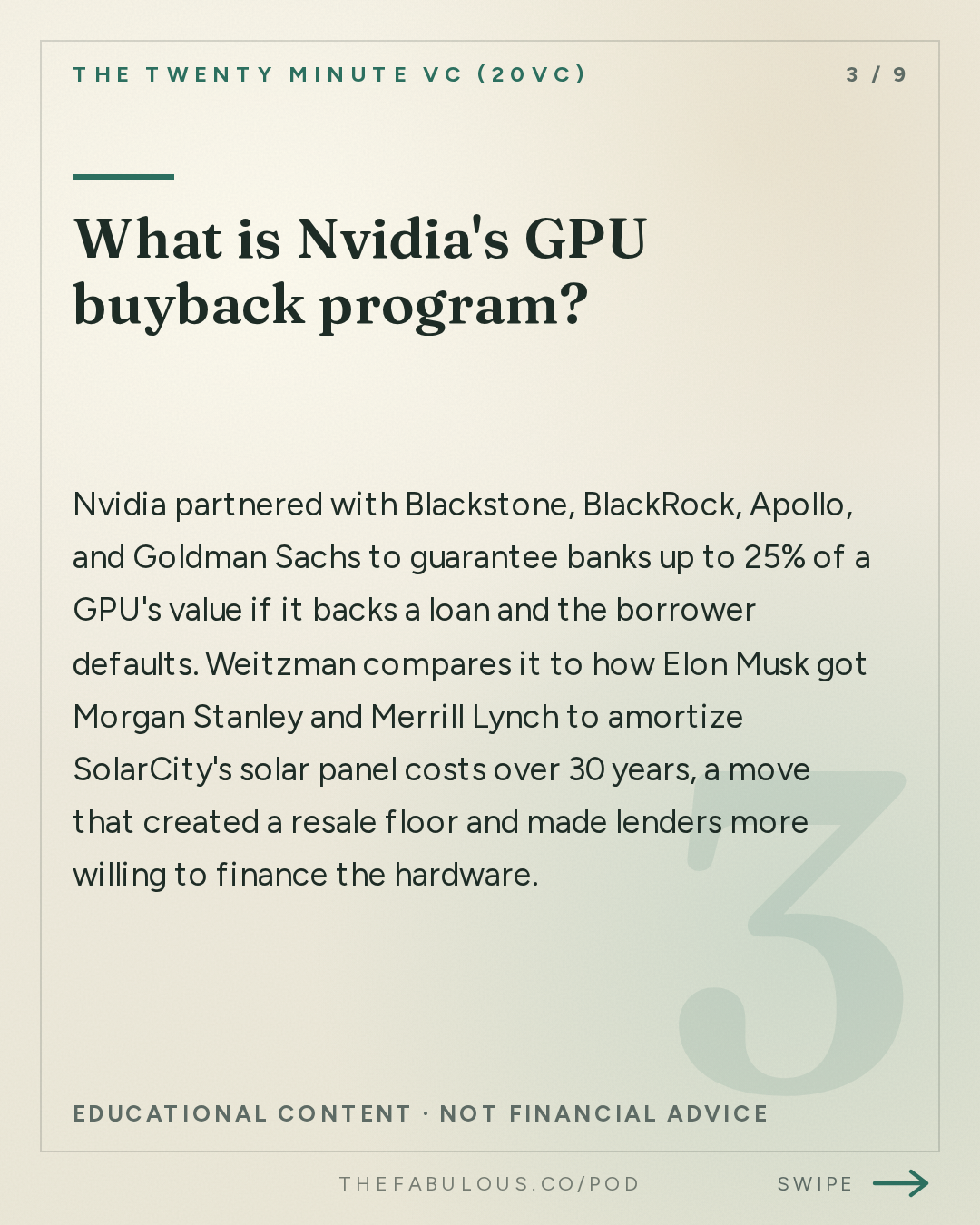
Nvidia has also been busy turning GPUs into something closer to a financial asset than a depreciating expense. Weitzman describes a deal, done this year with Blackstone, BlackRock, Apollo, and Goldman Sachs, in which Nvidia agrees to underwrite up to 25% of a GPU's value if a bank lends money against that chip as collateral and the borrower defaults (13:38). That guarantee gives banks a reason to lend against hardware at better rates, which is the same trick Elon Musk used at SolarCity, where he got Morgan Stanley and Merrill Lynch to amortize solar panel costs over 30 years by treating the panel itself as loan collateral (14:05). The effect, in both cases, is a price floor. If a GPU has a guaranteed resale value, it behaves less like a wasting asset and more like a bond.
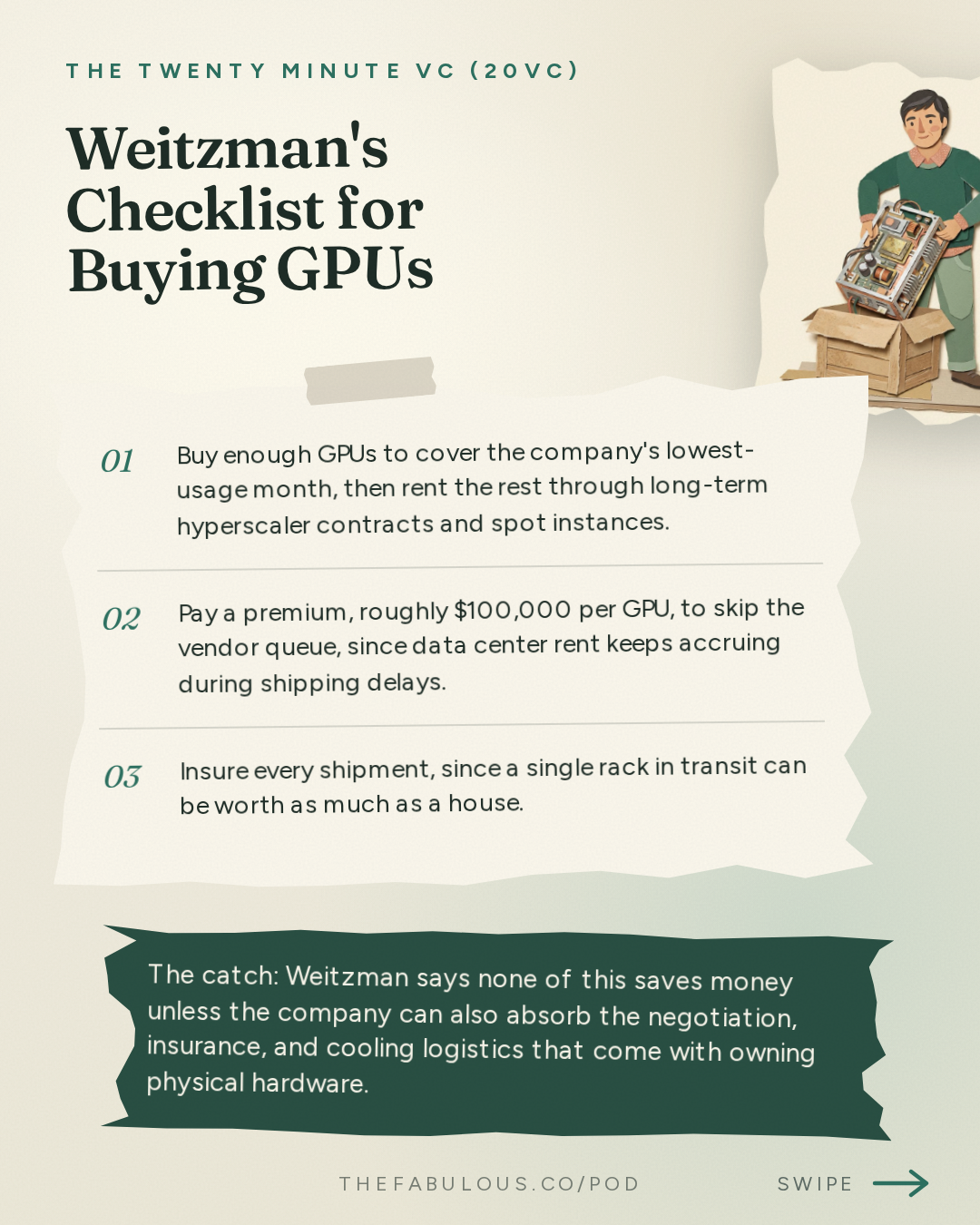
None of this is free of headaches, and Weitzman is candid about the logistics that come with owning physical hardware. Racks get delayed in transit, and delay is the most expensive part of the whole process, because a company keeps paying data center rent whether or not the chips have arrived (16:50). Weitzman describes calling a vendor in France to renegotiate a late shipment, and paying extra to skip the delivery queue entirely once a better offer came along (16:36). A truck carrying an unreleased Nvidia rack can be worth as much as a house, which means it needs its own insurance policy (17:09). And the newest chips, like Nvidia's Rubin line, are liquid-cooled, which most data centers are not set up to handle, so Weitzman's team had to source and install a separate cooling unit before the racks could even be turned on (18:06).
The Mistake That Let a Rival Win
The hardware conversation sets up a more personal one. Weitzman met the founders of ElevenLabs, a rival AI voice company, in 2022, and decided against building an API business because he expected text-to-speech APIs to become commoditized, cheap and interchangeable, over time (24:34). ElevenLabs made the opposite bet, and it paid off: an API became their wedge product, which led to voice agents, which led to partnerships with Western governments (25:29). Weitzman now calls the decision the worst one he has made as a founder.
"It was the biggest strategic mistake I made in the history of Speechify." - Cliff Weitzman [24:17]
What he missed, in his own telling, is that the first product an AI lab ships is rarely the business. It is the entry point that earns the right to sell everything that comes after it (24:50). Speechify still dominates its original market. It holds 98% of installs in consumer text-to-speech apps and has served more than 770 billion words to users (27:45). But dominance in one lane did not stop a competitor from building an entirely new lane next to it. Speechify has since launched its own API, called Simba 3.2, priced at $10 per million characters, compared with $100 from ElevenLabs and $196 from OpenAI's benchmark model (23:58). Weitzman frames the decision to enter B2B late as a cost of staying out of a race rather than a cost of losing one.
"The best way to lose is not to be in the race. Be in the race." - Cliff Weitzman [28:55]
Hiring in the Age of Agents
The same competitive pressure shows up in hiring. Weitzman says compensation for elite researchers at frontier labs like OpenAI and Anthropic now starts around $15 million a year, a number that Harry Stebbings suggested only a small number of heavily funded seed companies, some raising $150 million to $300 million rounds, could realistically match, though Weitzman was skeptical that such rounds should even be called seed rounds (33:21). For most seed-stage founders, he argues, that competition barely matters, because the pool of people worth hiring has actually gotten larger. A founder no longer needs someone who has memorized a decade of software engineering textbooks. Raw technical aptitude and a willingness to learn fast now matter more, since AI tools can close the skills gap in months (33:45). Weitzman says 18 of Speechify's first 21 employees had already been a CEO, CTO, or VP of engineering somewhere else, and that Anthropic itself now recruits more CTOs than CEOs, because CTOs are the ones who get most excited about a product built for engineers (32:40).
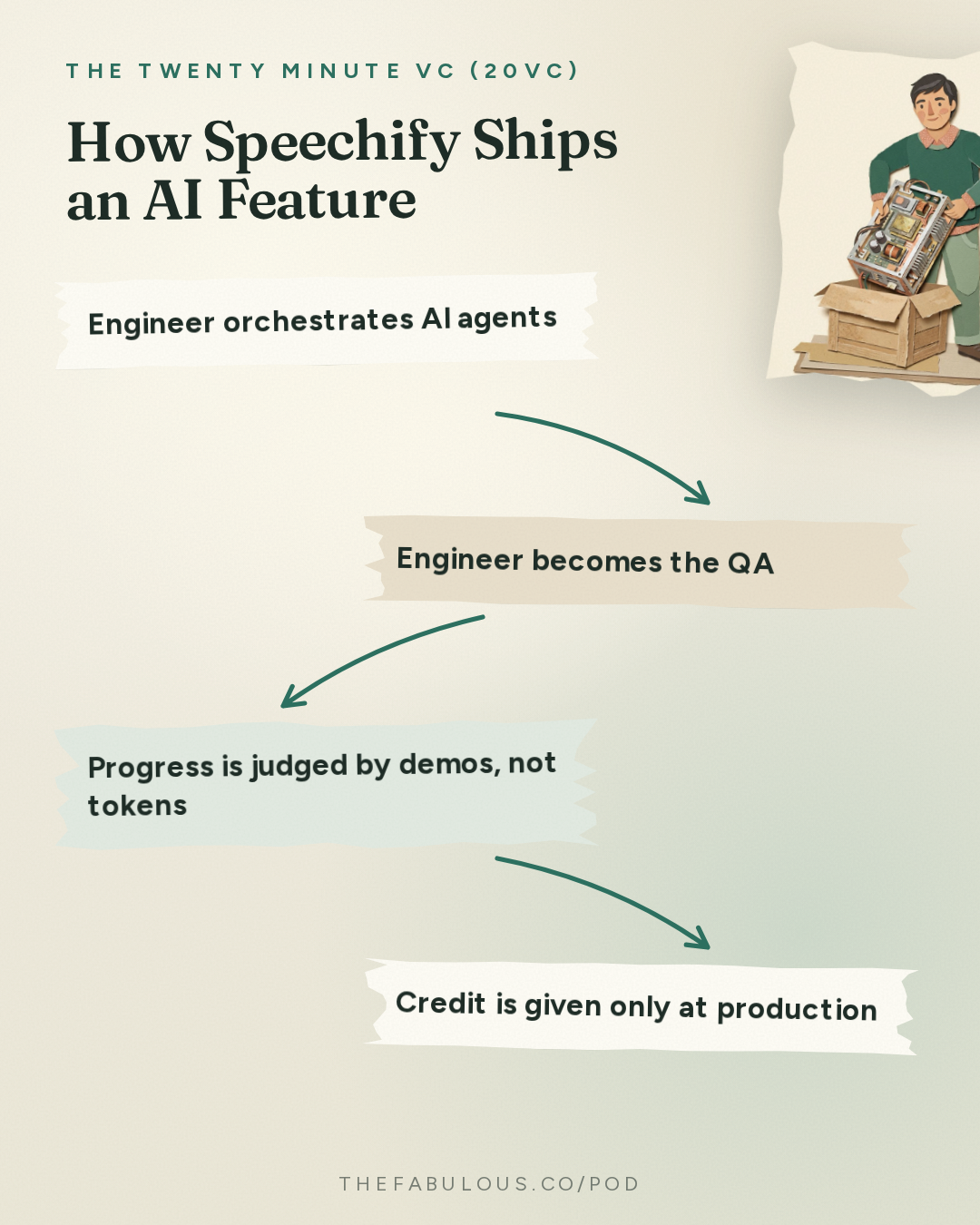
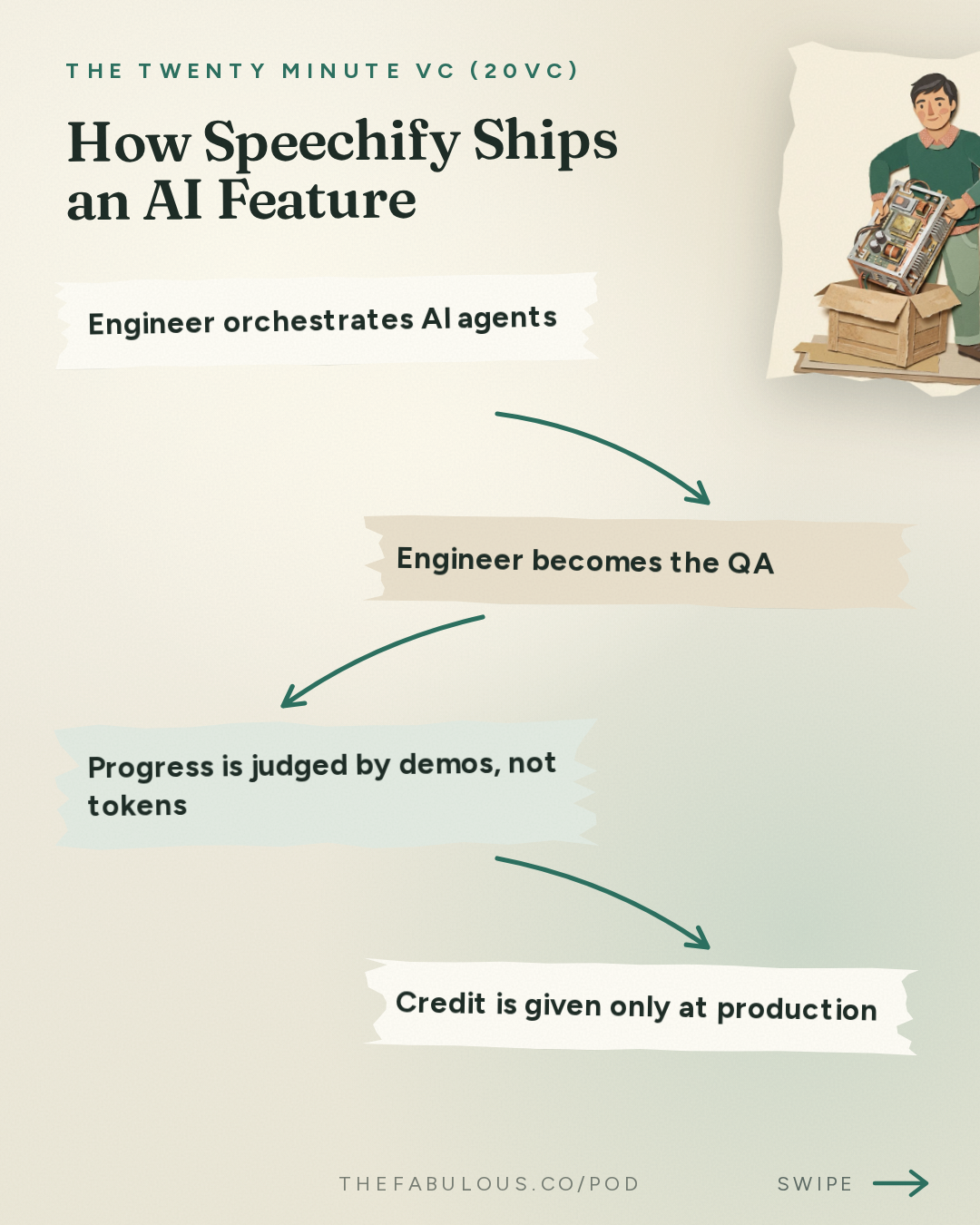
What has changed inside Speechify's own engineering team is the definition of the job itself. Coding tools like Claude Code and Cursor now write the feature. The engineer's job is to catch what is wrong with it.
"And then really a good engineer today is just an exceptional QA. The AI will make the feature. You will test the feature, see if it's good." - Cliff Weitzman [38:59]
QA here means quality assurance, the discipline of testing a feature for bugs and edge cases before it reaches a user. Weitzman says his AI research team runs five to 18 agents at once on long-running coding tasks, and a good engineer's real job has become making about ten sound product and architecture decisions a day rather than typing code line by line (20:12). Progress is not judged by how many tokens a team burns or how a leaderboard ranks them. It is judged by whether a feature actually reaches production with no bugs and real users touch it. Weitzman compares a feature that almost ships to a football carried to the goal line but never crossed over: no credit (40:15).
The clearest illustration of what this workflow makes possible is not about a company at all. Weitzman has a family member with a rare autoimmune neural inflammation disorder. Over 15 weeks, he collected blood samples, sequenced the genome, ran proteomics and RNA analysis, and compared the results against daily self-reported mood and quality-of-life data, then ran all of it through a GPU cluster looking for patterns no doctor had found (58:52). He describes using the same approach, with a GPU cluster, to help locate a cancer lesion in his father's body that doctors had missed (61:11). Weitzman was a child who could not learn to read until his father read him Harry Potter aloud, and later built his own version of a text-to-speech tool just to get through college. The line he draws from that childhood to a GPU cluster searching for a cure is the clearest argument in the whole conversation for why he thinks owning compute is not a luxury.
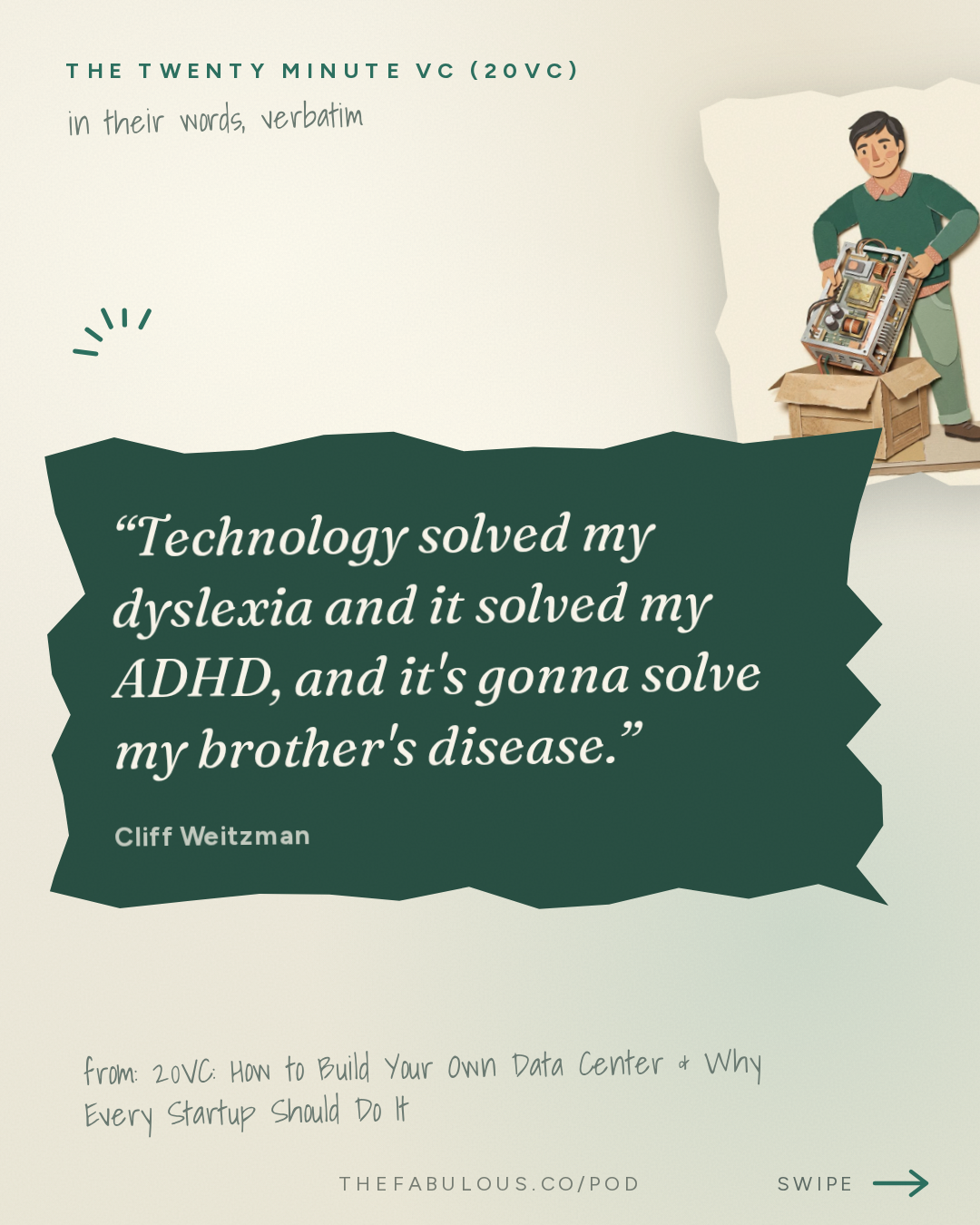
"Technology solved my dyslexia and it solved my ADHD, and it's gonna solve my brother's disease." - Cliff Weitzman [61:11]
Weitzman closes with a prediction that ties the hardware argument back to product design: within a few years, he expects most human-computer interaction to move from screens to voice, the same way ChatGPT's plain chat box beat GPT-3's raw interface by removing friction (54:11). Whether or not that timeline holds, the throughline of the conversation is consistent. Every advantage Weitzman describes, cheaper compute, a faster hiring pool, a workflow built around shipped features rather than clever demos, comes down to removing the friction between having an idea and testing it. Owning the hoop, in other words, is not really about the hoop.
Ask this episode anything
Pod's AI answers from the episode itself, with the minute mark so you can hear it yourself.
Or start with one of these
Ask this episode
Pod's AI listens to the whole episode to answer, and points you to the minute it comes from.
The rest of this answer, and any question after it
Answers come from the episode itself, never from a summary of it.
ContinueKey takeaways
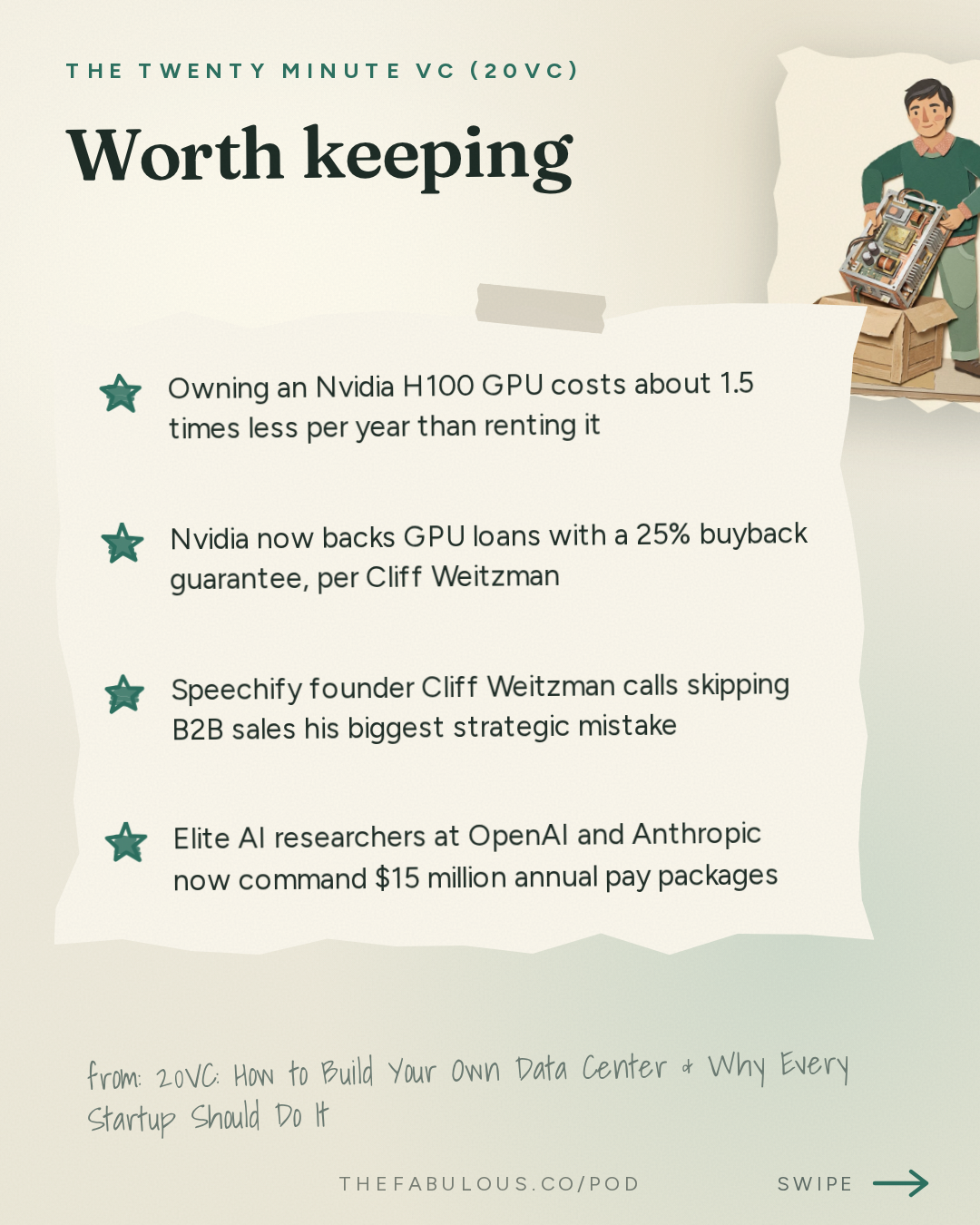
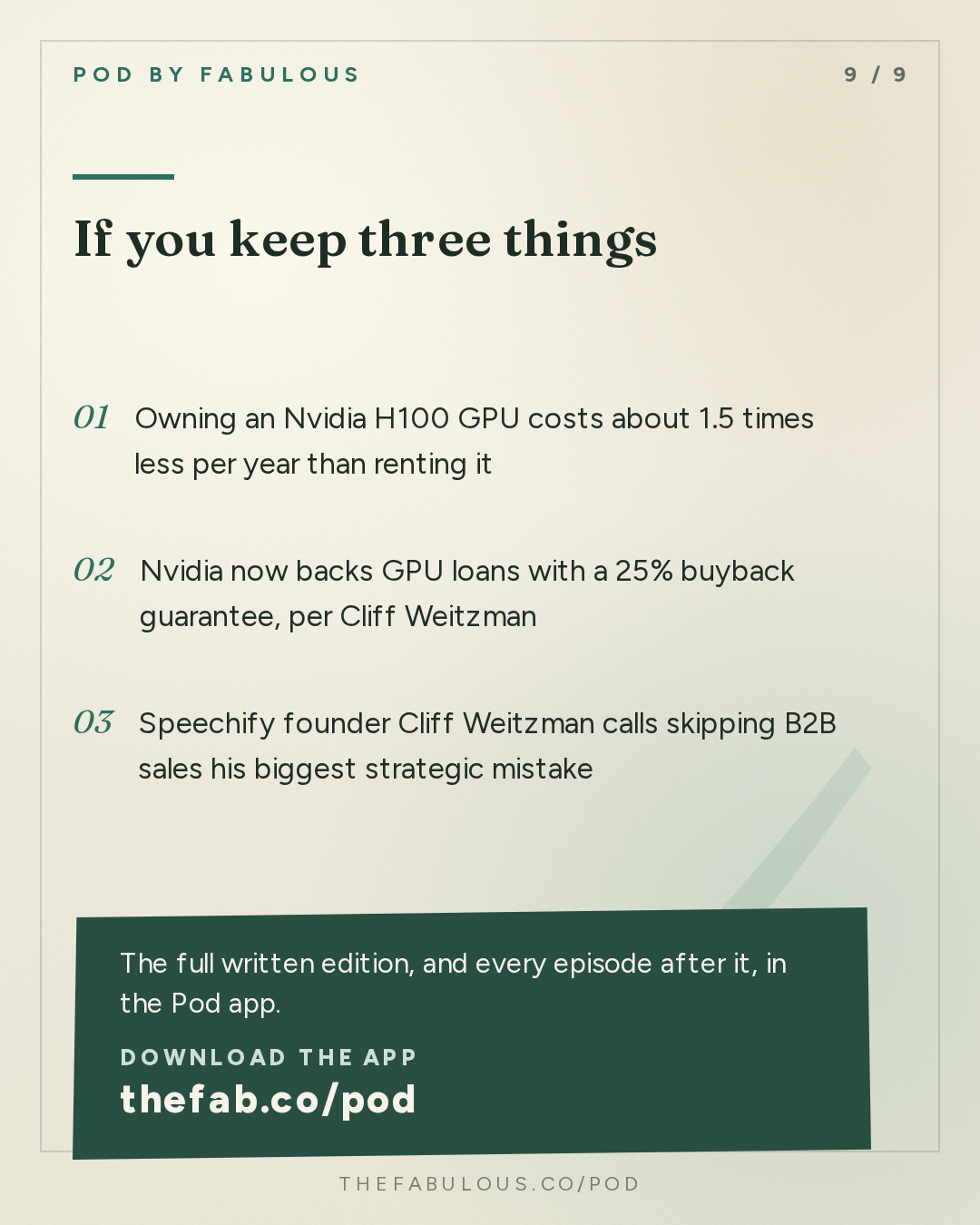
- Owning an Nvidia H100 GPU costs about 1.5 times less per year than renting it
- Nvidia now backs GPU loans with a 25% buyback guarantee, per Cliff Weitzman
- Speechify founder Cliff Weitzman calls skipping B2B sales his biggest strategic mistake
- Elite AI researchers at OpenAI and Anthropic now command $15 million annual pay packages
- Weitzman says a great engineer today is mainly an exceptional QA for AI-written code
The episode in cards
By the numbers
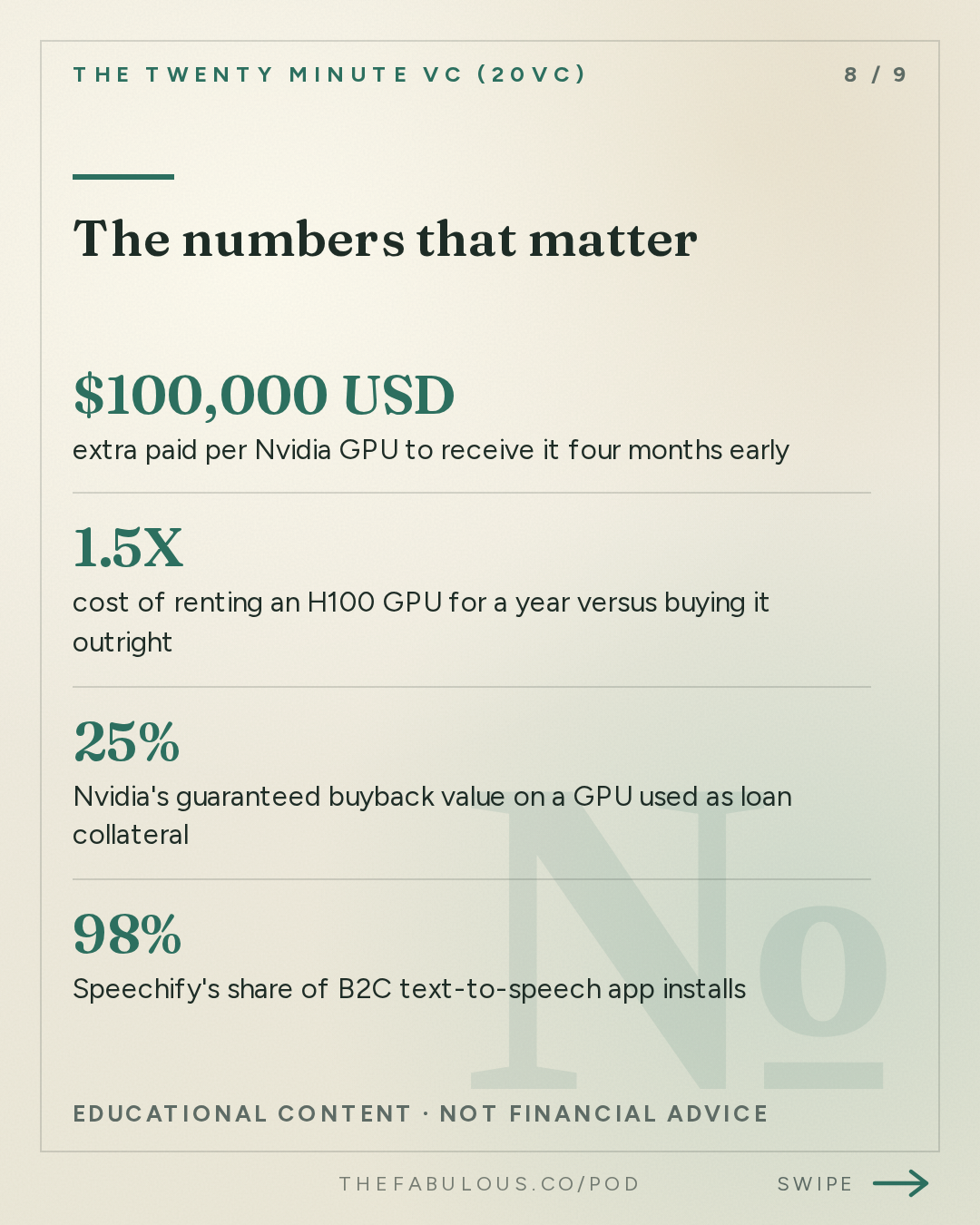
- $100,000 USD extra paid per Nvidia GPU to receive it four months early
- 1.5X cost of renting an H100 GPU for a year versus buying it outright
- 25% percent Nvidia's guaranteed buyback value on a GPU used as loan collateral
- 98% percent Speechify's share of B2C text-to-speech app installs
- $15 million USD/year starting annual pay for elite researchers at OpenAI or Anthropic
- $10 USD per million characters price of Speechify's Simba 3.2 API versus $100 from ElevenLabs
In their words
“It was the biggest strategic mistake I made in the history of Speechify.”
“The best way to lose is not to be in the race. Be in the race.”
“And then really a good engineer today is just an exceptional QA. The AI will make the feature. You will test the feature, see if it's good”
“Technology solved my dyslexia and it solved my ADHD, and it's gonna solve my brother's disease.”
Protocols
-
Size GPU ownership to baseline demand
Cliff Weitzman buys enough GPUs to cover a company's lowest-usage month, then fills the remaining swing capacity with long-term hyperscaler contracts and short-term spot instances, since owned hardware costs about 1.5 times less than a year of rental fees. He notes this only pays off if the company can also absorb the delivery delays, insurance, and cooling logistics that come with physical hardware.
ongoing capacity planning
-
Hire on technical aptitude, not polished code
Cliff Weitzman runs functional interviews where candidates build a feature and pass it through unit tests, then hands them a large open-source codebase to modify while he watches how they orchestrate AI coding agents. He prioritizes raw intelligence and math or physics backgrounds over prior coding experience, on the reasoning that any capable hire can be taught the rest within six months.
per hiring round
-
Grant credit only at production
Cliff Weitzman gives his engineering team credit for a feature only once it ships to production with no bugs and real users are touching it, comparing unfinished work to a football carried short of the end zone. He judges progress through live demos and screen recordings rather than token counts or internal leaderboards.
per feature
Questions this episode answers
Is it cheaper to buy or rent Nvidia GPUs for AI training?
Speechify CEO Cliff Weitzman says buying is cheaper: an Nvidia H100 GPU costs about $30,000 to purchase but $35,000 to $50,000 a year to rent from a cloud provider, roughly 1.5 times more (06:07). He also argues large-scale training needs memory co-located with a dedicated cluster, something renting cannot easily provide (06:32).
What is Nvidia's GPU buyback program?
Nvidia partnered with Blackstone, BlackRock, Apollo, and Goldman Sachs to guarantee banks up to 25% of a GPU's value if it backs a loan and the borrower defaults (13:38). Weitzman compares it to how Elon Musk got Morgan Stanley and Merrill Lynch to amortize SolarCity's solar panel costs over 30 years, a move that created a resale floor and made lenders more willing to finance the hardware (14:05).
Why did Speechify avoid building a B2B product?
Founder Cliff Weitzman expected text-to-speech APIs to become commoditized, so Speechify stayed consumer-only while rival ElevenLabs built an API business, then agents, then government partnerships (24:34). He now calls this his biggest strategic mistake, even though Speechify still holds 98% of B2C text-to-speech app installs (27:45).
How much do top AI researchers get paid at OpenAI and Anthropic?
Weitzman says compensation for elite researchers at frontier labs like OpenAI and Anthropic starts around $15 million a year, a level only a handful of heavily funded seed companies can match (33:21). He argues this makes hiring hardest for growth-stage startups, while seed-stage founders can still hire promising, less experienced talent because AI tools close skill gaps quickly (33:45).
How has AI changed what a software engineer does day to day?
Weitzman says a great engineer today functions mainly as quality assurance: AI coding tools like Claude Code and Cursor write the feature, and the engineer tests it, finds edge cases, and prompts fixes (38:59). He judges progress by whether a feature ships to production with real users, not by token counts or leaderboards (39:53).
The full read, in cards
Go deeper
- Anthropic paper on long-horizon agent tasks with Claude (referred to as "Fable") — described a model completing a two-week task while spending about $12,500 in tokens to build a better model
- SolarCity financing model — Elon Musk got banks to amortize solar panel costs over 30 years using the panel as collateral, the template Weitzman says Nvidia is now applying to GPUs
Mentioned
Cliff Weitzman · Speechify · Nvidia · ElevenLabs · Brett Taylor · Sierra · Anthropic · OpenAI · Dell · Blackstone · AlphaFold · Elon Musk · Mark Zuckerberg
More from this show and category

Sameer Dholakia on Bessemer's AI Investing Playbook
Bessemer's Sameer Dholakia explains why his firm paid roughly 150x ARR for Anthropic, and why capital itself is now a moat in AI investing. He prices deals on next-twelve-months revenue, targets 10 to 15 times NTM multiples, and says Bessemer's new $5.75 billion in funds reflects venture splitting into giant platforms and extreme specialists.

Harrison Chase on Why AI Agents Are So Hard to Build
LangChain founder Harrison Chase says AI agents break because models are unpredictable black boxes, not because they are weak. The fix, he argues, is a model-neutral 'harness,' the code layer that routes tasks, manages memory and controls token costs, with vertical, domain-specific agents built to outperform horizontal ones.

Pro Rata Lawsuit: Valar Atomics vs Day One VC
Day One Ventures and Valar Atomics are fighting over pro rata rights in a $6 billion nuclear-startup round, exposing how waivers actually work in venture capital. The panel also covers Meta's new Muse Wonder model, NVIDIA's reported bid for Reflection, Jev's $870 million round, Anthropic's price cuts, and software's rising IPO bar.

Mike Cannon-Brookes on Atlassian's AI Strategy
Atlassian CEO Mike Cannon-Brookes argues design, not agents, decides AI-era winners, so Atlassian keeps investing in interfaces rather than going headless. He also says enterprises increasingly reject Chinese AI models even as they embrace open weights, and doubts most "specialized models" are just fine-tuned versions of them.
