
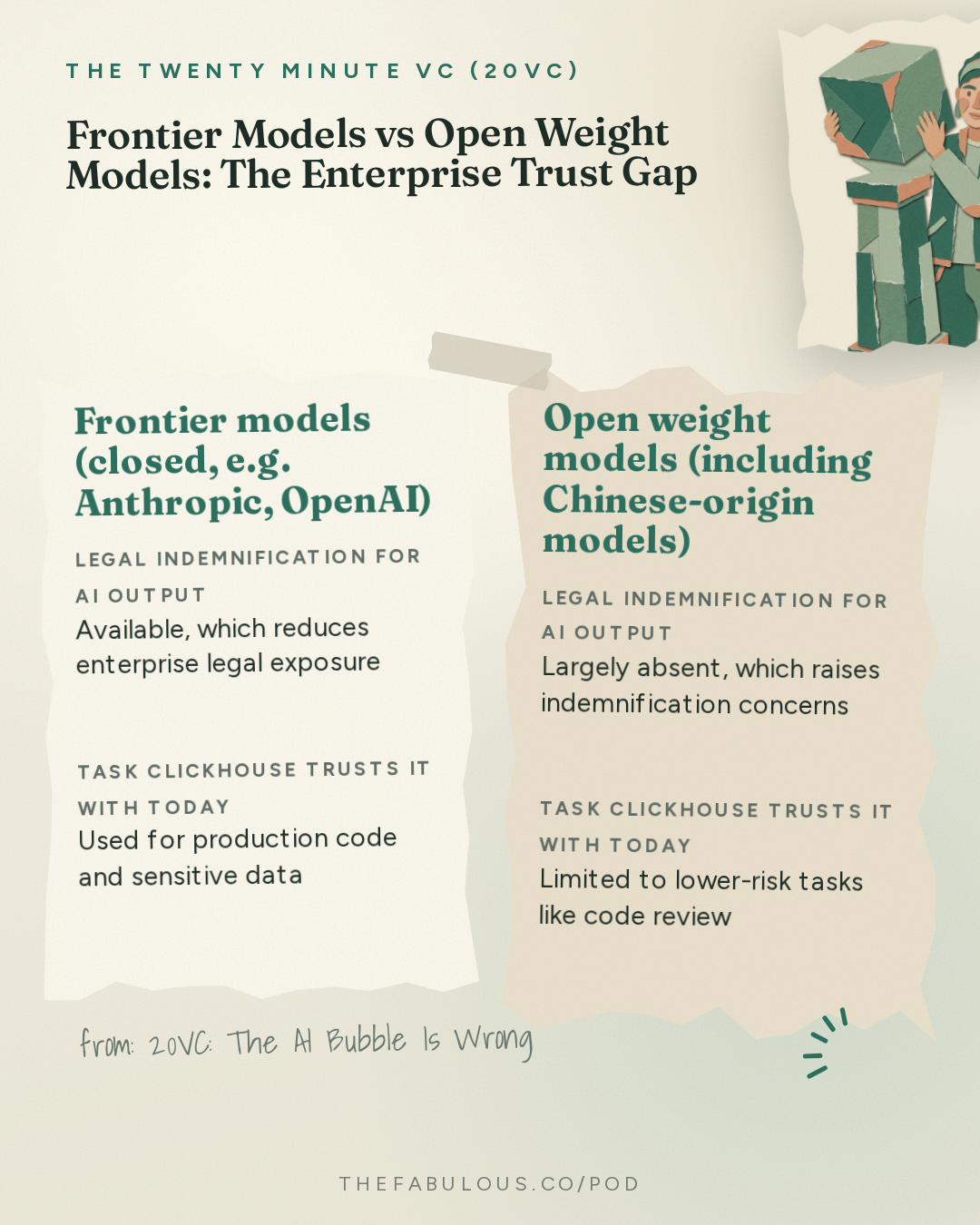
Aaron Katz on ClickHouse's Explosive Revenue Growth
20VC: The AI Bubble Is Wrong | AI Margins Need to Improve | Revenue Concentration Should be a Concern | Why People Over-Estimate Open Models But Enterprises Still Fear Frontier Models with Aaron Katz, ClickHouse
The brief
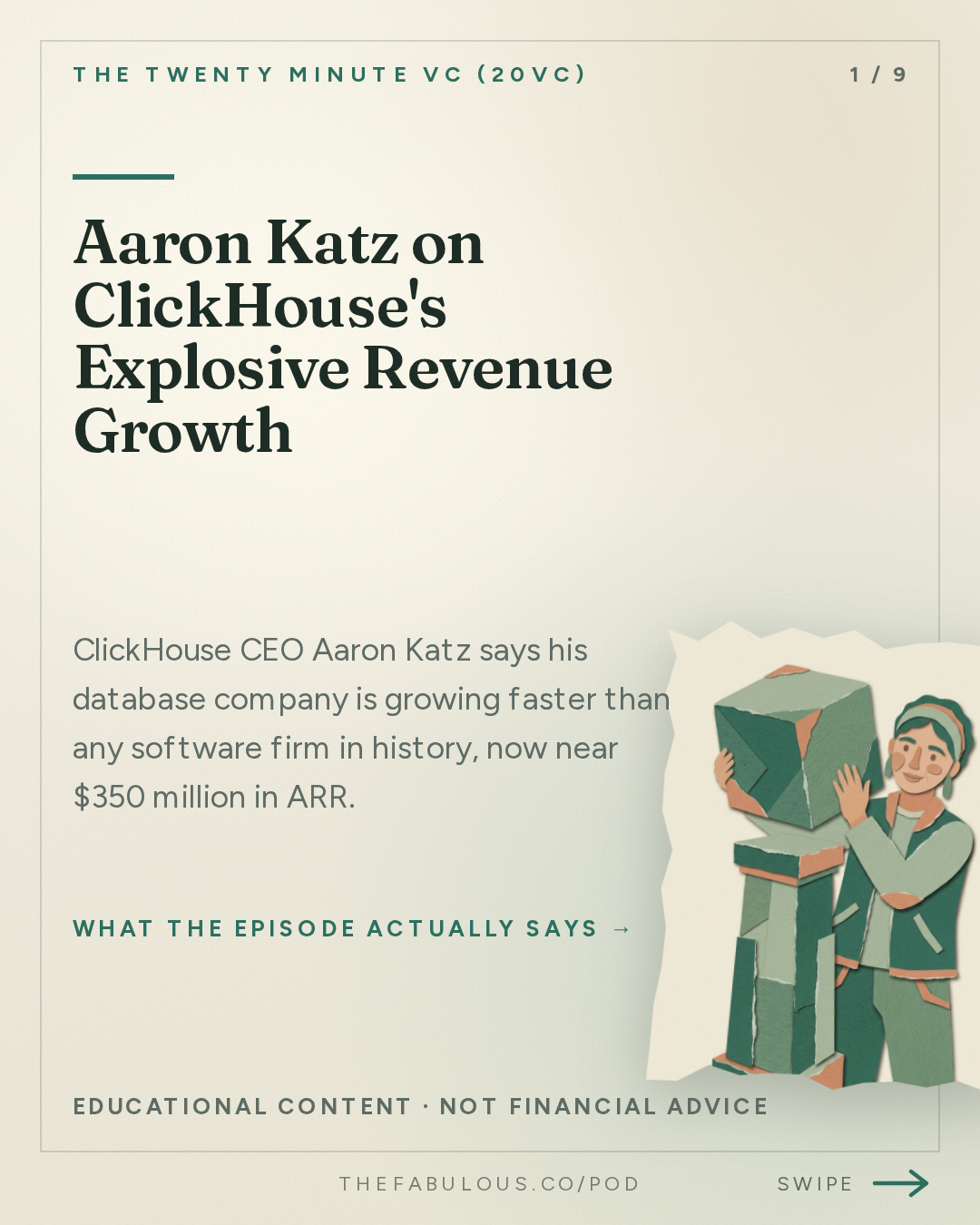
ClickHouse CEO Aaron Katz says his database company is growing faster than any software firm in history, now near $350 million in ARR. He treats any revenue category above 10% of sales as a real risk, doubts the AI bubble narrative, and says enterprises still trust frontier AI models over open weight ones for legal protection.
The interview took place inside Craven Cottage, the home stadium of Fulham Football Club, because the company being discussed had just bought the shirt sponsorship. That fact alone tells you something about the current moment in technology: a database company, the kind of business that used to advertise in trade magazines, is now paying to put its name on a Premier League jersey. But the real spectacle that day was not the pitch. It was the numbers.
Aaron Katz is the co-founder and CEO of ClickHouse, an open source database built for fast analytical queries over huge volumes of data. Anthropic, OpenAI, Tesla, Netflix, and Microsoft all use it. The company has just crossed $350 million in annual recurring revenue, or ARR, the standard measure of a subscription business's yearly income run rate (00:50), and it is valued at $15 billion (44:17). Katz has lived through three technology cycles as a builder, first at Salesforce for twelve years, then at Elastic, and now at ClickHouse. So when he says the current AI wave does not resemble anything he has seen before, it is worth taking seriously.
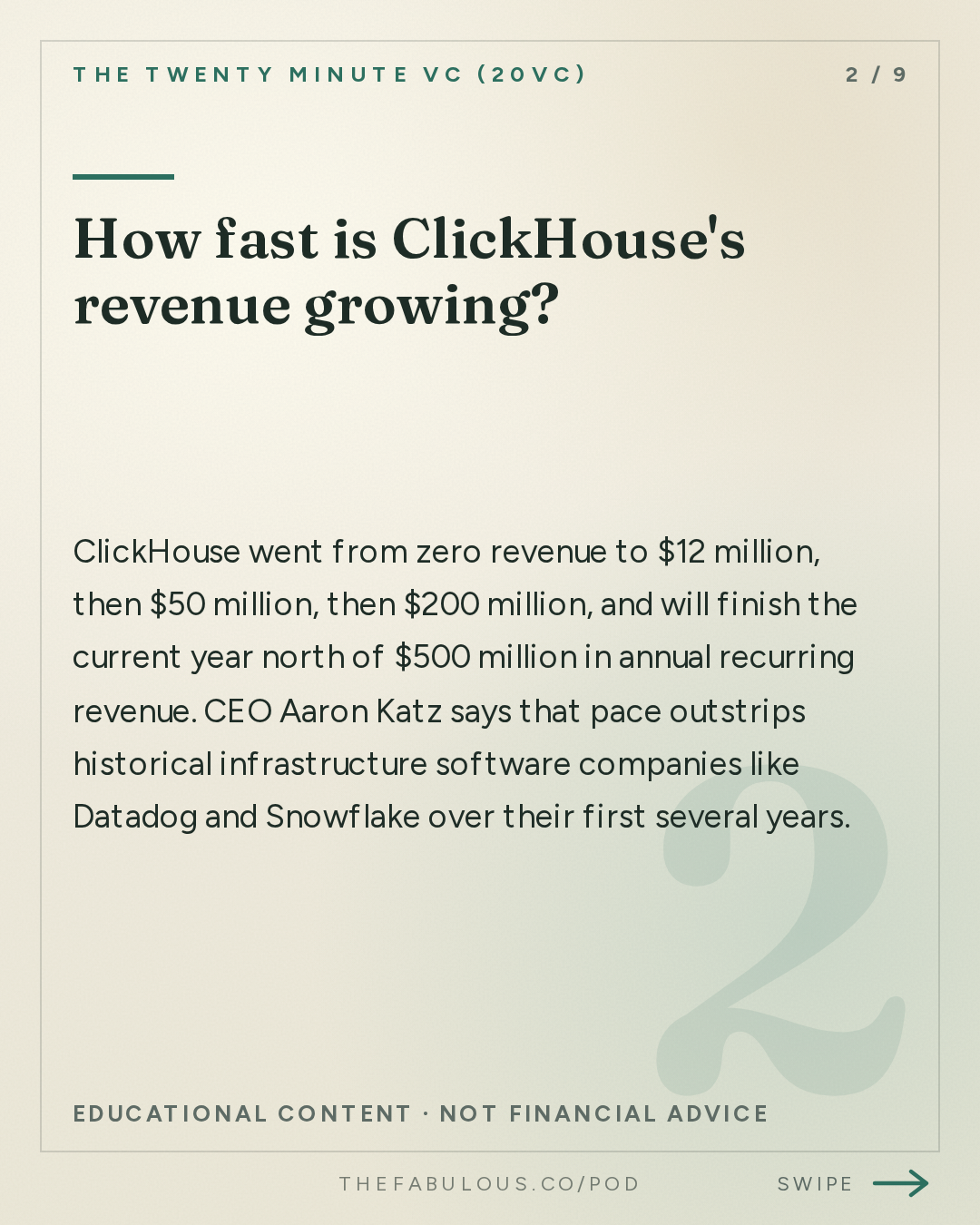
"This seems to be accelerating at a unprecedented pace," he told Harry Stebbings, host of the 20VC podcast. "We haven't seen revenue growth like this in our lifetime" (05:10). ClickHouse's own trajectory backs this up. The company went from zero revenue to $12 million, then $50 million, then $200 million, and will finish this year north of $500 million.
"We went zero, 12, 50, 200, and we'll finish this year north of 500." — Aaron Katz [45:24]
That is not a smooth SaaS curve of tripling and then doubling. It is a jump that Katz says outpaces even the fastest historical infrastructure companies he can name, including Datadog and Snowflake, the two he studied most closely before building his own go-to-market plan (10:08).
The Real Risk Is Not Margins
The obvious objection to all this growth is gross margin, the percentage of revenue left after paying for the cost of delivering a service. Some AI-native companies run gross margins in the 30 percent range, far below the 70 to 80 percent that public software investors expect. Katz is not worried about that, as long as a company can show a credible path toward margin expansion over a few years while growing this fast (06:06). What worries him instead is durability: whether the revenue sticks around.
"The switching costs can be very low for agentic applications, and we're seeing that with these model providers that are leapfrogging one another." — Aaron Katz [06:45]
Infrastructure software like ClickHouse is deeply embedded in a customer's systems, so switching away is expensive and slow. An application built on top of a large language model can be rebuilt around a different model in weeks if a competitor ships something better. That gap, Katz argues, is the honest risk in today's AI investing environment, more than the margin story that gets most of the attention.
Some of that discipline traces back to his years at Salesforce, where he worked under founder Marc Benioff for twelve years starting when the company was a three-year-old startup selling what was essentially a glorified contact manager. Benioff insisted on chasing giants like Siebel, SAP, and Oracle long before the product could compete with them, and he was right on a longer timeline than anyone expected.
"That you can overestimate what you can achieve in one year and underestimate what you can achieve in five." — Aaron Katz [11:17]
Katz has carried that patience into his own fundraising. ClickHouse did not need its most recent round of capital; the company already had a billion dollars on its balance sheet. He raised anyway, in part to bring in strategic investors, and in part to fund things like the Fulham sponsorship, which he frames less as sentiment and more as brand infrastructure aimed at the humans who still control enterprise technology budgets (31:03). He argues that sports and live experience are becoming more valuable, not less, precisely because so much of work and life is moving into software (34:42). He also predicted that top sports franchises will eventually sell for $20 billion, pointing to the Los Angeles Lakers' recent $12.5 billion sale as a signal of where prices are headed (34:05).
When Software Buyers Are Machines, Not People
The most striking part of the conversation is Katz's picture of who, or what, will be choosing infrastructure a few years from now. Today, a human engineer decides whether a company uses ClickHouse or Snowflake or Databricks. Katz thinks that decision is starting to move to the AI agents themselves.
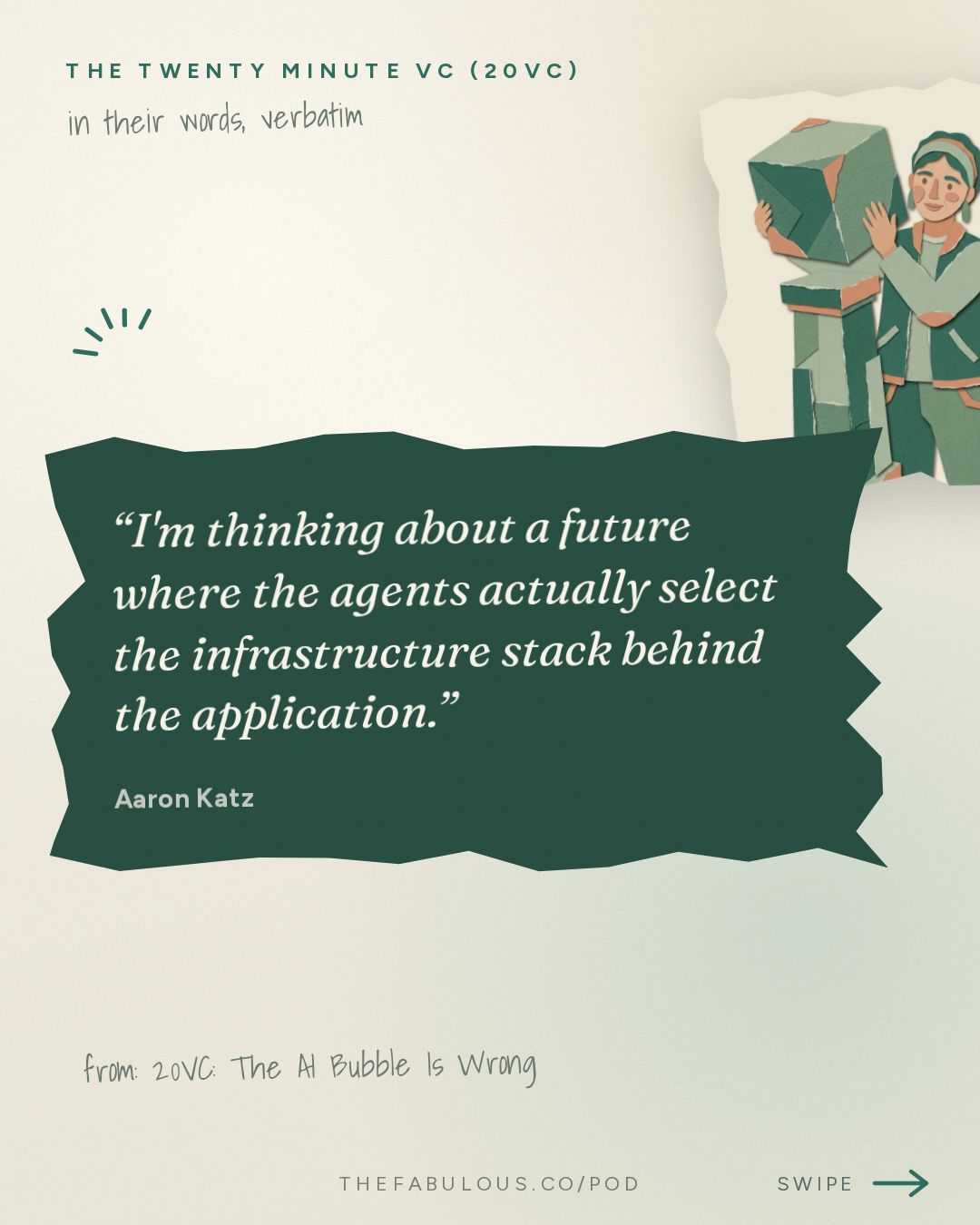
"I'm thinking about a future where the agents actually select the infrastructure stack behind the application." — Aaron Katz [15:24]
He already sees an early version of this: when Anthropic's engineers wanted to pick a database for a new observability feature, they asked their own AI model, Claude, which one to use, and Claude suggested ClickHouse (17:52). If that pattern generalizes, then the winning technology in any category becomes whatever an AI model is most likely to recommend, which changes how companies think about developer relations and community.
That agentic future has a very specific technical requirement, in Katz's view: speed. Human users tolerate a slow dashboard. An AI agent running dozens of database queries at once, to answer a single question, cannot. "What's the number one requirement for agentic query patterns? Low latency," he said, describing systems whose experience "is gonna be defined by the slowest point in that chain" (14:09). As proof of what this scale looks like in practice, he pointed to Tesla, which is now ingesting a billion events per second into ClickHouse (15:44).
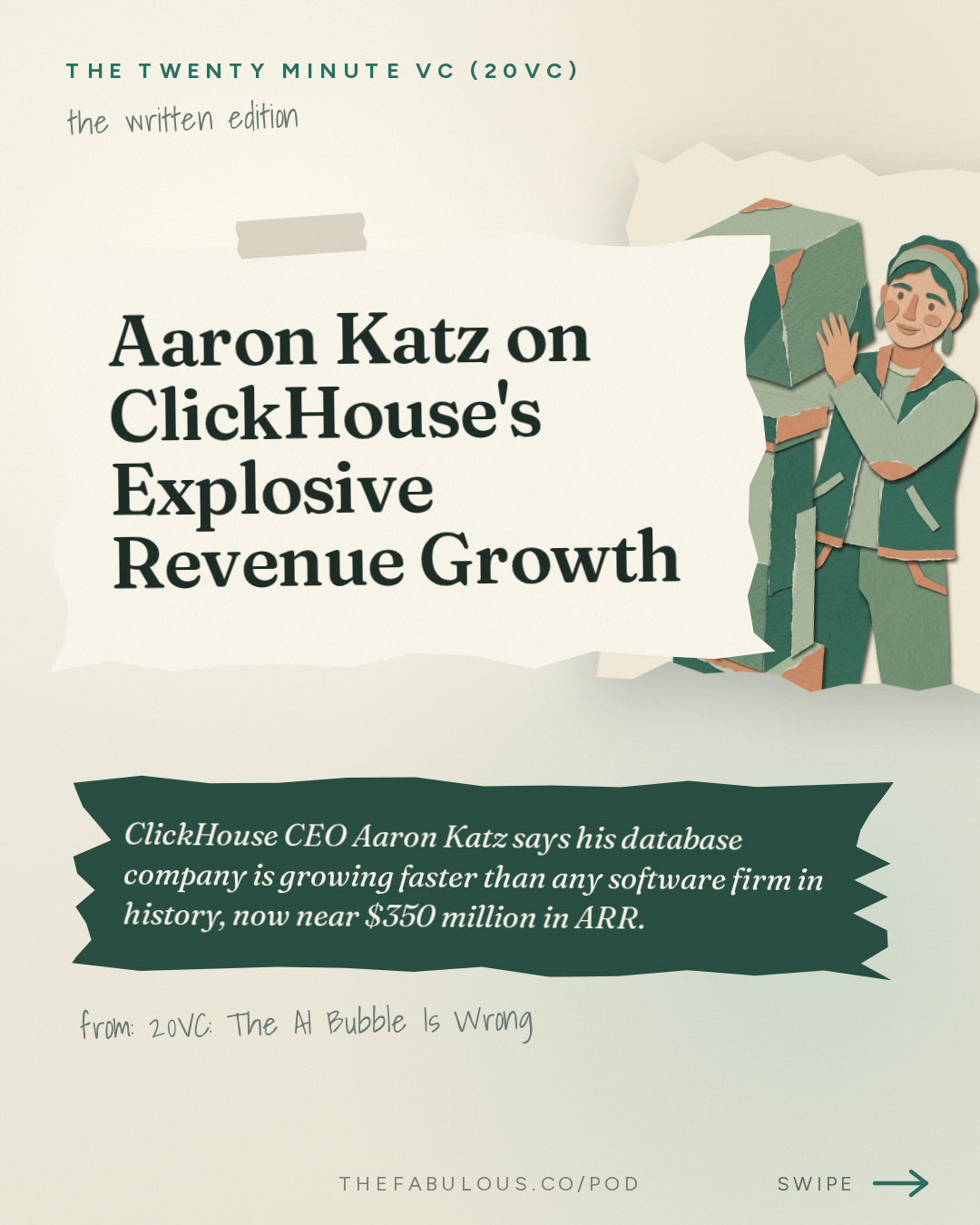
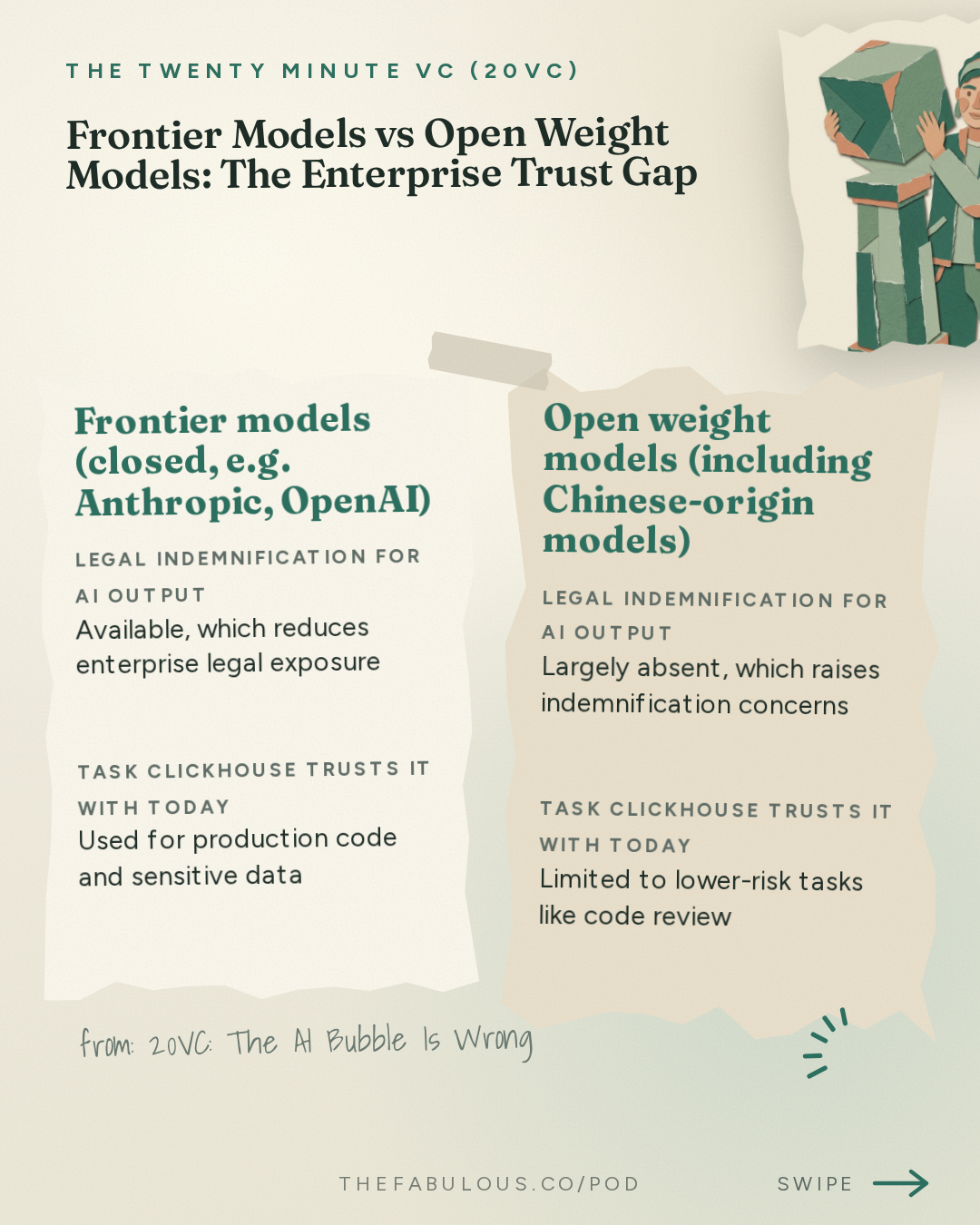
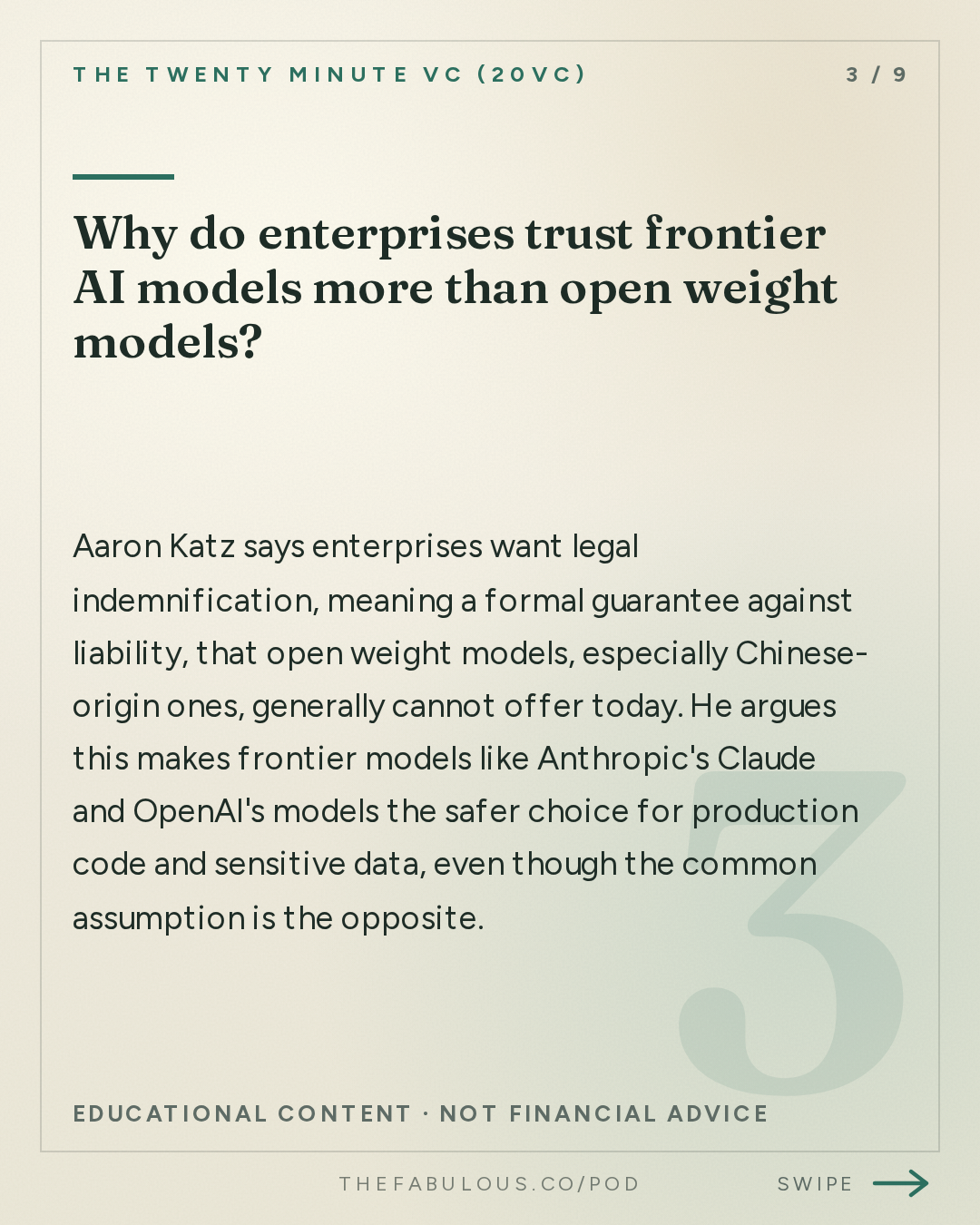
That same shift toward machine buyers raises a trust problem, and here Katz offers a genuinely counterintuitive claim. The conventional wisdom in AI circles holds that closed, expensive frontier models like those from Anthropic and OpenAI will be reserved for a handful of extremely high-value problems, like curing cancer, while cheaper open weight models handle the rest of enterprise work. Katz disagrees, especially for large companies (23:59). Open weight models, particularly those built in China, cannot yet offer the legal indemnification, meaning a formal guarantee against liability, that enterprises want before they trust a model with sensitive code or data (25:50). Some of his own peers, he says, have gotten this backwards, treating a frontier lab's promise of "zero data retention" as untrustworthy while feeling comfortable sending sensitive material to an open Chinese model, when the actual risk profile runs the other way (25:26). ClickHouse itself limits open models to lower-stakes tasks like code review while keeping frontier models for anything that touches production systems or customer data.
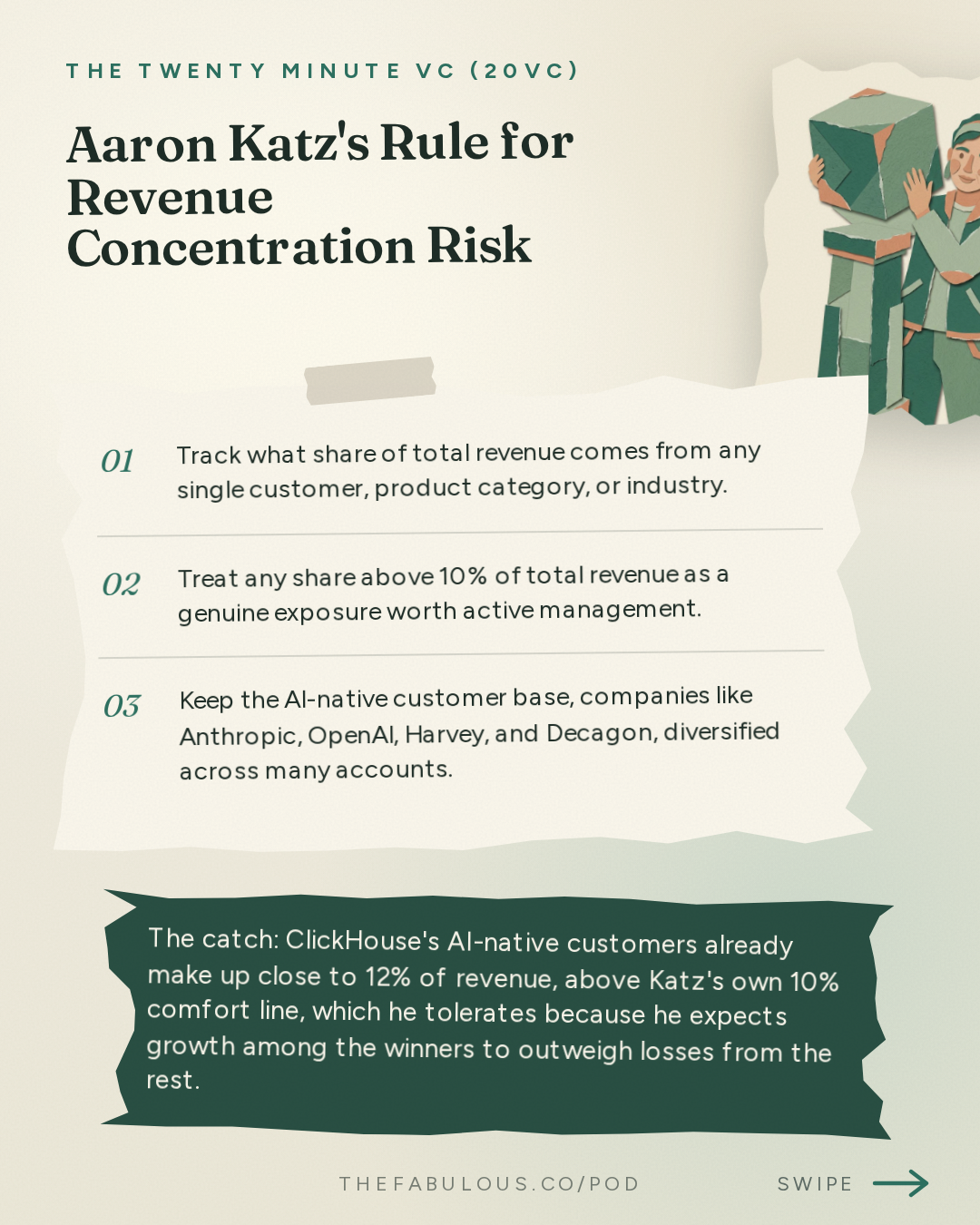
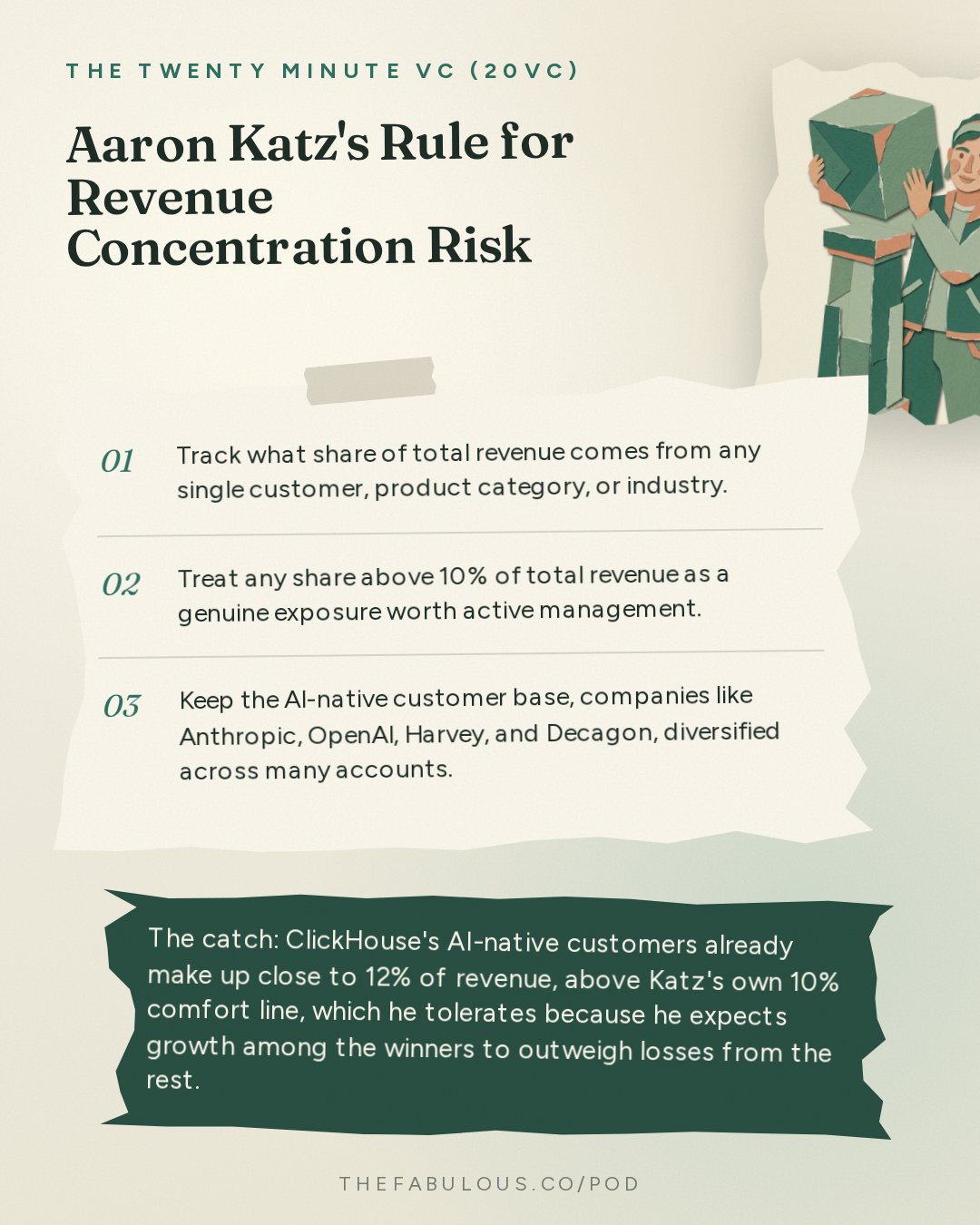
None of this optimism blinds Katz to concentration risk, the danger that a company depends too heavily on one customer, category, or trend. He treats any revenue segment that crosses 10 percent of total revenue as a real concern worth active management (46:41). Right now, the entire basket of AI-native customers on ClickHouse, including Anthropic, OpenAI, Harvey, Sierra, and Decagon, adds up to just under 12 percent of revenue (45:45), a number he is comfortable with because ClickHouse's customer base is broad enough that no single wave, even the AI wave itself, can sink the business if some of those names fade.
That comfort with uncertainty extends to the biggest question hanging over the whole industry: is this a bubble? Katz's answer, delivered near the end of the conversation, is a bet rather than a certainty. He does not think AI is overblown, and he is willing to put a number behind ClickHouse's own ambitions, wagering that the company hits $1 billion in ARR before December 2027 (37:57), well ahead of the pace of Salesforce, which went public in 2004 at a $1 billion market cap after years of building. Whether ClickHouse goes public on that timeline or later, Katz says, is almost beside the point. "I'm hoping this company outlives me," he said, "in which case whether or not we go public next year or in five years is pretty irrelevant" (58:19). It is the kind of statement that only makes sense from someone who has already watched a five-year plan get blown apart by events nobody saw coming, and decided the only sane response is to build for a horizon further out than the current panic, or the current hype, can reach.
Ask this episode anything
Pod's AI answers from the episode itself, with the minute mark so you can hear it yourself.
Or start with one of these
Ask this episode
Pod's AI listens to the whole episode to answer, and points you to the minute it comes from.
The rest of this answer, and any question after it
Answers come from the episode itself, never from a summary of it.
ContinueKey takeaways
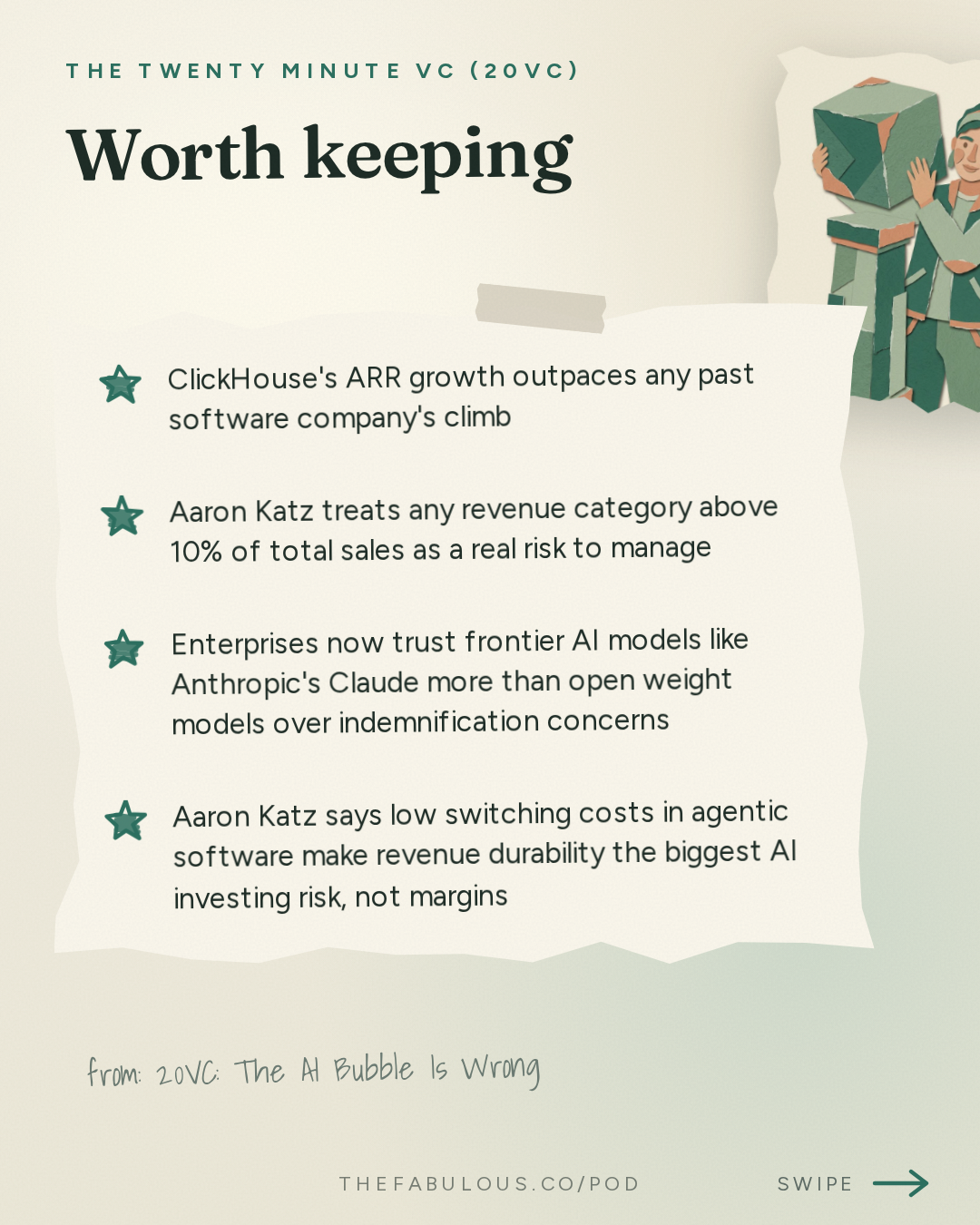
- ClickHouse's ARR growth outpaces any past software company's climb
- Aaron Katz treats any revenue category above 10% of total sales as a real risk to manage
- Enterprises now trust frontier AI models like Anthropic's Claude more than open weight models over indemnification concerns
- Aaron Katz says low switching costs in agentic software make revenue durability the biggest AI investing risk, not margins
- Aaron Katz expects AI agents, not humans, to eventually pick infrastructure, making low latency the top requirement
The episode in cards
By the numbers
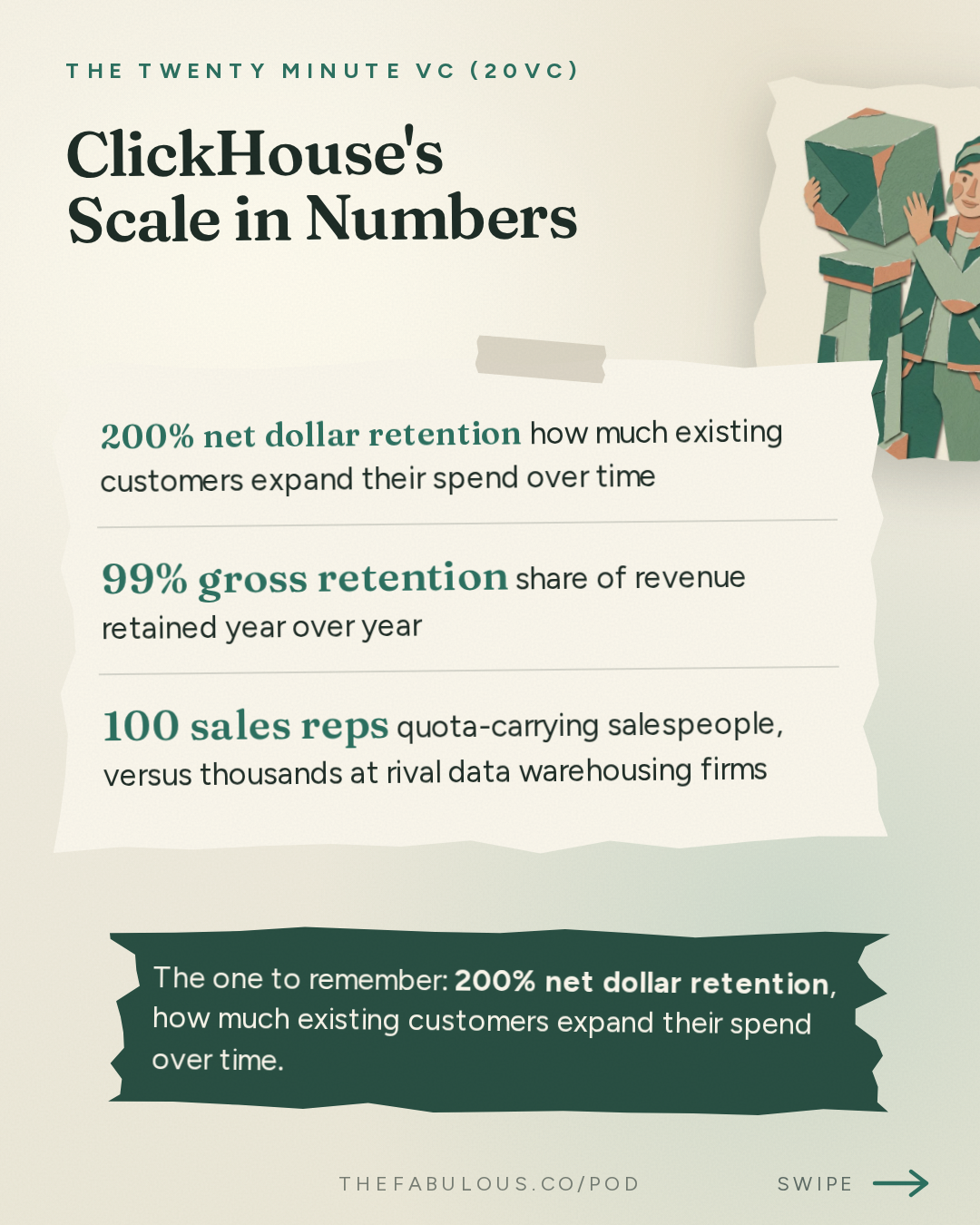
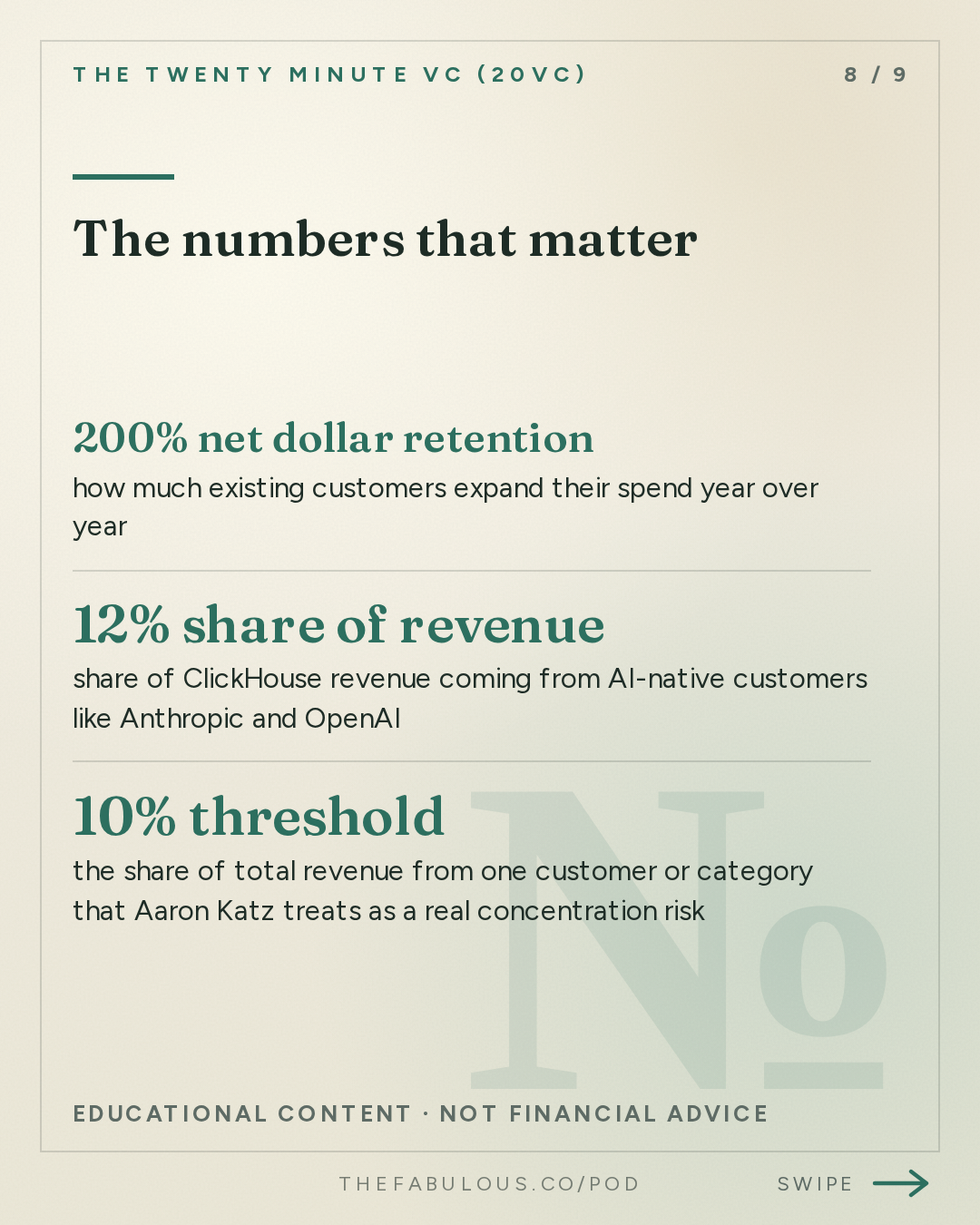
- 200% net dollar retention how much existing customers expand their spend year over year
- 12% share of revenue share of ClickHouse revenue coming from AI-native customers like Anthropic and OpenAI
- 10% threshold the share of total revenue from one customer or category that Aaron Katz treats as a real concentration risk
In their words
“We went zero, 12, 50, 200, and we'll finish this year north of 500.”
“The switching costs can be very low for agentic applications, and we're seeing that with these model providers that are leapfrogging one another.”
“I'm thinking about a future where the agents actually select the infrastructure stack behind the application.”
“I worry about is the technology coming from the rear view mirror. I worry about the next ClickHouse”
Protocols
-
Cap on revenue concentration
Aaron Katz tracks what share of ClickHouse's total revenue comes from any single customer, product category, or industry, and he treats any share above 10% of total revenue as a genuine exposure that needs active management to protect the business's predictability.
ongoing, reviewed as the customer and revenue mix shifts
-
Split AI model use by risk level
Aaron Katz has ClickHouse route lower-risk coding tasks, like code review, to open weight AI models, while keeping frontier models such as Anthropic's Claude and OpenAI's models for anything that touches production code, because he is not yet confident in open models' output reliability and legal indemnification.
per task, based on how sensitive the output is
-
Reference-check prospective investors
Aaron Katz calls a prospective investor's existing portfolio companies before agreeing to take their money, and he asks specifically about the customer introductions, recruiting help, and reputation that investor brought to those companies, only moving forward if the feedback is a unanimous yes.
once per fundraising decision
Questions this episode answers
How fast is ClickHouse's revenue growing?
ClickHouse went from zero revenue to $12 million, then $50 million, then $200 million, and will finish the current year north of $500 million in annual recurring revenue (45:24). CEO Aaron Katz says that pace outstrips historical infrastructure software companies like Datadog and Snowflake over their first several years.
Why do enterprises trust frontier AI models more than open weight models?
Aaron Katz says enterprises want legal indemnification, meaning a formal guarantee against liability, that open weight models, especially Chinese-origin ones, generally cannot offer today (25:50). He argues this makes frontier models like Anthropic's Claude and OpenAI's models the safer choice for production code and sensitive data, even though the common assumption is the opposite (23:59).
What is ClickHouse's net dollar retention?
ClickHouse's net dollar retention, the growth rate of revenue from existing customers, is over 200% (20:45), which Aaron Katz attributes to customers expanding from one use case, like data warehousing, into multiple additional ones over time.
How much revenue concentration risk does ClickHouse have from AI companies?
AI-native customers such as Anthropic, OpenAI, Harvey, Sierra, and Decagon make up just under 12% of ClickHouse's revenue (45:45). Aaron Katz normally treats any single revenue category above 10% as a risk worth managing (46:41), but he tolerates this one because the customer base underneath it is broad.
When does ClickHouse expect to reach $1 billion in ARR?
Aaron Katz bet host Harry Stebbings that ClickHouse will cross $1 billion in annual recurring revenue before December 2027 (37:57), which would put it ahead of the pace Salesforce set when it reached a $1 billion market cap around its 2004 IPO.
What is the biggest investing risk in AI companies right now, according to Aaron Katz?
Aaron Katz says the real risk is revenue durability, not gross margins. He points out that switching costs are low for agentic applications built on top of AI models, because model providers keep leapfrogging each other, making some AI application revenue less sticky than traditional infrastructure software revenue (06:45).
The full read, in cards
Go deeper
- Marc Benioff's early Salesforce playbook — Katz's account of how Benioff sold a vision of competing with Siebel, SAP, and Oracle before Salesforce's product could back it up
Mentioned
Aaron Katz · ClickHouse · Anthropic · OpenAI · Elastic · Marc Benioff · Salesforce · Datadog · Snowflake · Databricks · Fulham Football Club · David Sachs · Peter Fenton · Mike Volpi · Tesla · Harry Stebbings
More from this show and category

Sameer Dholakia on Bessemer's AI Investing Playbook
Bessemer's Sameer Dholakia explains why his firm paid roughly 150x ARR for Anthropic, and why capital itself is now a moat in AI investing. He prices deals on next-twelve-months revenue, targets 10 to 15 times NTM multiples, and says Bessemer's new $5.75 billion in funds reflects venture splitting into giant platforms and extreme specialists.

Harrison Chase on Why AI Agents Are So Hard to Build
LangChain founder Harrison Chase says AI agents break because models are unpredictable black boxes, not because they are weak. The fix, he argues, is a model-neutral 'harness,' the code layer that routes tasks, manages memory and controls token costs, with vertical, domain-specific agents built to outperform horizontal ones.

Pro Rata Lawsuit: Valar Atomics vs Day One VC
Day One Ventures and Valar Atomics are fighting over pro rata rights in a $6 billion nuclear-startup round, exposing how waivers actually work in venture capital. The panel also covers Meta's new Muse Wonder model, NVIDIA's reported bid for Reflection, Jev's $870 million round, Anthropic's price cuts, and software's rising IPO bar.

Mike Cannon-Brookes on Atlassian's AI Strategy
Atlassian CEO Mike Cannon-Brookes argues design, not agents, decides AI-era winners, so Atlassian keeps investing in interfaces rather than going headless. He also says enterprises increasingly reject Chinese AI models even as they embrace open weights, and doubts most "specialized models" are just fine-tuned versions of them.
