
Mike Cannon-Brookes on Atlassian's AI Strategy
20VC: Atlassian CEO on Why Agents Won't Replace Interfaces | Why Enterprises Won't Trust Chinese Models | Why The Jury Is Still Out On The Benefits of Specialised Models with Mike Cannon-Brookes
The brief
Atlassian CEO Mike Cannon-Brookes argues design, not agents, decides AI-era winners, so Atlassian keeps investing in interfaces rather than going headless. He also says enterprises increasingly reject Chinese AI models even as they embrace open weights, and doubts most "specialized models" are just fine-tuned versions of them.
The worst interface in modern software may be the one every company is now building its future on: a blank white box, inviting a user to type anything and promising it can do everything. Mike Cannon-Brookes, the Australian co-founder and CEO of Atlassian, the twenty-four-year-old company behind Jira and Confluence, thinks this is a problem the industry has not solved. He said as much on The Twenty Minute VC with host Harry Stebbings, in a conversation that keeps circling back to one idea: as AI makes it easier to build software, the thing that makes software work gets harder.
The Brainless Bet
Cannon-Brookes opens with a flat rejection of a popular idea in enterprise software circles, that products should go "headless," stripping out the interface and letting AI agents interact directly with the underlying data. "Headless is brainless by definition," he says (05:22). If a company gives up on its interface, he argues, it has given up on solving the customer's problem at all.
"If you're giving up on your user interface, if you're giving up on evolving your experience for a customer to solve the problems that you set out to solve for them, if you are not a significant part of that experience, yes, I think that's a brainless bet." - Mike Cannon-Brookes [05:22]
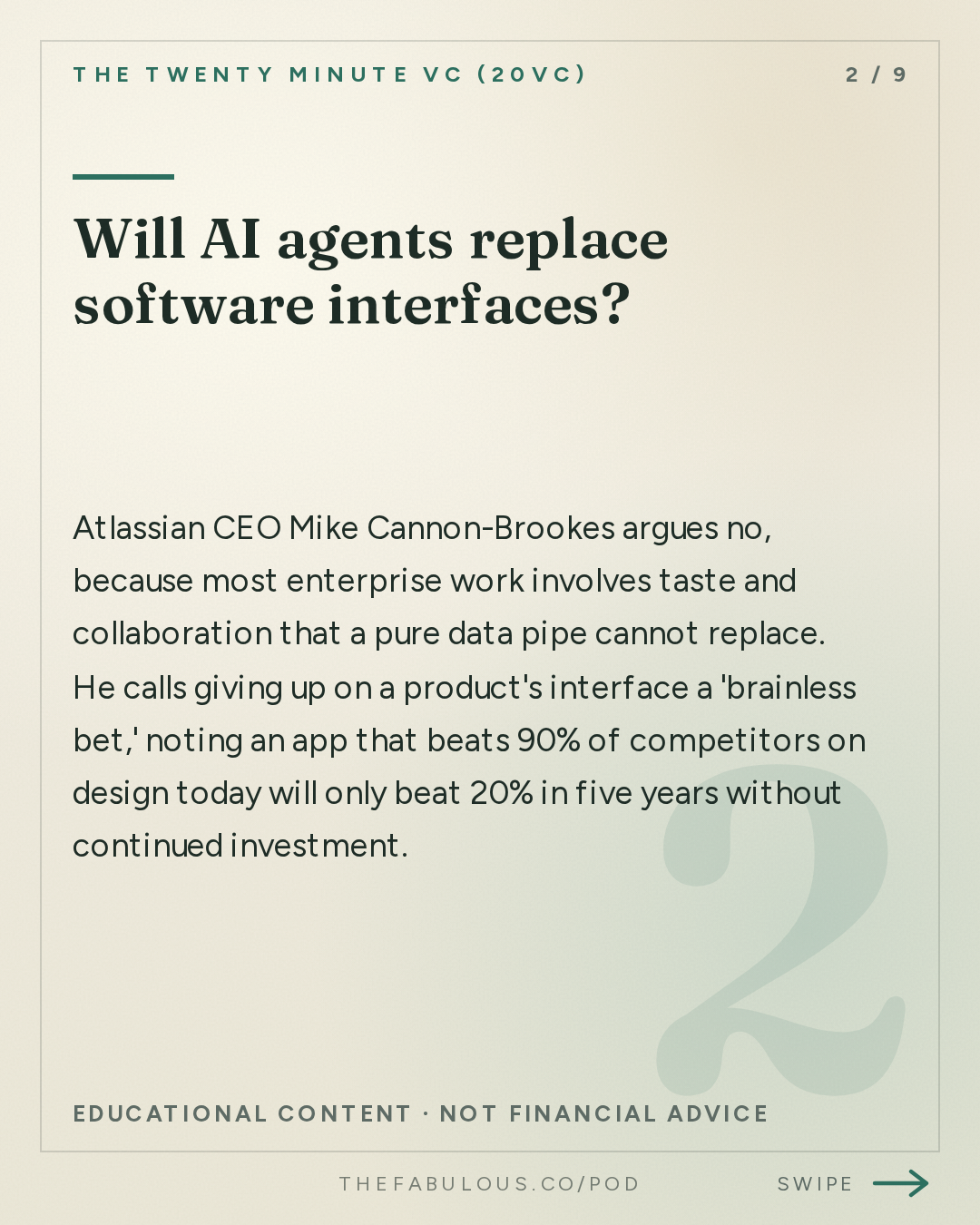
This is not a rejection of agents. Atlassian has, by Cannon-Brookes's account, one of the top three to five MCP servers in the world (05:48). MCP, short for Model Context Protocol, is the open standard that lets AI agents read data from a company's software and write actions back into it. Atlassian leans into it. But Cannon-Brookes separates the plumbing from the experience: agents can fetch information, yet most enterprise work, he says, involves "taste and interaction and collaboration" that a pipe cannot replace (03:58).
The design argument gets sharper when he turns to the tools people use today. Chat interfaces, he says, hand users "unlimited power" through "a blank one-line text box," and most people respond by treating a large language model like a search bar (11:24). That is a design failure, not a user failure. He thinks the last time the industry had to solve a problem this foundational was the arrival of mobile phones, when touchscreens forced every app to be rethought from scratch (10:06). Questions he says remain open: how should an agent announce itself inside a shared workspace, how should people tell AI-touched content apart from human-written content, and does that distinction even matter (10:27).
Underneath this is a competitive claim. Cannon-Brookes estimates that a brand new app today can beat ninety percent of existing software on design with modest effort. In five years, the same app will only beat twenty percent, because user expectations keep rising (06:52). If building a product is getting cheap, he reasons, the thing that remains expensive, and valuable, is making it feel good to use.
From Information to Imagination
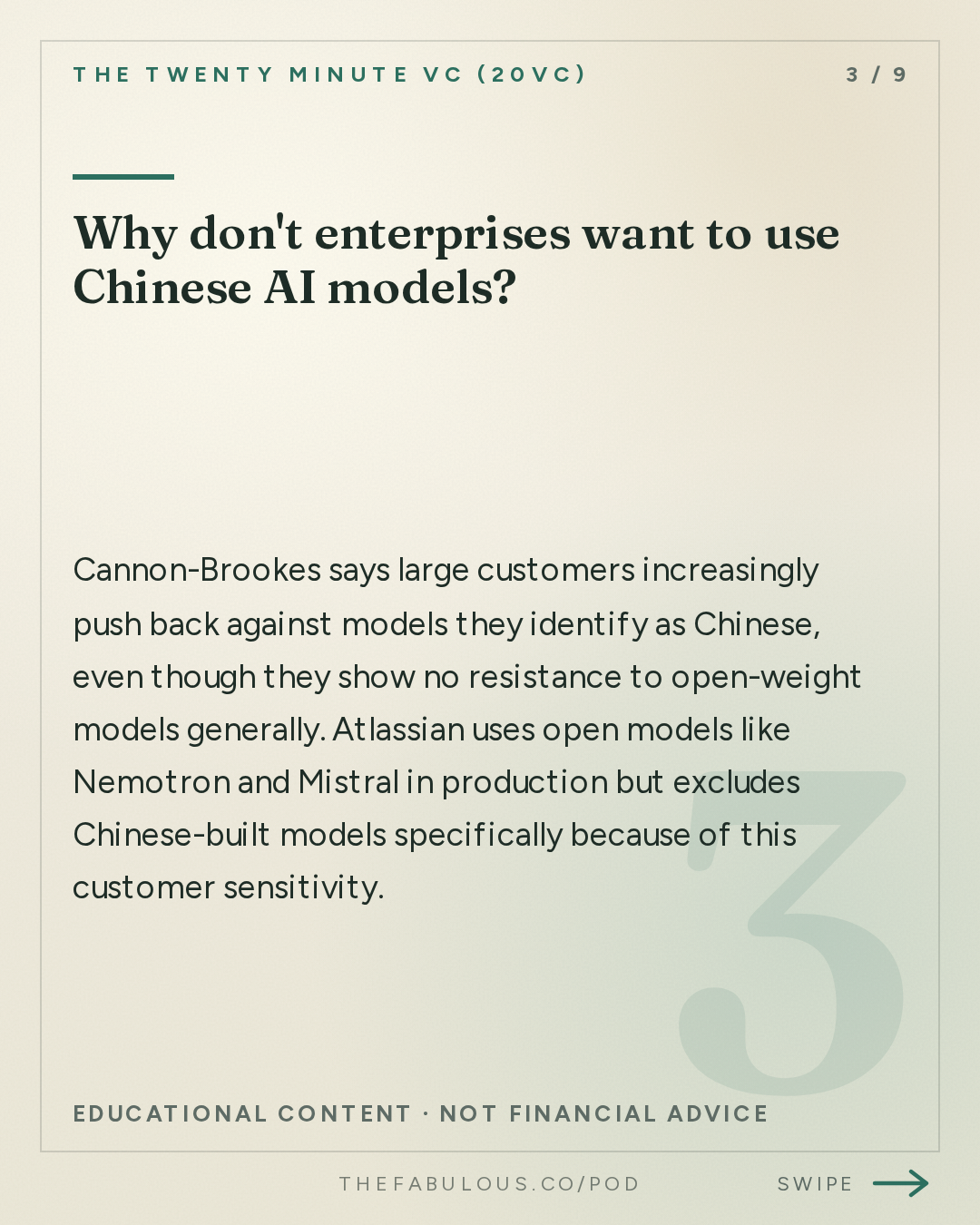
Two more threads run through the conversation, and both are about trust and cost rather than taste. The first is geopolitical. Cannon-Brookes says Atlassian hears real pushback from large customers about using models associated with China, even though those same customers show no objection to open weight models in general (17:29). Atlassian runs Nemotron, a model family built with Nvidia, and uses some Mistral models, but keeps Chinese built models out of production entirely (17:49). He separates the geopolitical question, who controls the technology, from the technical one, whether an openly published model can be trusted because its weights can be inspected. As a comparison, he points out that roughly forty percent of contributions to Linux, the open source operating system, now come from China, and almost nobody treats that as disqualifying (18:28).
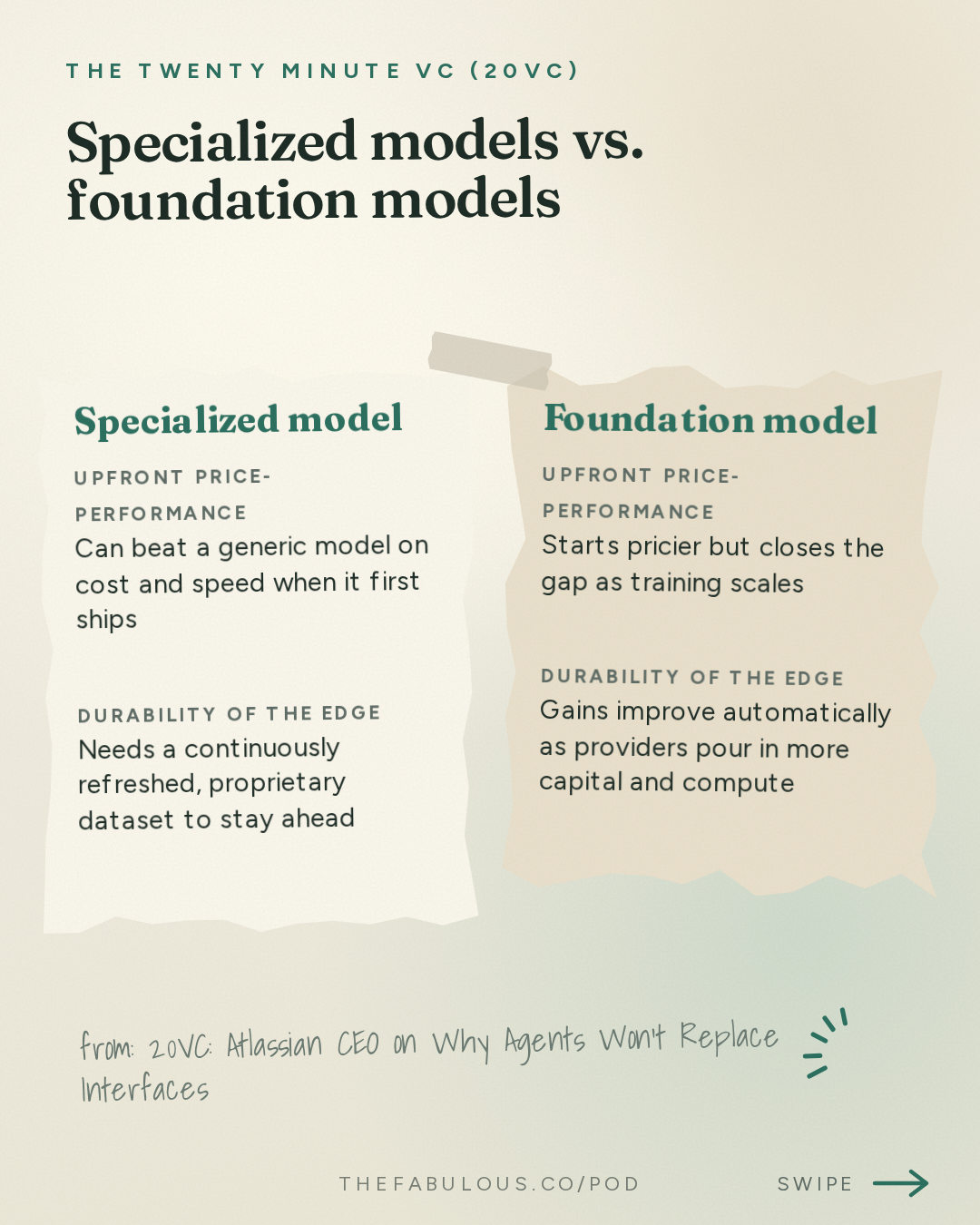
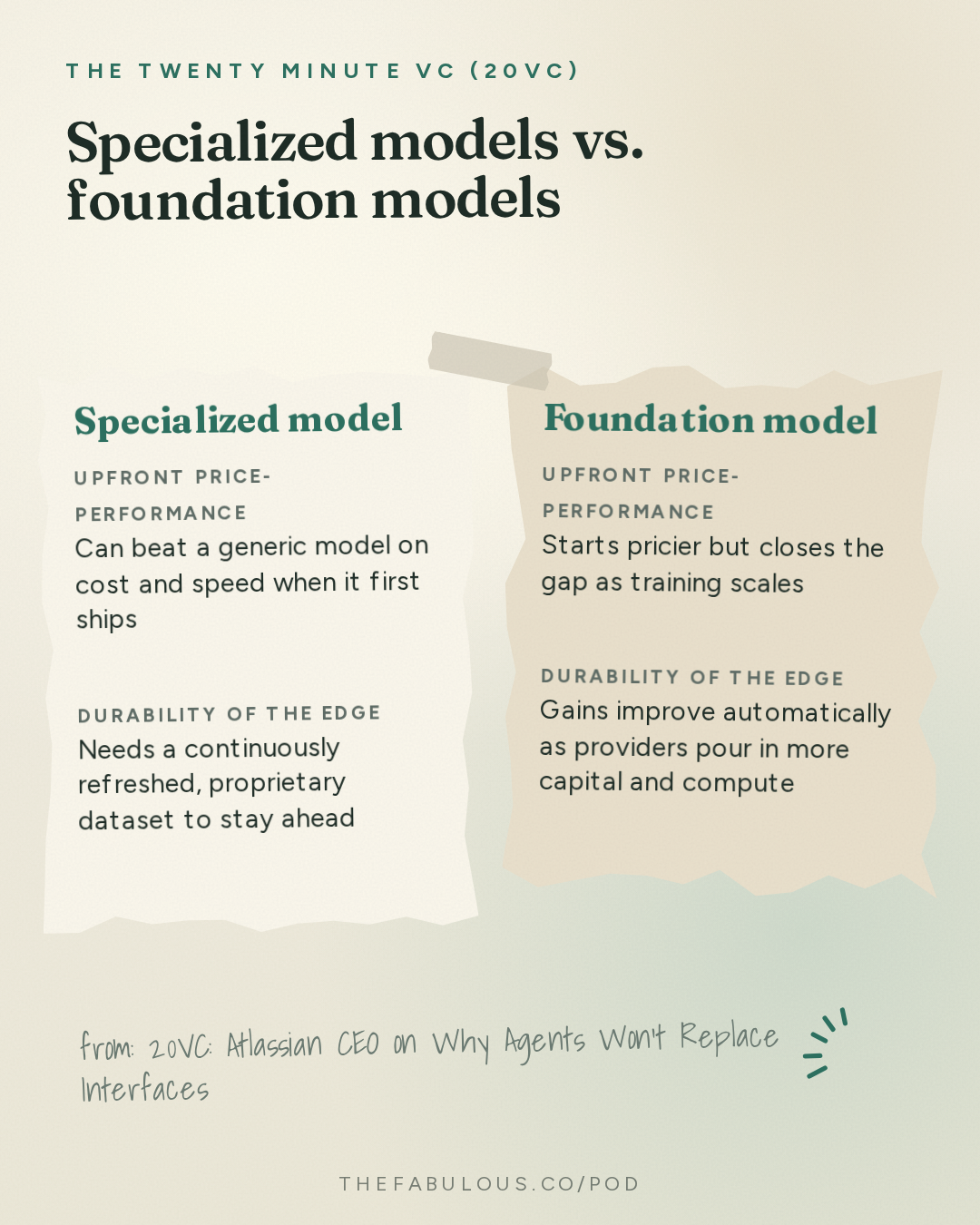
The same skepticism shows up when he talks about "specialized models," the current venture pitch that a narrow, purpose built model beats a general one. "The jury is really out on the benefits of building specialized models at the moment," he says (20:52).
"The jury is really out on the benefits of building specialized models at the moment." - Mike Cannon-Brookes [20:52]
His objection is partly semantic and partly empirical. Semantically, he argues that most companies claiming to have "built their own model" have actually taken an open weight model, often Chinese, and fine-tuned it for a narrow task, a much cheaper undertaking than training from raw data (22:19). Empirically, he says general foundation models have improved fast enough to erase the price-performance edge specialized models had at launch (23:59). The exceptions he grants are real: domains with large proprietary datasets, like robotics, where a specialized approach still makes sense (21:14).
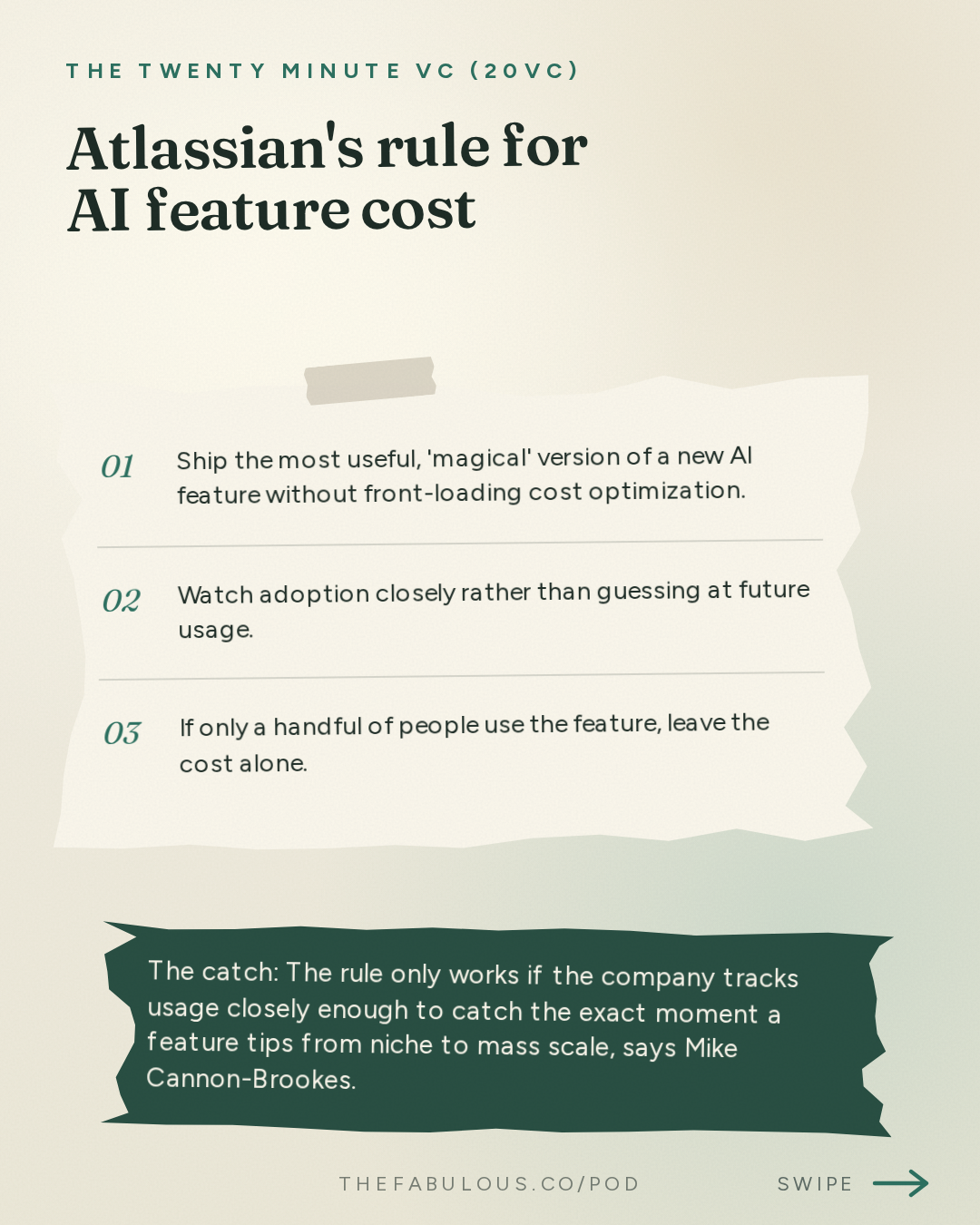
Cost discipline, in his telling, is becoming a core skill for any serious technology company, in the same way financial discipline is. He calls it FinOps, short for financial operations applied to cloud and AI spending, and says managing it well will be "a core strength and attribute of a great technology company" (26:35). Atlassian routes every AI feature internally, blending multiple models to balance price, quality, and speed for each request, rather than relying on third-party routing tools (28:04). Internally, he tells product teams not to worry about inference cost while a feature is small. "If five people are using a feature, I don't care how much it costs. If five million people use a feature, I'm going to care a lot about cost" (29:37).
That distinction between production and consumption becomes the episode's clearest thesis. "Right now, the production of technology is faster than the consumption of technology. We've reached a tipping point," Cannon-Brookes says (31:29). Companies can now build features faster than customers can absorb them into daily work. The constraint on AI's usefulness is no longer supply. It is attention and imagination. He credits Didier Elzinga, the founder of the employee feedback company Culture Amp, with a phrase he has adopted: the economy is moving "from a world of information asymmetry to imagination asymmetry" (32:57).
"We're moving from a world of information asymmetry to imagination asymmetry." - Mike Cannon-Brookes [32:57]
Knowing something other people do not used to be the advantage. Now, he argues, the advantage belongs to whoever can think of a genuinely new way to apply a technology everyone already has access to.
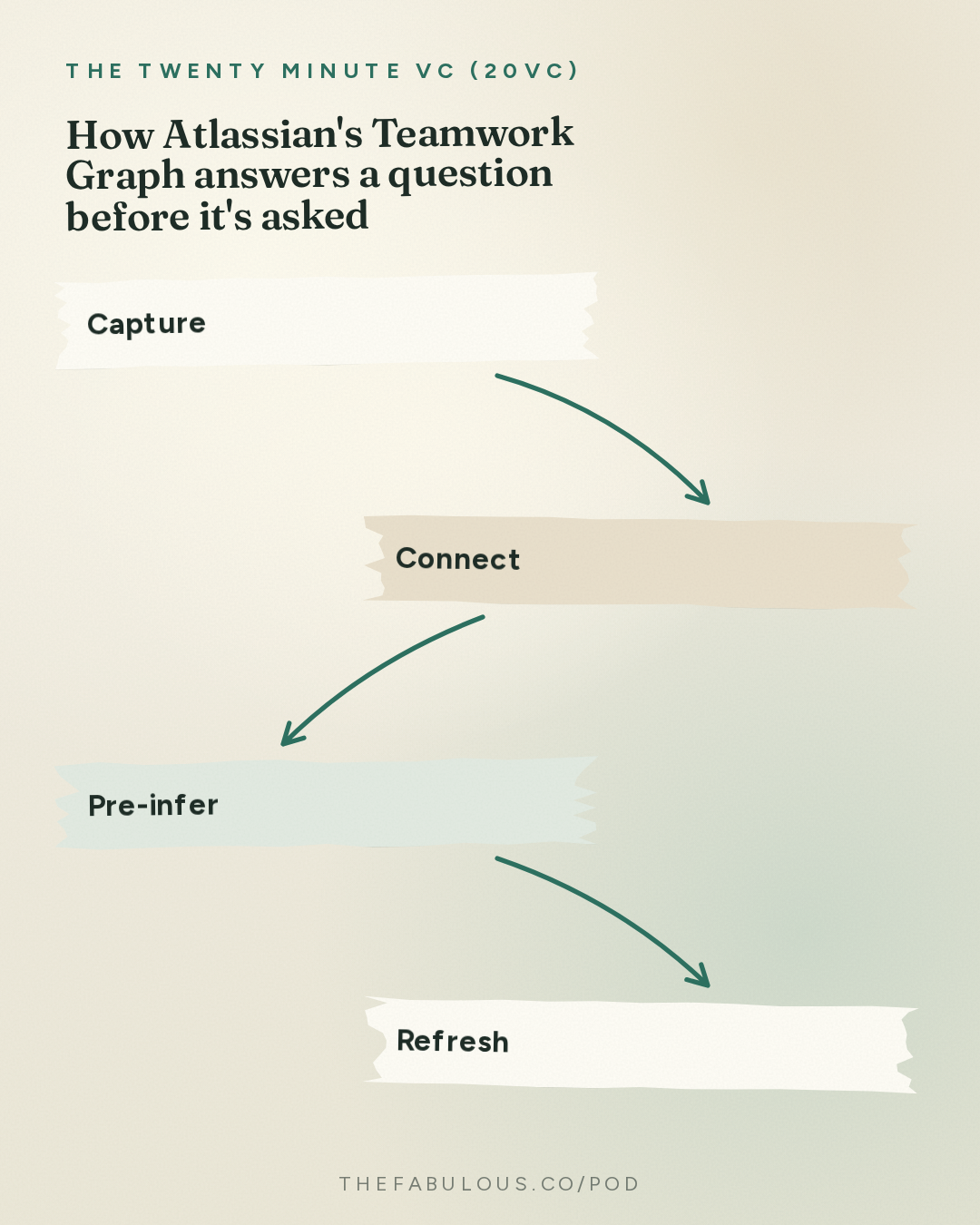
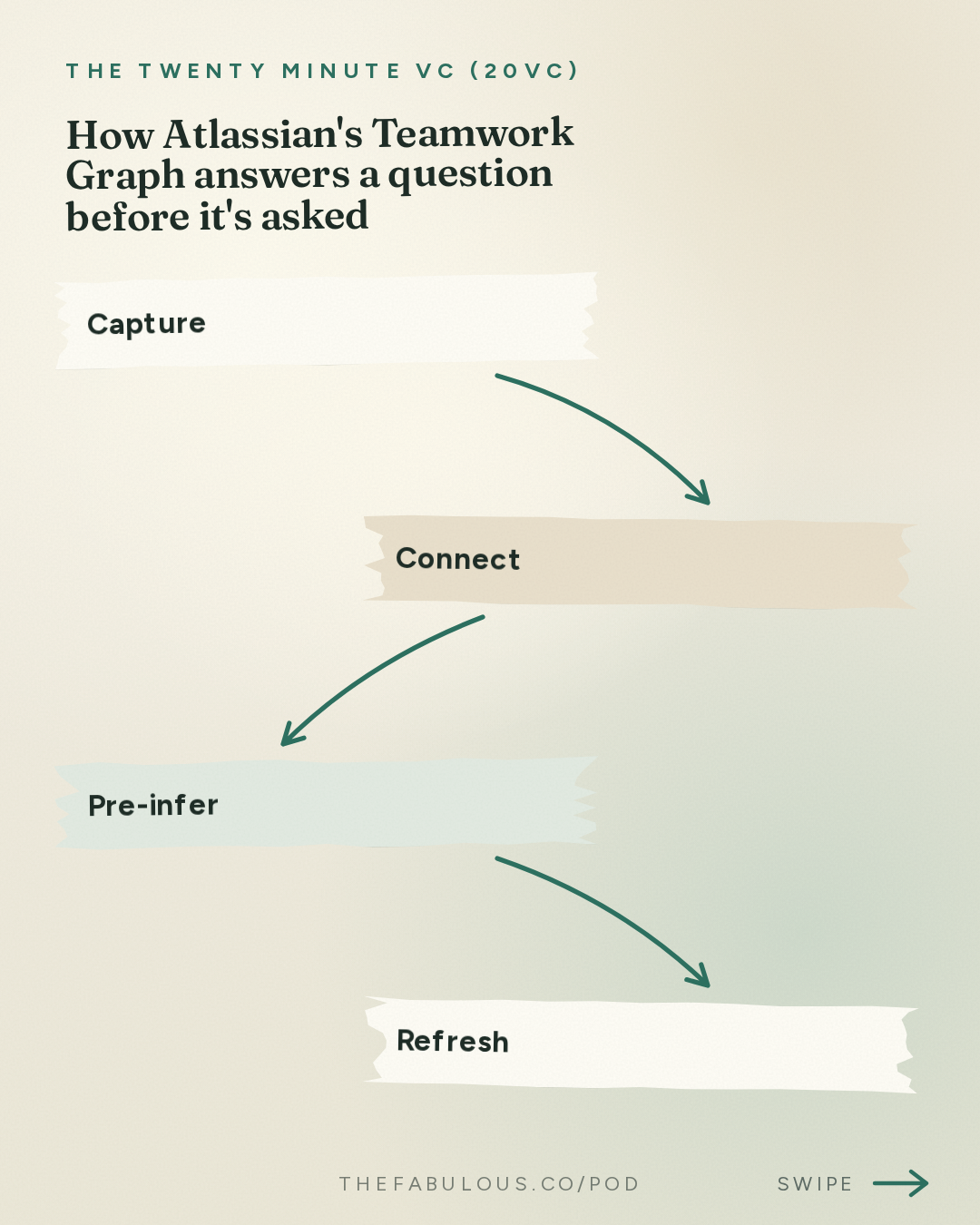
That idea explains Atlassian's bet on what it calls the Teamwork Graph, a system meant to link a company's documents, code, chat messages, and the people behind them into a single layer that AI agents can query (36:08). Cannon-Brookes makes a small, telling point about where organizational knowledge actually lives: "How many times are PowerPoint slides the place where people put actual facts and figures? A lot" (36:38). Formal databases, in his account, often miss the decisions that matter most, because those decisions get made in a slide deck and never migrate anywhere else.
The graph's trickiest property, he says, is that it expires. "The social graph of a company is valid today, and only today," because people join and leave constantly, changing who works with whom (38:04). The system has to behave like a search index, inferring likely answers in advance rather than looking things up live, while constantly refreshing itself to stay current (37:09).
It is worth noting what this system is built on. Confluence, Atlassian's documentation product, generates more than $1.5 billion in annual recurring revenue and was still growing faster than twenty-five percent a year as of the company's last disclosed figures, a scale that would make it a strong public company on its own (42:13). Cannon-Brookes is candid that writing text is not, by itself, a defensible product; there are, he notes, roughly twenty ways to write a document on any given computer already. What sustains Confluence's growth, he argues, is the same thing he opened the conversation with: continuous, unglamorous investment in design and integration, not the existence of one clever feature.
The conversation closes on a smaller, more personal note that still fits the theme. Cannon-Brookes, twenty-four years into running Atlassian with ten thousand employees (45:13), says his current struggle is not motivation but time, carving out space for "deep, long thinking" in a culture that rewards instant, fragmented action (34:00). Stebbings worries aloud that venture capital has made founding a company too easy, pointing out that raising a fifteen million dollar pre-seed round is no longer unusual (48:43), which lets people take on the founder role without building the discipline that makes companies last. His advice, half to Stebbings and half to himself, matches everything else he said: slow down enough to notice what is actually worth building, because the parts of the job that are genuinely hard, taste, trust, and patience, are the parts AI has not made any easier.
Ask this episode anything
Pod's AI answers from the episode itself, with the minute mark so you can hear it yourself.
Or start with one of these
Ask this episode
Pod's AI listens to the whole episode to answer, and points you to the minute it comes from.
The rest of this answer, and any question after it
Answers come from the episode itself, never from a summary of it.
ContinueKey takeaways
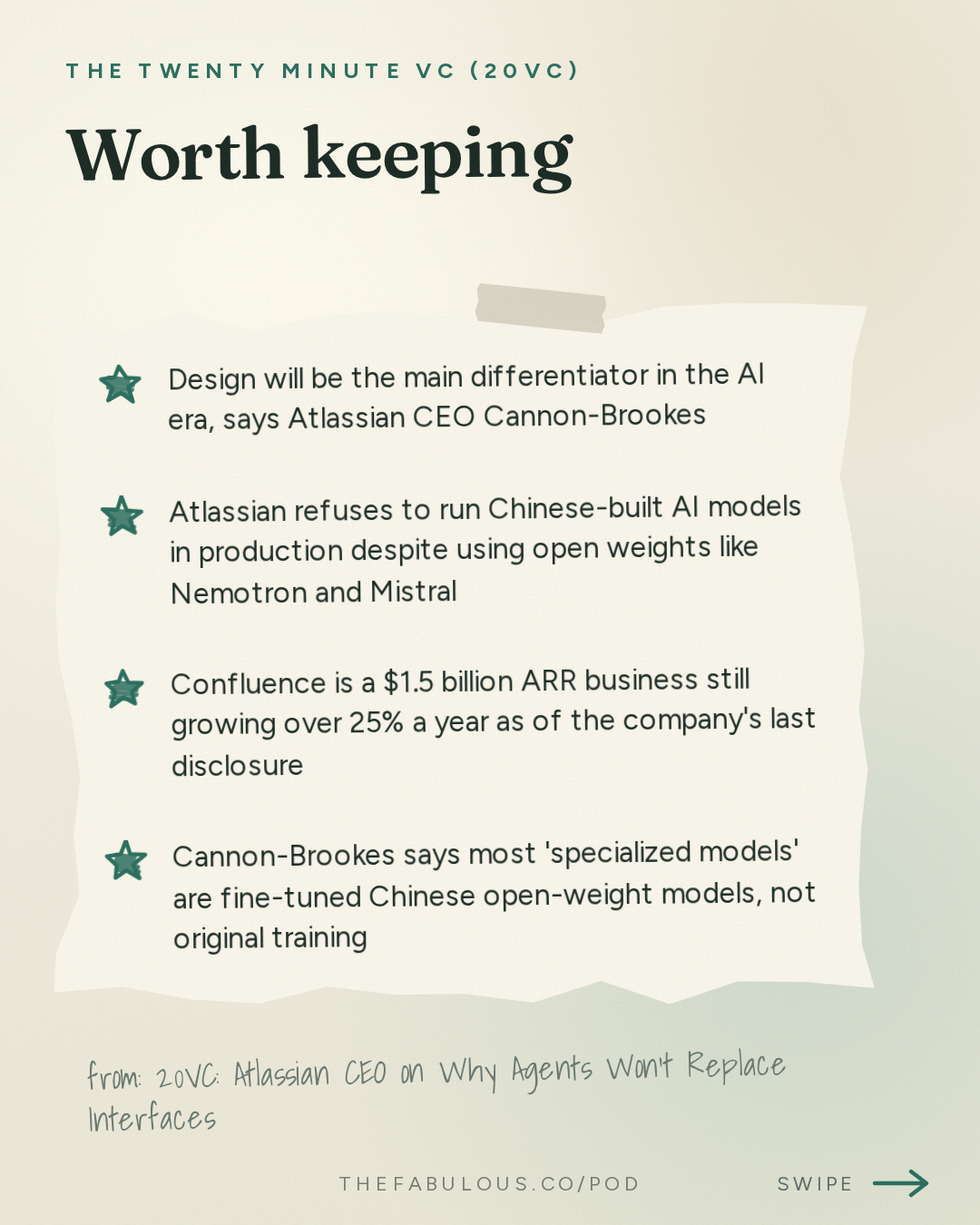
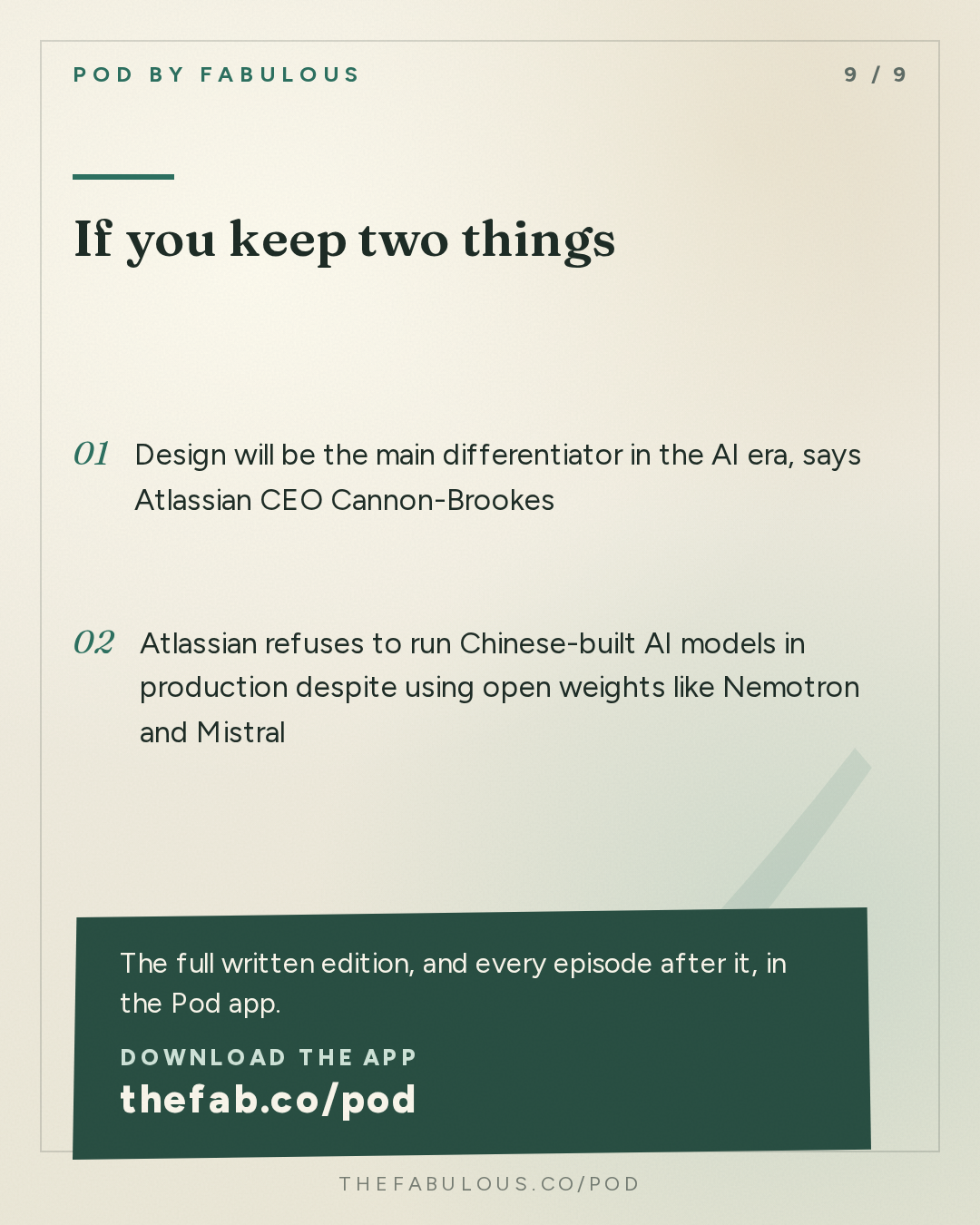
- Design will be the main differentiator in the AI era, says Atlassian CEO Cannon-Brookes
- Atlassian refuses to run Chinese-built AI models in production despite using open weights like Nemotron and Mistral
- Confluence is a $1.5 billion ARR business still growing over 25% a year as of the company's last disclosure
- Cannon-Brookes says most 'specialized models' are fine-tuned Chinese open-weight models, not original training
- Atlassian builds its own internal AI model routing to blend cost, quality, and speed instead of using third-party tools
The episode in cards
By the numbers
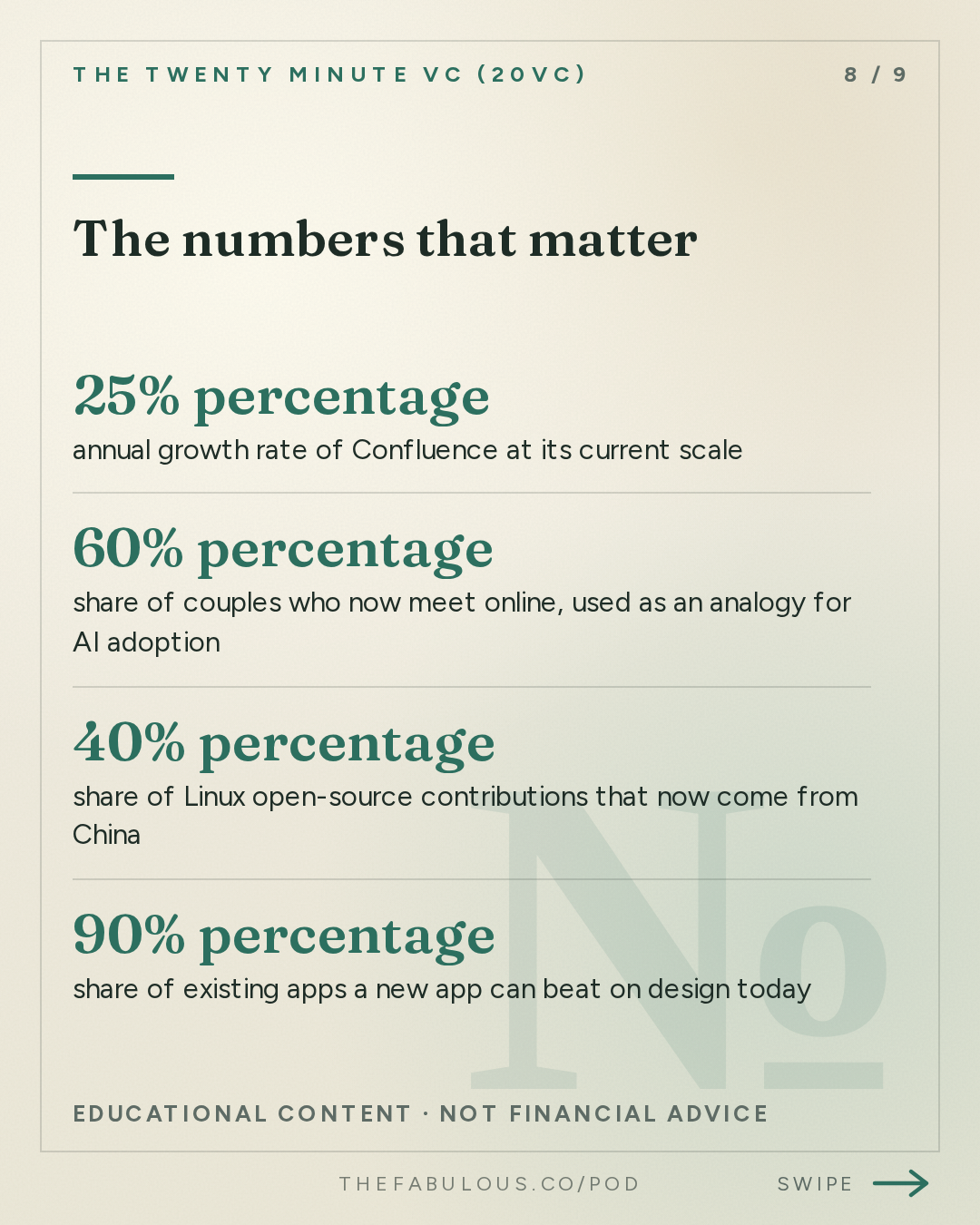
- 25% percentage annual growth rate of Confluence at its current scale
- 60% percentage share of couples who now meet online, used as an analogy for AI adoption
- 40% percentage share of Linux open-source contributions that now come from China
- 90% percentage share of existing apps a new app can beat on design today
In their words
“If you're giving up on your user interface, if you're giving up on evolving your experience for a customer to solve the problems that you set out to solve for them, if you are not a significant part of that experience, yes, I think that's a brainless bet.”
“The jury is really out on the benefits of building specialized models at the moment.”
“I mean, text boxes suck, firstly.”
“We're moving from a world of information asymmetry to imagination asymmetry, which is such a great way of thinking about it, right?”
Protocols
-
Don't optimize AI feature cost before it reaches scale
Cannon-Brookes tells Atlassian product teams to ship the most useful version of a new AI feature first without worrying about inference cost. He says the team only starts optimizing spend once a feature proves it is genuinely valuable and adoption grows into the millions of users.
applied to every new AI feature before and after it scales
-
Route AI model calls internally instead of using third-party routers
Cannon-Brookes says Atlassian built its own internal AI gateway team to route every customer-facing AI request across multiple models. He says the team blends models to balance price, quality, and speed for each request rather than relying on generic routing tools from outside vendors.
continuous, applied across all AI-powered features
Questions this episode answers
Will AI agents replace software interfaces?
Atlassian CEO Mike Cannon-Brookes argues no, because most enterprise work involves taste and collaboration that a pure data pipe cannot replace (03:34). He calls giving up on a product's interface a 'brainless bet,' noting an app that beats 90% of competitors on design today will only beat 20% in five years without continued investment (06:52).
Why don't enterprises want to use Chinese AI models?
Cannon-Brookes says large customers increasingly push back against models they identify as Chinese, even though they show no resistance to open-weight models generally (17:29). Atlassian uses open models like Nemotron and Mistral in production but excludes Chinese-built models specifically because of this customer sensitivity (17:49).
Are specialized AI models worth building instead of using foundation models?
Cannon-Brookes says 'the jury is really out' on specialized models, because general foundation models have improved fast enough to erase most early price-performance advantages (20:52). He adds that many companies claiming to have 'built their own model' are really fine-tuning open-weight Chinese models and calling the result proprietary (22:19).
How big is Atlassian's Confluence business?
Confluence generates more than $1.5 billion in annual recurring revenue and was still growing over 25% a year as of Atlassian's last disclosed figures (42:13). Cannon-Brookes says that scale alone would make it a strong public company, even though writing documents is not inherently defensible technology.
What is Atlassian's Teamwork Graph?
It is Atlassian's internal system linking documents, code, chat, and the people who created them into one context layer that AI agents can query (36:08). Cannon-Brookes compares it to a search index that pre-computes likely answers in advance, and says the social graph of who works with whom is valid only on the day it is measured because staff constantly join and leave (38:04).
The full read, in cards
Mentioned
Mike Cannon-Brookes · Atlassian · Jira · Confluence · MCP · Figma · Databricks · Mistral · Nemotron · Scott Farquhar · Didier Elzinga · Culture Amp · Jason Lamkin · Harry Stebbings
More from this show and category

Ramp's Sales Playbook: Max Freeman's Hiring Secrets
Ramp SVP of Sales Max Freeman breaks down how Ramp built its sales machine by hiring investment bankers and sellers from high-growth, low-NPS companies. He pays SDRs double market rate for 4 to 6 times standard output and automates outbound research down to 90 seconds per lead.

OpenAI's $70B Run Rate and the AI Deal Wars
OpenAI's revenue run rate is nearing $70 billion, re-accelerating sharply just as Anthropic prepares to go public. The episode also unpacks a Cognition-Factory executive poaching dispute, Vinod Khosla's public swipe at a portfolio founder, ElevenLabs' jump to a $22 billion valuation, Salesforce's $2 billion purchase of Listen Labs, and legal risk in Nvidia's $17 billion Groq license deal.

Venky Ganesan on AI Venture Capital Ownership
Menlo Ventures partner Venky Ganesan says AI seed rounds now run $10-20 million, and ownership matters less than owning a sliver of a giant. Drawing on 28 years in venture capital, he argues investors should expect 60% dilution by exit, cap single-company bets near 20% of a fund, and chase cash returns over paper markups.

Chase Lochmiller on AI Data Center Economics
Crusoe Energy co-founder Chase Lochmiller argues AI's real bottleneck is energy and manufacturing, not chips, and vertical integration beats business moats. He says data centers actually lower local energy prices, use near-zero water, and that about half of planned projects will never get built.
