
Ramp's Sales Playbook: Max Freeman's Hiring Secrets
20Sales: Inside Ramp's Sales Playbook: How to Build a $1.7BN ARR Sales Machine with Max Freeman, SVP Sales @ Ramp
The brief
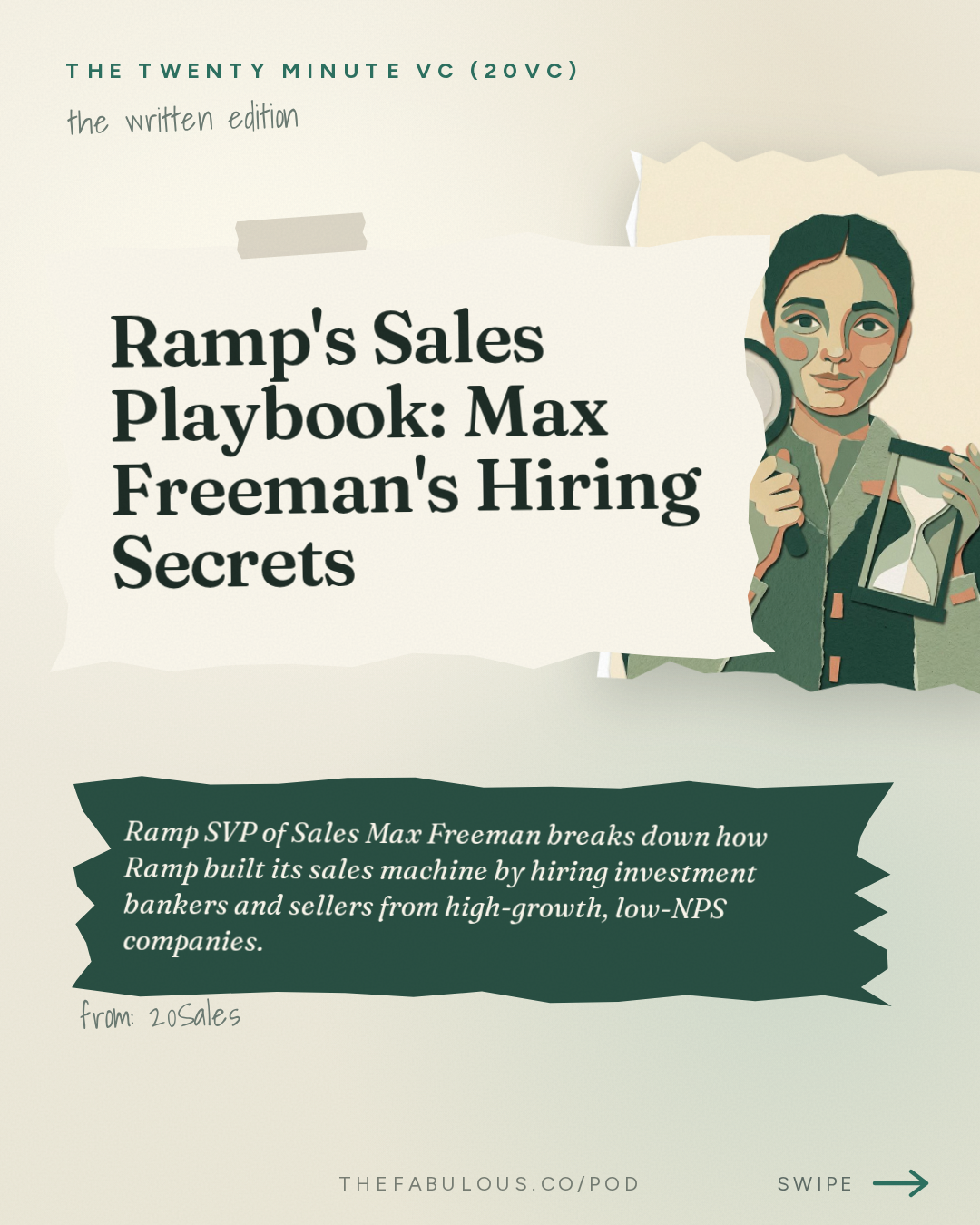
Ramp SVP of Sales Max Freeman breaks down how Ramp built its sales machine by hiring investment bankers and sellers from high-growth, low-NPS companies. He pays SDRs double market rate for 4 to 6 times standard output and automates outbound research down to 90 seconds per lead.
Max Freeman once quit a stable job as a mid-market account executive to become an SDR (sales development representative, the entry-level role that books meetings for closers) all over again at Ramp. People at the company looked at him, he says, like he had twenty heads (14:58). The demotion was deliberate. Freeman, now Ramp's SVP of Sales, had decided that career acceleration comes from three things: the size of the market, the density of the talent around you, and the quality of the founders, never the title on the offer letter. That bet paid off. Ramp, the corporate card and spend management company founded by Eric Glyman and Karim Atiyeh, became one of the fastest growing software companies in the world, and Freeman's sales organization built much of the machine that got it there.
The strangest ingredient in that machine is investment bankers. Freeman has pulled sellers from Goldman Sachs and Citi and put them in charge of large pieces of Ramp's revenue (05:19). His reasoning has nothing to do with financial modeling. Bankers, he says, are programmed to work; the nine to five is foreign to them (05:44). They carry business acumen that is hard to teach quickly, and because Ramp sells into the office of the CFO, a banker who opens with 'I just quit my job at Goldman TMT IB to join this credit card business' gets a hearing a generic sales rep would not (05:44). Early sales teams don't have time to train someone on cold-email grammar or call discipline, so hiring people who already carry that polish lets the team skip a step (06:20).
Freeman calls his broader hiring philosophy a Moneyball approach, after the Oakland A's strategy, popularized in the book Moneyball, of finding undervalued baseball players through overlooked statistics. The Ramp version looks for sellers at companies that have grown revenue past nine figures despite a low Net Promoter Score, the standard customer satisfaction metric that measures how likely a customer is to recommend a product (09:40). A salesperson who hits big numbers at a company with an unloved product had to create demand from nothing, argue past bad reviews on sites like G2, and defend a premium price against cheaper rivals. Put that person inside a company with a product customers actually want, Freeman argues, and the alpha shows up fast (10:01).
Spotting that talent requires an interview built to catch bluffing. Freeman does not ask candidates for their number; he asks them to decompose it. How much of the two million dollars in sales was inbound. How much was outbound. How much was expansion of an existing account, or inherited pipeline, or a deal the founder sourced personally (11:26). Then he asks for a chronological walk-through of two deals, watching for whether the candidate can describe the real mechanics of advancing a sale, plus a story about a deal they lost, to see if they own the loss rather than blame a competitor or an uncooperative buyer.
"You've just been selling shit products." Max Freeman, [10:45]
That line sums up his read on candidates who come from weak products: their numbers can look unremarkable next to Ramp's, but the underlying skill transfers. The screening continues into a business case exercise, a mock discovery call where Ramp checks whether the candidate has researched the prospective company, down to its regulatory filings, and whether, bluntly, Freeman would buy a product from this person (13:45). If the answer is no, he does not hire.
The Machine Behind the Pitch
Where the conversation turns genuinely unusual is Freeman's claim that outbound sales, the unsolicited emails and calls that build a pipeline, is not a writing problem. It is an engineering problem.
"Sales is very much an engineering problem when you break it down. It's a data infrastructure problem. It's a math problem." Max Freeman, [18:18]
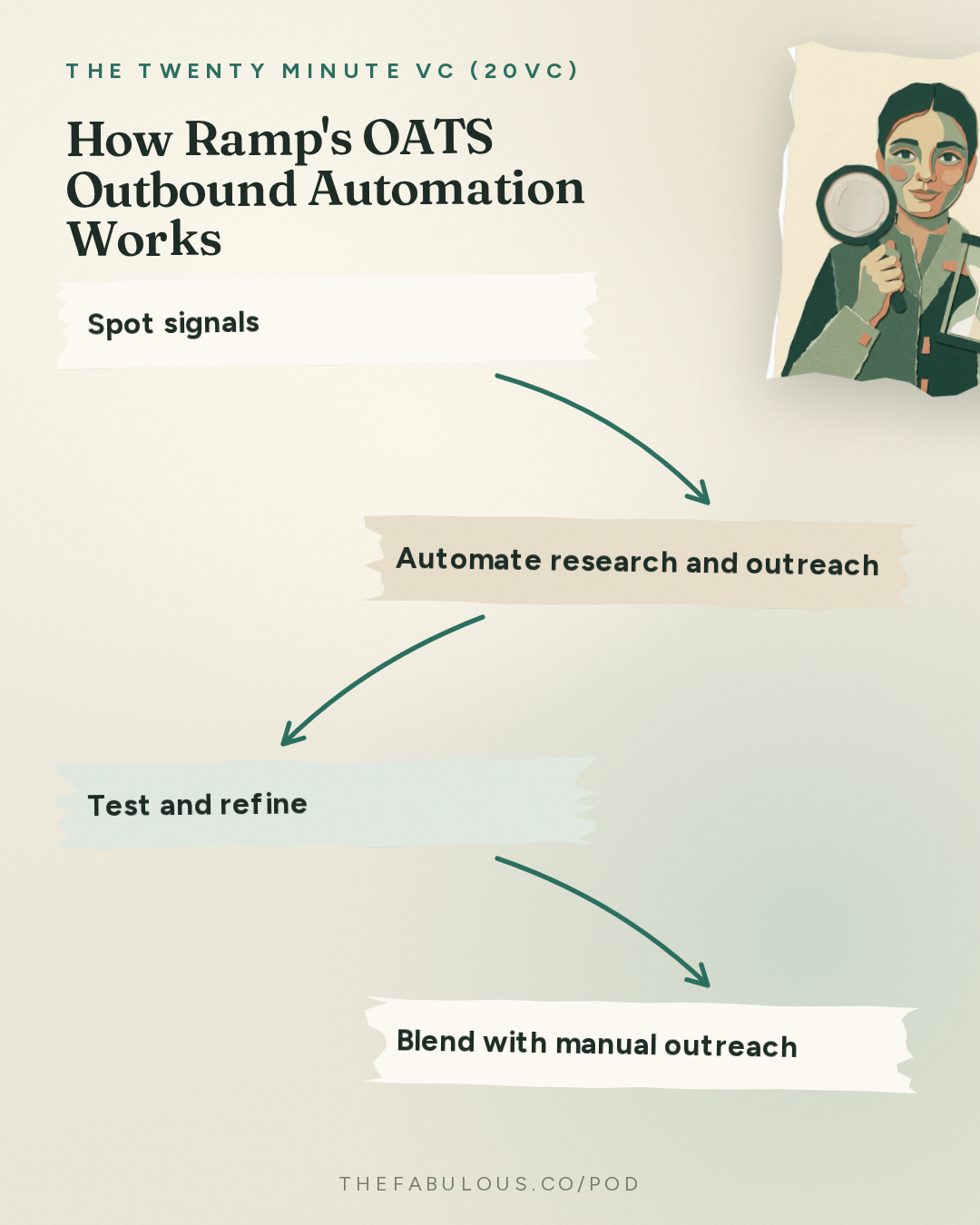
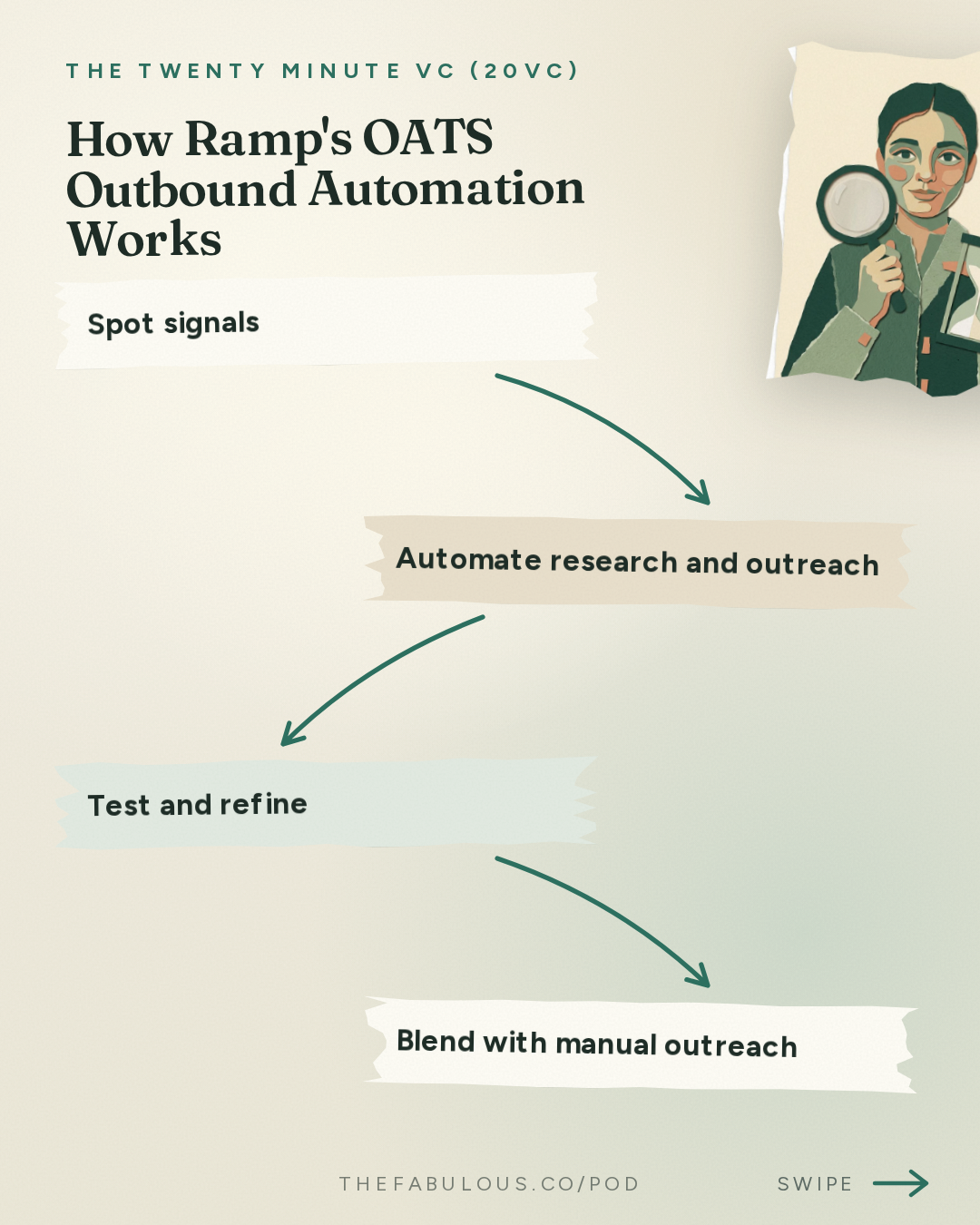
In late 2020, before generative AI made this kind of thing fashionable, Ramp built internal infrastructure called OATS, short for outbound automation team, to industrialize the work a good SDR does by instinct (19:05). The system watches for signals, a new executive hire at a target company, a shared investor on the cap table, an overlapping university, then automates the list building, contact research, and first touch email that used to eat a rep's morning (19:32). Ramp now runs a growth engineering team of roughly half a dozen engineers whose only job is building tools for sales (22:12). The payoff is coverage: a small early sales team cannot send more than a few hundred manual emails or dials a day, which is not enough in markets with constantly expanding addressable sizes, so automation lets a handful of people act like an army (20:38). Freeman is careful to note the system is not a replacement for curated outreach. It has to be recursive, constantly testing what converts and feeding that back in, and a well researched personal note from a human still beats a template (21:31). The benchmark he uses for a healthy outbound program is a meeting conversion rate just under one percent of emails sent (23:02).
That same instinct to treat go to market as a system shows up in when Ramp decides to specialize. Verticalizing a sales team, organizing reps around one industry like airlines or construction, feels like an obvious efficiency move, but Freeman argues most companies do it too early. While a market is still wide open, splitting a team by vertical shrinks the pool of leads each rep can chase. The right trigger, he says, is roughly three to five percent market share, the point where a company has to switch from grabbing new accounts to converting the leads it already has at a higher rate (24:08). He points to Oracle, Workday, and SAP as companies that made that pivot at the right moment.
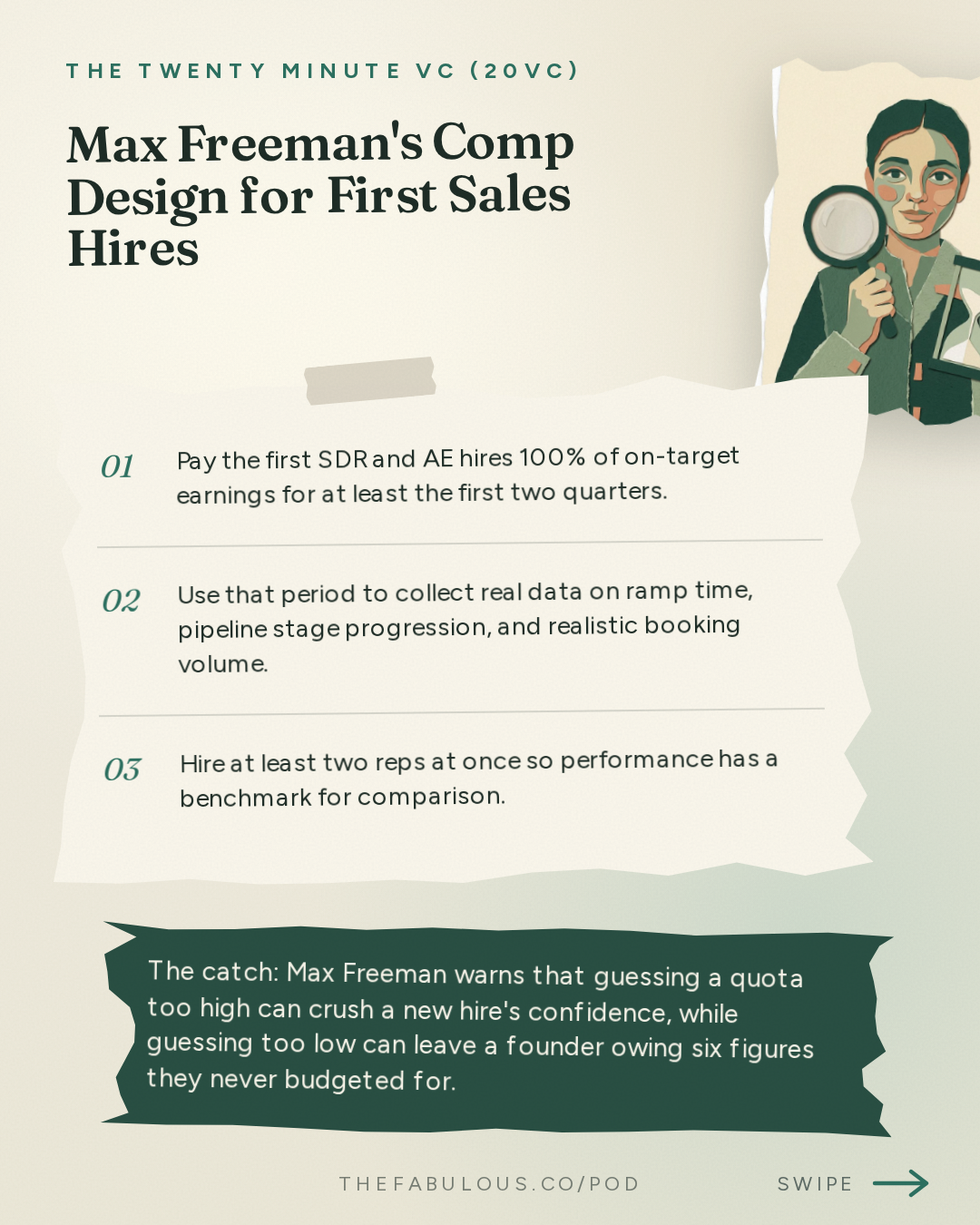
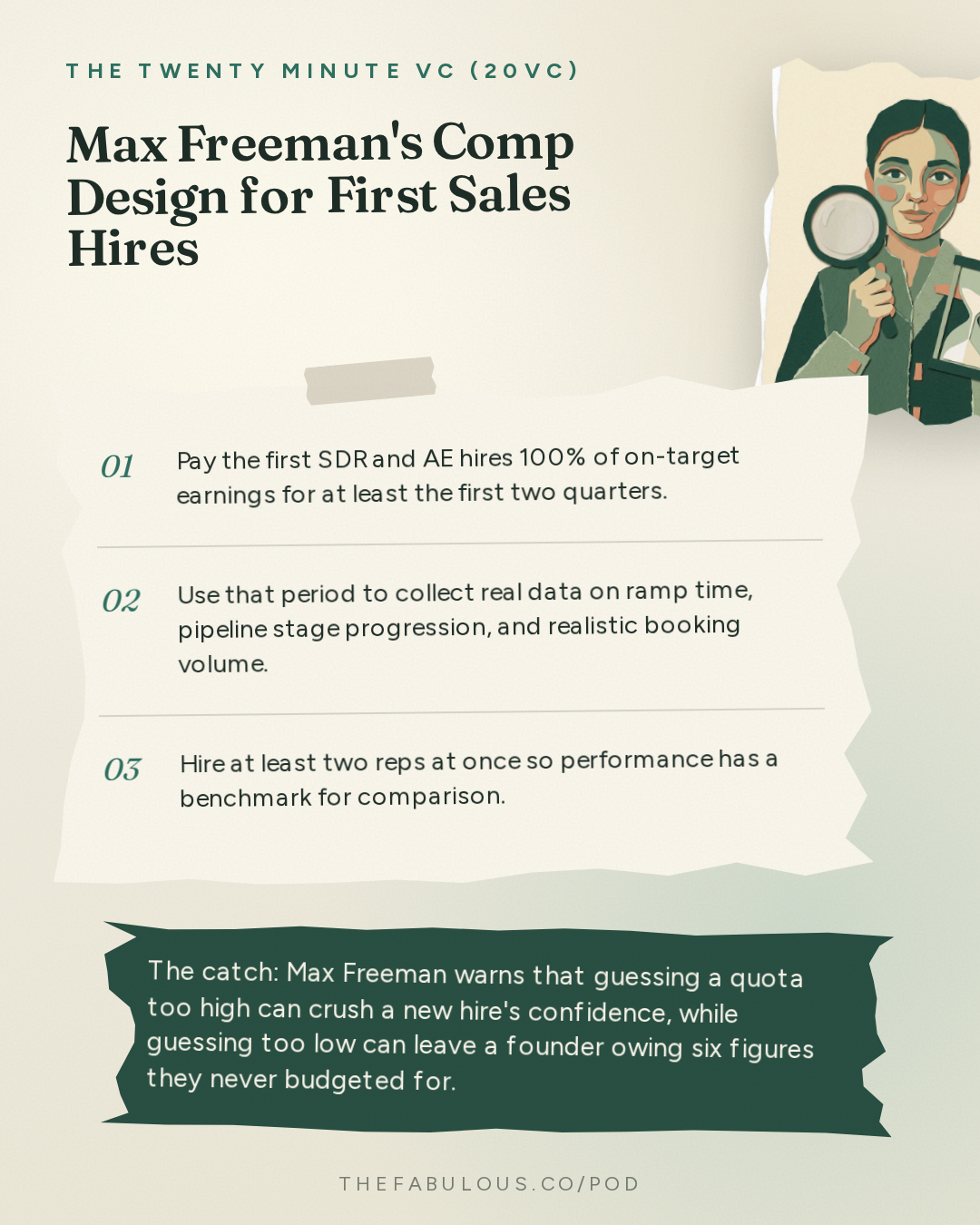
Compensation follows an equally deliberate script. Freeman tells founders not to build a commission plan at all for the first two quarters, paying the first SDRs and account executives 100 percent of their on target earnings while the company gathers real data on what a reasonable quota looks like (28:01). Guess wrong too early, he warns, and a founder can end up owing a top performer six figures they never budgeted for, or set a target so unreachable that a new hire's confidence collapses before it has a chance to build (28:16). He also insists founders never hire one salesperson at a time, since a single hire gives no benchmark for whether they are actually good. Hire in pairs instead, let them compete, and only act on the gap if one is a clear outlier; a ten to twenty percent difference is worth investigating, not punishing, since it might reflect better pipeline rather than better selling (29:44).
Onboarding gets the same systematized treatment. New Ramp sellers go through a sixty to ninety day boot camp built around four pillars: deep product knowledge, the priorities of different buyer personas, since a venture backed CFO wants a different conversation than a construction company's accountant, the lineup of competitors, and the internal operating mechanics of how Ramp itself runs (34:57). Certifications in discovery and demo skills are mandatory; fail them, and a new hire does not get accounts routed to them at all (36:44). Full independence, taking calls without a manager listening in, arrives in two to four weeks (37:31), though the full ramp period before a rep is expected to hit quota stretches from sixty days for inside sales up to six months for strategic enterprise deals, scaled to how long those sales cycles naturally run (41:00). Freeman says he can often predict who will succeed just from who pesters him with questions in week one; relentless, specific curiosity correlates with later performance, while quiet, hands off new hires are a weak signal (41:45).
Forecasting, the unglamorous discipline of predicting how much revenue closes and when, gets less sympathy. Freeman credits Ramp's finance team with models accurate within a five percent margin across the whole business (45:30), a precision he attributes less to software than to incentives: sellers are not paid on forecasting accuracy, but it shows up in every one on one and performance review, so they learn to care (46:18). He has eliminated separate forecasting calls entirely, calling them performative work theater now that the pipeline data speaks for itself, and keeps only a weekly pipeline review focused on the deals at risk of being lost, not the ones already going well (47:25).
The newest layer is an internal tool called Ramp Revenue, built to close what Freeman calls the talent gap between an average seller and a great one. Before a call, a strong rep might spend fifteen to thirty minutes researching a prospect across LinkedIn, the company website, and data platforms like PitchBook; an average seller often skips that work. Ramp Revenue automates the research and surfaces it in about ninety seconds (51:53), freeing time that Freeman says Ramp converts directly into higher quotas. He still sends at least five cold emails a day himself as SVP of sales, on the theory that a leader who drifts too far from the customer eventually loses the standing to lead.
"The moment that we as leaders get further and further away from the customer and what it is that our sellers are doing, I think we die." Max Freeman, [55:12]
None of this reads like a growth hack. It reads like an operating system built the way an engineer would build one: find the bottleneck, instrument it, automate what can be automated, and hold a human accountable for everything else.
Ask this episode anything
Pod's AI answers from the episode itself, with the minute mark so you can hear it yourself.
Or start with one of these
Ask this episode
Pod's AI listens to the whole episode to answer, and points you to the minute it comes from.
The rest of this answer, and any question after it
Answers come from the episode itself, never from a summary of it.
ContinueKey takeaways
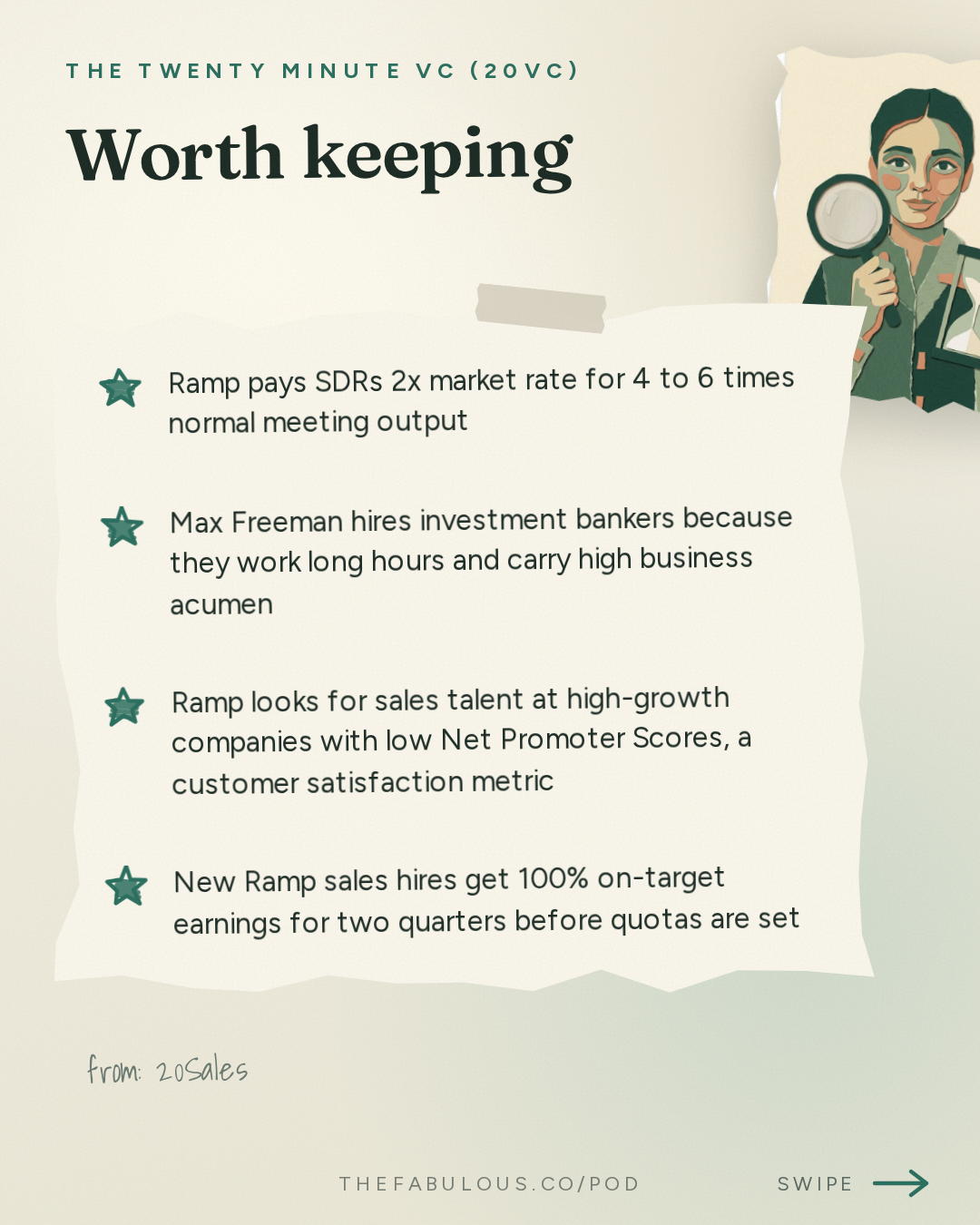
- Ramp pays SDRs 2x market rate for 4 to 6 times normal meeting output
- Max Freeman hires investment bankers because they work long hours and carry high business acumen
- Ramp looks for sales talent at high-growth companies with low Net Promoter Scores, a customer satisfaction metric
- New Ramp sales hires get 100% on-target earnings for two quarters before quotas are set
- Ramp's internal tool cuts pre-call research time from up to 30 minutes to 90 seconds
The episode in cards

By the numbers
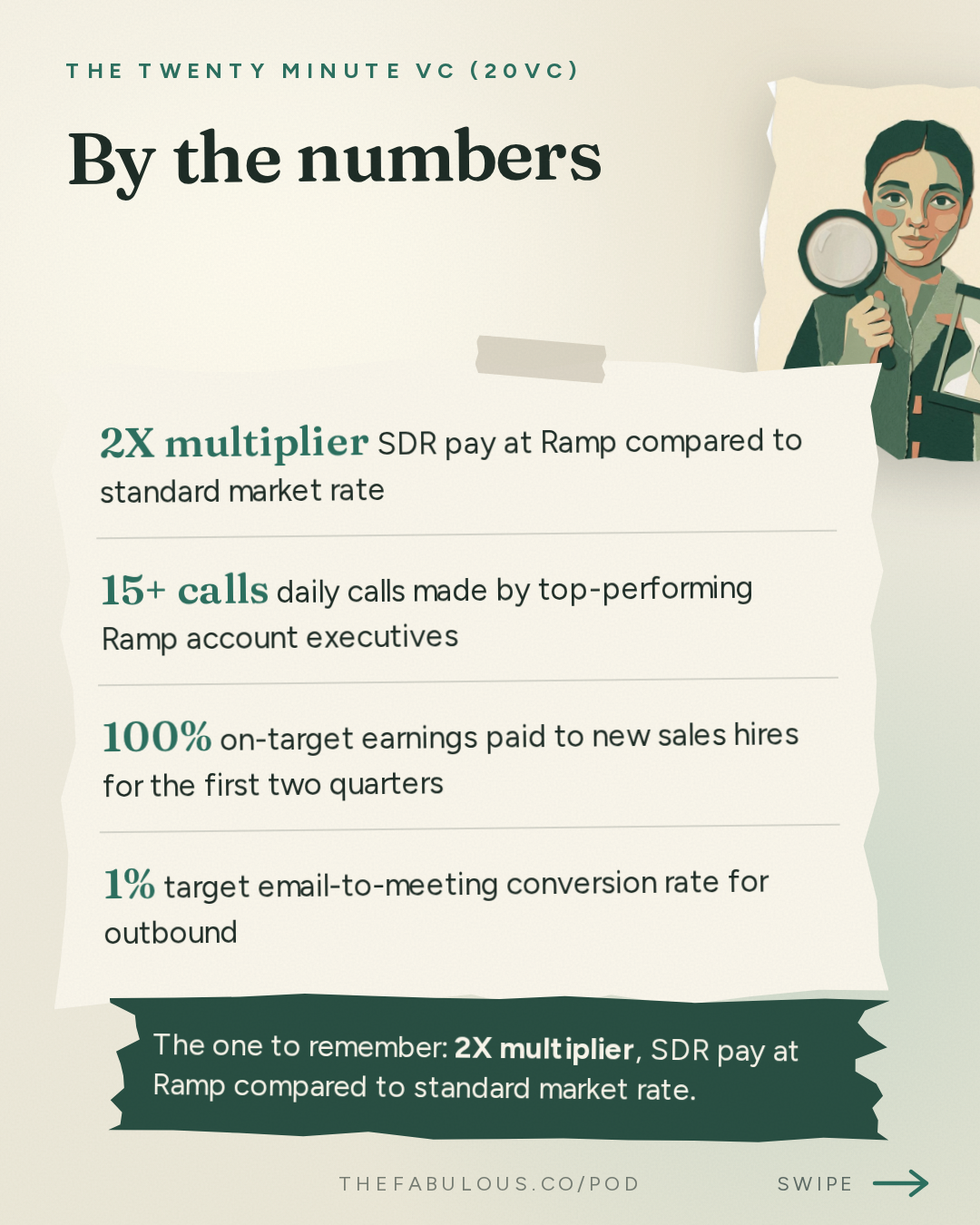
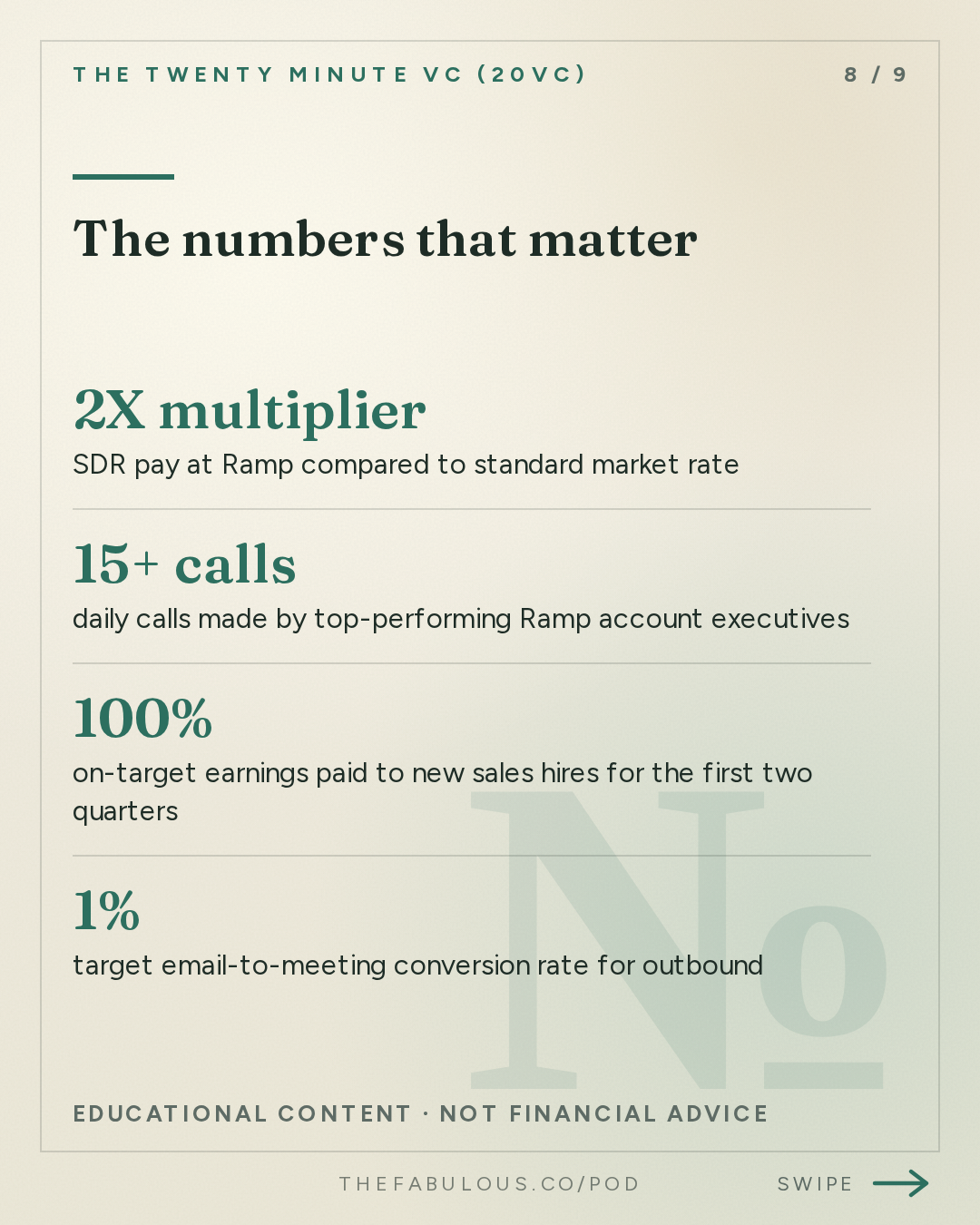
- 2X multiplier SDR pay at Ramp compared to standard market rate
- 15+ calls daily calls made by top-performing Ramp account executives
- 100% percent on-target earnings paid to new sales hires for the first two quarters
- 1% percent target email-to-meeting conversion rate for outbound
- 90 seconds time for Ramp's automated pre-call research tool to finish
In their words
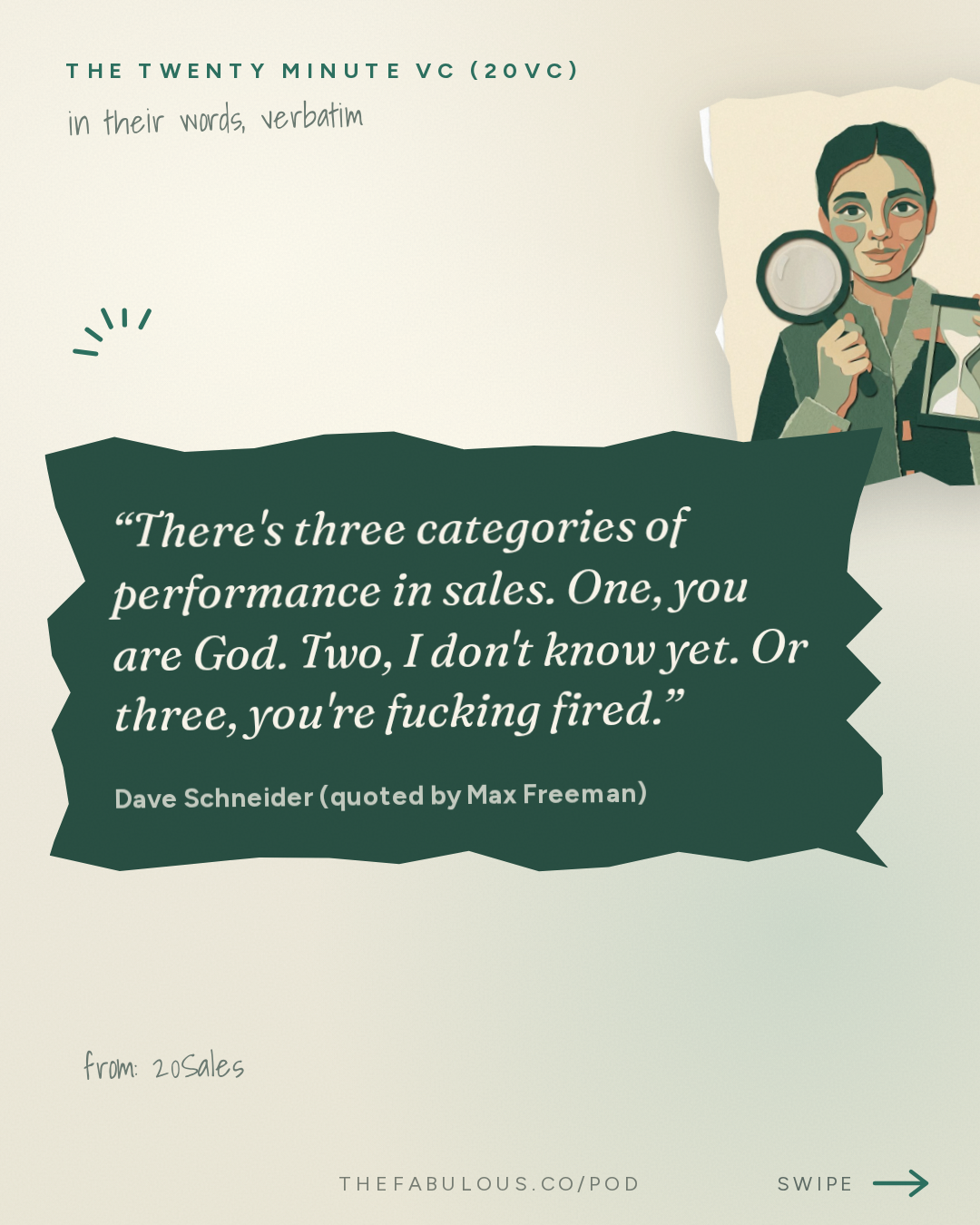
“There's three categories of performance in sales. One, you are God. Two, I don't know yet. Or three, you're fucking fired.”
“Sales is very much an engineering problem when you break it down. It's a data infrastructure problem. It's a math problem.”
“You've just been selling shit products.”
“The moment that we as leaders get further and further away from the customer and what it is that our sellers are do- doing, I think we die”
Protocols
-
Pay new sales hires full OTE before setting quotas
Max Freeman advises founders to pay the first sales hires 100% of on-target earnings for at least two full quarters instead of building a commission plan right away. He says this gives the company real performance data before committing to a quota number that could be badly wrong in either direction.
First two quarters of employment
-
Hire salespeople in pairs, never one at a time
Freeman tells founders to hire at least two sales reps at once rather than a single hire, because one person alone gives no benchmark for whether their performance is good or bad. He treats a 10 to 20 percent performance gap between the pair as worth investigating rather than acting on, since it may reflect pipeline quality rather than skill.
At every early sales hiring round
-
Over-incentivize new products with inflated quota credit
Freeman has sales reps retire 2 to 3 times the normal quota value when they sell a newly launched product, to push the team toward building early case studies and momentum. He says this incentive design becomes essential once a company is mature enough to sell multiple products at once.
During each new product launch
-
Verticalize sales only after owning 3 to 5 percent of the market
Freeman recommends against organizing a sales team by industry vertical while a market is still wide open, because it narrows the pool of leads each rep can pursue. He says the right time to specialize is once a company owns roughly 3 to 5 percent of its addressable market and needs to convert existing leads at a higher rate instead of finding new ones.
Once market share reaches 3-5%
Questions this episode answers
Why does Ramp hire investment bankers for sales roles?
Ramp SVP of Sales Max Freeman says bankers are already conditioned to work long hours, carry strong business acumen, and can open doors with CFOs by naming a firm like Goldman Sachs (05:44). He adds that early sales teams don't have time to teach basic professionalism, so hiring people who already have it lets the team focus purely on execution (06:20).
How much does Ramp pay its SDRs compared to the market?
Freeman says Ramp pays sales development reps, or SDRs, roughly double the standard market rate, but expects 4 to 6 times the typical meeting output in return, with top performers booking 40 to 60 meetings a month (07:25). He frames this as a deliberate unit-economics bet rather than simple overpayment.
What is Ramp's OATS outbound automation program?
OATS, short for outbound automation team, is internal infrastructure Ramp built starting in late 2020 to automate parts of outbound sales such as list building, contact research, and first-touch emails (19:05). Freeman says the system tracks signals like a new executive hire or a shared investor, and he treats a meeting conversion rate just under 1% of emails sent as a strong outbound benchmark (23:02).
How should founders structure pay for their first sales hires?
Max Freeman advises paying the first SDR and account executive hires 100% of on-target earnings for at least two quarters instead of setting a quota immediately, since founders often guess wrong on numbers before they have real data (28:01). He also recommends hiring at least two reps at once so their performance can be benchmarked against each other rather than guessed at (29:44).
When should a startup verticalize its sales team?
Freeman says companies verticalize, meaning they organize sales reps around a single industry, far too early. He recommends waiting until a company owns roughly 3% to 5% of its addressable market, the point where focus needs to shift from finding new leads to converting existing ones at a higher rate (24:08).
What does Ramp's internal sales tool actually automate?
Ramp built an internal system called Ramp Revenue that performs pre-call research automatically, a task that used to take a seller 15 to 30 minutes per prospect, cutting it down to about 90 seconds (51:53). Freeman says the tool also closes the skill gap between average and top sellers by surfacing account details a less experienced rep might miss (51:06).
The full read, in cards
Go deeper
- Moneyball — Cited as the model for finding undervalued sales talent through overlooked signals like low NPS at high-growth companies
Mentioned
Max Freeman · Ramp · Goldman Sachs · Moneyball · Billy Beane · Eric Glyman · OATS · Gong · Inspect · Dave Schneider
More from this show and category

OpenAI's $70B Run Rate and the AI Deal Wars
OpenAI's revenue run rate is nearing $70 billion, re-accelerating sharply just as Anthropic prepares to go public. The episode also unpacks a Cognition-Factory executive poaching dispute, Vinod Khosla's public swipe at a portfolio founder, ElevenLabs' jump to a $22 billion valuation, Salesforce's $2 billion purchase of Listen Labs, and legal risk in Nvidia's $17 billion Groq license deal.

Venky Ganesan on AI Venture Capital Ownership
Menlo Ventures partner Venky Ganesan says AI seed rounds now run $10-20 million, and ownership matters less than owning a sliver of a giant. Drawing on 28 years in venture capital, he argues investors should expect 60% dilution by exit, cap single-company bets near 20% of a fund, and chase cash returns over paper markups.

Chase Lochmiller on AI Data Center Economics
Crusoe Energy co-founder Chase Lochmiller argues AI's real bottleneck is energy and manufacturing, not chips, and vertical integration beats business moats. He says data centers actually lower local energy prices, use near-zero water, and that about half of planned projects will never get built.

Parag Agrawal on AI Agent Web Search
Parallel founder Parag Agrawal predicts AI agents will search the web 1,000 times more than humans, breaking today's ad-supported internet. He says Parallel already delivers search results up to 50 times cheaper than legacy stacks, and that 5 to 20 percent of all inference spend will eventually flow into web search infrastructure built for agents, not people.
