
Chase Lochmiller on AI Data Center Economics
20VC: The Future of Datacentres: What You Need to Know | Why Everyone Gets GPU Depreciation and AI's Energy Costs Wrong | Who Really Makes Money From AI & Why Most Moats Don't Exist with Chase Lochmiller
The brief
Crusoe Energy co-founder Chase Lochmiller argues AI's real bottleneck is energy and manufacturing, not chips, and vertical integration beats business moats. He says data centers actually lower local energy prices, use near-zero water, and that about half of planned projects will never get built.
Chase Lochmiller spent his twenties training to become a theoretical physicist at MIT and Los Alamos National Lab, chasing what he calls a monastic life of discovery. He decided the field moved too slowly, switched into quantitative finance, made money, and in 2018 walked away to climb Mount Everest with nothing planned for afterward (08:18). That blank slate, he says, is where the idea for Crusoe Energy came from. Crusoe is now one of the companies building the physical plumbing of the AI boom: the data centers, the chips inside them, and the software layer that turns both into billable tokens. The company just closed a $3.9 billion Series F at a $30.9 billion valuation (01:16).
Lochmiller runs the company on a philosophy borrowed from the mountains. Crusoe has written "think like a mountaineer" into its official values: expect things to go wrong, keep a plan B and a plan C, and treat safety as non-negotiable, which matters more now that the company is pouring concrete and wiring high-voltage power at industrial scale.
"Getting up to the top is optional, getting down is mandatory. We try to practice that safety culture here at Crusoe." — Chase Lochmiller [06:40]
Crusoe did not start as an AI company in practice, even though Lochmiller says that was always the destination. In its early years the business monetized stranded energy, mostly natural gas that would otherwise be flared at oil wells, by running Bitcoin mining rigs on it. That detour taught the company something useful: how cheap a data center becomes once you strip out redundancy. Lochmiller says the Bitcoin industry cut data center costs by roughly 98% by moving from colocation-grade facilities, built to the "five nines" reliability standard, down to bare, no-frills buildings he calls "chicken coops" (15:53). Crusoe launched a cloud platform for AI researchers in early 2022, but the moment that reordered the company's priorities, he says, was November 30, 2022, the day ChatGPT launched (14:33).
Why Crusoe Builds Its Own Parts
The case Lochmiller makes for vertical integration (owning more of the supply chain rather than buying each piece from a vendor) is concrete rather than ideological. When Crusoe committed to building its first data center campus in Abilene, Texas, in one year, against competing bids of two and a half years, it hit a bottleneck: a power distribution center, the equipment that steps high-voltage power down to something a server rack can use. The standard market lead time for that part was 100 weeks. Crusoe's team instead sourced components and manufactured the units itself, cutting delivery to 28 weeks (19:14). Lochmiller borrows a phrase from Elon Musk to describe the discipline behind this: the "idiot index," the ratio between what raw materials cost and what the finished product sells for. Owning more of the chain does not mean fat margins on manufacturing, which he says is not a high-margin business even now. What it buys is speed, availability, and a clear view of true costs across the whole stack.
That same logic reshaped where AI infrastructure gets built. Traditional internet infrastructure clustered around hubs like Northern Virginia because network latency mattered. Lochmiller argues AI workloads behave differently: most of the time to answer a prompt is spent computing inside the data center, not traveling to it. That breaks the old anchor to centralized hubs and opens the door to building wherever power is cheap and abundant.
"The infrastructure to support AI wasn't gonna be centralized. It was gonna be distributed where energy was low cost and abundant." — Chase Lochmiller [17:16]
Lochmiller spends real time pushing back on what he calls misinformation about data centers. On water: modern AI buildings use closed-loop cooling, and he says one of Crusoe's 140-megawatt buildings in Abilene uses about as much water annually as 10 single-family homes, mostly from staff using sinks and bathrooms (25:05). On electricity prices: he argues data centers typically bring local energy costs down, not up, because new generation investment gets spread across more megawatts and the same transmission infrastructure (26:13). Where he is less bullish is on the pipeline itself. Asked what share of currently planned data centers will actually get built, he puts it at roughly 50%, citing failures in permitting, land acquisition, and utility interconnection agreements as the usual killers (28:29).
The AI Super Major
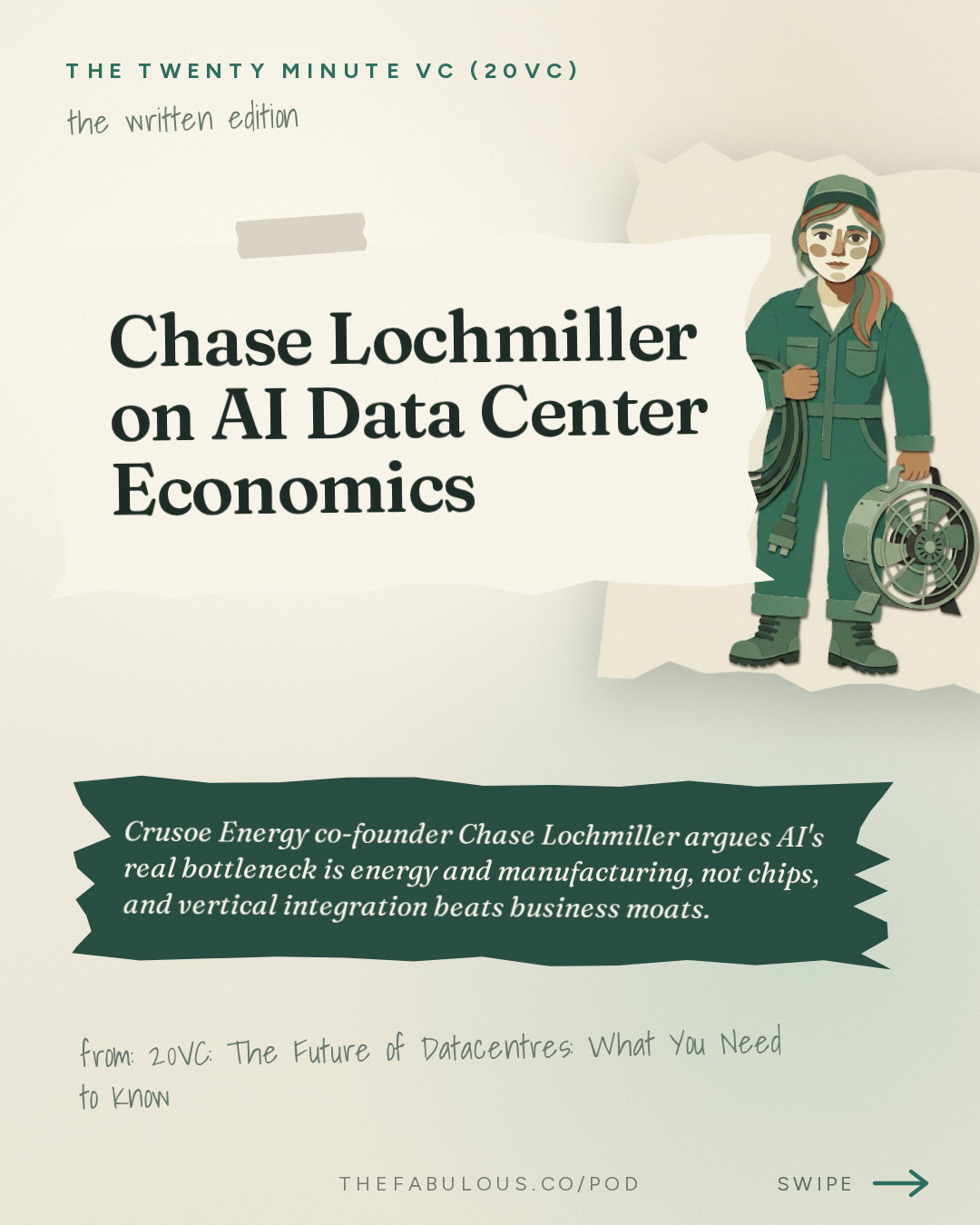
Lochmiller frames Crusoe's business as three products sold across one value chain: data centers, GPUs, and tokens (34:36). He draws the analogy directly from oil and gas, where companies like Exxon and Chevron are "super majors" spanning upstream drilling, midstream transport, and downstream refining. Exxon famously does not hedge its oil exposure, because vertical integration is itself a hedge: when oil prices fall, upstream margins shrink but downstream margins on gasoline and plastics expand. Lochmiller sees the same seesaw happening across electrical infrastructure, chips, and inference services, and says margin right now is highest in managed GPU rental, because supply is so short (36:23).
That shortage shows up starkly in chip economics. Crusoe depreciates its GPUs on a standard six-year cycle (38:43). When the company placed large orders for Nvidia's Hopper-generation chips back in 2023, the market doubted they would hold value past year three. Three years later, Lochmiller says, the rental rates customers pay for those same Hopper chips are higher than when the chips were brand new, because demand for compute, even older compute, has outrun supply (40:17). The company's bet is that layering managed services like inference and fine-tuning on top of aging hardware can stretch the useful economic life of a chip well beyond its accounting depreciation schedule.
Underneath that bet sits a genuinely technical problem: keeping expensive GPUs busy. Lochmiller calls the GPU the single most valuable object in the building, so idle GPU time is value burning for no reason. The fix involves managing something called the KV cache, short for key-value cache, a lookup table that stores intermediate results from a neural network so it does not have to redo the same math twice. As that cache grows past the fast on-chip memory (HBM), it has to be shuffled across slower system memory and solid-state storage without stalling the chip, which Lochmiller treats as a core engineering advantage for Crusoe's managed inference product (46:16).
"Most moats are a illusion. Most moats don't exist. Most of them are ephemeral." — Chase Lochmiller [55:00]
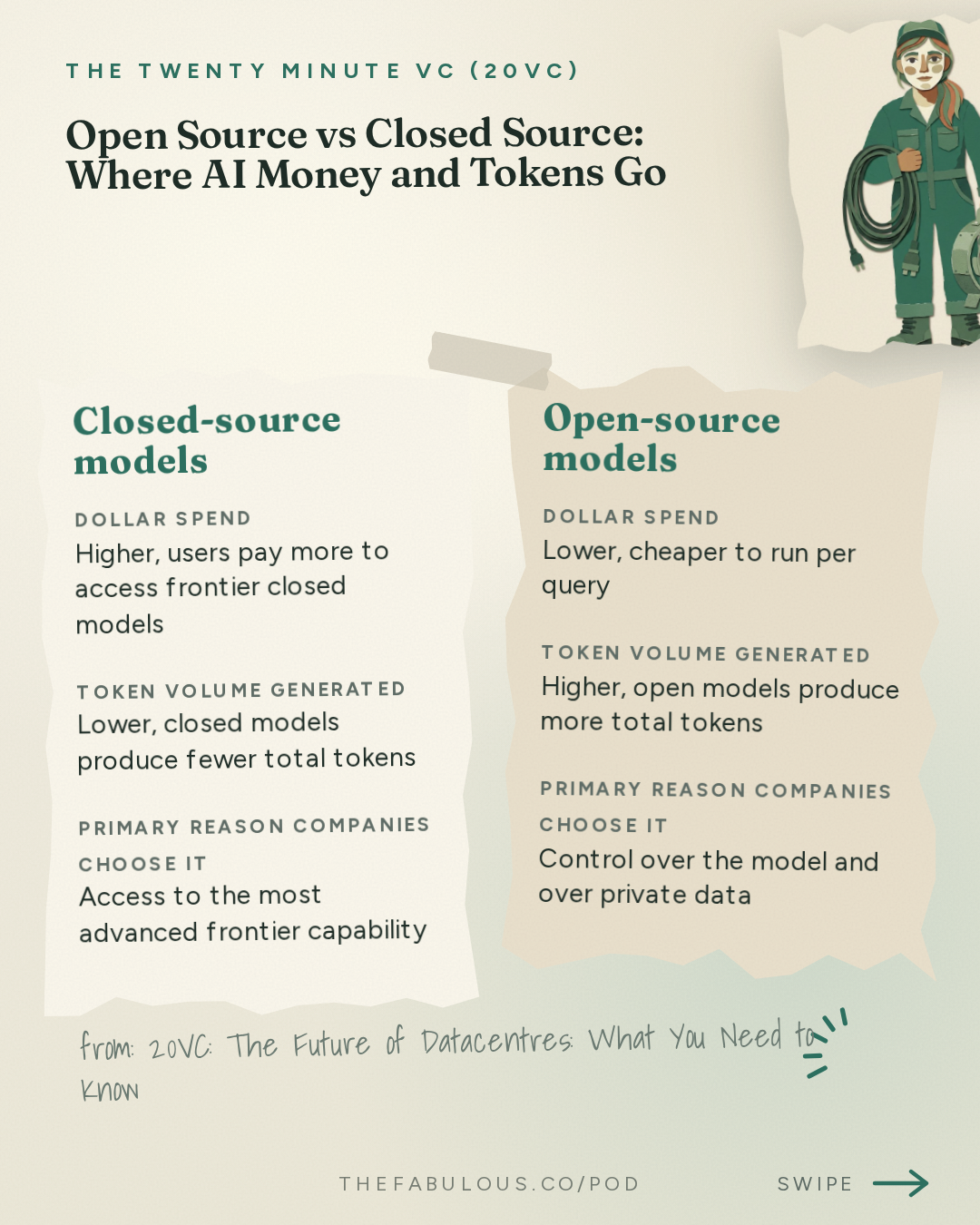
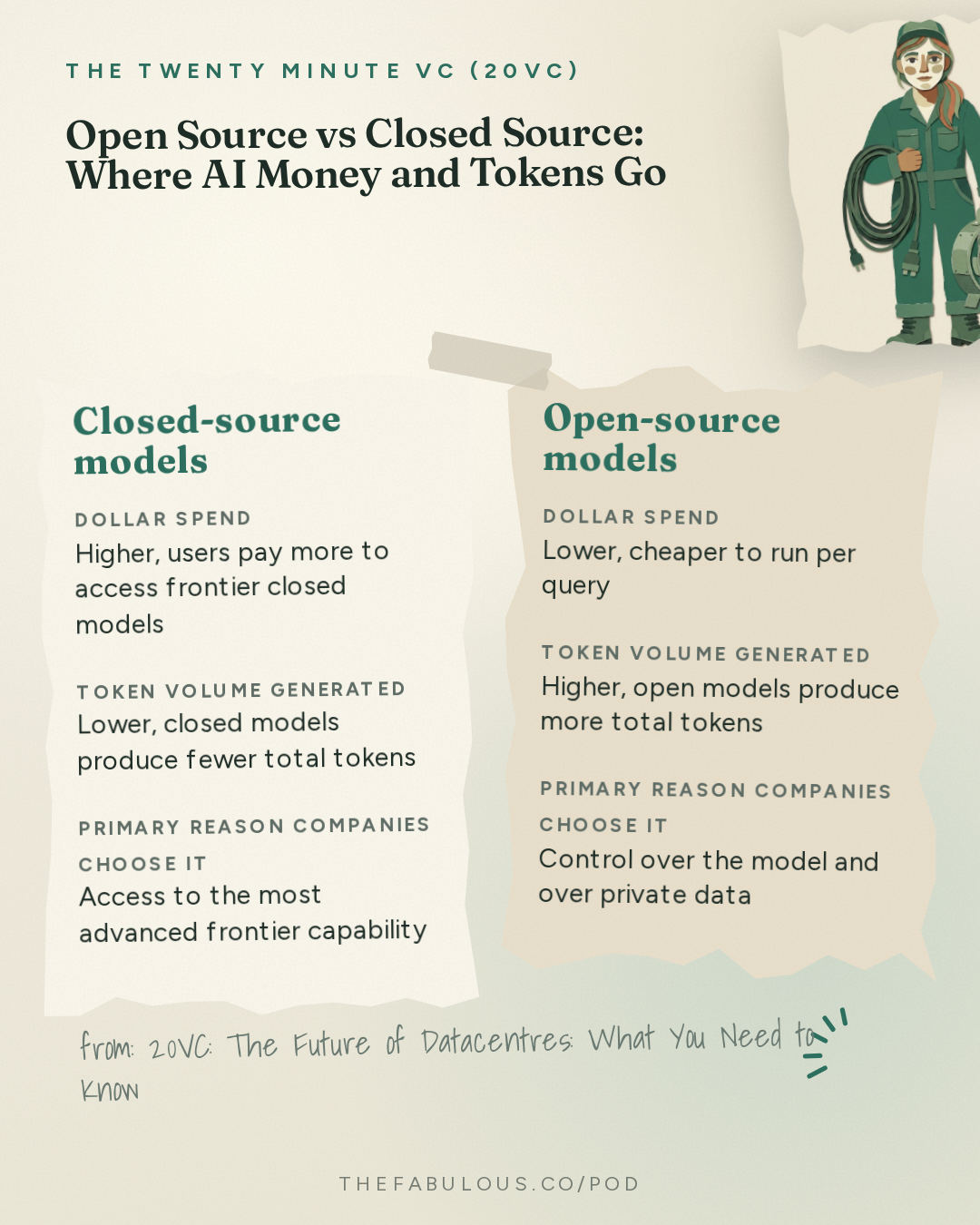
That line lands as the thesis statement for the whole conversation. Lochmiller has watched the market obsess over defensibility, the classic venture capital question of what protects a company's margin over time, and concluded that in AI infrastructure almost nothing stays protected for long. Open-source models are already eating usage even as closed models keep more dollars: Lochmiller says customers spend more money on closed-source frontier models but generate more total tokens on open-source ones, because open models are cheaper to run at volume (49:27). His own answer to the moat question is not a technology but a habit: move fast enough, and adapt efficiently enough, that the next bottleneck gets solved before it becomes someone else's advantage. It is the same instinct he describes on a mountain, where the plan matters less than the willingness to revise it when the weather changes.
Ask this episode anything
Pod's AI answers from the episode itself, with the minute mark so you can hear it yourself.
Or start with one of these
Ask this episode
Pod's AI listens to the whole episode to answer, and points you to the minute it comes from.
The rest of this answer, and any question after it
Answers come from the episode itself, never from a summary of it.
ContinueKey takeaways
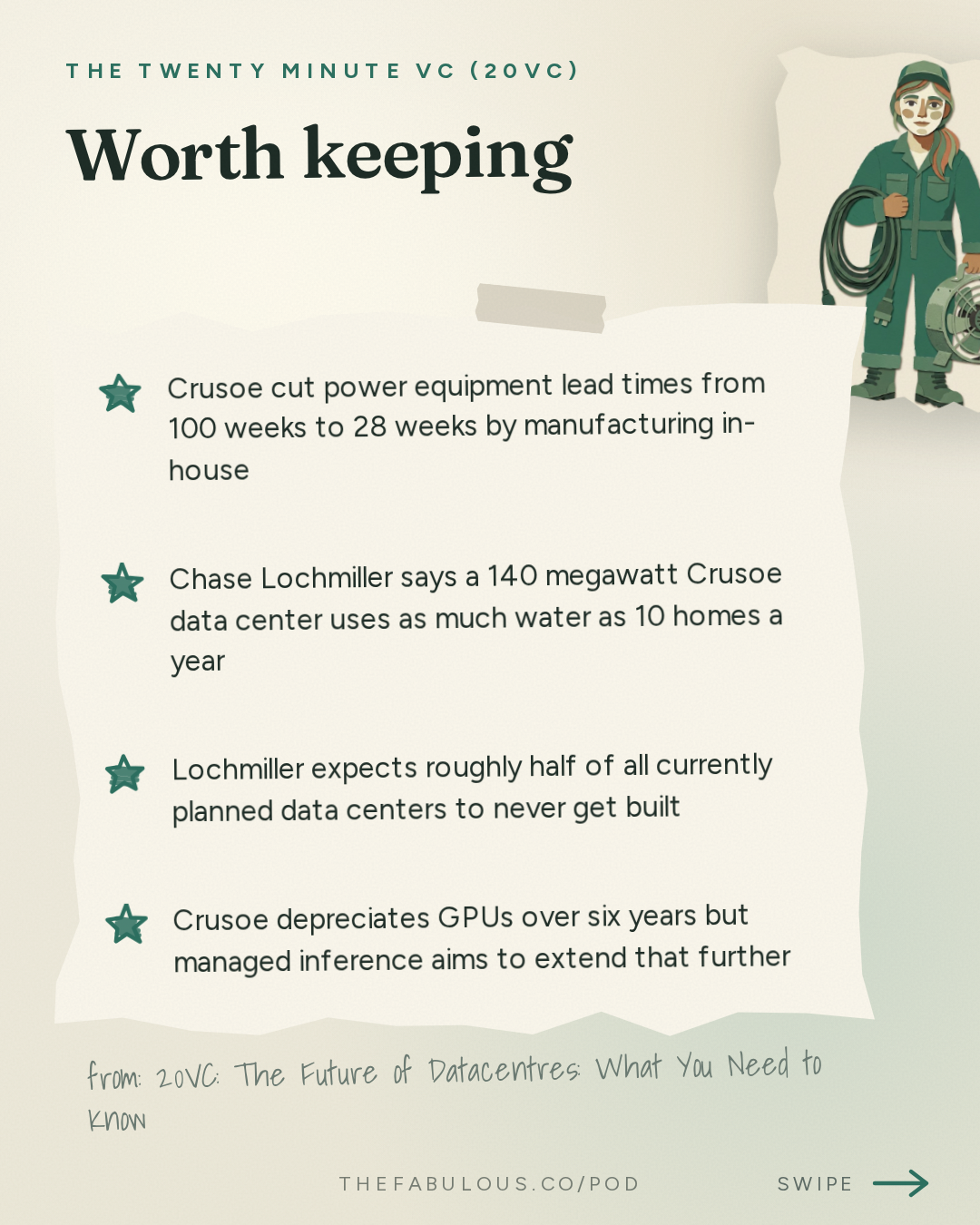
- Crusoe cut power equipment lead times from 100 weeks to 28 weeks by manufacturing in-house
- Chase Lochmiller says a 140 megawatt Crusoe data center uses as much water as 10 homes a year
- Lochmiller expects roughly half of all currently planned data centers to never get built
- Crusoe depreciates GPUs over six years but managed inference aims to extend that further
- Lochmiller says most competitive moats are illusions and speed of adaptation matters more
The episode in cards
By the numbers
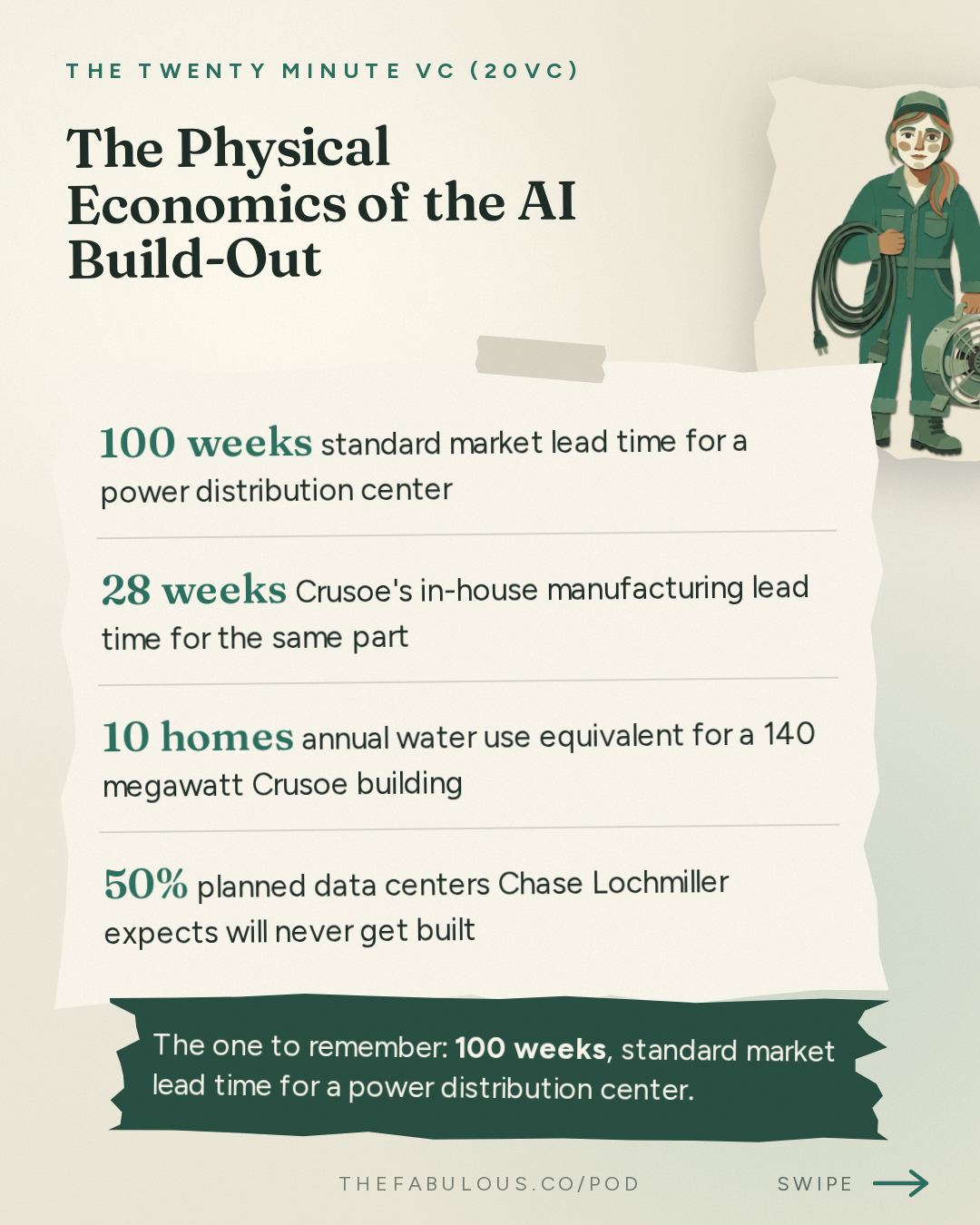
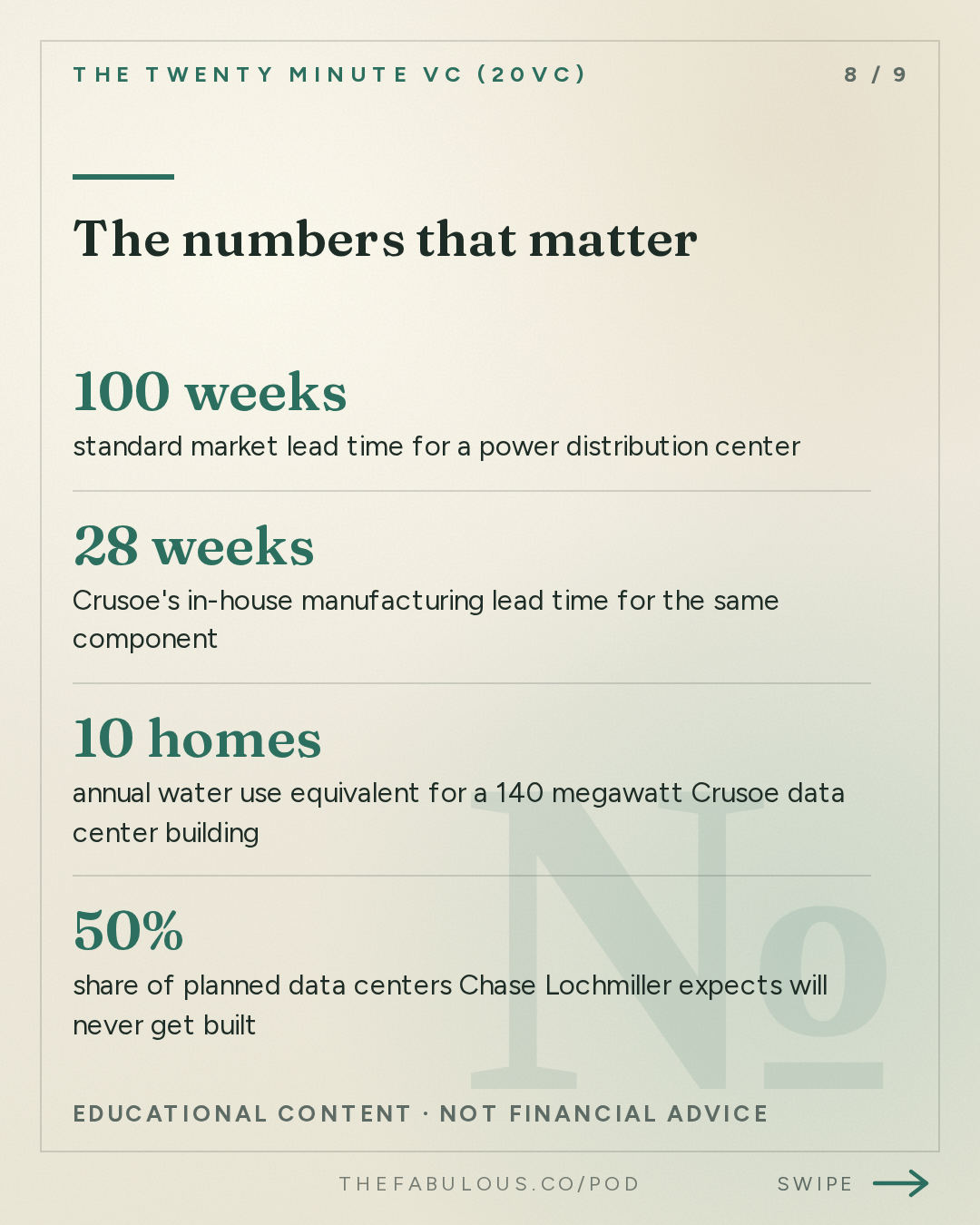
- 100 weeks standard market lead time for a power distribution center
- 28 weeks Crusoe's in-house manufacturing lead time for the same component
- 10 homes annual water use equivalent for a 140 megawatt Crusoe data center building
- 50% share of planned data centers Chase Lochmiller expects will never get built
In their words
“Getting up to the top is optional, getting down is mandatory. We try to practice that, that safety culture here at Crusoe”
“The infrastructure to support AI wasn't gonna be centralized. It was gonna be distributed where energy was low cost and abundant.”
“Most moats are a illusion, that most moats don't exist. Most of them are ephemeral”
Protocols
-
Collapse infrastructure lead times through in-house manufacturing
Chase Lochmiller has Crusoe's internal team manufacture bottleneck components, such as medium-voltage power distribution centers, instead of waiting on outside vendors, and he says this cut delivery time from a 100-week market standard to 28 weeks. The catch is that manufacturing is not itself a high-margin business, so the payoff only shows up in speed and availability, not in extra profit on the part.
applied to every new data center build
-
Extend GPU economic life past the depreciation schedule
Chase Lochmiller depreciates GPUs on Crusoe's books over six years, the industry standard, while building managed inference and fine-tuning services meant to keep monetizing the same chips after that window closes. He notes the catch is that this only works if demand for older, cheaper compute keeps growing alongside demand for the newest silicon.
ongoing, applied per chip cohort purchased
Questions this episode answers
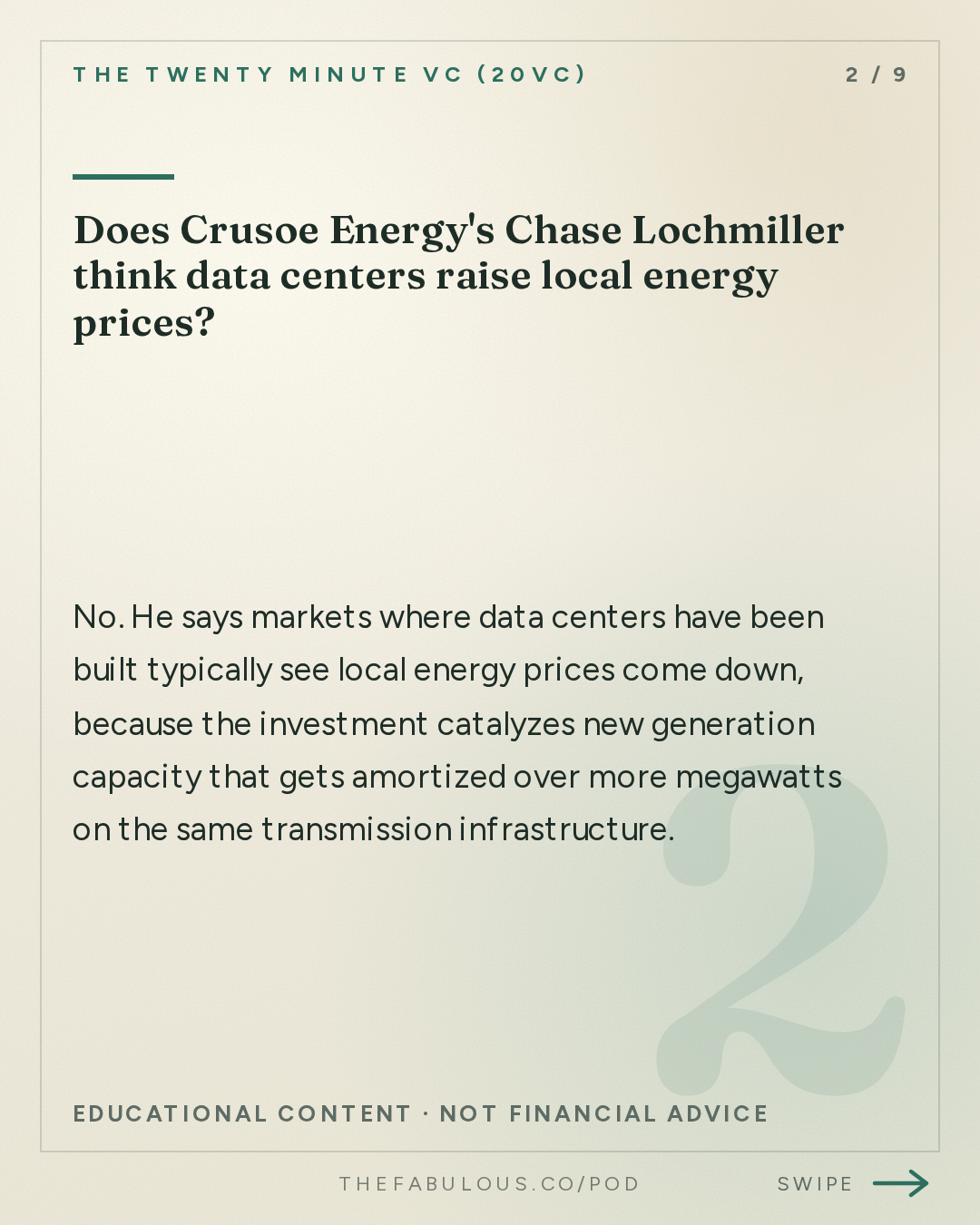
Does Crusoe Energy's Chase Lochmiller think data centers raise local energy prices?
No. He says markets where data centers have been built typically see local energy prices come down, because the investment catalyzes new generation capacity that gets amortized over more megawatts on the same transmission infrastructure (26:13).
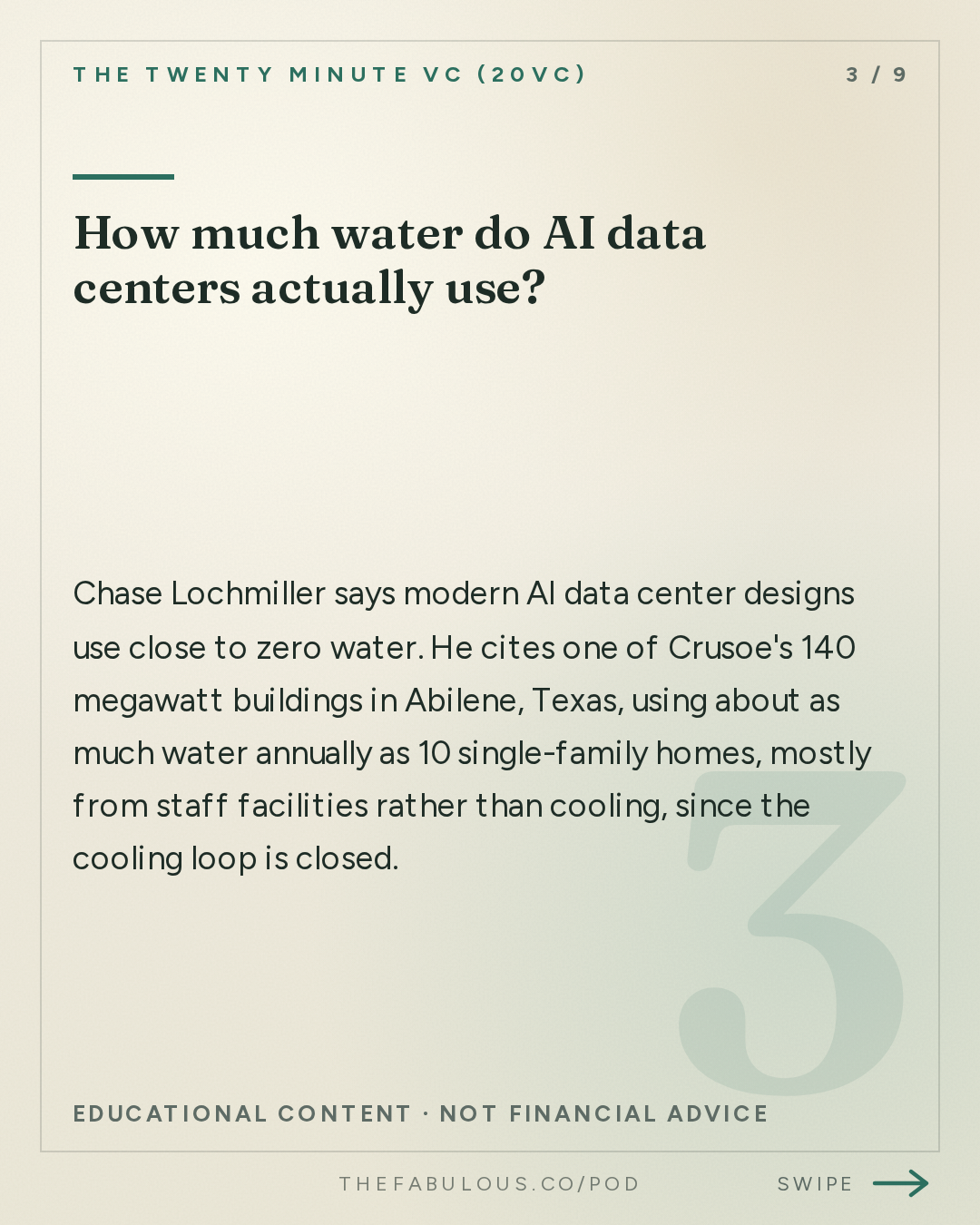
How much water do AI data centers actually use?
Chase Lochmiller says modern AI data center designs use close to zero water. He cites one of Crusoe's 140 megawatt buildings in Abilene, Texas, using about as much water annually as 10 single-family homes, mostly from staff facilities rather than cooling, since the cooling loop is closed (25:05).
How does Crusoe depreciate its GPUs?
Crusoe uses a six-year depreciation cycle for its chips, which Lochmiller calls the industry standard. He says the company is building managed inference and fine-tuning services specifically to extend monetization of chips beyond that six-year window (38:43).
What percentage of planned AI data centers will actually get built?
Chase Lochmiller estimates roughly 50% of currently planned data centers will not get built, pointing to failures in land acquisition, permitting, and utility interconnection agreements as the main causes (28:29).
Why does Chase Lochmiller say most business moats don't exist?
He argues that in a period of fast-moving AI capability gains, most competitive advantages are temporary rather than structural, and that long-term advantage comes from speed of adaptation rather than a defensible position (55:00). This is his personal view on strategy, not an established industry finding.
Are people spending more on open-source or closed-source AI models?
Chase Lochmiller says users spend more total dollars on closed-source frontier models, but that open-source models generate a greater total volume of tokens, largely because they are cheaper to run at scale (49:27).
The full read, in cards

Mentioned
Chase Lochmiller · Crusoe Energy · Nvidia · Abilene, Texas · Exxon · Michael Dell · ChatGPT · Fireworks · Taylor County
More from this show and category

Parag Agrawal on AI Agent Web Search
Parallel founder Parag Agrawal predicts AI agents will search the web 1,000 times more than humans, breaking today's ad-supported internet. He says Parallel already delivers search results up to 50 times cheaper than legacy stacks, and that 5 to 20 percent of all inference spend will eventually flow into web search infrastructure built for agents, not people.

Why Anthropic Delayed Its IPO to November
Anthropic delayed its $2 trillion IPO from October to November to present cleaner third quarter numbers. Meta's Muse app hit No. 1 and emerged as ChatGPT's first rival, developer tool Jev exposed wasted AI spend on simple tasks, seed checks are ballooning toward $10 million, and Crusoe's $30.9 billion valuation stoked fears the AI data center trade is overheating.

Daniel Dines on AI's 'Map of Work' Thesis
UiPath CEO Daniel Dines argues AI still cannot replace enterprise employees because models do not learn on the job the way people do. He says every company needs a documented 'map of work' before handing processes to AI, and that the workflow around a model, not its weights, is where lasting business value sits (26:34, 45:49).

AI's Memory Wall: Thomas Sohmers on Inference Costs
Inference is memory bound: each token requires reading the model's full weights, while training is compute bound and parallelizable. Positron AI co-founder Thomas Sohmers notes GPU memory bandwidth grew only 17X since 2014 versus 120X for flops (07:59), and cached tokens cost about 1,000 times less to process than fresh ones (11:37).
