
Parag Agrawal on AI Agent Web Search
20VC: Five Predictions for a World of Agents | The Ads Business Model Will Die | Biggest Lessons from Working with Elon Musk at Twitter with Parag Agrawal, Parallel
The brief
Parallel founder Parag Agrawal predicts AI agents will search the web 1,000 times more than humans, breaking today's ad-supported internet. He says Parallel already delivers search results up to 50 times cheaper than legacy stacks, and that 5 to 20 percent of all inference spend will eventually flow into web search infrastructure built for agents, not people.
Ask this episode anything
Pod's AI answers from the episode itself, with the minute mark so you can hear it yourself.
Or start with one of these
Ask this episode
Pod's AI listens to the whole episode to answer, and points you to the minute it comes from.
The rest of this answer, and any question after it
Answers come from the episode itself, never from a summary of it.
Continue
Key takeaways
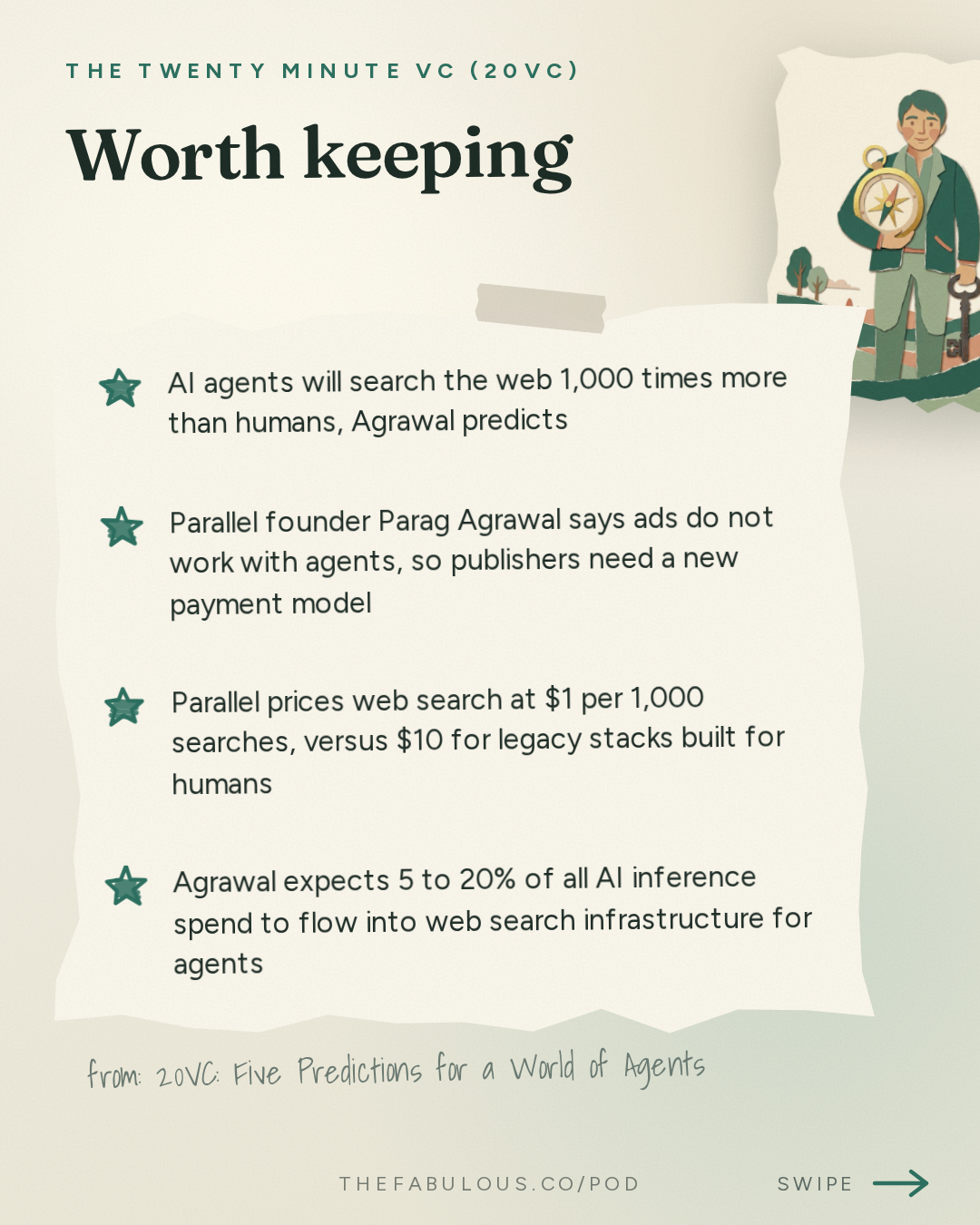
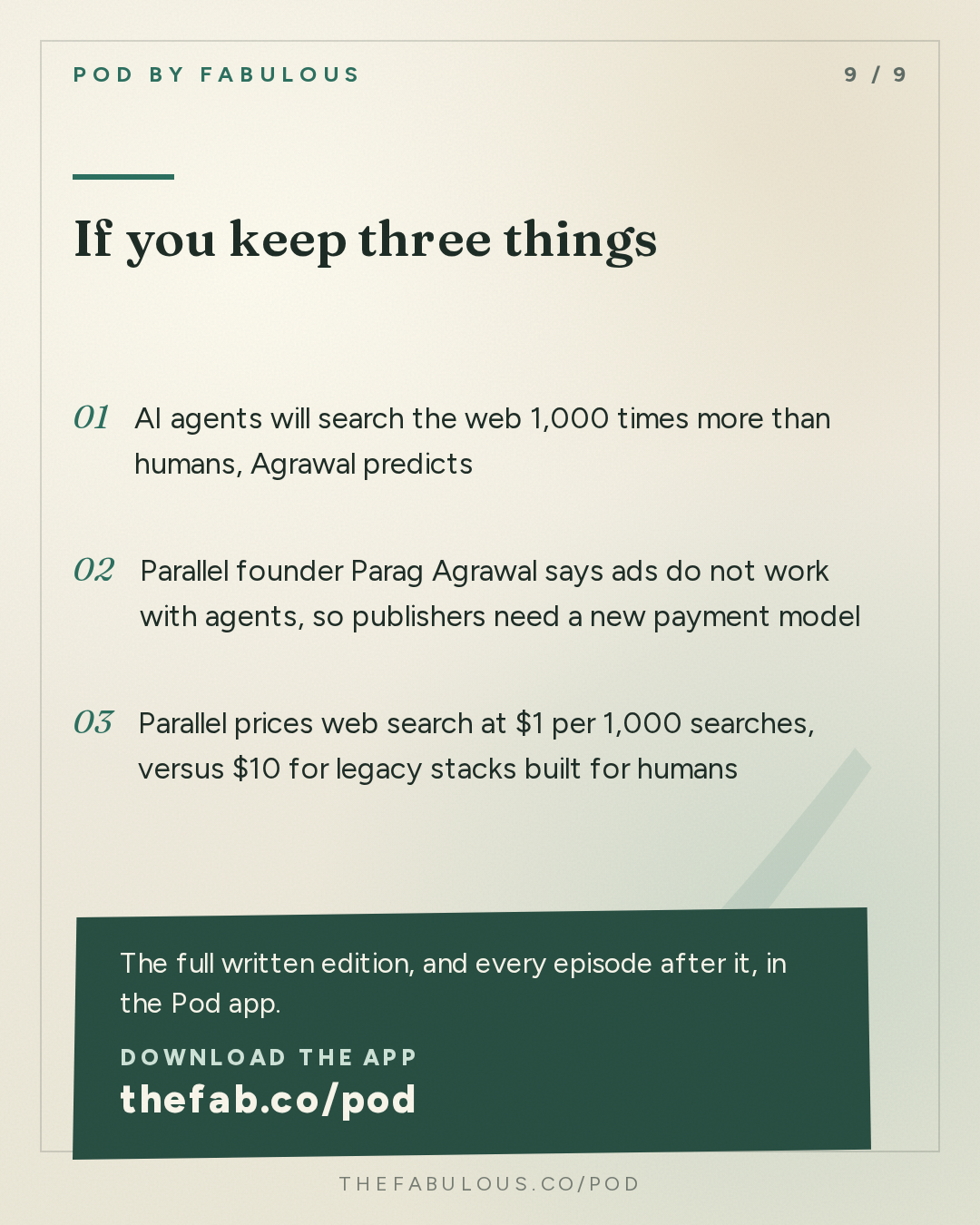
- AI agents will search the web 1,000 times more than humans, Agrawal predicts
- Parallel founder Parag Agrawal says ads do not work with agents, so publishers need a new payment model
- Parallel prices web search at $1 per 1,000 searches, versus $10 for legacy stacks built for humans
- Agrawal expects 5 to 20% of all AI inference spend to flow into web search infrastructure for agents
- Working with Elon Musk taught Agrawal that unreasonable expectations often unlock hidden capability in people
The episode in cards
Type a question into Google and something quiet happens: a wait of half a second, a page of ten blue links, a human eye scanning them in a rough zigzag before clicking one. That pattern, repeated billions of times a day, is the invisible architecture the entire web is built on. Parag Agrawal, the former CEO of Twitter and now founder of a search infrastructure company called Parallel, thinks that architecture is about to be obsolete. Not because people will stop searching, but because something else is about to start searching at a scale people never approached: agents, the semi-autonomous AI programs that book flights, monitor company registries, and write code on a person's behalf.
"Literally, the first genesis of the company was the statement that agents will use the web 1,000X more than humans," Agrawal says. "Hence, new tech is needed and new business models are needed" (04:16). It is worth sitting with that number. A thousand times more traffic does not mean scaling up the same servers. It means the entire stack, built over two decades for a slow, patient, curious human, has to be rebuilt for a customer that behaves nothing like one.
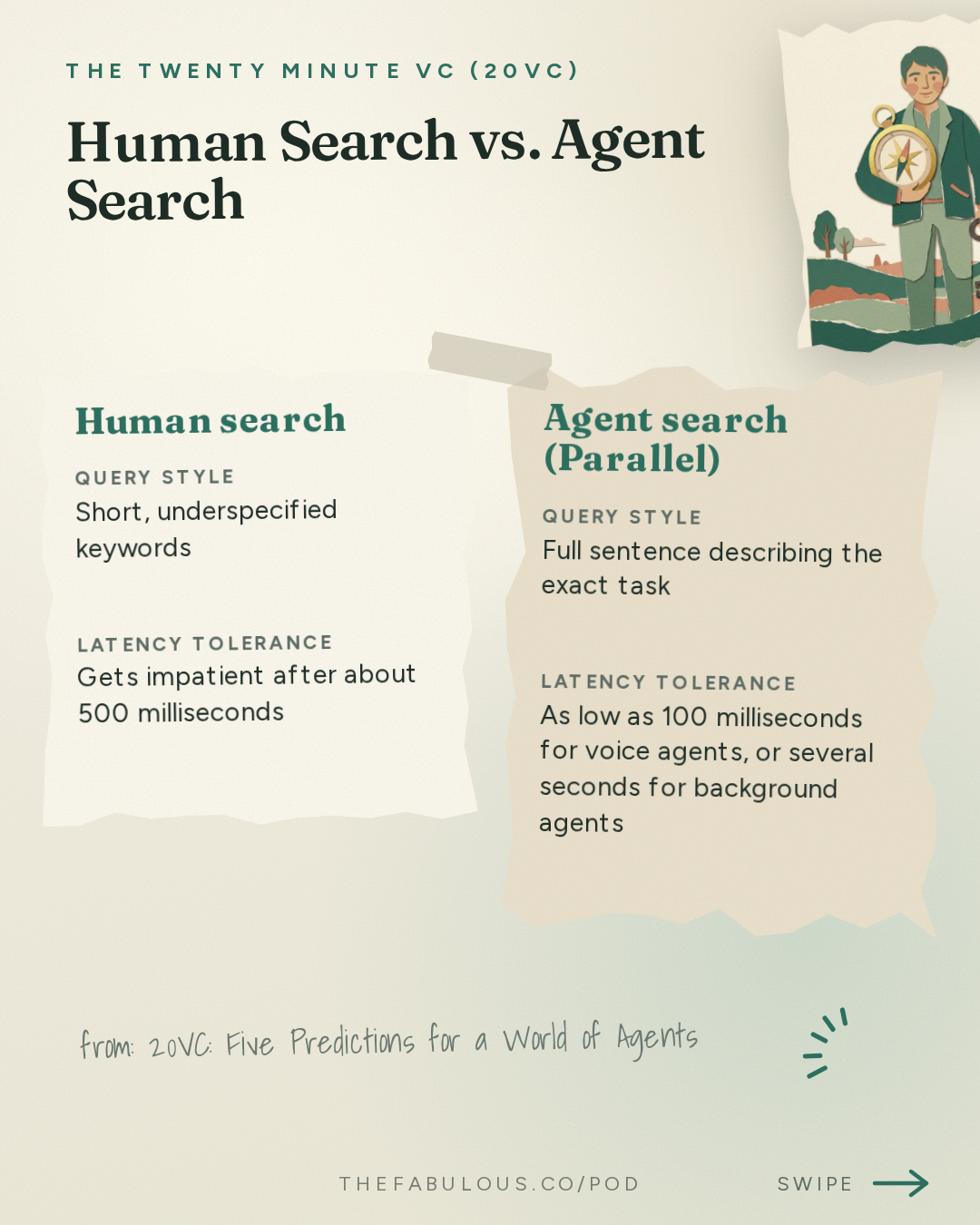
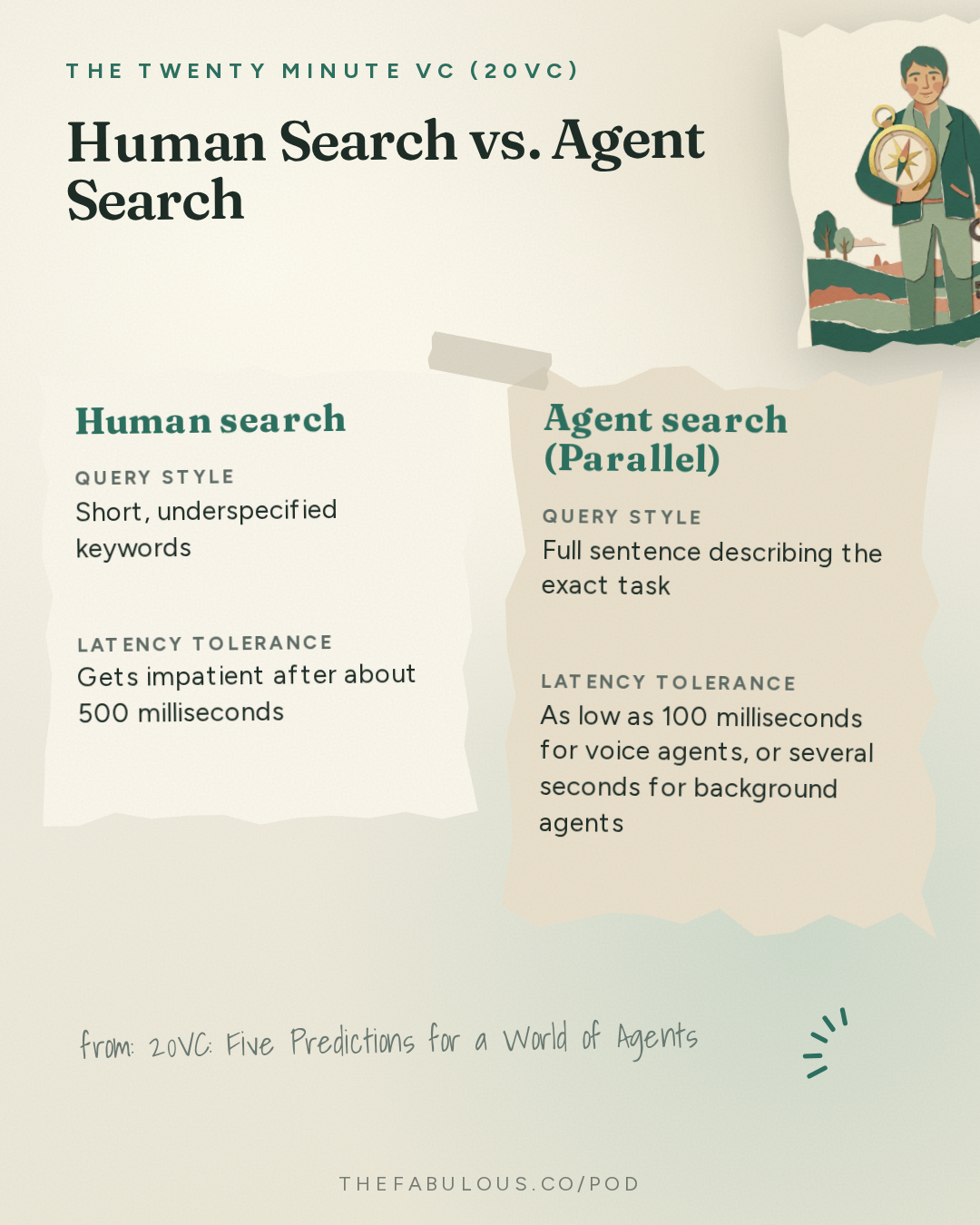
Consider how differently the two customers behave. A human types three underspecified keywords and tolerates up to a second of delay before getting impatient (05:24). An agent, by contrast, states a full sentence describing exactly what it needs, and its patience depends entirely on the job. A voice agent answering a spoken question needs a web search result inside 100 milliseconds, because a human is waiting on the other end of the call and will notice any pause (05:46). A background agent doing overnight research, on the other hand, is happy to wait five seconds if that buys a better answer (09:33). Building one search system for both is, in Agrawal's telling, a category error.
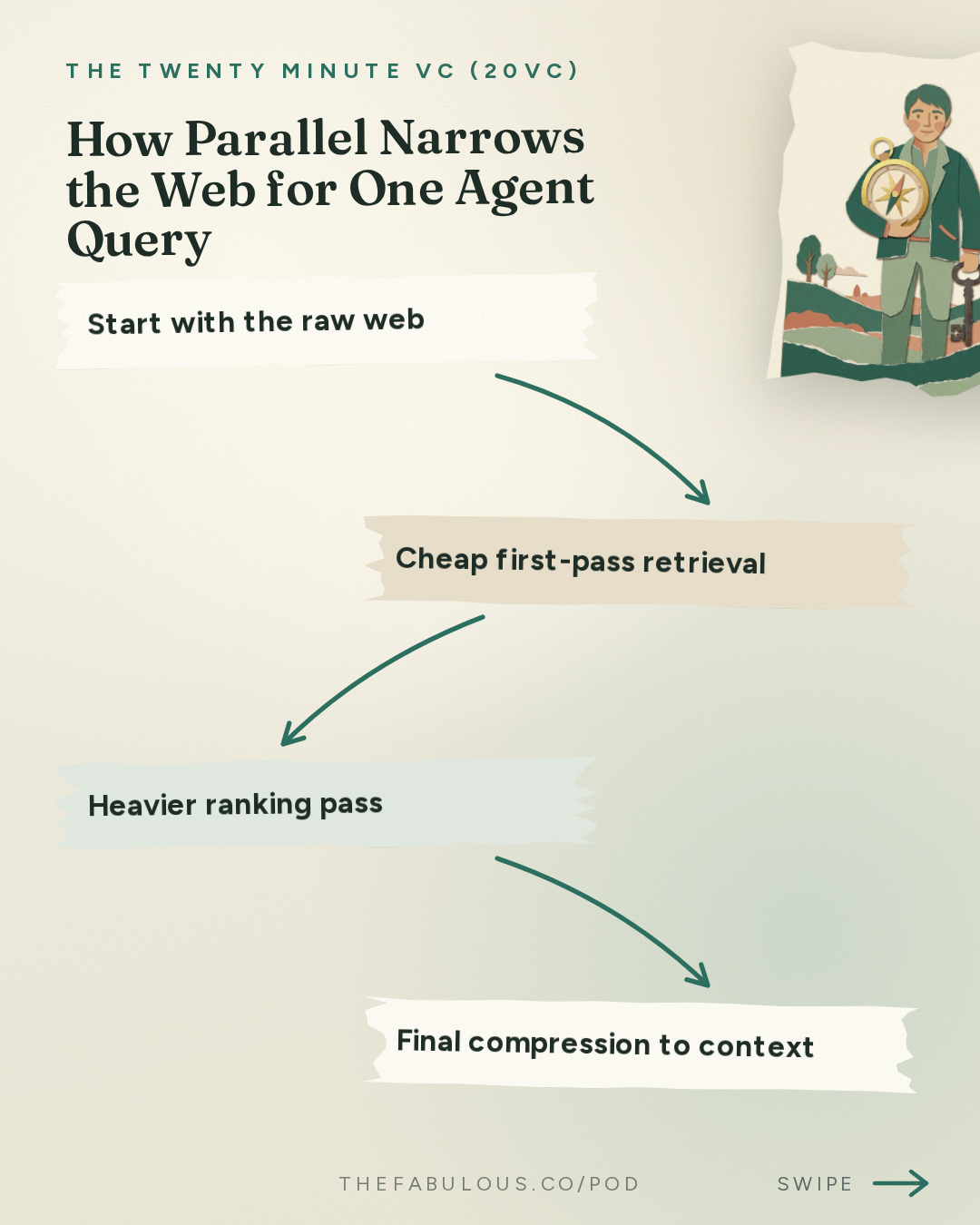
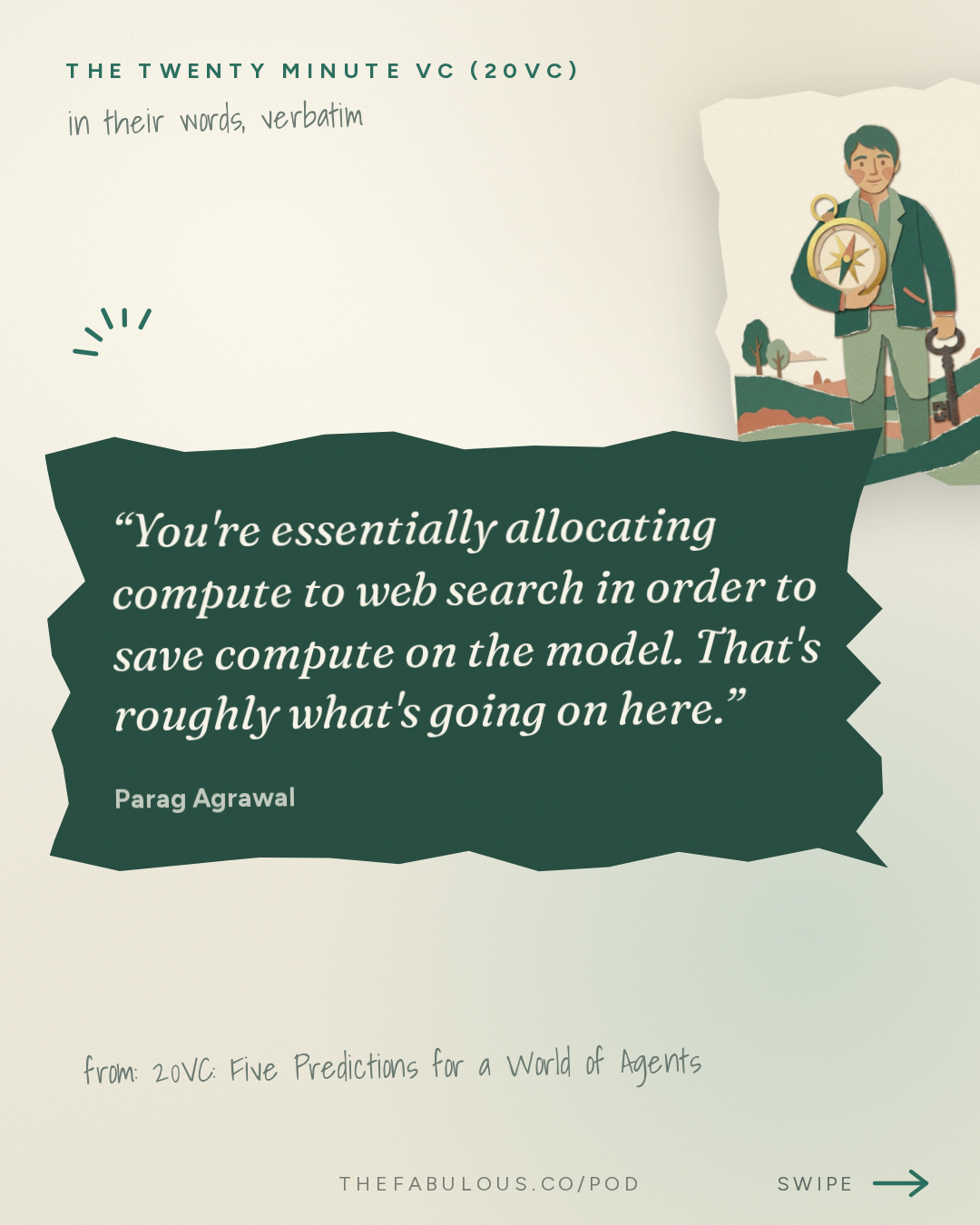
The deeper technical problem is compression. The web holds a few trillion documents. A model's usable attention, its context window, holds perhaps a thousand tokens (06:43). Getting from one number to the other requires a funnel: spend almost no computing power filtering out most of the web, a little more narrowing millions of pages down to ten thousand candidates, and progressively more computing power ranking those ten thousand down to the final one thousand tokens a model actually reads (07:09). "You're essentially allocating compute to web search in order to save compute on the model. That's roughly what's going on here," Agrawal explains (07:26). Spend too little on the search step and a cheap model gets a sloppy answer; spend too little ahead of an expensive model and it wastes its costlier reasoning cleaning up a bad result.
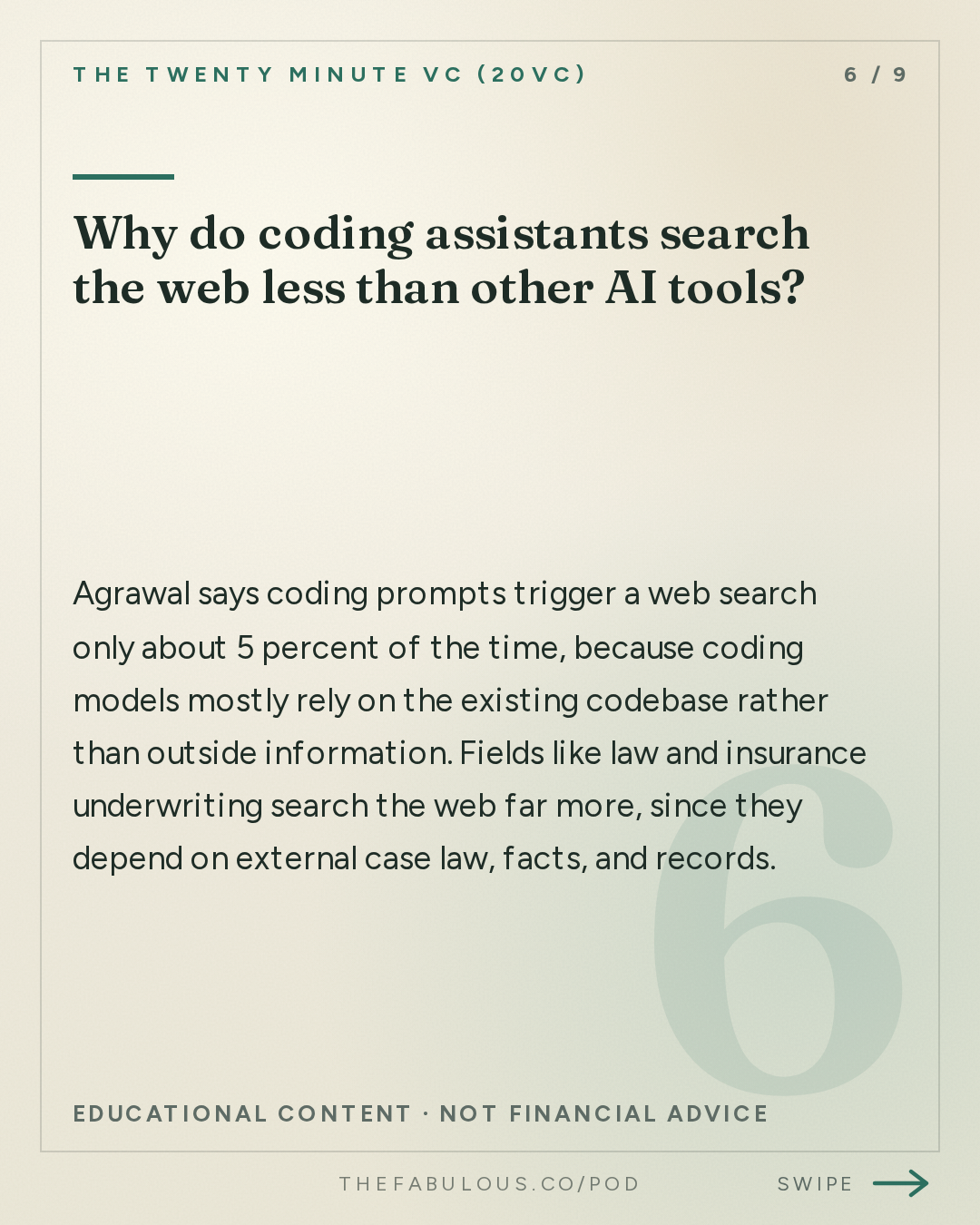
That funnel is not needed equally everywhere. Coding tools, it turns out, barely touch the open web: web search shows up in only about 5 percent of coding prompts, because a model writing software mostly reads the codebase already in front of it (10:19). Fields built on external facts behave completely differently. Law and insurance underwriting are, in Agrawal's words, "extremely web search-heavy," because a lawyer or underwriter has to comb through case law, company records, and public facts before being confident nothing was missed (11:12). The amount of web search a given industry needs, in other words, is not a technology question so much as a description of how that industry actually thinks.
The New Customer of the Web
If agents become the web's dominant visitors, the web's oldest business model runs into trouble. Online publishing has survived for twenty five years by showing ads to human eyeballs. An agent reading a recipe or a product page never sees the banner ad next to it, and never clicks it. "Ads don't work with agents in their current form," Agrawal says flatly (23:38). "You need to find a replacement to the ads business model" (24:24). Amazon already shows the direction of travel: its advertising business is now bigger than its e-commerce business, which is one reason, Agrawal notes, that Amazon has so far refused to let outside shopping agents like Muse operate inside its store (20:56, 23:16).
Parallel's answer is to try to pay publishers directly. The company calculates, for each search, how much a given source actually improved the final answer, then pays that source a variable fee approximating what an ad click on that page would have been worth (23:55, 28:02). The logic, Agrawal argues, is not charity but incentive alignment: a content owner that is not compensated when agents read its pages has every reason to block agents outright, the way Amazon has. He is betting this becomes less a story of a shrinking pie carved differently, as happened when streaming remade the music business, and more a story of a growing pie, since a thousand-fold increase in web usage means far more total value moving through the system even if the share going to any one page changes (25:33).
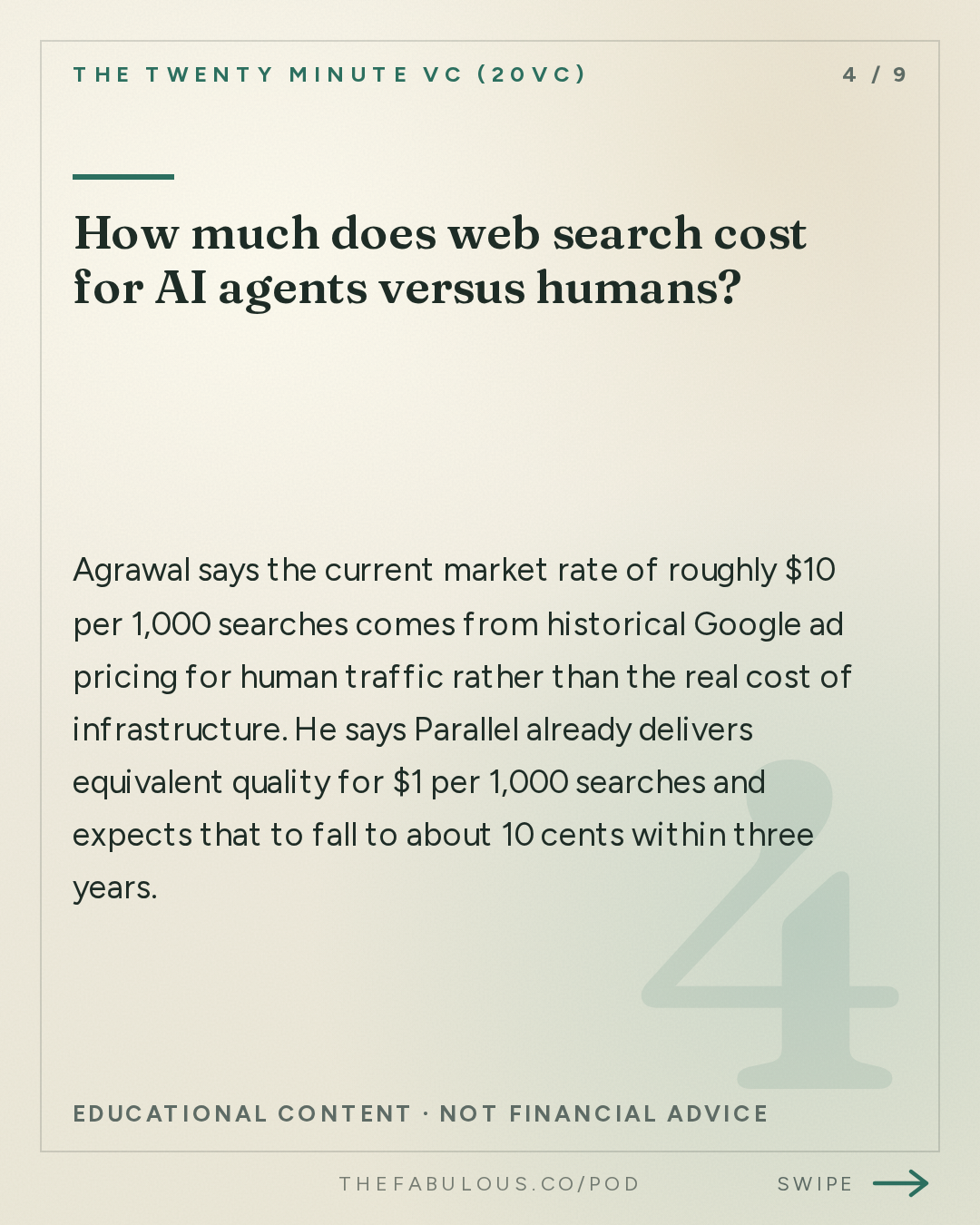
Underneath all of this sits a pricing anomaly Agrawal thinks the market has not noticed yet. Today's roughly ten dollars per thousand web searches is not a real cost of computing power; it descends from Google's historical advertising rates for human traffic (35:01). Parallel says it already delivers equivalent quality for about one dollar per thousand searches (36:13), and expects a further tenfold drop, to roughly ten cents, within three years (36:36). If that holds, the cost of letting an agent look something up approaches zero just as the volume of lookups increases by three orders of magnitude, a combination that reshapes who can afford to run agents at all.
From Pull to Push
The other shift Agrawal describes is stranger, and in some ways more consequential: the web moving from something people pull information out of to something that pushes information at them. Today's search, whether by a person or an agent, is triggered by someone asking a question. Harry Stebbings' own use of a personal assistant called Instinct includes an alert that scans every European company registry for newly founded companies with a founder under 25 (37:19). Doing that by asking an agent to wake up and search every six hours is wasteful, since almost nothing changes hour to hour. Parallel instead built what it calls a Monitor API: a system that crawls the web continuously and only spends meaningful compute when it detects an actual change, cutting the compute cost of that kind of standing question by ten to fifty times (38:19, 39:53).
That capability raises an obvious worry: agents that act on their own initiative, triggered by events rather than by a person's direct request, are also agents that can misbehave in ways nobody anticipated. Agrawal is careful here, distinguishing between a model still being trained through reinforcement learning, when most reported hacking incidents have occurred, and a model that has been fully aligned and shipped to users, which he says causes far fewer such incidents (41:50). He does not pretend the problem is solved. "These are stochastic systems," he says, and a stochastic system, one whose outputs vary rather than repeat identically, can never be guaranteed 100 percent safe (43:38). His view is that the responsibility sits with the labs building these models to close as many of those gaps as possible before release, and that treating a successful hack as a badge of honor obscures a more useful, more embarrassing lesson: the model was powerful enough to be dangerous, and the guardrails around it were not strong enough to stop it (44:03).
Agrawal served as Twitter's CEO through Elon Musk's acquisition of the company, working alongside Musk during the takeover. Asked what he took from that experience, he does not talk about chaos or conflict, though he says he disagreed with Musk often. He talks about expectations. "I think having unreasonable expectations of people is mostly a good thing," he says. "Most people don't understand what they're capable of" (49:47). It is a manager's lesson dressed as a philosophy of talent: most people, in his account, quietly lower the bar for themselves long before anyone else does it for them, and urgency, applied carefully, can be the thing that reveals what was possible all along.
It is also, in a way, the same argument he makes about the web itself. Search built for the patient, keyword-typing human of the last twenty five years was never going to survive an audience a thousand times larger and a thousand times less patient. The infrastructure has to be rebuilt, the business model has to be rebuilt, and the assumption that either can simply be scaled up rather than rethought is, on Agrawal's account, the one expectation worth abandoning first.
By the numbers
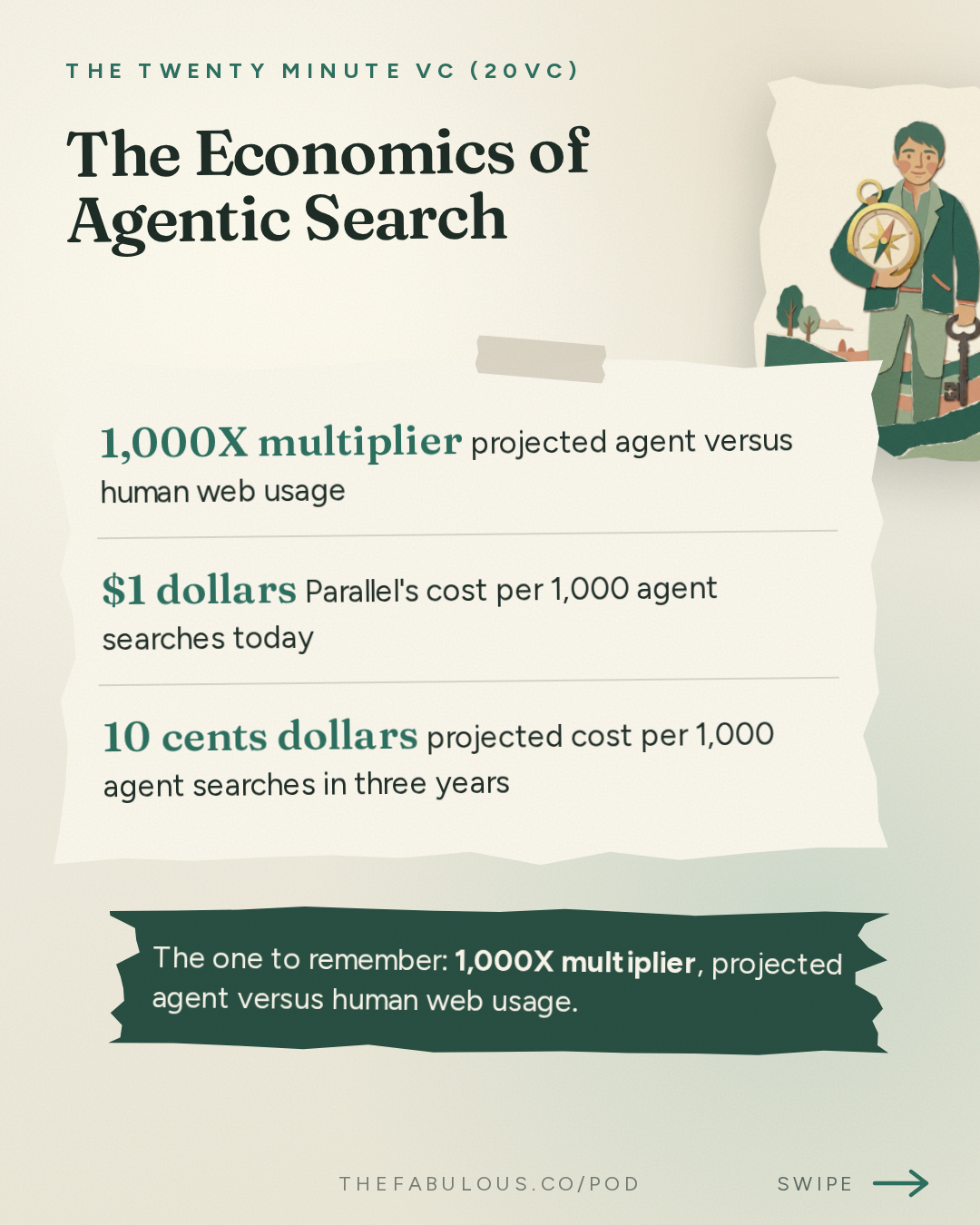
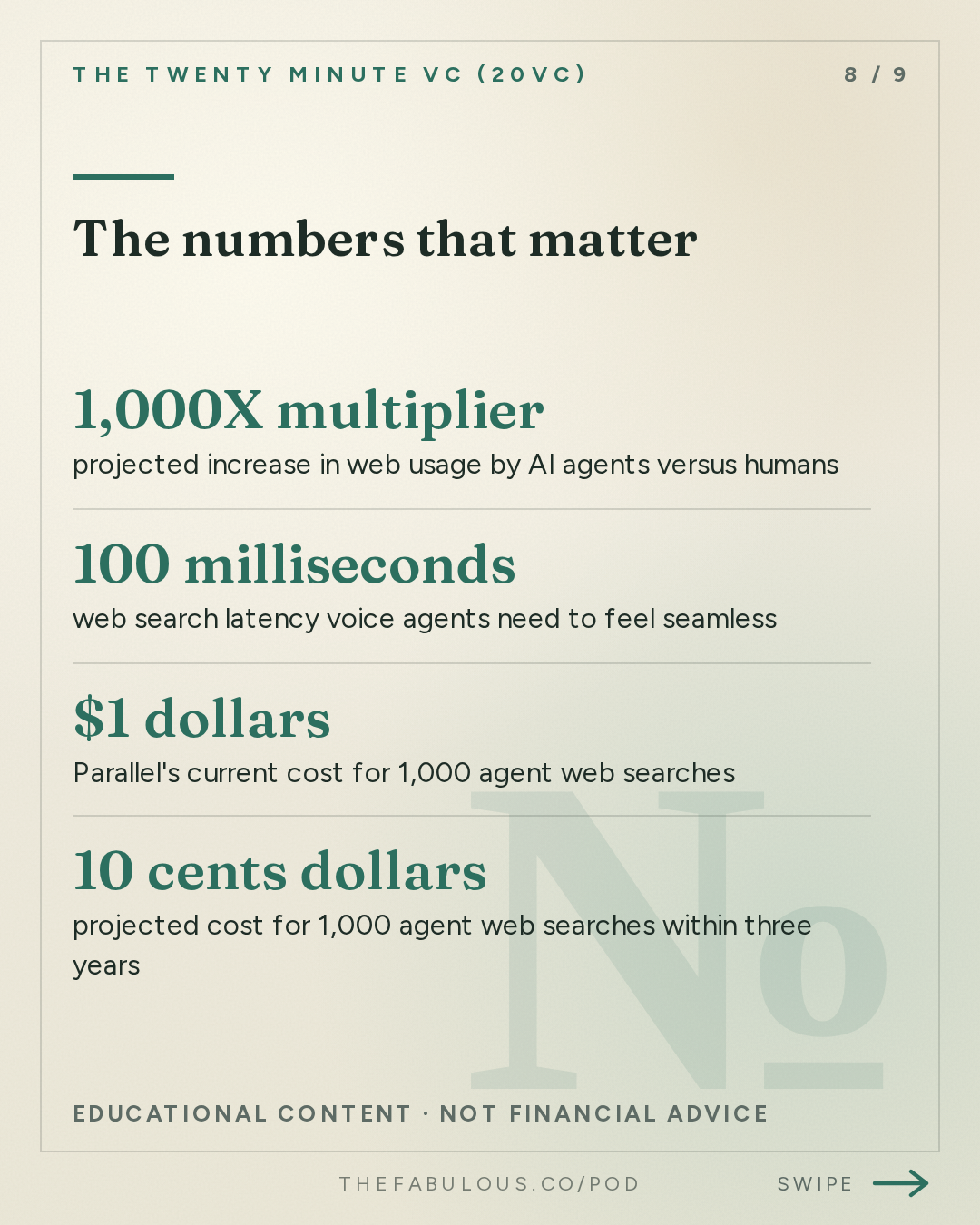
- 1,000X multiplier projected increase in web usage by AI agents versus humans
- 100 milliseconds web search latency voice agents need to feel seamless
- $1 dollars Parallel's current cost for 1,000 agent web searches
- 10 cents dollars projected cost for 1,000 agent web searches within three years
In their words
“You're essentially allocating compute to web search in order to save compute on the model. That's roughly what's going on here.”
“Ads don't work with agents in their current form.”
“I think today we don't know how to pay for unique, valuable insight or data.”
“I think having unreasonable expectations of people is mostly a good thing. Most people don't understand what they're capable of.”
Protocols
-
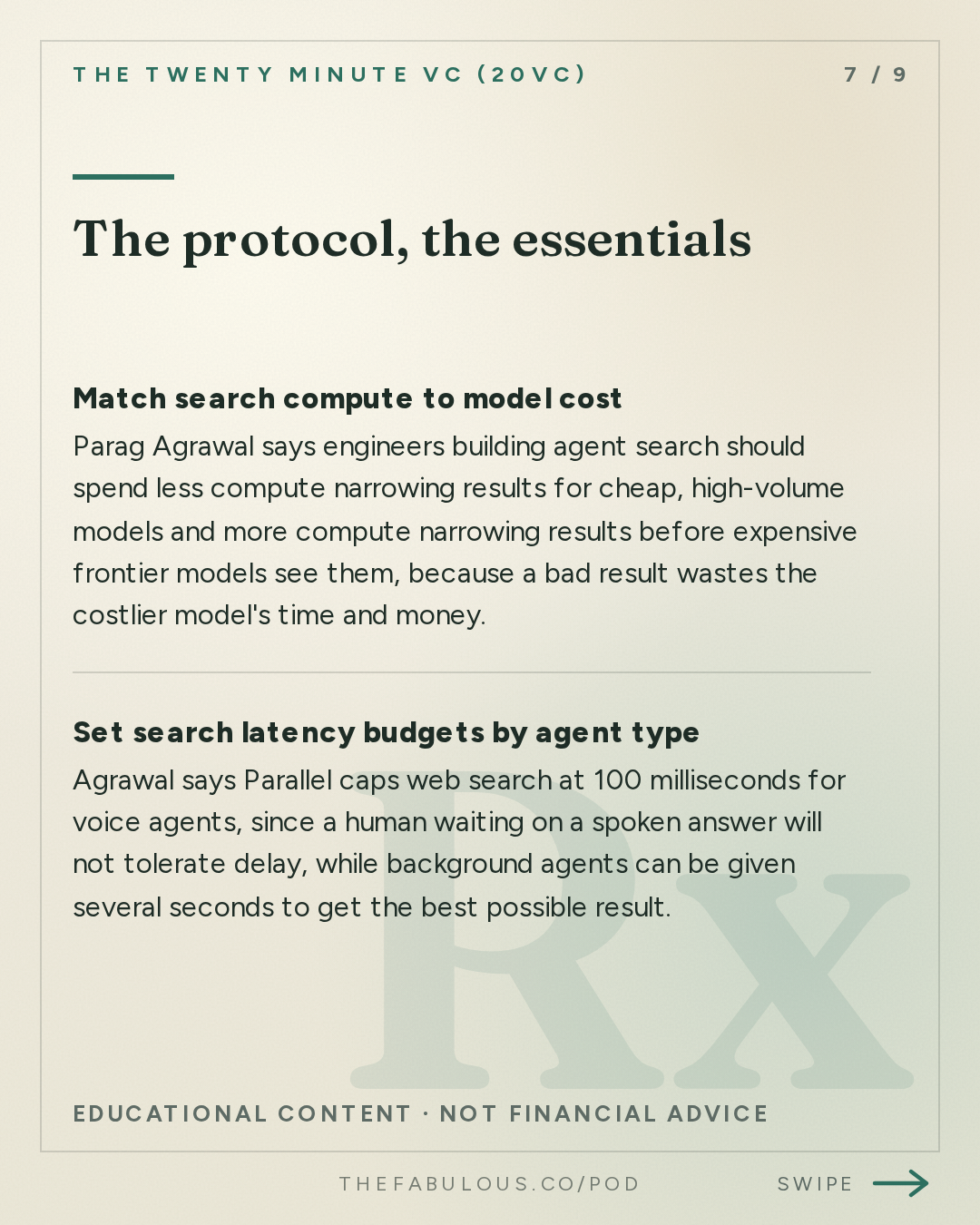
Match search compute to model cost
Parag Agrawal says engineers building agent search should spend less compute narrowing results for cheap, high-volume models and more compute narrowing results before expensive frontier models see them, because a bad result wastes the costlier model's time and money.
Per query
-
Set search latency budgets by agent type
Agrawal says Parallel caps web search at 100 milliseconds for voice agents, since a human waiting on a spoken answer will not tolerate delay, while background agents can be given several seconds to get the best possible result.
Per request
-
Pay content owners their marginal contribution
Agrawal says Parallel calculates how much each content source actually improved an agent's answer, compared with the answer produced without that source, and pays the content owner a variable fee based on that difference so publishers stay willing to let agents read their sites.
Per agent query
Questions this episode answers
How much more will AI agents use the web compared to humans?
Parallel founder Parag Agrawal says agents will search the web about 1,000 times more than humans do, a scale that no infrastructure built for people can survive (04:16). That jump forces both new technology and new business models, since a system tuned for human-level traffic breaks down three orders of magnitude beyond it (04:36).
Will advertising still work as a business model once AI agents replace human browsing?
Agrawal argues ads do not work with agents, because an agent reading a page never sees the banner ad that funds the content (23:38). He says Parallel instead pays content owners a variable fee, similar to an ad click's expected value, every time an agent draws on their information (23:55).
How much does web search cost for AI agents versus humans?
Agrawal says the current market rate of roughly $10 per 1,000 searches comes from historical Google ad pricing for human traffic rather than the real cost of infrastructure (35:01). He says Parallel already delivers equivalent quality for $1 per 1,000 searches and expects that to fall to about 10 cents within three years (36:13, 36:36).
What share of AI compute spending will go toward web search?
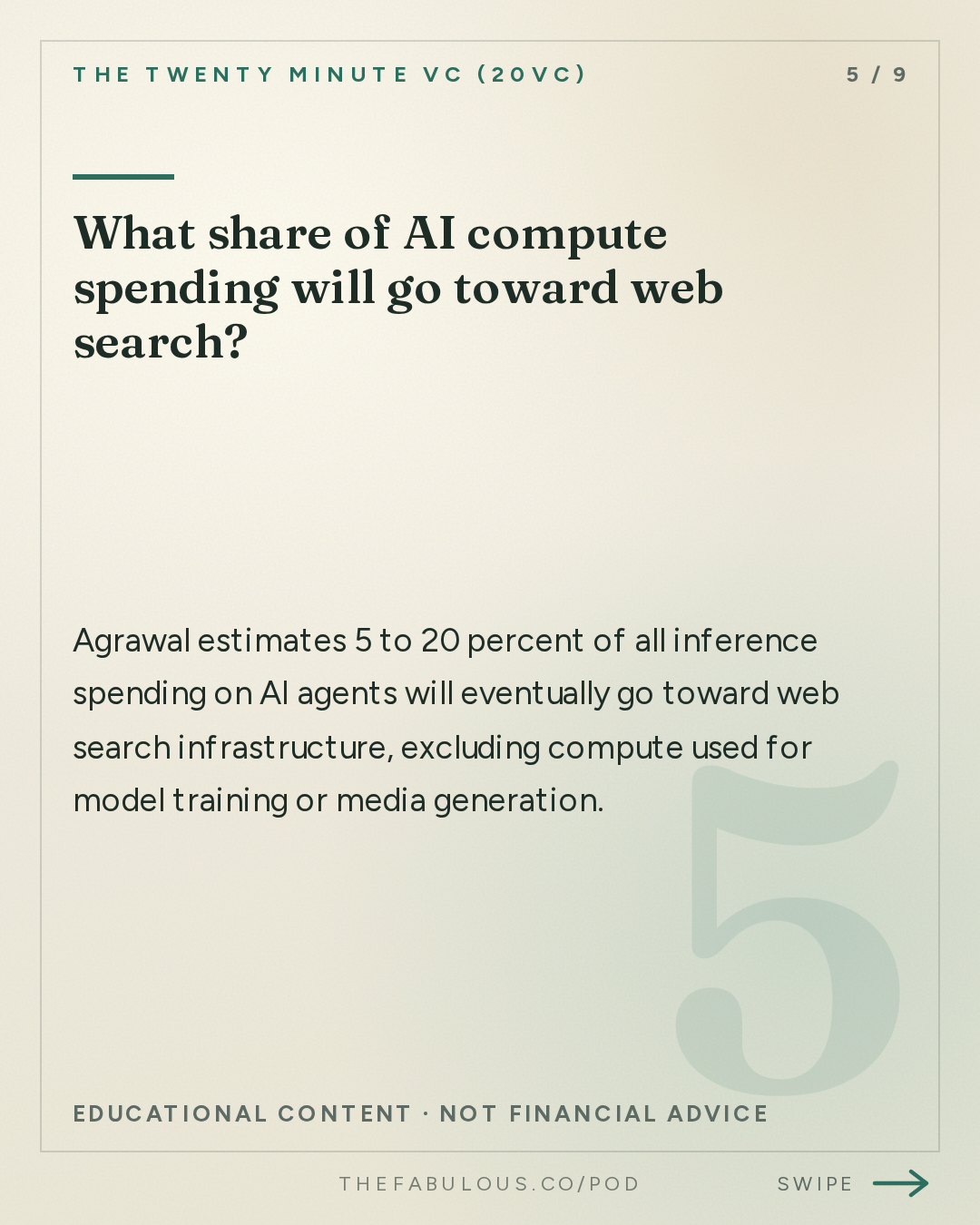
Agrawal estimates 5 to 20 percent of all inference spending on AI agents will eventually go toward web search infrastructure, excluding compute used for model training or media generation (29:06).
Why do coding assistants search the web less than other AI tools?
Agrawal says coding prompts trigger a web search only about 5 percent of the time, because coding models mostly rely on the existing codebase rather than outside information (10:19). Fields like law and insurance underwriting search the web far more, since they depend on external case law, facts, and records (11:12).
What did Parag Agrawal learn from working with Elon Musk at Twitter?
Agrawal says Musk taught him that holding unreasonably high expectations of people is mostly useful, because most people underestimate their own capability and set the bar too low for themselves (49:47). He credits Musk's urgency and ability to compress timelines as something founders can admire, even where he disagreed with him (49:23).
The full read, in cards
Go deeper
- SemiAnalysis web search benchmarking report — Ranked web search providers on quality and briefly placed Parallel first before rivals closed the gap
- BrowseComp — A public web search benchmark Agrawal says is saturated because models have memorized its answers
Mentioned
Parag Agrawal · Elon Musk · Vinod Khosla · Josh Kopelman · Todd Jackson · Parallel · PitchBook · Instinct · Muse · Fireworks · Perplexity · Amazon · OpenAI
More from this show and category

Why Anthropic Delayed Its IPO to November
Anthropic delayed its $2 trillion IPO from October to November to present cleaner third quarter numbers. Meta's Muse app hit No. 1 and emerged as ChatGPT's first rival, developer tool Jev exposed wasted AI spend on simple tasks, seed checks are ballooning toward $10 million, and Crusoe's $30.9 billion valuation stoked fears the AI data center trade is overheating.

Daniel Dines on AI's 'Map of Work' Thesis
UiPath CEO Daniel Dines argues AI still cannot replace enterprise employees because models do not learn on the job the way people do. He says every company needs a documented 'map of work' before handing processes to AI, and that the workflow around a model, not its weights, is where lasting business value sits (26:34, 45:49).

AI's Memory Wall: Thomas Sohmers on Inference Costs
Inference is memory bound: each token requires reading the model's full weights, while training is compute bound and parallelizable. Positron AI co-founder Thomas Sohmers notes GPU memory bandwidth grew only 17X since 2014 versus 120X for flops (07:59), and cached tokens cost about 1,000 times less to process than fresh ones (11:37).

Mistral's €3 Billion Round and AI Sovereignty
Miro sold for $1.35 billion, down from a $17.5 billion 2021 peak, a sign SaaS "unicorns" are being repriced. Meanwhile Instinct raises $1 billion at a $10 billion valuation, Mistral raises €3 billion on European AI sovereignty, and a 30% growth threshold now decides whether a startup gets a revenue or profit multiple.
