
Venky Ganesan on AI Venture Capital Ownership
20VC: Is Seed Investing Dead Without a $1BN Fund? | Does Ownership and Price Matter When Companies Can Be $1TRN Exits | Are AI Revenue Numbers Real and What to Watch Out For with Venky Ganesan, Menlo Ventures
The brief
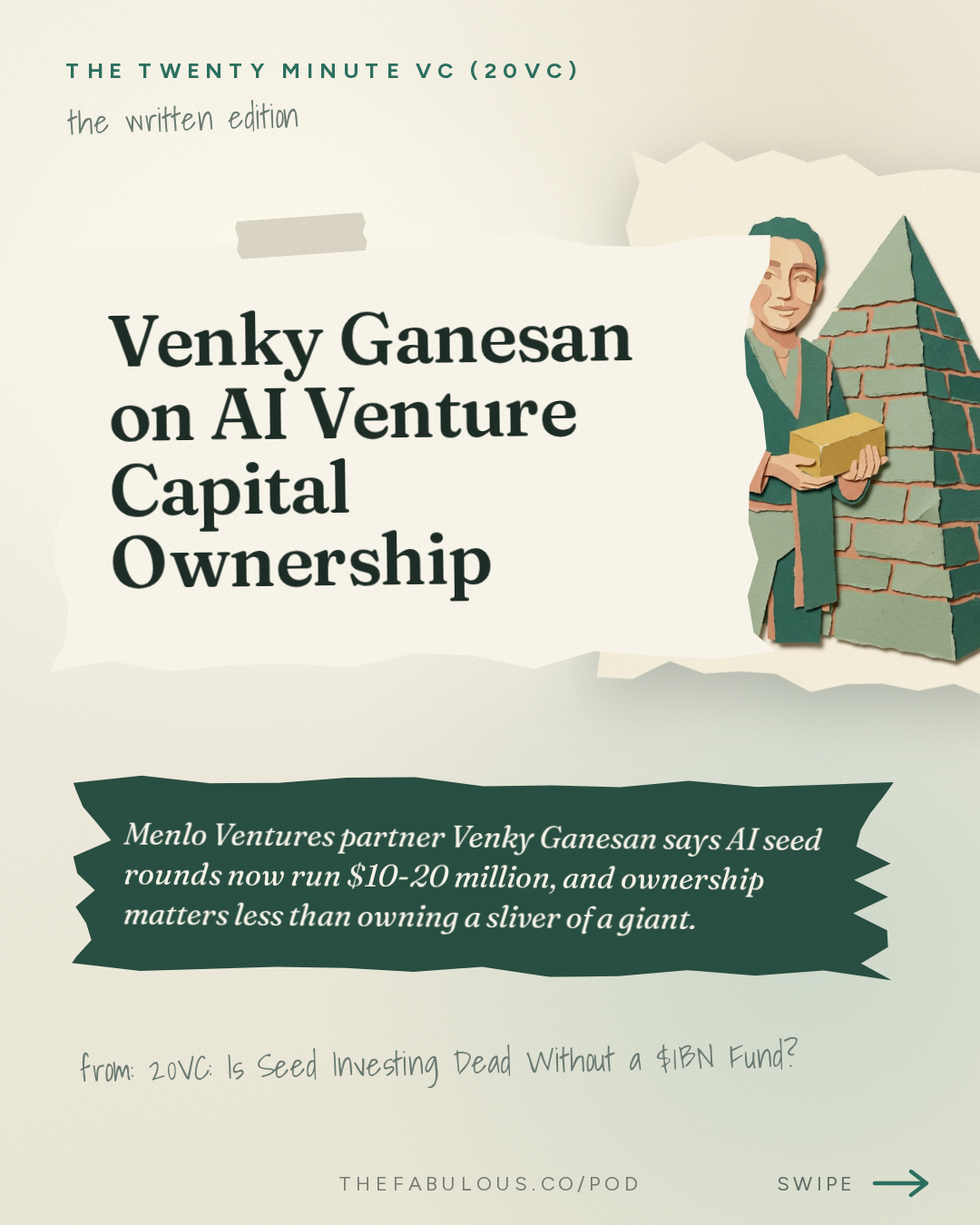
Menlo Ventures partner Venky Ganesan says AI seed rounds now run $10-20 million, and ownership matters less than owning a sliver of a giant. Drawing on 28 years in venture capital, he argues investors should expect 60% dilution by exit, cap single-company bets near 20% of a fund, and chase cash returns over paper markups.
In 2000, a young venture associate named Venky Ganesan put $5,000 into the IPO of a fiber-optics company called Avinex. The stock climbed so fast that his modest stake was worth $200,000, a fortune to a man about to get married. His fiancee suggested selling some for a house down payment. He refused: Avinex was going to a million. It dropped 90 percent instead, and he sold what remained for about $8,000 to $9,000 (05:40). Twenty-five years later, as a partner at Menlo Ventures, he still calls it the most useful loss of his career, not because it taught him to sell everything, but because it taught him that at some point, an investor has to take some chips off the table.
That lesson sits underneath almost everything Ganesan says about venture capital today, because the game, by his own account, barely resembles the one he joined 28 years ago (36:27). Stebbings' team now comes to him and reports they cannot find a seed deal under $100 million, meaning that is the size of the round, not the valuation (07:29). AI application startups are raising $10 to $20 million at seed, a number that would have been a Series A a few years ago (10:19). The frontier labs raise far more. Ganesan's response is not panic but a kind of discipline: a dot, he says, is not a line, and a snapshot of one crazy quarter should not reset an entire investment strategy (07:47).
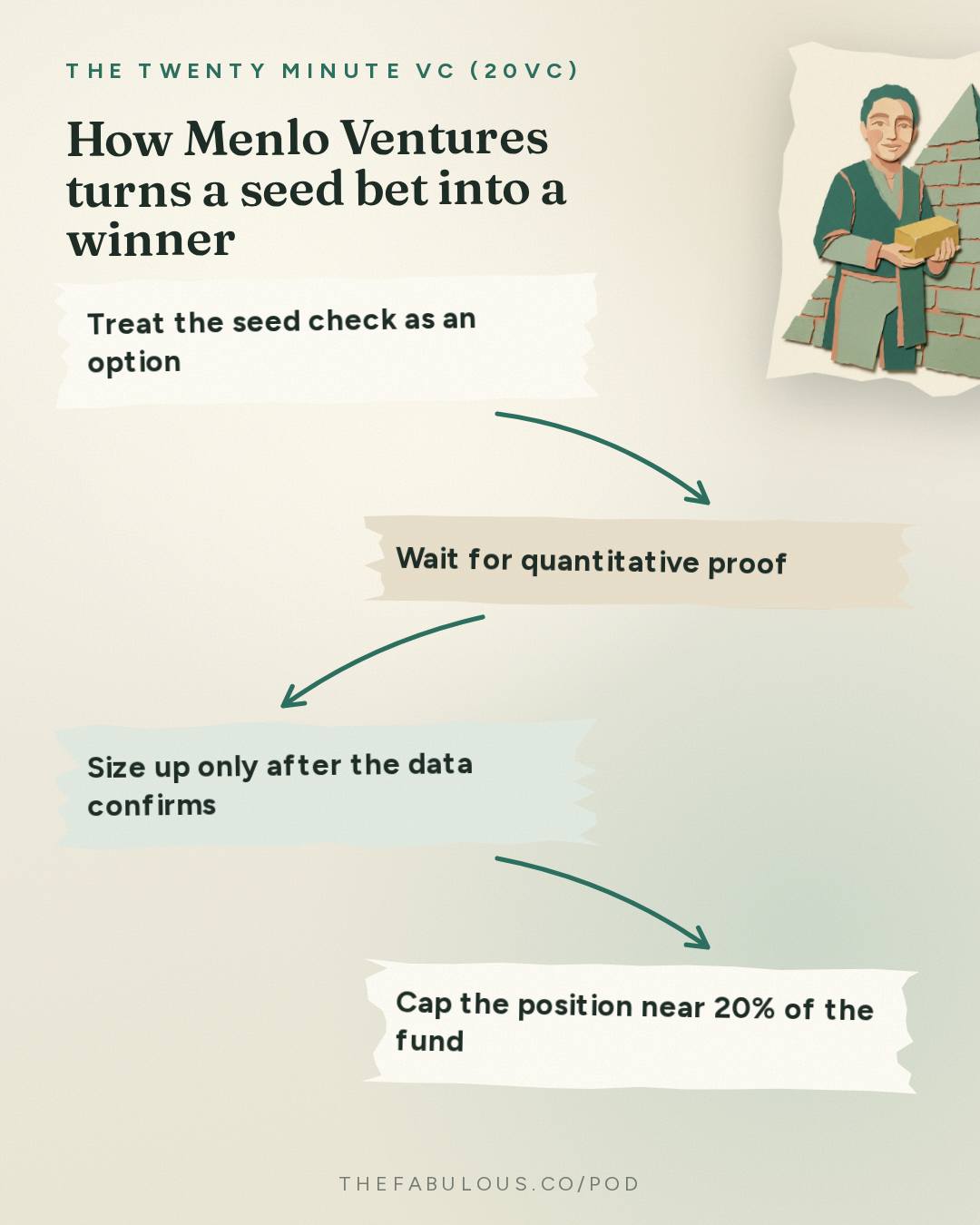
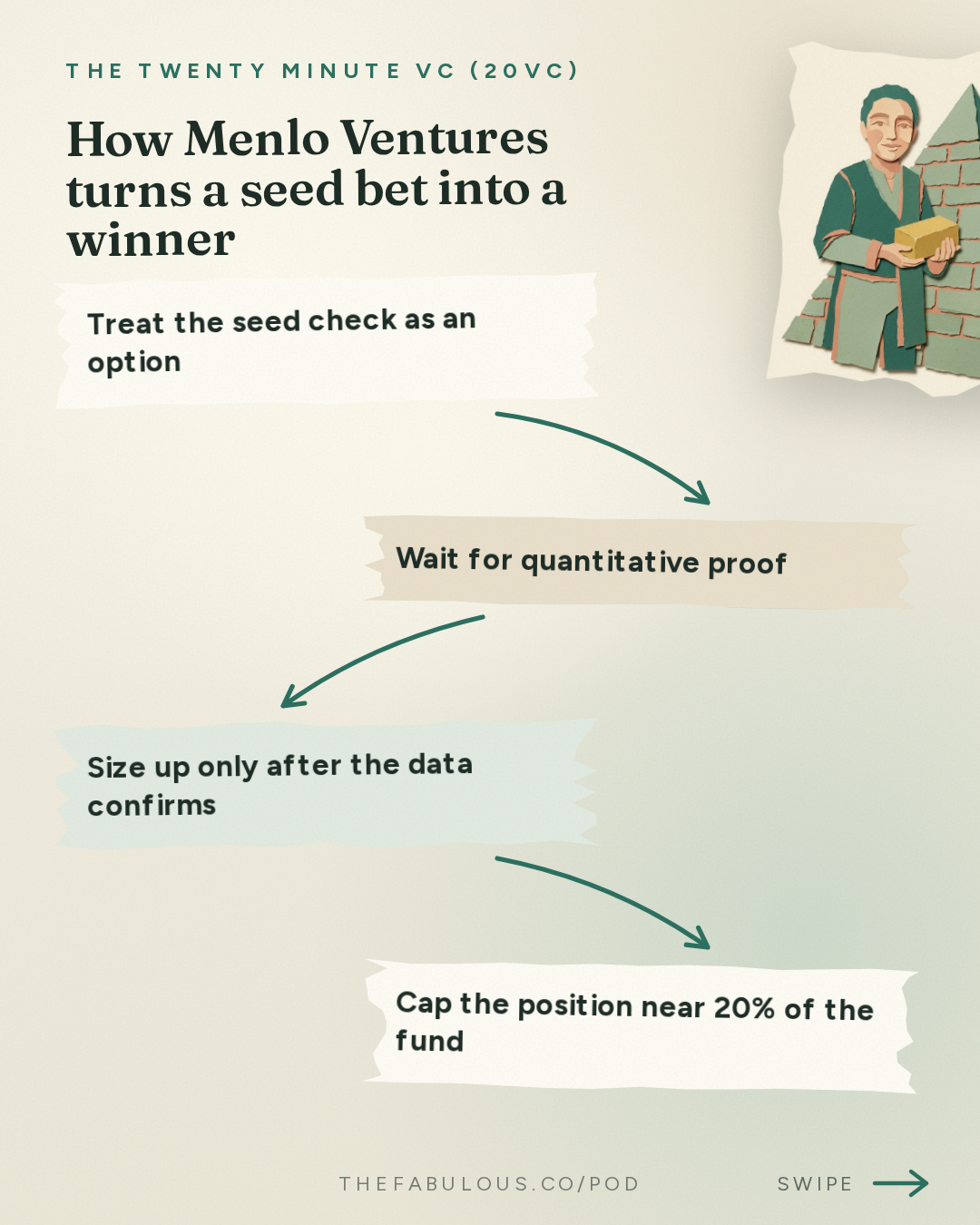
Part of that discipline is treating every seed check as what he calls an option bet.
"Each seed investment is an option bet. You're buying an option to see if it's an outlier." — Venky Ganesan [09:34]
The point of the option is not ownership for its own sake. It is information. A small check buys a seat at the table and the right to watch a company's real numbers before deciding whether to size up. That is also why Ganesan is candid about why seed prices have become indifferent to logic: large funds, including his own, are often willing to overpay at seed because the real goal is simply to be in the room if the company becomes a monster (10:19).
Those real numbers, though, are getting harder to trust. Founders now show contracted revenue that is not yet collected, or run-rates extrapolated from a single best day multiplied by 365 (11:23). Ganesan has a blunt explanation: any metric that investors weight heavily will eventually be gamed, the same way net revenue retention was gamed during the SaaS years by splitting one big contract into several smaller ones to inflate the growth math (11:48). He reaches for a concept he attributes to Keynes or another famous economist, the idea of "the bezzle," the gap between when embezzlement happens and when it is discovered, which grows quietly during every boom (12:07). Layered on top of that is what Ganesan calls reflexivity, borrowing from investor George Soros: a company marks up, the markup attracts more capital and talent, which drives real growth, until copycats start chasing the markup itself rather than the growth, and the cycle eventually snaps (13:20). Historically, he says, the snap comes from debt, not equity, because equity investors simply write down a loss while lenders expect to be repaid regardless of what the business is actually worth (14:28).
Ownership Stops Being the Point
If seed-stage ownership is shrinking, as it is across the industry, Ganesan argues that is not automatically a problem. "I'd rather take 2% of a trillion-dollar company than 20% of a $100 million company." — Venky Ganesan [25:10]. Menlo owns less than 2% of Anthropic (25:22), a stake that is still larger in dollar terms than a dominant position in a mid-size outcome would be. But he is careful to separate two different games. Before a company proves itself an outlier, he argues investors should fight for ownership, because that period is still a selection game. Once a company is an obvious winner, ownership becomes a pure capital-allocation question, since everyone already knows it is going to work (25:50).
That does not mean concentration is unlimited. Menlo caps any single company at roughly 20% of a fund, and has only once gone that high, for Anthropic (27:13). The logic is about sequencing: laddering up to a large position as new data confirms a company's trajectory carries far less risk than betting big on day one, before there is any evidence at all (27:36).
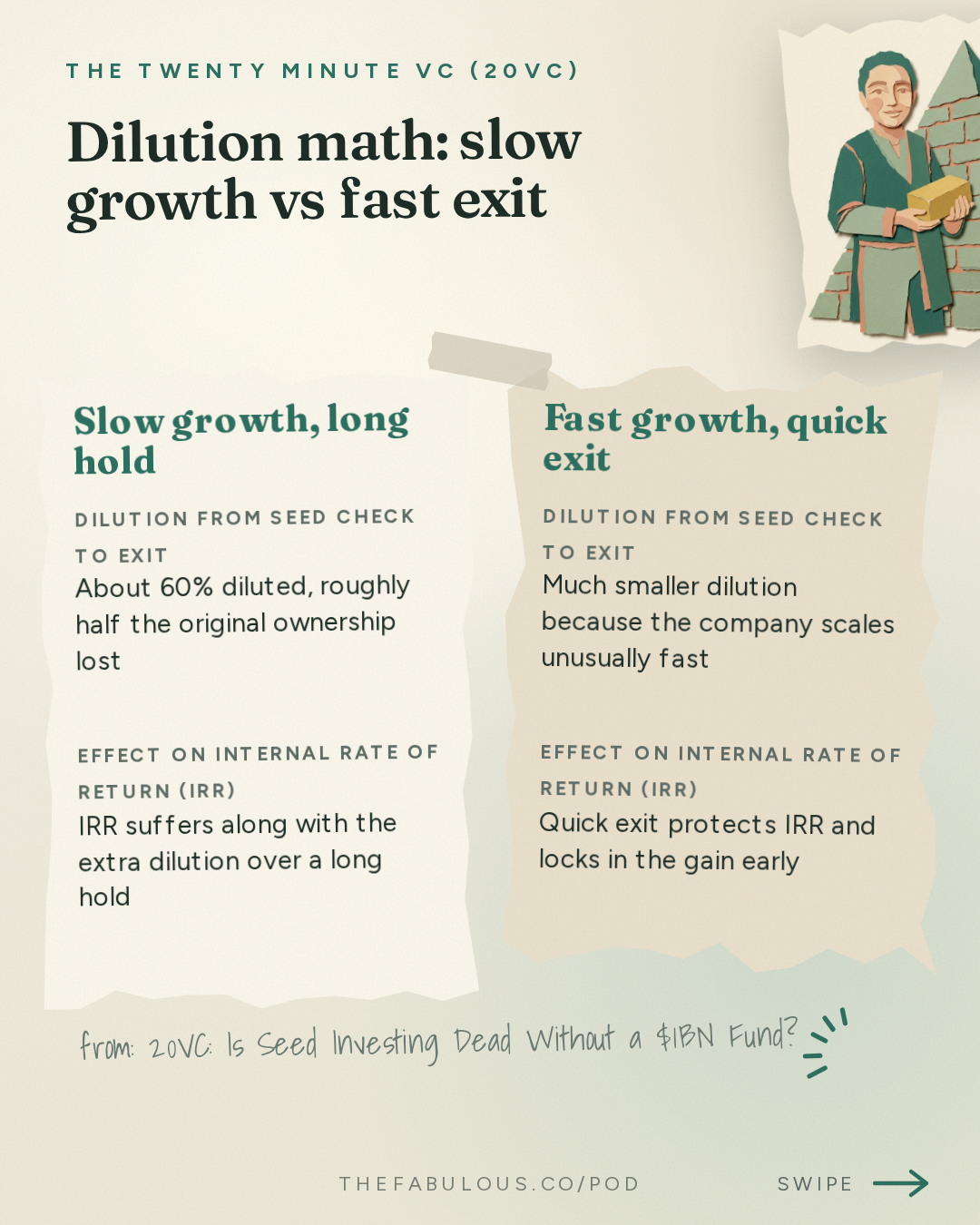
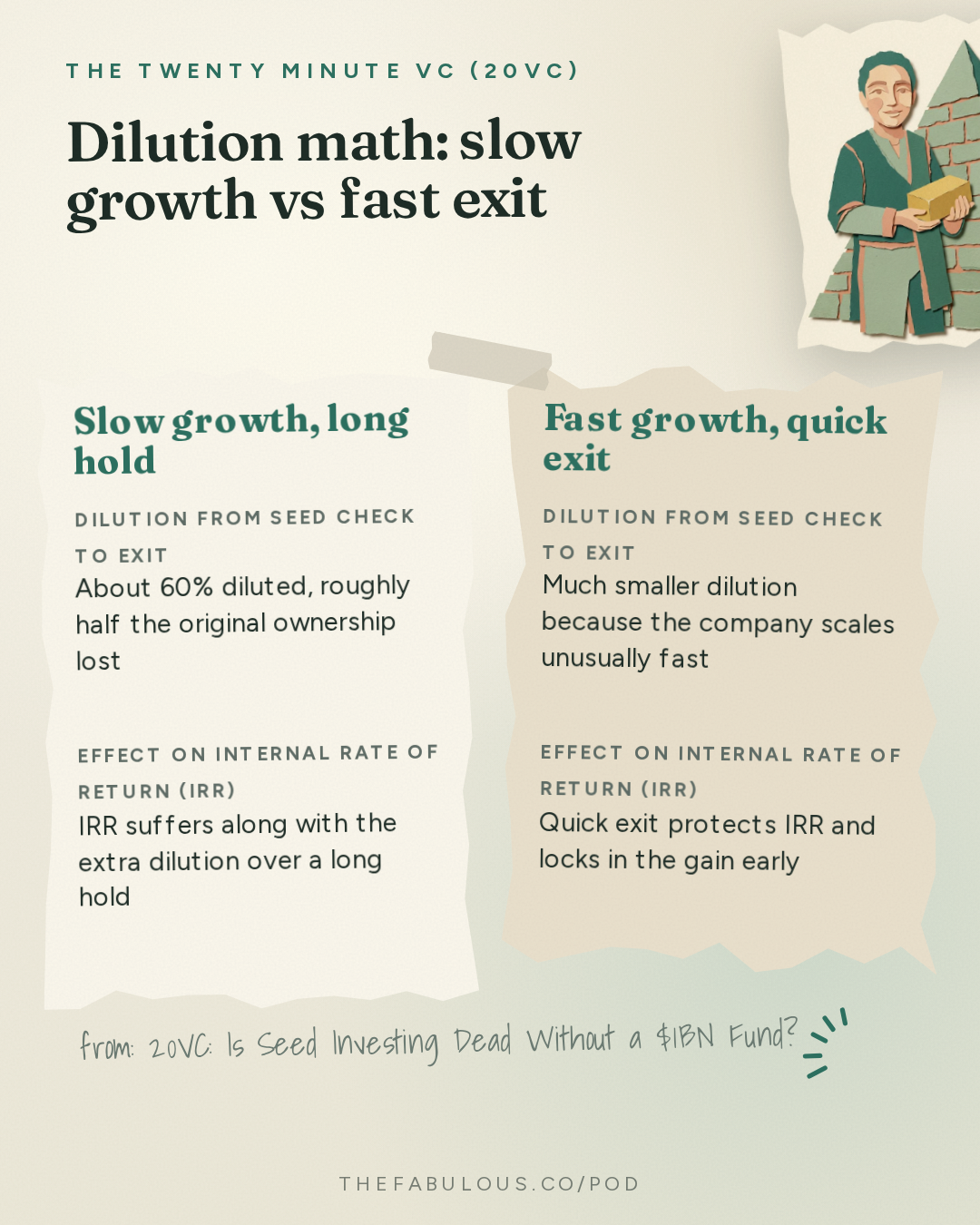
Dilution complicates the ownership math further. Menlo assumes that a 10% stake bought at seed will shrink to roughly 3.5 to 4% by exit, a loss of about 60%, driven by follow-on financing rounds and the steady expansion of employee option pools (34:00). But the rate of dilution depends heavily on how fast a company grows. A company that scales quickly and exits quickly, the way Stebbings describes AI model interface platform OpenRouter doing, suffers far less dilution, because a fast rise in valuation means each new hire costs less equity. A $200 million company might give up 2% of itself to hire one senior executive; the same hire at a $2 billion company might get $20 million in stock that represents just 0.1% of the company (36:04). Time, in other words, is the quiet variable behind every dilution outcome.
All of this feeds into a shift Ganesan says the whole industry has made: from cash-on-cash thinking to a focus on internal rate of return, or IRR, a measure of how fast money grows annually rather than just by how much. He argues that because every major AI company now effectively pays a toll to Nvidia, a cloud provider, and a foundation model company, all of which investors can access through public, no-fee index funds, venture capital has to clear a much higher bar: roughly 1,000 basis points, or 10 percentage points, of extra annual return above the public market, just to justify its fees (37:13). Limited partners, meanwhile, are asking for something more concrete than IRR: distributions to paid-in capital, or DPI, which is cash actually returned rather than a paper markup (41:19). Ganesan says most LPs now have two complaints: they want real DPI, not just unrealized gains, and they cannot afford to skip the AI wave because their much larger private equity portfolios, often three to four times the size of their venture allocations, are directly exposed to AI disruption and need a hedge (44:09).
What Money Reveals
Ganesan is just as direct about the psychology of the business as the math. On the subject of founders who have made enormous sums very young, he offers a line he has clearly turned over before.
"Money doesn't change people, it reveals them." — Venky Ganesan [50:45]
People who were driven before stay driven, he argues, because for the best operators money is simply a scoreboard, not the game itself (51:04). But he is unusually candid about how much privilege plays into his own clean conscience, admitting that his comfort with doing the right thing now, as a wealthy and established investor, is not proof he would have made the same choices at 25, scrapping to build a career.
"Morality is sort of a privilege of the people who already succeeded. It's easy to be moral now when you already have the things you have." — Venky Ganesan [53:48]
He extends the same honesty to the structure of venture capital itself. Being richer, he says, makes him a better investor mainly because it removes fear: he can go for broke more easily, the way a poker player with a large chip stack can see more cards and take more risks (54:29). That, he concedes, is exactly why the rich tend to get richer in this business, and why funds between $30 million and $100 million are, in his words, the worst place to be right now, squeezed by firms with far bigger stacks, unless the manager is exceptional enough to beat the odds anyway, the way Sarah Guo's Conviction or Dave Tisch's BoxGroup have (55:09).
His closing advice to limited partners sizing up a fund is less about spreadsheets than about asking the right people. Performance, he says, is a lagging indicator, trailing the real decisions by five to seven years, so a track record tells an LP what a firm did, not what it will do (60:29). His suggested test is simple: call successful AI founders and ask which investors they respect most among the ones who never got to write the check. If a firm's name does not come up among the rejections, that is the real signal, more honest than any IRR on a slide deck.
Ask this episode anything
Pod's AI answers from the episode itself, with the minute mark so you can hear it yourself.
Or start with one of these
Ask this episode
Pod's AI listens to the whole episode to answer, and points you to the minute it comes from.
The rest of this answer, and any question after it
Answers come from the episode itself, never from a summary of it.
ContinueKey takeaways
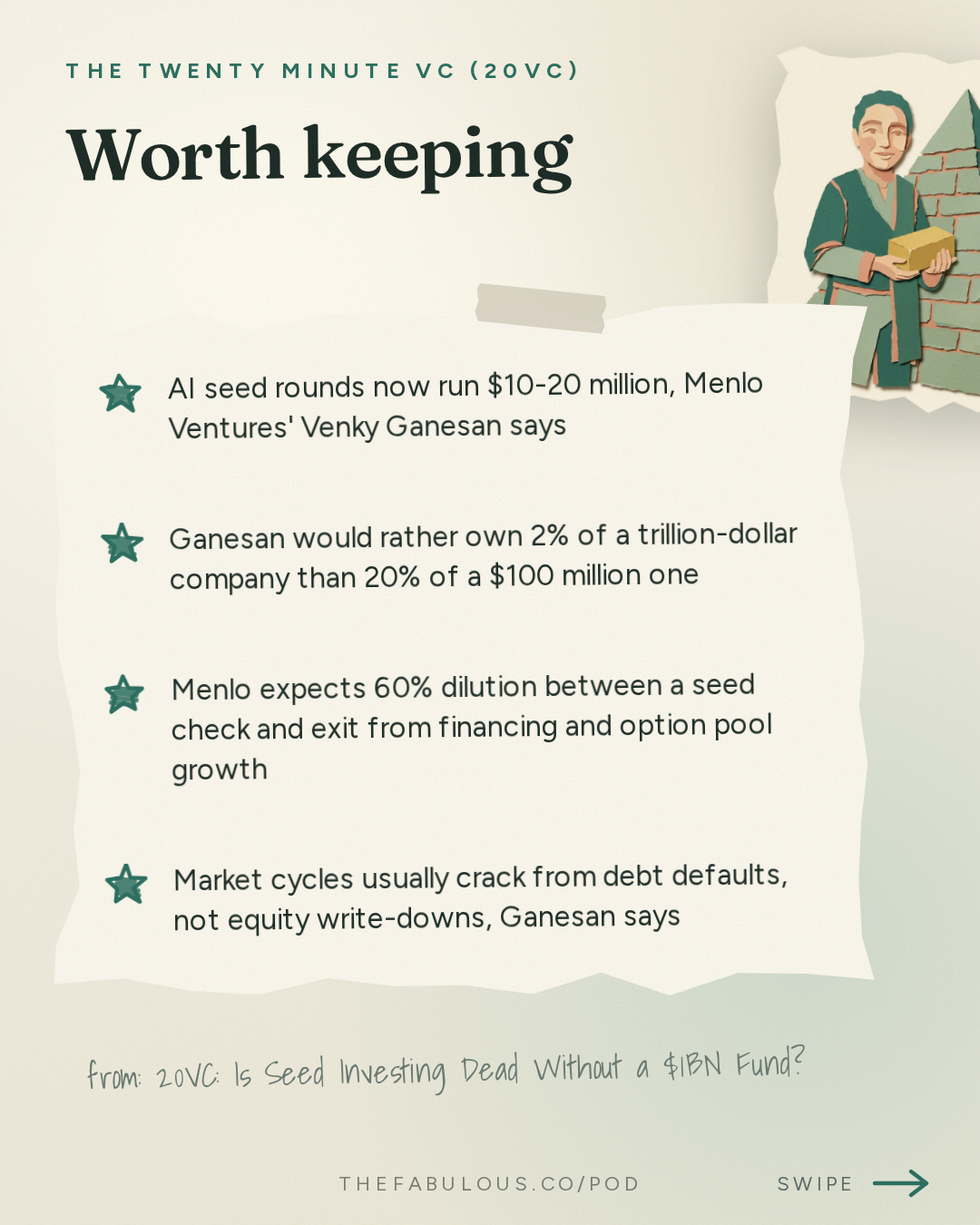
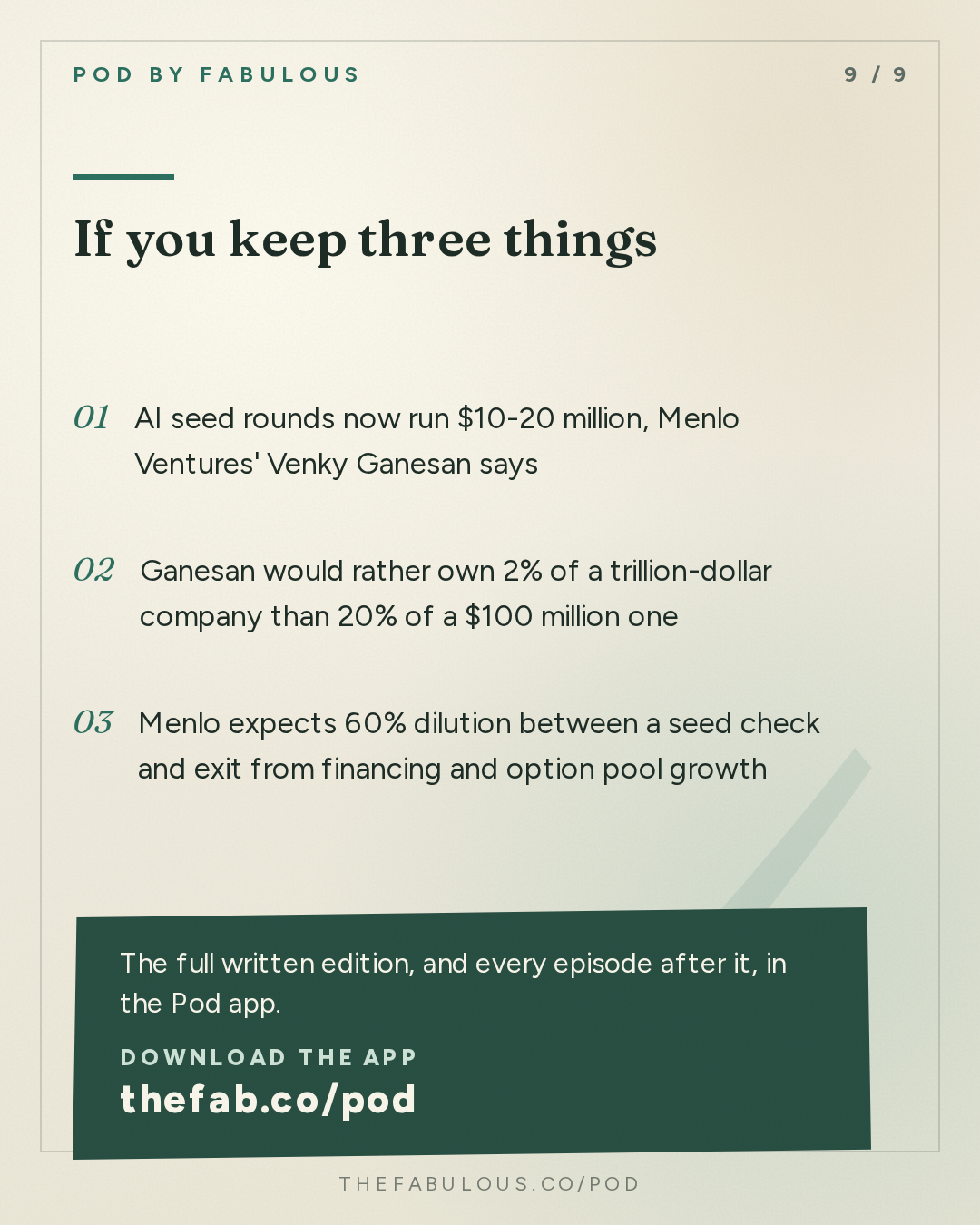
- AI seed rounds now run $10-20 million, Menlo Ventures' Venky Ganesan says
- Ganesan would rather own 2% of a trillion-dollar company than 20% of a $100 million one
- Menlo expects 60% dilution between a seed check and exit from financing and option pool growth
- Market cycles usually crack from debt defaults, not equity write-downs, Ganesan says
- Venture performance lags 5 to 7 years, so Ganesan tells LPs to ask founders which investors they turned down
The episode in cards
By the numbers
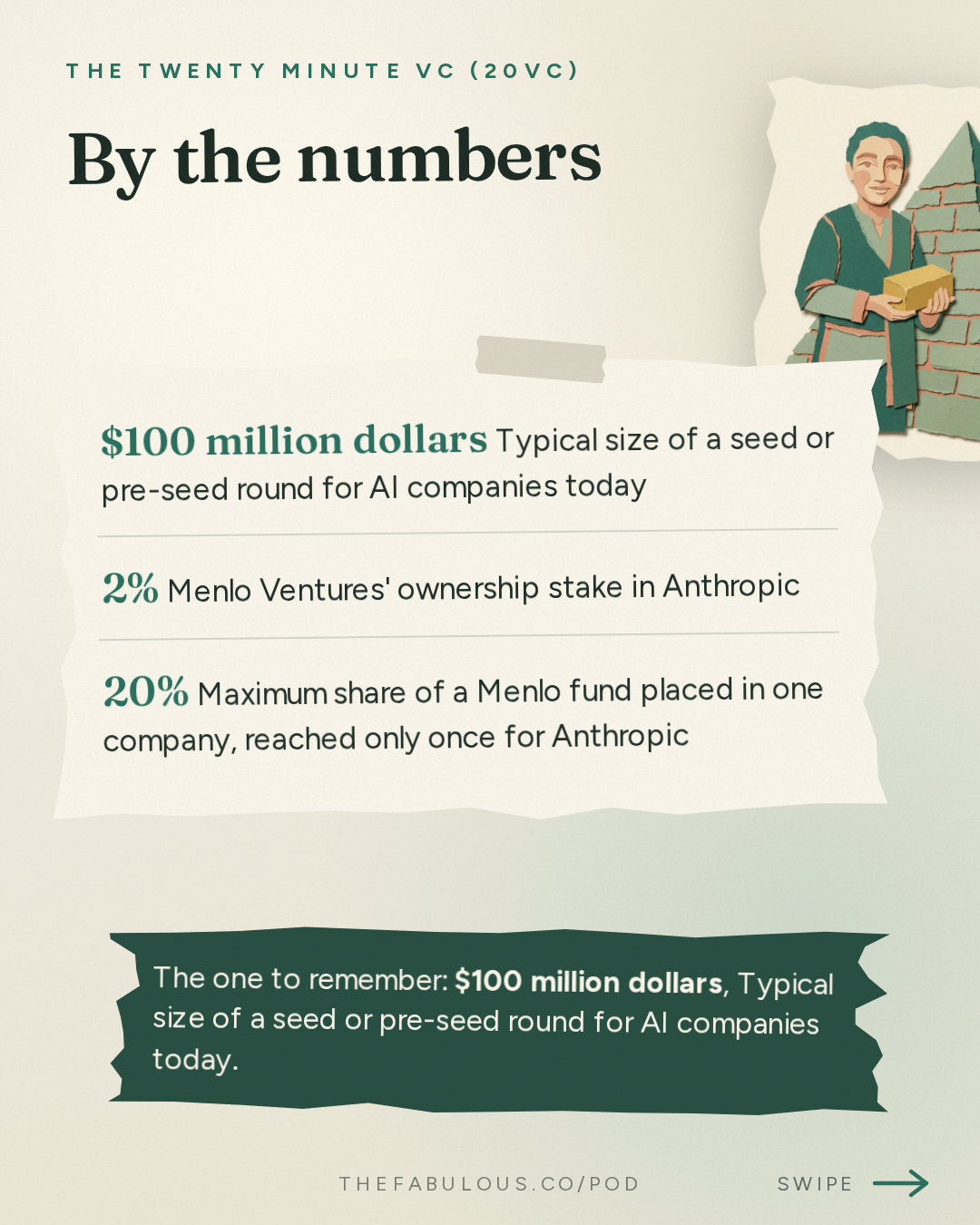
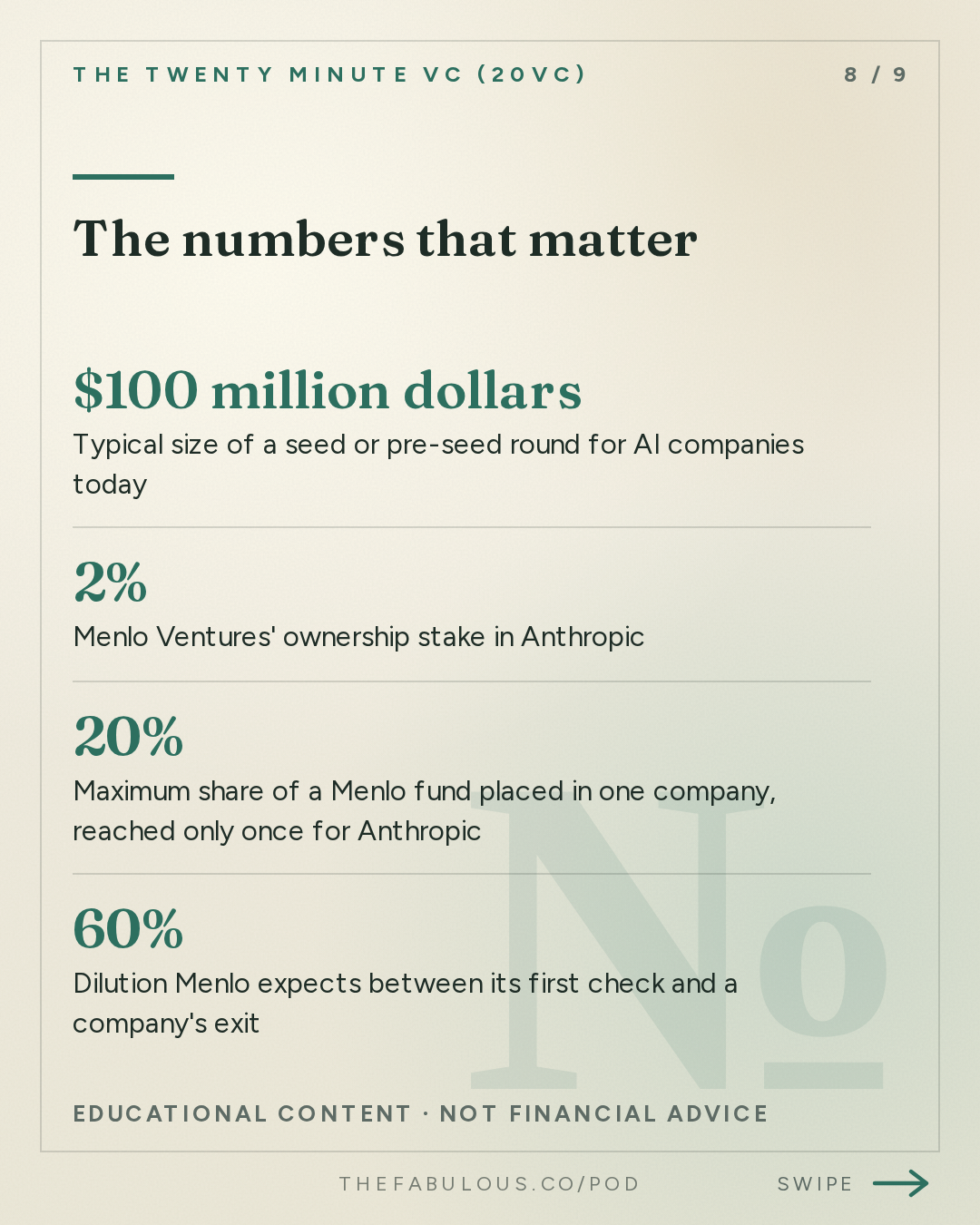
- $100 million dollars Typical size of a seed or pre-seed round for AI companies today
- 2% percent Menlo Ventures' ownership stake in Anthropic
- 20% percent Maximum share of a Menlo fund placed in one company, reached only once for Anthropic
- 60% percent Dilution Menlo expects between its first check and a company's exit
- 1,000 basis points basis points Extra annual return venture capital must beat public index funds by to justify its fees
In their words
“The most important lesson I learned from a 90% loss, which is at some point, you should take some chips off the table.”
“Each seed investment is an option bet. You're buying an option to see if it's an outlier.”
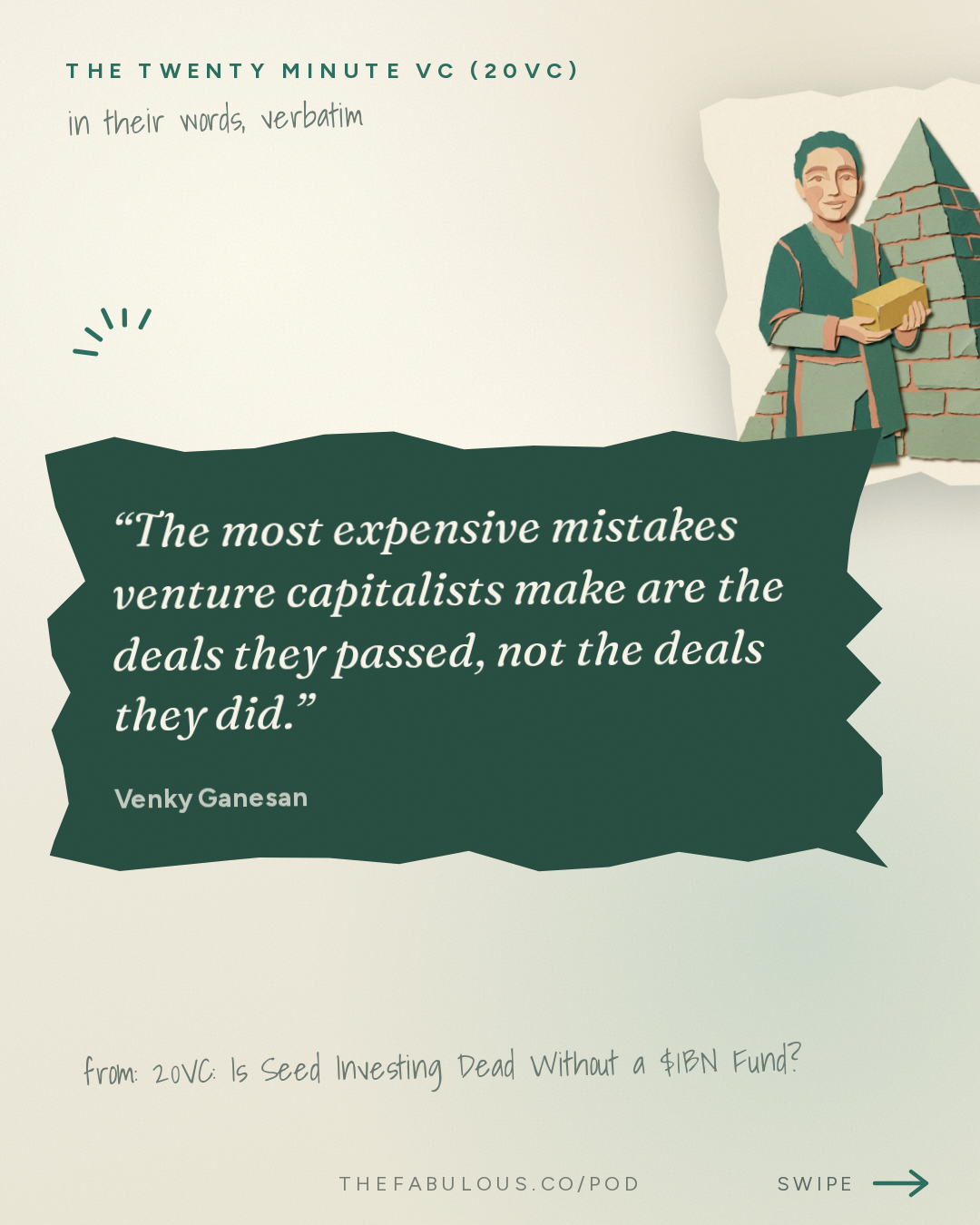
“The most expensive mistakes venture capitalists make are the deals they passed, not the deals they did.”
“I'd rather take 2% of a trillion-dollar company than, than 20% of a $100 million company”
“Money doesn't change people, it reveals them.”
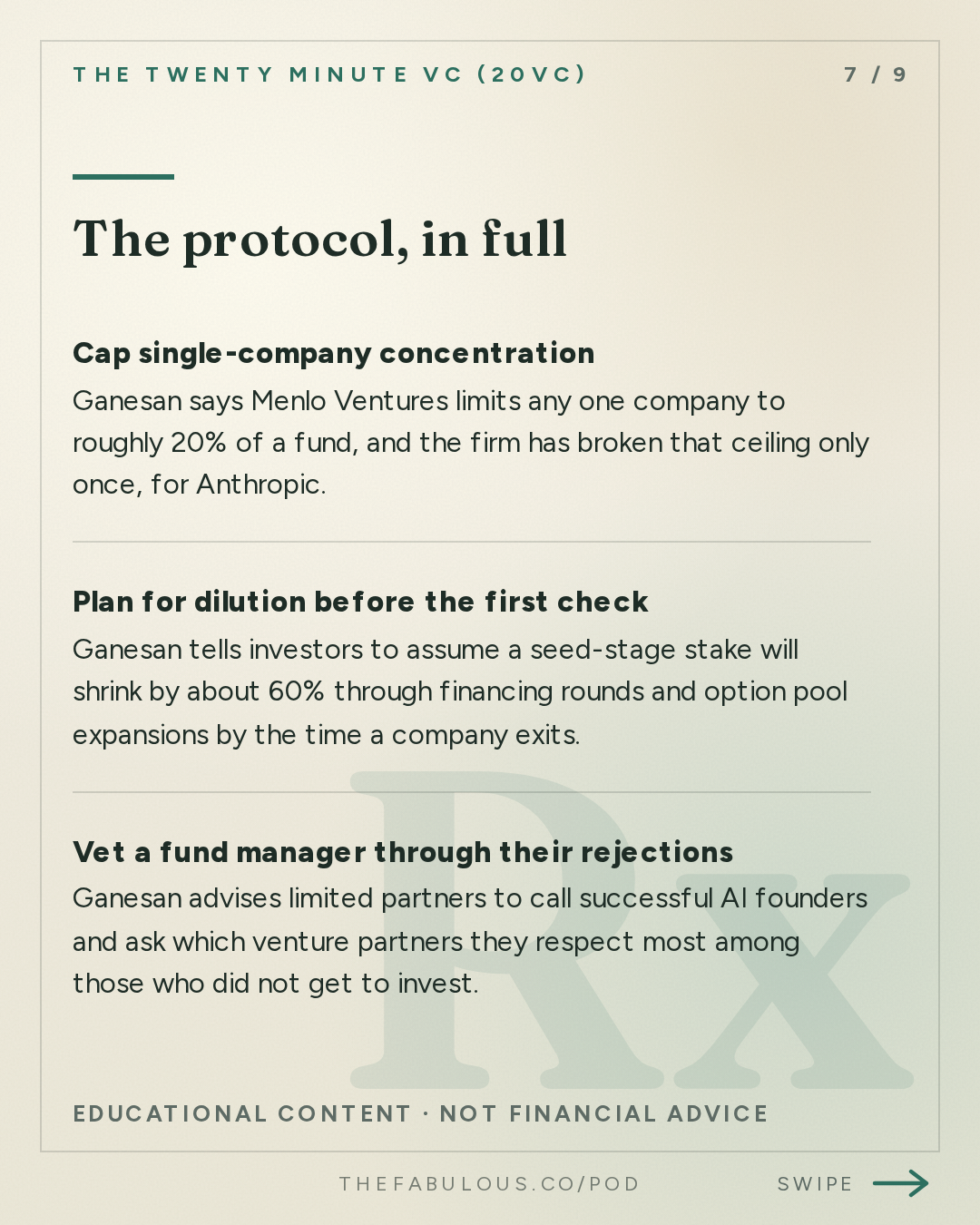
Protocols
-
Cap single-company concentration
Ganesan says Menlo Ventures limits any one company to roughly 20% of a fund, and the firm has broken that ceiling only once, for Anthropic.
per fund
-
Plan for dilution before the first check
Ganesan tells investors to assume a seed-stage stake will shrink by about 60% through financing rounds and option pool expansions by the time a company exits.
per investment
-
Vet a fund manager through their rejections
Ganesan advises limited partners to call successful AI founders and ask which venture partners they respect most among those who did not get to invest.
before committing capital
Questions this episode answers
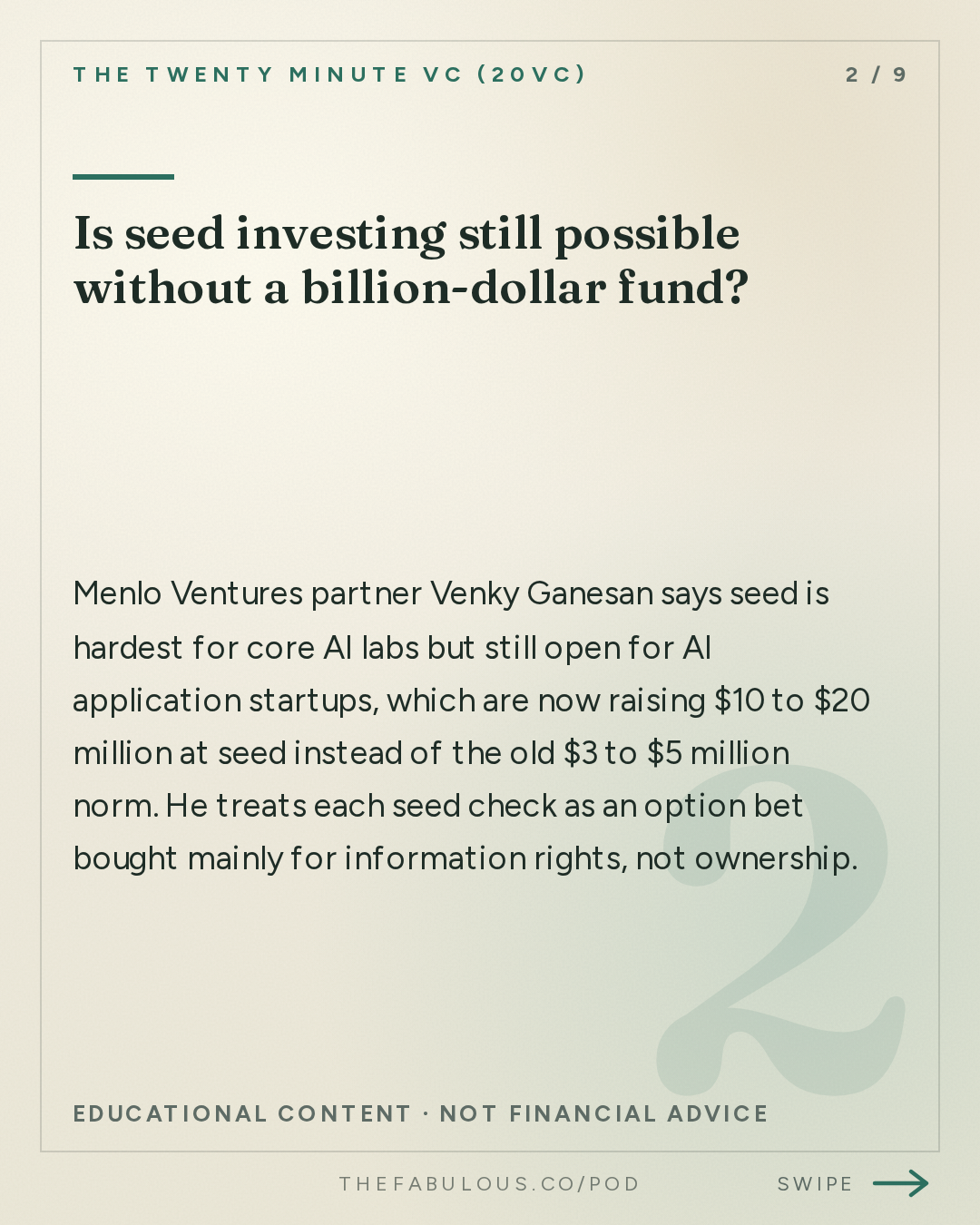
Is seed investing still possible without a billion-dollar fund?
Menlo Ventures partner Venky Ganesan says seed is hardest for core AI labs but still open for AI application startups, which are now raising $10 to $20 million at seed instead of the old $3 to $5 million norm (10:19). He treats each seed check as an option bet bought mainly for information rights, not ownership (09:34).
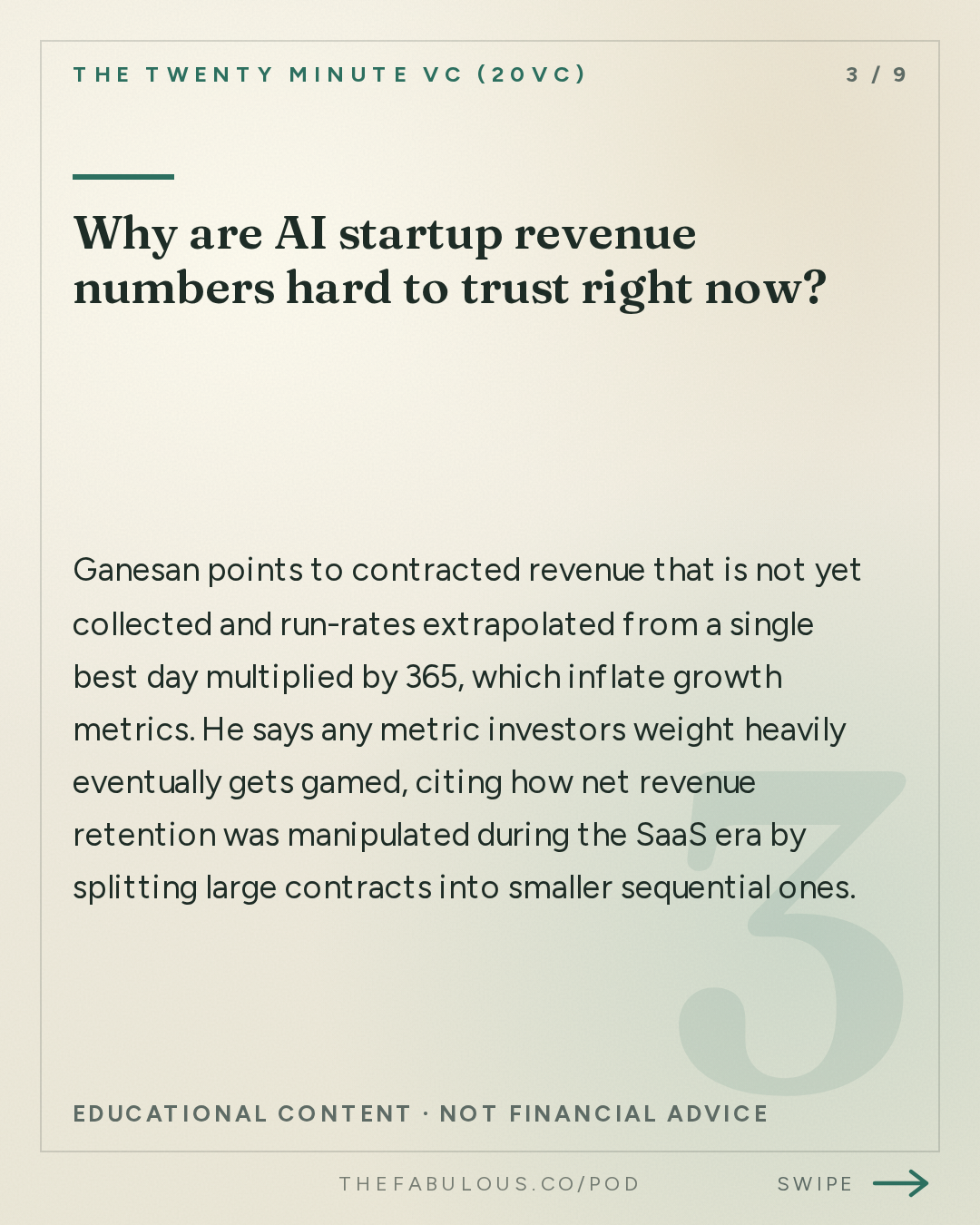
Why are AI startup revenue numbers hard to trust right now?
Ganesan points to contracted revenue that is not yet collected and run-rates extrapolated from a single best day multiplied by 365, which inflate growth metrics (11:23). He says any metric investors weight heavily eventually gets gamed, citing how net revenue retention was manipulated during the SaaS era by splitting large contracts into smaller sequential ones (11:48).
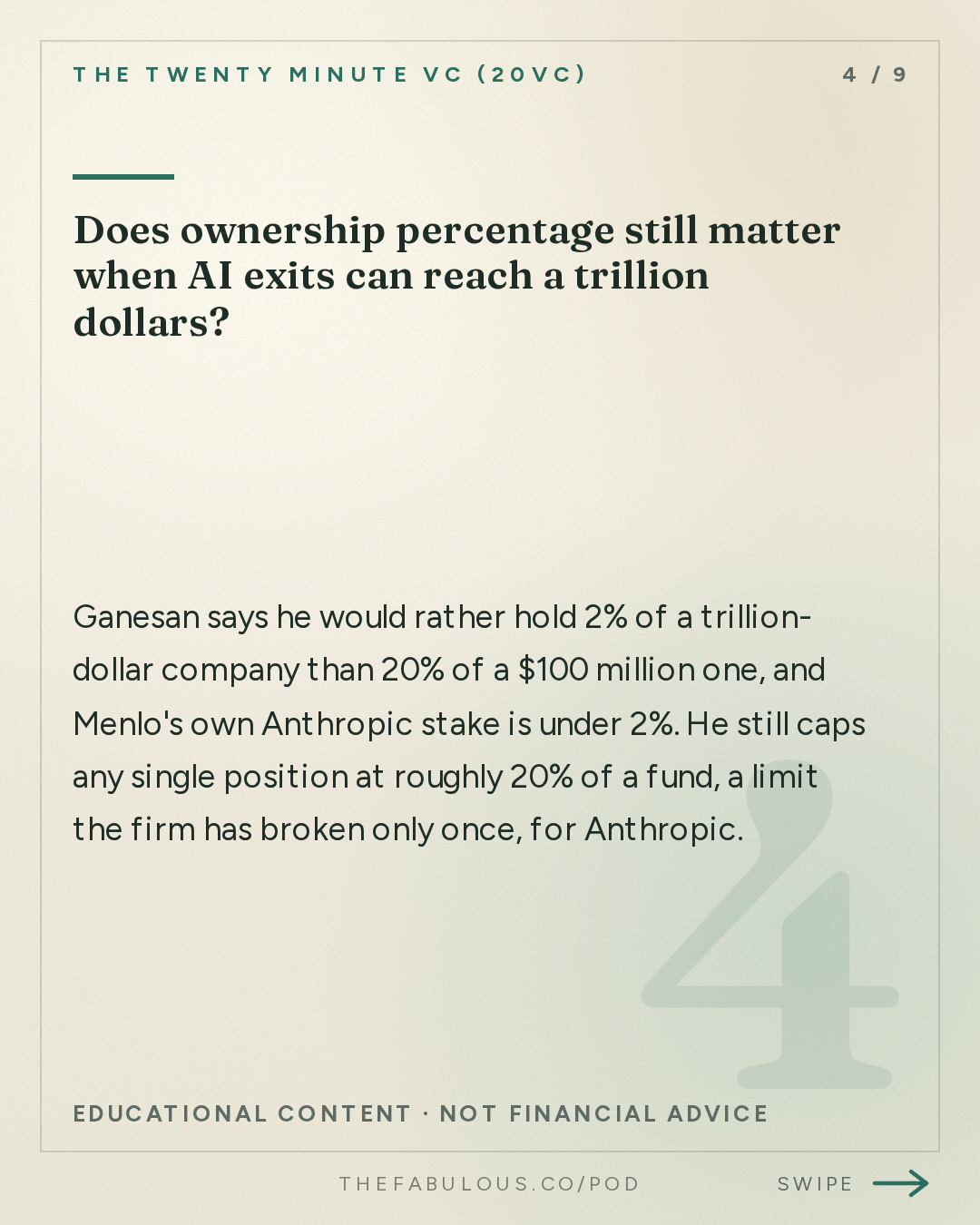
Does ownership percentage still matter when AI exits can reach a trillion dollars?
Ganesan says he would rather hold 2% of a trillion-dollar company than 20% of a $100 million one, and Menlo's own Anthropic stake is under 2% (25:10, 25:22). He still caps any single position at roughly 20% of a fund, a limit the firm has broken only once, for Anthropic (27:13).
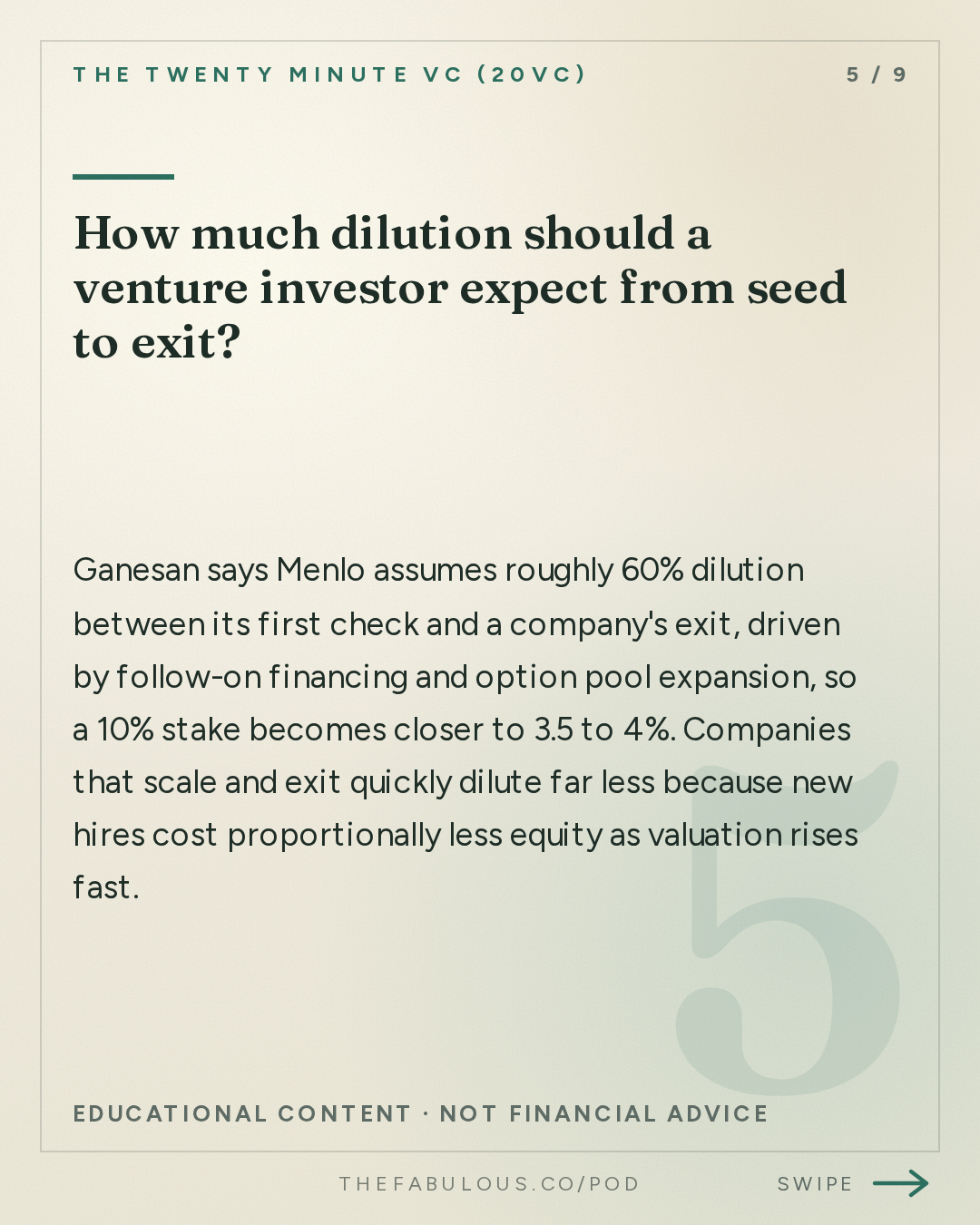
How much dilution should a venture investor expect from seed to exit?
Ganesan says Menlo assumes roughly 60% dilution between its first check and a company's exit, driven by follow-on financing and option pool expansion, so a 10% stake becomes closer to 3.5 to 4% (34:00). Companies that scale and exit quickly dilute far less because new hires cost proportionally less equity as valuation rises fast (36:04).
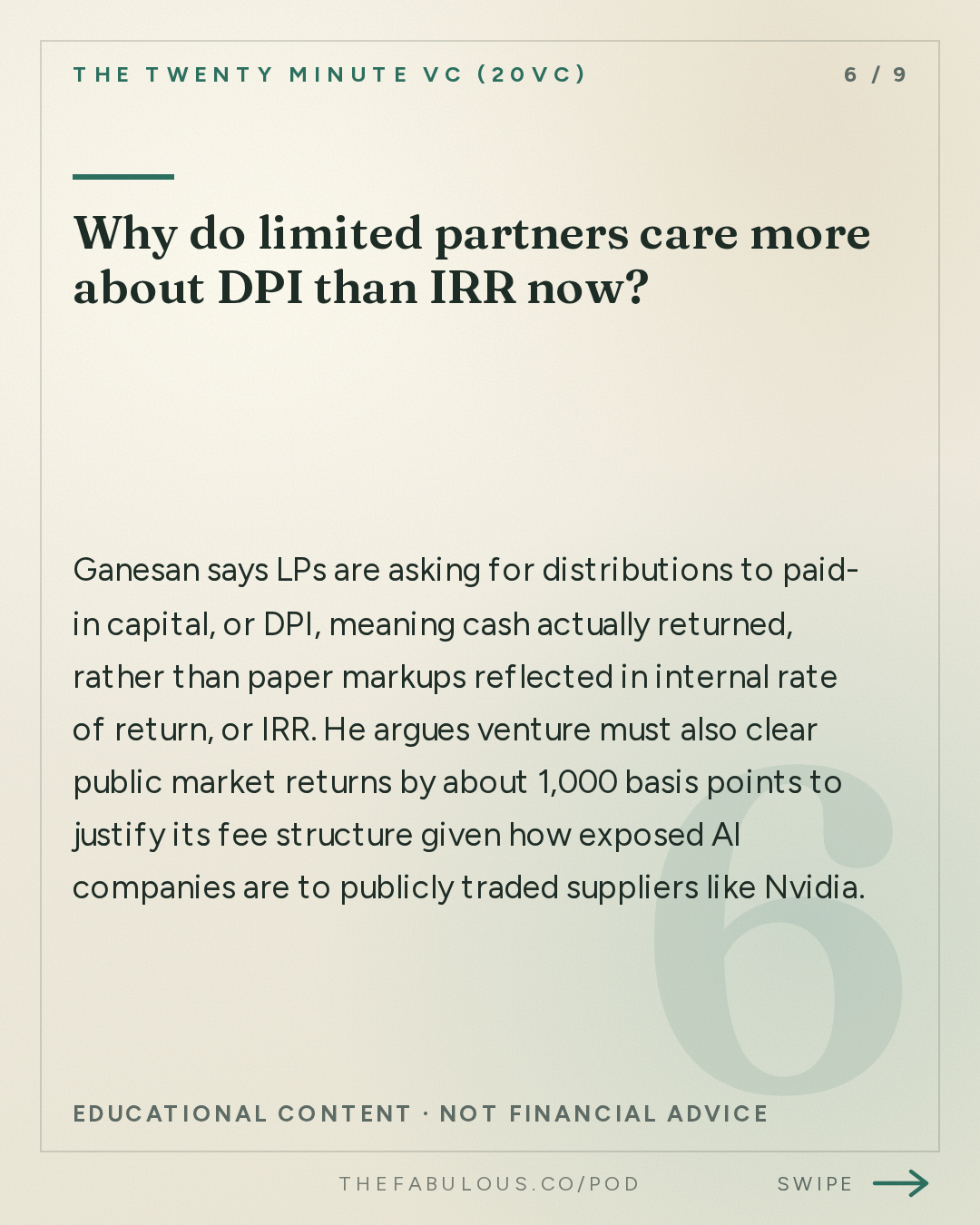
Why do limited partners care more about DPI than IRR now?
Ganesan says LPs are asking for distributions to paid-in capital, or DPI, meaning cash actually returned, rather than paper markups reflected in internal rate of return, or IRR (41:19). He argues venture must also clear public market returns by about 1,000 basis points to justify its fee structure given how exposed AI companies are to publicly traded suppliers like Nvidia (37:13).
What signals suggest a market cycle in venture capital is about to crack?
Ganesan says cycles typically break because of major debt defaults rather than equity write-downs, since equity investors can simply mark down a loss while lenders expect repayment regardless of a company's real value (14:28). He points to reflexivity, the idea from investor George Soros that markups attract more capital and attention until the pattern eventually snaps, though the timing is unpredictable (13:20).
The full read, in cards
Go deeper
- Reflexivity theory — Investor George Soros's idea that rising prices attract capital and attention that push prices higher until the pattern breaks, used here to explain markup-driven funding cycles
- The bezzle — Economist John Kenneth Galbraith's term for the hidden gap between when fraud happens and when it is discovered during a boom
Mentioned
Menlo Ventures · Anthropic · Sean Parker · George Soros · Bill Gurley · Washington State Investment Board · Nikesh Arora · Bessemer Venture Partners · Benchmark · Plaxo · Sarah Guo · Frank Slootman
More from this show and category

Chase Lochmiller on AI Data Center Economics
Crusoe Energy co-founder Chase Lochmiller argues AI's real bottleneck is energy and manufacturing, not chips, and vertical integration beats business moats. He says data centers actually lower local energy prices, use near-zero water, and that about half of planned projects will never get built.

Parag Agrawal on AI Agent Web Search
Parallel founder Parag Agrawal predicts AI agents will search the web 1,000 times more than humans, breaking today's ad-supported internet. He says Parallel already delivers search results up to 50 times cheaper than legacy stacks, and that 5 to 20 percent of all inference spend will eventually flow into web search infrastructure built for agents, not people.

Why Anthropic Delayed Its IPO to November
Anthropic delayed its $2 trillion IPO from October to November to present cleaner third quarter numbers. Meta's Muse app hit No. 1 and emerged as ChatGPT's first rival, developer tool Jev exposed wasted AI spend on simple tasks, seed checks are ballooning toward $10 million, and Crusoe's $30.9 billion valuation stoked fears the AI data center trade is overheating.

Daniel Dines on AI's 'Map of Work' Thesis
UiPath CEO Daniel Dines argues AI still cannot replace enterprise employees because models do not learn on the job the way people do. He says every company needs a documented 'map of work' before handing processes to AI, and that the workflow around a model, not its weights, is where lasting business value sits (26:34, 45:49).
