
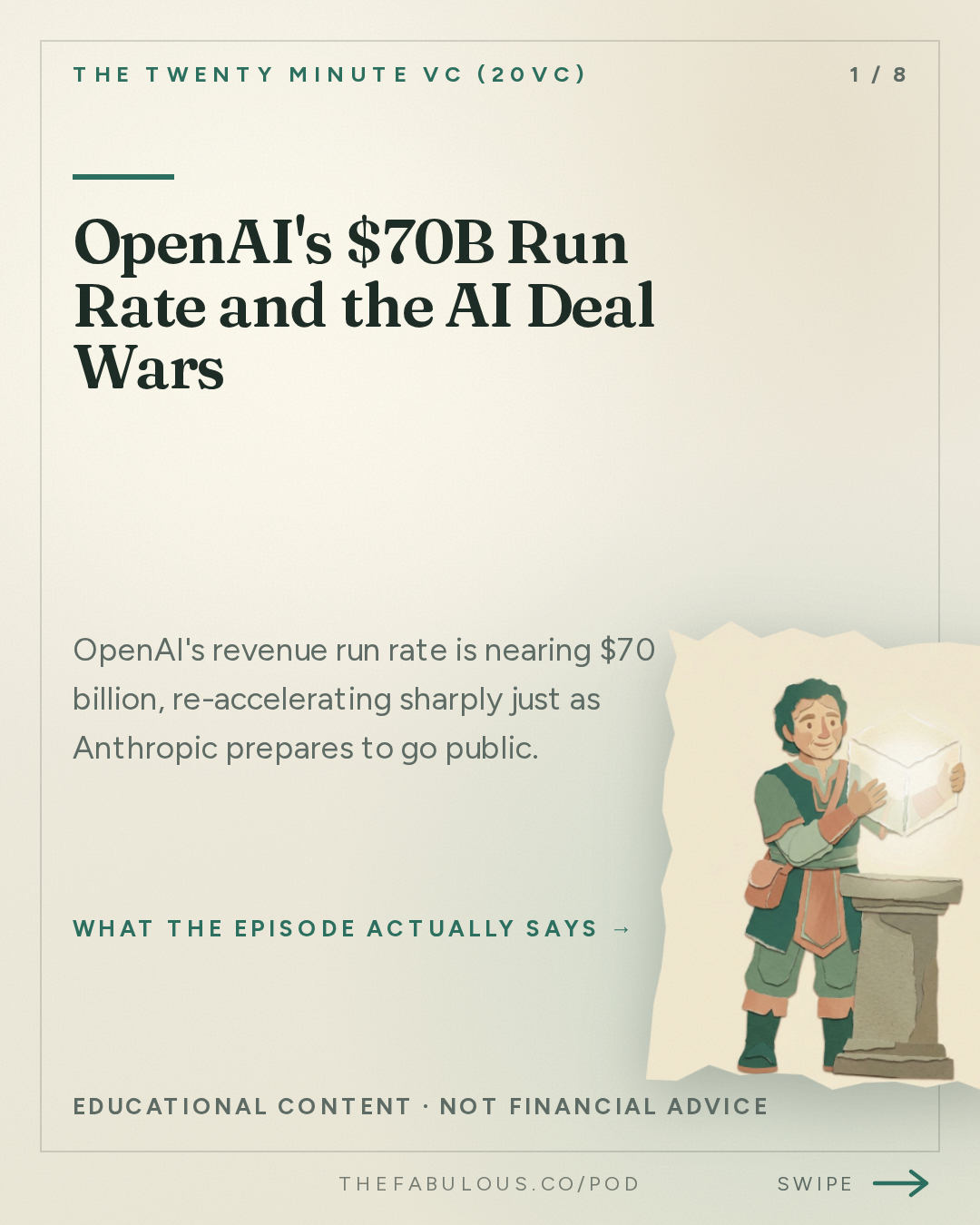
OpenAI's $70B Run Rate and the AI Deal Wars
20VC: Cognition vs Factory: Vinod Khosla Creates a Storm | OpenAI Nears $70B Run Rate: Anthropic Under Threat | ElevenLabs Doubles Its Valuation to $22B & Salesforce Buys Listen Labs for $2B
The brief
OpenAI's revenue run rate is nearing $70 billion, re-accelerating sharply just as Anthropic prepares to go public. The episode also unpacks a Cognition-Factory executive poaching dispute, Vinod Khosla's public swipe at a portfolio founder, ElevenLabs' jump to a $22 billion valuation, Salesforce's $2 billion purchase of Listen Labs, and legal risk in Nvidia's $17 billion Groq license deal.
A sales executive leaves a company he never officially worked for. He was an advisor, a board observer, someone the founder called every day. Then he takes the top sales job at a direct competitor, and the founder calls it a betrayal in public. It sounds like a small, petty story. It is actually a useful window into what the people building and funding artificial intelligence companies now consider normal, and what they still, grudgingly, consider a betrayal.
The executive is Chris Degnan, a veteran sales leader who had been a board observer and informal advisor at the AI coding startup Factory, run by founder Matan. While advising Matan, Degnan was also interviewing to become chief revenue officer, or CRO, at Cognition, a rival AI coding company (12:37). When Matan found out, he accused Degnan publicly of disloyalty. On this week's 20VC, host Harry Stebbings, SaaStr investor Jason Lemkin, venture investor Rory O'Driscoll, and guest Dave Ittycheria, the chief executive of the database company MongoDB, picked the episode apart to ask a bigger question: has loyalty actually changed in the AI industry, or does it just look different because everything is moving faster.
When Loyalty Breaks
Ittycheria, who has hired and fired plenty of sales leaders, drew a sharp line. A CRO who switches industries is normal. A CRO who defects to a direct competitor is not.
I've never seen a CRO flip from one competitor to another. I've seen a CRO go from one company to another in a different space, but I've never seen a CRO flip to a direct competitor. (14:08) Dave Ittycheria
His reasoning is not sentimental. A CRO recruits a sales team by selling them a story about the company's future. If that same person jumps to the enemy, everyone they hired is left holding a story that turned out to be disposable. O'Driscoll pushed back a little, noting that Degnan was only an advisor, not a full-time employee with board duties, so the rules were murkier than Matan's public anger suggested. Lemkin went further, arguing that in the current market, roughly 95 percent of CROs would see nothing wrong with taking the best offer on the table, competitor or not, because job turnover at that level has simply sped up.
Vinod Khosla, the founder of Khosla Ventures and an investor who had led Factory's most recent funding round, then made things worse. He posted publicly that Matan was a struggling second-tier competitor, an attack on the founder of his own portfolio company (23:03). The panel's reaction was closer to professional embarrassment than outrage.
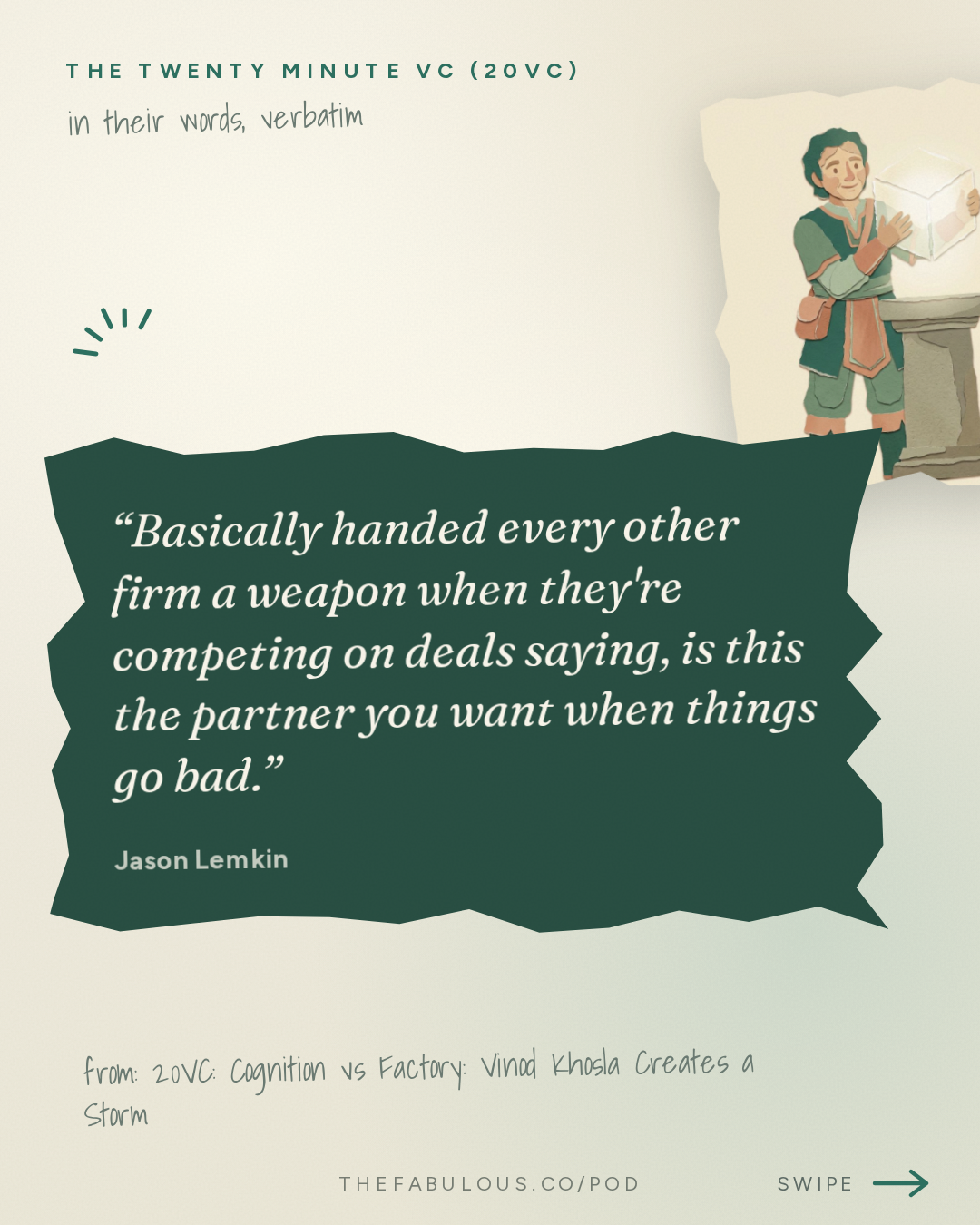
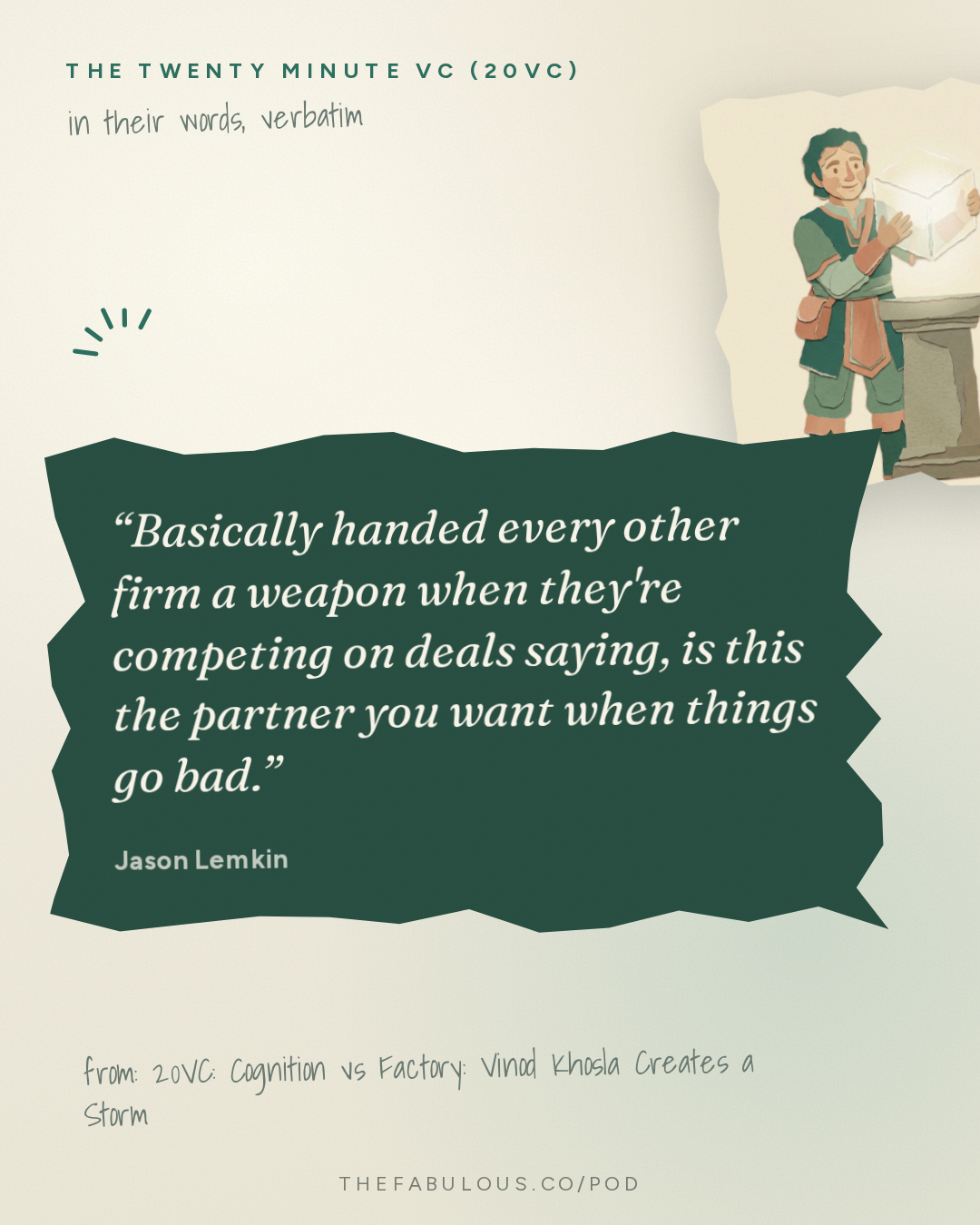
Basically handed every other firm a weapon when they're competing on deals saying, is this the partner you want when things go bad. (24:00) Jason Lemkin
The point is not that Khosla was wrong about the company. It is that venture firms who back two competitors in the same category survive by staying quiet in public, and Khosla broke that unwritten rule in a single tweet, handing every rival firm a talking point for future pitch meetings.
The Money Behind the Noise
Underneath the personnel drama sits a much larger shift in the economics of the industry, and it starts with OpenAI. After a wobbly first half of the year, in which OpenAI's GAAP revenue, meaning revenue recognized under standard accounting rules rather than bookings or projections, grew just 18 percent quarter on quarter in Q2 while Anthropic was growing roughly tenfold, OpenAI's growth reaccelerated to 70 percent quarter on quarter in Q3 (08:12). That pushed its run rate, an annualized estimate of revenue based on the current quarter's pace, to nearly $70 billion (04:44), alongside reports of a $1.4 trillion valuation in a new funding round (04:29). Ittycheria pointed to a simple, overlooked reason: enterprise customers do not switch AI vendors as casually as individual developers do, because switching means retraining staff and rebuilding workflows, so once OpenAI is inside a company's procurement system, it is hard to dislodge (06:52). The timing matters too, because Anthropic is expected to file for an IPO in the middle of November, and its own Q3 numbers will land in that prospectus just as the market judges whether OpenAI's comeback came at Anthropic's expense (10:15).
Voice technology supplied its own outsized number. ElevenLabs, an AI voice company, doubled its valuation to $22 billion (33:55). Lemkin argued the case rests on a narrow but real technical bar: voice applications need response times fast enough that a caller never notices a delay, because if an automated system is picking up a phone for a florist's order line, it has to answer correctly in seconds or the product is worthless (35:30). Meanwhile Salesforce bought Listen Labs, an AI-powered market research company, for $2 billion (37:02), a deal Ittycheria said he intellectually understood but didn't quite believe in, given that $2 billion is a rounding error against Salesforce's roughly $60 billion in revenue (39:13). Ittycheria's framing was sharper: many AI applications are really just clever features sitting on someone else's platform, dressed up as companies, and the real test of durability is whether a product builds a data loop, where usage creates proprietary data that improves the product and attracts more usage, something a feature can't easily replicate (39:55).
The most forward-looking number came from Vercel, the application hosting company, where Lemkin noted that fully 50 percent of new business is now being driven by autonomous AI agents choosing the platform on their own, up from just 3 percent earlier this year, on $600 million of annual recurring revenue (46:30). This is not a human reading reviews. It is software deciding which vendor to use without being asked.
When agents pick you, it's a force of nature right now. And agents, what I've learned from them, have opinions, and they're really hard to argue with. (47:41) Jason Lemkin
Ittycheria connected this to twenty-five years of search engine optimization suddenly needing a sequel: companies now have to make sure AI agents, not just human searchers, can find and trust them, or risk becoming invisible in a market where the buyer is a piece of software (48:47).
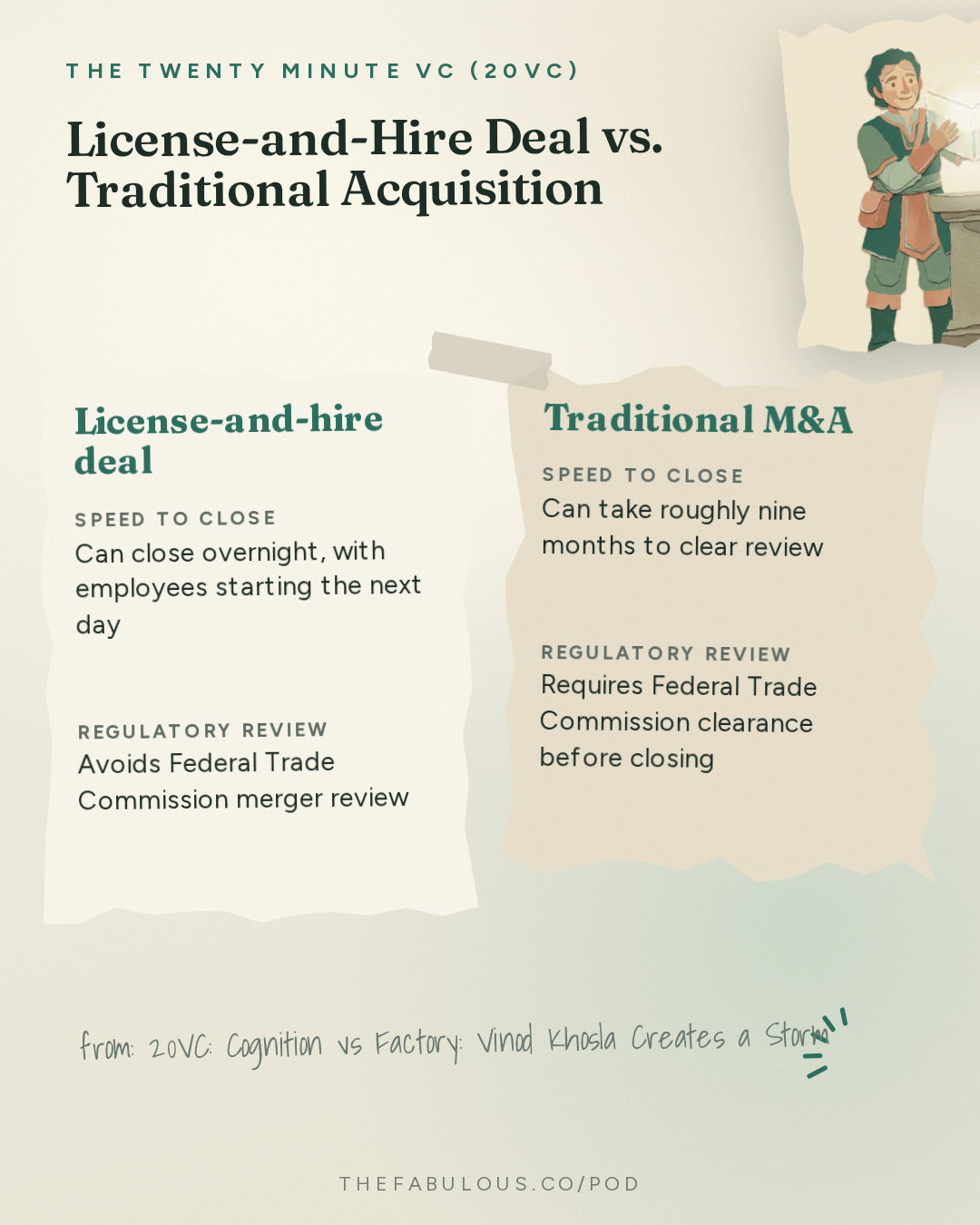
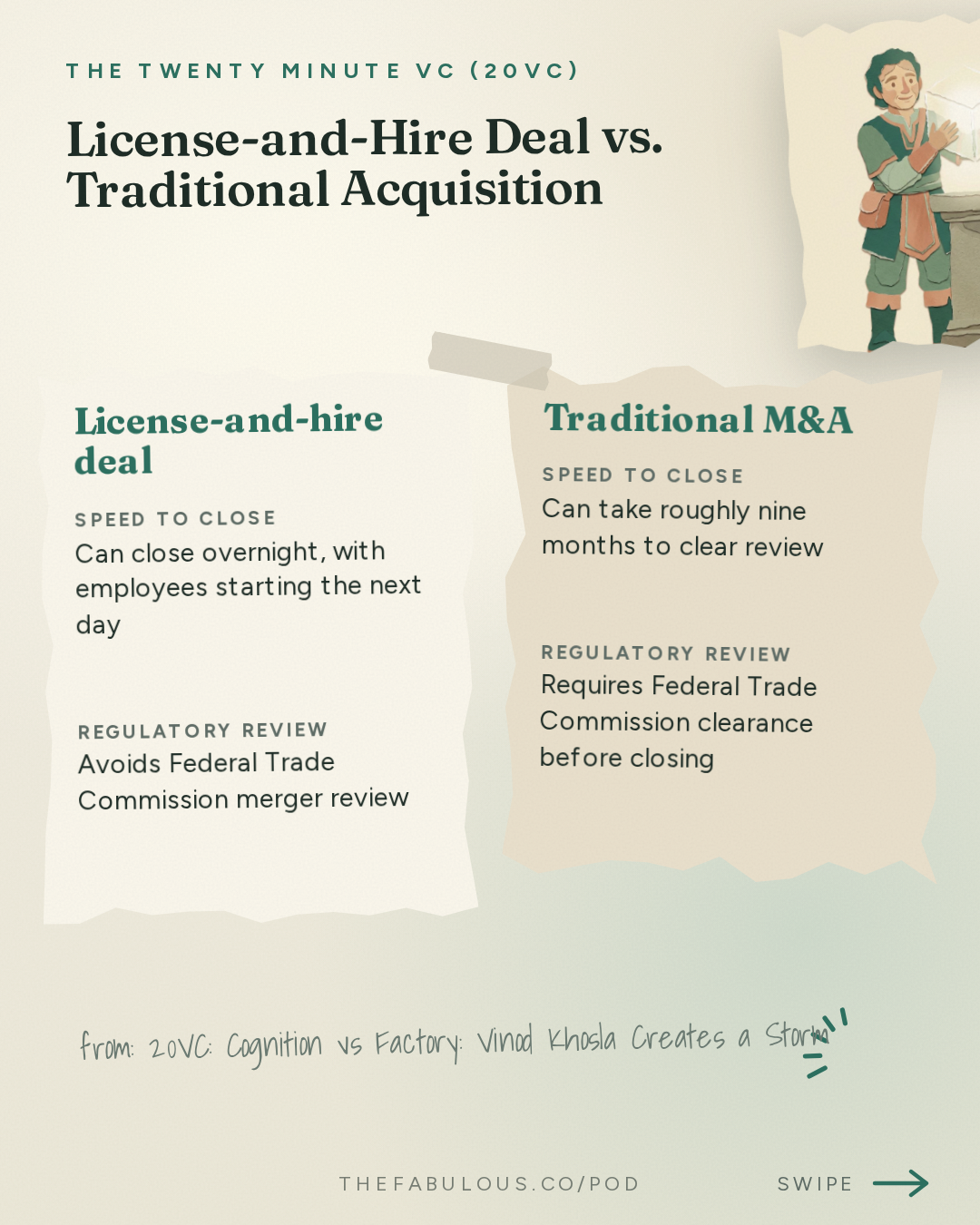
Not every structure built for this speed survives contact with the law. Nvidia's $17 billion deal to license technology from and hire engineers out of the AI chip startup Groq, rather than acquire it outright, is now facing a shareholder lawsuit in Delaware from two former Groq engineers who argue the arrangement was an acquisition in substance, not form, and that it left ordinary shareholders worse off than those who crossed over to Nvidia (55:13). O'Driscoll explained why this format exists at all: it is a workaround for the slow pace of antitrust review at the Federal Trade Commission, letting a deal close overnight instead of waiting roughly nine months for approval (58:33). The catch, as Lemkin put it, is that calling something a license instead of a merger does not change what it functionally is.
Just 'cause you say it's not a duck, it don't mean it's not a duck. I think some of these are ducks. (60:00) Jason Lemkin
The episode closed on two smaller but telling signals. First, Meta's new consumer AI assistant, Muse, drew praise from the panel for its polish and resourcing, in sharp contrast to OpenAI's Dots launch, which Stebbings called tech-centric and underwhelming for ordinary users (61:21). Lemkin suggested Dots might simply be built for a different audience, developers running persistent coding agents, rather than consumers, and that judging it on consumer appeal might miss the point entirely (63:20). Second, the home security and personal safety company Aura pulled its IPO despite growing 74 percent on $1.2 billion in revenue, which Ittycheria guessed came down to a gap between what bankers had promised the board on pricing and what public investors were actually willing to pay (66:55). It is a reminder that even in a year of extraordinary valuations, the public markets still set their own price, no matter how fast the private story moves.
Ask this episode anything
Pod's AI answers from the episode itself, with the minute mark so you can hear it yourself.
Or start with one of these
Ask this episode
Pod's AI listens to the whole episode to answer, and points you to the minute it comes from.
The rest of this answer, and any question after it
Answers come from the episode itself, never from a summary of it.
ContinueKey takeaways
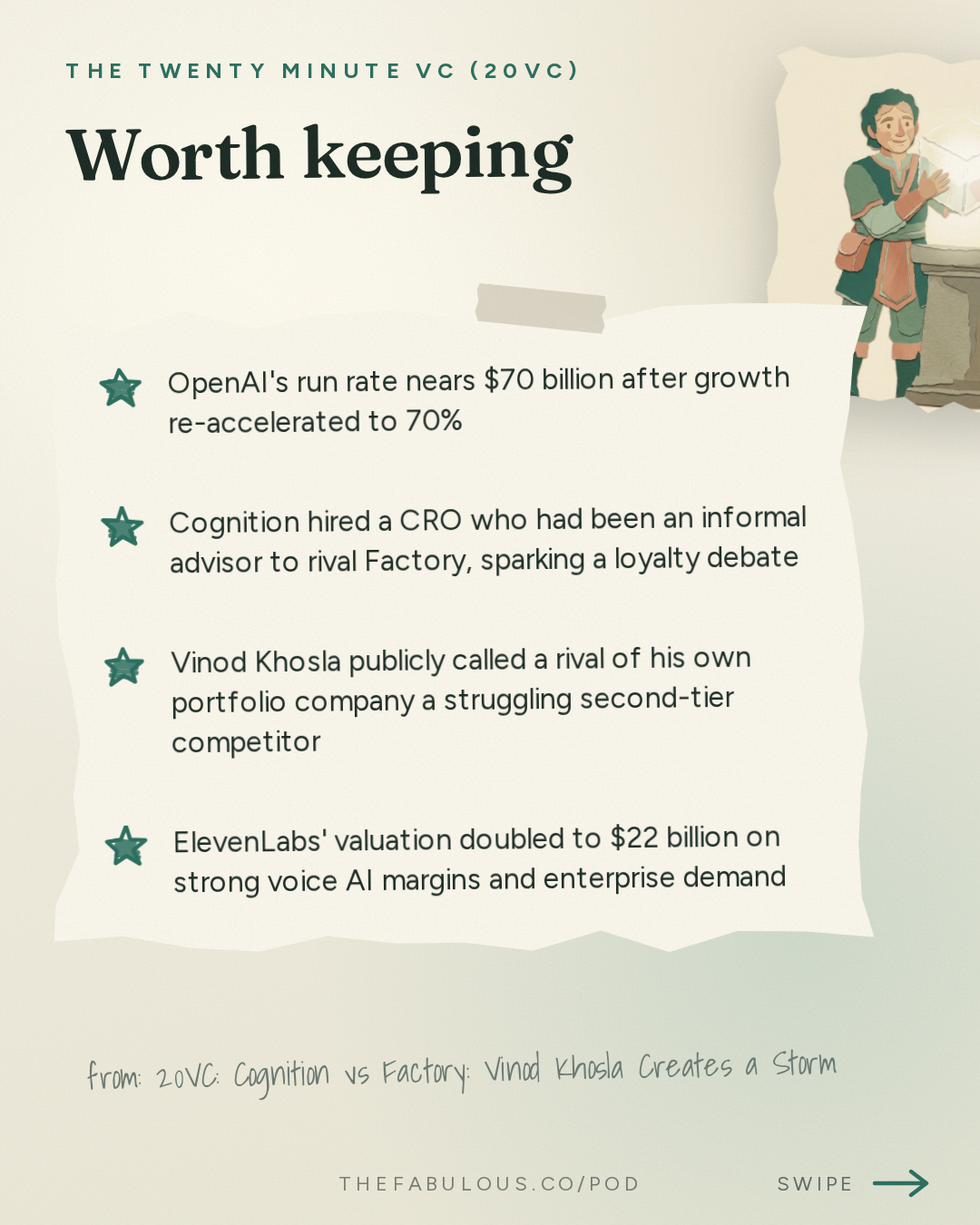
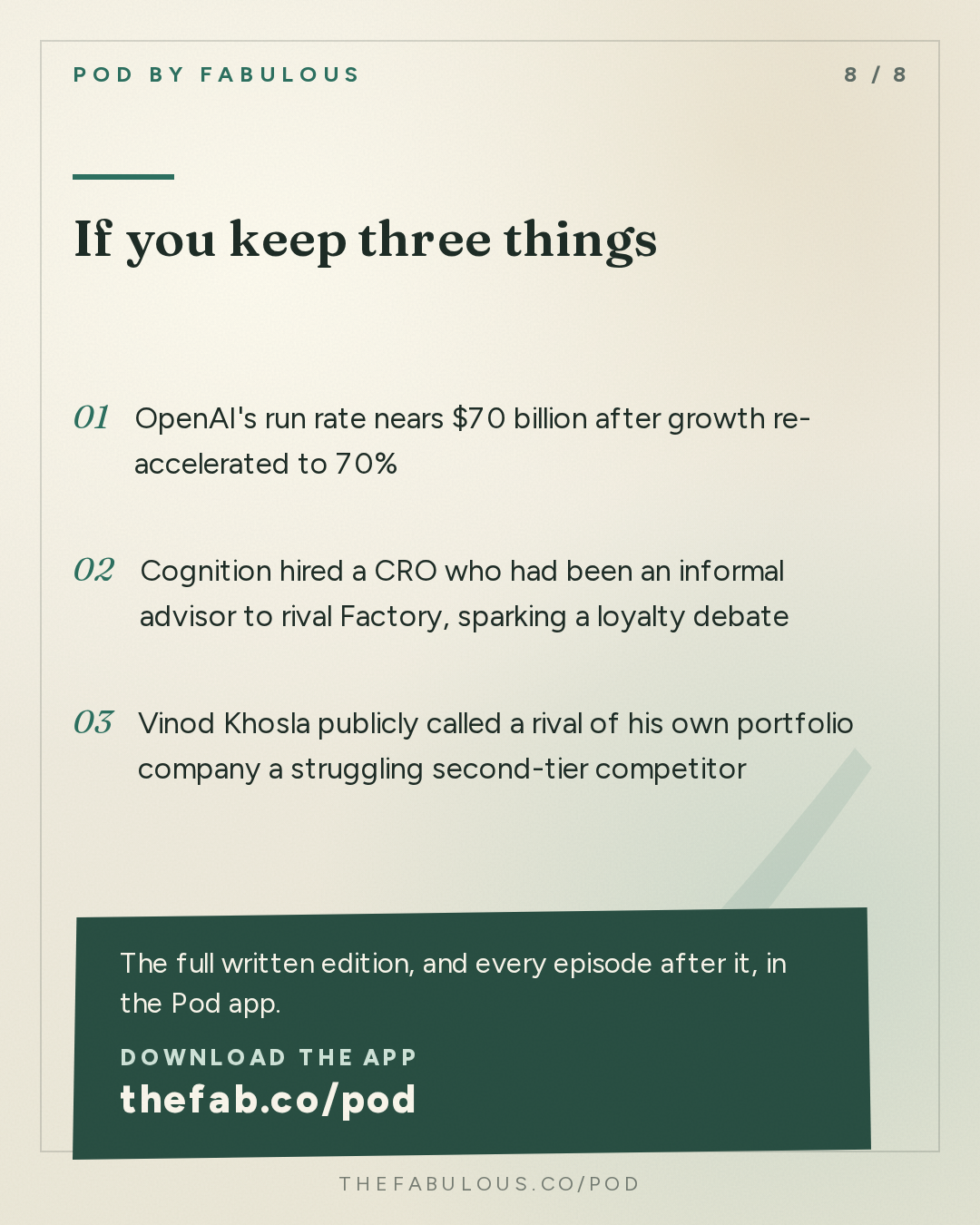
- OpenAI's run rate nears $70 billion after growth re-accelerated to 70%
- Cognition hired a CRO who had been an informal advisor to rival Factory, sparking a loyalty debate
- Vinod Khosla publicly called a rival of his own portfolio company a struggling second-tier competitor
- ElevenLabs' valuation doubled to $22 billion on strong voice AI margins and enterprise demand
- Nvidia's $17 billion license-and-hire deal with Groq now faces a Delaware shareholder lawsuit
The episode in cards
By the numbers
- 70% percent OpenAI's quarter-on-quarter GAAP revenue growth in Q3
In their words
“Basically handed every other firm a weapon when they're competing on deals saying, is this the partner you want when things go bad.”
“Comparison is the thief of joy. You start comparing yourself to everyone else, and you're gonna be very miserable for the rest of your life”
Protocols
-
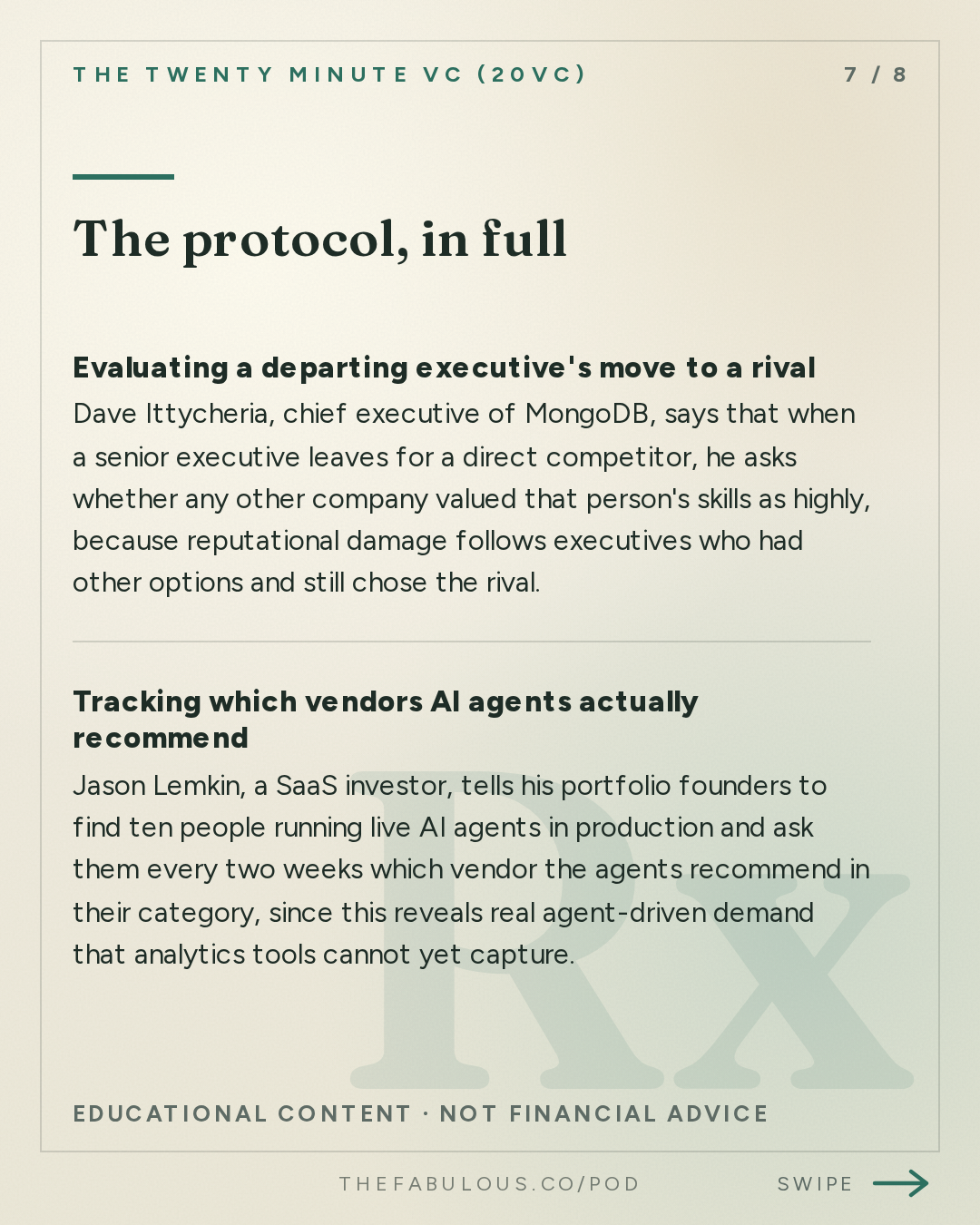
Evaluating a departing executive's move to a rival
Dave Ittycheria, chief executive of MongoDB, says that when a senior executive leaves for a direct competitor, he asks whether any other company valued that person's skills as highly, because reputational damage follows executives who had other options and still chose the rival.
Whenever a senior leader resigns to join a direct competitor
-
Tracking which vendors AI agents actually recommend
Jason Lemkin, a SaaS investor, tells his portfolio founders to find ten people running live AI agents in production and ask them every two weeks which vendor the agents recommend in their category, since this reveals real agent-driven demand that analytics tools cannot yet capture.
Every two weeks
Questions this episode answers
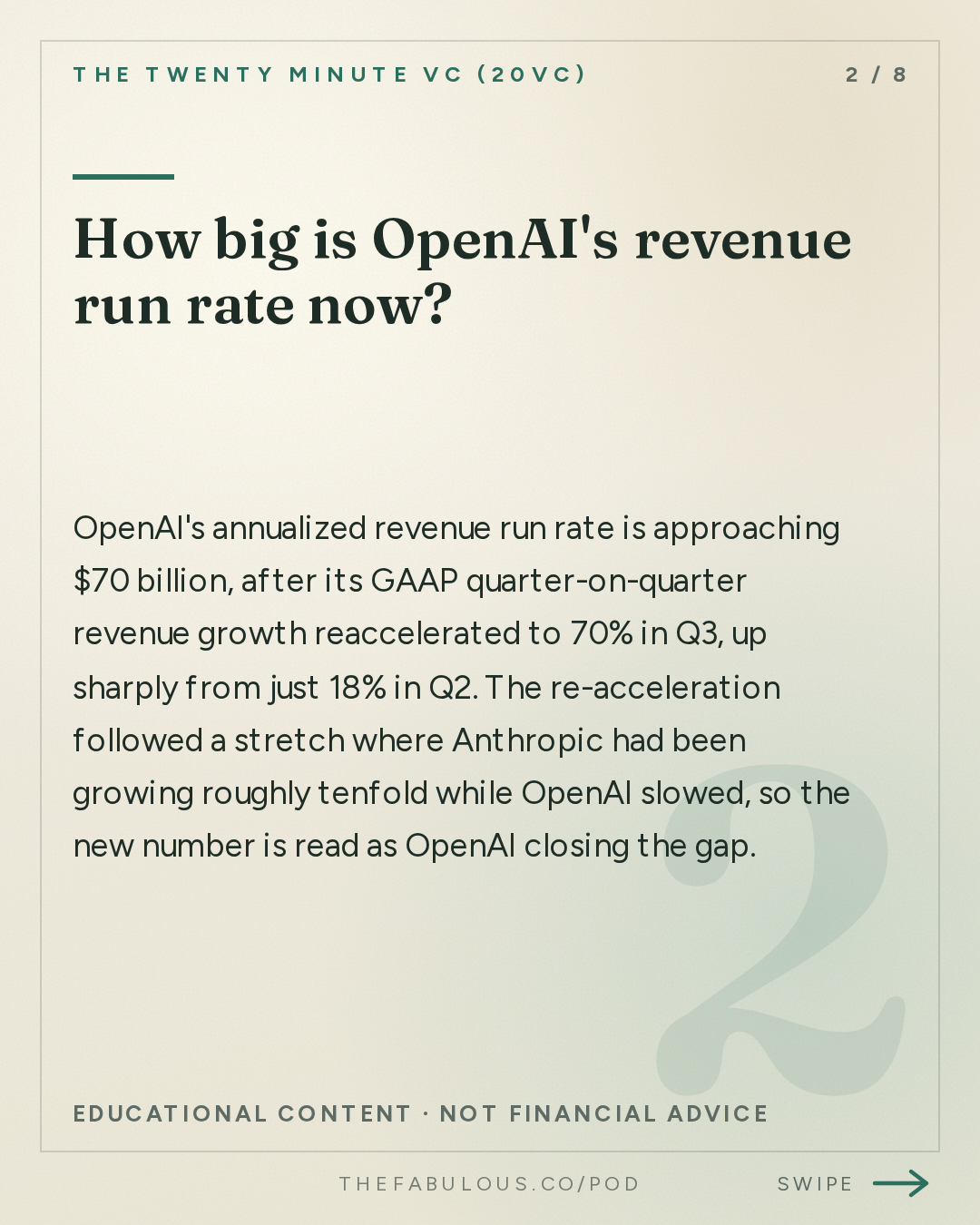
How big is OpenAI's revenue run rate now?
OpenAI's annualized revenue run rate is approaching $70 billion, after its GAAP quarter-on-quarter revenue growth reaccelerated to 70% in Q3, up sharply from just 18% in Q2 (04:44, 08:12). The re-acceleration followed a stretch where Anthropic had been growing roughly tenfold while OpenAI slowed, so the new number is read as OpenAI closing the gap.
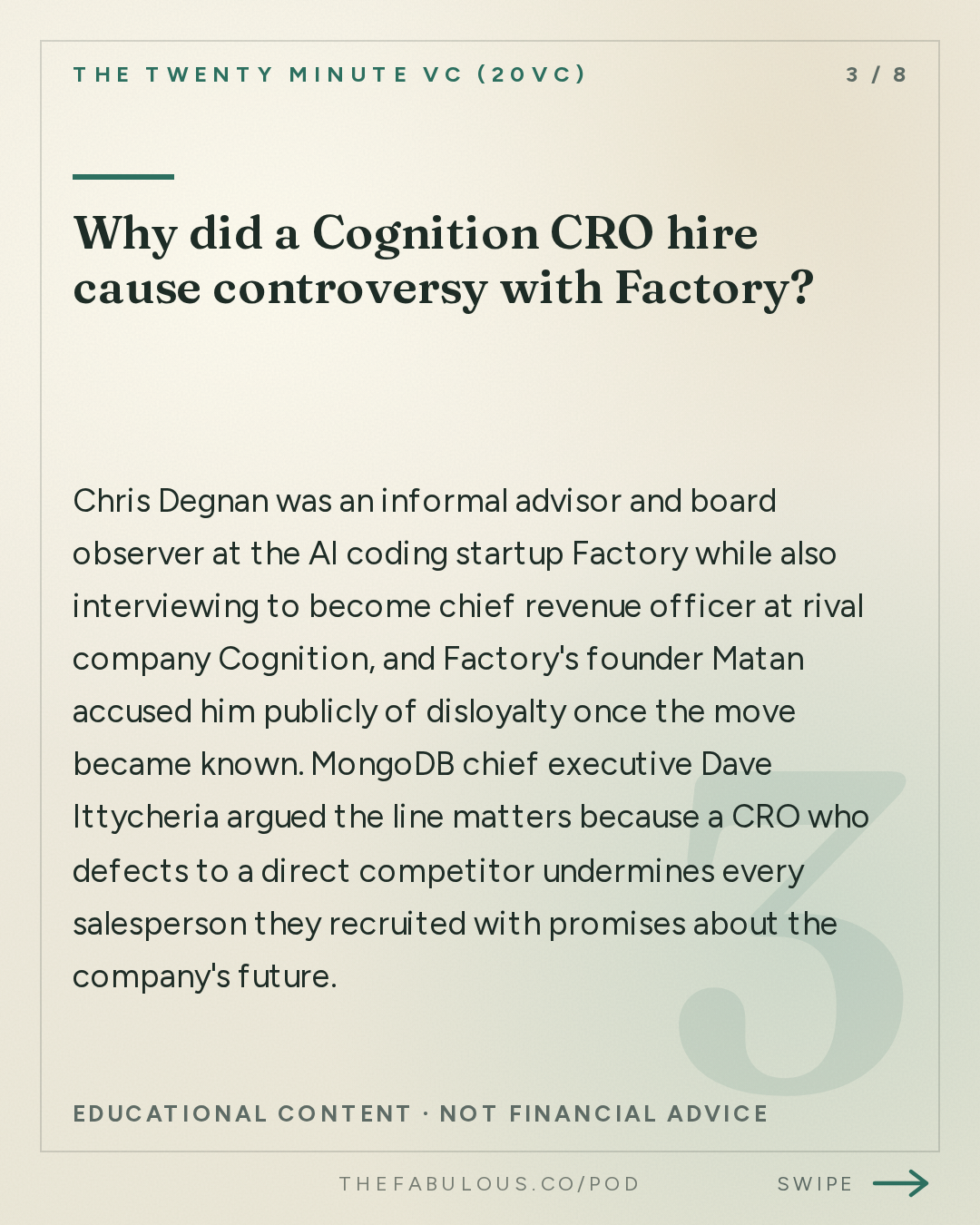
Why did a Cognition CRO hire cause controversy with Factory?
Chris Degnan was an informal advisor and board observer at the AI coding startup Factory while also interviewing to become chief revenue officer at rival company Cognition, and Factory's founder Matan accused him publicly of disloyalty once the move became known (12:37). MongoDB chief executive Dave Ittycheria argued the line matters because a CRO who defects to a direct competitor undermines every salesperson they recruited with promises about the company's future (14:08).
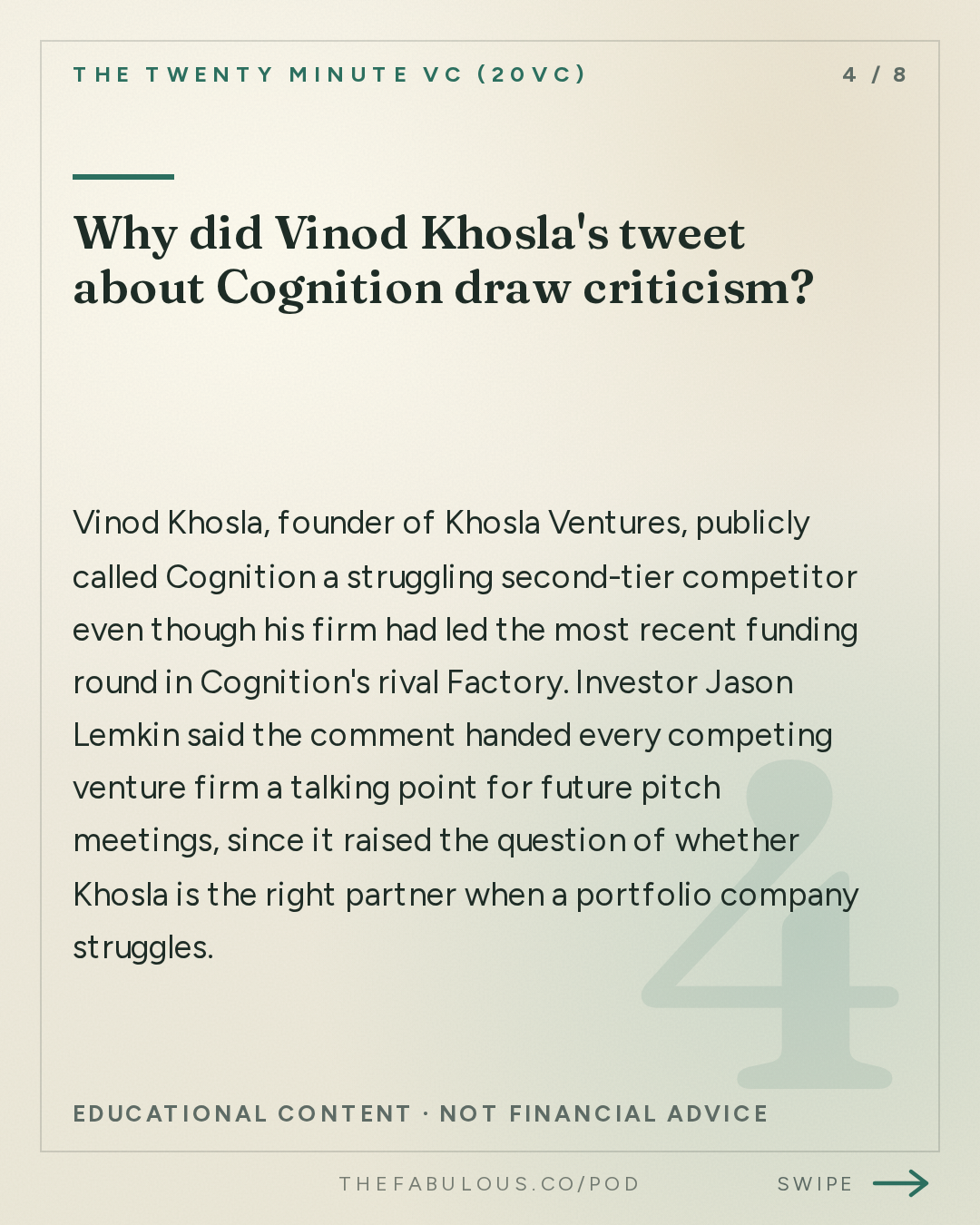
Why did Vinod Khosla's tweet about Cognition draw criticism?
Vinod Khosla, founder of Khosla Ventures, publicly called Cognition a struggling second-tier competitor even though his firm had led the most recent funding round in Cognition's rival Factory (23:03). Investor Jason Lemkin said the comment handed every competing venture firm a talking point for future pitch meetings, since it raised the question of whether Khosla is the right partner when a portfolio company struggles (24:00).
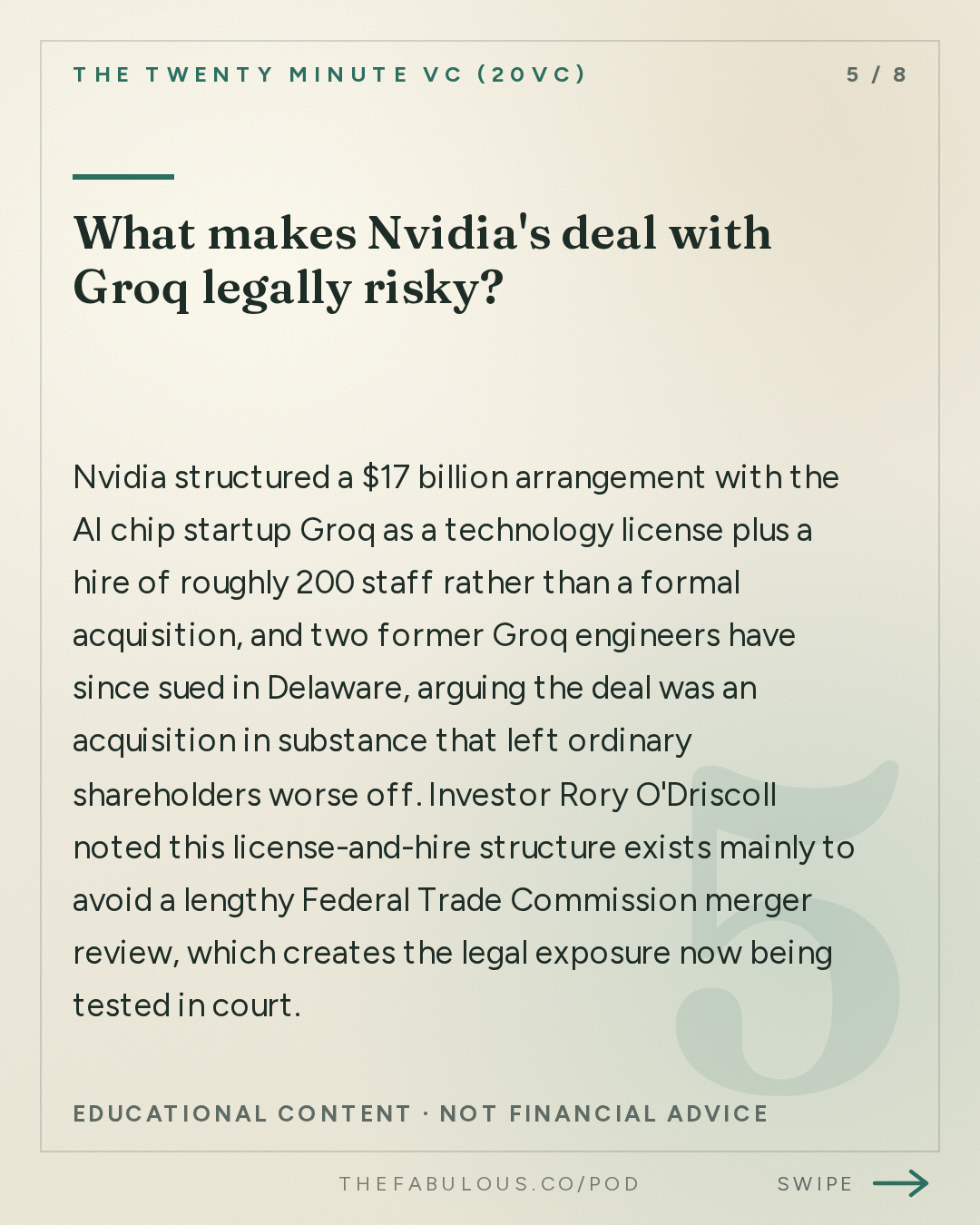
What makes Nvidia's deal with Groq legally risky?
Nvidia structured a $17 billion arrangement with the AI chip startup Groq as a technology license plus a hire of roughly 200 staff rather than a formal acquisition, and two former Groq engineers have since sued in Delaware, arguing the deal was an acquisition in substance that left ordinary shareholders worse off (55:13). Investor Rory O'Driscoll noted this license-and-hire structure exists mainly to avoid a lengthy Federal Trade Commission merger review, which creates the legal exposure now being tested in court (58:33).
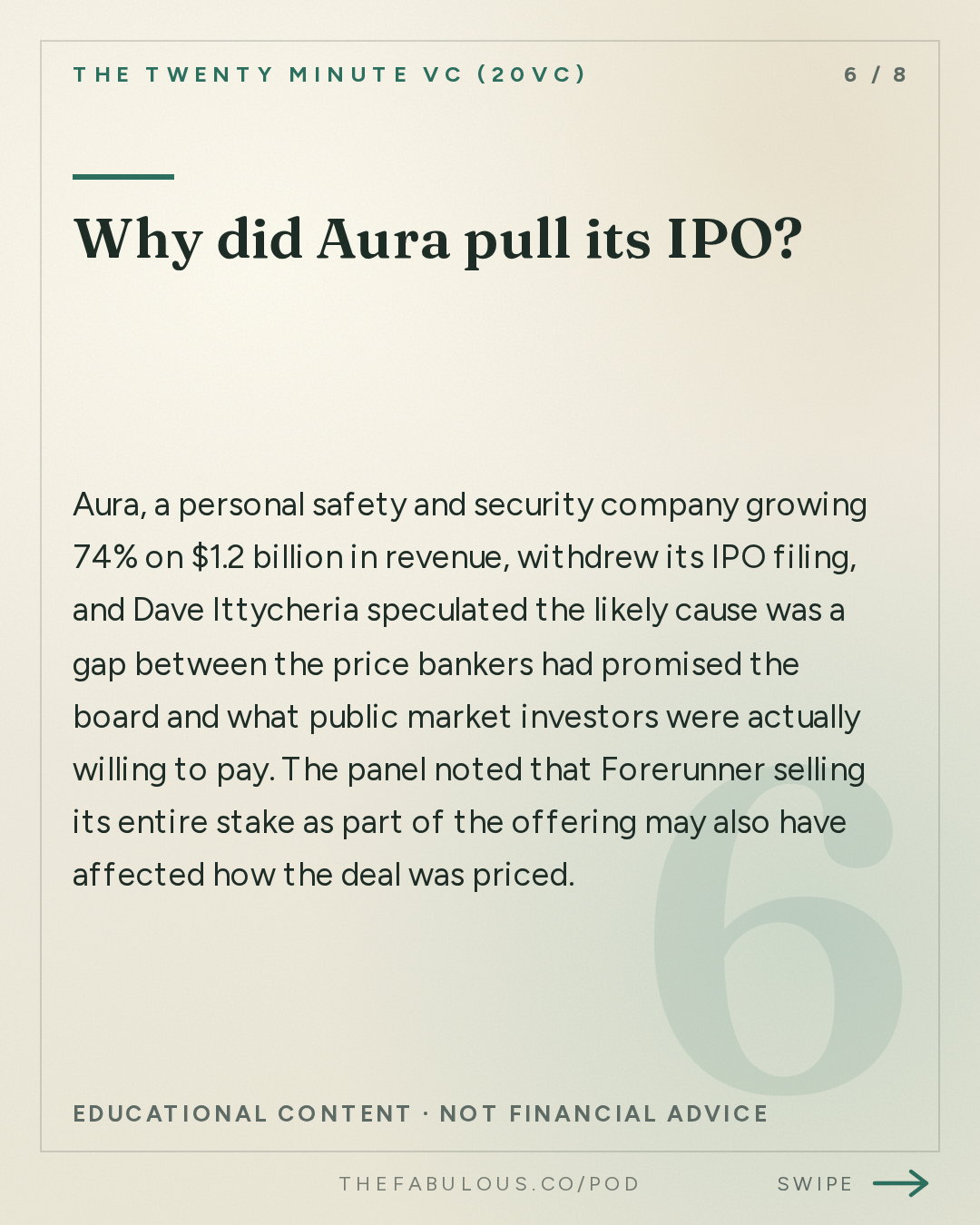
Why did Aura pull its IPO?
Aura, a personal safety and security company growing 74% on $1.2 billion in revenue, withdrew its IPO filing, and Dave Ittycheria speculated the likely cause was a gap between the price bankers had promised the board and what public market investors were actually willing to pay (66:55). The panel noted that Forerunner selling its entire stake as part of the offering may also have affected how the deal was priced (66:11).
The full read, in cards
Go deeper
- Wall Street Journal article on Aura's withdrawn IPO — Examined the pricing dynamics investors believe led the company to pull its filing
Mentioned
Vinod Khosla · Dave Ittycheria · Jason Lemkin · Rory O'Driscoll · Harry Stebbings · Matan · Chris Degnan · OpenAI · Anthropic · ElevenLabs · Listen Labs · Vercel · Salesforce · Khosla Ventures · Sequoia Capital · Nvidia · Groq · Reflection · MongoDB · Aura
More from this show and category

Venky Ganesan on AI Venture Capital Ownership
Menlo Ventures partner Venky Ganesan says AI seed rounds now run $10-20 million, and ownership matters less than owning a sliver of a giant. Drawing on 28 years in venture capital, he argues investors should expect 60% dilution by exit, cap single-company bets near 20% of a fund, and chase cash returns over paper markups.

Chase Lochmiller on AI Data Center Economics
Crusoe Energy co-founder Chase Lochmiller argues AI's real bottleneck is energy and manufacturing, not chips, and vertical integration beats business moats. He says data centers actually lower local energy prices, use near-zero water, and that about half of planned projects will never get built.

Parag Agrawal on AI Agent Web Search
Parallel founder Parag Agrawal predicts AI agents will search the web 1,000 times more than humans, breaking today's ad-supported internet. He says Parallel already delivers search results up to 50 times cheaper than legacy stacks, and that 5 to 20 percent of all inference spend will eventually flow into web search infrastructure built for agents, not people.

Why Anthropic Delayed Its IPO to November
Anthropic delayed its $2 trillion IPO from October to November to present cleaner third quarter numbers. Meta's Muse app hit No. 1 and emerged as ChatGPT's first rival, developer tool Jev exposed wasted AI spend on simple tasks, seed checks are ballooning toward $10 million, and Crusoe's $30.9 billion valuation stoked fears the AI data center trade is overheating.
