
Sameer Dholakia on Bessemer's AI Investing Playbook
20VC: You Need $1BN To Do Seed Today: The Untold Truths of Venture | Who Wins and Who Loses in the Next Decade of VC | Why Margin and Price Matter Less in a World of AI with Sameer Dholakia, Bessemer
The brief
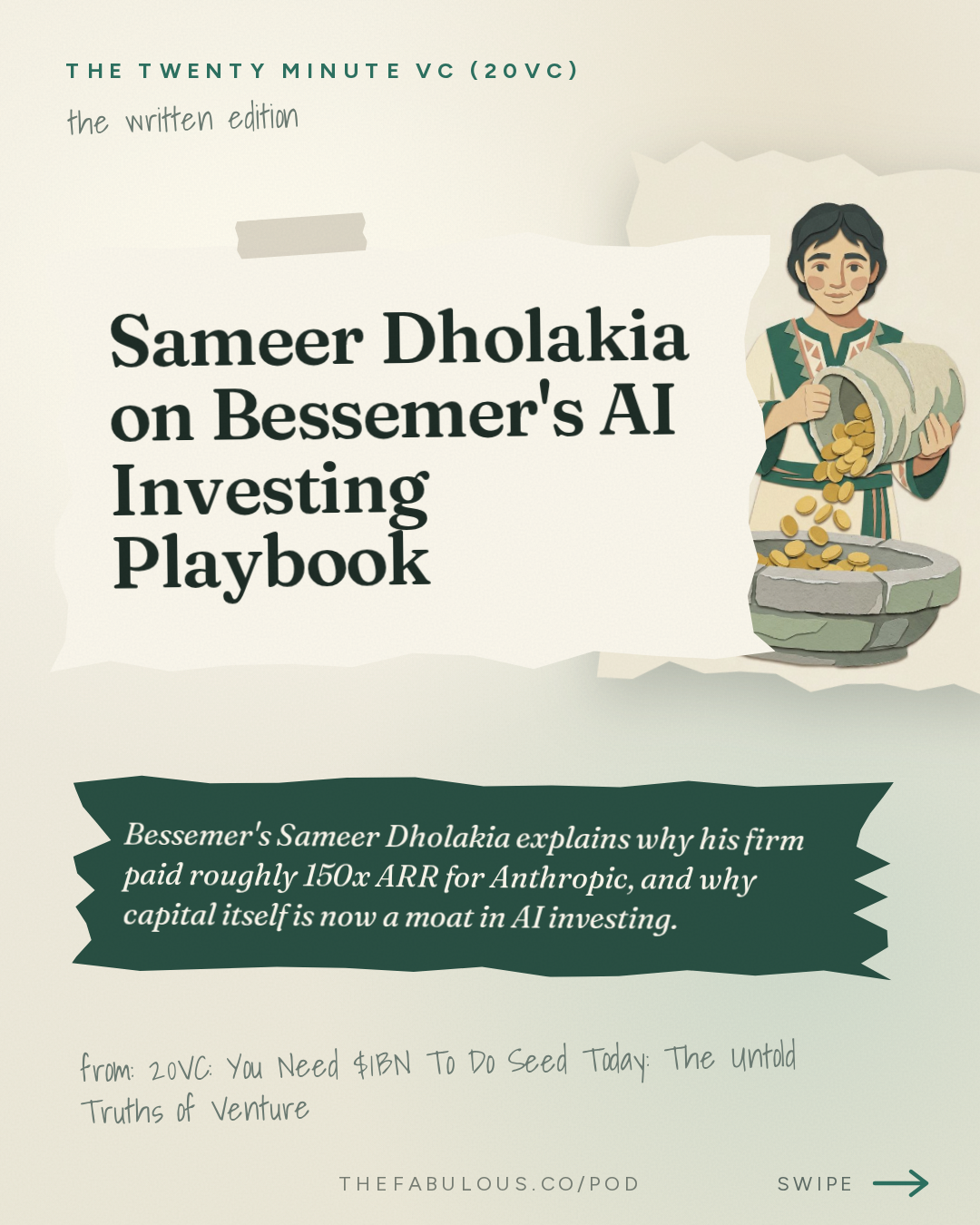
Bessemer's Sameer Dholakia explains why his firm paid roughly 150x ARR for Anthropic, and why capital itself is now a moat in AI investing. He prices deals on next-twelve-months revenue, targets 10 to 15 times NTM multiples, and says Bessemer's new $5.75 billion in funds reflects venture splitting into giant platforms and extreme specialists.
Sameer Dholakia has felt magic exactly three times in a thirty-one-year career in software, and each time a trillion-dollar market followed within a few years (05:03). The first was the early internet, when he graduated into Silicon Valley in 1995. The second was the rise of cloud computing, when he watched VMware move a running computer workload from one machine to another without interrupting it. The third came during a sabbatical in the winter of 2021, when a young founder showed him a marketing tool built on top of GPT-3. "Magic," he thought again (06:53). Dholakia, now a growth investor at Bessemer Venture Partners and formerly the CEO of the email infrastructure company SendGrid, believes this AI cycle is bigger than the internet and cloud cycles combined (06:53).
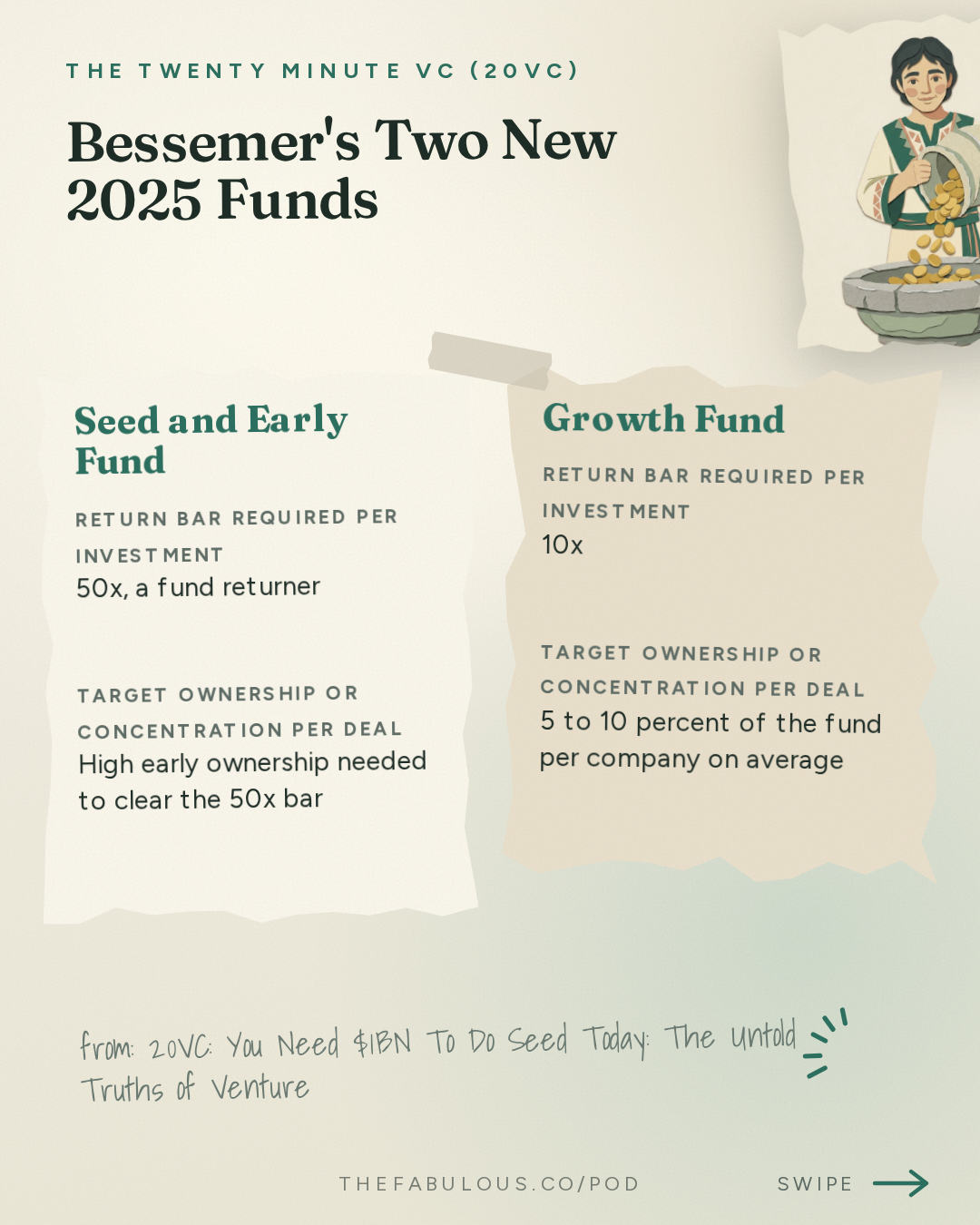
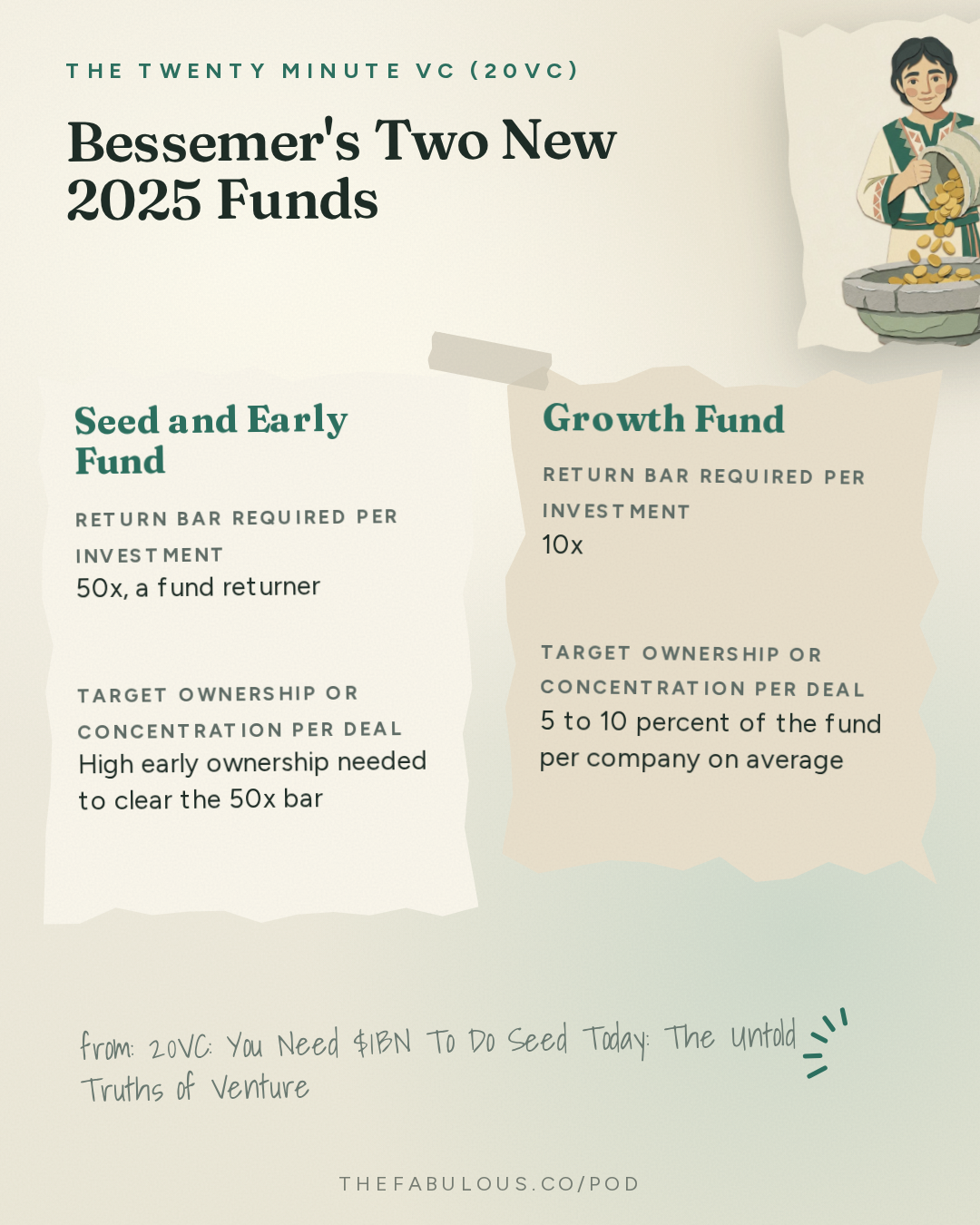
The scale of his conviction shows up in the numbers. Bessemer just raised $5.75 billion across two new funds: a $4 billion growth fund and a $1.75 billion seed and early-stage fund (00:24). That seed number alone is almost double what a well-known peer fund just announced, and it underlines a blunt claim Dholakia makes about the market today: with AI valuations where they are, and with many AI companies needing heavy compute spend, a small seed fund can not take enough shots on goal to find a winner (28:17).
"Intelligence is gonna be bigger as a market than oil because oil powers all the machines. Intelligence powers all the humans." — Sameer Dholakia [07:19]
That line explains why Bessemer went all in on Anthropic, the AI lab behind the Claude models. The firm joined Anthropic's Series D at a $15 billion pre-money valuation (08:02), a round led by Menlo Ventures, which Lightspeed and Bessemer joined. Dholakia says it was, by his partner Byron Deeter's account, the lowest-voted deal in Bessemer's history at the time (10:18). The thesis was a "cloud redux": just as cloud computing consolidated around a handful of capital-intensive hyperscalers like AWS, Azure, and Google Cloud, frontier AI would consolidate around a short list of labs that could afford the scaling laws, with hundreds of applications built on top of them (08:35). His biggest regret is not writing a bigger check. He says he and his partners underestimated how large the business could become by "factors" (11:22).
Paying for the Future, Not the Past
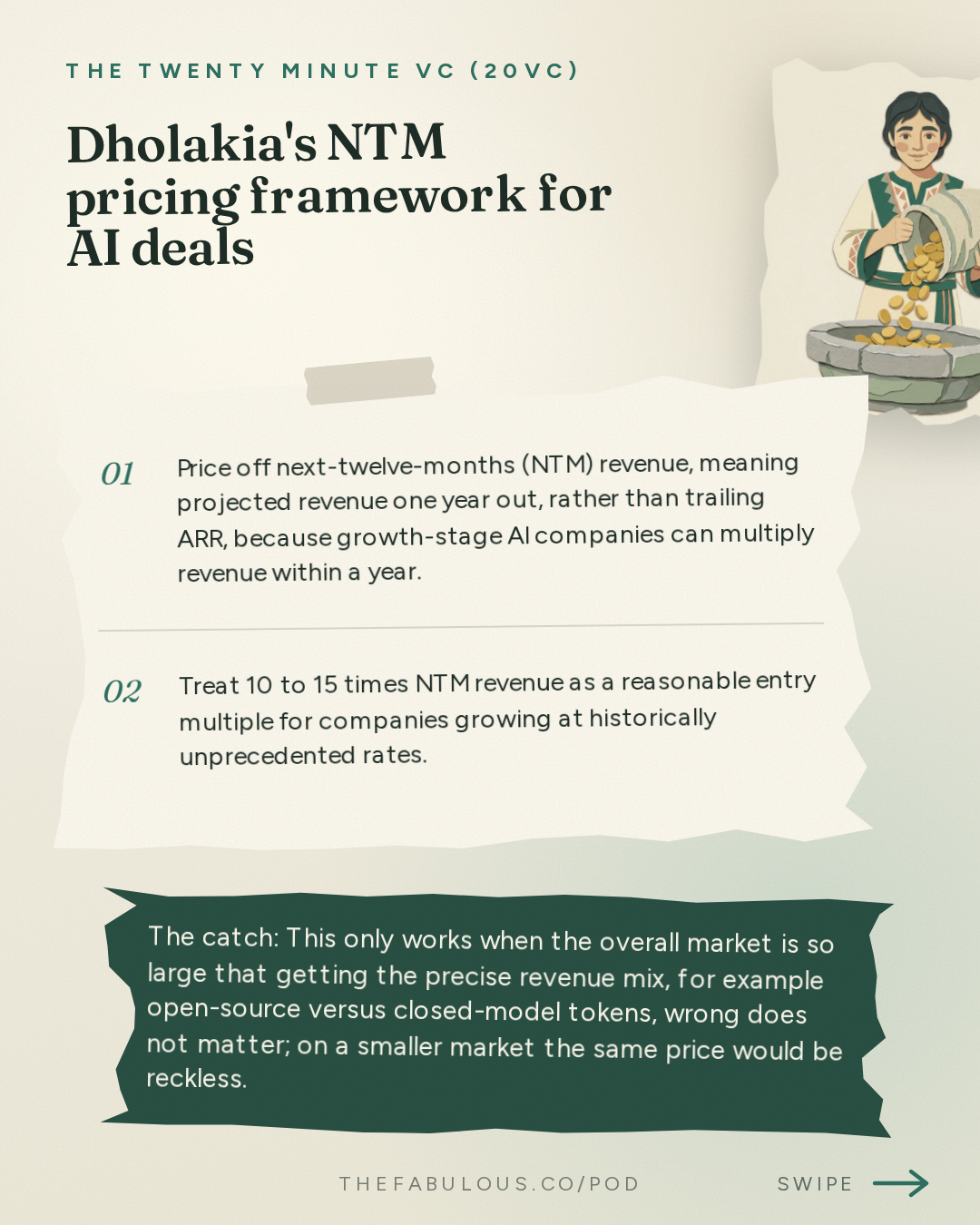
That Anthropic round meant paying about 150 times the company's current annual recurring revenue, or ARR, which is the yearly subscription revenue a company is already collecting (17:56). Dholakia says a price like that would "make most venture capitalists throw up" if you only looked backward. His answer is to look at NTM, or next-twelve-months revenue: his estimate of what the company's revenue will be a year from now, not what it is today (18:24). He treats 10 to 15 times NTM revenue as a reasonable entry multiple for companies growing at rates he has never seen in 31 years in software (19:15). He applied the same logic to Harvey competitor Lagora, leading a $1.8 billion round when the legal AI company had just $20 million of ARR; it has since grown to roughly $200 million (19:19, 17:56).
Price is not the only variable. Dholakia says he pays close attention to the quality of revenue: gross and net dollar retention, meaning how much of a customer's spend sticks around and grows over time. He would pay a much lower multiple for a consumer or "prosumer" business, where churn can kill a company, than for a sticky enterprise product (19:52). Thin gross margins do not scare him either, as long as he can defend why they will expand; he says many of his past investments had margins at entry that were "factors" lower than what they reached within 12 to 24 months (21:04).
"I absolutely believe capital is a moat. I've always said that markets pick winners, and then it becomes a self-fulfilling prophecy." — Sameer Dholakia [23:59]
That belief, that raising a war chest is itself a competitive advantage, is the thread running through the episode. Dholakia argues that compute, the computing power needed to train and run AI models, is scarce and expensive enough that companies without massive funding simply cannot compete at the frontier (24:20). Big rounds create brand, brand attracts talent, talent wins customers, and the cycle reinforces itself, much as it did when SendGrid and Twilio became the default developer tools for sending messages in the 2010s (24:20). He is careful to add a caveat: capital is necessary but not sufficient. A company still needs a product customers rave about (25:19).
Dholakia extends the same consolidation logic to the venture industry itself. He argues that venture capital, like most industries that professionalize and scale, is splitting into two viable positions: giant global platforms like Bessemer that can write checks from pre-seed through pre-IPO across every sector and geography, or extremely specialized firms that add differentiated value in one narrow niche. The middle, he says, is "a hard world to make money" in (29:56, 30:49).
Teammates, Not Colleagues
Dholakia's second obsession, alongside pricing, is culture, a subject he says most CEOs claim to care about without doing much about it. His guiding line, used for over a decade, is that "teammates and friends" outperform "colleagues and coworkers" because teammates do not want to let each other down (40:57, 42:02).
"They're not working for themselves. They're working for their teammates, and they're working for their team, and you never wanna effing let down your teammates." — Sameer Dholakia [42:02]
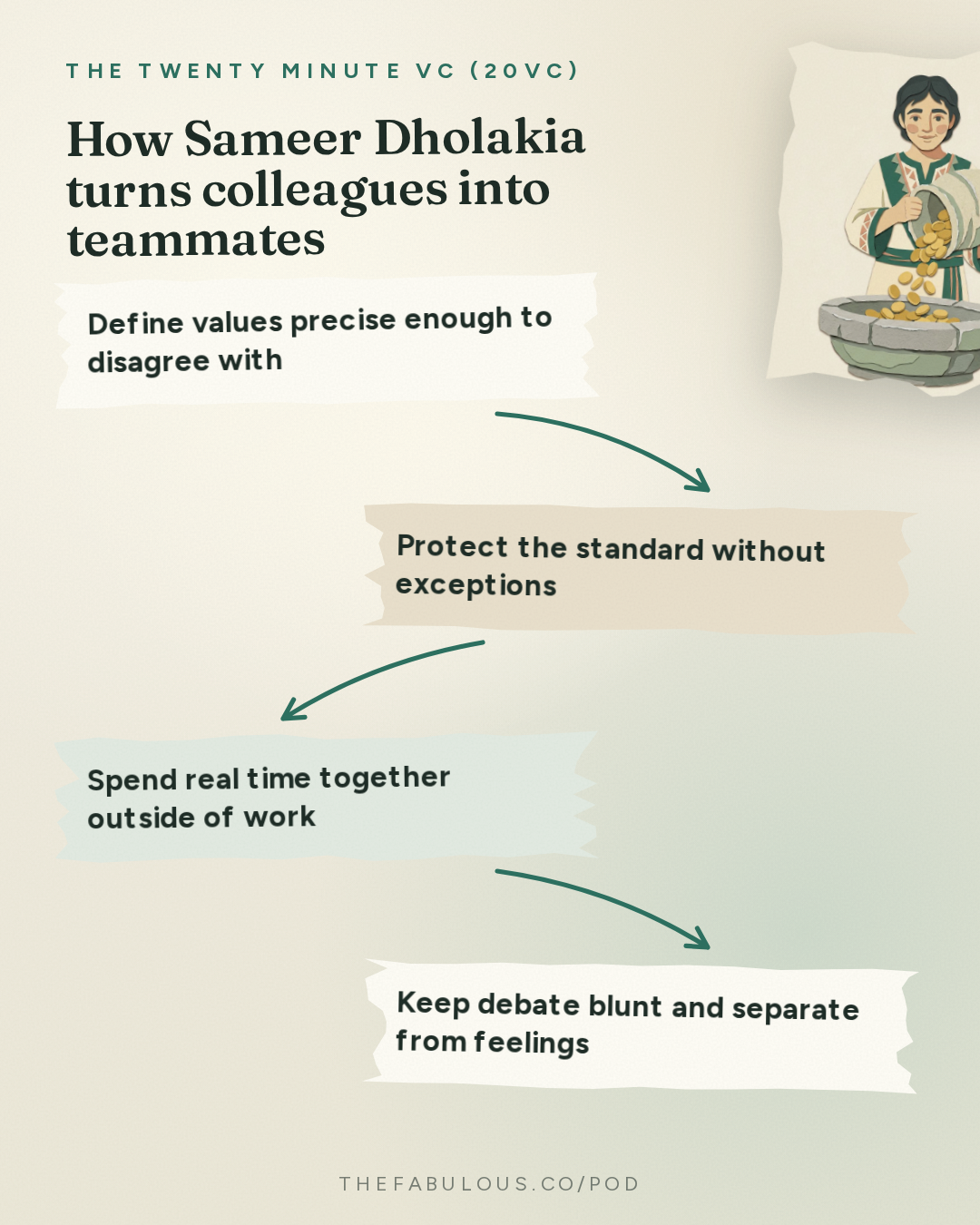
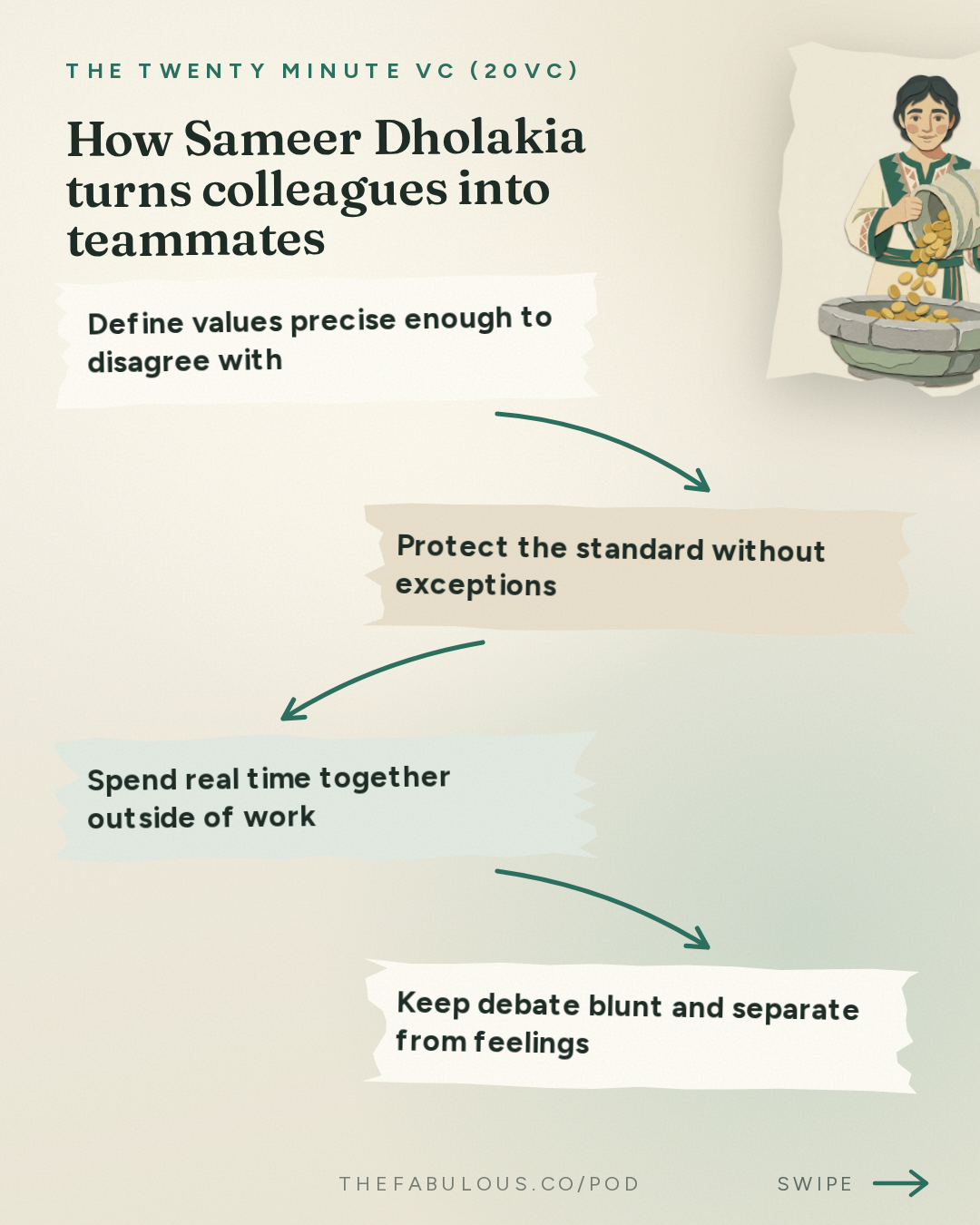
At SendGrid, he built this around four explicit values he called the four Hs: happy, hungry, humble, honest (40:57). Harry suggested that a value only works if people could reasonably argue against it, a premise Dholakia disagreed with. "Humble" at SendGrid meant favoring the word "we" over "I" in interviews, to the point that interviewers literally counted pronouns; that would have been a miserable standard for some candidates, and that was the point (43:01). He also insists culture needs shared time that has nothing to do with work. SendGrid flew its entire staff to Mexico every January, then spent a second day pairing people off for kayaking, mountain biking, or just sitting by a pool (44:42). When something goes wrong, he says, colleagues point fingers or head for the door; teammates who have spent real time together instead say, "we've got to figure this out" (45:21). He wants the same directness inside Bessemer's investment committee, where he believes partners should tell each other bluntly when a price looks wrong rather than soften it into mush (47:20).
That same appetite for a market with no obvious ceiling shapes how Dholakia talks about what comes next. He expects a "permanent structural shift" toward companies staying private longer, simply because there is now so much private capital chasing deals, but he also expects a real unlock in IPOs in 2027 and 2028, driven by public investors who want direct exposure to dozens or hundreds of AI companies, not just a handful (52:15, 52:59). He is particularly animated about Fireworks, an AI infrastructure company he says is led by CEO Lin Qiao (referred to in conversation as "Lynn") and president George Hu, and about Waymo, the autonomous driving company Bessemer put nearly $200 million into, which he argues could eventually be worth more than a ride-hailing business by selling autonomy as a subscription on every car, not just robotaxis (68:20, 70:08). He closes on biology: citing Anthropic CEO Dario Amodei's essay "Machines of Love and Grace," he says he believes AI could compress a half-century of drug discovery into a decade (71:31). It is, in other words, one more moment that feels like magic, and Dholakia has learned what tends to follow those.
Ask this episode anything
Pod's AI answers from the episode itself, with the minute mark so you can hear it yourself.
Or start with one of these
Ask this episode
Pod's AI listens to the whole episode to answer, and points you to the minute it comes from.
The rest of this answer, and any question after it
Answers come from the episode itself, never from a summary of it.
ContinueKey takeaways
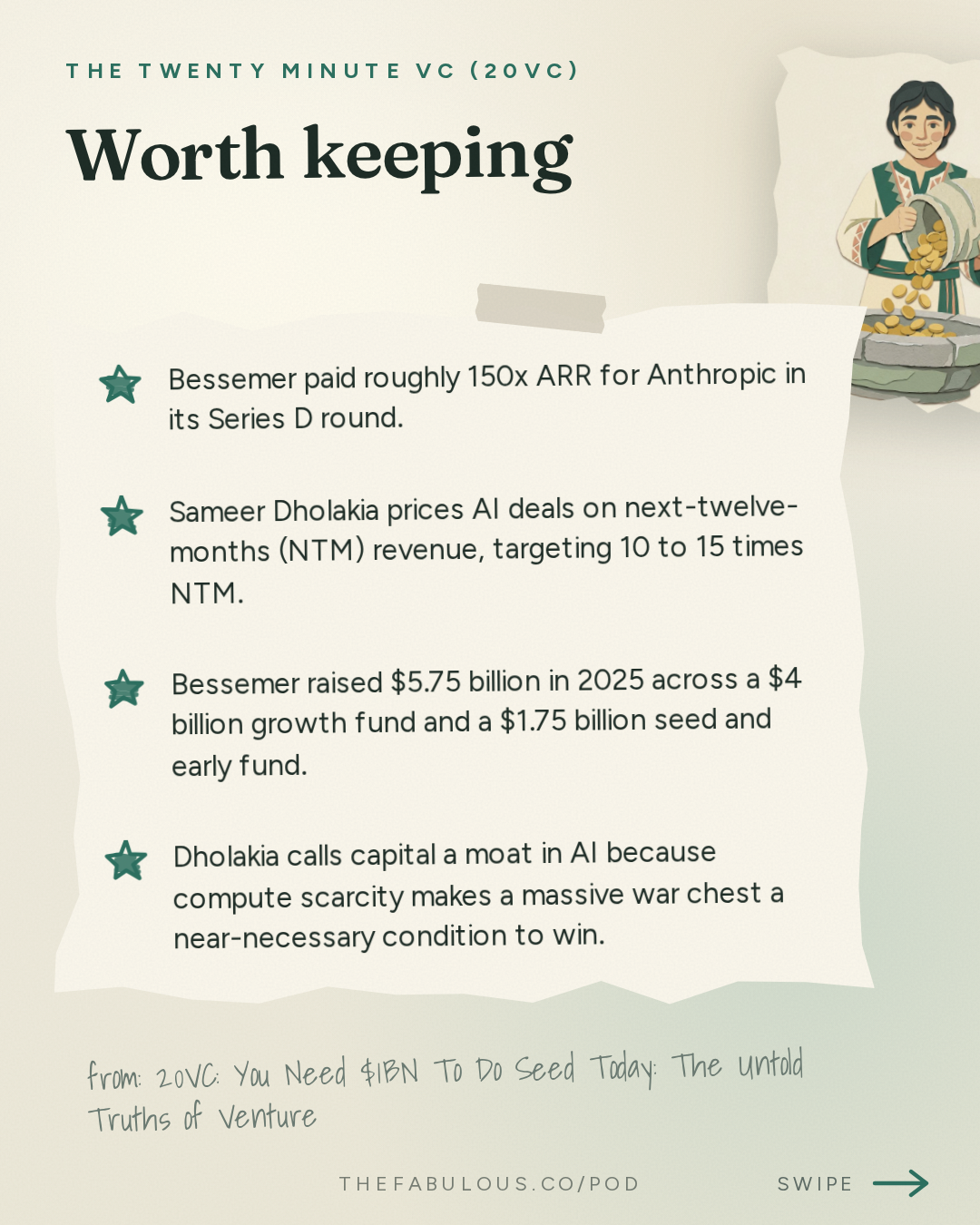
- Bessemer paid roughly 150x ARR for Anthropic in its Series D round.
- Sameer Dholakia prices AI deals on next-twelve-months (NTM) revenue, targeting 10 to 15 times NTM.
- Bessemer raised $5.75 billion in 2025 across a $4 billion growth fund and a $1.75 billion seed and early fund.
- Dholakia calls capital a moat in AI because compute scarcity makes a massive war chest a near-necessary condition to win.
- Dholakia says venture capital is splitting into giant global platforms or extreme specialists, leaving the middle hard to make money in.
The episode in cards
In their words
“Intelligence is gonna be bigger as a market than oil because oil powers all the machines. Intelligence powers all the humans”
“I absolutely believe capital is a moat. I've always said that markets pick winners, and then it becomes a self-fulfilling prophecy.”
“They're not working for themselves. They're working for their teammates, and they're working for their team, and you never wanna effing let down your teammates”
“Teammates and friends will beat colleagues and coworkers every day and twice on Sunday.”
Protocols
-
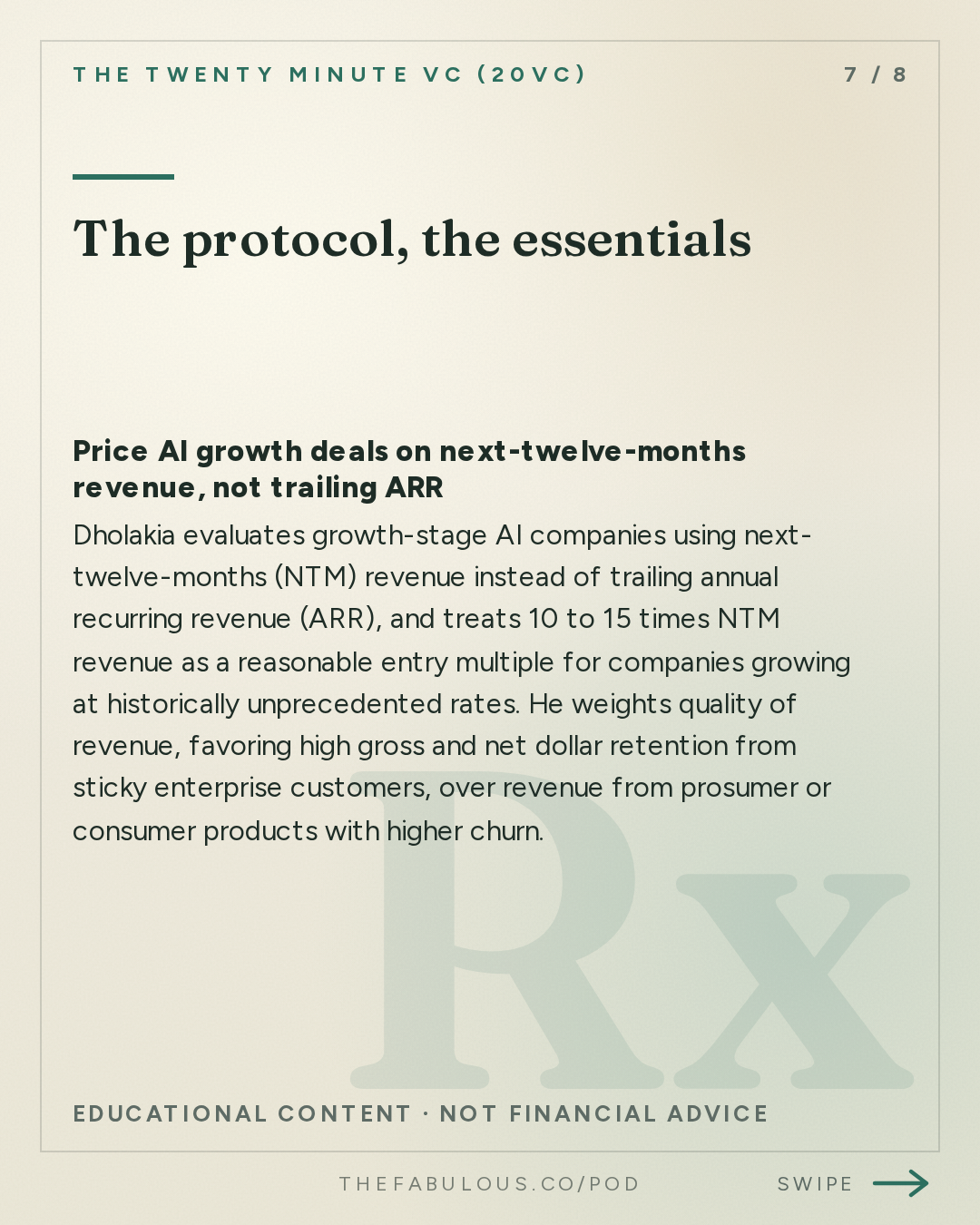
Price AI growth deals on next-twelve-months revenue, not trailing ARR
Dholakia evaluates growth-stage AI companies using next-twelve-months (NTM) revenue instead of trailing annual recurring revenue (ARR), and treats 10 to 15 times NTM revenue as a reasonable entry multiple for companies growing at historically unprecedented rates. He weights quality of revenue, favoring high gross and net dollar retention from sticky enterprise customers, over revenue from prosumer or consumer products with higher churn.
Applied at each growth-stage investment decision
-
Turn colleagues into teammates with explicit values and shared time outside work
Dholakia says a company should define a short list of values precise enough that someone could reasonably disagree with them, the way SendGrid's four Hs (happy, hungry, humble, honest) set a specific bar rather than generic virtues everyone would already accept. He pairs that with regular non-work time together, such as flying the entire SendGrid staff to Mexico every January for a kickoff followed by a day of pairing employees for activities like kayaking or mountain biking, because people who have spent time together solve problems as a team instead of placing blame when the business hits trouble.
Ongoing, reinforced at hiring and at annual company offsites
Questions this episode answers
Why did Bessemer pay 150 times ARR for Anthropic?
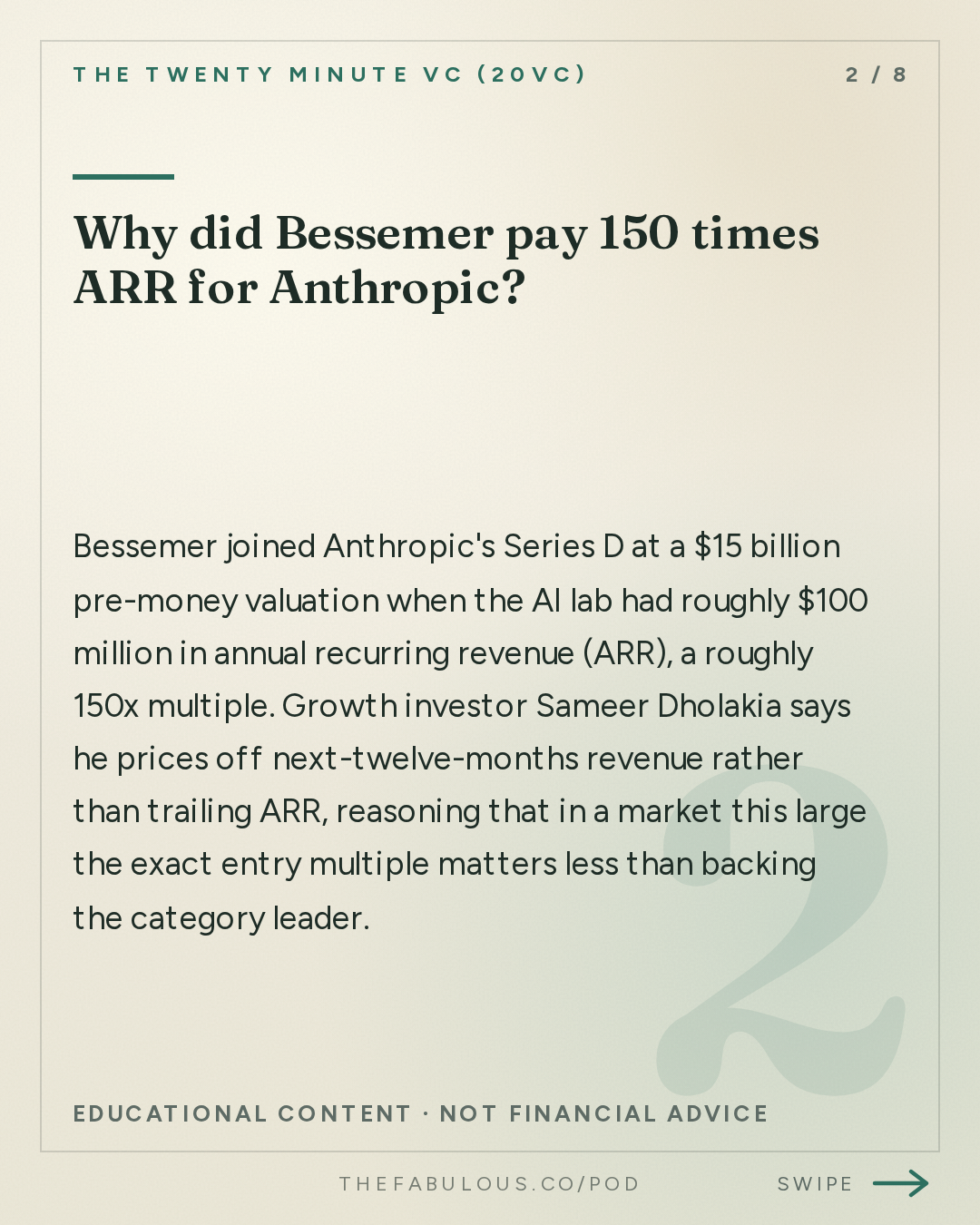
Bessemer joined Anthropic's Series D at a $15 billion pre-money valuation when the AI lab had roughly $100 million in annual recurring revenue (ARR), a roughly 150x multiple (17:56). Growth investor Sameer Dholakia says he prices off next-twelve-months revenue rather than trailing ARR, reasoning that in a market this large the exact entry multiple matters less than backing the category leader (18:24).
What does 'capital as a moat' mean in venture capital?
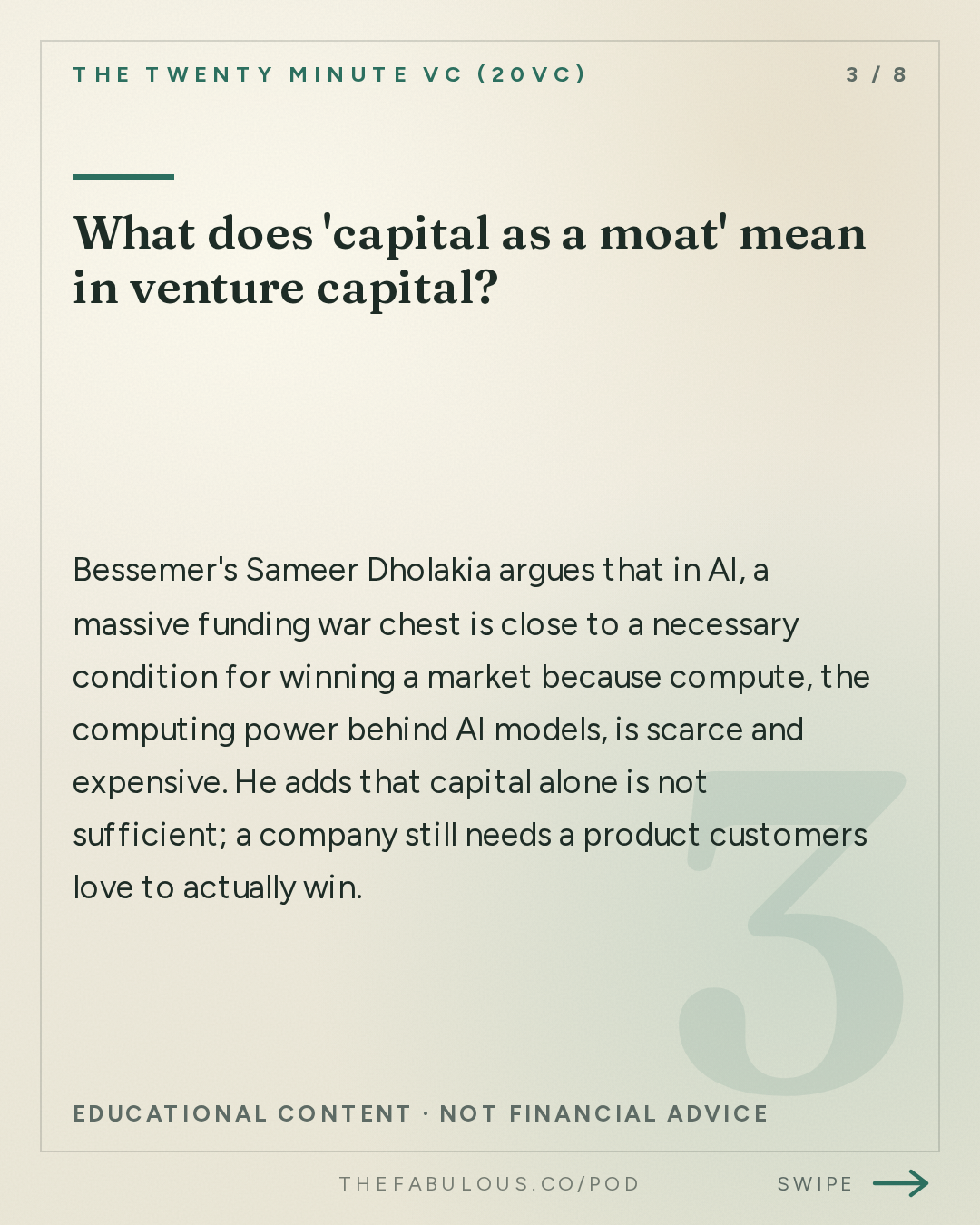
Bessemer's Sameer Dholakia argues that in AI, a massive funding war chest is close to a necessary condition for winning a market because compute, the computing power behind AI models, is scarce and expensive (23:30, 24:20). He adds that capital alone is not sufficient; a company still needs a product customers love to actually win (25:19).
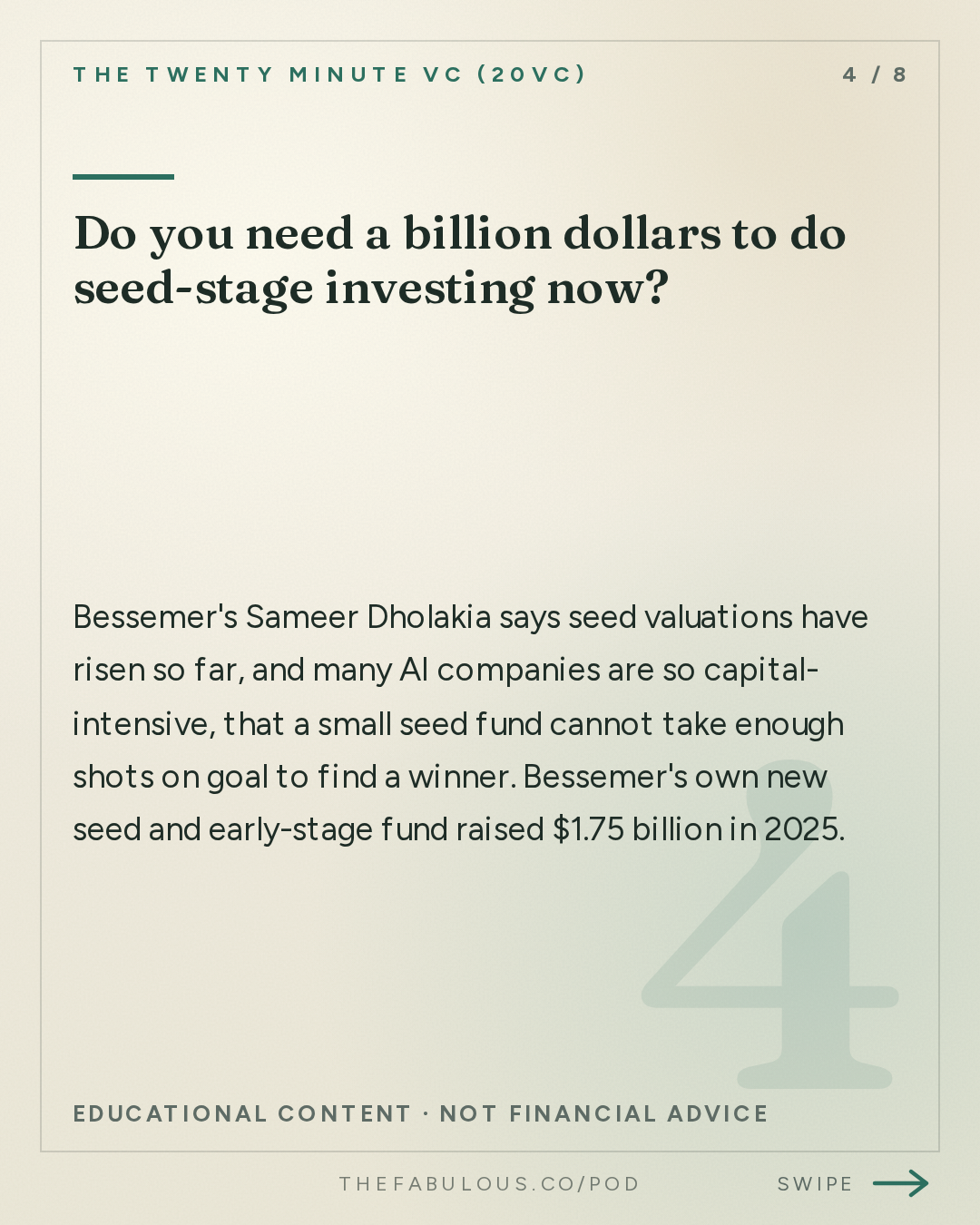
Do you need a billion dollars to do seed-stage investing now?
Bessemer's Sameer Dholakia says seed valuations have risen so far, and many AI companies are so capital-intensive, that a small seed fund cannot take enough shots on goal to find a winner (28:17). Bessemer's own new seed and early-stage fund raised $1.75 billion in 2025 (00:24).
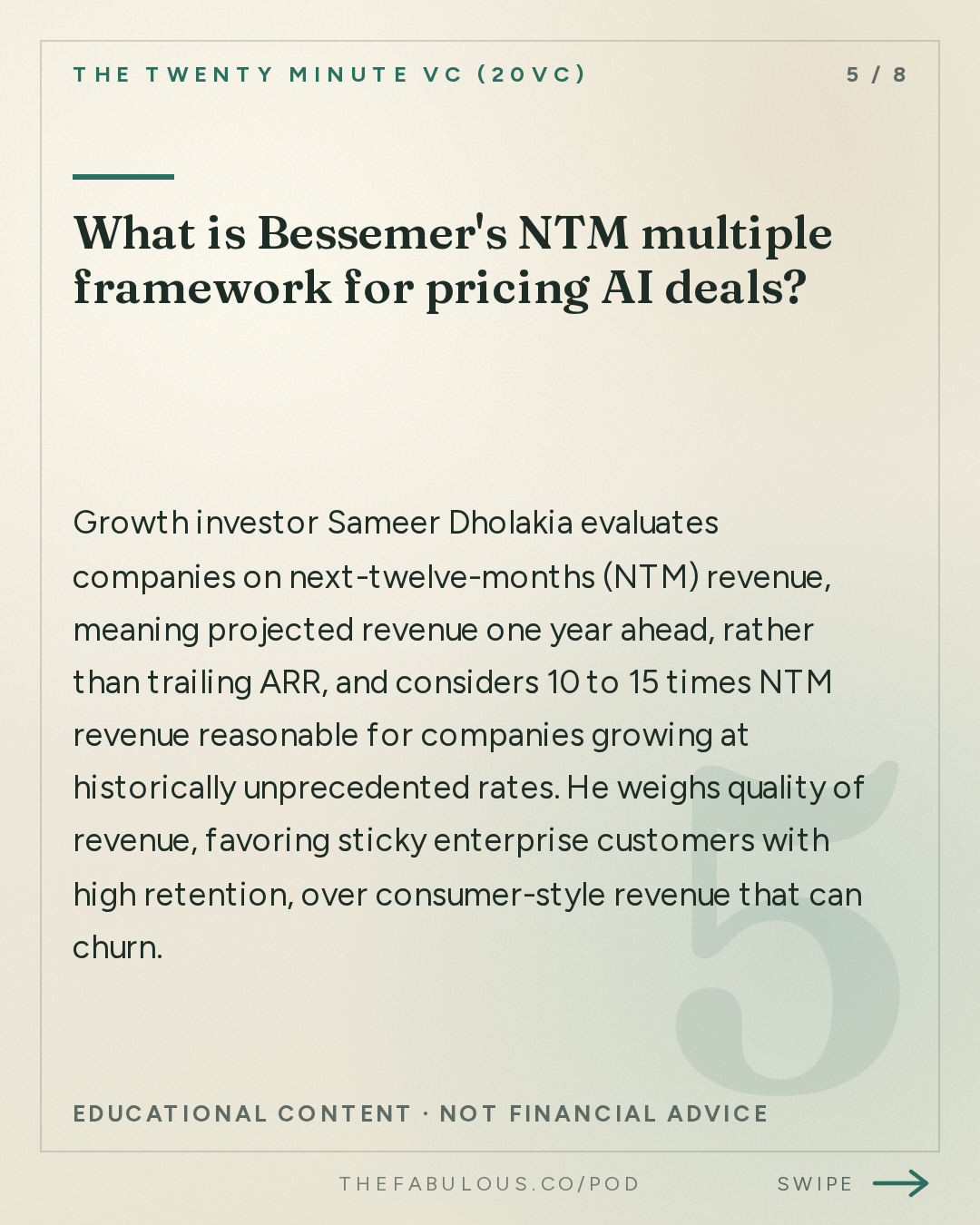
What is Bessemer's NTM multiple framework for pricing AI deals?
Growth investor Sameer Dholakia evaluates companies on next-twelve-months (NTM) revenue, meaning projected revenue one year ahead, rather than trailing ARR, and considers 10 to 15 times NTM revenue reasonable for companies growing at historically unprecedented rates (19:15). He weighs quality of revenue, favoring sticky enterprise customers with high retention, over consumer-style revenue that can churn (19:52).
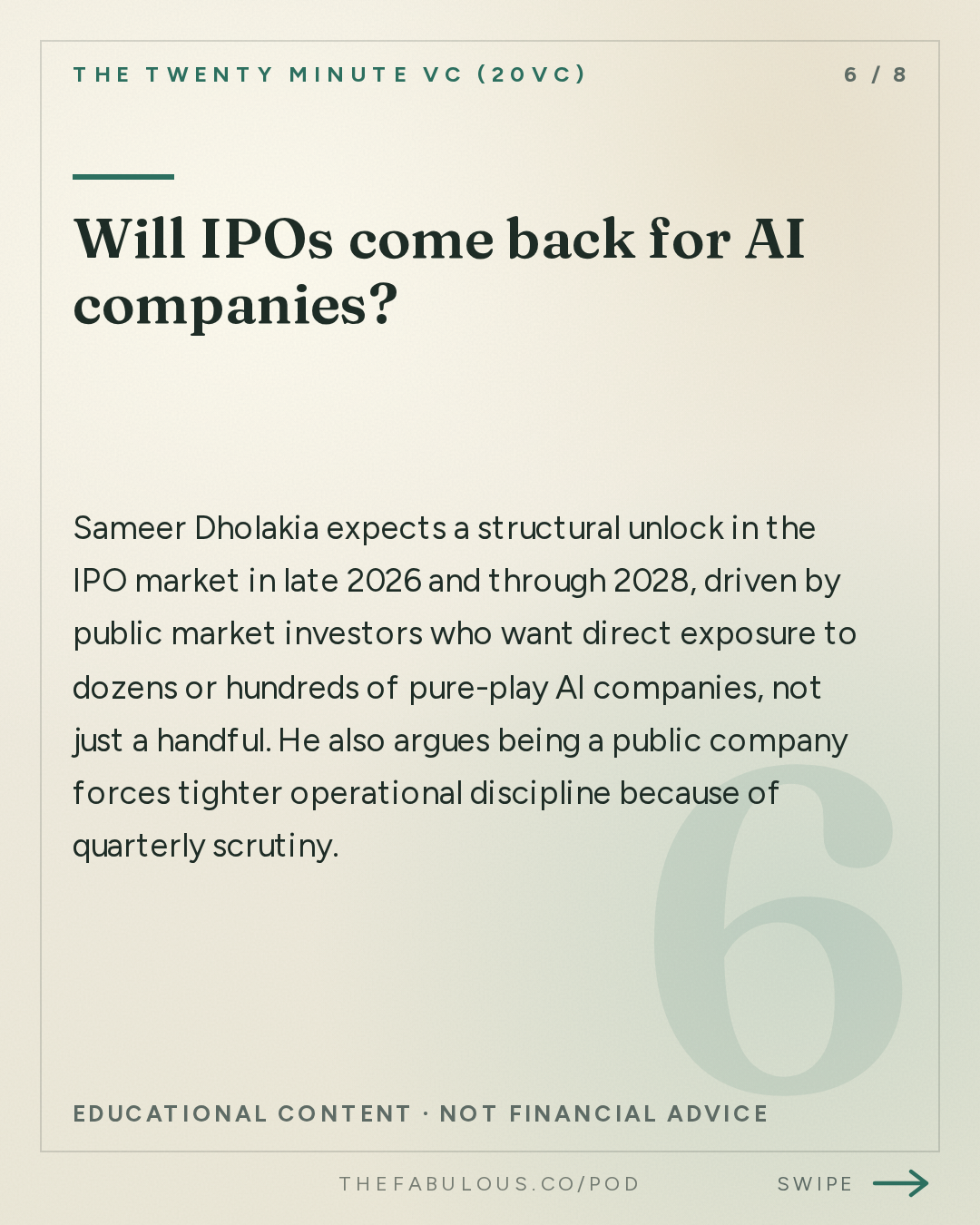
Will IPOs come back for AI companies?
Sameer Dholakia expects a structural unlock in the IPO market in late 2026 and through 2028, driven by public market investors who want direct exposure to dozens or hundreds of pure-play AI companies, not just a handful (52:59, 53:21). He also argues being a public company forces tighter operational discipline because of quarterly scrutiny (53:59).
What are Sameer Dholakia's 'four Hs' for startup culture?
At SendGrid, the email infrastructure company Dholakia led before joining Bessemer, he built culture around four values: happy, hungry, humble, and honest, each defined specifically enough that employees could knowingly agree or disagree with the standard (40:57, 43:01). He pairs explicit values with shared non-work time, like flying the whole company to Mexico every January, to turn coworkers into teammates who solve problems together under pressure (44:42).
The full read, in cards
Go deeper
- Machines of Love and Grace — Essay by Anthropic CEO Dario Amodei arguing AI could compress decades of biological and medical discovery into a far shorter span; Dholakia says he believes this will play out in drug development.
Mentioned
Sameer Dholakia · Bessemer Venture Partners · Byron Deeter · David Cowan · Anthropic · Fireworks · Lagora · SendGrid · Stripe · Waymo · Mistral · George Hu · Dario Amodei · Lin Qiao
More from this show and category

Harrison Chase on Why AI Agents Are So Hard to Build
LangChain founder Harrison Chase says AI agents break because models are unpredictable black boxes, not because they are weak. The fix, he argues, is a model-neutral 'harness,' the code layer that routes tasks, manages memory and controls token costs, with vertical, domain-specific agents built to outperform horizontal ones.

Pro Rata Lawsuit: Valar Atomics vs Day One VC
Day One Ventures and Valar Atomics are fighting over pro rata rights in a $6 billion nuclear-startup round, exposing how waivers actually work in venture capital. The panel also covers Meta's new Muse Wonder model, NVIDIA's reported bid for Reflection, Jev's $870 million round, Anthropic's price cuts, and software's rising IPO bar.

Mike Cannon-Brookes on Atlassian's AI Strategy
Atlassian CEO Mike Cannon-Brookes argues design, not agents, decides AI-era winners, so Atlassian keeps investing in interfaces rather than going headless. He also says enterprises increasingly reject Chinese AI models even as they embrace open weights, and doubts most "specialized models" are just fine-tuned versions of them.

Ramp's Sales Playbook: Max Freeman's Hiring Secrets
Ramp SVP of Sales Max Freeman breaks down how Ramp built its sales machine by hiring investment bankers and sellers from high-growth, low-NPS companies. He pays SDRs double market rate for 4 to 6 times standard output and automates outbound research down to 90 seconds per lead.
