
Message-Market Fit vs Product-Market Fit Explained
20VC: Why ARR Per Employee is a BS Metric | Message-Market Fit vs. Product-Market Fit: Why Founders Should Launch Broken Products | The Biggest Mistakes Founders Make When Scaling Sales Teams with David Paffenholz, Juicebox
The brief
Juicebox cofounder David Paffenholz turned a failed college music app into a Sequoia-backed AI recruiting platform now doing tens of millions in revenue. He explains why message-market fit must come before product-market fit, why founders should ship broken products, and why ARR per employee is a vanity metric that can hide under-hiring in sales.
In college, David Paffenholz built an app that played fifteen seconds of a song, then asked you to swipe. Connect your Spotify, hear a snippet, like it or not, get the next one. It was TikTok crossed with a jukebox, and it worked, in the sense that 100,000 people downloaded it (11:02). It did not work in the sense that matters: nobody stuck around. "Playlist building, not the most retentive use case," he says now, with the flat humor of someone who has made peace with a dead idea.
That dead idea is why the company is called Juicebox, a pun on jukebox from a product that no longer exists. What exists today is an AI recruiting platform backed by Sequoia, with 120 employees (08:52), built by two cofounders who spent two and a half years as a team of exactly two (09:01), living on $400,000 raised in their YC round plus YC's own $500,000 investment, with no other funding, for the whole stretch (00:00, 13:51). The distance between a failed music app and a startup Sequoia fought to fund is the actual subject of this conversation, and Paffenholz is unusually precise about what closed that distance.
His central idea is a distinction he says most founders blur: message-market fit versus product-market fit.
"Message market fit is basically if a launch goes well and people want to learn more about your product, maybe they're even impressed by demoing your product. That's hugely valuable in and of itself because it means that the thing you're saying you're doing is actually solving a real customer pain point." David Paffenholz [15:06]
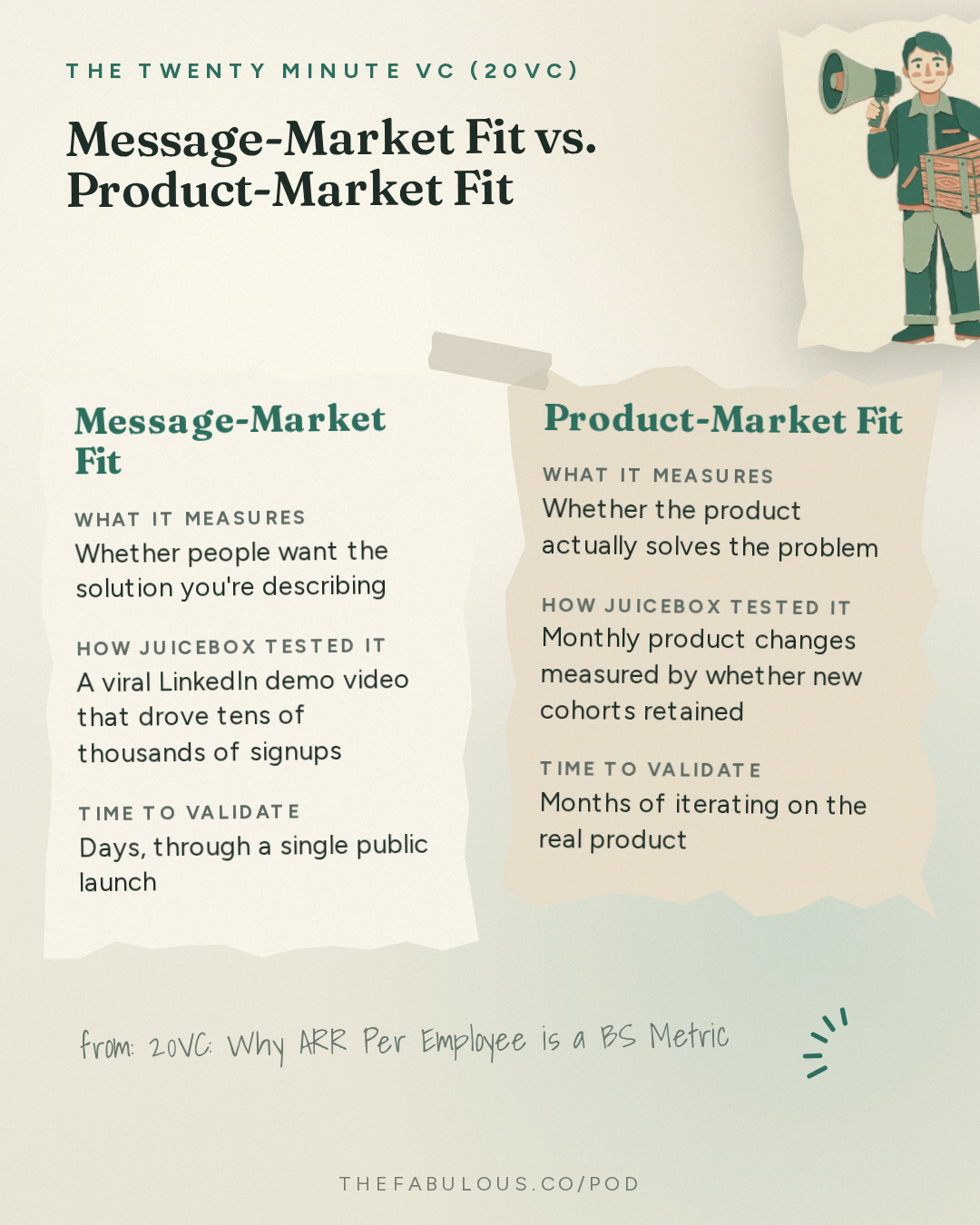
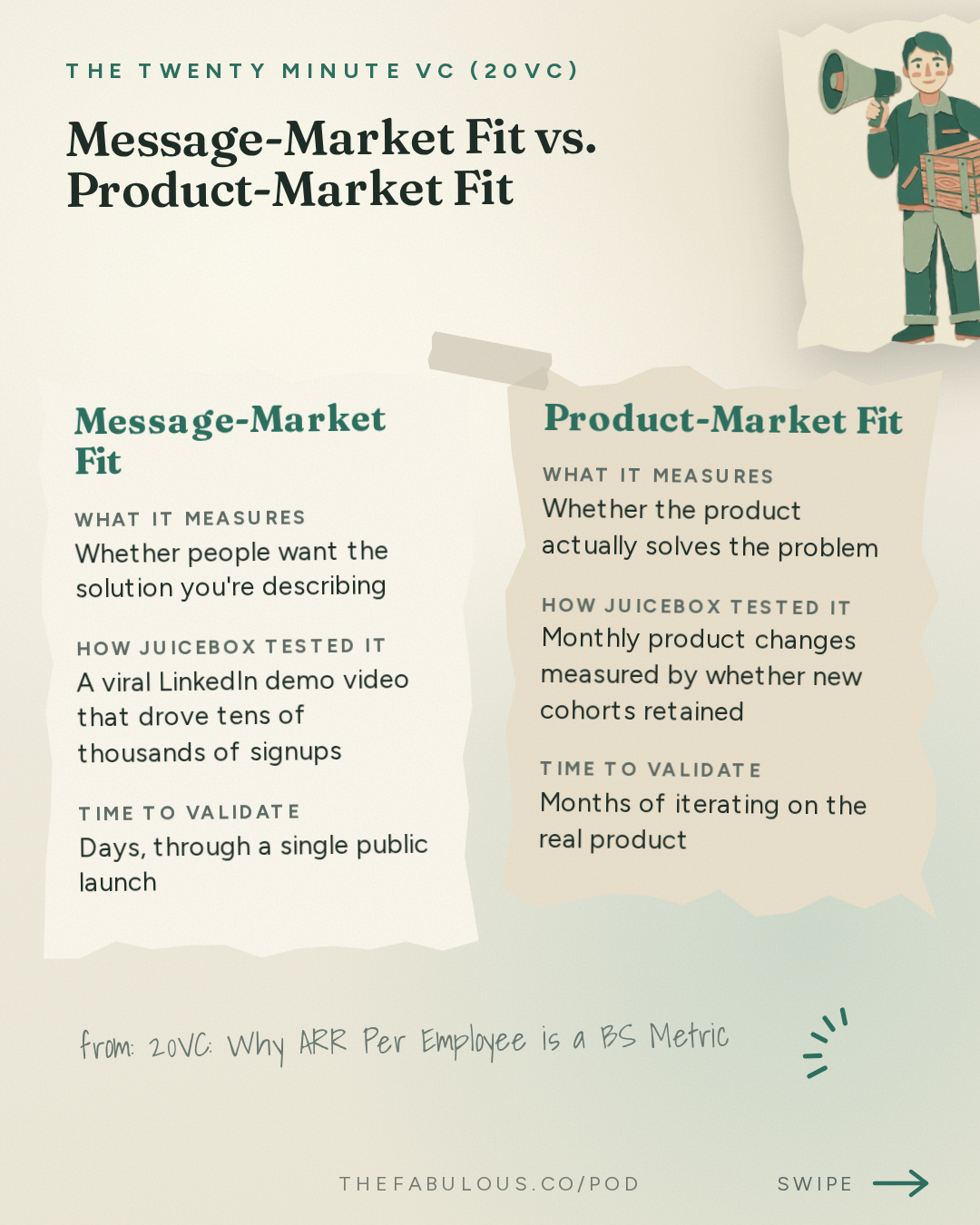
Message-market fit is the test of the pitch. Product-market fit is the test of the thing itself. Paffenholz's claim is that founders can and should validate the first before the second even exists. In May 2023, he posted a Loom-style walkthrough of Juicebox on LinkedIn, showing the flow on its best possible day, not its average one. It went viral, pulling in millions of views, tens of thousands of free signups over a weekend, and the company's first hundred paying users (16:01, 16:20). Nearly all of them churned within two months, because the product genuinely was not ready (16:28). That did not bother him. The video had proven that people wanted the solution he was describing. The product could catch up later.
"I think you have to ship immediately, even if it's broken." David Paffenholz [15:53]
This is standard Y Combinator doctrine, and Paffenholz credits YC, which the company went through remotely in the locked-down summer of 2022, with drilling it into him weekly until it stopped being a slogan and became a habit (14:09, 14:31). But the harder discipline he describes is knowing when message-market fit is not enough. On enterprise sales calls early on, he tried to make the unfinished product look polished, and it backfired: the fast feedback loop that worked for self-serve users stalled for buyers who expected something finished (17:45). The lesson was not to stop shipping broken things. It was to be honest about which audience could tolerate that and which could not.
The Discount That Was Also a Strategy
By the time Juicebox raised its Series A, the company had gone from $1 million to $5 million in annual recurring revenue (ARR, the yearly value of subscription contracts) in four to five months (21:05). Sequoia partner David Kahn reached out early, the two took a three-hour walk through San Francisco's Dogpatch neighborhood, and within two weeks Juicebox ran a compressed process with about fifteen firms it was genuinely excited about (21:47, 22:22). The investment committee meeting lasted forty-five minutes. Paffenholz and his cofounder then waited an hour in a conference room Sequoia jokingly called the Harvard Room, a nod to his undergraduate degree, before partner David Kahn walked in and wrote the term sheet out by hand (23:38, 24:20).
The terms were slightly below what Juicebox had targeted. Paffenholz took them anyway, and he is candid about why.
"The brand of the VC is a very credible signal for talent to recognize." David Paffenholz [26:41]
He calls this the Sequoia discount: a firm's reputation is worth accepting a lower valuation for, because it compresses future fundraising risk and, just as importantly, makes hiring easier. New engineers and salespeople use investor brand as a proxy for a company's health, since they lack the information an investor has and are staking their careers on the answer (26:15). Juicebox raised $30 million in that round (25:24), and about six months later closed a Series B with DST's Saurabh after tripling ARR to roughly $15 million (43:59, 44:08). Notably, the company turned down a paper term sheet that would have more than doubled its Series A valuation the same day the Series A wire landed, on the logic that an artificially high mark now would only make the next round harder (44:08, 44:23).
Growth That Hides and Growth That Shows
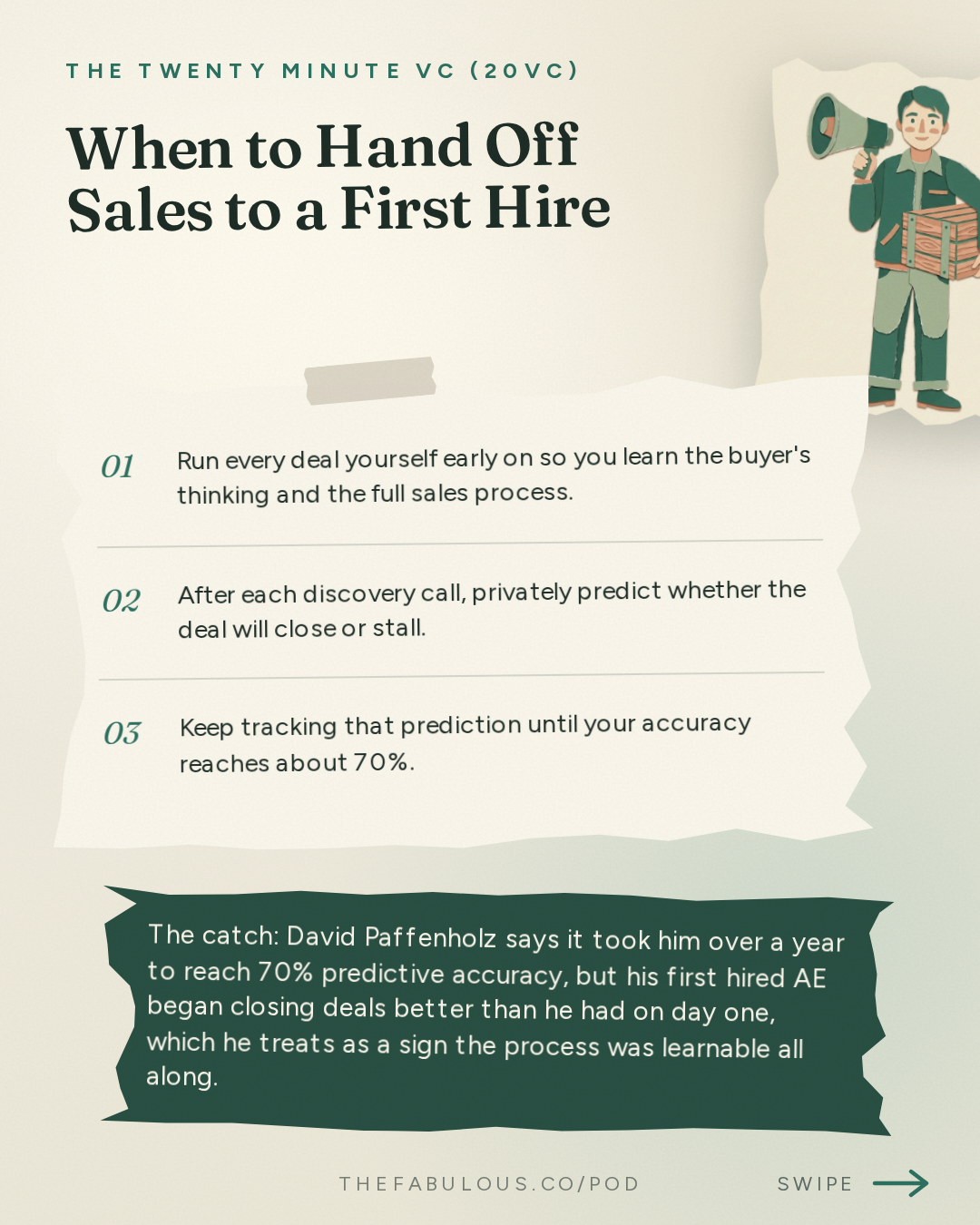
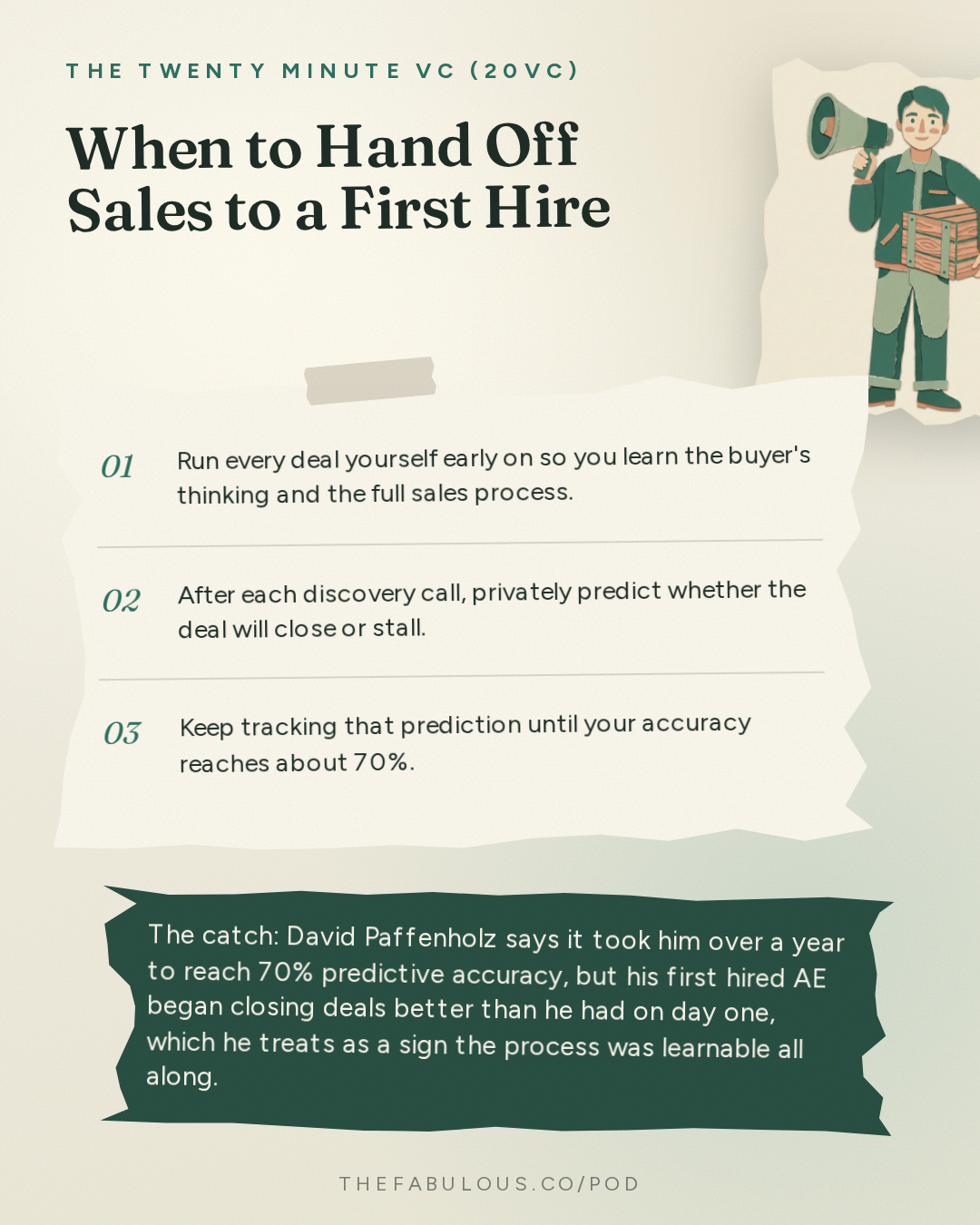
Two scaling lessons stand out. The first is about when a founder should stop running sales personally. Paffenholz was Juicebox's only salesperson for years, and he defines the handoff point narrowly: once a founder can predict, after a single discovery call, whether a deal will close or stall, with something like 70 percent accuracy, the pattern is learnable enough to teach someone else (28:47). It took him over a year to reach that reliability. His first hired account executive, by contrast, began closing deals better than Paffenholz had on his own first day, which he treats as proof the process was teachable, not as an insult (28:19).
The second lesson is about what sales enablement looks like for an AI product, and here Juicebox breaks with convention on purpose. Traditional SaaS training saves the product demo for the third call, after discovery and qualification. Paffenholz's rule is the opposite.
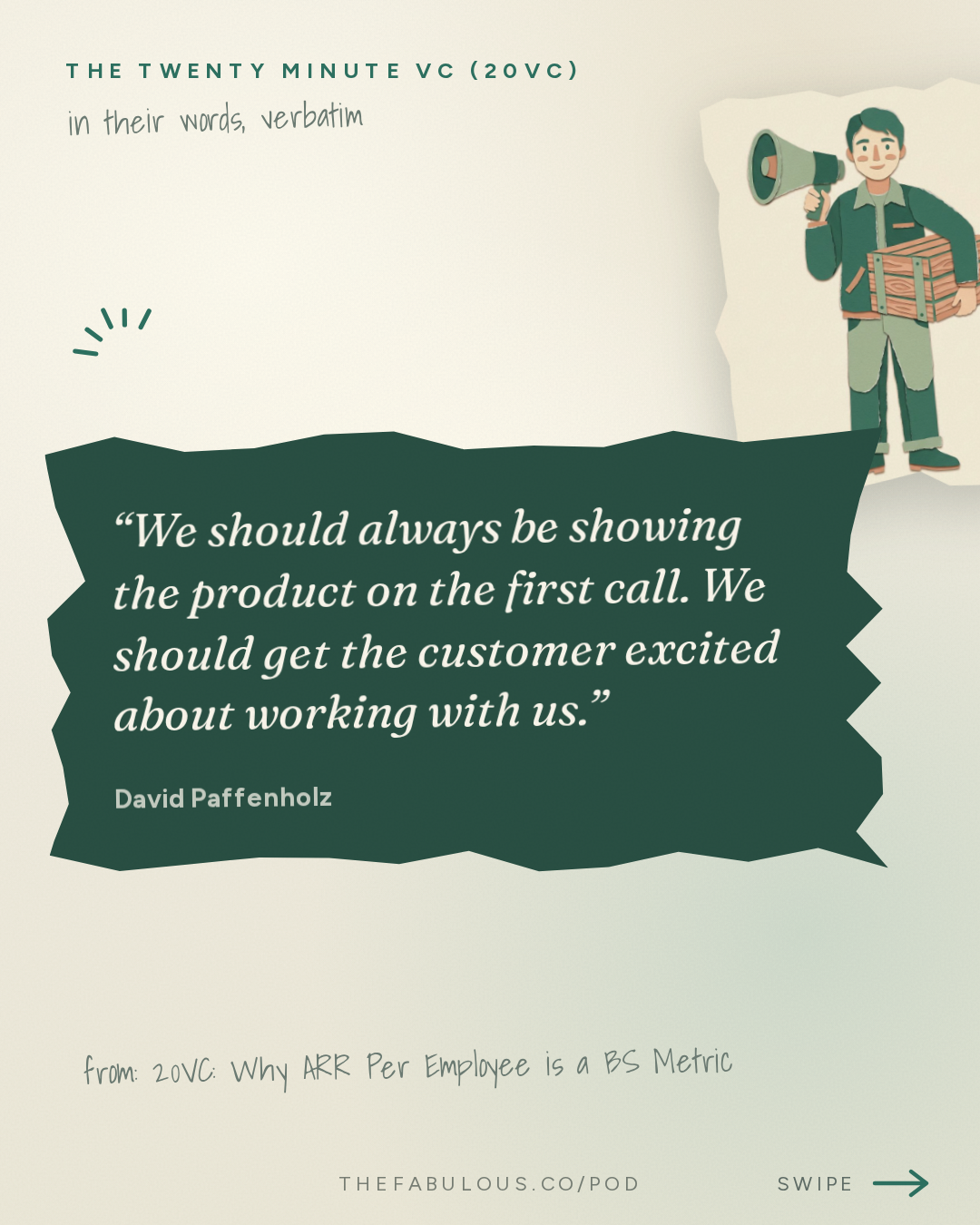
"We should always be showing the product on the first call. We should get the customer excited about working with us because we believe in our product." David Paffenholz [30:11]
The company still has not hired a dedicated sales enablement lead, partly because candidates keep arriving with the old SaaS playbook in hand, one Paffenholz thinks does not fit an AI product whose main selling point is the product itself (29:42).
That same instinct for separating real signal from flattering noise shapes his biggest reversal of the past year: ARR per employee, a common efficiency metric that divides a company's annual recurring revenue by its headcount.
"ARR per employee is a vanity metric in almost all cases, and actually the only thing that matters is ARR growth." David Paffenholz [56:31]
He used to treat a high ratio as proof the team was lean and high-impact. Now he sees the other side: if the sales team is understaffed, ARR per employee looks great precisely because growth is being left on the table (56:08). The fix is not hiring for its own sake, it is recognizing that a tidy efficiency number can mask a slower top line.
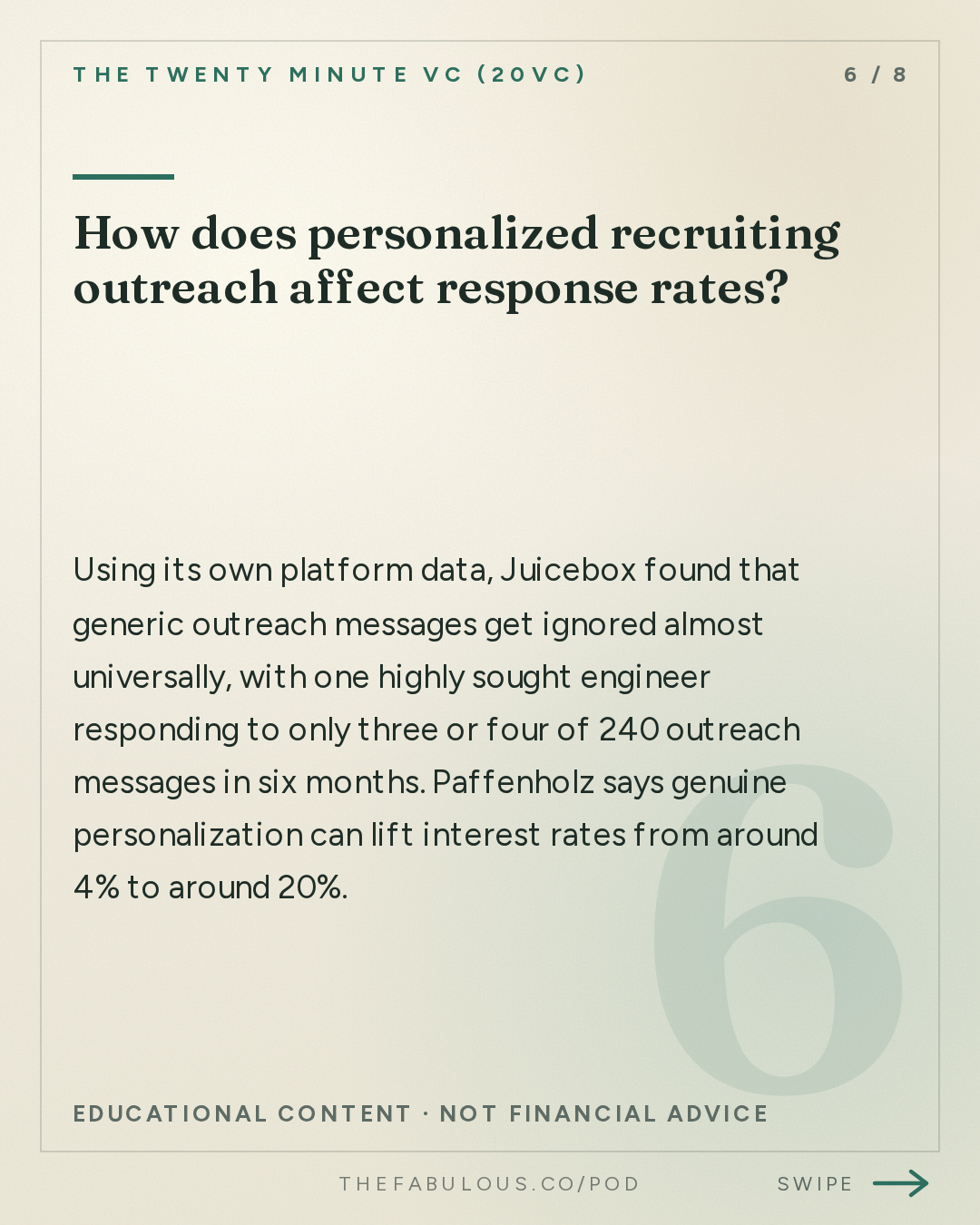
The same discipline about signal versus noise shows up in how Juicebox recruits candidates for its clients. Using the company's own platform data, Paffenholz found that the single most sought-after software engineer in a recent six-month window received 240 outreach messages and responded to only three or four of them (51:16). Generic, templated recruiting messages get ignored almost universally. Paffenholz says genuine personalization, a message that names why a specific candidate fits a specific role, can lift response rates from around 4 percent to around 20 percent (51:58). It is a small, mechanical version of the same idea that runs through the whole conversation: a convincing story and a true one are not automatically the same thing, and the gap between them is usually where the actual work lives.
Ask this episode anything
Pod's AI answers from the episode itself, with the minute mark so you can hear it yourself.
Or start with one of these
Ask this episode
Pod's AI listens to the whole episode to answer, and points you to the minute it comes from.
The rest of this answer, and any question after it
Answers come from the episode itself, never from a summary of it.
ContinueKey takeaways
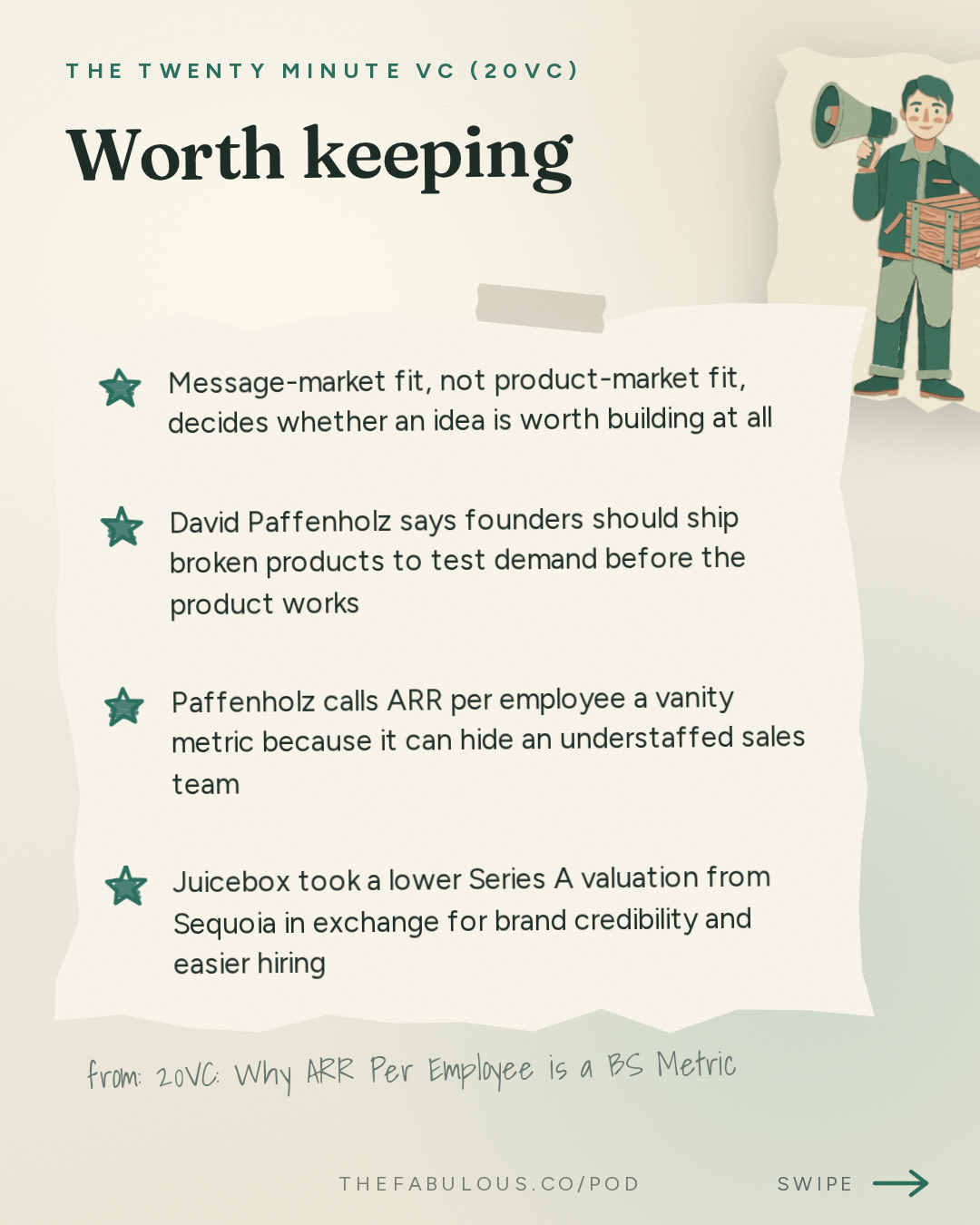
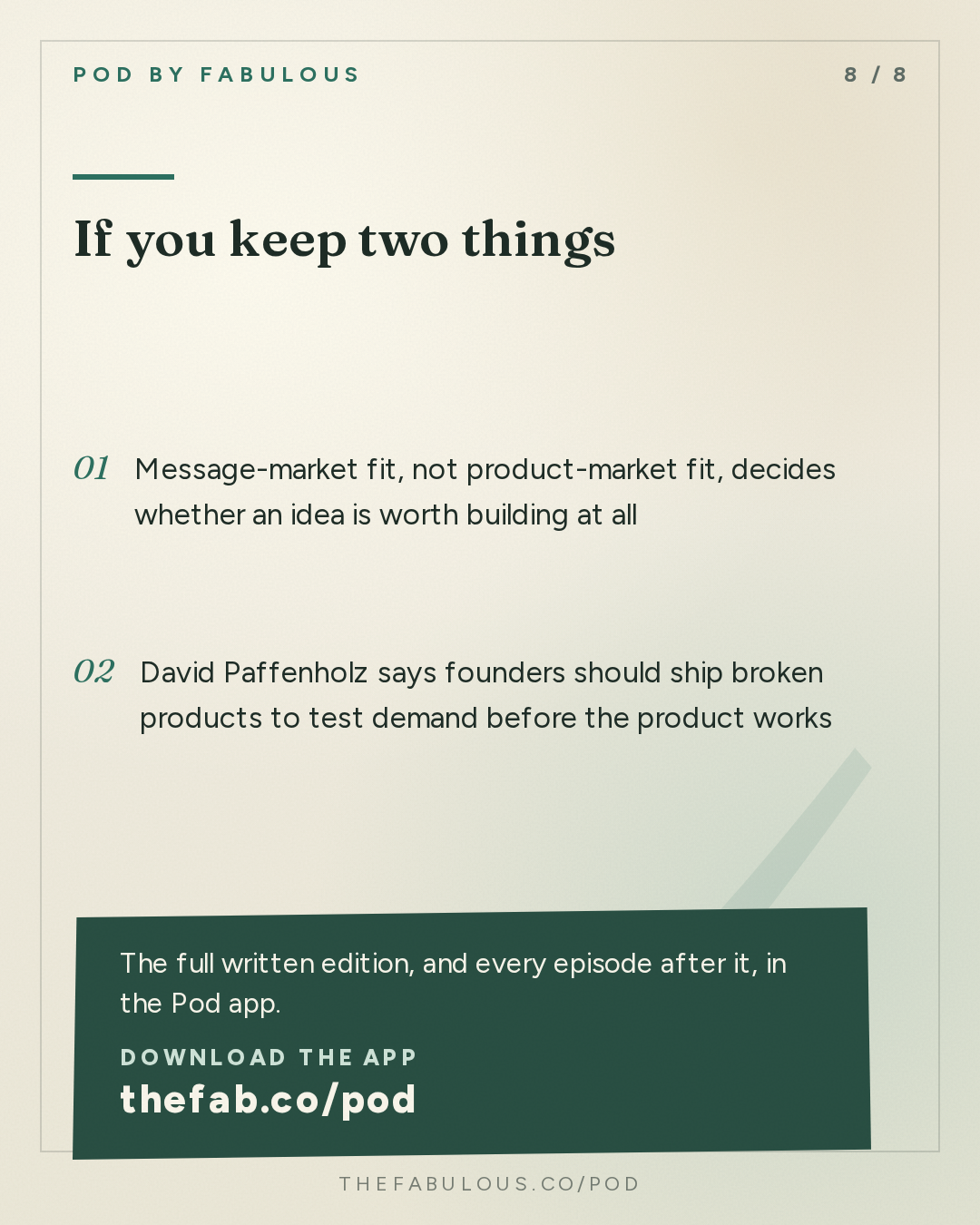
- Message-market fit, not product-market fit, decides whether an idea is worth building at all
- David Paffenholz says founders should ship broken products to test demand before the product works
- Paffenholz calls ARR per employee a vanity metric because it can hide an understaffed sales team
- Juicebox took a lower Series A valuation from Sequoia in exchange for brand credibility and easier hiring
- Personalized recruiting outreach lifts candidate interest from around 4% to around 20%, per Juicebox data
The episode in cards
By the numbers
- 240 outreaches messages the most-contacted engineer received in six months on Juicebox
In their words
“Message market fit is basically if a launch goes well and people want to learn more about your product, maybe they're even impressed by demoing your product.”
“I think you have to ship immediately, even if it's broken.”
“We should always be showing the product on the first call. We should get the customer excited about working with us.”
“ARR per employee is a, is a vanity metric in almost all cases, and actually the only thing that matters is ARR”
“The brand of the VC is a very credible signal for talent to recognize.”
Protocols
-
When to hand sales off to a first hire
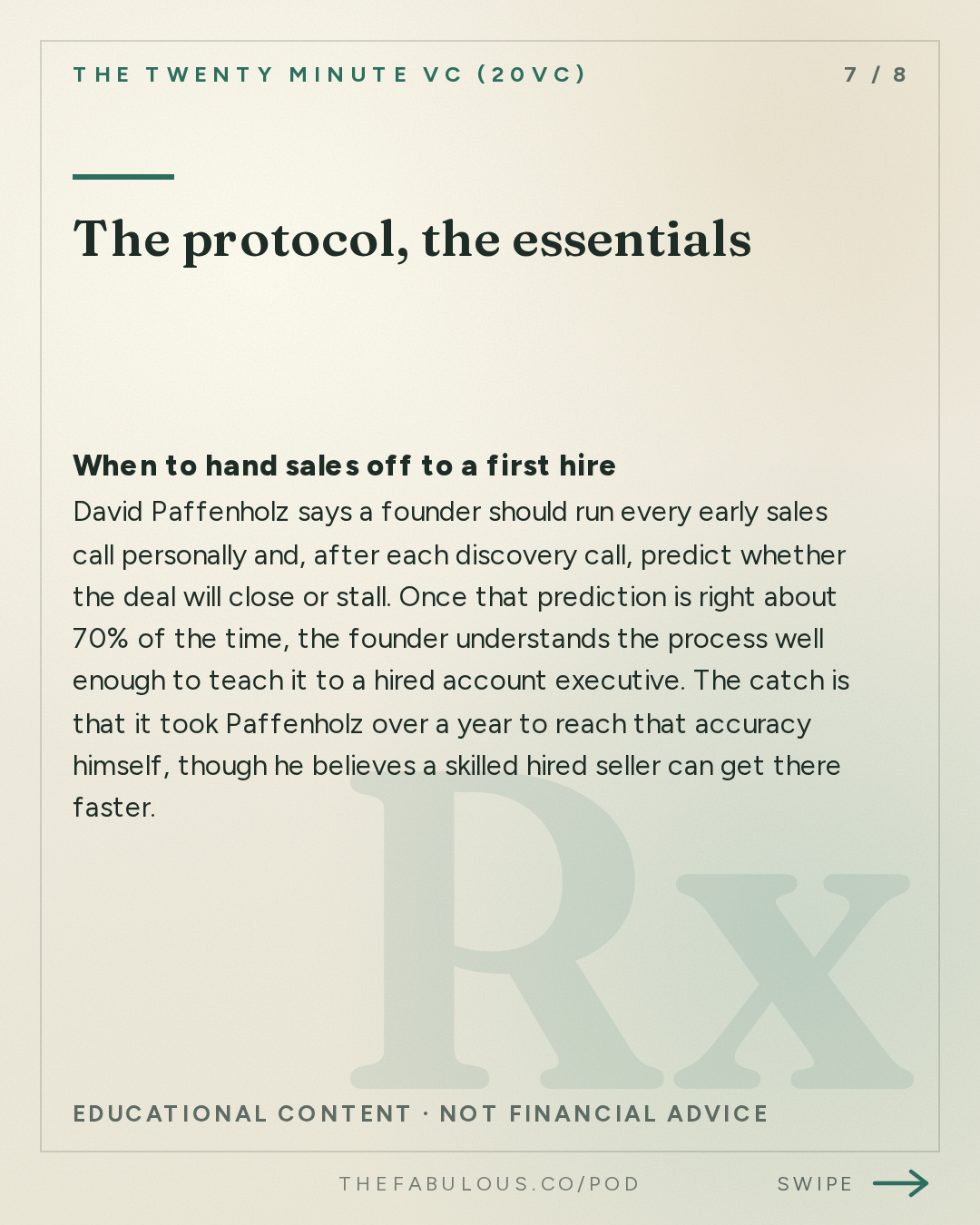
David Paffenholz says a founder should run every early sales call personally and, after each discovery call, predict whether the deal will close or stall. Once that prediction is right about 70% of the time, the founder understands the process well enough to teach it to a hired account executive. The catch is that it took Paffenholz over a year to reach that accuracy himself, though he believes a skilled hired seller can get there faster.
evaluated after every discovery call until the 70% threshold is consistently hit
-
Show the product on the first sales call
Paffenholz has his sales team demo the product on the very first call with a prospect, rather than saving the demo for later in the cycle as traditional SaaS playbooks recommend. He believes the goal is to make the customer excited about the product itself, since that excitement is the actual reason they buy. The catch is that this breaks from standard sales enablement training, which is part of why Juicebox has struggled to hire a dedicated enablement lead.
every first call
-
Launch before the product is ready
Paffenholz recommends founders launch frequently and ship a version of the product that works on its best day, even if it is not reliably ready, in order to test whether real demand exists. The catch is that early adopters will largely churn, as happened with Juicebox's first hundred paying users who nearly all canceled within two months, but the resulting feedback is what lets the product catch up to the pitch.
repeated with each new launch or major update
Questions this episode answers
What is message-market fit versus product-market fit?
Message-market fit tests whether people want the solution a founder is describing, usually through a launch or demo, while product-market fit tests whether the actual product delivers on that promise. David Paffenholz says founders can validate message-market fit in days through a public launch, then spend months closing the gap to product-market fit (15:06).
Why does David Paffenholz say ARR per employee is a vanity metric?
Paffenholz used to see high ARR per employee as proof of an efficient team, but changed his mind because a high ratio can mean a company is under-hiring sales and leaving revenue on the table. He now argues ARR growth, not revenue divided by headcount, is the number that matters (56:08, 56:31).
When should a founder hand off sales to a hired salesperson?
Paffenholz's rule is to keep running sales calls personally until a founder can predict, with about 70% accuracy after a single discovery call, whether a deal will close or stall. He says it took him over a year to hit that accuracy at Juicebox (28:47).
How much did Juicebox raise and from whom?
Juicebox started with $400,000 from its YC batch plus YC's own $500,000 investment, took a seed round from Nat Friedman and Daniel Gross's NFDG through the AI Grant program, raised a $30 million Series A led by Sequoia's David Kahn, and closed a Series B about six months later led by DST's Saurabh after roughly tripling ARR (00:00, 19:49, 25:24, 43:59).
How does personalized recruiting outreach affect response rates?
Using its own platform data, Juicebox found that generic outreach messages get ignored almost universally, with one highly sought engineer responding to only three or four of 240 outreach messages in six months. Paffenholz says genuine personalization can lift interest rates from around 4% to around 20% (51:16, 51:58).
The full read, in cards

Go deeper
- Sequoia piece on services-enabled AI businesses — argued services-enabled AI is a promising model, which Paffenholz disputes for recruiting agencies
Mentioned
David Paffenholz · Juicebox · Sequoia · David Kahn · Ishan · LinkedIn · Indeed · Nat Friedman · Daniel Gross · Saurabh · DST · Bryan Halligan · Mathilde Collin · Harry Stebbings
More from this show and category

Anthropic's IPO: Valuation, Price, and What's Next
Anthropic priced its IPO at $83 a share, scaling from a $10 billion to $100 billion valuation in a single year. The same week Jensen Huang's return to Nvidia added $1 trillion in value, and venture investors argued AI agents are already killing legacy software and vibe coding.

Anjney Midha: Why AI's Real Bottleneck Is Energy
Anjney Midha argues frontier AI is an energy business limited by stranded power, not chips, and most VCs lack the technical training to see it. He also says tranched funding rounds are often used to market unproven startups to limited partners rather than track milestones, and that inference will be absorbed in-house by AI research teams.

Kush Bavaria on GPU Pricing and Compute Markets
Kush Bavaria, co-founder of compute-market startup Ornn, argues GPU owners collect rent even when their AI tenants fail, and that chip prices are rising rather than falling. He details building a price index and futures market for compute, modeled on oil's Brent benchmark, while betting on OpenAI over Anthropic because compute, not cash, is the real bottleneck.

Anthropic's IPO and the New Venture Math
Anthropic's IPO priced near $1.4 trillion and was seven times oversubscribed, a deal two venture investors call the best venture return ever (00:21). The same episode covers Jensen Huang's uncertain return to NVIDIA, a net-new-customer slowdown at HubSpot and Monday.com, and why SpaceX's value now rests on compute, not rockets.
