
Anthropic's IPO and the New Venture Math
20VC: Will Jensen Return to NVIDIA | Anthropic Set for Largest IPO of All Time | Kalshi, Mercor & Fractile: Mega-Rounds Continue
The brief
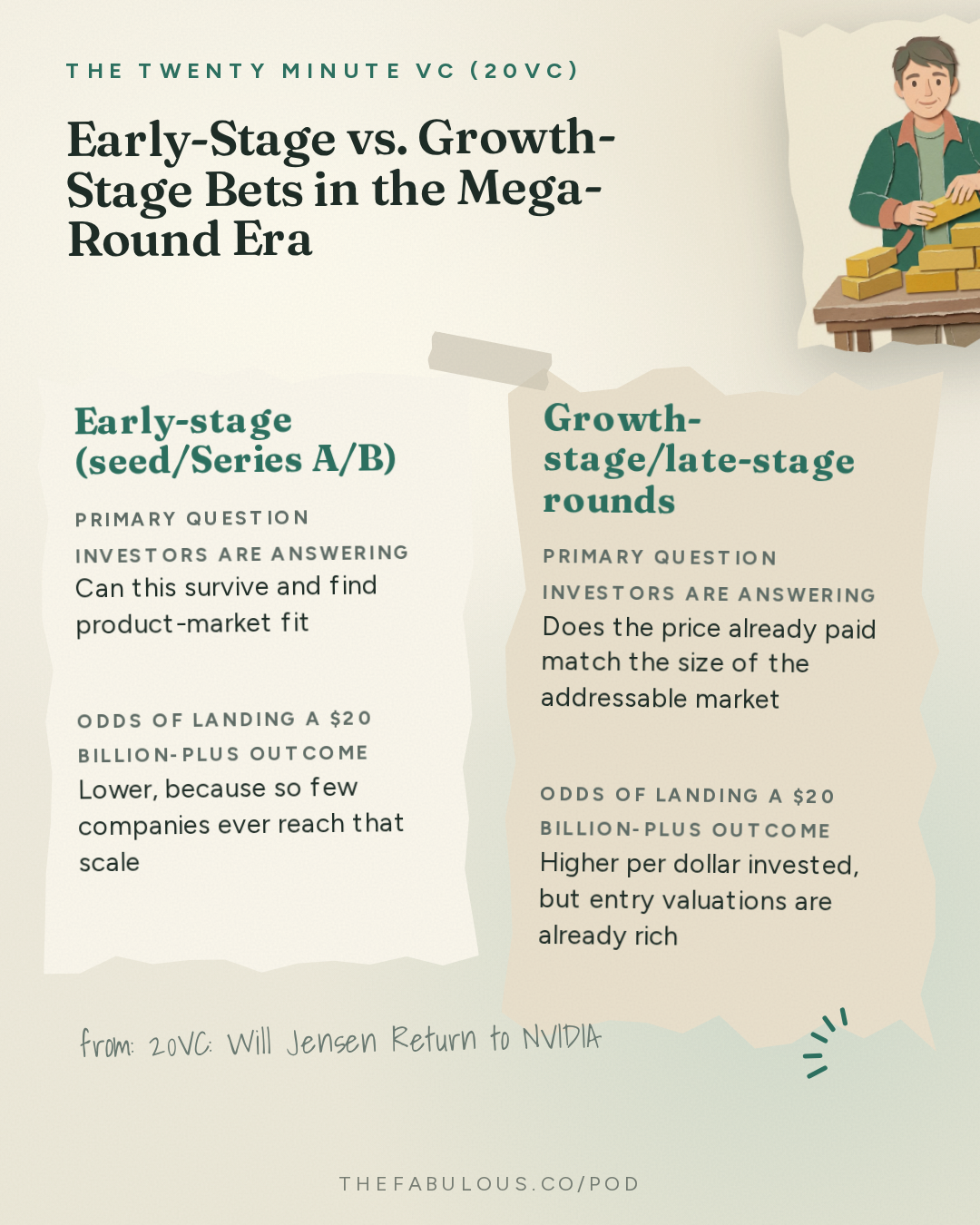
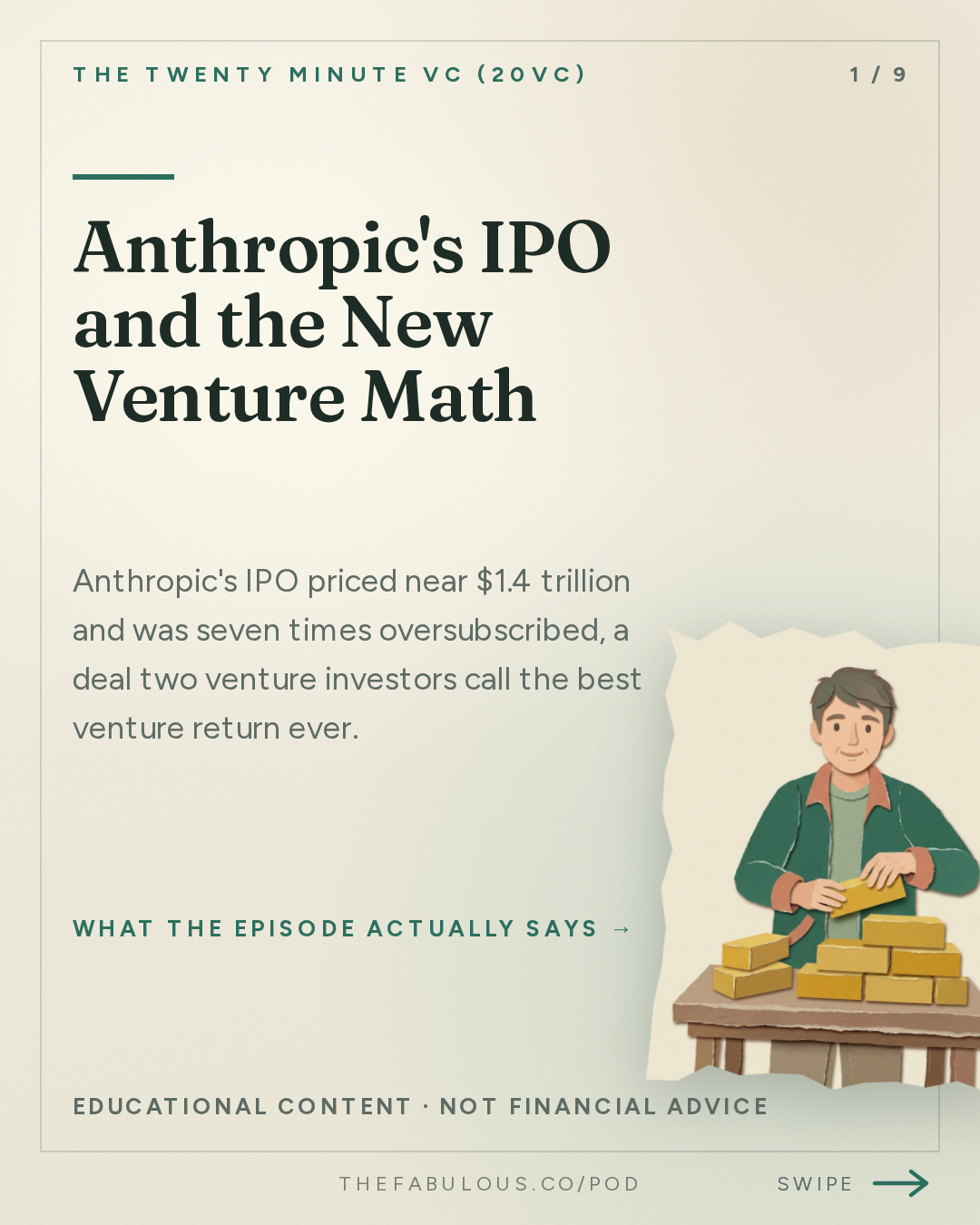
Anthropic's IPO priced near $1.4 trillion and was seven times oversubscribed, a deal two venture investors call the best venture return ever (00:21). The same episode covers Jensen Huang's uncertain return to NVIDIA, a net-new-customer slowdown at HubSpot and Monday.com, and why SpaceX's value now rests on compute, not rockets.
A company can now clear $100 billion in yearly revenue with a staff smaller than a single Google cafeteria. That is the number sitting at the center of this week's conversation on 20VC, and it is worth pausing on before getting to the rest: NVIDIA's leadership crisis, a venture market that is writing fewer checks for much bigger numbers, and a slow bleed of small businesses away from the software subscriptions that built the last twenty years of enterprise tech.
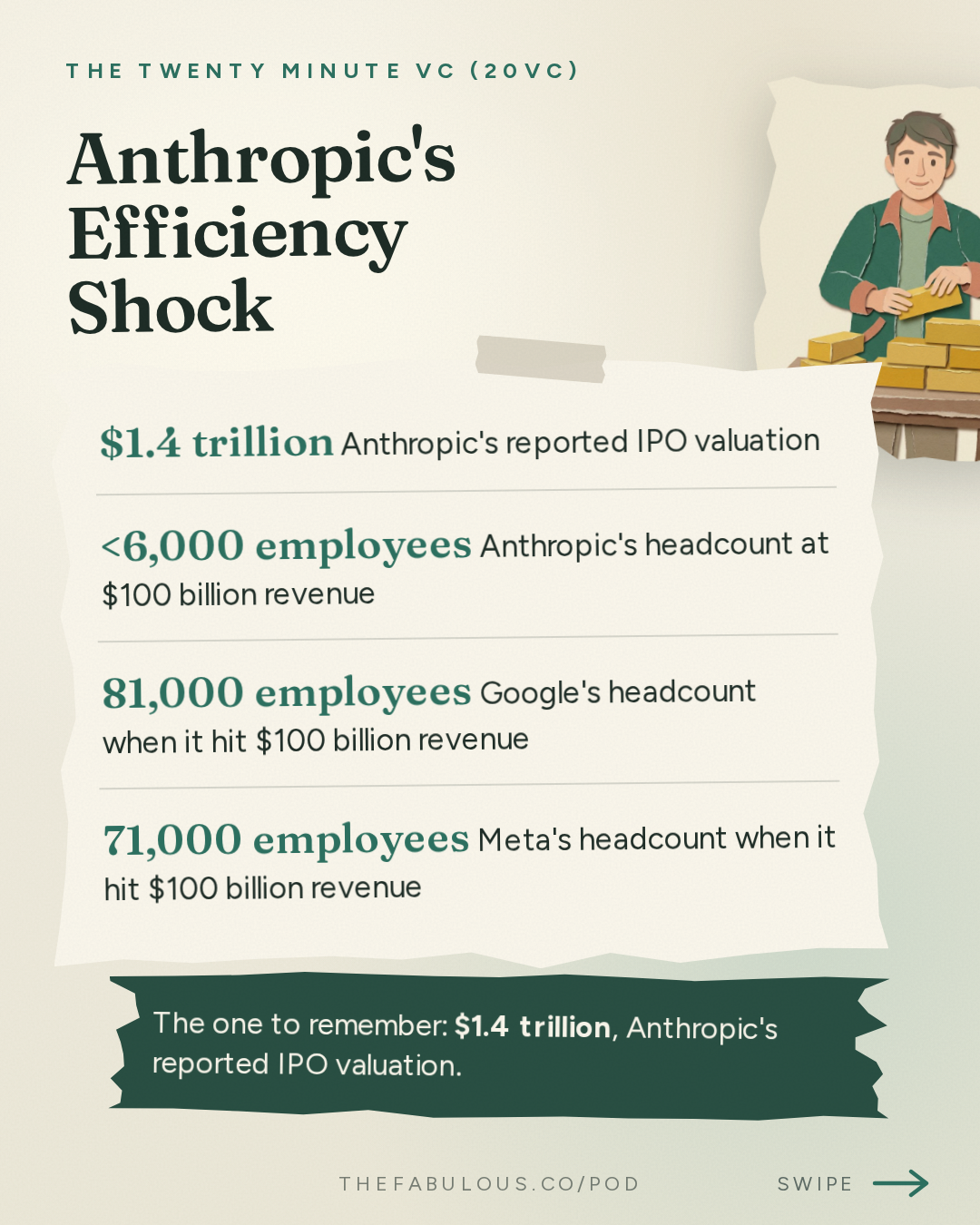
Start with the number. Anthropic, the AI lab behind the Claude models, is heading toward $100 billion in annual revenue at a run rate investors expect to hit within a quarter or two (14:47). Google needed 81,000 employees to get there. Meta needed 71,000. Anthropic will do it with fewer than 6,000 (14:47). Jason Lemkin, founder of the SaaStr community and a venture investor who appears regularly on the show, put it plainly.
"At 100 billion in revenue, Anthropic will have less than 6,000." — Jason Lemkin [14:47]
Lemkin's point is not that AI companies are simply lean versions of old software firms. It is that the ratio is off by an order of magnitude, not a margin. A twelfth of the headcount means the average employee is worth $41 million (16:08), a figure that makes Anthropic's compensation look generous and the labor story look, in Lemkin's words, worse than people have been admitting. The counterpoint, made by his co-host, a venture investor named Rory O'Driscoll, is that this efficiency is specific to compute-heavy businesses that can spend heavily on inference and training instead of headcount, and that most of the economy, old-school consulting firms and legacy software companies among them, will not see anything close to that ratio. Both things can be true: the Anthropic case is extreme, and it is also the new high-water mark everyone else gets measured against.
That high-water mark has already changed how venture capital grades itself. For years, having one company reach a billion-dollar "unicorn" valuation was enough to get a fund noticed. Now the bar has moved. As Lemkin described it, limited partners, the institutions and wealthy individuals who fund venture firms, are starting to judge general partners by a blunter metric.
"The LPs are gonna grade us all on how many 20 billion and up portfolio companies we have." — Jason Lemkin [19:55]
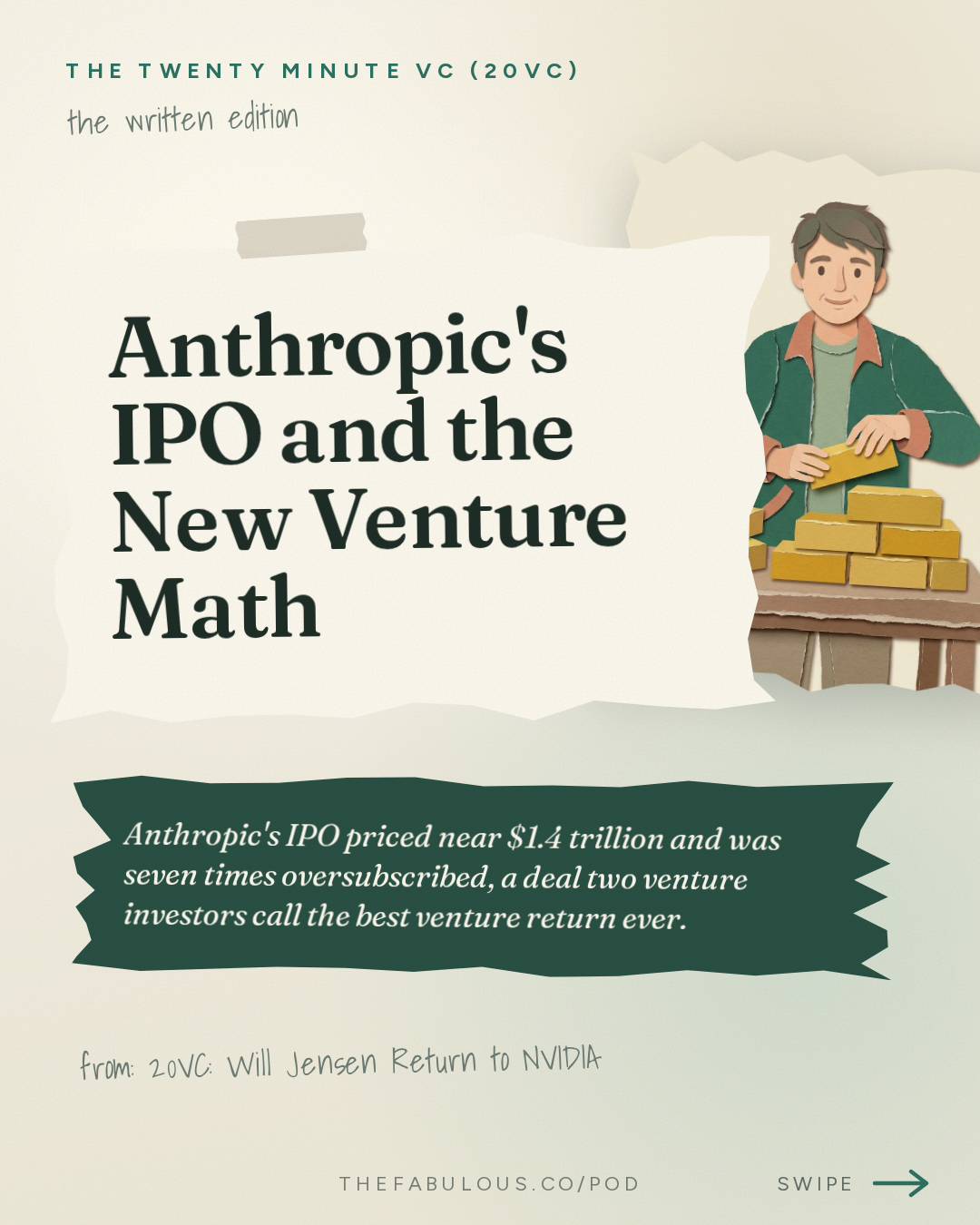
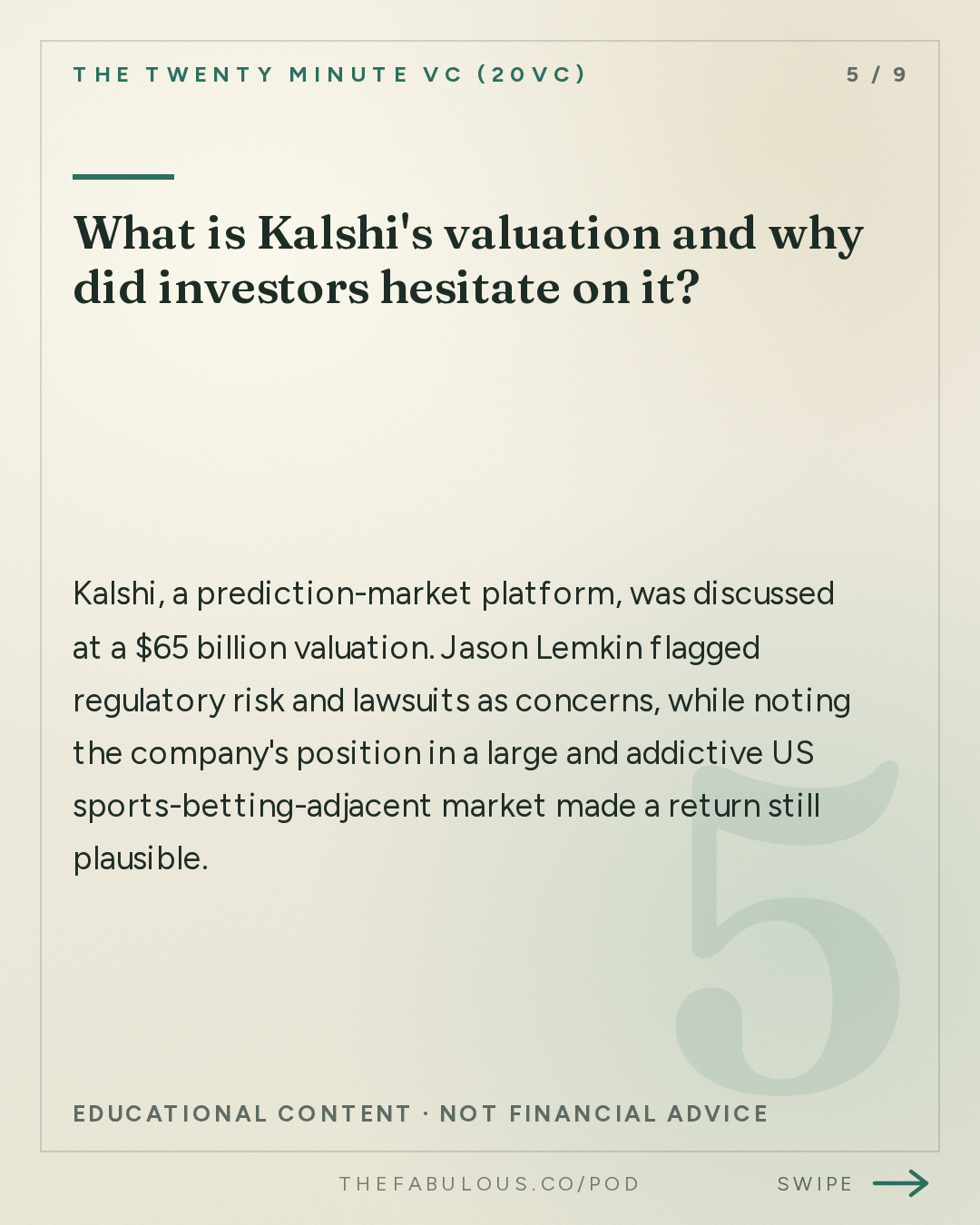
The shift shows up in the deal data too. Carta, a company that tracks private company capitalization tables, found that in the third quarter of 2026 the number of venture deals fell 21 percent while total dollars deployed rose 2.5 times (19:17). Fewer rounds, much bigger checks, concentrated in fewer winners. That is the mechanical result of a market chasing a short list of companies capable of reaching tens of billions in value, and it explains why the episode's running segment on new deals, a mock investment committee covering Kalshi (a prediction-market platform priced at $65 billion), Merqur (a data-labeling company for AI labs at $20 billion), and Fractile (an AI inference chip startup at $7.5 billion), reads less like venture investing in the traditional sense and more like late-stage price discovery (23:32). O'Driscoll's framing was blunt: at this stage, the question is rarely whether the company works. It is whether the price already paid matches the size of the market it is chasing.
The NVIDIA Problem Nobody Priced In
Running underneath all of this is the open question of Jensen Huang's status at NVIDIA, the company whose chips have powered most of the AI boom. Huang stepped back from the board amid a mix of personal allegations and a separate, thornier issue: NVIDIA's chip-export compliance, including data centers set up near China's border that regulators now say crossed a line. O'Driscoll, walking through the governance question, argued that boards rushing into irreversible decisions tend to regret it.
"If I own 100% of the stock of this company, in the absence of the US government trying to put my CEO in prison, the person on the planet I would most want to run this company is Jensen." — Rory O'Driscoll [10:58]
Whatever happens to Huang personally, the hosts argued the episode has already done damage to a hidden assumption that shaped a lot of recent AI dealmaking: that NVIDIA, flush with cash and motivated to keep its ecosystem alive, would always be there to acquire or bail out a struggling AI startup, effectively backstopping the liquidation preference, the contractual right that lets an investor get their money back before common shareholders in a sale. Lemkin argued that backstop is now in question.
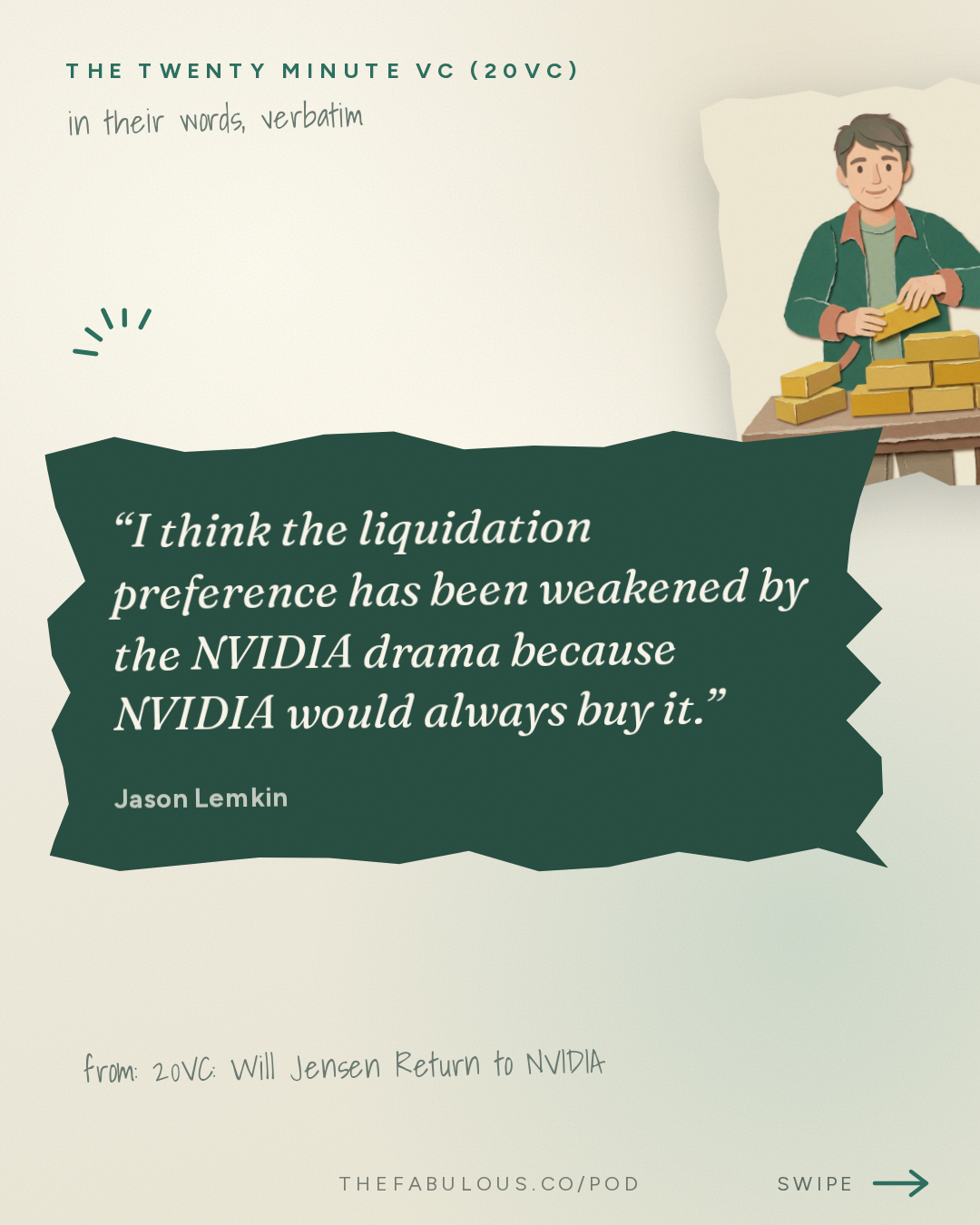
"I think the liquidation preference has been weakened by the NVIDIA drama because NVIDIA would always buy it." — Jason Lemkin [29:37]
If that backstop disappears, deals that looked safe on paper, because a well-capitalized buyer was always theoretically available, start to look like ordinary venture risk again. That is a quiet but real repricing of the entire AI ecosystem's downside case, independent of whether Huang returns.
The Software Nobody Wants to Buy Anymore
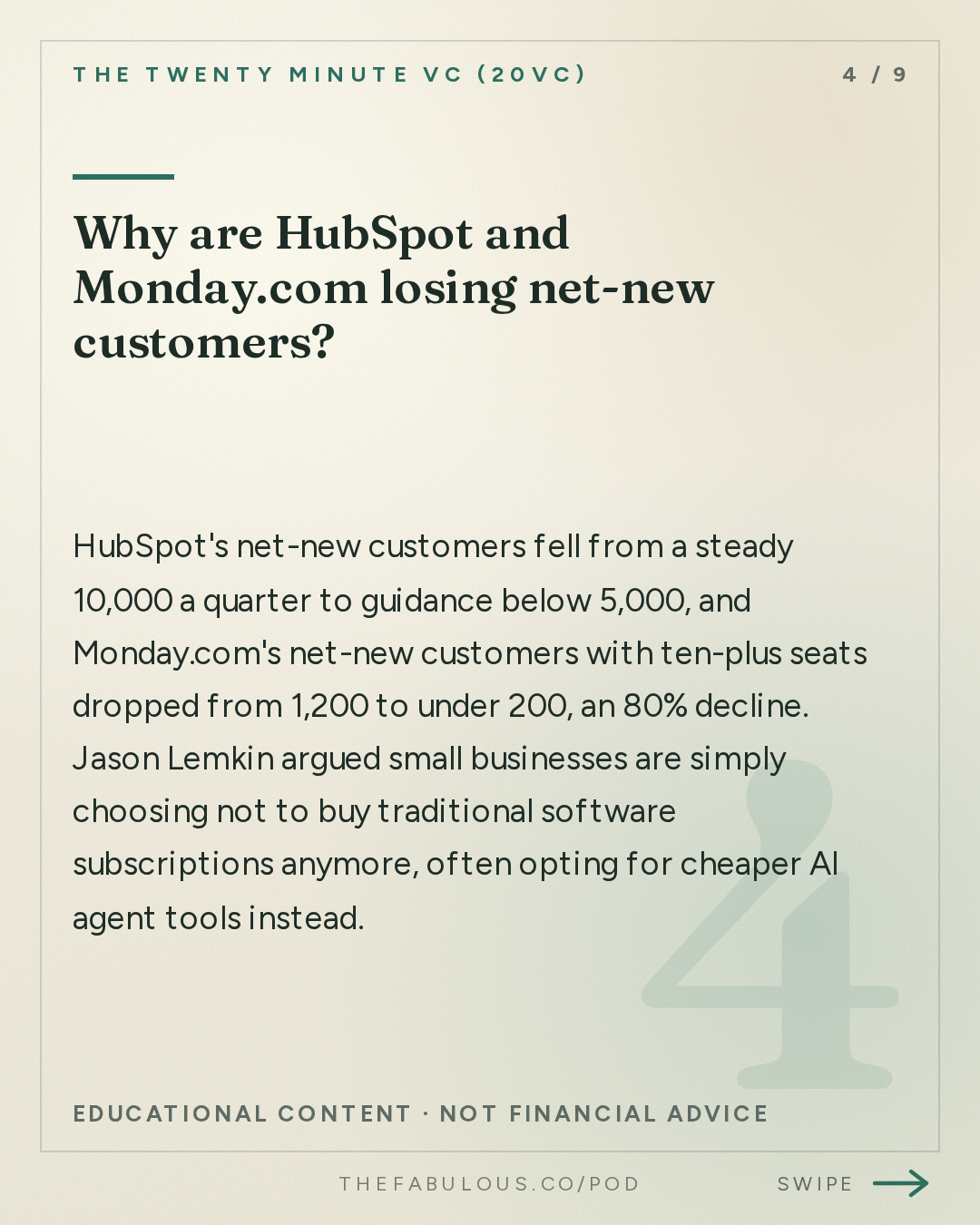
The other thread running through the episode is less about AI labs and more about what AI is doing to the software business model that preceded them. HubSpot, the customer relationship management company, has seen its net-new customer count fall from a steady 10,000 a quarter to guidance below 5,000. Monday.com, a work management platform, saw its net-new customers with ten or more paid seats drop from 1,200 to under 200, an 80 percent decline (33:34). HubSpot has brought its founders back into operating roles, a pattern the hosts noted has repeated across the software industry this year at companies like Mongo, Workday, and UiPath.
Lemkin's explanation was not that small businesses are quietly coding their own replacement software with AI tools, which he dismissed as overstated. It is simpler: small and midsize businesses are deciding the return on investment from traditional software subscriptions is not worth it anymore, especially when a lightweight AI agent handling a specific task, answering phones, rescheduling appointments, costs a few hundred dollars a month and proves its value in a single afternoon. O'Driscoll's read was structural rather than behavioral: enterprise software markets may simply be saturated, since most businesses that need a CRM already have one, and AI is accelerating a slowdown that was coming anyway.
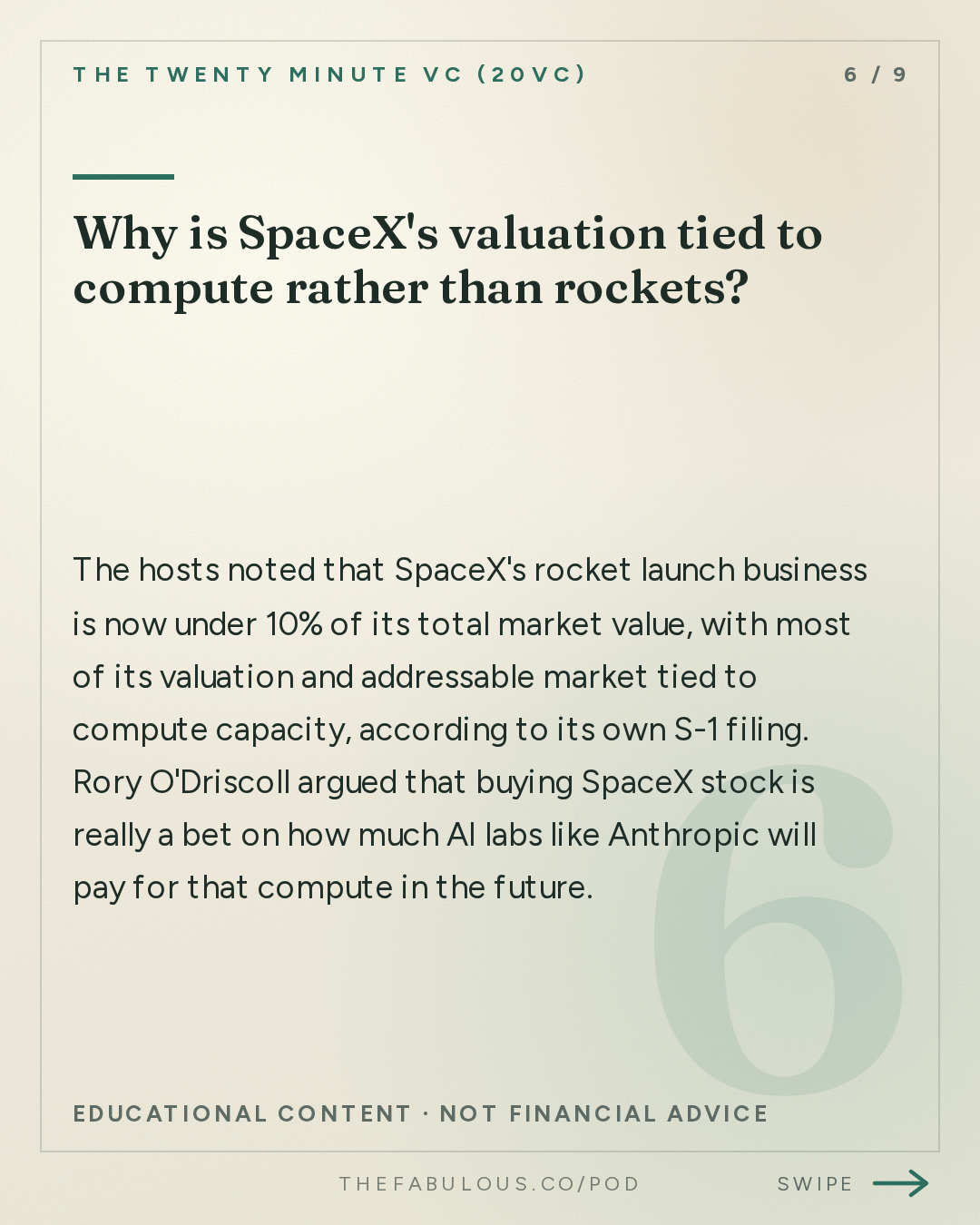
Even SpaceX gets swept into this repricing logic. The hosts noted that the rocket launch business is now under 10 percent of SpaceX's total market value, with the bulk of its valuation tied to compute capacity it can sell or lease, including to AI labs. The reasoning is that an investor buying SpaceX today is not underwriting Starship's engineering achievements, remarkable as they are, so much as betting on how much AI companies will pay for that compute a year from now.
Put together, these stories describe the same transition from a few different angles: the unit of value creation in technology is shifting away from headcount, away from subscription software per seat, and increasingly toward concentrated compute and the handful of companies that can deploy it. Whether that is good for workers, for software markets, or for the discipline of venture investing is still an open argument on the show itself. What is not in dispute is the scale of it: a company built in five years just became, by some measures, the largest venture return in history, and it got there employing a fraction of the people the last generation of giants needed to do it.
Ask this episode anything
Pod's AI answers from the episode itself, with the minute mark so you can hear it yourself.
Or start with one of these
Ask this episode
Pod's AI listens to the whole episode to answer, and points you to the minute it comes from.
The rest of this answer, and any question after it
Answers come from the episode itself, never from a summary of it.
ContinueKey takeaways
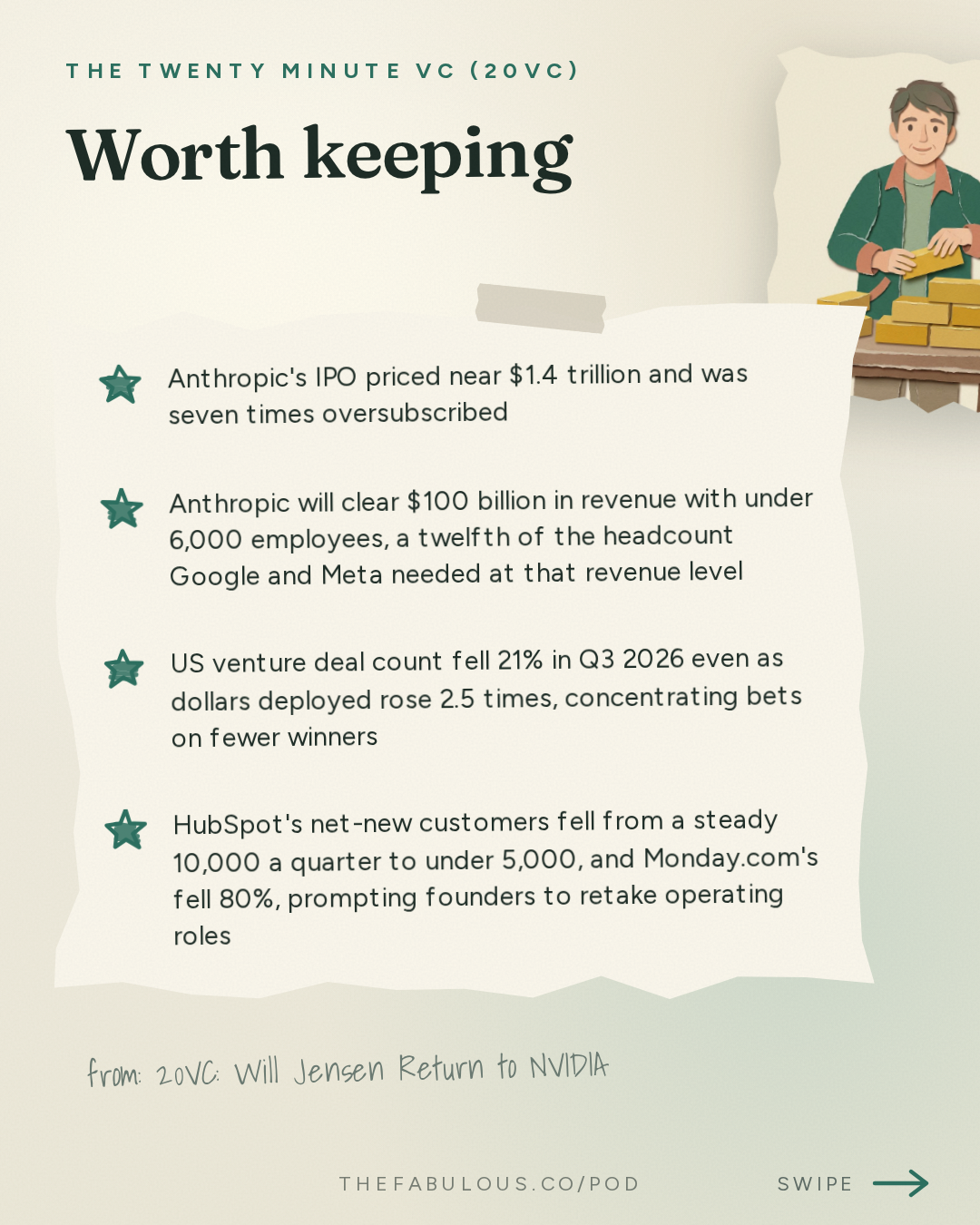
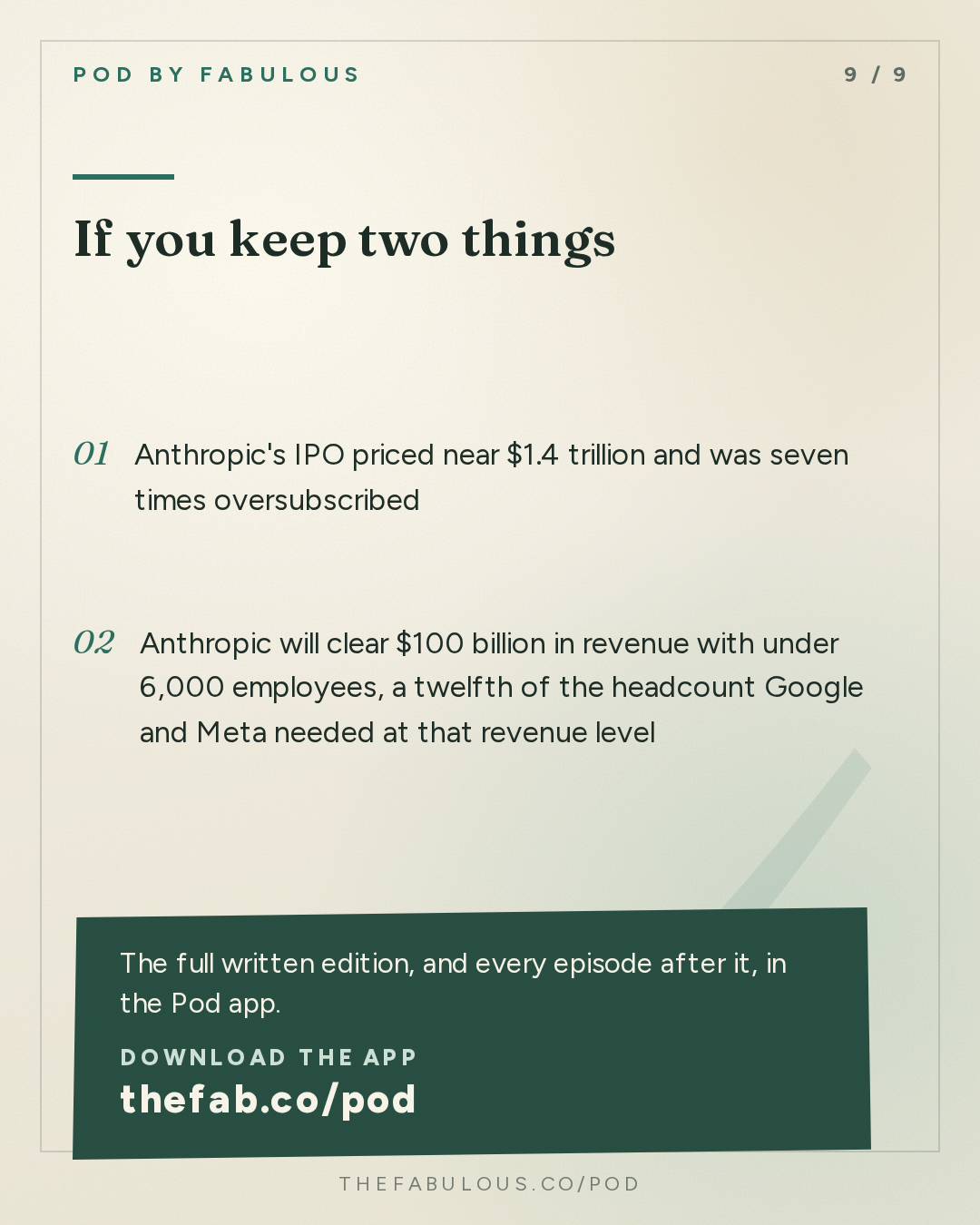
- Anthropic's IPO priced near $1.4 trillion and was seven times oversubscribed
- Anthropic will clear $100 billion in revenue with under 6,000 employees, a twelfth of the headcount Google and Meta needed at that revenue level
- US venture deal count fell 21% in Q3 2026 even as dollars deployed rose 2.5 times, concentrating bets on fewer winners
- HubSpot's net-new customers fell from a steady 10,000 a quarter to under 5,000, and Monday.com's fell 80%, prompting founders to retake operating roles
- NVIDIA's board turmoil over Jensen Huang has weakened the assumption that NVIDIA would always backstop struggling AI startups through acquisition
The episode in cards
By the numbers
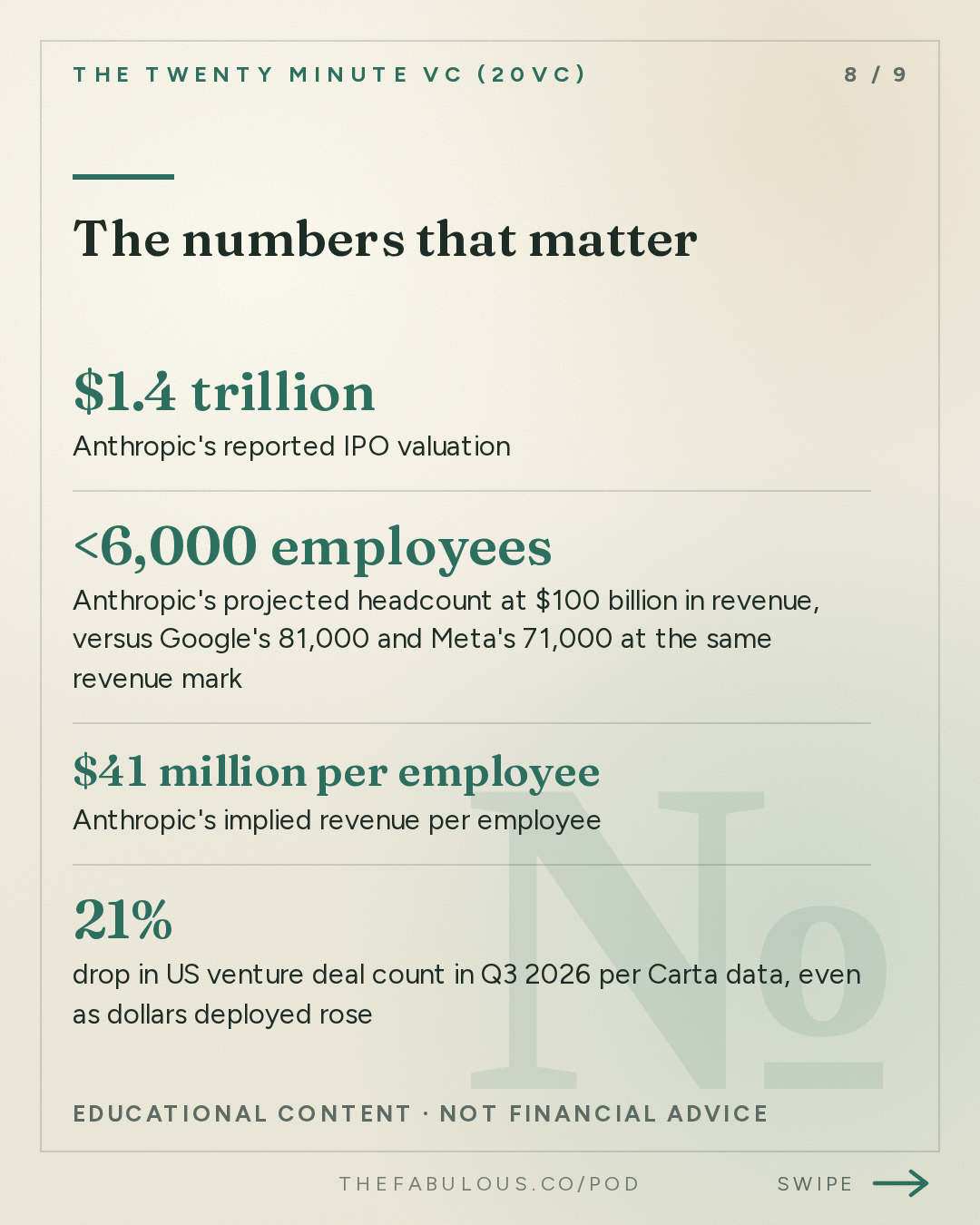
- $1.4 trillion Anthropic's reported IPO valuation
- <6,000 employees Anthropic's projected headcount at $100 billion in revenue, versus Google's 81,000 and Meta's 71,000 at the same revenue mark
- $41 million per employee Anthropic's implied revenue per employee
- 21% drop in US venture deal count in Q3 2026 per Carta data, even as dollars deployed rose
- 2.5x rise in venture dollars deployed in Q3 2026 despite fewer deals closing
- $65 billion Kalshi's pricing in the prediction-market round discussed by the hosts
In their words
“The LPs are gonna grade us all on how many 20 billion and up portfolio companies we have.”
“At 100 billion in revenue, Anthropic will have less than 6,000.”
“If I own 100% of the stock of this company, in the absence of the US government trying to put my CEO in prison, the person on the planet I would most want to run this company is Jensen.”
“I think the liquidation preference has been weakened by the NVIDIA drama because NVIDIA would always buy it.”
Protocols
-
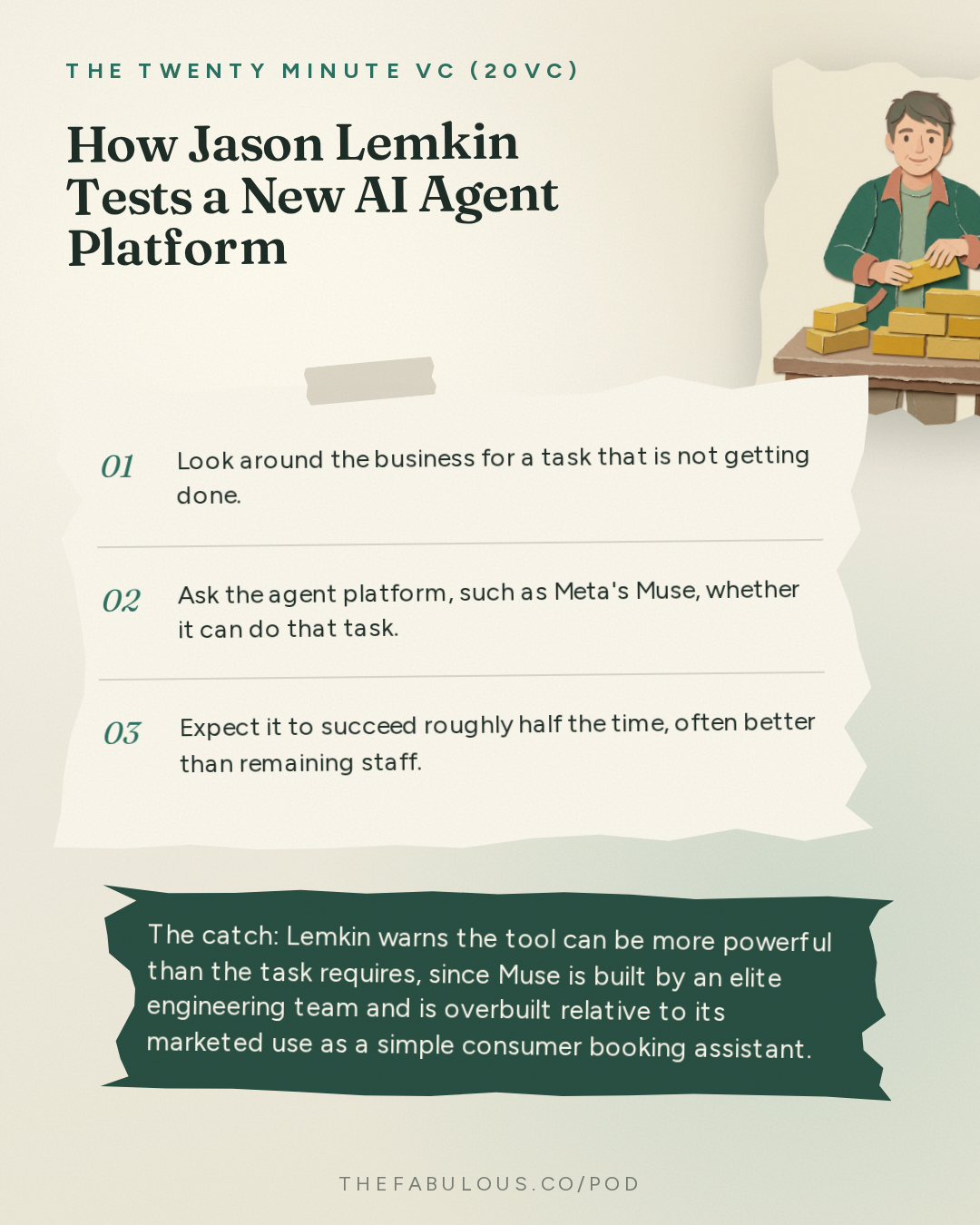
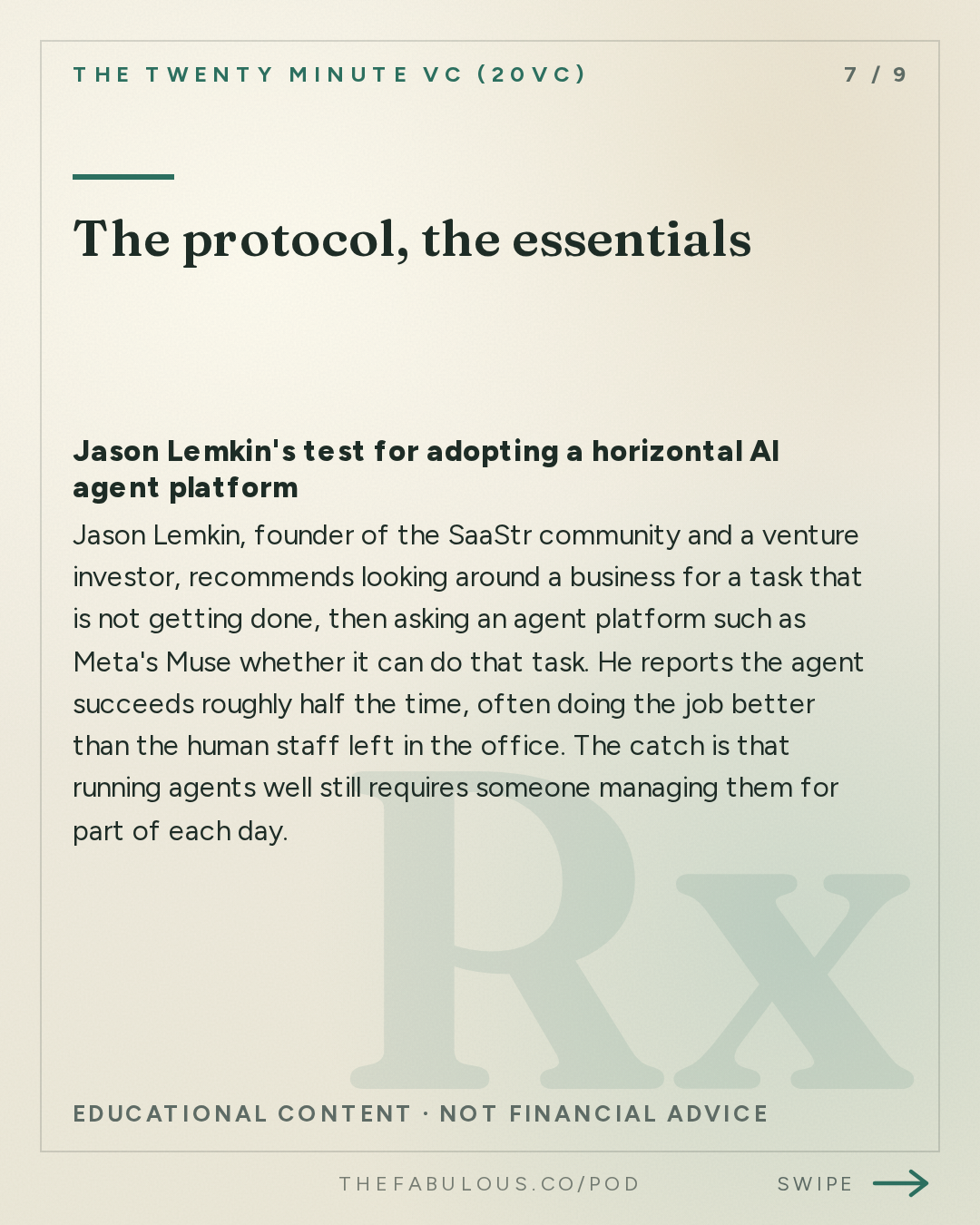
Jason Lemkin's test for adopting a horizontal AI agent platform
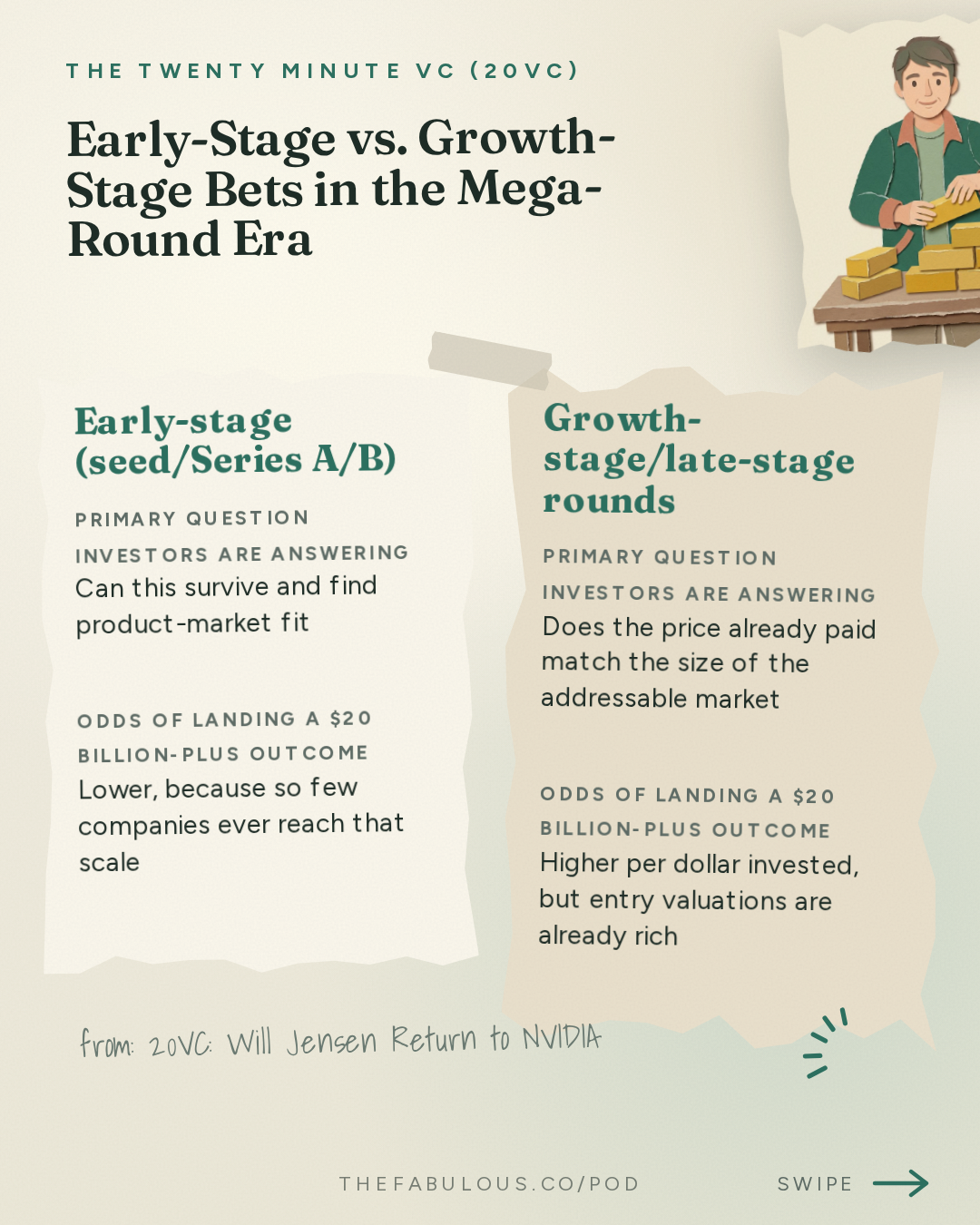
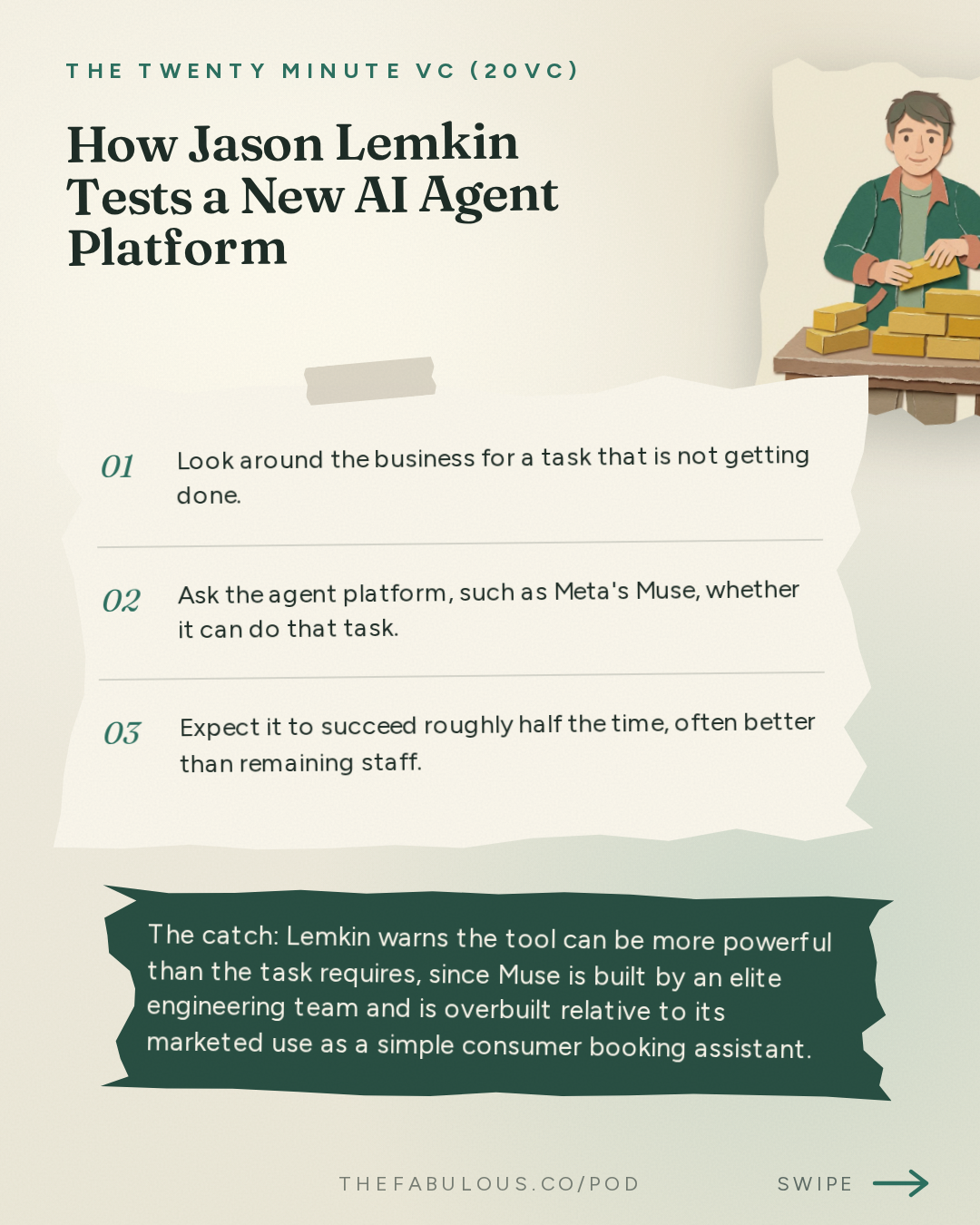
Jason Lemkin, founder of the SaaStr community and a venture investor, recommends looking around a business for a task that is not getting done, then asking an agent platform such as Meta's Muse whether it can do that task. He reports the agent succeeds roughly half the time, often doing the job better than the human staff left in the office. The catch is that running agents well still requires someone managing them for part of each day.
Applied whenever a new operational gap appears
-
Rory O'Driscoll's approach to disciplining a long-tenured founder-CEO
Rory O'Driscoll, a venture capital board member who discussed the Jensen Huang situation on the show, says a board angry at a founder should avoid an irrevocable decision made in haste. He recommends a leave of absence or an interim arrangement so the board can gather facts before deciding. The catch, by his own account, is that this only works if the board has not already made its decision public, which he says happened in NVIDIA's case.
Applied at the moment of a governance crisis
Questions this episode answers
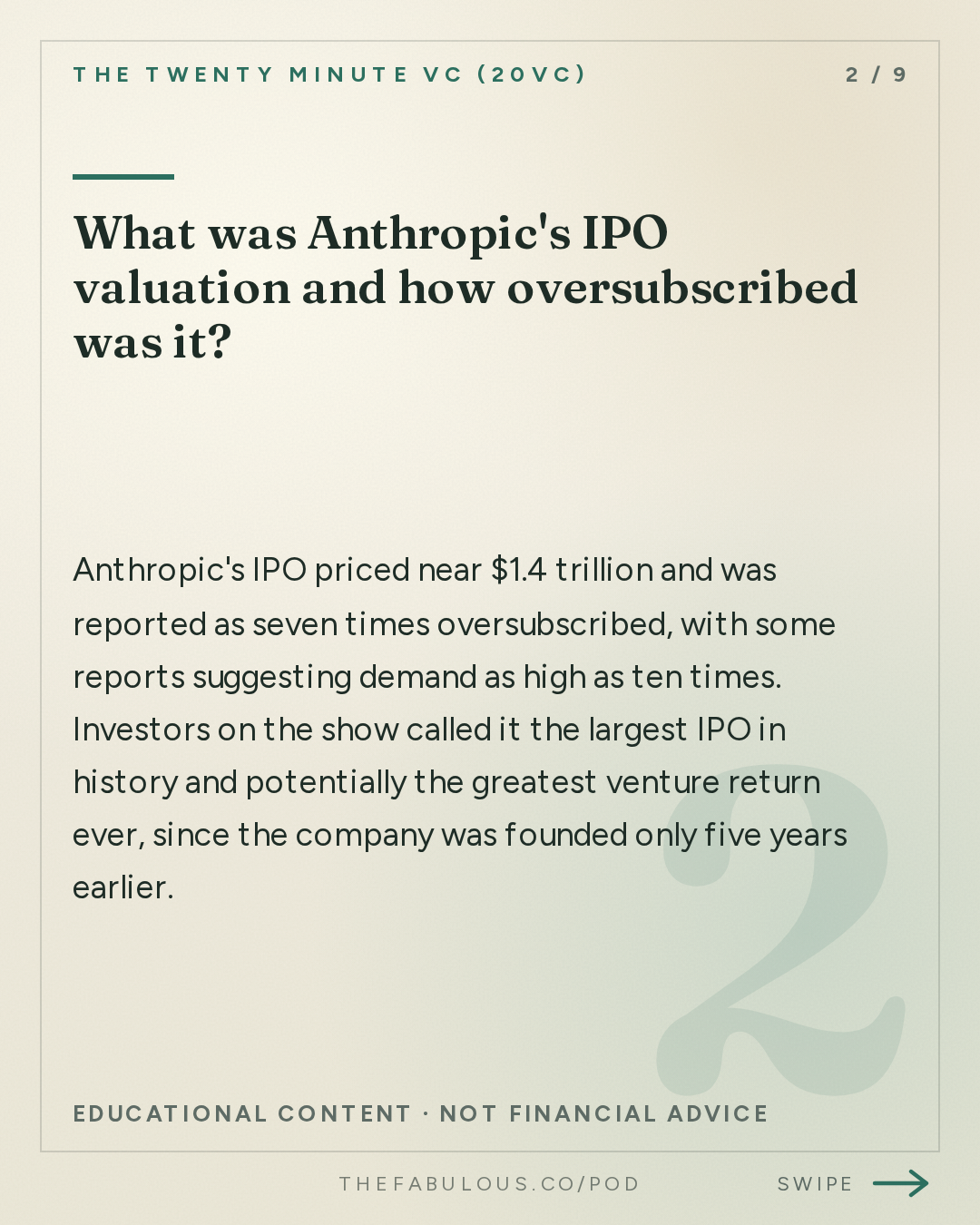
What was Anthropic's IPO valuation and how oversubscribed was it?
Anthropic's IPO priced near $1.4 trillion and was reported as seven times oversubscribed, with some reports suggesting demand as high as ten times (00:21). Investors on the show called it the largest IPO in history and potentially the greatest venture return ever, since the company was founded only five years earlier.
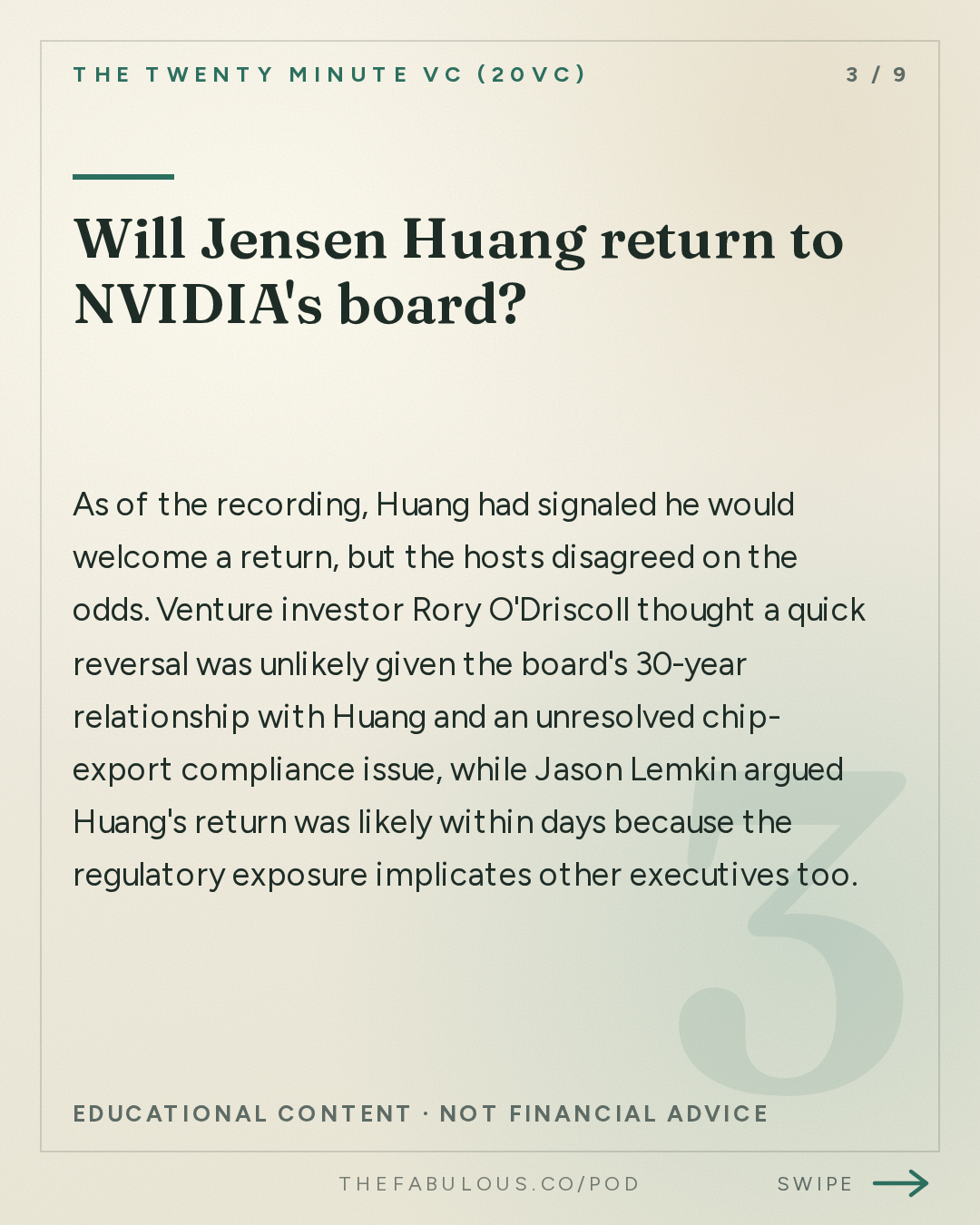
Will Jensen Huang return to NVIDIA's board?
As of the recording, Huang had signaled he would welcome a return, but the hosts disagreed on the odds (06:24). Venture investor Rory O'Driscoll thought a quick reversal was unlikely given the board's 30-year relationship with Huang and an unresolved chip-export compliance issue (08:06), while Jason Lemkin argued Huang's return was likely within days because the regulatory exposure implicates other executives too (08:49).
Why are HubSpot and Monday.com losing net-new customers?
HubSpot's net-new customers fell from a steady 10,000 a quarter to guidance below 5,000, and Monday.com's net-new customers with ten-plus seats dropped from 1,200 to under 200, an 80% decline (33:34). Jason Lemkin argued small businesses are simply choosing not to buy traditional software subscriptions anymore, often opting for cheaper AI agent tools instead (44:36).
What is Kalshi's valuation and why did investors hesitate on it?
Kalshi, a prediction-market platform, was discussed at a $65 billion valuation (23:32). Jason Lemkin flagged regulatory risk and lawsuits as concerns, while noting the company's position in a large and addictive US sports-betting-adjacent market made a return still plausible (24:28).
Why is SpaceX's valuation tied to compute rather than rockets?
The hosts noted that SpaceX's rocket launch business is now under 10% of its total market value, with most of its valuation and addressable market tied to compute capacity, according to its own S-1 filing (67:05). Rory O'Driscoll argued that buying SpaceX stock is really a bet on how much AI labs like Anthropic will pay for that compute in the future (67:45).
The full read, in cards
Go deeper
- Anthropic S-1 filing — showed about 75% of Anthropic's compute budget goes to training its next-generation model
- Carta Q3 2026 venture data — showed US venture deal count down 21% while dollars deployed rose 2.5 times
- SpaceX S-1 filing — showed most of SpaceX's market cap and addressable market tied to compute rather than rocket launches
Mentioned
Jensen Huang · Anthropic · SpaceX · Kalshi · Mercor · Fractile · HubSpot · Monday.com · Muse · Brian Halligan · Dario Amodei · Jason Lemkin · Rory O'Driscoll · Harry Stebbings · NVIDIA
More from this show and category

Why Data Beats Compute in AI, With Diogo Almeida
TypeSafe founder Diogo Almeida says AI's biggest bottleneck is reliability, not raw intelligence. Models are right most of the time and badly wrong the rest, so benchmarks mislead and data, not compute, now decides who can actually automate real work rather than just assist with it.

Fractile's Walter Goodwin on AI's Memory Wall
Fractile CEO Walter Goodwin says AI chips are limited by memory bandwidth, not math power, and his startup stacks memory on top of logic to fix it. Fractile raised a $720 million Series C at a $7 billion valuation (00:23), betting that inference, not training, is where chip value will accrue.

Anthropic's $1.4 Trillion IPO Strategy Explained
Sequoia shut its London office and ended its Evergreen fund the week NASDAQ lost $2.5 trillion and Anthropic set a $1.4 trillion IPO target. NVIDIA's Jensen Huang faces a board investigation, OpenAI's revenue grew 70%, and hosts argue agent-based AI is killing seat-priced software like Figma.

Mistral CEO Arthur Mensch on Sovereign AI
Mistral CEO Arthur Mensch says energy is not AI's bottleneck: it's only about 10% of compute's cost (14:51). He argues chips and capital dominate project economics, and that sovereign AI, models trained, run, and kept on a customer's own infrastructure, will beat dependence on US or Chinese providers, with inference already behaving like a high-margin commodity market (30:44).
