
Mistral CEO Arthur Mensch on Sovereign AI
20VC: Mistral CEO on Why Energy Is Not the Bottleneck to AI | Why OpenAI and Anthropic Will Come for Your Business | The Future of the Inference Market | Are Chinese Open-Source Models Truly Safe?
The brief
Mistral CEO Arthur Mensch says energy is not AI's bottleneck: it's only about 10% of compute's cost (14:51). He argues chips and capital dominate project economics, and that sovereign AI, models trained, run, and kept on a customer's own infrastructure, will beat dependence on US or Chinese providers, with inference already behaving like a high-margin commodity market (30:44).
Picture a factory that runs less on electricity than on metal and money. That is roughly how Arthur Mensch, co-founder and chief executive of the French AI lab Mistral AI, describes the economics of building artificial intelligence today. The common worry, repeated in boardrooms and energy ministries alike, is that power grids will cap how much AI the world can build. Mensch's answer, delivered plainly on this episode of 20VC, cuts the other way. Energy, he says, is only around 10 percent of the total cost of owning compute (14:51).
"The cost of energy, at the end of the day, is not the one thing that matters in the economic of a project." — Arthur Mensch [15:14]
What actually drives the bill, in his telling, is the price of chips and the cost of capital. That doesn't mean energy is irrelevant. Mensch expects it to become a genuine constraint around 2029 or 2030, as gigawatt-scale data centers multiply faster than new power supply (16:05). France, he notes, already has energy surplus to spare, and so do the Nordic countries, which is why Mistral is racing to build capacity there before supply tightens. The UK and Germany have less slack. His prescription isn't exotic: match demand to the energy that already exists today, while governments use the certainty of AI demand to justify new nuclear and solar build-out for the next decade.
The energy point is really a setup for Mensch's larger argument, which is about who gets to own the technology at all. Mistral was founded in 2023, well before European politicians started using the word "sovereignty" as a campaign slogan, and Mensch is blunt about what's at stake if Europe sits this one out.
"Leaving frontier AI to the US and China will end up costing Europe what remains of its place in the world." — Arthur Mensch [04:06]
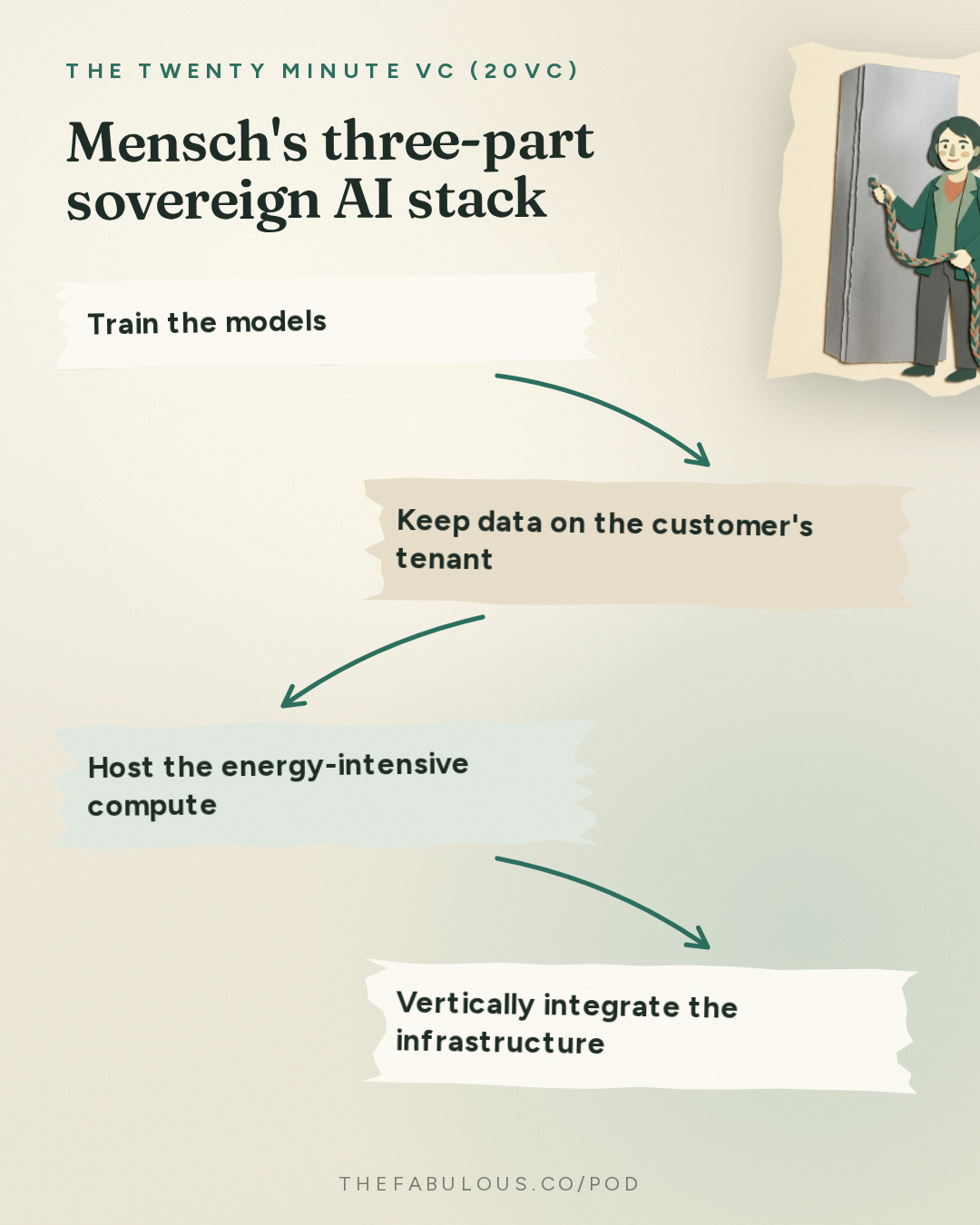
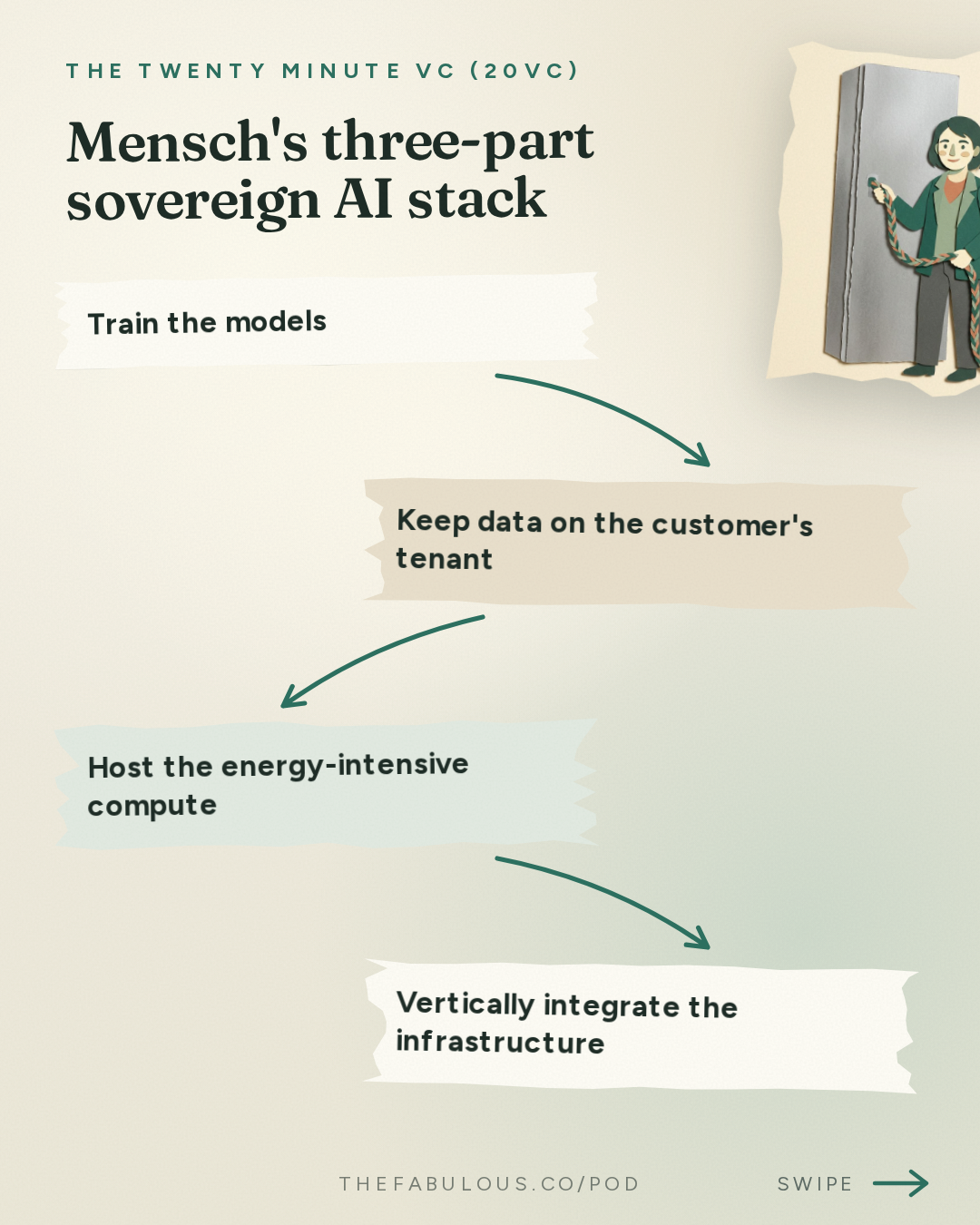
His case isn't really about patriotism. It's an accounting problem. If a company or a government routes its core processes through artificial intelligence, and that AI lives entirely inside another country's infrastructure, the money spent on those processes leaves the territory permanently. Mensch calls this a trade balance problem before it is a political one. His fix, which he has been selling to European enterprises and governments since Mistral's founding, has three parts (07:19): a company needs a "model factory" it controls, so it keeps improving its own frontier models rather than renting someone else's; it needs a data plane that runs on the customer's own infrastructure, so information never flows back to an outside AI provider; and it needs access to token generation, the actual compute that turns a trained model into usable output, because most enterprises can't easily buy or manage that much GPU capacity themselves.
That third piece explains a number that surprised even the host: 80 percent of Mistral's own token traffic, the raw units of text its models actually process and generate, comes from its own open models rather than other open models it also hosts (10:58). Mistral does sell inference for Chinese and other third-party open models, because customers want choice and a fuller menu keeps infrastructure utilization high. But Mensch is careful to separate convenience from confidence. If you don't control the data that trained a model, he argues, you can't fully guarantee what it will do, or rule out it being used as an attack vector, even if that risk is "very theoretical" today (10:14). That theoretical risk is becoming less theoretical by the month: both the US and China have begun restricting exports of advanced models above certain capability thresholds, treating them, in effect, as dual-use defense technology rather than ordinary software (12:19).
The bottleneck that actually bites
If energy isn't the constraint, what is? Mensch's answer is compute procurement, and he describes it less like a software business and more like an industrial supply chain, with GPUs, CPUs, storage, and electrical components that all have to be forecast months in advance. Building a cloud, he says, is mostly "about matching supply and demand" (18:52), financed with project debt and offtake agreements the way a utility or an airline might finance a fleet. Mistral spent about 18 months moving upstream from simply training models to owning the infrastructure that serves them, including token generation inside Europe that sits outside US extraterritorial law (24:19). Today around 60 percent of Mistral's revenue is European, with the rest split between the US and Asia-Pacific (22:35).
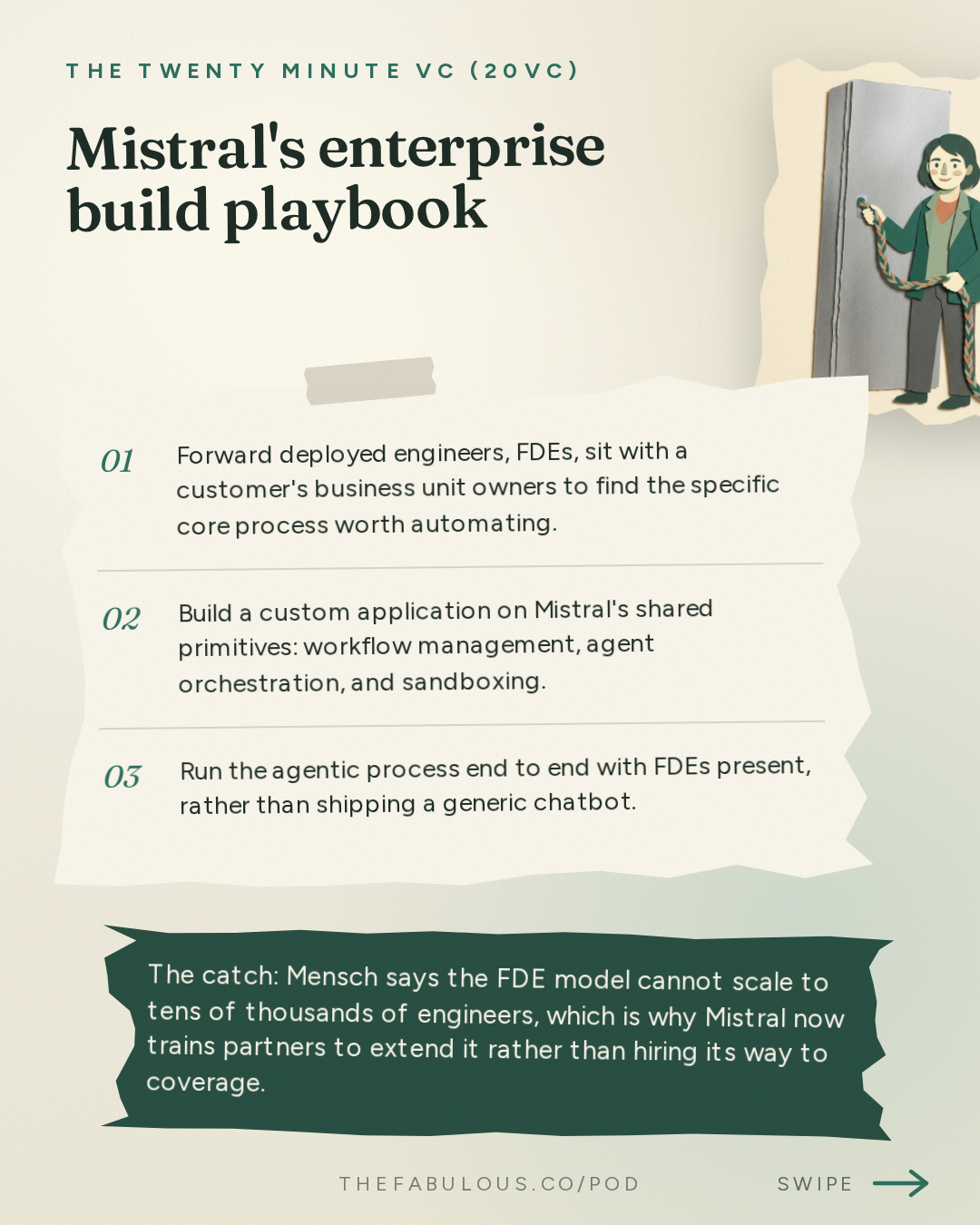
The company has also built an internal team of forward deployed engineers, FDEs, who sit directly inside customer organizations such as manufacturers, banks, and defense agencies, diagnose the specific process worth automating, and build a custom application on shared infrastructure for workflow management and agent orchestration (25:06). That hands-on approach doesn't scale past a certain headcount, so Mistral has started training partners like Accenture and the IT services firm TCS to run the same playbook at wider reach.
Zoom out further and the picture is a crowded one. Harry counts 102 separate "neo-lab" AI providers that have launched in the current wave (31:39), and Mensch frames the inference market, the business of running trained models to answer real requests, in two tiers.
"The inference market behaves very much like a commodity market, which is pretty high margin today." — Arthur Mensch [30:44]
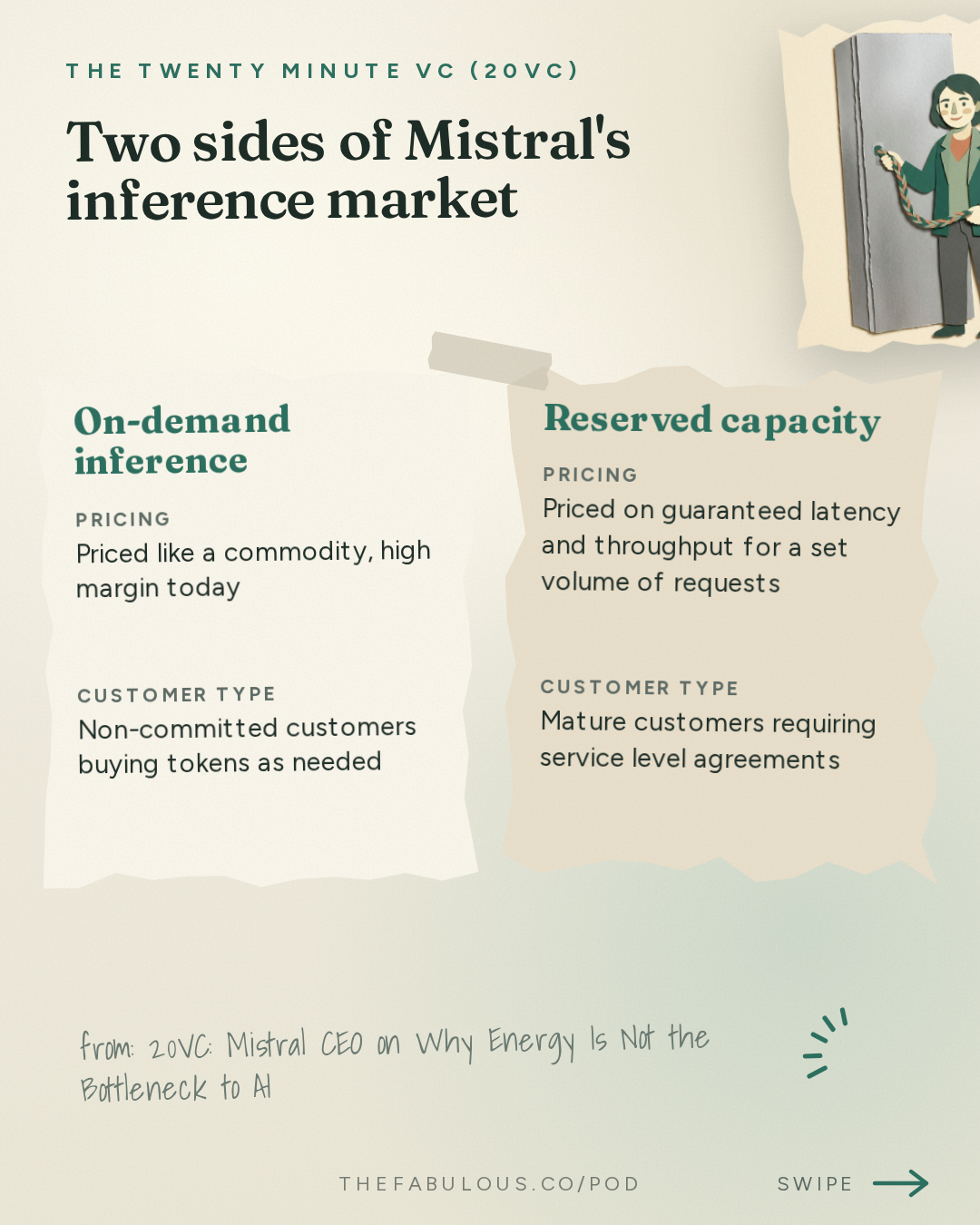
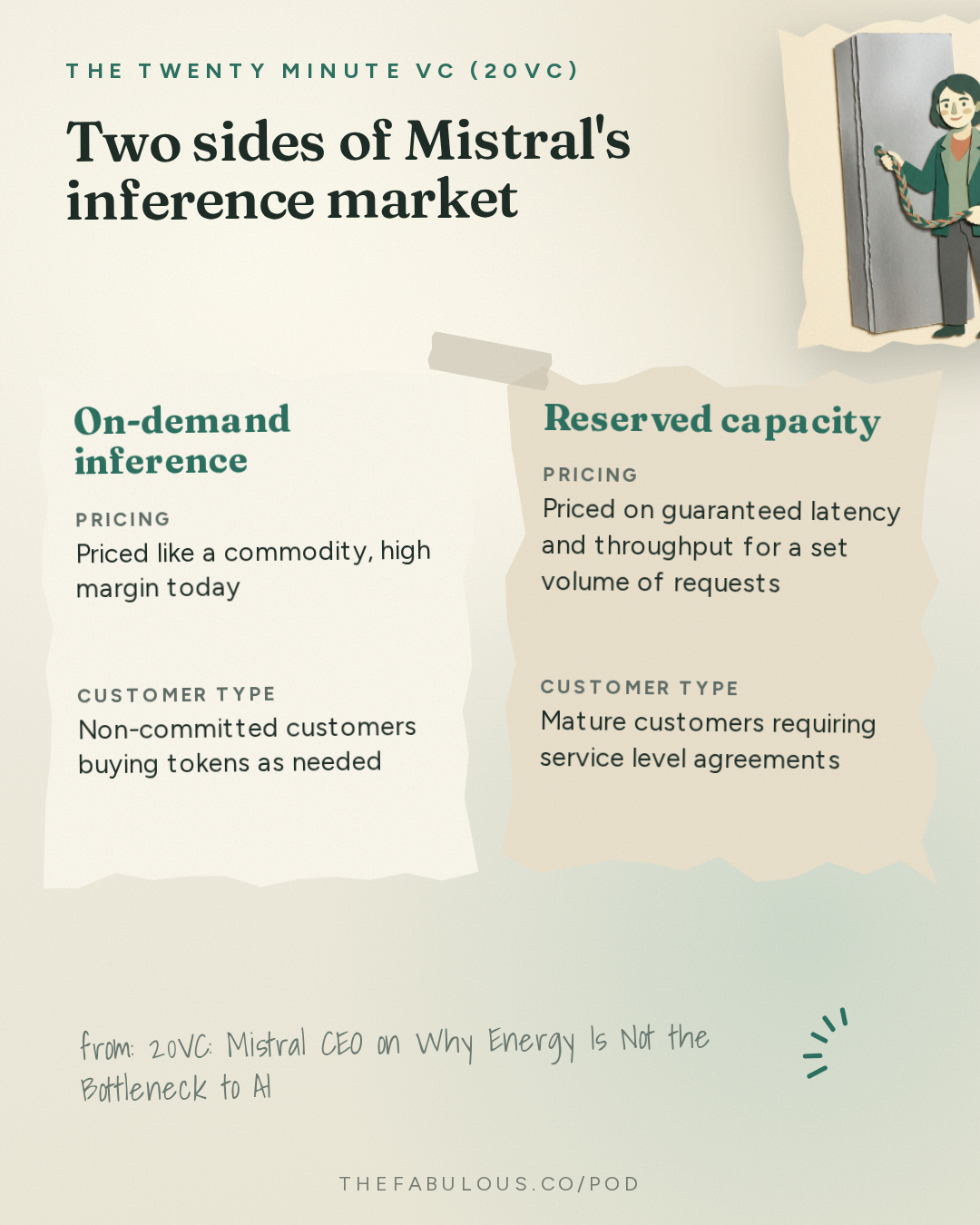
On-demand inference for ordinary customers behaves like any commodity: supply, demand, and price. Larger, more sophisticated customers pay a premium for guaranteed latency and reserved capacity, the kind of service-level agreement a bank or an airline would want before trusting a model with a live process. For the many new labs chasing this market, Mensch argues the real differentiator isn't research talent so much as whether they can get GPUs at a workable price at all (33:46).
That scarcity sits oddly next to a prediction Mensch is openly skeptical of. Microsoft AI head Mustafa Suleyman has floated the idea of $100 billion training runs within a few years. Mensch's response is that the bottleneck for a run that size isn't simply stacking more compute. It's sourcing enough high-quality, well-structured data for specialized domains like chip design or industrial engineering, a problem he says "takes some skill and taste" to solve, not just capital (36:00). He doesn't think that scale of training run is near. On why some AI-adjacent public stocks have fallen sharply even as compute remains scarce, Mensch says Mistral's own financing is anchored to revenue commitments and take-or-pay contracts rather than heavy debt leverage, which he thinks gives it more resilience if the broader market gets nervous (36:48).
Underneath the strategy talk is something closer to a sense of duty. Mensch has become, half-jokingly and half-seriously, the face of Europe's claim to a seat at the frontier AI table, and he doesn't shy from the weight of that.
"If we don't succeed, I don't know what's going to happen in the world, I think." — Arthur Mensch [40:36]
It's a startling thing to hear a chief executive say plainly, without the usual hedge of corporate caution. But it tracks with everything else in the conversation: a bet that the next decade of economic growth depends less on raw intelligence than on solving specific, physical, often ambiguous problems, in factories, hospitals, and power grids, and that whoever controls that infrastructure, not just the cleverest model, keeps the leverage.
Ask this episode anything
Pod's AI answers from the episode itself, with the minute mark so you can hear it yourself.
Or start with one of these
Ask this episode
Pod's AI listens to the whole episode to answer, and points you to the minute it comes from.
The rest of this answer, and any question after it
Answers come from the episode itself, never from a summary of it.
ContinueKey takeaways
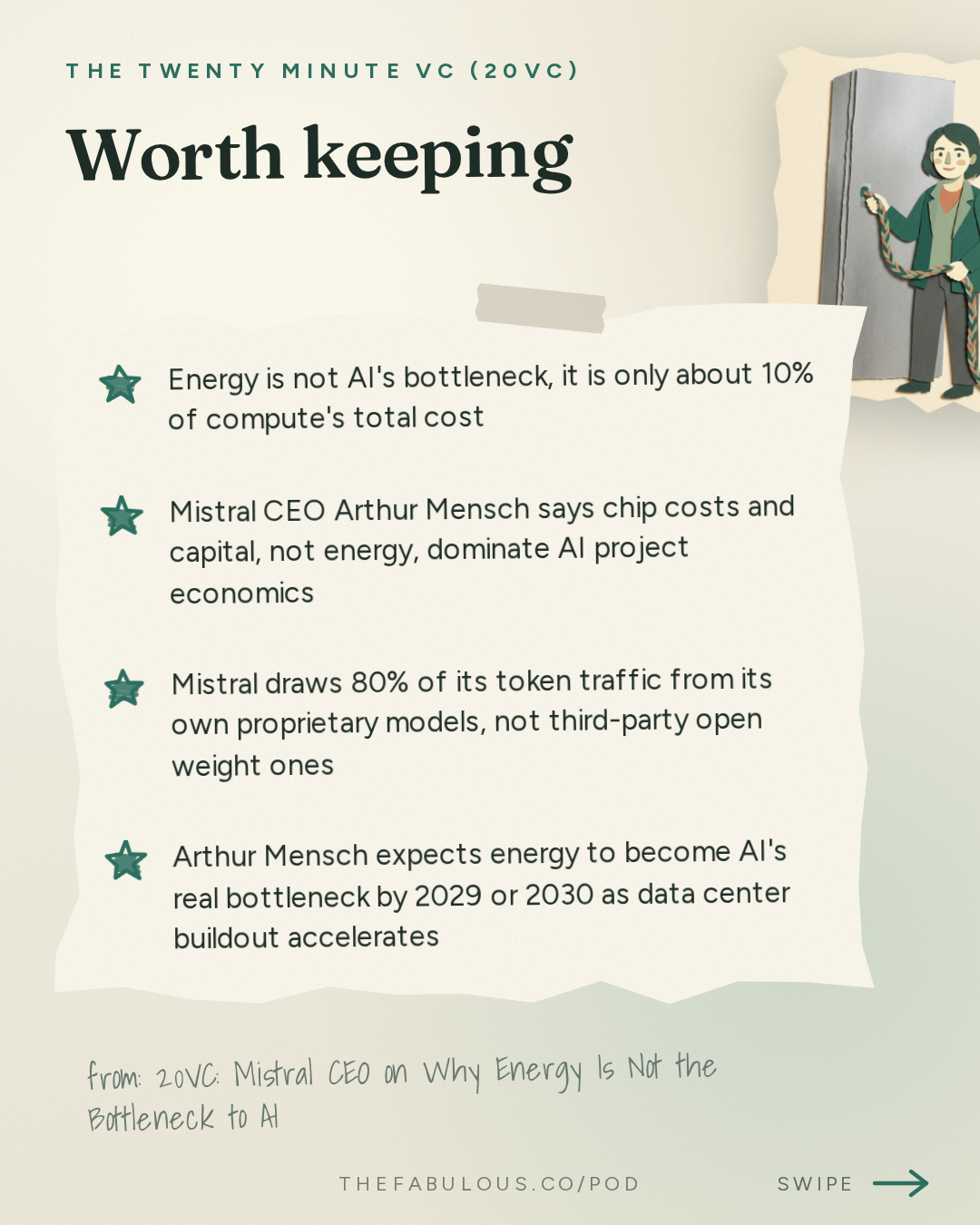
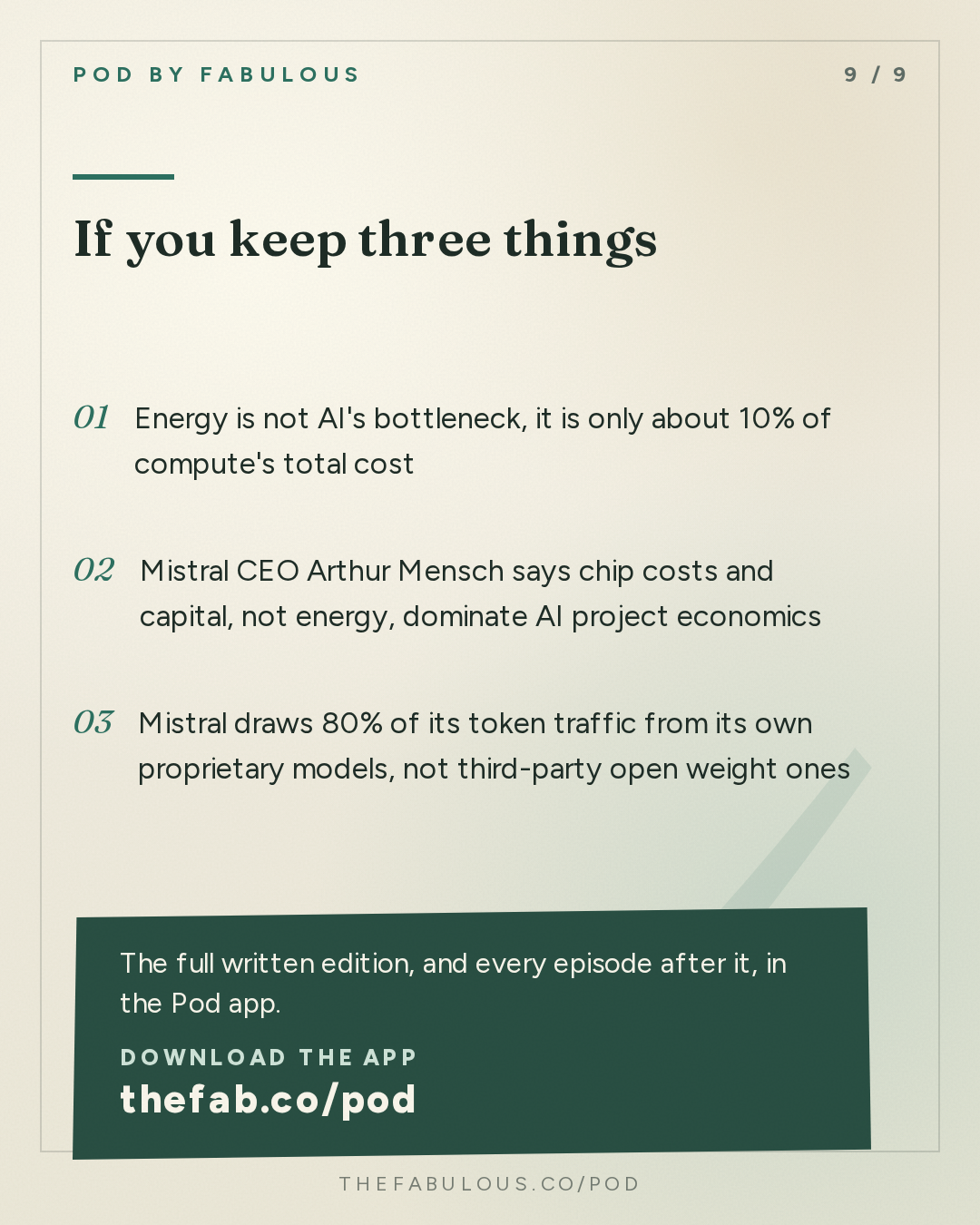
- Energy is not AI's bottleneck, it is only about 10% of compute's total cost
- Mistral CEO Arthur Mensch says chip costs and capital, not energy, dominate AI project economics
- Mistral draws 80% of its token traffic from its own proprietary models, not third-party open weight ones
- Arthur Mensch expects energy to become AI's real bottleneck by 2029 or 2030 as data center buildout accelerates
- Mensch doubts 100 billion dollar training runs are near, since sourcing quality data limits scale more than stacking compute
The episode in cards

By the numbers
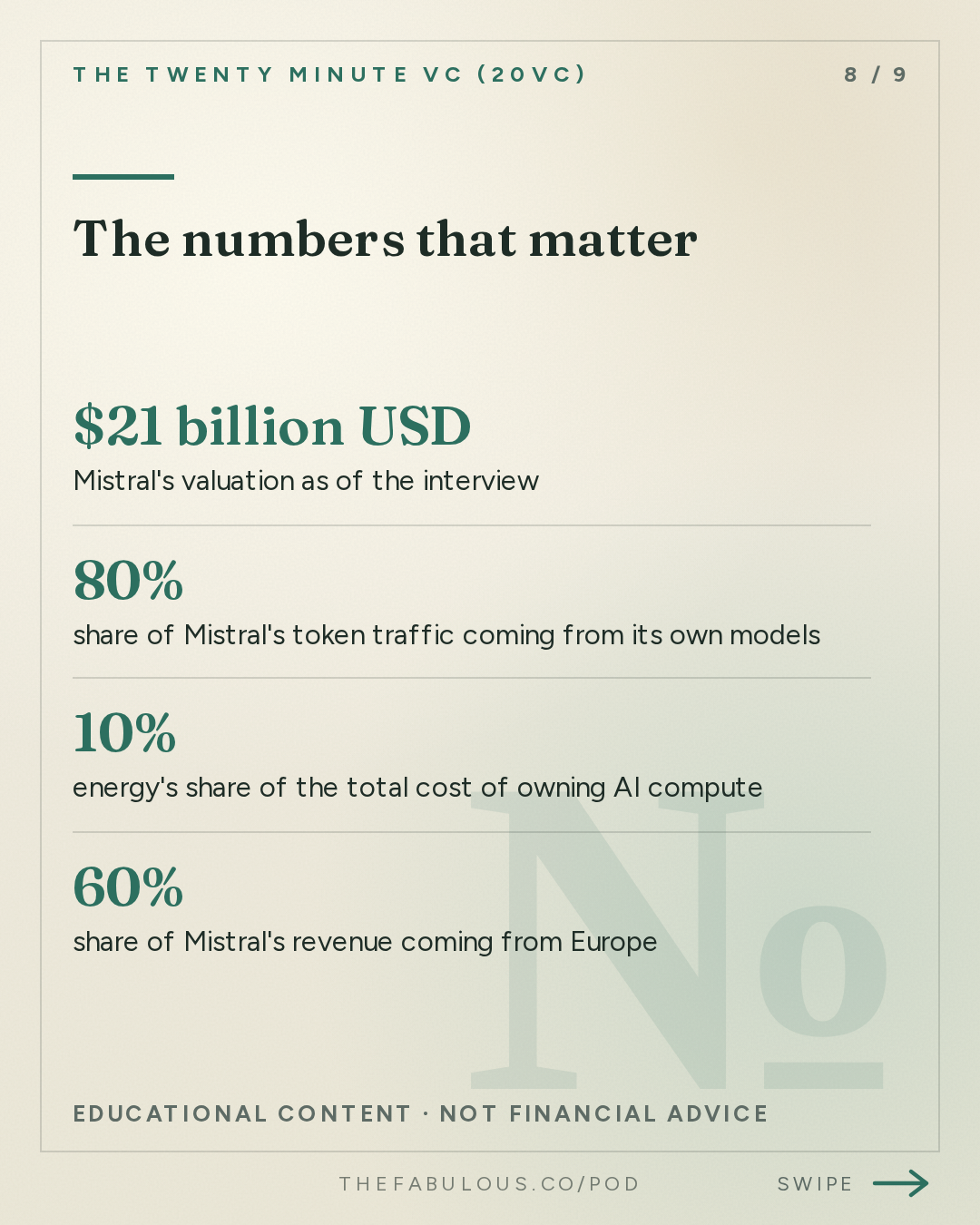
- $21 billion USD Mistral's valuation as of the interview
- 80% percent share of Mistral's token traffic coming from its own models
- 10% percent energy's share of the total cost of owning AI compute
- 60% percent share of Mistral's revenue coming from Europe
- $100 billion USD predicted cost of future frontier AI training runs
In their words
“Leaving frontier AI to the US and China will end up costing Europe what remains of its place in the world.”
“The cost of energy, at the end of the day, is not the one thing that matters in the economic of a project.”
“The inference market behaves very much like a commodity market, which is pretty high margin today.”
“If we don't succeed, I don't know what's going to happen in the world, I think.”
Protocols
-
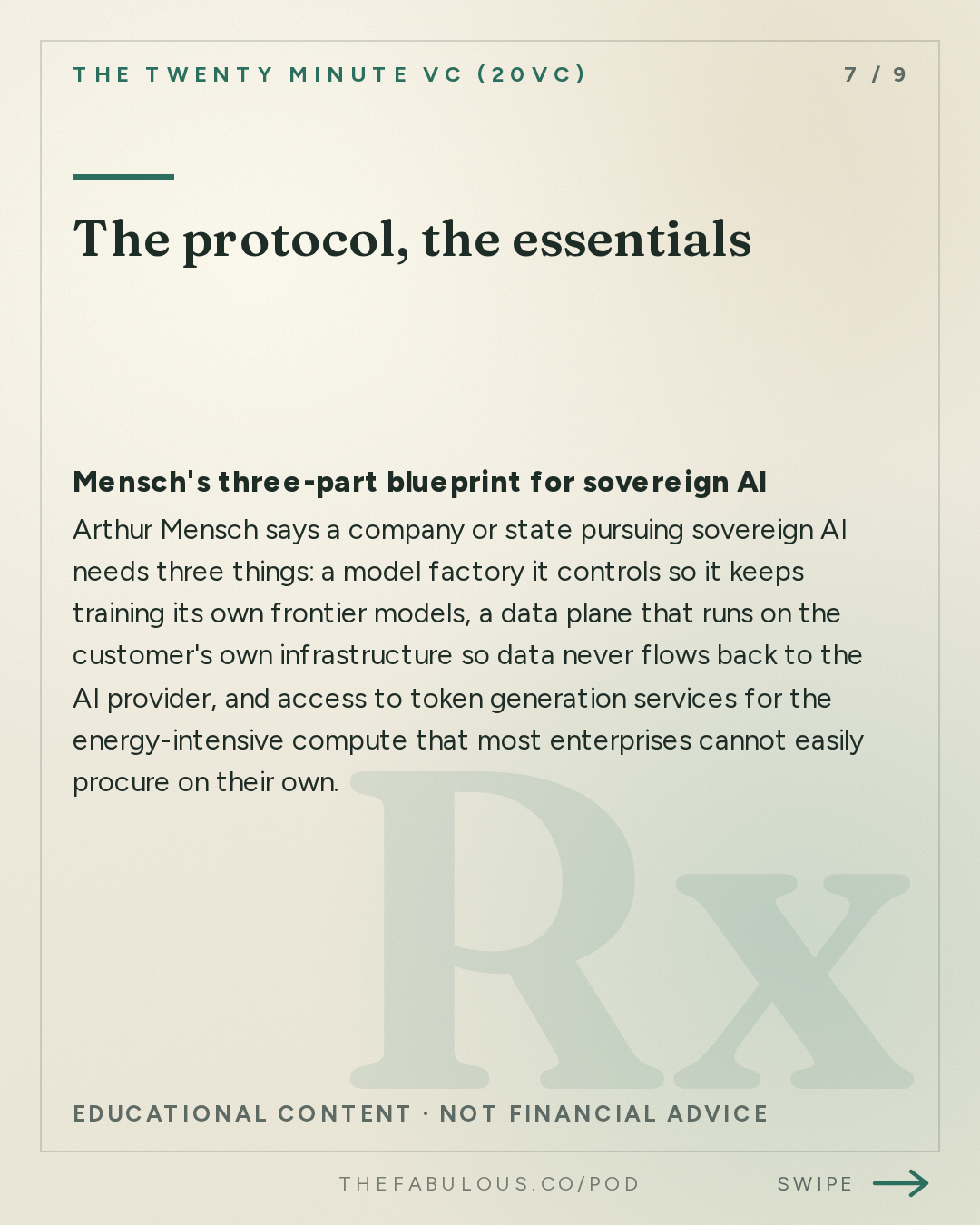
Mensch's three-part blueprint for sovereign AI
Arthur Mensch says a company or state pursuing sovereign AI needs three things: a model factory it controls so it keeps training its own frontier models, a data plane that runs on the customer's own infrastructure so data never flows back to the AI provider, and access to token generation services for the energy-intensive compute that most enterprises cannot easily procure on their own.
Ongoing, as Mistral continuously retrains and redeploys its models
-
How Mistral embeds with enterprise customers
Mensch sends forward deployed engineers, FDEs, to sit directly with a customer's business unit, identify the specific core process worth automating, and build a custom application on Mistral's shared primitives for workflow management, agent orchestration, and sandboxing. Mensch says this hands-on model cannot scale to tens of thousands of in-house engineers, so Mistral now trains system integrator partners such as Accenture and TCS to carry the same approach further.
Per enterprise account, then handed off to partners for wider scaling
Questions this episode answers
Is energy the biggest bottleneck for AI growth?
Not yet, according to Mistral CEO Arthur Mensch: energy is only about 10% of the total cost of owning compute, with chips and capital dominating the bill (14:51). He expects energy to become a real constraint around 2029 or 2030 as gigawatt-scale data center buildouts accelerate (16:05).
Are Chinese open-source AI models safe to run?
Mistral CEO Arthur Mensch says that if a company does not control the data a model was trained on, it cannot fully guarantee the model's outputs or rule out it being used as an attack vector, though he calls that risk very theoretical today (10:14). Mistral still hosts third-party open models for customer choice, while reserving stronger guarantees for its own (09:53).
What does sovereign AI mean?
Mensch defines sovereign AI as three-part control: training your own frontier models, keeping customer data on the customer's own infrastructure, and having access to token generation for heavy compute (07:19). He argues this prevents enterprises from depending on a small number of centralized providers that could use their data to build competing products (13:47).
How big is the AI inference market?
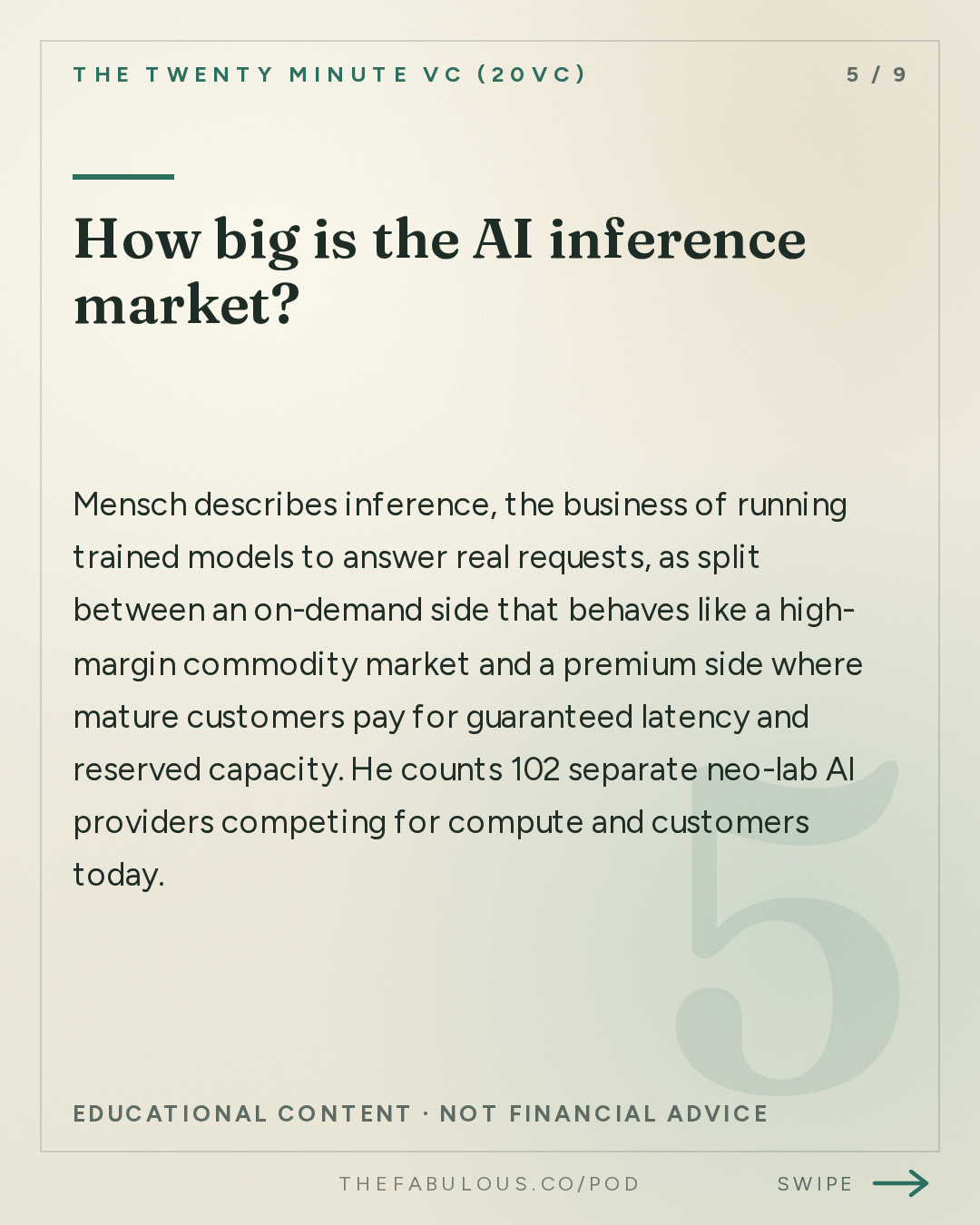
Mensch describes inference, the business of running trained models to answer real requests, as split between an on-demand side that behaves like a high-margin commodity market and a premium side where mature customers pay for guaranteed latency and reserved capacity (30:44). He counts 102 separate neo-lab AI providers competing for compute and customers today (31:39).
Will AI require $100 billion training runs soon?
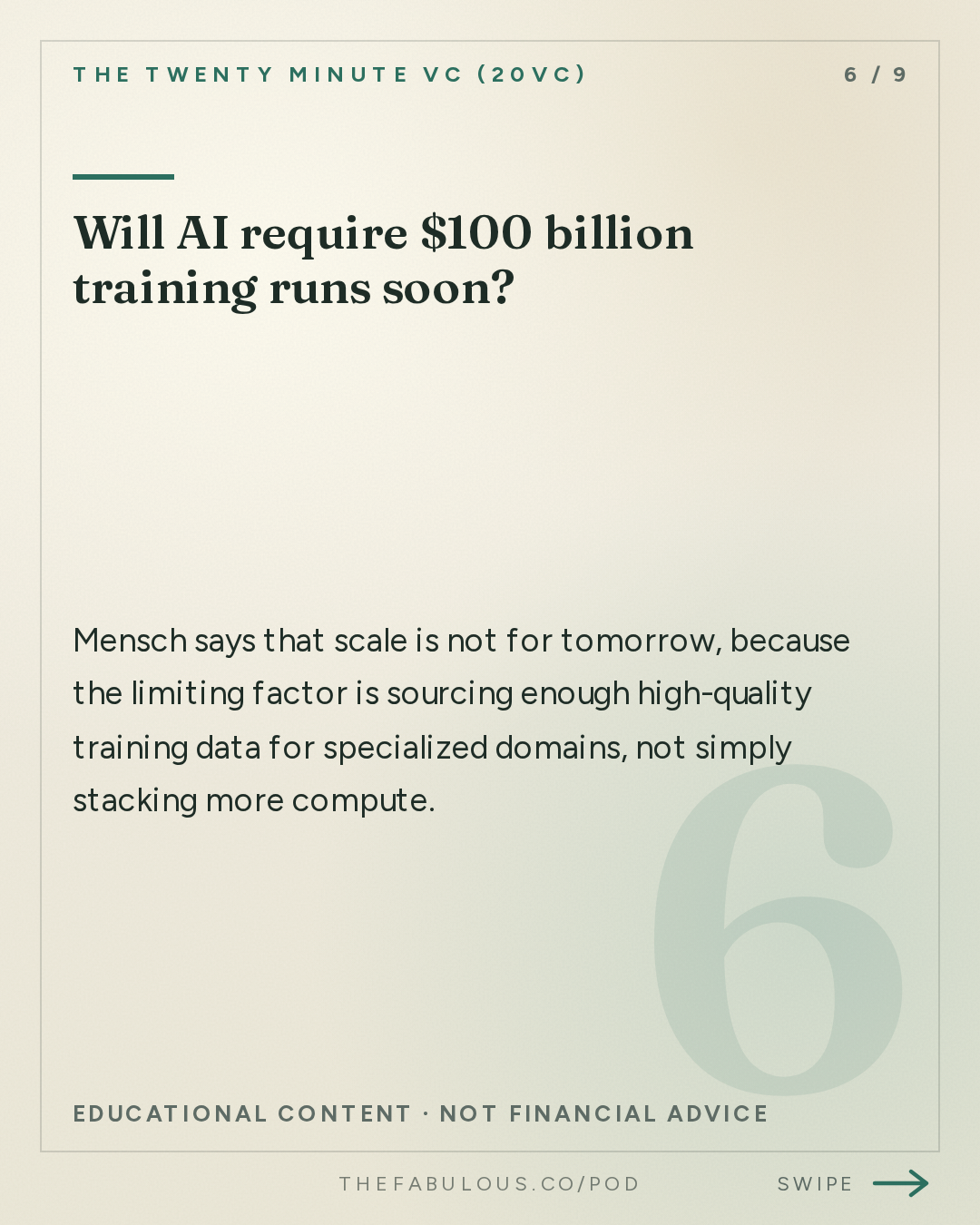
Mensch says that scale is not for tomorrow, because the limiting factor is sourcing enough high-quality training data for specialized domains, not simply stacking more compute (36:00).
The full read, in cards
Go deeper
- Mistral Large 4 technical report — Documents the training process and setbacks behind Mistral's flagship open-weight model before its release
Mentioned
Arthur Mensch · Mistral AI · OpenAI · Anthropic · ASML · Airbus · Microsoft · Accenture · TCS · DeepSeek · Cohere · Yann LeCun · Satya Nadella · Mustafa Suleyman
More from this show and category

WashU Endowment Strategy: Scott Wilson Explains
Scott Wilson grew WashU's endowment from $8 billion to near $20 billion by firing most hedge funds and concentrating in direct private deals. SpaceX once made up over 20% of assets. Wilson argues many AI firms will not survive a decade, and sees underpriced opportunity in Europe and China.

Erik Bernhardsson on AI Inference Economics
Modal CEO Erik Bernhardsson says splitting the AI stack across many paid layers has ended 90% software margins for good. He also says the GPU market stays supply-constrained, open source inference usage will grow 5 to 20 times in the next year, and reinforcement learning works best on tasks like coding with fast feedback loops.

David Tisch on BoxGroup's Contrarian VC Strategy
BoxGroup's David Tisch says concentrated seed funds claiming a 90% win rate actually win closer to 20%. That gap, he argues, is why BoxGroup skips ownership targets entirely, writing checks as small as 1% ownership across roughly 150 companies a year, betting on founder access and speed over concentrated conviction.

Anthropic's S1 Filing: Revenue, Cash, and Risk
Anthropic's S1 filing shows $16.3 billion in first-half revenue and $110 billion in cash, though Broadcom had to backstop its chip debt. Microsoft offered buyouts to 60,000 staff, Meta raised $95 billion in equity for compute, and hosts Jason Lemkin and Rory O'Driscoll debated a rumored $30 billion round for consumer AI app Instinct.
