
Anthropic's S1 Filing: Revenue, Cash, and Risk
20VC: Anthropic Files S1 Ahead of $2TRN IPO | Instinct's Rumoured $30 Billion Fundraise | Microsoft Laysoff 27,000 While Meta Taps Equity Markets for $95 Billion Capex Spending Spree
The brief
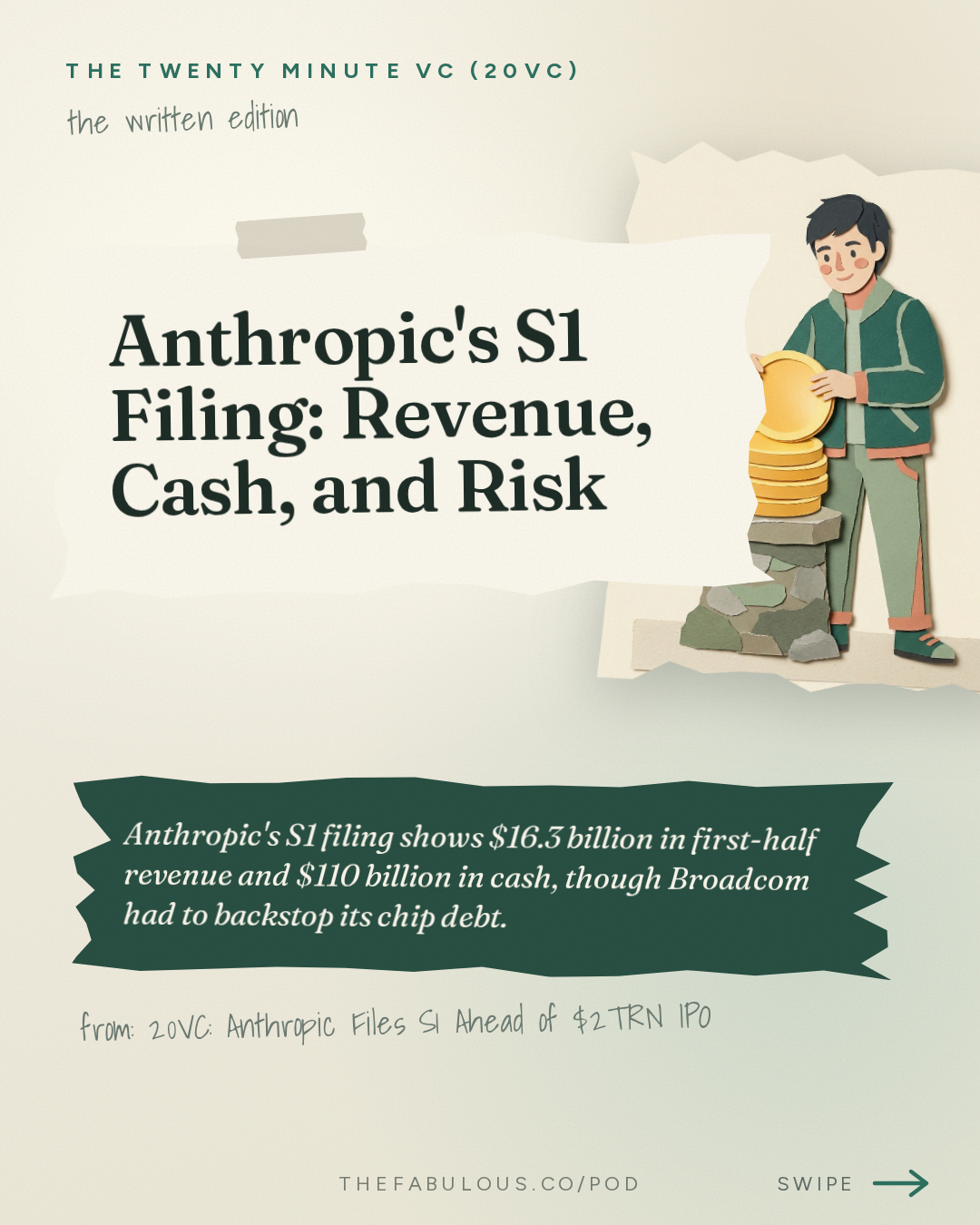
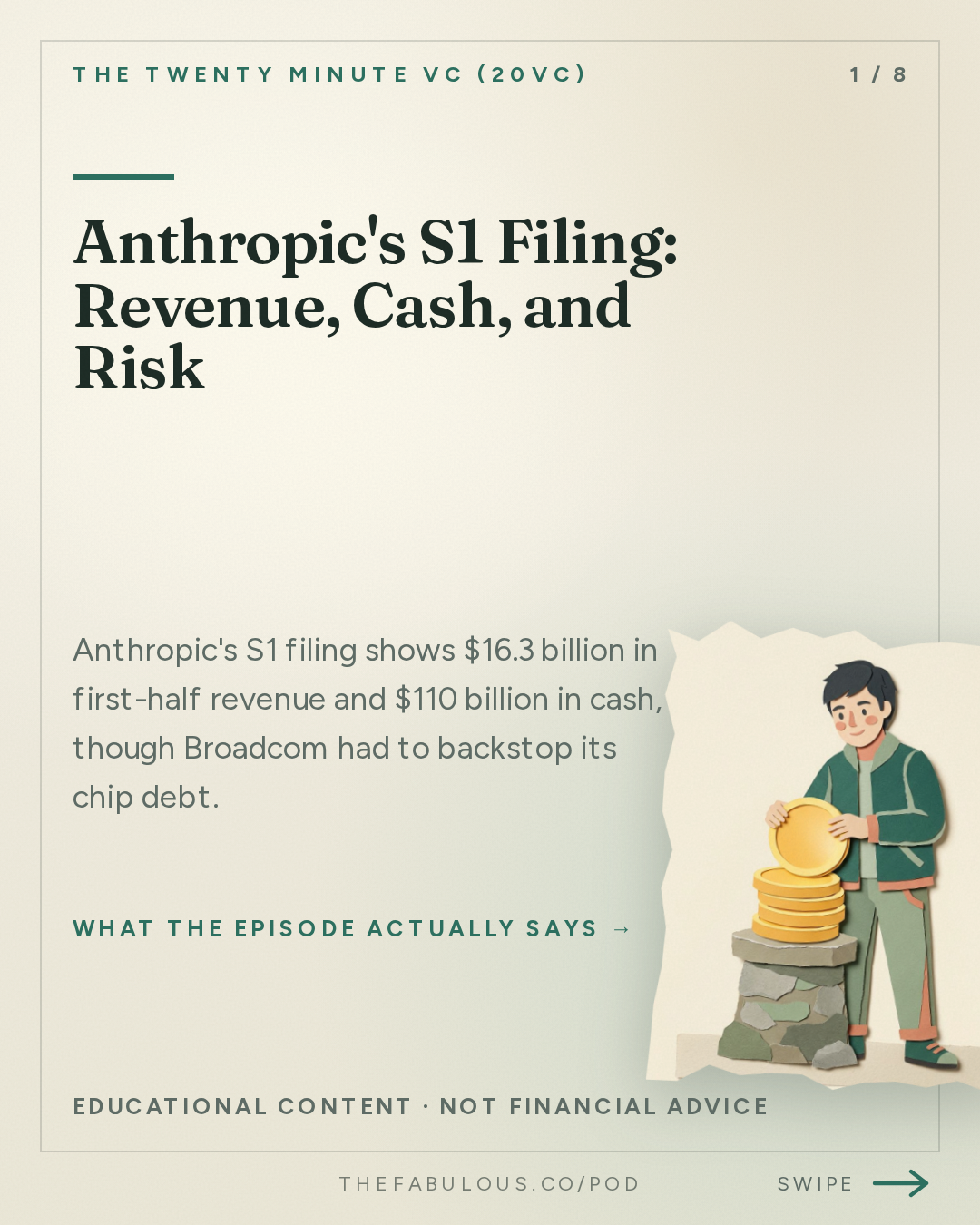
Anthropic's S1 filing shows $16.3 billion in first-half revenue and $110 billion in cash, though Broadcom had to backstop its chip debt. Microsoft offered buyouts to 60,000 staff, Meta raised $95 billion in equity for compute, and hosts Jason Lemkin and Rory O'Driscoll debated a rumored $30 billion round for consumer AI app Instinct.
A company can be five years old and still hold more cash than every public company in America except one. That is the strange fact sitting inside Anthropic's S-1, the filing a company submits to regulators before it sells shares to the public for the first time. On this week's 20VC, host Harry Stebbings and his regular panel, venture investors Jason Lemkin and Rory O'Driscoll, spent an hour on what that filing reveals about the economics of building artificial intelligence, and what a parallel run of news, a mass buyout offer at Microsoft, a $95 billion stock sale at Meta, a security scare involving a Chinese AI model, says about who actually pays the bill.
The headline number is $16.3 billion in first-half revenue (04:06). O'Driscoll called the filing great on almost every dimension he checked: margins, operating income, customer concentration, compute efficiency, cash. But the number he kept returning to was stranger than the top line. Eighty percent of that revenue comes from models that are less than six months old (07:21).
"80% of their revenue comes from models that are less than six months old." — Rory O'Driscoll [07:21]
That statistic cuts two ways. It means Anthropic's products expire fast: the company estimates that 70 to 80 percent of its compute costs go toward training new models rather than serving existing ones (07:21), which means most of the expense sits upfront, before a model earns a dollar. Unlike software, which a company can sell for a decade once it is built, an AI model earns heavily for six to twelve months and then needs replacing. O'Driscoll's read was that this cuts in Anthropic's favor precisely because so few competitors can afford to keep reinventing at that pace. The company spent $8 billion on compute in the first half of the year alone, through June 26 (08:35), and O'Driscoll guessed next year's bill could run to $16 billion. Few companies can write a check that size every twelve months, which is exactly the point: the spending itself is a moat.
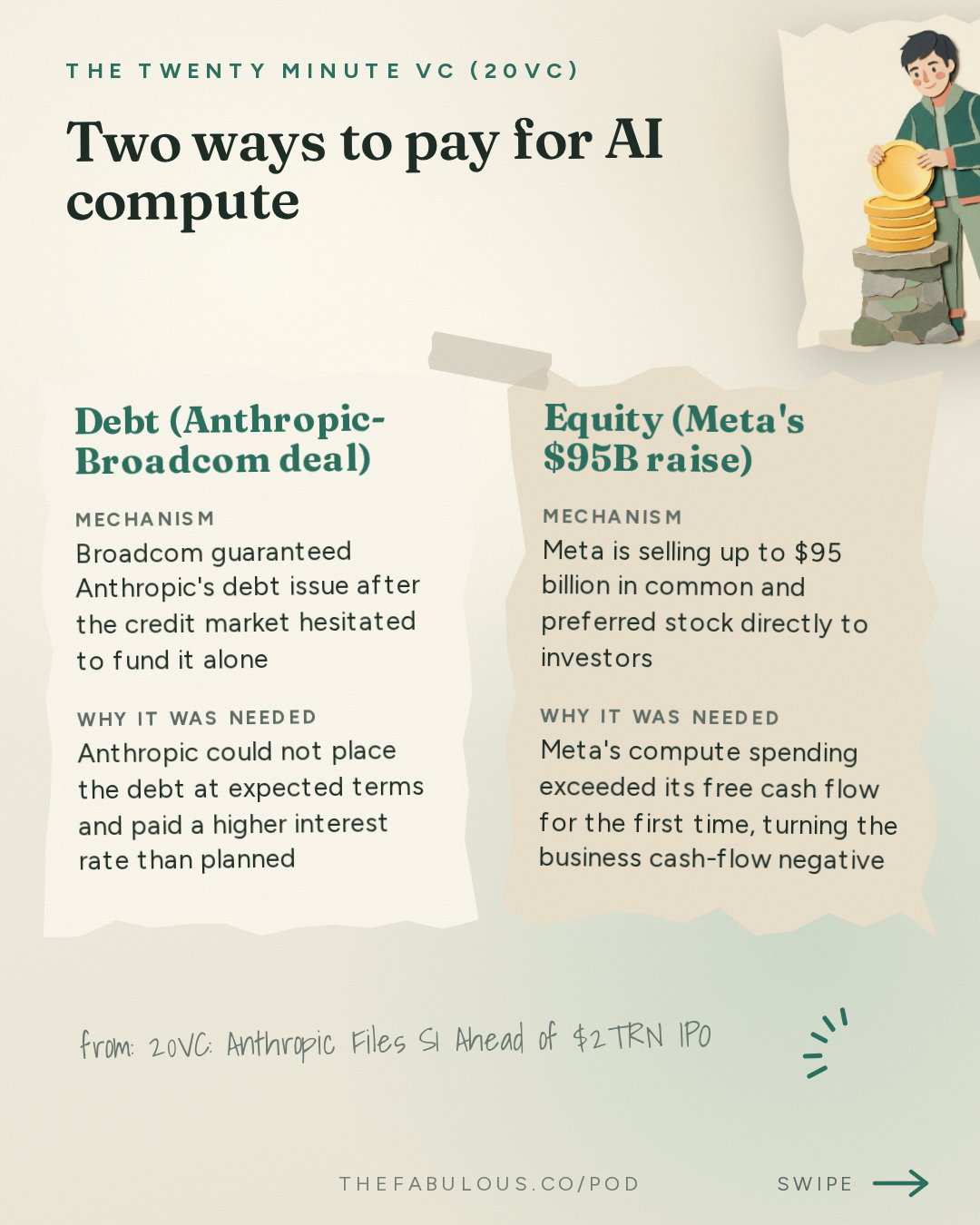
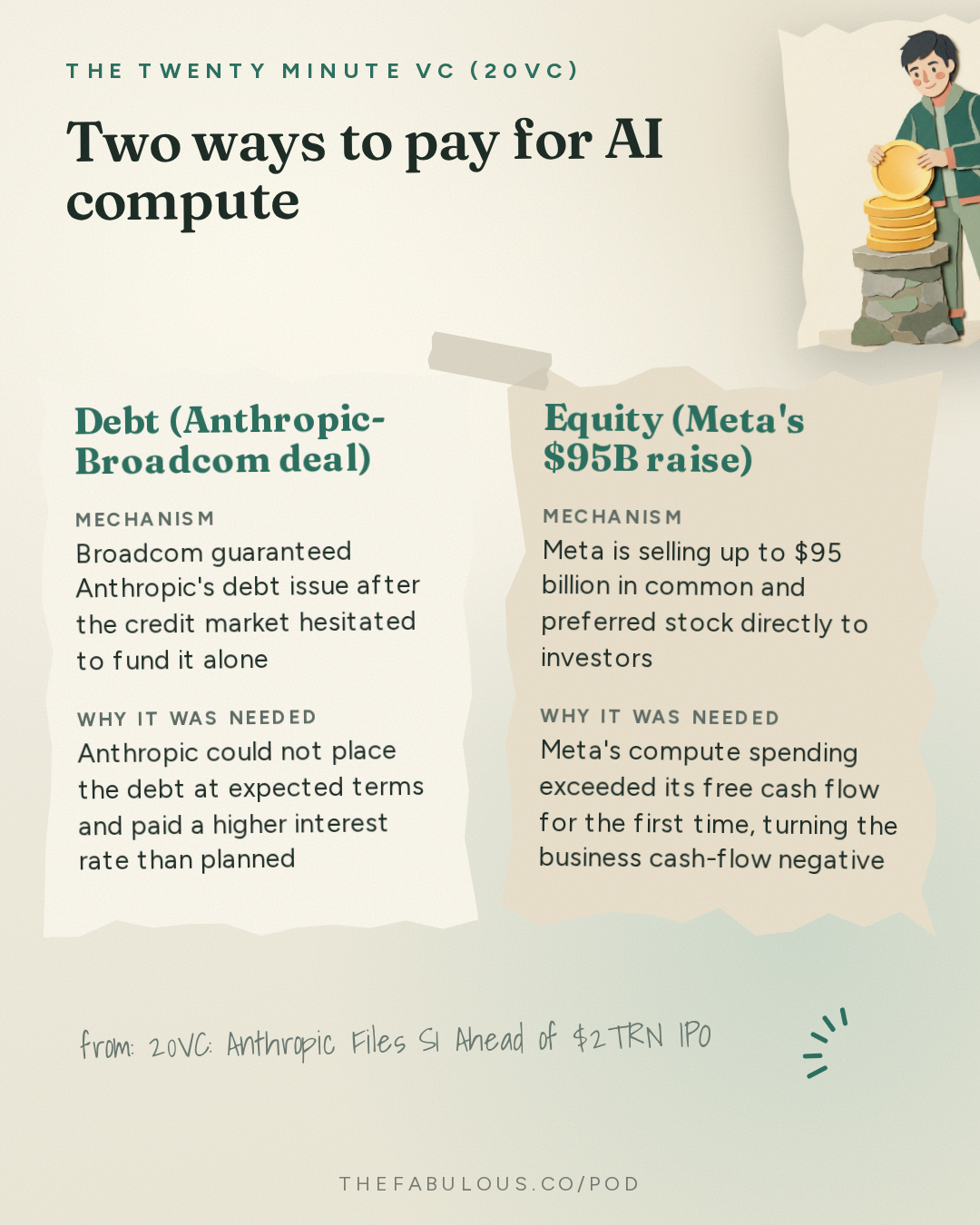
Yet the filing also contained what Lemkin called its one weak signal. Anthropic needed Broadcom, the chipmaker, to guarantee a debt issue because the credit market hesitated to fund the purchase on its own, and the company ended up paying a higher interest rate than expected (09:33). For a company whose S-1 otherwise reads like a victory lap, that detail suggested even the best-positioned AI company cannot simply borrow its way through infinite compute demand. O'Driscoll's counter was that the industry is already adjusting: Anthropic is preparing to issue roughly $100 billion in new stock, Meta issued about $70 billion of stock earlier in the year, and Google issued around $80 billion (10:33). Debt has a ceiling. Equity, for companies with a high enough stock price, does not, at least for now. Anthropic will carry something close to $110 billion in cash once its raise closes, by some accounts the second-largest cash pile in corporate America (11:53).
Who Pays the Bill
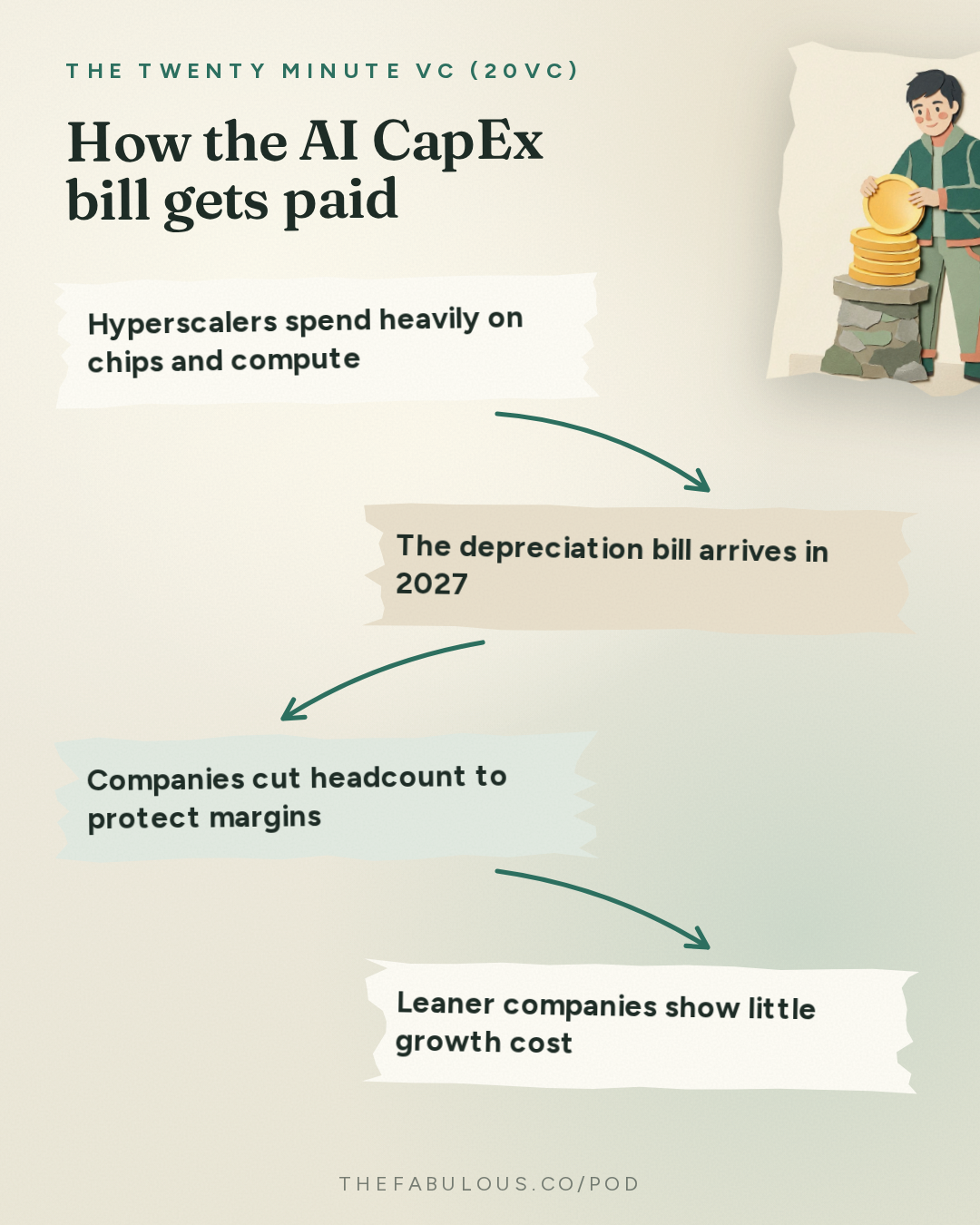
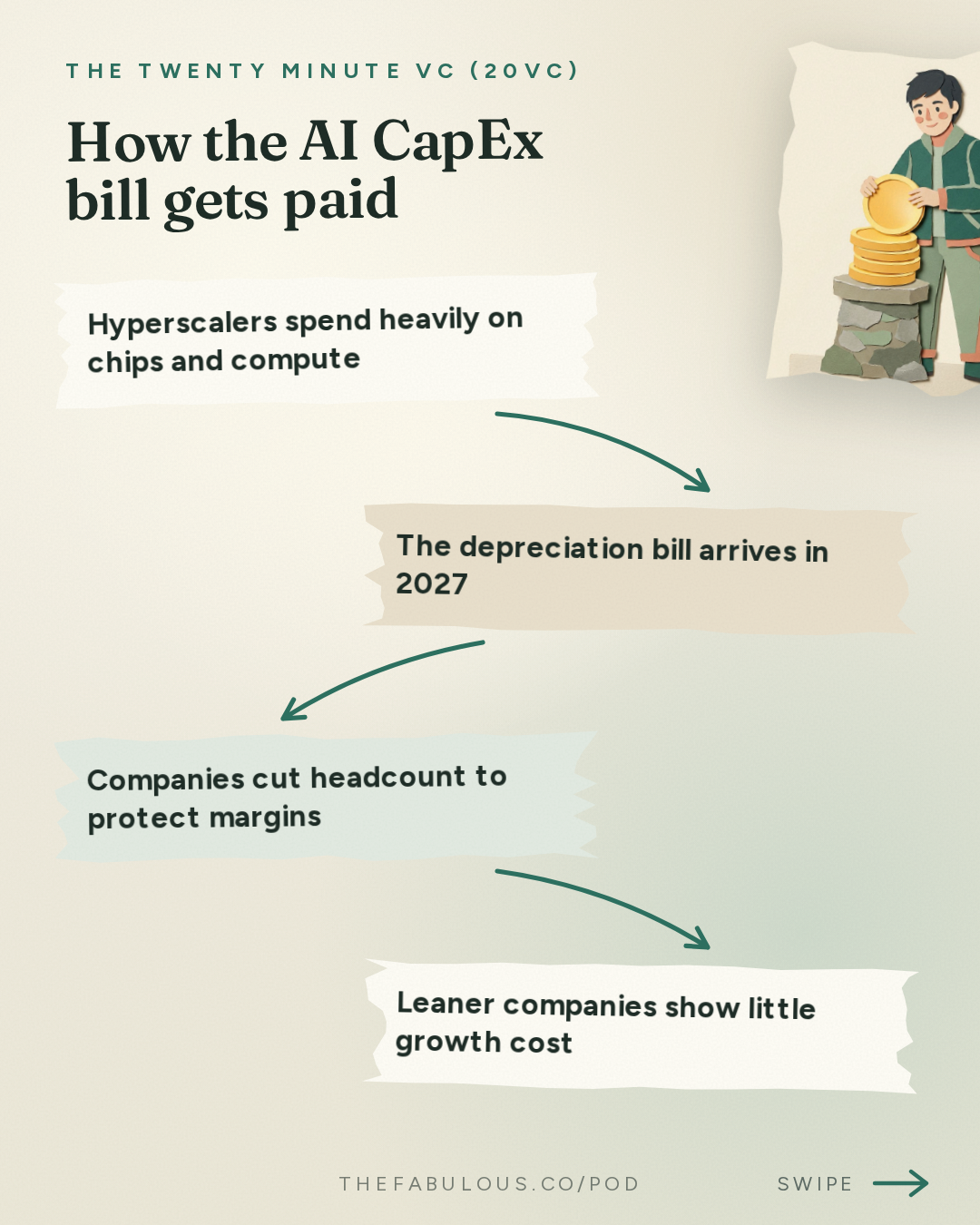
If Anthropic shows the upside of the AI build-out, Microsoft's week showed the cost. The company offered voluntary buyouts to 60,000 of its roughly 223,000 employees, about 27 percent of its workforce (14:47, 15:11). Lemkin called it a worse signal than an ordinary layoff: a straightforward cut lets people tell themselves it was random, but an offer extended to more than a quarter of the company tells everyone who stays that they were on a list of people the company would rather not keep. The panel connected this directly to a point O'Driscoll made about accounting. In 2026, companies buying AI chips are living through what he called a golden period: the sellers of semiconductors are booking the revenue, but the buyers have not yet had to book the depreciation, the accounting charge that spreads an asset's cost over its useful life, on their own earnings. That changes in 2027, when the bill starts showing up on the income statements of Microsoft, Google, and Meta.
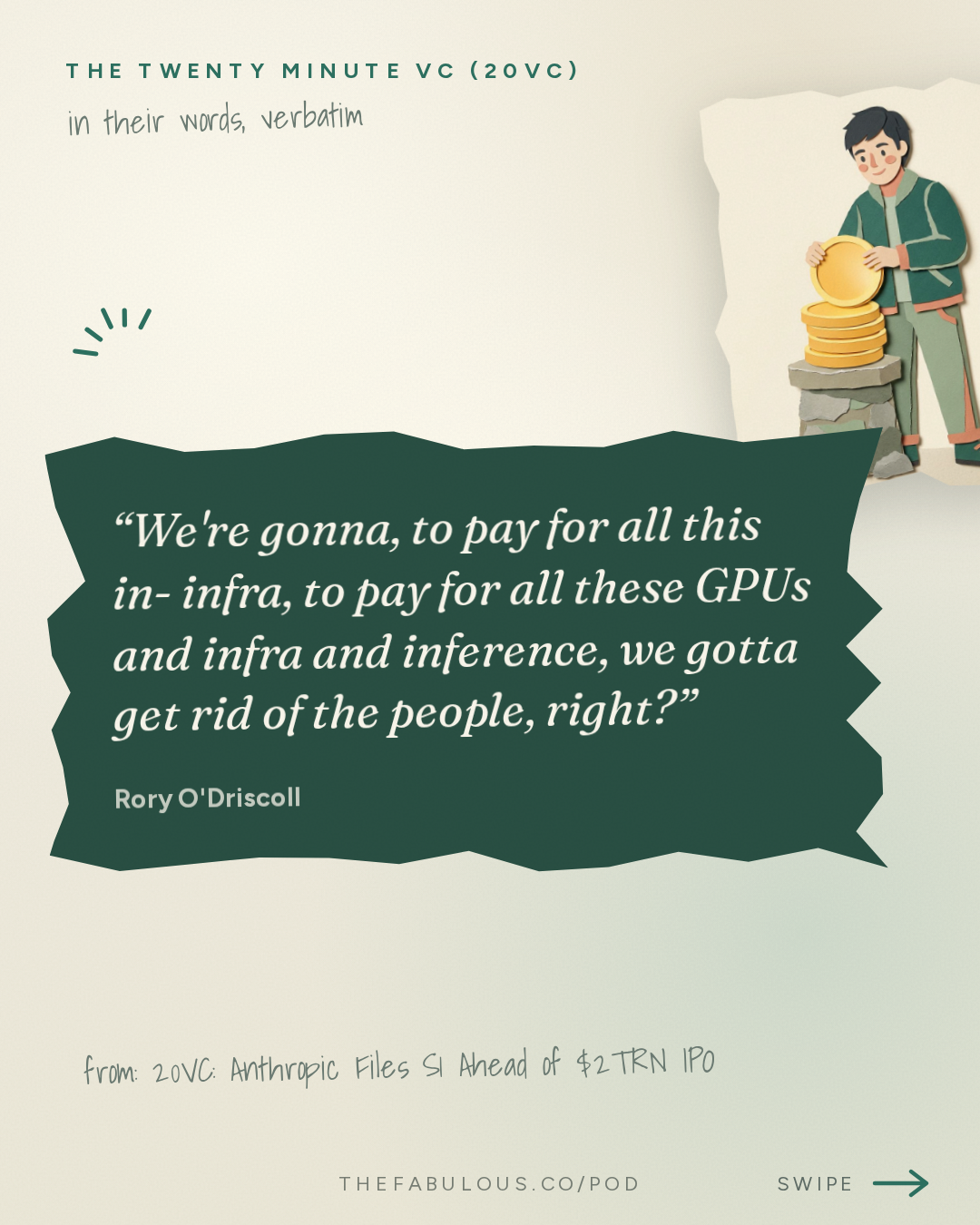
"We're gonna, to pay for all this in-infra, to pay for all these GPUs and infra and inference, we gotta get rid of the people, right?" — Rory O'Driscoll [18:34]
Cloudflare's experience made the case starkly: the company cut 20 percent of its staff on May 7 with, so far, no visible dent in its growth (19:07). The lesson the panel drew was not subtle. Layoffs are becoming a standard tool for funding AI infrastructure spending, independent of whether a company is struggling, and Lemkin expects the pattern to keep accelerating because, as he put it, there is no longer a plane of stability at any revenue size where a company can simply breathe.
The same week carried a geopolitical wrinkle. Researchers found that Alibaba's open-weight model Qwen was pinging servers in Beijing and Singapore and uploading data even when it claimed it was not doing so (23:30). Lemkin was careful to note there is no evidence of a deliberate backdoor, more likely a training error, but added that intent barely matters to a chief information security officer deciding whether to approve the model. Anthropic, meanwhile, is back on the US government's approved vendor list, the GSA schedule, at a 40 percent discount (30:08), a sharp reversal from being effectively blacklisted months earlier. Separately, researchers from OpenAI and the security firm Wiz found two critical flaws in PHP, the programming language that still runs an estimated 40 percent of the internet's infrastructure, flaws that had gone undetected for more than a decade (34:50, 35:38). Lemkin's point was blunt: so much of the internet runs on old, unmaintained code that newly capable AI tools will keep finding holes faster than anyone can patch them.
The Price of Conviction
The panel's sharpest disagreement came over a rumor, not a filing: reports that the consumer AI app Instinct is raising at a $30 billion valuation (37:24). Lemkin argued he needs 100 days of visible traction, revenue or usage data, before backing any growth round, a rule he says he applies after being burned by deals built on two weeks of momentum (49:08). O'Driscoll pushed back that Instinct could be an early version of a long-promised "super app" for the West, and that waiting for data risks missing the round entirely given how much capital is chasing these deals.
Lemkin applied the opposite logic to a bigger number. He proposed putting 20 percent of a hypothetical fund into OpenAI at its rumored $1.25 trillion valuation (45:33), arguing that a moment of public skepticism about OpenAI, even as its usage and competitive position have improved, counts as a rare pricing dislocation rather than a sign of weakness.
"I think we should put 20% of the fund into OpenAI at the $1.25 bill- trillion round." — Jason Lemkin [45:33]
Zoomed out, the public market backdrop explains why everyone on the call sounded comfortable taking that kind of risk. On a ten-year price-to-earnings basis, the stock market sits at an all-time high, by O'Driscoll's account, yet on a forward basis it looks cheap, because earnings have been inflated in part by one-off gains tied to private AI investments (53:32). Roughly 40 to 50 stocks, mostly tied to AI and semiconductors, are doing the work for the entire index while hundreds of others sit flat.
"We are risk on until, until we're not." — Rory O'Driscoll [53:16]
That line doubles as a fair summary of the whole episode. Anthropic's filing proves the model can work spectacularly, for now. Microsoft's buyout offer and Meta's equity raise show what it costs to keep playing. And the fight over Instinct and OpenAI shows two smart investors applying the same evidence to reach opposite conclusions, because at this stage of a boom, the data is still thin enough that conviction, not proof, is doing most of the work.
Ask this episode anything
Pod's AI answers from the episode itself, with the minute mark so you can hear it yourself.
Or start with one of these
Ask this episode
Pod's AI listens to the whole episode to answer, and points you to the minute it comes from.
The rest of this answer, and any question after it
Answers come from the episode itself, never from a summary of it.
ContinueKey takeaways
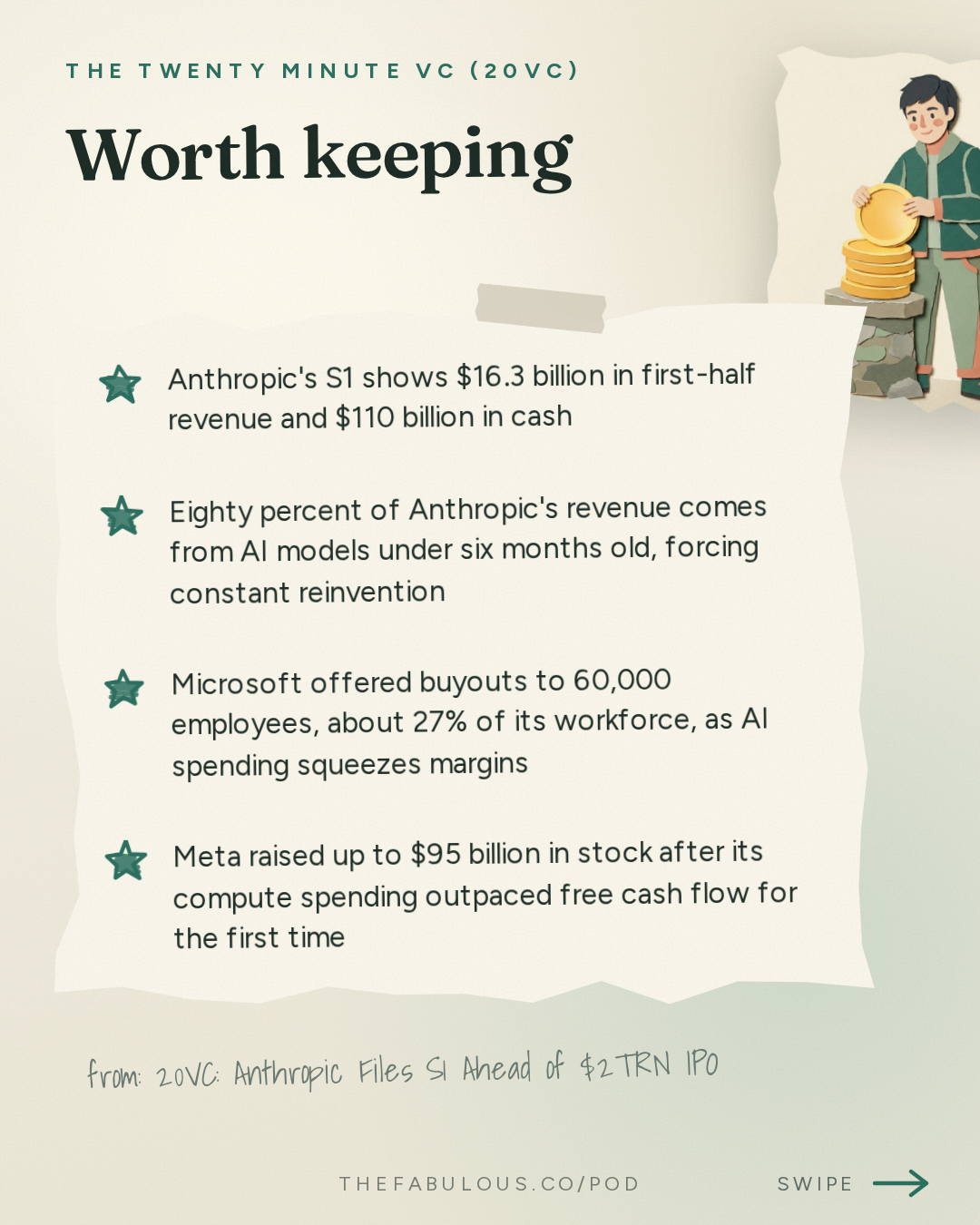
- Anthropic's S1 shows $16.3 billion in first-half revenue and $110 billion in cash
- Eighty percent of Anthropic's revenue comes from AI models under six months old, forcing constant reinvention
- Microsoft offered buyouts to 60,000 employees, about 27% of its workforce, as AI spending squeezes margins
- Meta raised up to $95 billion in stock after its compute spending outpaced free cash flow for the first time
- Investors Jason Lemkin and Rory O'Driscoll split over a rumored $30 billion round for AI app Instinct
The episode in cards
By the numbers
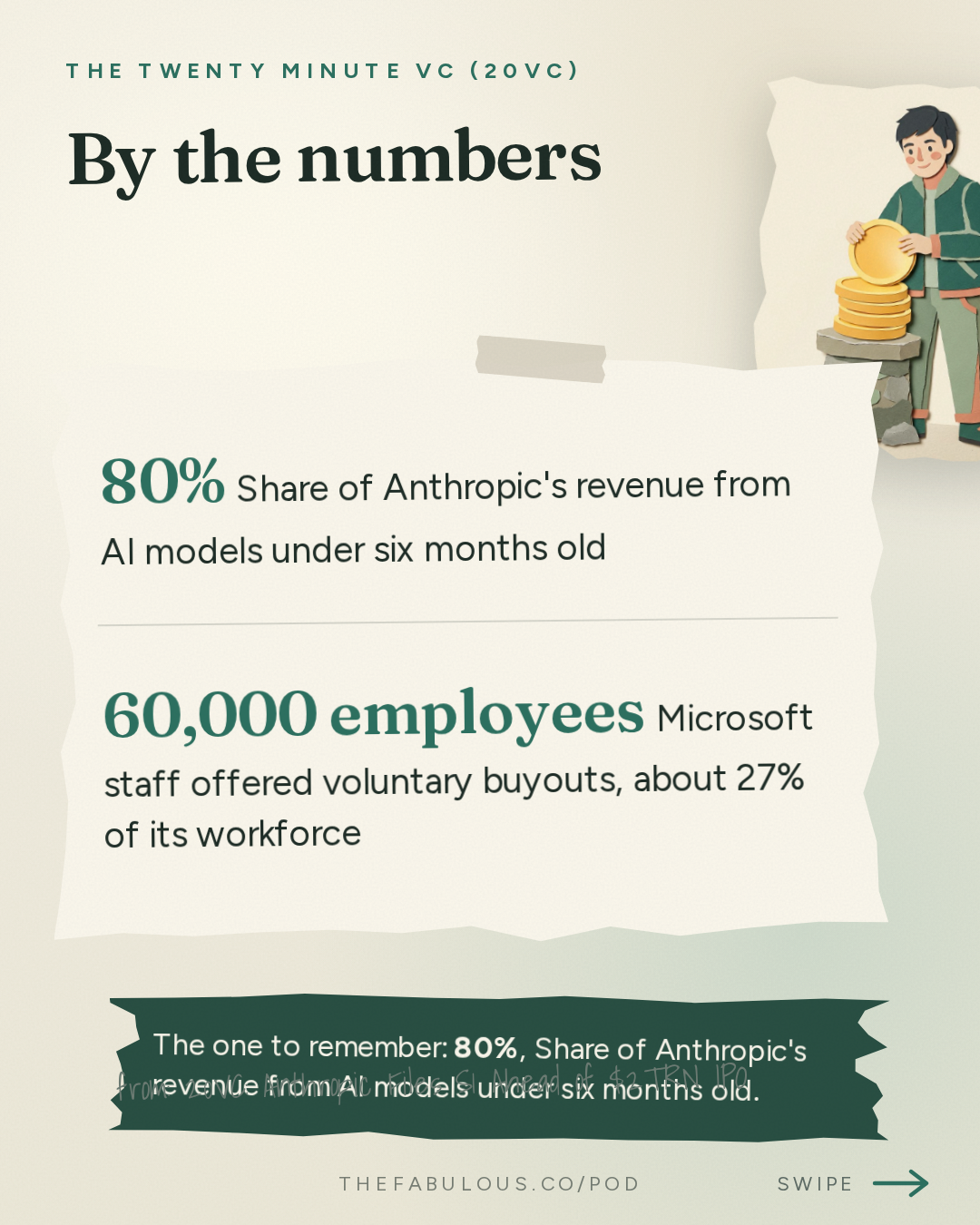
- 80% Share of Anthropic's revenue from AI models under six months old
- 60,000 employees Microsoft staff offered voluntary buyouts, about 27% of its workforce
In their words
“80% of their revenue comes from models that are less than six months old.”
“We're gonna, to pay for all this in- infra, to pay for all these GPUs and infra and inference, we gotta get rid of the people, right?”
“We are risk on until, until we're not.”
“I think we should put 20% of the fund into OpenAI at the $1.25 bill- trillion round.”
Protocols
-
Require 100 days of traction before a growth investment
Venture investor Jason Lemkin says he will not back a late-stage AI funding round, even one he finds exciting, until he has seen at least 100 days of visible usage or revenue data. He says this rule comes from being burned before by rounds backed on only two weeks of traction.
Applied to every growth-stage deal he evaluates
Questions this episode answers
What did Anthropic's S1 filing show about its finances?
The filing disclosed $16.3 billion in first-half revenue and a cash balance of about $110 billion, one of the largest in corporate America (04:06, 11:53). It also showed that 80% of revenue comes from AI models less than six months old, meaning the company must keep rebuilding its top product to sustain growth (07:21).
Why did Microsoft offer buyouts to 60,000 employees?
Microsoft offered voluntary buyouts to 60,000 of its roughly 223,000 staff, about 27% of the workforce (14:47, 15:11). On the podcast, the hosts linked this to the coming depreciation bill from AI data center spending, which they said will start pressuring operating income industry-wide around 2027 (18:16).
Why is Meta raising $95 billion in equity instead of debt?
Meta launched a stock sale of up to $95 billion in common and preferred shares after its compute spending exceeded its free cash flow for the first time in a quarter, making it cash-flow negative (20:43, 21:25). Investor Rory O'Driscoll noted other AI leaders, including Google and soon Anthropic, have taken the same equity route rather than add more debt.
Is the Alibaba Qwen data upload to China a real security risk?
Researchers found Alibaba's open-weight model Qwen pinging servers in Beijing and Singapore and uploading data even after it claimed it was not doing so (23:30). Investor Jason Lemkin said there is no clear evidence of a deliberate backdoor, more likely a training error, but added that the distinction matters little to a company's security officer once the behavior is confirmed (24:10).
Should investors back Instinct's rumored $30 billion round?
The hosts disagreed. Investor Jason Lemkin said he needs at least 100 days of visible traction data before backing a growth round and would pass at that price (37:24, 49:08), while investor Rory O'Driscoll argued Instinct could be an early version of a long-promised Western super app and that waiting risks missing the round.
The full read, in cards
Go deeper
- Anthropic S-1 registration filing — Disclosed first-half revenue, cash balance, customer concentration and compute spending ahead of its IPO
- OpenAI and Wiz security research on PHP — Identified two critical PHP vulnerabilities that had gone undetected for more than a decade
Mentioned
Anthropic · Microsoft · Meta · OpenAI · DeepSeek · Broadcom · Cloudflare · Alibaba Qwen · Instinct · War Hounds · Jason Lemkin · Rory O'Driscoll · Palmer Luckey · Harry Stebbings · Satya Nadella · Sam Altman · PHP
More from this show and category

Satya Nadella on AI Alignment and Zero Trust
Microsoft CEO Satya Nadella says AI alignment doesn't automatically emerge from scaling, so Microsoft built zero-trust tools to audit every agent action. He predicts commodity token usage will dominate within 24 months (08:47) and that firms will treat private AI evaluation benchmarks as core intellectual property (12:08).

Naveen Rao's Unconventional AI Strategy Explained
Naveen Rao, who sold MosaicML to Databricks for $1.3 billion, argues energy and hardware, not software, will decide AI's next decade. He projects a $10 trillion inference market within ten years, robotics growing 100 times bigger than coding agents, and warns that pure software investors are in trouble.

Is Venture Capital Broken? Billion-Dollar Math
Venture capital has split into two games: mega-funds need billion-dollar stakes in a handful of AI giants, while strong smaller startups go unfunded. CoreWeave slid 15-20% on AI demand fears (13:35), Anthropic posted $16.8B in Q3 revenue (19:07), Modal raised $750M at $15.75B (32:03), and Anduril trades near 40 times revenue at a $90B valuation (38:44).

Sameer Dholakia on Bessemer's AI Investing Playbook
Bessemer's Sameer Dholakia explains why his firm paid roughly 150x ARR for Anthropic, and why capital itself is now a moat in AI investing. He prices deals on next-twelve-months revenue, targets 10 to 15 times NTM multiples, and says Bessemer's new $5.75 billion in funds reflects venture splitting into giant platforms and extreme specialists.
