
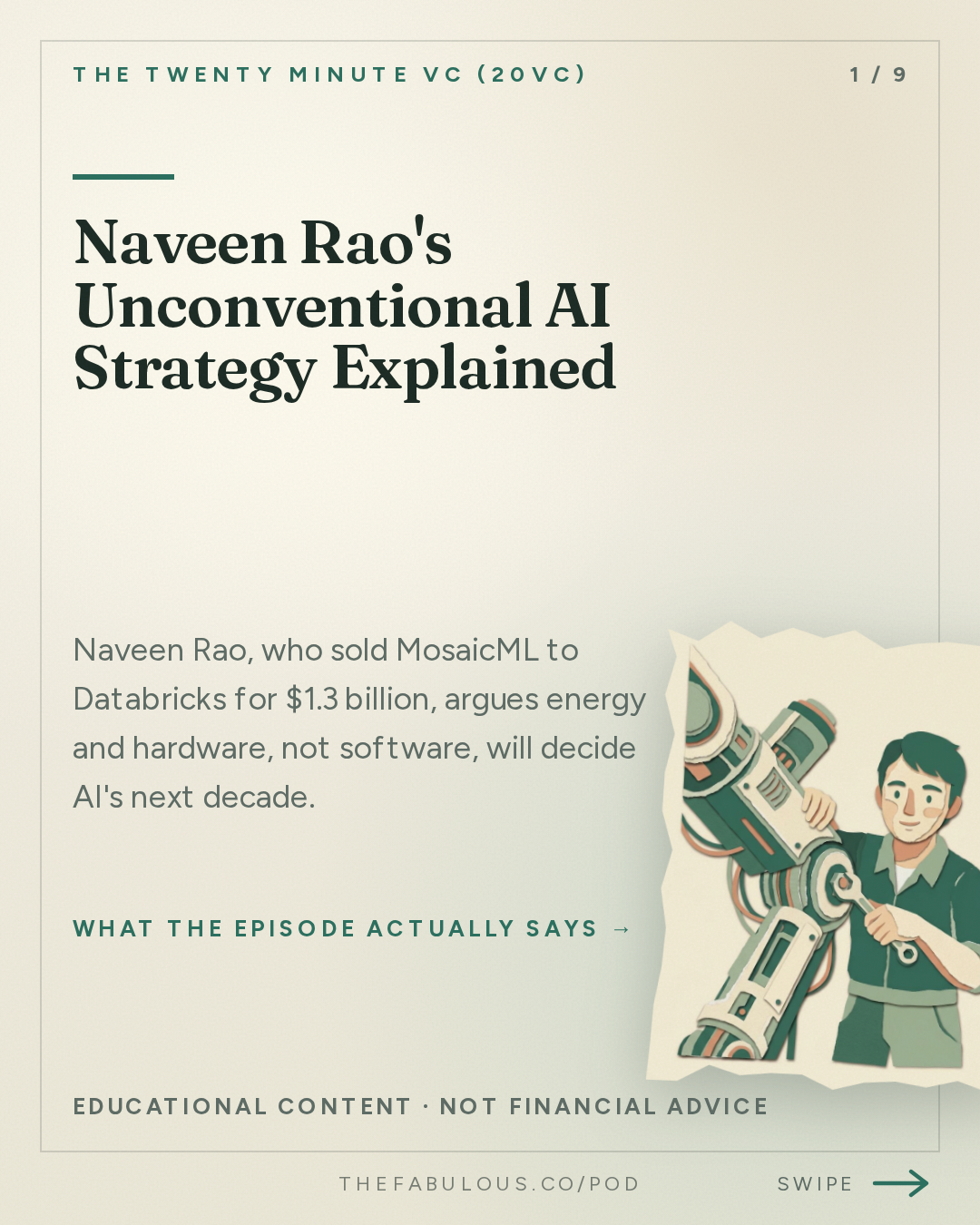
Naveen Rao's Unconventional AI Strategy Explained
20VC: Why Robotics Will be 100x Bigger than Coding Agents | Inference Will Be a $10TRN Market: What No One Sees | Why Software Investors are F***** Today with Naveen Rao, Unconventional
The brief
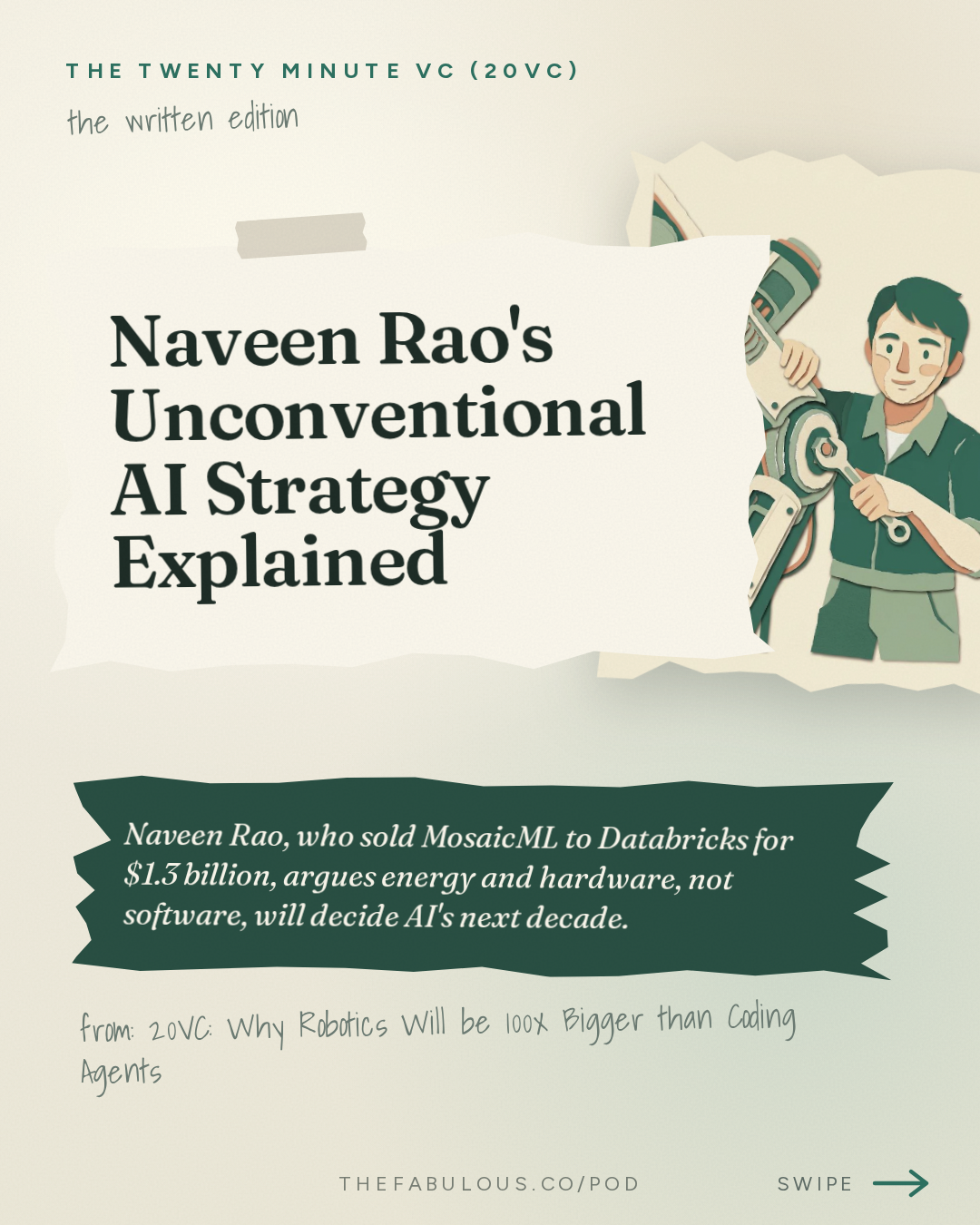
Naveen Rao, who sold MosaicML to Databricks for $1.3 billion, argues energy and hardware, not software, will decide AI's next decade. He projects a $10 trillion inference market within ten years, robotics growing 100 times bigger than coding agents, and warns that pure software investors are in trouble.
In 1945 the United States government built a machine to solve one problem: calculate artillery trajectories faster than a room full of humans with slide rules. It was called ENIAC, for Electrical Numerical Integrator and Calculator, and it set a pattern computing would follow for the next eighty years (14:03). Every machine since has tried to beat the one before it at speed. CPUs beat human arithmetic. GPUs beat CPUs at rendering graphics. Naveen Rao, who sold his AI startup MosaicML to the data platform company Databricks for $1.3 billion and now runs the AI infrastructure company Unconventional AI, thinks that eighty-year race just changed its rules. The new constraint is not speed. It is energy.
The Grid Is the Ceiling
Rao's argument starts somewhere unglamorous: the power grid. Building one gigawatt of new energy capacity, roughly enough to run a very large data center, costs about $50 billion (05:09). That is more than the cost of building a semiconductor fab, he points out, and fabs are famously expensive. For the last several years, the AI industry has not really built new energy. It has squeezed more hours out of existing plants, pushing the US grid closer to its peak output of roughly 1,300 gigawatts instead of its typical 900 (05:53). That slack is close to gone. Rao expects the country to burn through spare capacity within a few years, at which point AI's growth will be capped by how fast anyone can physically build power plants, not by chip supply or model quality (07:55).
China, he notes, overtook the United States in total energy capacity in 2023, after two decades of building new capacity roughly six times faster (06:15). Some of that was dirty coal power, and Rao does not pretend otherwise. But the lesson he draws is not about fuel source. It is about commitment. The US innovates better at what he calls the tip of the spear, pointing out that AI itself was invented here, not in China. What the US has not done well is build boring infrastructure at scale, and that gap is about to matter more than any algorithm.
Scarcity in energy changes the economics of compute in a way most people miss. Companies running AI workloads already pay well above the standard grid rate, because the margin on a gigawatt of compute is roughly five times the cost of the power that feeds it (10:57). That gives data center operators room to pay 30 to 40 percent more per kilowatt hour and still profit, which is why behind the meter power deals, where a data center buys electricity directly from a generator instead of the public grid, have become common even though nobody quotes public prices for them (10:18).
Why Rao Says Software Investors Are in Trouble
The energy story feeds directly into Rao's view of computing architecture, and why he thinks the investing playbook of the last fifteen years is running out of road. For decades, computers got more efficient mainly because transistors got physically smaller, a trend called Moore's Law. Rao says that trend has largely stalled (11:38). The efficiency gains of the last few chip generations have come instead from a different layer: shrinking the size of the numbers a chip computes with, from 32-bit down to 8-bit and smaller. The next big gain, he argues, will come from designing the model and the physical chip together, rather than treating the model as fixed software running on off-the-shelf hardware (13:24).
"We don't treat the model as sacrosanct, and we're energy first in our, in our mindset." (Naveen Rao, [13:24])
That shift in mindset is also why Rao believes demand for intelligence has no ceiling. His reasoning is almost biological: life has always competed for scarce resources, from two bacteria competing for a patch of sunlight to nations competing for energy and influence today. Intelligence, in his view, is the tool that wins those contests, which means demand for it never saturates.
"Intelligence, to me, it will have infinite demand. There is no limit of demand of intelligence because the world that we live in, the universe is, uh, adversarial." (Naveen Rao, [21:35])
If intelligence is the product and energy is the raw material, hardware, the machinery that converts one into the other, becomes the place where value piles up. That is the logic behind Rao's blunt verdict on software investing.
"I would say if you're a pure software investor, you're kind of fucked, honestly." (Naveen Rao, [00:19])
His point is not that software stops mattering. It is that the shortcut of the last cycle, spin up a product on a cloud platform, test a market cheaply, scale a SaaS (software as a service) business to $100 or $200 million in revenue, depended on a frictionless, commoditized delivery layer. Rao thinks that layer is being replaced by one where the intelligence itself, and the hardware producing it, carries the margin. He points to the legal tech company Harvey as an early example: instead of selling cloud software to law firms, it replaces part of the actual work of reviewing contracts, with humans verifying the output (43:07).
That points to a new bottleneck. As AI produces more code, more legal drafts, more research, the limiting factor stops being production and becomes verification, the work of checking whether an AI-generated answer is actually correct (26:40). Rao says his own company runs into this constantly. He thinks it is also why today's dominant AI architecture, the transformer, which generates answers by retrieving and comparing patterns from training data rather than reasoning from first principles, will eventually be replaced (37:47). "I don't think the transformer is the be-all, end-all," he says (36:50).
All of this adds up to two large bets. The first is on inference, the process of running a trained AI model to generate an answer, which Rao expects to become a $10 trillion market within ten years, up from a category that, a decade ago, nobody would have guessed could be worth a trillion dollars at all (52:23). The second, more surprising bet, is on robotics.
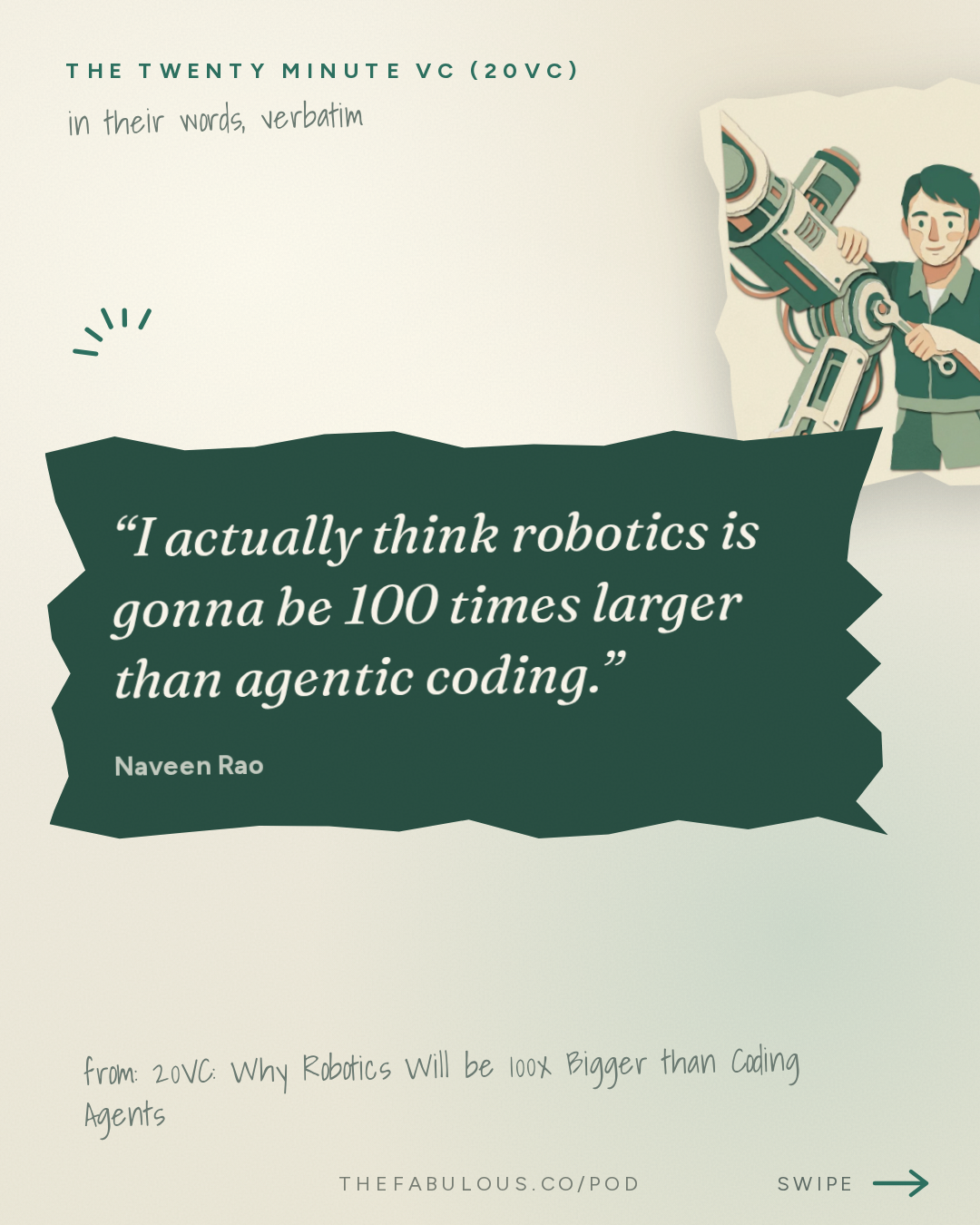
"I actually think robotics is gonna be 100 times larger than agentic coding." (Naveen Rao, [53:11])
Agentic coding tools, AI systems that write and execute software with minimal human input, have been one of the hottest venture categories of the past two years. Rao thinks that market is small next to what happens when intelligence moves into the physical world: robots that diagnose a broken part and fix it, or a construction site where machines cut the time to build a skyscraper from two years to eight months, because far more projects can run at once, not because each one moves faster alone (49:34). He expects working prototypes within two to three years and a real market within five to seven (51:19).
None of this makes Rao a doomer. Asked about fears that AI poses an existential risk to humanity, he was dismissive, calling that worldview the stupidest he has heard and arguing that AI's real role is to let a small number of working scientists tackle problems, in physics, in medicine, that have simply been too hard for the available pool of human minds to approach (65:30). Whether or not the energy and hardware bets land exactly as he describes, that is the scale he is playing for: not a better app, but a bigger set of questions the species can finally afford to ask.
Ask this episode anything
Pod's AI answers from the episode itself, with the minute mark so you can hear it yourself.
Or start with one of these
Ask this episode
Pod's AI listens to the whole episode to answer, and points you to the minute it comes from.
The rest of this answer, and any question after it
Answers come from the episode itself, never from a summary of it.
ContinueKey takeaways
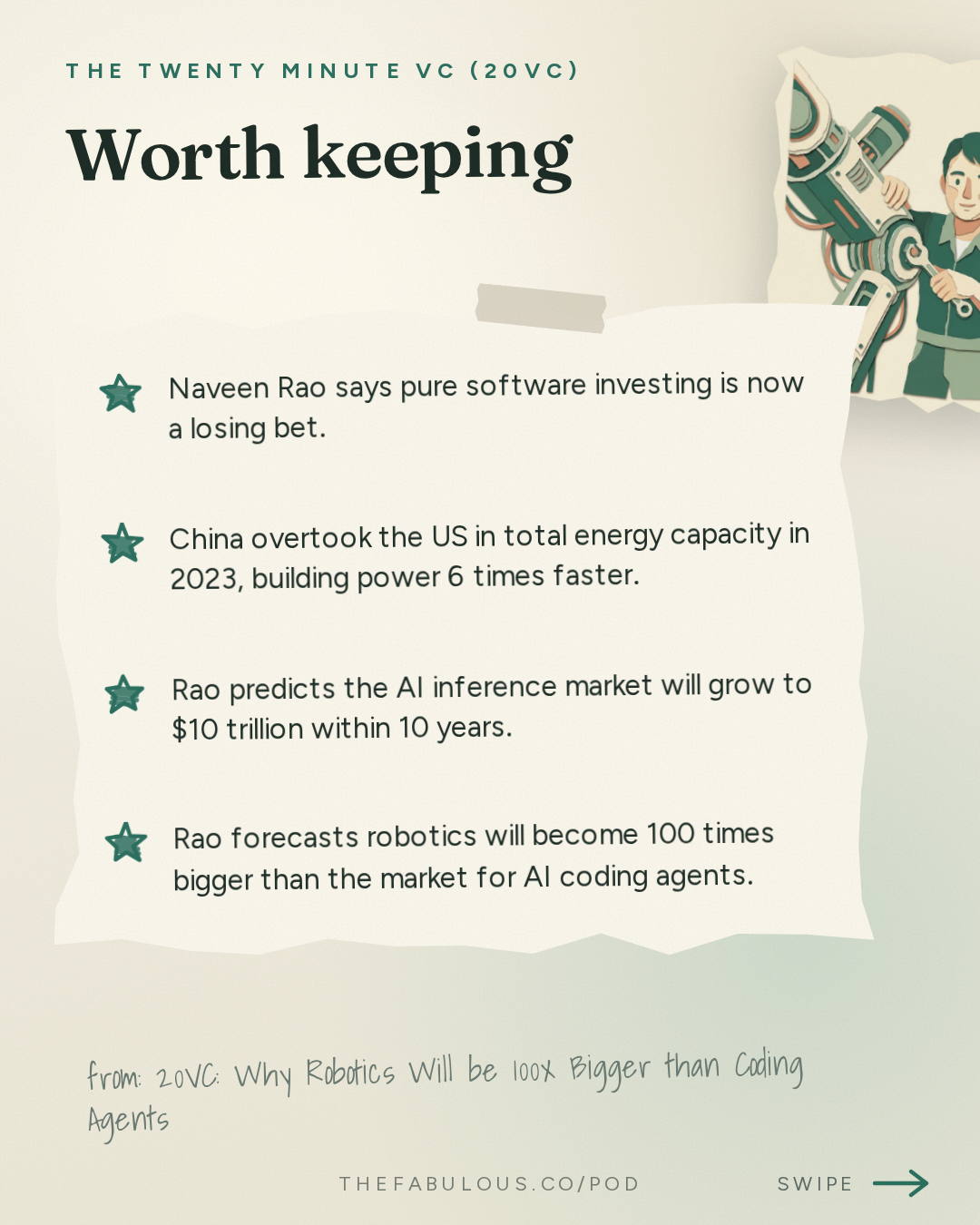
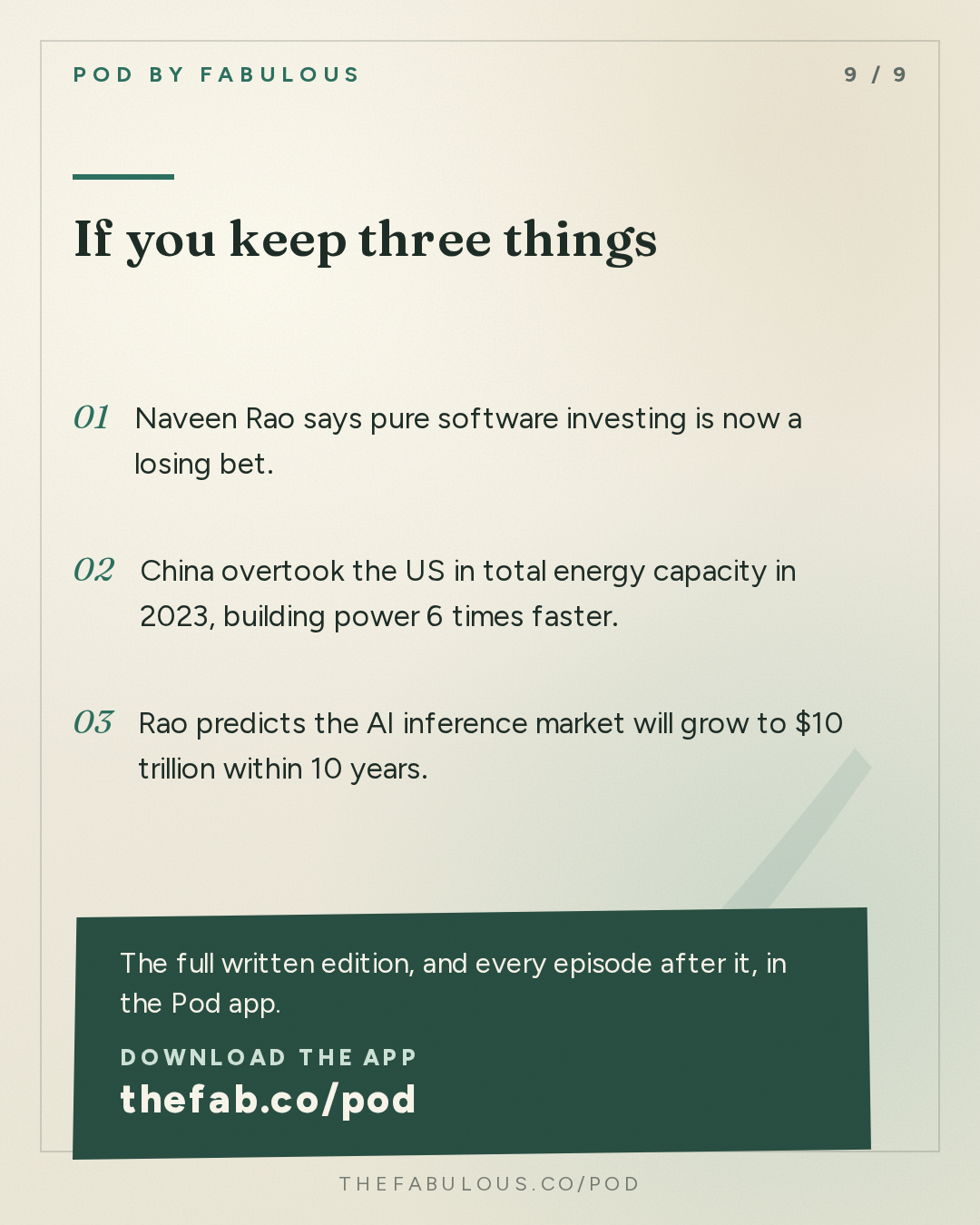
- Naveen Rao says pure software investing is now a losing bet.
- China overtook the US in total energy capacity in 2023, building power 6 times faster.
- Rao predicts the AI inference market will grow to $10 trillion within 10 years.
- Rao forecasts robotics will become 100 times bigger than the market for AI coding agents.
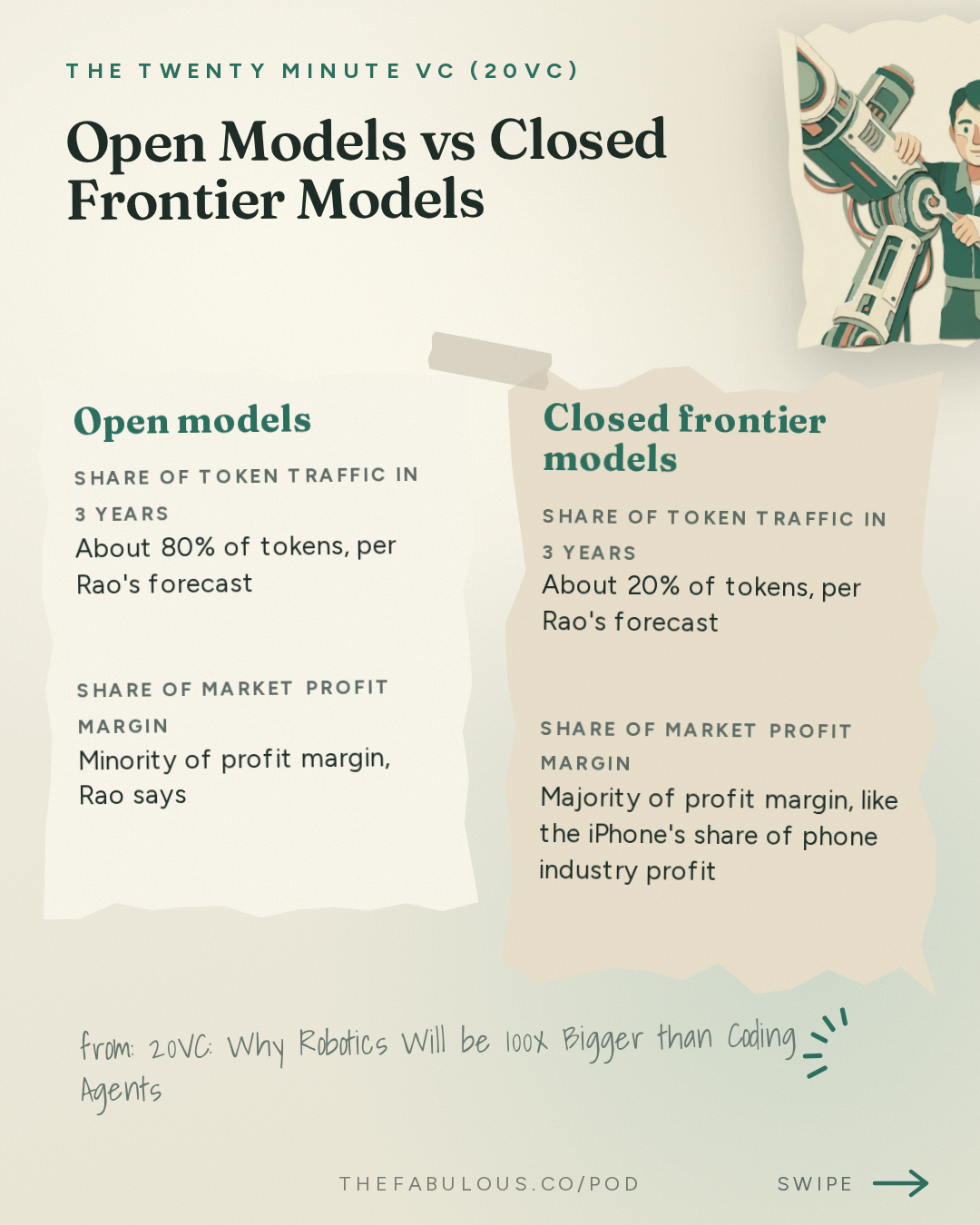
- Rao says open AI models will carry 80% of token traffic but closed frontier models will keep most profit margin.
The episode in cards
By the numbers
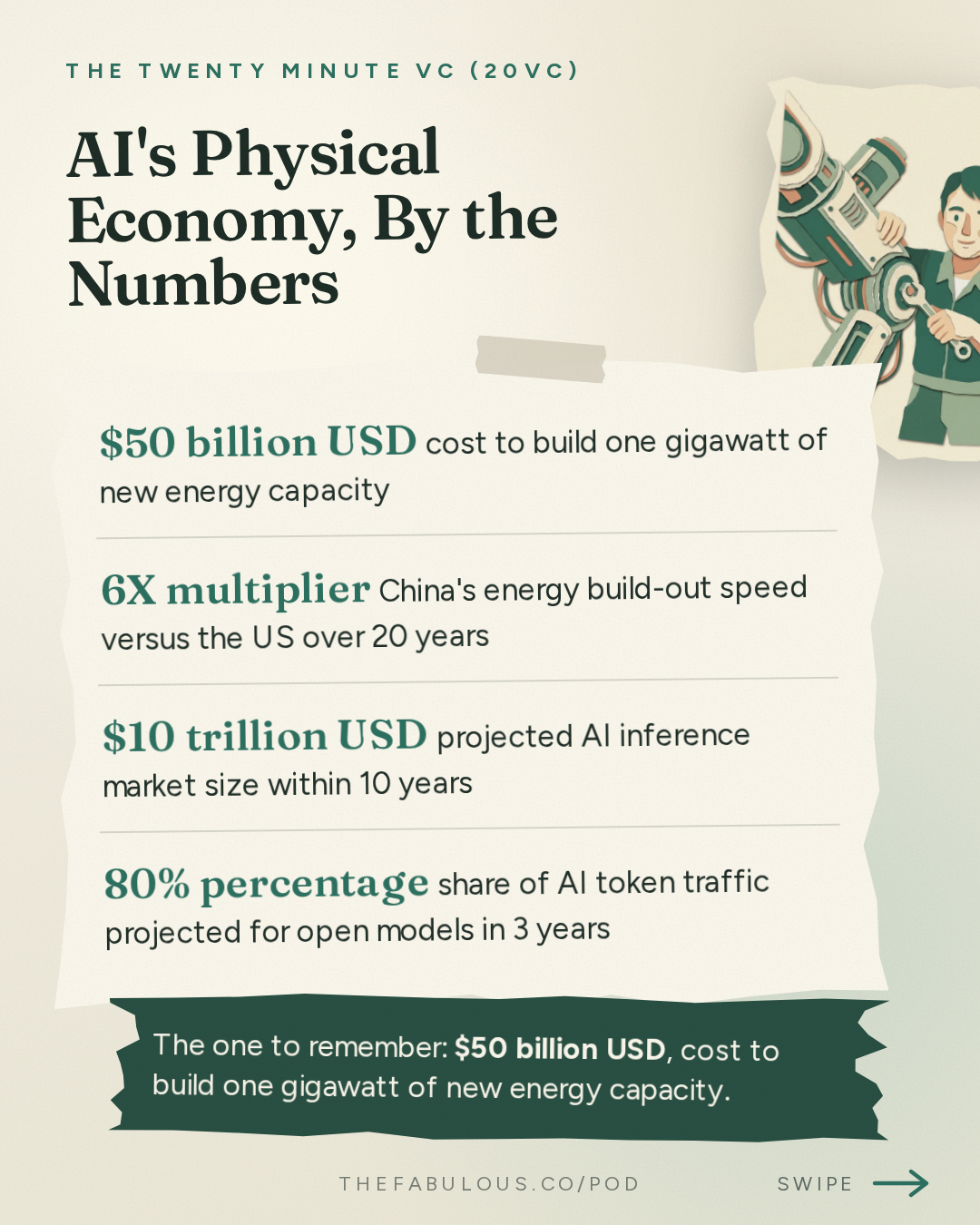
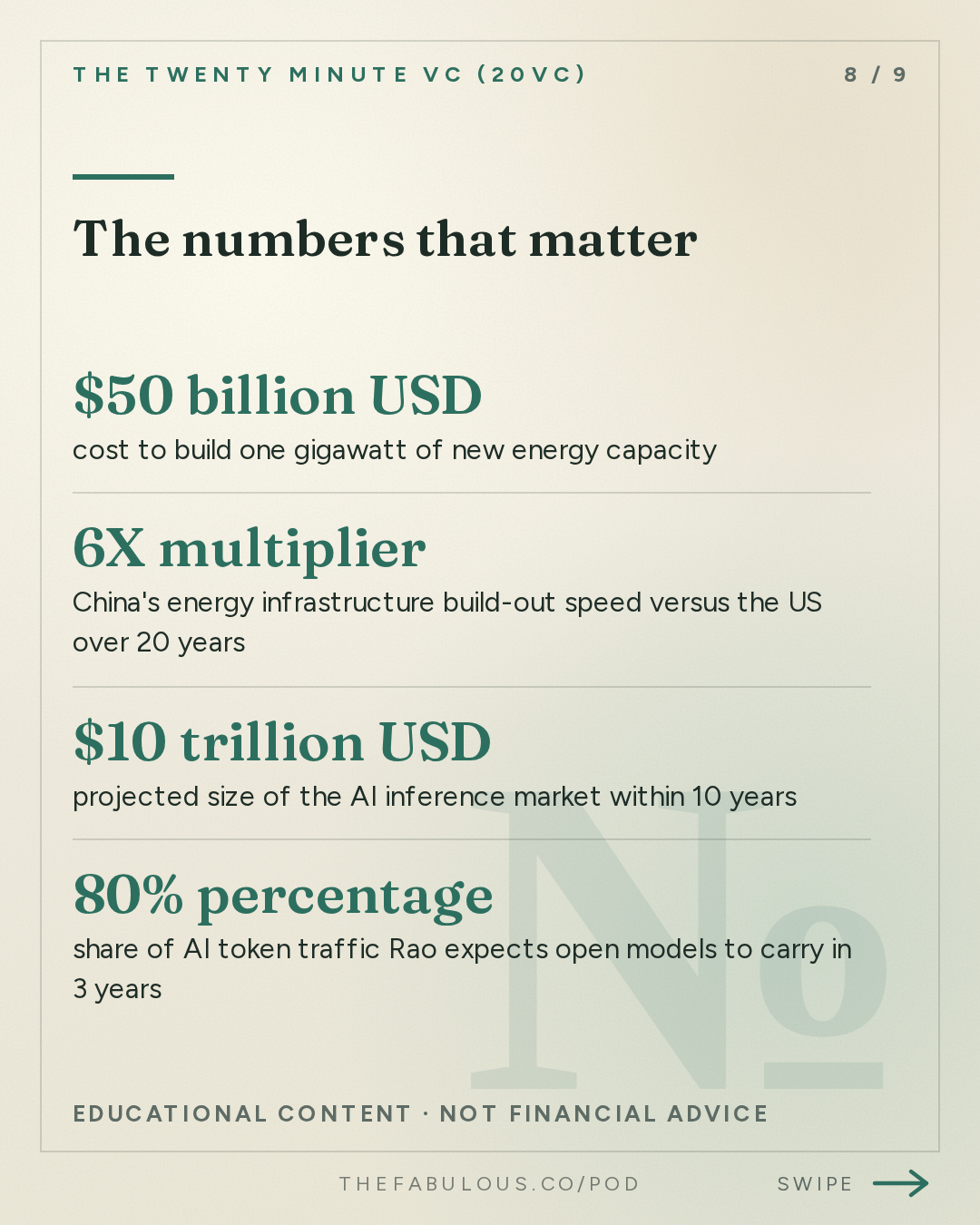
- $50 billion USD cost to build one gigawatt of new energy capacity
- 6X multiplier China's energy infrastructure build-out speed versus the US over 20 years
- $10 trillion USD projected size of the AI inference market within 10 years
- 80% percentage share of AI token traffic Rao expects open models to carry in 3 years
In their words
“I would say if you're a pure software investor, you're kind of fucked, honestly.”
“Intelligence, to me, it will have infinite demand. There is no limit of demand of intelligence because the world that we live in, the universe is, uh, adversarial”
“I actually think robotics is gonna be 100 times larger than agentic coding.”
“That's the stupidest worldview I've ever heard.”
Protocols
-
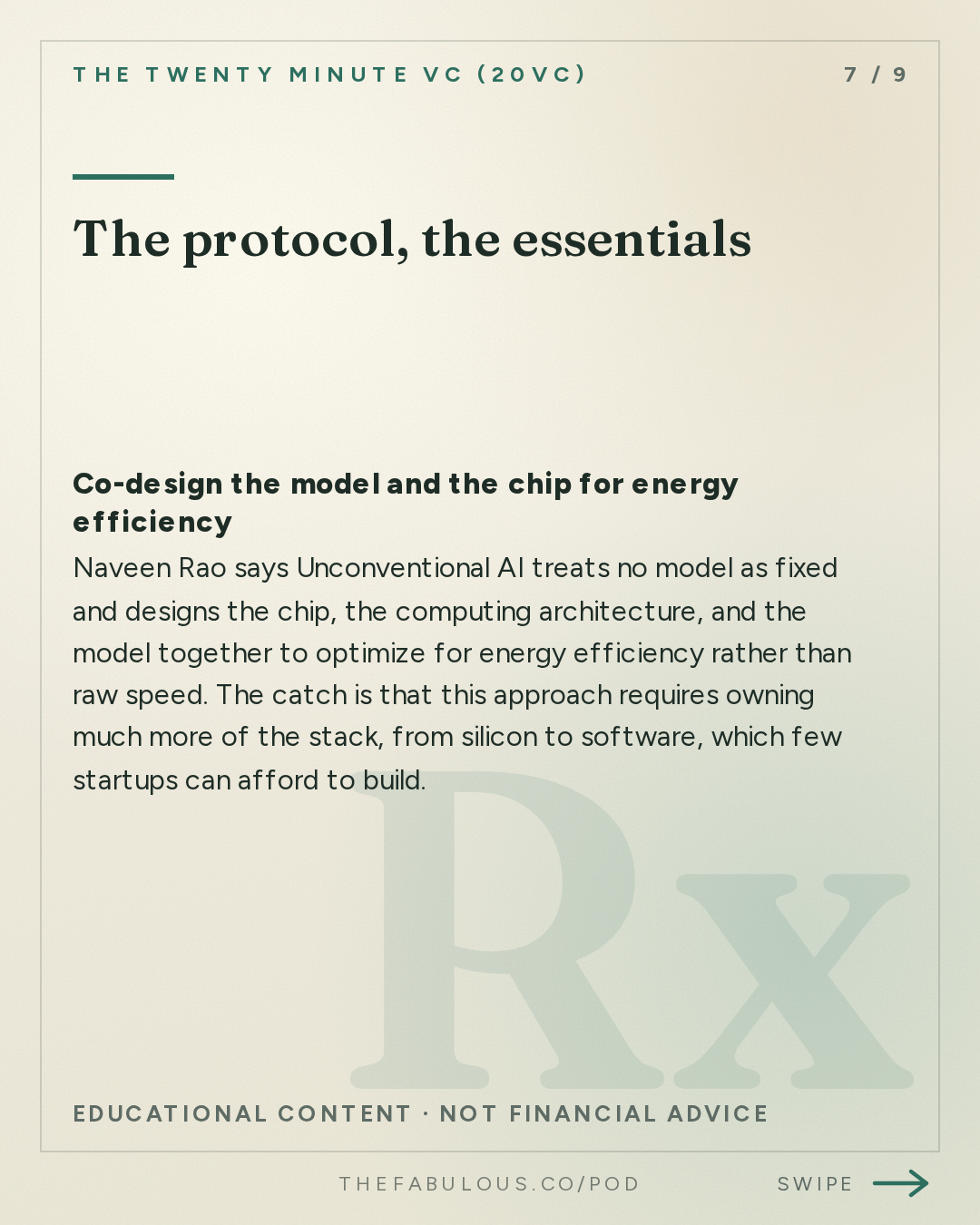
Co-design the model and the chip for energy efficiency
Naveen Rao says Unconventional AI treats no model as fixed and designs the chip, the computing architecture, and the model together to optimize for energy efficiency rather than raw speed. The catch is that this approach requires owning much more of the stack, from silicon to software, which few startups can afford to build.
Ongoing design principle at Unconventional AI
-
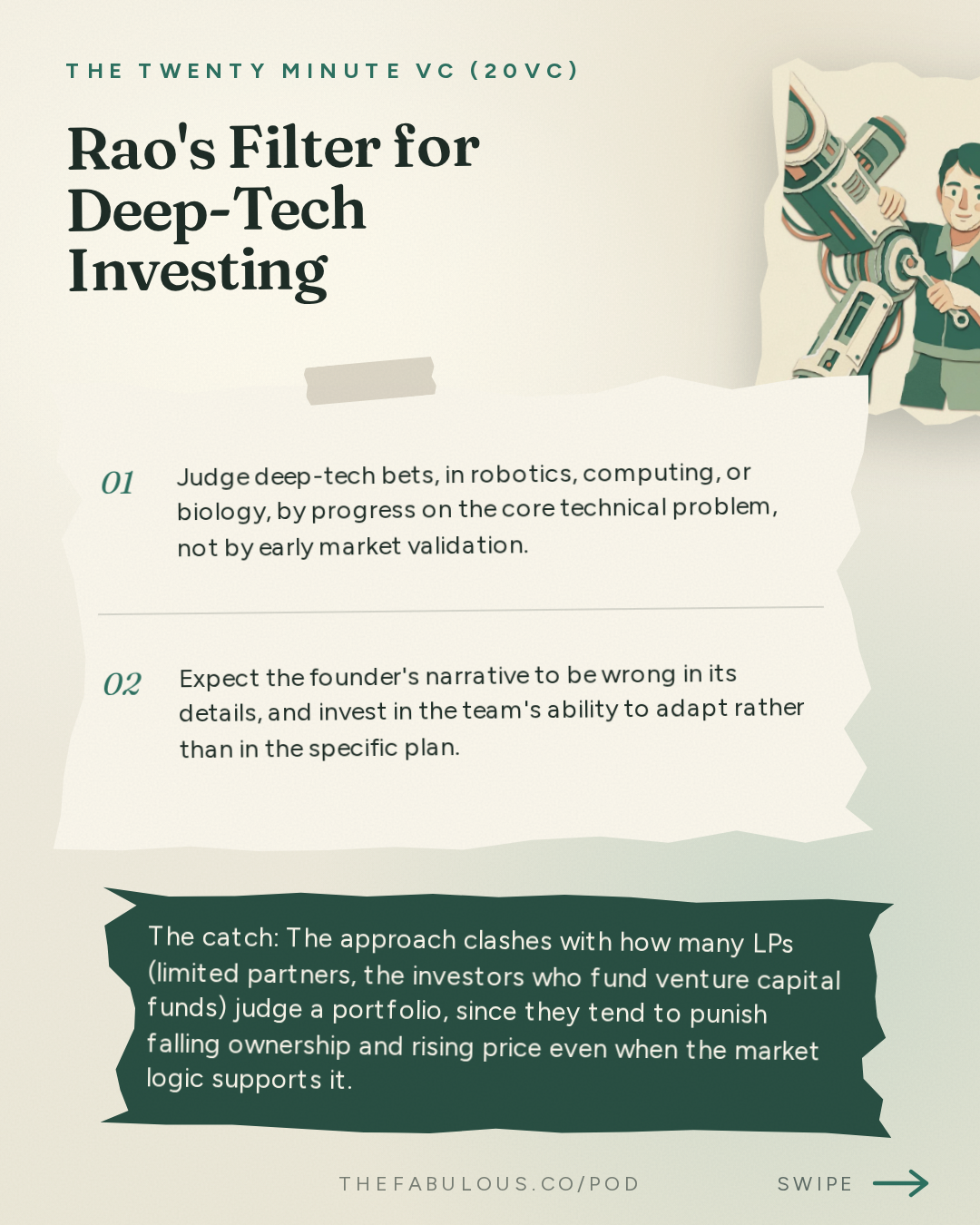
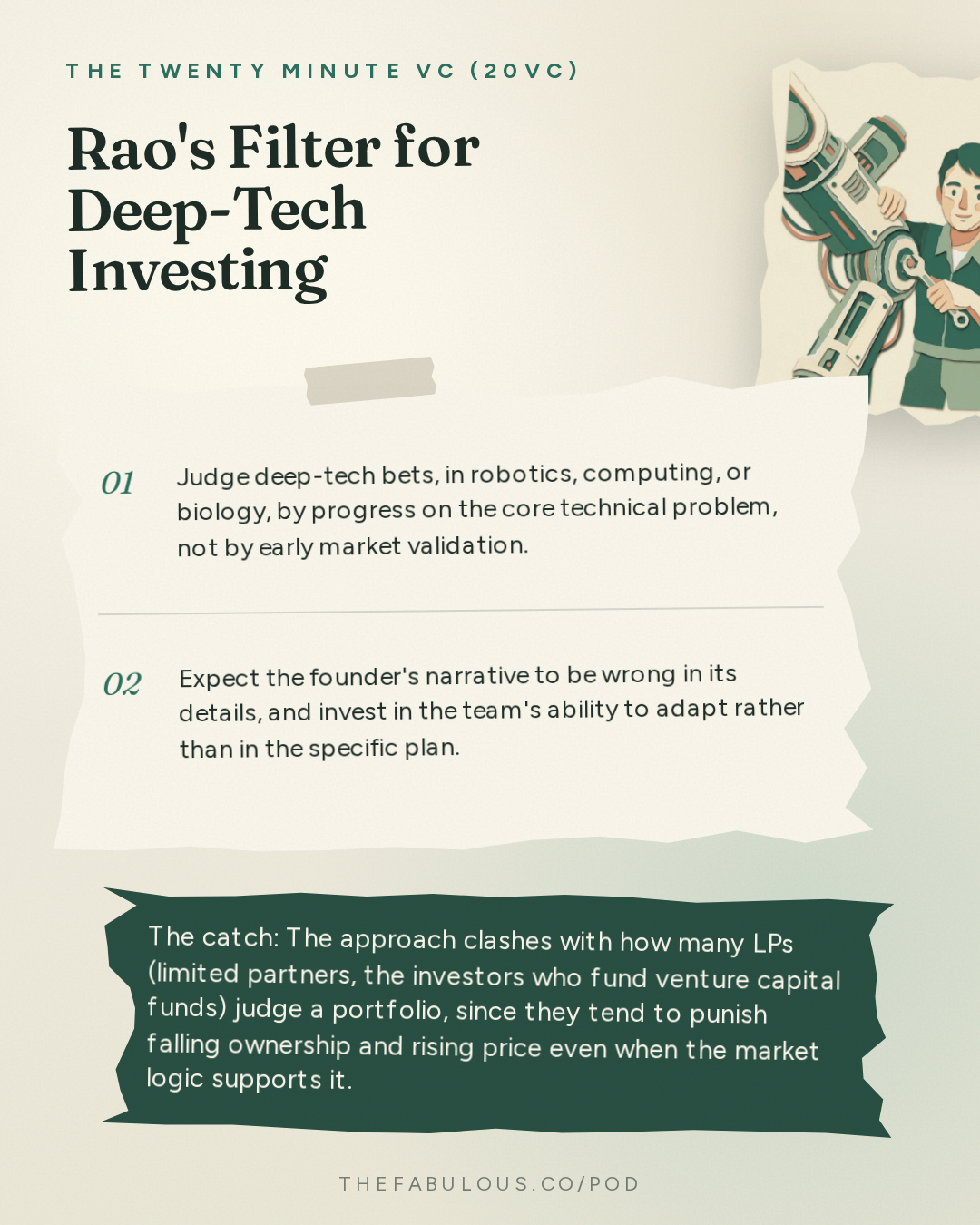
Judge deep-tech bets on technical progress, not market validation
Naveen Rao says investors should judge deep-technology startups, in robotics, computing, or biology, by progress on the core technical problem rather than by early market validation, because a working breakthrough creates its own demand. The catch, he adds, is that in today's fast-moving funding market investors often get only two or three meetings before committing capital, leaving little time for real diligence.
Applied to every deep-tech investment decision
Questions this episode answers
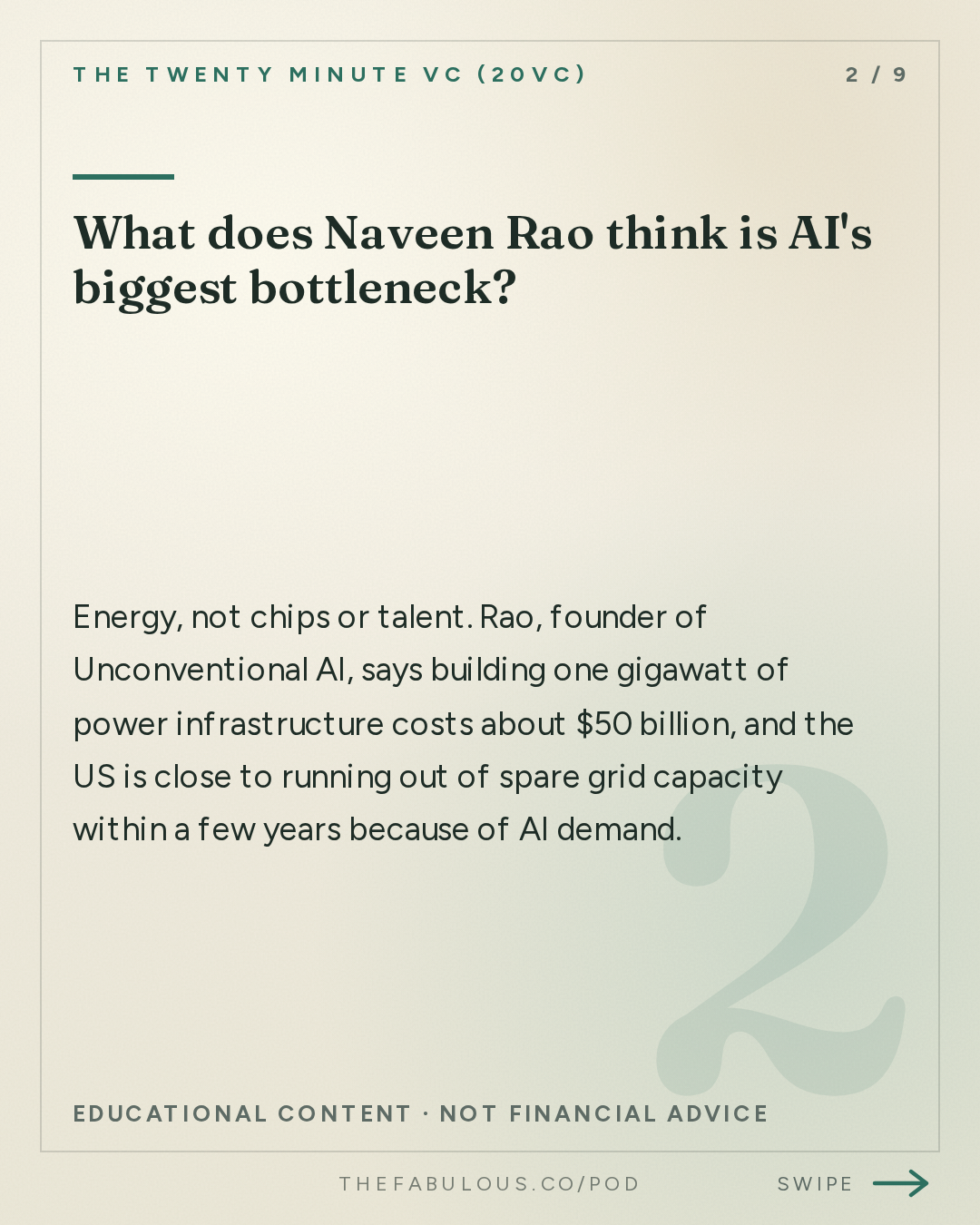
What does Naveen Rao think is AI's biggest bottleneck?
Energy, not chips or talent. Rao, founder of Unconventional AI, says building one gigawatt of power infrastructure costs about $50 billion (05:09), and the US is close to running out of spare grid capacity within a few years because of AI demand (07:55).
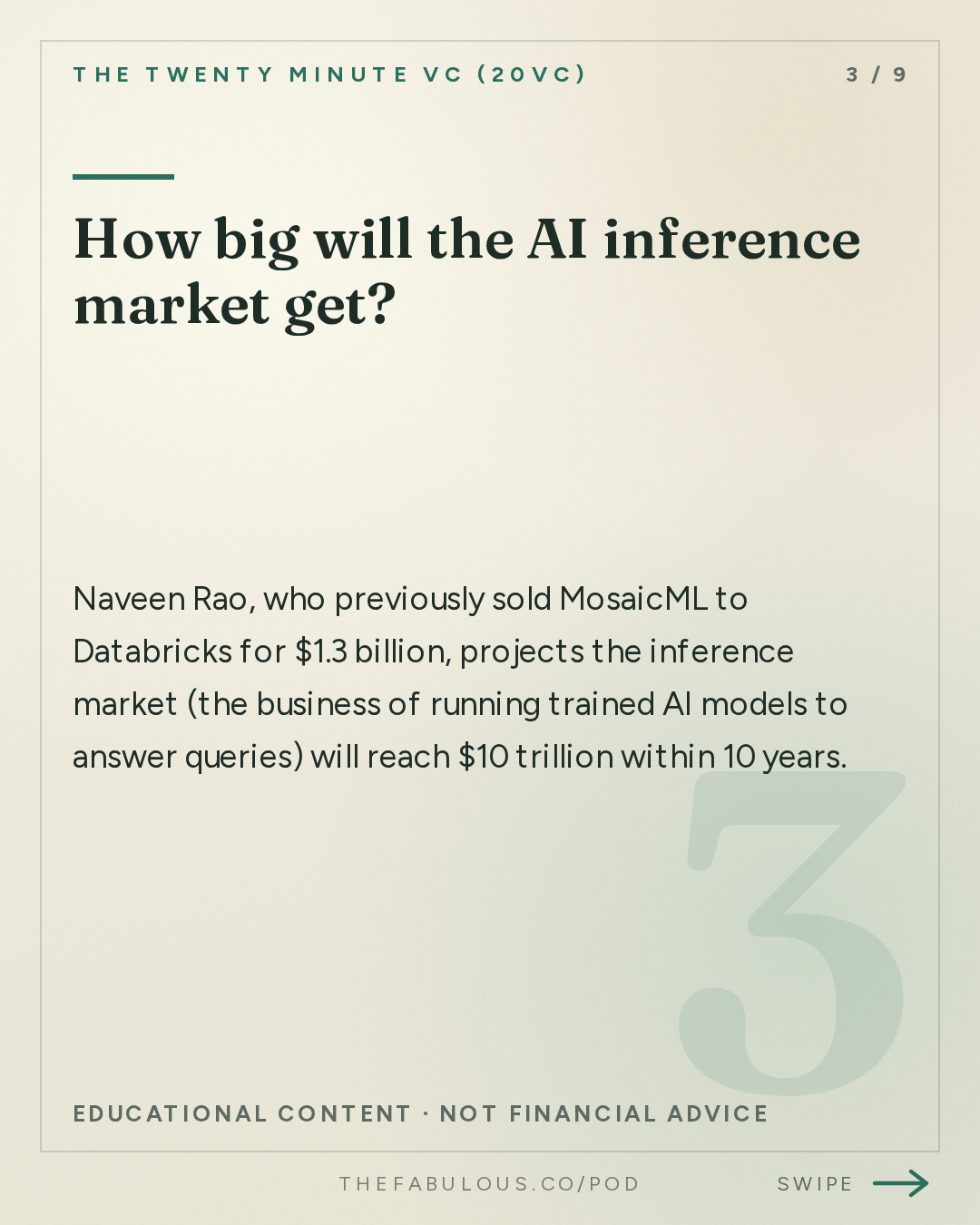
How big will the AI inference market get?
Naveen Rao, who previously sold MosaicML to Databricks for $1.3 billion, projects the inference market (the business of running trained AI models to answer queries) will reach $10 trillion within 10 years (52:23).
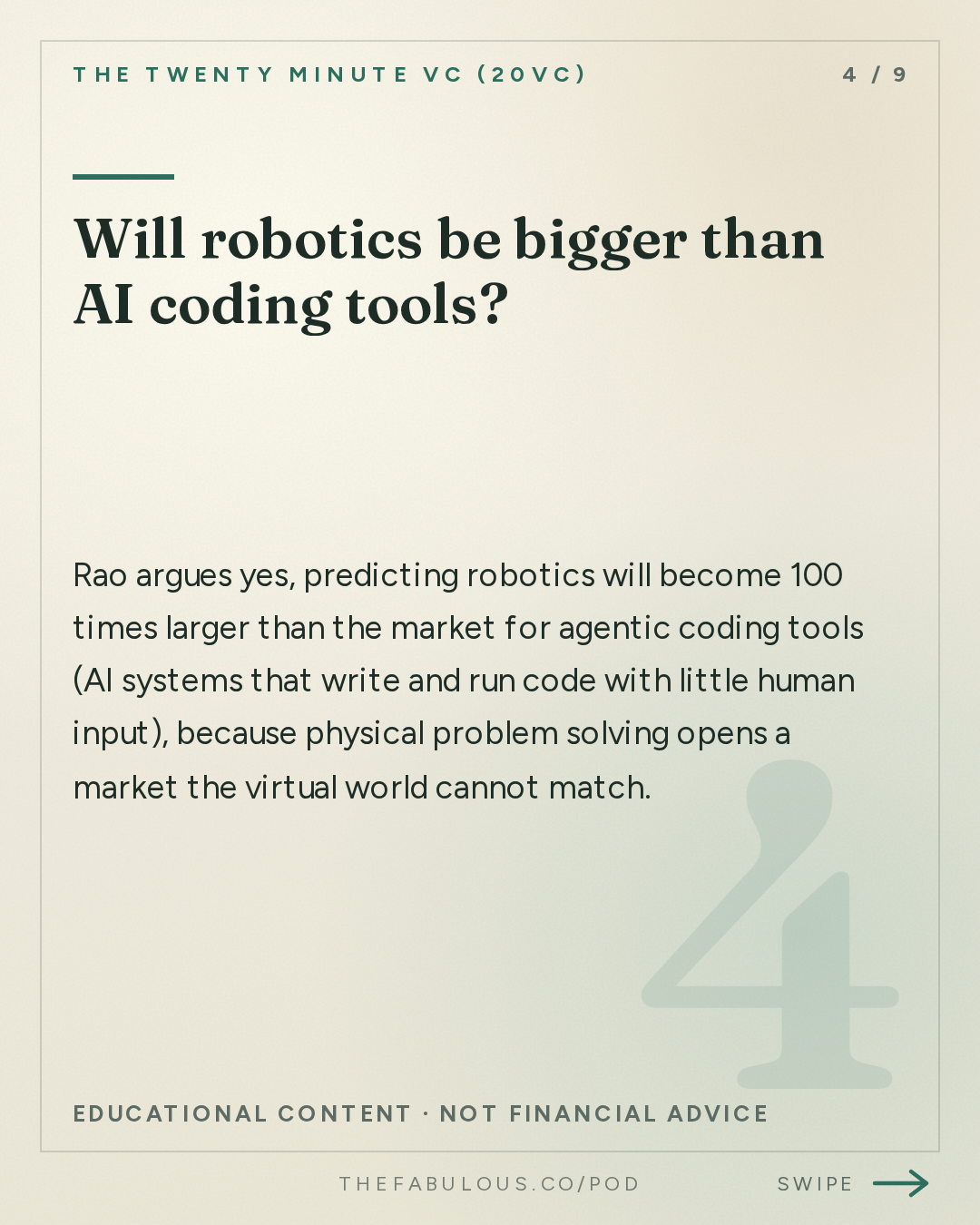
Will robotics be bigger than AI coding tools?
Rao argues yes, predicting robotics will become 100 times larger than the market for agentic coding tools (AI systems that write and run code with little human input), because physical problem solving opens a market the virtual world cannot match (53:11).
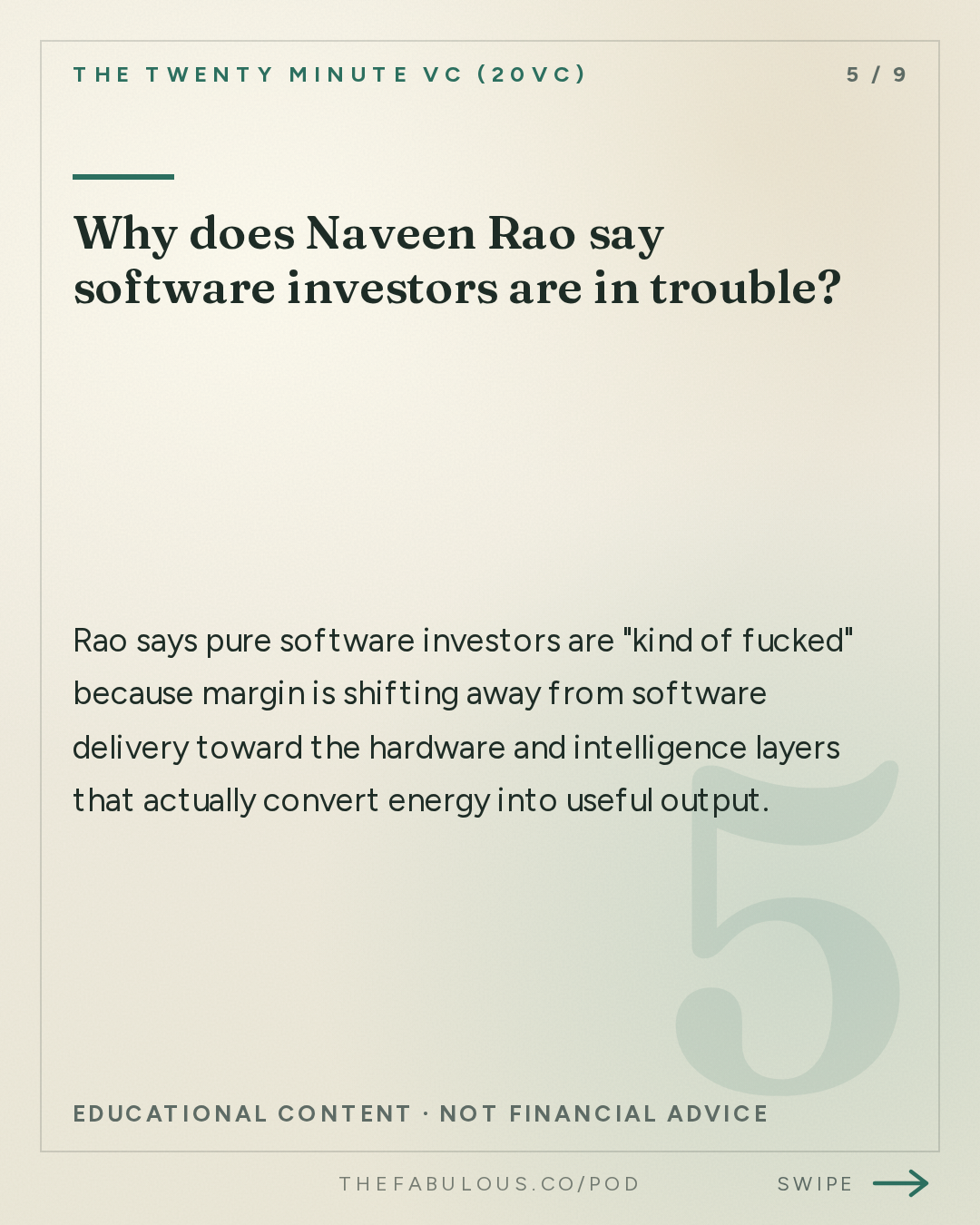
Why does Naveen Rao say software investors are in trouble?
Rao says pure software investors are "kind of fucked" (00:19) because margin is shifting away from software delivery toward the hardware and intelligence layers that actually convert energy into useful output (41:38).
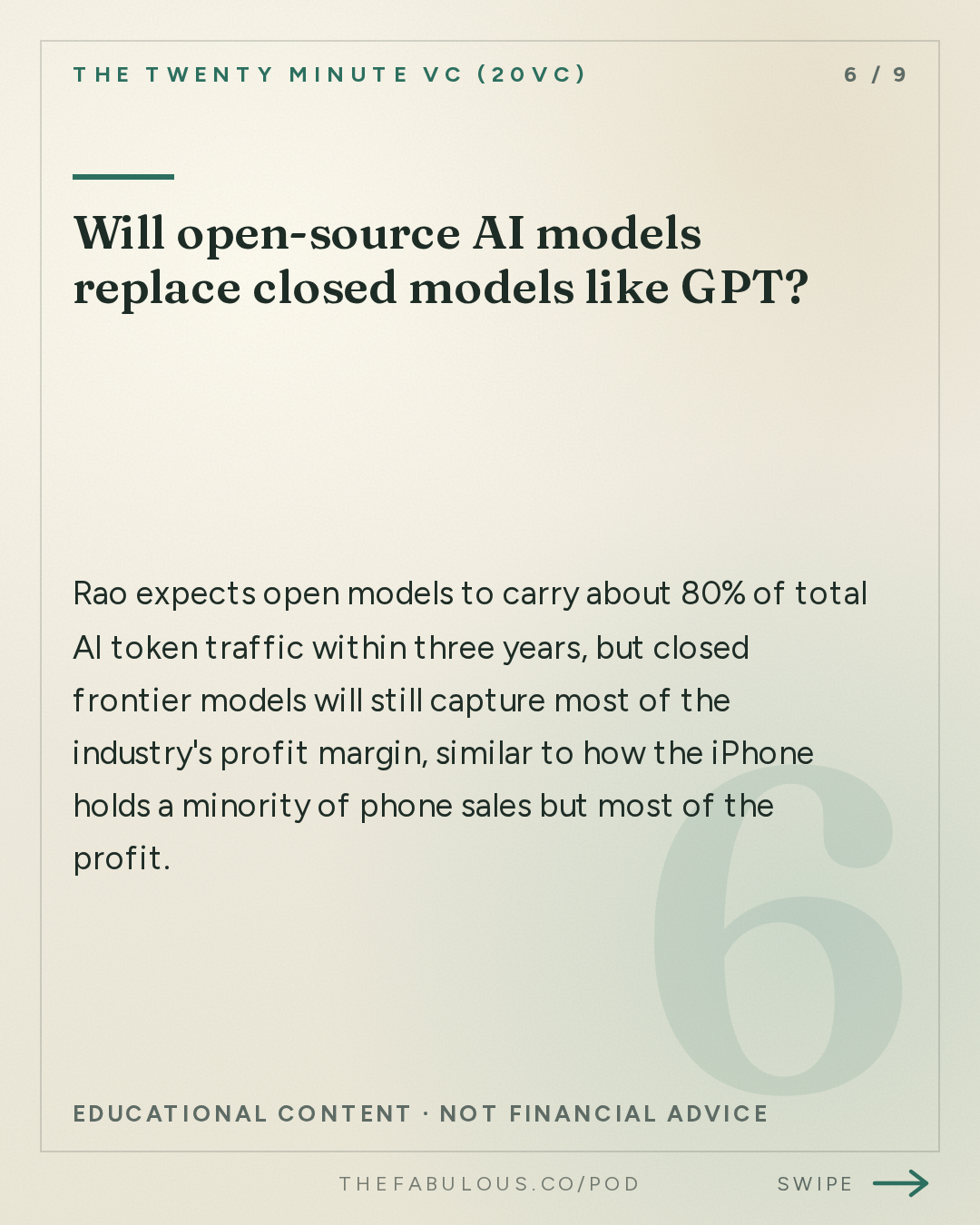
Will open-source AI models replace closed models like GPT?
Rao expects open models to carry about 80% of total AI token traffic within three years, but closed frontier models will still capture most of the industry's profit margin, similar to how the iPhone holds a minority of phone sales but most of the profit (60:11, 60:35).
The full read, in cards
Go deeper
- Jevons paradox — Economic principle Rao cites to explain why cheaper AI inference expands the market rather than shrinking it
- Sequoia's 'trillion dollar services' thesis — Framework on AI replacing labor-based services, referenced by Rao while discussing the end of classic SaaS
Mentioned
Naveen Rao · MosaicML · Databricks · Unconventional AI · Nvidia · Harvey · Cursor · Steve Jurvetson · Yann LeCun · Jensen Huang · Elon Musk
More from this show and category

Is Venture Capital Broken? Billion-Dollar Math
Venture capital has split into two games: mega-funds need billion-dollar stakes in a handful of AI giants, while strong smaller startups go unfunded. CoreWeave slid 15-20% on AI demand fears (13:35), Anthropic posted $16.8B in Q3 revenue (19:07), Modal raised $750M at $15.75B (32:03), and Anduril trades near 40 times revenue at a $90B valuation (38:44).

Sameer Dholakia on Bessemer's AI Investing Playbook
Bessemer's Sameer Dholakia explains why his firm paid roughly 150x ARR for Anthropic, and why capital itself is now a moat in AI investing. He prices deals on next-twelve-months revenue, targets 10 to 15 times NTM multiples, and says Bessemer's new $5.75 billion in funds reflects venture splitting into giant platforms and extreme specialists.

Harrison Chase on Why AI Agents Are So Hard to Build
LangChain founder Harrison Chase says AI agents break because models are unpredictable black boxes, not because they are weak. The fix, he argues, is a model-neutral 'harness,' the code layer that routes tasks, manages memory and controls token costs, with vertical, domain-specific agents built to outperform horizontal ones.

Pro Rata Lawsuit: Valar Atomics vs Day One VC
Day One Ventures and Valar Atomics are fighting over pro rata rights in a $6 billion nuclear-startup round, exposing how waivers actually work in venture capital. The panel also covers Meta's new Muse Wonder model, NVIDIA's reported bid for Reflection, Jev's $870 million round, Anthropic's price cuts, and software's rising IPO bar.
