
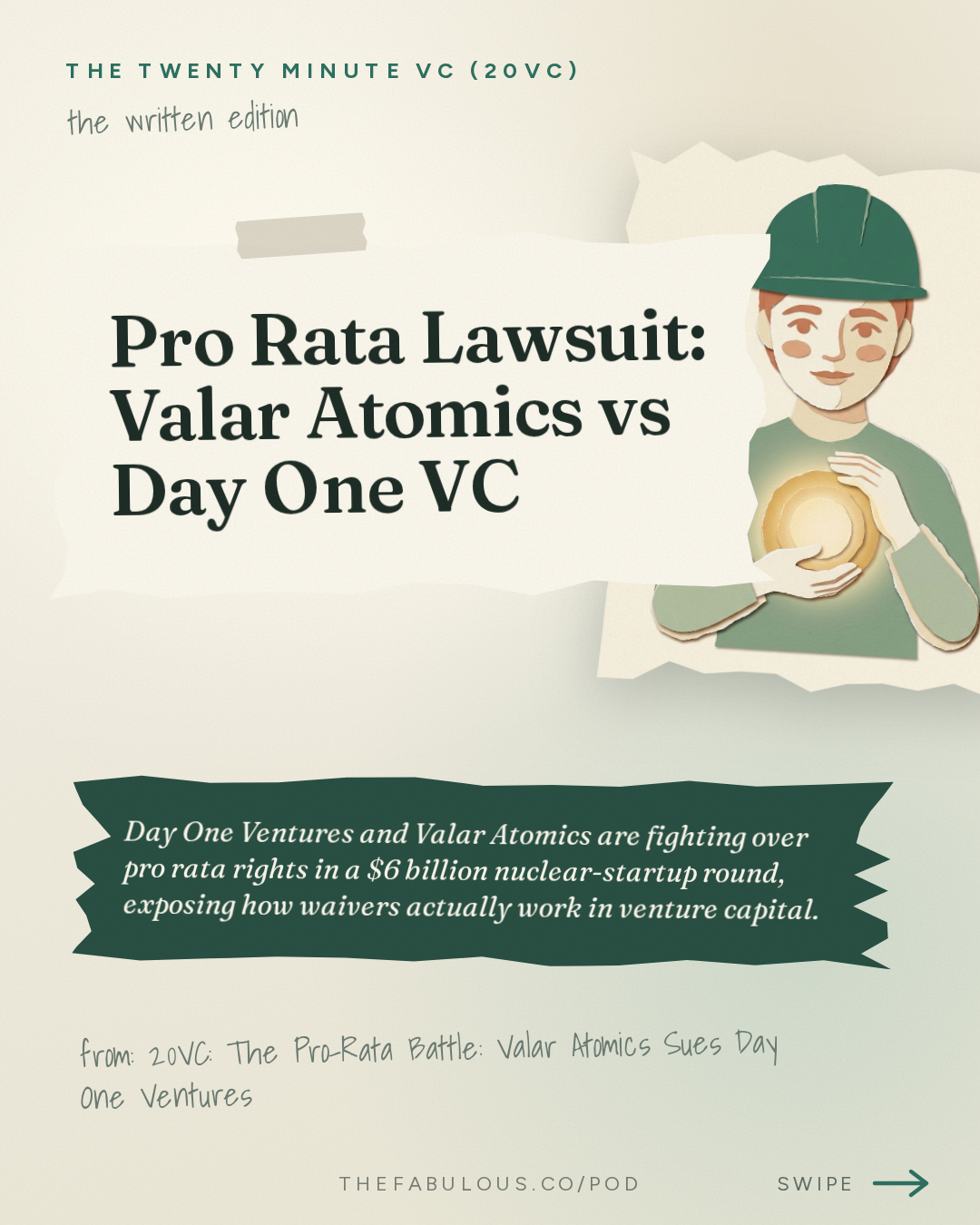
Pro Rata Lawsuit: Valar Atomics vs Day One VC
20VC: The Pro-Rata Battle: Valar Atomics Sues Day One Ventures | Meta Returns to the AI Frontier With Muse Wonder | NVIDIA Eyes $30B Reflection Deal & Jev Raises $870M at a $7.5B Valuation
The brief
Day One Ventures and Valar Atomics are fighting over pro rata rights in a $6 billion nuclear-startup round, exposing how waivers actually work in venture capital. The panel also covers Meta's new Muse Wonder model, NVIDIA's reported bid for Reflection, Jev's $870 million round, Anthropic's price cuts, and software's rising IPO bar.
Every venture capital term sheet contains a quiet act of faith. An early investor puts in money when a startup is unproven, and in exchange gets a right called pro rata: the option to keep buying enough of future rounds to hold onto that original percentage. The right usually sits unused in a drawer. This week it ended up in a lawsuit.
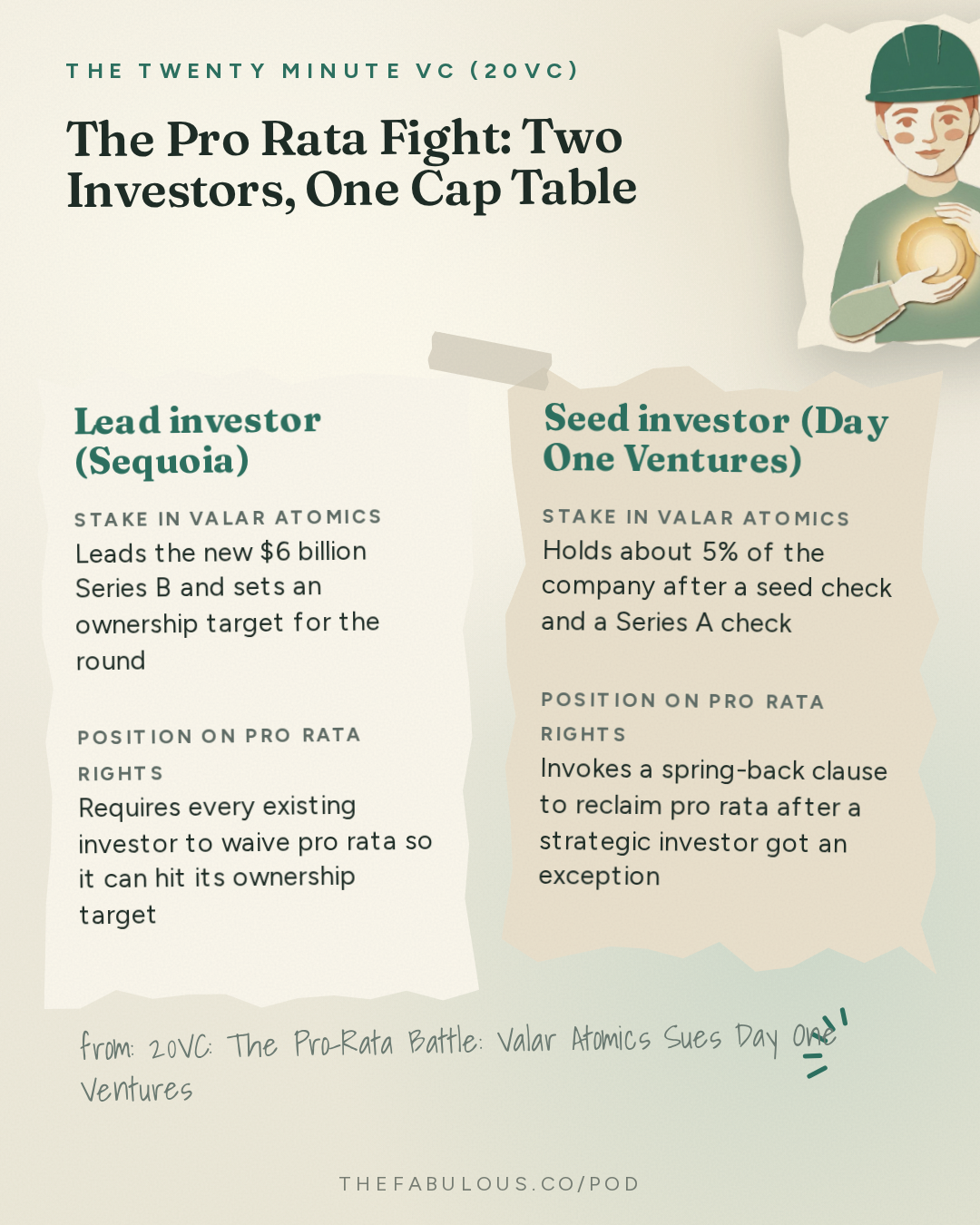
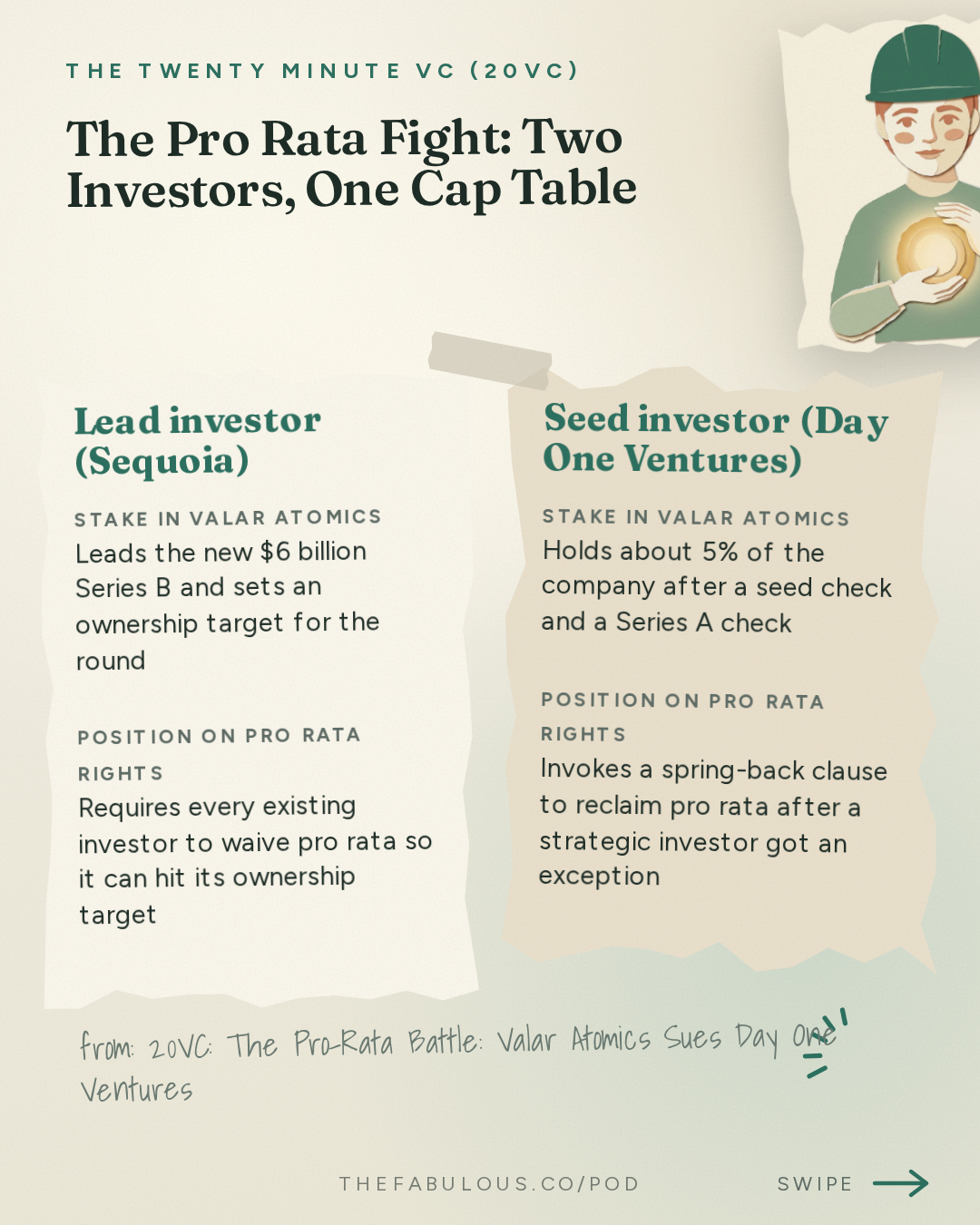
The startup is Valar Atomics, a nuclear energy company that just raised a Series B at a $6 billion valuation led by Sequoia Capital (04:07). The seed investor is Day One Ventures, a small fund that put in about one million dollars at seed and fifteen million more in the Series A, building a stake of roughly five percent (04:07). When the new round came together, the Valar CEO reportedly asked every existing investor to give up its pro rata rights, a common ask from big lead investors trying to hit an ownership target. Most agreed. Day One did not, and pointed to a so-called spring-back clause: if the company let one investor keep buying extra shares while asking everyone else to step back, the waiver was not really a fair vote, and the old rights should spring back. Valar has gone to court asking a judge to simply settle the question.
Investor Jason Lemkin, co-host of the show, called the dispute a wash. "I think everyone's wrong here," he said, pointing out that the CEO's public complaints about Day One looked ungrateful toward a fund that had bridged the company when nobody else would (12:15). But he was just as unimpressed by Day One's choice to hire the litigation firm Quinn Emanuel. His advice for any investor who feels shortchanged by a founder is blunt.
"It's not your company. It is not your cap table. The founders have to work at this company for 20 years; you just gotta get with the program." (Jason Lemkin, 08:03)
His co-host Rory O'Driscoll, a venture investor at Scale Venture Partners, made the more pointed observation: the math barely matters. Day One already waived its pro rata, so any spring-back is proportional only to whatever a new strategic investor puts in, likely a few million dollars on top of a stake already worth something like $300 million (12:34). Picking this fight, he suggested, risks a relationship for a rounding error.
The segment doubled as a small education in how power actually works on a cap table. A majority of investors can vote to waive pro rata for everyone, which is exactly what happens when a fund like Sequoia writes a term sheet demanding the whole round (10:59). Investor Keith Rabois once offered what Lemkin called the one honest answer to the debate: a fund willing to give up its own pro rata should, in theory, be willing to pay half the price upfront, since the right to buy more later has real value. Nobody, Lemkin noted, has ever taken him up on it (15:51).
A Supermodel Model, and NVIDIA Goes Shopping
Meta re-entered the AI frontier with a new model called Muse Wonder, which scores just behind Anthropic's Opus 5.5 on independent benchmarks (16:57). The catch: there is no external API yet, so outside developers cannot touch it (17:21). Rory O'Driscoll called the launch "the most performative eval," useful mostly for recruiting and morale rather than revenue, at least for now (17:21). Still, the panel credited Mark Zuckerberg's roughly $100 billion AI buildout, anchored by the hire of Scale AI founder Alex Wang, with putting Meta back in contention after it had faded from the closed-model race.
Meanwhile NVIDIA is reportedly circling Reflection, an open-source model startup backed by Sequoia last valued near $25 billion, at a price around $30 billion (20:11). Add that to NVIDIA's earlier purchase of the model startup Poolside for $12 billion, and a pattern appears: a chip company spending its enormous cash pile to keep more of the industry's money flowing toward open models rather than toward the closed, proprietary labs that compete with its own ambitions (20:59). As Lemkin put it, describing the pitch NVIDIA makes to startups it courts, it is "a little scary" to say no to a buyer that will simply go fund your competitor instead (22:22).
The clearest sign of how much money is chasing a small number of outcomes showed up in the hour's biggest number. Jev, an AI classifier tool built by parent company TypeSafe, raised an $870 million Series A at a $7.5 billion valuation just weeks after launching, led by Andreessen Horowitz with Sequoia also participating (25:35). Lemkin, running the show's recurring "investment committee" bit, argued the price was already stale and that usage had quadrupled since the round closed. His summary of why a firm would chase a round like this, with competition already circling from Cloudflare, OpenAI, and Amazon, doubled as a summary of how the biggest funds think these days.
"Not every winner wins, but you can only win by being in the winners." (Jason Lemkin, 26:42)
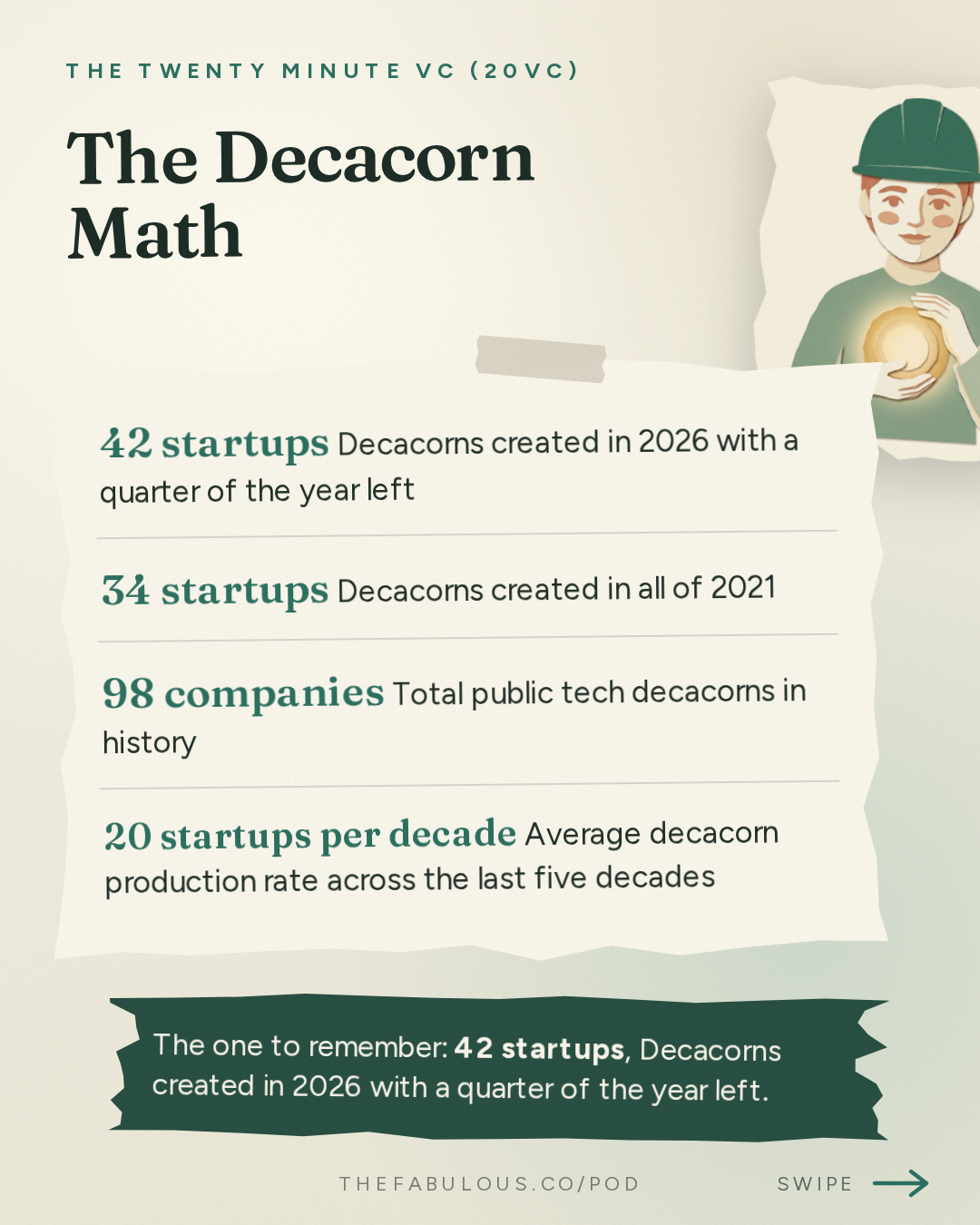
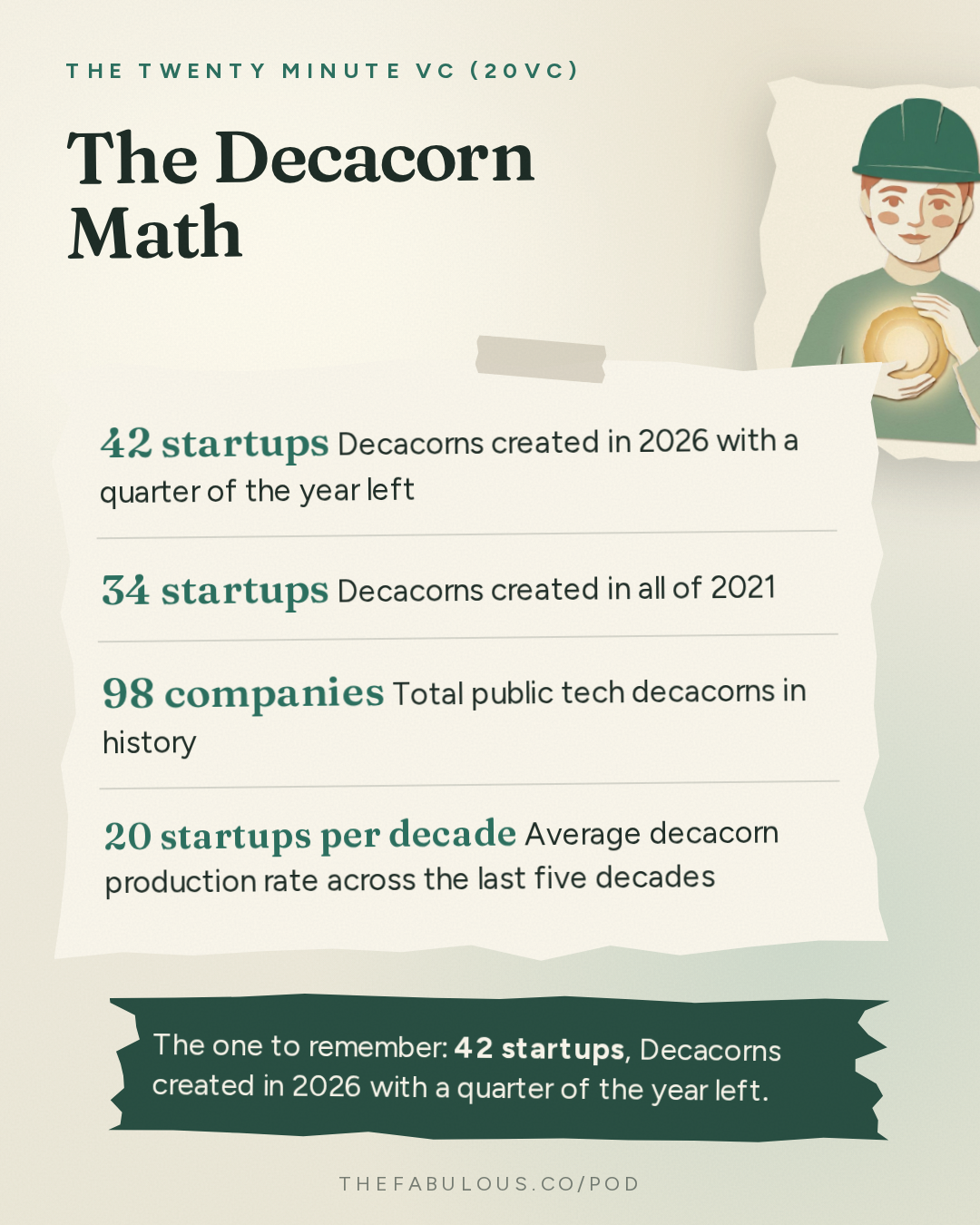
That logic also explains the stranger number of the episode: 2026 has produced 42 "decacorns," startups worth $10 billion or more, with a quarter of the year still to go (31:41). For comparison, the industry averaged roughly 20 such companies per decade across the last five decades, and there have been only 98 public decacorns in history (32:30). Asked directly whether this looks like a bubble, O'Driscoll reached for the mechanism that makes high prices feel survivable to the people paying them: a liquidation preference, the contractual right to get invested money back first in a down outcome.
"Once you have a liquidation preference and you believe it exists, you can say to yourself it's a 1X plus option value." (Rory O'Driscoll, 33:41)
In other words, a private valuation is not really a bet on what a company is worth today. It is a bet with a floor, as long as somebody is willing to buy the company for at least what was paid, wrapped around an upside that resembles an option on an industry that keeps producing more outsized outcomes than anyone predicted.
From Replacing Labor to Discovering Drugs
The clearest example of AI chasing something other than office labor is Isomorphic Labs, the drug discovery company founded by Google DeepMind chief Demis Hassabis, reportedly in talks to raise at a $40 billion to $50 billion valuation just months after a round near $10 billion from Thrive Capital (36:33). O'Driscoll framed the opportunity in terms of where the money actually comes from: automating the scientists who do drug discovery does not generate much value, because science salaries are a small line item. The real prize is owning a royalty on a drug that might sell for $200 billion over its lifetime (37:28). Lemkin, who says he was skeptical of longevity science until recently, has come around on the broader promise of GLP-1 class weight-loss and metabolic drugs and whatever comes after them.
"We're going from weirdos microdosing to finding out we're all gonna have a set of drugs that dramatically extend longevity and quality of life." (Jason Lemkin, 38:45)
The same optimism about underlying technology showed up, with more caution, in a conversation about pricing. Anthropic cut the price of its Haiku model by roughly 90 percent (45:44), and its Sonnet 5.5 model became twice as fast while costing only about 10 percent less than its predecessor (48:02). Lemkin called this the first real sign of deflation in AI, after a year in which falling token prices were offset by fast-rising usage. The bet underneath the price cuts is that demand is elastic enough to make up the difference in volume, a bet that should show up soon in Anthropic's own revenue disclosures.
That same scale obsession runs through the closing argument of the episode, about what it now takes for a software company to go public. A few years ago $500 million in annual recurring revenue felt like a plausible IPO threshold. Lemkin argued the bar has moved.
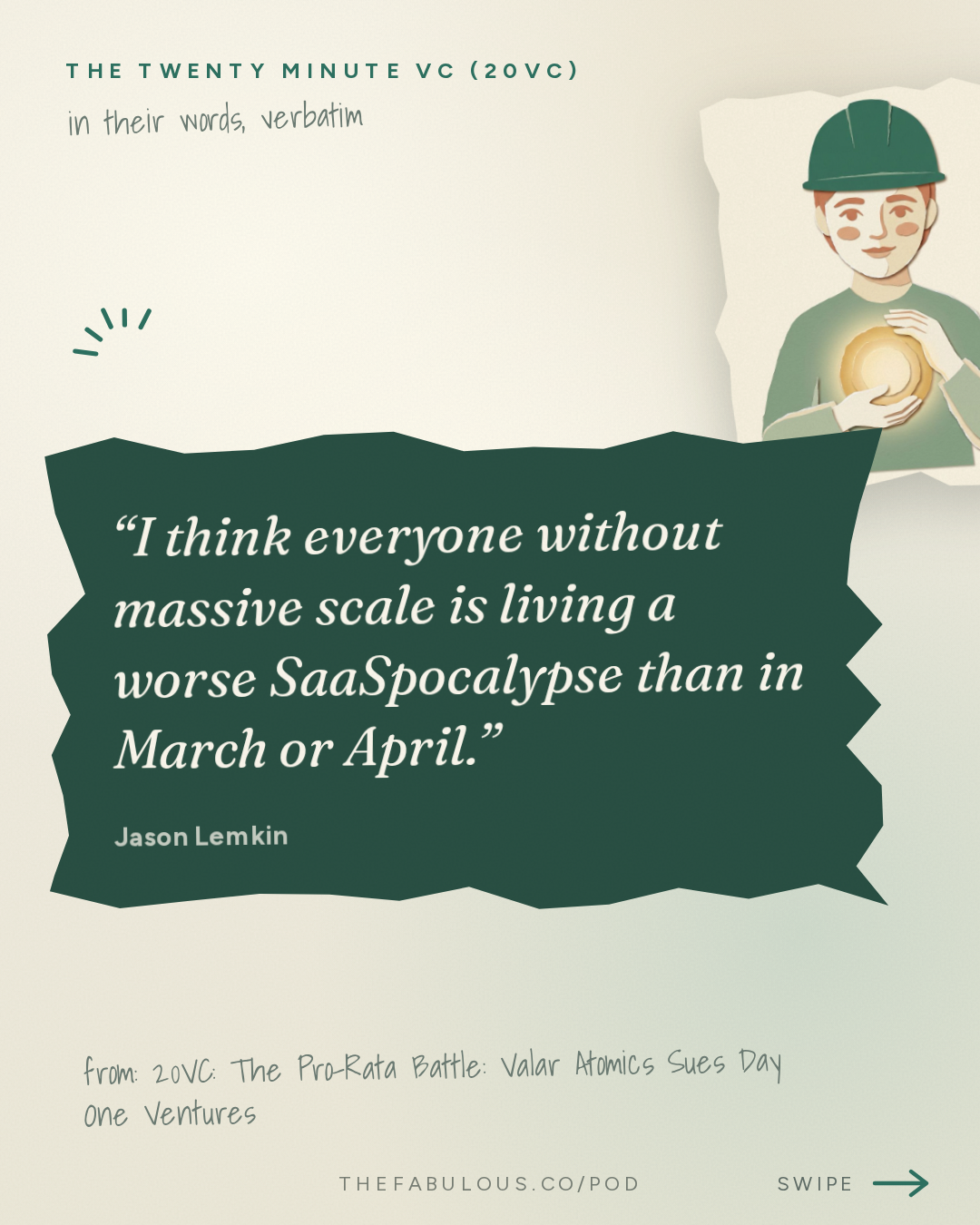
"I think everyone without massive scale is living a worse SaaSpocalypse than in March or April." (Jason Lemkin, 61:58)
The Nasdaq is up 22 percent this year and software stocks broadly have recovered from their spring lows, but Lemkin's point is that the recovery only reached companies with massive scale, north of a billion dollars in revenue. Everyone else, he argues, now needs something like $1.5 billion to $2 billion in ARR to be considered a safe public offering (62:57), a bar high enough that most midsize software companies are left to either sell, consolidate, or grind quietly toward relevance. The pro rata lawsuit, the decacorn count, and the rising IPO bar are, in the end, versions of the same story: in a market this concentrated, being almost big enough is no longer a strategy.
Ask this episode anything
Pod's AI answers from the episode itself, with the minute mark so you can hear it yourself.
Or start with one of these
Ask this episode
Pod's AI listens to the whole episode to answer, and points you to the minute it comes from.
The rest of this answer, and any question after it
Answers come from the episode itself, never from a summary of it.
ContinueKey takeaways
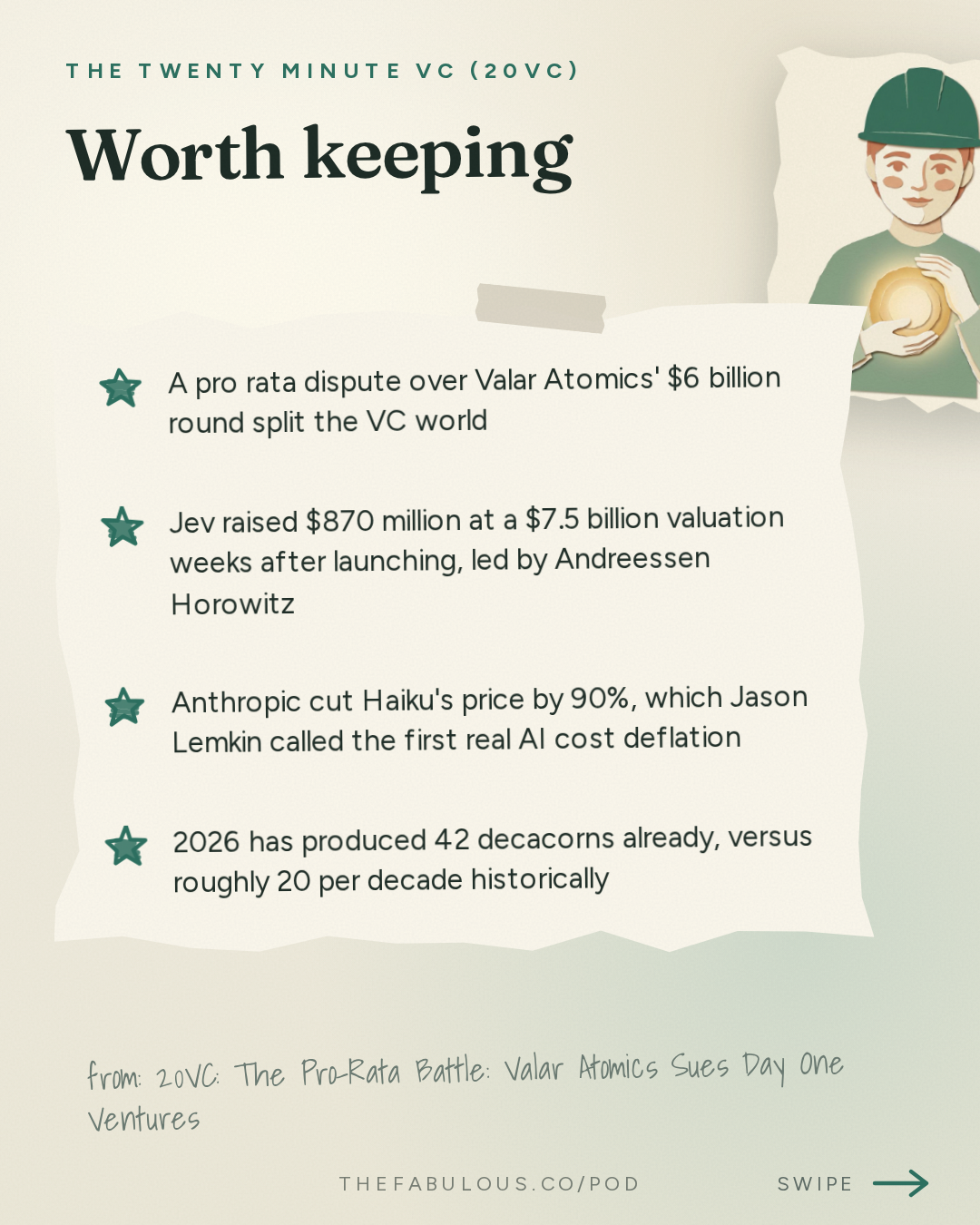
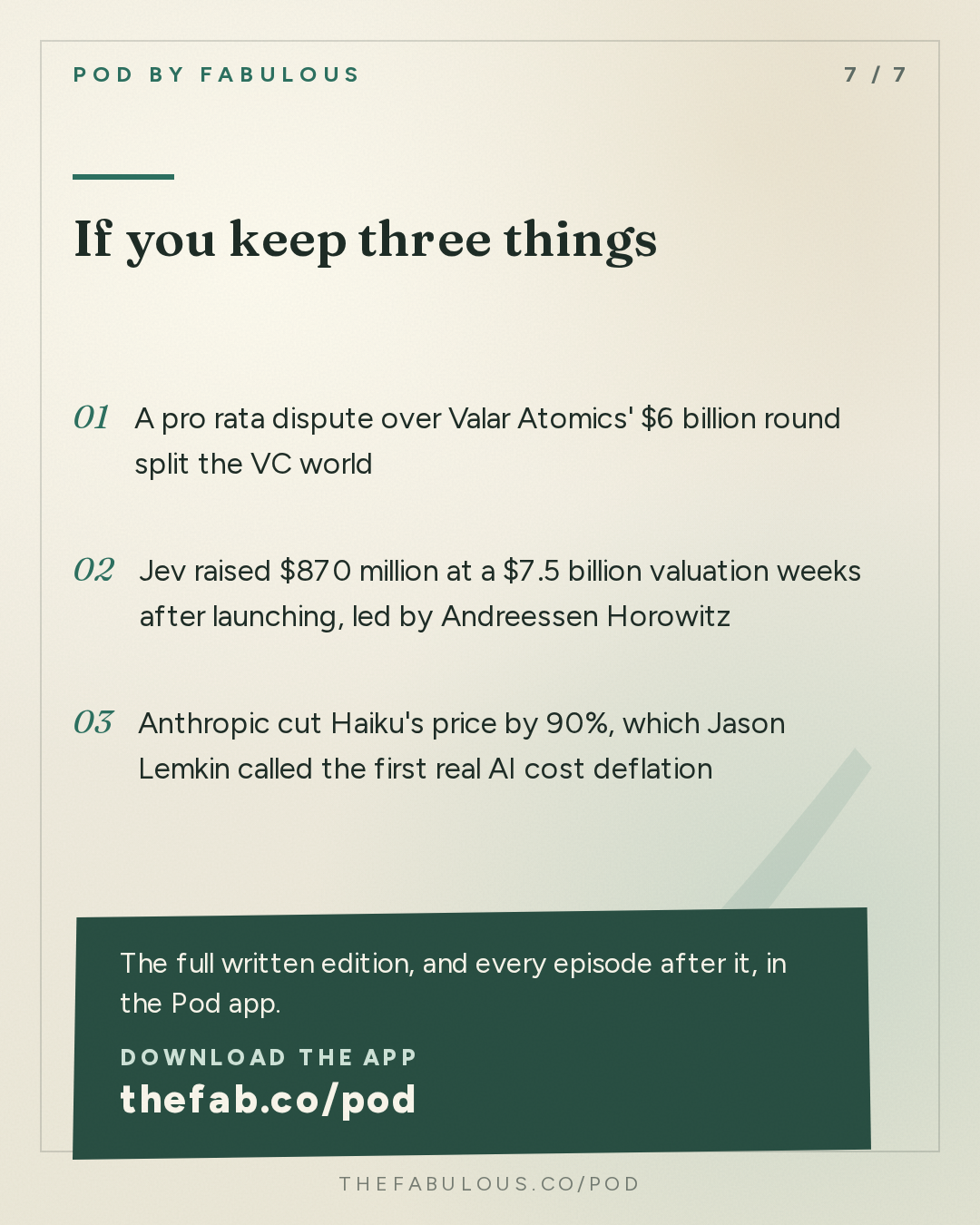
- A pro rata dispute over Valar Atomics' $6 billion round split the VC world
- Jev raised $870 million at a $7.5 billion valuation weeks after launching, led by Andreessen Horowitz
- Anthropic cut Haiku's price by 90%, which Jason Lemkin called the first real AI cost deflation
- 2026 has produced 42 decacorns already, versus roughly 20 per decade historically
- A safe software IPO may now require $1.5 billion to $2 billion in ARR, up from $500 million
The episode in cards
By the numbers
- 90% Price cut applied to Anthropic's Haiku model
- 42 startups Decacorns created in 2026 so far, versus about 20 per decade historically
In their words
“Not every winner wins, but you can only win by being in the winners.”
“I think everyone without massive scale is living a worse SaaSpocalypse than in March or April.”
Questions this episode answers
What is the Valar Atomics pro rata lawsuit about?
Nuclear energy startup Valar Atomics is asking a court to resolve a dispute with its seed investor, Day One Ventures, after Day One refused to waive its pro rata rights in a $6 billion Series B led by Sequoia Capital (04:07). Day One argues a spring-back clause restores its rights because another investor got an exception to the waiver (05:25).
What does pro rata mean in venture capital?
Pro rata is the right for an early investor to buy enough shares in later rounds to keep its original ownership percentage (04:37). A majority of investors on a cap table can typically vote to waive that right for everyone, which is what big lead investors often require before funding a round (10:59).
How much did Jev raise and at what valuation?
Jev's parent company, TypeSafe, raised an $870 million Series A at a $7.5 billion valuation just weeks after the product launched, led by Andreessen Horowitz with Sequoia Capital also participating (25:35). Investor Jason Lemkin said usage had already quadrupled since the deal was signed (26:08).
Why did Anthropic cut the price of its Haiku model by 90 percent?
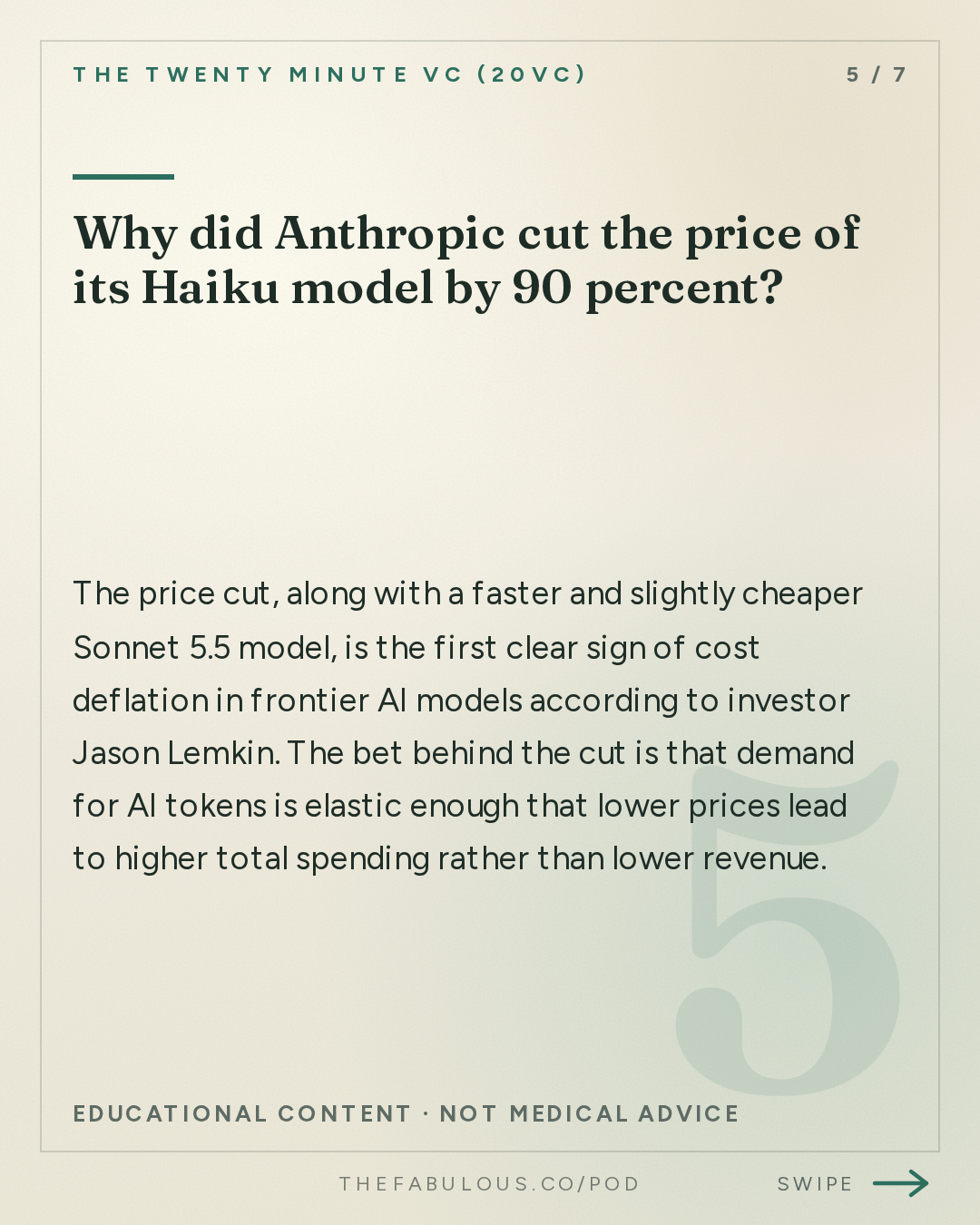
The price cut, along with a faster and slightly cheaper Sonnet 5.5 model, is the first clear sign of cost deflation in frontier AI models according to investor Jason Lemkin (45:44). The bet behind the cut is that demand for AI tokens is elastic enough that lower prices lead to higher total spending rather than lower revenue (49:00).
How much ARR does a software company need to IPO safely now?
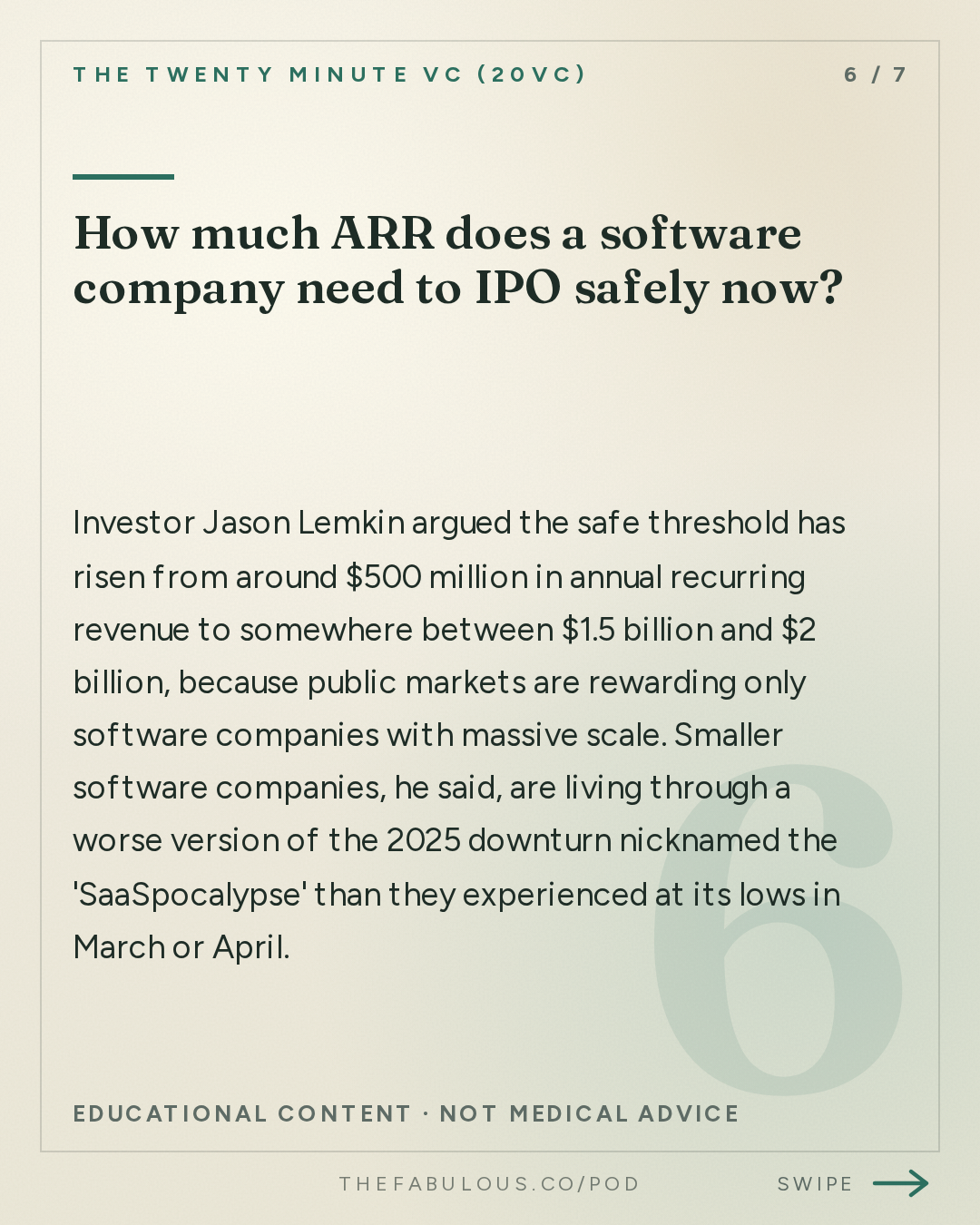
Investor Jason Lemkin argued the safe threshold has risen from around $500 million in annual recurring revenue to somewhere between $1.5 billion and $2 billion, because public markets are rewarding only software companies with massive scale (62:57). Smaller software companies, he said, are living through a worse version of the 2025 downturn nicknamed the 'SaaSpocalypse' than they experienced at its lows in March or April (61:58).
The full read, in cards
Mentioned
Valar Atomics · Day One Ventures · Sequoia Capital · Jev · Demis Hassabis · Isomorphic Labs · Bending Spoons · Anthropic · Flock Safety · NVIDIA
More from this show and category

Mike Cannon-Brookes on Atlassian's AI Strategy
Atlassian CEO Mike Cannon-Brookes argues design, not agents, decides AI-era winners, so Atlassian keeps investing in interfaces rather than going headless. He also says enterprises increasingly reject Chinese AI models even as they embrace open weights, and doubts most "specialized models" are just fine-tuned versions of them.

Ramp's Sales Playbook: Max Freeman's Hiring Secrets
Ramp SVP of Sales Max Freeman breaks down how Ramp built its sales machine by hiring investment bankers and sellers from high-growth, low-NPS companies. He pays SDRs double market rate for 4 to 6 times standard output and automates outbound research down to 90 seconds per lead.

OpenAI's $70B Run Rate and the AI Deal Wars
OpenAI's revenue run rate is nearing $70 billion, re-accelerating sharply just as Anthropic prepares to go public. The episode also unpacks a Cognition-Factory executive poaching dispute, Vinod Khosla's public swipe at a portfolio founder, ElevenLabs' jump to a $22 billion valuation, Salesforce's $2 billion purchase of Listen Labs, and legal risk in Nvidia's $17 billion Groq license deal.

Venky Ganesan on AI Venture Capital Ownership
Menlo Ventures partner Venky Ganesan says AI seed rounds now run $10-20 million, and ownership matters less than owning a sliver of a giant. Drawing on 28 years in venture capital, he argues investors should expect 60% dilution by exit, cap single-company bets near 20% of a fund, and chase cash returns over paper markups.
