
Is Venture Capital Broken? Billion-Dollar Math
20VC: Trillion or Bust: The New VC Game | Coreweave Sell-Off Creates Panic | Town at $1B, Anduril at $90B: Revenue Multiples Out of Control | General Atlantic Eyes IPO & Modal Raises $750M at $15.75B
The brief
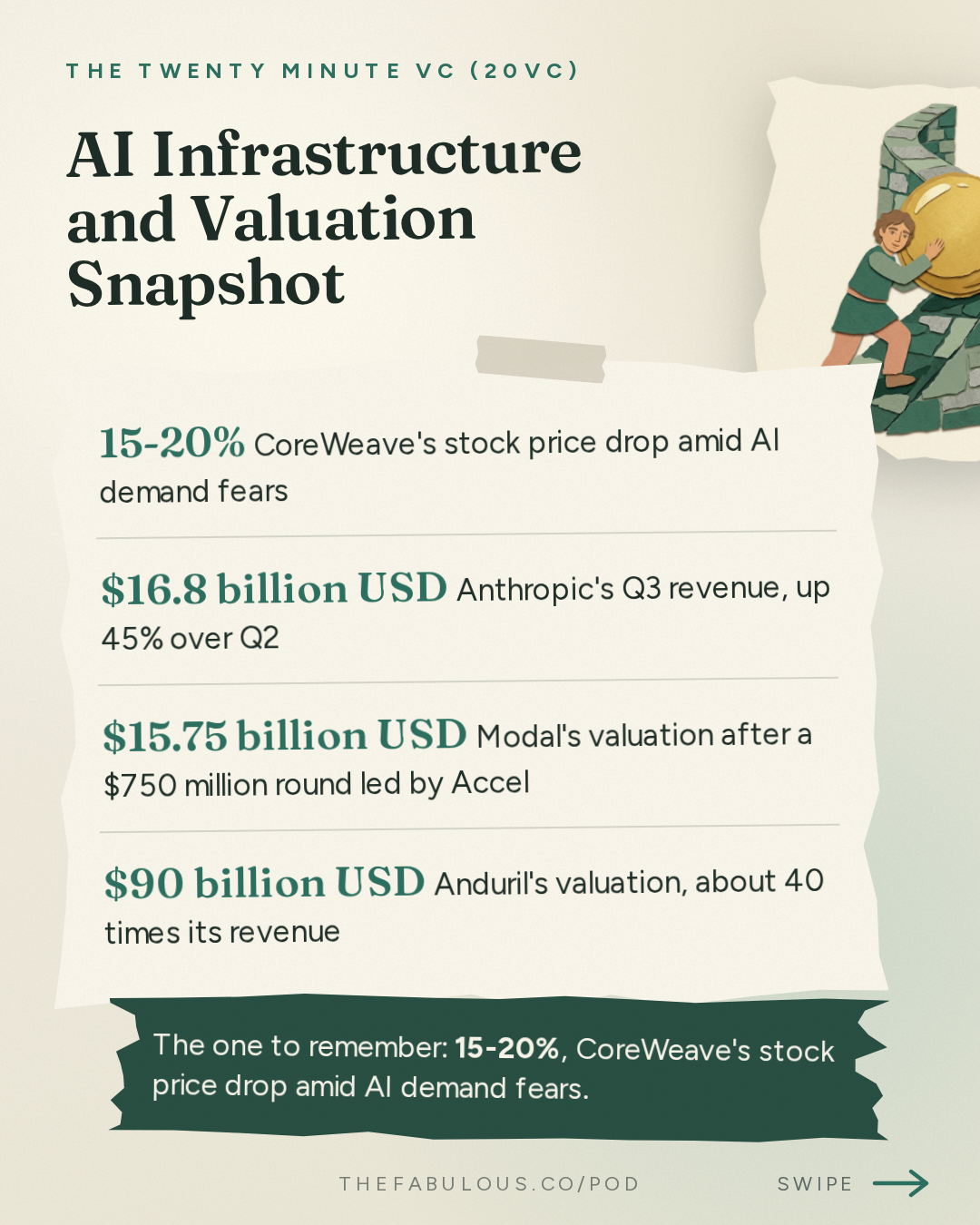
Venture capital has split into two games: mega-funds need billion-dollar stakes in a handful of AI giants, while strong smaller startups go unfunded. CoreWeave slid 15-20% on AI demand fears (13:35), Anthropic posted $16.8B in Q3 revenue (19:07), Modal raised $750M at $15.75B (32:03), and Anduril trades near 40 times revenue at a $90B valuation (38:44).
Picture a software company doing $20 million a year in revenue, growing incredibly fast, and already 600 to 700 percent profitable. A decade ago, that company would have had term sheets by lunch. Today, it got nothing. Host Harry Stebbings described meeting exactly this founder and watching top venture firms shrug.
"I think venture is broken today... I have a company that's 20 million in ARR, growing incredibly fast, 600, 700% profitable. Brilliant business with a great team. Crickets. VCs do not want it." — Harry Stebbings [04:47]
ARR, or annual recurring revenue, used to be the whole conversation. Hit the right growth rate and the right margin, and a check followed. On this episode of The Twenty Minute VC, venture investors Rory O'Driscoll and Jason Lemkin, the founder and investor behind SaaStr, try to explain why that stopped working, and what replaced it: a search for a small number of companies big enough to move a giant fund's returns on their own.
The Billion-Dollar Floor
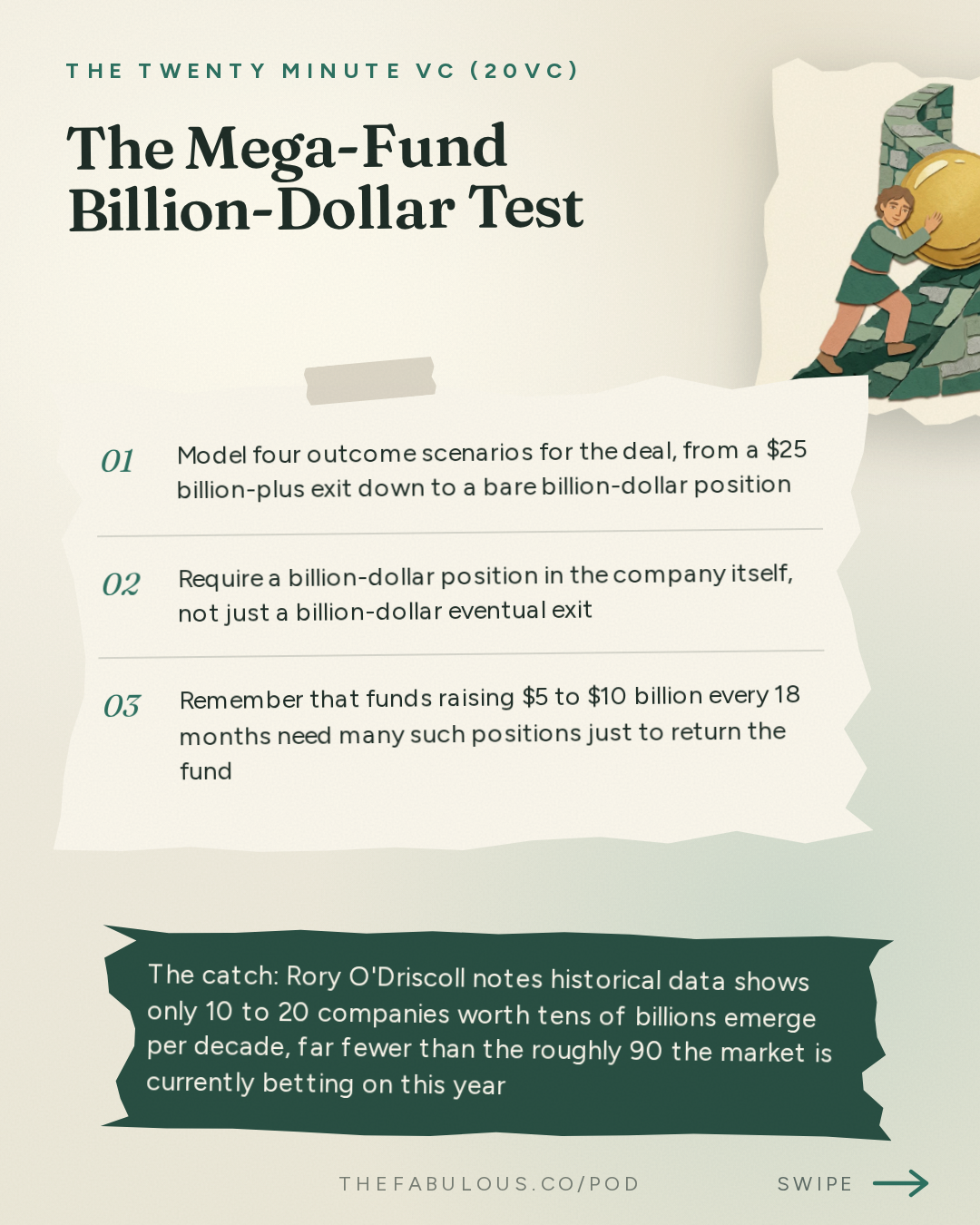
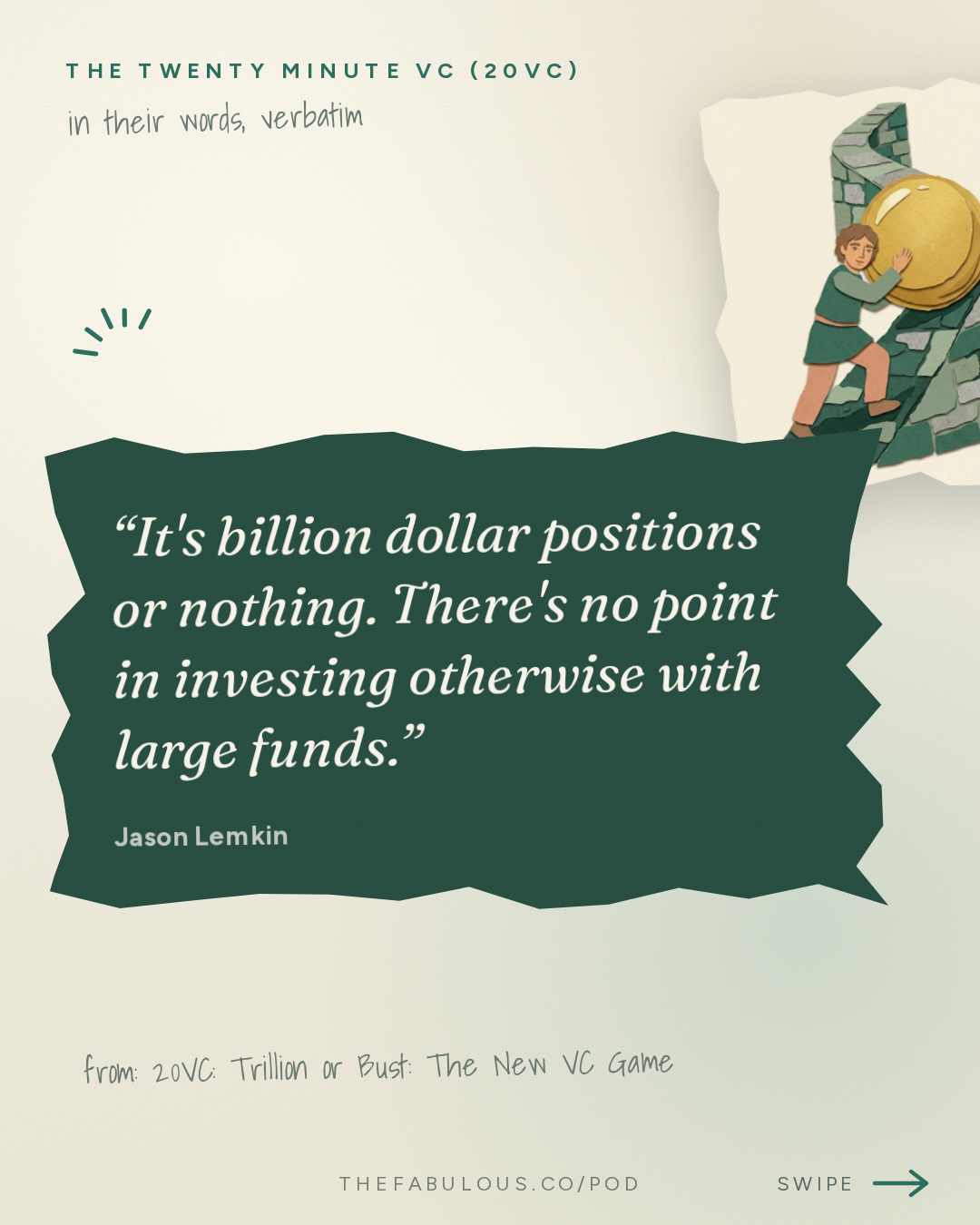
Lemkin lays out the math bluntly. A fund raising five to ten billion dollars every eighteen months cannot afford to care about a company that might sell for a few hundred million. It needs positions worth a billion dollars each, repeatedly, just to return the fund.
"It's billion dollar positions or nothing. There's no point in investing otherwise with large funds." — Jason Lemkin [09:21]
That logic explains why a seed round priced at 50 to 100 million dollars is now, in Lemkin's words, nearly impossible to make money from (11:32): the entry price is too high, mega-funds crowd in and shrink everyone else's allocation, and a small check into a huge valuation barely moves a portfolio. O'Driscoll pushes back a little. He notes that history shows only ten to twenty companies worth tens of billions get created in the US each decade, and the industry is currently betting on ninety of them this year (09:41). Somebody's math is wrong.
The flip side of that same instinct shows up in public markets. CoreWeave, a company that rents out Nvidia chips to AI labs, dropped 15 to 20 percent in a single week as investors worried AI demand might be slowing (13:35). O'Driscoll calls these companies "neoclouds": businesses borrowing tens of billions of dollars to build data centers, which makes them fragile the moment growth even looks like it is decelerating (13:44). Lemkin is blunter about where that leaves them in the pecking order.
"Compared to NVIDIA, we're all fucking B-tier assets. How about that?" — Jason Lemkin [00:20]
His point: CoreWeave and Oracle exist because Nvidia and the big model makers need extra capacity for now, not because they own anything unique. B-tier assets, he argues, should trade at a discount and swing harder on every scrap of news, which is exactly what happened.
Anthropic supplied that scrap of news. The AI lab reported Q3 revenue of $16.8 billion, up 45 percent over the prior quarter, with an 85 percent gross margin, meaning it keeps 85 cents of every revenue dollar after direct costs (19:07). Growth is slowing from an unsustainable pace, Rory O'Driscoll notes: triple-digit growth off a $10 billion run rate simply cannot continue forever. Chamath Palihapitiya had reportedly floated the idea that Anthropic should raise at whatever price gets the round done rather than optimize for a round number, and the market chatter shifted the rumored IPO price from $2 trillion down to $1.5 trillion (20:19). Both investors agree the company is extraordinary. Their worry is how much of today's market share survives contact with OpenAI, open-weight models, and new entrants a year from now.
That same uncertainty showed up when Replit, the coding platform, quietly switched its default AI model from Anthropic's Claude to OpenAI because the quality was comparable at 30 to 40 percent lower cost (24:41). Lemkin, a heavy daily user of these tools, argues the real opportunity isn't writing code anymore, since large language models already generate code quickly. The bottleneck is turning that code into something safe to ship.
"I actually think code review is the single most important category today in software." — Jason Lemkin [29:37]
He calls it "build to prod": the gap between a feature that works in a demo and one that survives in production. That gap, he argues, is where the next wave of software value gets created, even if it never produces a company worth hundreds of billions of dollars on its own (31:41).
Money is already flowing into the infrastructure underneath that gap. Modal, a cloud platform for running AI workloads, closed a $750 million round led by investment firm Accel at a $15.75 billion valuation, with its revenue run rate just crossing a billion dollars (32:03). O'Driscoll frames the opportunity in context: the handful of leading inference providers (companies that run AI models for other businesses) together generate only $5 to $6 billion in run-rate revenue, while OpenAI and Anthropic alone bring in over $100 billion combined. Inference captures less than 5 percent of that total today (33:25), which both investors read as room to grow rather than a sign the market is already full.
Not every number in this episode holds together as neatly. Defense technology company Anduril is valued at $90 billion, which O'Driscoll and Lemkin estimate is roughly 40 times its revenue (38:44). Compare that to public software leaders like HubSpot and Klaviyo, both trading around 2 to 3 times revenue despite growing more than 20 percent a year (39:23). Lemkin's conclusion is almost an admission against interest, given his own business: "We are just taking revenue multiples too far today" (41:19 paraphrase of 39:44). The justification for Anduril, O'Driscoll says, rests entirely on betting its growth rate holds for years, not on what the business is worth today.
The Other Path
Not every company in the episode is playing that game. Berkshire Hathaway, Warren Buffett's holding company, bought $330 million more in shares of Bending Spoons, an Italian company that buys aging software products like Evernote and Vimeo and runs them for cash rather than growth. Lemkin thinks the comparison to Berkshire is earned.
"Bending Spoons is like the Berkshire version of software, right?" — Jason Lemkin [42:59]
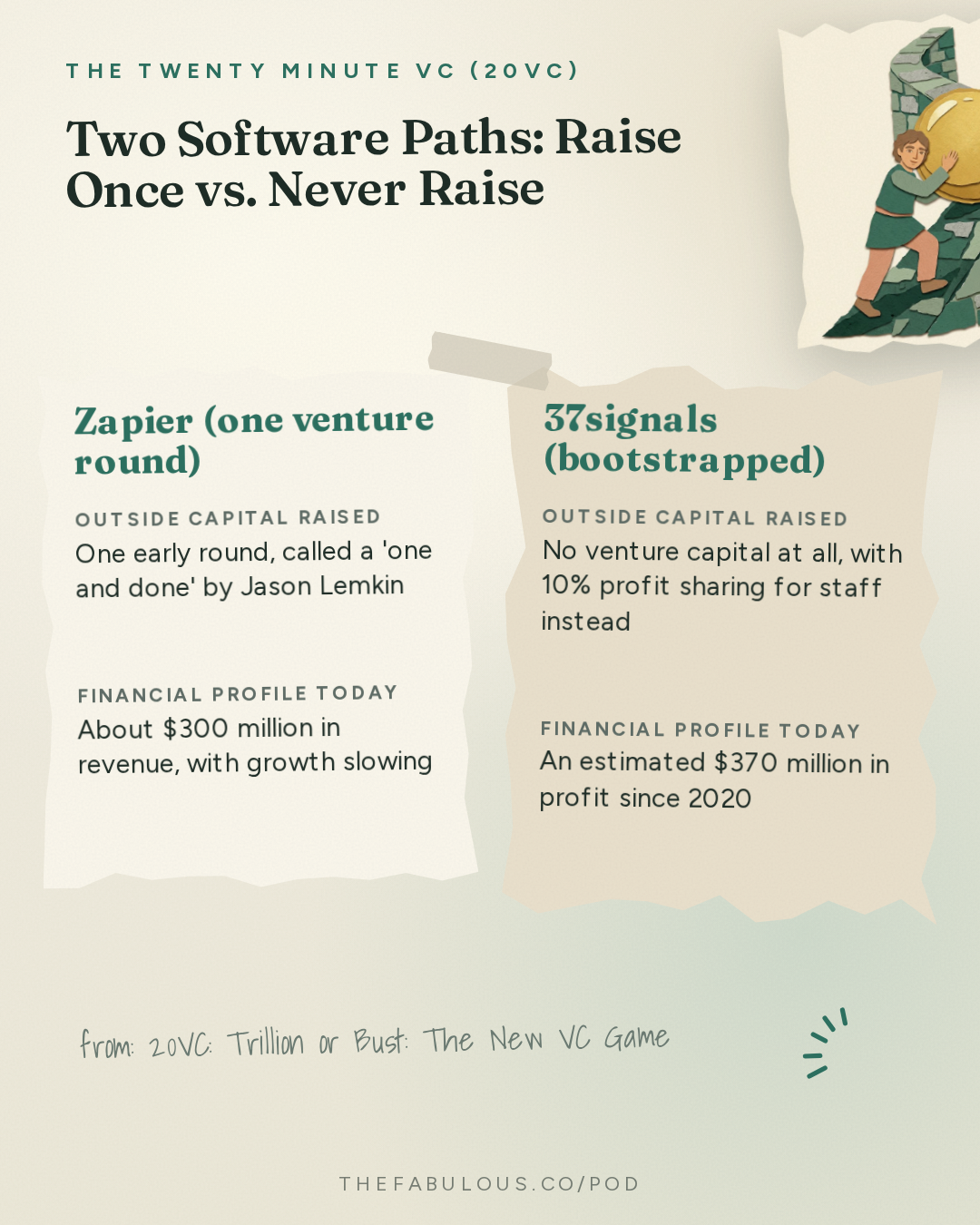
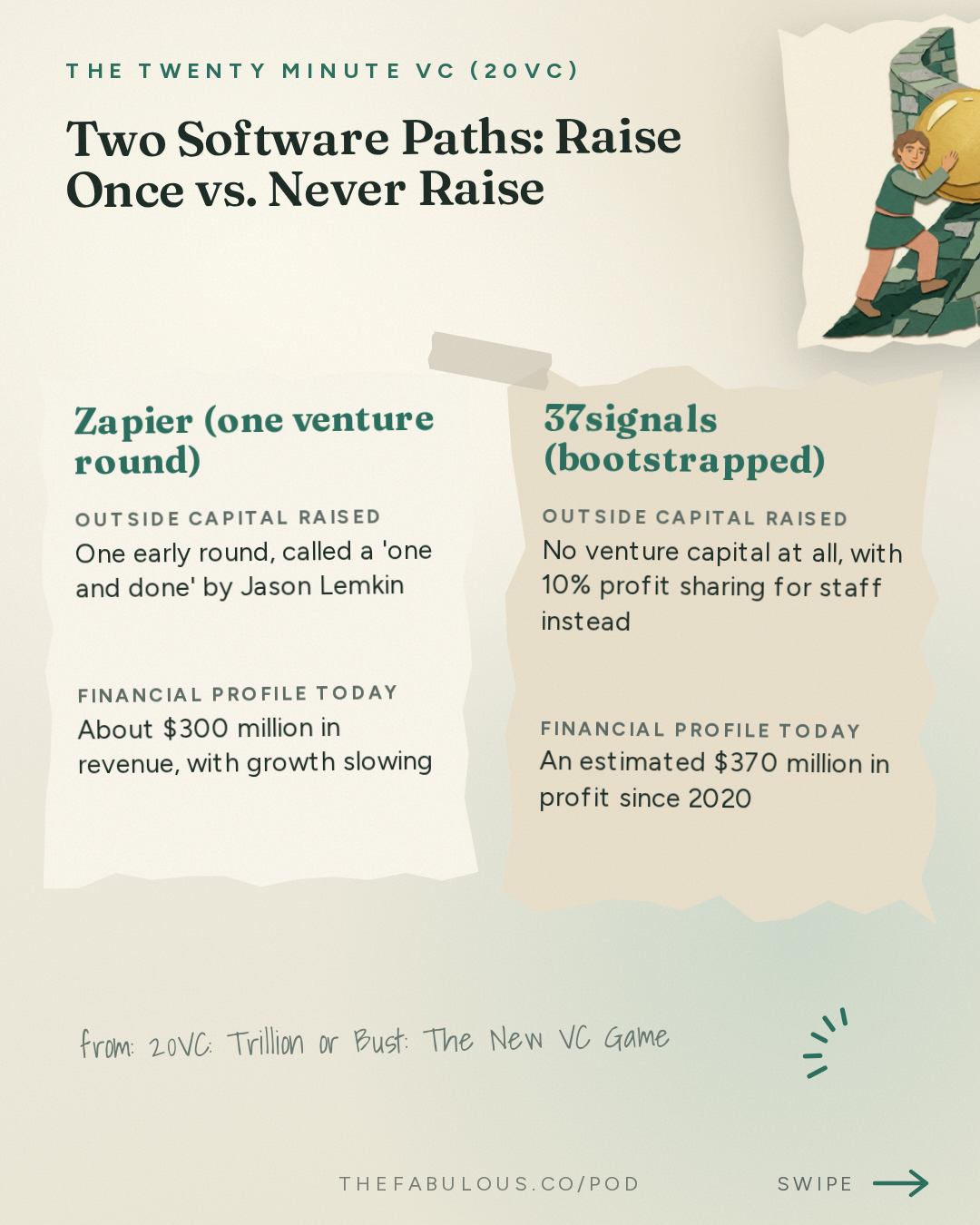
Then there is 37signals, the bootstrapped maker of Basecamp, which has generated an estimated $370 million in profit since 2020 without ever taking venture money, instead running a 10 percent profit-sharing plan with employees (45:08). Lemkin contrasts this with automation company Zapier, which raised one early round and reached roughly $300 million in revenue but will probably never go public. He calls Zapier's path "one and done" and argues the better model now is "none and done": skip venture funding entirely, because once a company takes outside investors, it becomes hard to pay out profits as cash rather than reinvesting for growth (46:48).
That same capital math decides whether venture firms themselves can go public. O'Driscoll estimates a firm needs roughly $800 million to $1 billion in annual fee income, the money a firm earns for managing other people's capital, before an IPO produces a market value that matters (49:11). That implies tens of billions of dollars under management. Few firms clear that bar, which is why General Atlantic's move toward an IPO is notable rather than routine.
The episode closes on Harvard University's endowment, which returned 27.1 percent on $68 billion in assets, helped by a SpaceX stake worth about $2.2 billion (52:14). Both investors note that a handful of concentrated bets, SpaceX, Anthropic, OpenAI, are now responsible for an outsized share of institutional returns, which both predicts more capital flowing back into venture and explains why Elon Musk's showmanship, like distributing a SpaceX share into every child's new savings account, functions as marketing that protects his companies' valuations by turning critics into shareholders (55:16).
What ties these stories together is not AI hype exactly. It's a market where capital has sorted itself into extremes: a small set of businesses large enough to justify billion-dollar bets, and everyone else, who increasingly have to decide whether to chase that tier, settle for being B-tier, or opt out of the venture game altogether and just keep the cash.
Ask this episode anything
Pod's AI answers from the episode itself, with the minute mark so you can hear it yourself.
Or start with one of these
Ask this episode
Pod's AI listens to the whole episode to answer, and points you to the minute it comes from.
The rest of this answer, and any question after it
Answers come from the episode itself, never from a summary of it.
ContinueKey takeaways
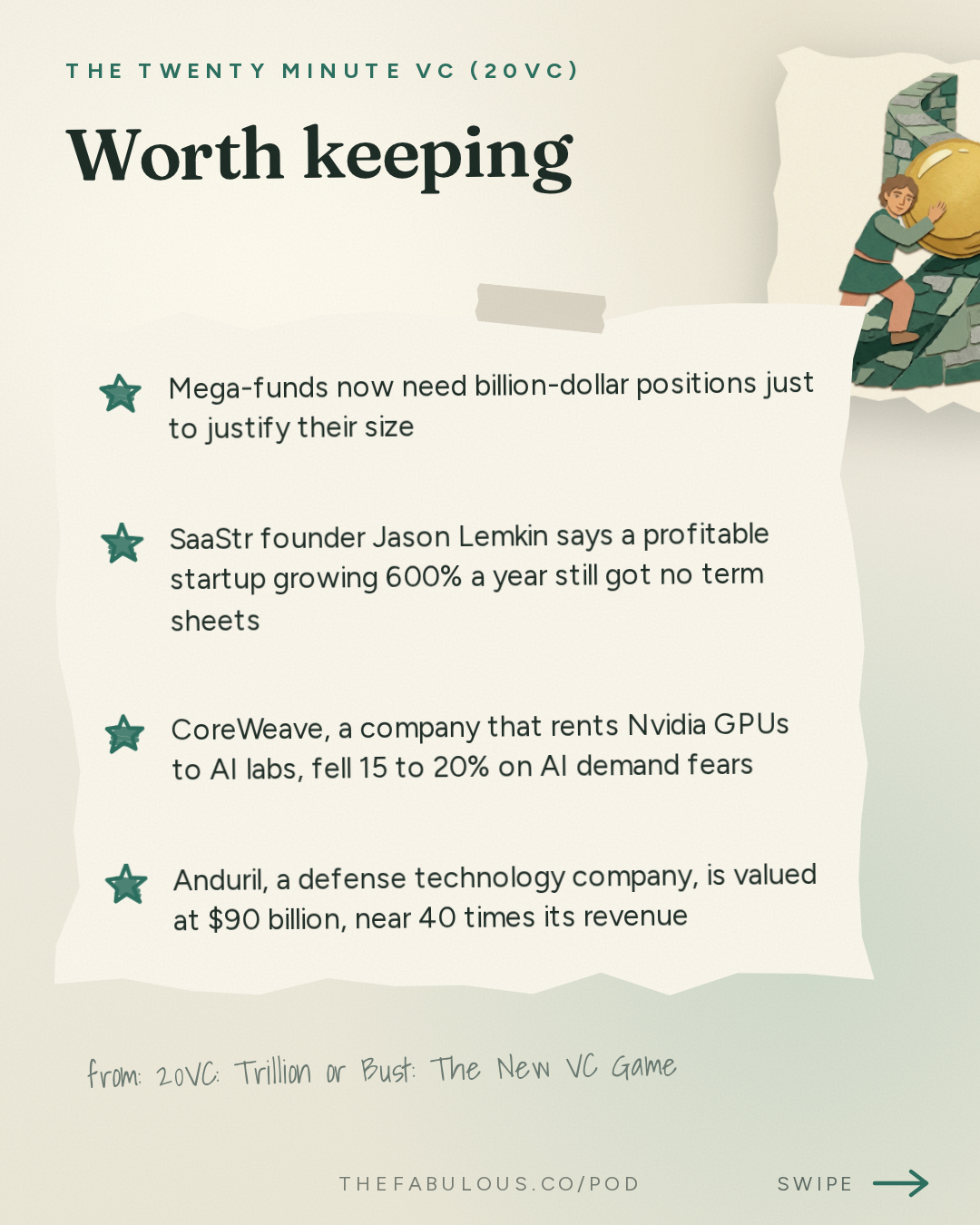
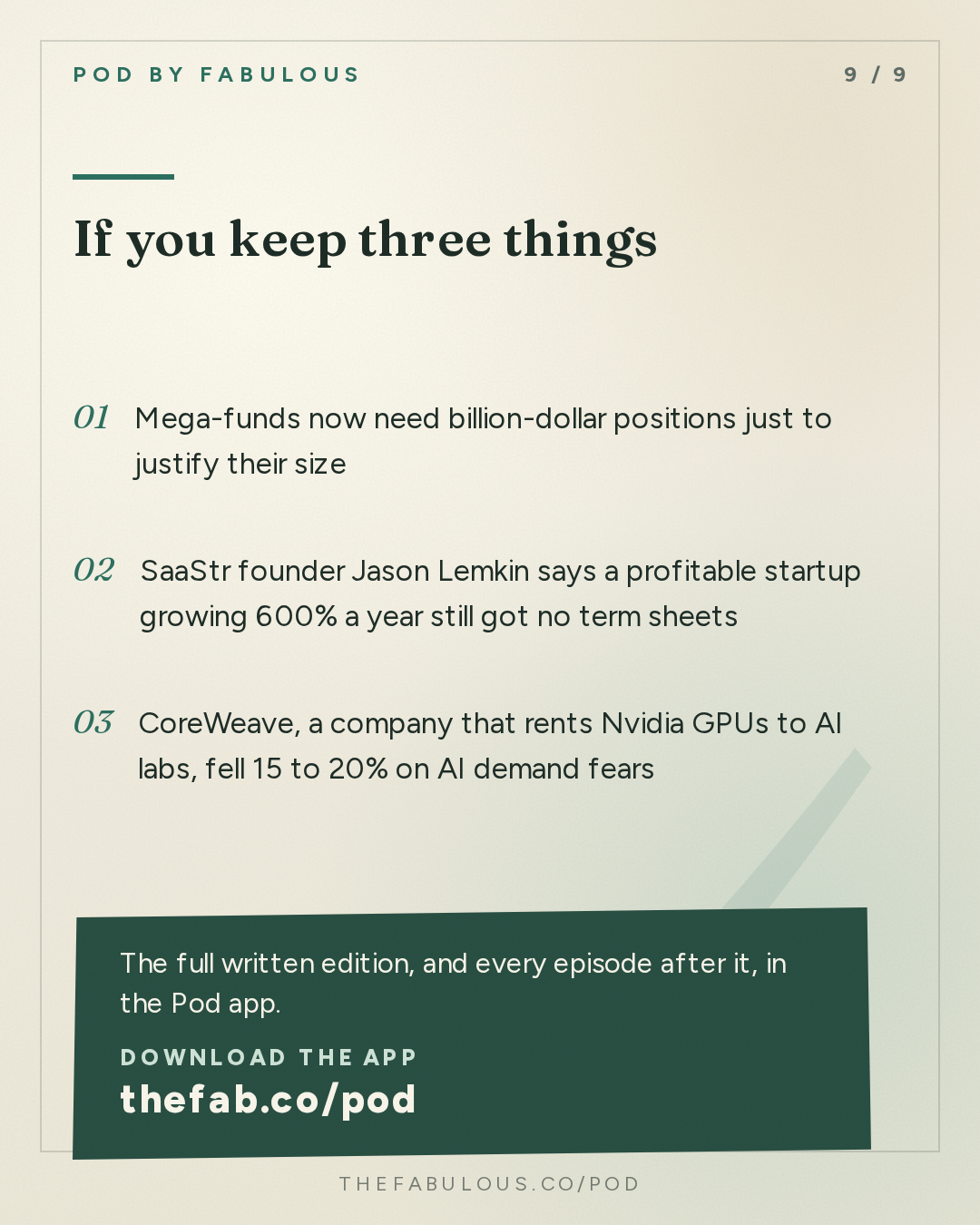
- Mega-funds now need billion-dollar positions just to justify their size
- SaaStr founder Jason Lemkin says a profitable startup growing 600% a year still got no term sheets
- CoreWeave, a company that rents Nvidia GPUs to AI labs, fell 15 to 20% on AI demand fears
- Anduril, a defense technology company, is valued at $90 billion, near 40 times its revenue
- 37signals, a bootstrapped software company, made $370 million in profit since 2020 without VC money
The episode in cards
By the numbers
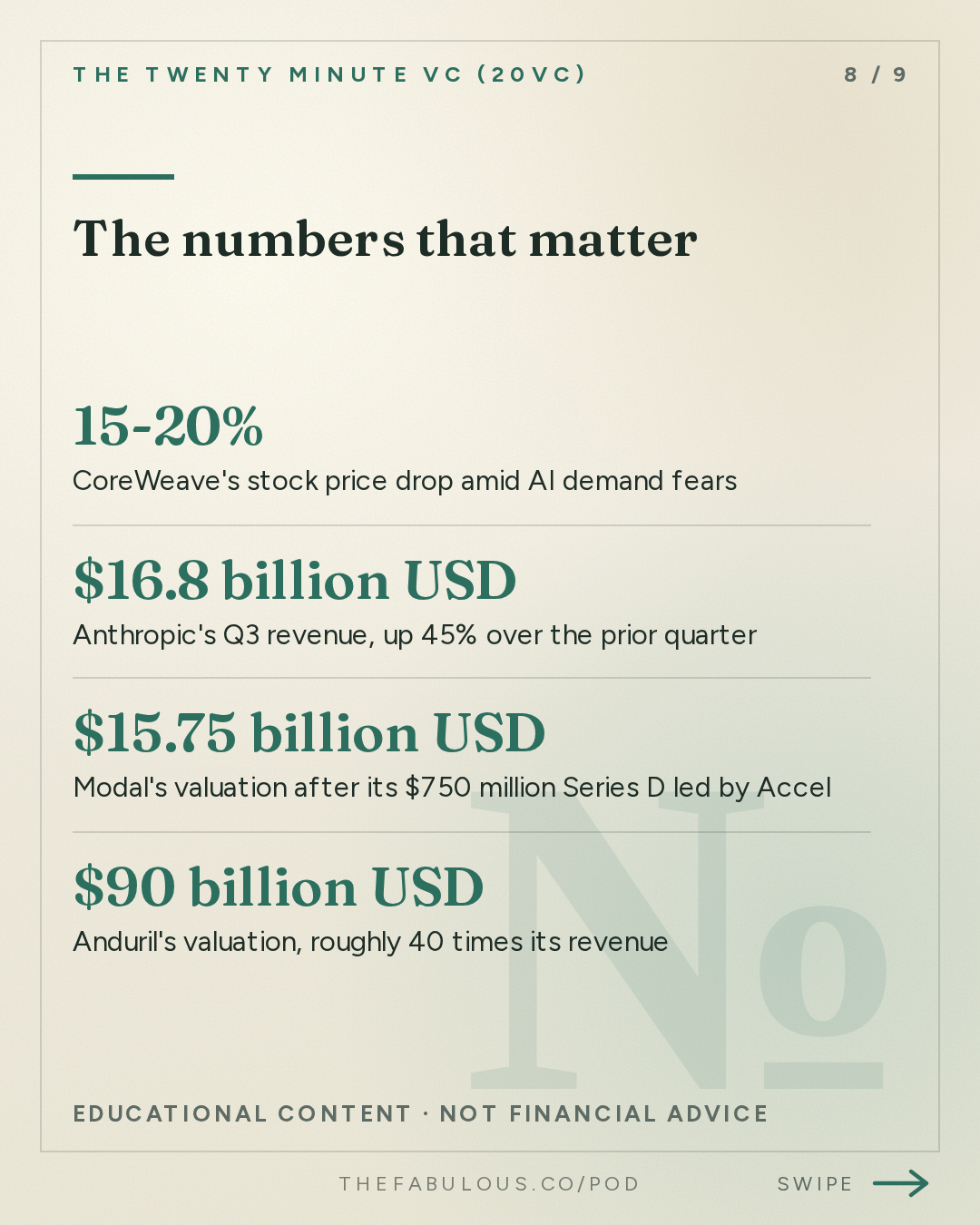
- 15-20% percent CoreWeave's stock price drop amid AI demand fears
- $16.8 billion USD Anthropic's Q3 revenue, up 45% over the prior quarter
- $15.75 billion USD Modal's valuation after its $750 million Series D led by Accel
- $90 billion USD Anduril's valuation, roughly 40 times its revenue
- $370 million USD 37signals' estimated profit since 2020, without venture funding
- 27.1% percent Harvard University's endowment return, on $68 billion in assets
In their words
“It's billion dollar positions or nothing. There's no point in investing otherwise with large funds.”
“Compared to NVIDIA, we're all fucking B-tier assets. How about that?”
“I actually think code review is the single most important category today in software.”
“Bending Spoons is like the Berkshire version of software, right?”
Protocols
-
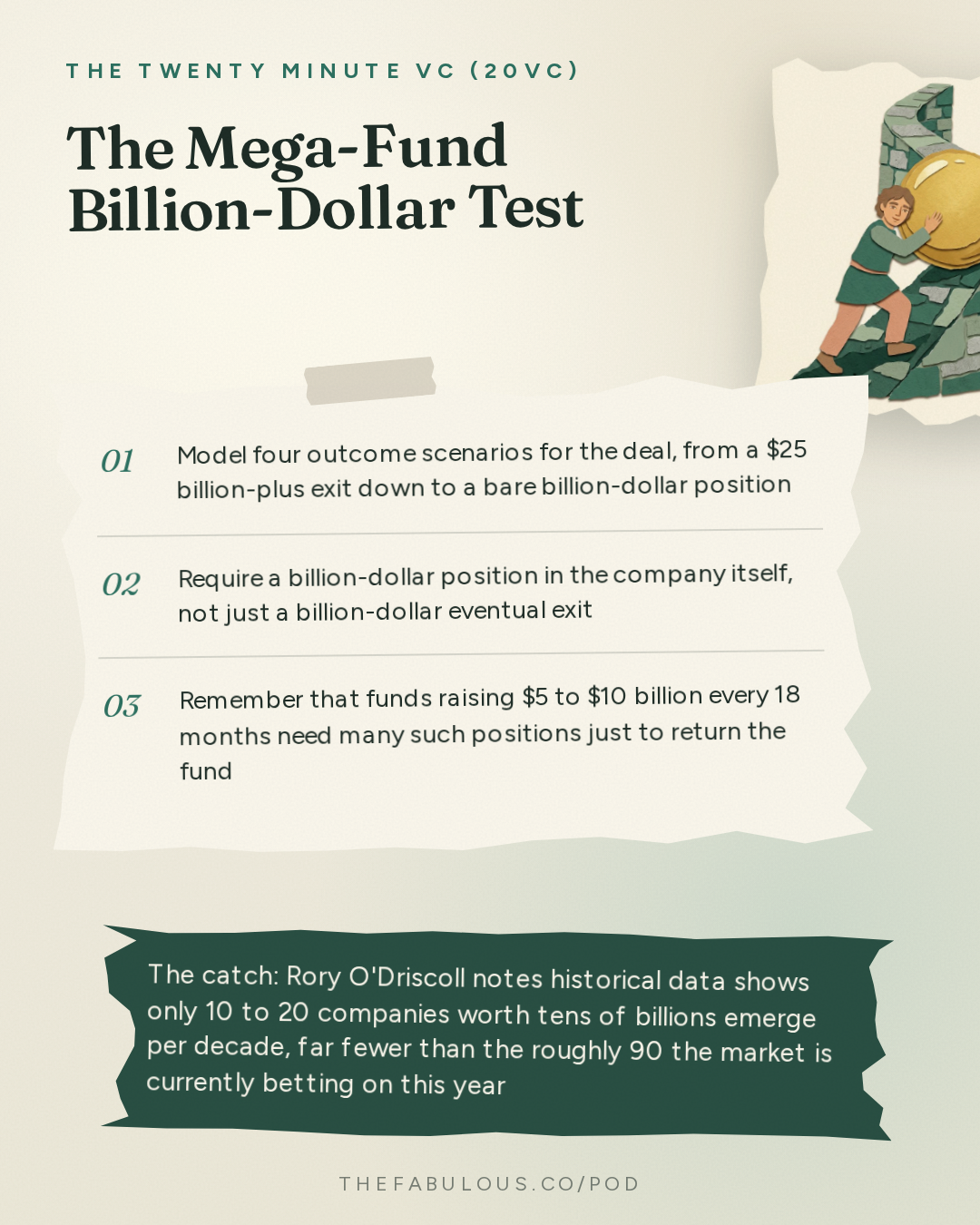
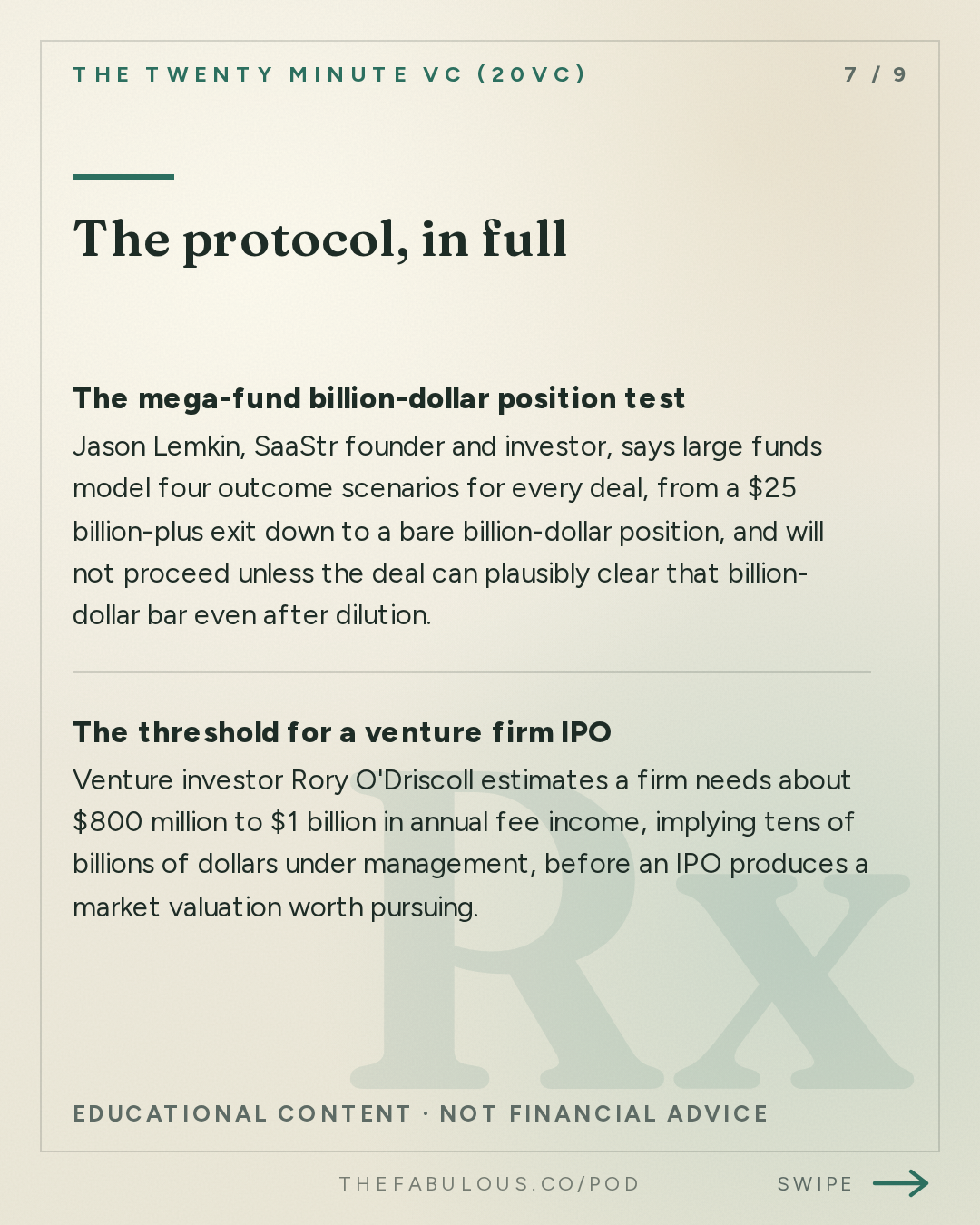
The mega-fund billion-dollar position test
Jason Lemkin, SaaStr founder and investor, says large funds model four outcome scenarios for every deal, from a $25 billion-plus exit down to a bare billion-dollar position, and will not proceed unless the deal can plausibly clear that billion-dollar bar even after dilution.
Applied to every prospective investment
-
The threshold for a venture firm IPO
Venture investor Rory O'Driscoll estimates a firm needs about $800 million to $1 billion in annual fee income, implying tens of billions of dollars under management, before an IPO produces a market valuation worth pursuing.
One-time structural threshold, not recurring
Questions this episode answers
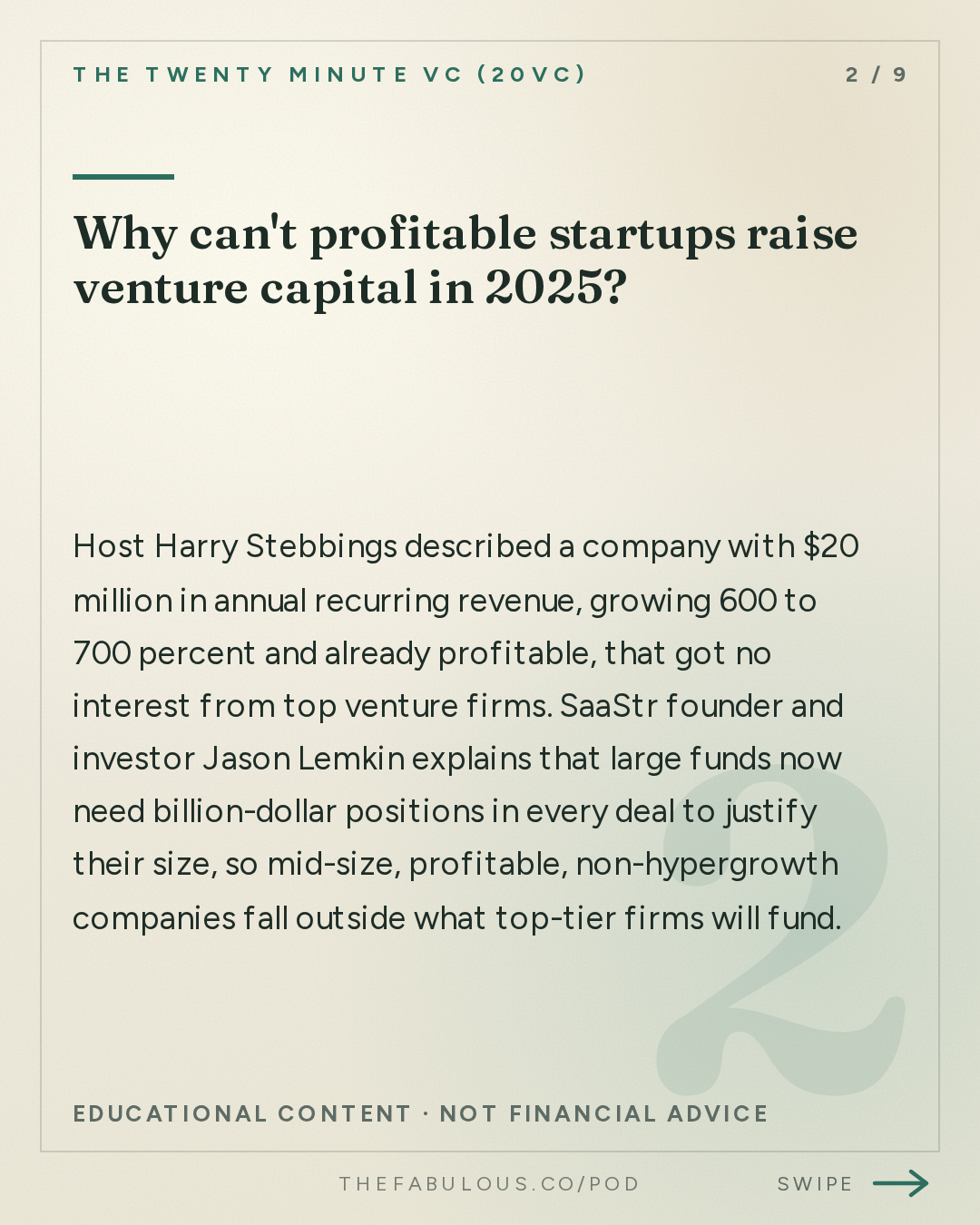
Why can't profitable startups raise venture capital in 2025?
Host Harry Stebbings described a company with $20 million in annual recurring revenue, growing 600 to 700 percent and already profitable, that got no interest from top venture firms (04:47). SaaStr founder and investor Jason Lemkin explains that large funds now need billion-dollar positions in every deal to justify their size, so mid-size, profitable, non-hypergrowth companies fall outside what top-tier firms will fund (09:21).
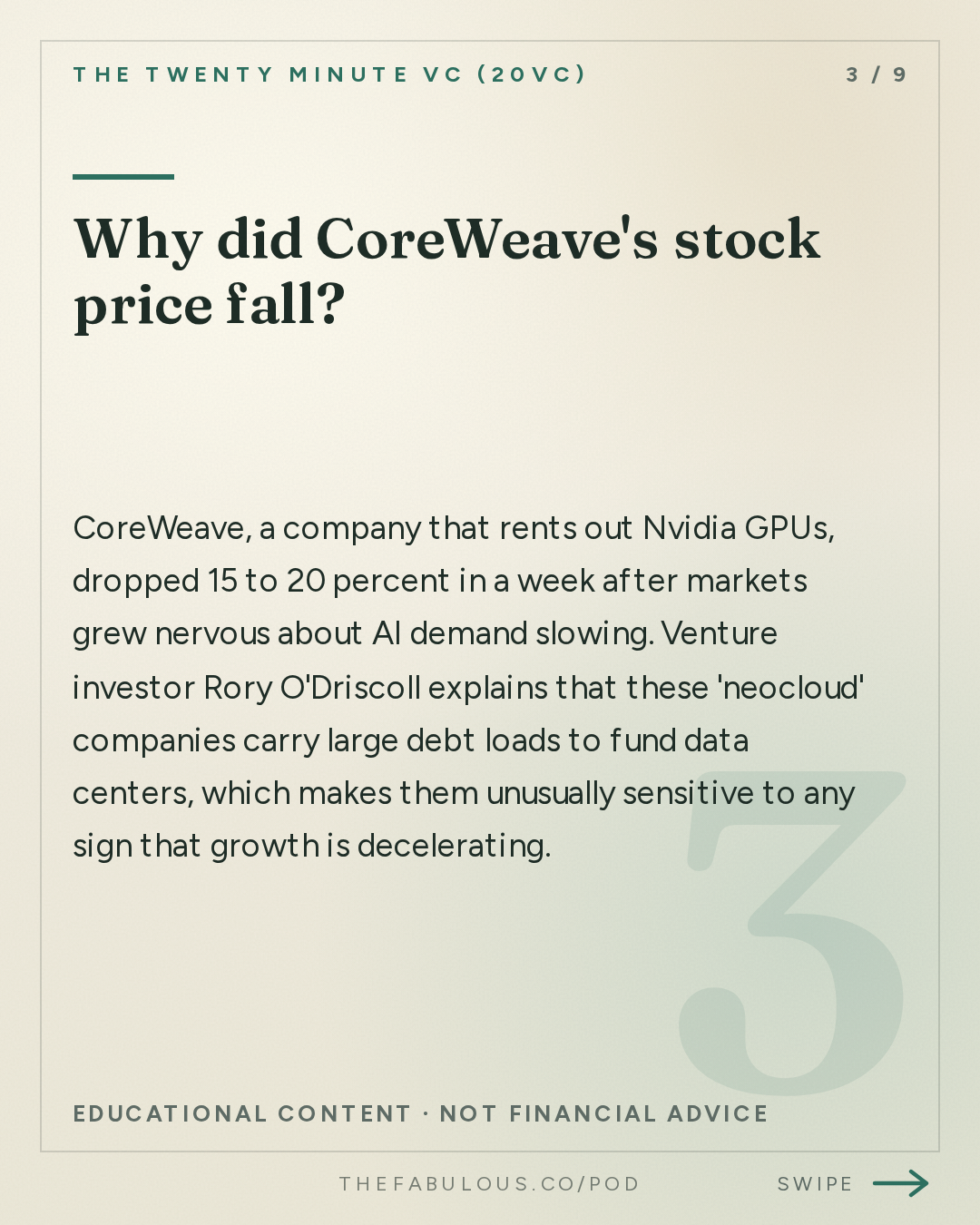
Why did CoreWeave's stock price fall?
CoreWeave, a company that rents out Nvidia GPUs, dropped 15 to 20 percent in a week after markets grew nervous about AI demand slowing (13:35). Venture investor Rory O'Driscoll explains that these 'neocloud' companies carry large debt loads to fund data centers, which makes them unusually sensitive to any sign that growth is decelerating (13:44).
What was Anthropic's Q3 2025 revenue?
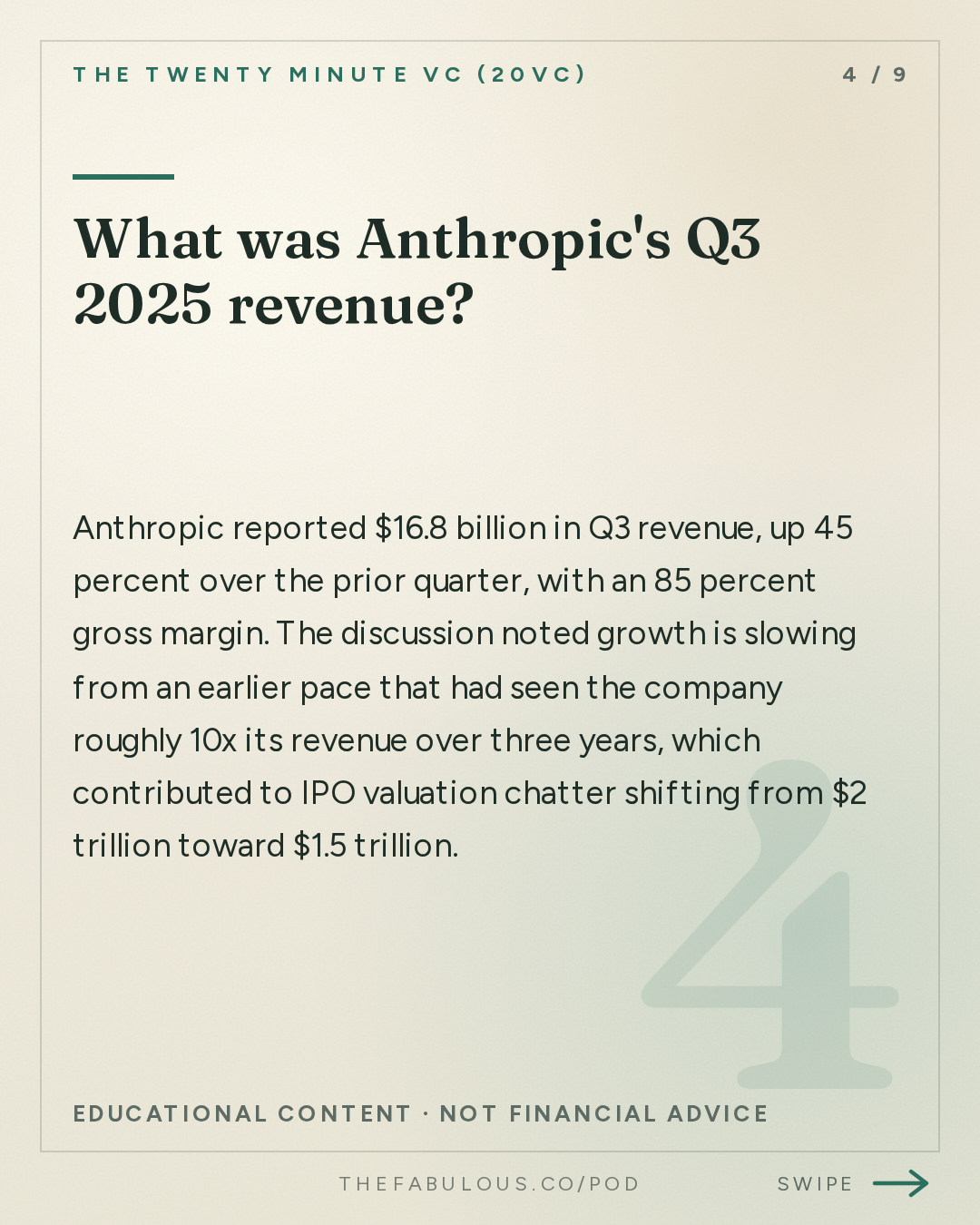
Anthropic reported $16.8 billion in Q3 revenue, up 45 percent over the prior quarter, with an 85 percent gross margin (19:07). The discussion noted growth is slowing from an earlier pace that had seen the company roughly 10x its revenue over three years, which contributed to IPO valuation chatter shifting from $2 trillion toward $1.5 trillion (19:07).
How much did Modal raise and at what valuation?
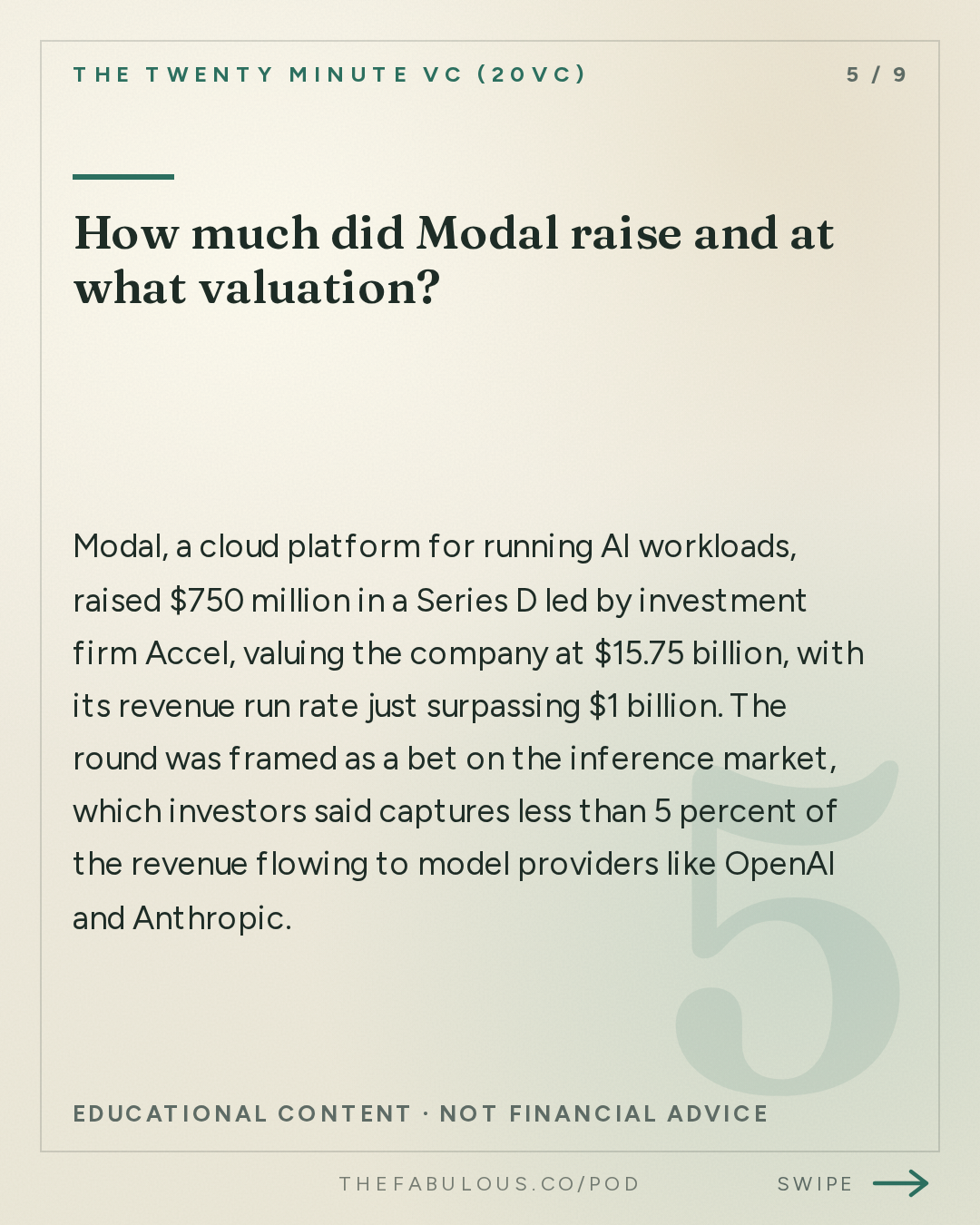
Modal, a cloud platform for running AI workloads, raised $750 million in a Series D led by investment firm Accel, valuing the company at $15.75 billion, with its revenue run rate just surpassing $1 billion (32:03). The round was framed as a bet on the inference market, which investors said captures less than 5 percent of the revenue flowing to model providers like OpenAI and Anthropic (33:25).
Is Anduril's $90 billion valuation justified?
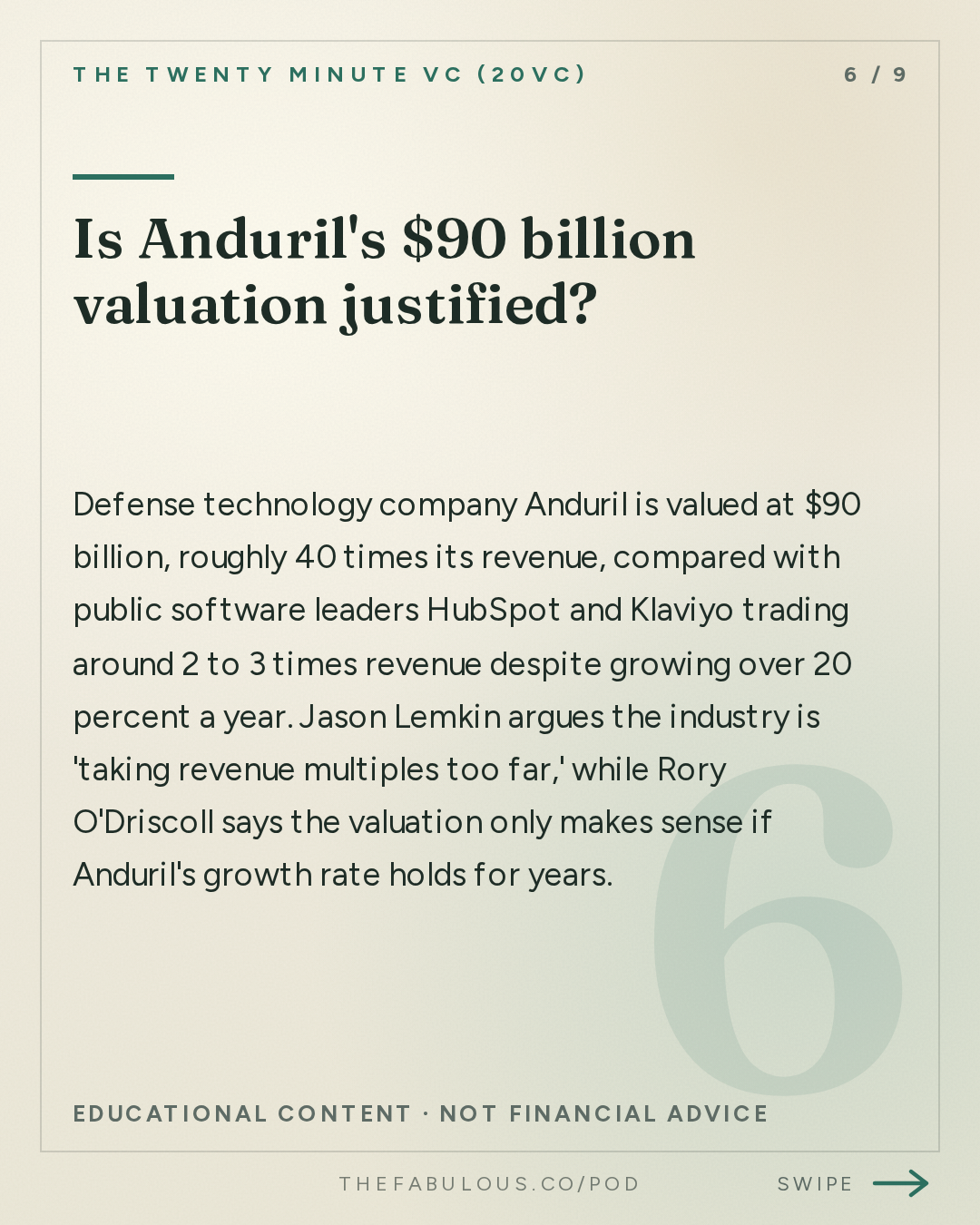
Defense technology company Anduril is valued at $90 billion, roughly 40 times its revenue, compared with public software leaders HubSpot and Klaviyo trading around 2 to 3 times revenue despite growing over 20 percent a year (38:44). Jason Lemkin argues the industry is 'taking revenue multiples too far,' while Rory O'Driscoll says the valuation only makes sense if Anduril's growth rate holds for years (40:02).
The full read, in cards
Go deeper
- Anthropic paper on AI and employment — Cited by Rory O'Driscoll as evidence that software output is scaling by an order of magnitude in the agentic era
Mentioned
CoreWeave · Anthropic · Modal · Anduril · Bending Spoons · 37signals · Elon Musk · Jason Lemkin · Rory O'Driscoll · Harry Stebbings · Harvard University · General Atlantic · Replit · Accel · SpaceX · Warren Buffett
More from this show and category

Sameer Dholakia on Bessemer's AI Investing Playbook
Bessemer's Sameer Dholakia explains why his firm paid roughly 150x ARR for Anthropic, and why capital itself is now a moat in AI investing. He prices deals on next-twelve-months revenue, targets 10 to 15 times NTM multiples, and says Bessemer's new $5.75 billion in funds reflects venture splitting into giant platforms and extreme specialists.

Harrison Chase on Why AI Agents Are So Hard to Build
LangChain founder Harrison Chase says AI agents break because models are unpredictable black boxes, not because they are weak. The fix, he argues, is a model-neutral 'harness,' the code layer that routes tasks, manages memory and controls token costs, with vertical, domain-specific agents built to outperform horizontal ones.

Pro Rata Lawsuit: Valar Atomics vs Day One VC
Day One Ventures and Valar Atomics are fighting over pro rata rights in a $6 billion nuclear-startup round, exposing how waivers actually work in venture capital. The panel also covers Meta's new Muse Wonder model, NVIDIA's reported bid for Reflection, Jev's $870 million round, Anthropic's price cuts, and software's rising IPO bar.

Mike Cannon-Brookes on Atlassian's AI Strategy
Atlassian CEO Mike Cannon-Brookes argues design, not agents, decides AI-era winners, so Atlassian keeps investing in interfaces rather than going headless. He also says enterprises increasingly reject Chinese AI models even as they embrace open weights, and doubts most "specialized models" are just fine-tuned versions of them.
