
David Tisch on BoxGroup's Contrarian VC Strategy
20VC: David Tisch on Why High Ownership and Concentration is BS | Why No Manager Actually Wants to Stay Small | Why Competing with the Mega Platforms is a Losing Game | Why the Lean Startup is a Fake?
The brief
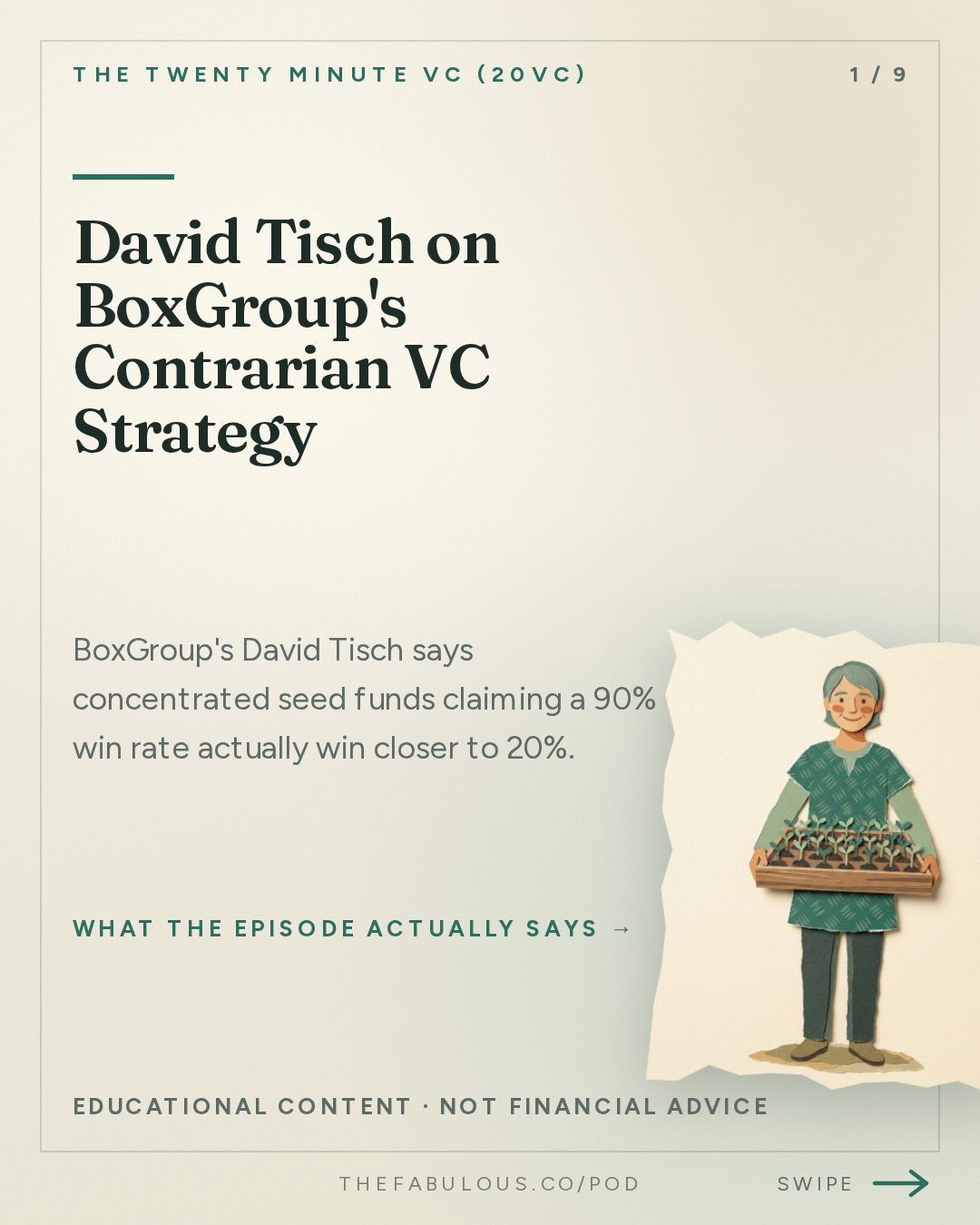
BoxGroup's David Tisch says concentrated seed funds claiming a 90% win rate actually win closer to 20%. That gap, he argues, is why BoxGroup skips ownership targets entirely, writing checks as small as 1% ownership across roughly 150 companies a year, betting on founder access and speed over concentrated conviction.
Ask a concentrated venture fund how often it lands the deals it wants, and the answer is almost always the same: north of ninety percent. David Tisch, who has spent seventeen years investing in very young companies and co-founded the seed fund BoxGroup, thinks that number is close to fiction. "Every concentrated manager will say that we win 90% of the deals we wanna win, and I think that's total BS. I think it's, like, 20%," he tells Harry Stebbings on The Twenty Minute VC (16:35).
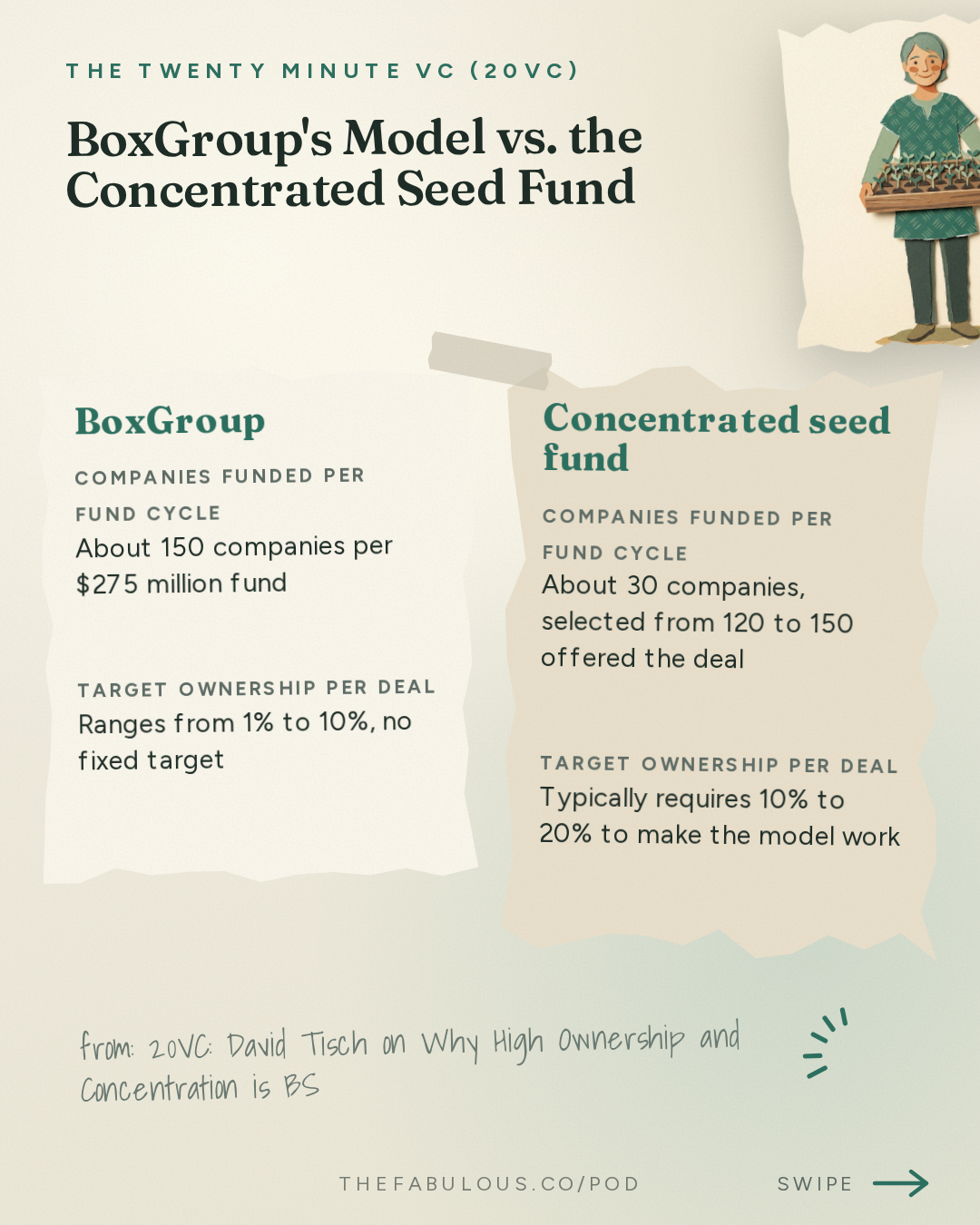
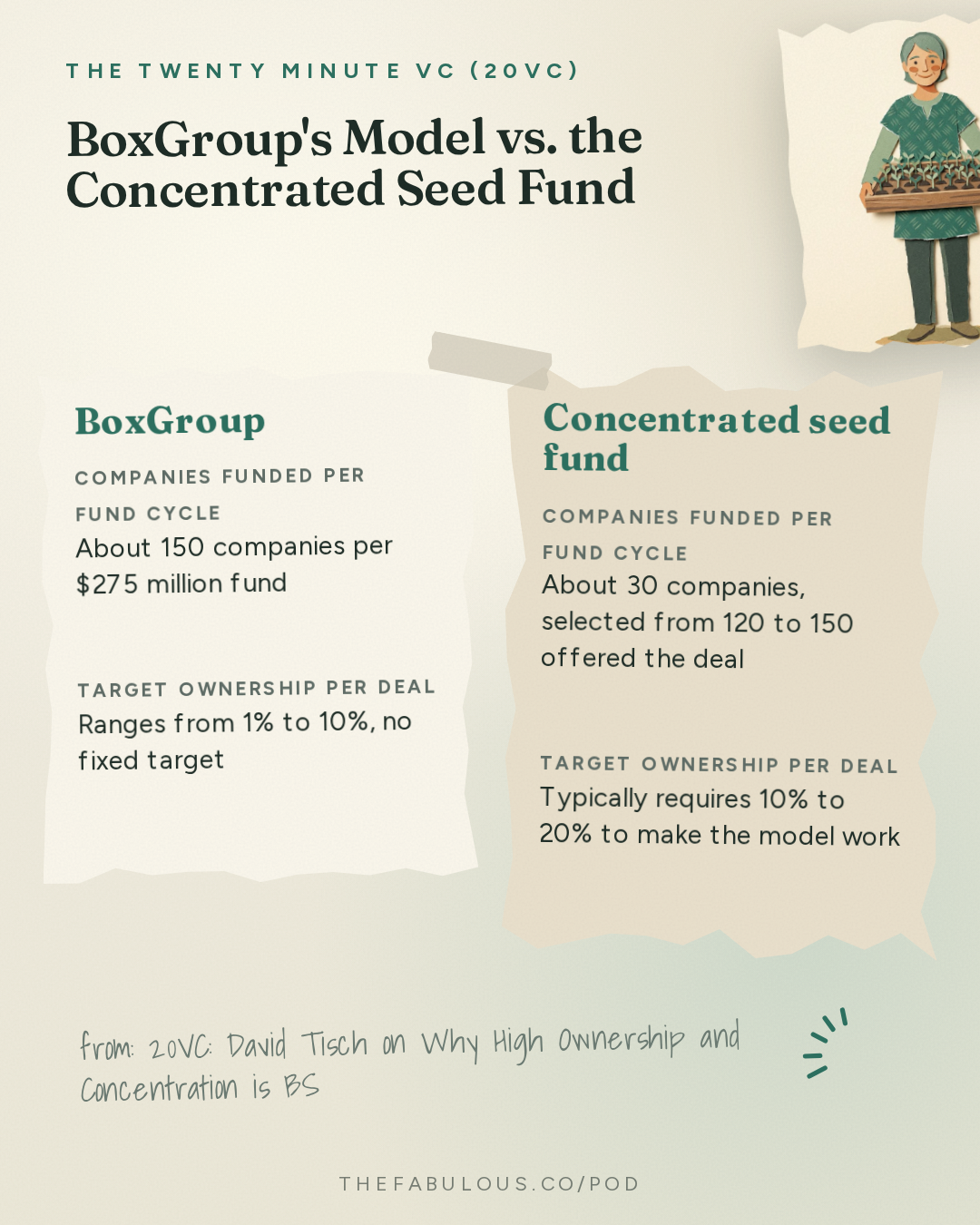
That gap between the story funds tell about themselves and the arithmetic underneath it is the real subject of this conversation. Tisch explains the mechanism plainly. A concentrated fund usually needs something like 10% to 20% ownership of a company to make its model work (13:00). If that fund wants to end up with 30 portfolio companies it believes in, it has to offer that 10% deal to something like 120 to 150 companies to get the 30 who actually say yes (17:03). The founders who turn a fund down are not randomly distributed. Often they are the most sought-after ones, with the most other offers. So a concentrated portfolio is not a list of the 30 best companies a fund saw. It is a list of the 30 best companies that also agreed to give up double-digit ownership. "I think the best companies, the ones you're most excited about, don't always make it into the portfolio," Tisch says (17:03).
BoxGroup's answer is to stop chasing a fixed ownership number altogether. The firm runs two $275 million funds, a core seed vehicle and a follow-on fund, and expects the seed fund alone to end up invested in roughly 150 companies (31:16). Ten investors, six partners, and checks that range from 1% of a company up to 10%, with everything in between (23:54). The logic: a sliver of a giant outcome beats a large slice of a deal you never got into. BoxGroup was an early investor in the AI coding tool Cursor, which sold to Elon Musk's X for $60 billion, a deal Tisch says returned the fund "multiple times" on its own (31:58).
Tisch is candid that he used to think this was the wrong way to build a firm. He once turned down good companies over ownership concerns and now calls those "terrible decisions" (25:47). What changed his mind was watching outcome sizes expand. A company that might have been written off as a billion-dollar business a decade ago is now the kind of outcome an early-stage investor has to "squint" to imagine reaching $10 billion (10:31). At the same time, the companies that do break out are raising later rounds at far less dilution than they used to, something like 3% to 8% per round instead of the historical 12% to 20% (10:56). Stack a few rounds of lighter dilution on top of a bigger eventual outcome, and a small initial stake compounds into real money. Venture, Tisch argues, "is a pure power law dynamic industry," meaning almost all the returns come from a handful of enormous winners rather than being spread evenly across a portfolio, so getting into the right company matters more than owning a large piece of an average one (12:50).
This is also why Tisch is unsparing about The Lean Startup, the influential 2011 book and methodology that told founders to build minimum viable products, test cheaply, and avoid raising or spending too much before finding product-market fit. "I think the lean startup was a total fake. It was a, like, stupid, like, brainwash that happened for 10 years," he says, challenging anyone to name a company that actually built a venture-scale business by running the lean playbook (18:46). His point is not that discipline is bad. It is that being well-funded and being undisciplined are not the same thing, and an entire generation of founders was told to stay small when the companies that actually mattered got big by spending aggressively.
Begging for Scraps, Gracefully
Being a price-taker rather than a price-setter is, by Tisch's own account, often uncomfortable. He describes founders tranching their rounds, taking an initial check at one price and a later slice at double the valuation once bigger names have validated the deal, leaving earlier investors like BoxGroup negotiating for the cheaper tranche after the fact. "I would like the lower tranche please," he says, half-joking about the posture this forces on him (21:07). Pressed on whether he resents it, he is unambiguous about where the resentment actually lands: not on the founder making a rational choice, but on the other investor who restructured the deal to squeeze him out. "I also have a long memory," he notes (21:37).
That same unsentimental read extends to who gets to stay in the lead-investor business at all. Tisch argues that pure-play, lead-only seed funds, the kind many limited partners say they want exposure to, are a dying category, because they cannot compete with multi-stage firms that will write a bigger check at a higher price and still want the deal (26:50). Firms once content to wait and invest at the Series A or B now have to fight for entry wherever they can get it, because waiting means losing the company to someone else entirely (28:05).
BoxGroup's self-reported win rate on deals it actually bids for is 70% to 90% (24:39), a number Tisch attributes mostly to speed: the single biggest reason the firm loses a deal is getting to the founder too late, not losing a straight fight on terms (24:39). The clearest illustration of how misread early-stage judgment can be is Rogo, an AI company built for finance. After BoxGroup's seed investment, founder Gabe took the company out to raise a Series A from roughly 40 lead investors. Thirty-nine said no. Keith Rabois led the round that one firm agreed to do, and Rogo has since been funded by Sequoia and Kleiner Perkins as what Tisch calls "a consensus company" (42:20). The lesson he draws is not that the 39 were foolish, but that early-stage investing is not a market with perfect information, and conviction has to survive being wrong in public, repeatedly, before it pays off.
Earning the Right to Follow On
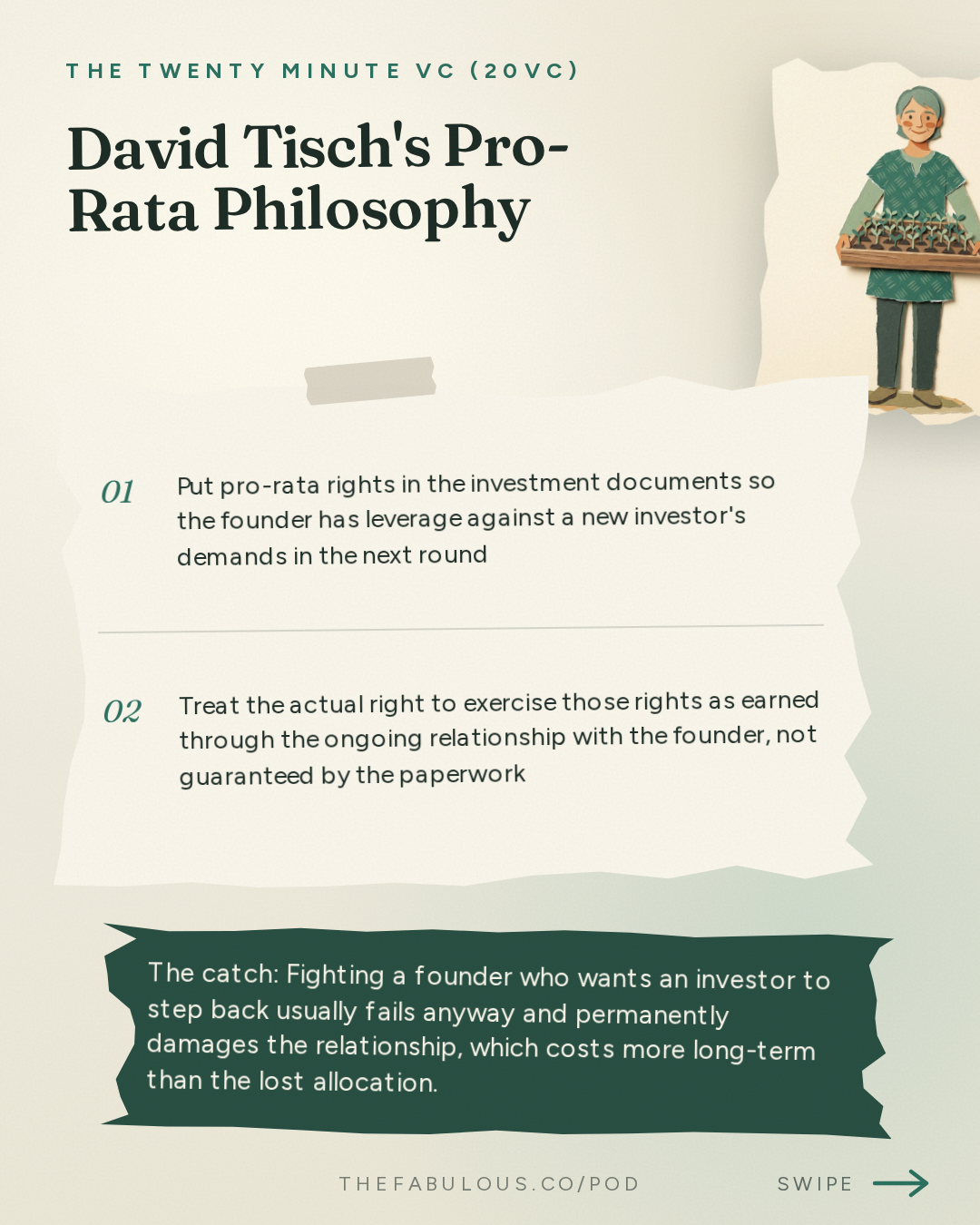
On pro-rata rights, the contractual right to invest more in a company's future rounds, Tisch rejects both extremes common in venture Twitter debates. He does not think pro-rata is an automatic entitlement, and he does not think funds that loudly renounce it are being principled either. "I believe the right to invest in subsequent rounds is earned. Whether you have it in the documents or not, it's earned," he says (46:05). Having the right documented mainly helps the founder, he explains, because it gives them leverage to push back on a new investor demanding an outsized allocation in the next round. But enforcing that right against a founder's wishes is close to reputational suicide: a fund that fights a founder over pro-rata will likely lose anyway, and will certainly lose the relationship.
A similar relationship-first logic shapes how Tisch thinks about founders selling stock early, known as secondary sales. He argues these sales can raise a founder's appetite for risk rather than signal doubt, because removing personal financial pressure, debt, housing stress, the need for a safety net, frees a founder to keep swinging for a bigger outcome rather than selling the company early out of fear (51:48). He draws a sharp line between that and a fund trimming its own position to make its numbers look better to its own investors, which he sees as a fundamentally different, less defensible motive (52:21).
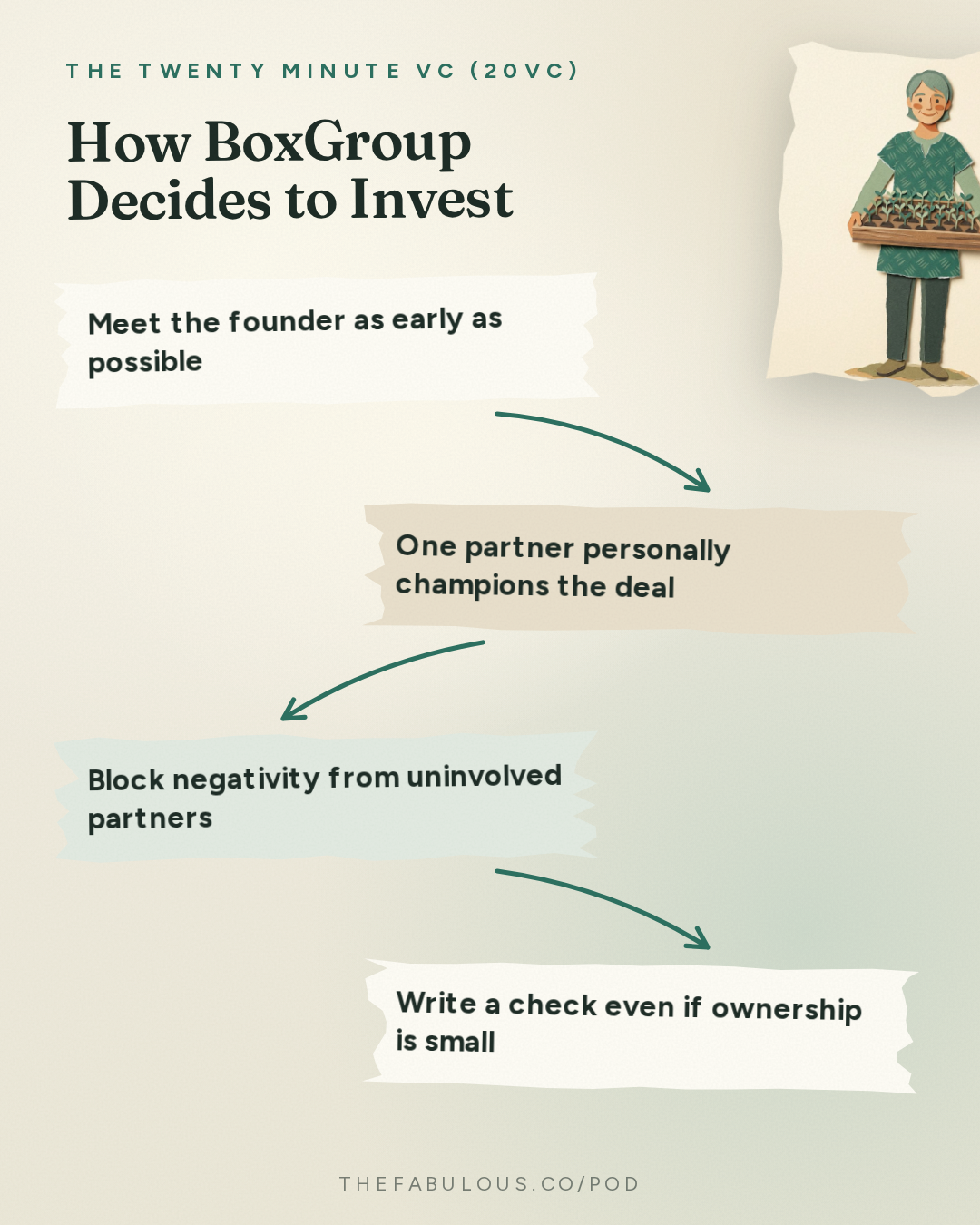
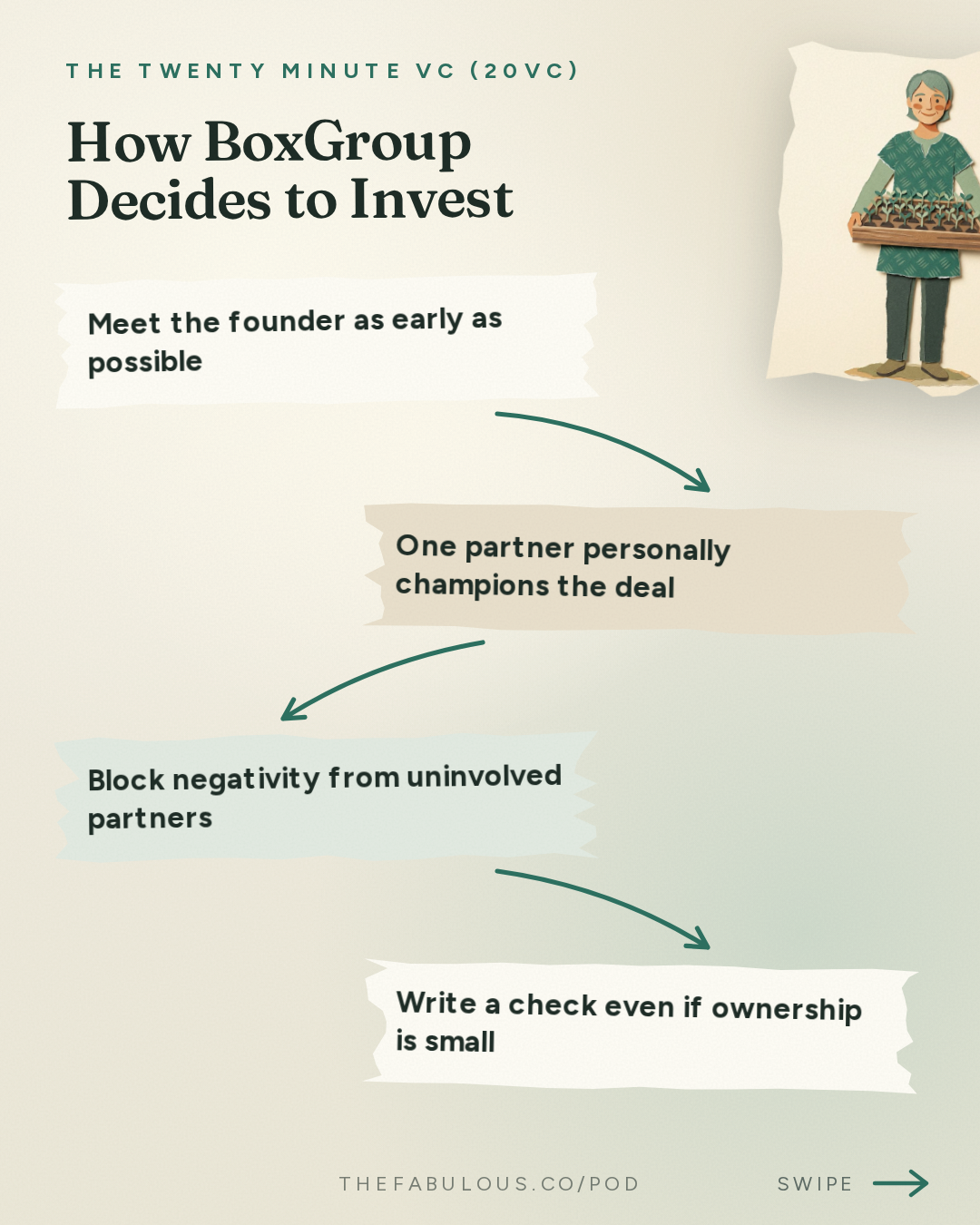
Inside BoxGroup's own decision-making, Tisch has built a culture meant to protect a conviction once it exists. Partners meet 50 to 100 founders a week as a firm (61:00) and decide twice weekly, but a partner who has not personally spent time with a founder is not allowed to criticize that deal in the room. "We don't allow grenades at early stage. You're not allowed to throw a grenade on someone else's deal," he says (62:23). His reasoning is almost mathematically blunt: since the large majority of early-stage companies fail, anyone can construct a plausible case for why a given company will not work. That exercise is trivial and, in his view, useless. The actual craft, the one BoxGroup is built around, is the harder and rarer skill of looking at an unproven founder and unproven market and finding the reason it might succeed. "The magic of our business is squinting and seeing why something is going to work," he says (63:12). It is a modest-sounding claim for a firm that was early into a company that sold for $60 billion, but it is also, on the evidence of this conversation, the whole argument: venture rewards the investor willing to say yes before the proof exists, not the one with the tidiest portfolio math.
Ask this episode anything
Pod's AI answers from the episode itself, with the minute mark so you can hear it yourself.
Or start with one of these
Ask this episode
Pod's AI listens to the whole episode to answer, and points you to the minute it comes from.
The rest of this answer, and any question after it
Answers come from the episode itself, never from a summary of it.
ContinueKey takeaways
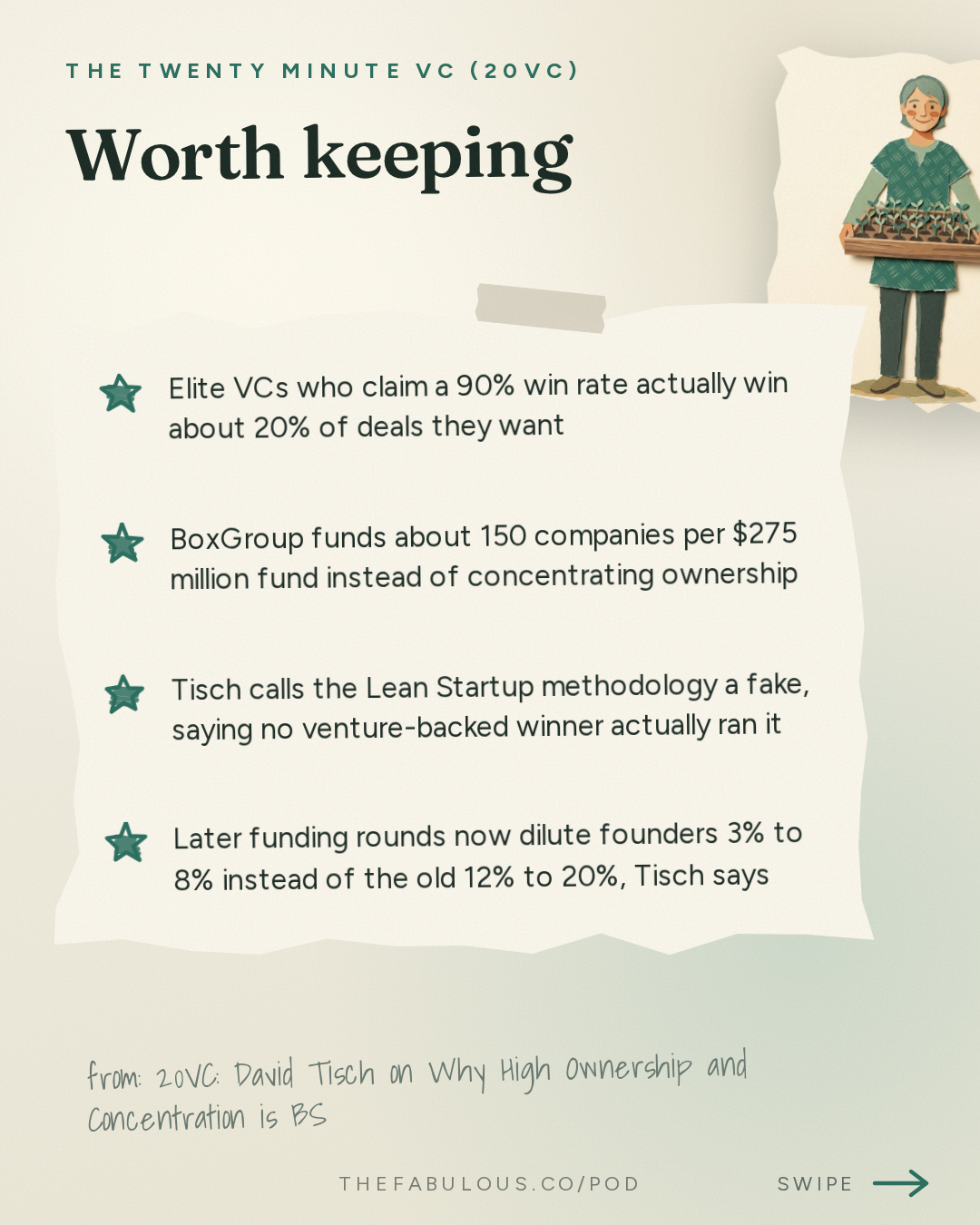
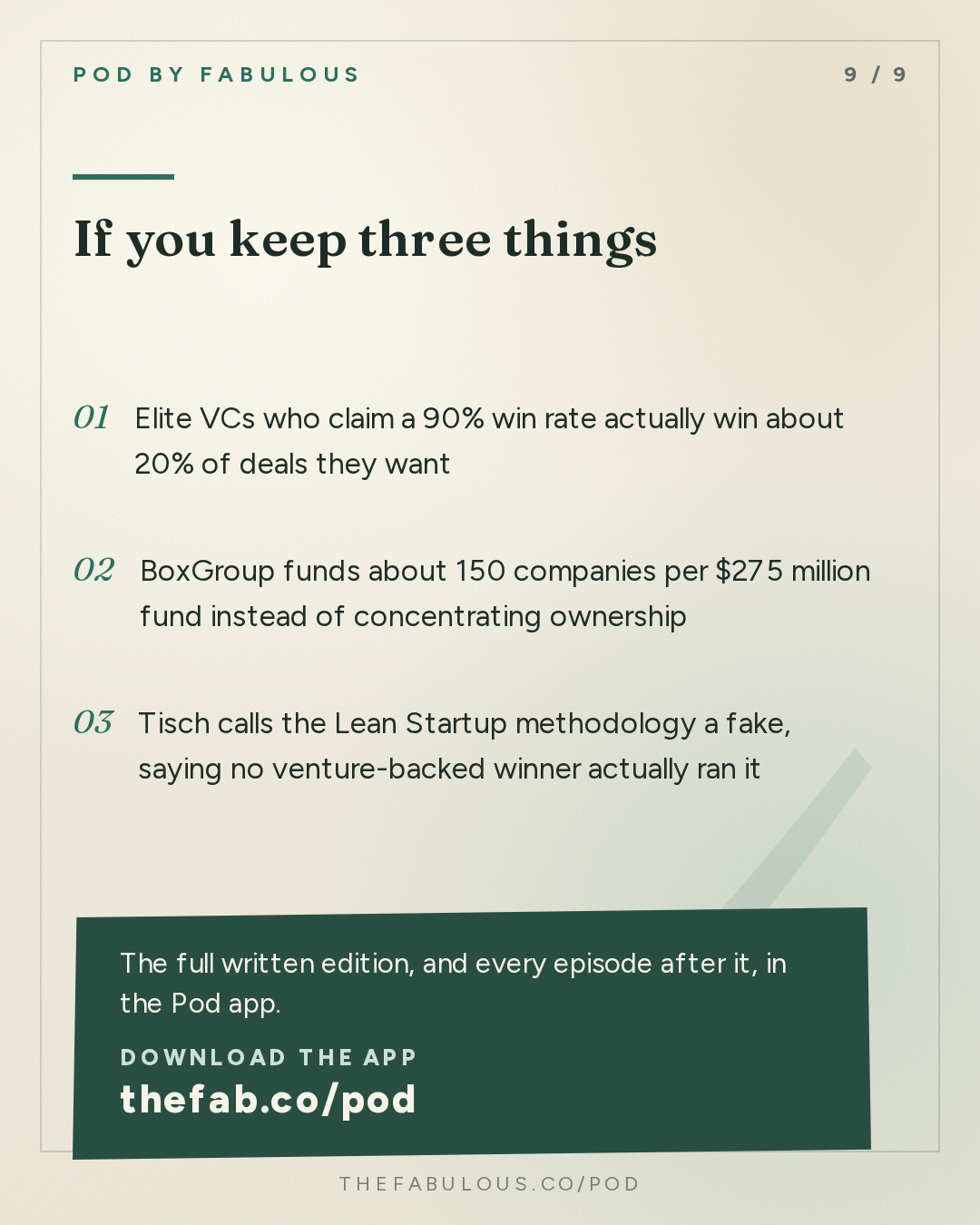
- Elite VCs who claim a 90% win rate actually win about 20% of deals they want
- BoxGroup funds about 150 companies per $275 million fund instead of concentrating ownership
- Tisch calls the Lean Startup methodology a fake, saying no venture-backed winner actually ran it
- Later funding rounds now dilute founders 3% to 8% instead of the old 12% to 20%, Tisch says
- Rogo, an AI finance startup, was rejected by 39 of 40 Series A investors before Keith Rabois led its round
The episode in cards
By the numbers
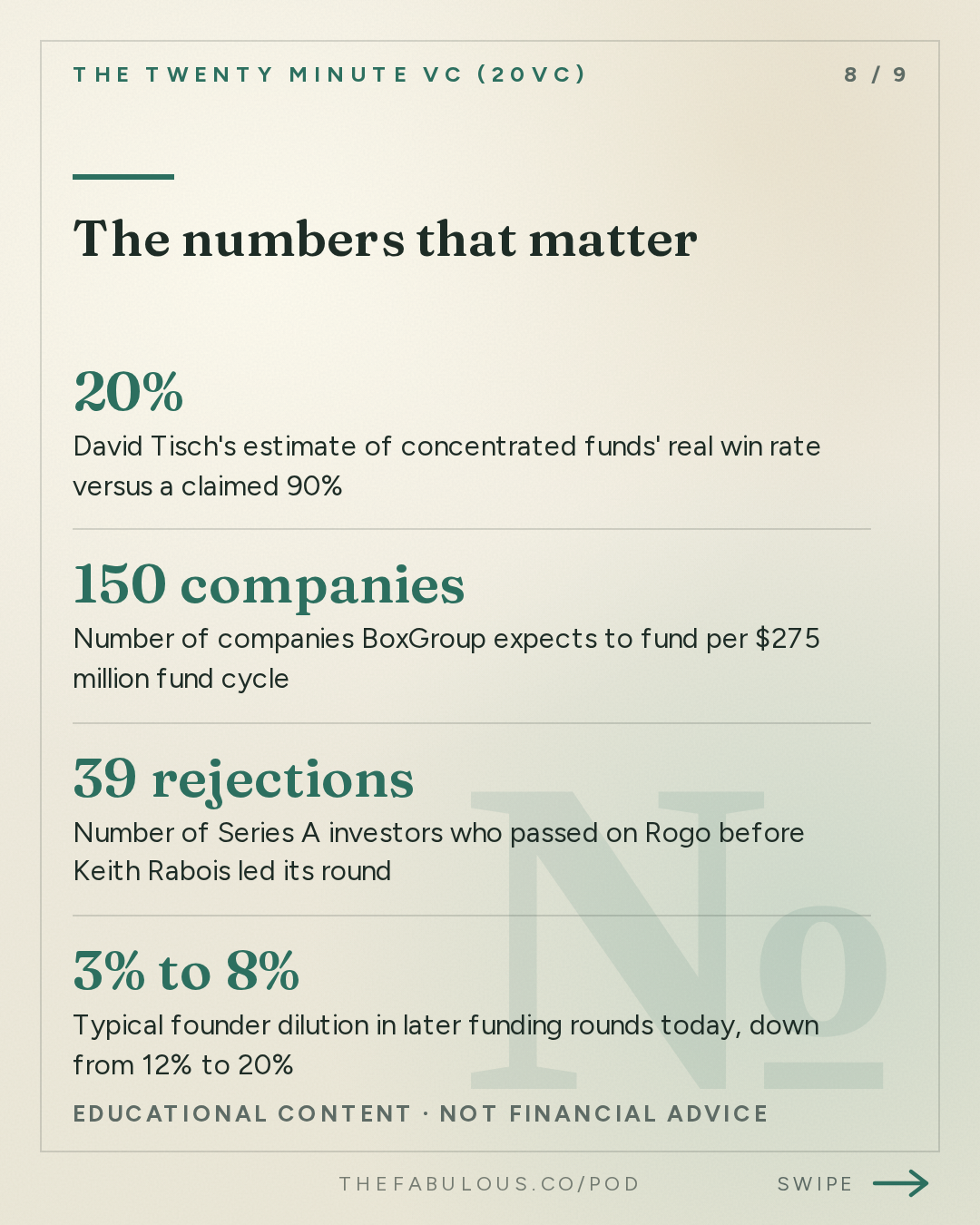
- 20% percent David Tisch's estimate of concentrated funds' real win rate versus a claimed 90%
- 150 companies Number of companies BoxGroup expects to fund per $275 million fund cycle
- 39 rejections Number of Series A investors who passed on Rogo before Keith Rabois led its round
- 3% to 8% percent Typical founder dilution in later funding rounds today, down from 12% to 20%
- 1% percent Lowest ownership stake David Tisch will accept in an initial check
In their words
“Every concentrated manager will say that we win 90% of the deals we wanna win, and I think that's total BS. I think it's, like, 20%.”
“I think the lean startup was a total fake. It was a, like, stupid, like, brainwash that happened for 10 years.”
“I believe the right to invest in subsequent rounds is earned. Whether you have it in the documents or not, it's earned”
“We don't allow grenades at early stage. You're not allowed to throw a grenade on someone else's deal.”
“The magic of our business is- is squinting and seeing why something is going to work.”
Protocols
-
Treat pro-rata as earned, not owned
Tisch puts pro-rata rights in the investment documents because it gives the founder leverage to push back on a new investor demanding a large allocation in the next round, but he treats the actual right to use those rights as something earned through the relationship with the founder. He steps back if a founder asks him to, even when it costs him money or allocation, because fighting a founder over pro-rata usually fails and damages the relationship permanently.
Every follow-on round
-
Ban negativity from partners who have not met the founder
Tisch does not allow BoxGroup partners to argue against a deal in investment committee unless they have personally spent time with the founders. He argues that anyone can list reasons a company will fail, since most early-stage companies do, so that exercise is treated as irrelevant to the actual decision.
Every investment committee meeting
-
Write small checks rather than skip great founders
Tisch accepts ownership stakes as low as 1% when BoxGroup meets a promising company late in its fundraising process, rather than walking away over an ownership target. He says he feels disappointed about the small check but still takes the deal because missing the founder entirely is worse.
As needed, when meeting a deal late
Questions this episode answers
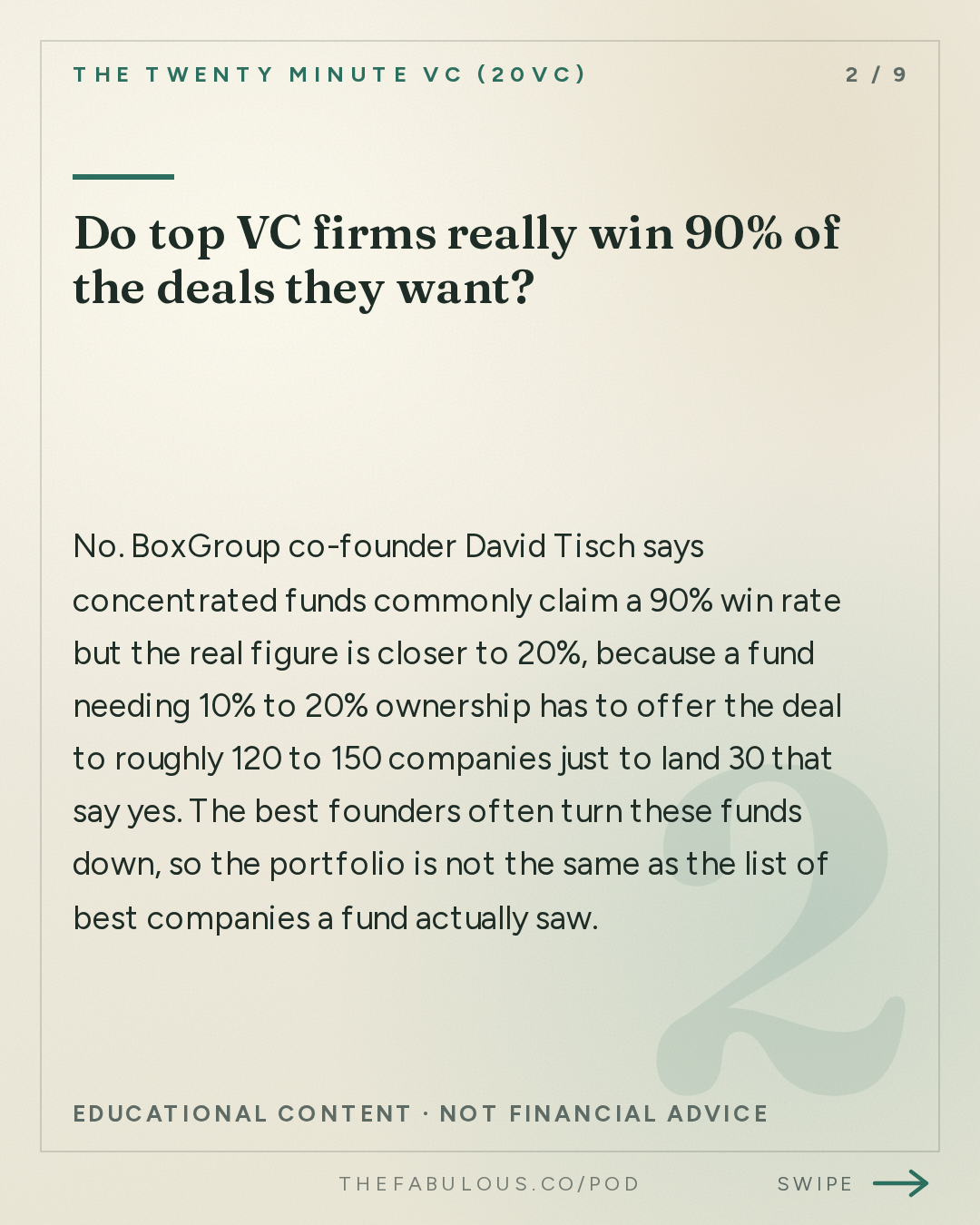
Do top VC firms really win 90% of the deals they want?
No. BoxGroup co-founder David Tisch says concentrated funds commonly claim a 90% win rate but the real figure is closer to 20%, because a fund needing 10% to 20% ownership has to offer the deal to roughly 120 to 150 companies just to land 30 that say yes (16:35, 17:03). The best founders often turn these funds down, so the portfolio is not the same as the list of best companies a fund actually saw.
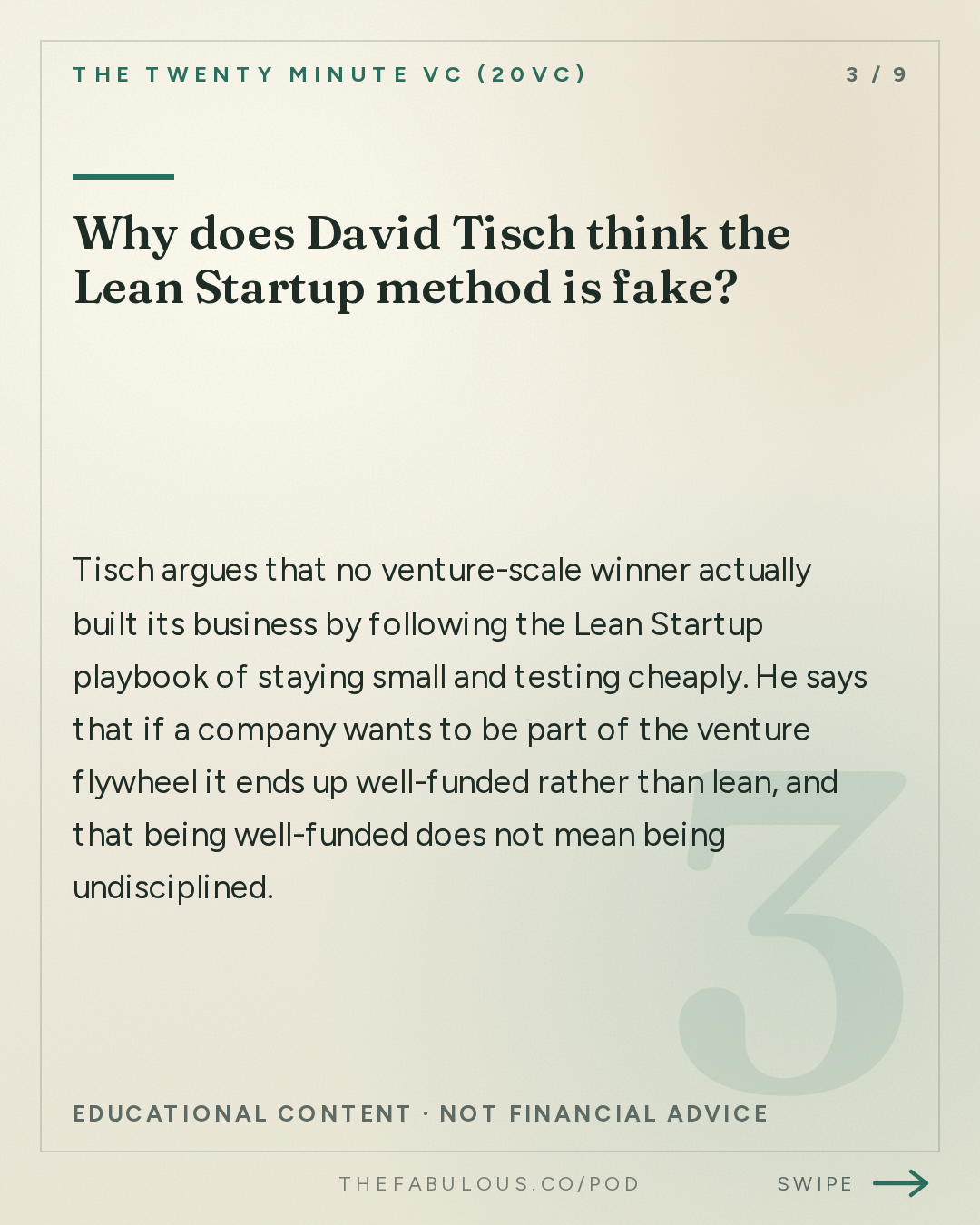
Why does David Tisch think the Lean Startup method is fake?
Tisch argues that no venture-scale winner actually built its business by following the Lean Startup playbook of staying small and testing cheaply (18:46). He says that if a company wants to be part of the venture flywheel it ends up well-funded rather than lean, and that being well-funded does not mean being undisciplined.
How much does BoxGroup typically invest in a seed deal?
BoxGroup takes ownership stakes anywhere from 1% to 10% of a company at the seed stage, with no fixed ownership target, and expects to fund around 150 companies out of its current $275 million core seed fund (23:54, 31:16). Tisch says the firm will accept a very small stake rather than pass on a founder it believes in.
What happened with Rogo's Series A fundraise?
AI finance startup Rogo was passed on by 39 of roughly 40 Series A lead investors that BoxGroup's David Tisch introduced the company to, before Keith Rabois agreed to lead the round (42:20, 42:30). Rogo has since been funded by Sequoia and Kleiner Perkins, which Tisch cites as proof that early-stage investing lacks perfect information.
Is pro-rata a right investors are guaranteed in venture capital?
Tisch says pro-rata, the contractual right to invest more in a company's future funding rounds, is not an automatic entitlement even when it is written into the investment documents (46:05). He treats it as something earned through the relationship with the founder, and argues that enforcing it against a founder's wishes usually fails and damages the relationship.
Why are founder secondary sales good according to David Tisch?
Tisch argues that letting founders sell some of their stock early can increase their appetite for risk rather than signal weak conviction, because removing personal financial pressure frees them to keep pursuing a bigger outcome instead of selling the company too soon (51:48, 52:00). He distinguishes this from a fund selling its own position just to improve its reported numbers, which he sees as a different motive entirely.
The full read, in cards
Go deeper
- The Lean Startup — Eric Ries's startup methodology, which Tisch argues misled a decade of founders into underfunding their companies
Mentioned
David Tisch · BoxGroup · Cursor · Rogo · Keith Rabois · Y Combinator · Sequoia · Kleiner Perkins · Thrive Capital · Clay · Base10 · Ramp · Harry Stebbings
More from this show and category

Anthropic's S1 Filing: Revenue, Cash, and Risk
Anthropic's S1 filing shows $16.3 billion in first-half revenue and $110 billion in cash, though Broadcom had to backstop its chip debt. Microsoft offered buyouts to 60,000 staff, Meta raised $95 billion in equity for compute, and hosts Jason Lemkin and Rory O'Driscoll debated a rumored $30 billion round for consumer AI app Instinct.

Satya Nadella on AI Alignment and Zero Trust
Microsoft CEO Satya Nadella says AI alignment doesn't automatically emerge from scaling, so Microsoft built zero-trust tools to audit every agent action. He predicts commodity token usage will dominate within 24 months (08:47) and that firms will treat private AI evaluation benchmarks as core intellectual property (12:08).

Naveen Rao's Unconventional AI Strategy Explained
Naveen Rao, who sold MosaicML to Databricks for $1.3 billion, argues energy and hardware, not software, will decide AI's next decade. He projects a $10 trillion inference market within ten years, robotics growing 100 times bigger than coding agents, and warns that pure software investors are in trouble.

Is Venture Capital Broken? Billion-Dollar Math
Venture capital has split into two games: mega-funds need billion-dollar stakes in a handful of AI giants, while strong smaller startups go unfunded. CoreWeave slid 15-20% on AI demand fears (13:35), Anthropic posted $16.8B in Q3 revenue (19:07), Modal raised $750M at $15.75B (32:03), and Anduril trades near 40 times revenue at a $90B valuation (38:44).
