
WashU Endowment Strategy: Scott Wilson Explains
20VC: From $8BN to $19BN: Inside WashU's Endowment Fund | SpaceX Made Up 20% of Our AUM | Why Europe and China Has So Much Opportunity | The Reckoning That is Coming for AI Companies with Scott Wilson
The brief
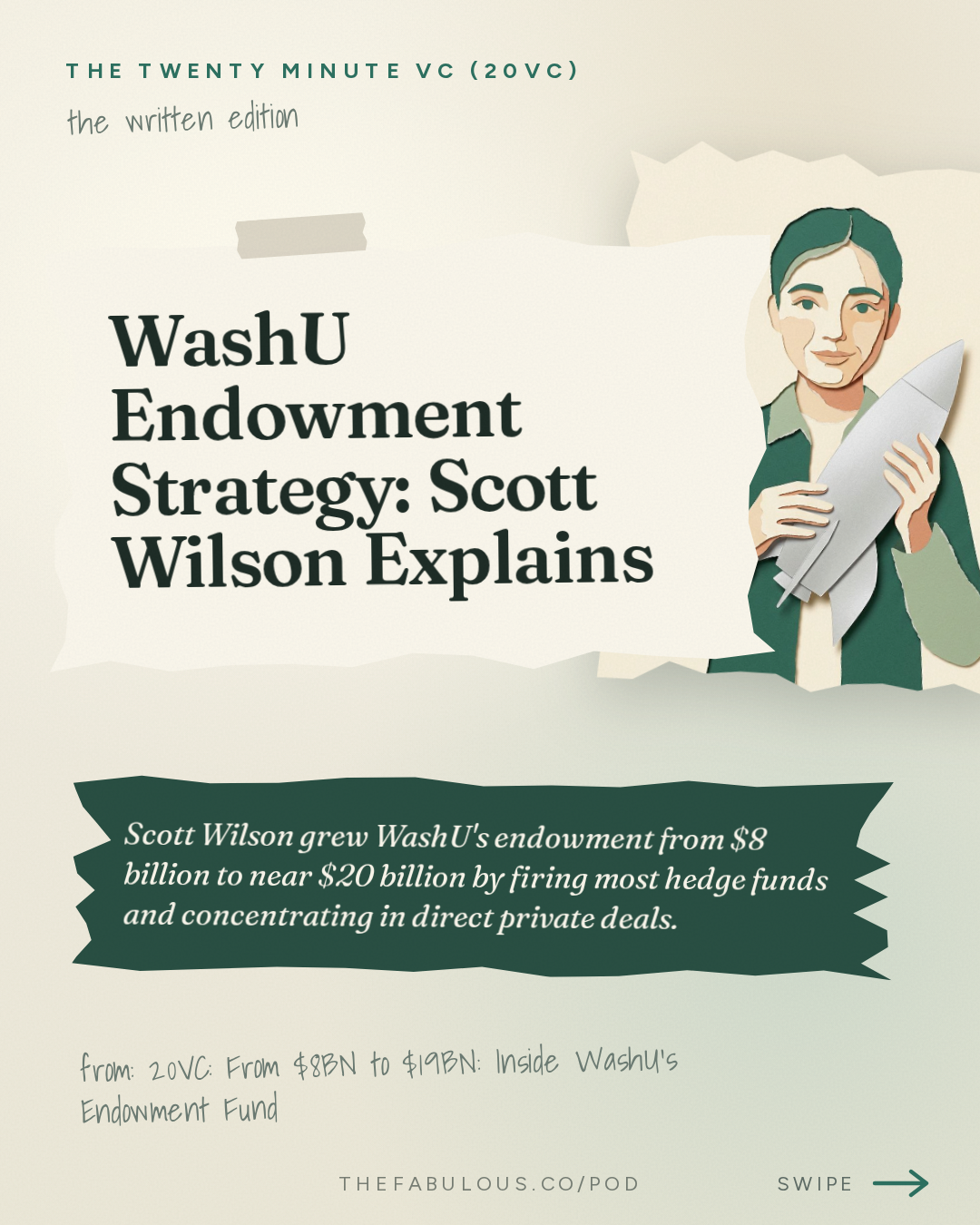
Scott Wilson grew WashU's endowment from $8 billion to near $20 billion by firing most hedge funds and concentrating in direct private deals. SpaceX once made up over 20% of assets. Wilson argues many AI firms will not survive a decade, and sees underpriced opportunity in Europe and China.
Most institutions that manage billions of dollars are built to avoid surprise. Committees meet quarterly. Decisions move through layers. Change, when it comes, comes slowly. So it is worth sitting with the fact that in his first week running WashU's endowment, Scott Wilson put in redemption requests for more than half the portfolio (06:22). Not a gradual rebalancing. A fire sale, conducted before he had even fully moved into the job.
WashU's endowment, the investment pool that funds Washington University in St. Louis, stood at just under $8 billion when Wilson took over (01:10). It sits near $20 billion today (01:10). In between, he did something that sounds almost reckless on paper and turns out, on inspection, to be a coherent argument about where returns actually come from.
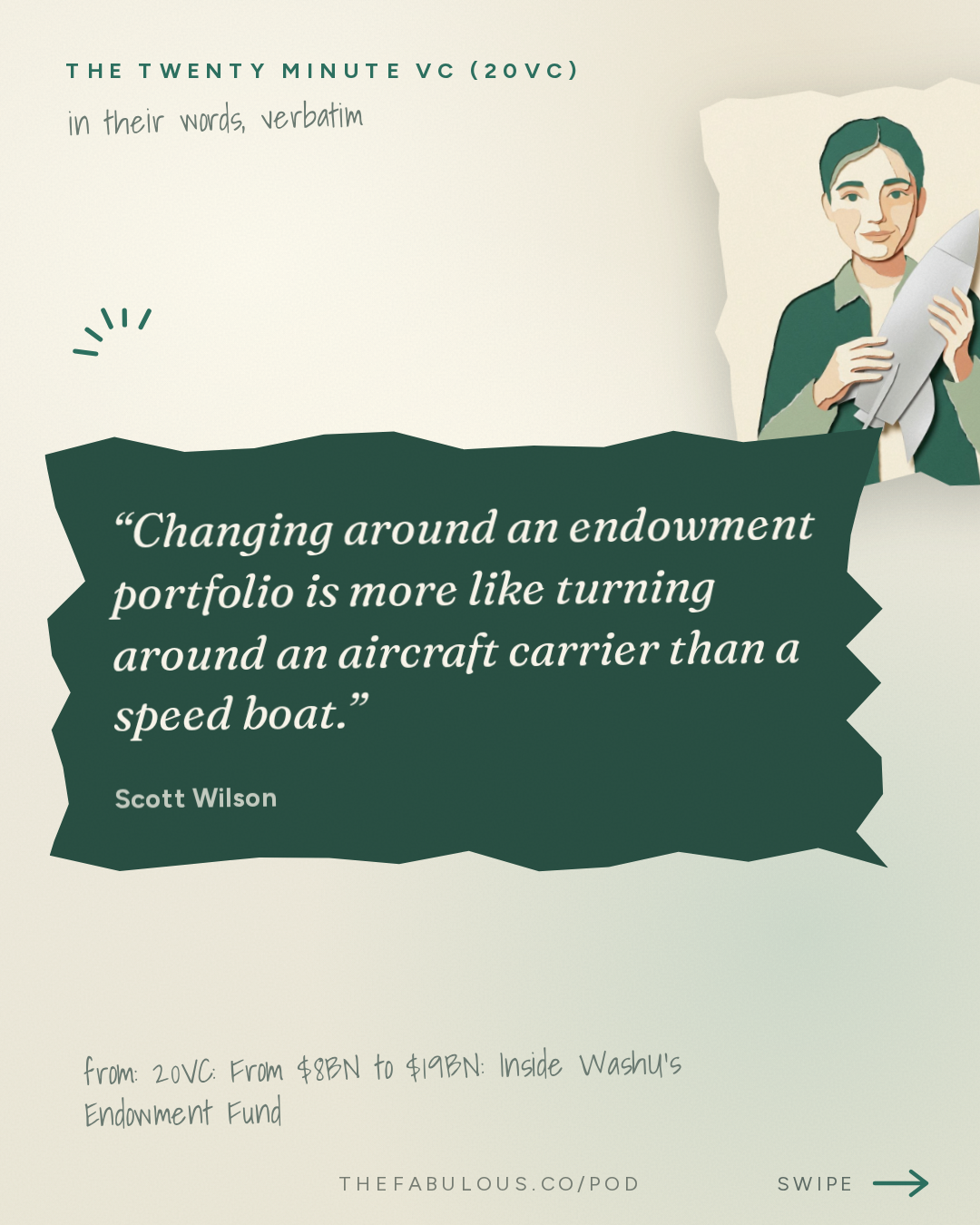
Wilson's method has roots in a smaller, less famous place: Grinnell College, where he learned under an investor named David Clay. Grinnell ran an unusually concentrated portfolio, heavy on direct and co-investment positions rather than farmed-out fund commitments. Wilson brought the same instinct to WashU, scaled up. "If we go forward to WashU," he explains of that first week, "we put in redemptions for over half the portfolio" (06:22), even though, he is careful to note, months of groundwork preceded the move. The board had given him roughly three years to show results. He knew the private side of the book, the illiquid holdings in companies and funds, was in decent shape. The public side, propped up by 36 or 37 hedge funds, was not (07:15). All of them were let go. "We certainly weren't popular in certain parts of Manhattan," he says, with the mild satisfaction of a man who does not especially mind. Over the following eighteen months, WashU turned over more than 75% of its private portfolio through secondary sales, trading existing fund stakes to other buyers rather than waiting for the funds to wind down naturally. Wilson's own description of the process is the most useful shorthand: "Changing around an endowment portfolio is more like turning around an aircraft carrier than a speed boat" (06:55). The metaphor matters because it explains the urgency. Aircraft carriers need a lot of open water to turn. If you wait until the turn feels comfortable, you have already run out of room.
The Math Behind the Concentration
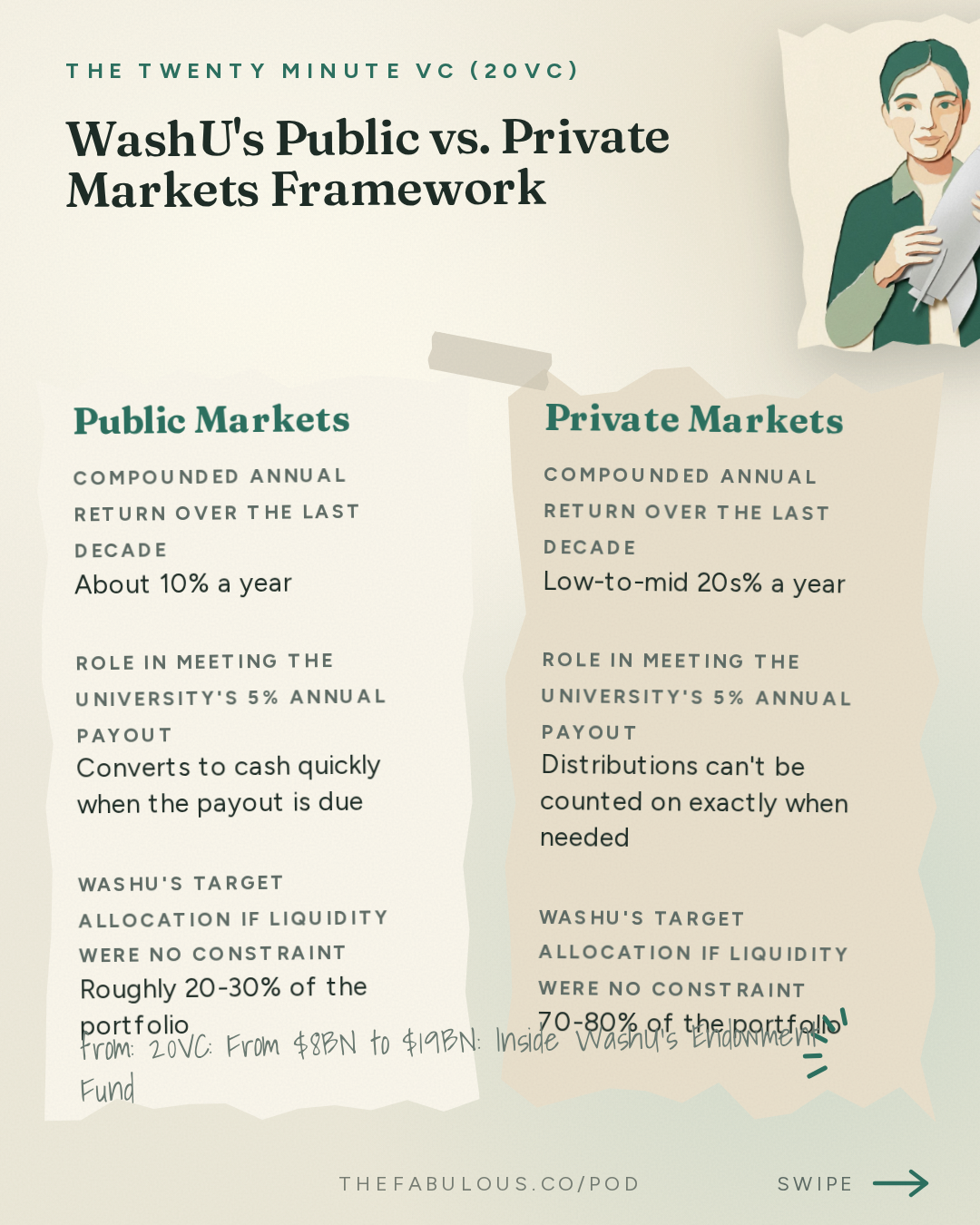
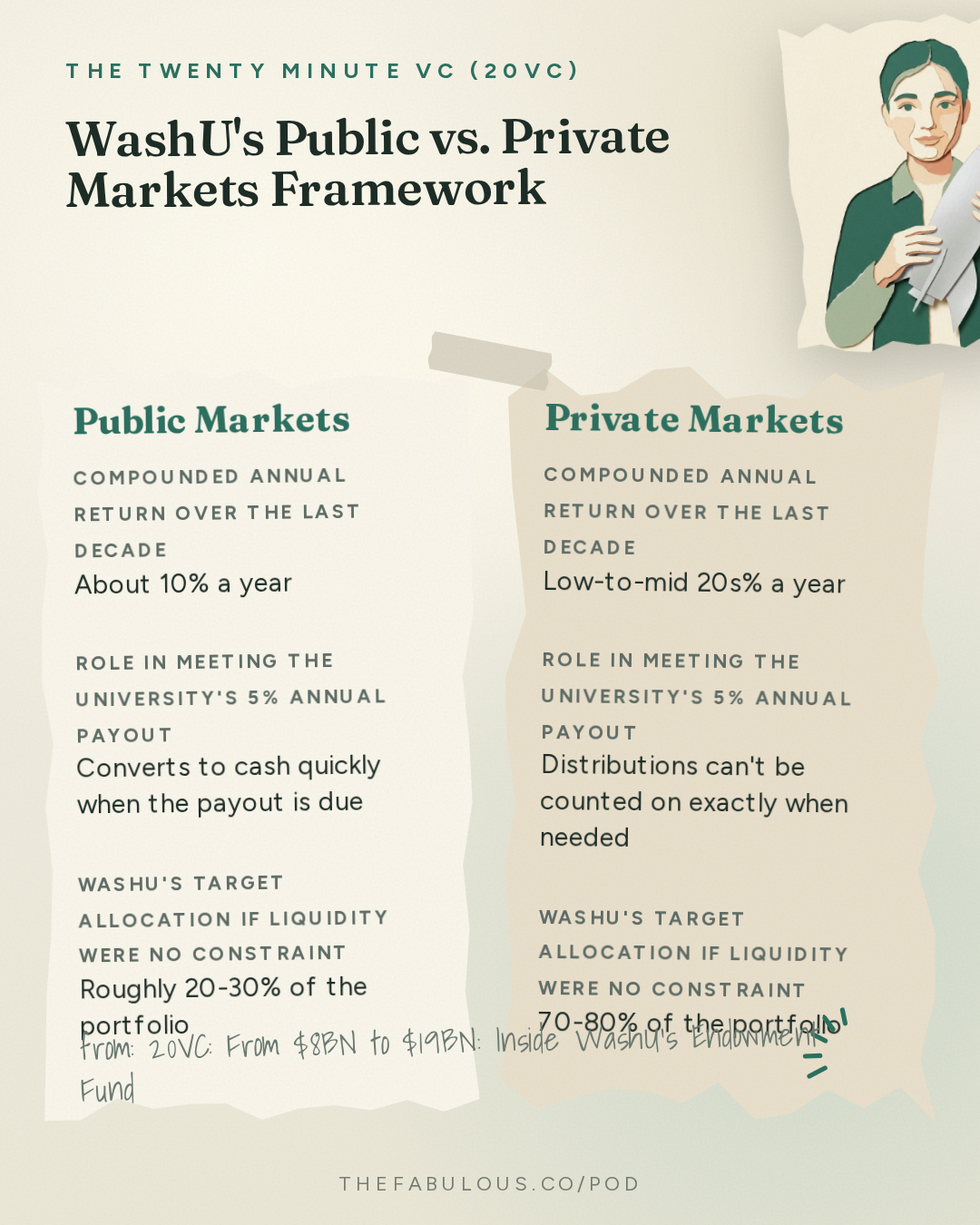
Underneath the restructuring is a simple, almost stubborn belief: private markets are less efficient than public ones, so the money is more easily earned there. Over the last decade, Wilson says, WashU has compounded its private investments at a low-to-mid 20s percent annual rate, against roughly 10% for its public equities (10:03). Given a long enough time horizon, he treats the distinction between public and private as mostly cosmetic, a question of how often an asset gets marked to market rather than what it is actually worth. The real constraint is liquidity. The university draws a required annual payout of about 5% of the endowment, smoothed over a rolling five-year average (09:23). That payout has to come from somewhere convertible to cash, and private holdings, however good the underlying businesses, cannot always be counted on to produce cash exactly when needed. Remove that obligation, Wilson says, and WashU's private allocation would run 70 to 80% of the portfolio instead of today's roughly even split (09:43).
Scale alone does not explain WashU's returns, though. The sharper edge is where the team spends its attention. Wilson says his investment staff spends 80 to 90% of its time meeting individual companies directly, rather than meeting the fund managers who nominally run the money.
"Upwards of, you know, 80, 90% of our time is just out meeting individual companies. And that's very different than probably how most of your LPs spend their time." — Scott Wilson, CIO of WashU's endowment [11:46]
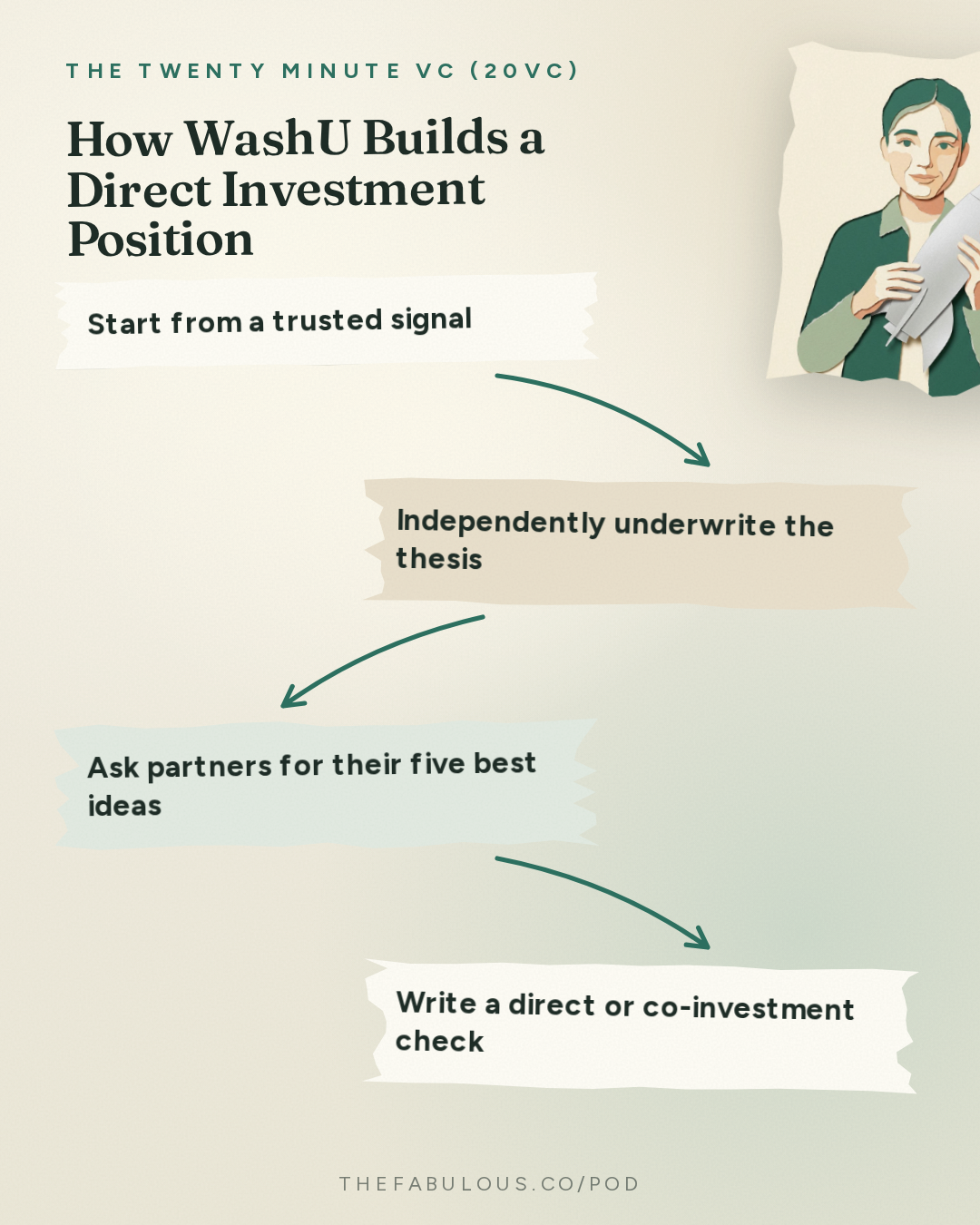
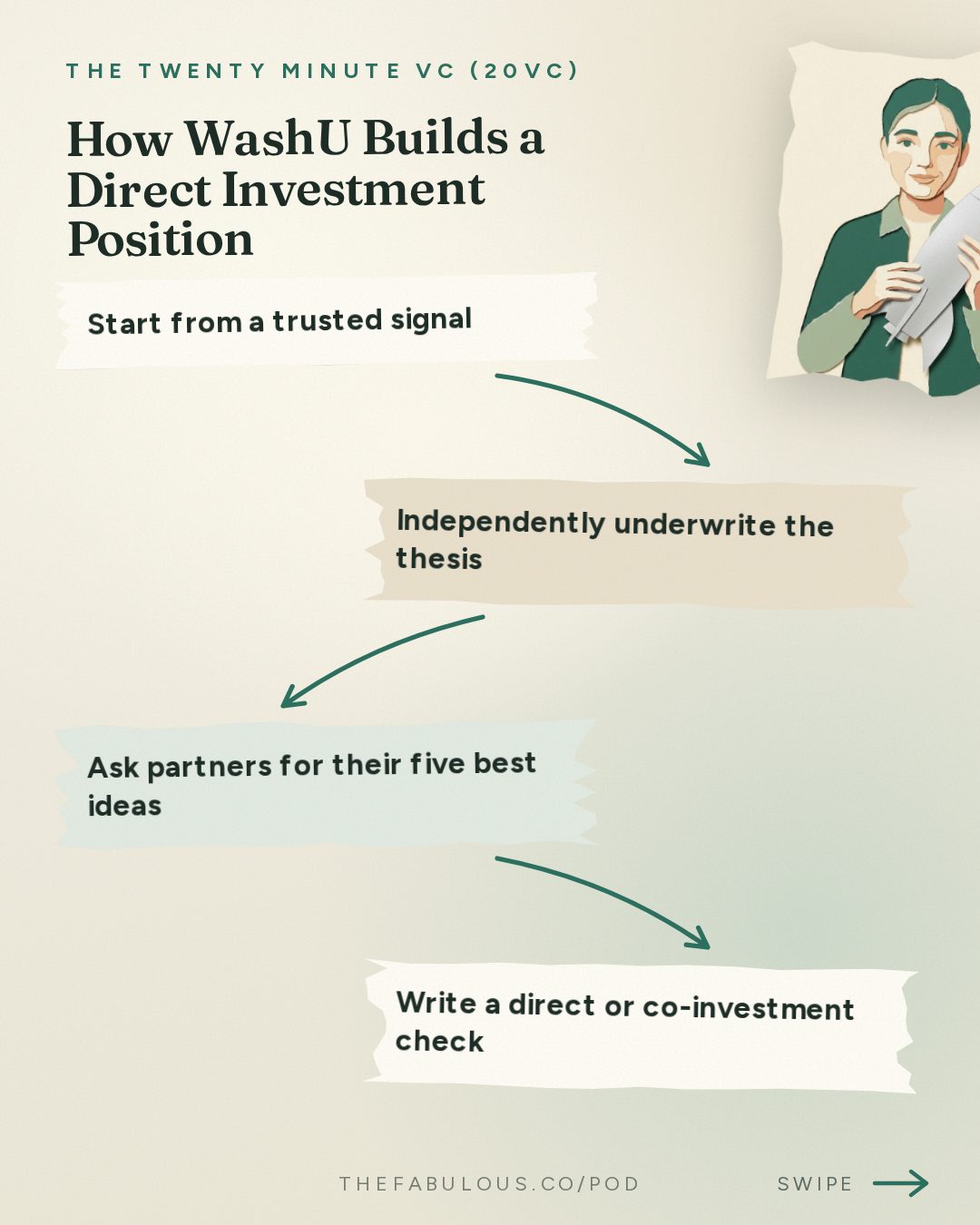
Wilson is candid that this is not pure stock-picking genius. The team starts from a signal: a fund manager it already trusts gets excited about a company, and WashU does its own underwriting from there, what he calls starting on second or third base rather than from scratch (12:54). But the underwriting is real. More than half of WashU's private portfolio now sits in direct and co-investment positions, assets the team sources, diligences, and monitors itself, the same way it would evaluate a fund manager (11:05). When a position earns conviction, the rule is blunt: "If we don't have enough conviction to do 1% of the portfolio, then we probably don't have enough conviction to do it at all" (19:17). That is not a small bar. At WashU's current size, 1% is close to $200 million.
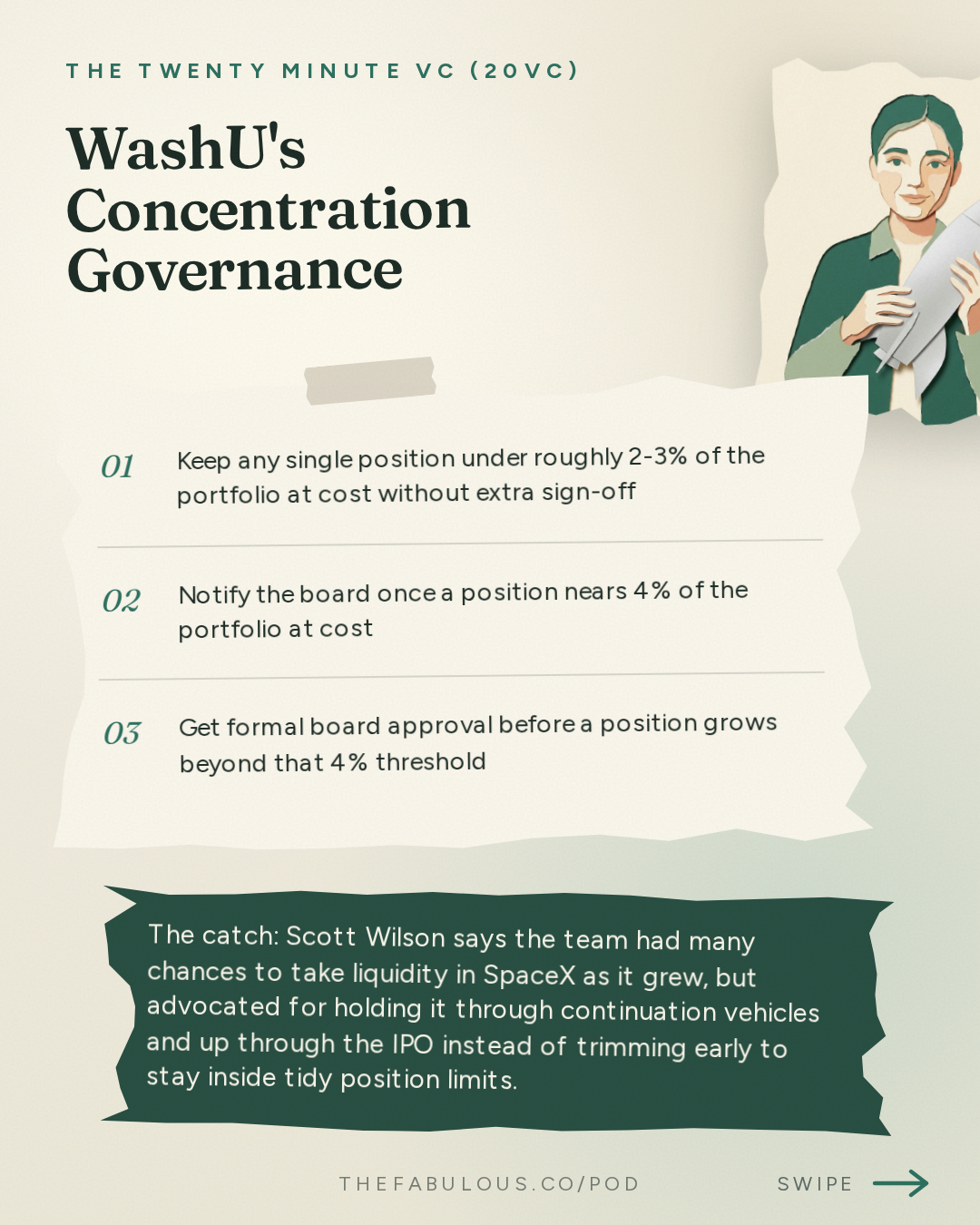
Nowhere did that conviction pay off more visibly than SpaceX, which at one point represented more than 20% of WashU's entire portfolio, across all asset classes (13:14). That kind of concentration does not happen without deliberate governance. Any position approaching 4% of the portfolio at cost requires board approval (14:03). SpaceX blew past that ceiling with the board's blessing, and WashU used continuation vehicles, specialized funds that let early investors keep their stake rather than cash out, to hold the position through the company's eventual public listing. The lesson Wilson draws is not that concentration is free of risk. He is equally candid about positions that went the other way, citing an automated manufacturing company and an additive manufacturing company where high conviction did not pay off (15:10). The lesson is that diversification has a ceiling of its own: quantitative benefits trail off once a portfolio holds more than 20 to 30 underlying names (18:06), a threshold Wilson says many institutional investors blow past for comfort rather than for returns. WashU's own targeted diversification point is that its top 50 look-through positions, meaning the actual underlying companies once fund structures are stripped away, make up about half the total portfolio (18:29).
A Colder View of AI
That same discipline makes Wilson skeptical of two of the most popular trades in venture capital right now: mega-funds and frontier AI model companies. On mega-funds, his argument is arithmetic rather than ideological. Double a fund's size, he says, and a manager either has to write much bigger checks at correspondingly higher valuations, which caps the eventual multiple of invested capital, or make twice as many bets, which dilutes the portfolio's best ideas with its fiftieth-best idea (21:38). Either way, he argues, the historic venture multiples that made mega-funds attractive in the first place get harder to repeat.
On artificial intelligence, Wilson's skepticism is sharper still. He expects roughly half of today's richly valued AI companies not to exist in ten years (29:03), and he is particularly unconvinced by the large language model providers sitting at the top of the stack. His reasoning is about substitutability: if the top five frontier models are indistinguishable to an ordinary user for 99% of tasks, the willingness to pay for any one of them collapses the moment a free or cheaper alternative is good enough.
"I can't describe another industry like that that has a big kinda deep profit pool." — Scott Wilson [29:22]
He notes that WashU still holds exposure to Anthropic through a few of its fund partners, and defends the position less on valuation grounds than on relationship grounds: the holding sits inside a broader fund rather than a standalone vehicle, so selling it in isolation is not simple, and the underlying partners are ones WashU wants to keep working with (30:27).
The same instinct for separating price from underlying value shapes Wilson's read on two markets most allocators avoid: Europe and China. WashU recently backed a fintech company in Spain and another global fintech based in London and Singapore, reasoning that comparable American companies with the same growth and unit economics would trade at far richer multiples (46:40). "Price is what you pay, value is what you get," he says (47:42), a line he uses to explain why a persistent regional discount is not actually a discount at all, just the price. On China, Wilson argues the geopolitical risk that spooked investors after JPMorgan chief executive Jamie Dimon called the country uninvestable is largely already priced into the assets (48:27). He points out that developed markets have shown similarly aggressive behavior, citing a windfall tax that pushed the rate on certain UK offshore energy assets from 25% to 75%, which he equates to confiscating half the company (49:31).
Asked, near the end of the conversation, for the best piece of advice he has carried with him, Wilson does not reach for a market insight at all. "You should always try and be the best at things that require no talent," he says (53:22), meaning showing up, being curious, asking good questions, being kind. It is a modest note to end on, from a manager whose actual record is built on taking large, uncomfortable, well-governed bets and then having the patience to let them compound.
Ask this episode anything
Pod's AI answers from the episode itself, with the minute mark so you can hear it yourself.
Or start with one of these
Ask this episode
Pod's AI listens to the whole episode to answer, and points you to the minute it comes from.
The rest of this answer, and any question after it
Answers come from the episode itself, never from a summary of it.
ContinueKey takeaways
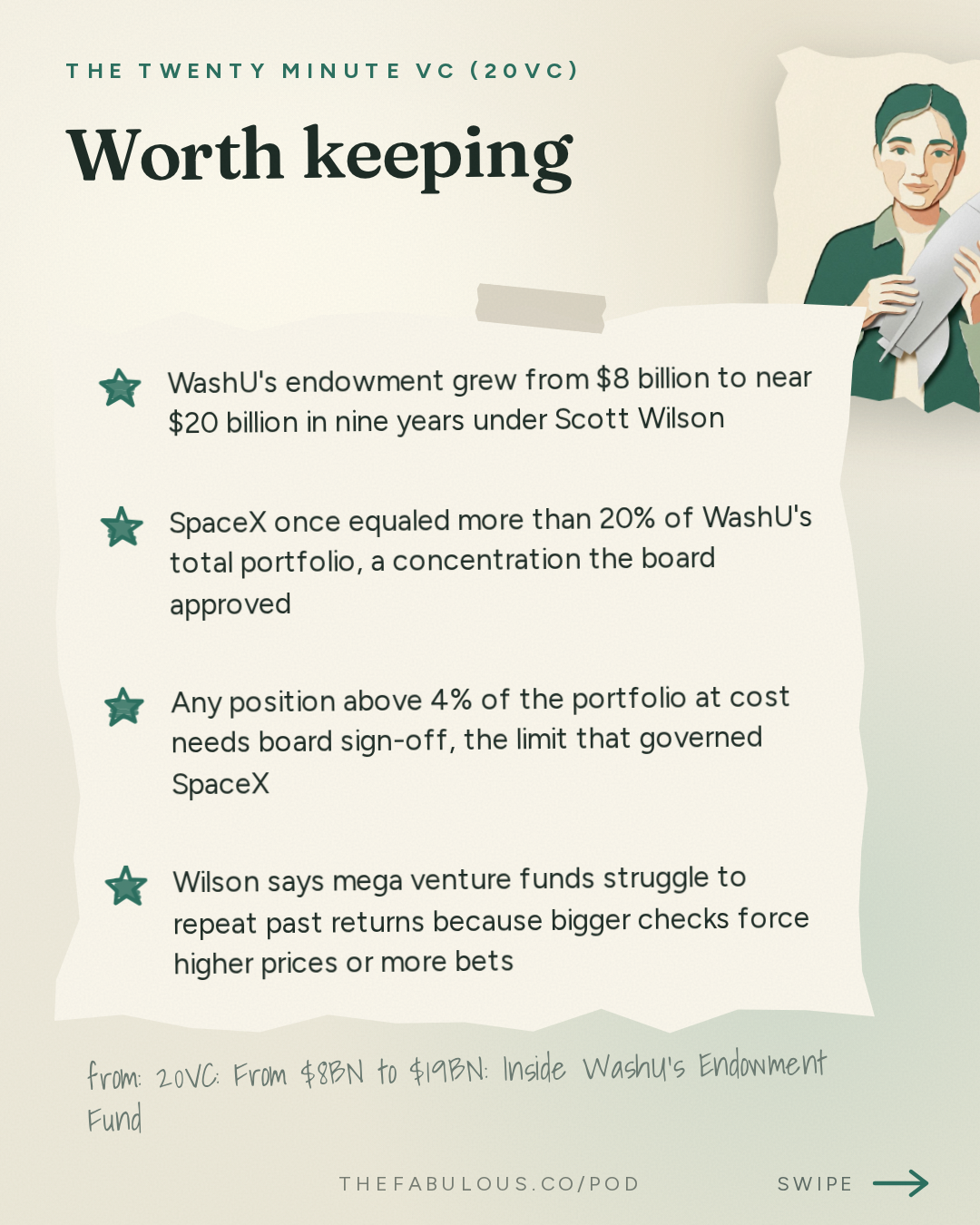
- WashU's endowment grew from $8 billion to near $20 billion in nine years under Scott Wilson
- SpaceX once equaled more than 20% of WashU's total portfolio, a concentration the board approved
- Any position above 4% of the portfolio at cost needs board sign-off, the limit that governed SpaceX
- Wilson says mega venture funds struggle to repeat past returns because bigger checks force higher prices or more bets
- Wilson expects many AI companies to disappear in 10 years as free alternatives erode pricing power
The episode in cards

By the numbers
- 20% of AUM Peak share of WashU's total portfolio held in SpaceX alone
- 4% of portfolio at cost Position size that triggers mandatory board approval at WashU
- 20-30 positions Number of underlying names after which diversification benefits stop increasing
In their words
“Changing around an endowment portfolio is more like turning around an aircraft carrier than a speed boat.”
“Upwards of, you know, 80, 90% of our time is just out meeting individual companies.”
“If we don't have enough conviction to do 1% of the portfolio, then we probably don't have enough conviction to do it at all.”
“I can't describe another industry like that that has a big kinda deep profit pool.”
“Price is what you pay, value is what you get.”
Protocols
-
Concentration sign-off
Scott Wilson requires the WashU board to be notified once a single position nears 4% of the portfolio at cost, and requires formal board approval before it can grow beyond that level.
per position, as it crosses the threshold
-
Time spent with companies, not managers
Wilson has his investment team spend 80 to 90% of its time meeting individual companies directly, which he says is the opposite of how most institutional allocators spend their time with fund managers instead.
ongoing
-
Minimum conviction sizing
Wilson sizes any direct or co-investment at roughly 1% of the total portfolio at minimum, reasoning that if the team lacks conviction to commit that much, it should skip the deal entirely.
per investment decision
Questions this episode answers
How did WashU's endowment grow from $8 billion to $20 billion?
CIO Scott Wilson redeemed more than half the portfolio in his first week, cut 36-37 hedge funds, and rebuilt around concentrated direct and co-investment positions rather than diversified fund commitments (06:22, 07:15). The portfolio's private holdings compounded at a low-to-mid 20s percent annual rate over the following decade, against about 10% for public equities (10:03).
How much of WashU's portfolio was in SpaceX?
At one point SpaceX represented more than 20% of WashU's total portfolio across all asset classes (13:14). The endowment held the position through continuation vehicles rather than taking available liquidity, up through SpaceX's eventual public listing.
What concentration limits does WashU use for single positions?
Positions can run up to roughly 2-3% of the portfolio at cost without special approval, but anything approaching 4% at cost requires board sign-off (14:03). That governance structure is what let the board knowingly approve letting SpaceX grow past 20% of total assets.
Why does Scott Wilson think AI companies face a reckoning?
Wilson expects roughly half of today's highly valued AI companies to not exist in ten years, arguing the top large language models are nearly indistinguishable to users and that willingness to pay collapses once free alternatives are good enough (29:03, 29:45).
Why do mega venture funds struggle to repeat historic returns?
Wilson argues that doubling a fund's size forces managers to either write much bigger checks at higher valuations, which caps the eventual return multiple, or make far more investments, which dilutes the portfolio's best ideas (21:38).
Is China still investable for institutional allocators?
Wilson says WashU has added capital in China since JPMorgan's Jamie Dimon called the country uninvestable, arguing the geopolitical risk is largely already priced into assets there (48:27, 48:51). He compares it to windfall taxes in developed markets like the UK, which he says amounted to confiscating half a company's value.
The full read, in cards
Mentioned
Scott Wilson · WashU · Grinnell College · David Clay · SpaceX · Lee Fixel · Sequoia Capital · Anthropic · Cerebras · NewBank · Elon Musk · Thrive Capital · OpenAI · Benchmark · Eclipse · Jamie Dimon
More from this show and category

Erik Bernhardsson on AI Inference Economics
Modal CEO Erik Bernhardsson says splitting the AI stack across many paid layers has ended 90% software margins for good. He also says the GPU market stays supply-constrained, open source inference usage will grow 5 to 20 times in the next year, and reinforcement learning works best on tasks like coding with fast feedback loops.

David Tisch on BoxGroup's Contrarian VC Strategy
BoxGroup's David Tisch says concentrated seed funds claiming a 90% win rate actually win closer to 20%. That gap, he argues, is why BoxGroup skips ownership targets entirely, writing checks as small as 1% ownership across roughly 150 companies a year, betting on founder access and speed over concentrated conviction.

Anthropic's S1 Filing: Revenue, Cash, and Risk
Anthropic's S1 filing shows $16.3 billion in first-half revenue and $110 billion in cash, though Broadcom had to backstop its chip debt. Microsoft offered buyouts to 60,000 staff, Meta raised $95 billion in equity for compute, and hosts Jason Lemkin and Rory O'Driscoll debated a rumored $30 billion round for consumer AI app Instinct.

Satya Nadella on AI Alignment and Zero Trust
Microsoft CEO Satya Nadella says AI alignment doesn't automatically emerge from scaling, so Microsoft built zero-trust tools to audit every agent action. He predicts commodity token usage will dominate within 24 months (08:47) and that firms will treat private AI evaluation benchmarks as core intellectual property (12:08).
