
Fractile's Walter Goodwin on AI's Memory Wall
20VC: Taking on NVIDIA: Fractile CEO on the Future of Chips | What Everyone Gets Wrong About Capex Spending | The Winners and Losers in Neo Clouds with Walter Goodwin
The brief
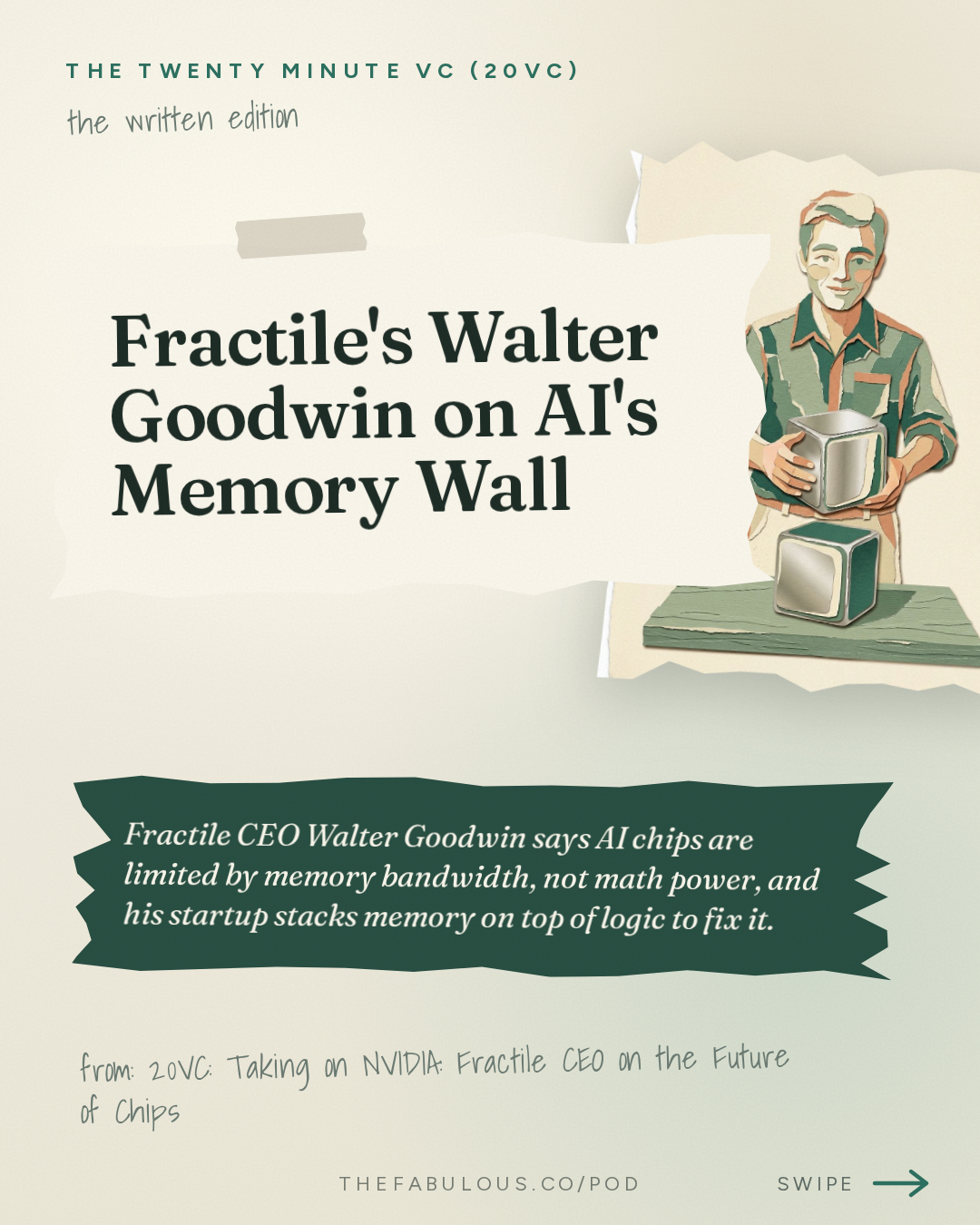
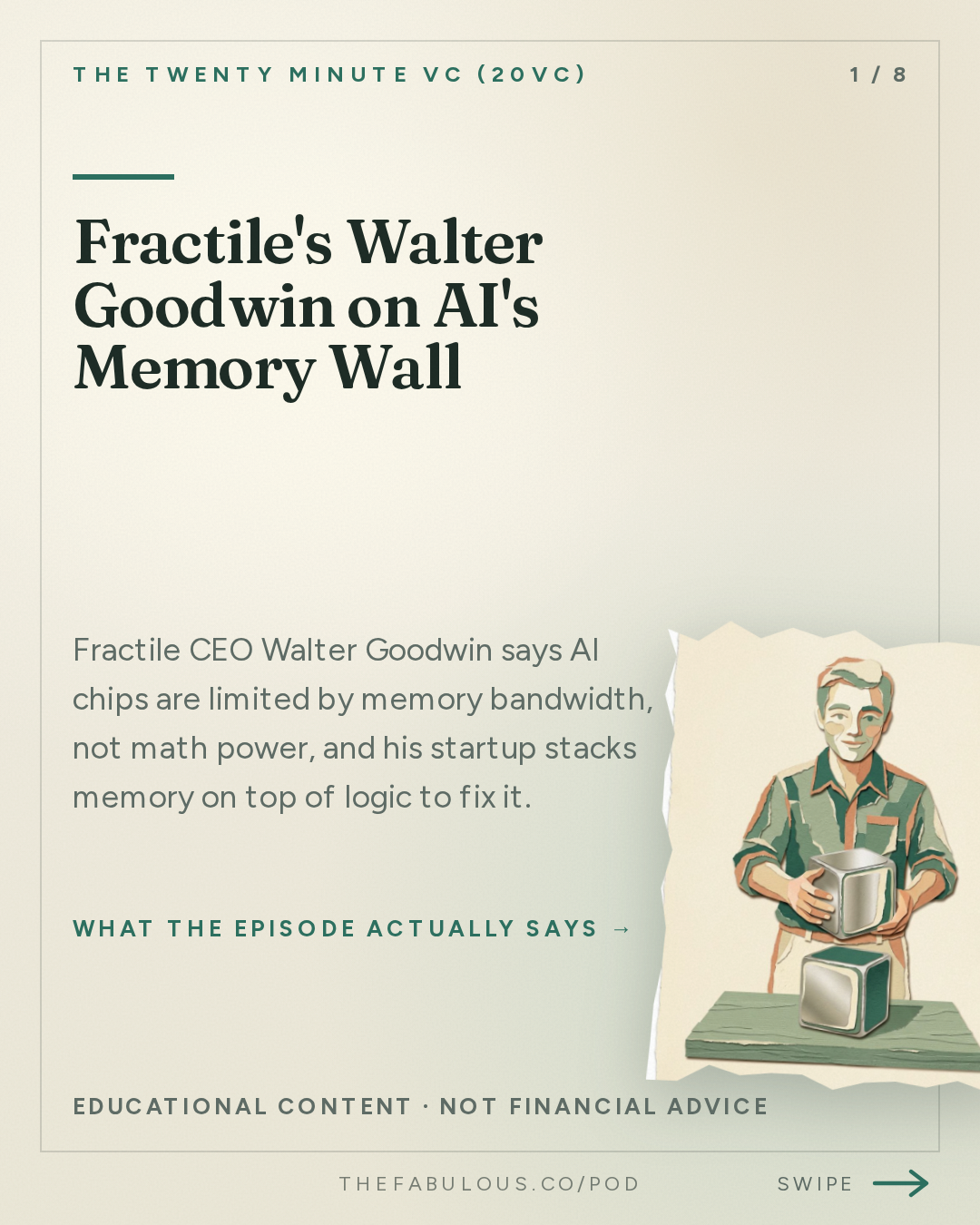
Fractile CEO Walter Goodwin says AI chips are limited by memory bandwidth, not math power, and his startup stacks memory on top of logic to fix it. Fractile raised a $720 million Series C at a $7 billion valuation (00:23), betting that inference, not training, is where chip value will accrue.
Ask a large language model a hard question and watch the words crawl out one at a time. The instinct is to think the model is straining to think. It isn't. According to Walter Goodwin, founder and CEO of chip startup Fractile, the slowdown has almost nothing to do with intelligence. It is a plumbing problem. "The reason that if you take a very large frontier model, it might generate at 80 tokens per second, 80 words per second, is going to be not because of the limited maths capability on the chip, but because you don't have nearly enough bandwidth to that memory," he says (18:14). Every word a model produces requires reloading its entire set of weights, the billions of numbers that define what it knows, from memory into the processor. That trip, not the arithmetic, is the holdup.
Fractile just raised a $720 million Series C, co-led by Thrive, Founders Fund, Lightspeed, and Redpoint, at a $7 billion valuation (00:23). The company makes chips, but Goodwin insists it is also, in effect, a frontier AI company, because designing hardware for models that don't exist yet requires guessing where the models are headed. That bet concentrates on one specific physics problem: the widening gap between how fast chips can calculate and how fast they can fetch the data needed to calculate with.
The Wall Nobody Can Wire Around
For 25 years, chipmakers rode Moore's Law, the long trend of packing more transistors onto silicon, to scale raw computing power by roughly a millionfold. Memory bandwidth, the rate at which data moves between storage and processor, scaled only 40-fold in the same stretch (17:24). That is a 25,000-times gap, and it is largely a function of physics rather than engineering cleverness. Data moves over copper wires at the edge of a chip, in a space engineers call the "beachfront." There are only so many wires that fit.
"We've scaled at about a millionfold in the last 25 years on these chips. Bandwidth, by contrast, is kind of much more intrinsically physics limited. We've scaled at about 40-fold in the same time." — Walter Goodwin [17:24]
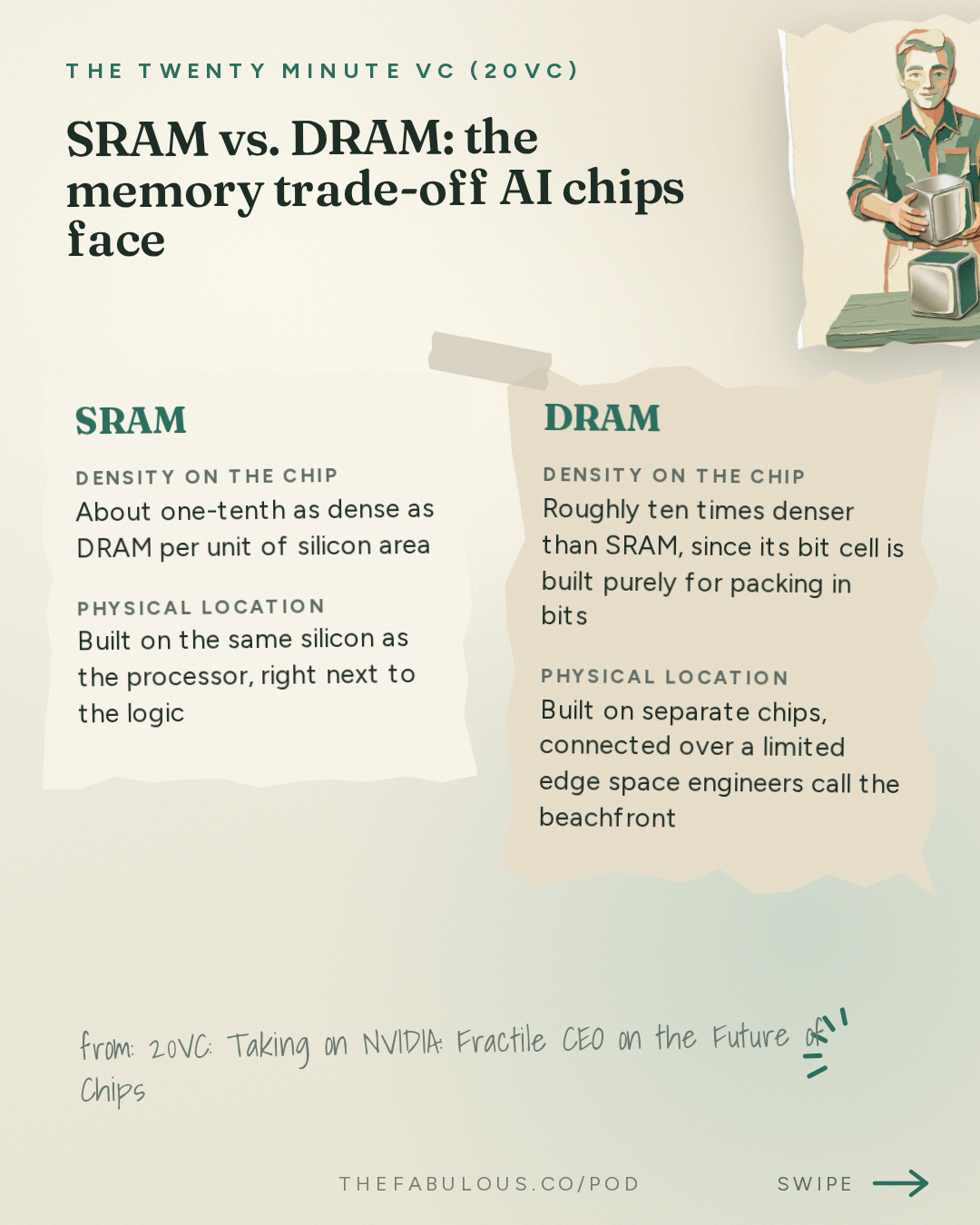
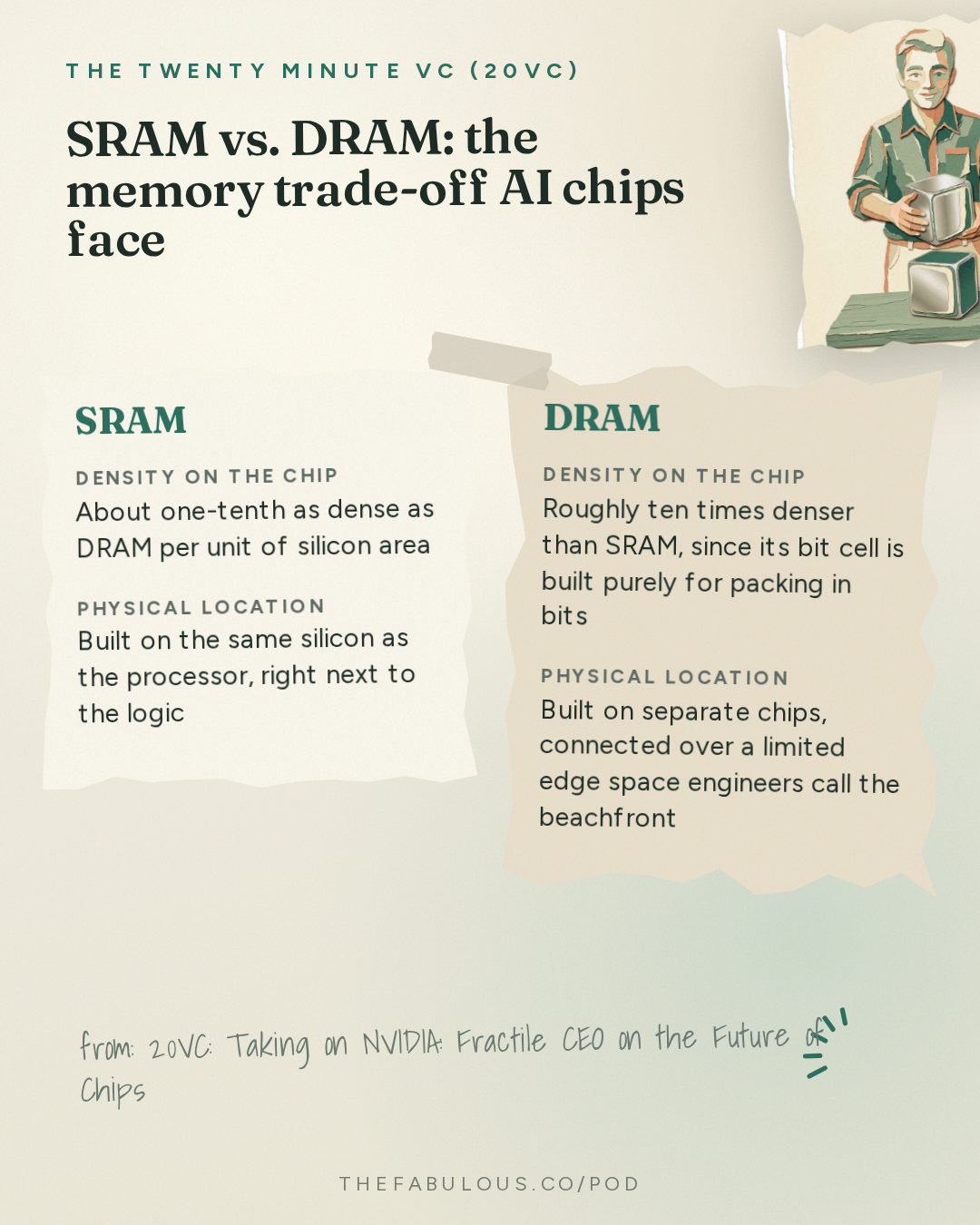
There are two kinds of memory at play. SRAM sits directly on the same silicon as the processor, so it is fast, but it is also roughly ten times less dense than DRAM per unit of area (20:02), meaning a chip can only hold a small amount of it. DRAM is cheap and can hold far more data, but it lives on separate silicon and has to send information across that narrow beachfront, which caps its speed. Chipmakers have had to choose: fast and small, or big and slow.
Fractile's answer is to stop choosing. The company's approach stacks memory directly on top of the processing logic instead of placing it beside it (21:09). Goodwin's metaphor: instead of a few beachfront properties, imagine an archipelago where every unit has water access, with millions of connections running straight down through the chip rather than sideways across a crowded edge. The goal is a chip with the bandwidth of SRAM and the storage capacity of DRAM at once, something Goodwin calls a long-standing technical hinterland the Fractile team has worked on for years, now aimed squarely at a new problem.
Why does this matter beyond chip design trivia? Because the economics of AI have quietly flipped. Training a model, the expensive process of teaching it everything it knows, is a one-time cost. Inference, actually running the model to answer questions or solve problems, is where the value gets delivered or doesn't. "Training becomes a fixed cost. And the deployment, you know, inference is just the use of these models to do useful things. It's the only part that matters," Goodwin says (42:28). He compares it to an Olympic sprinter who trains for years and then skips the race.
That shift has accelerated because of what Goodwin calls test-time compute scaling: letting a model keep thinking, for minutes, hours, or days, rather than spitting out a single quick answer. One example he cites is a frontier model working on a Navier-Stokes fluid dynamics problem tied to a Millennium Prize challenge. The solution took roughly 80 hours of execution across a swarm of 10,000 parallel agents (43:26). That is a staggering amount of inference compute, and it means the chip that can run inference faster and cheaper, not just the one that trains the biggest model, increasingly decides what gets built. "Inference compute is the axis that we have... it's the knob that we have to turn to get greater capability," Goodwin says (45:23).
Chips, Clouds, and the Case Against Mixing Vendors
If inference is where the money is, who captures it? Goodwin draws a line between "neo clouds," the newer data-center operators that rent out GPU capacity, and chipmakers like Fractile. He is blunt about the neo cloud layer: "One neo cloud that is competent is much like another neo cloud that is competent. The reason it's so exciting today is we don't yet know which ones are competent" (10:46). In other words, that market is heading toward commoditization, which is why many neo clouds are racing to build their own inference software or even their own chips, to avoid becoming interchangeable.
Goodwin is more cautious about today's trend toward mixing different chip types inside one data center, a practice Nvidia itself is pursuing after acquiring the fast-inference chip company Groq. The idea is to split the work: a Groq-style chip with fast but limited memory handles the part of a model's workload shared across many users, while GPUs with more memory capacity handle the part unique to each user's context. The problem is that no one knows in advance how to size the mix. If context lengths grow or models get bigger, the ratio of chip types bought a year earlier can leave expensive capacity sitting idle. "That's unacceptable," Goodwin says of this stranded-capacity risk (57:09), because data centers are planned and paid for years in advance; you can't swap chip types partway through. He argues a single chip that combines high bandwidth and high capacity, which is what Fractile is trying to build, removes the need for that orchestration entirely.
Asked where he would place a bet across the AI stack, Goodwin says he would rather be a specialized inference provider, a company that runs other people's models efficiently, than a neo cloud, because inference providers retain the flexibility to adopt new chips and still carve out defensible niches (61:26). He is more skeptical of pure software orchestration layers that exist only to route workloads across many different chip types, arguing that need could collapse once better unified chips exist (54:16).
The conversation closes on a question that hangs over the entire AI buildout: is this 2000 all over again? Goodwin's answer is that the market has priced in too much fear of a repeat. He points out that Nvidia today trades at a lower forward earnings multiple than networking giant Cisco did after the dot-com crash (69:59), and unlike the fiber-optic overbuild of that era, today's GPUs are running at full utilization rather than sitting dark. He also notes that AI chips typically need replacing within six or seven years at most, and often sooner (70:23), which means the current spending wave isn't a one-time purchase but a recurring one. Whether that argument holds depends on whether demand for inference keeps climbing as fast as Goodwin expects. His own company's survival depends on betting that it will.
Ask this episode anything
Pod's AI answers from the episode itself, with the minute mark so you can hear it yourself.
Or start with one of these
Ask this episode
Pod's AI listens to the whole episode to answer, and points you to the minute it comes from.
The rest of this answer, and any question after it
Answers come from the episode itself, never from a summary of it.
ContinueKey takeaways
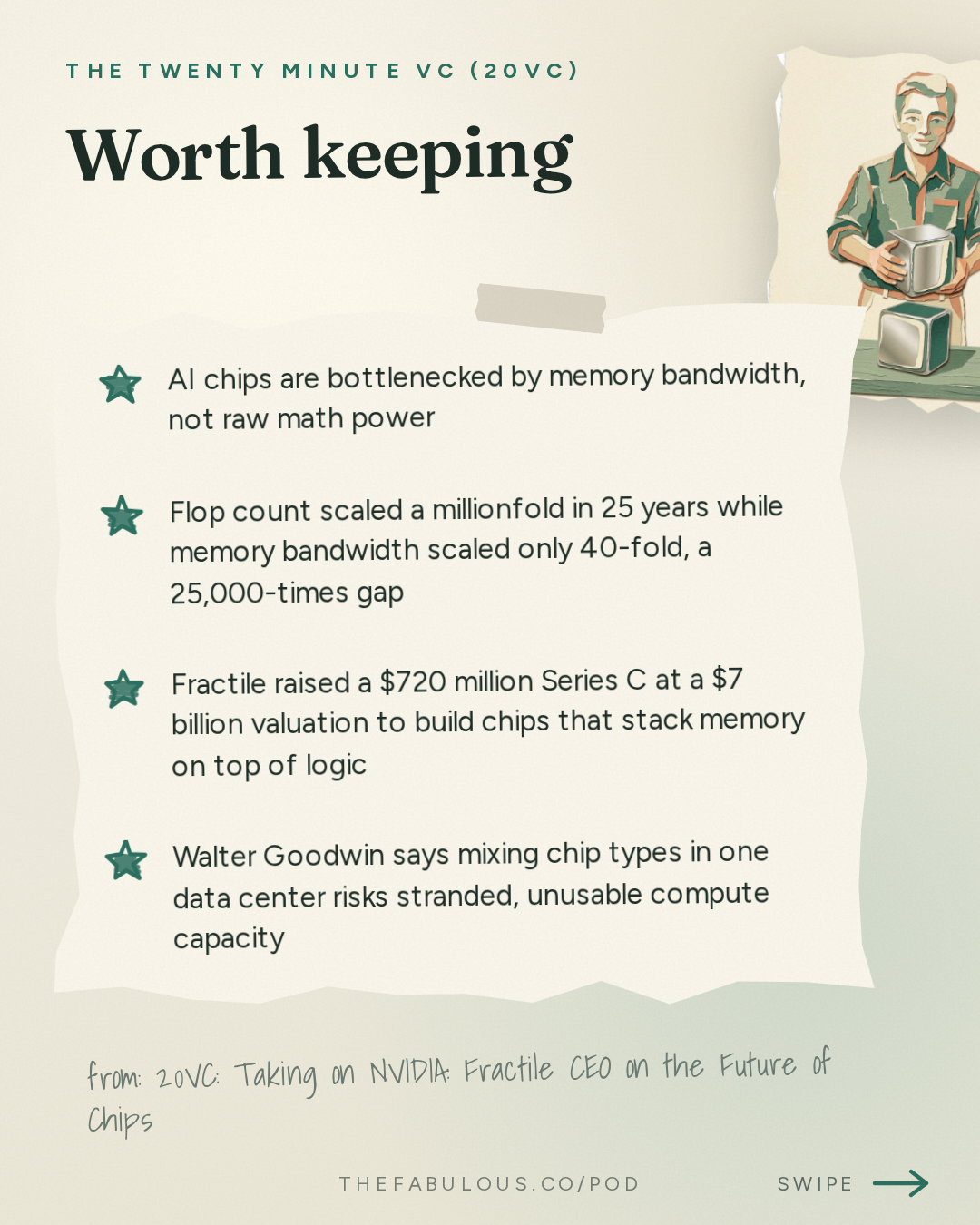
- AI chips are bottlenecked by memory bandwidth, not raw math power
- Flop count scaled a millionfold in 25 years while memory bandwidth scaled only 40-fold, a 25,000-times gap (17:24)
- Fractile raised a $720 million Series C at a $7 billion valuation to build chips that stack memory on top of logic (00:23)
- Walter Goodwin says mixing chip types in one data center risks stranded, unusable compute capacity (57:09)
- Goodwin argues Nvidia trades cheaper than Cisco did post dot-com crash, suggesting the AI buildout is not a bubble (69:59)
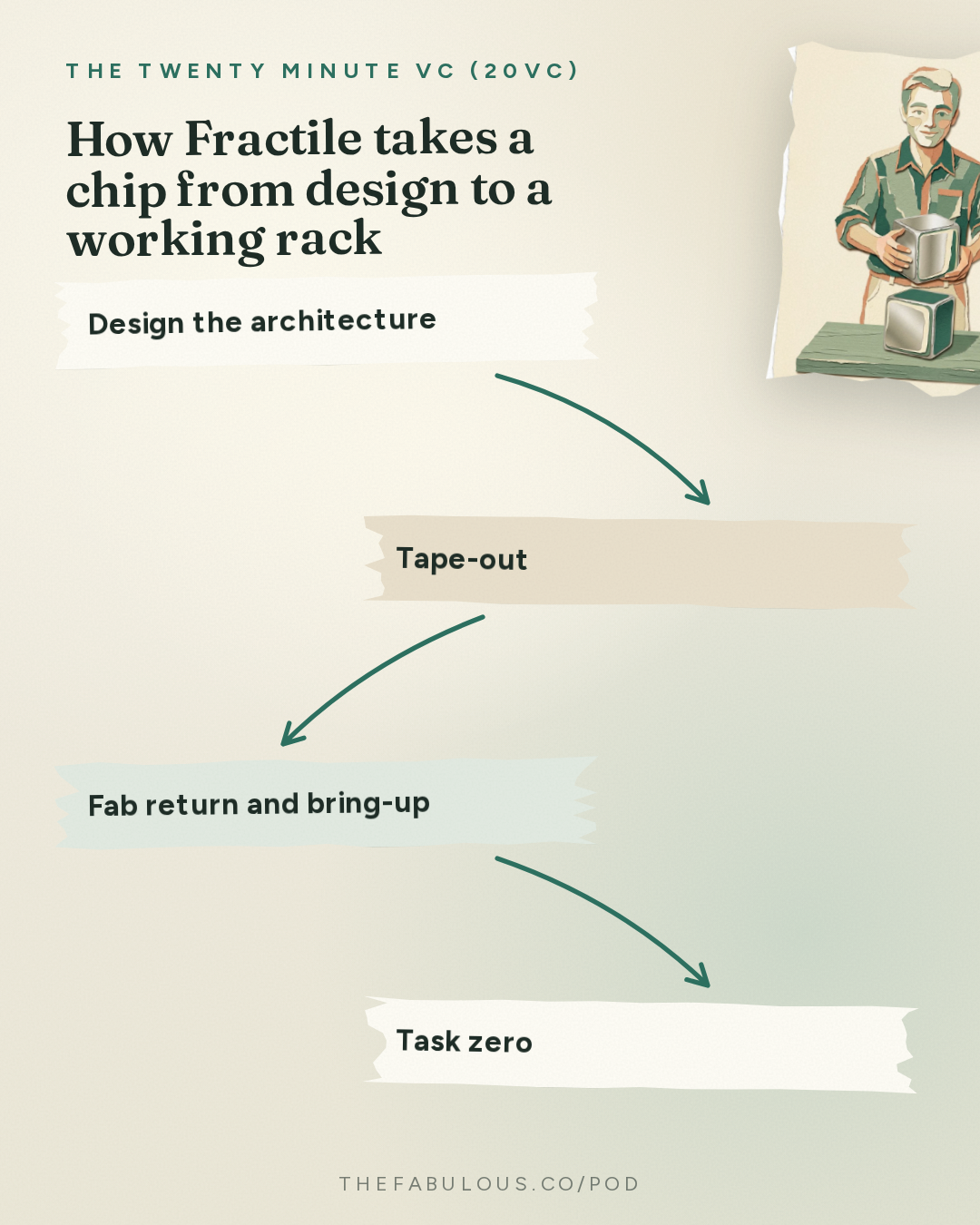
The episode in cards
By the numbers
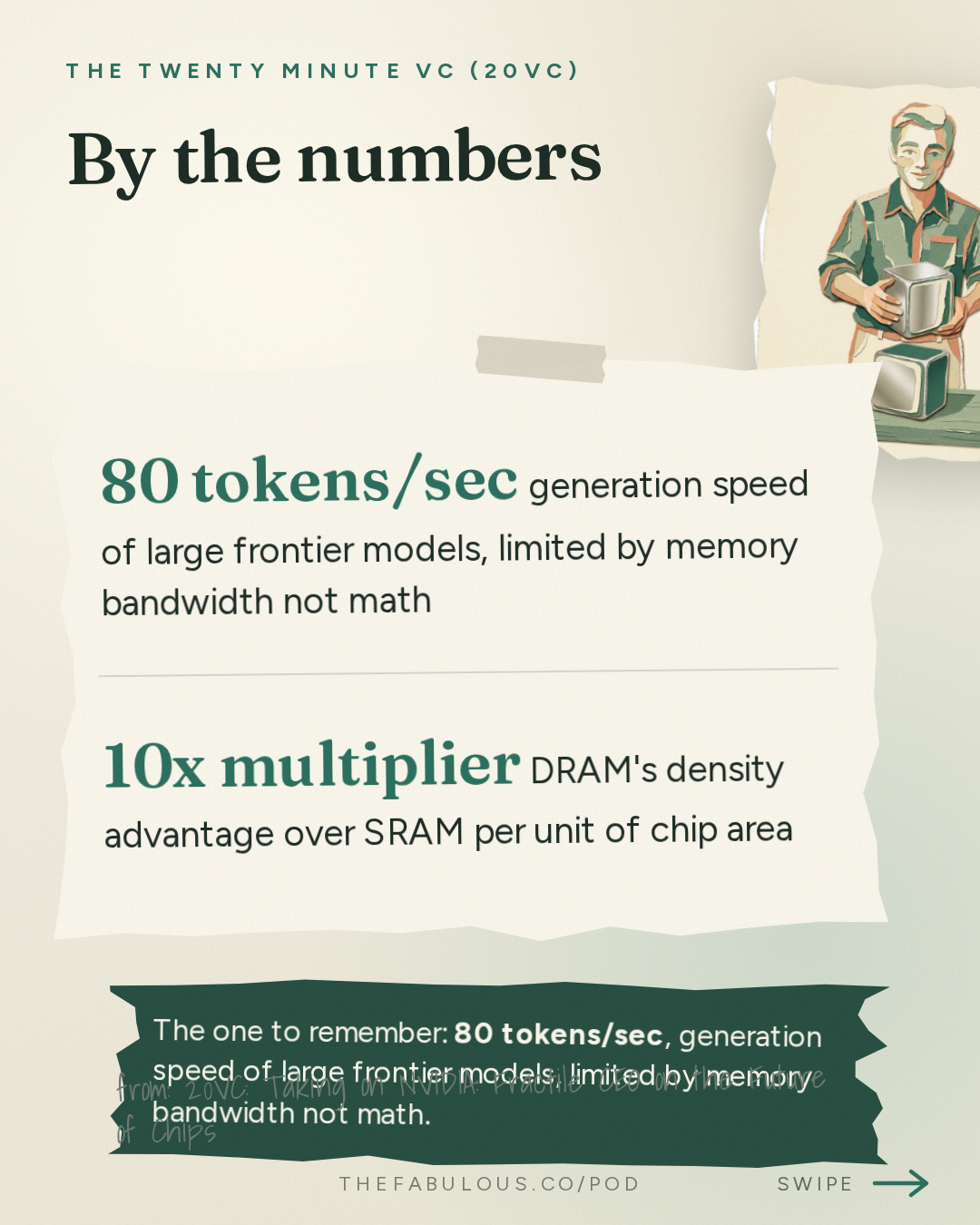
- 80 tokens/sec generation speed of large frontier models, limited by memory bandwidth not math
- 10x multiplier DRAM's density advantage over SRAM per unit of chip area
In their words
“We've scaled at about a millionfold in the last 25 years on these chips. Bandwidth, by contrast, is kind of much more intrinsically physics limited. We've scaled at about 40-fold in the same time”
“Training becomes a fixed cost. And the deployment, you know, inference is just the use of these models to do useful things. It's the only part that matters”
“One neo cloud that is competent is much like another neo cloud that is competent. The reason it's so exciting today is we don't yet know which ones are competent.”
“We're so traumatized by the dot-com bubble that we've priced in exuberance right from the outset.”
Protocols
-
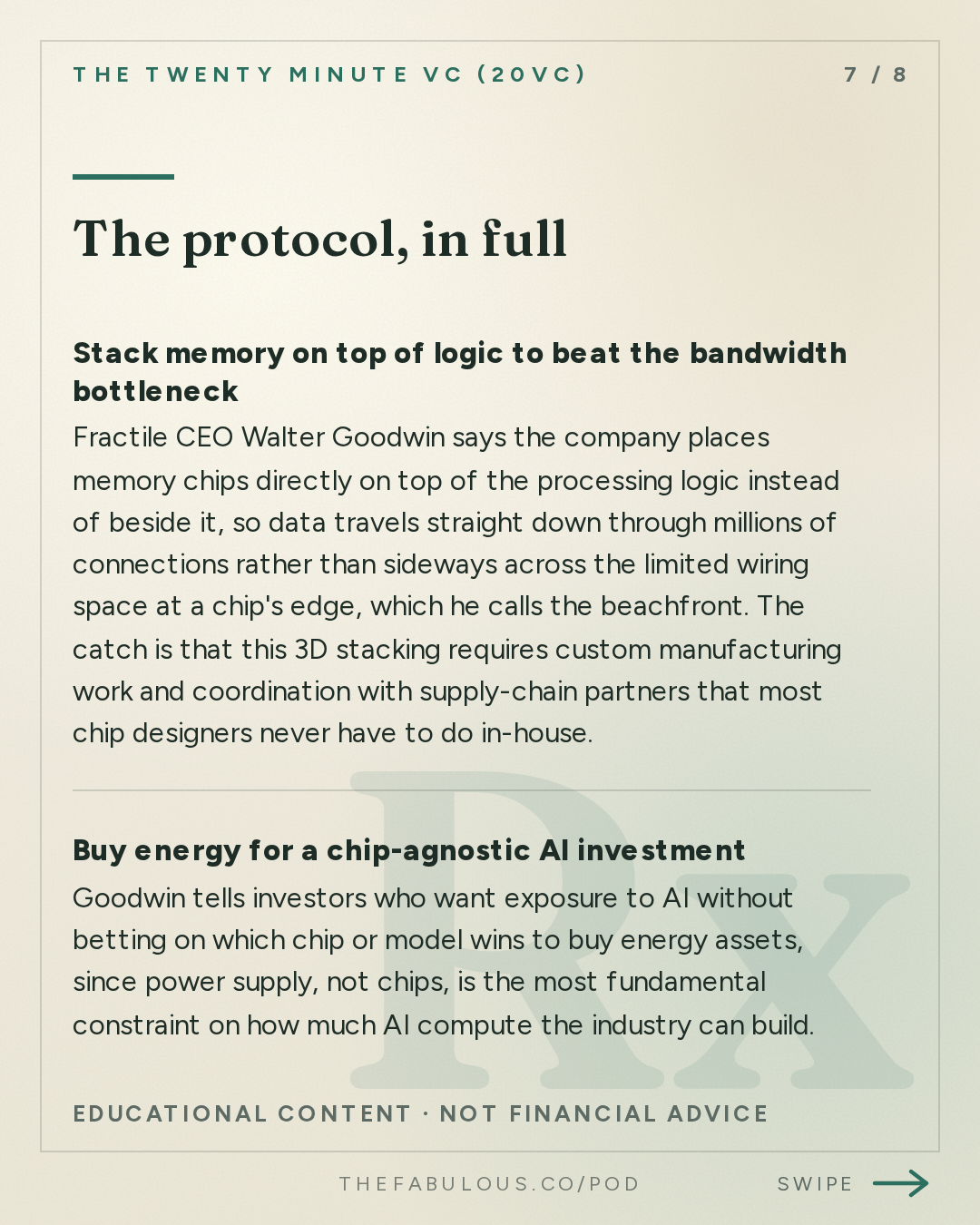
Stack memory on top of logic to beat the bandwidth bottleneck
Fractile CEO Walter Goodwin says the company places memory chips directly on top of the processing logic instead of beside it, so data travels straight down through millions of connections rather than sideways across the limited wiring space at a chip's edge, which he calls the beachfront. The catch is that this 3D stacking requires custom manufacturing work and coordination with supply-chain partners that most chip designers never have to do in-house.
Core architecture for every Fractile chip generation
-
Buy energy for a chip-agnostic AI investment
Goodwin tells investors who want exposure to AI without betting on which chip or model wins to buy energy assets, since power supply, not chips, is the most fundamental constraint on how much AI compute the industry can build.
One-time allocation decision, not recurring
Questions this episode answers
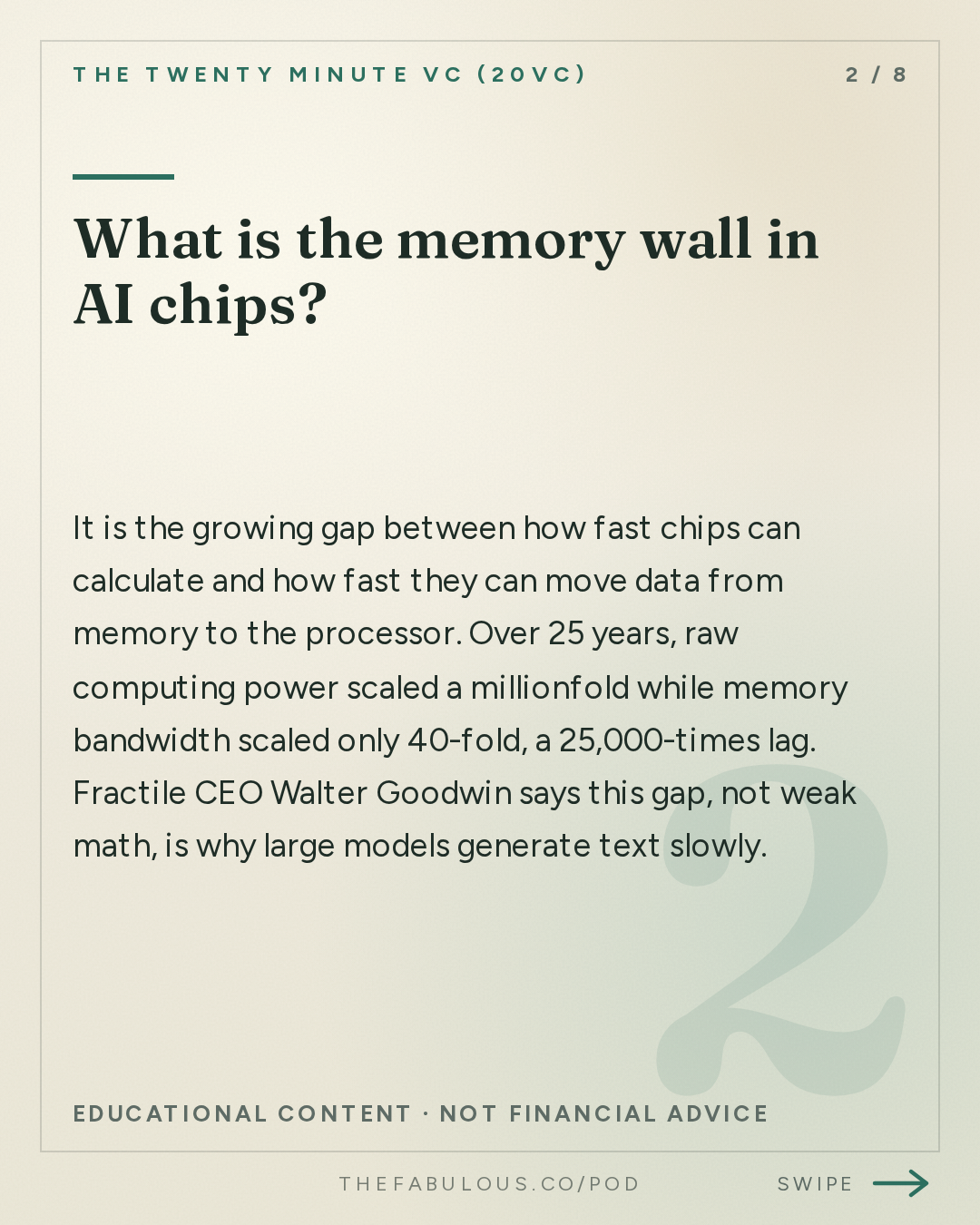
What is the memory wall in AI chips?
It is the growing gap between how fast chips can calculate and how fast they can move data from memory to the processor. Over 25 years, raw computing power scaled a millionfold while memory bandwidth scaled only 40-fold, a 25,000-times lag (17:24). Fractile CEO Walter Goodwin says this gap, not weak math, is why large models generate text slowly.
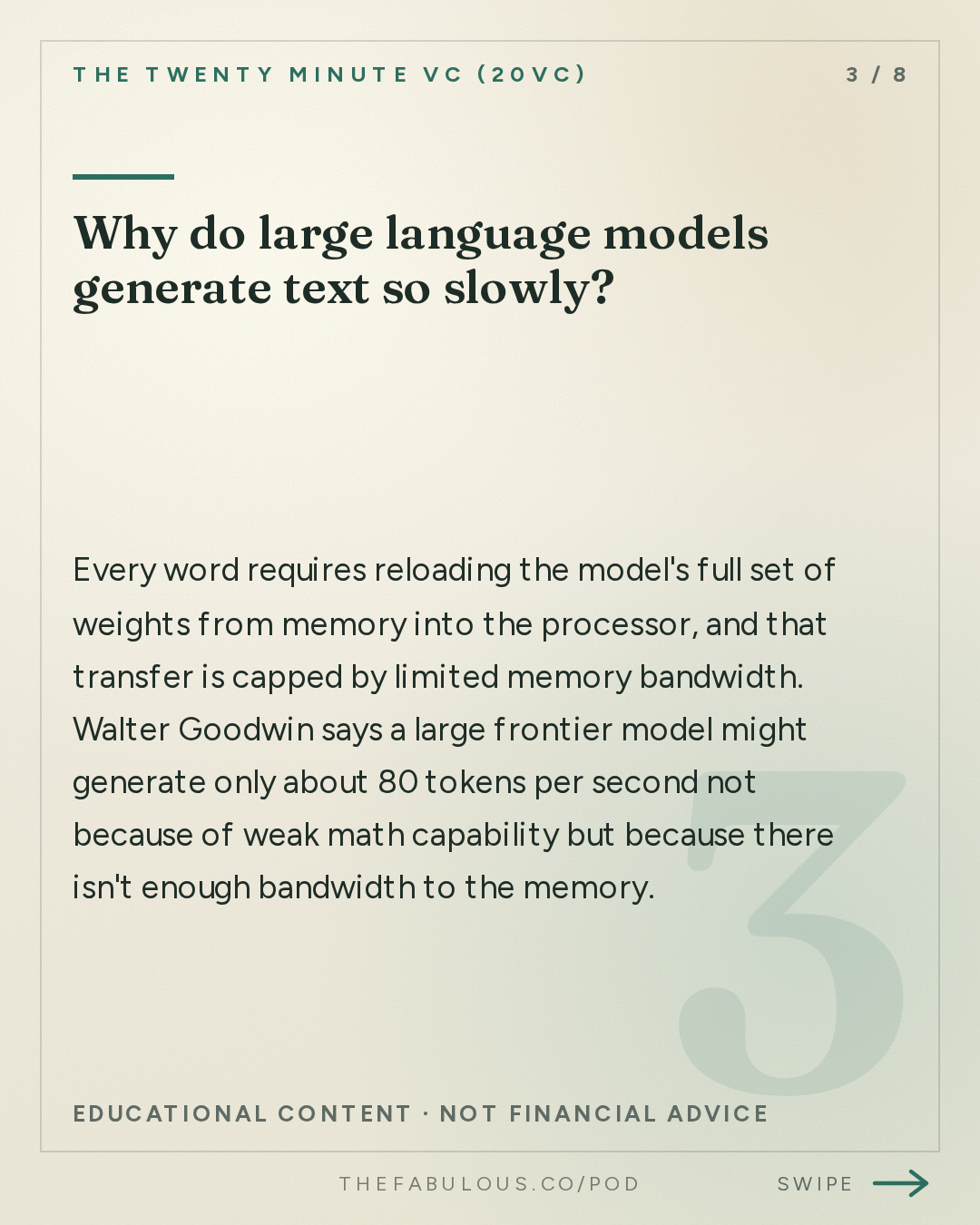
Why do large language models generate text so slowly?
Every word requires reloading the model's full set of weights from memory into the processor, and that transfer is capped by limited memory bandwidth. Walter Goodwin says a large frontier model might generate only about 80 tokens per second not because of weak math capability but because there isn't enough bandwidth to the memory (18:14).
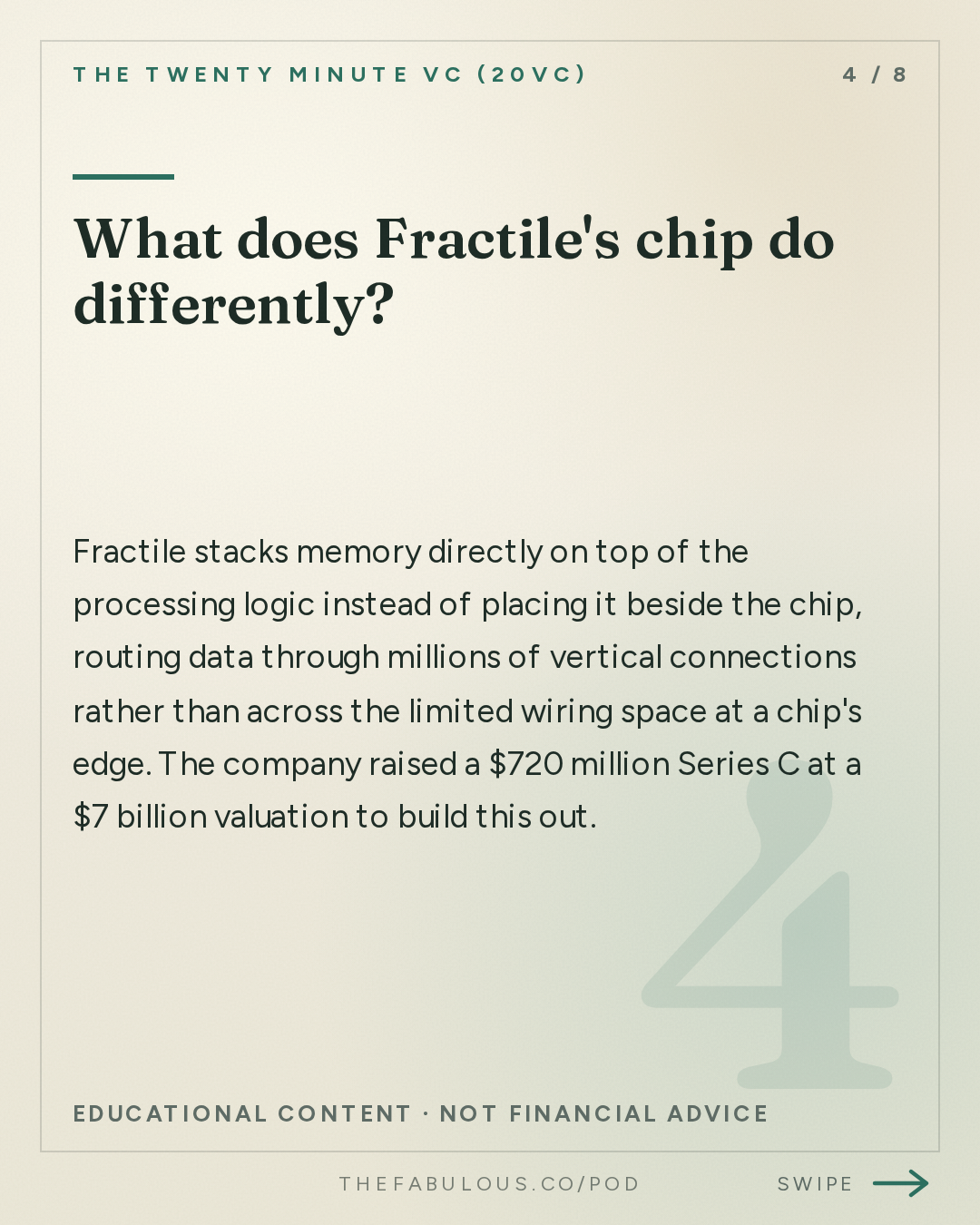
What does Fractile's chip do differently?
Fractile stacks memory directly on top of the processing logic instead of placing it beside the chip, routing data through millions of vertical connections rather than across the limited wiring space at a chip's edge (21:09). The company raised a $720 million Series C at a $7 billion valuation to build this out (00:23).
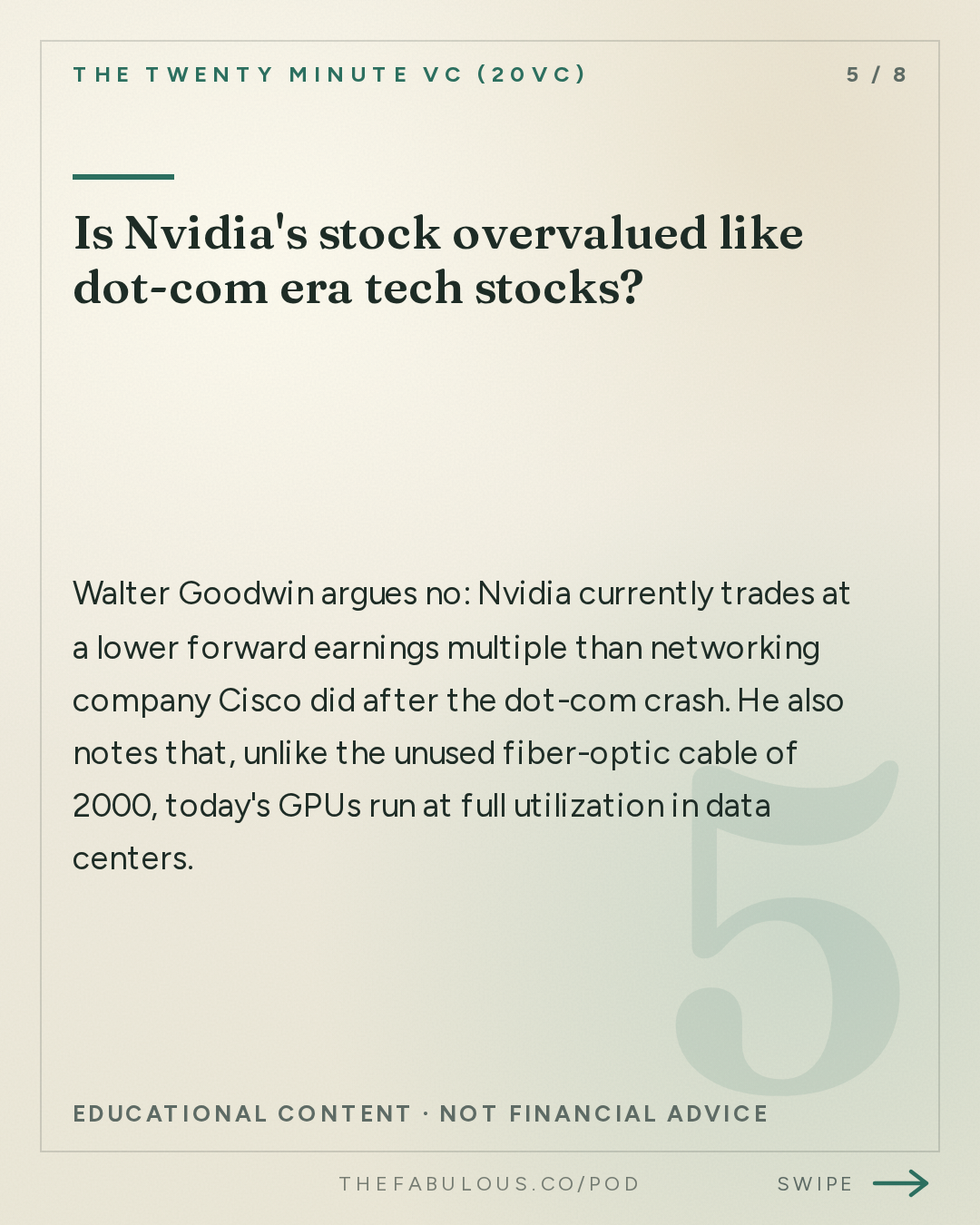
Is Nvidia's stock overvalued like dot-com era tech stocks?
Walter Goodwin argues no: Nvidia currently trades at a lower forward earnings multiple than networking company Cisco did after the dot-com crash (69:59). He also notes that, unlike the unused fiber-optic cable of 2000, today's GPUs run at full utilization in data centers (48:47).
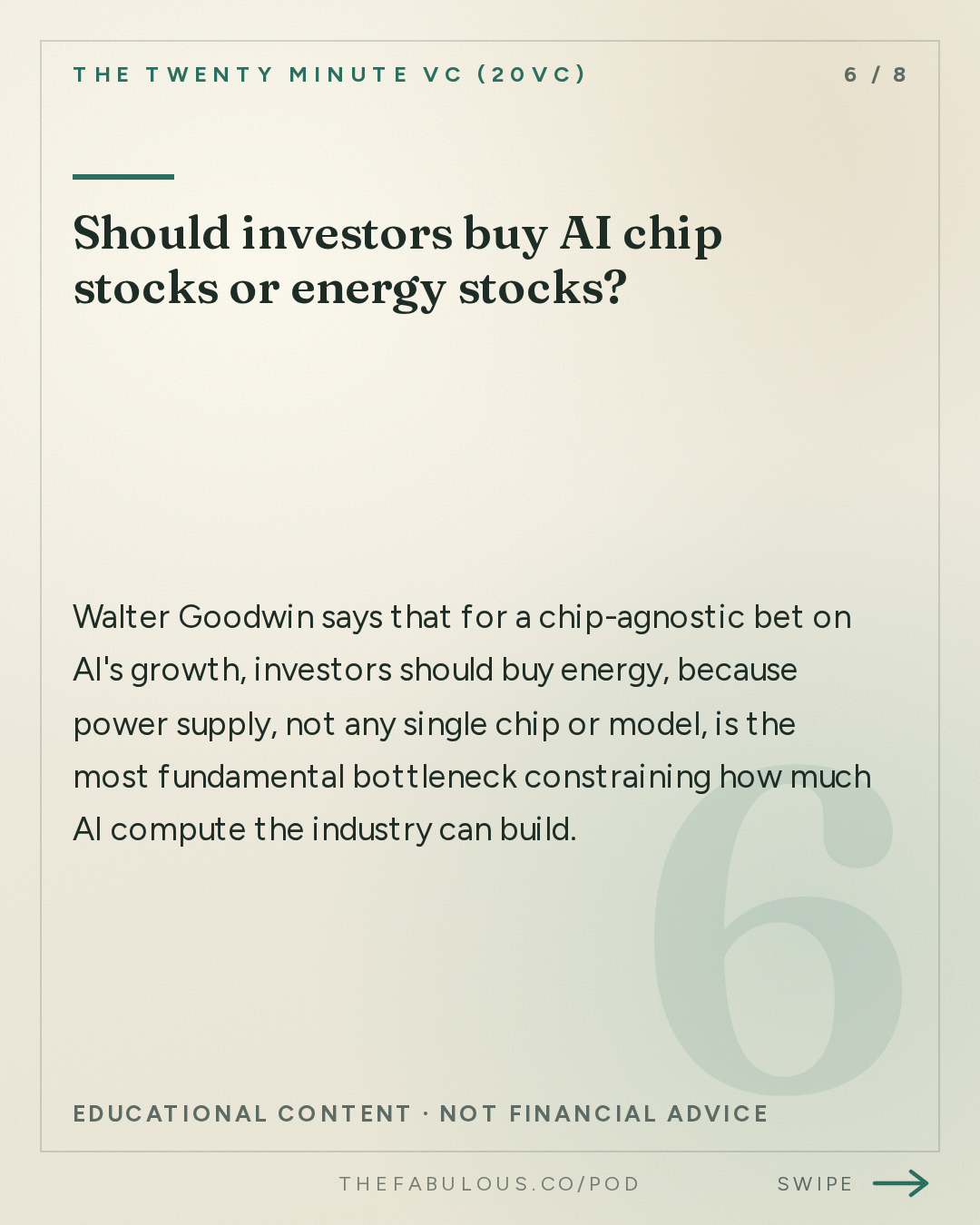
Should investors buy AI chip stocks or energy stocks?
Walter Goodwin says that for a chip-agnostic bet on AI's growth, investors should buy energy, because power supply, not any single chip or model, is the most fundamental bottleneck constraining how much AI compute the industry can build (37:29).
Why is mixing different AI chip types in one data center risky?
Goodwin says operators can't predict in advance the right ratio of chip types to buy, since context lengths and model sizes keep changing, which can leave some purchased capacity sitting unused for years once the data center is built (57:09). He argues a single chip combining high bandwidth and high capacity removes this risk.
The full read, in cards
Go deeper
- DeepSeek's open-source inference stack release — showed an open model could outperform rivals by pairing it with a highly efficient inference server, resisting full commoditization
Mentioned
Walter Goodwin · Fractile · Nvidia · TSMC · Broadcom · Groq · Cerebras · DeepSeek · OpenAI · Demis Hassabis · Jensen Huang · Cisco · Mike Cannon-Brookes · Dmatrix · Fluid Stack
More from this show and category

Anthropic's $1.4 Trillion IPO Strategy Explained
Sequoia shut its London office and ended its Evergreen fund the week NASDAQ lost $2.5 trillion and Anthropic set a $1.4 trillion IPO target. NVIDIA's Jensen Huang faces a board investigation, OpenAI's revenue grew 70%, and hosts argue agent-based AI is killing seat-priced software like Figma.

Mistral CEO Arthur Mensch on Sovereign AI
Mistral CEO Arthur Mensch says energy is not AI's bottleneck: it's only about 10% of compute's cost (14:51). He argues chips and capital dominate project economics, and that sovereign AI, models trained, run, and kept on a customer's own infrastructure, will beat dependence on US or Chinese providers, with inference already behaving like a high-margin commodity market (30:44).

WashU Endowment Strategy: Scott Wilson Explains
Scott Wilson grew WashU's endowment from $8 billion to near $20 billion by firing most hedge funds and concentrating in direct private deals. SpaceX once made up over 20% of assets. Wilson argues many AI firms will not survive a decade, and sees underpriced opportunity in Europe and China.

Erik Bernhardsson on AI Inference Economics
Modal CEO Erik Bernhardsson says splitting the AI stack across many paid layers has ended 90% software margins for good. He also says the GPU market stays supply-constrained, open source inference usage will grow 5 to 20 times in the next year, and reinforcement learning works best on tasks like coding with fast feedback loops.
