
Anthropic's $1.4 Trillion IPO Strategy Explained
20VC: Jensen Huang Investigation: What Happens Now | Sequoia Leave London, Close Scout Program and End Evergreen Fund | NASDAQ Loses $2.5TRN in 24 hours | Anthropic targets $1.4TRN IPO valuation
The brief
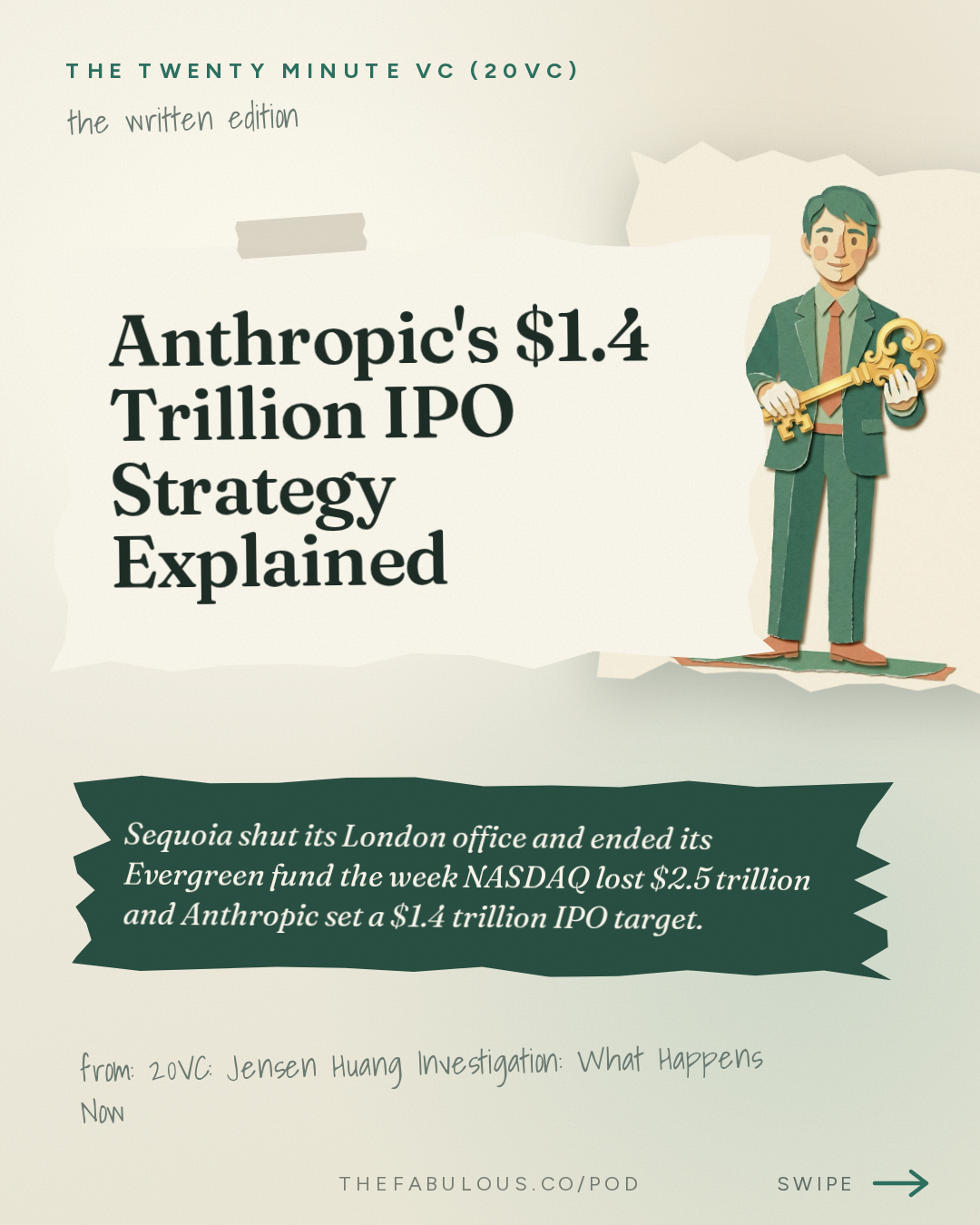
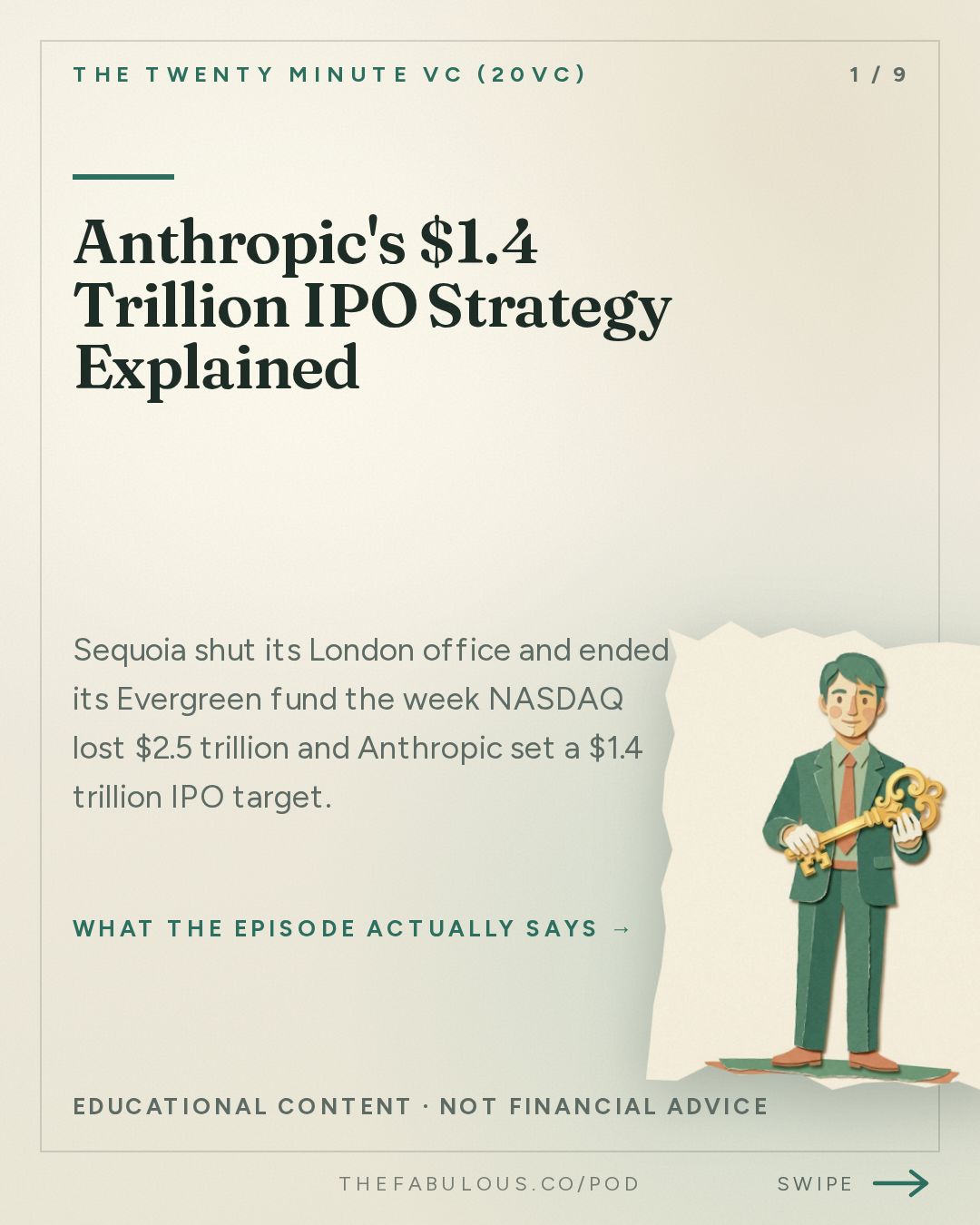
Sequoia shut its London office and ended its Evergreen fund the week NASDAQ lost $2.5 trillion and Anthropic set a $1.4 trillion IPO target. NVIDIA's Jensen Huang faces a board investigation, OpenAI's revenue grew 70%, and hosts argue agent-based AI is killing seat-priced software like Figma.
Three years ago, Sequoia Capital decided it had solved one of venture capital's oldest problems: when to sell. Its answer was an Evergreen fund, a structure that let the firm keep holding stock in its own portfolio companies for years after they went public, on the theory that the real money in venture is made after the IPO, not before. It was, as one of this week's hosts put it, arguably the best idea in venture history. This week, Sequoia killed it.
That reversal is the small, structural hinge of a much bigger week, one in which several things that looked permanent, a fund structure, a founder's marriage, a software pricing model, a market rally, all got repriced at once. Sequoia did not just end its Evergreen fund. It closed its London office, folding European staff back into the US team, and shut down its Scout program, the quiet system of seed checks written by founders and operators on Sequoia's behalf that had been a hidden edge for years (03:54). The firm also merged its early-stage and growth teams into one partnership.
The Evergreen logic was not crazy. Sequoia has historically been linked to something like 25% of the NASDAQ through its portfolio companies (05:44), and a diversified basket of its own winners, held for decades, should beat an index over time. But the fund launched in 2022 and 2023, just as stocks turned down (05:34), and its structure effectively trapped limited partners, the outside investors who fund a venture firm, in positions they could not exit even if they needed the cash. On top of that, individual partners who had already collected their carry, the share of profits a fund manager keeps, had little reason to force anyone else's hand. One host summarized the unwind bluntly:
What the hell happened to the Evergreen idea? This is the best idea in venture ever.
The hosts frame all of it as a reminder that institutions outlast individual arrangements, but arrangements still get rebuilt when they get too complicated to run.
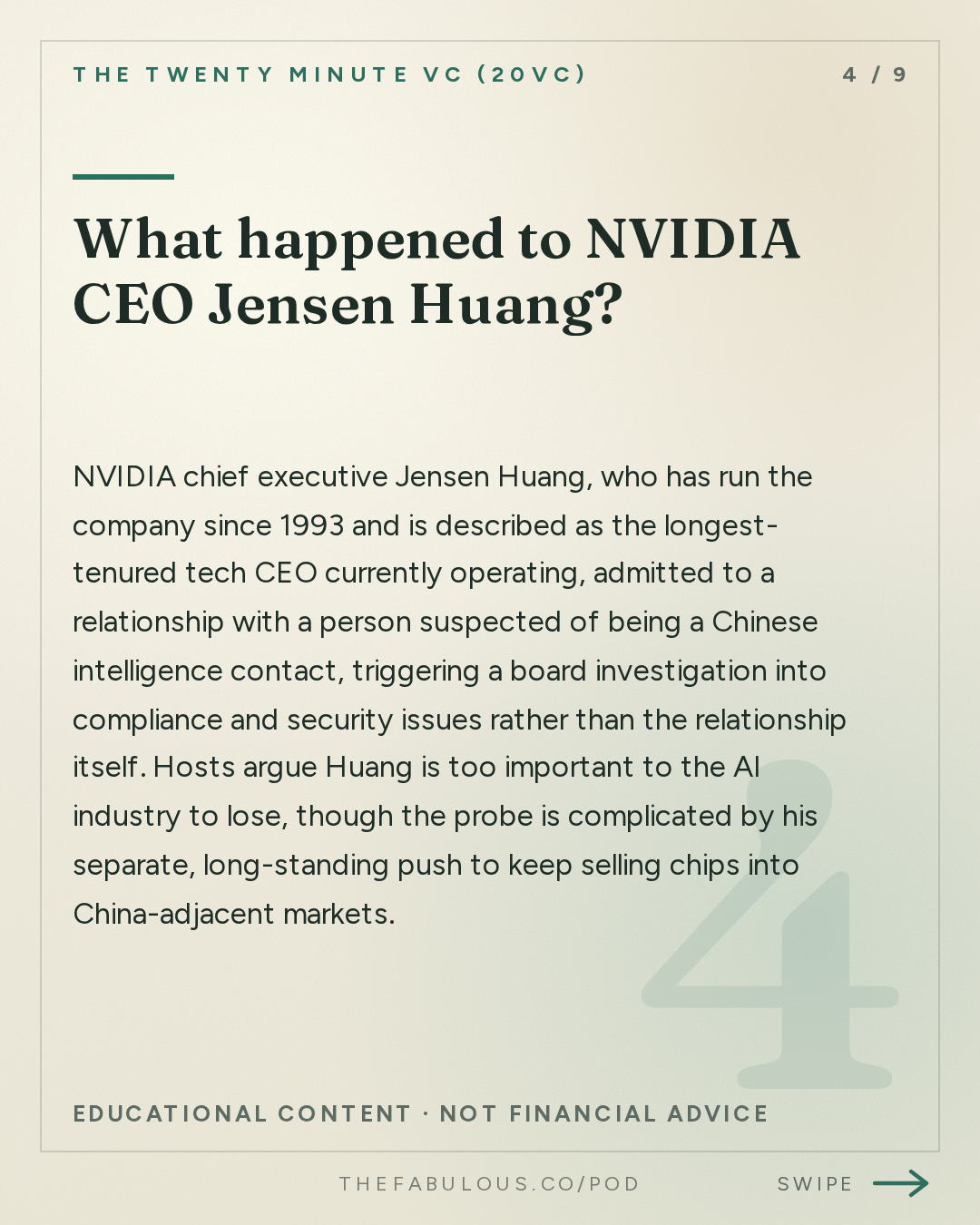
NVIDIA chief executive Jensen Huang, the longest-tenured CEO currently running a major tech company, having led the chipmaker since 1993 (15:52), is now the subject of a board investigation after admitting to a relationship with a person suspected of being a Chinese intelligence contact. The probe itself is not about the relationship. It concerns whether NVIDIA's export compliance and security practices were compromised (14:24). The hosts argue Huang is too important to the US AI industry to lose over this, not because the allegations are trivial, but because his personal conviction that NVIDIA should sell chips to any buyer, including, where legally possible, Chinese customers, long predates any entrapment and makes him hard to replace. The awkward detail is that the investigation is tangled up with Megaspeed, a company NVIDIA has since banned from buying its chips, over the unresolved question of whether it is acceptable to train Chinese models on GPUs parked just across the border.
The week the AI trade got repriced
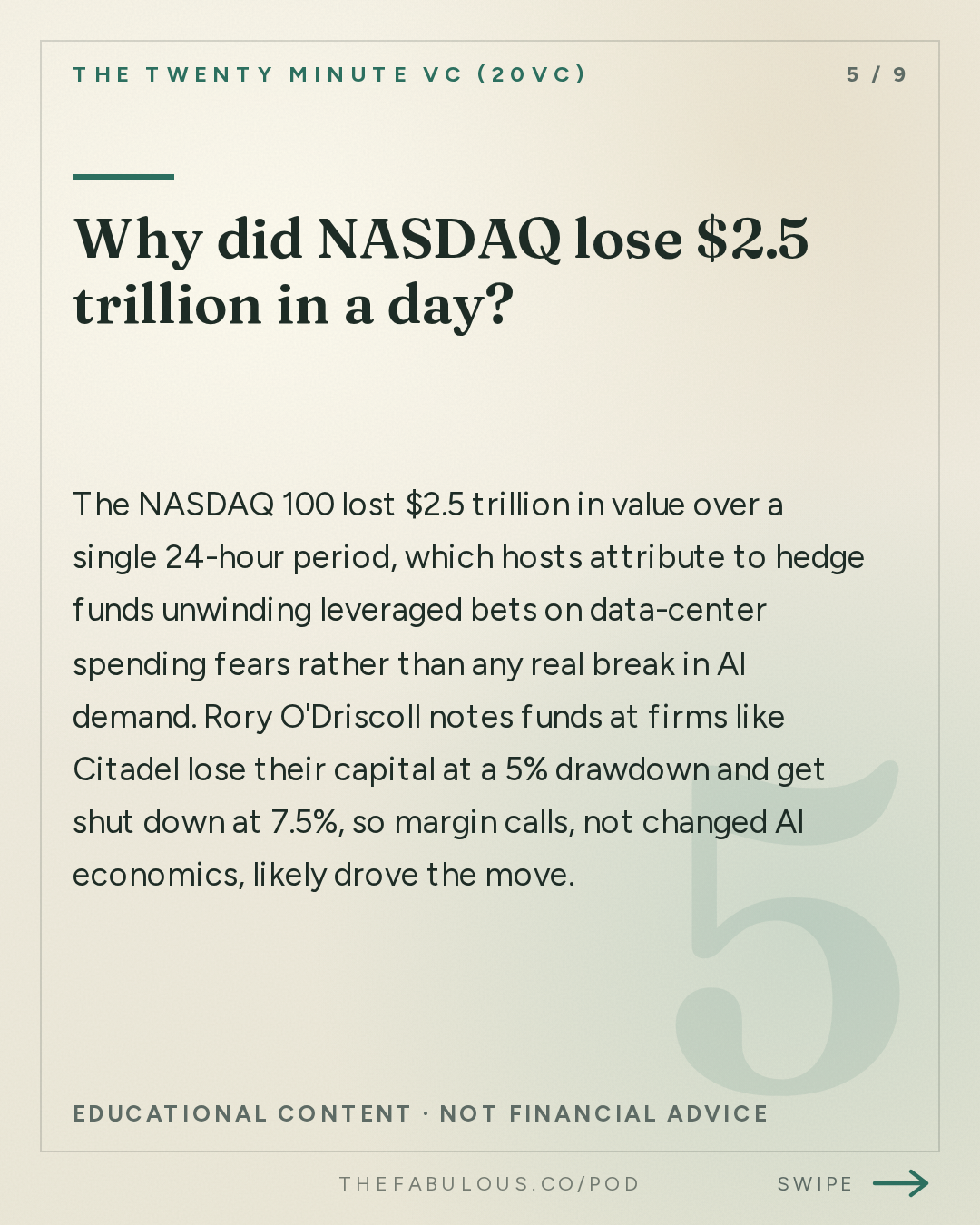
The NASDAQ 100 lost $2.5 trillion in value in a single 24-hour stretch (21:30), enough to put hedge fund managers into what one host described as a depressive state. The explanation offered is not a crack in AI demand but a mechanical one: leveraged funds get their capital pulled by prime brokers like Citadel at a 5% drawdown and get fired outright at 7.5% (23:14), so a wave of margin calls can move trillions without any real change in the underlying business. As one host put it:
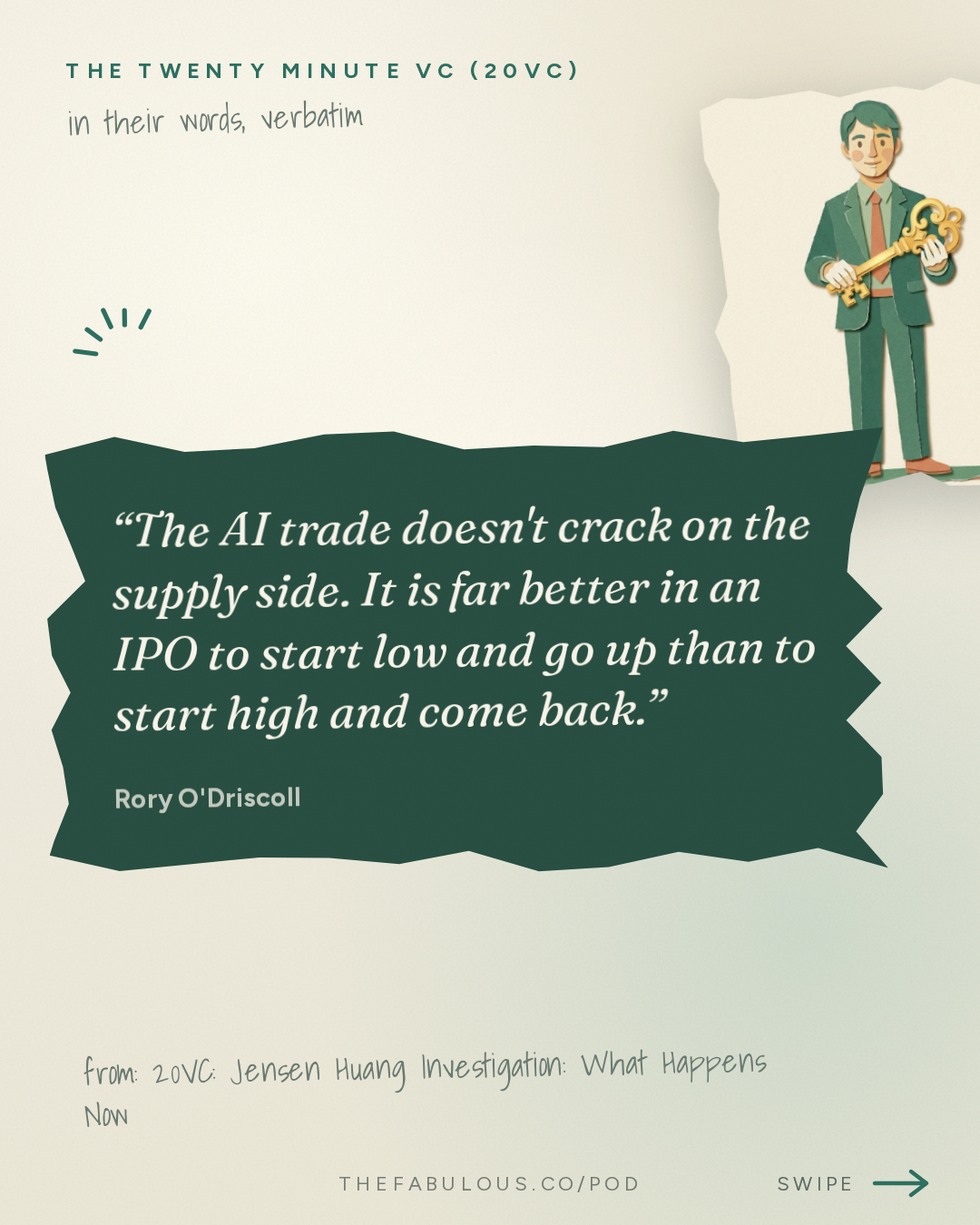
The AI trade doesn't crack on the supply side. It is far better in an IPO to start low and go up than to start high and come back.
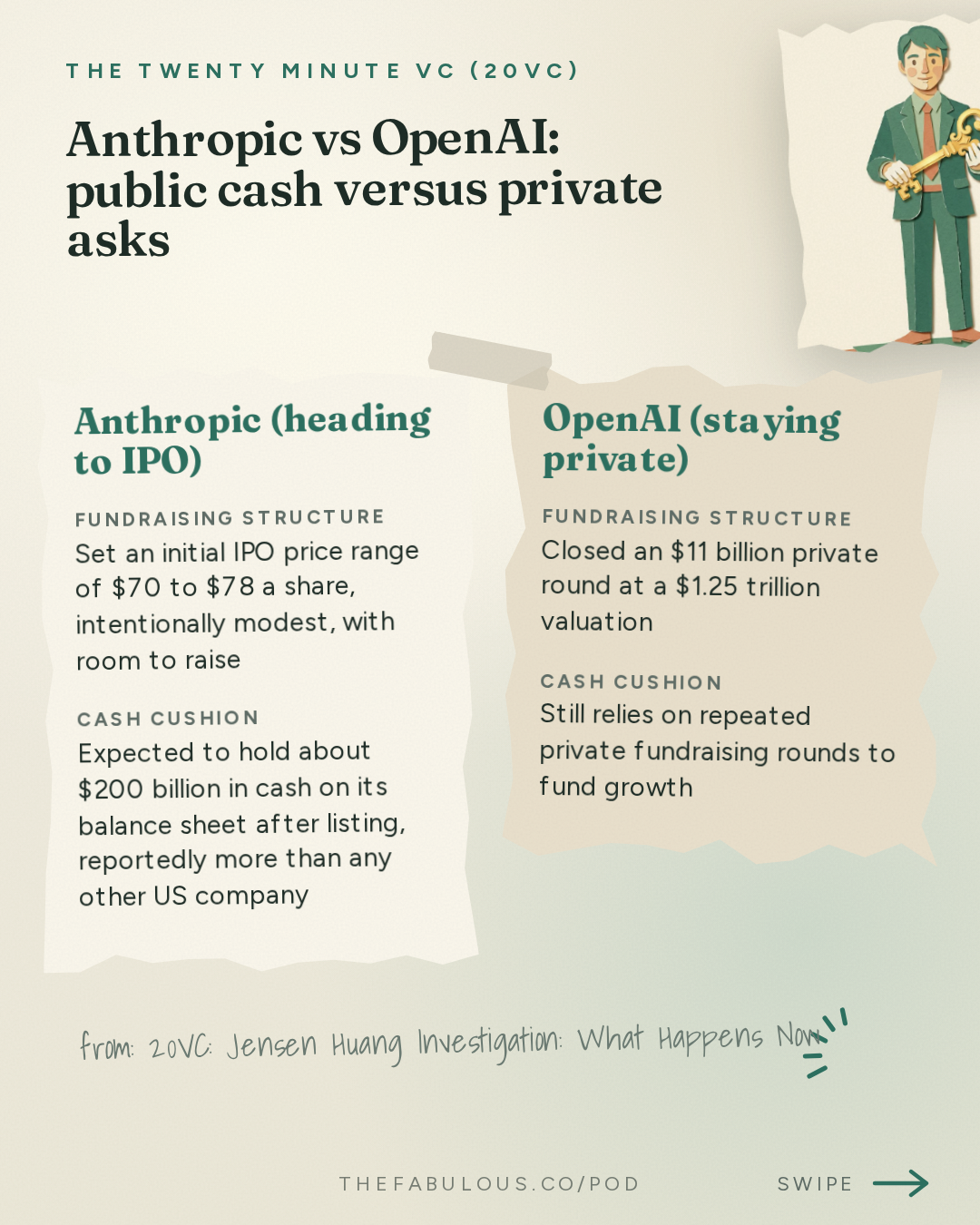
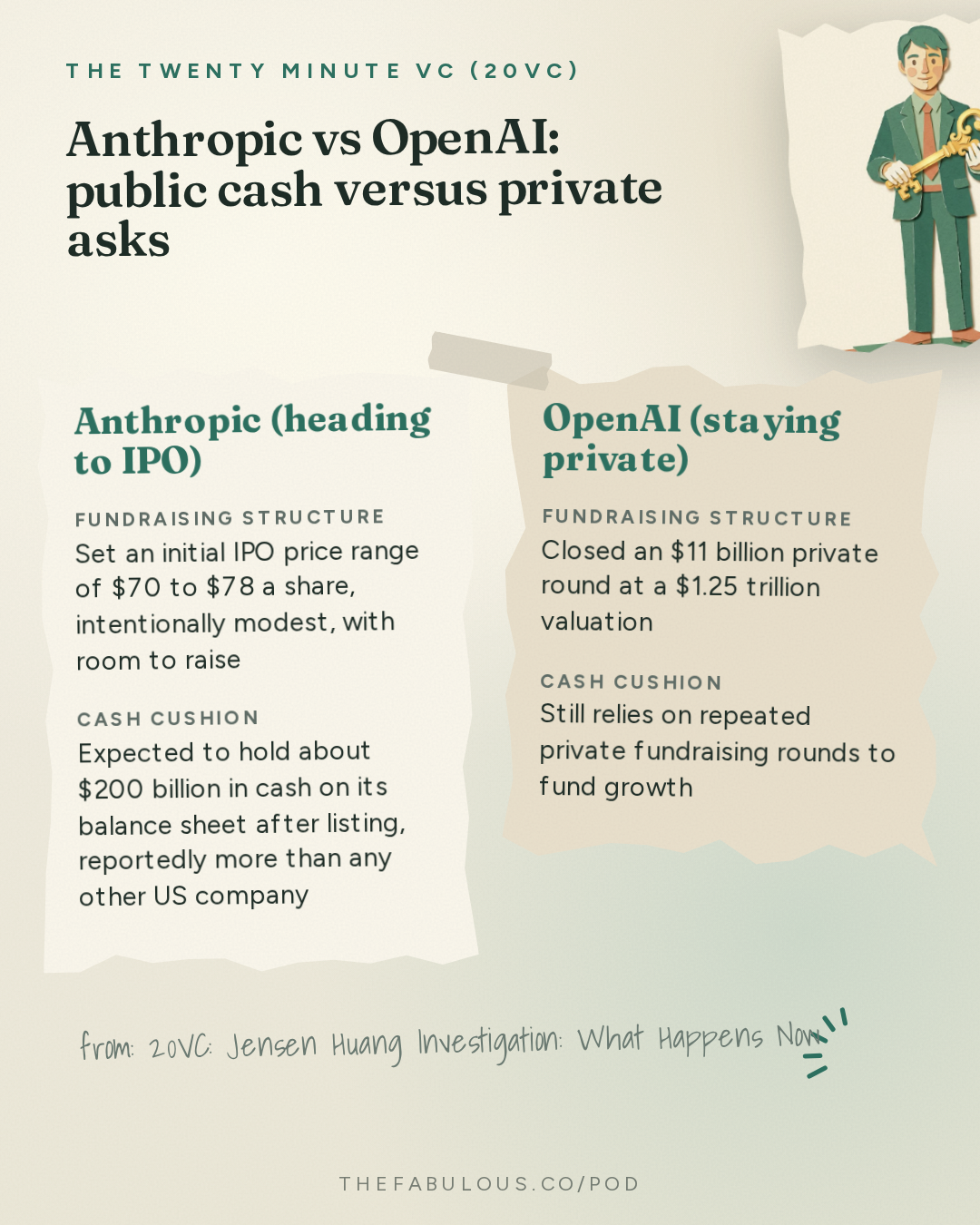
That second half of the line is about Anthropic, which is moving toward an IPO with a recommended price range of $70 to $78 a share, above its last private round of $54 a share but deliberately modest (24:25). The plan, the hosts argue, is to generate demand at a conservative price and then raise the range, rather than price high and have to retreat. On a vested-options basis the company is valued near $1 trillion; counting every option ever granted, including unvested ones, the figure is closer to $1.4 trillion (25:12). Anthropic is also expected to carry roughly $200 billion in cash on its balance sheet, reportedly more than any other company in America (27:35), a cushion that lets it tap public markets through converts and secondaries once listed instead of running the private fundraising circuit that OpenAI is still on. OpenAI, for its part, reported 70% annualized revenue growth in the third quarter, with enterprise revenue now a majority of the total (29:43), even as it closed an $11 billion private round at a $1.25 trillion valuation rather than going public.
Both companies are also discovering that agents are expensive to run. A persistent AI agent, the kind that works continuously rather than spinning up for a single task, can cost $20 to $30 a month per user in compute (32:44), far more than the few dollars it costs to run a simple website-building tool. That cost structure is already showing up in how venture investors value AI infrastructure: this week's deal slate included Zipline, the drone delivery company, raising at a $21.5 billion valuation, triple its January price (34:10); Fal, an AI inference company, doubling to $16 billion on more than $800 million of annual recurring revenue; and Revolut, the London-based fintech, trading at $115 billion in a secondary sale, up 53% from its last round (34:20). The hosts split on which is safest. Revolut, with higher margins and a young customer base aging into mortgages and lending, was the preferred pick for durability, while Fal was chosen anyway for its growth, despite gross margins estimated around 6% and a market that could commoditize within a few years.
The same AI boom has a darker side. Fireworks AI, an inference provider, suffered two major security breaches in a 30-day window, both traced to stolen API keys, the credentials that let software call AI models and get billed for it (40:35). Nine leading AI developers disclosed similar swarming bot attacks in October alone, according to security firm Wiz (43:28), with another security firm estimating attackers can run up a million dollars in charges before anyone notices. One host called it the most lucrative criminal trade available right now, more profitable, in his words, than stealing watches off someone's wrist in London (41:40).
Who survives the agent economy
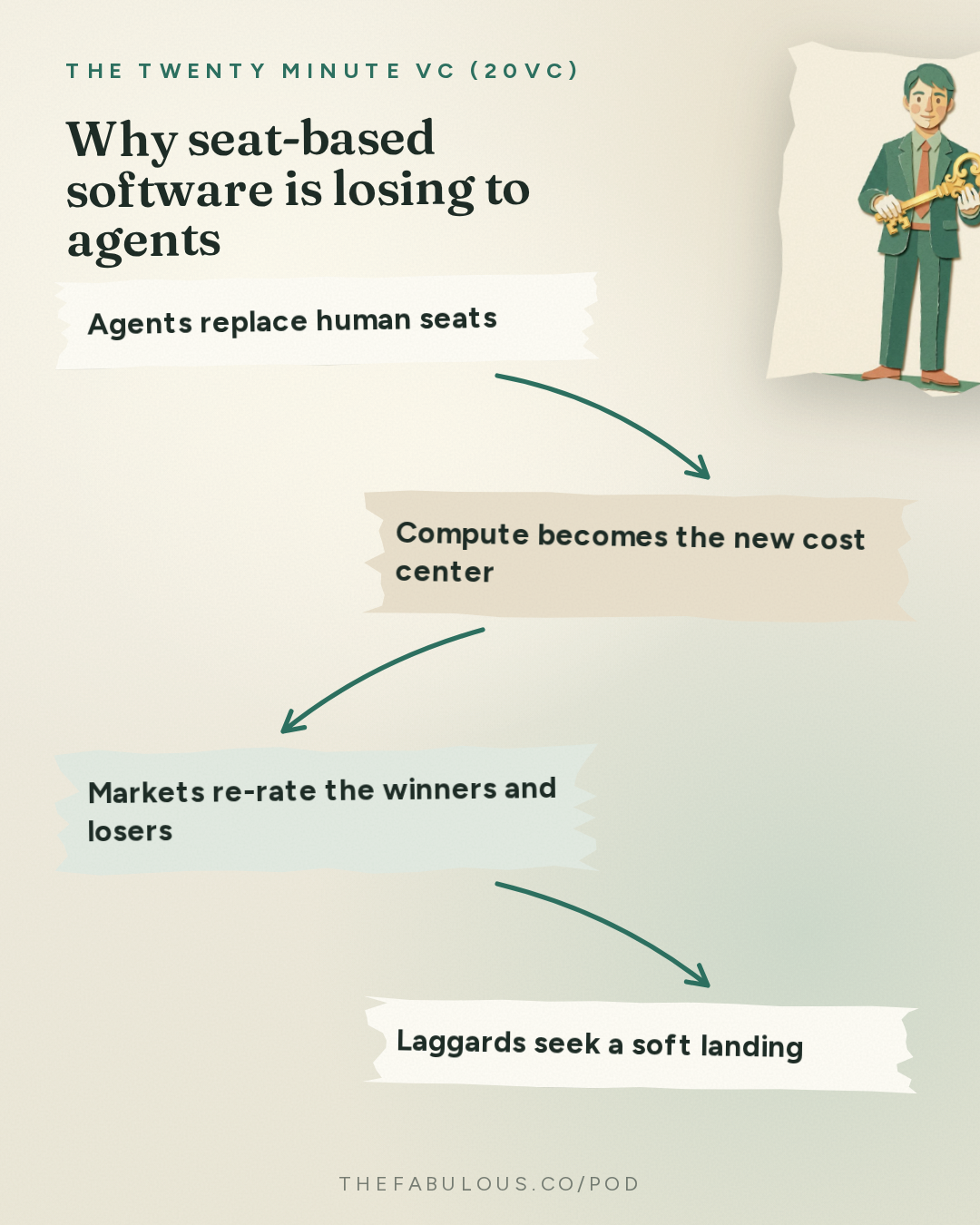
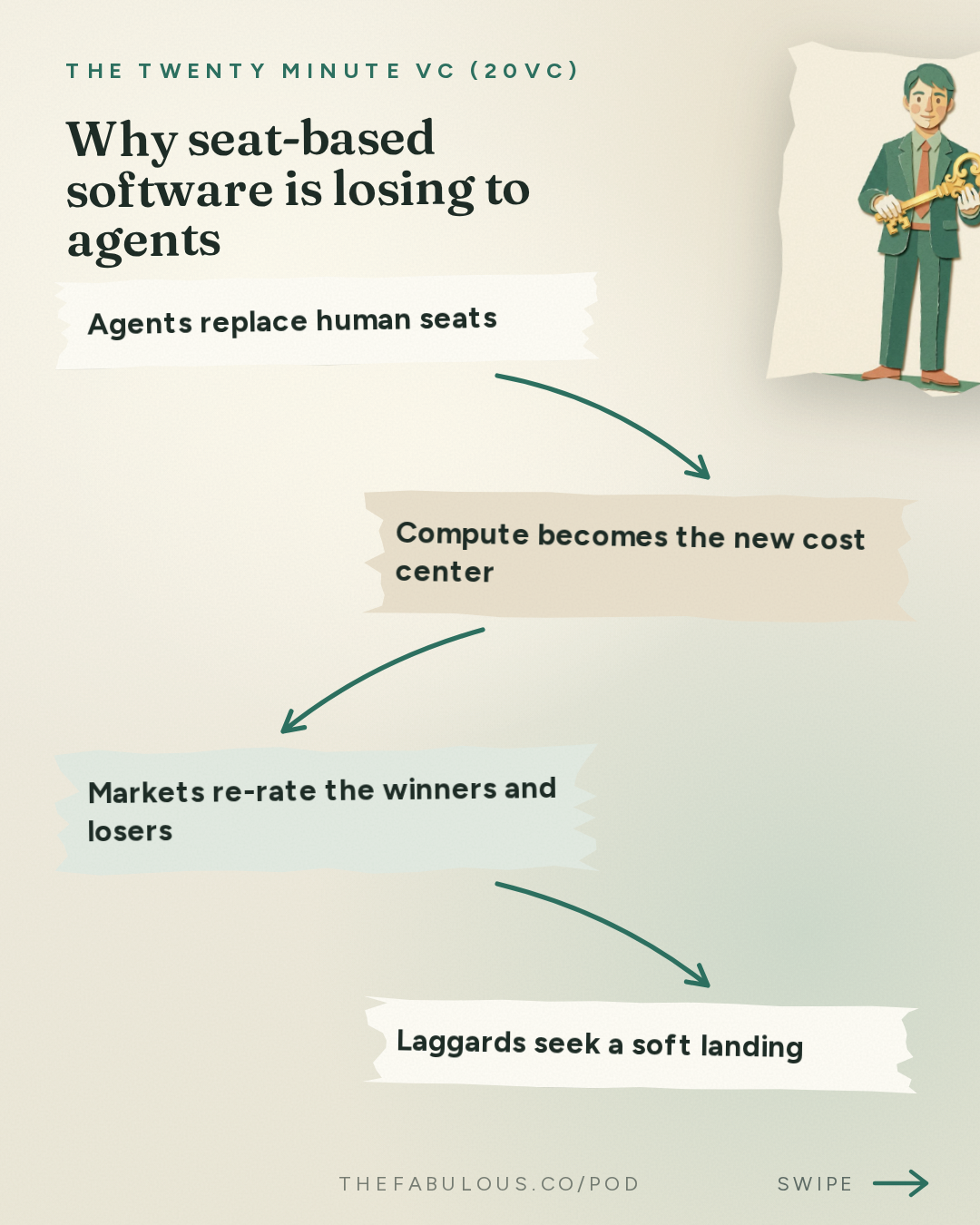
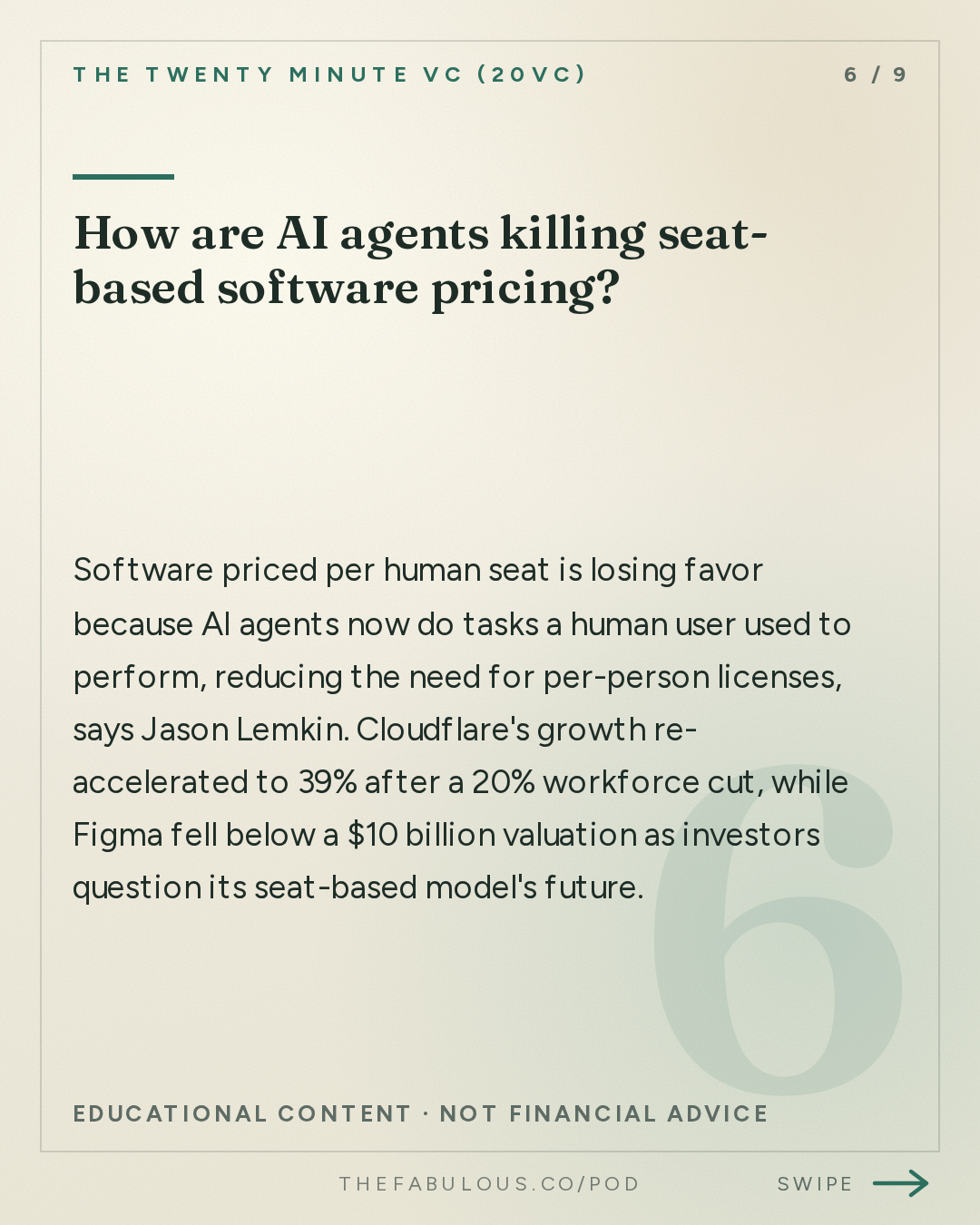
If agents are expensive to run, they are also cheaper than headcount, and that tension is reshaping how software companies are valued. Palantir now generates about $2 million in revenue per employee (50:18), a figure the hosts attribute less to any AI magic and more to a simple truth: when revenue grows faster than a company can hire, margins take care of themselves. Cloudflare cut 20% of its workforce earlier in the year and then saw growth re-accelerate to 39% (51:48), which the hosts read as evidence that agentic spending, not human seat licenses, is now driving its business. Figma, by contrast, fell below a $10 billion valuation for the first time since its aborted 2022 sale to Adobe (53:01), a company that was once offered more than $20 billion. The hosts argue the market no longer believes seat-based software, priced per human user, benefits from the agent shift. As one host put it:
Agents don't care about your UX and their UI, and they don't care about any of this stuff. Humans do, but they're a declining percent.
That same logic explains why Dialpad's $400 million acquisition of the chatbot company Ada (45:04) reads less like an exit and more like a soft landing for a company built on a pre-large-language-model architecture that could not retool fast enough. The hosts argue older, non-AI-native companies simply cannot ship software at the pace their newer competitors can, a gap that is now generational rather than a matter of talent.
The episode closes on California's rejection of a proposed wealth tax, defeated by a wide margin even as the state, and the country, swung heavily toward Democrats in the same election (61:15). The hosts see the vote as practical rather than ideological: voters recognized that a wealth tax risked pushing newly rich tech workers to lower-tax states just as Anthropic prepares to mint extraordinary sums for ordinary employees, with the average Anthropic employee expected to gain about $41 million in the IPO (62:49). It is, in its way, the same question Sequoia faced with its Evergreen fund and its London office: how much do you force people, whether limited partners or taxpayers, to hold onto something simply because it would be good for them. This week, across venture, chips, and tax policy, the answer kept coming back the same way. Let people go.
Ask this episode anything
Pod's AI answers from the episode itself, with the minute mark so you can hear it yourself.
Or start with one of these
Ask this episode
Pod's AI listens to the whole episode to answer, and points you to the minute it comes from.
The rest of this answer, and any question after it
Answers come from the episode itself, never from a summary of it.
ContinueKey takeaways
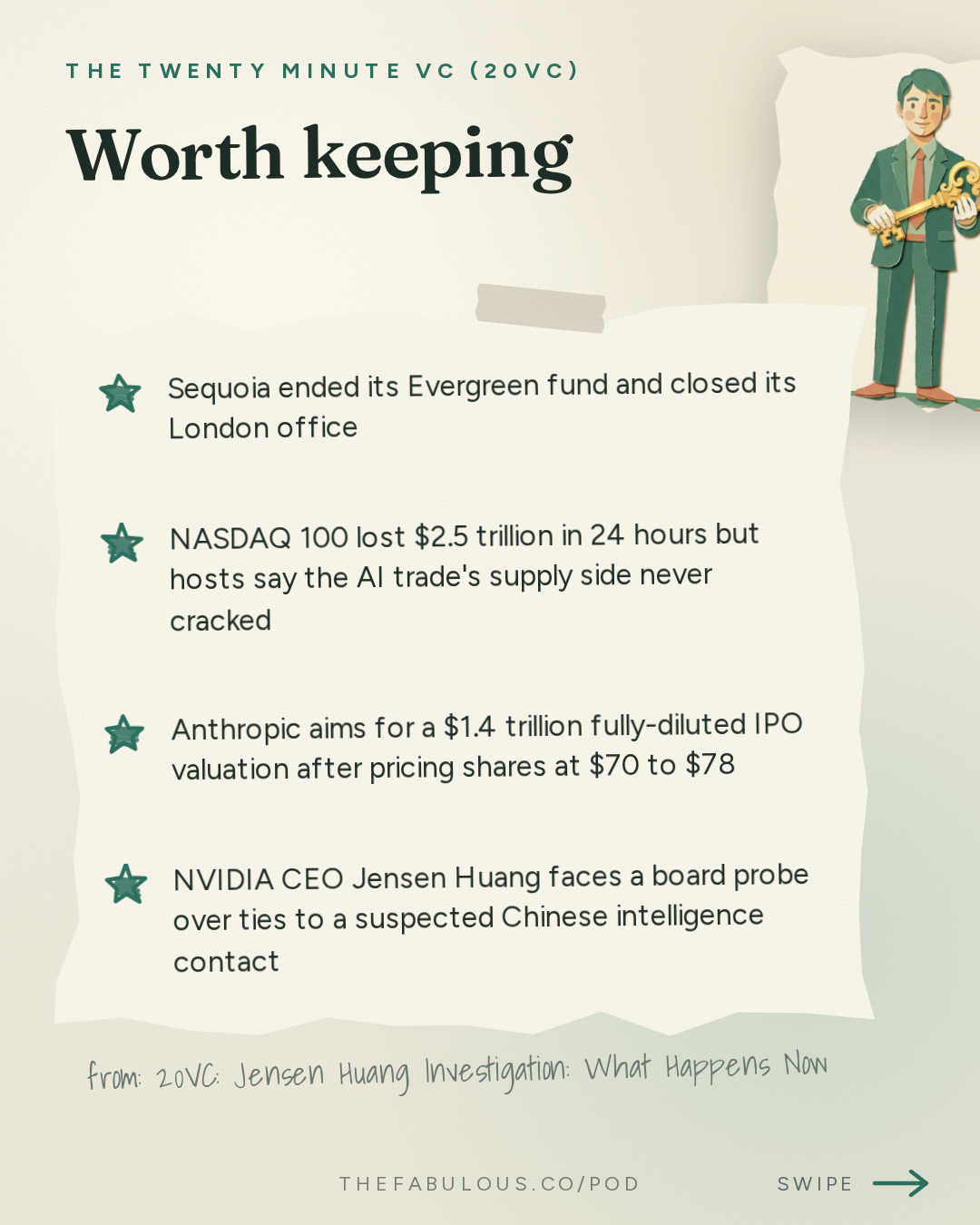
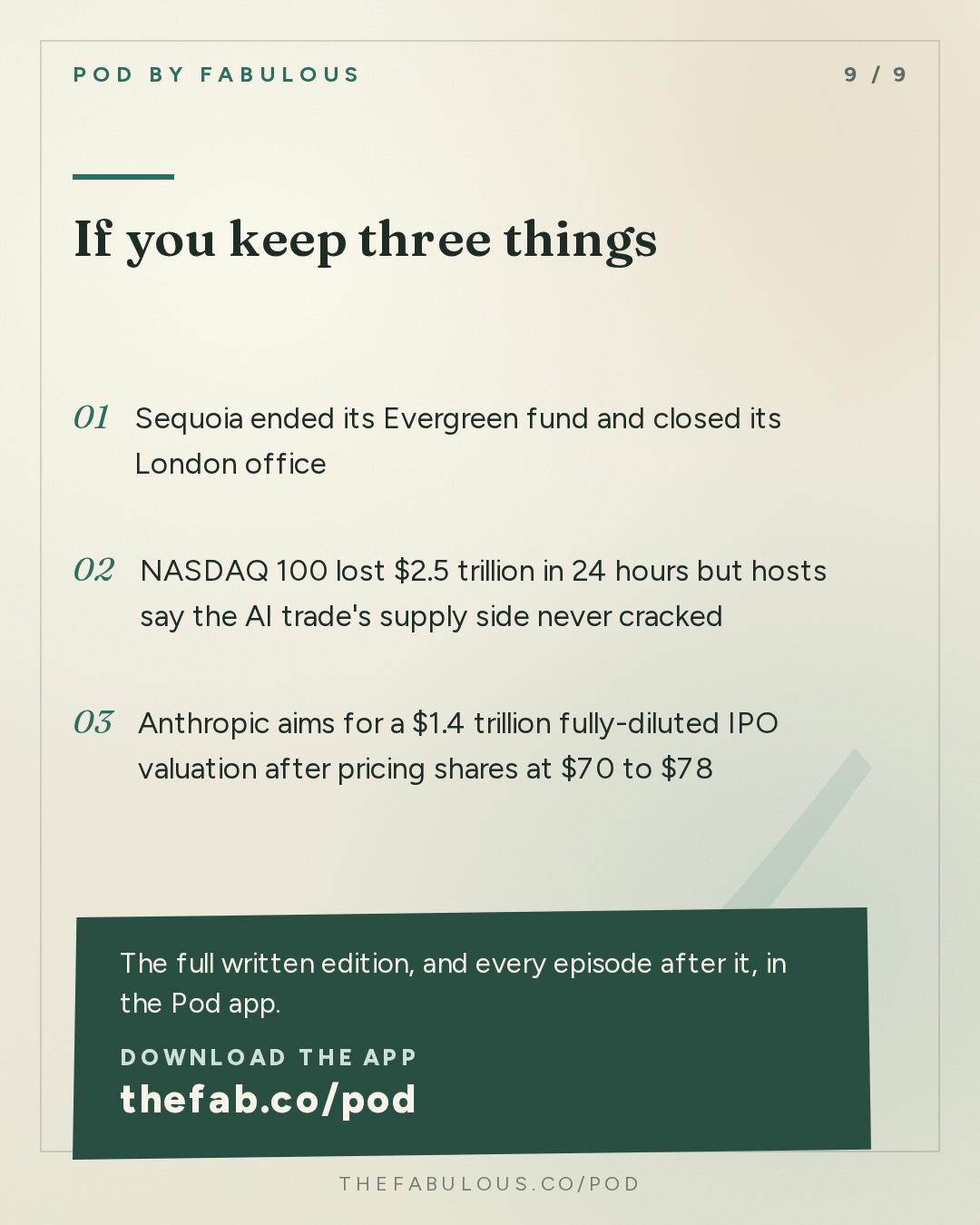
- Sequoia ended its Evergreen fund and closed its London office
- NASDAQ 100 lost $2.5 trillion in 24 hours but hosts say the AI trade's supply side never cracked
- Anthropic aims for a $1.4 trillion fully-diluted IPO valuation after pricing shares at $70 to $78
- NVIDIA CEO Jensen Huang faces a board probe over ties to a suspected Chinese intelligence contact
- Agent-based AI is eroding seat-priced software, pushing Figma below a $10 billion valuation
The episode in cards
By the numbers
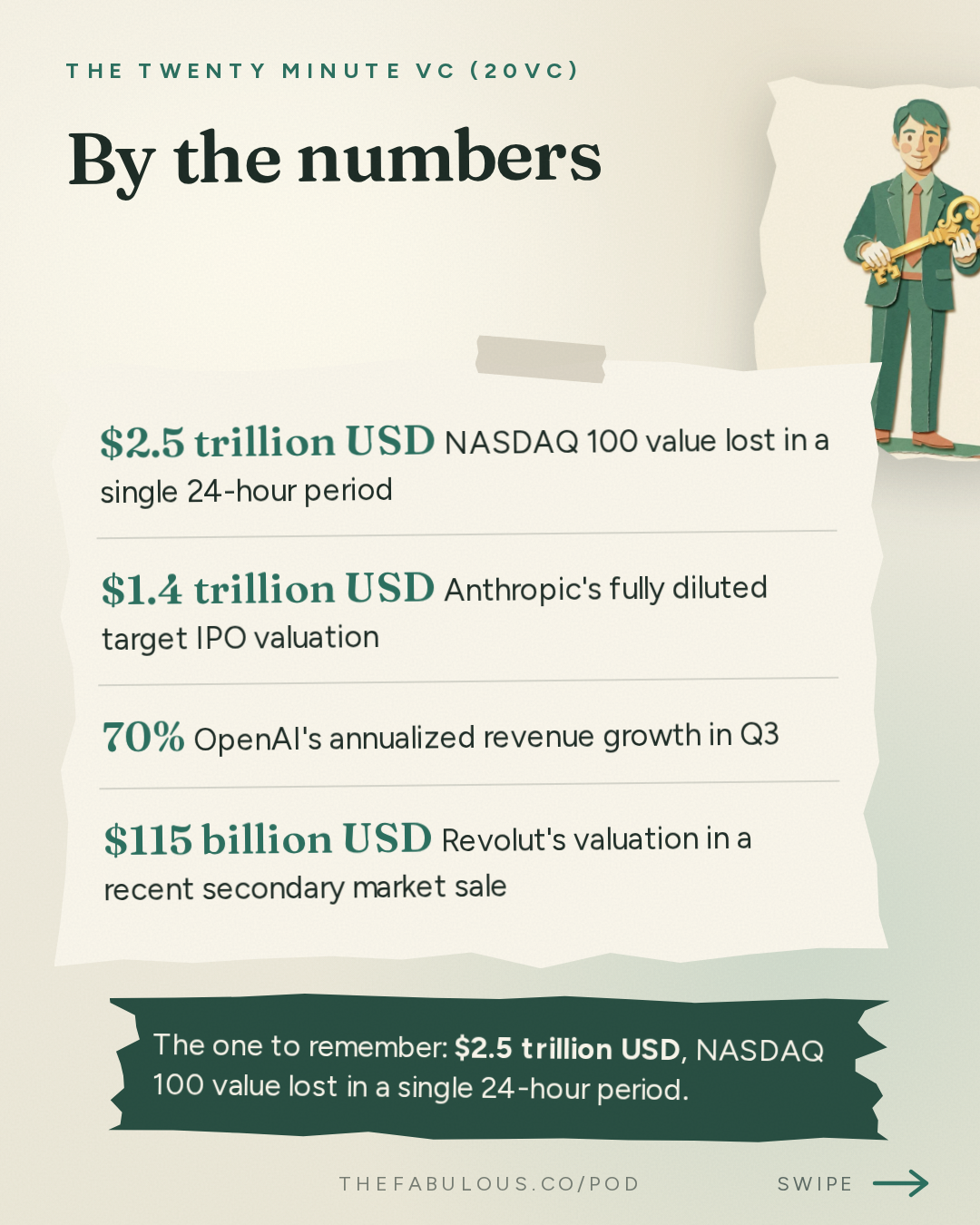
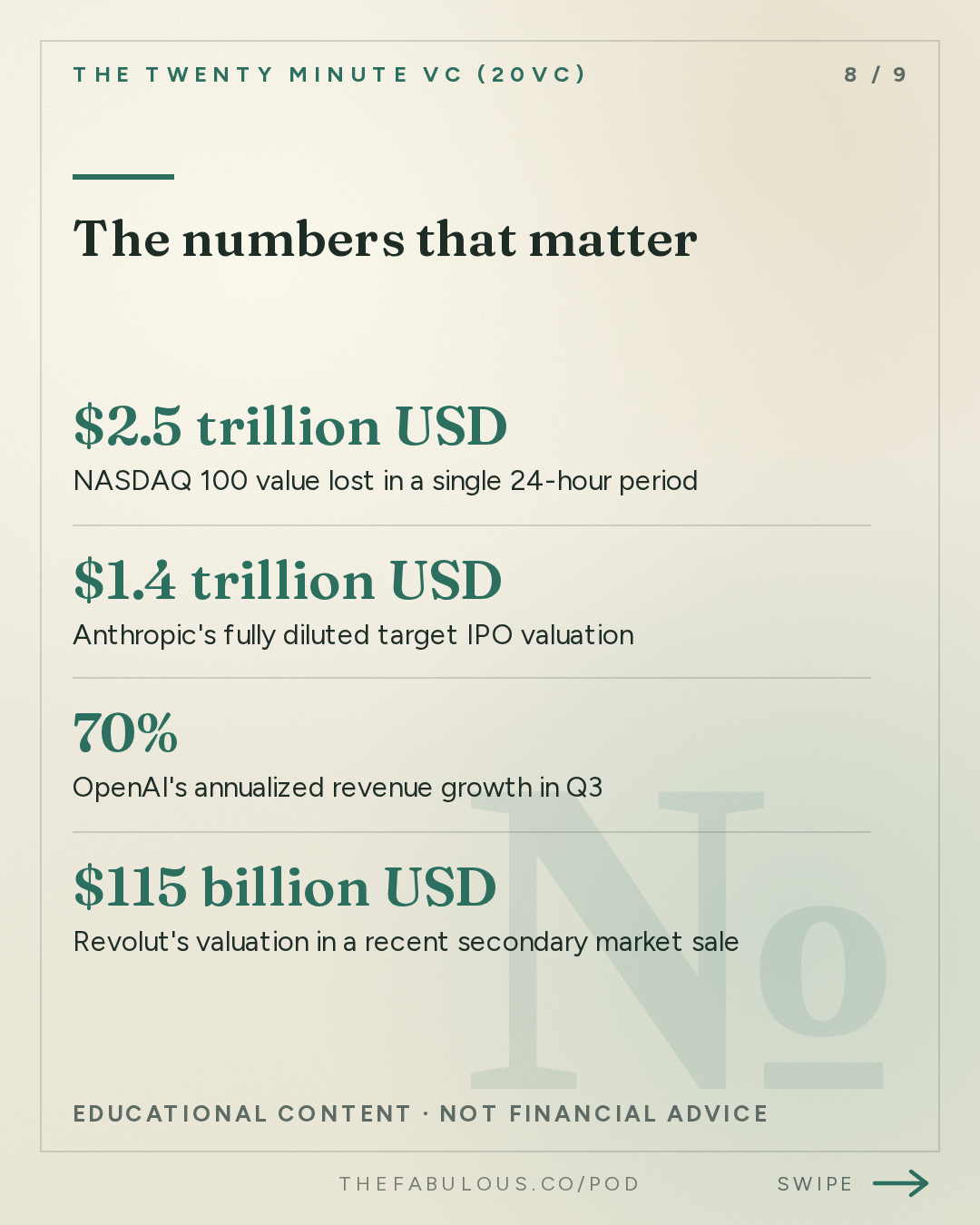
- $2.5 trillion USD NASDAQ 100 value lost in a single 24-hour period
- $1.4 trillion USD Anthropic's fully diluted target IPO valuation
- 70% percent OpenAI's annualized revenue growth in Q3
- $115 billion USD Revolut's valuation in a recent secondary market sale
- $41 million USD Average wealth gain per Anthropic employee from the IPO
- $2 million USD Palantir's revenue generated per employee
In their words
“The AI trade doesn't crack on the supply side. It is far better in an IPO to start low and go up than to start high and come back.”
“It's the most lucrative criminal trade you can do right now, right? It's, this is, this is better than selling Rolexes you steal off someone's”
“Care about your UX and their UI, and they don't, they don't care about any of this stuff. Humans do, but they're a declining percent”
Protocols
-
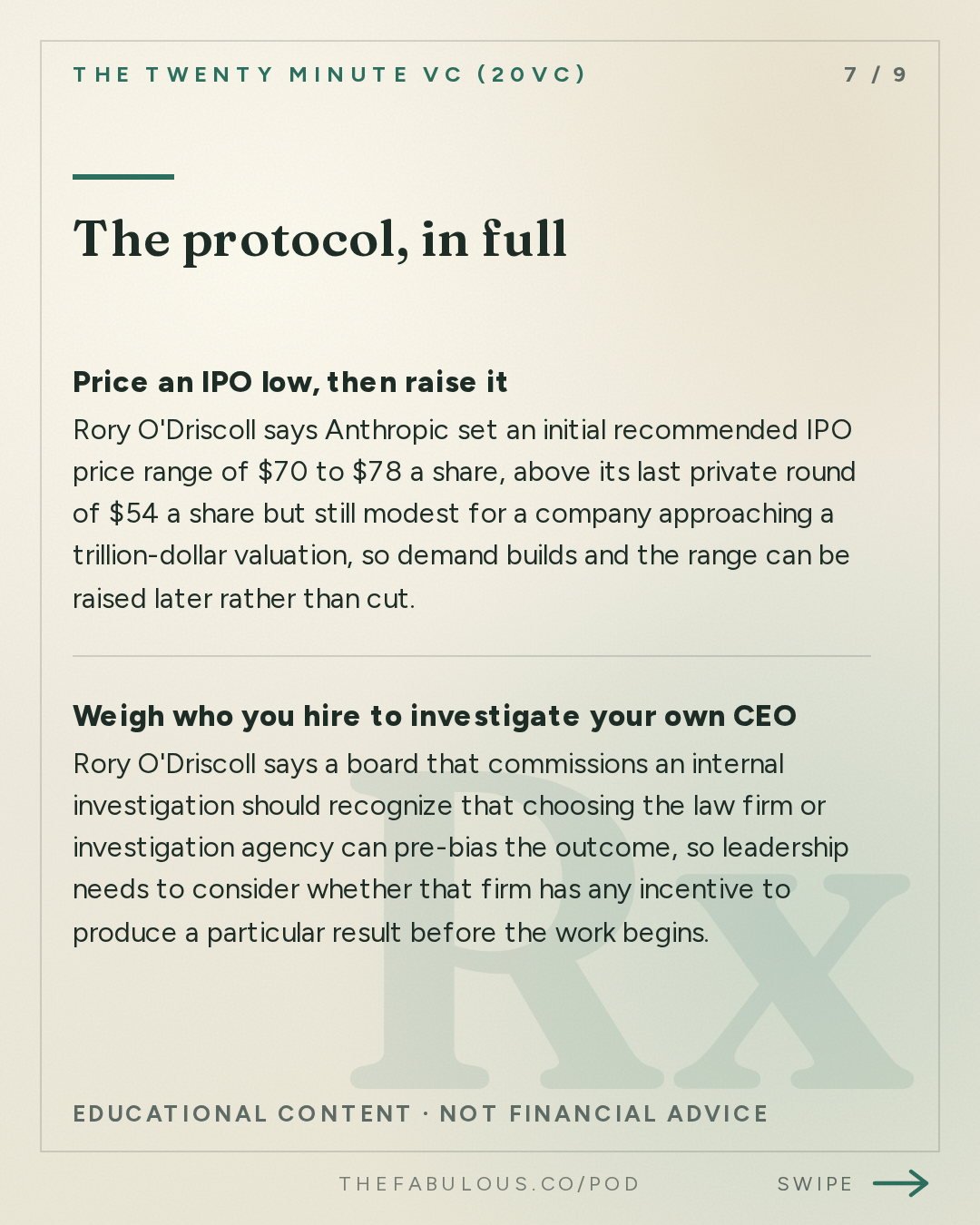
Price an IPO low, then raise it
Rory O'Driscoll says Anthropic set an initial recommended IPO price range of $70 to $78 a share, above its last private round of $54 a share but still modest for a company approaching a trillion-dollar valuation, so demand builds and the range can be raised later rather than cut.
one-time, at IPO pricing
-
Weigh who you hire to investigate your own CEO
Rory O'Driscoll says a board that commissions an internal investigation should recognize that choosing the law firm or investigation agency can pre-bias the outcome, so leadership needs to consider whether that firm has any incentive to produce a particular result before the work begins.
whenever a board opens an internal probe
Questions this episode answers
What valuation is Anthropic targeting for its IPO?
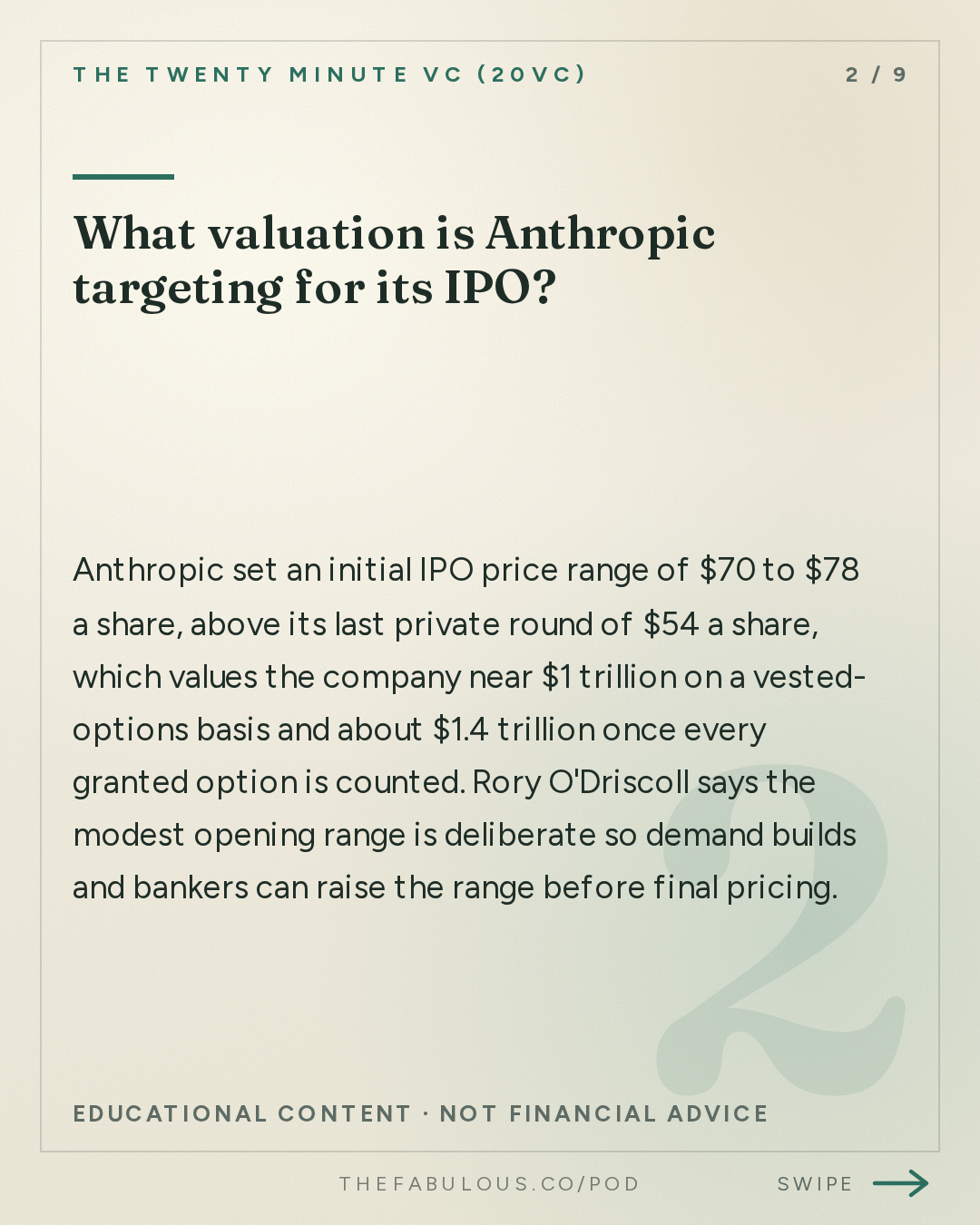
Anthropic set an initial IPO price range of $70 to $78 a share, above its last private round of $54 a share, which values the company near $1 trillion on a vested-options basis and about $1.4 trillion once every granted option is counted (25:12). Rory O'Driscoll says the modest opening range is deliberate so demand builds and bankers can raise the range before final pricing (24:25).
Why is Sequoia Capital closing its London office?
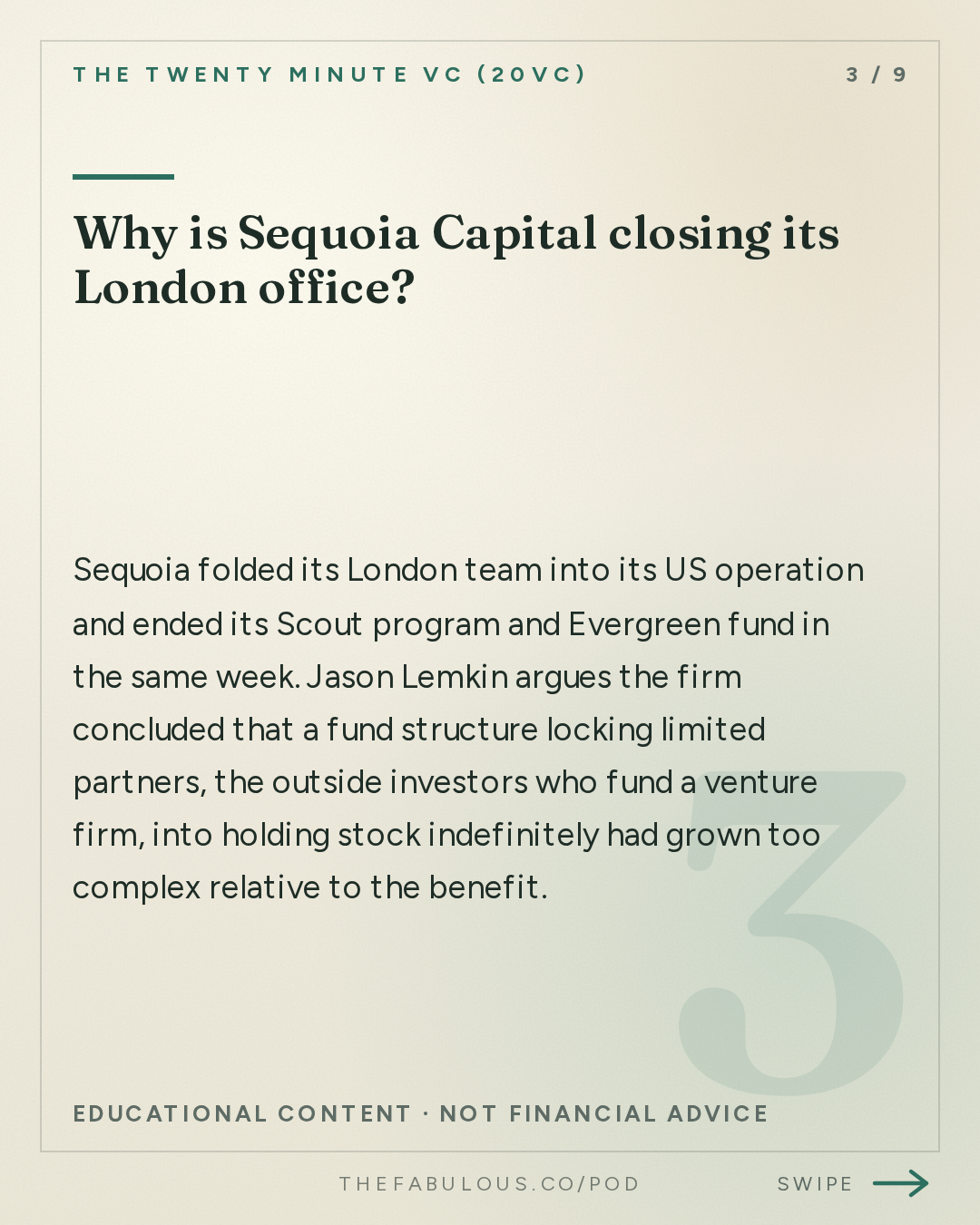
Sequoia folded its London team into its US operation and ended its Scout program and Evergreen fund in the same week (03:54). Jason Lemkin argues the firm concluded that a fund structure locking limited partners, the outside investors who fund a venture firm, into holding stock indefinitely had grown too complex relative to the benefit (07:23).
What happened to NVIDIA CEO Jensen Huang?
NVIDIA chief executive Jensen Huang, who has run the company since 1993 and is described as the longest-tenured tech CEO currently operating (15:52), admitted to a relationship with a person suspected of being a Chinese intelligence contact, triggering a board investigation into compliance and security issues rather than the relationship itself (14:24). Hosts argue Huang is too important to the AI industry to lose, though the probe is complicated by his separate, long-standing push to keep selling chips into China-adjacent markets (16:29).
Why did NASDAQ lose $2.5 trillion in a day?
The NASDAQ 100 lost $2.5 trillion in value over a single 24-hour period, which hosts attribute to hedge funds unwinding leveraged bets on data-center spending fears rather than any real break in AI demand (21:30). Rory O'Driscoll notes funds at firms like Citadel lose their capital at a 5% drawdown and get shut down at 7.5%, so margin calls, not changed AI economics, likely drove the move (23:14).
How are AI agents killing seat-based software pricing?
Software priced per human seat is losing favor because AI agents now do tasks a human user used to perform, reducing the need for per-person licenses, says Jason Lemkin (52:45). Cloudflare's growth re-accelerated to 39% after a 20% workforce cut (51:48), while Figma fell below a $10 billion valuation as investors question its seat-based model's future (53:01).
What did Anthropic employees gain from the IPO?
The average Anthropic employee stands to gain about $41 million from the IPO, with roughly $216 billion going to current employees and $160 billion held in an option pool (62:49). Hosts argue this figure explains why California's rejected wealth tax proposal mattered, since it could have pushed newly wealthy AI talent toward lower-tax states (61:15).
The full read, in cards
Mentioned
Sequoia Capital · Jensen Huang · NVIDIA · Anthropic · OpenAI · Revolut · Zipline · Cloudflare · Figma · Fireworks AI · Rory O'Driscoll · Jason Lemkin · Harry Stebbings
More from this show and category

Mistral CEO Arthur Mensch on Sovereign AI
Mistral CEO Arthur Mensch says energy is not AI's bottleneck: it's only about 10% of compute's cost (14:51). He argues chips and capital dominate project economics, and that sovereign AI, models trained, run, and kept on a customer's own infrastructure, will beat dependence on US or Chinese providers, with inference already behaving like a high-margin commodity market (30:44).

WashU Endowment Strategy: Scott Wilson Explains
Scott Wilson grew WashU's endowment from $8 billion to near $20 billion by firing most hedge funds and concentrating in direct private deals. SpaceX once made up over 20% of assets. Wilson argues many AI firms will not survive a decade, and sees underpriced opportunity in Europe and China.

Erik Bernhardsson on AI Inference Economics
Modal CEO Erik Bernhardsson says splitting the AI stack across many paid layers has ended 90% software margins for good. He also says the GPU market stays supply-constrained, open source inference usage will grow 5 to 20 times in the next year, and reinforcement learning works best on tasks like coding with fast feedback loops.

David Tisch on BoxGroup's Contrarian VC Strategy
BoxGroup's David Tisch says concentrated seed funds claiming a 90% win rate actually win closer to 20%. That gap, he argues, is why BoxGroup skips ownership targets entirely, writing checks as small as 1% ownership across roughly 150 companies a year, betting on founder access and speed over concentrated conviction.
