
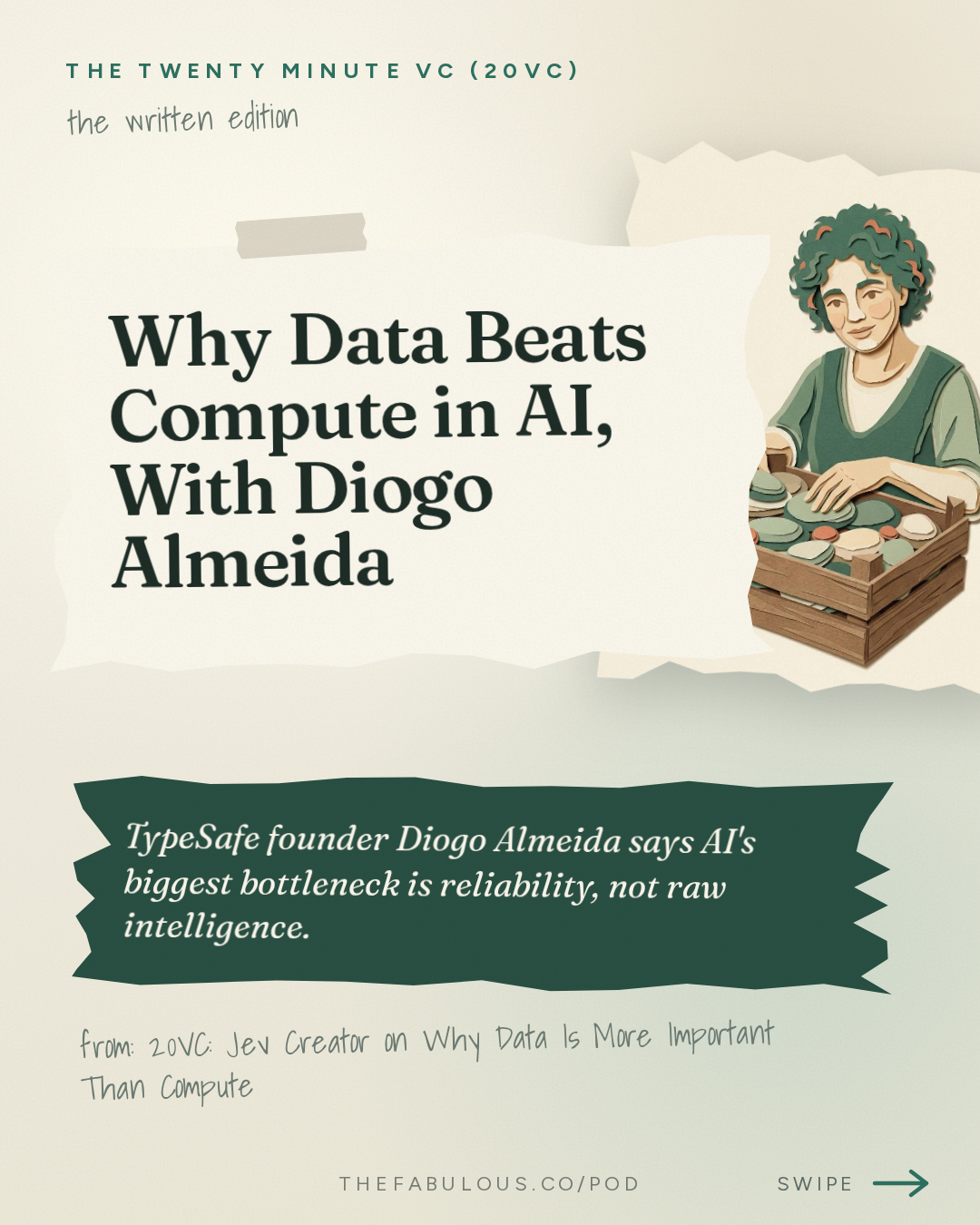
Why Data Beats Compute in AI, With Diogo Almeida
20VC: Jev Creator on Why Data Is More Important Than Compute | Will US Open-Source Models Catch Chinese | The Cost of Intelligence and Tokens: What No One Sees But Needs to Know with Diogo Almeida
The brief
TypeSafe founder Diogo Almeida says AI's biggest bottleneck is reliability, not raw intelligence. Models are right most of the time and badly wrong the rest, so benchmarks mislead and data, not compute, now decides who can actually automate real work rather than just assist with it.
Picture a coworker who is right ninety-five times out of a hundred and, the other five times, produces something unusable. Most managers would not let that person near payroll. Yet this is roughly how Diogo Almeida describes the state of frontier AI. Almeida is the founder of TypeSafe, maker of an AI product called Jev, and his central claim is disarmingly simple: the thing holding AI back from automating real work is not intelligence, it is reliability.
"You get Einstein, like, maybe 95% of the time, and Mr. Bean the other 5%." — Diogo Almeida [00:00]
That gap between genius and farce, repeated across millions of decisions, is why companies that tried to automate something as routine as accounting kept failing (07:00). The math simply does not work out: an assistant who nails the hard cases but occasionally invents a number is worse than useless in a finance department, because the one bad answer costs more than all the good ones saved. Almeida is careful to separate this from uptime. A system can run all day without crashing and still be unreliable in the sense he means: its judgment, not its availability, is what breaks (06:14).
Jev has grown fast enough to make this argument hard to dismiss. Sequoia partner Pat Grady says the product went from zero to $100 million in revenue in seven days (01:10), and TypeSafe says roughly a third of Fortune 500 companies now use it (01:10). The company was valued at $7.5 billion in a round led by Andreessen Horowitz's Martín Casado, with Sequoia also investing (01:10). Those numbers matter less as a growth story than as evidence for Almeida's underlying wager: that there is a large, mostly untapped market for software that does not need a human checking its work.
The Bitterest Lesson
Computer scientist Richard Sutton once argued, in an essay widely cited in AI circles, that general methods backed by more computing power beat clever hand-built algorithms, a claim known as the bitter lesson. Almeida thinks the field has learned a second, bitterer one: once you have enough compute, data matched to the right task matters far more than more compute (08:13).
"I would argue that there's a bitter lesson, which is that data matters a lot more than compute." — Diogo Almeida [08:38]
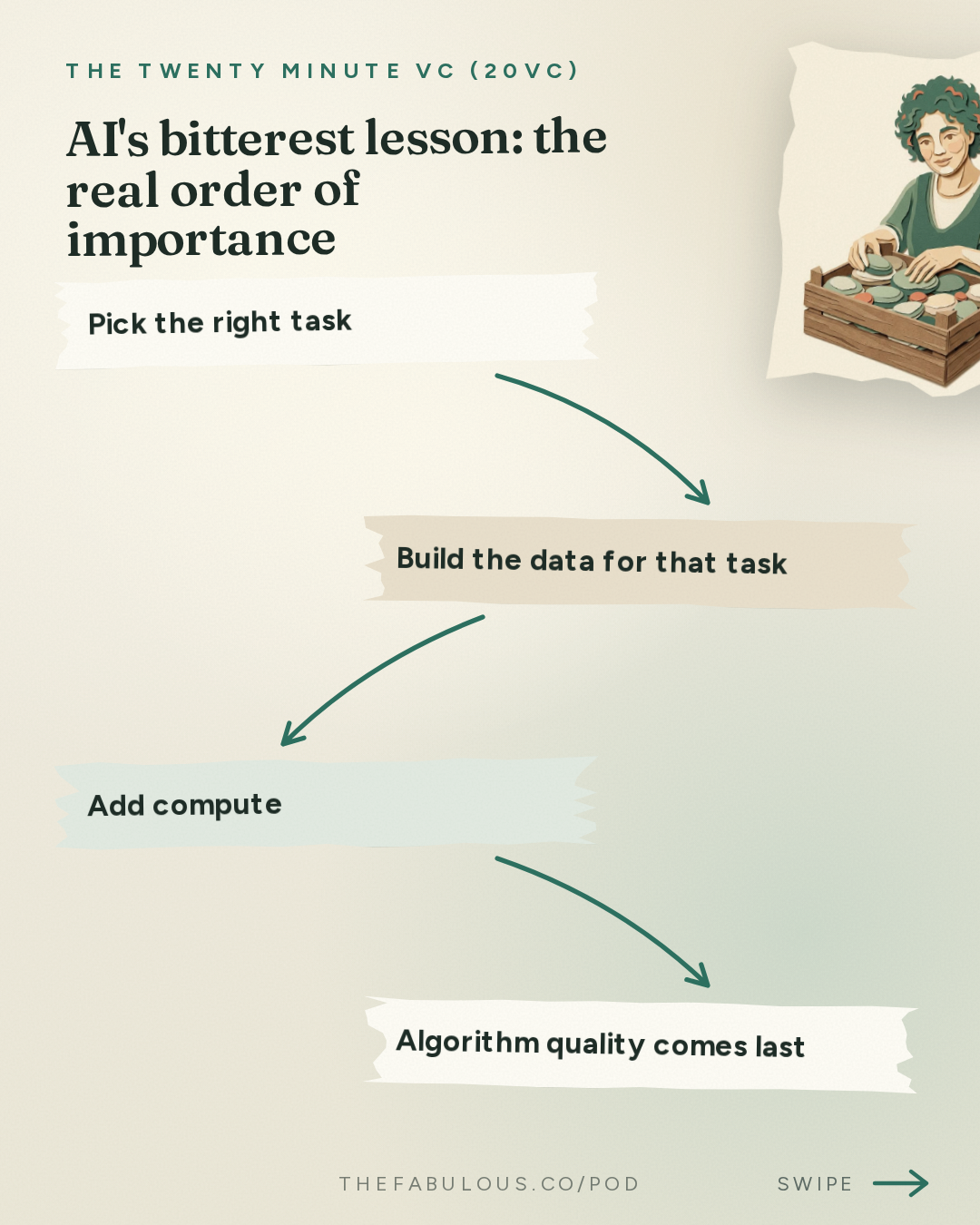
His evidence is GPT-4.5. By his account it was the largest model ever built by token cost, and pure scaling stopped paying off there, which is why labs quietly moved on from scale-to-the-moon thinking (08:38, 10:46). What replaced it, he argues, is a new hierarchy: first decide the right task, then build the data for it, then add compute, and only then worry about the algorithm (12:18). The reason this order matters is that data for a brand-new task usually does not exist anywhere, not in a database, not on the internet. When researchers built RLHF (reinforcement learning from human feedback), the preference data they needed had to be invented from scratch, through human labelers and iteration (12:37). Almeida thinks most of the industry still underrates how hard, and how valuable, that invention step is. He is also skeptical of one popular shortcut: synthetic data, which he says is good for helping small models catch up to large ones but is "overhyped" as a way to improve the frontier itself (16:53). And he has little patience for what he calls "Neo labs," startups that hire ex-lab researchers, buy GPUs, and hope to get acquired. He calls the pattern "incredibly wasteful" even while admitting the venture math can still work out for investors chasing a moonshot (17:57, 18:15).
Why the Scoreboard Lies
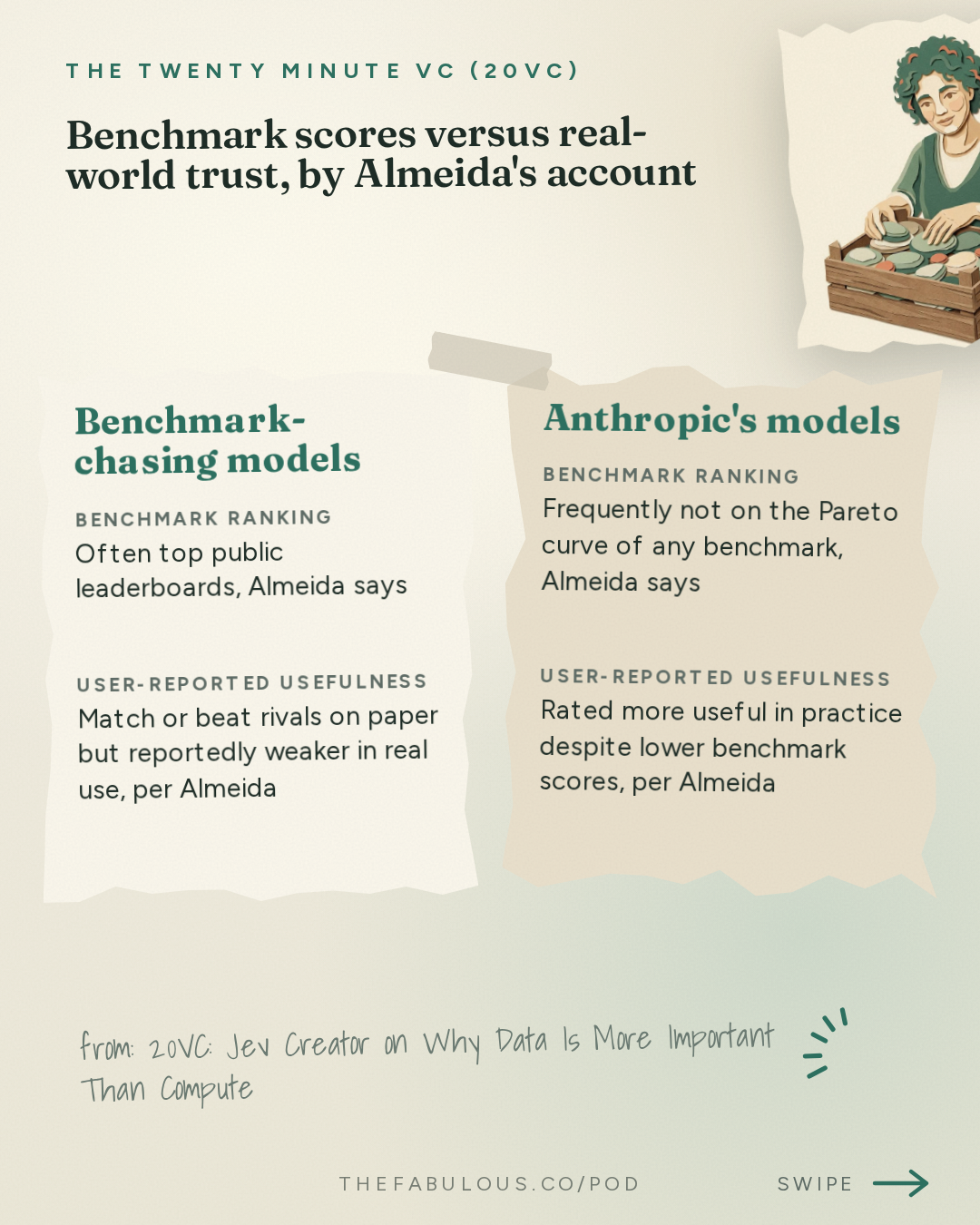
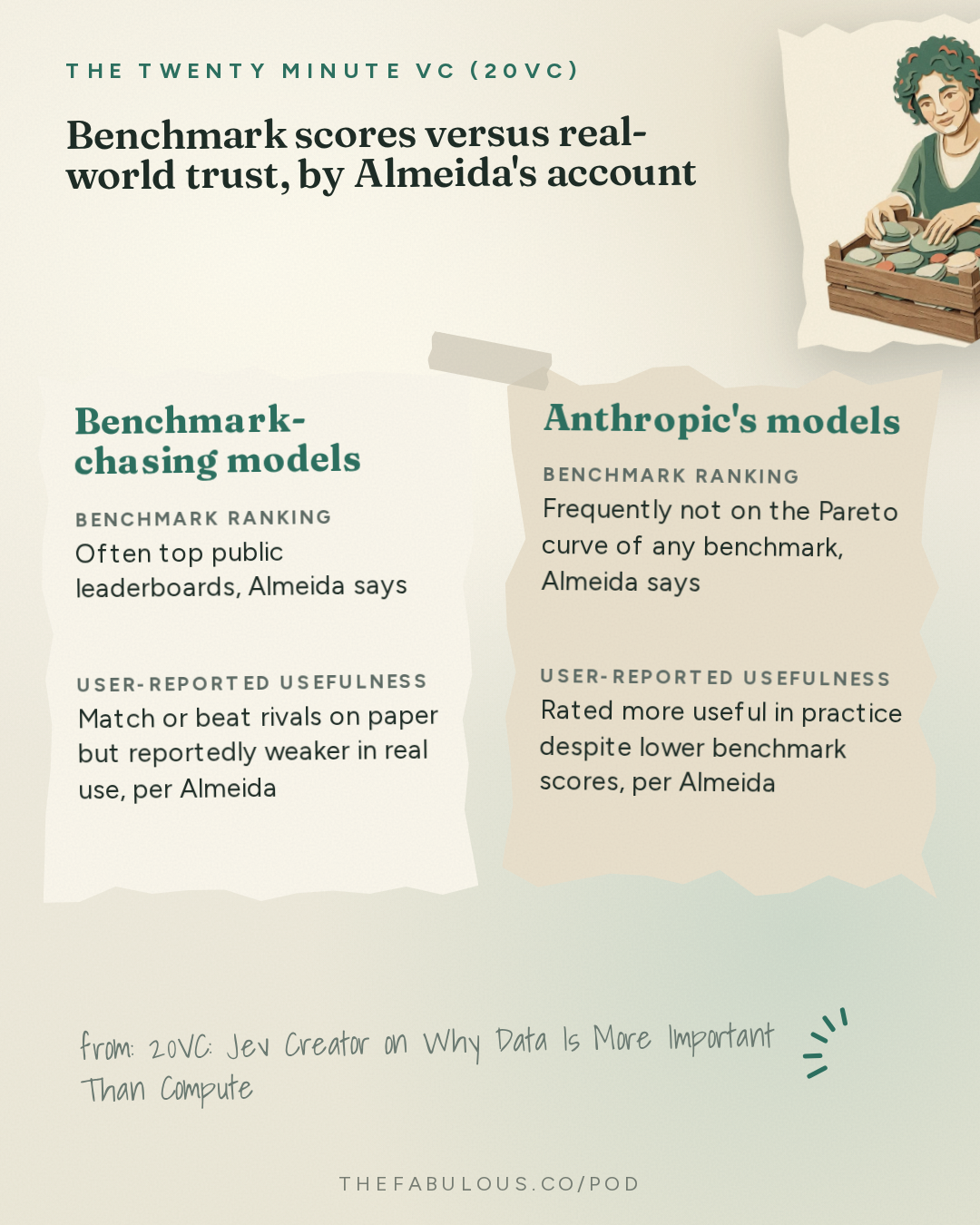
If data matters more than people think, benchmarks, Almeida argues, matter much less. "Benchmarks are total bullshit," he says flatly, describing a field where second-tier labs have every incentive to game public tests to look like first-tier ones, while top labs like OpenAI and Anthropic have less need to cheat because they can actually compete on substance (42:39, 43:36). His proof point is Anthropic, whose chatbot Claude he says is judged more useful in practice even when it is not sitting on the leaderboard's leading edge (22:41, 23:18). The uncomfortable implication is that anyone shopping for a model by scrolling a leaderboard is optimizing for the wrong signal entirely.
This same skepticism shapes Almeida's view of a popular narrative in AI investing: that companies should "own their own intelligence" by training custom, proprietary models. He pushes back hard, arguing that this framing treats AI as a kind of digital coworker, an interface choice he compares to the "horseless carriage," an early car built to look like a carriage because nobody could yet imagine the shape a car should actually take (33:01). Automation, he says, should have a different strength profile than a human employee, which means companies like Harvey, a legal AI company, or Cognition, a coding-agent company, may be investing less in secret models than in ordinary software engineering wrapped around existing large language models. "Proprietary intelligence happens at the code level," he says, not necessarily in a custom-trained model (37:20).
Almeida extends the same doubt to geopolitics. Asked whether American open-source AI models can catch up to Chinese ones, he says probably not, because American labs hold themselves to tighter ethical and legal limits that make closing the gap difficult (48:36). But he resists the idea that this is purely dangerous, arguing the real security question is whether engineers can build guardrails and bias controls around a model, rather than assuming any model running "vanilla" is a threat (46:43, 48:12).
On where all this money and attention is heading, Almeida is blunt: he thinks AI has been in a bubble for a while, and expects the correction to come from weak demand rather than a supply shock, because many buyers are miscalibrated about what today's models can actually do (50:02, 50:58). Yet he does not think this means token usage will shrink as AI gets cheaper and better. He points to the Jevons paradox, the historical pattern in which making a resource more efficient increases total consumption of it rather than reducing total spending. "I truly believe that we're gonna, like, mega Jevons paradox," he says (25:12), arguing that cheaper, more reliable intelligence will unlock so many new projects that total spending rises rather than falls (52:43). By his own account, the opportunity is still almost entirely unclaimed: on the metric that matters most to him, real automation, he puts Jev and its closest rivals at roughly 0% (53:45).
That unclaimed territory is also why Almeida says TypeSafe raised its $7.5 billion round the way it did, fielding twenty-eight term sheets without a pitch deck (56:25) and choosing investors for alignment rather than valuation. He says the deciding factor at Sequoia was not the fund but partner Sonya Wang, whom he calls uniquely able to offer a different strategic perspective (60:49). It is consistent with how he says he hires: not for credentials, but for obsession. "I need someone to be obsessive about their craft, addicted to making it better. They can't sleep at night," he says of his ideal hire (65:00), and he adds that he avoids recruiting researchers out of OpenAI because their training, in his telling, pushes them toward algorithms and away from the unglamorous work of data (67:04). Whether or not every claim here survives contact with a more competitive market, Almeida's real argument is a plea to measure the right thing: not how clever a model looks on a test, but how often it can be trusted to get something right when nobody is watching.
Ask this episode anything
Pod's AI answers from the episode itself, with the minute mark so you can hear it yourself.
Or start with one of these
Ask this episode
Pod's AI listens to the whole episode to answer, and points you to the minute it comes from.
The rest of this answer, and any question after it
Answers come from the episode itself, never from a summary of it.
ContinueKey takeaways
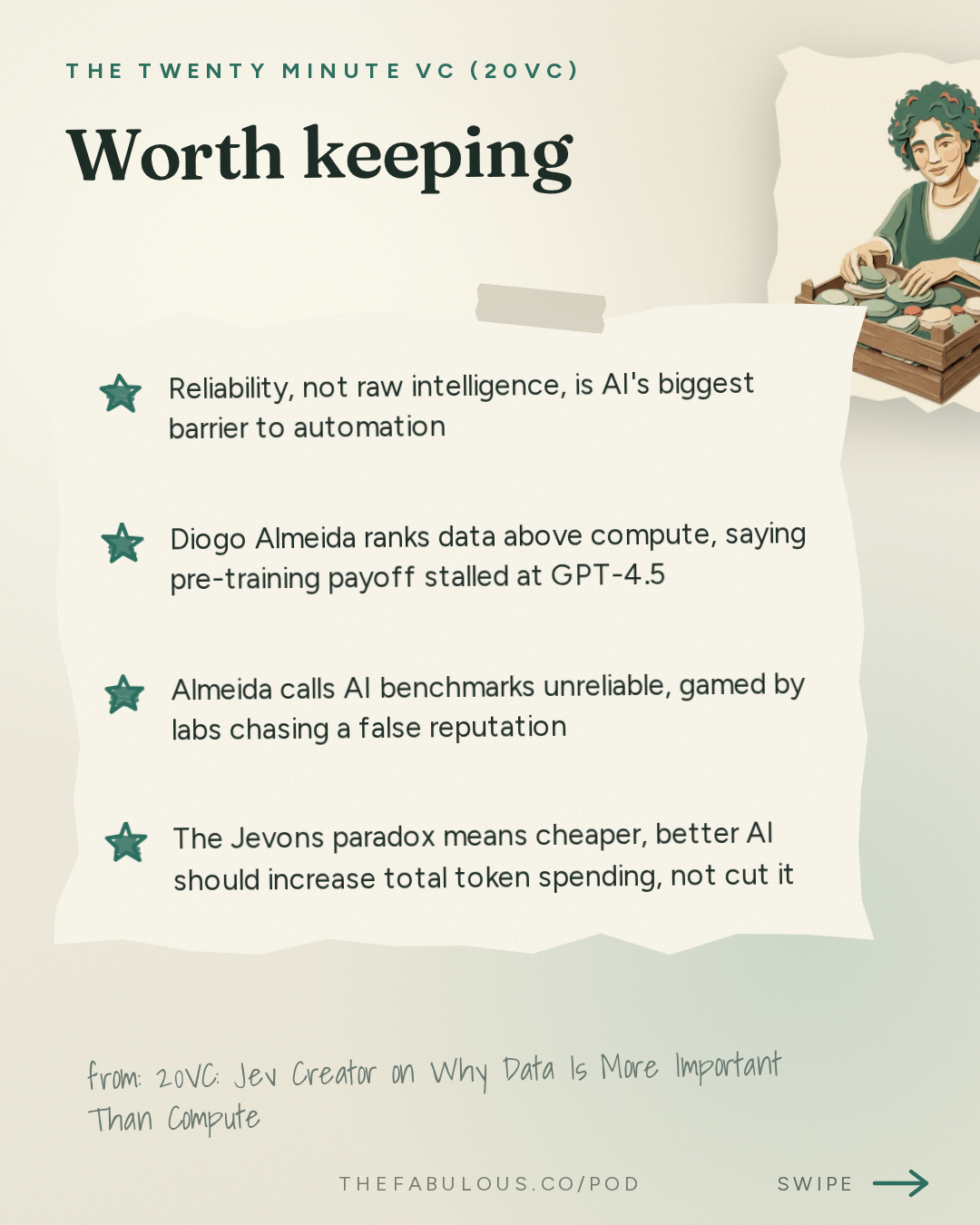
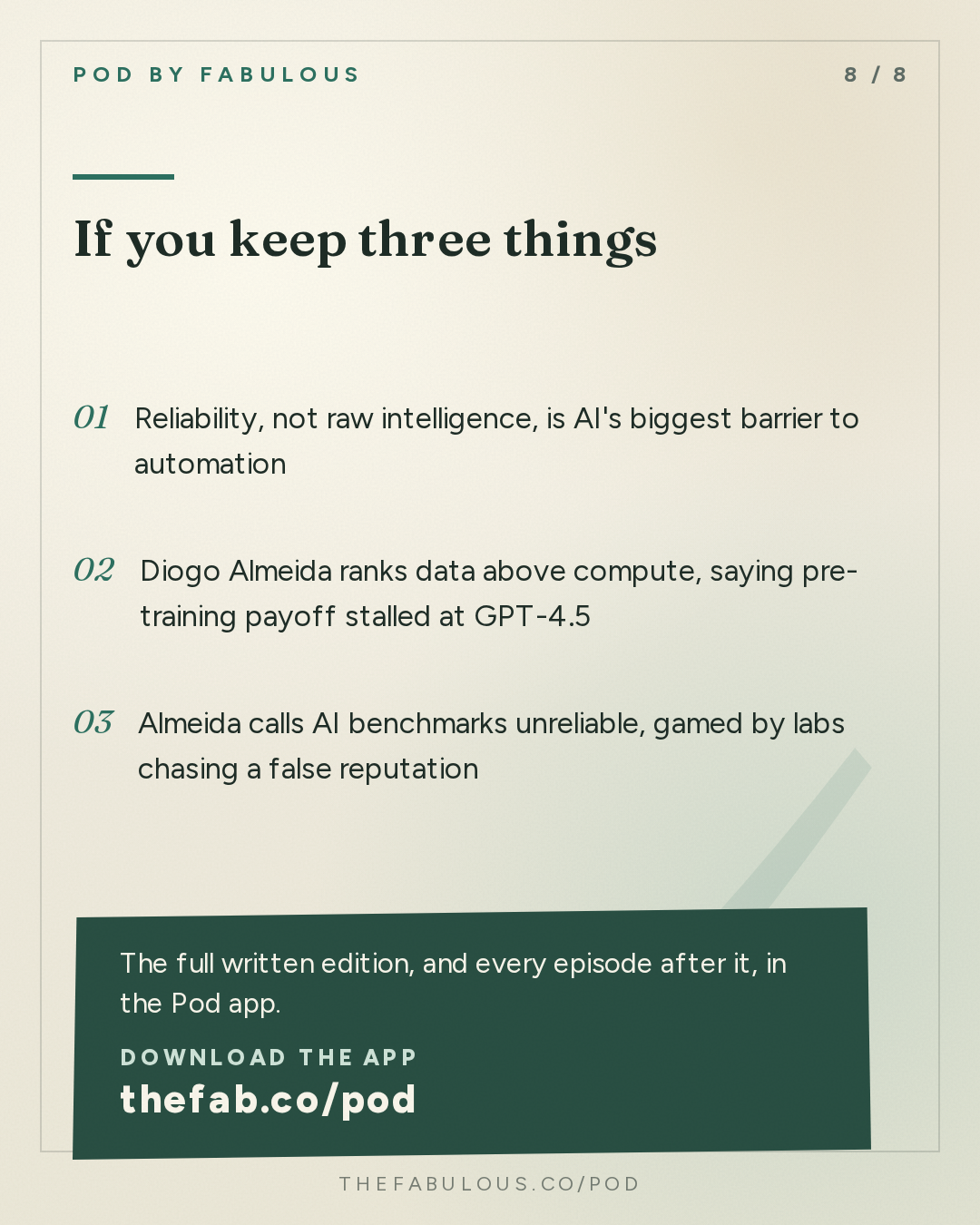
- Reliability, not raw intelligence, is AI's biggest barrier to automation
- Diogo Almeida ranks data above compute, saying pre-training payoff stalled at GPT-4.5
- Almeida calls AI benchmarks unreliable, gamed by labs chasing a false reputation
- The Jevons paradox means cheaper, better AI should increase total token spending, not cut it
- TypeSafe's Jev reached $100 million in revenue within seven days, per Sequoia's Pat Grady
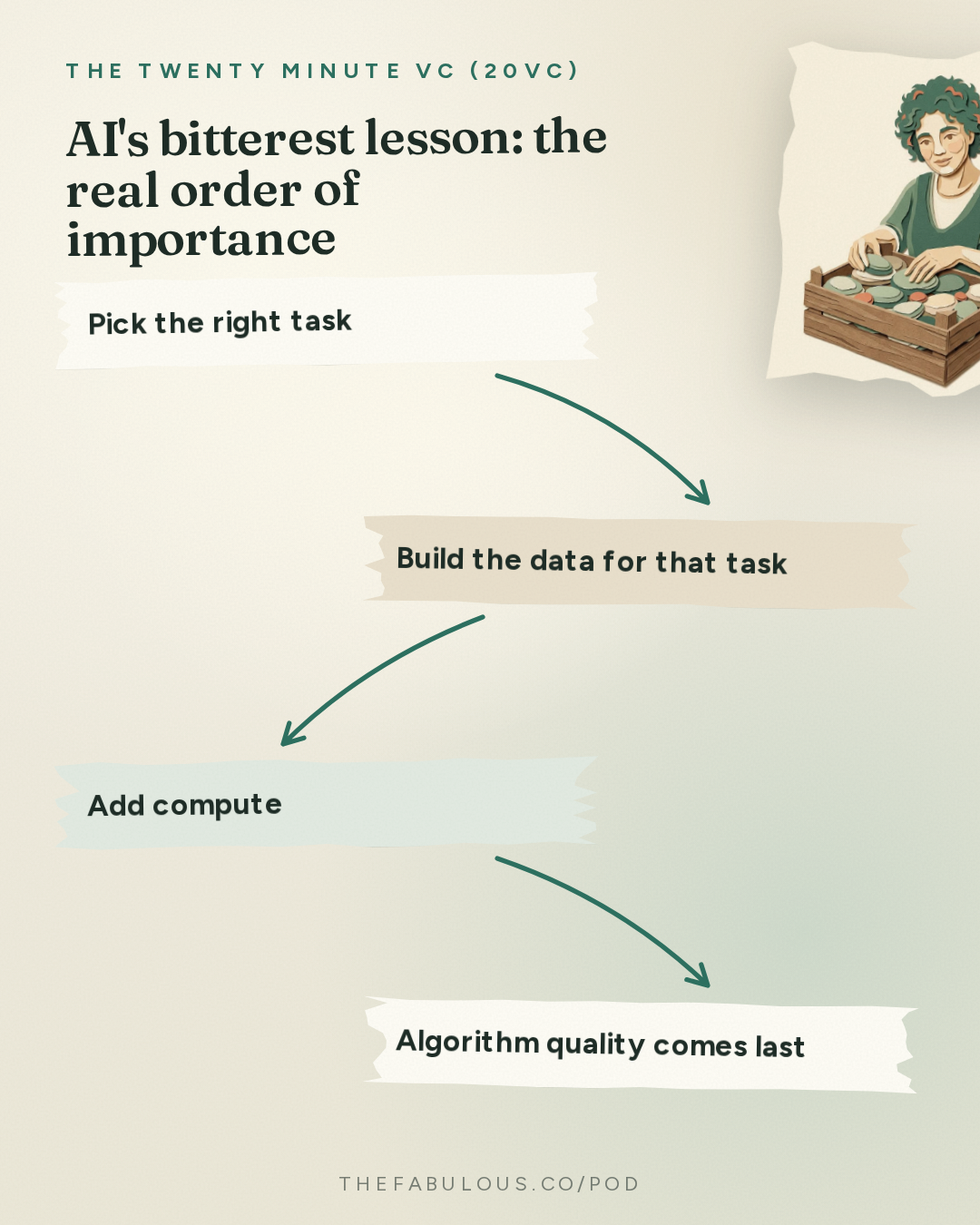
The episode in cards

By the numbers
- 95% percent share of the time AI models perform at expert level, in Almeida's Einstein analogy
- 0% percent real automation achieved by top AI models today, by Almeida's own estimate
In their words
“You get Einstein, like, maybe 95% of the time, and Mr. Bean the other 5%.”
“I would argue that there's a bitter lesson, which is that, um, data matters a lot more than compute.”
“Benchmarks are total bullshit. All benchmarks are bad. There's perverse incentives.”
“I need someone to be obsessive about their craft, addicted to making it better. They can't sleep at night.”
Protocols
-
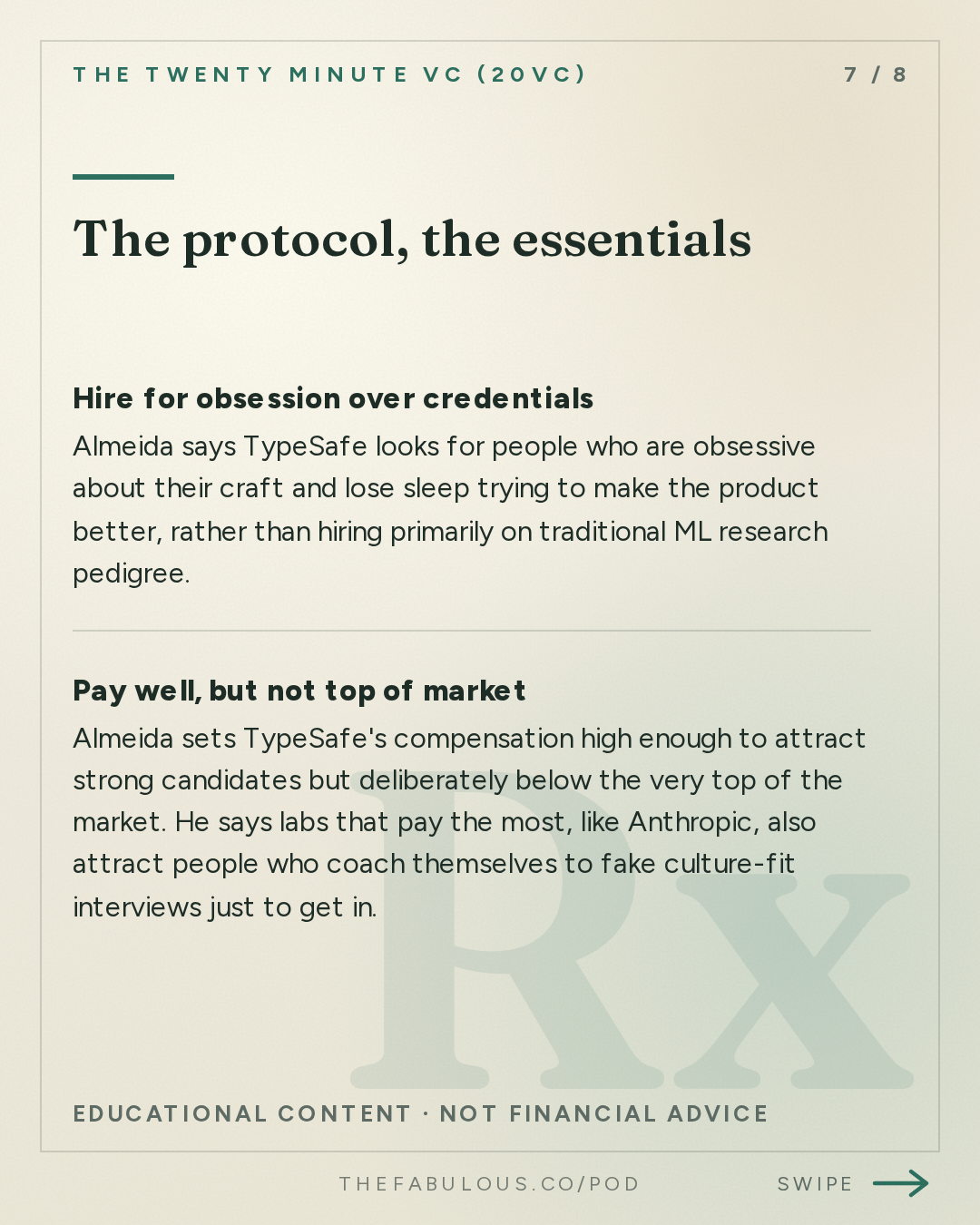
Hire for obsession over credentials
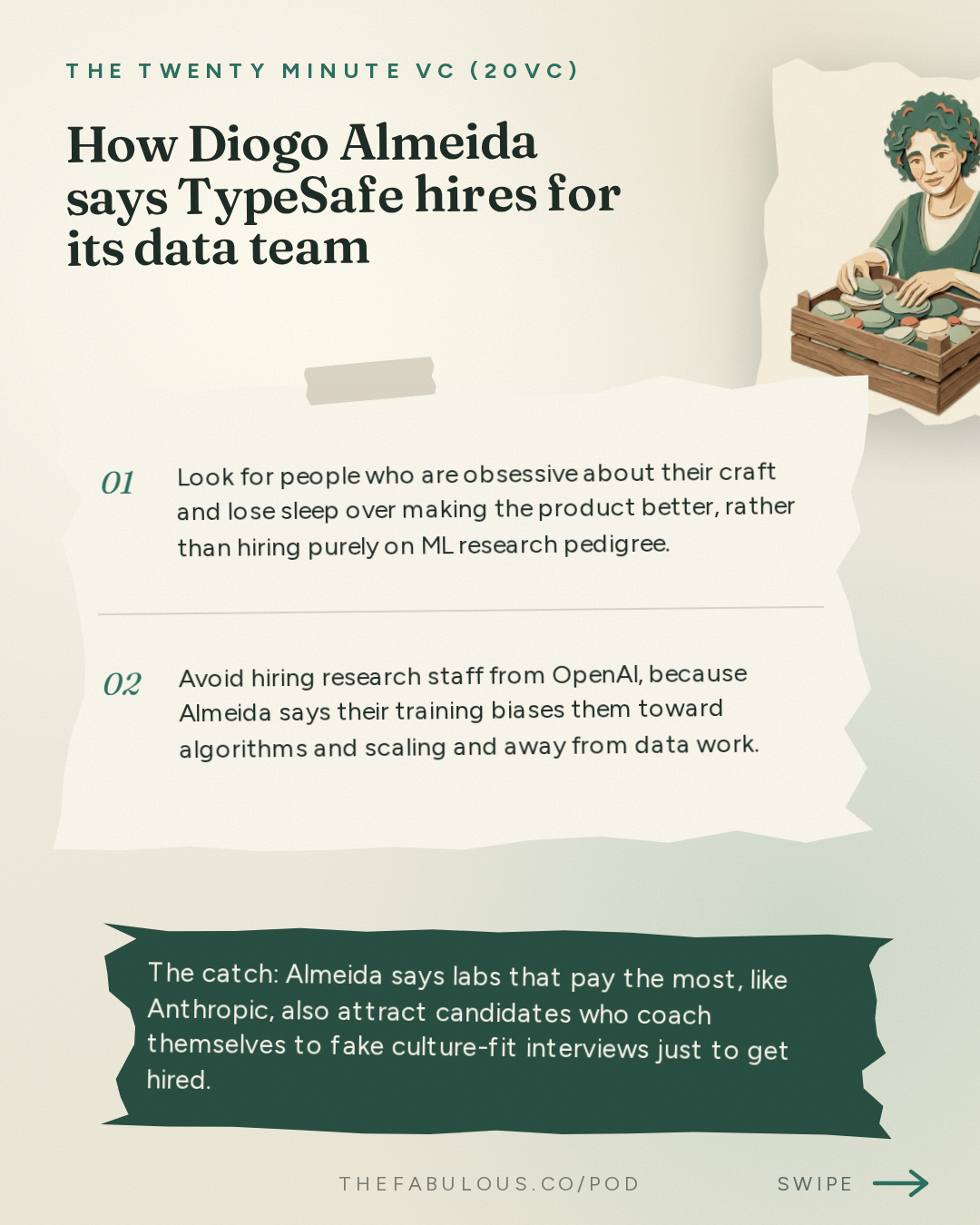
Almeida says TypeSafe looks for people who are obsessive about their craft and lose sleep trying to make the product better, rather than hiring primarily on traditional ML research pedigree.
Applied to every hire
-
Pay well, but not top of market
Almeida sets TypeSafe's compensation high enough to attract strong candidates but deliberately below the very top of the market. He says labs that pay the most, like Anthropic, also attract people who coach themselves to fake culture-fit interviews just to get in.
Ongoing compensation policy
-
Make important decisions slowly
Almeida says TypeSafe's operating value is to make great decisions slowly, insisting on understanding the underlying why and framework before acting on anything that matters.
For high-stakes decisions
Questions this episode answers
What is Jev and why did it reach $100 million in revenue so fast?
Jev is an AI product built by Diogo Almeida's company TypeSafe, designed for automation rather than chatbot assistance. Sequoia partner Pat Grady said it went from zero to $100 million in revenue in seven days, and the company says about a third of Fortune 500 companies use it (01:10).
Why does Diogo Almeida say data matters more than compute in AI?
Almeida argues that once a model has enough compute, gains come from data matched to the right task, not from more pre-training. He points to GPT-4.5 as the model where pure compute scaling stopped paying off commercially (08:13, 08:38).
Are AI benchmarks reliable measures of model quality?
Almeida calls benchmarks "total bullshit," arguing second-tier labs have strong incentive to game them while top labs like Anthropic have less need to cheat. He notes Anthropic's models are often not on the Pareto curve of any benchmark yet are judged more useful in practice (42:39, 23:18).
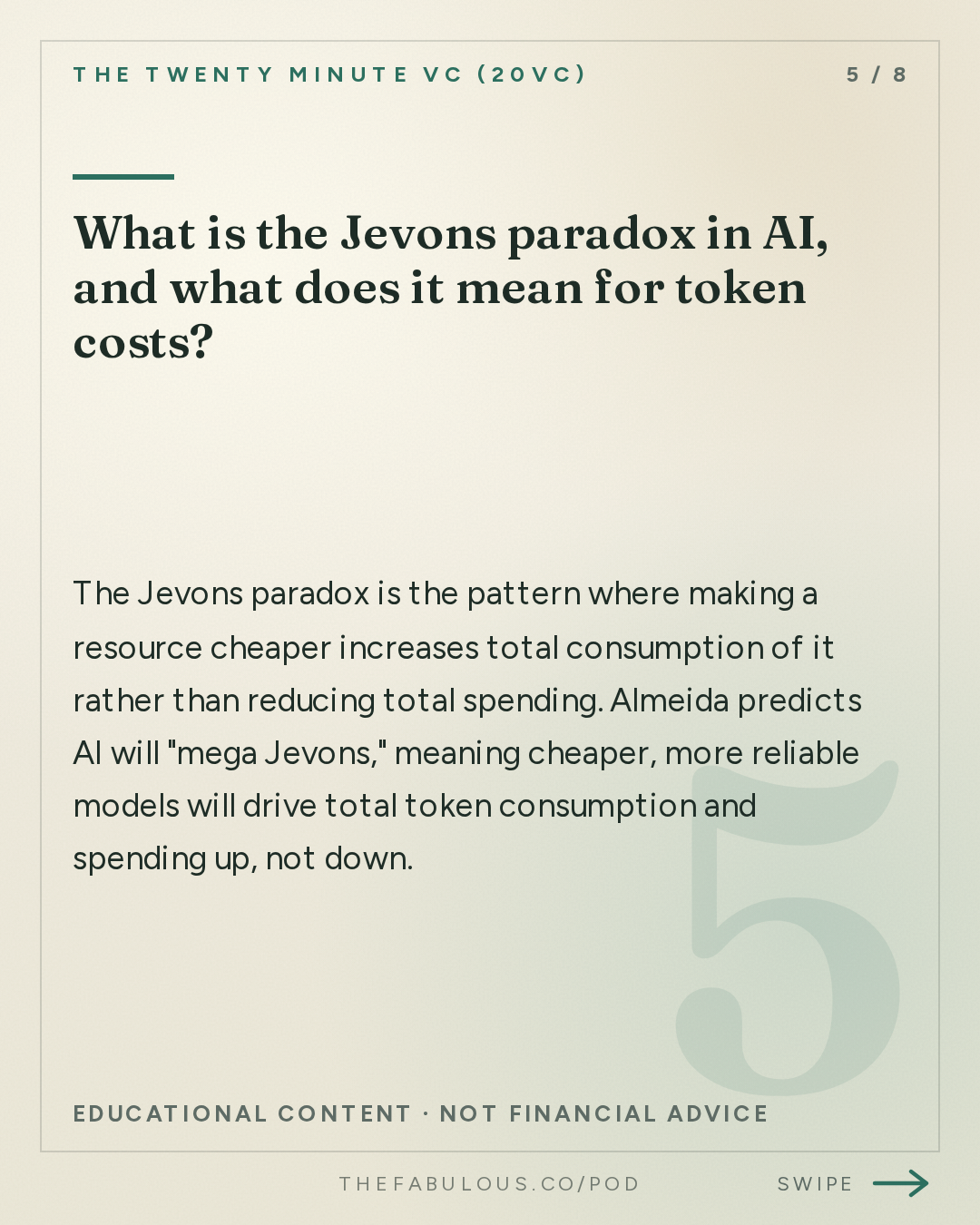
What is the Jevons paradox in AI, and what does it mean for token costs?
The Jevons paradox is the pattern where making a resource cheaper increases total consumption of it rather than reducing total spending. Almeida predicts AI will "mega Jevons," meaning cheaper, more reliable models will drive total token consumption and spending up, not down (25:12, 52:43).
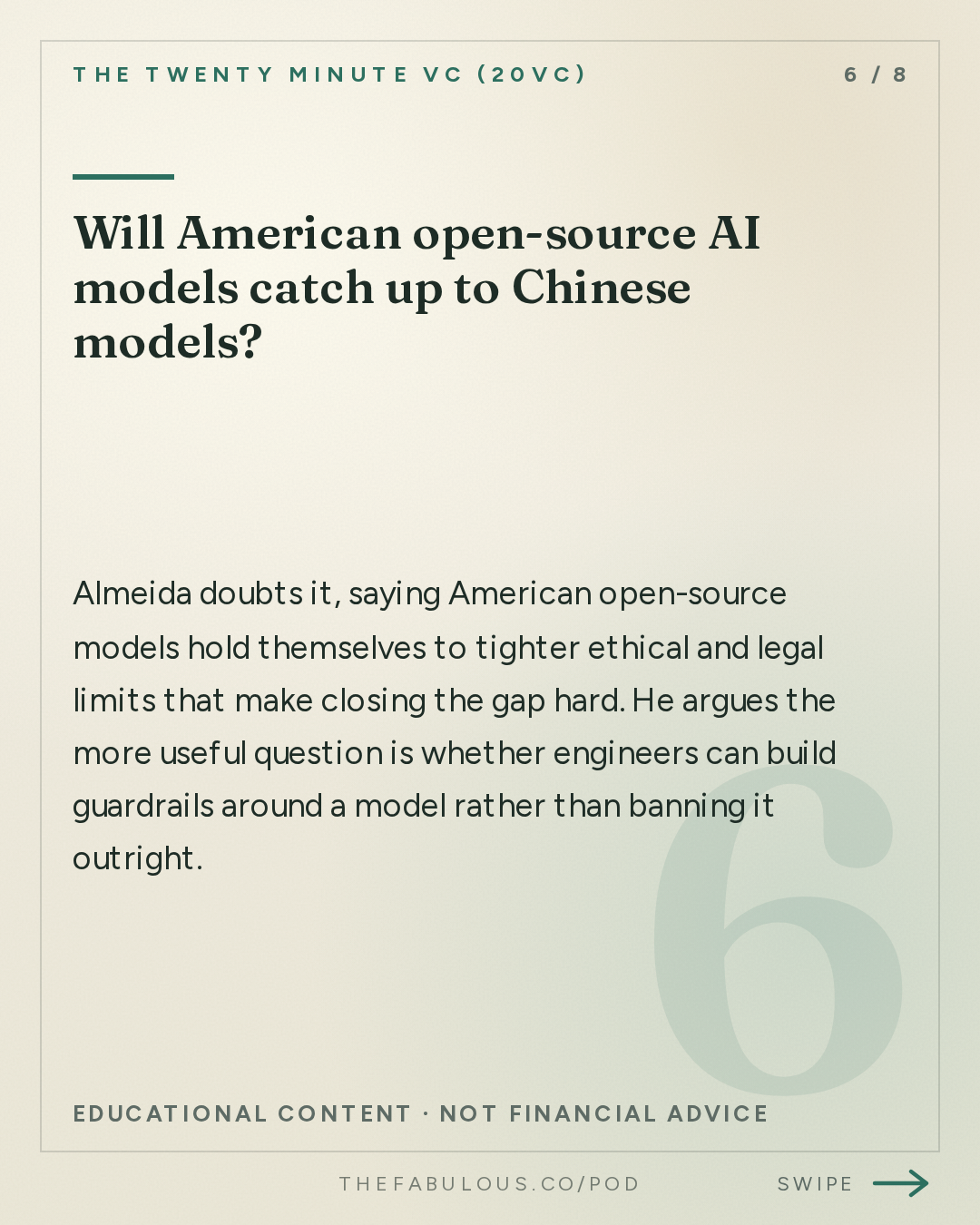
Will American open-source AI models catch up to Chinese models?
Almeida doubts it, saying American open-source models hold themselves to tighter ethical and legal limits that make closing the gap hard. He argues the more useful question is whether engineers can build guardrails around a model rather than banning it outright (45:28, 48:36).
Is the AI industry in a bubble, according to Diogo Almeida?
Almeida says he has believed AI was in a bubble for a while and expects a demand-side correction rather than a supply shock, because he thinks many buyers are miscalibrated about what current AI can reliably do (50:02, 50:58).
The full read, in cards
Go deeper
- The Bitter Lesson (Richard Sutton) — Sutton's essay argued general, compute-scaled methods beat hand-crafted algorithms; Almeida says a bitterer lesson now favors data over compute.
- Dwarkesh Twitter post comparing data and algorithms — A recent post Almeida cites showing data improved model performance many times more than algorithmic changes did.
- Will De Pue's result on Blackwell GPUs and Chinese models — A result Almeida references suggesting some Chinese models behaved differently when run on the latest Nvidia Blackwell chips, raising questions about export-ban effectiveness.
Mentioned
Diogo Almeida · Jev · TypeSafe · Pat Grady · Sequoia · Andreessen Horowitz · Martín Casado · Sonya Wang · Anthropic · OpenAI · GPT-4.5 · Harvey · Cognition · Richard Sutton · Harry Stebbings
More from this show and category

Fractile's Walter Goodwin on AI's Memory Wall
Fractile CEO Walter Goodwin says AI chips are limited by memory bandwidth, not math power, and his startup stacks memory on top of logic to fix it. Fractile raised a $720 million Series C at a $7 billion valuation (00:23), betting that inference, not training, is where chip value will accrue.

Anthropic's $1.4 Trillion IPO Strategy Explained
Sequoia shut its London office and ended its Evergreen fund the week NASDAQ lost $2.5 trillion and Anthropic set a $1.4 trillion IPO target. NVIDIA's Jensen Huang faces a board investigation, OpenAI's revenue grew 70%, and hosts argue agent-based AI is killing seat-priced software like Figma.

Mistral CEO Arthur Mensch on Sovereign AI
Mistral CEO Arthur Mensch says energy is not AI's bottleneck: it's only about 10% of compute's cost (14:51). He argues chips and capital dominate project economics, and that sovereign AI, models trained, run, and kept on a customer's own infrastructure, will beat dependence on US or Chinese providers, with inference already behaving like a high-margin commodity market (30:44).

WashU Endowment Strategy: Scott Wilson Explains
Scott Wilson grew WashU's endowment from $8 billion to near $20 billion by firing most hedge funds and concentrating in direct private deals. SpaceX once made up over 20% of assets. Wilson argues many AI firms will not survive a decade, and sees underpriced opportunity in Europe and China.
