
Kush Bavaria on GPU Pricing and Compute Markets
20VC: The State of Compute: What Everyone Needs to Know | Why Neo-Clouds are Great Businesses | What Everyone Is Missing About GPU Prices? | How AI Infrastructure Investors Will Win with Kush Bavaria, Co-Founder @ Ornn
The brief
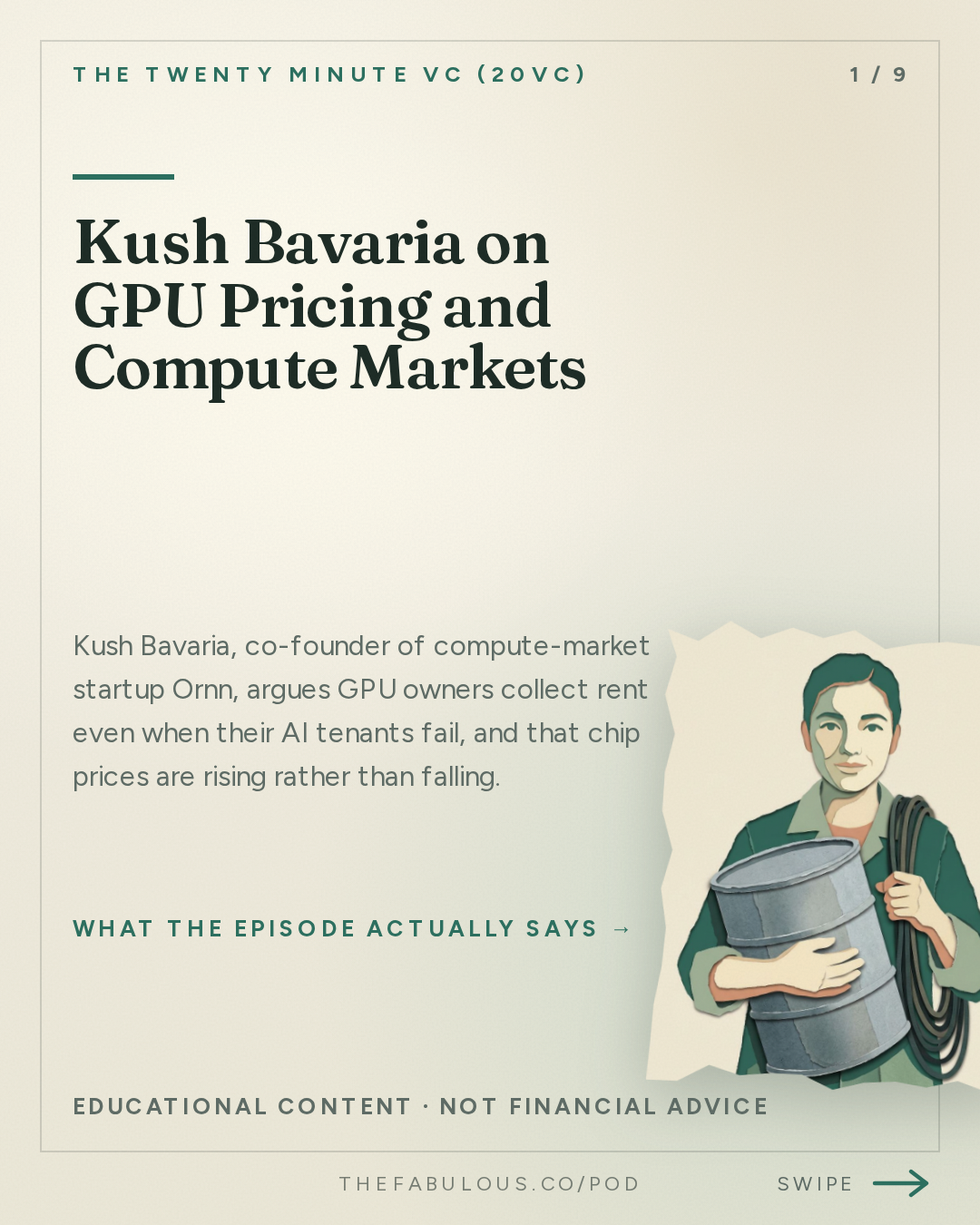
Kush Bavaria, co-founder of compute-market startup Ornn, argues GPU owners collect rent even when their AI tenants fail, and that chip prices are rising rather than falling. He details building a price index and futures market for compute, modeled on oil's Brent benchmark, while betting on OpenAI over Anthropic because compute, not cash, is the real bottleneck.
Picture a city with exactly one growth industry. Rents go up because everyone wants to live there, and they keep going up even if half the businesses in town eventually fail, because somebody else is always waiting to take the empty unit. That is how Kush Bavaria, co-founder of the compute-market startup Ornn, thinks about data centers. The GPUs are apartments. The AI labs are tenants. And the people who own the building, he argues, almost never lose.
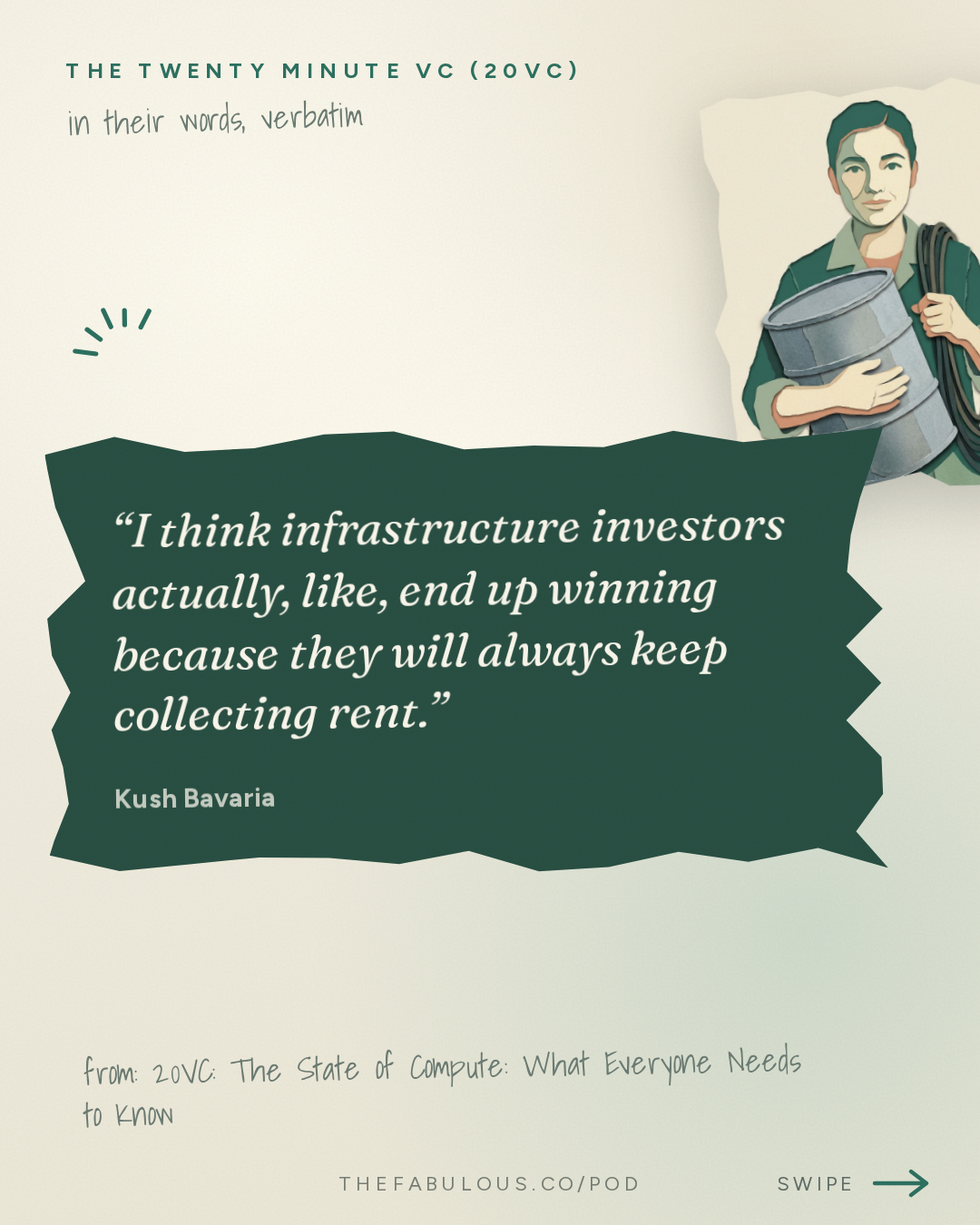
"I think infrastructure investors actually, like, end up winning because they will always keep collecting rent." — Kush Bavaria [00:00]
This is the opening move of a conversation that is really about one question: what happens to prices when a technology's usefulness is not in doubt but its business model still is. Bavaria's answer, built from two years of watching how GPU hours actually get bought and sold, is that the market for compute behaves less like a tech product cycle and more like a commodity, and it is still missing most of the plumbing that makes commodities investable.
Start with the chips themselves. A year ago, buyers assumed that GPU prices would fall over time, the way most hardware does. Lenders were handing out free call options on future capacity because nobody thought anyone would exercise them. Bavaria says that assumption has flipped (13:25). Demand for tokens, the basic unit of AI output, keeps climbing faster than supply, so today's five-year GPU hour runs about seven to eight dollars, and Bavaria would not be surprised if Nvidia's next-generation Rubin chips cost twenty to thirty dollars an hour by the time they ship (13:48). Lead times tell the same story: Eric, the CEO of Modal, currently orders chips eighteen to twenty weeks ahead of need, but Bavaria suggests he should start buying twenty-two to twenty-six weeks out now that lead times have increased (16:54), and CoreWeave, one of the largest GPU rental companies, is reportedly quoting delivery as far out as the final quarter of 2027 for some orders (11:15). Old hardware has not aged out either. Bavaria notes that four-year-old H100 chips and six-year-old A100s are still being rented on three-year contracts, because demand for cheaper, slower inference work has not run out of uses for them (19:40).
A market with landlords but no index
If compute behaves like a commodity, Bavaria's bet is that it needs the machinery commodities have: a reference price, a public exchange, futures, and eventually credit ratings. He compares it directly to oil. Brent crude, the benchmark everyone quotes, represents something like 0.8 percent of global oil volume (31:37), yet it still functions as the reference price because it is standardized and trusted. Ornn is trying to do the same thing for GPU hours: pick one well-defined flavor of compute, track it rigorously, and let that tracked price become the quoted standard, the way Saudi crude and Venezuelan crude both still get priced off Brent. The prize, if it works, is enormous. Bavaria points out that the commodity exchanges that run this kind of infrastructure for oil and interest rates, ICE and CME, are each worth more than a hundred billion dollars, and the ratings agency S&P is worth more still. His argument is that compute is a bigger market than any commodity of the last century and a half (33:25), partly because the data-center buildout itself is projected to reach seven trillion dollars (25:43), and partly because the buyer base has exploded from a handful of cloud giants to roughly three hundred so-called neo-clouds competing for the same GPUs (30:45).
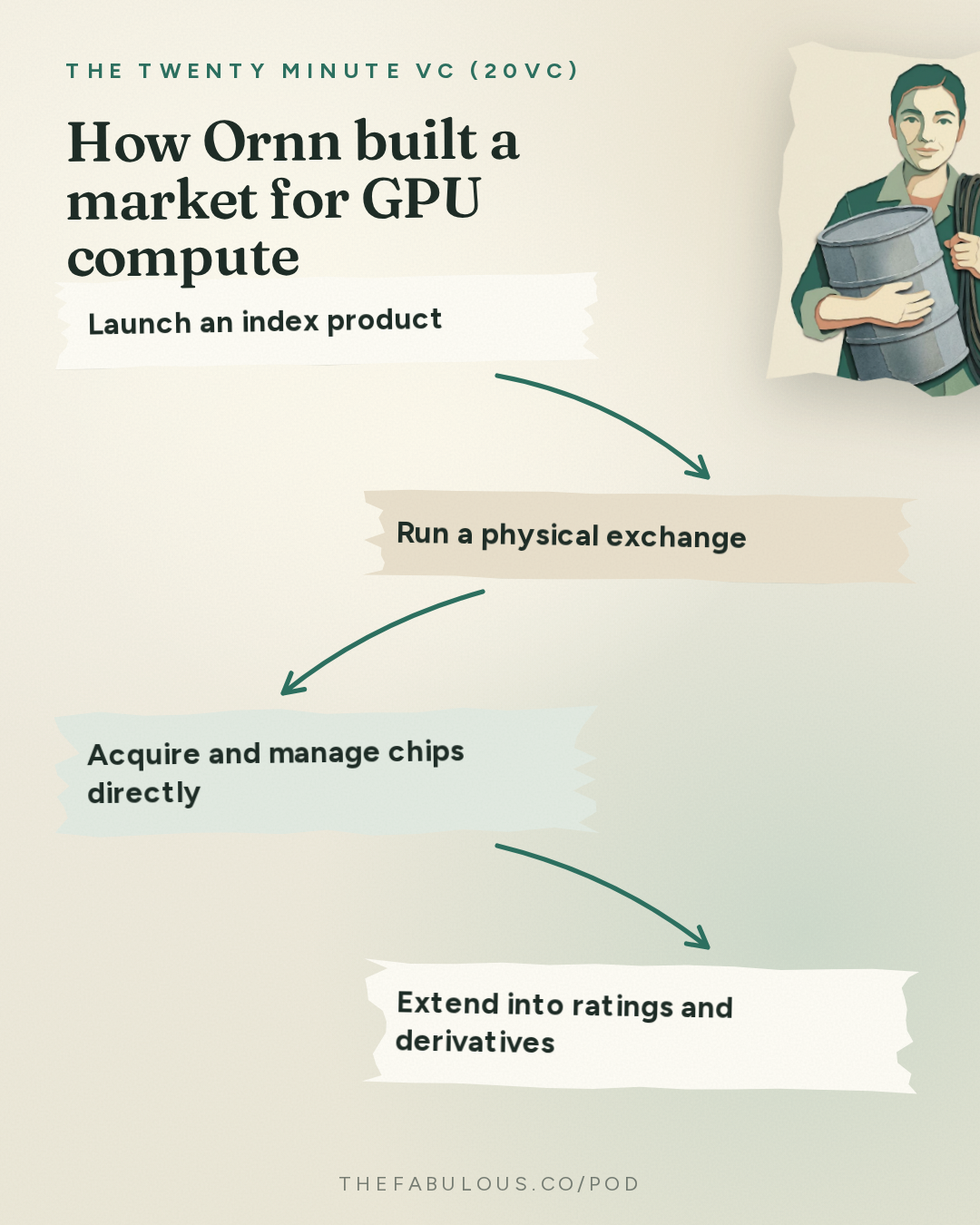
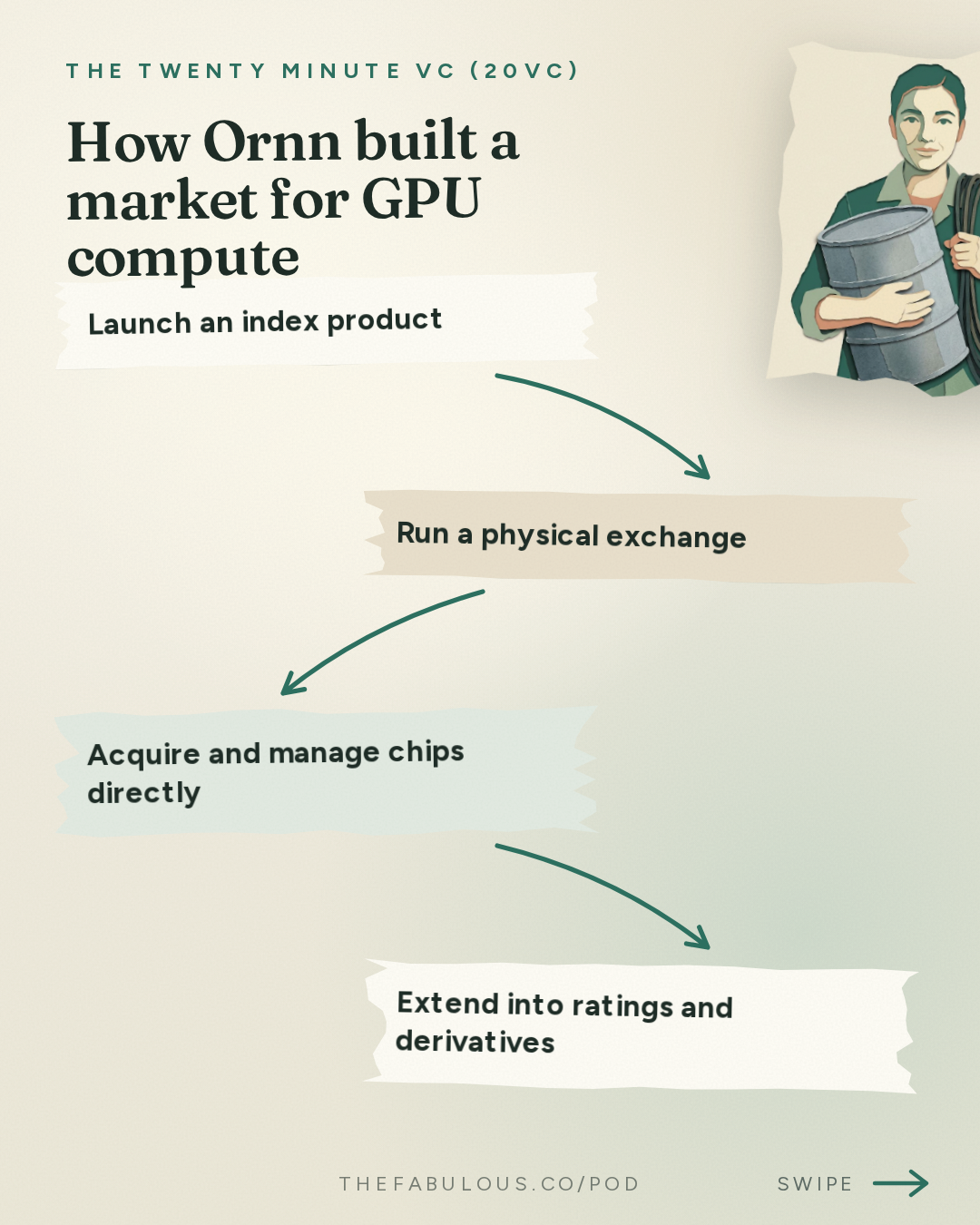
Getting the data to build that index turned out to be the hard part. No neo-cloud will simply hand over its transaction records, Bavaria says, because that pricing data is their most valuable asset (34:56). So Ornn ended up doing something it did not originally plan: buying and controlling chips itself, often through sale-leaseback arrangements where outside investors fund the hardware and Ornn manages and rents it out, an arrangement he compares to Airbnb (34:26). That, in turn, raises a financing question that behaves a lot like a credit question. A lender financing a GPU cluster is really making a bet on the AI company renting it, on whether that startup keeps raising venture money or whether the price of compute itself rises enough to cover the loan (36:22). Standardizing clusters, so that if one tenant defaults another can move straight into the same setup, is one way to make that bet less risky.
"If I have an apartment that all looks the same for every single building, that means it doesn't matter if, like, I lose it. Someone else can just move in." — Kush Bavaria [39:43]
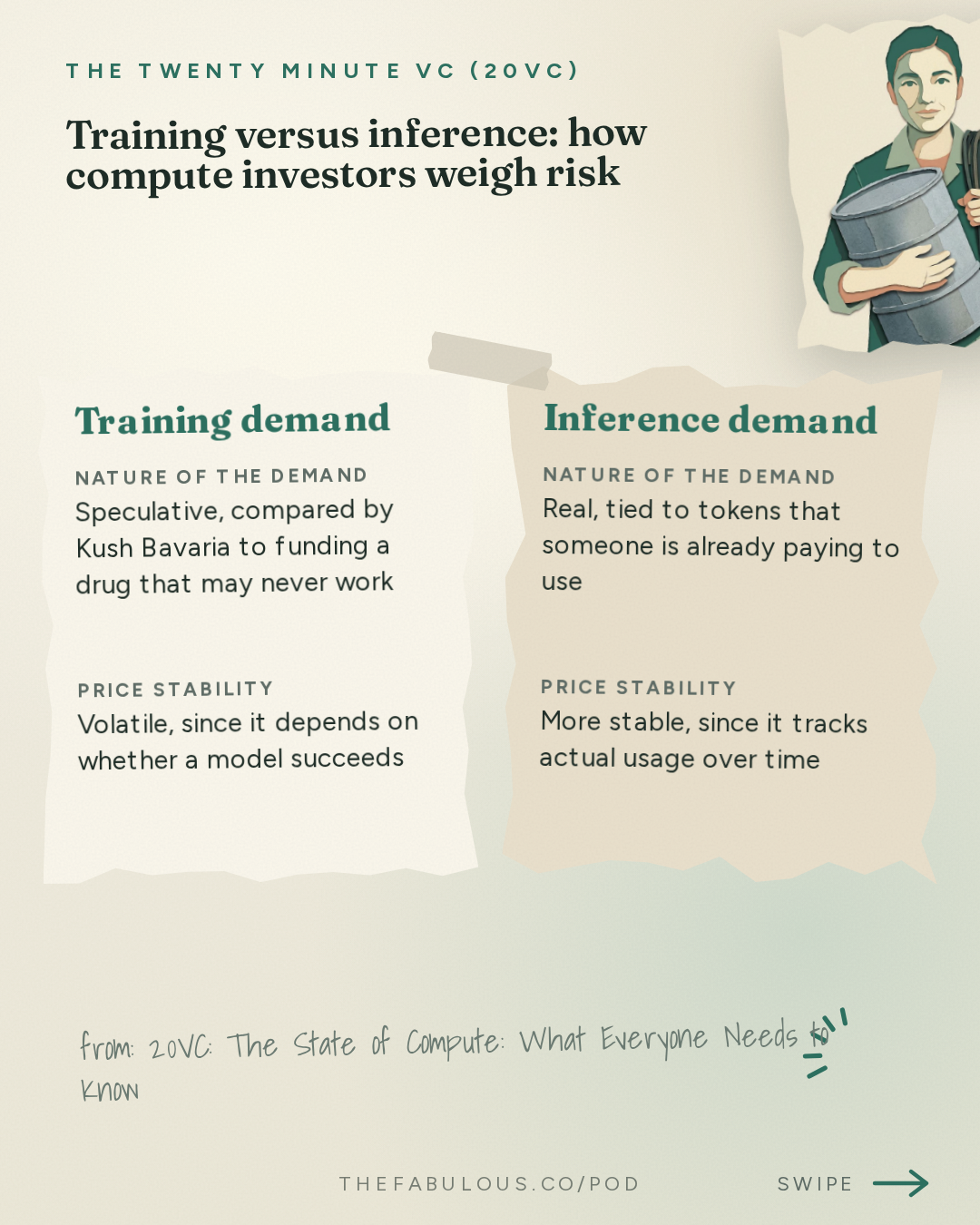
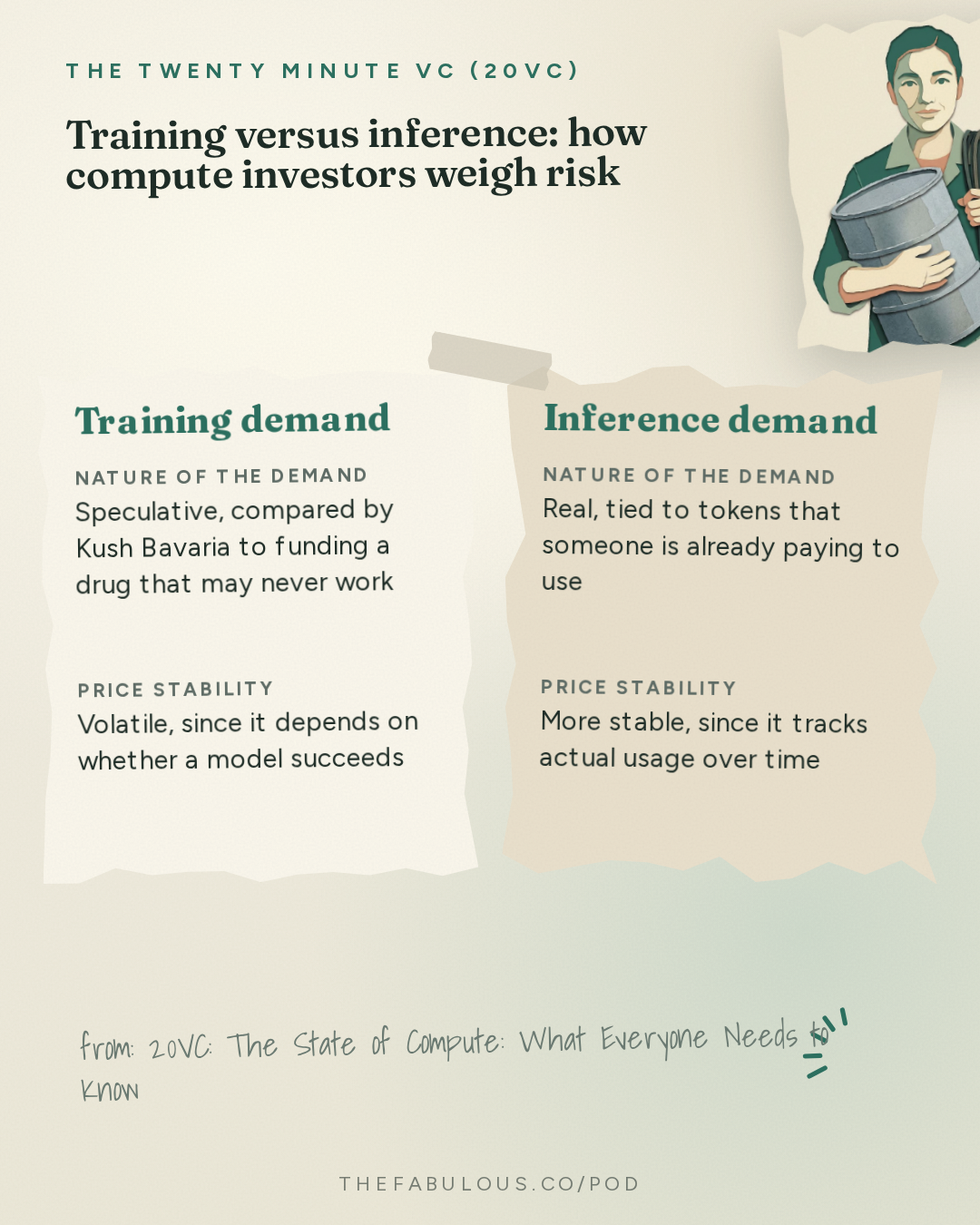
Bavaria draws a sharp line between the two kinds of demand feeding this market. Training new models is speculative, in his telling, closer to drug development than to a normal business expense: a lab spends enormous sums and does not know in advance whether the result will work (42:45). Inference, the ongoing cost of actually serving a model's answers to users, is different, because someone is paying for those tokens right now. That distinction matters for anyone pricing risk in this market, since training demand can evaporate overnight if a model fails, while inference demand tends to track real usage.
Betting on capacity over talent
Pushed on what actually determines which AI labs survive, Bavaria gives a blunt answer: compute matters more than talent. Asked directly whether he would choose more compute or better people for his company, he picks compute, reasoning that today's models are close enough to being able to improve themselves that raw capacity becomes the deciding factor (44:12). He extends that logic to the two best-funded labs in the industry. Given a choice between OpenAI and Anthropic as a long-term bet, he takes OpenAI, on the grounds that it has more compute (65:01). Anthropic's cash reserves, he argues, cannot buy its way around the actual constraint, which is how many chips the Taiwan Semiconductor Manufacturing Company, or TSMC, can physically fabricate (65:17). Money helps you queue for chips. It does not make the fabrication line move faster.
The same instinct for structural leverage over surface prestige shows up in how Bavaria built his own company. He turned down a larger venture term sheet, worth more on paper, in favor of a boutique investor because, as he puts it, a small firm's success is tied more directly to the founder's success, while a giant multi-stage fund barely notices a single portfolio company that represents a tiny fraction of its total capital (53:01). He picked Thrive Capital's Miles Grimshaw for a similar reason: in their first meeting, Grimshaw spent most of the time asking about Bavaria and his co-founders as people rather than about the business plan (50:24). It is a theme that recurs through the conversation, a preference for depth of relationship over brand name, which Bavaria also applies to his own life: he and a co-founder live in a six-floor walk-up apartment in New York with no elevator, not out of necessity but, in his words, to stay hungry (57:44).
That hunger has a cost, and Bavaria is unusually candid about it. He describes the emotional swing of startup life as something nobody warns founders about properly: feeling like the best company in the world one hour and certain of failure the next, sometimes on the same day (55:29). He says he wishes he had a therapist and does not, and half-jokes that he has postponed dating until the company returns investor capital (56:22, 56:45). It is a smaller, more human companion claim to the macro argument running underneath the whole episode: that building the plumbing for a trillion-dollar market is, underneath the spreadsheets, still a story about which people a founder chooses to trust, and how long he can keep absorbing the volatility of not knowing what happens next.
Ask this episode anything
Pod's AI answers from the episode itself, with the minute mark so you can hear it yourself.
Or start with one of these
Ask this episode
Pod's AI listens to the whole episode to answer, and points you to the minute it comes from.
The rest of this answer, and any question after it
Answers come from the episode itself, never from a summary of it.
ContinueKey takeaways
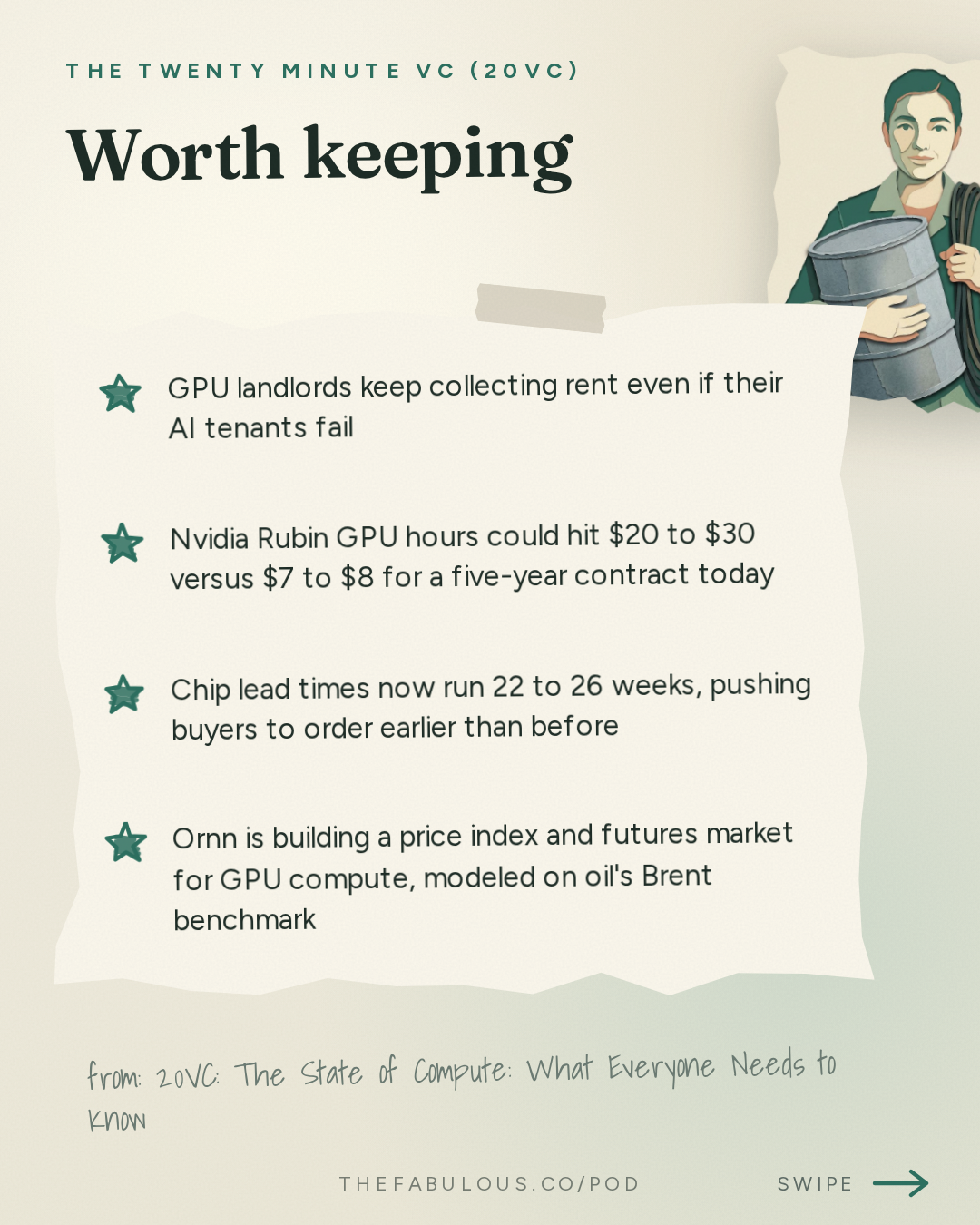
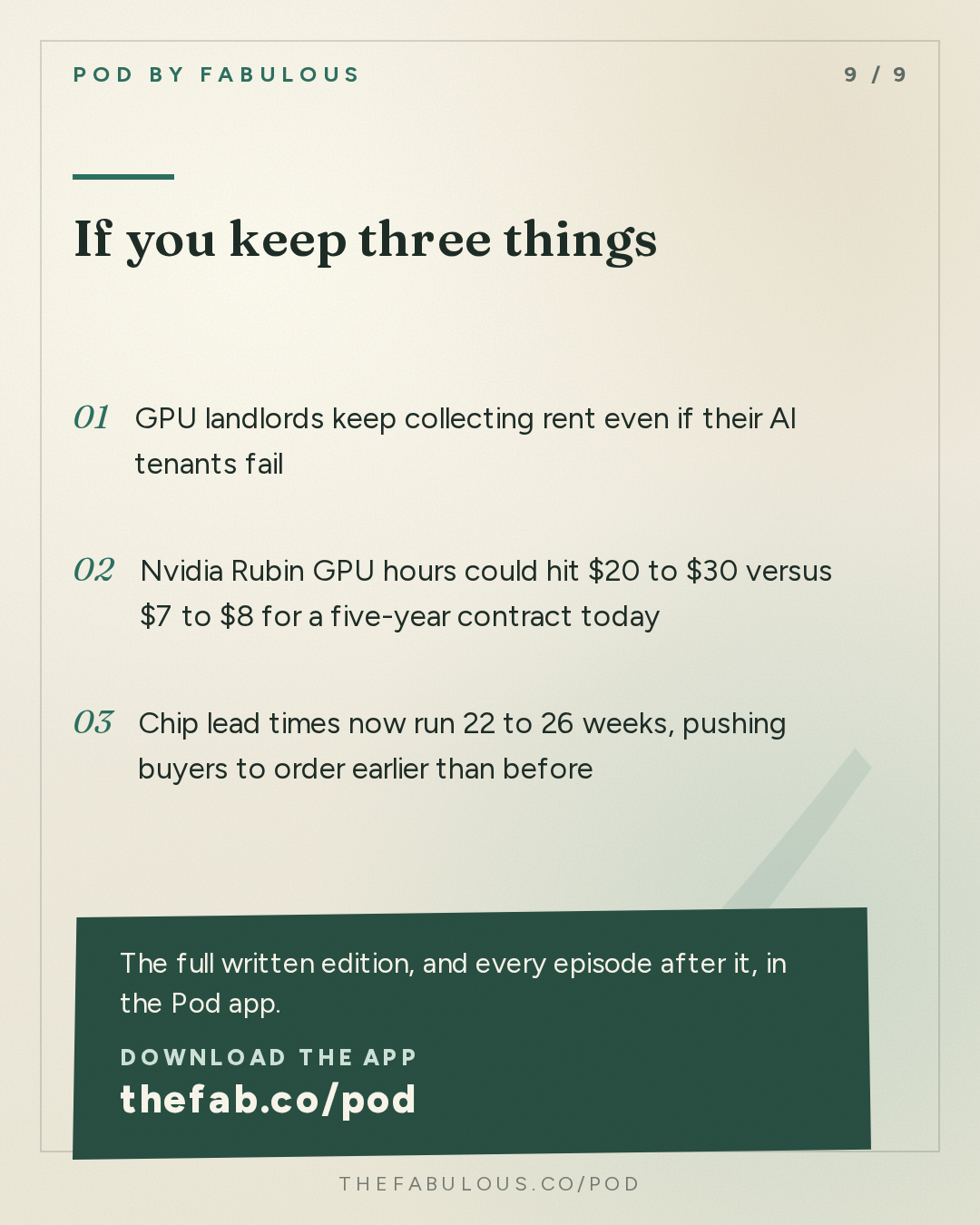
- GPU landlords keep collecting rent even if their AI tenants fail
- Nvidia Rubin GPU hours could hit $20 to $30 versus $7 to $8 for a five-year contract today
- Chip lead times now run 22 to 26 weeks, pushing buyers to order earlier than before
- Ornn is building a price index and futures market for GPU compute, modeled on oil's Brent benchmark
- Inference demand is more stable than training because it tracks real token usage, not speculative bets
The episode in cards
By the numbers
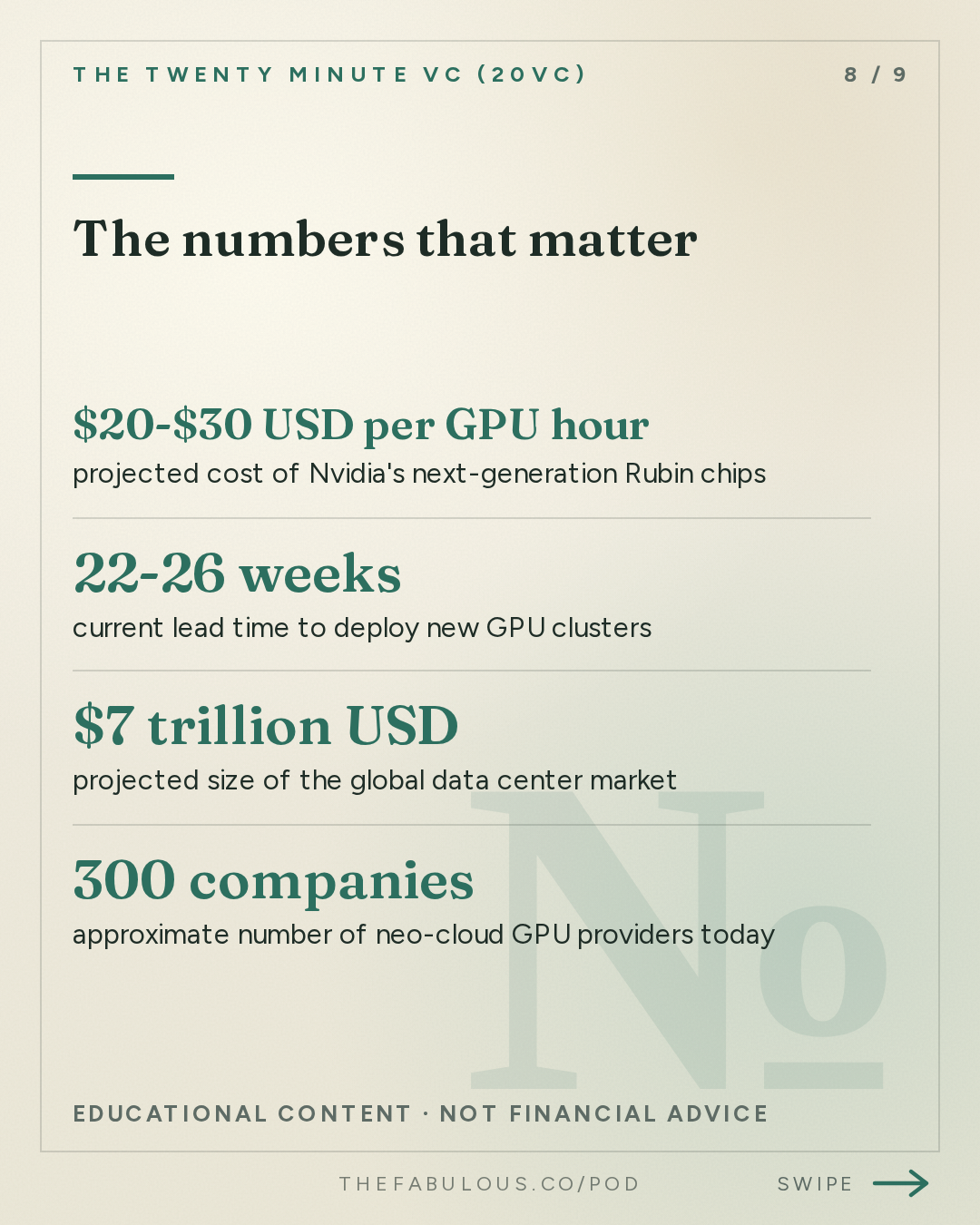
- $20-$30 USD per GPU hour projected cost of Nvidia's next-generation Rubin chips
- 22-26 weeks current lead time to deploy new GPU clusters
- $7 trillion USD projected size of the global data center market
- 300 companies approximate number of neo-cloud GPU providers today
In their words
“I think infrastructure investors actually, like, end up winning because they will always keep collecting rent.”
“If I have an apartment that all looks the same for every single building, that means it doesn't matter if, like, I lose it. Someone else can just move in.”
“Training is much more speculative, right? It is, like, kind of like biotech where you spend all this money developing this drug, and you don't actually know if it works out.”
“Uh, more compute. Wow. I think the, the models are good enough to do, like, RSI, so you just kinda just need compute”
Protocols
-
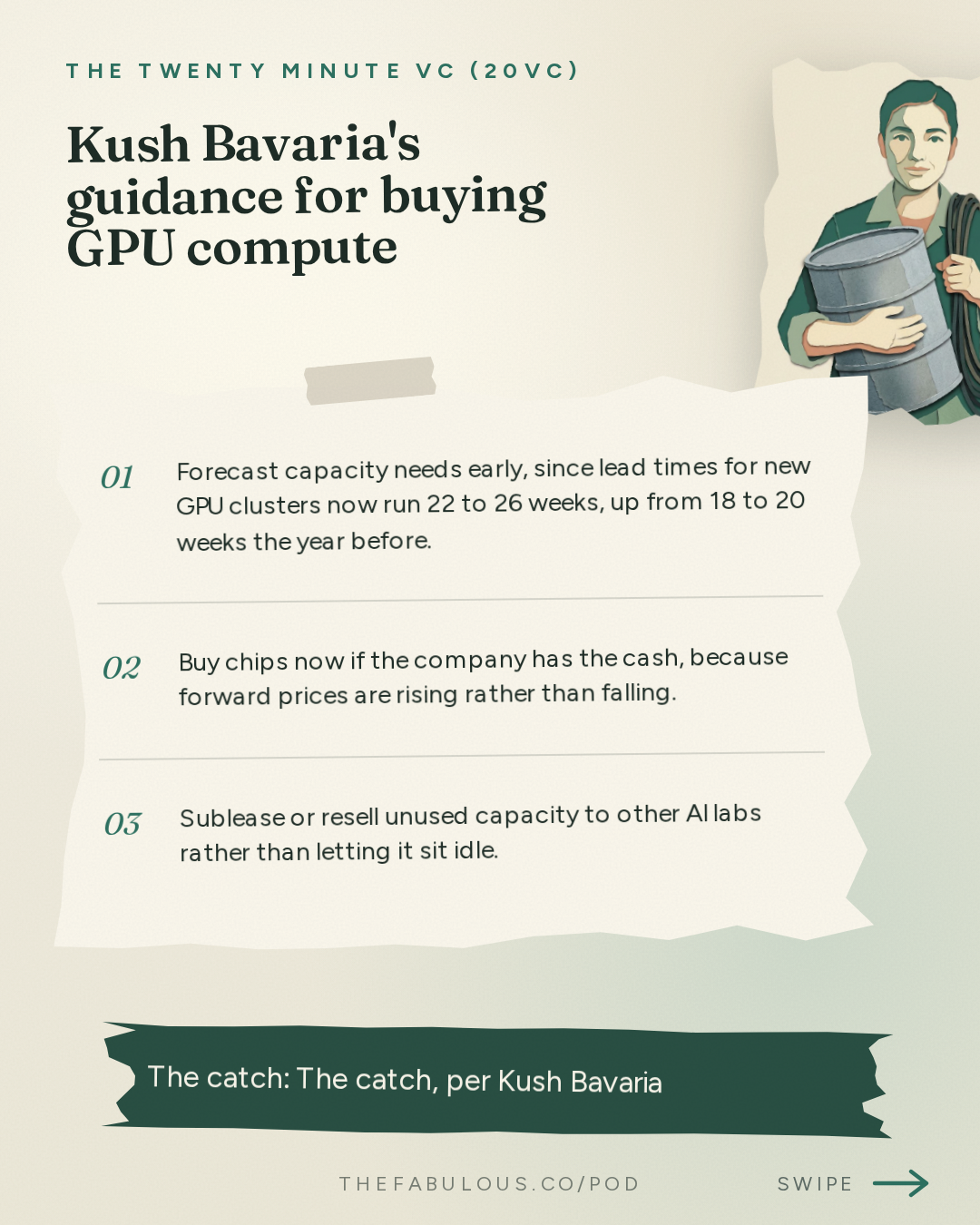
Buy compute early rather than waiting for a better price
Kush Bavaria advises founders with available cash to purchase GPU capacity now instead of waiting, because he believes the forward price curve for chips is rising rather than falling, which means delaying a purchase only raises its eventual cost.
Once per capacity planning cycle, ideally 22 to 26 weeks before the compute is needed
-
Resell idle chips instead of letting them sit unused
Kush Bavaria says founders who over-buy compute can sublease the unused GPU capacity to other AI companies at market rates, following the model he attributes to Elon Musk moving spare chips between SpaceX and other ventures.
Whenever purchased capacity is not fully utilized
Questions this episode answers
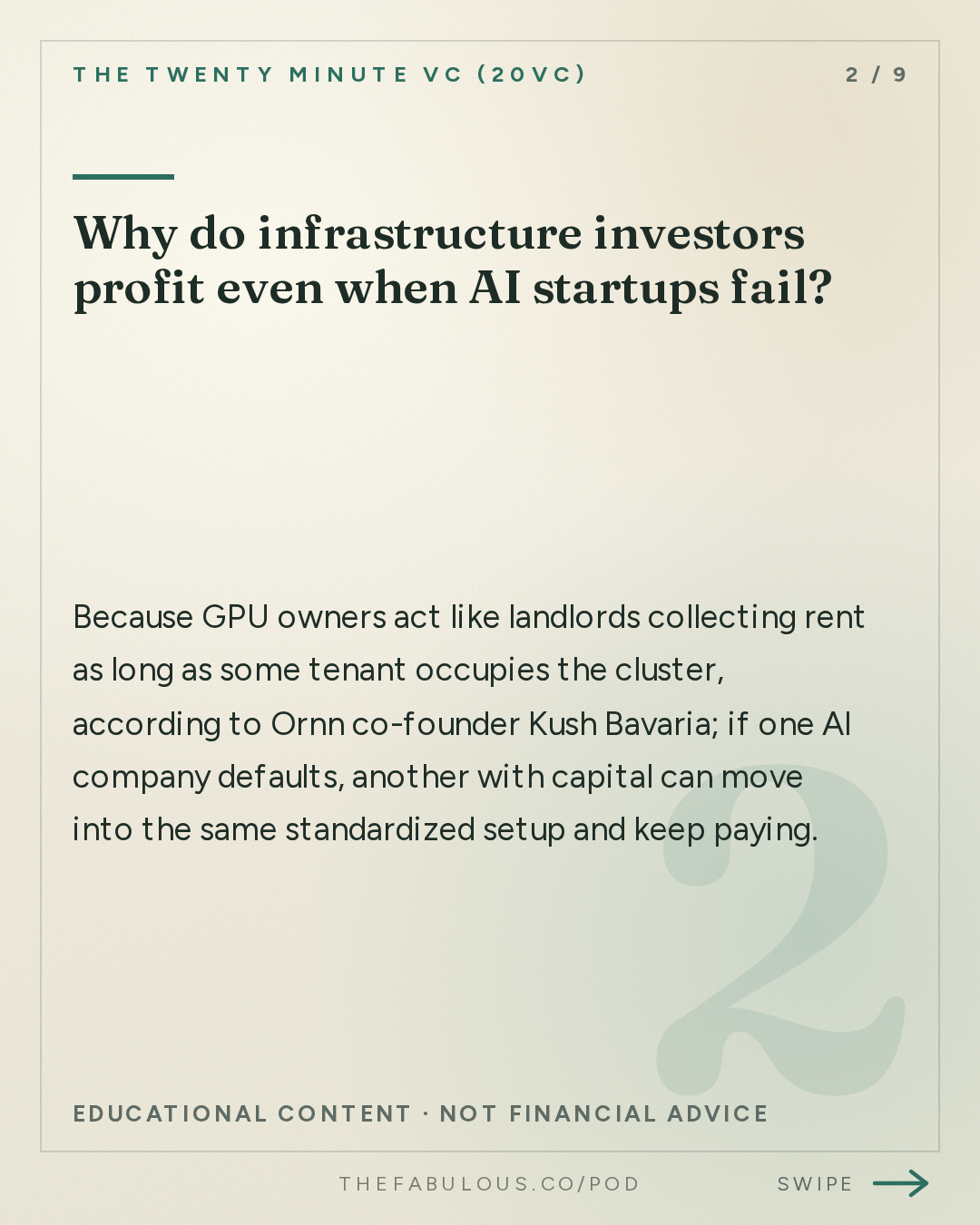
Why do infrastructure investors profit even when AI startups fail?
Because GPU owners act like landlords collecting rent as long as some tenant occupies the cluster, according to Ornn co-founder Kush Bavaria; if one AI company defaults, another with capital can move into the same standardized setup and keep paying (09:55, 39:23).
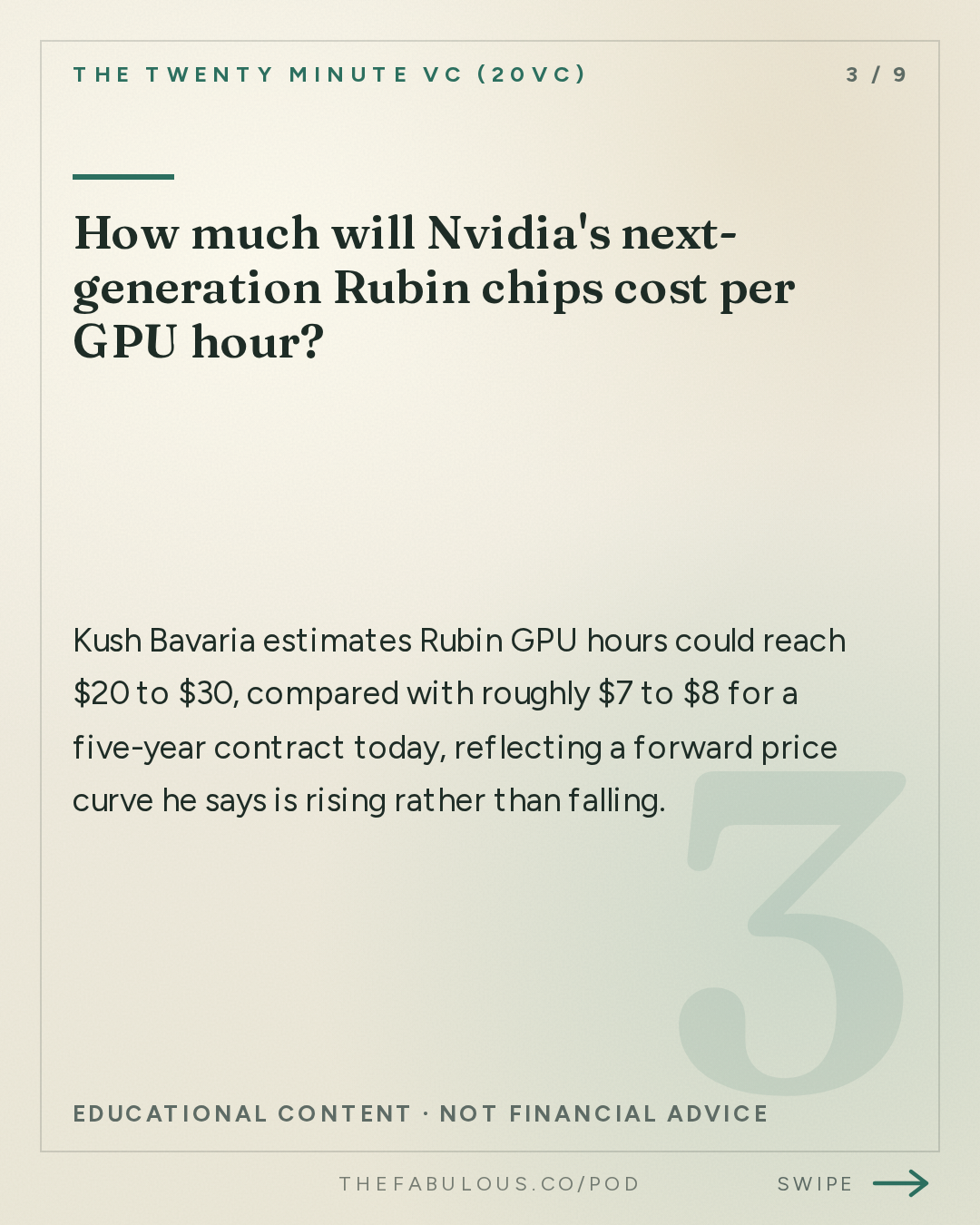
How much will Nvidia's next-generation Rubin chips cost per GPU hour?
Kush Bavaria estimates Rubin GPU hours could reach $20 to $30, compared with roughly $7 to $8 for a five-year contract today (13:48), reflecting a forward price curve he says is rising rather than falling (13:25).
Why are GPU lead times so long right now?
Current wait times for new chip deployments run 22 to 26 weeks, up from 18 to 20 weeks the prior year, and some orders through providers like CoreWeave are reportedly quoted as far out as the end of 2027 (11:15, 16:54).
Will the AI inference market consolidate into a few large providers?
Kush Bavaria argues the opposite: he expects inference to fragment into specialized categories such as fast, slow, and biological inference, with roughly 100 niche providers surviving alongside one dominant horizontal player (21:57).
Is OpenAI or Anthropic the better long-term bet based on compute access?
Kush Bavaria says he would choose OpenAI over Anthropic because OpenAI has more compute, arguing that Anthropic's cash reserves cannot buy around the real constraint, which is chip output from TSMC's fabrication lines (65:01, 65:17).
The full read, in cards

Go deeper
- Study on startup name length and success rates — Found that startups with five letters or fewer in their name are five times more likely to succeed, which Kush Bavaria cited when naming his company Ornn
- Consulting-firm studies on enterprise AI adoption — Found that most large enterprises have not yet seen measurable business impact from implementing AI tools, according to Kush Bavaria, a former BCG consultant
Mentioned
Kush Bavaria · Ornn · CoreWeave · Nebius · Miles Grimshaw · Thrive Capital · Travis Kalanick · Jensen Huang · Factory · Cognition · Andreessen Horowitz · Bryan Johnson · TSMC · Moody's · S&P Global · ICE · Elon Musk
More from this show and category

Anthropic's IPO and the New Venture Math
Anthropic's IPO priced near $1.4 trillion and was seven times oversubscribed, a deal two venture investors call the best venture return ever (00:21). The same episode covers Jensen Huang's uncertain return to NVIDIA, a net-new-customer slowdown at HubSpot and Monday.com, and why SpaceX's value now rests on compute, not rockets.

Why Data Beats Compute in AI, With Diogo Almeida
TypeSafe founder Diogo Almeida says AI's biggest bottleneck is reliability, not raw intelligence. Models are right most of the time and badly wrong the rest, so benchmarks mislead and data, not compute, now decides who can actually automate real work rather than just assist with it.

Fractile's Walter Goodwin on AI's Memory Wall
Fractile CEO Walter Goodwin says AI chips are limited by memory bandwidth, not math power, and his startup stacks memory on top of logic to fix it. Fractile raised a $720 million Series C at a $7 billion valuation (00:23), betting that inference, not training, is where chip value will accrue.

Anthropic's $1.4 Trillion IPO Strategy Explained
Sequoia shut its London office and ended its Evergreen fund the week NASDAQ lost $2.5 trillion and Anthropic set a $1.4 trillion IPO target. NVIDIA's Jensen Huang faces a board investigation, OpenAI's revenue grew 70%, and hosts argue agent-based AI is killing seat-priced software like Figma.
