
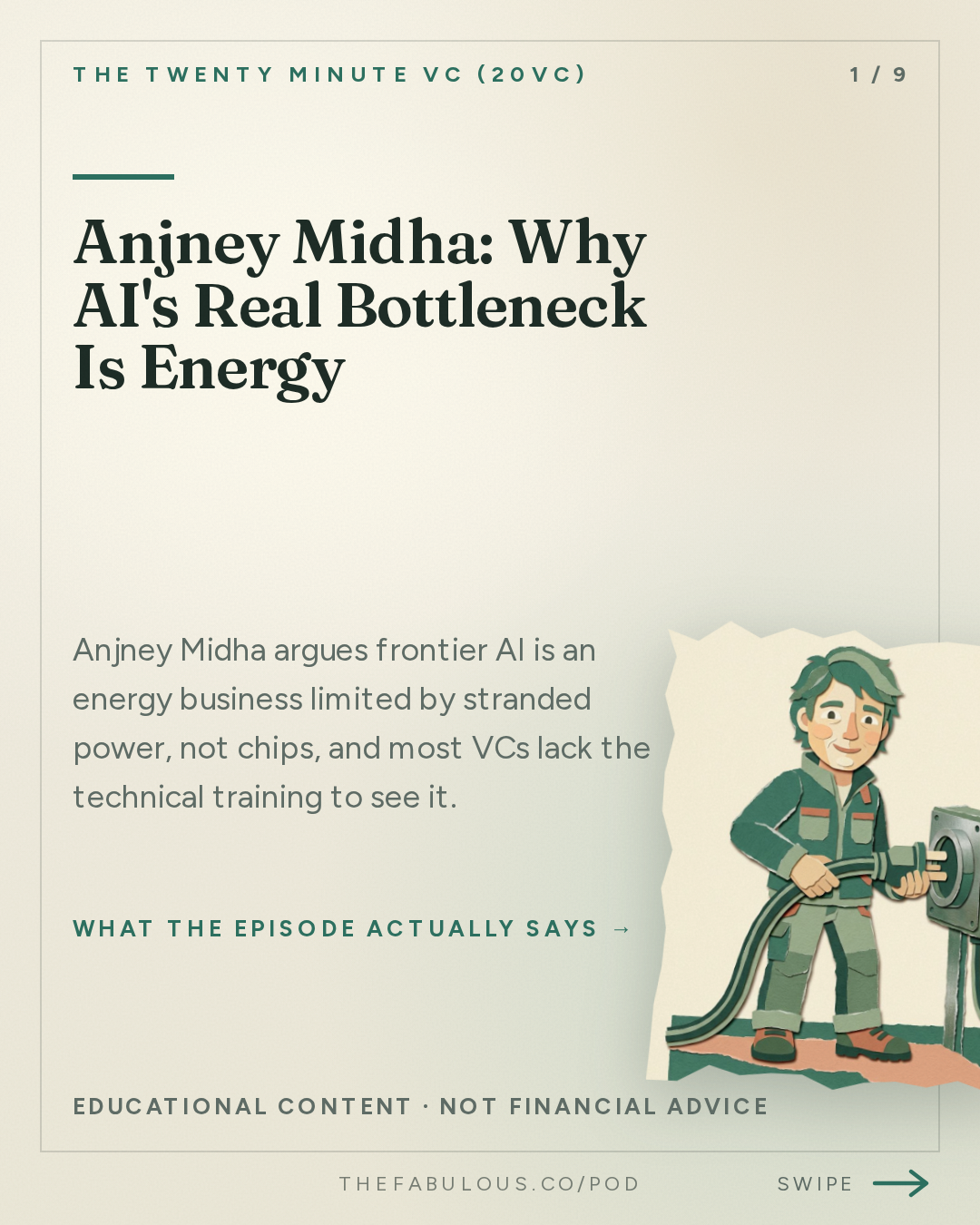
Anjney Midha: Why AI's Real Bottleneck Is Energy
20VC: Nvidia Without Jensen: Is Anthropic the Real Winner? | "Fire the Bankers": Why Most VCs Won't Survive AI | Why the Inference Layer is Uninvestable and Tranched Rounds Should Be Banned with Anjney Midha
The brief
Anjney Midha argues frontier AI is an energy business limited by stranded power, not chips, and most VCs lack the technical training to see it. He also says tranched funding rounds are often used to market unproven startups to limited partners rather than track milestones, and that inference will be absorbed in-house by AI research teams.
A venture capital firm named itself after a unit of electrical current. Amp, founded by investor Anjney Midha, picked that name on purpose. As he explains on this episode of The Twenty Minute VC, the thesis behind it is simple: strip away the chatbots and the chip shortages, and what is left of the AI industry is an energy trade. Companies buy megawatts and turn them into tokens, a unit of intelligence, which then gets sold back into the economy. "It's buying megawatts and then finding a way to turn that into tokens," Midha says of frontier AI labs (06:09).
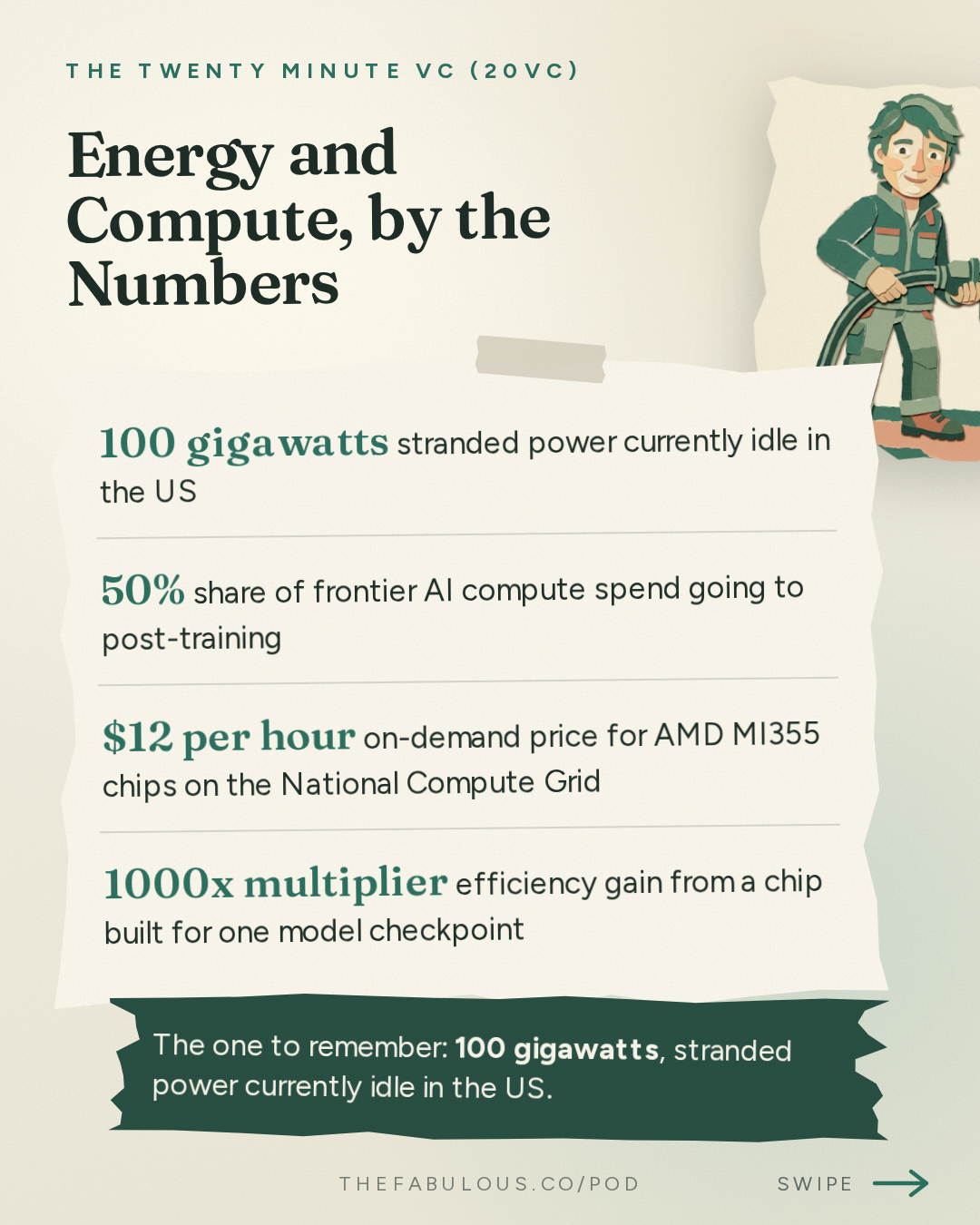
That framing turns into a number quickly. China plans to add more than 500 gigawatts of industrial energy capacity for AI over the next five years (09:29). The United States, by contrast, has more than 100 gigawatts of power sitting idle, what Midha calls "stranded power" (12:16): old factories, decommissioned military land, and generation that was never wired into a grid built for AI-scale compute. His explanation for the gap is less about technology than about muscle memory.
"The West is really great at invention, but we are not good anymore at infrastructure scaling by default. We forgot that skill." (09:12) — Anjney Midha
The last time America coordinated energy production at national scale, he argues, was during the two World Wars. China has kept that coordination muscle, and is willing to trade civil liberties for industrial capacity in a way the West will not match. One possible way out is a room-temperature superconductor, a material that would carry electricity with no energy loss at normal temperatures, which would effectively remove the energy bottleneck on AI progress. Amp's first investment after launching was Periodic Labs, a company chasing exactly that. Midha says its AI-driven research loop has already turned up 13 new materials, one now used in ballistic heat shields (07:43), and that his father-in-law, a physicist who has spent his career on the problem, calls the pace of discovery "unprecedented" (07:59).
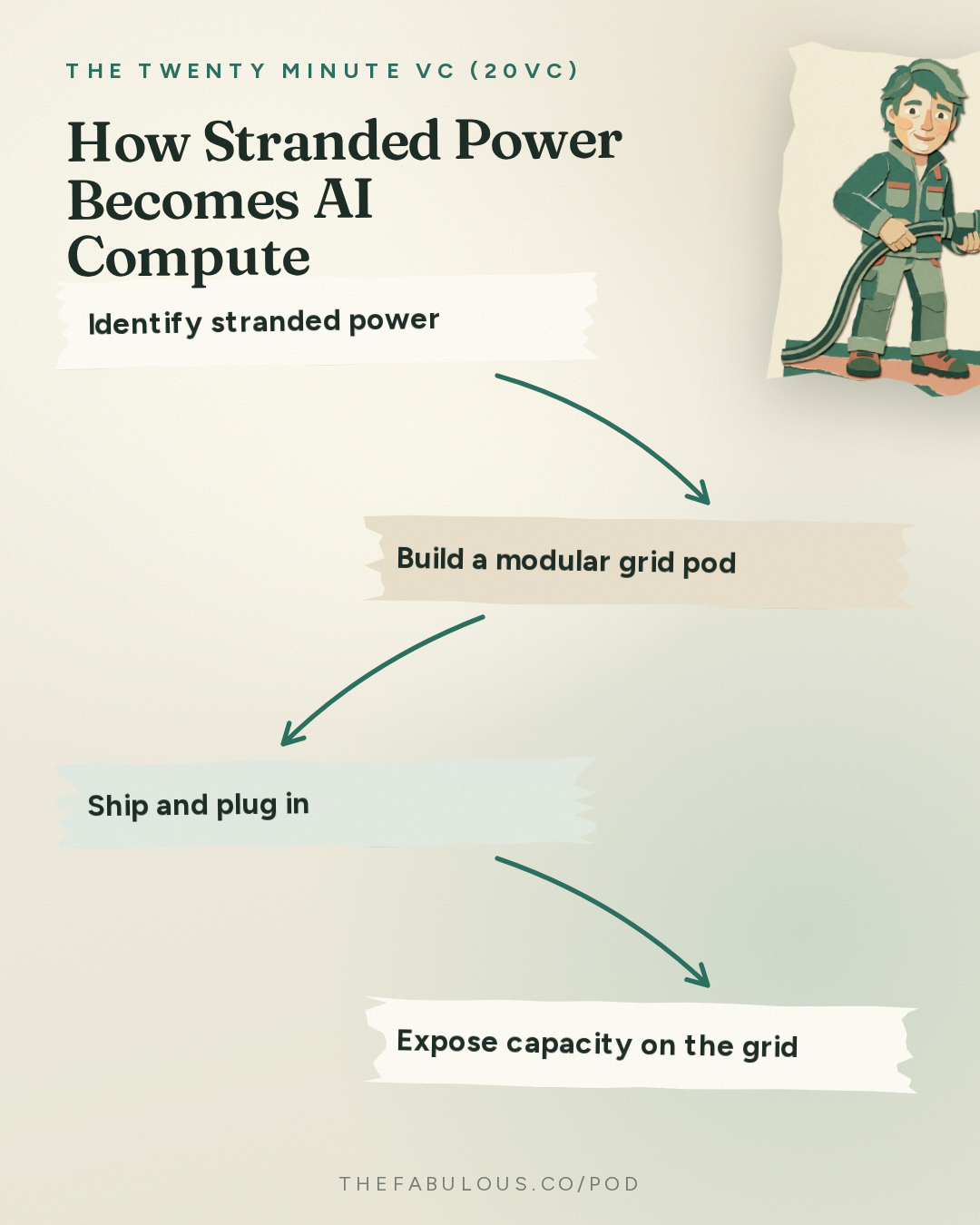
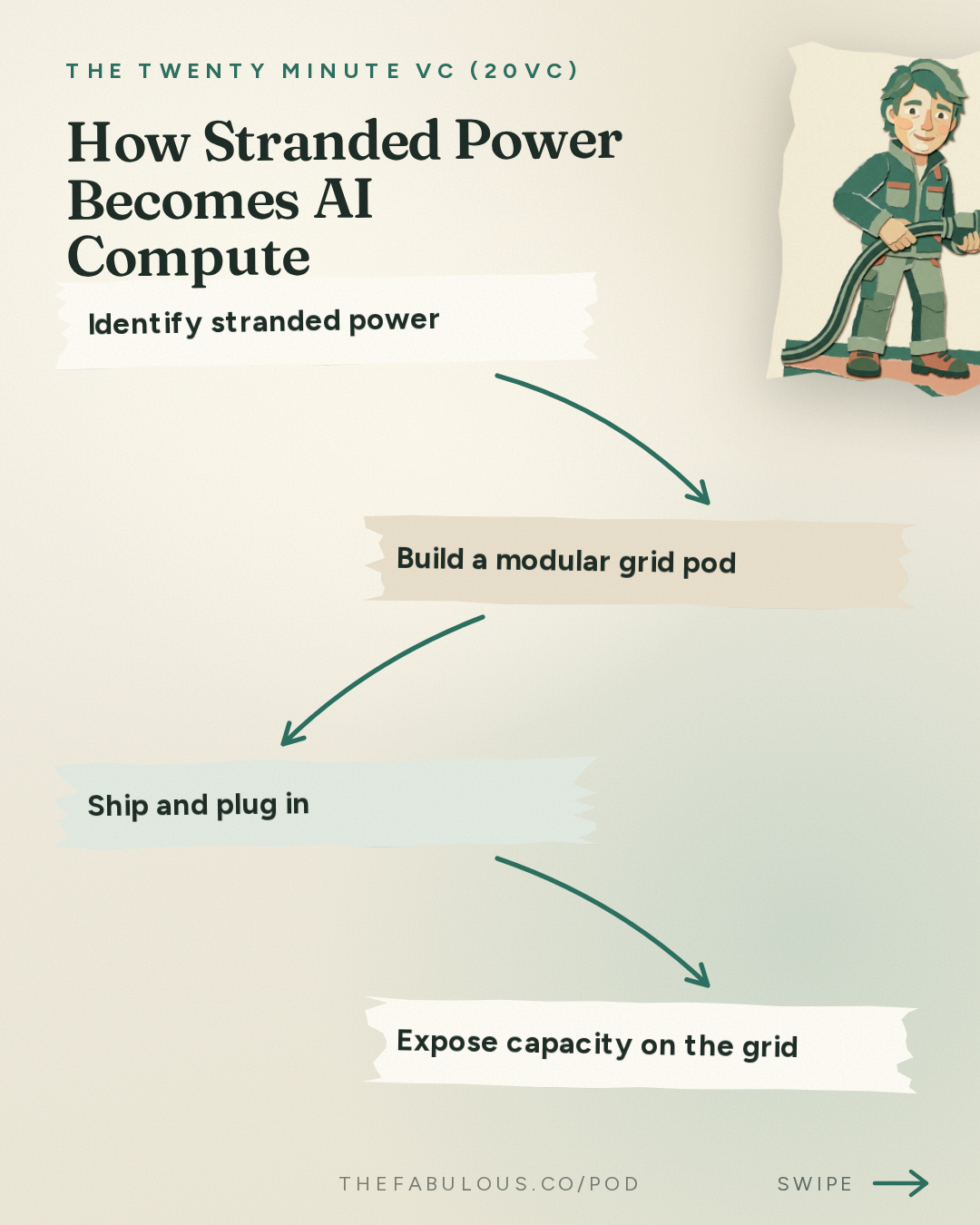
A breakthrough on an unpredictable timeline is not a plan, though, so Amp built a company called National Compute to work the problem in the meantime. It buys stranded land and power and connects it to what Midha calls the National Compute Grid. The basic unit is a "grid pod," a prefabricated block of chips sized at 5 to 10 megawatts that can be shipped straight to a stranded power site and plugged in, no new construction required (13:24). Midha says this also lowers electricity costs for the surrounding community, because utility regulation charges ratepayers a flat amount whether power is used or not (13:46); the pods soak up capacity that residents were already paying for.
Part of why this works, he says, is that a growing share of frontier AI work does not need a single giant, tightly interconnected cluster. Reinforcement learning, where an AI agent attempts a task, gets scored, and feeds that feedback back into training, can be spread across many smaller, disconnected sites. Midha puts post-training at roughly 50 percent of compute spend across Amp's portfolio companies now (12:56), which is why decentralized, stranded power can matter at the frontier rather than just at the margins. Pricing on the grid looks backward at first glance: on-demand access to AMD's MI355 chips clears at $12 an hour, compared with $3 to $4 an hour for a five-year lease (14:48). Midha argues that is the wrong comparison, because what matters is cost per completed job rather than cost per hour, a metric Google reportedly used internally to take GPU utilization from about 60 percent to 99 percent over five years (16:32).
Fire the Bankers
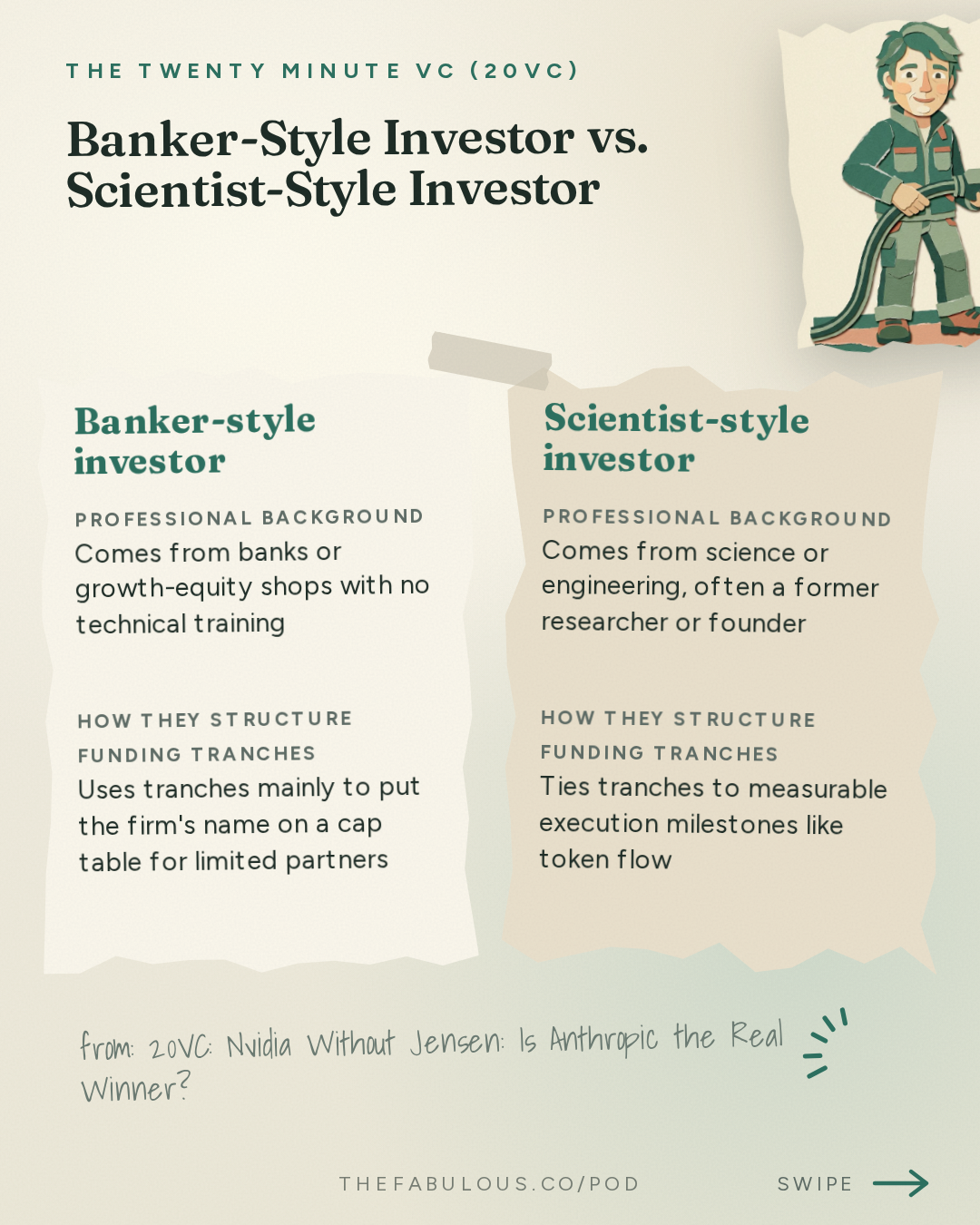
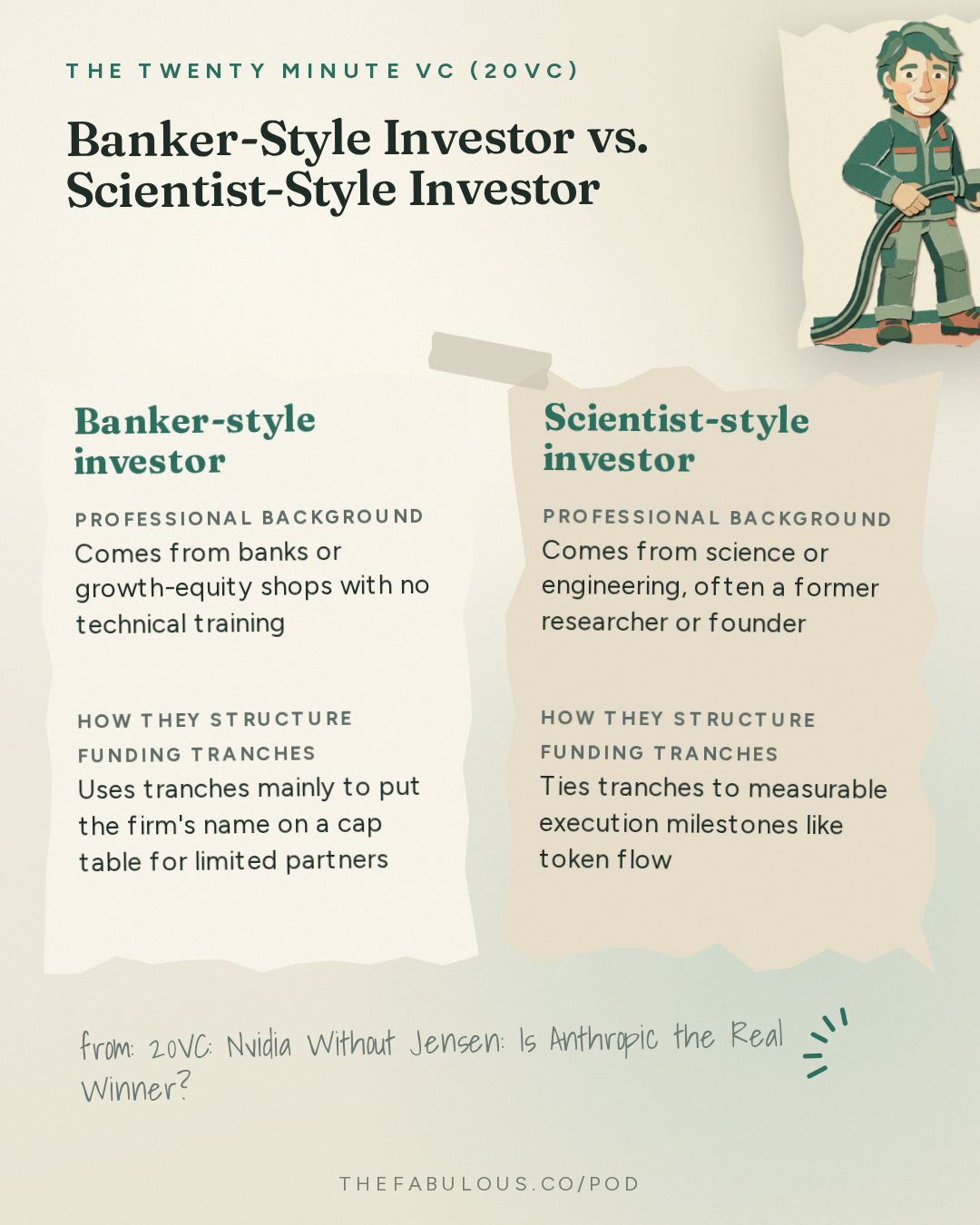
If the energy argument is about physical constraints, the second half of the conversation is about financial ones. Midha's claim is blunt: a large share of people calling themselves venture capitalists are, in his words, "glorified bankers with spreadsheets" (21:27), who moved from Wall Street or growth equity into venture during the last boom and now sit on marks from 2021 and 2022 that do not reflect reality. He thinks limited partners, the institutions that fund venture firms, are starting to rotate out of funds that cannot defend those valuations.
"Fire the bankers. Bring in the scientists. It is time for revenge of the scientists and intellectual honesty." (27:33) — Anjney Midha
Tranched funding rounds, where a startup raises money in stages tied to milestones, get a qualified defense rather than a blanket dismissal. Midha says tranching works when it tracks real progress, the way he structured his investment in OpenRouter, an AI model marketplace that Amp helped fund and that sold to the payments company Stripe for more than $7 billion, with his roughly 20 percent stake in OpenRouter, held through Sixteen Z, returning over $1 billion to Sixteen Z's limited partners in eight months (26:31). It becomes, in his word, "smoke and mirrors" when a brand-name firm uses a tranche mainly to put its name on a cap table and market an unproven company to its own investors for a markup.
The same skepticism toward hype shapes his view of specialized chips, semiconductors built for one specific AI model rather than general-purpose computing. Once a model's architecture is stable, usually a mixture-of-experts design, a chip built just for that checkpoint can run up to 1,000 times more efficiently than general-purpose hardware, Midha says (29:12), which is why National Compute has started ordering custom silicon.
His most pointed claim concerns compute and national security. He says a 24,000-GPU cluster in the United States, large enough for frontier research, was recently pre-sold to one of China's four largest state-linked companies instead of going to American university or lab teams who were willing to pay for it (39:43). He is careful not to blame Nvidia chief executive Jensen Huang personally, calling it instead a "collective action problem" (40:39): cloud providers under-capitalized by American credit markets turned to balance sheets backed by the Chinese state. Amp has joined the insurer Zurich in a multi-billion-dollar effort to buy such clusters back for American research teams.
That same instinct, that renting out a capability means losing control of it, shapes his view of AI inference, the stage where a trained model actually answers a question, as distinct from training, where it learns from data. The common venture bet has been that companies selling inference as a service would become a durable layer of the AI stack. Midha disagrees: "Inference is currently a feature, not a standalone service. That is how the research teams that we interact with see it" (49:41). He says every serious research team Amp backs, including the French AI lab Mistral and the image-generation company Black Forest Labs, starts by buying inference from an outside provider, then partners to reduce risk, and eventually builds the capability in-house, because inference is the feedback loop that tells a team how its model is actually used. Giving that up means giving up the understanding at the center of the business. "To own your intelligence, you cannot outsource your own understanding," he says (52:23), which is also why Amp has avoided data-labeling marketplaces and instead backed Arena, an AI evaluation platform where users compare unreleased models side by side, now generating more than $200 million a year in annualized usage (51:44).
Underneath both arguments, energy as destiny and inference as something to own rather than rent, sits a single worldview: AI has stopped being a contained technical discipline and become infrastructure, the kind of thing institutions build for decades rather than rent for a quarter. Midha, who also teaches at Stanford, mentions a trivia night he attended at a bar in a small Michigan town, where locals answered questions about AI chip companies without missing a beat (45:26), as evidence that the technology has become mainstream culture rather than a specialist's hobby. The implication he leaves mostly unstated is that the industry's current habits, treating valuations like headlines and compute like a subscription, are leftovers from a much smaller era of software that no longer applies.
Ask this episode anything
Pod's AI answers from the episode itself, with the minute mark so you can hear it yourself.
Or start with one of these
Ask this episode
Pod's AI listens to the whole episode to answer, and points you to the minute it comes from.
The rest of this answer, and any question after it
Answers come from the episode itself, never from a summary of it.
ContinueKey takeaways
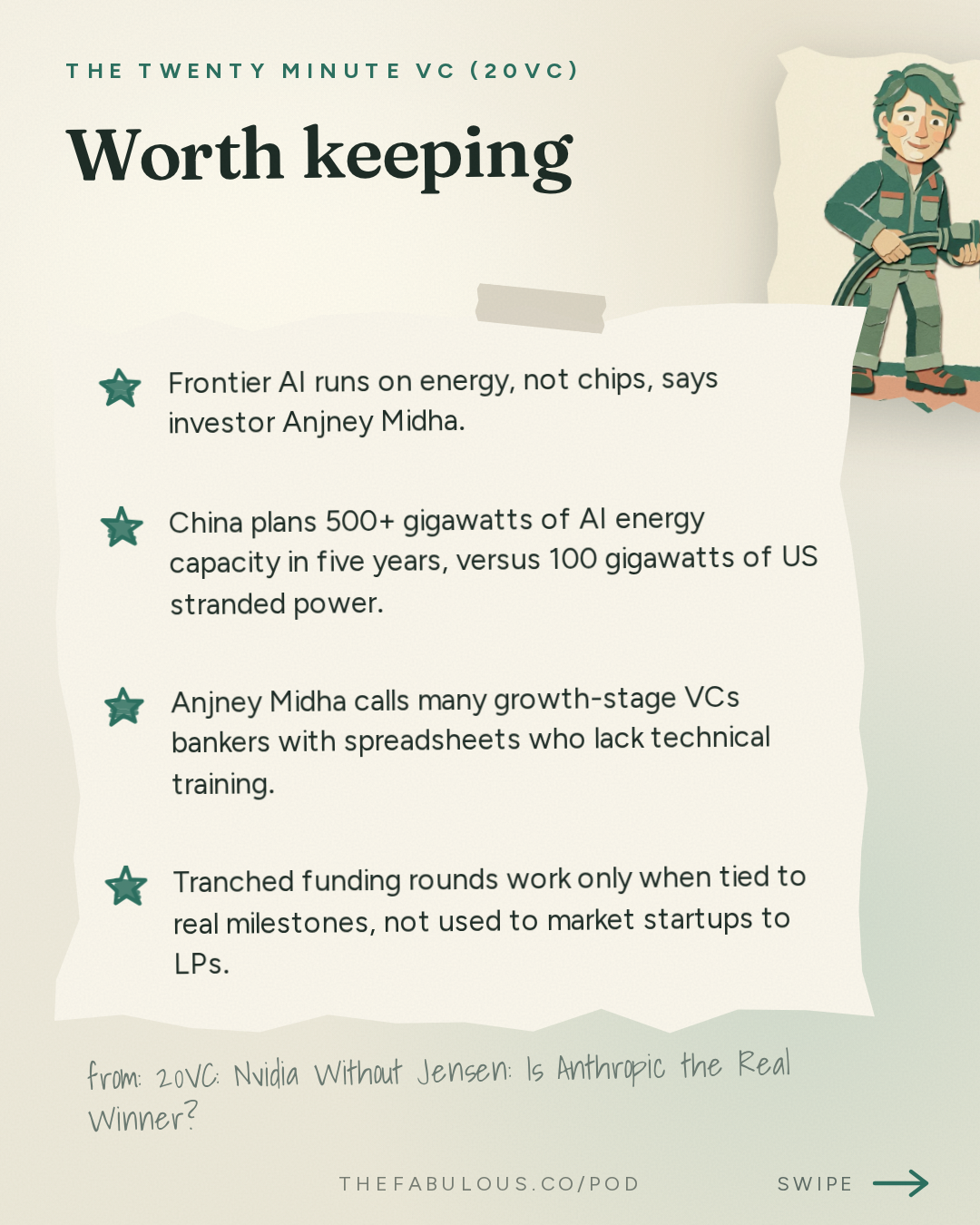
- Frontier AI runs on energy, not chips, says investor Anjney Midha.
- China plans 500+ gigawatts of AI energy capacity in five years, versus 100 gigawatts of US stranded power.
- Anjney Midha calls many growth-stage VCs bankers with spreadsheets who lack technical training.
- Tranched funding rounds work only when tied to real milestones, not used to market startups to LPs.
- Midha says inference is a feature AI research teams will eventually bring in-house, not a standalone business.
The episode in cards

By the numbers
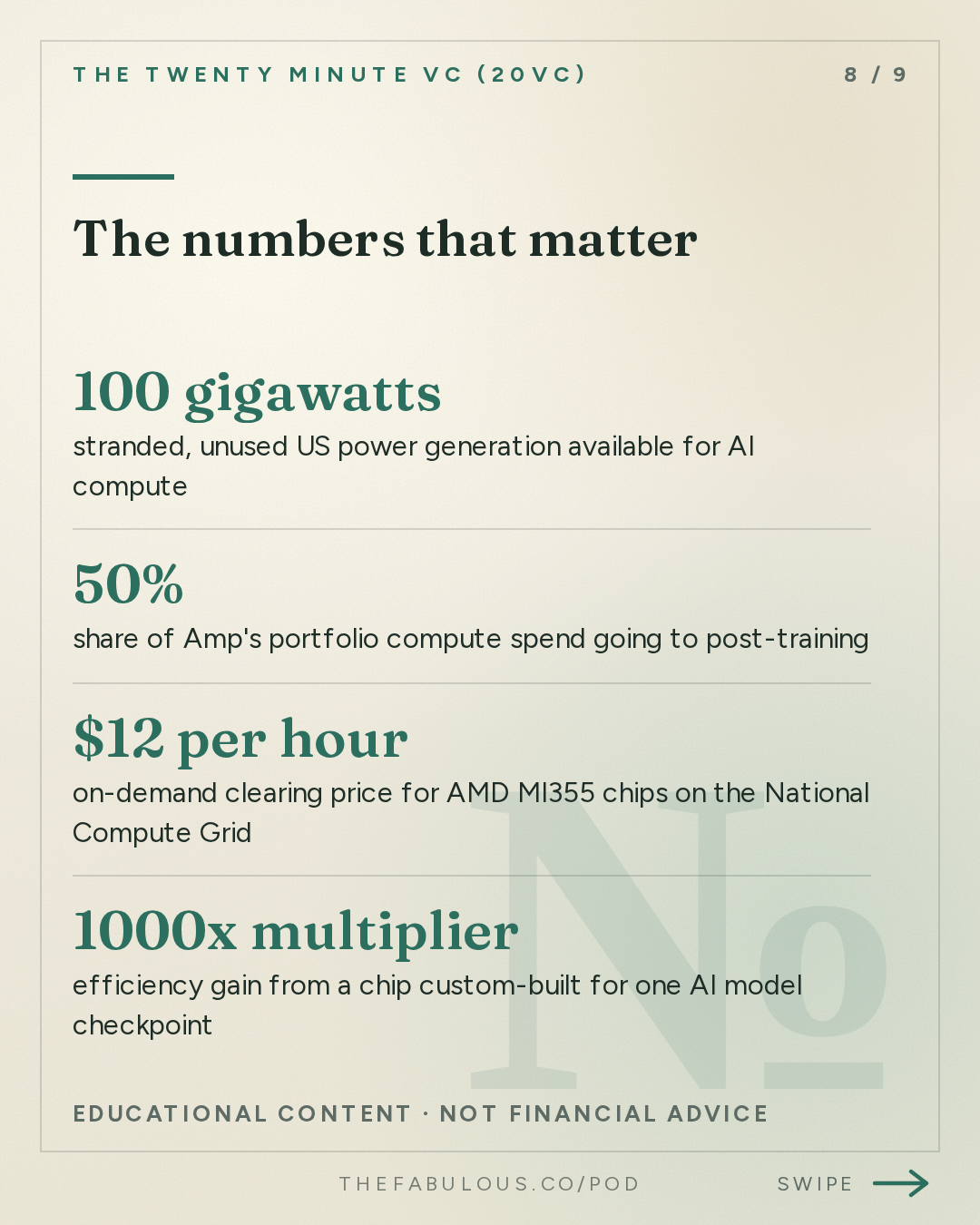
- 100 gigawatts stranded, unused US power generation available for AI compute
- 50% share of Amp's portfolio compute spend going to post-training
- $12 per hour on-demand clearing price for AMD MI355 chips on the National Compute Grid
- 1000x multiplier efficiency gain from a chip custom-built for one AI model checkpoint
- 24,000 GPUs size of a US compute cluster pre-sold to a Chinese state-linked company
In their words
“It's buying megawatts and then finding a way to turn that into tokens.”
“The West is really great at invention, but we are not good anymore at infrastructure scaling by default. We forgot that skill”
“Fire the bankers. Bring in the scientists. It is time for revenge of the scientists and intellectual honesty.”
“Inference is currently a feature, not a standalone service. That is how the research teams that we interact with see it”
“To own your intelligence, you cannot outsource your own understanding.”
Protocols
-
Tie tranche milestones to measurable progress
Anjney Midha structures tranched funding rounds around clear execution milestones, such as token flow on a platform, rather than around a firm's brand name, which he says is how Amp's investment in OpenRouter was tranched before its sale to Stripe.
Applied at each funding stage of a company
-
Ship modular grid pods to stranded power sites
Midha's company National Compute deploys prefabricated 5 to 10 megawatt compute pods directly to stranded power locations, so chips can plug into existing generation without new construction or disrupting the local community.
Per site, as stranded power sites are identified
Questions this episode answers
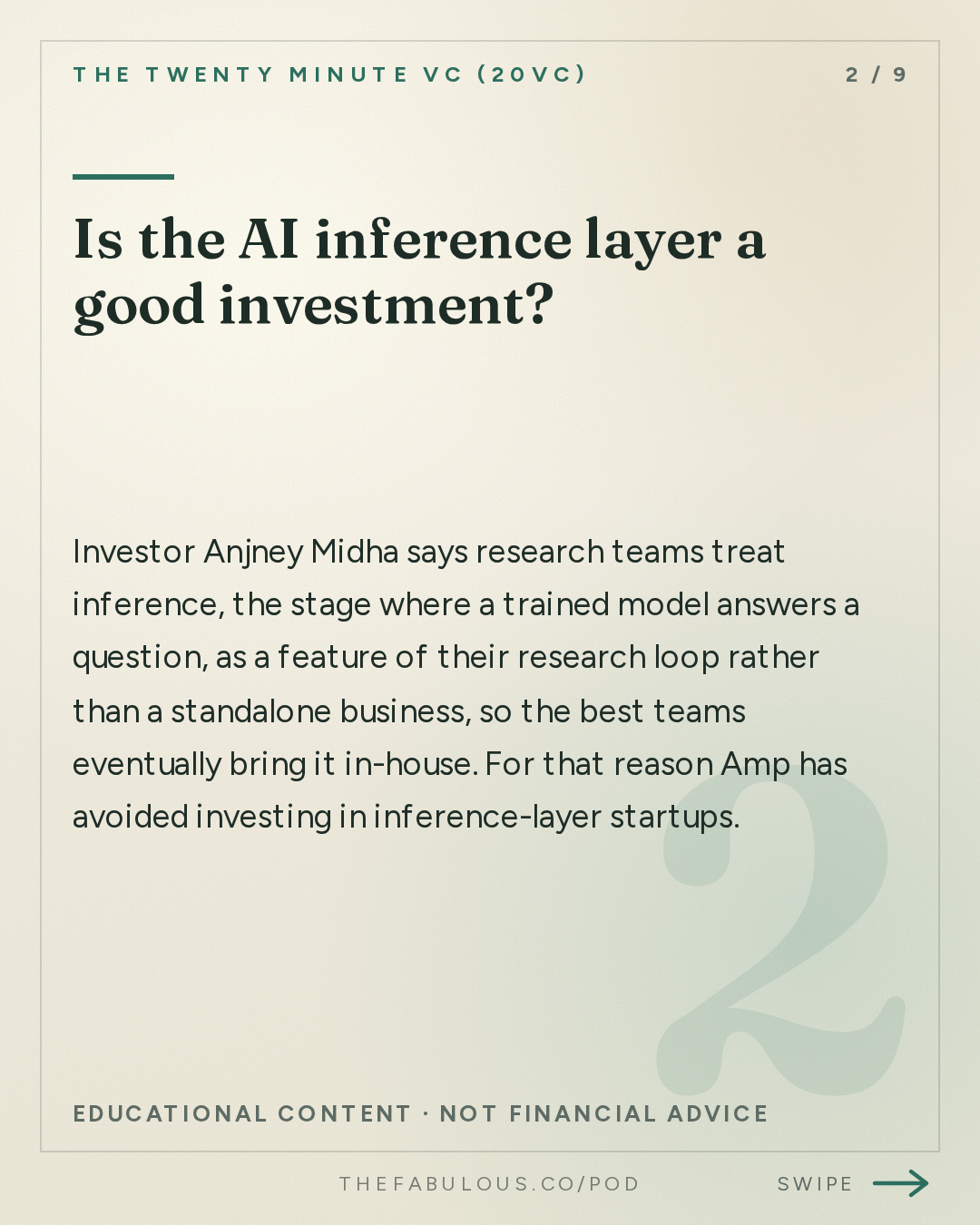
Is the AI inference layer a good investment?
Investor Anjney Midha says research teams treat inference, the stage where a trained model answers a question, as a feature of their research loop rather than a standalone business, so the best teams eventually bring it in-house (49:41). For that reason Amp has avoided investing in inference-layer startups (50:02).
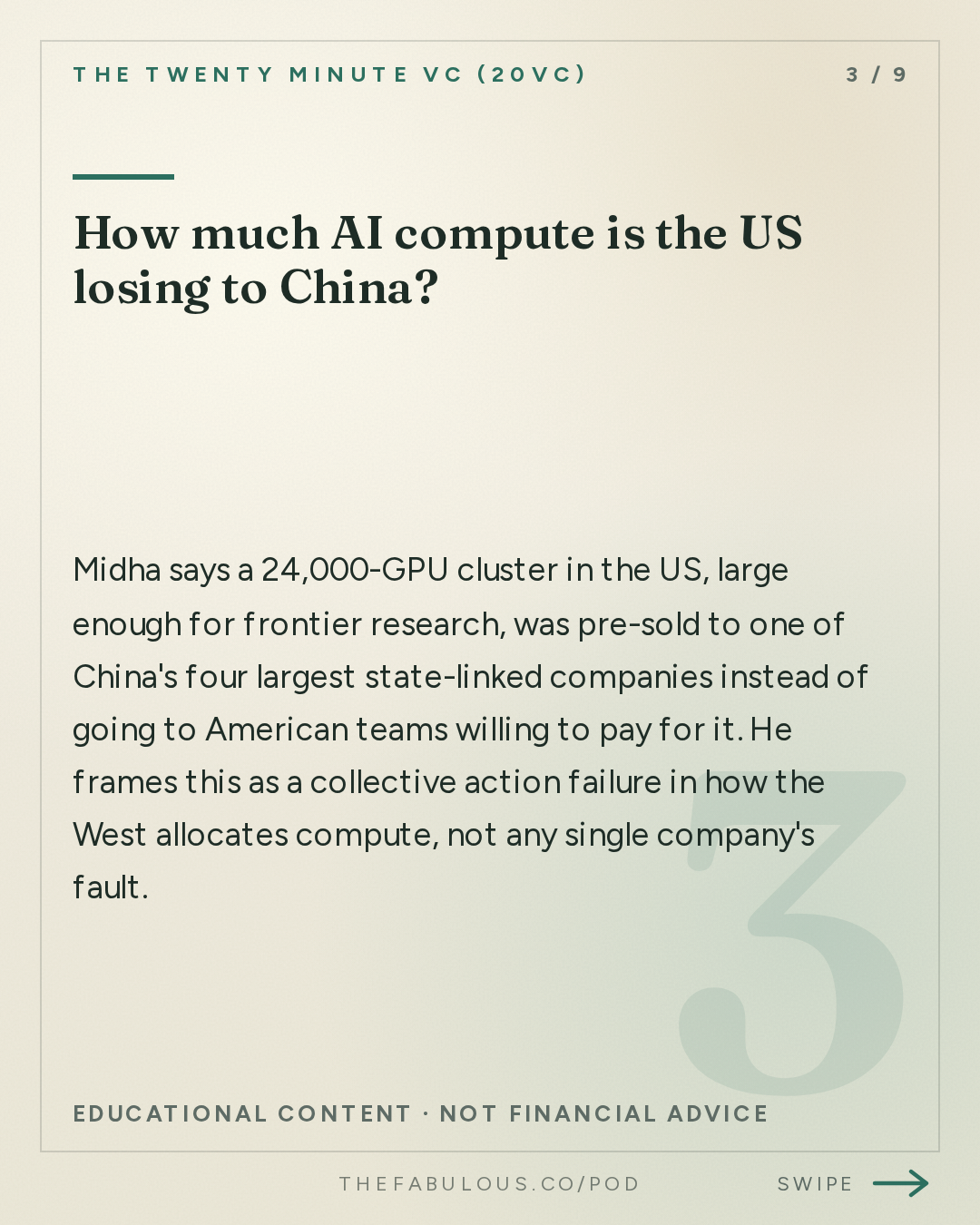
How much AI compute is the US losing to China?
Midha says a 24,000-GPU cluster in the US, large enough for frontier research, was pre-sold to one of China's four largest state-linked companies instead of going to American teams willing to pay for it (39:43). He frames this as a collective action failure in how the West allocates compute, not any single company's fault (40:39).
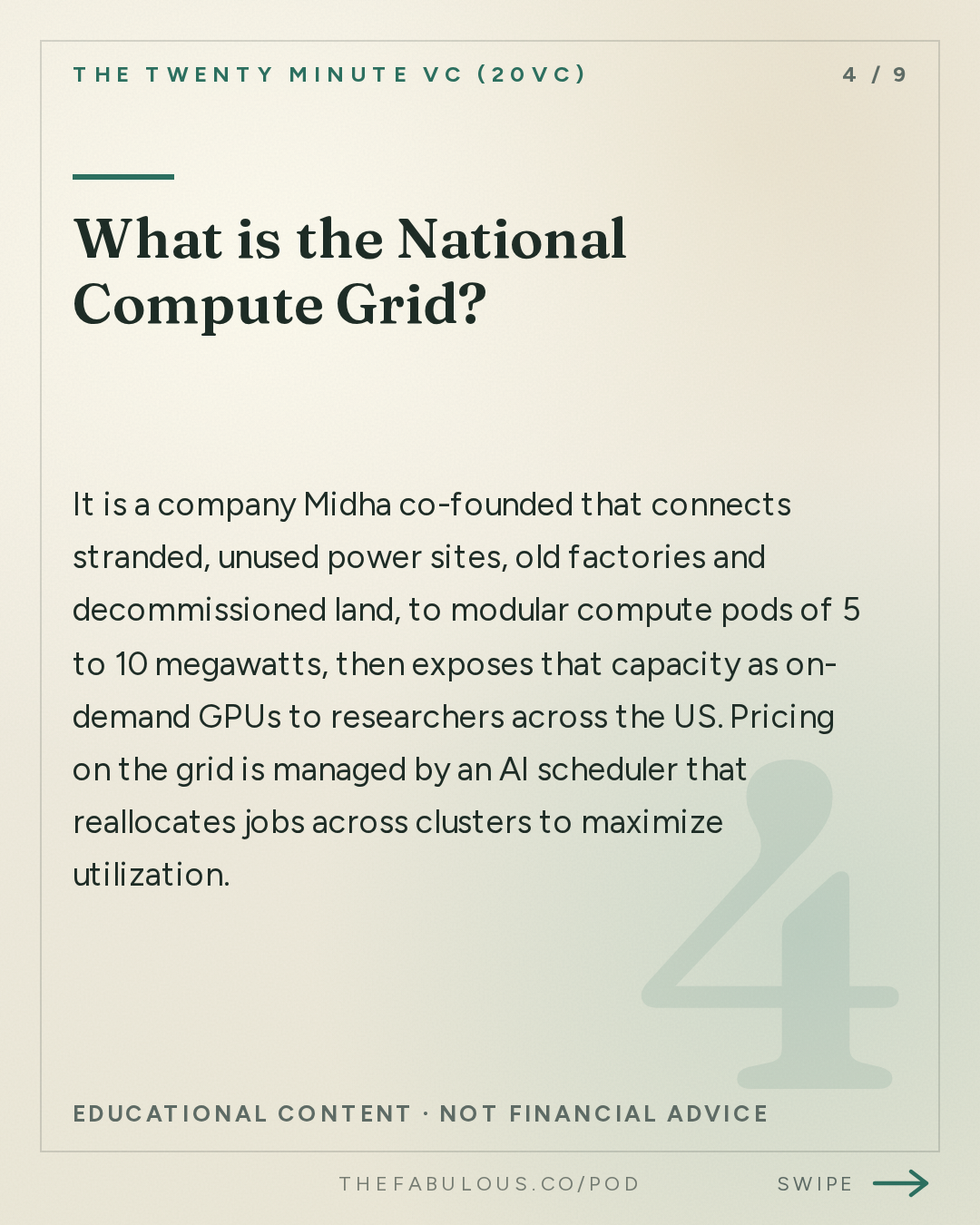
What is the National Compute Grid?
It is a company Midha co-founded that connects stranded, unused power sites, old factories and decommissioned land, to modular compute pods of 5 to 10 megawatts, then exposes that capacity as on-demand GPUs to researchers across the US (12:16, 14:24). Pricing on the grid is managed by an AI scheduler that reallocates jobs across clusters to maximize utilization (16:32).
Why does Anjney Midha call most VCs 'bankers with spreadsheets'?
He says a large share of growth-stage venture investors came from Wall Street or growth-equity shops with no technical or scientific training, and are now defending inflated 2021 and 2022 valuations rather than admitting their marks are not real (21:27, 22:09).
How does AMD MI355 on-demand pricing compare to long-term GPU leases?
Midha says on-demand access to AMD's MI355 chips on the National Compute Grid clears at $12 an hour, versus $3 to $4 an hour for a five-year lease (14:48), but argues the real comparison should be cost per completed job rather than cost per hour of rented time.
Should tranched venture funding rounds be banned?
Midha does not call for a ban outright; he says tranches are fine when tied to measurable milestones, as with Amp's investment in OpenRouter (26:12), but become 'smoke and mirrors' when used mainly to market an unproven startup to a firm's own limited partners (26:49).
The full read, in cards
Go deeper
- Anthropic S-1 filing — Midha points to it as evidence frontier AI's economics are essentially buying megawatts and converting them into tokens
- Google's internal Borg scheduling system — cited as the model for raising GPU fleet utilization from about 60% to 99% over five years
Mentioned
Anjney Midha · Anthropic · Amp · Periodic Labs · National Compute · Mavria · AMD MI355 · Satya Nadella · Mistral · Black Forest Labs · Jensen Huang · Colette Kress · OpenRouter · Arena · Lisa Su · Zurich · John Doerr
More from this show and category

Kush Bavaria on GPU Pricing and Compute Markets
Kush Bavaria, co-founder of compute-market startup Ornn, argues GPU owners collect rent even when their AI tenants fail, and that chip prices are rising rather than falling. He details building a price index and futures market for compute, modeled on oil's Brent benchmark, while betting on OpenAI over Anthropic because compute, not cash, is the real bottleneck.

Anthropic's IPO and the New Venture Math
Anthropic's IPO priced near $1.4 trillion and was seven times oversubscribed, a deal two venture investors call the best venture return ever (00:21). The same episode covers Jensen Huang's uncertain return to NVIDIA, a net-new-customer slowdown at HubSpot and Monday.com, and why SpaceX's value now rests on compute, not rockets.

Why Data Beats Compute in AI, With Diogo Almeida
TypeSafe founder Diogo Almeida says AI's biggest bottleneck is reliability, not raw intelligence. Models are right most of the time and badly wrong the rest, so benchmarks mislead and data, not compute, now decides who can actually automate real work rather than just assist with it.

Fractile's Walter Goodwin on AI's Memory Wall
Fractile CEO Walter Goodwin says AI chips are limited by memory bandwidth, not math power, and his startup stacks memory on top of logic to fix it. Fractile raised a $720 million Series C at a $7 billion valuation (00:23), betting that inference, not training, is where chip value will accrue.
