
Anthropic's IPO: Valuation, Price, and What's Next
20VC: Jensen Huang's $1TRN Return: What Happens Now | Anthropic Goes Public: Largest IPO Of All Time & How It Changes Venture | Applied Compute, Bill.com and Mailchimp Acquisitions Broken Down
The brief
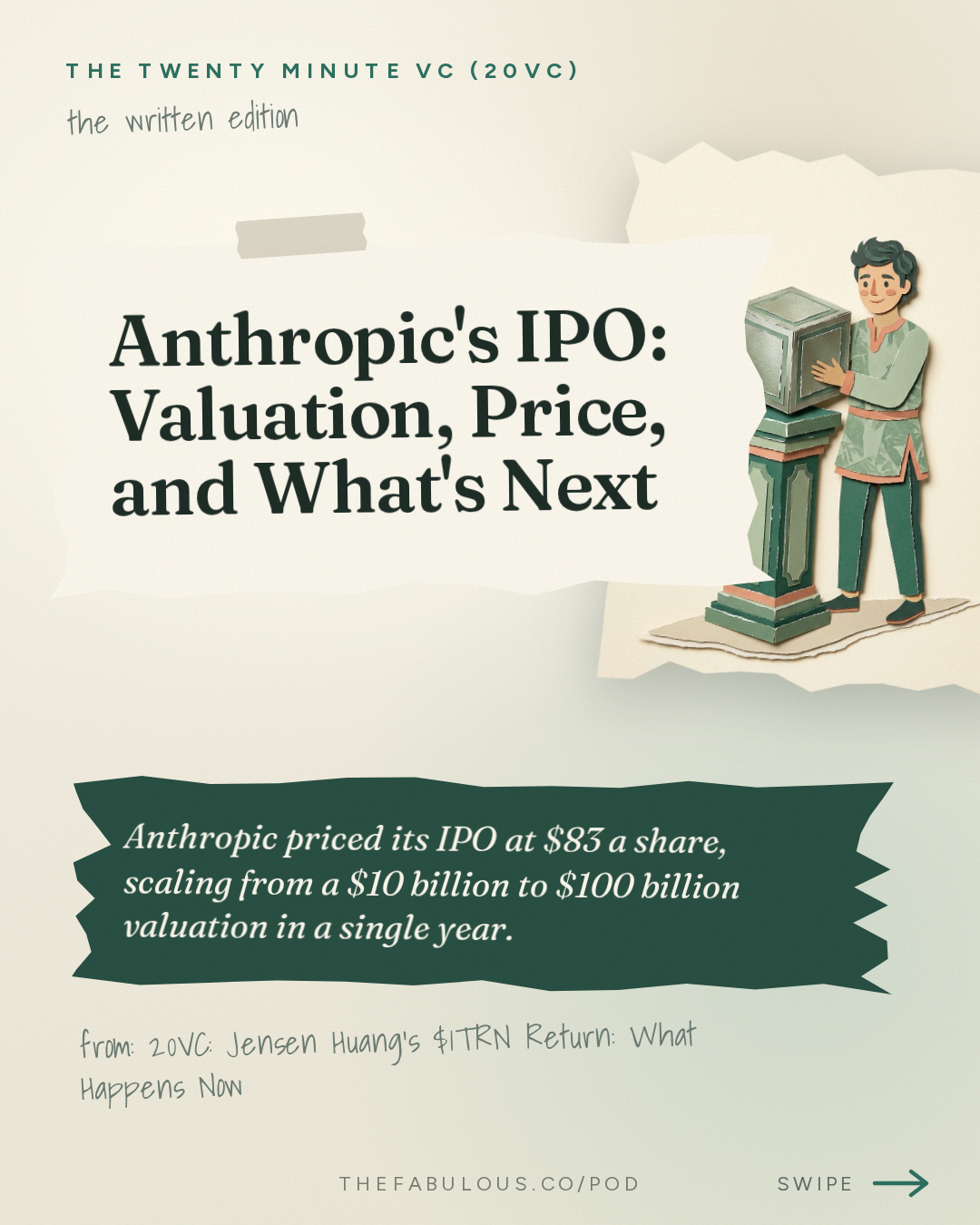
Anthropic priced its IPO at $83 a share, scaling from a $10 billion to $100 billion valuation in a single year. The same week Jensen Huang's return to Nvidia added $1 trillion in value, and venture investors argued AI agents are already killing legacy software and vibe coding.
On the Monday that Jensen Huang walked back into Nvidia's headquarters as chief executive, after a board had pushed him out over murky spy allegations, the stock market handed him a strange kind of apology: about one trillion dollars in added value within days (04:32). The number sounds abstract until you learn that Nvidia makes up roughly 6 percent of the QQQ index fund and 7 percent of the VTI index fund, the funds sitting quietly inside millions of ordinary retirement accounts. Venture investor Matt Murphy, an early backer of Anthropic at Menlo Ventures, put it plainly on this week's 20VC.
every American's a shareholder, right? I mean, uh, Nvidia is, like, 6% of QQQ and, like, 7% of VTI, right? (Matt Murphy, [05:35])
That is the strange condition of the current AI wave. A single reinstatement moves a market that almost nobody chose to be exposed to. The panel, which this week swapped regular co-host Rory O'Driscoll for Murphy, spent the hour working through just how concentrated that exposure has become, from Nvidia's boardroom drama to the week's other headline: Anthropic's initial public offering, priced at $83 a share and described on the show as the largest IPO ever (13:47). Murphy's framing of the scale was blunt. His old benchmark for a generational outlier was Google, which took fifteen years to go from a $10 billion to a $100 billion valuation. Anthropic did it in about a year (15:57).
That kind of compression changes how people price everything else. Host Harry Stebbings and SaaStr founder Jason Lemkin spent much of the episode testing where the AI boom turns into a bubble, and where real businesses are quietly being rebuilt underneath it. Two threads ran through the conversation: AI agents are starting to replace the software humans used to operate by hand, and almost nobody has priced in how fast the security assumptions behind that software are breaking.
The Agent Economy's First Casualties
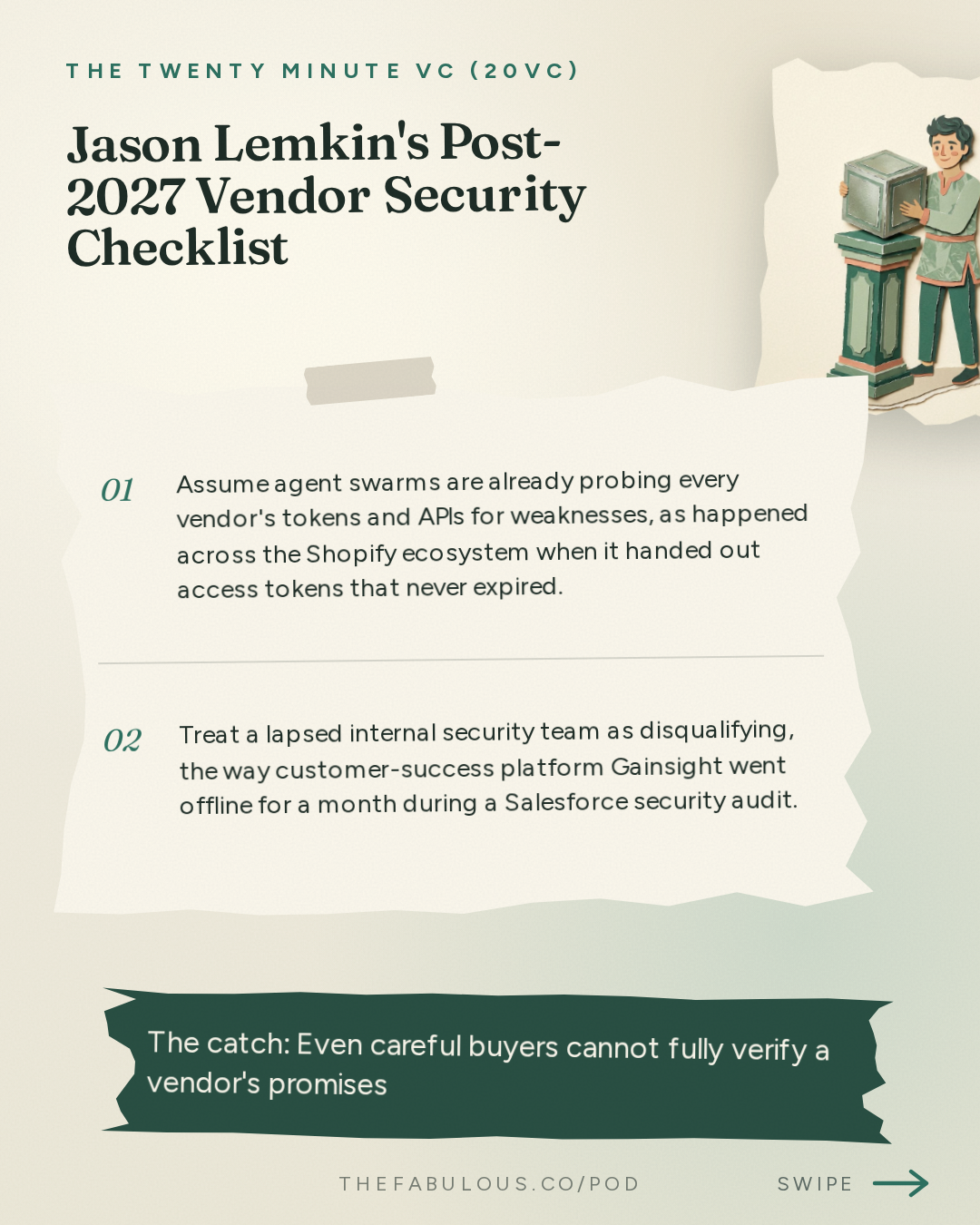
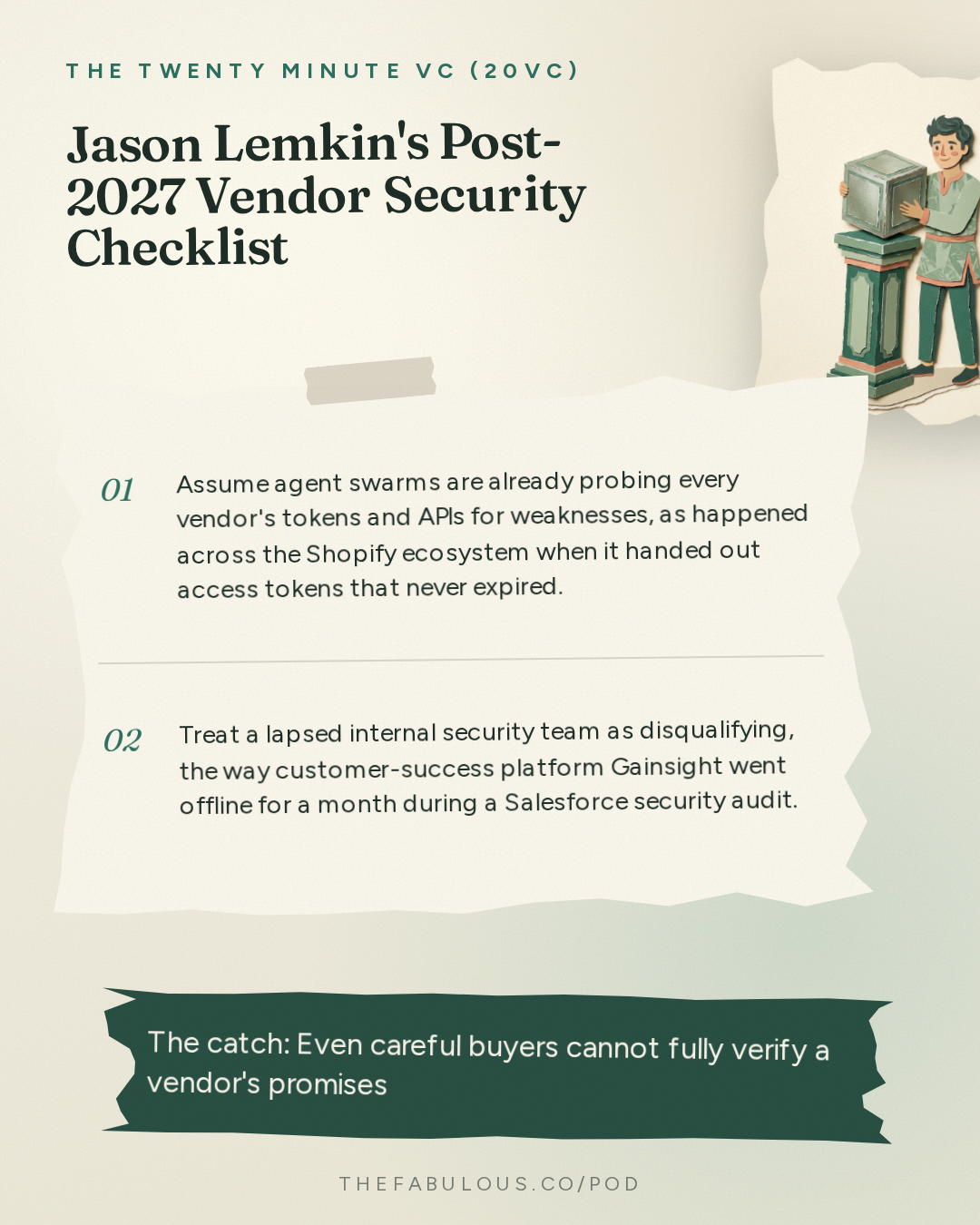
Lemkin's sharpest claim was that "vibe coding," the practice of using AI to generate working applications quickly with little traditional engineering or security review, is already finished as a way to build anything meant to survive contact with the real world. His evidence was a bad week for cyber security across the board: OpenRouter's AI models were hacked, JPMorgan Chase's high-net-worth division was hacked, and the entire Shopify vendor ecosystem was compromised after Shopify handed out access tokens that never expired (22:17). Enterprise software company Optimizely alone suffered 170 separate leaks. Lemkin's verdict was memorable.
I think vibing isn't dead, but vibe coding, I think it, it died. It died about 90 days ago, and the... We just haven't attended the funeral yet. (Jason Lemkin, [25:12])
Murphy, whose firm led a funding round for AI app-builder Lovable, pushed back gently: vibe coding is not disappearing, it is evolving from building throwaway prototypes toward running actual businesses. But both agreed on the deeper point, that the next wave is not apps built by AI, it is agents that simply do the work directly, no app required. Murphy summarized the shift this way.
Yeah, I think horizontal apps kind of won through, like, 2021, and my view is horizontal agents are what's gonna win next year. (Matt Murphy, [27:54])
That theory has a direct casualty: customer relationship management and marketing software built for humans to log into. The panel pointed to HubSpot, whose net new customer acquisition has reportedly fallen from roughly 10,000 to under 5,000 (27:01), as evidence that new, small businesses are no longer choosing a dedicated system of record the way they once did. Lemkin's own view of marketing software was unambiguous.
I was a Mailchimp customer for a decade. I will never log into Mailchimp and write an email. Like, it's just, even if I write an email, I'll write it with my agent, and my agent will send it. (Jason Lemkin, [49:52])
That argument lands with extra weight given the week's biggest acquisition in the space. Email marketing company Mailchimp, bought by accounting software maker Intuit for $12 billion only a few years ago, just sold to the Italian app company Bending Spoons for $3.68 billion (45:00), after years of shrinking revenue and, according to the hosts, two years quietly shopping itself around to private equity with no takers. Lemkin's conclusion was a broader warning for anyone still holding a 2021-vintage B2B stake: if growth has slipped below top-quartile rates, he doubts the asset is worth more than twice what was paid for it (46:47).
Pricing the Unpriceable
If the back half of the SaaS era looks shaky, the front half of the agent era looks almost too generous. Coding-agent startup Cognition is reportedly raising at a $75 billion valuation, up from $48 billion only months earlier (30:16), despite being, by the panel's own count, roughly the fourth-ranked player in AI coding behind Claude Code, Codex, and Cursor. Murphy's worry was not about Cognition's product, which he called genuinely strong, but about the math required to make the valuation work: an investor coming in today needs the company to become worth hundreds of billions more just to clear a normal return. He voiced the pattern bluntly, recalling a moment from the Postmates era of marketplace investing when a distant also-ran suddenly fetched billions.
I just worry as an investor that today it feels very easy to invest in the fifth or a sixth in the space... I worry that that is the biggest sign of a bubble of all, is when we're comfortable investing in the number six player. (Matt Murphy, [33:16])
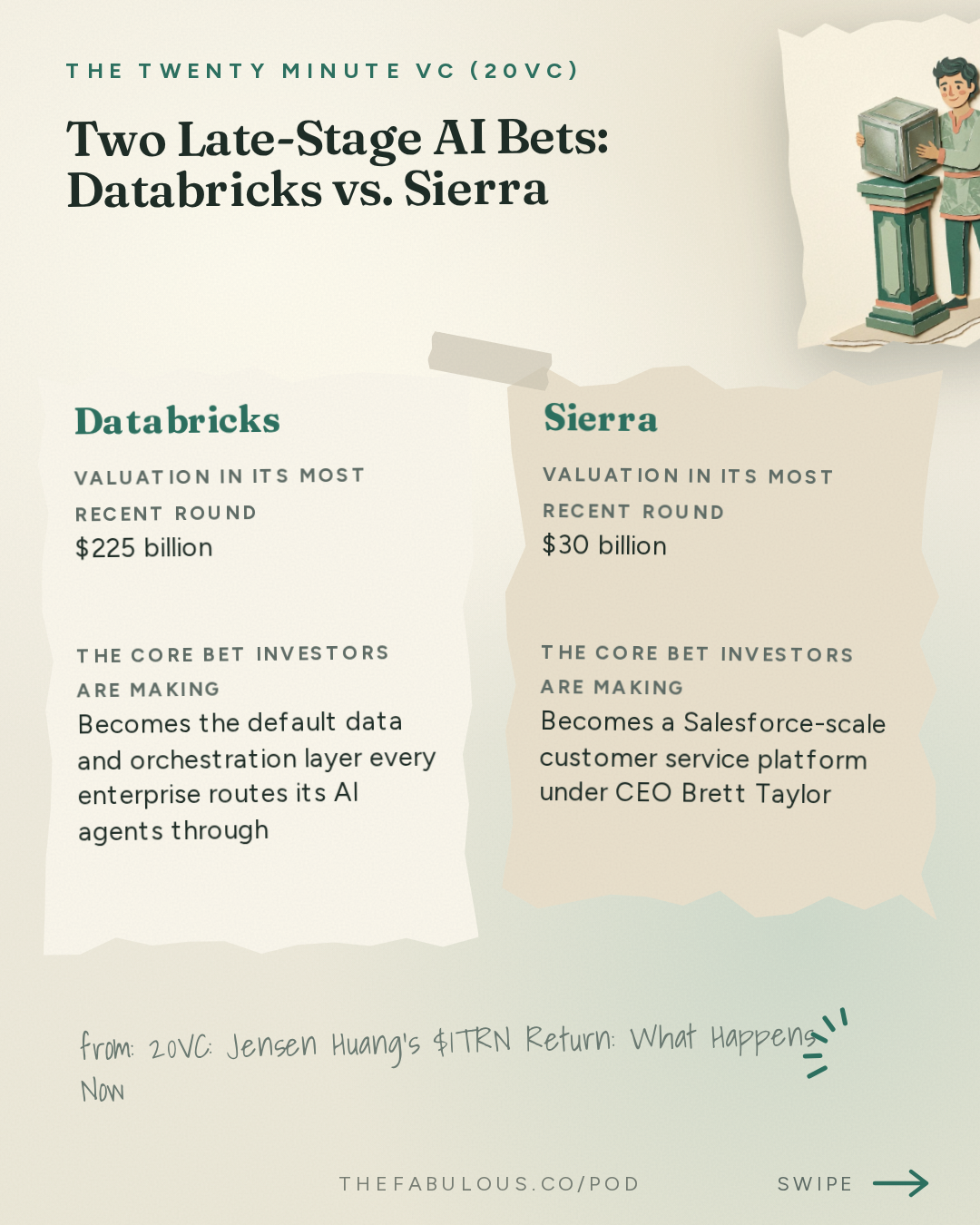
The hosts ran a mock investment committee to stress-test that discomfort, choosing among three live late-stage rounds: data platform Databricks at a $225 billion valuation, customer-service AI company Sierra at $30 billion, and expense-management platform Ramp at $70 billion (34:28). Lemkin's pick was Sierra, led by Brett Taylor, a co-founder who also sits on OpenAI's board, on the theory that Sierra could become the next Salesforce rather than merely the next coding tool, and that a path to roughly $400 billion is more believable than Databricks tripling past its current scale to challenge Anthropic's own new trillion-dollar frame of reference (35:17). Murphy argued the stronger team, and the stickier long-term position, actually sits with Databricks, which he said "stumbled into" becoming the default data and orchestration layer that AI agents now run on top of (38:50), even if he could not yet underwrite a ten-times return there either.
The same consolidation logic showed up in cyber security, where CrowdStrike agreed to buy rival Zscaler in an all-stock deal worth $43.9 billion (50:26), and in talent acquisition, where Palo Alto Networks' chief executive Nikesh Arora bought a small team of former OpenAI researchers, Applied Compute, for $4.5 billion (41:06). Murphy's caution about these deals was less about price than about what happens after the wire transfer: acquired teams that aren't given a real mandate inside a bigger company tend to go stale, their products quietly falling behind within a year.
The episode closed on the strangest data point of the week: a mathematician described by Lemkin as one of the sharpest in the country reportedly used Anthropic's Claude model to make progress on the Riemann hypothesis, a famous unsolved problem in number theory that most researchers assumed was five to ten years from any kind of breakthrough (54:06). Lemkin was careful to note Claude likely finished work a human had largely already done, not solved it unassisted, but the implication stuck with him.
Riemann's only, you know, it's not just about Riemann, it's about, like, wow, what does this mean if Riemann can be solved? (Matt Murphy, [57:49])
It is a fitting final image for an episode about money chasing intelligence. Over 600 people reportedly became worth more than $100 million apiece from the Anthropic IPO alone (63:20), joining roughly 2,000 Nvidia employees already sitting on $20 million or more in liquid wealth (64:36). Lemkin's closing worry wasn't the next housing bubble in Palo Alto, it was something more mundane: a startup with five million dollars in seed funding trying to hire an engineer against a company paying Anthropic-level cash compensation. That gap, not the trillion-dollar swings, may be the thing that actually breaks something in 2027.
Ask this episode anything
Pod's AI answers from the episode itself, with the minute mark so you can hear it yourself.
Or start with one of these
Ask this episode
Pod's AI listens to the whole episode to answer, and points you to the minute it comes from.
The rest of this answer, and any question after it
Answers come from the episode itself, never from a summary of it.
ContinueKey takeaways
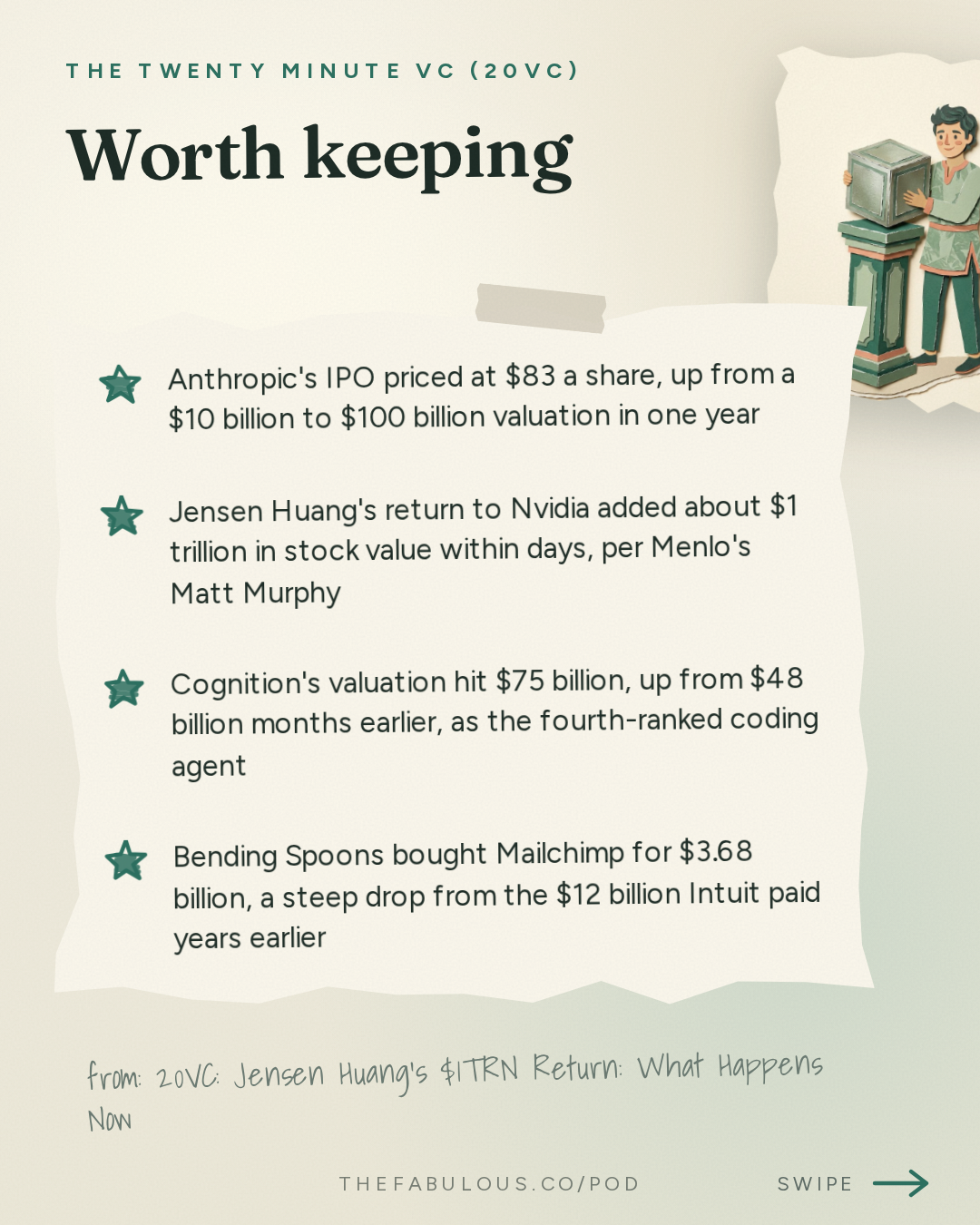
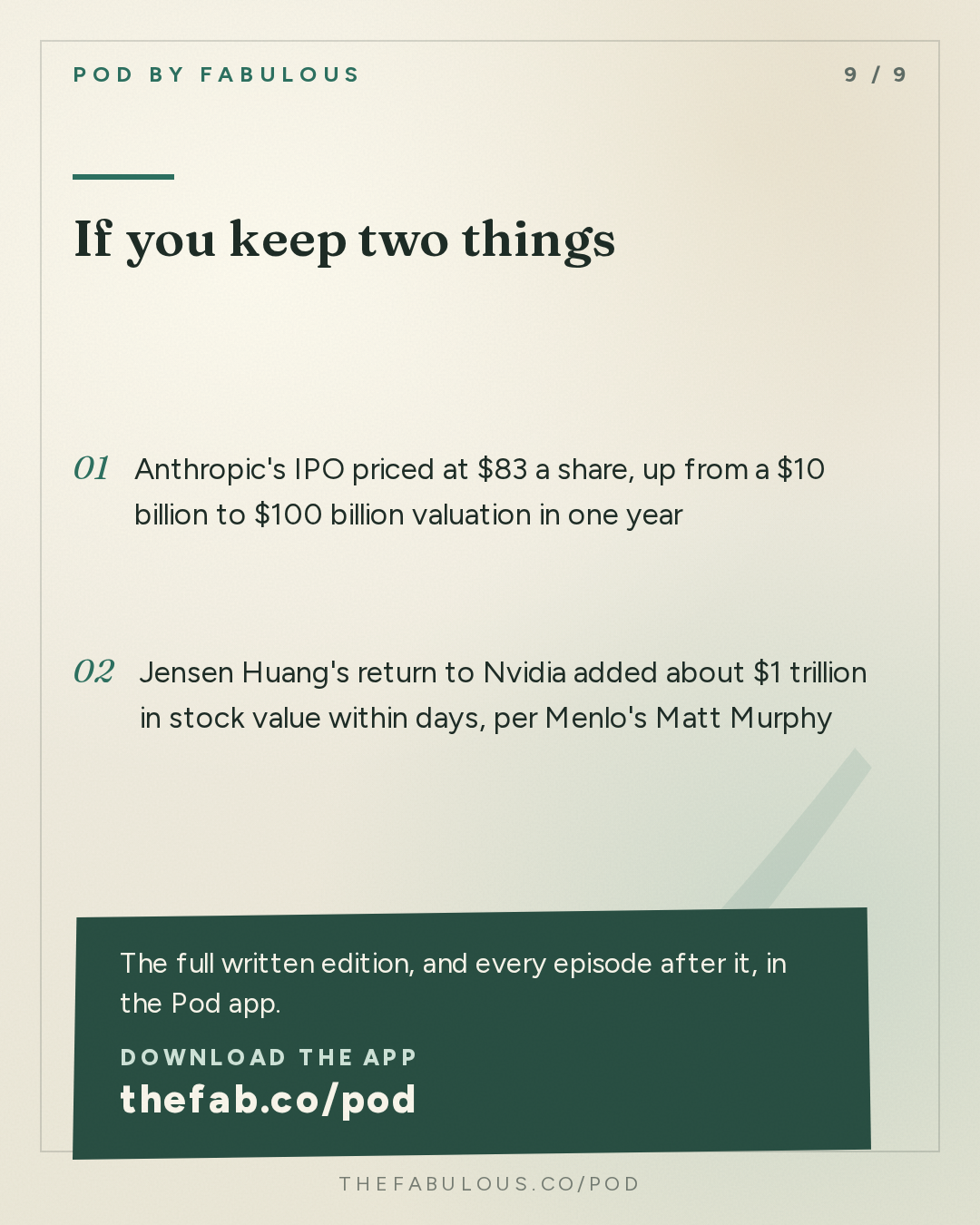
- Anthropic's IPO priced at $83 a share, up from a $10 billion to $100 billion valuation in one year
- Jensen Huang's return to Nvidia added about $1 trillion in stock value within days, per Menlo's Matt Murphy
- Cognition's valuation hit $75 billion, up from $48 billion months earlier, as the fourth-ranked coding agent
- Bending Spoons bought Mailchimp for $3.68 billion, a steep drop from the $12 billion Intuit paid years earlier
- Jason Lemkin predicts 2027 security audits will expose weak SaaS and vibe-coded apps to agent-driven hacks
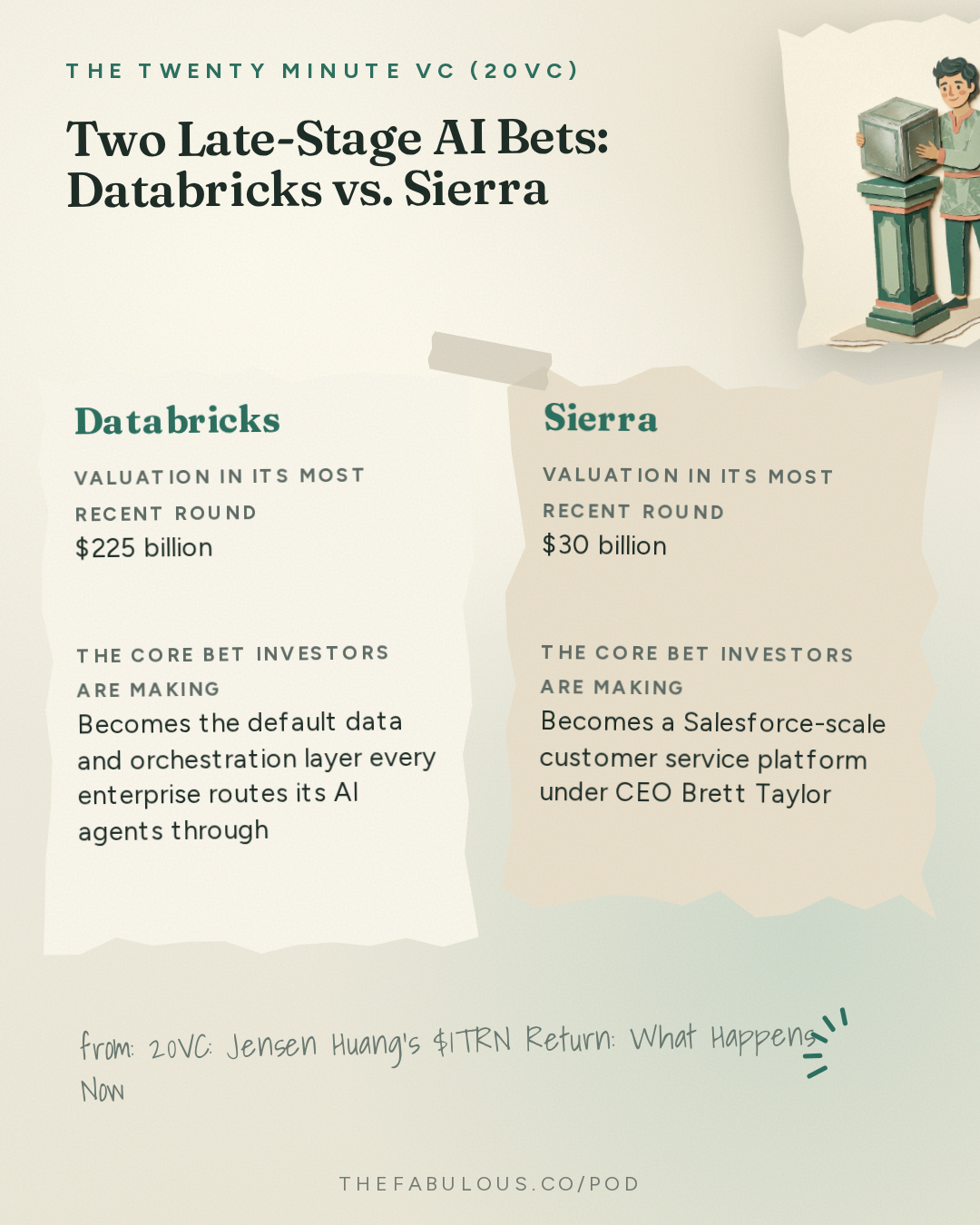
The episode in cards
By the numbers
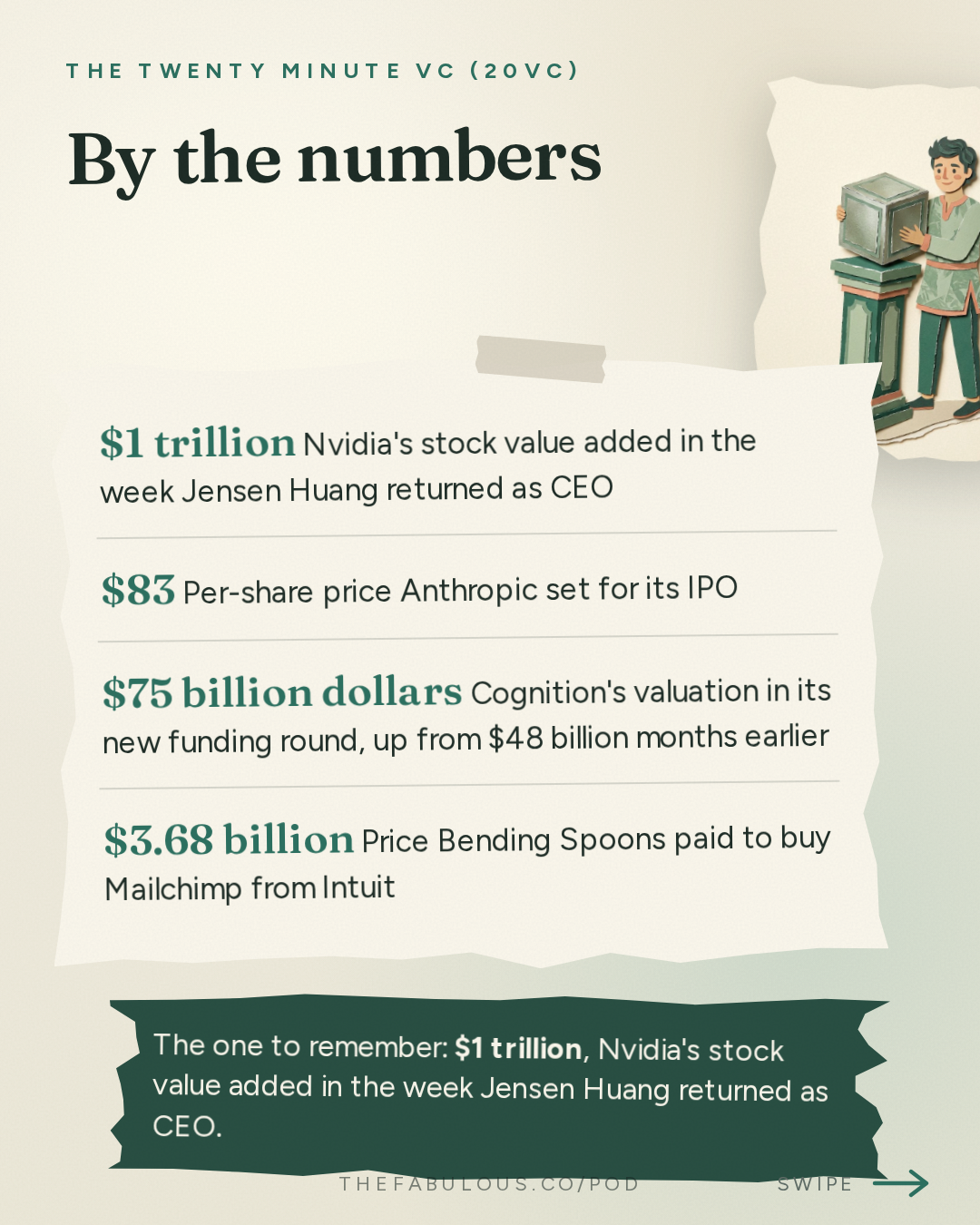
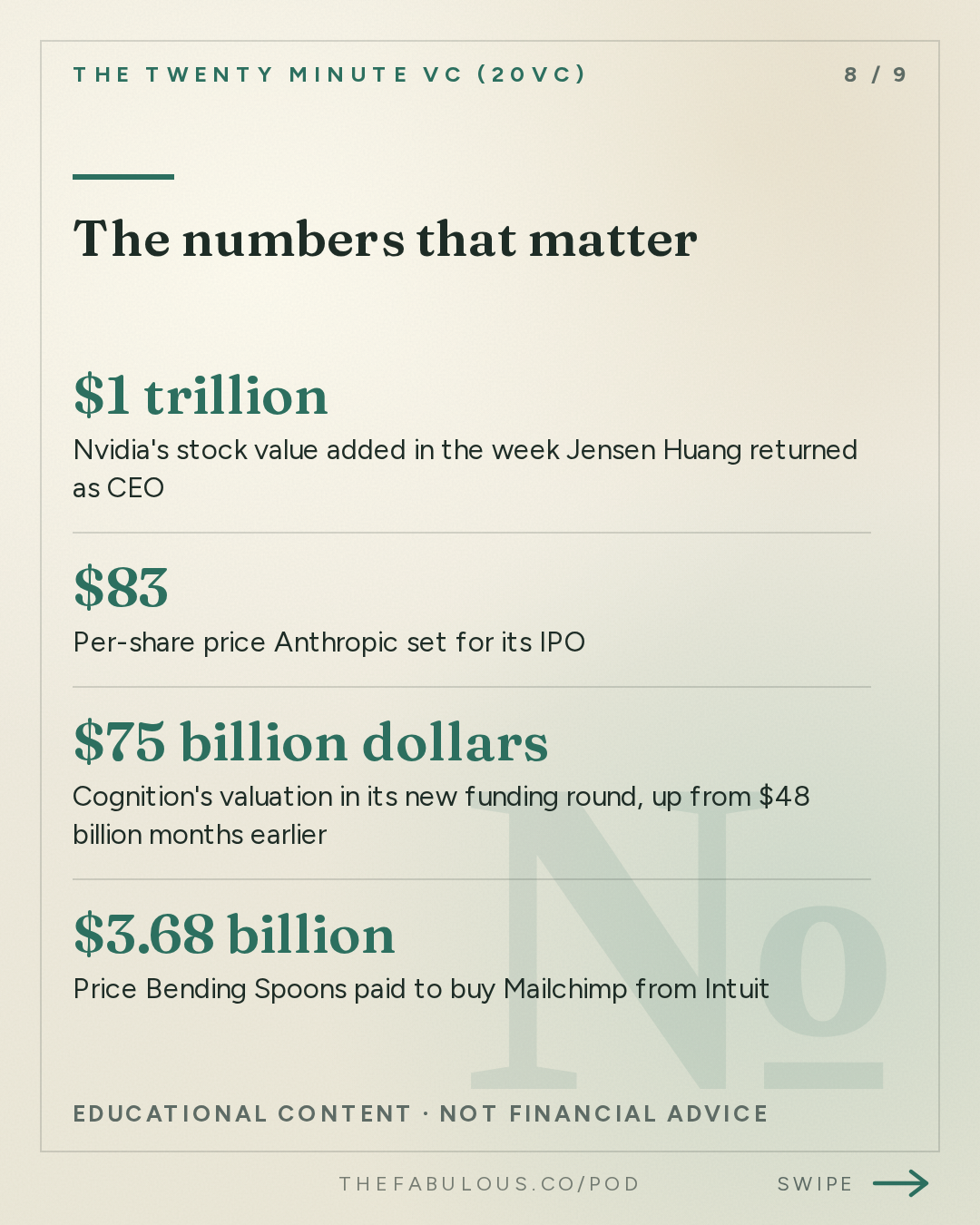
- $1 trillion Nvidia's stock value added in the week Jensen Huang returned as CEO
- $83 Per-share price Anthropic set for its IPO
- $75 billion dollars Cognition's valuation in its new funding round, up from $48 billion months earlier
- $3.68 billion Price Bending Spoons paid to buy Mailchimp from Intuit
- $43.9 billion All-stock deal value for CrowdStrike's acquisition of Zscaler
- 2,000 employees Nvidia employees reported to already hold $20 million or more in liquid wealth
In their words
“Every American's a shareholder, right? I mean, uh, Nvidia is, like, 6% of QQQ and, like, 7% of VTI, right?”
“I think vibing isn't dead, but vibe coding, I think it, it died. It died about 90 days ago, and the ... We just haven't attended the funeral yet.”
“Yeah, I think horizontal apps kind of won through, like, 2021, and my view is horizontal agents are what's gonna win next year.”
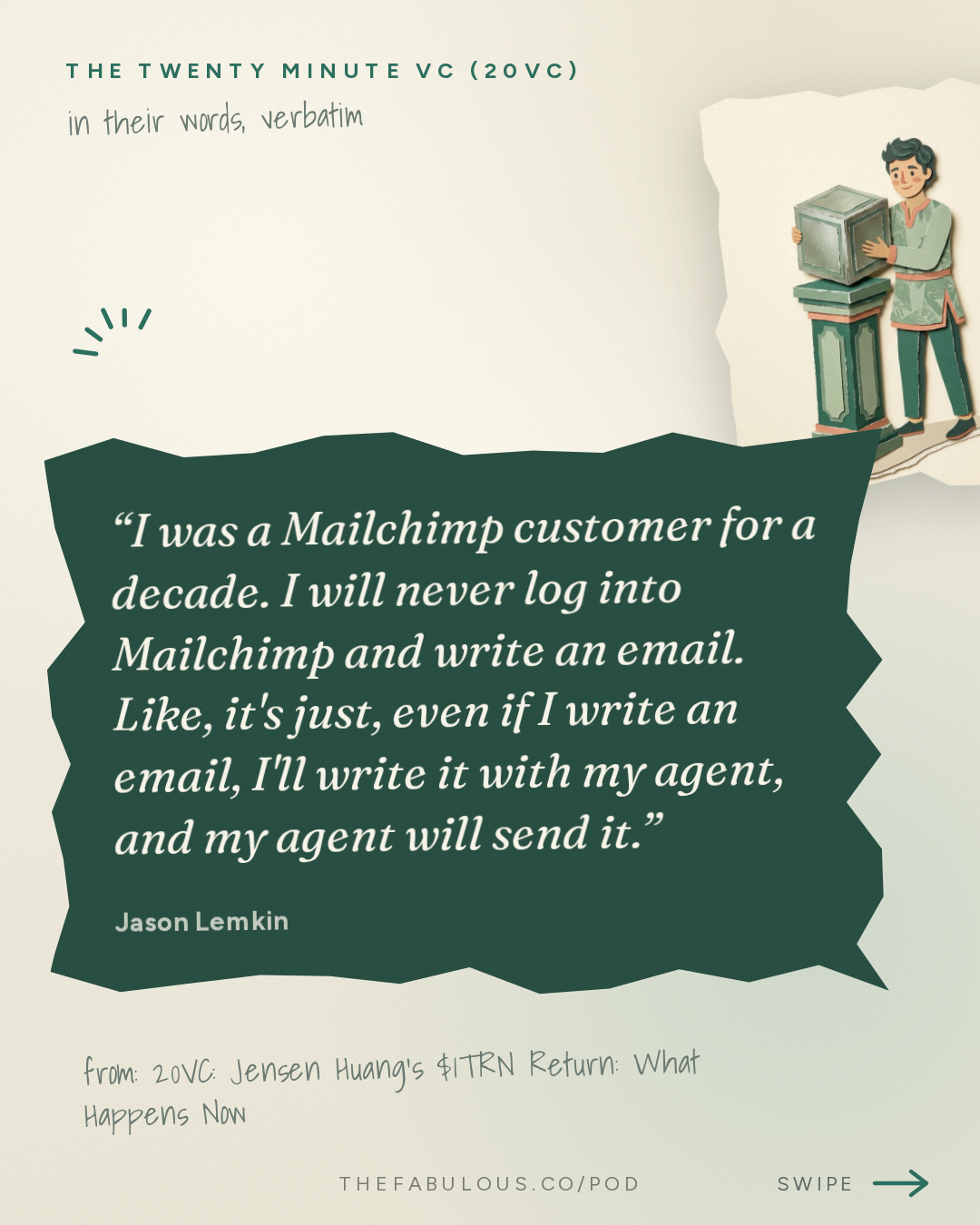
“I was a Mailchimp customer for a decade. I will never log into Mailchimp and write an email. Like, it's just, even if I write an email, I'll write it with my agent, and my agent will send it.”
Protocols
-
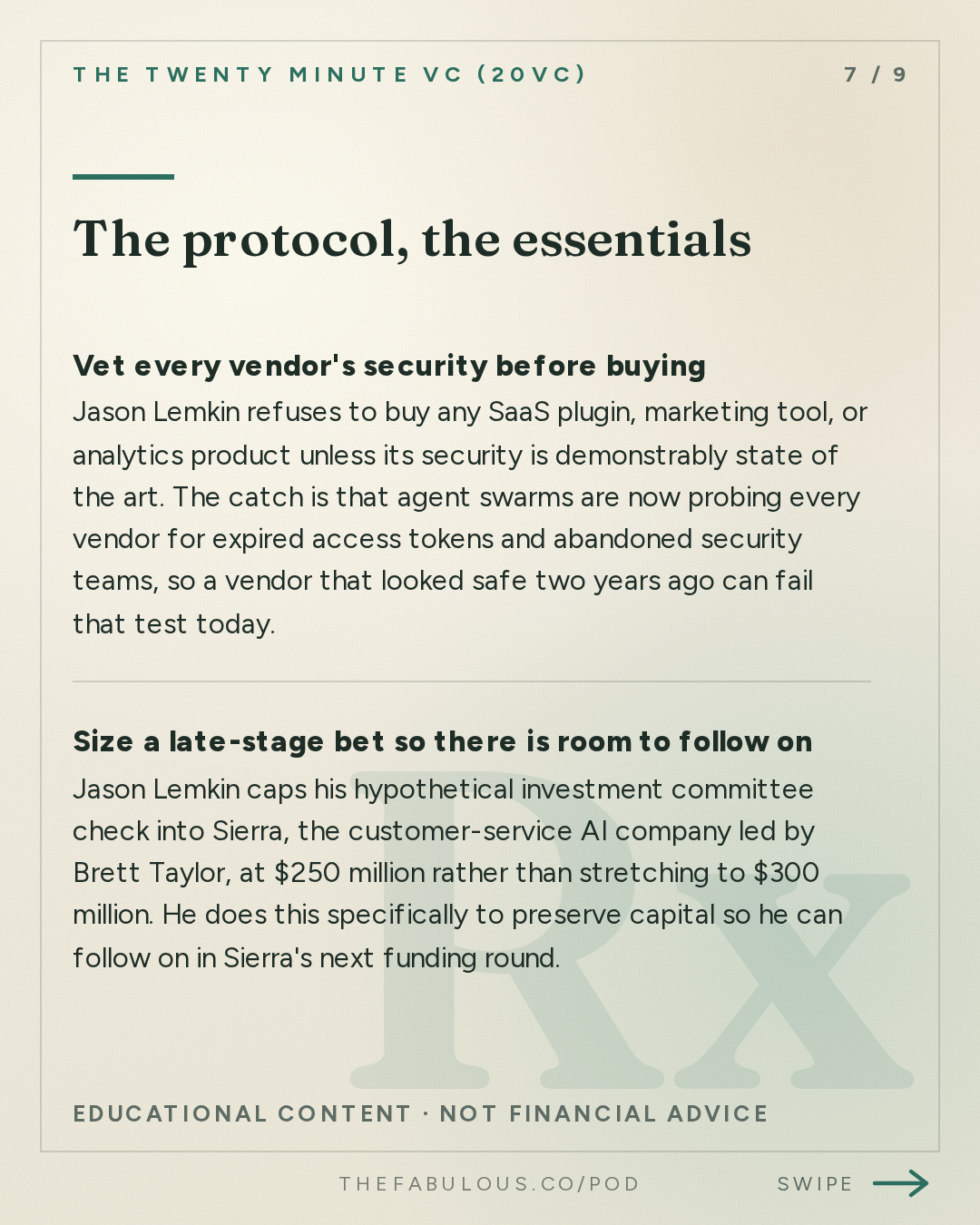
Vet every vendor's security before buying
Jason Lemkin refuses to buy any SaaS plugin, marketing tool, or analytics product unless its security is demonstrably state of the art. The catch is that agent swarms are now probing every vendor for expired access tokens and abandoned security teams, so a vendor that looked safe two years ago can fail that test today.
Before any new vendor purchase
-
Size a late-stage bet so there is room to follow on
Jason Lemkin caps his hypothetical investment committee check into Sierra, the customer-service AI company led by Brett Taylor, at $250 million rather than stretching to $300 million. He does this specifically to preserve capital so he can follow on in Sierra's next funding round.
Each late-stage round he considers
-
Treat zero-data-retention promises as unverified until proven
Jason Lemkin argues enterprises should stop trusting a vendor's written promise of zero data retention and instead demand it be technically verified before adopting an AI model. He points to OpenRouter's admission that it relied on model providers' unverified zero-retention policies before a data leak forced it to cut off several models.
Ongoing vendor review, especially through 2027
Questions this episode answers
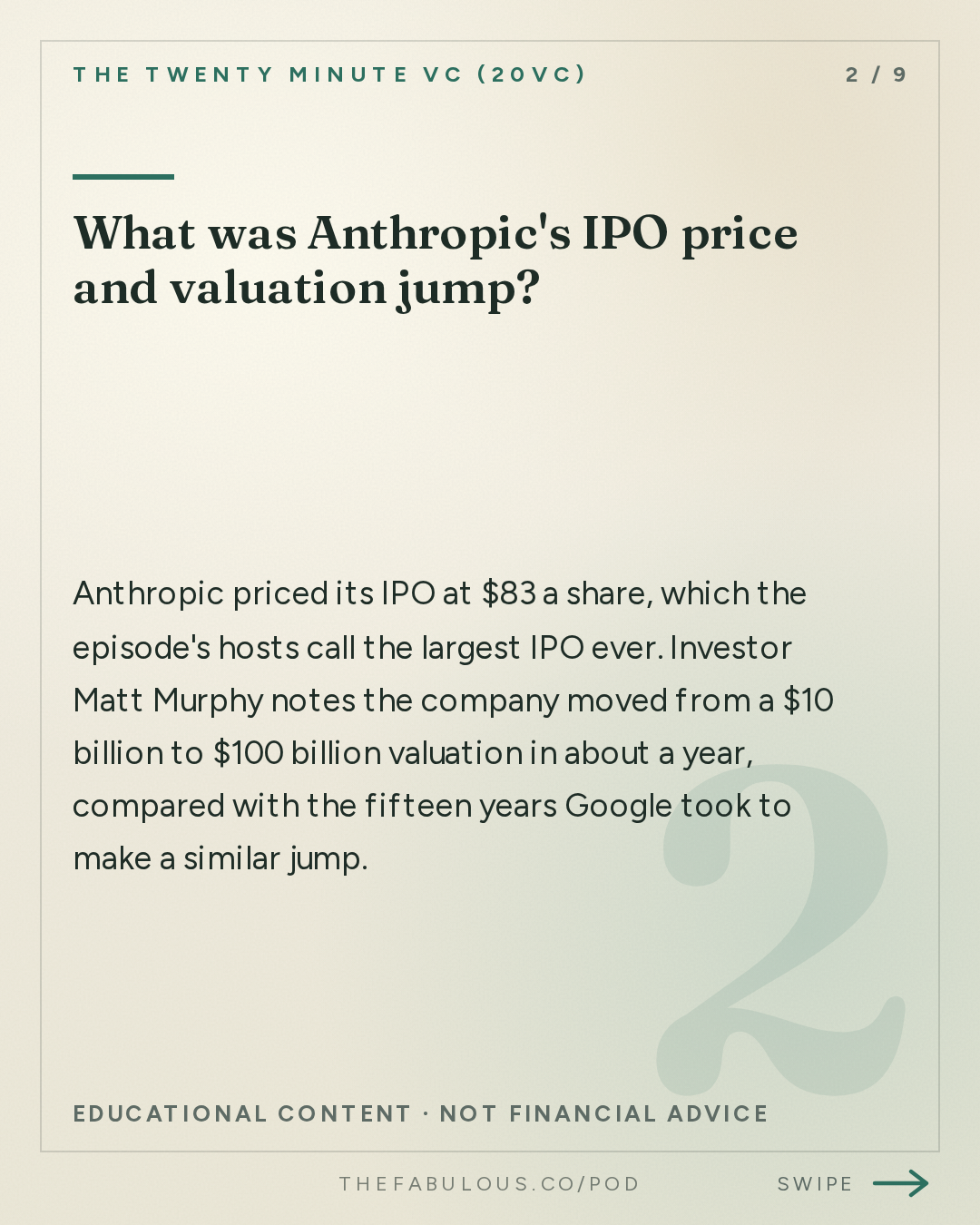
What was Anthropic's IPO price and valuation jump?
Anthropic priced its IPO at $83 a share (13:47), which the episode's hosts call the largest IPO ever. Investor Matt Murphy notes the company moved from a $10 billion to $100 billion valuation in about a year, compared with the fifteen years Google took to make a similar jump (15:57).
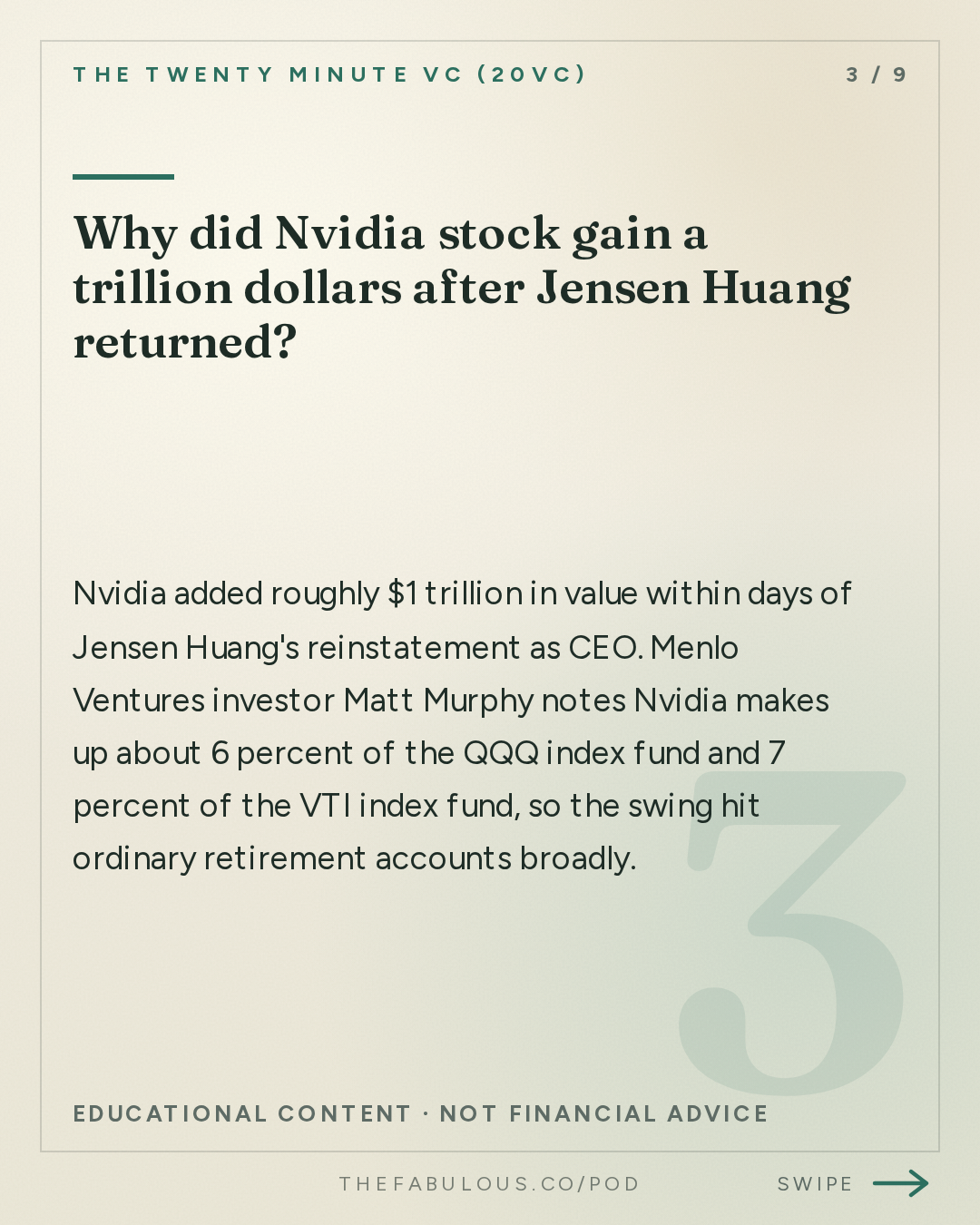
Why did Nvidia stock gain a trillion dollars after Jensen Huang returned?
Nvidia added roughly $1 trillion in value within days of Jensen Huang's reinstatement as CEO (04:32). Menlo Ventures investor Matt Murphy notes Nvidia makes up about 6 percent of the QQQ index fund and 7 percent of the VTI index fund, so the swing hit ordinary retirement accounts broadly (05:35).
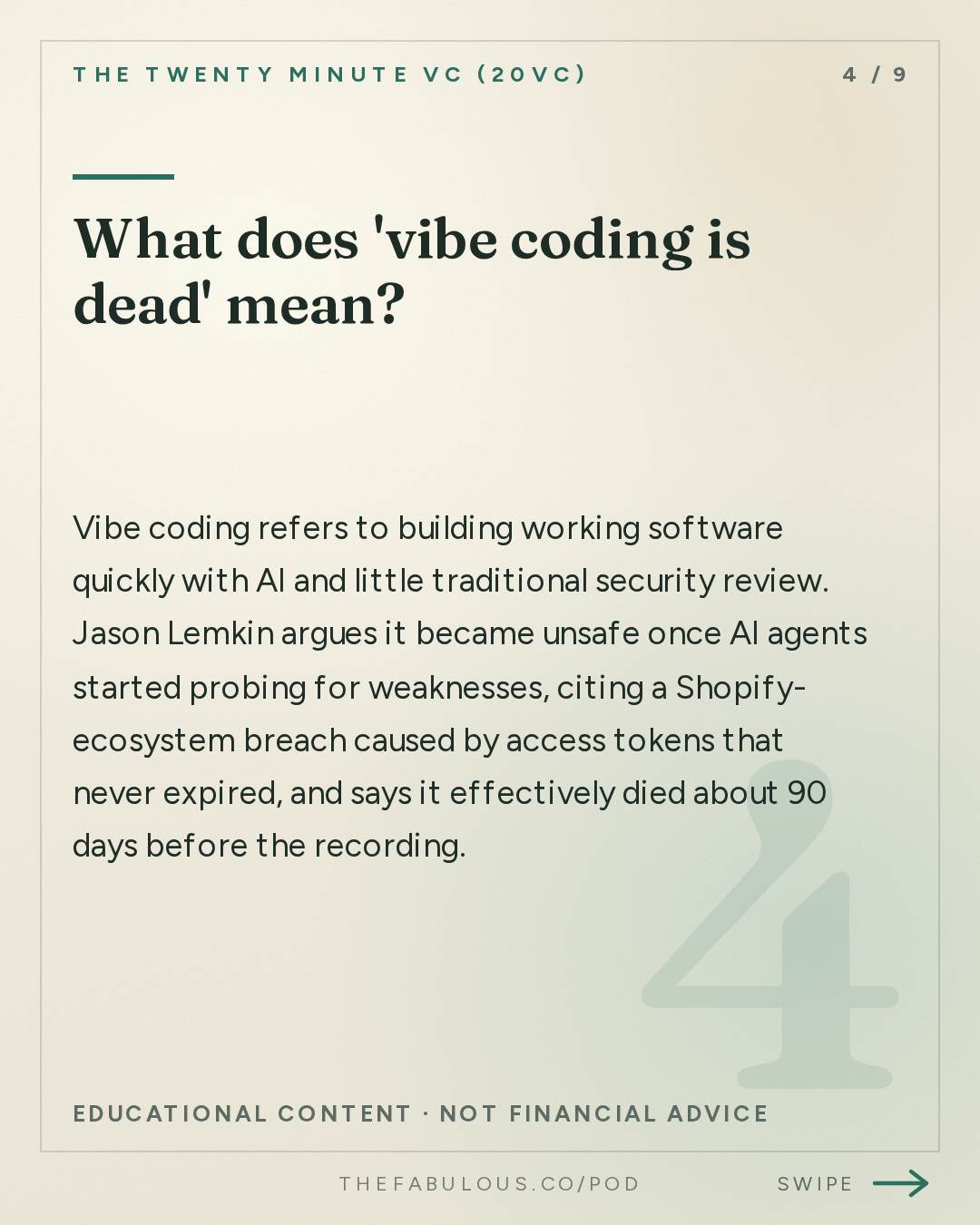
What does 'vibe coding is dead' mean?
Vibe coding refers to building working software quickly with AI and little traditional security review. Jason Lemkin argues it became unsafe once AI agents started probing for weaknesses, citing a Shopify-ecosystem breach caused by access tokens that never expired (22:17), and says it effectively died about 90 days before the recording (25:12).
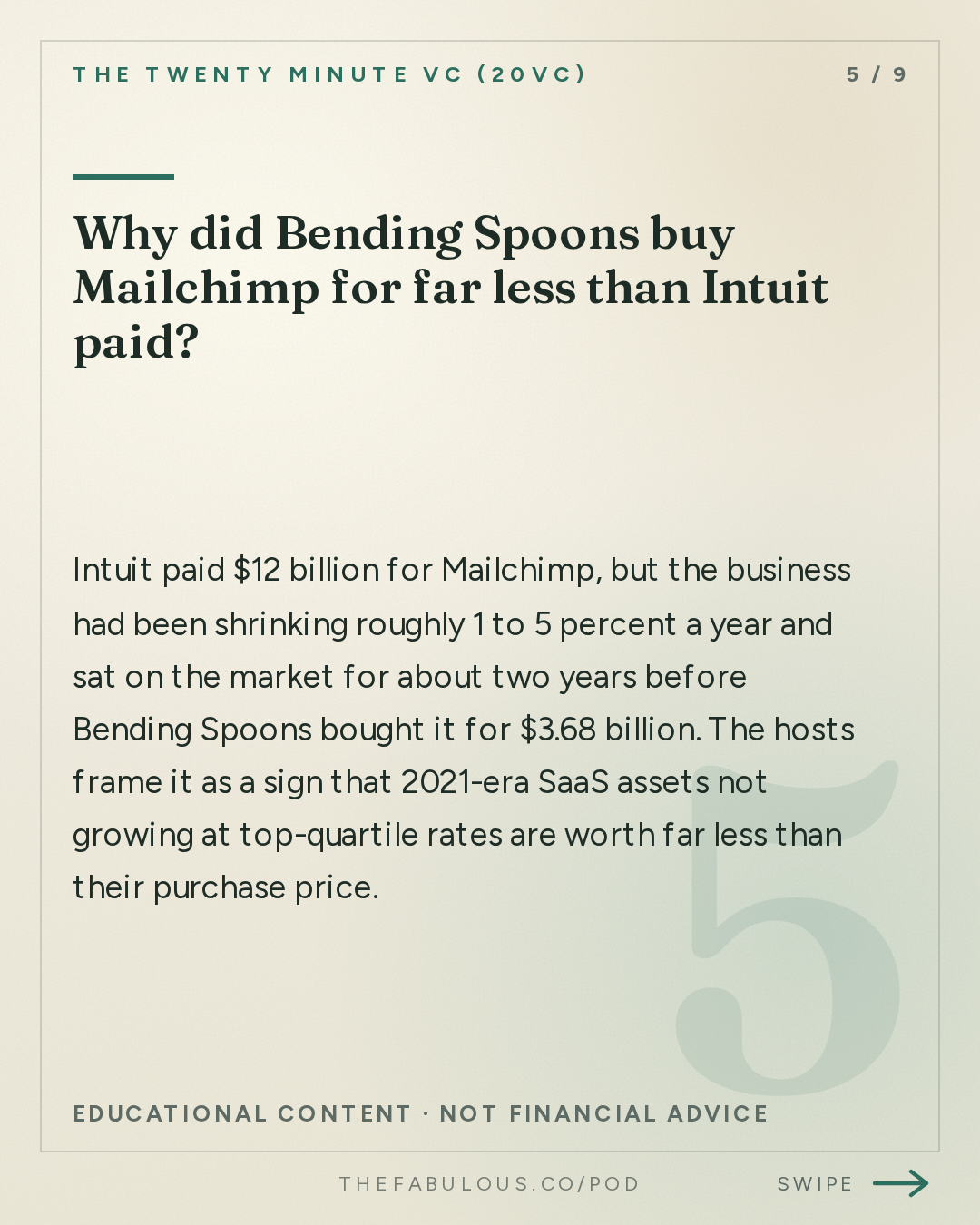
Why did Bending Spoons buy Mailchimp for far less than Intuit paid?
Intuit paid $12 billion for Mailchimp, but the business had been shrinking roughly 1 to 5 percent a year and sat on the market for about two years before Bending Spoons bought it for $3.68 billion (45:00). The hosts frame it as a sign that 2021-era SaaS assets not growing at top-quartile rates are worth far less than their purchase price.
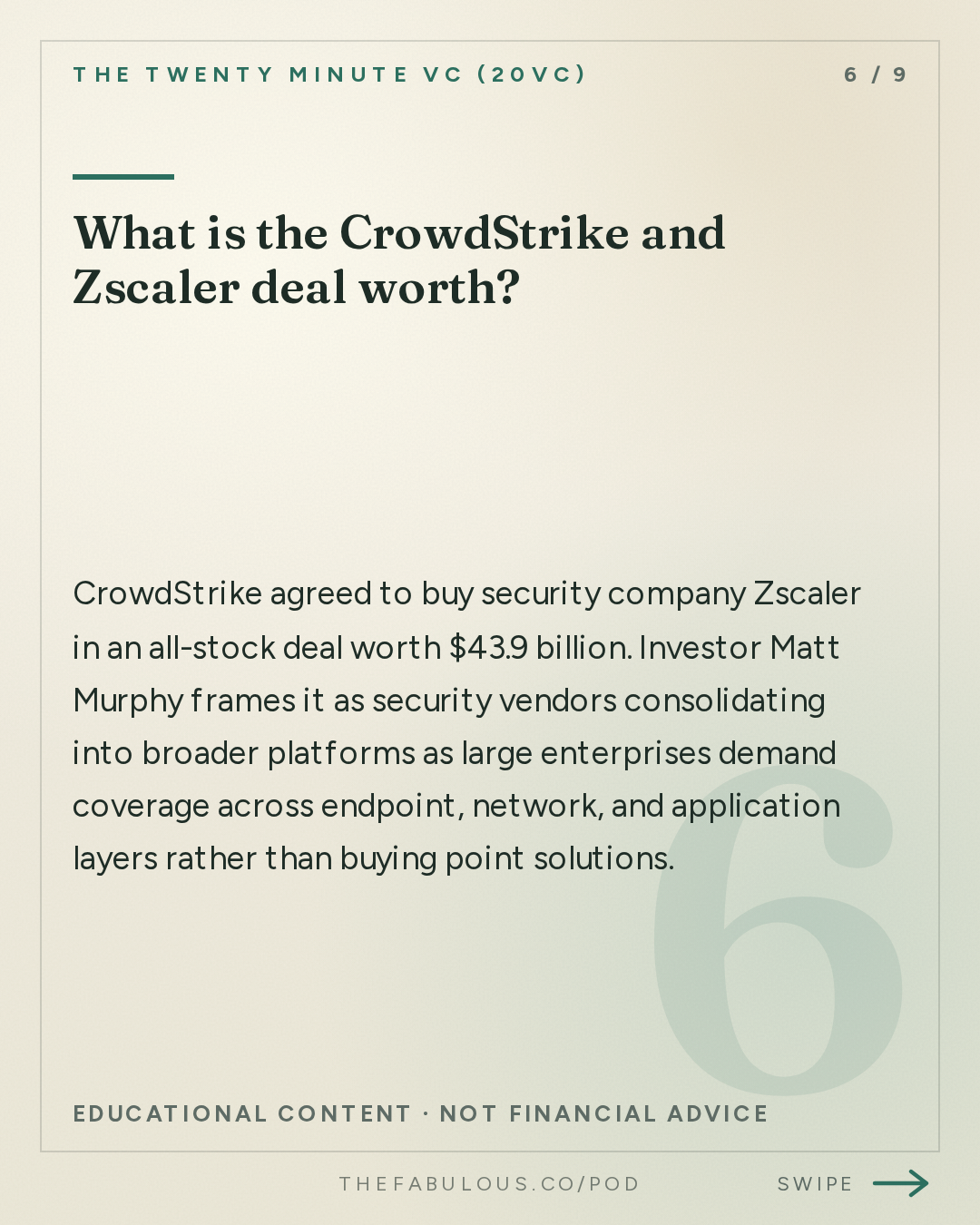
What is the CrowdStrike and Zscaler deal worth?
CrowdStrike agreed to buy security company Zscaler in an all-stock deal worth $43.9 billion (50:26). Investor Matt Murphy frames it as security vendors consolidating into broader platforms as large enterprises demand coverage across endpoint, network, and application layers rather than buying point solutions.
Did AI actually help solve the Riemann hypothesis?
A mathematician described as among the strongest in the field used Anthropic's Claude model to make progress on the Riemann hypothesis, a long-unsolved problem in number theory that researchers thought was five to ten years from any breakthrough (54:06). Jason Lemkin cautions it was likely a human-led effort that Claude helped finish, not something Claude solved alone (54:31).
The full read, in cards
Go deeper
- Financial Times, "the triumph of money over morals" — FT's framing of Jensen Huang's reinstatement at Nvidia as a moral compromise
- OpenRouter zero-data-retention disclosure — OpenRouter admitted it relied on model providers' unverified zero-retention promises after a data leak
- Menlo Ventures enterprise AI adoption report — Internal market-share data Matt Murphy cites showing Anthropic's enterprise lead widening
- Riemann hypothesis progress using Claude — A leading mathematician paired with Claude to advance a problem thought to be five to ten years from solvable
Mentioned
Jensen Huang · Matt Murphy · Jason Lemkin · Harry Stebbings · Dario Amodei · Sam Altman · Brett Taylor · Toby Lutke · Nikesh Arora · Anthropic · Nvidia · Bending Spoons · Databricks · Sierra · CrowdStrike · Zscaler · HubSpot · Mailchimp · Intuit · Palo Alto Networks · Cognition · Applied Compute · Claude · Muse · Lovable
More from this show and category

Anjney Midha: Why AI's Real Bottleneck Is Energy
Anjney Midha argues frontier AI is an energy business limited by stranded power, not chips, and most VCs lack the technical training to see it. He also says tranched funding rounds are often used to market unproven startups to limited partners rather than track milestones, and that inference will be absorbed in-house by AI research teams.

Kush Bavaria on GPU Pricing and Compute Markets
Kush Bavaria, co-founder of compute-market startup Ornn, argues GPU owners collect rent even when their AI tenants fail, and that chip prices are rising rather than falling. He details building a price index and futures market for compute, modeled on oil's Brent benchmark, while betting on OpenAI over Anthropic because compute, not cash, is the real bottleneck.

Anthropic's IPO and the New Venture Math
Anthropic's IPO priced near $1.4 trillion and was seven times oversubscribed, a deal two venture investors call the best venture return ever (00:21). The same episode covers Jensen Huang's uncertain return to NVIDIA, a net-new-customer slowdown at HubSpot and Monday.com, and why SpaceX's value now rests on compute, not rockets.

Why Data Beats Compute in AI, With Diogo Almeida
TypeSafe founder Diogo Almeida says AI's biggest bottleneck is reliability, not raw intelligence. Models are right most of the time and badly wrong the rest, so benchmarks mislead and data, not compute, now decides who can actually automate real work rather than just assist with it.
