
Town's JD on the AI Assistant Race and Economics
20VC: The $100 Billion AI Assistant Race: Town vs Instinct vs GrokBot | We Spend $75K Per Engineer on AI Tools | Why the AI Assistant Market Is Not a Bubble & AI Assistants Will Replace Every App on Your Phone with JD, Founder of Town
The brief
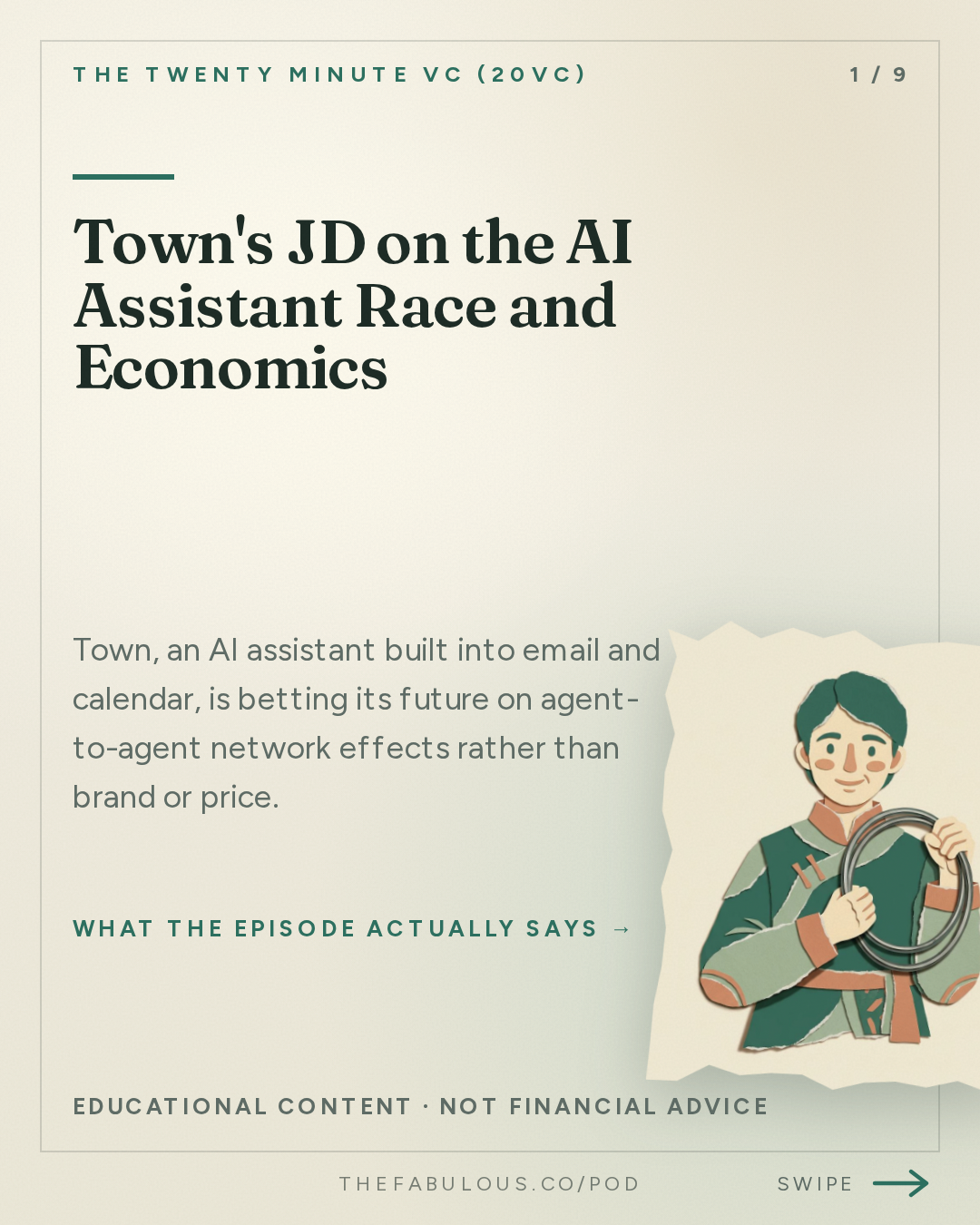
Town, an AI assistant built into email and calendar, is betting its future on agent-to-agent network effects rather than brand or price. Founder JD, a former Plaid CTO, says Town converts over 15% of trial users to paid and spends $75,000 per engineer per year on AI tools like Devon and Codex.
A founder who wakes at 3 a.m. usually fears failure. Jean-Denis, who goes by JD and built the AI assistant Town, fears something stranger: being noticed too fast. "I know what I'm building is a top-three priority at Google and Apple, like, in the next 12 months," he says. "Not a top-10 priority, like, a top-three priority" (00:00). That sentence captures the strange physics of building inside the AI assistant category right now. The market is enormous, the tools are new, and everyone with a cloud budget and a model API key can see exactly what works within weeks of it working.
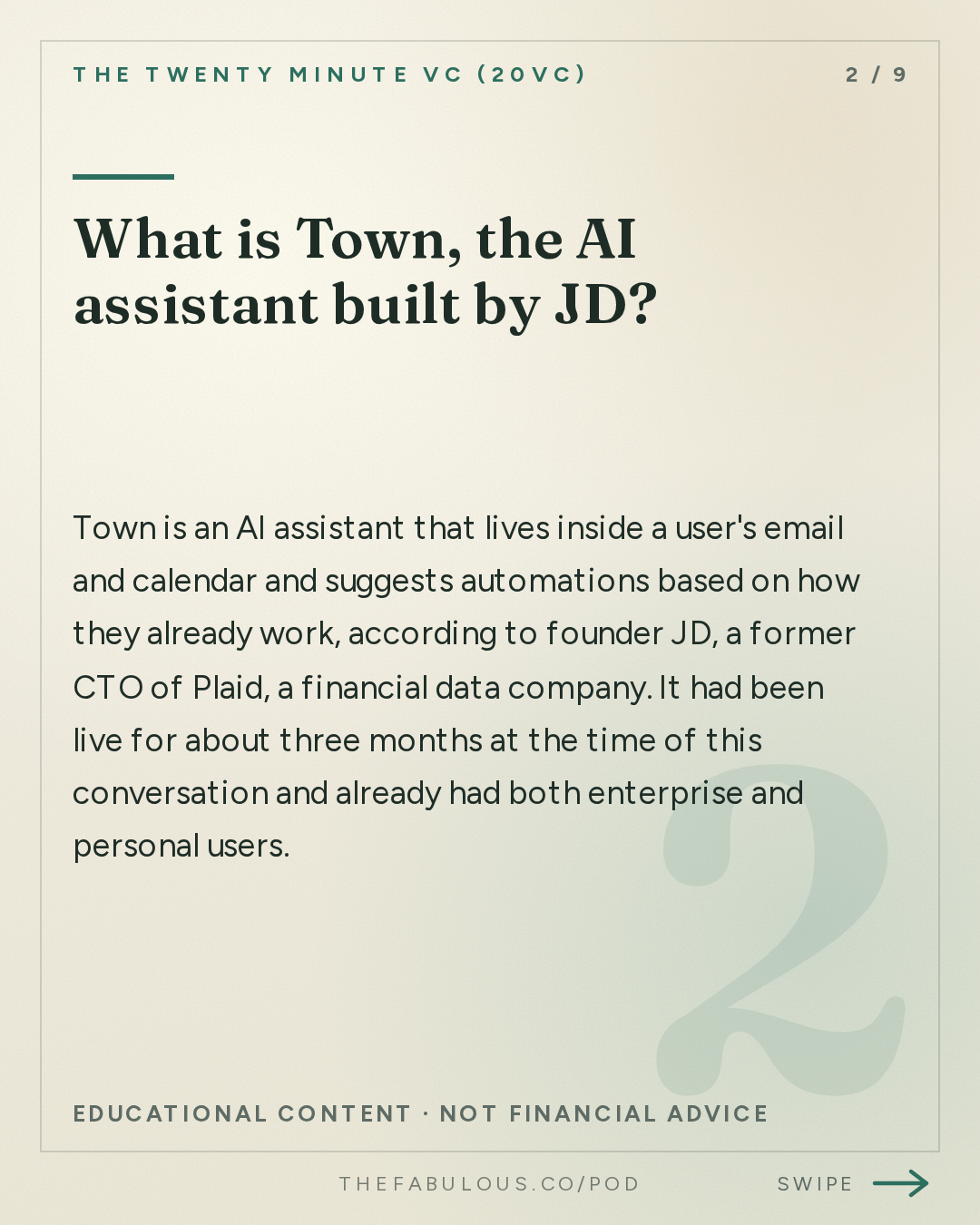
Town is an AI assistant that lives inside a user's email and calendar. It watches how someone already organizes their day, then suggests automations that quietly do parts of that work for them (04:26). JD arrived here by accident. He and his team spent a year building an AI tax-prep company, got some traction, and concluded it would never be a great business (05:13). They spent three months in what he calls "the wilderness" before noticing that almost nobody had built a serious AI product that operates out of email. The timing mattered: Anthropic's Opus model had just become capable of real multi-step, agentic work, not just a few isolated steps (05:51). A two-week prototype found product-market fit almost immediately.
Moats Are a Luxury
Ask most founders about defensibility and they reach for a tidy answer. JD refuses the premise. "Talking about moats is a little bit of a luxury," he says, "and you have to be more successful than Town is today for it to matter" (07:53). His actual plan is blunter: get to product-market fit so deep that scale becomes its own kind of protection. Underneath that, though, he does have a thesis about what eventually wins. He calls it the agent-level network effect. Inside Town, a user's assistant, nicknamed a "townie," can notice it doesn't know an answer and go ask a coworker's townie instead.
"I think the product in this category that will win will have a network effect at the agent level." — JD [00:00]
Once a whole team is wired together this way, JD argues, switching products stops being a software decision and starts being an organizational one. He thinks no company, including his own competitors, has genuinely solved multiplayer AI yet (08:50). It's a bet, not a fact, but it explains why Town's roadmap looks less like feature-shipping and more like plumbing between people.
That plumbing depends on trust, and JD's boldest claim in the conversation is about where that trust is going. He imagines a near future where a person's agent decides, on its own, what information is safe to hand to someone else. He offers a small, specific scene: two friends ask your agent about your medical history as a joke, and the agent simply declines, without ever having been told that rule explicitly (13:02). He extends the logic past privacy into corporate life, arguing that large language models, the AI systems trained to predict and generate text, will eventually make far fewer data-sharing mistakes than the humans who currently do that filtering by hand, the coworker who replies to the whole company instead of a small group, the HR staffer who shares a salary spreadsheet with everyone by accident (18:09).
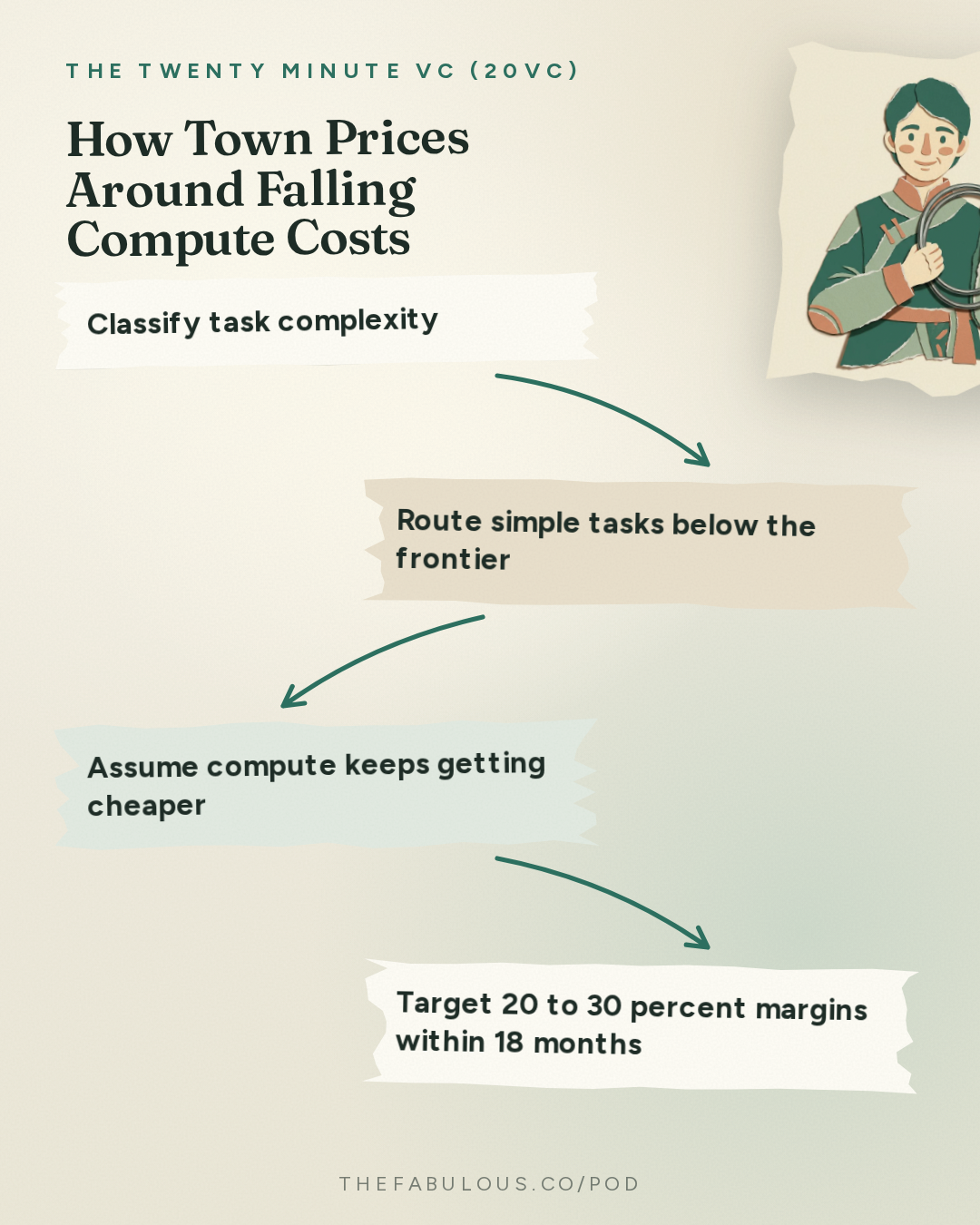
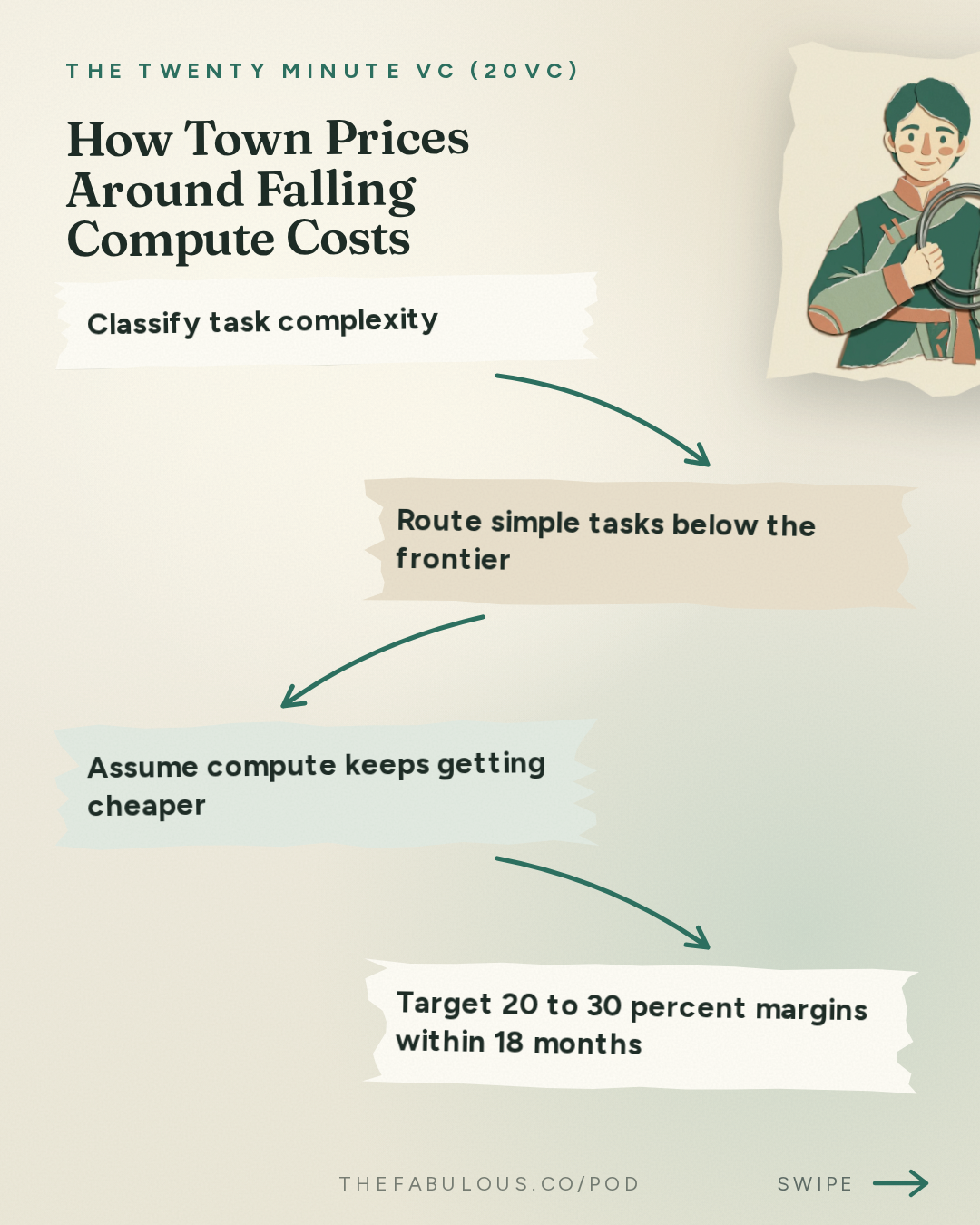
None of this works if the economics don't work, and Town's numbers are unusually specific for a three-month-old product. JD prices Town's subscription tiers at $14, $49, $99, and $199 a month, on the assumption that compute costs roughly halve every nine to twelve months, which is why he expects the business to reach 20 to 30 percent margins within eighteen months even though it is not there today (25:02). Simple tasks, like labeling an email, already run on models well below the frontier, the most capable and most expensive models currently available. Complex custom workflows still eat frontier compute, and that gap, not raw usage, is what determines a company's margin ceiling. Voice is the sharpest version of this problem: ElevenLabs, a voice-AI company, sounds better than open alternatives but charges accordingly, and JD says he doesn't yet know whether voice quality will plateau before the price does (47:05).
Learning at the Speed of Humans
The single most striking claim in the conversation isn't about moats or margins. It's about tempo. "You can build now at the speed of machines," JD says, "but you can only learn at the speed of humans" (00:19). In the old startup playbook, a company that shipped a good feature first got months, sometimes years, to learn from it before a competitor caught up. JD says that window has collapsed to two to four weeks. When Town launched, he counted roughly fifteen startups worth worrying about. Within two quarters, that list shrank to two or three, not because most of them failed, but because the pace of imitation made a crowded field consolidate almost overnight (34:10).
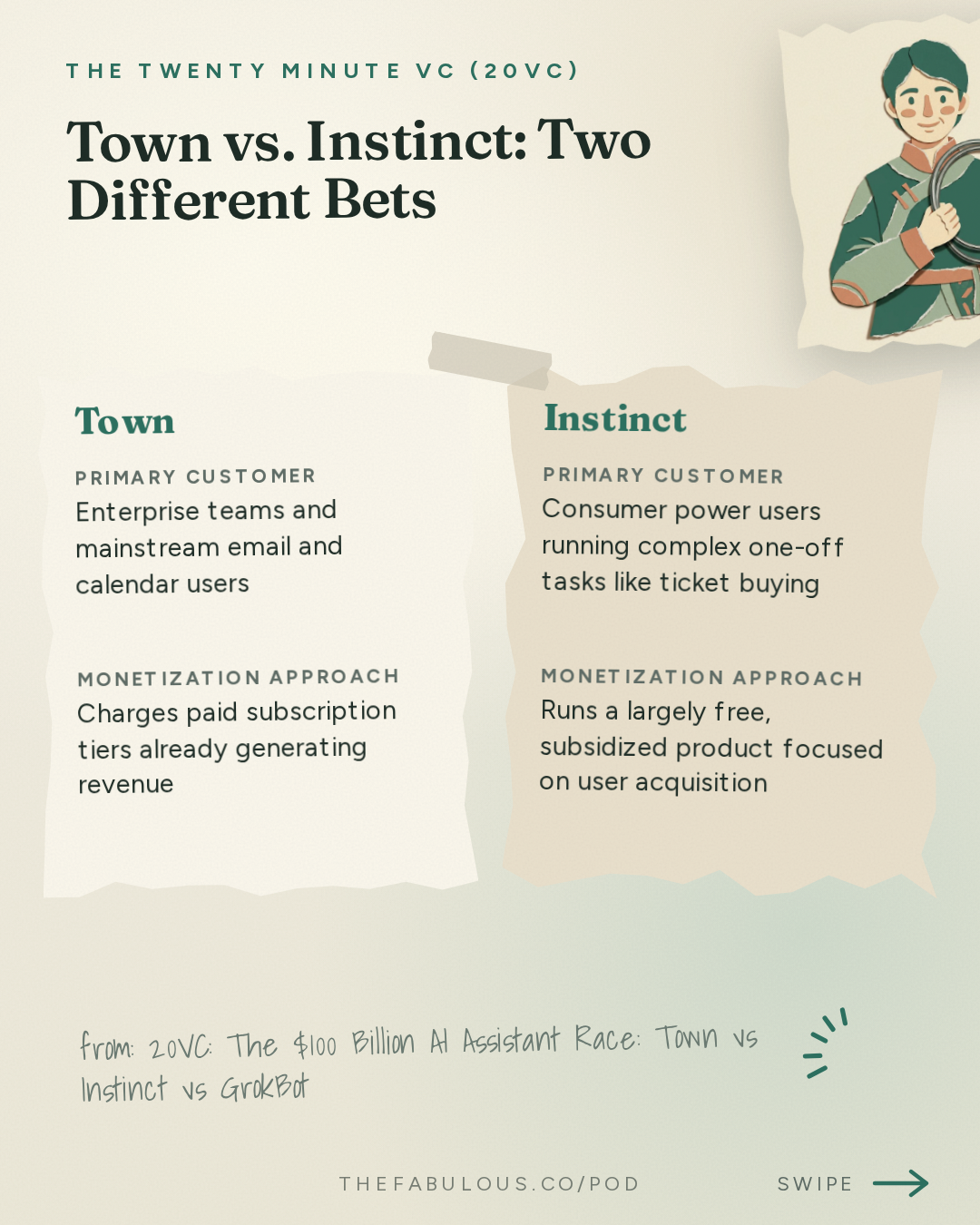
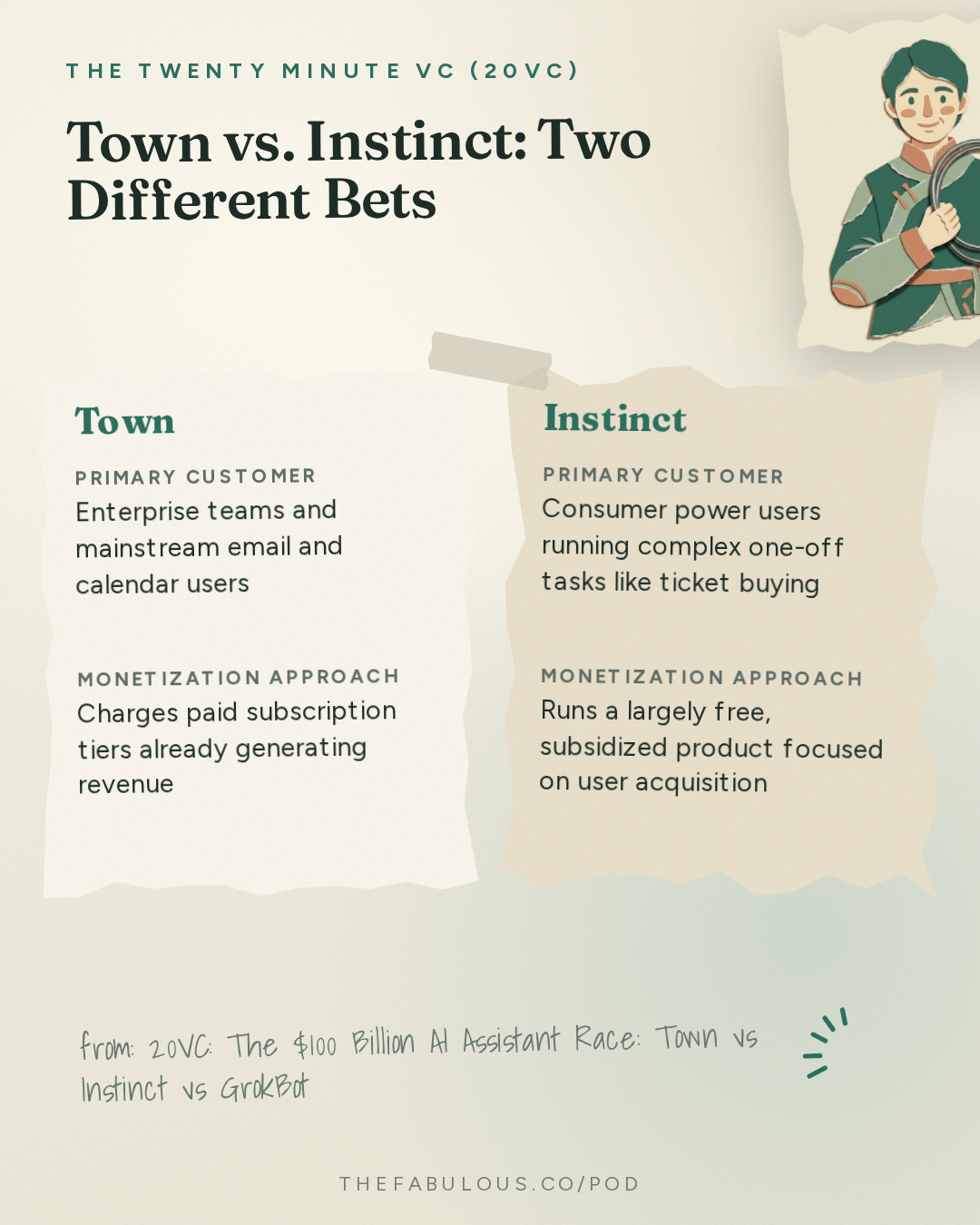
That pressure shapes who JD watches. He says Town and the well-funded consumer assistant Instinct, which has reached a $2.5 billion valuation without a clear monetization plan (00:40), aren't really competing for the same customer: Town generates revenue from companies using it for work with network effects across team members, while he sees Instinct's strategy as more about customer acquisition with a product that is currently fully subsidized (36:03). He pays closer attention to GrokBot, built by Elon Musk's AI company, because it aims at a similar mainstream audience to Town's, even if he thinks its association with the X platform will put off some professional users on brand grounds alone.
"I think brand for them, I think some people just won't wanna touch it because of brand." — JD [36:55]
Underneath all of this is a simple test JD applies to his own product: does someone keep paying every month? He is openly wary of judging success by token usage, the volume of AI computation a user consumes, because more usage doesn't always mean more value. Early in Town's beta, before pricing existed, one user racked up $26,000 in compute costs over five months, with no natural brake on the spending (60:34). That experience pushed Town toward what JD calls a hard paywall: new users must connect their email and calendar before they can use the product at all, because without that access Town can't see enough to be useful. The requirement costs Town about 30 percent of prospective users on the spot (52:12), but the users who stay convert to paying customers at a rate above 15 percent, which JD calls unusually high for a product-led growth motion (50:26).
The most unexpected market Town found wasn't enterprise at all. It was families, parents drowning in school portals, sports schedules, and haircut appointments, a group with real willingness to pay but a smaller budget than a mid-market company (52:19). JD is still arguing internally about how much attention that segment deserves. It's a small tension that says something larger about building in this category: the technology moves fast enough that product-market fit shows up in places nobody planned for, and the discipline is deciding what to chase.
"Success for me is you pay me and you trust that we're the right platform that helps you both use AI but do so efficiently." — JD [43:49]
That discipline extends to headcount. JD says Town's run rate is at least $75,000 per engineer per year on AI tools like Devon, Claude, Cursor, and Codex (63:55), a number that would have sounded absurd three years ago and now reads, in his telling, as an obvious trade: AI-augmented engineers generate enough extra revenue that the tooling pays for itself many times over. It's a small, concrete number in a conversation full of large, unresolved bets, agent-to-agent trust, privacy norms, model economics, and it may be the most durable one. Everything else in the AI assistant race is still being negotiated in real time, at a speed no one, including JD, claims to fully control.
Ask this episode anything
Pod's AI answers from the episode itself, with the minute mark so you can hear it yourself.
Or start with one of these
Ask this episode
Pod's AI listens to the whole episode to answer, and points you to the minute it comes from.
The rest of this answer, and any question after it
Answers come from the episode itself, never from a summary of it.
ContinueKey takeaways
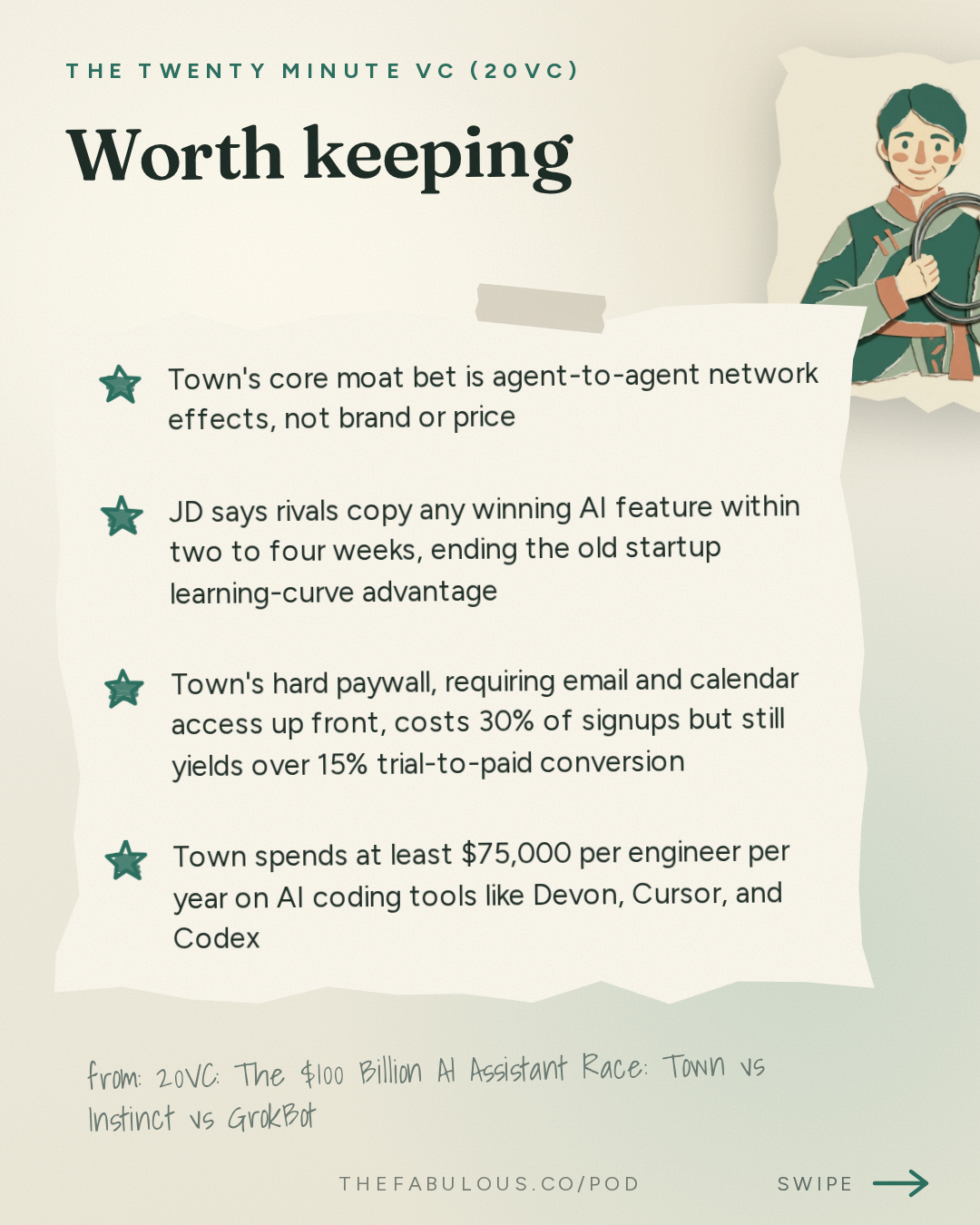
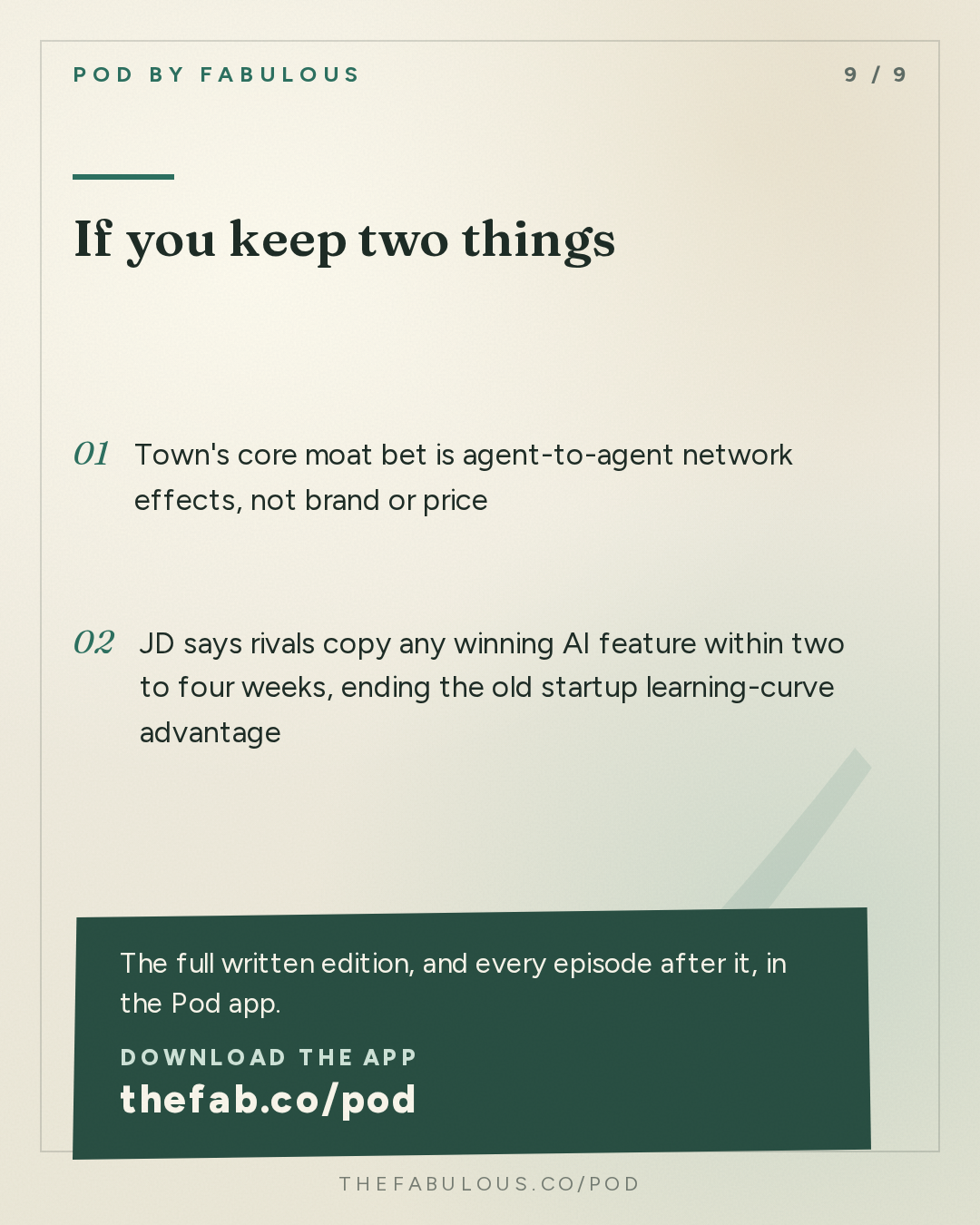
- Town's core moat bet is agent-to-agent network effects, not brand or price
- JD says rivals copy any winning AI feature within two to four weeks, ending the old startup learning-curve advantage
- Town's hard paywall, requiring email and calendar access up front, costs 30% of signups but still yields over 15% trial-to-paid conversion
- Town spends at least $75,000 per engineer per year on AI coding tools like Devon, Cursor, and Codex
- Town's biggest unexpected product-market fit came from families managing school and sports schedules, not its enterprise target
The episode in cards
By the numbers
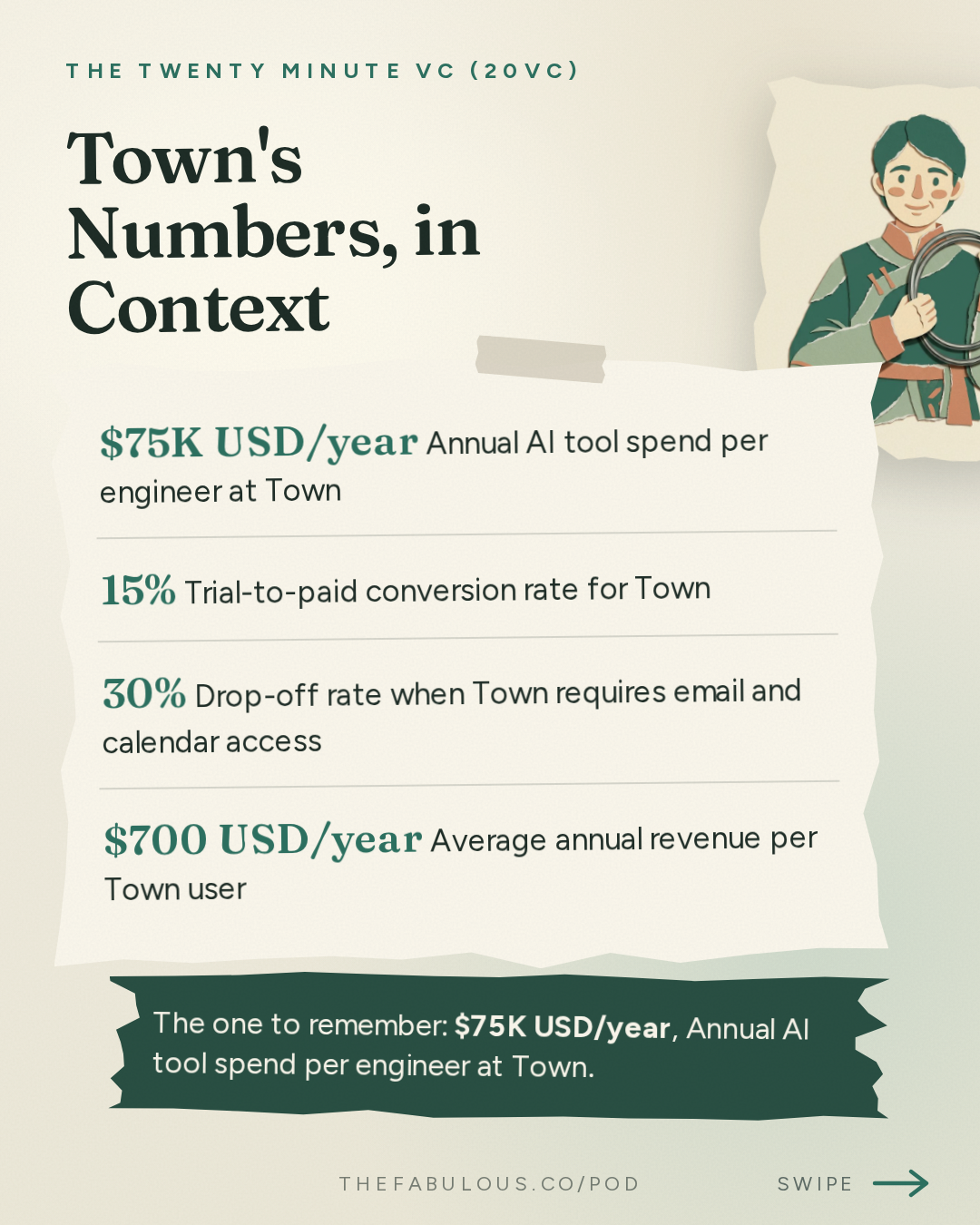
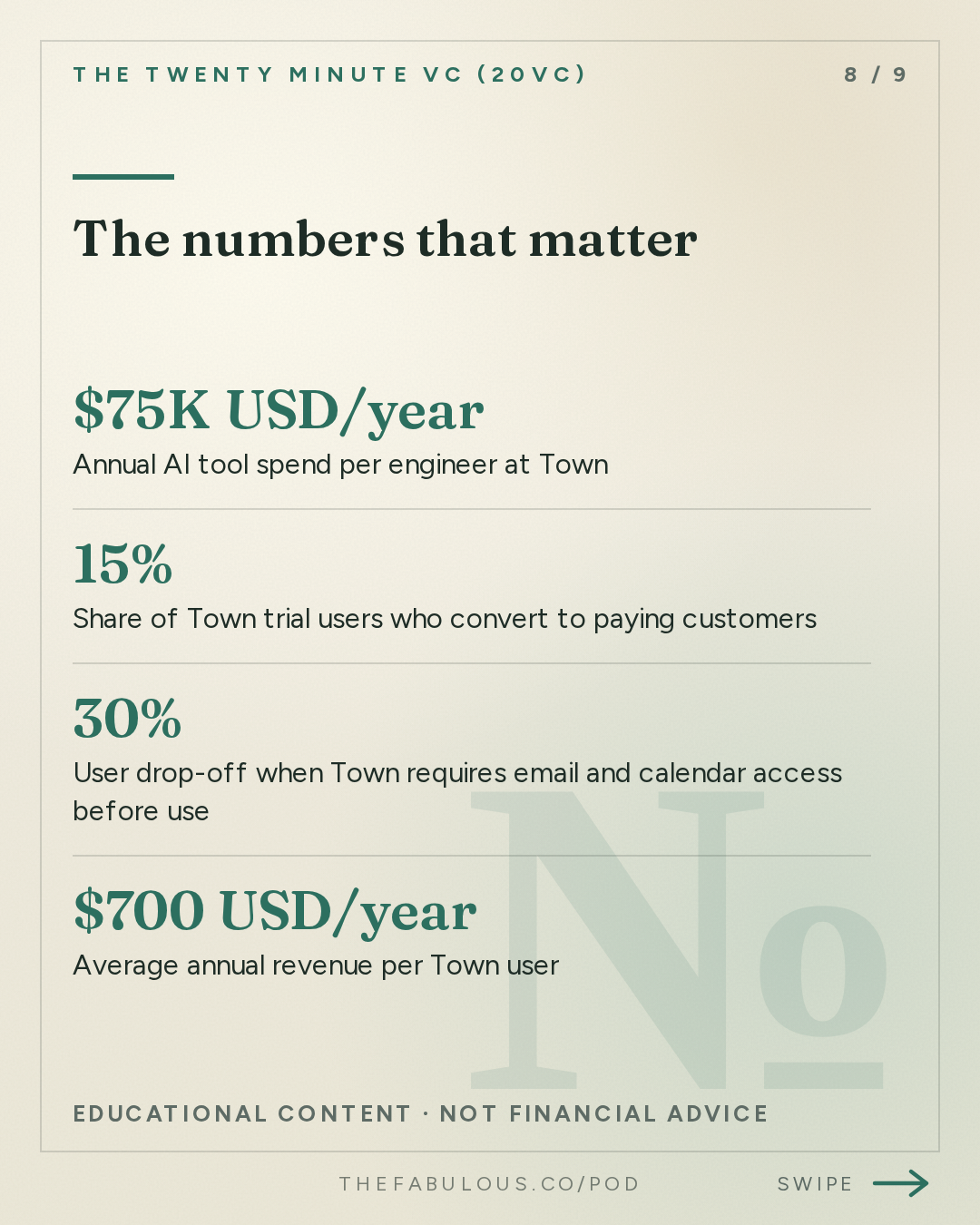
- $75K USD/year Annual AI tool spend per engineer at Town
- 15% percent Share of Town trial users who convert to paying customers
- 30% percent User drop-off when Town requires email and calendar access before use
- $700 USD/year Average annual revenue per Town user
In their words
“I think the product in this category that will win will have a network effect at the agent level.”
“You can build now at the speed of machines, but you can only learn at the speed of humans.”
“Success for me is you pay me and you trust that we're the right platform that helps you both use AI but do so efficiently.”
“I think brand for them, I think some people just won't wanna touch it because of brand.”
Protocols
-
Price for the compute costs of eighteen months from now
JD sets Town's subscription prices today assuming compute costs roughly halve every nine to twelve months, so the product is designed to reach 20 to 30 percent margins within eighteen months even though frontier model costs make it run thinner than that today.
Ongoing pricing policy
-
Require a hard paywall before users see any value
JD requires every new Town user to connect their email and calendar before they can use the product at all, which causes about 30 percent of people to leave immediately but lets Town build enough context to convert more than 15 percent of the remaining trial users into paying customers.
At signup
-
Skip the technical interview for vouched hires
JD skips the technical interview for an engineering candidate whenever a trusted team member says that person is one of the best people they have ever worked with, and Town uses the interview slot to sell the candidate on joining rather than to evaluate their skills.
Per hire
Questions this episode answers
What is Town, the AI assistant built by JD?
Town is an AI assistant that lives inside a user's email and calendar and suggests automations based on how they already work, according to founder JD, a former CTO of Plaid, a financial data company (04:26). It had been live for about three months at the time of this conversation and already had both enterprise and personal users (04:49).
How is Town different from Instinct and GrokBot?
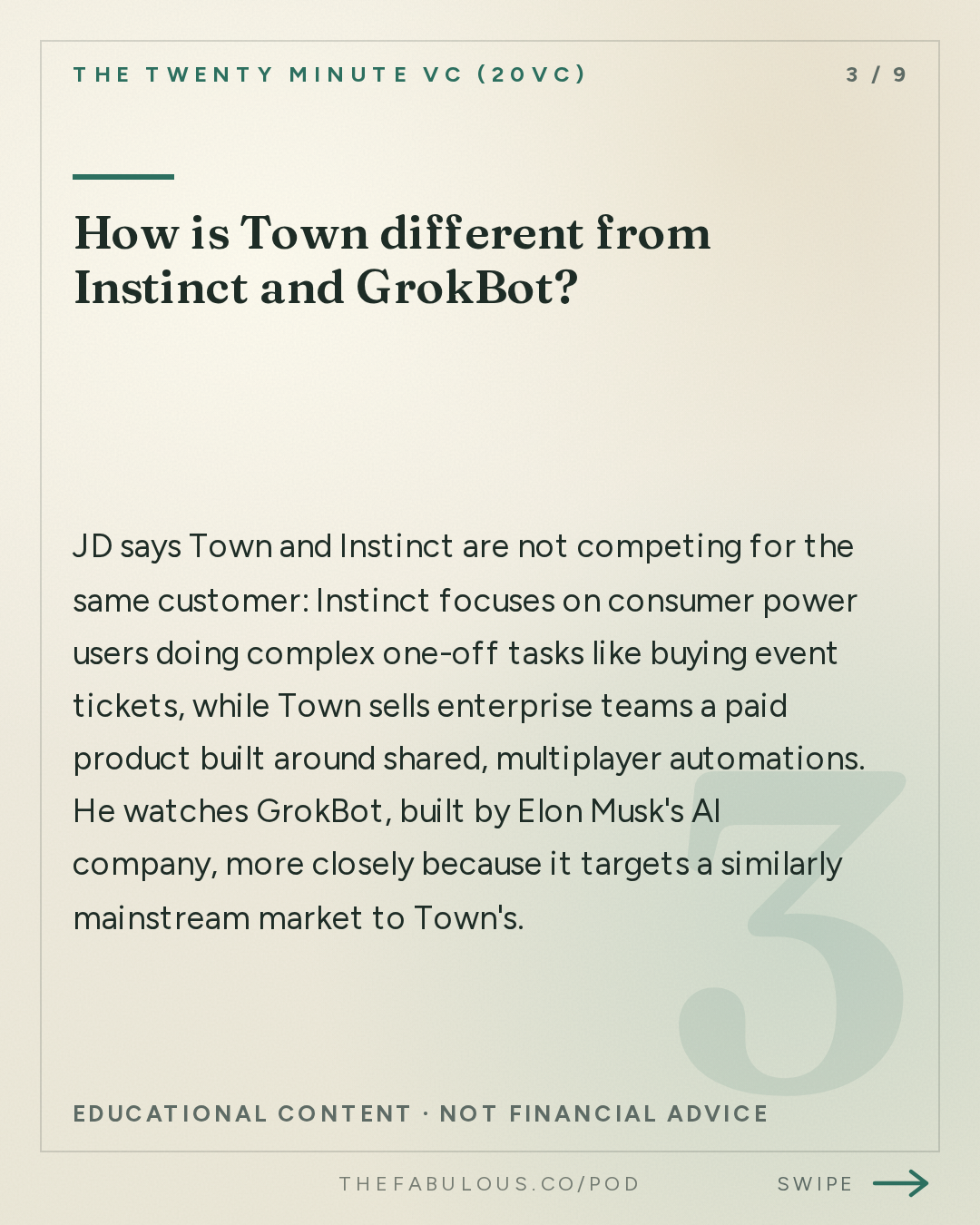
JD says Town and Instinct are not competing for the same customer: Instinct focuses on consumer power users doing complex one-off tasks like buying event tickets, while Town sells enterprise teams a paid product built around shared, multiplayer automations (25:22, 36:03). He watches GrokBot, built by Elon Musk's AI company, more closely because it targets a similarly mainstream market to Town's (36:21).
Why do AI startups spend so much on AI coding tools per engineer?
JD says Town's run rate is at least $75,000 per engineer per year on tools like Devon, Cursor, Claude, and Codex, because AI now lets a single engineer generate meaningfully more revenue than before, which makes the tooling spend pay for itself (63:55, 64:04).
What is the agent-to-agent network effect in AI assistants?
It is JD's theory that the real moat in the AI assistant category will come from assistants communicating with each other on a user's behalf, for example one person's assistant asking a coworker's assistant for information it does not have (08:44). He argues that no company has fully solved multi-user, multiplayer AI yet, which is why he expects this feature to be hard to copy.
Why does Town require users to connect email and calendar before they can use it?
JD calls it a hard paywall: without that access, Town cannot see enough about a person's work to suggest anything useful, so it requires the connection up front rather than easing users in gradually the way ChatGPT does (51:45, 52:01). The requirement causes about 30% of new users to leave immediately, but the users who stay convert to paying customers at over 15%, which JD calls exceptionally high for a product-led growth motion (52:12, 50:26).
The full read, in cards
Mentioned
JD (Jean-Denis) · Harry Stebbings · Town.com · Plaid · Instinct · GrokBot · Anthropic · Elon Musk · ElevenLabs · Cursor · Devon · Meta · WhatsApp
More from this show and category

Is Venture Capital Broken? Billion-Dollar Math
Venture capital has split into two games: mega-funds need billion-dollar stakes in a handful of AI giants, while strong smaller startups go unfunded. CoreWeave slid 15-20% on AI demand fears (13:35), Anthropic posted $16.8B in Q3 revenue (19:07), Modal raised $750M at $15.75B (32:03), and Anduril trades near 40 times revenue at a $90B valuation (38:44).

Sameer Dholakia on Bessemer's AI Investing Playbook
Bessemer's Sameer Dholakia explains why his firm paid roughly 150x ARR for Anthropic, and why capital itself is now a moat in AI investing. He prices deals on next-twelve-months revenue, targets 10 to 15 times NTM multiples, and says Bessemer's new $5.75 billion in funds reflects venture splitting into giant platforms and extreme specialists.

Harrison Chase on Why AI Agents Are So Hard to Build
LangChain founder Harrison Chase says AI agents break because models are unpredictable black boxes, not because they are weak. The fix, he argues, is a model-neutral 'harness,' the code layer that routes tasks, manages memory and controls token costs, with vertical, domain-specific agents built to outperform horizontal ones.

Pro Rata Lawsuit: Valar Atomics vs Day One VC
Day One Ventures and Valar Atomics are fighting over pro rata rights in a $6 billion nuclear-startup round, exposing how waivers actually work in venture capital. The panel also covers Meta's new Muse Wonder model, NVIDIA's reported bid for Reflection, Jev's $870 million round, Anthropic's price cuts, and software's rising IPO bar.
