
Essential Amino Acids and Muscle Protein Synthesis
Essential Amino Acids Explained: Protein Quality, Leucine, BCAAs and How Much You Need
▶ Listen to the full episode More from The Dr. Gabrielle Lyon Show
The brief
The body doesn't have a protein requirement, it has an essential amino acid requirement: nine amino acids it cannot make itself (01:33). Animal foods pack more of them per gram than plants do (07:39), aging raises the dose needed to trigger muscle building (17:27), and about 30 grams of protein usually clears the 2.5-gram leucine threshold that switches on recovery (11:35).
Pick up a tub of hemp protein powder and the label will tell you, with great confidence, that one scoop contains fifteen grams of protein. What it will not tell you is what that protein is actually made of, or whether your body can use it. That number, a guest nutrition scientist explains on this episode, is really a measure of nitrogen content, not amino acid quality (06:08). It is a bit like judging a car by the weight of its chassis and saying nothing about the engine.
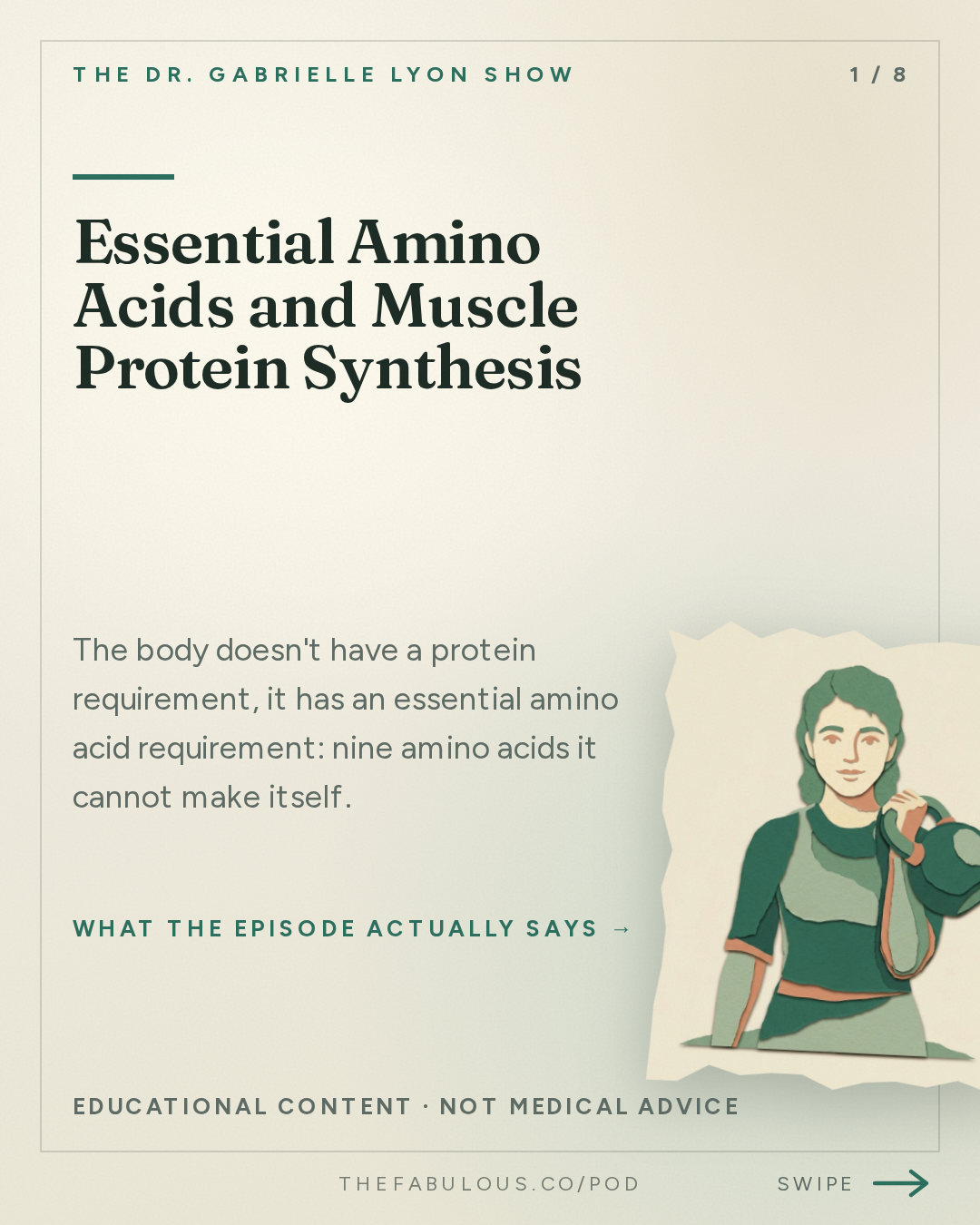
This episode, a compilation of conversations Dr. Gabrielle Lyon has had with protein researchers, keeps returning to one reframe: there is no such thing as a protein requirement. There is an essential amino acid requirement. The body needs twenty amino acids to build its proteins and run its metabolism. It can manufacture eleven of them on its own. The other nine, called essential or indispensable, have to come from food (01:33). Protein, in this telling, is not the nutrient that matters. It is the delivery truck.
"We don't have a protein requirement, but what we really have is an essential amino acid requirement." (00:59)
Those nine amino acids do far more than build muscle. Leucine supplies nitrogen the body uses to make arginine, which helps regulate blood pressure. Tryptophan feeds serotonin production, which shapes sleep and mood. Phenylalanine is a building block for dopamine, tied to cognitive function. Methionine supports glutathione, the body's main defense against oxidative stress (02:21, 02:47). A research field fixated on whether protein changes lean body mass, the guest argues, misses all of this. Amino acids being used for serotonin or dopamine are not wasted amino acids. They are amino acids doing their other jobs.
Why the Label Lies
The gap between quantity and quality shows up starkly in the government's own Dietary Guidelines for America, which translate protein intake into "ounce equivalents." A half-ounce of nuts and an ounce of lean beef count as the same unit. But that half-ounce of nuts delivers about four grams of protein and only one gram of essential amino acids, while the ounce of beef delivers nine grams of protein and about 3.5 grams of essential amino acids (07:05). The quantities look comparable on paper. They are not comparable in what the body can actually use.
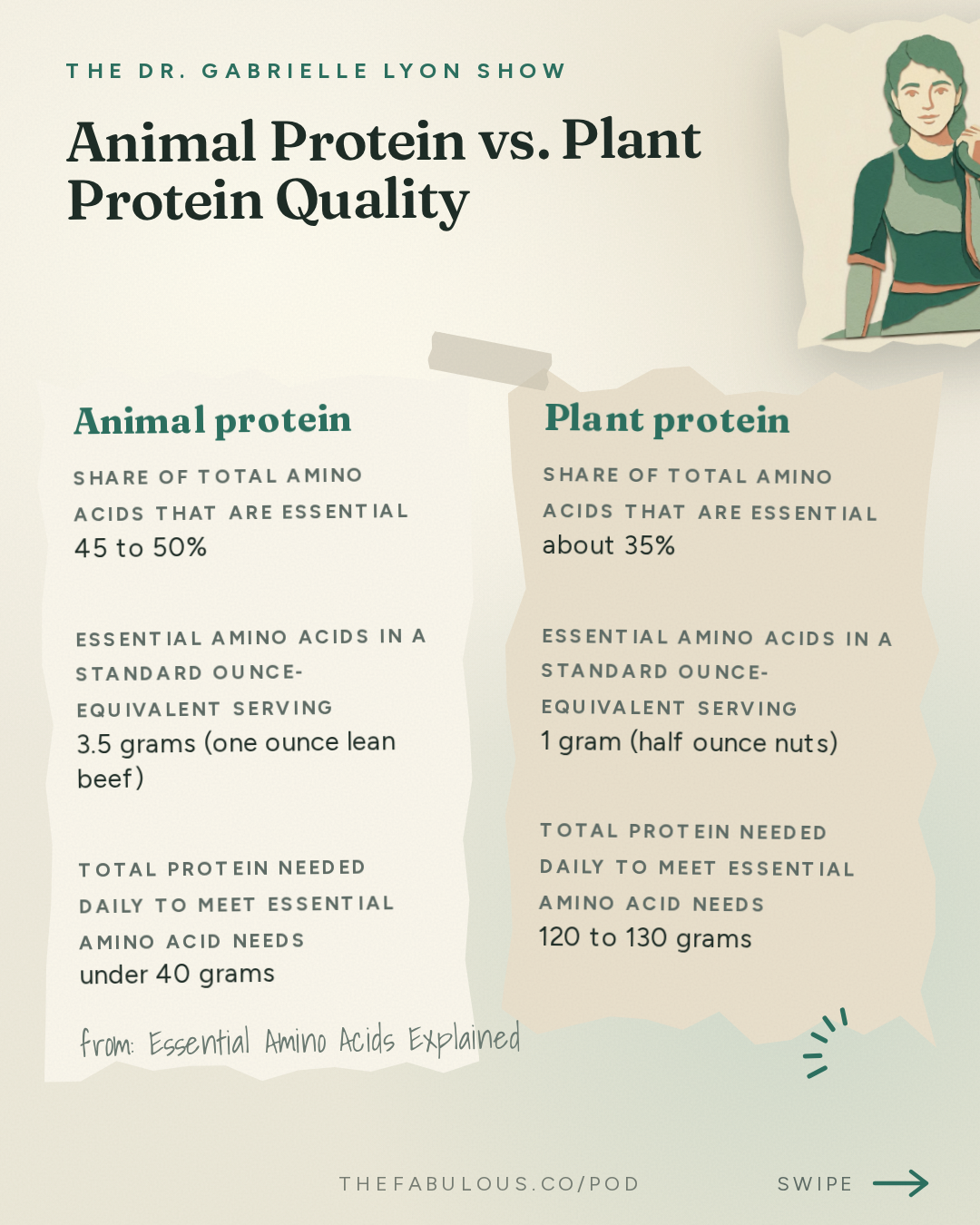
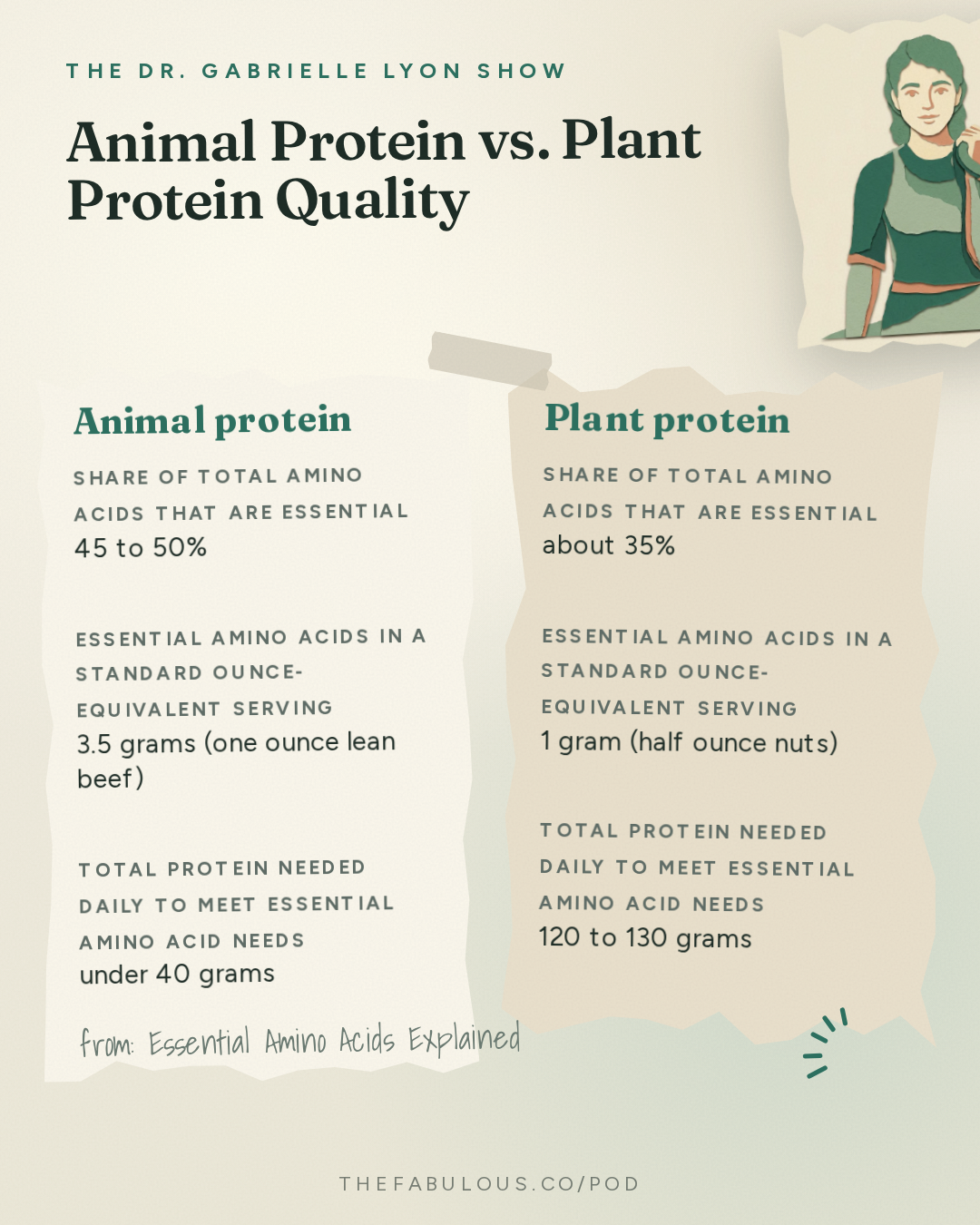
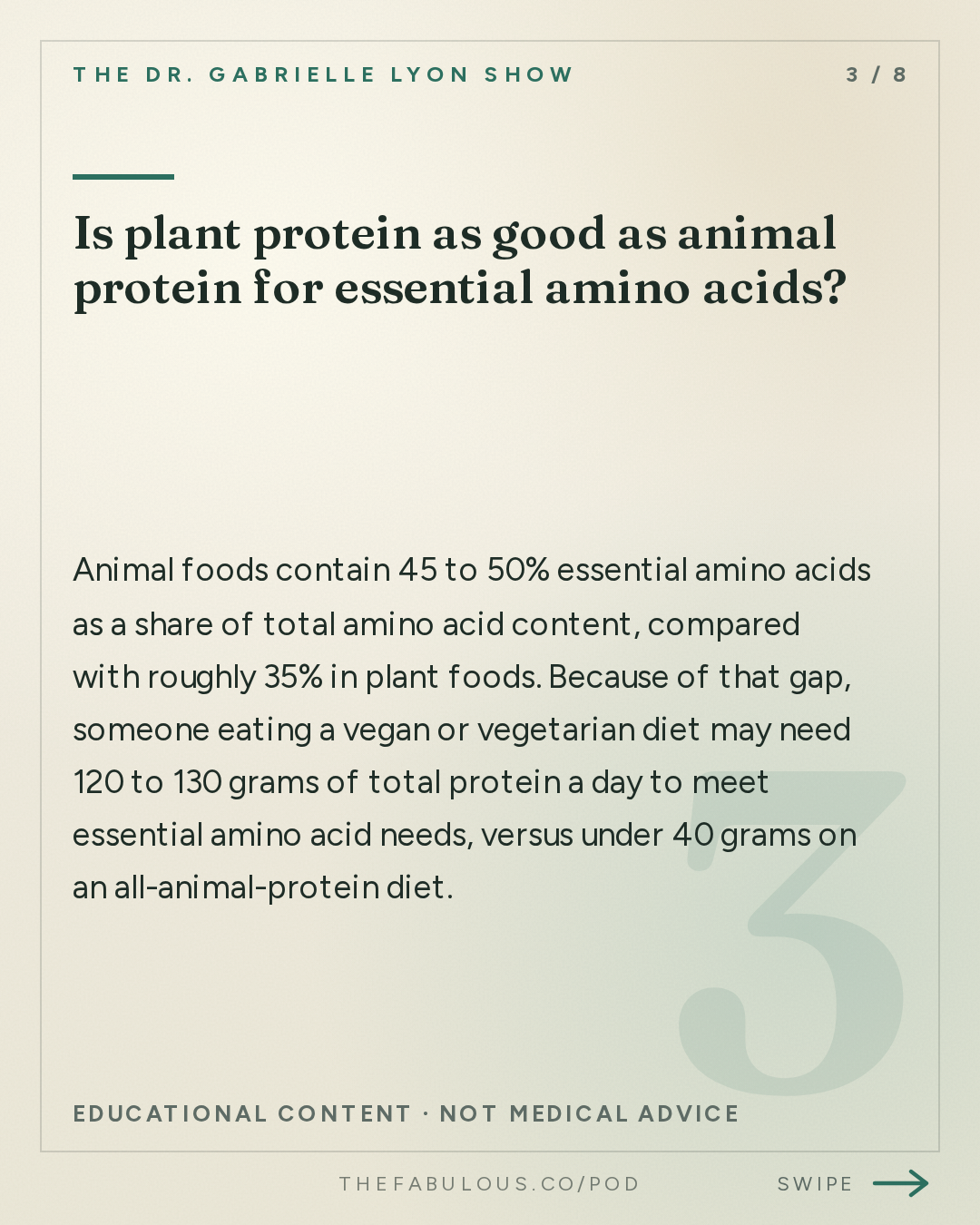
Zoom out and the pattern holds. In animal foods, essential amino acids make up 45 to 50 percent of total amino acid content. In plant foods, it is closer to 35 percent (07:39). National survey data (NHANES) shows that when people shift toward plant-based eating, they tend to shift toward grains rather than beans, lentils, nuts, or seeds, which drags quality down further (08:07). Model the math and a diet built entirely on animal protein can meet essential amino acid needs with under 40 grams of protein a day. Drop below 50 percent animal protein, and the standard Recommended Dietary Allowance (RDA) for protein no longer covers essential amino acid needs. A vegan or vegetarian eater may need to reach 120 to 130 grams of total protein daily just to land in the same place (08:34, 09:13).
The Leucine Trigger
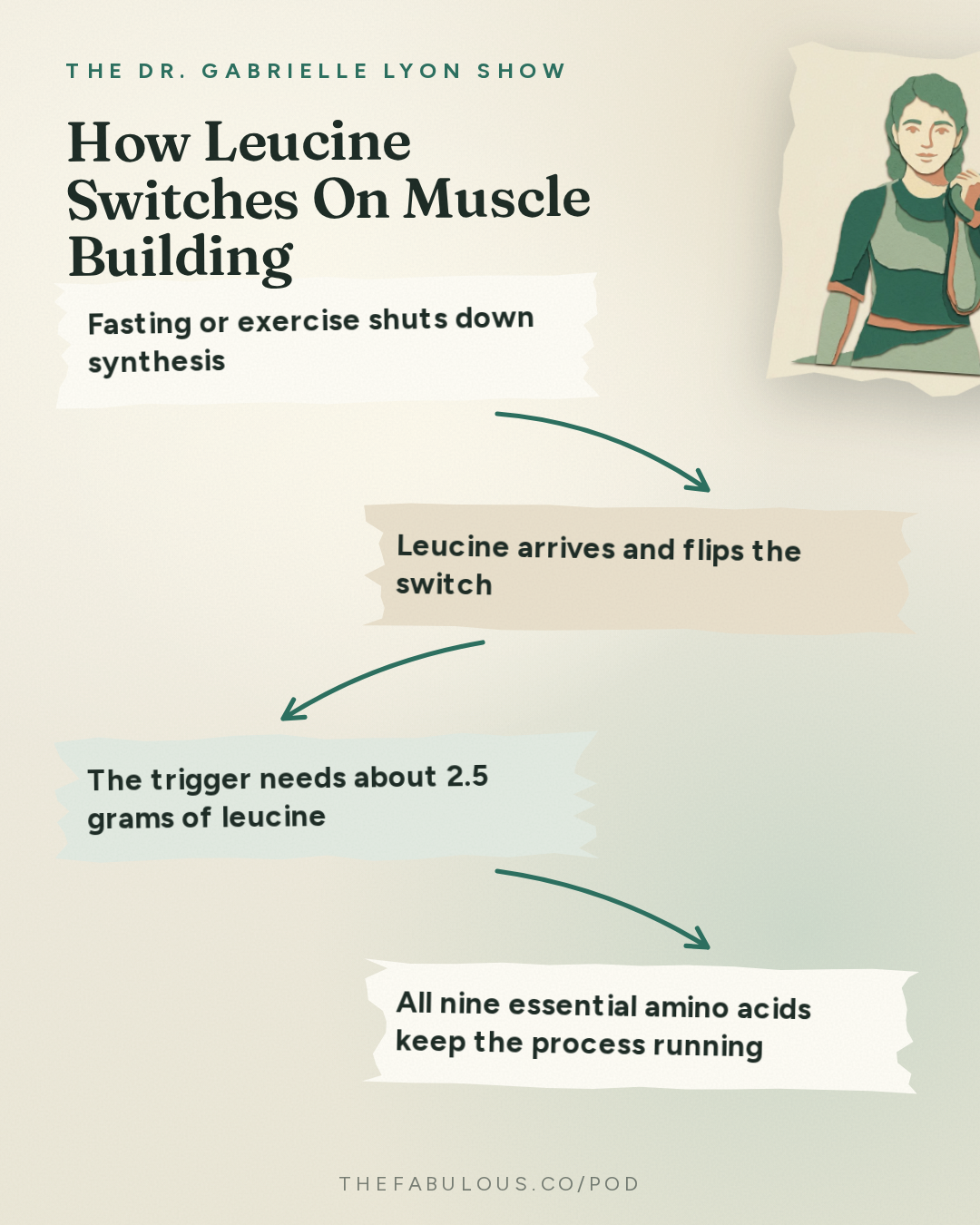
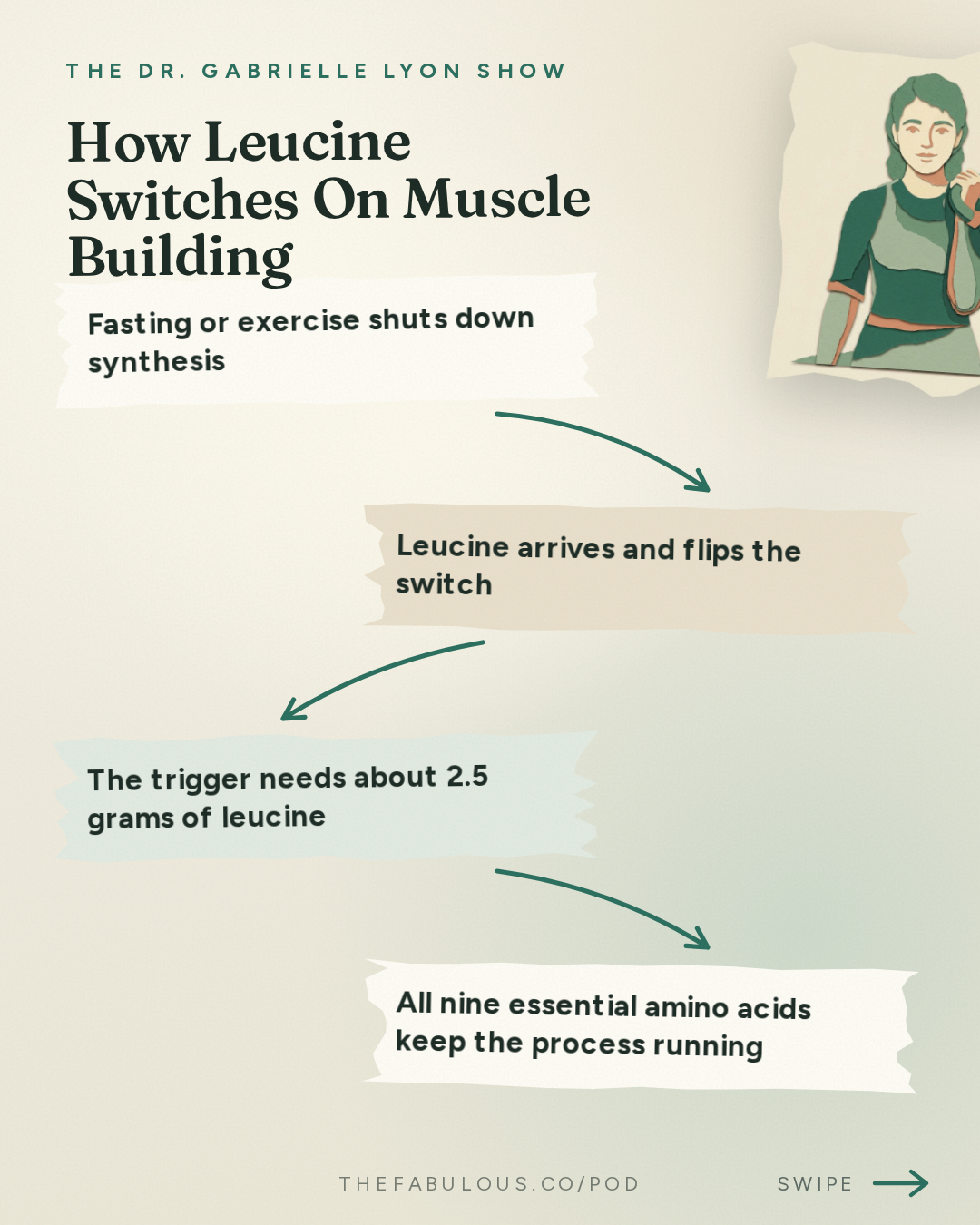
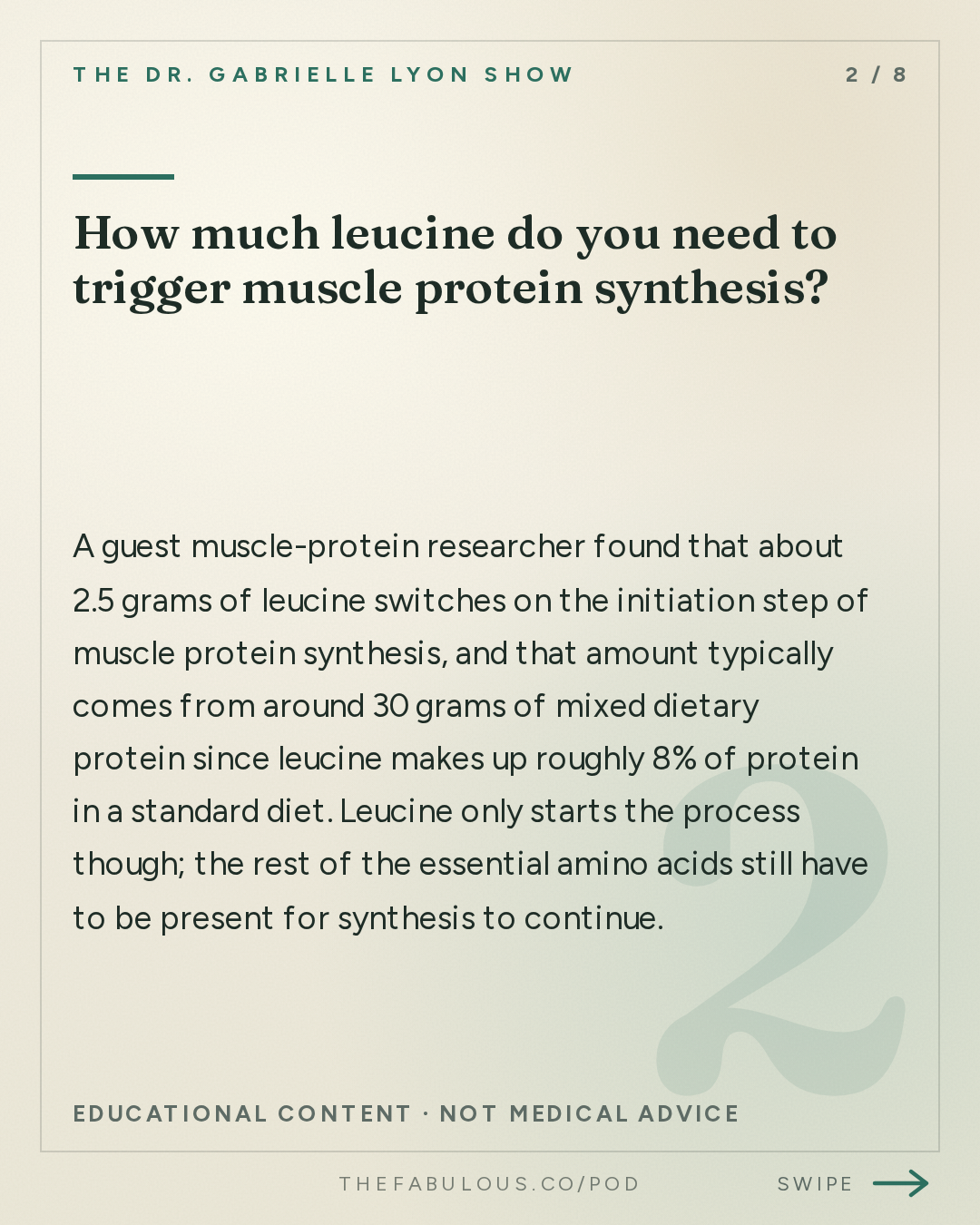
A second guest, a researcher who studies muscle protein synthesis, the process of building new muscle protein, shifts the conversation to leucine and mTOR, a cellular pathway that switches protein synthesis on. During an overnight fast or after endurance exercise, the body downshifts into an energy-saving, catabolic state, meaning it breaks down more protein than it builds. Leucine is what flips the switch back on (09:45, 10:21). The threshold for that switch is about 2.5 grams of leucine, which in a typical mixed American diet, where leucine makes up roughly 8 percent of protein, works out to about 30 grams of protein per meal (11:35).
"Leucine is a trigger to turn on the system for initiation, and as soon as you turn on the trigger, then you have to have all the amino acids to make it work." (12:03)
That line is the hinge of the whole episode. Leucine starts the engine. It does not run the engine. Branched-chain amino acid supplements, built around leucine and its two cousins, can nudge the starter, but building actual muscle tissue requires the full roster of essential amino acids working together. This is the researcher's answer to a common gym question: take the complete protein, not the isolated branched-chain amino acids, because only the complete protein has everything the trigger needs once it fires (12:31).
A separate study referenced on the episode tested this under real stress: five days of roughly 30 percent energy deficit combined with controlled exercise, comparing the standard sports-nutrition dose of 0.1 grams of essential amino acids per kilogram of body weight against a higher 0.3 grams per kilogram (14:20). The higher dose produced a better whole-body protein balance, the net difference between protein synthesis and protein breakdown across the entire body (15:05). But at the muscle level specifically, there was no statistically significant difference between the two doses. The likely explanation: the standard dose already supplied about eight grams of essential amino acids, which sits inside the 8 to 11 gram range the broader research literature identifies as the sweet spot for maximizing muscle protein synthesis (16:13). More helped the rest of the body. It didn't help the muscle further, because the muscle was already saturated.
Age changes that math. The literature, the researcher notes, points to a higher protein and essential amino acid requirement as people get older, driven by some combination of reduced ability to digest and absorb whole-food protein, and anabolic resistance, a reduced sensitivity of muscle tissue to the same dose of amino acids (17:27, 17:57). Older adults are also often eating fewer calories overall and moving less, which compounds the problem: less protein coming in, and a muscle that responds more sluggishly to what does arrive (19:02).
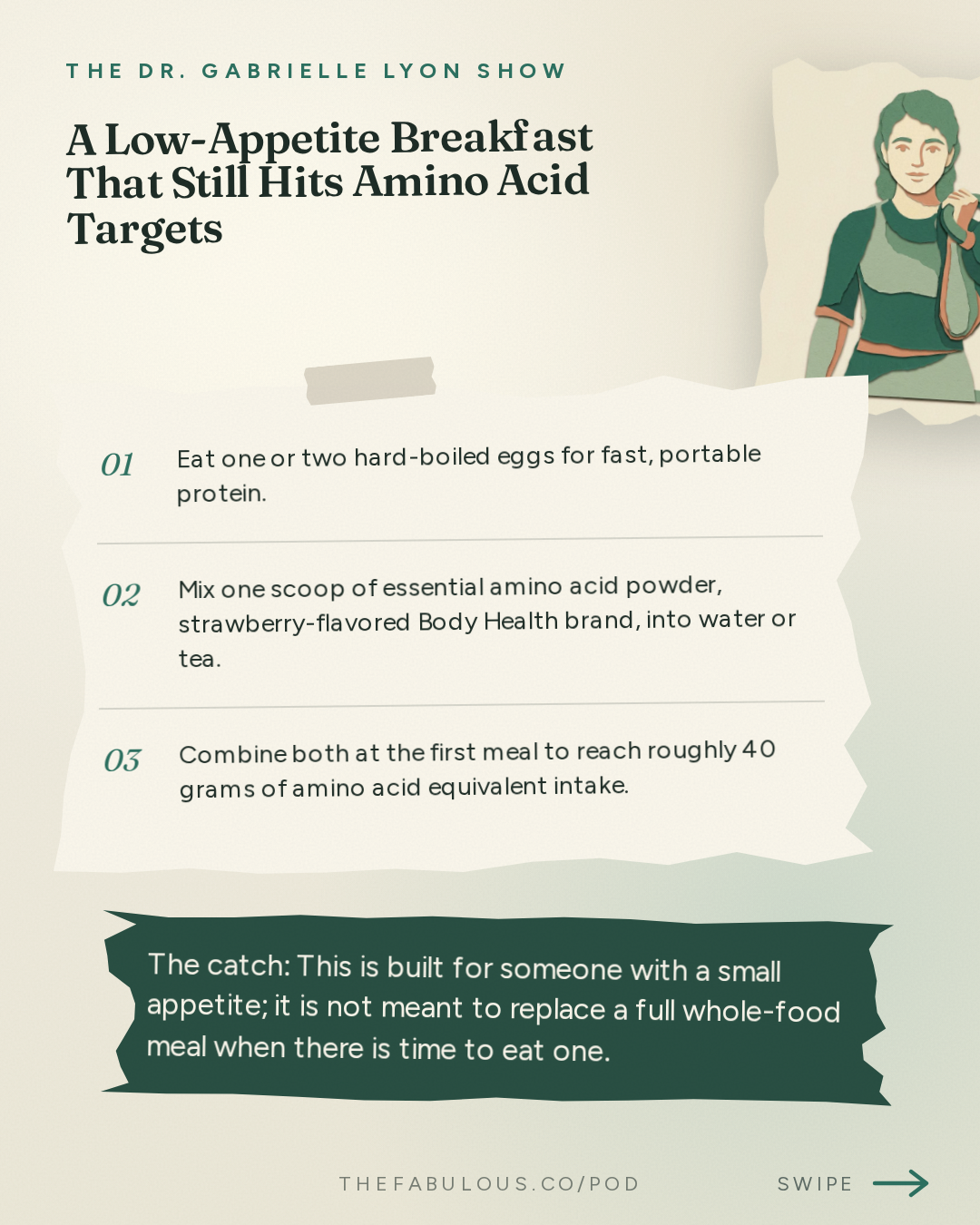
None of this is an argument against whole food. Both guests agree that a whole-foods approach delivers a nutrient matrix, meaning the vitamins and micronutrients that travel alongside protein in real food, that a powder cannot replicate (19:27). But when life does not cooperate, free-form essential amino acid powder becomes what one guest calls a tool in the toolbox, useful for a service member in the field without access to a kitchen, or for a parent rushing kids out the door (20:21, 20:56). Lyon offers her own version of that tradeoff: as a roughly 110-pound woman with a small morning appetite, she eats one or two hard-boiled eggs and stirs a scoop of essential amino acid powder into water or tea, landing at the nutrient equivalent of about 40 grams for her first meal (21:24, 21:49).
The episode closes on a line that functions as its thesis in miniature: start with whole foods, and when life gets in the way, let amino acid supplementation fill the gap (22:14). The deeper point underneath the logistics is a shift in how to think about protein altogether. Not as a single macronutrient to hit on a tracking app, but as a supply chain for nine specific molecules the body cannot build on its own, each with its own job, each with its own threshold, and each more necessary, not less, as the body ages.
Ask this episode anything
Pod's AI answers from the episode itself, with the minute mark so you can hear it yourself.
Or start with one of these
Ask this episode
Pod's AI listens to the whole episode to answer, and points you to the minute it comes from.
The rest of this answer, and any question after it
Answers come from the episode itself, never from a summary of it.
ContinueKey takeaways
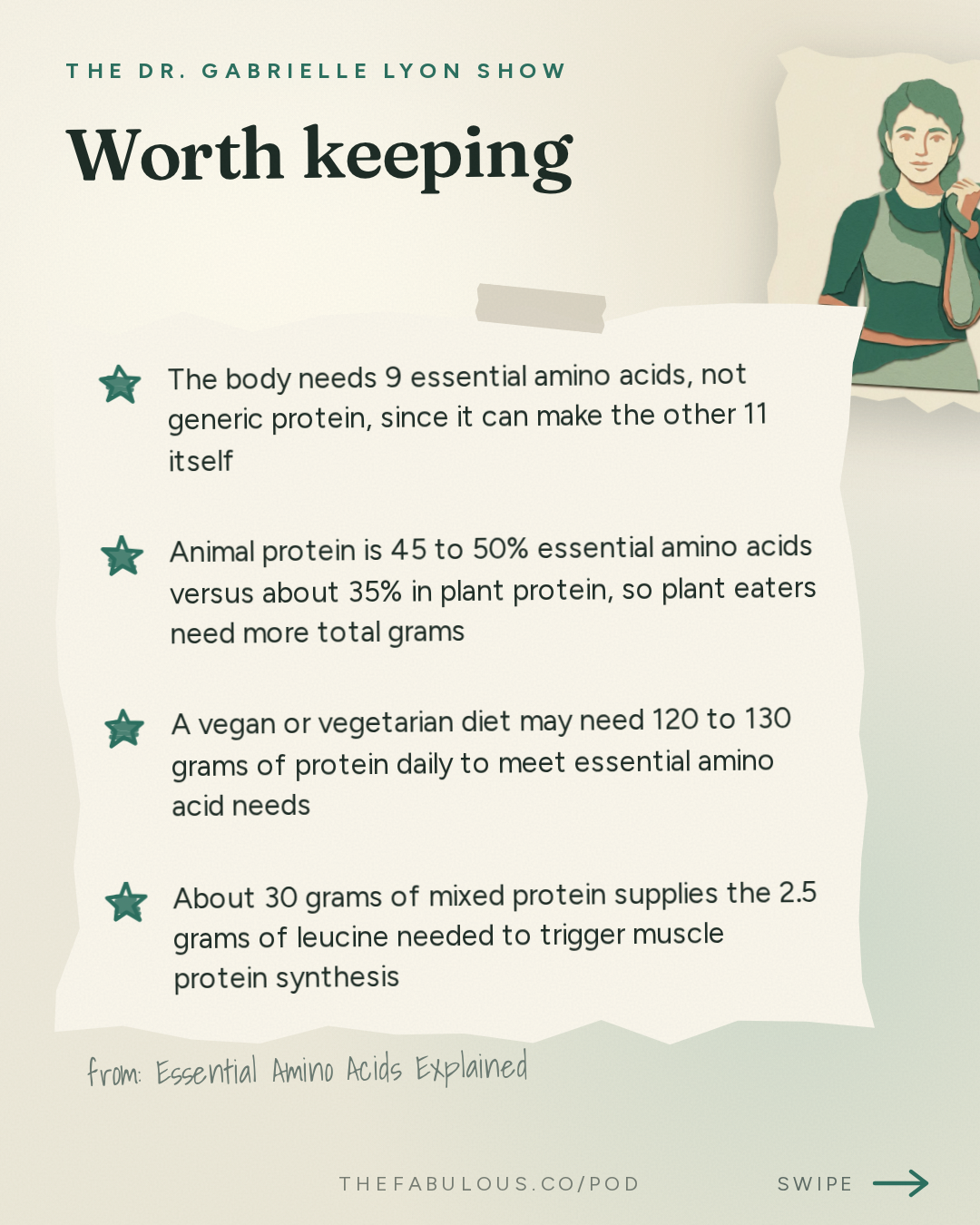
- The body needs 9 essential amino acids, not generic protein, since it can make the other 11 itself (01:33)
- Animal protein is 45 to 50% essential amino acids versus about 35% in plant protein, so plant eaters need more total grams (07:39)
- A vegan or vegetarian diet may need 120 to 130 grams of protein daily to meet essential amino acid needs (09:13)
- About 30 grams of mixed protein supplies the 2.5 grams of leucine needed to trigger muscle protein synthesis (11:35)
- Aging raises essential amino acid needs partly because of anabolic resistance, a reduced muscle response to the same dose (17:27)
The episode in cards
By the numbers
- 35% percentage share of total amino acids that are essential in plant foods
- 2.5 grams leucine needed to trigger muscle protein synthesis
In their words
“We don't have a protein requirement, but we, what we really have is an essential amino acid requirement.”
“What that label is telling you is the nitrogen content. So that protein gram amount doesn't speak to the essential amino acid content”
“Leucine is is a trigger to turn on the system for initiation, and as soon as you turn on the trigger, then you have to have all the amino acids to make it work”
“If you are with me and you believe that muscle is the organ of longevity, feed it to stay forever strong.”
Protocols
-
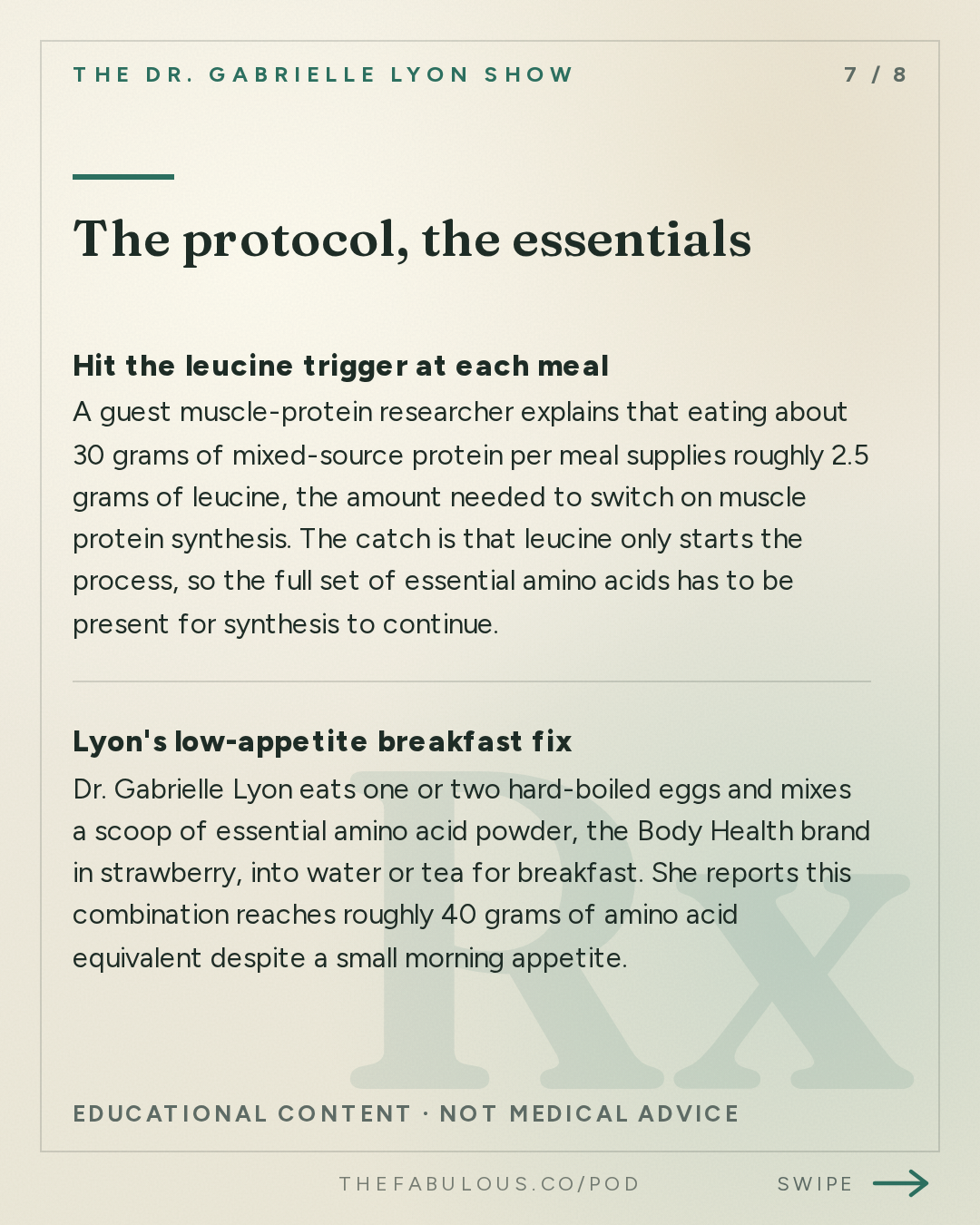
Hit the leucine trigger at each meal
A guest muscle-protein researcher explains that eating about 30 grams of mixed-source protein per meal supplies roughly 2.5 grams of leucine, the amount needed to switch on muscle protein synthesis. The catch is that leucine only starts the process, so the full set of essential amino acids has to be present for synthesis to continue.
Each meal, especially the first meal of the day or after endurance exercise
-
Lyon's low-appetite breakfast fix
Dr. Gabrielle Lyon eats one or two hard-boiled eggs and mixes a scoop of essential amino acid powder, the Body Health brand in strawberry, into water or tea for breakfast. She reports this combination reaches roughly 40 grams of amino acid equivalent despite a small morning appetite.
Daily, first meal of the day
-
Raise the essential amino acid dose under heavy stress
A guest researcher studying nutrition under physical and energy stress suggests considering about 0.3 grams of essential amino acids per kilogram of body weight, three times the standard sports-nutrition dose of 0.1 grams per kilogram, during intense exercise combined with a calorie deficit. The catch is that this higher dose improved whole-body protein balance but showed no significant extra benefit at the muscle level compared with the standard dose.
During periods of intense training or energy deficit, not necessarily daily
Questions this episode answers
How much leucine do you need to trigger muscle protein synthesis?
A guest muscle-protein researcher found that about 2.5 grams of leucine switches on the initiation step of muscle protein synthesis, and that amount typically comes from around 30 grams of mixed dietary protein since leucine makes up roughly 8% of protein in a standard diet (11:35). Leucine only starts the process though; the rest of the essential amino acids still have to be present for synthesis to continue (12:03).
Is plant protein as good as animal protein for essential amino acids?
Animal foods contain 45 to 50% essential amino acids as a share of total amino acid content, compared with roughly 35% in plant foods (07:39). Because of that gap, someone eating a vegan or vegetarian diet may need 120 to 130 grams of total protein a day to meet essential amino acid needs, versus under 40 grams on an all-animal-protein diet (09:13).
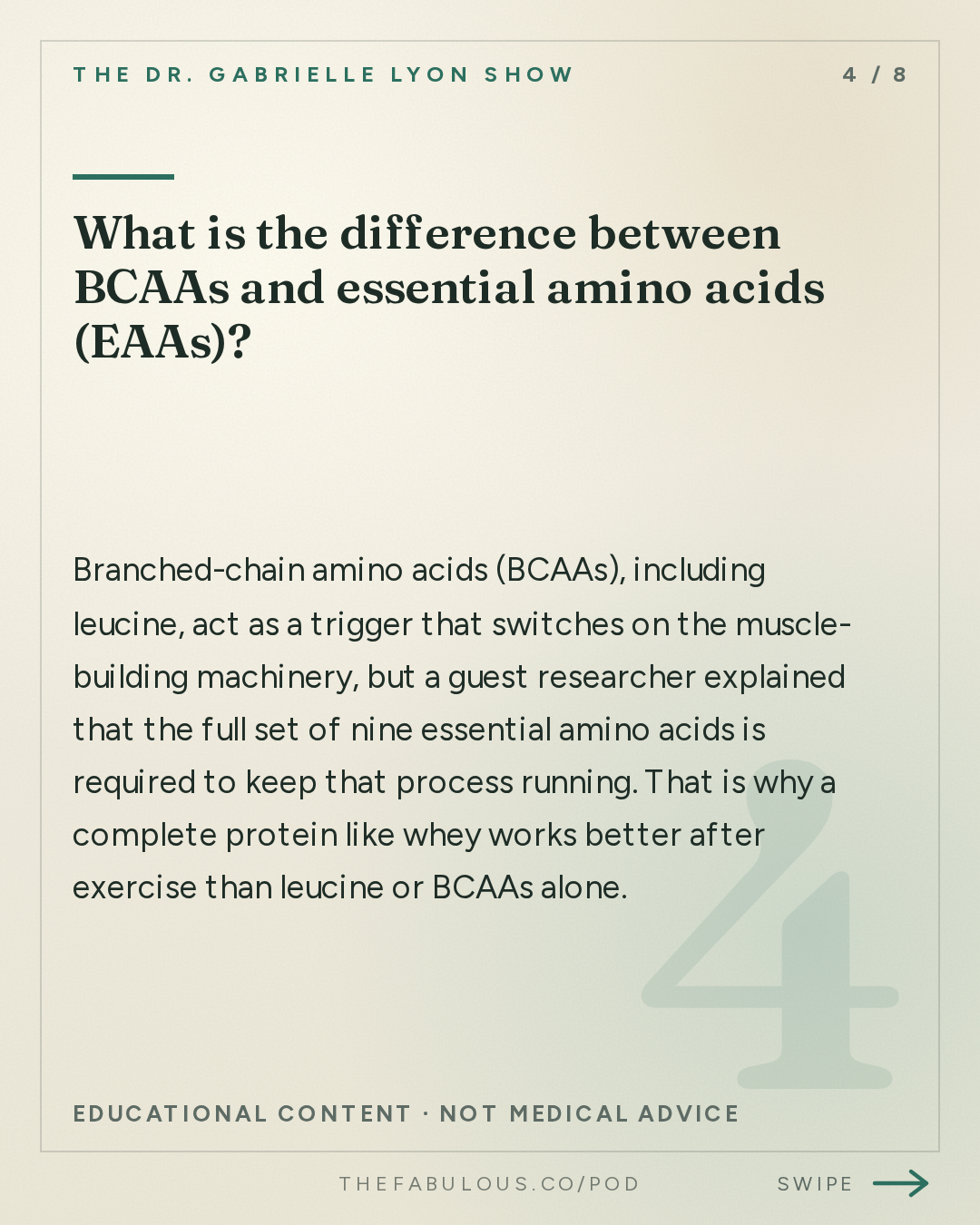
What is the difference between BCAAs and essential amino acids (EAAs)?
Branched-chain amino acids (BCAAs), including leucine, act as a trigger that switches on the muscle-building machinery, but a guest researcher explained that the full set of nine essential amino acids is required to keep that process running (12:03). That is why a complete protein like whey works better after exercise than leucine or BCAAs alone (12:31).
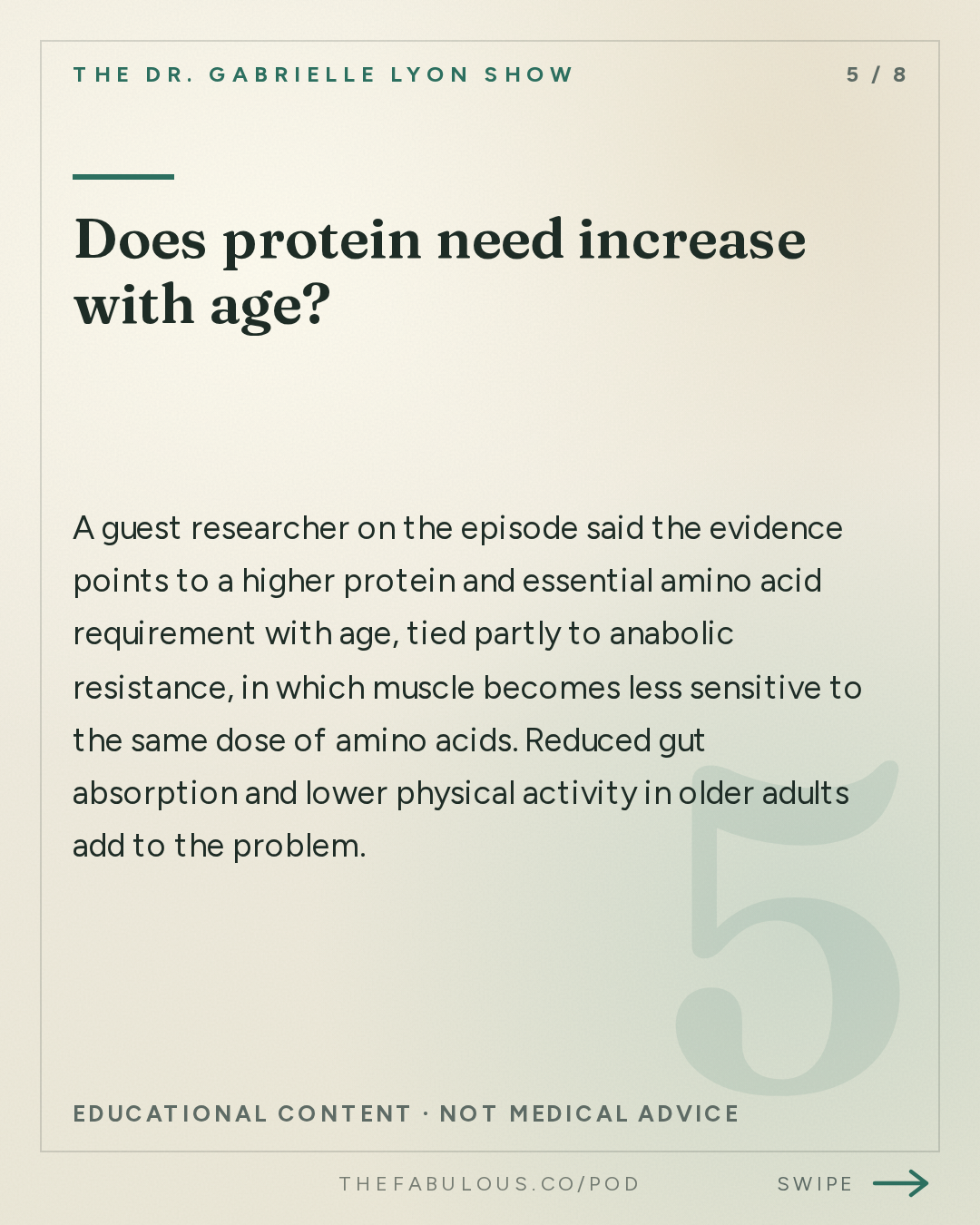
Does protein need increase with age?
A guest researcher on the episode said the evidence points to a higher protein and essential amino acid requirement with age, tied partly to anabolic resistance, in which muscle becomes less sensitive to the same dose of amino acids (17:27). Reduced gut absorption and lower physical activity in older adults add to the problem (17:57).
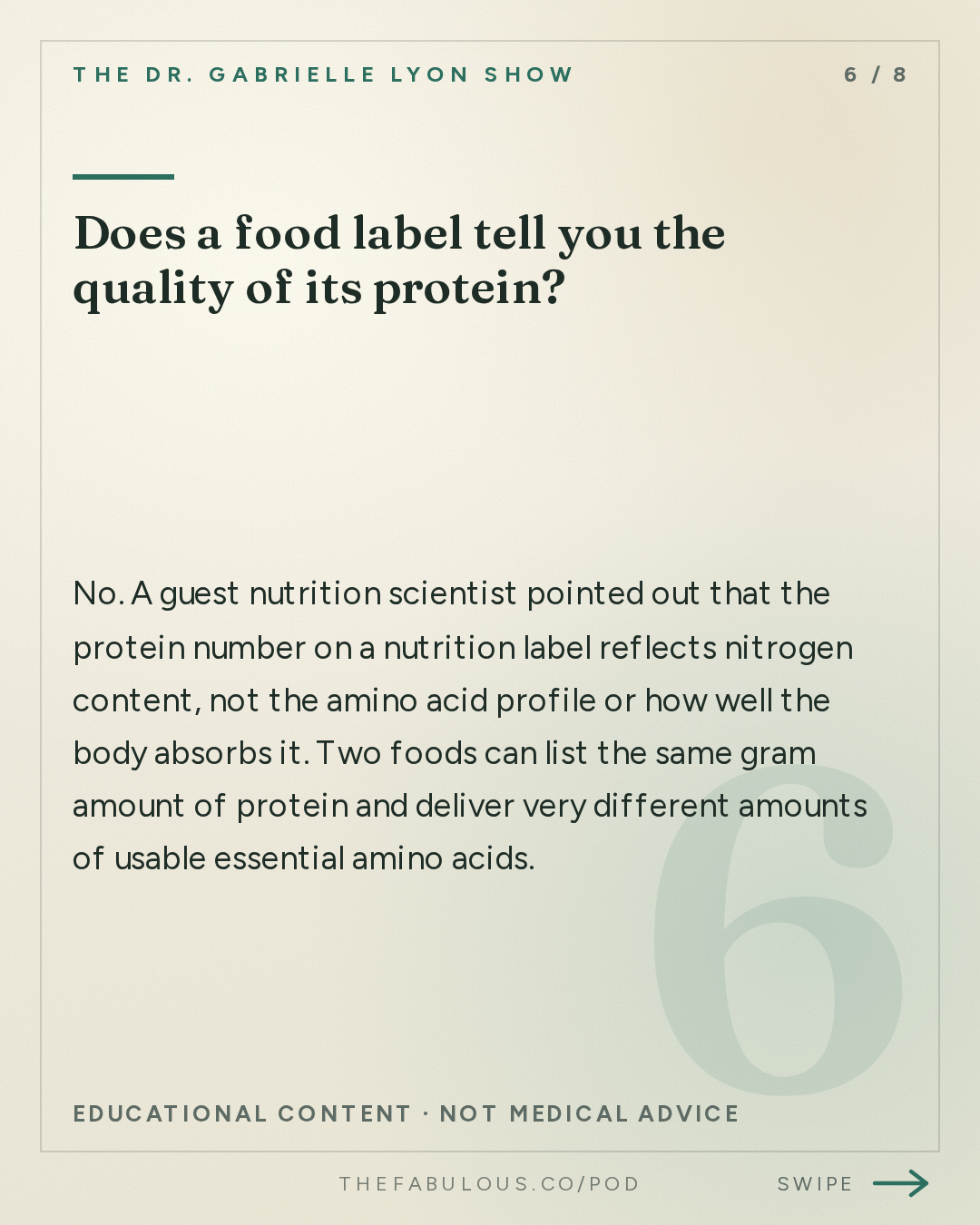
Does a food label tell you the quality of its protein?
No. A guest nutrition scientist pointed out that the protein number on a nutrition label reflects nitrogen content, not the amino acid profile or how well the body absorbs it (06:08). Two foods can list the same gram amount of protein and deliver very different amounts of usable essential amino acids.
The full read, in cards
Go deeper
- NHANES (National Health and Nutrition Examination Survey) — Shows that people who shift to plant-based eating tend to add more grains rather than beans, lentils, or nuts, lowering overall protein quality
- Dietary Guidelines for America — Uses ounce-equivalent protein recommendations that treat nuts and lean beef as comparable despite very different essential amino acid content
- High-dose versus standard-dose essential amino acid study under energy deficit — Compared 0.1 g/kg and 0.3 g/kg essential amino acid doses during exercise and a 30% energy deficit, finding better whole-body protein balance but no added muscle-level benefit at the higher dose
Mentioned
Dr. Gabrielle Lyon · NHANES · Dietary Guidelines for America · Leucine · mTOR · Body Health · Jamie Baum
More from this show and category
Eating Before Bed: What Pre-Sleep Protein Research Shows
A small protein snack 30 minutes before bed does not spoil fat metabolism, and exercise erases any downside. Florida State researcher Dr. Mike Ormsbee's microdialysis and bariatric-diet studies show resistance training protects muscle during severe calorie cuts, casein and whey work equally well, and extra protein is not stored as fat.
How Much Protein Do Kids Really Need?
Growing kids need more protein than official guidelines suggest, and puberty is a brief window for building muscle and bone. Dr. Gabrielle Lyon cites research showing children ages 6 to 11 may need close to 1.5 g/kg of protein daily, that 40 to 60% of adult bone mass forms during puberty, and that supervised strength training is safe at any age once a child can follow instructions.
Mozaffarian: How Food Made Us Sick
Cardiologist Dariush Mozaffarian says the food system, not willpower, is driving disease: 14 of 15 US adults already have a diet-related condition. He explains why saturated fat was wrongly blamed, how ultra-processed carbs work, and offers a 10-to-1 carb-to-fiber rule for judging packaged food.
How Much Protein Do You Really Need?
The standard protein recommendation of 0.8 grams per kilogram prevents deficiency, not optimal health. Researchers at Protein Summit 3.0 debated a higher range, 1.1 to 1.6 grams per kilogram, for better metabolic outcomes, noting needs shift by age, activity, and health status (07:15).
