
Mozaffarian: How Food Made Us Sick
Dr. Dariush Mozaffarian: How the Food System Got Us Sick. Can We Fix It?
▶ Listen to the full episode More from The Dr. Gabrielle Lyon Show
The brief
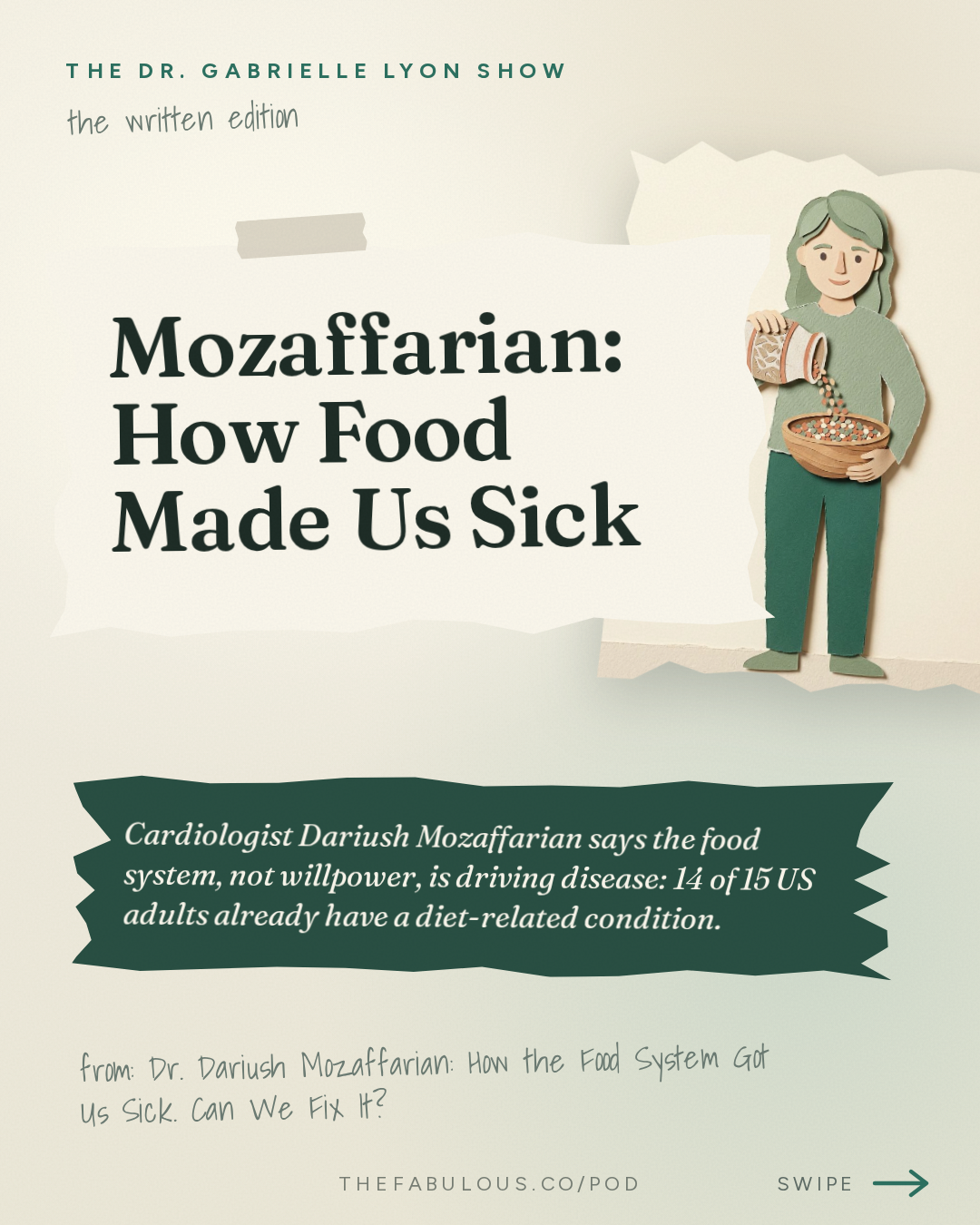
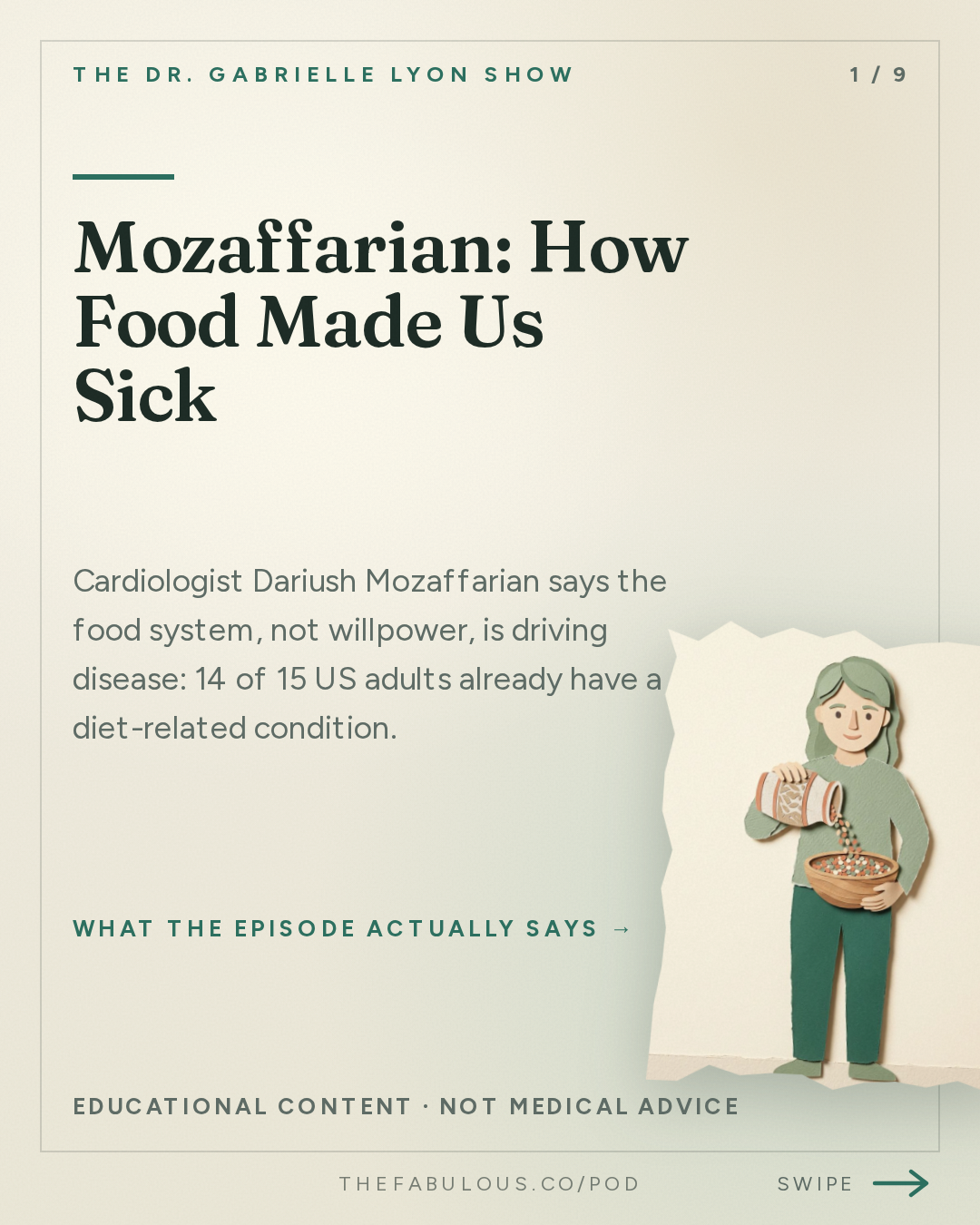
Cardiologist Dariush Mozaffarian says the food system, not willpower, is driving disease: 14 of 15 US adults already have a diet-related condition. He explains why saturated fat was wrongly blamed, how ultra-processed carbs work, and offers a 10-to-1 carb-to-fiber rule for judging packaged food.
In the 1920s, a mysterious illness swept through the American South. Doctors assumed it was infectious. It was not. It was pellagra, a deficiency of niacin, a vitamin nobody had yet identified, and it killed roughly 100,000 people in the United States that decade (18:23). The fix, once scientists found it, was almost absurdly simple: add the vitamin back to the food supply. That single move erased a disease that had baffled physicians for years.
Cardiologist and nutrition scientist Dariush Mozaffarian opens his new book with that story, and tells it again partway through this conversation with Dr. Gabrielle Lyon, because he thinks today's crisis rhymes with it. Only now the mystery is not a missing nutrient. It is something added, and it is much harder to see. Mozaffarian trained for fifteen years after high school, through medical school and a cardiology fellowship, and says he learned almost nothing about nutrition in any of it (05:51). What changed his path was simple arithmetic: food is the leading cause of poor health, and it was missing from healthcare (06:30).
The numbers he cites are blunt. Fourteen of fifteen American adults now have at least one diet-related condition (01:17). The country spends $5.5 trillion a year on healthcare (01:36), an amount so large Mozaffarian translates it into something a listener can feel: the average family of four effectively spends $50,000 a year on healthcare, more than it spends on housing, food, transportation, and vacations combined (72:24). Kids born today have better than even odds of developing Type 2 diabetes in their lifetime (04:30). These are not projections. They are descriptions of where things already stand.
Mozaffarian's own turning point came from a study, not a patient. In the 1990s, the Lyon Diet Heart Study took French heart attack survivors and randomized them either to the standard low-fat, low-cholesterol "cardiac diet" or to a Mediterranean-style diet rich in healthy fat. The Mediterranean group had roughly 60 percent fewer heart attacks (08:32). That result unsettled him enough that he spent years of his early career trying to confirm the opposite, the prevailing belief that saturated fat itself was the villain of heart disease. He could not confirm it. "I started out with the opposite hypothesis," he tells Lyon, and the evidence pulled him away from it (34:15).
Why Saturated Fat Was the Wrong Villain
The story Mozaffarian tells about saturated fat is really a story about how nutrition science got built in the first place. The big wins of the twentieth century, curing vitamin deficiencies, feeding a population that quadrupled in a hundred years, came from isolating single nutrients and treating them as switches: find the vitamin, add the vitamin, solve the disease. When heart disease became the next target in the 1970s and 80s, scientists looked for an equivalent switch and landed on saturated fat. It made sense to try. It just was not the right answer.
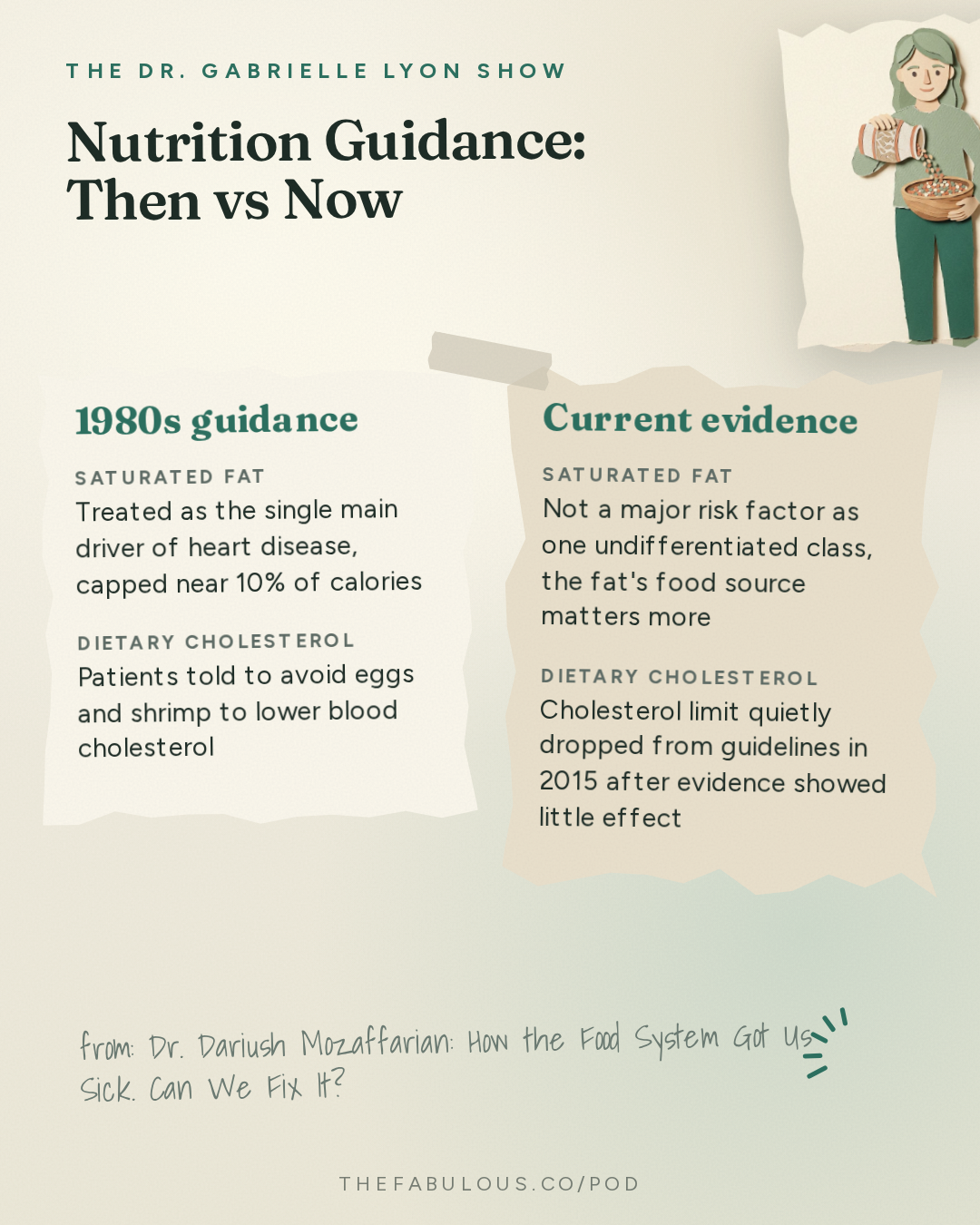
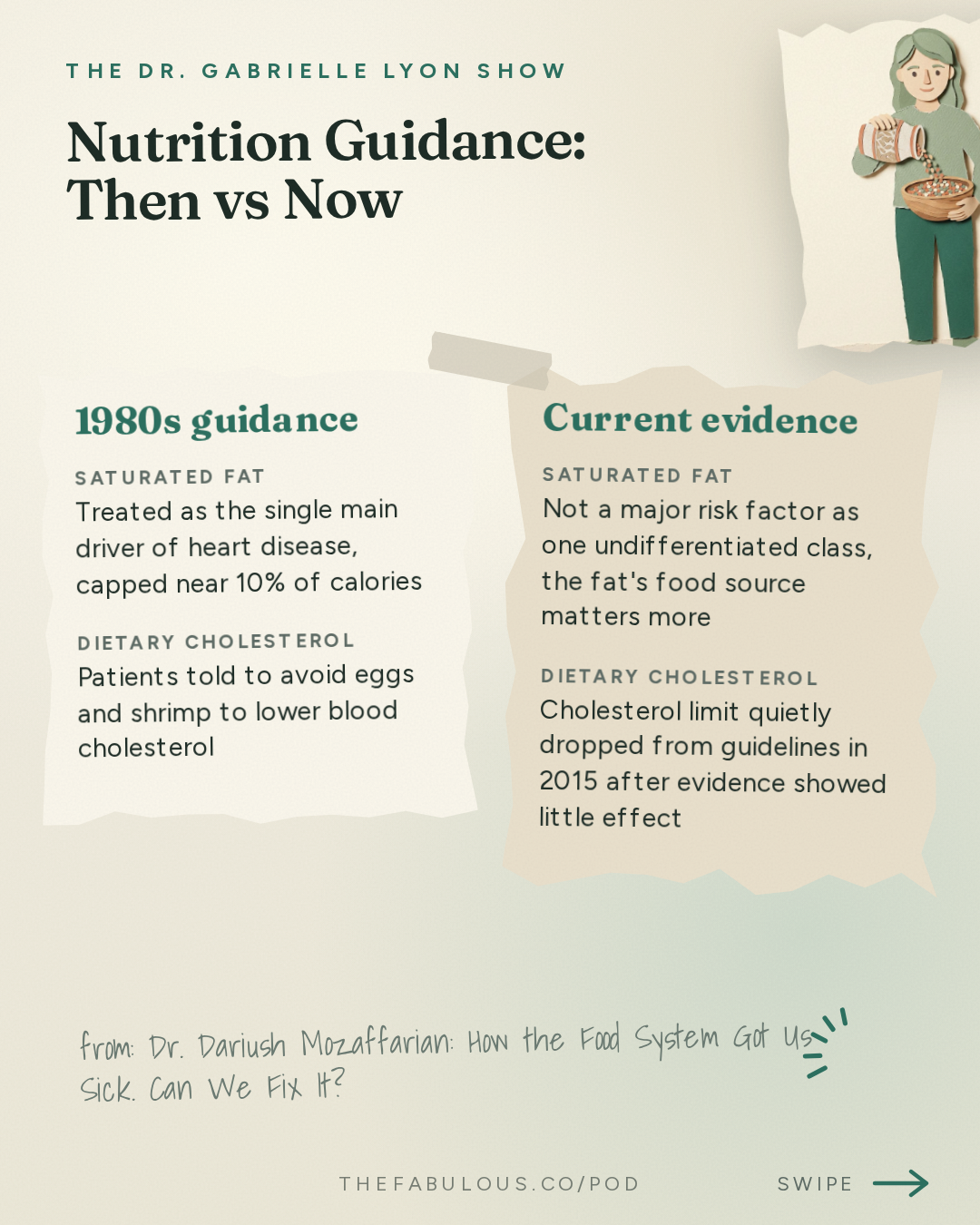
Mozaffarian argues that saturated fat, as one undifferentiated class, is not a major independent risk factor for heart disease (33:36). What matters more is where it comes from. Dairy fat carries compounds called sphingolipids that appear to reduce cholesterol absorption in the gut, which is part of why whole-fat dairy was finally cleared in the newest US dietary guidelines after forty-five years of restriction (36:02). Cheese, a fermented food, is not linked to weight gain or heart disease and is tied to lower diabetes risk (39:11). Dietary cholesterol itself, the reason patients were once told to avoid eggs and shrimp, was quietly dropped from the guidelines back in 2015 because the evidence did not support it (36:39), a change Lyon notes many doctors still have not caught up to in their own exam rooms (36:59).
"Long term, the quality of the diet trumps the quantity. Long term we are biological creatures, and so long term our biology shifts." — Dariush Mozaffarian [28:43]
That line gets at Mozaffarian's larger argument about obesity. The common story, that people simply eat too much and move too little, does not match the data he has reviewed. US calorie intake rose by about 300 calories per person per day from the 1970s through 2000 (26:04), enough to explain the rise in obesity through that period. But since 2000, calorie intake has been flat or falling, and physical activity, by multiple measures, has gone up (26:49). Obesity has kept climbing anyway. Something besides raw quantity is driving weight gain, and Mozaffarian's candidate is the structure of the food itself, not just its calories, salt, or sugar.
What Ultra-Processing Actually Means
The term for that structural change is ultra-processing, a classification system called NOVA, created by Brazilian researcher Carlos Monteiro. Monteiro's insight, as Mozaffarian explains it, was that food can make people sick in ways that have nothing to do with the nutrients listed on the label (50:31). More than 100 studies now link higher ultra-processed food intake to diabetes, cancer, obesity, and other conditions, and three short-term randomized trials have shown that people eating ultra-processed diets overeat and gain weight even when the two diets are matched for salt, sugar, and fiber (50:48).
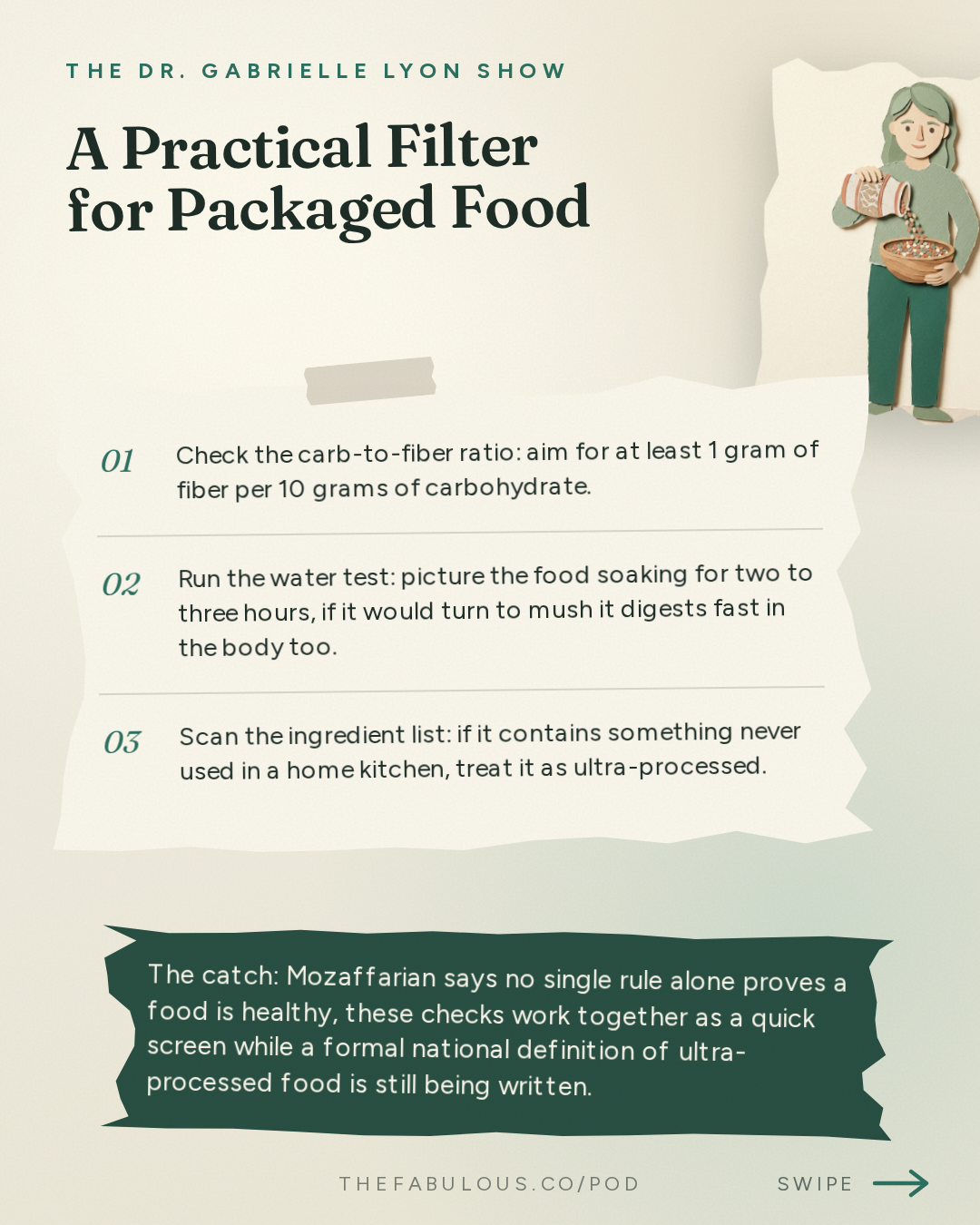
Mozaffarian offers listeners a plain-language test: "If it has an ingredient in there that's not used in a home kitchen, it's ultra-processed" (51:46). A potato chip made of potatoes, oil, and salt is processed but fine. One with added flavorings, colorings, and stabilizers crosses the line. He pairs that with a carbohydrate rule he uses himself, and recommends to patients: keep a carb-to-fiber ratio of 10-to-1 or better in packaged food, so a product with 40 grams of carbohydrate should carry at least 4 grams of fiber (48:07). A second check is what he calls the water test: picture a carb-heavy food soaking in water for two or three hours. If it would turn to mush, it is going to be digested just as fast inside the body, spiking blood sugar and starving the gut microbiome of the slow-release material it depends on (48:47). White bread, he points out, actually has a higher glycemic index than table sugar, because sugar is glucose and fructose together while bread is pure glucose chains (46:05).
"White bread, in fact, has a higher glycemic index than sugar." — Dariush Mozaffarian [46:05]
None of this, Mozaffarian is careful to say, means every traditional food is safe in any amount. He ranks unprocessed red meat in the middle of his personal food hierarchy, below fish, yogurt, nuts, and vegetables, because of compounds it generates in the gut, including iron and sulfur byproducts that are pro-inflammatory and linked to higher cancer and diabetes risk, and he recommends limiting it to one or two servings a week (56:33).
Where the conversation turns genuinely hopeful is policy, because Mozaffarian frames it as an economic argument rather than a moral one. The federal government already spends roughly $140 billion a year on SNAP, school meals, and WIC combined, and SNAP, unlike WIC and school meals, has no nutrition standards at all (75:12). Shifting that existing spending toward real food, he argues, would not cost extra money; it would save money, since diet-related disease is the leading cause of medical bills, which in turn is the leading cause of personal bankruptcy, and poor nutrition itself is estimated to cost $1.5 trillion a year (74:03). Even the newest wrinkle, GLP-1 weight loss drugs, reinforces his point rather than undercutting it: $140 billion was spent on these medications last year alone (78:37), a figure so large that even with real health benefits, Mozaffarian says they are not cost-saving for the healthcare system (78:59). He is not against the drugs. He has simply watched a patient on one who was still drinking ten cans of Coca-Cola a day because no one had mentioned his diet at all (81:03).
Mozaffarian's closing claim is the most provocative one in the episode: that the human brain is not actually wired to crave ultra-processed food, and that craving it is a sign of broken signaling, not fixed biology (82:40). It is a reversal of thirty years of received wisdom that people are simply hooked on fat, sugar, and salt. If he is right, the fix is not resisting temptation forever. It is restoring a system, biological and political at once, that currently manufactures the temptation on purpose.
Ask this episode anything
Pod's AI answers from the episode itself, with the minute mark so you can hear it yourself.
Or start with one of these
Ask this episode
Pod's AI listens to the whole episode to answer, and points you to the minute it comes from.
The rest of this answer, and any question after it
Answers come from the episode itself, never from a summary of it.
ContinueKey takeaways
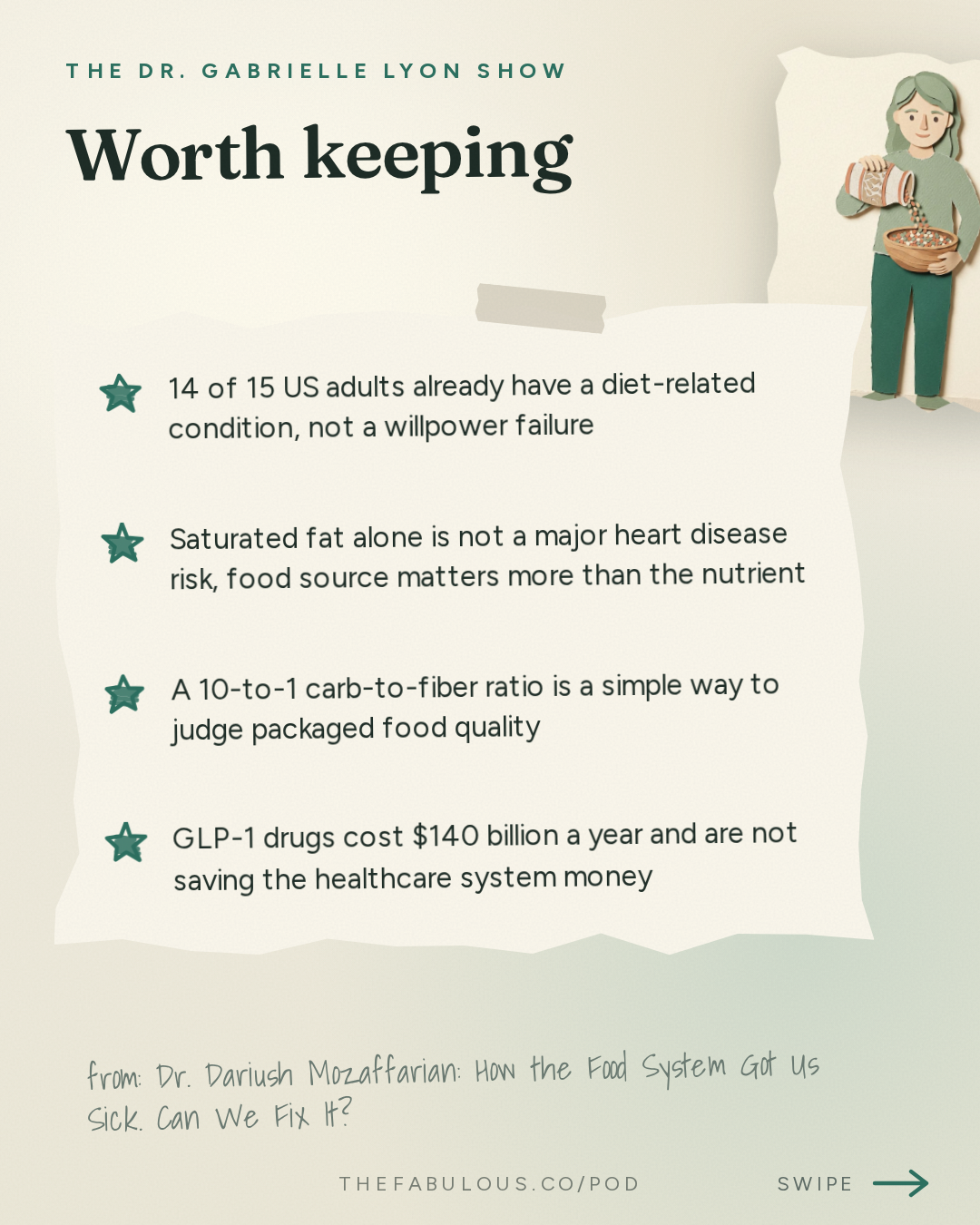
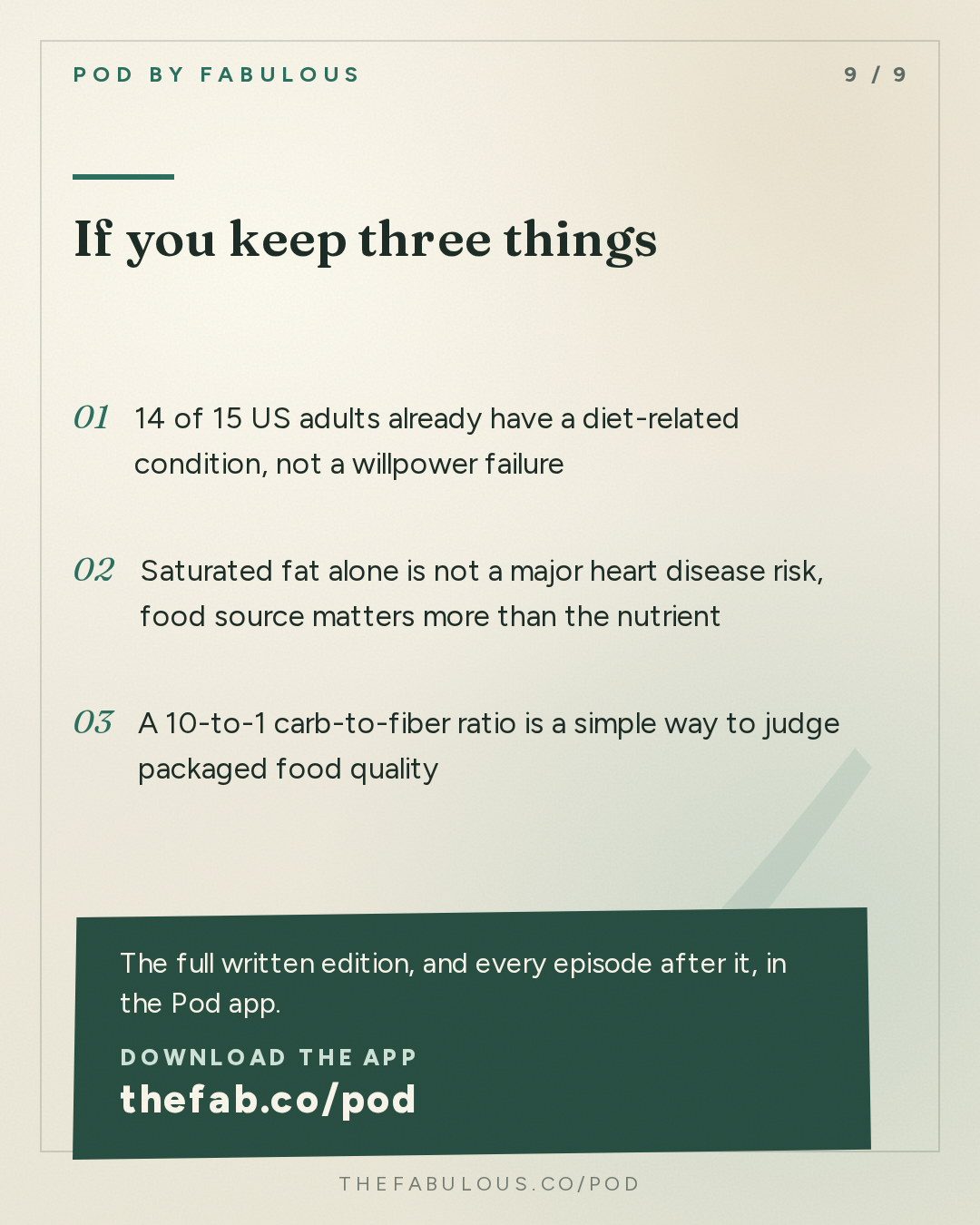
- 14 of 15 US adults already have a diet-related condition, not a willpower failure
- Saturated fat alone is not a major heart disease risk, food source matters more than the nutrient
- A 10-to-1 carb-to-fiber ratio is a simple way to judge packaged food quality
- GLP-1 drugs cost $140 billion a year and are not saving the healthcare system money
- US obesity kept rising after 2000 even as average calorie intake flattened and exercise increased
The episode in cards

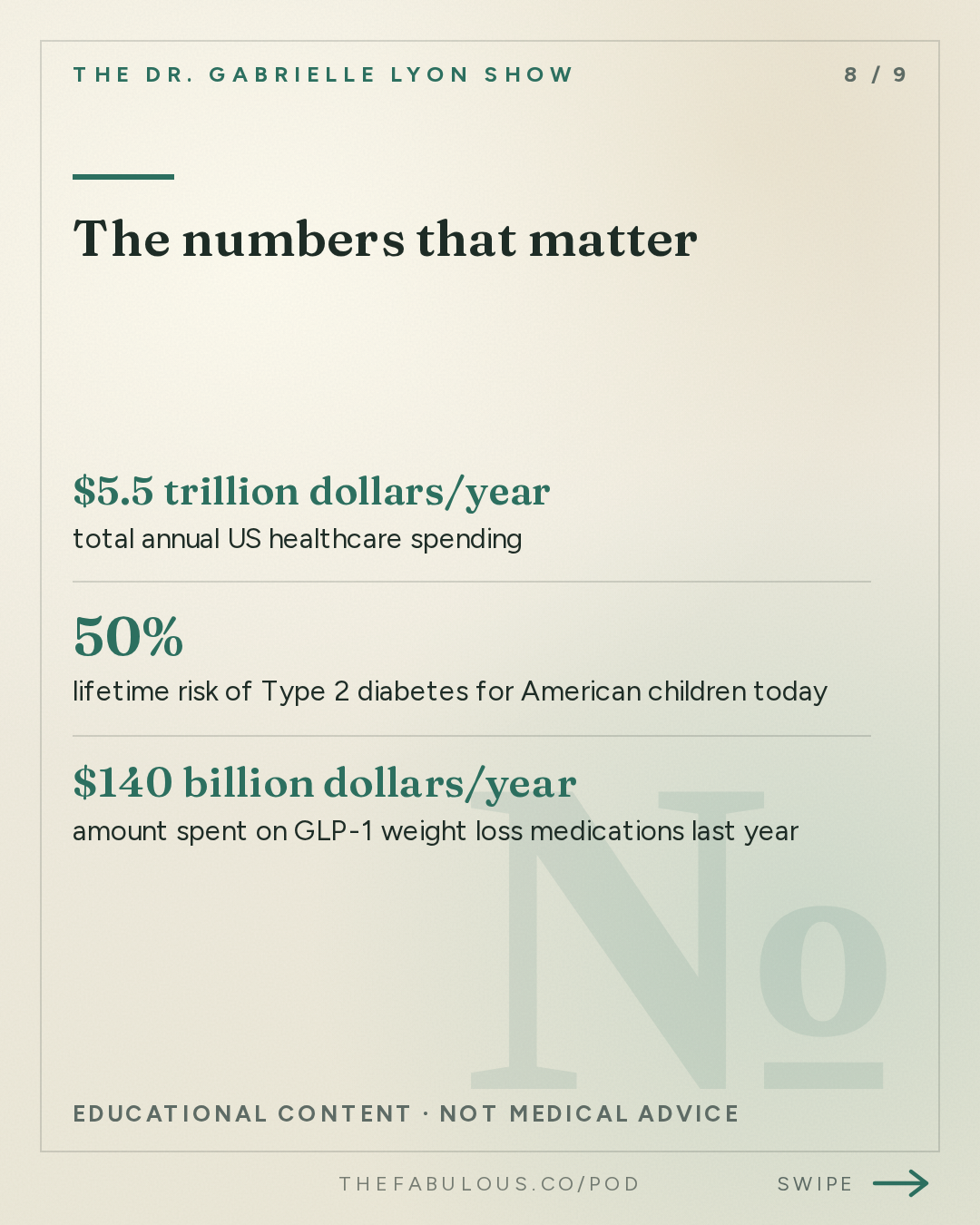
By the numbers
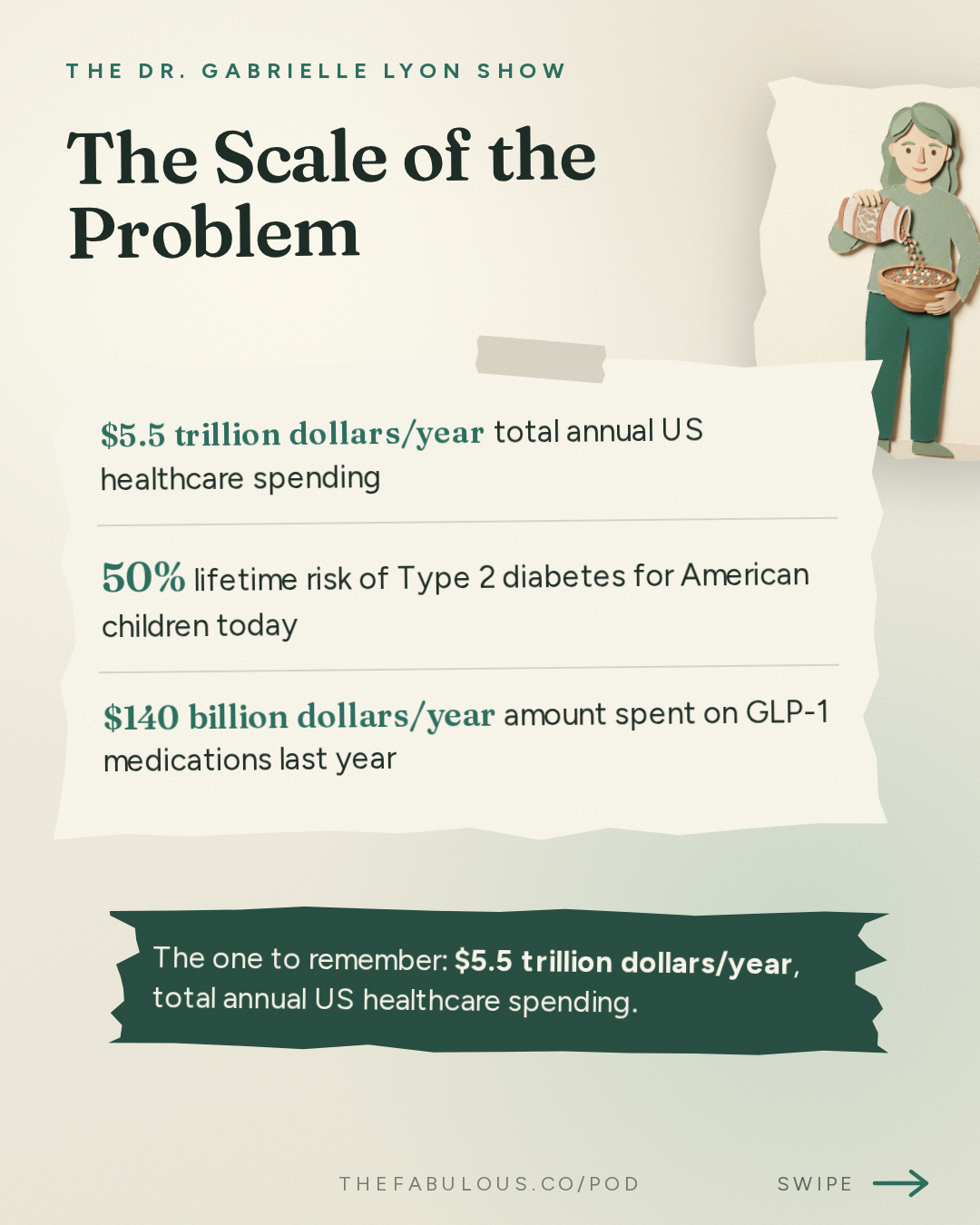
- $5.5 trillion dollars/year total annual US healthcare spending
- 50% percent lifetime risk of Type 2 diabetes for American children today
- $140 billion dollars/year amount spent on GLP-1 weight loss medications last year
In their words
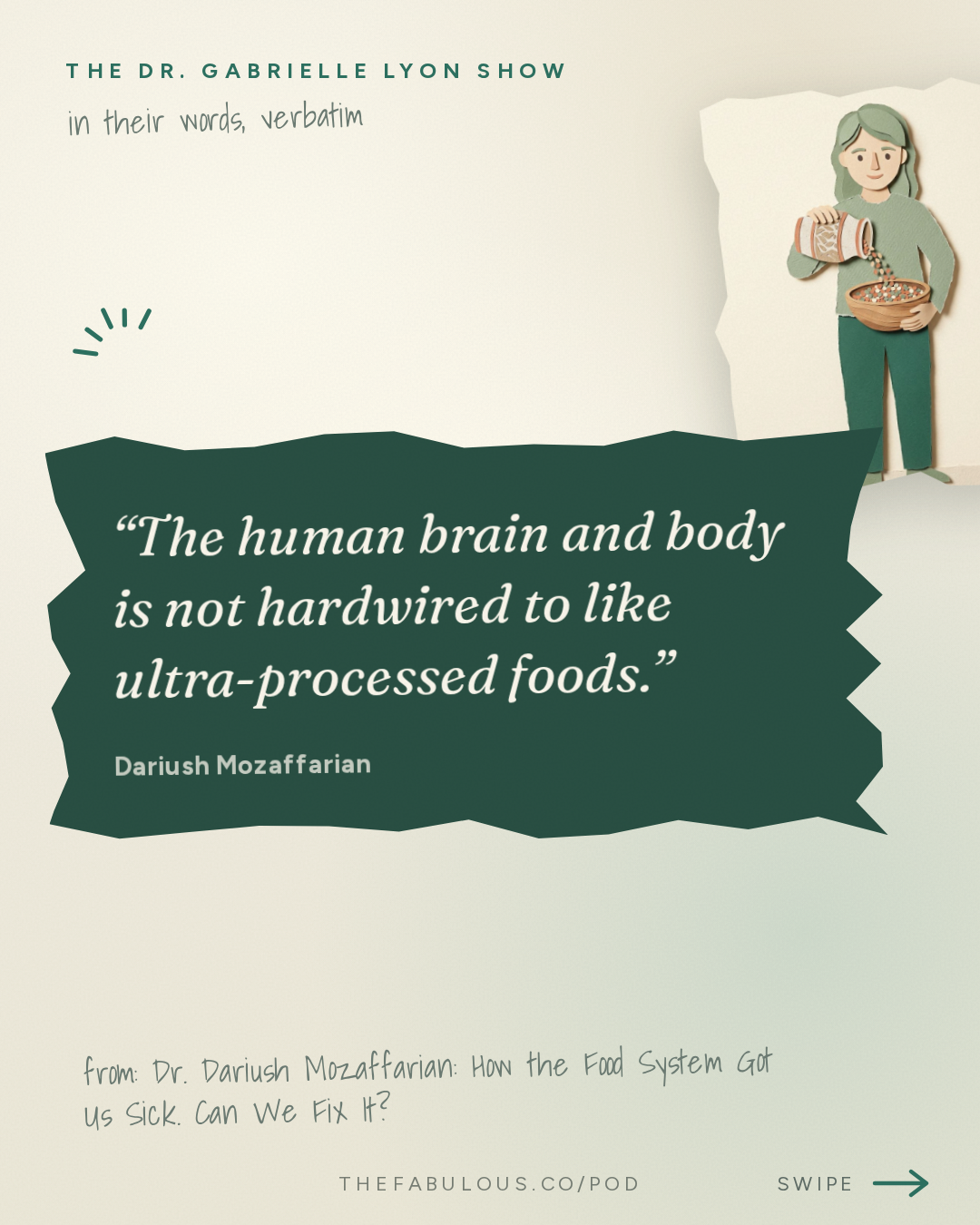
“The human brain and body is not hardwired to like ultra-processed foods.”
“If it has an ingredient in there that's not used in, in a home kitchen, it's ultra-processed”
“White bread, in fact, has a higher glycemic index than sugar.”
Protocols
-
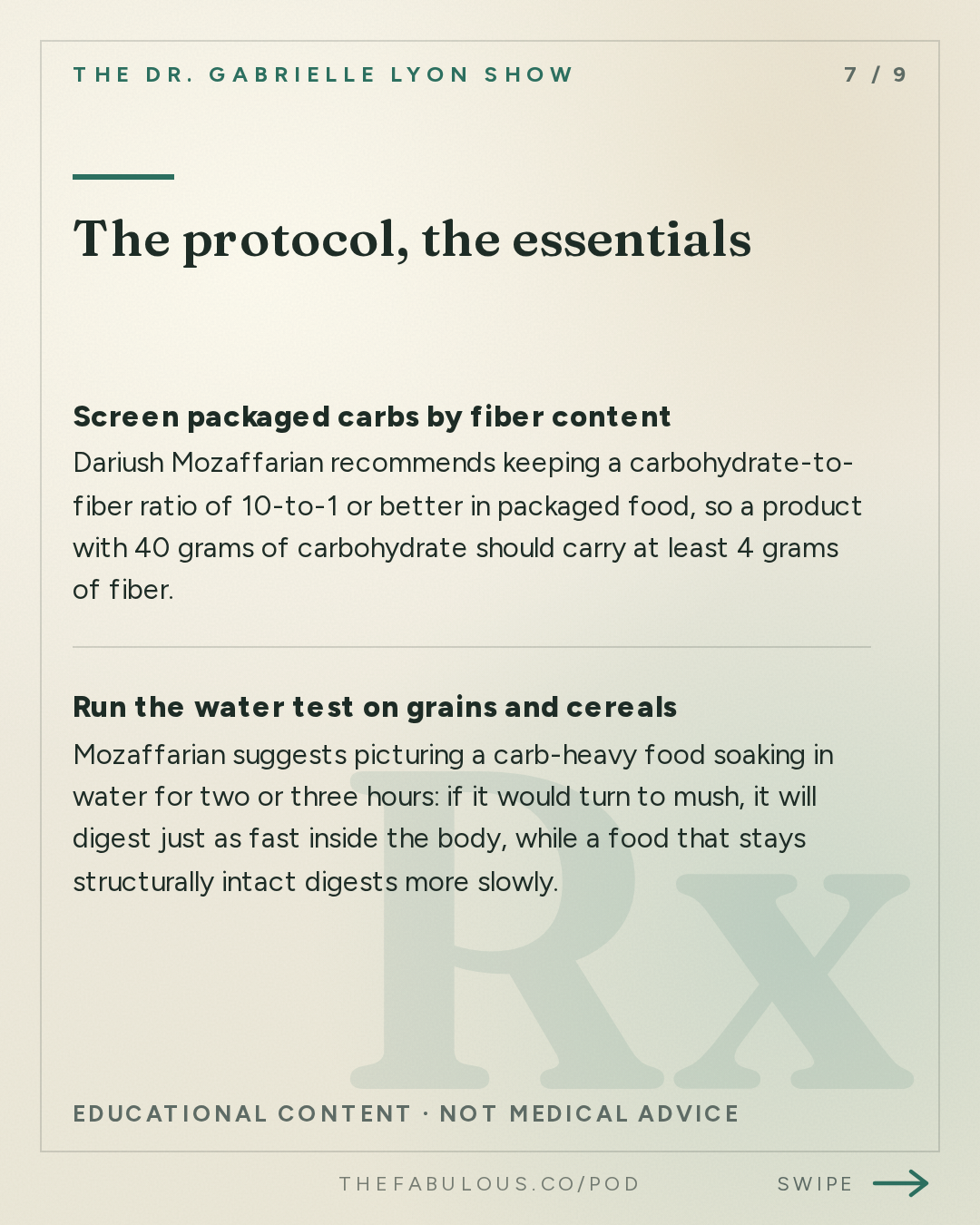
Screen packaged carbs by fiber content
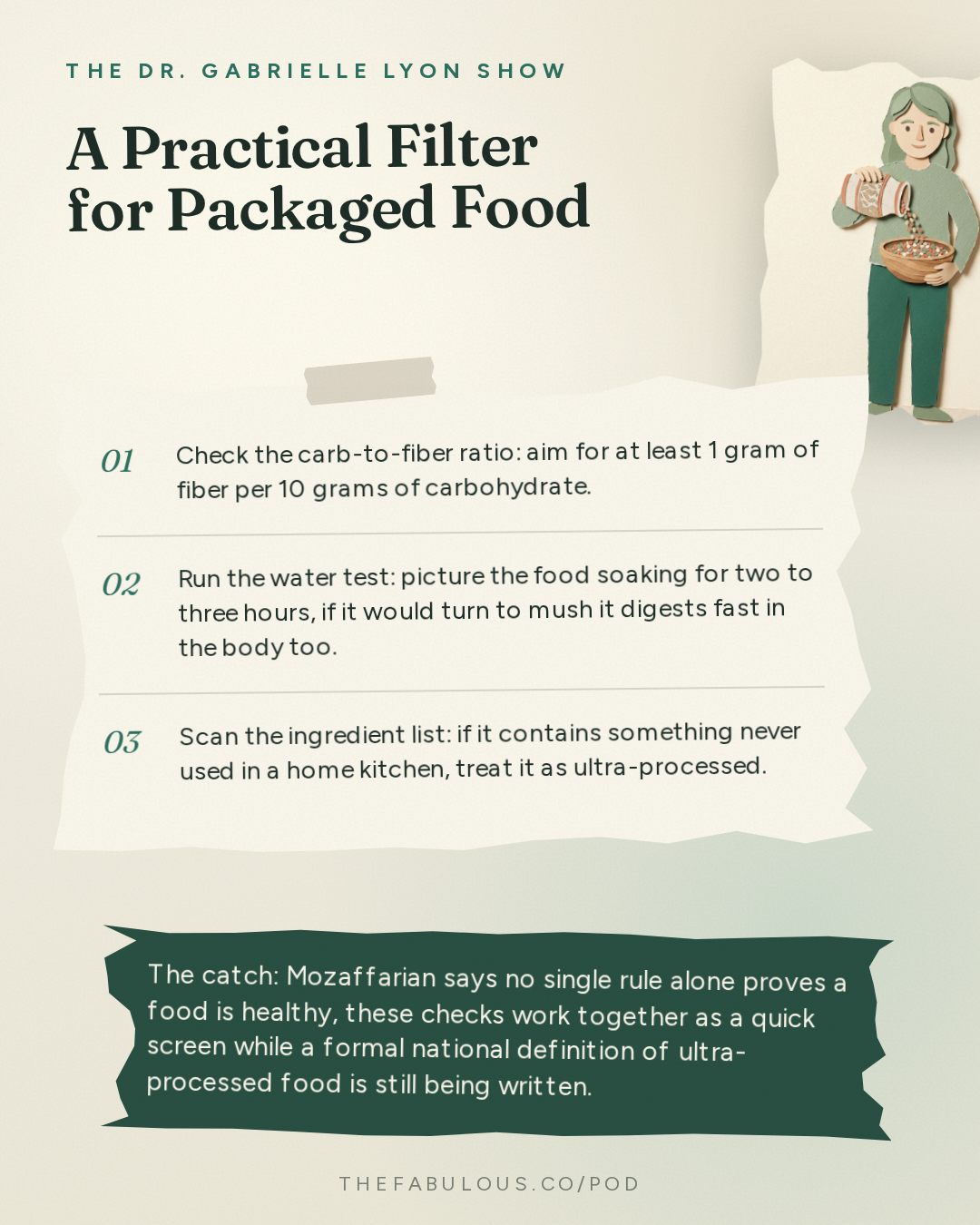
Dariush Mozaffarian recommends keeping a carbohydrate-to-fiber ratio of 10-to-1 or better in packaged food, so a product with 40 grams of carbohydrate should carry at least 4 grams of fiber.
every time choosing a packaged food
-
Run the water test on grains and cereals
Mozaffarian suggests picturing a carb-heavy food soaking in water for two or three hours: if it would turn to mush, it will digest just as fast inside the body, while a food that stays structurally intact digests more slowly.
when comparing grain products
-
Limit unprocessed red meat
Mozaffarian advises limiting unprocessed red meat to one or two servings a week, because it generates sulfur compounds and iron in the gut that are pro-inflammatory and linked to higher cancer and diabetes risk.
1 to 2 servings per week
Questions this episode answers
Is saturated fat still bad for heart disease?
Cardiologist Dariush Mozaffarian's own research found that saturated fat as a single class is not a major independent risk factor for heart disease, and that the food carrying it, such as dairy versus red meat, matters more than the nutrient itself (33:36).
What is the NOVA classification system for ultra-processed foods?
NOVA was created by Brazilian researcher Carlos Monteiro and groups food by degree of processing rather than by nutrients like salt or sugar. Over 100 studies link higher ultra-processed intake to diabetes, obesity, and other disease, and three short-term randomized trials found it causes overeating even when matched for salt and sugar (50:48).
What is a good carb-to-fiber ratio for packaged food?
Mozaffarian recommends a 10-to-1 ratio or better, meaning at least 1 gram of fiber for every 10 grams of carbohydrate, as a quick screen for judging packaged food quality (48:07).
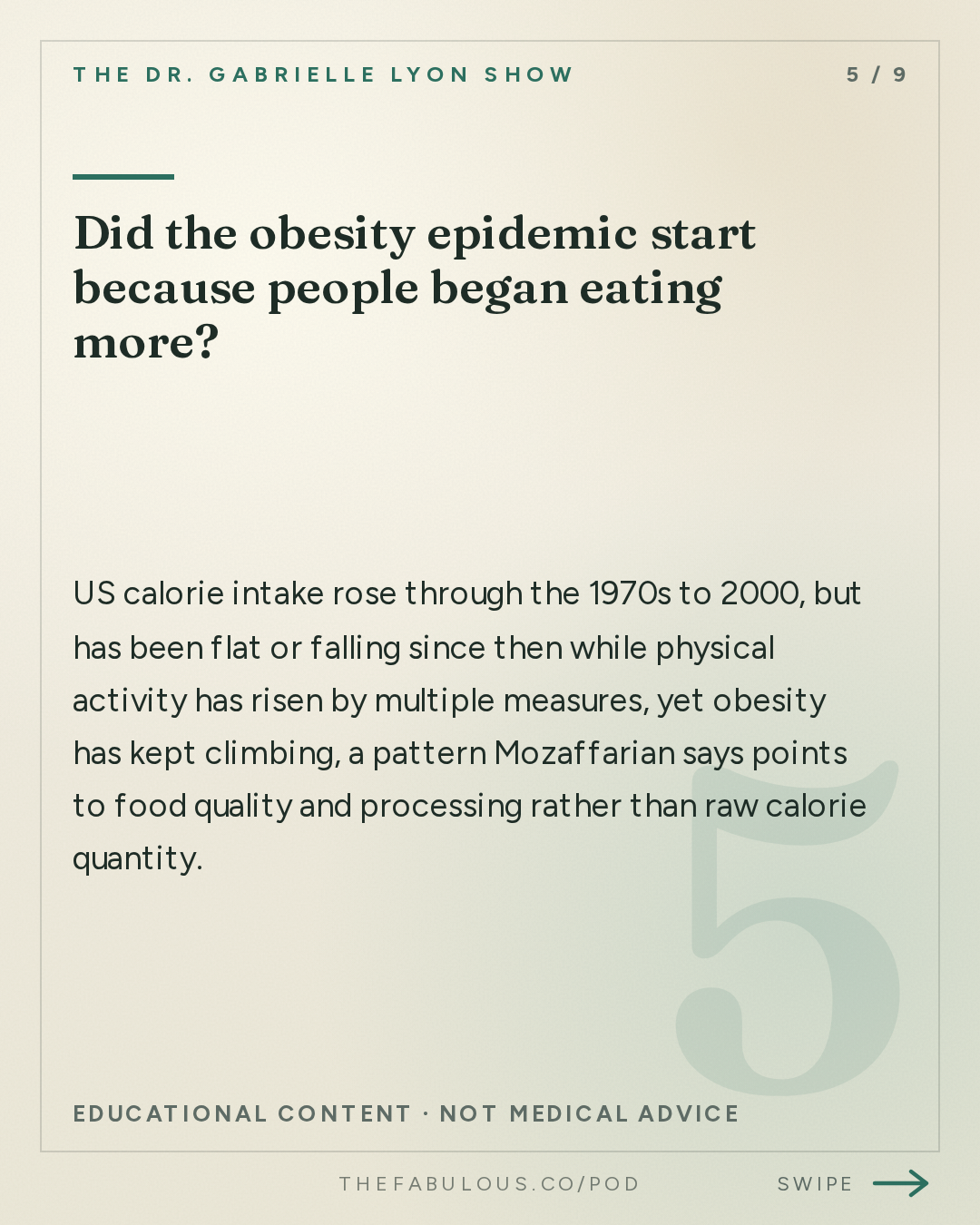
Did the obesity epidemic start because people began eating more?
US calorie intake rose through the 1970s to 2000, but has been flat or falling since then while physical activity has risen by multiple measures, yet obesity has kept climbing, a pattern Mozaffarian says points to food quality and processing rather than raw calorie quantity (26:49).
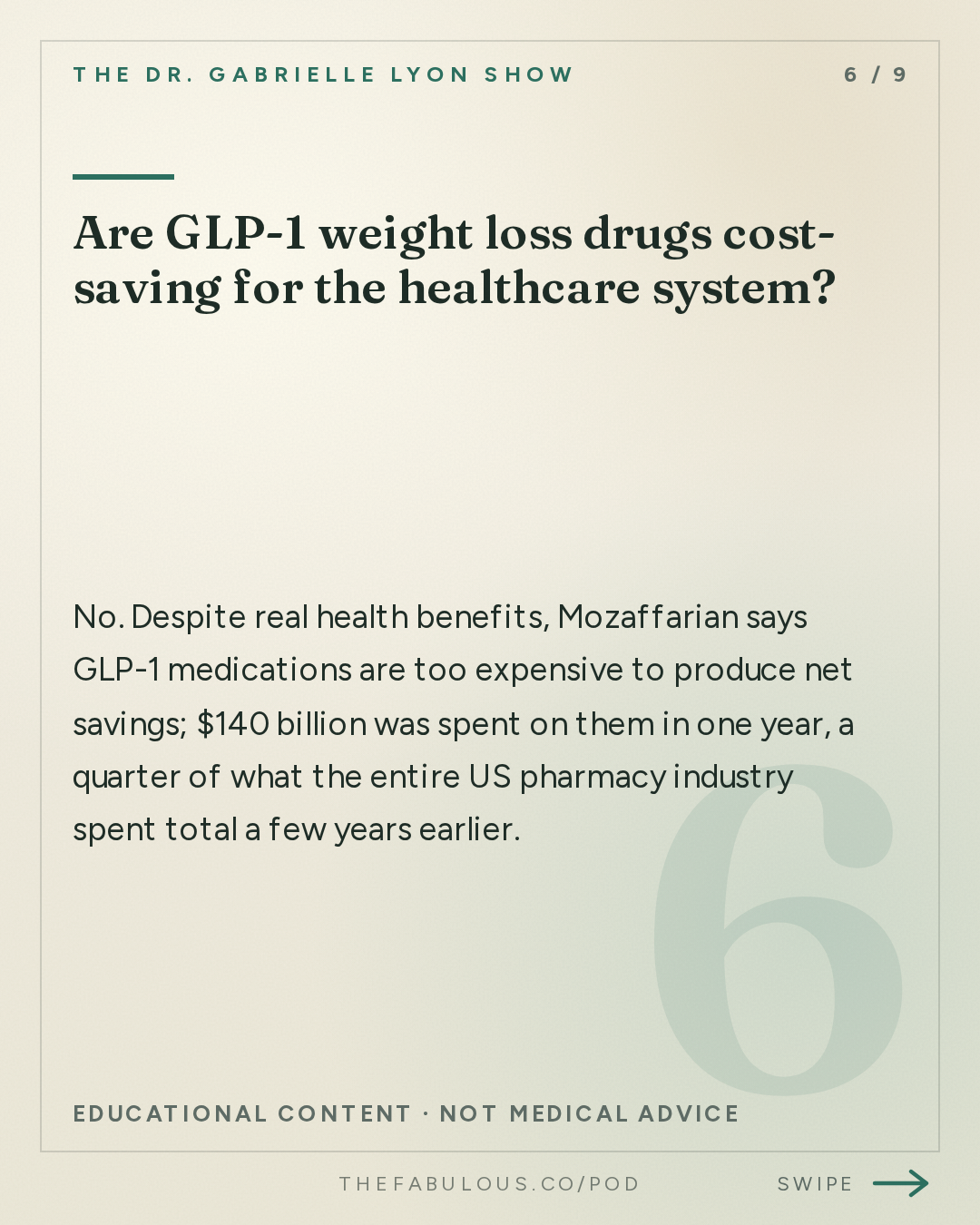
Are GLP-1 weight loss drugs cost-saving for the healthcare system?
No. Despite real health benefits, Mozaffarian says GLP-1 medications are too expensive to produce net savings; $140 billion was spent on them in one year, a quarter of what the entire US pharmacy industry spent total a few years earlier (78:37).
The full read, in cards
Go deeper
- Lyon Diet Heart Study — French trial showing a Mediterranean diet cut heart attack recurrence about 60% versus a low-fat cardiac diet
- NOVA classification system — created by Carlos Monteiro to classify food by degree of processing rather than by nutrient content
- Food Is Medicine — Dariush Mozaffarian's book on the history of the food system and policy paths to fix it
- Healthy Hunger-Free Kids Act — 2010 law that improved school meal nutrition standards
Mentioned
Dariush Mozaffarian · Jean Mayer · Norman Borlaug · Carlos Monteiro · Friedman School of Nutrition Science and Policy · SNAP · WIC · Lyon Diet Heart Study · Food Is Medicine · NOVA
More from this show and category
How Much Protein Do You Really Need?
The standard protein recommendation of 0.8 grams per kilogram prevents deficiency, not optimal health. Researchers at Protein Summit 3.0 debated a higher range, 1.1 to 1.6 grams per kilogram, for better metabolic outcomes, noting needs shift by age, activity, and health status (07:15).
Is Anesthesia Safe? What Really Happens in the OR
Anesthesiologist Dr. Tiffany Moon says healthy patients face under 0.1% mortality risk from elective surgery, lower than the odds of a car crash (25:28, 25:56). The bigger variables are body fat, which changes how drugs distribute, and vital-sign stability during the procedure, not whether someone wakes up at all (05:09, 24:10).
Hormones and Attraction: What the Science Shows
Hormones shape attraction traits mostly during puberty, not day to day. A masculine face doesn't reveal current testosterone, and the ovulatory-shift theory, that women prefer masculine men mainly near ovulation, lacks support. Perceived physical strength explains 70% of women's attractiveness ratings for men's bodies, making muscle, unlike facial bone structure, the one hormone-built trait people can still train.
JJ Thomas's Primal Physical Therapy Guide
Physical therapist JJ Thomas argues that pain is an alarm pointing to a movement problem elsewhere in the body, not proof that the hurting spot is broken. She treats patients with seven foundational movements (squat, hinge, push, pull, carry, reach, rotate) and dry needling at sites far from the pain, arguing most overuse injuries are really underuse injuries of neighboring muscles.
