
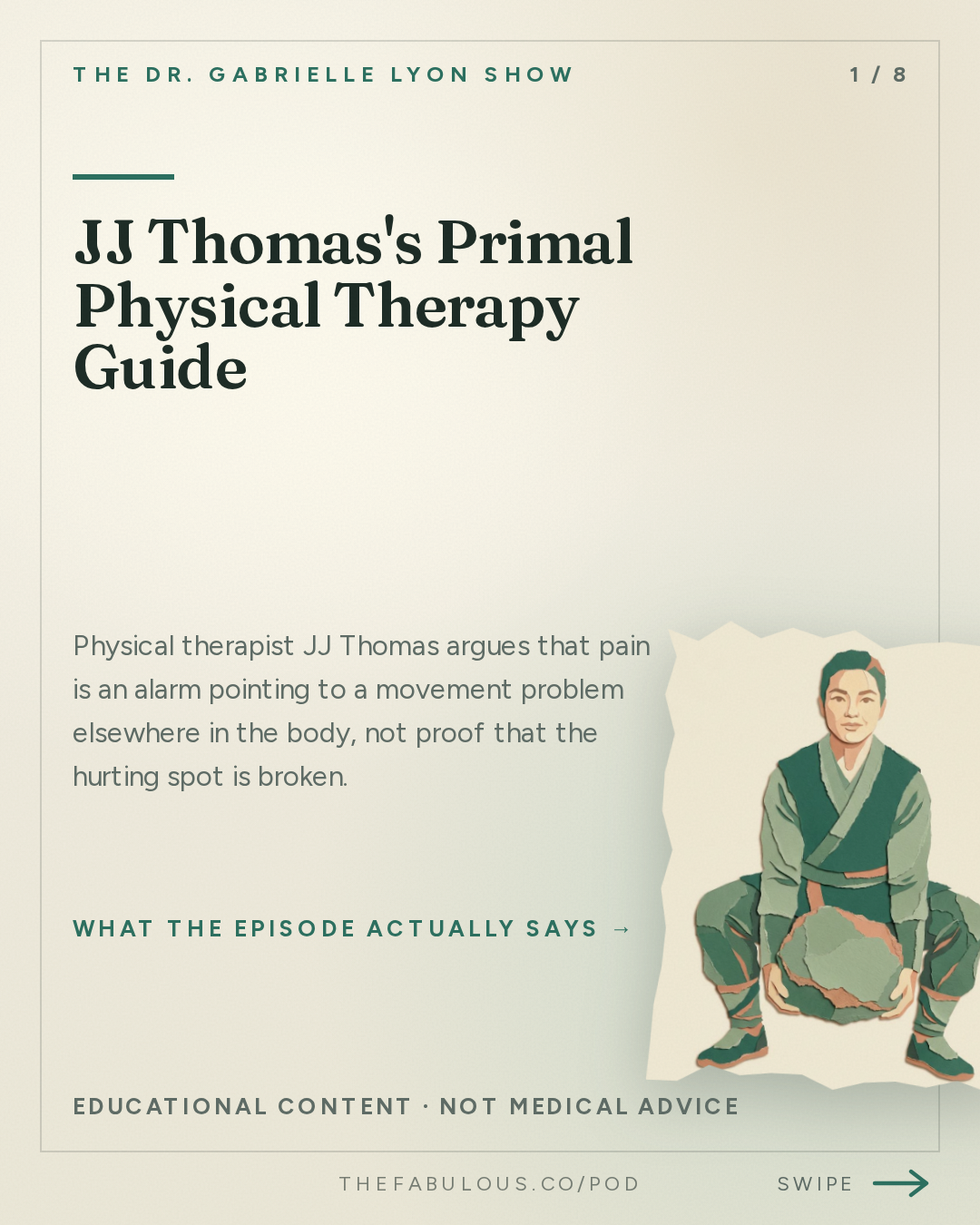
JJ Thomas's Primal Physical Therapy Guide
Dr. JJ Thomas: Pain Is an Alarm. Why Your Injury Keeps Coming Back and How To Fix It
▶ Listen to the full episode More from The Dr. Gabrielle Lyon Show
The brief
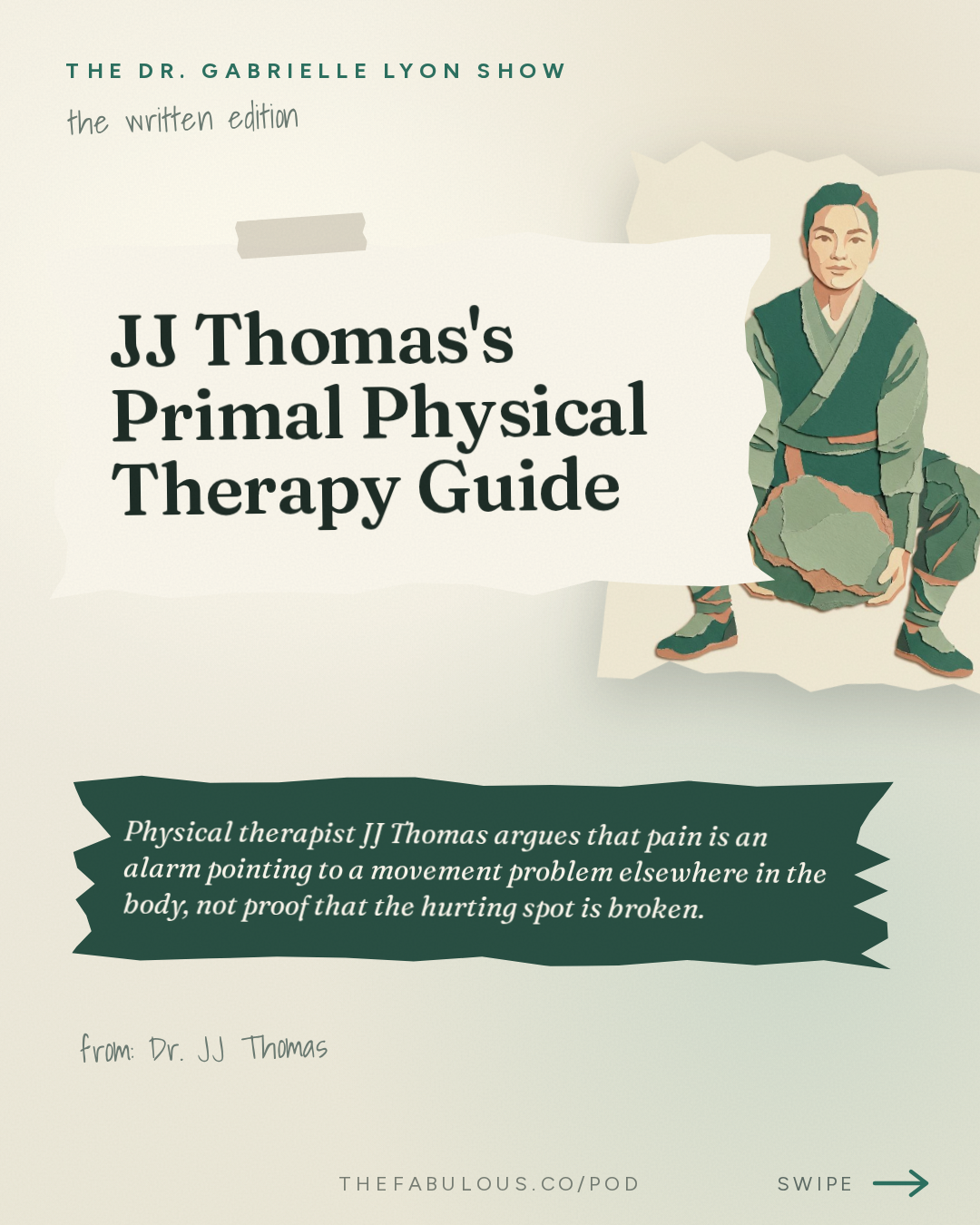
Physical therapist JJ Thomas argues that pain is an alarm pointing to a movement problem elsewhere in the body, not proof that the hurting spot is broken. She treats patients with seven foundational movements (squat, hinge, push, pull, carry, reach, rotate) and dry needling at sites far from the pain, arguing most overuse injuries are really underuse injuries of neighboring muscles.
A smoke alarm does not start the fire. It only tells the house something is burning. Most people, faced with a screeching alarm at 3 a.m., do not shrug and pull the battery. Yet that, says physical therapist JJ Thomas, is exactly what medicine often does with pain: it mutes the signal and calls the job finished.
Thomas runs Primal Physical Therapy outside Philadelphia and treats everyone from NBA players to forty-year-old mothers, including her friend and patient Dr. Gabrielle Lyon, who first came to her with what she assumed was a simple hamstring problem. It was not. Lyon's hamstring tear traced back to her shoulder and neck, a connection that seemed strange until Thomas explained the logic behind it.
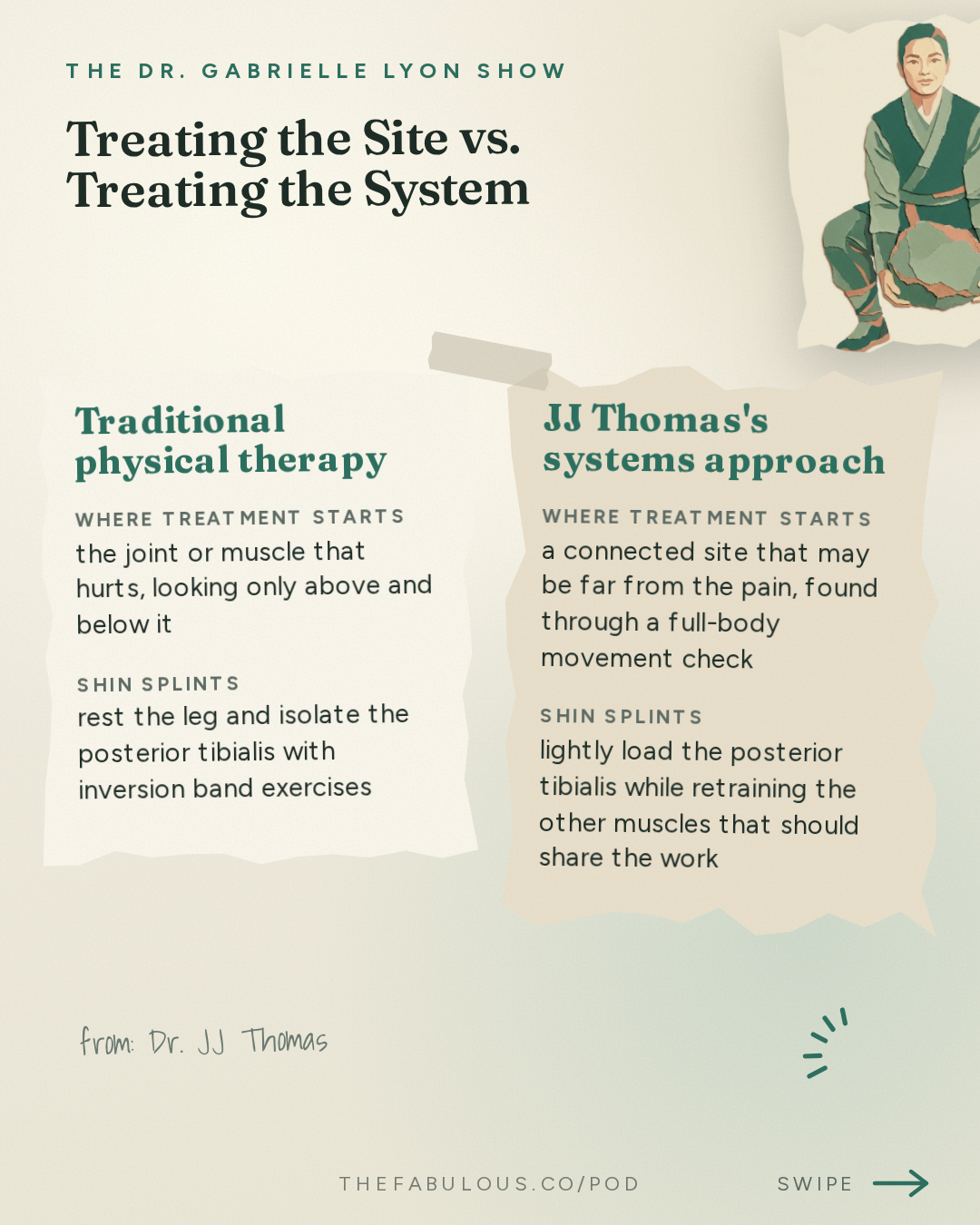
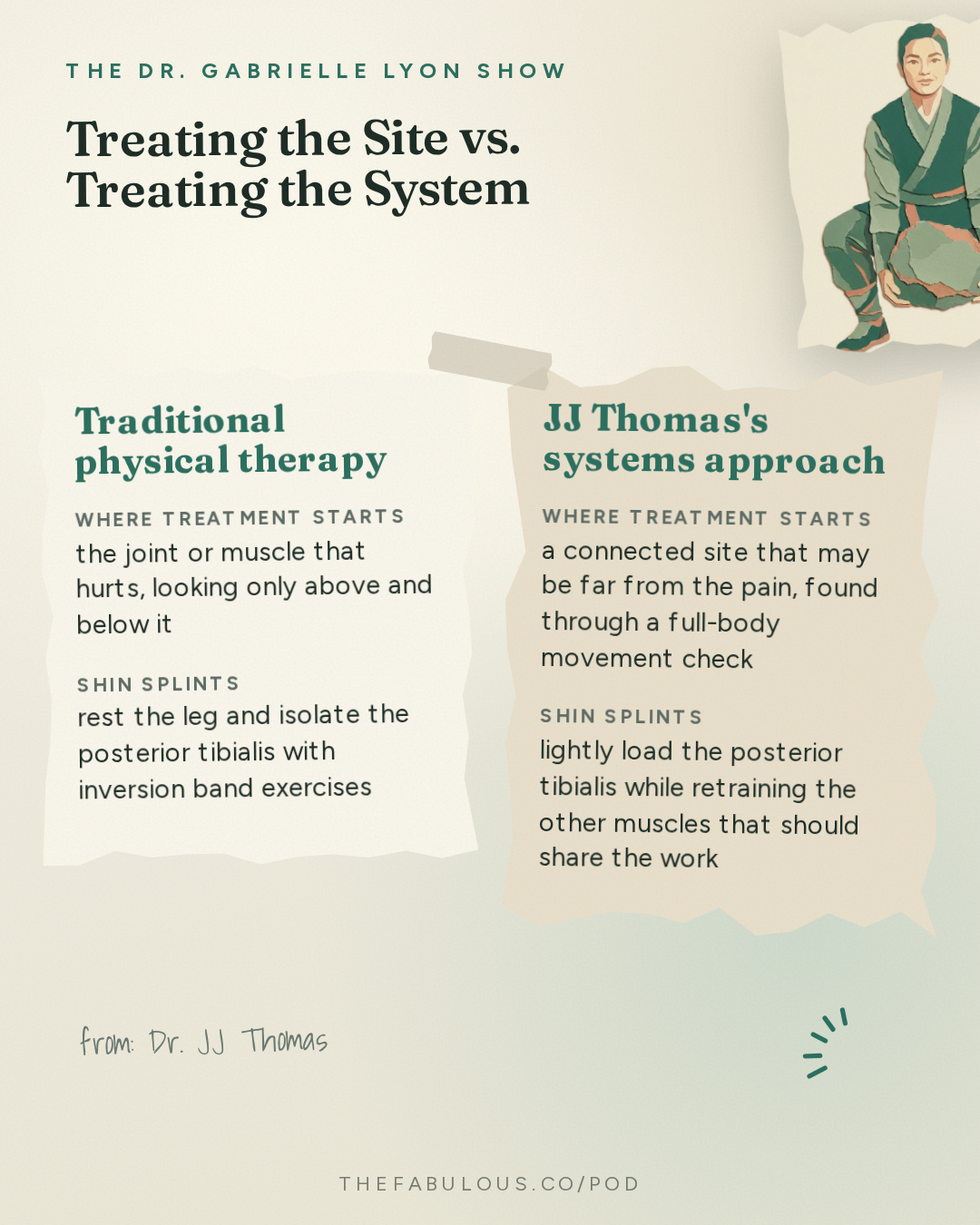
That logic runs against how most physical therapists are actually trained. Thomas graduated physical therapy school twenty-five years ago, when the standard was to look only above and below the injured joint (03:03). Under that model, a tendon injury gets eccentric loading, a technique where a muscle lengthens under tension, such as slowly lowering the leg after a hamstring curl (04:38). The tissue often heals. But if nobody asks why the tendon tore in the first place, Thomas says, "it's gonna come right back" (06:08).
"Really, the pain is the alarm, and so what we have to figure out is what is the signal, like, what is causing that alarm to go off? Often in medicine, we keep just, just taking the batteries out of the alarm." — JJ Thomas [00:00]
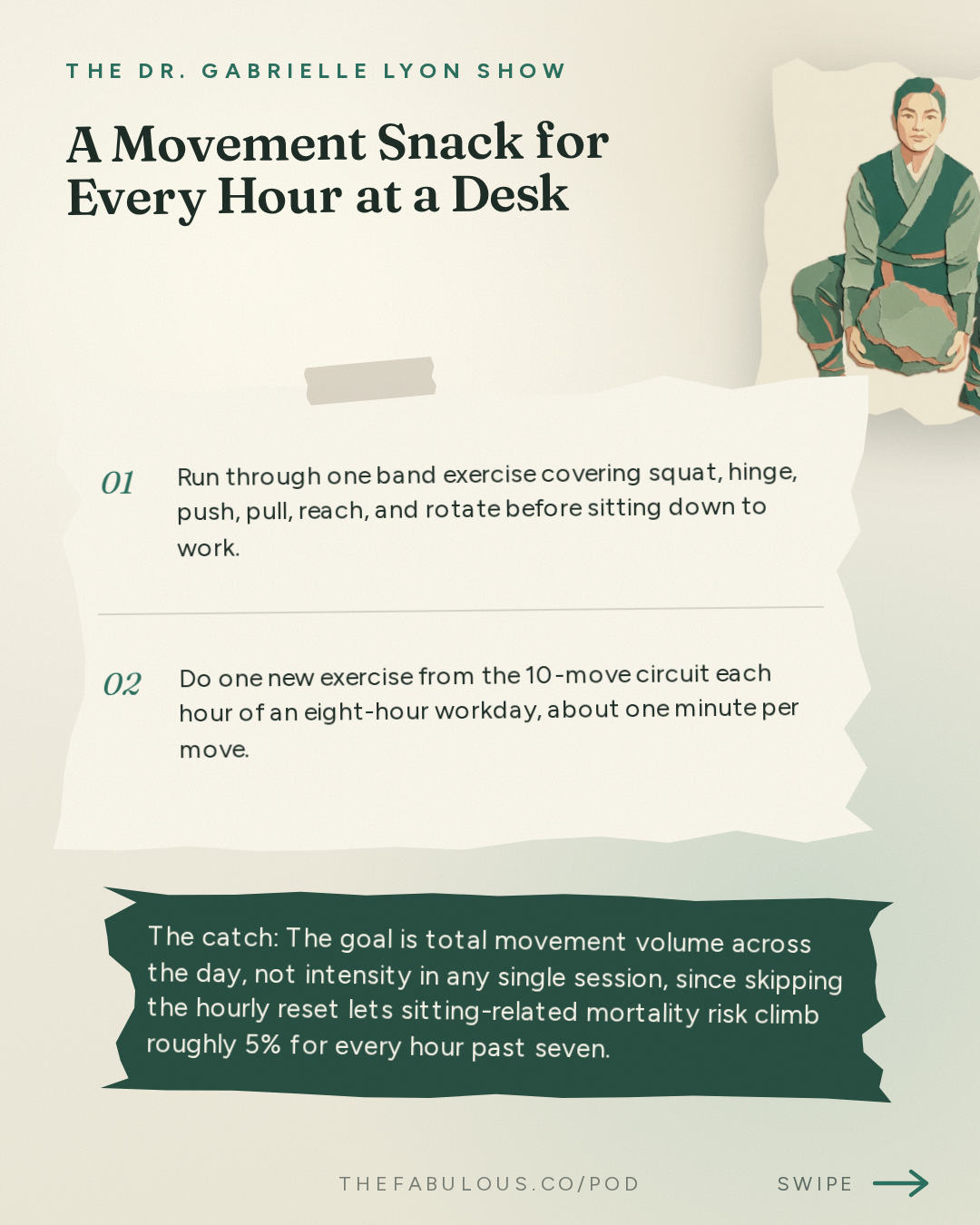
The alarm, in Thomas's view, goes off because modern life has quietly erased the movement signals the body expects. Adults are sedentary six to ten hours a day (07:05), 80 percent of people are insufficiently active even if they technically get some daily steps in (07:38), and for every hour of sitting beyond seven hours, mortality risk climbs about 5 percent (08:06). Thomas sums up her fix in an acronym, MORE: treat Movement as a driver of health rather than a supplement to it, move Often throughout the day, add Resistance, and remember how the body Evolved to move in the first place (10:16). Something as small as 10 to 15 squats an hour can shift glucose uptake and hormone regulation, and 20 squats an hour can change amino acid regulation tied to protein synthesis (10:55).
Every program Thomas writes, for an Olympic athlete or a desk worker, is built around seven patterns: squat, hinge, push, pull, carry, reach, and rotate (13:43). She ties these to the milestones babies pass through between birth and roughly age three, patterns like rolling, crawling, and standing that have to be earned in order before the next one becomes possible (15:00). Skip the overhead reaching pattern, she argues, and shoulder stability never properly links to the rest of the body, including the pelvis, because the muscles involved share the same connective tissue planes (14:13).
That shoulder-to-pelvis link sounds abstract until Thomas renames the part of the body most people call the pelvic floor.
"Pelvic floor is a really poor word, because you can't have a room with only a floor. Like, the reason the pelvic floor is a thing is because there's three other walls. The top of the wall is the diaphragm." — JJ Thomas [38:54]
The side walls, she explains, are the abdominal muscles and the spinal erectors, the muscles running from tailbone to skull. A floor cannot hold weight without walls around it. That is why Thomas will prescribe scapular exercises, meaning drills for the shoulder blade's stability, to a patient asking about pelvic floor weakness or incontinence (38:35). The two systems share scaffolding.
Posture Is Not a Decision
This same logic explains why telling someone to sit up straight rarely helps. Posture, Thomas says, is not a habit so much as a readout.
"Posture is really a reflection of your underlying stability, so it's really evidence of what your stability patterns are." — JJ Thomas [34:39]
If the stability is not there, consciously straightening the spine for a minute changes nothing once attention wanders. Left alone, poor scapular position can progress to shoulder impingement, where a tendon gets pinched under the shoulder blade's bony edge (36:54), to headaches and jaw problems from a forward head position (37:50), and eventually to pelvic floor dysfunction, since the wall holding the room together has already buckled (38:35). The fix, in Thomas's clinic, usually starts on the floor: variations of tummy time, which is the same position infants use to build head and spinal control, done as an adult (22:53).
The Muscle That Fixes the Neck
Thomas extends the same thinking to a category of injuries doctors usually file as overuse.
"What people think of as overuse injuries are often underuse injuries, in my opinion." — JJ Thomas [55:03]
Take shin splints, a common complaint involving the posterior tibialis, a muscle that controls the arch of the foot (56:09). Standard advice is rest and isolated strengthening with resistance bands. Thomas instead treats what she calls relative rest: light, weight-bearing positions like a half kneel, paired with rotational or lateral loading so the muscle learns it has support from three-dimensional movement, not just its own effort (57:21). The muscle got overused, in her telling, because the muscles around it were underused and never picked up their share of the load.
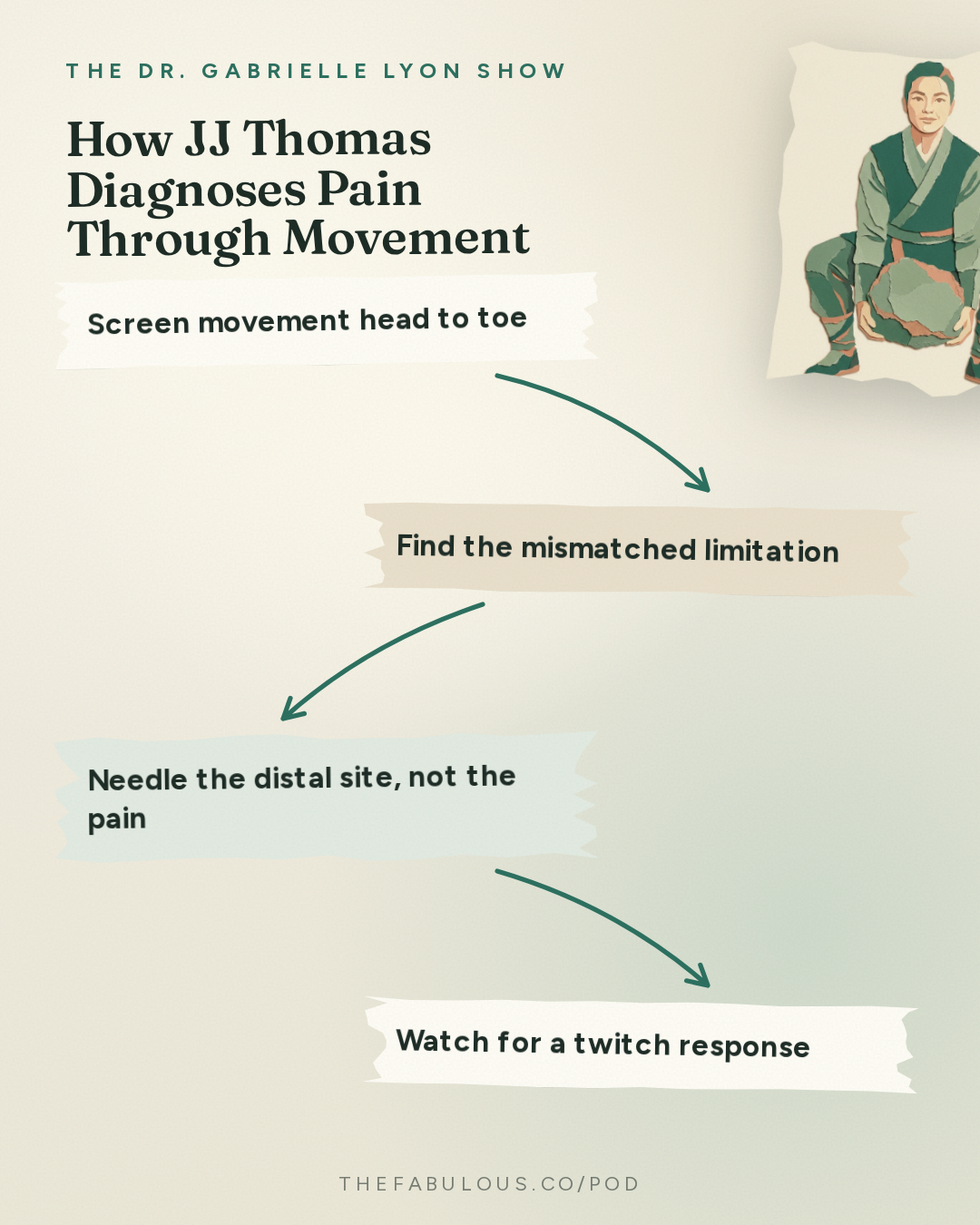
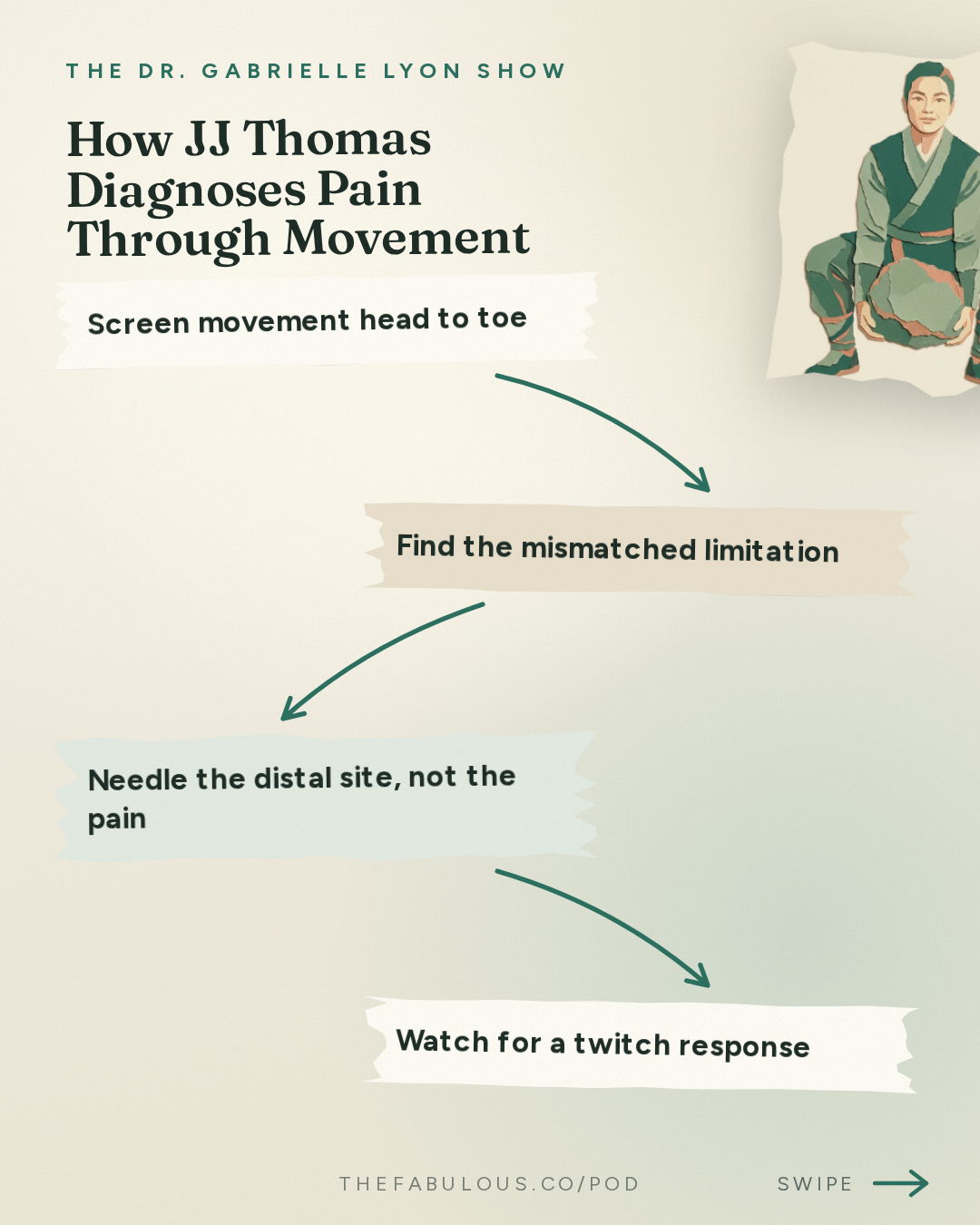
Thomas uses a simple test to find these hidden culprits. She has a patient rotate the neck while sitting, then while standing. If rotation is limited only while seated, the problem usually is not the neck at all. Sitting puts tension on the posterior chain, the muscles running up the back of the body, and that tension, not the neck itself, is what restricts the turn (72:33, 73:14). One older patient reported exactly this pattern: fine neck rotation standing, stuck while seated. Thomas treated his low back and hip. His neck improved without being touched (73:55).
This is also the thinking behind dry needling, a technique using thin needles to stimulate dysfunctional muscle, which Thomas began learning in 2009, when only about 300 physical therapists in the country were certified to do it (65:30). She rarely needles the painful site first. In one early case, she needled a clinician's groin muscles and his neck rotation, previously stuck at 30 degrees instead of a normal 80, immediately normalized (67:05). She now describes the needle's effect as a structural, biochemical, and electrical reset: it releases a shortened muscle fiber, produces a measurable twitch on electrical testing, and triggers biochemical changes that support repair (74:34). After needling, she puts patients straight back into the movement pattern that was failing, so the nervous system reinforces the change immediately rather than losing it (76:18).
None of this, Thomas is careful to add, works in isolation from metabolic health. When Thomas's own blood work came back with low estrogen and an underperforming thyroid, despite years of serious training, Lyon recognized a mismatch she had seen before: patients doing everything right physically while their biochemistry quietly worked against them (79:59). Once Thomas's hormones were addressed and her protein intake rose to around 130 grams a day, close to one gram per pound of body weight, her sugar cravings dropped and, within about eight months, her body composition changed substantially (87:11, 82:08). Thomas closes on a financial image: movement throughout the day tells the body where to spend its limited energy, the way daily choices direct money in and out of a bank account (89:43). The alarm, treated as information instead of noise, turns out to be useful after all.
Ask this episode anything
Pod's AI answers from the episode itself, with the minute mark so you can hear it yourself.
Or start with one of these
Ask this episode
Pod's AI listens to the whole episode to answer, and points you to the minute it comes from.
The rest of this answer, and any question after it
Answers come from the episode itself, never from a summary of it.
ContinueKey takeaways
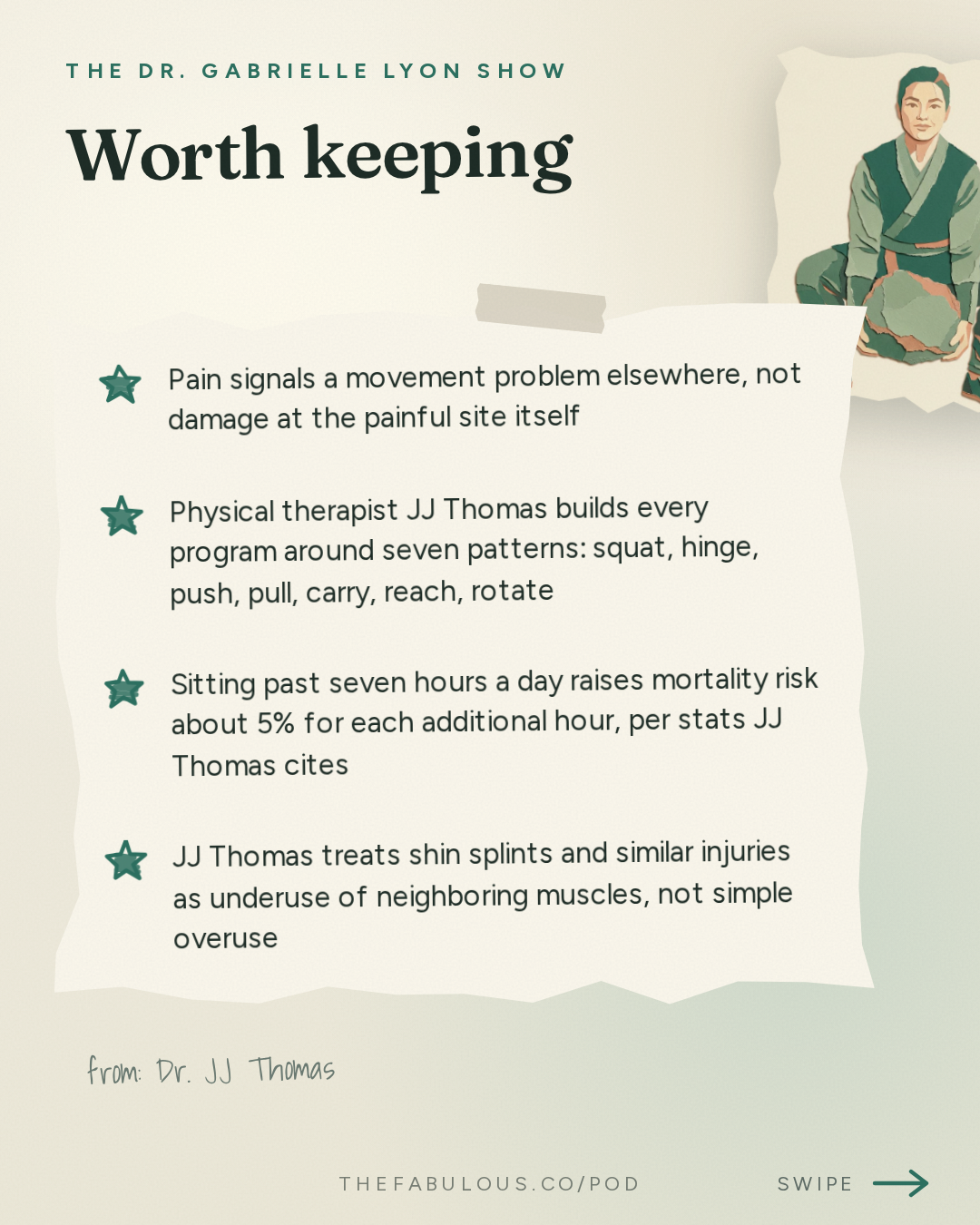
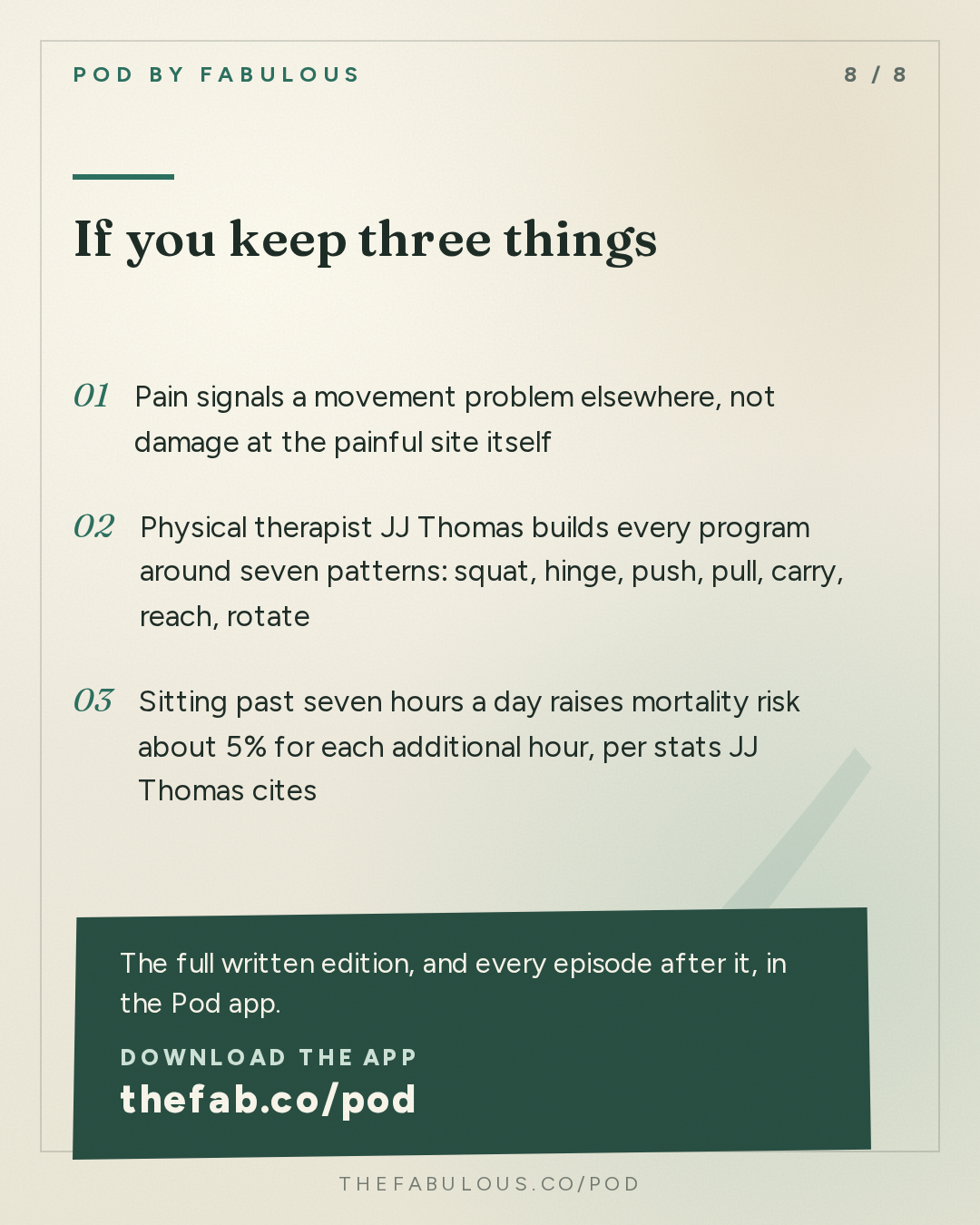
- Pain signals a movement problem elsewhere, not damage at the painful site itself
- Physical therapist JJ Thomas builds every program around seven patterns: squat, hinge, push, pull, carry, reach, rotate
- Sitting past seven hours a day raises mortality risk about 5% for each additional hour, per stats JJ Thomas cites
- JJ Thomas treats shin splints and similar injuries as underuse of neighboring muscles, not simple overuse
- A neck that rotates fine standing but not sitting points to tight back muscles, not a neck problem, per JJ Thomas's test
The episode in cards

By the numbers
- 5% percent increase in mortality risk for every hour of sitting beyond seven hours a day
In their words
“Really, the pain is the alarm, and so what we have to figure out is what is the signal, like, what is causing that alarm to go off? Often in medicine, we keep just, just taking the batteries out of the alarm.”
“Posture is really a reflection of your underlying stability, so it's really evidence of what your stability patterns are.”
“What people think of as overuse injuries are often underuse injuries, in my opinion.”
“Pelvic floor is a really poor word, because you can't have a room with only a floor. Like, the reason the pelvic floor is a thing is because there's three other walls. The top of the wall is the diaphragm.”
Protocols
-
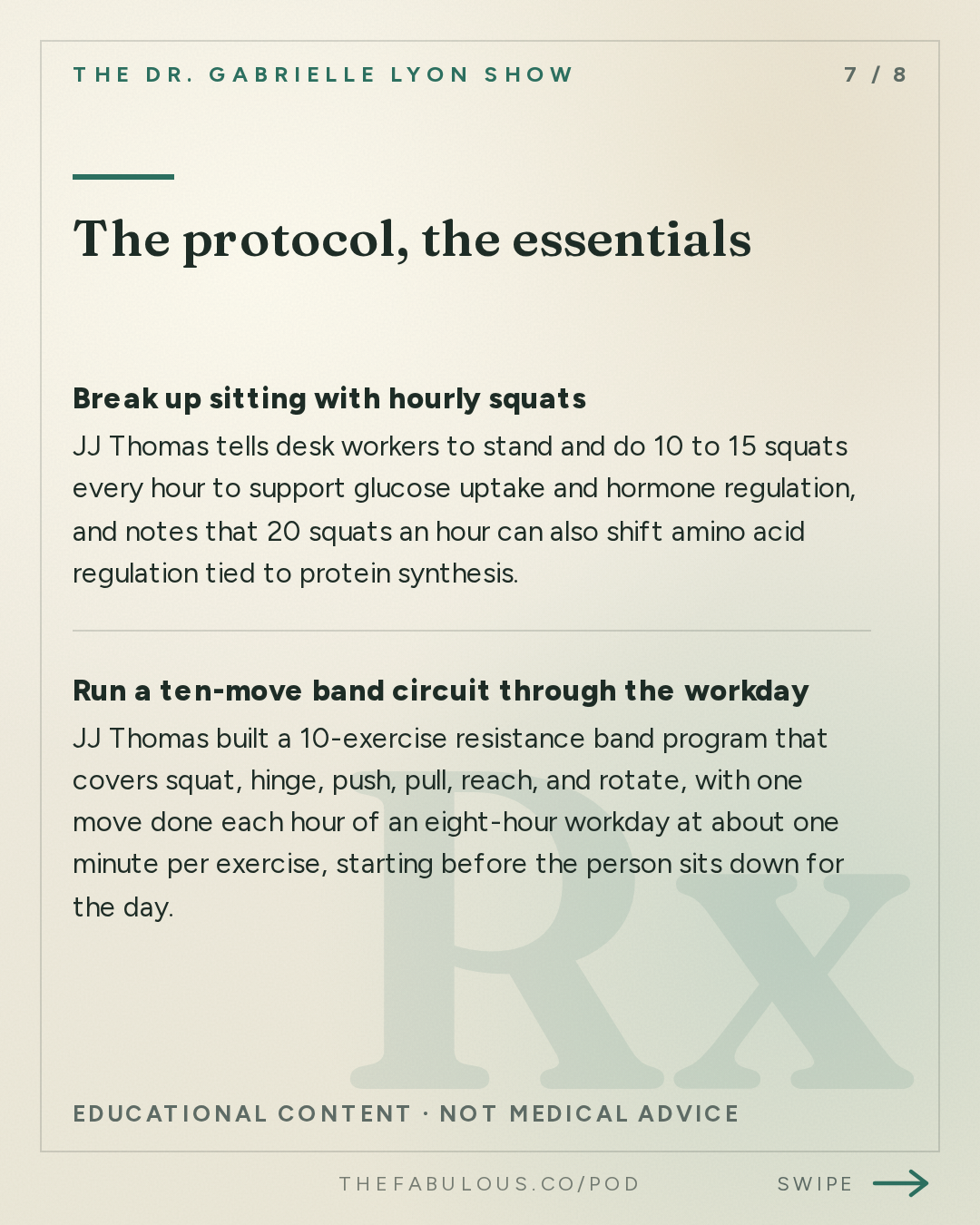
Break up sitting with hourly squats
JJ Thomas tells desk workers to stand and do 10 to 15 squats every hour to support glucose uptake and hormone regulation, and notes that 20 squats an hour can also shift amino acid regulation tied to protein synthesis.
every hour during the workday
-
Run a ten-move band circuit through the workday
JJ Thomas built a 10-exercise resistance band program that covers squat, hinge, push, pull, reach, and rotate, with one move done each hour of an eight-hour workday at about one minute per exercise, starting before the person sits down for the day.
once per hour across an eight-hour workday
-
Test neck rotation sitting versus standing
JJ Thomas has patients rotate their neck while seated and then while standing; if rotation is limited only while sitting, she treats the posterior chain, meaning the back muscles from the pelvis to the skull, before touching the neck itself, because the catch is that the neck is rarely the real problem in this pattern.
as a one-time self-check, repeated if symptoms return
-
Hit a protein target near body weight in pounds
JJ Thomas eats roughly 130 grams of protein a day, close to one gram per pound of her body weight, split with about 40 grams at breakfast and again at dinner, and she reports that reaching this number cut her nightly sugar cravings.
daily
Questions this episode answers
What does JJ Thomas mean by 'pain is an alarm'?
Philadelphia-based physical therapist JJ Thomas treats pain as a warning signal pointing to a movement pattern problem elsewhere in the body, not proof that the painful spot is damaged (00:00). She compares standard treatment to removing a smoke alarm's battery instead of checking the house for a fire.
What are the seven foundational movement patterns?
JJ Thomas builds every program around seven patterns: squat, hinge, push, pull, carry, reach, and rotate, because they mirror the developmental milestones people master between birth and about age three (13:43). Skipping overhead reaching, in particular, can leave the shoulders disconnected from pelvic stability (14:13).
Are overuse injuries really underuse injuries?
JJ Thomas argues that common problems like shin splints and tendinopathy are 'underuse injuries' because neighboring muscles fail to share the load, not simply because one muscle did too much work (55:03). For shin splints, she treats the posterior tibialis muscle, which controls arch collapse, with gradual multi-planar loading rather than rest alone (56:09).
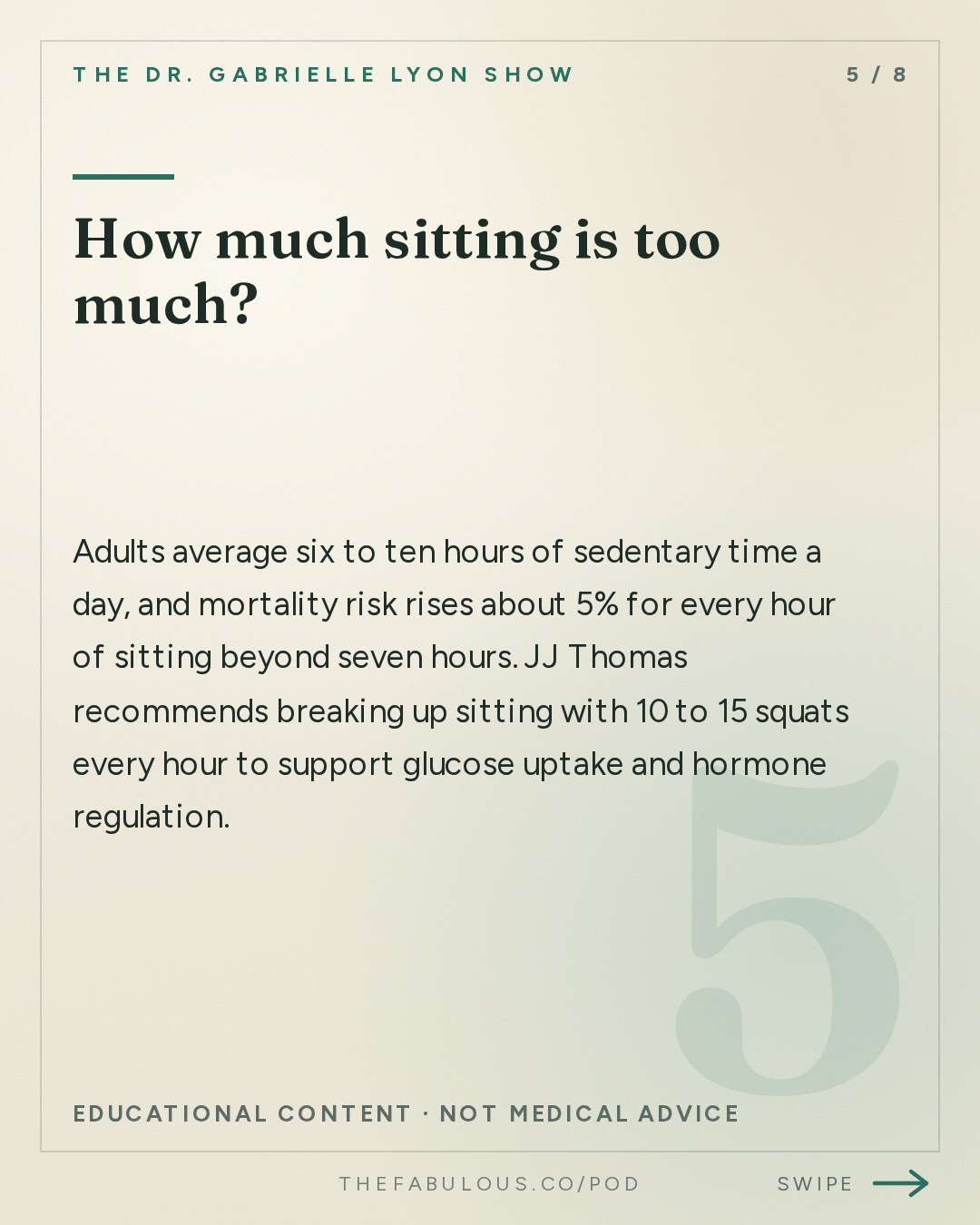
How much sitting is too much?
Adults average six to ten hours of sedentary time a day, and mortality risk rises about 5% for every hour of sitting beyond seven hours (07:05, 08:06). JJ Thomas recommends breaking up sitting with 10 to 15 squats every hour to support glucose uptake and hormone regulation (10:55).
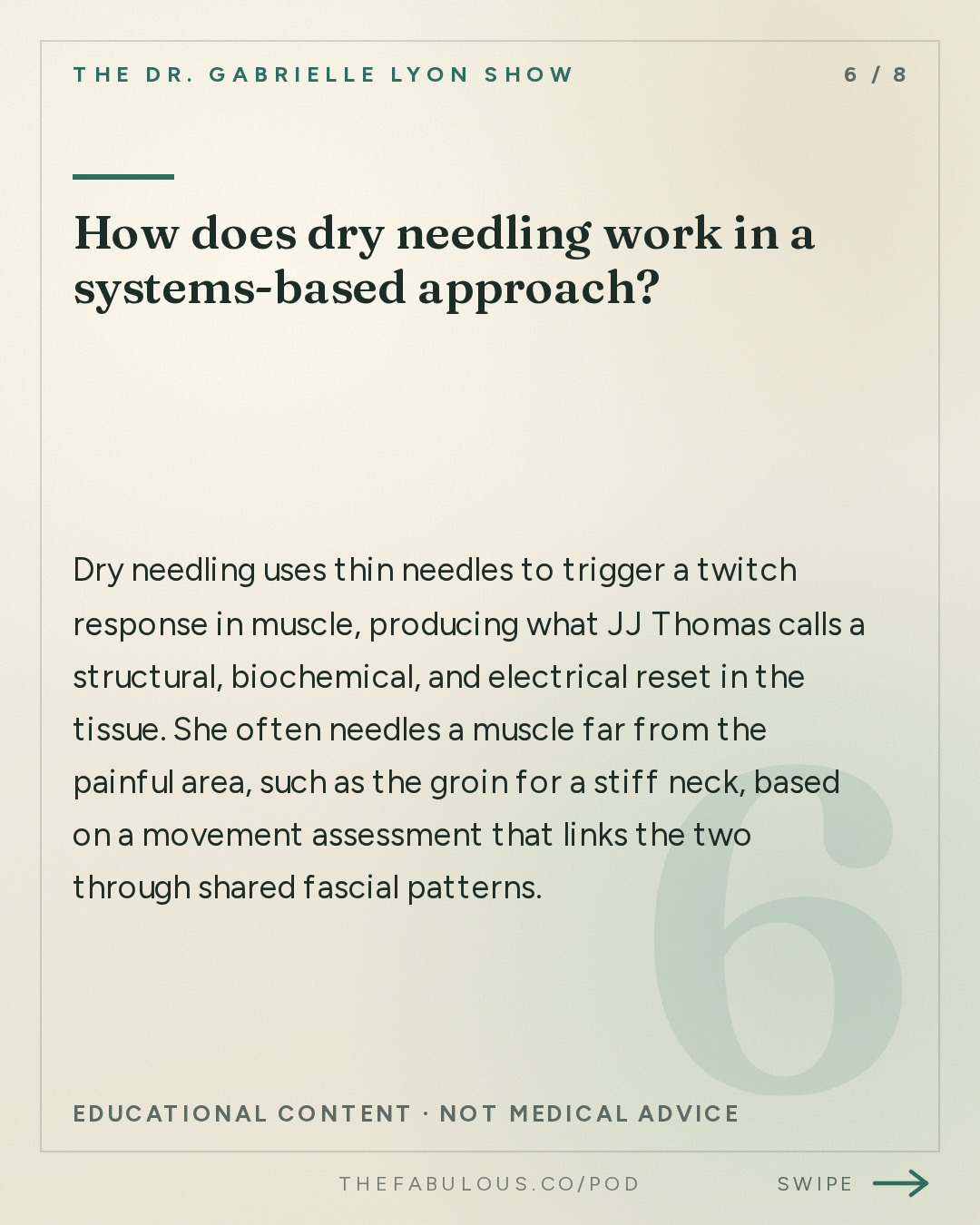
How does dry needling work in a systems-based approach?
Dry needling uses thin needles to trigger a twitch response in muscle, producing what JJ Thomas calls a structural, biochemical, and electrical reset in the tissue (74:34). She often needles a muscle far from the painful area, such as the groin for a stiff neck, based on a movement assessment that links the two through shared fascial patterns (68:13).
Can posture be fixed by just sitting up straight?
No. JJ Thomas says posture is evidence of underlying stability, not a habit someone can fix by consciously sitting taller (34:39). Lasting change requires rebuilding scapular and posterior-chain stability through floor-based movement rather than relying on posture cues.
The full read, in cards
Go deeper
- Forever Strong — JJ Thomas's first book, which pushed her to pair movement patterns with hormone and protein checks for patients who stopped responding to exercise alone
- DNS (Dynamic Neuromuscular Stabilization) — a training method JJ Thomas cites as sharing her approach of using infant developmental patterns as the standard for adult movement
- Selective Functional Movement Assessment — the movement screening tool JJ Thomas used while teaching dry needling clinicians to evaluate the whole body before treating a painful site
Mentioned
Dr. JJ Thomas · Dr. Gabrielle Lyon · Primal Physical Therapy · Forever Strong · DNS · Phil DeRue · Judd Leonard · Selective Functional Movement Assessment
More from this show and category
Building Muscle in Menopause: What Studies Show
No, it is not too late: postmenopausal women gained up to eight pounds of muscle in 12 weeks of structured lifting. Hormone therapy does not build muscle on its own, but it can amplify gains from resistance training, and the protein target for bone and muscle protection is roughly double the standard RDA.

Surgical Prehabilitation Protocol Guide
Prehabilitation, the practice of preparing the body before surgery instead of only recovering after it, can measurably change outcomes. Duke University surgeon Rebecca Knackstedt recommends 2 grams of protein per kilogram of body weight daily (34:26), a vitamin D level near 70 ng/mL (25:47), targeted muscle training, and five days of immunonutrition before major operations (69:01) to cut complications and speed healing.

ED as an Early Predictor of Heart Attack Risk
Erectile dysfunction predicts a future heart attack better than chest pain does, especially in younger men (11:11). Urologist Tobias Kohler describes two cheap early-warning tests, a coronary calcium scan and a Mayo Clinic ceramide blood test, plus the cardiac damage caused by high-dose testosterone abuse (12:49, 44:55).

Menopause, Muscle Loss, and Insulin Resistance
Menopause changes the body mainly by shrinking muscle, not just by crashing hormones. Dr. Gabrielle Lyon argues that muscle loss, which starts speeding up about two years before a woman's final period, drives the insulin resistance, bone loss, and fat gain often blamed on menopause alone, and that resistance training and higher protein intake are the direct countermeasures.
