Stuart McGill's Deadlift Fracture Claim, Debunked
What the Back Experts Get Wrong: Stu McGill's Deadlift Claims, Spinal Engine Theory, and Eccentric Overload
The brief
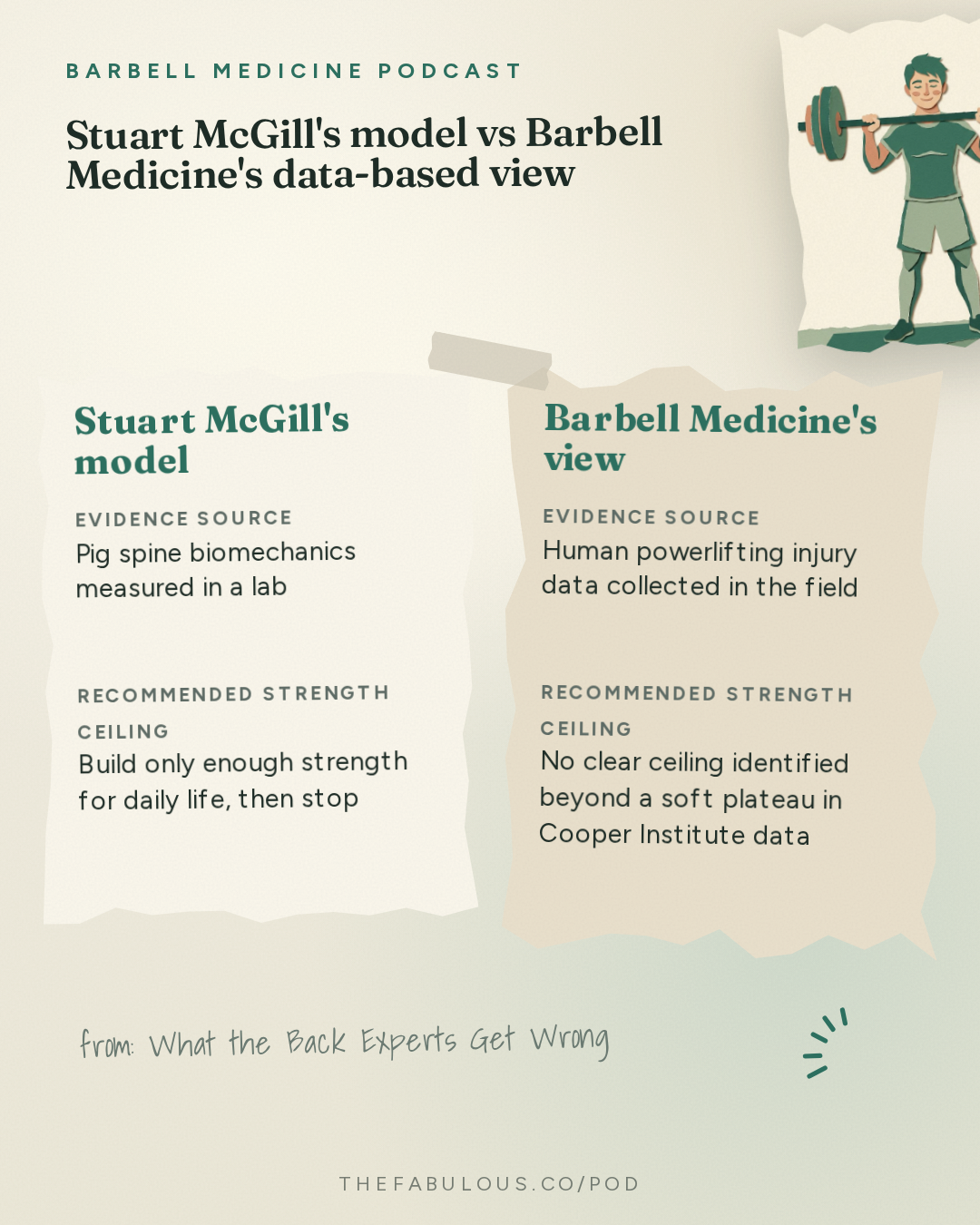
Barbell Medicine hosts debunk Stuart McGill's claim that deadlift PRs fracture spinal vertebrae, pointing to powerlifting's low injury rate (03:36). They also dismiss spinal engine theory and argue eccentric-overload machines like the Voltra do not add muscle mass beyond matched training load (19:52).
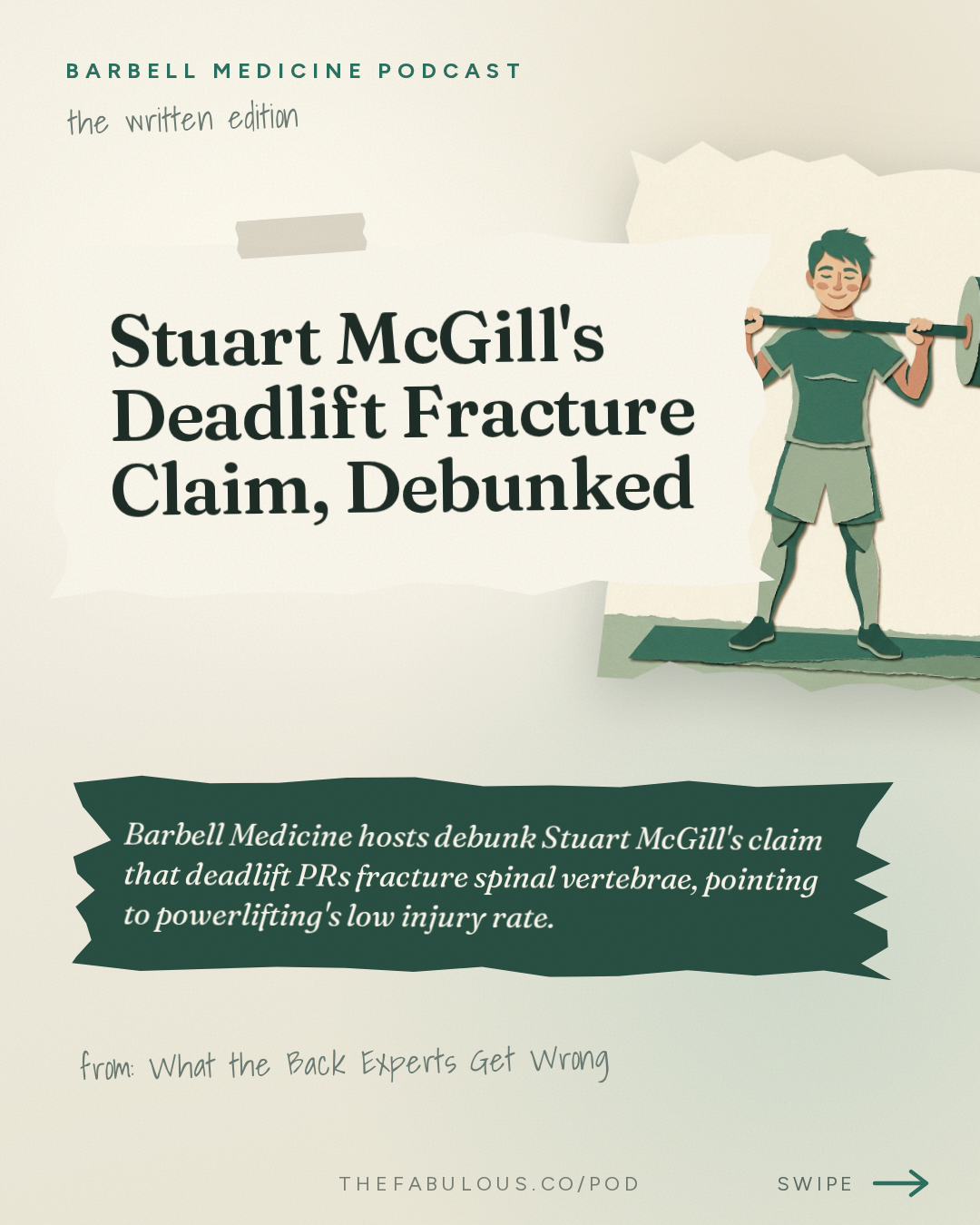
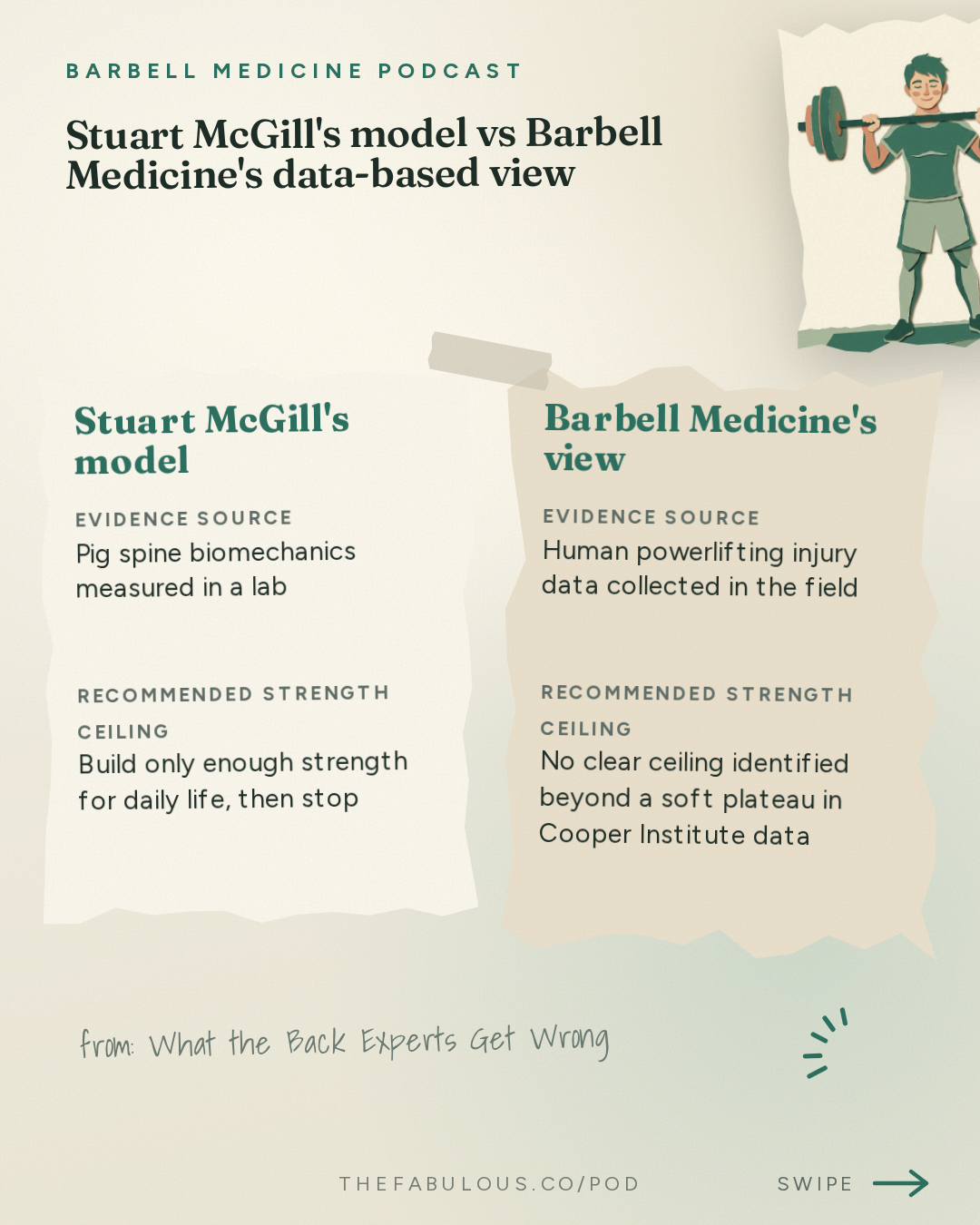
A biomechanist spends decades in a lab bending spines until they fail. Most of those spines come from pigs, because pigs walk on four legs and their backbones can be loaded in ways a living human's cannot. Then, on a popular health podcast, that same biomechanist tells millions of listeners that setting a true personal record on the deadlift leaves most people with tiny fractures under the end plates of their vertebrae, the thin caps of bone and cartilage that sit atop each spinal segment. The lab result and the headline claim are not the same thing, and the gap between them is the subject of this episode of the Barbell Medicine Podcast, hosted by physician and strength coach Dr. Jordan Feigenbaum and physician Dr. Austin Baraki.
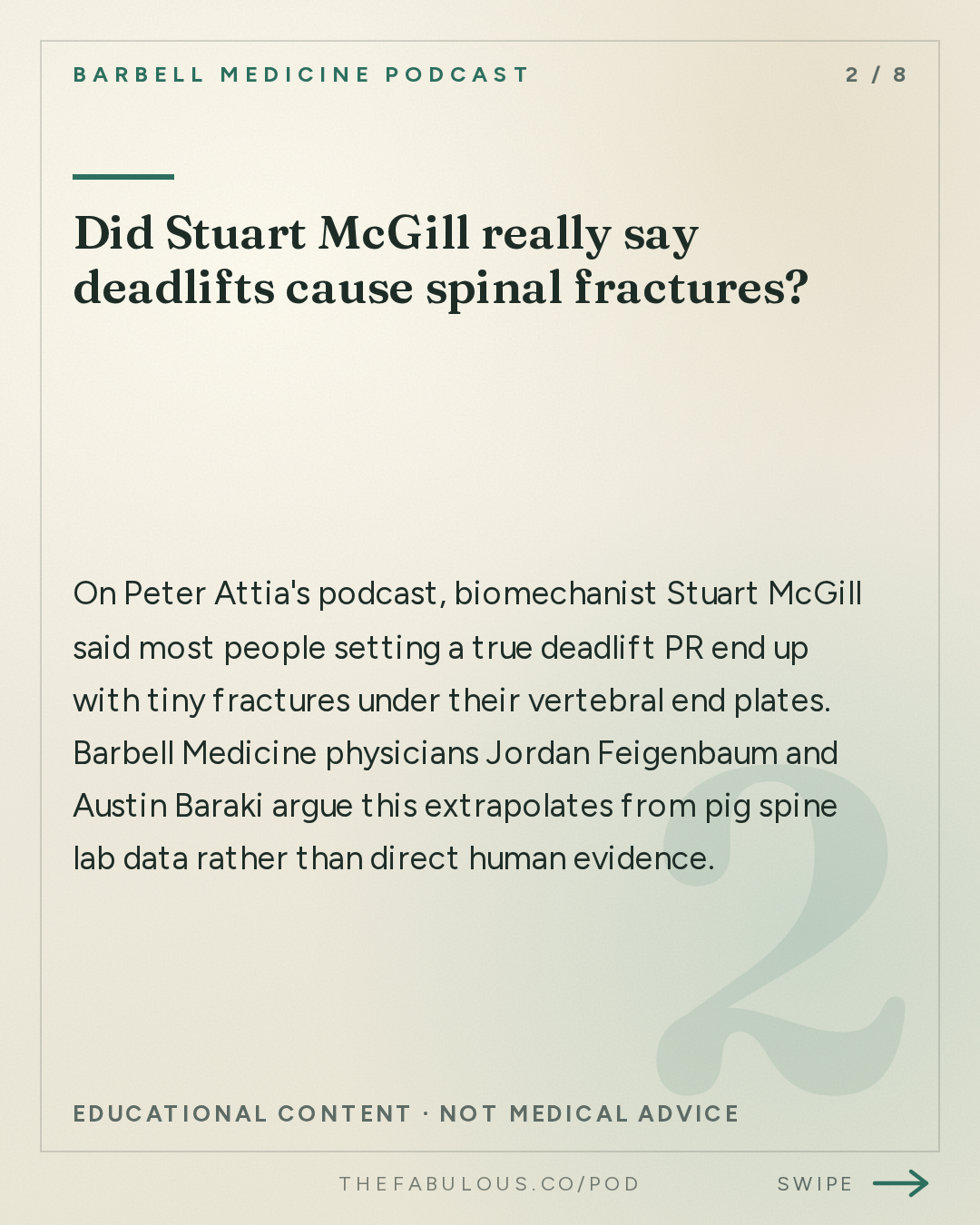
The claim in question came from Dr. Stuart McGill, professor emeritus at the University of Waterloo, during an appearance on Peter Attia's podcast The Drive that first aired in January 2024 and re-aired the following September. Feigenbaum opens the episode by restating it plainly.
"Dr. Stuart McGill said that when most people set a true PR on the deadlift, they end up with tiny fractures just under the end plates of their vertebra." — Jordan Feigenbaum [00:01]
Feigenbaum calls the broader appearance "an anthology of over interpreted pig spine data and weird superstitions about getting too strong" (00:56). His specific objection is not that McGill measured things poorly in the lab. It is that lab findings about failure thresholds in isolated tissue get translated, often by clipped video and social media, into blanket warnings about catastrophe. McGill's own advice, that people should build enough strength for their life and then stop chasing more, sounds reasonable on its face, but Feigenbaum points out it is undefined: nobody says how much is enough (01:22).
That question, how strong is strong enough, has actual data behind it. Feigenbaum cites Cooper Institute research on strength and health outcomes, which found that benefits from measured strength, tested on a leg press and machine bench press, appeared to plateau once someone reached the middle third of recorded strength levels (01:47). But the plateau is softer than it looks. The strongest group in that dataset averaged only a 330-pound leg press, just thirty pounds above the middle group (02:33), which suggests researchers found the floor where strength starts mattering for health, not a ceiling above which it stops. A similar pattern shows up in grip strength studies: grip strength barely improves with ordinary resistance training unless it is trained directly, and nobody in these cohorts is strong enough to reveal where real diminishing returns begin (02:15).
The sharper rebuttal to McGill's catastrophizing, though, is injury data from the sport that most resembles maximal lifting: competitive powerlifting. Feigenbaum asks the obvious question.
"Why is the injury rate in power lifting only two to four injuries per thousand participation hours?" — Jordan Feigenbaum [03:36]
That rate covers athletes squatting and deadlifting near their physical limits as the entire point of the sport. And when injuries occur, most do not require medical care and resolve within two weeks (03:54). Most are overuse injuries, meaning tissue irritated by accumulated load over time, not sudden structural failures (04:08). None of that matches a narrative in which a single heavy pull routinely cracks vertebrae.
Baraki adds context on McGill himself, pointing listeners toward physiotherapist and chiropractor Greg Lehman, who worked directly with McGill for years and appeared on Barbell Medicine's episode 131 to discuss his work in detail (04:44). Baraki also notes that the clinicians at E3 Rehab invited McGill onto their own podcast after this Attia appearance specifically to press him on some of these claims, and that McGill partially walked back his framing without fully abandoning it (06:00). Baraki's verdict on evaluating any public figure's claims is procedural rather than personal: give the specific claim, and the hosts will discuss the claim, not the person (06:44). Applied here, that means refusing to extend animal tissue data to human training decisions.
"The extrapolation does not go in either direction there. So I don't particularly care about that data, and honestly will just dismiss it out of hand until I have, you know, more direct kind of human evidence." — Austin Baraki [07:24]
A Spine That Drives Walking
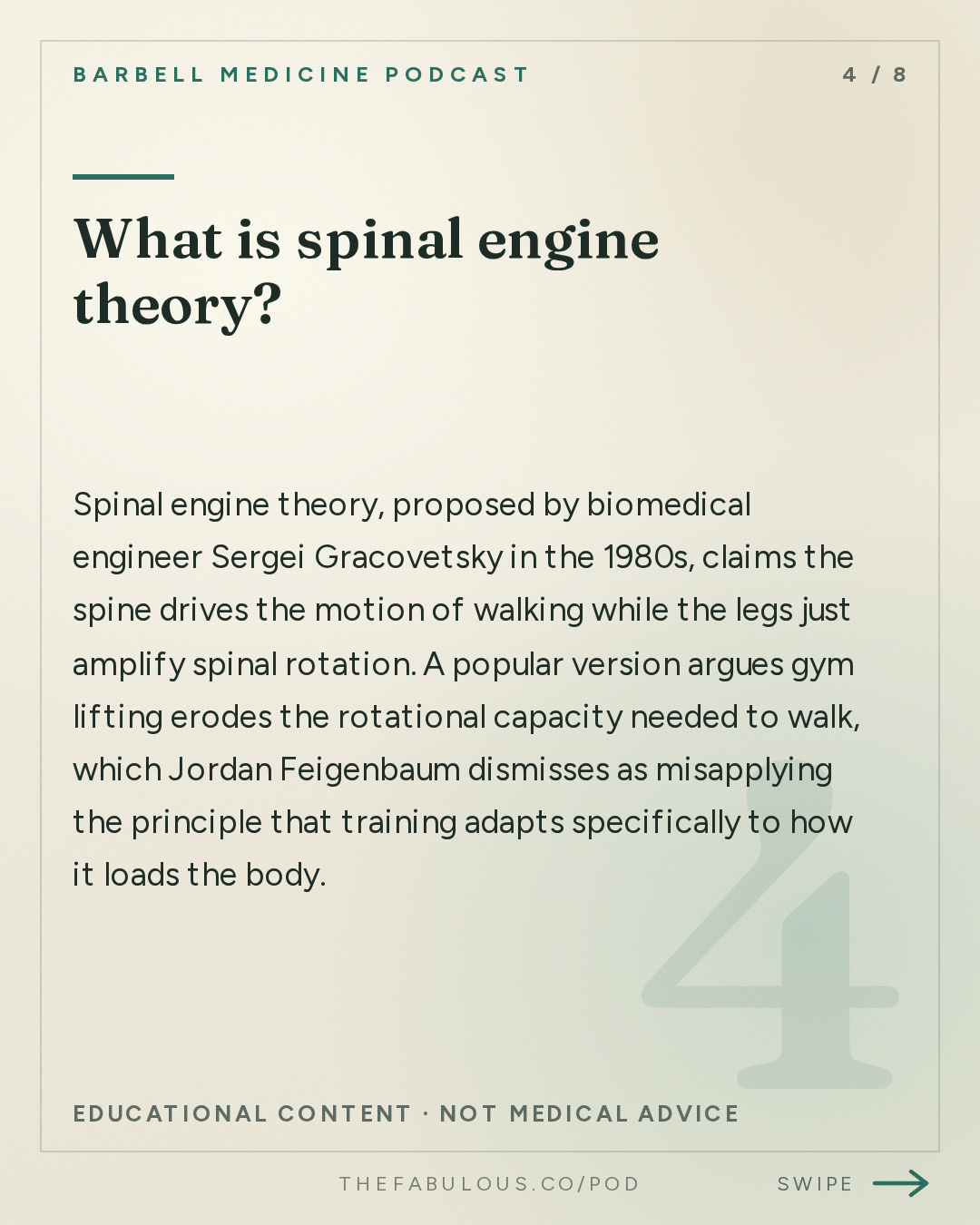
The episode's second major target is an older and stranger idea: spinal engine theory, proposed by biomedical engineer Sergei Gracovetsky in the 1980s, which holds that the spine itself drives the motion of walking and that the legs merely amplify spinal rotation (09:49). A popularized version of this theory claims that ordinary gym lifting, squats and deadlifts in particular, erodes the rotational capacity a person needs to walk well, and that rope, sled, and sandbag flow training should replace it.
Feigenbaum rejects the premise using a basic training principle sometimes called specificity of adaptation to imposed demand, or SAID: training produces adaptations specific to how it loads the body, so squatting mostly improves squatting and rotational work mostly improves rotational capacity (10:41). He extends the logic to its natural, slightly absurd conclusion.
"Gym training, quote-unquote, 'erodes running' if you're not running. Running erodes gym lifting strength if you're not lifting. You know, that's a weird way to phrase it." — Jordan Feigenbaum [13:24]
Baraki's clinical practice reflects the same logic rather than contradicting it. He prescribes rotational training often, but specifically inside rehabilitation, where the goal is restoring full and unrestricted movement after injury, and he keeps it in a program only as long as a patient responds to it or enjoys it (11:59). Outside rehab, for someone without a rotational sport, he does not insist on it by default. The point both hosts land on is that any single training mode trades off against capacities it does not directly train. That is not erosion in any sinister sense. It is just what specificity means.
Machines That Promise More Than the Research Supports
The final segment turns to motorized and pneumatic resistance devices, the Voltra, which uses a motor-driven cable system, and the Kaiser, which uses compressed air. Both can vary resistance across a lift's concentric phase, where muscle shortens and lifts the weight, and its eccentric phase, the lowering portion, where the body is naturally 20 percent to 50 percent stronger (19:13). Marketers pitch this as uniquely useful for hypertrophy, since a fixed barbell underloads that stronger eccentric phase.
Feigenbaum ran a research check before recording and reports a clear finding.
"Heavier eccentrics do not add more muscle mass when everything else is matched. Mainly the training load is the key factor here." — Jordan Feigenbaum [19:52]
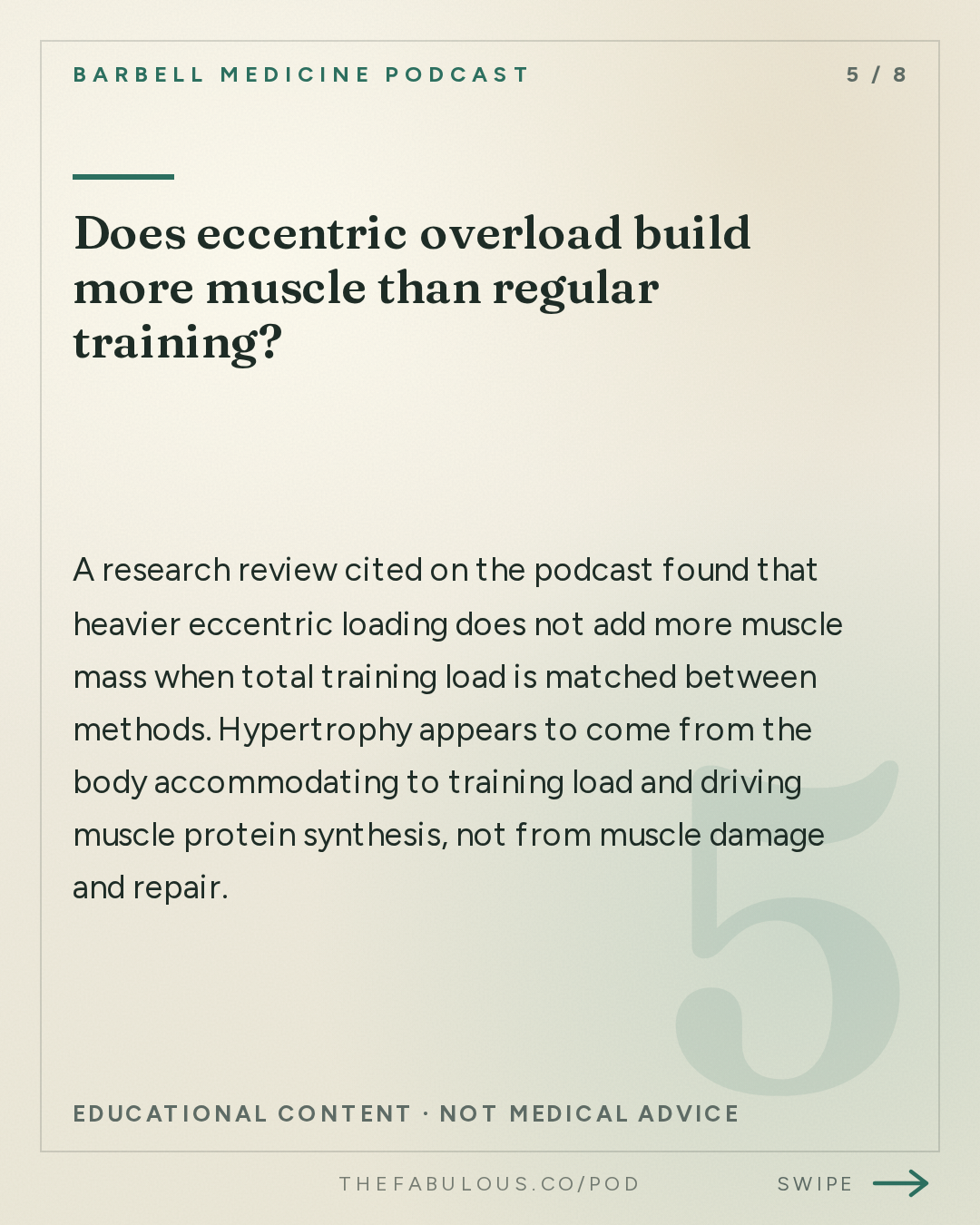
This challenges an older model of hypertrophy in which muscle damage from heavy eccentric loading is treated as the trigger for growth. The current view the hosts favor instead is that muscle grows because a person's body accommodates to a training load, producing less damage over time while the loading itself drives muscle protein synthesis, the cellular process of building new muscle tissue (20:12). Damage and repair alone do not explain added mass; adequate, repeated loading does.
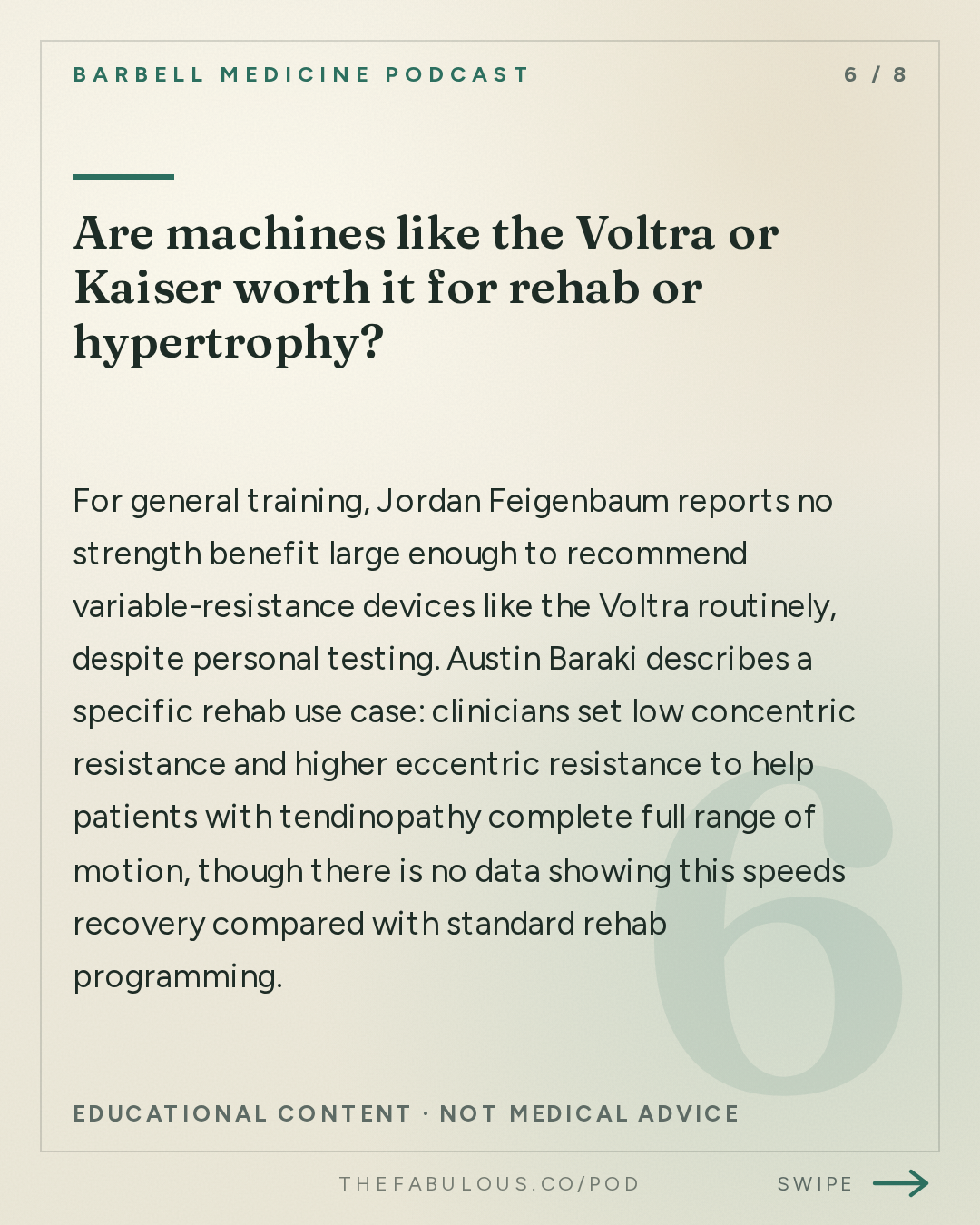
Feigenbaum has personally tried eccentric-overload tools, including weight releasers, chains, bands, and the Voltra itself, and does not report a strength benefit large enough to recommend them routinely (21:13). Feigenbaum keeps a Voltra in his own program mainly because it is enjoyable to use, not because it outperforms simpler loading (21:13). Its practical resistance also tops out around 200 pounds (21:35), which limits its use for already strong lifters.
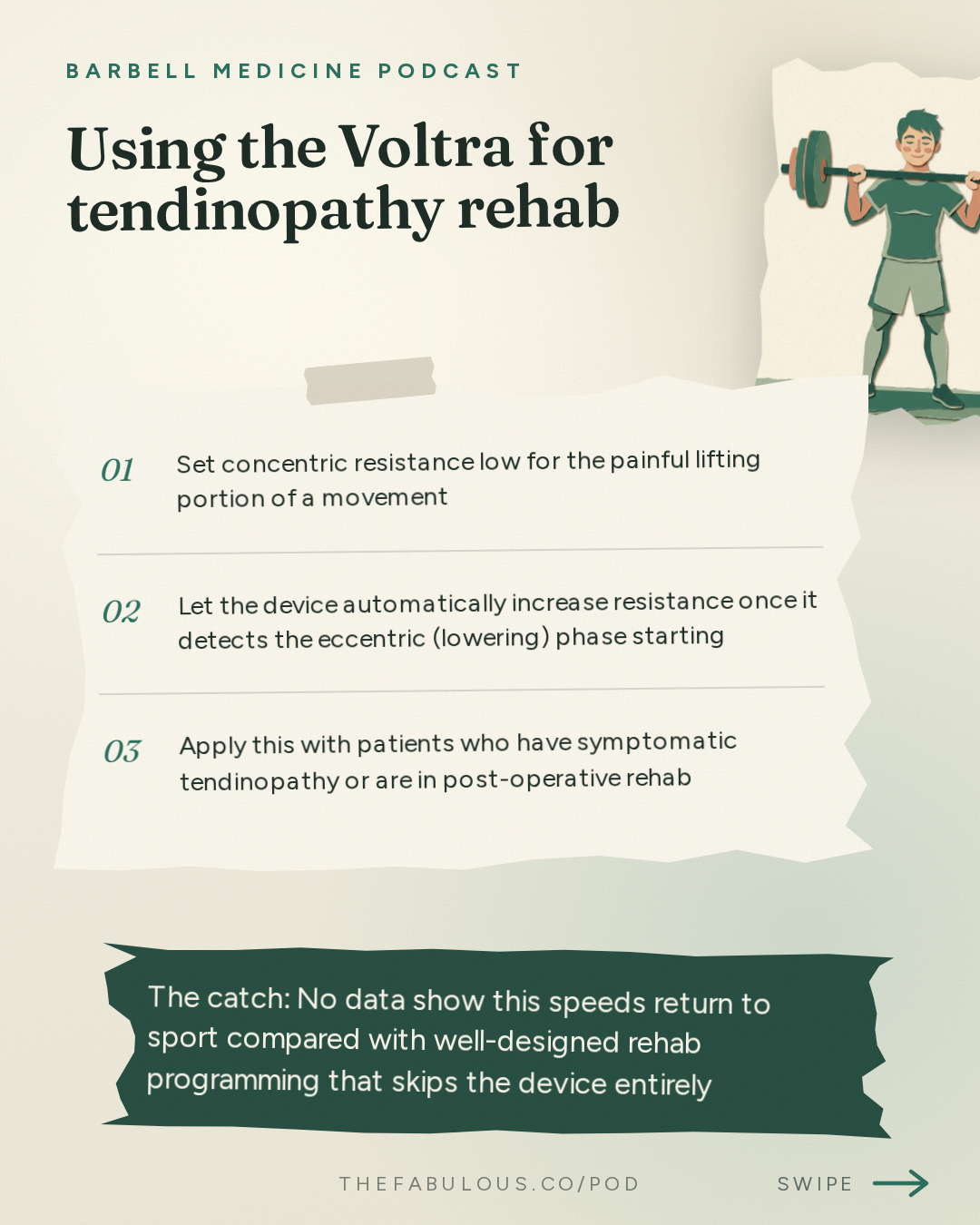
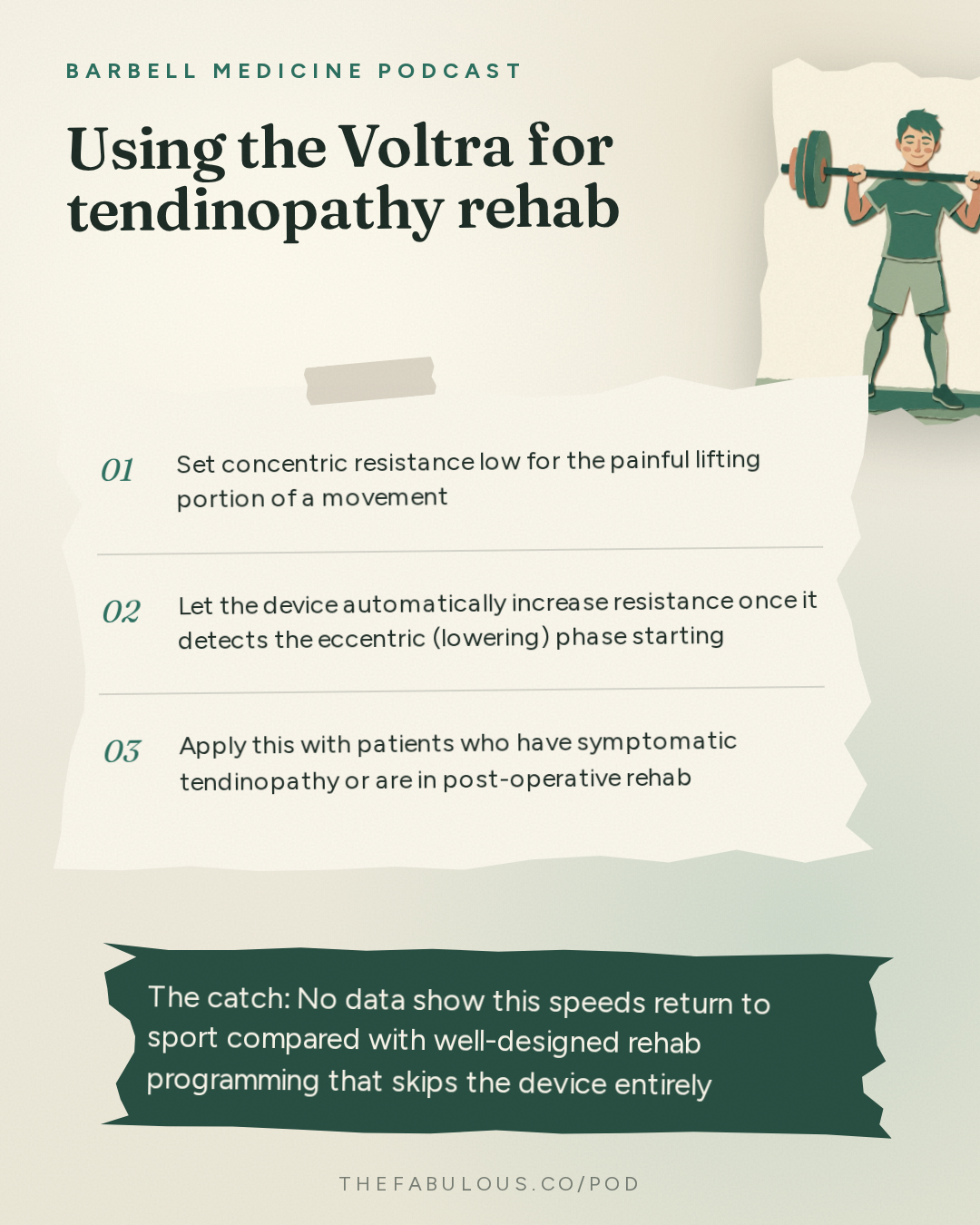
Where the device earns a genuine role is in clinical rehab. Baraki describes colleagues in Cincinnati, physical therapists Dr. Miles and Dr. Klauser, who use the Voltra regularly with patients suffering tendinopathy, a painful irritation of tendon tissue, by setting concentric resistance low in a sensitive range of motion and letting resistance rise automatically once the eccentric phase begins (22:53). That setup lets a patient complete a full range of motion while avoiding the portion of the lift that hurts most. Baraki is careful to bound the claim: he has no data suggesting this accelerates return to sport compared with well-designed rehab programming that skips the device entirely (23:41). It is a useful tool for specific problems, not a shortcut around time and good coaching.
Running under both halves of the episode is the same complaint: biomechanical lab findings and clever equipment both get oversold once they leave the room where they were measured. Pig spines fail under load in ways that do not map cleanly onto a human deadlifting in a gym. A motor that can vary resistance by phase of a lift does not, on its own, change the biology that drives muscle growth. What actually moves outcomes, the hosts argue, is less exotic: enough strength, applied consistently, without being talked out of it by a headline.
Ask this episode anything
Pod's AI answers from the episode itself, with the minute mark so you can hear it yourself.
Or start with one of these
Ask this episode
Pod's AI listens to the whole episode to answer, and points you to the minute it comes from.
The rest of this answer, and any question after it
Answers come from the episode itself, never from a summary of it.
ContinueKey takeaways
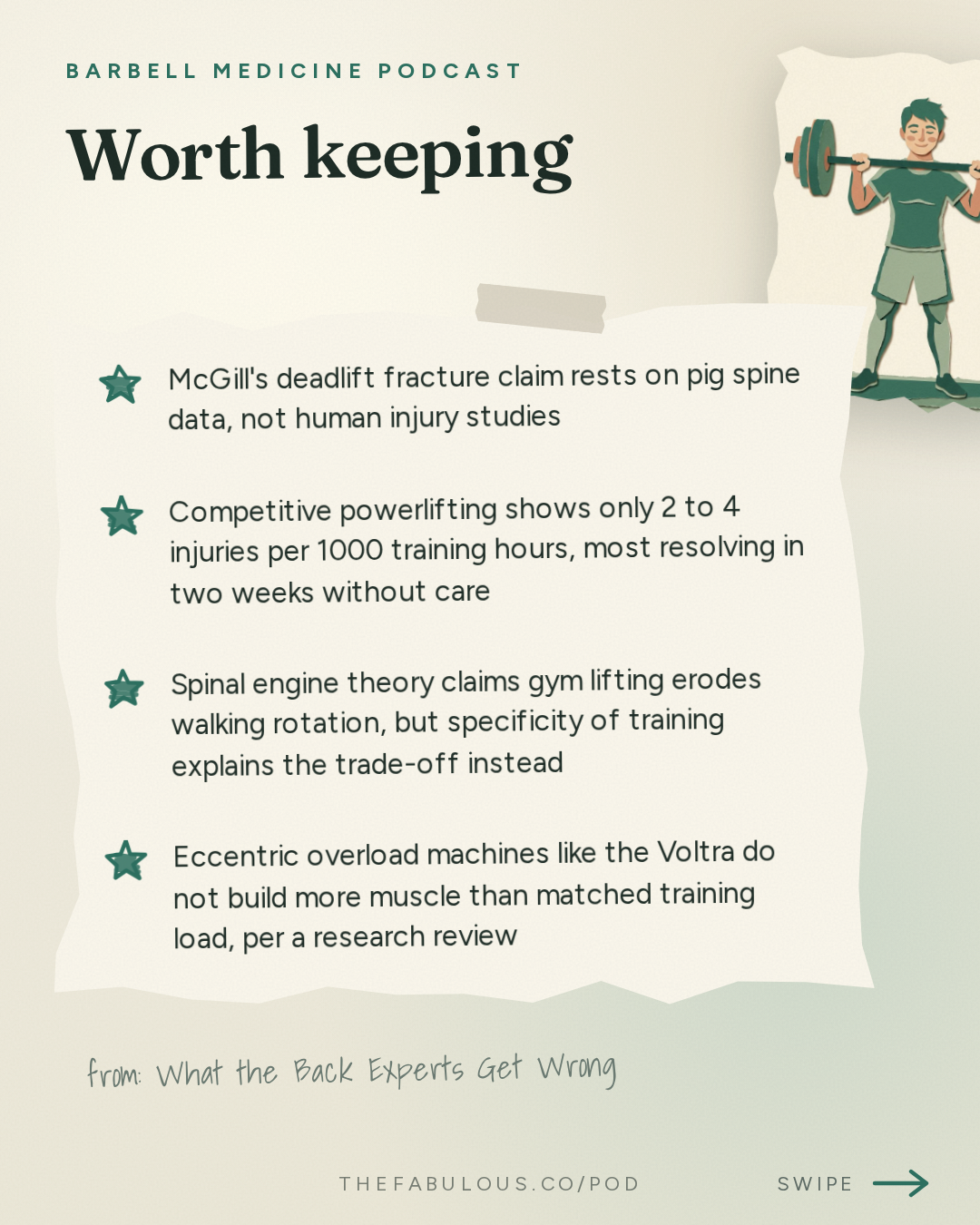
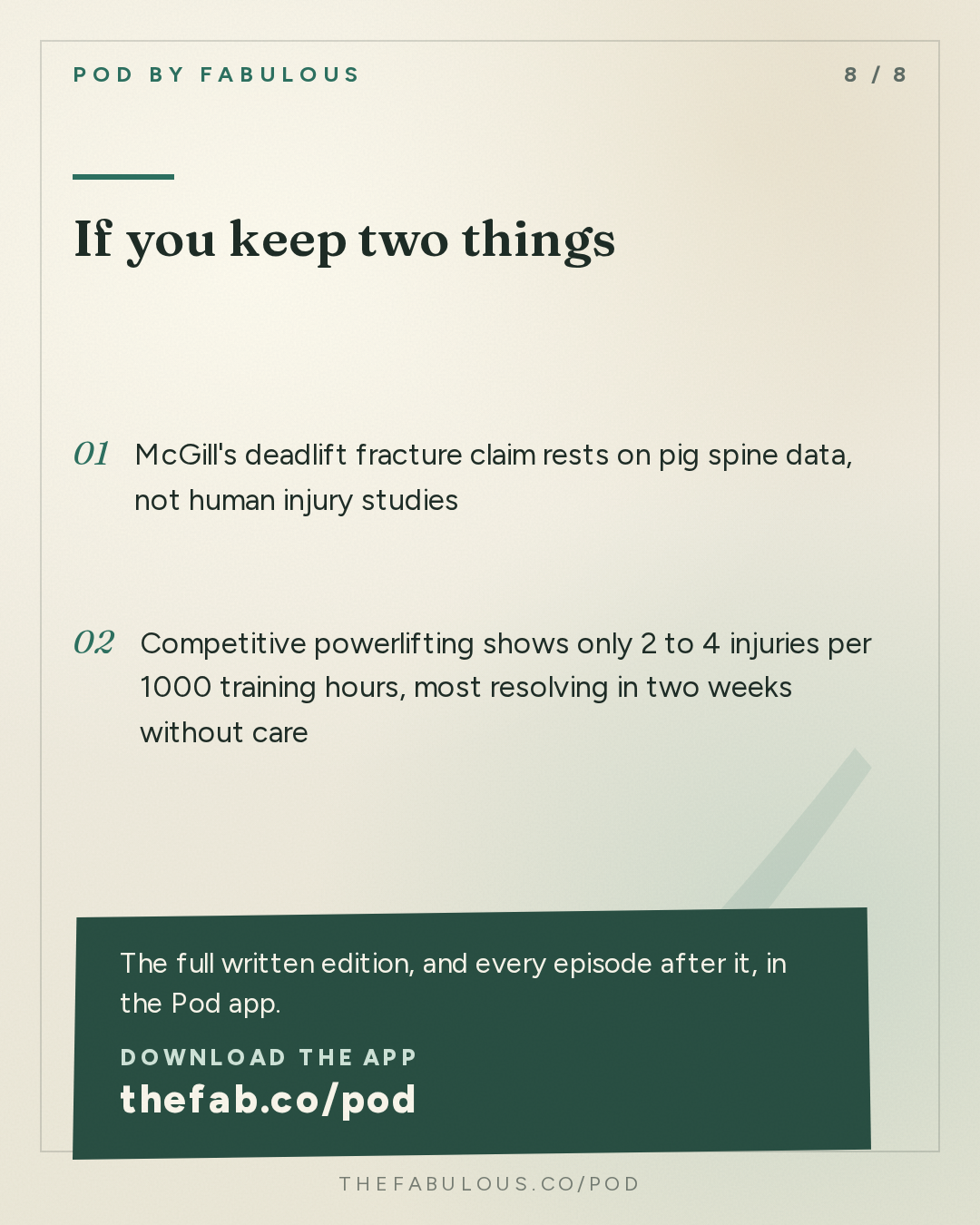
- McGill's deadlift fracture claim rests on pig spine data, not human injury studies
- Competitive powerlifting shows only 2 to 4 injuries per 1000 training hours, most resolving in two weeks without care
- Spinal engine theory claims gym lifting erodes walking rotation, but specificity of training explains the trade-off instead
- Eccentric overload machines like the Voltra do not build more muscle than matched training load, per a research review
- Strength gains past the middle third of measured levels show no clear extra benefit in Cooper Institute mortality data
The episode in cards
By the numbers
- 20% to 50% percent how much stronger people are in the eccentric (lowering) phase of a lift
In their words
“Dr. Stuart McGill said that when most people set a true PR on the deadlift, they end up with tiny fractures just under the end plates of their vertebra.”
“Why is the injury rate in power lifting only two to four injuries per thousand participation hours?”
“The extrapolation does not go in either direction there. So I don't particularly care about that data, and honestly will just dismiss it out of hand until I have, you know, more direct kind of human evidence.”
“Heavier eccentrics do not add, uh, more muscle mass, uh, when everything else is matched. Mainly the training load is the, the key”
Protocols
-
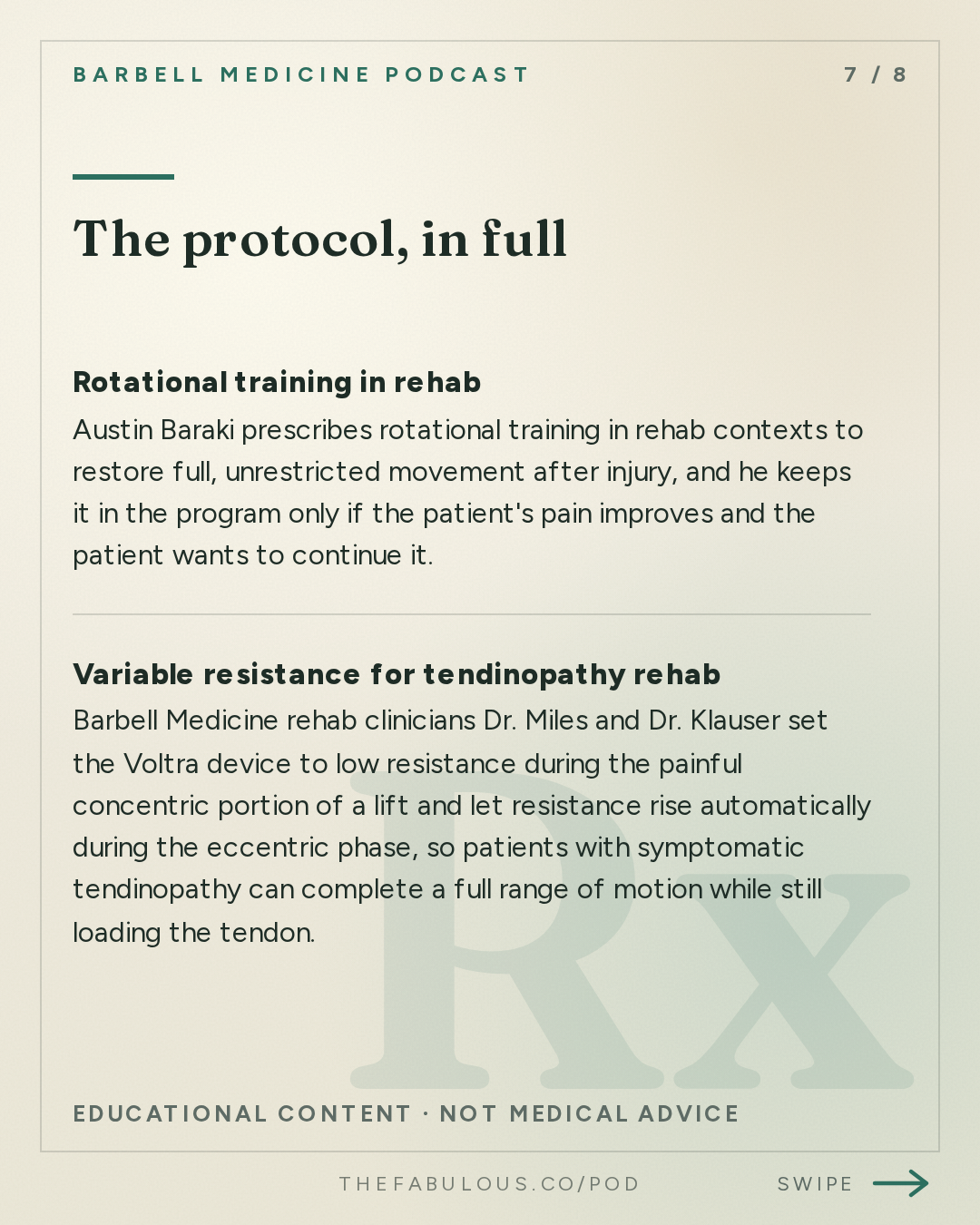
Rotational training in rehab
Austin Baraki prescribes rotational training in rehab contexts to restore full, unrestricted movement after injury, and he keeps it in the program only if the patient's pain improves and the patient wants to continue it.
Up to once a week, continued only based on patient response and preference
-
Variable resistance for tendinopathy rehab
Barbell Medicine rehab clinicians Dr. Miles and Dr. Klauser set the Voltra device to low resistance during the painful concentric portion of a lift and let resistance rise automatically during the eccentric phase, so patients with symptomatic tendinopathy can complete a full range of motion while still loading the tendon.
Used regularly with in-person rehab clients
Questions this episode answers
Did Stuart McGill really say deadlifts cause spinal fractures?
On Peter Attia's podcast, biomechanist Stuart McGill said most people setting a true deadlift PR end up with tiny fractures under their vertebral end plates (00:01). Barbell Medicine physicians Jordan Feigenbaum and Austin Baraki argue this extrapolates from pig spine lab data rather than direct human evidence (07:24).
What is the actual injury rate in powerlifting?
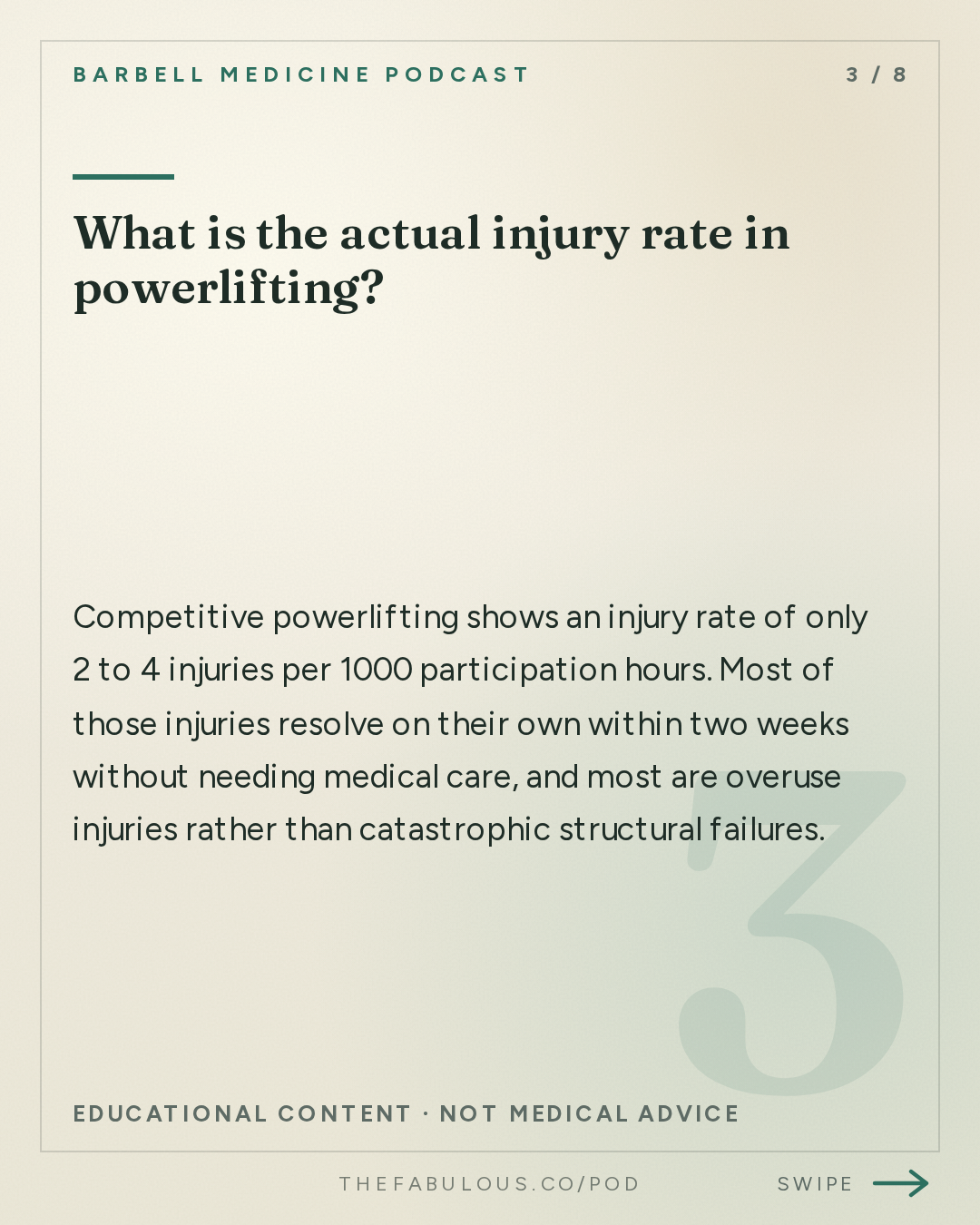
Competitive powerlifting shows an injury rate of only 2 to 4 injuries per 1000 participation hours (03:36). Most of those injuries resolve on their own within two weeks without needing medical care, and most are overuse injuries rather than catastrophic structural failures (03:54, 04:08).
What is spinal engine theory?
Spinal engine theory, proposed by biomedical engineer Sergei Gracovetsky in the 1980s, claims the spine drives the motion of walking while the legs just amplify spinal rotation (09:49). A popular version argues gym lifting erodes the rotational capacity needed to walk, which Jordan Feigenbaum dismisses as misapplying the principle that training adapts specifically to how it loads the body (10:41).
Does eccentric overload build more muscle than regular training?
A research review cited on the podcast found that heavier eccentric loading does not add more muscle mass when total training load is matched between methods (19:52). Hypertrophy appears to come from the body accommodating to training load and driving muscle protein synthesis, not from muscle damage and repair (20:12).
Are machines like the Voltra or Kaiser worth it for rehab or hypertrophy?
For general training, Jordan Feigenbaum reports no strength benefit large enough to recommend variable-resistance devices like the Voltra routinely, despite personal testing (21:13). Austin Baraki describes a specific rehab use case: clinicians set low concentric resistance and higher eccentric resistance to help patients with tendinopathy complete full range of motion, though there is no data showing this speeds recovery compared with standard rehab programming (22:53, 23:41).
The full read, in cards
Go deeper
- Peter Attia's podcast, The Drive, interview with Stuart McGill — where McGill made the deadlift fracture claim being debated
- Cooper Institute strength and mortality data — found strength benefits appeared to plateau after the middle third of measured leg press and bench press strength
- E3 Rehab podcast interview with Stuart McGill — clinicians directly challenged McGill on some of his claims after the Attia episode
- Barbell Medicine Podcast episode 131 with Greg Lehman — earlier deep dive into McGill's work by someone who worked with him directly
Mentioned
Stuart McGill · Peter Attia · Cooper Institute · Greg Lehman · E3 Rehab · Sergei Gracovetsky · Voltra · Kaiser · Jordan Feigenbaum · Austin Baraki
More from this show and category
Does Creatine Actually Work? What the Science Shows
Creatine modestly boosts strength and muscle size, with effect sizes far smaller than lifting itself, and does not damage healthy kidneys. Claims about cognition, depression, Parkinson's, Huntington's, menopause, and bone density do not hold up in the best-run trials (14:24, 26:47, 48:26, 51:20).

Is Collagen Protein a Scam? What the Evidence Shows
Collagen counts as protein but scores zero on the standard protein quality test because it lacks the essential amino acid tryptophan entirely. Claims that it beats whey for muscle, tendons, joints, skin, or nails rely on flawed trials, mismatched placebos, and a statistical mix-up between standard error and standard deviation.
Is Huberman's Protocols Book Scientifically Accurate?
Barbell Medicine doctors Jordan Feigenbaum and Austin Baraki fact-check Andrew Huberman's book Protocols and find its own citations often contradict its advice. The 540-page book claims a once-weekly, low-volume lifting plan, cold plunges, cortisol hacks and nicotine pouches all work every time, but the hosts count zero protocols that hold up and at least eight financial conflicts of interest.
Athlete's Heart vs Hypertrophic Cardiomyopathy
A 22-year-old soccer player's thickened heart wall, 16mm versus a normal top of 11-12mm, led doctors to diagnose hypertrophic cardiomyopathy (13:29). Four months off training shrank the wall to 10mm but doctors kept the diagnosis (24:22). New 2025 AHA/ACC guidance says HCM alone should not bar competitive sport, favoring shared decision-making instead (47:42).
