MedX Lumbar Extension Machine: Worth $20,000?
Don't Buy It: The $20,000 Back Machine, Flywheel Trainers, and Breathing Devices for Blood Pressure
The brief
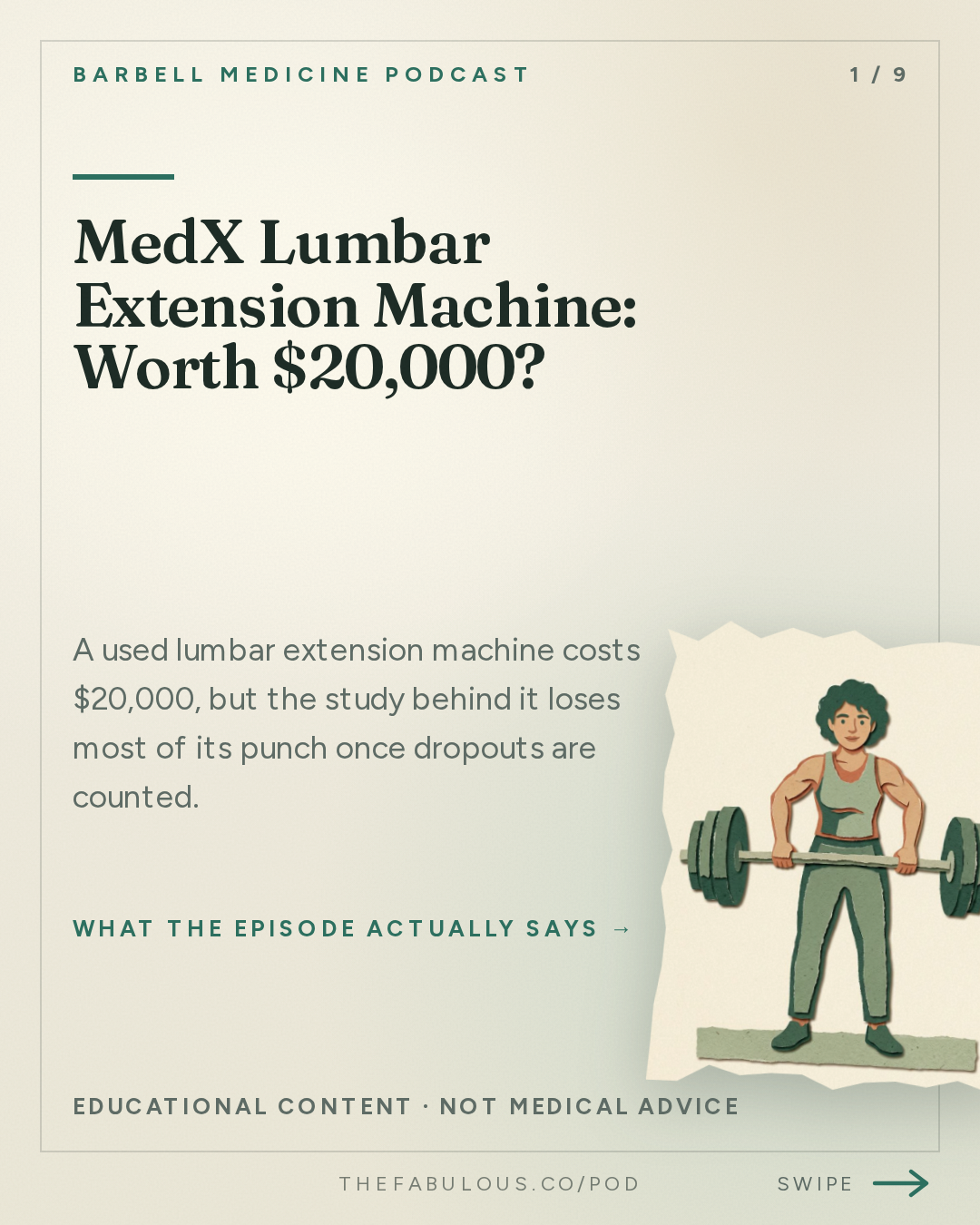
A used lumbar extension machine costs $20,000, but the study behind it loses most of its punch once dropouts are counted. Barbell Medicine's hosts argue that machine, flywheel trainers, and blood pressure breathing devices all promise shortcuts that regular training already covers for less money (00:01, 09:37).
Black Friday ads sell a familiar fantasy: one machine, one purchase, one fix. This year the Barbell Medicine podcast picked three of those fantasies apart, starting with a piece of gym equipment that costs twenty thousand dollars used and straps the pelvis down so the lower back does all the work (00:01). The hosts, physicians who also coach strength athletes, spend the next twenty minutes doing something podcasts rarely do with marketing claims: reading the actual study, counting the actual patients, and asking what the number really means before deciding whether to believe it.
The machine is called MedX, and its logic traces back to Arthur Jones, the inventor of Nautilus training equipment in the late 1980s (01:13). The idea is simple. When someone extends their trunk against resistance, the glutes and hamstrings normally share the load. Strap the pelvis so those muscles cannot help, and the work falls entirely on the paraspinals, the long muscles running alongside the spine, including the small muscle bundles called the multifidi that connect adjacent vertebrae (01:33, 01:56). People with chronic low back pain often show relative atrophy in these muscles compared to people without pain (03:11).
That correlation looks like a clue. It might not be a cause. The weaker multifidi could be causing the pain, or the pain could be causing people to move less, which causes the muscles to waste from disuse. Treating the atrophy, in that second story, addresses a downstream effect rather than whatever actually started the problem. One host compares it to silencing a car's check engine light instead of fixing the engine (04:03). The deeper point is about evidence itself:
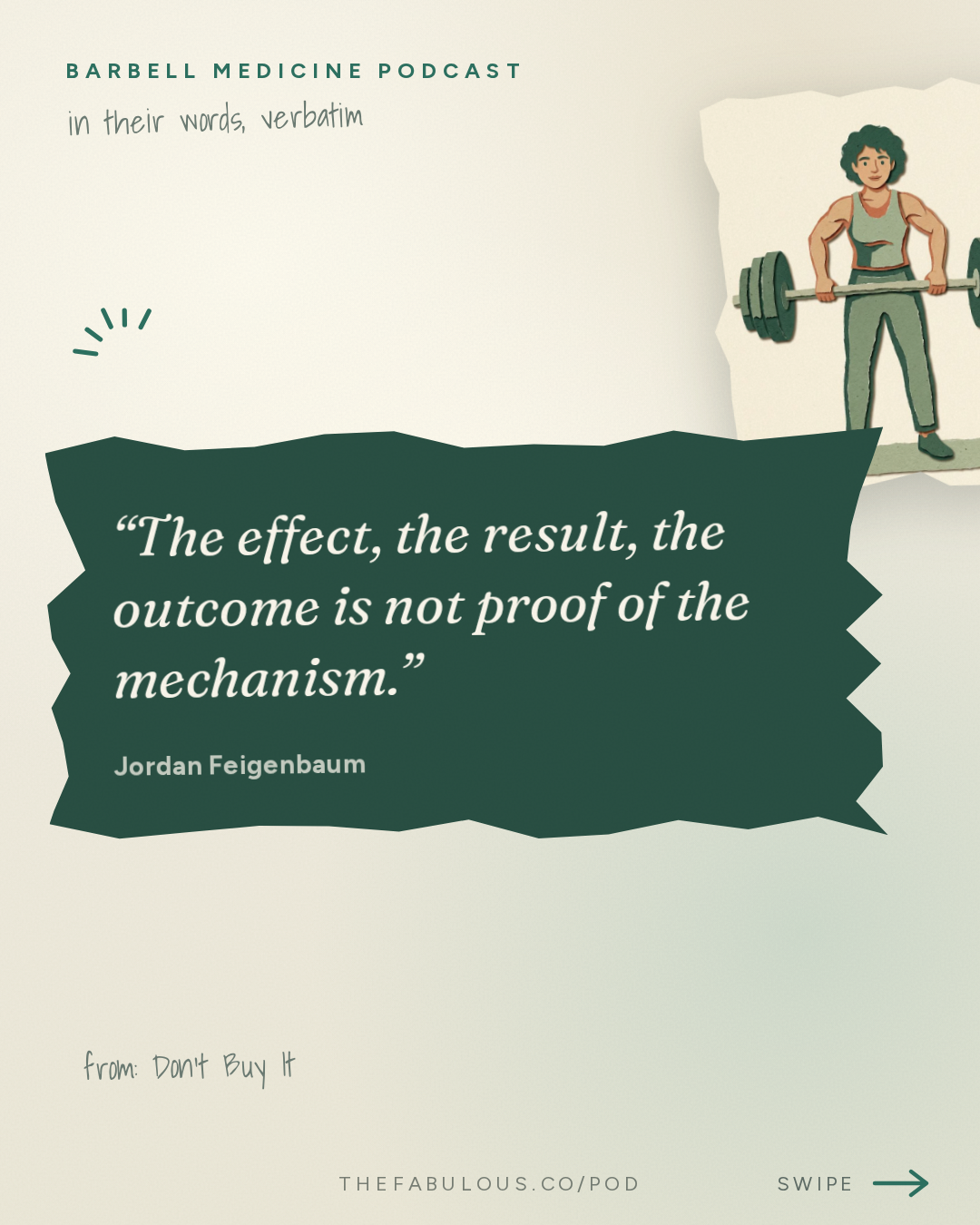
"The effect, the result, the outcome is not proof of the mechanism." — Jordan Feigenbaum (04:42)
Feeling better after an intervention does not prove the intervention worked the way its inventor claims. Back pain often improves on its own. Expectations, placebo response, and how much effort a person puts into any program can all move the needle, independent of the specific tool used. The hosts frame chronic back pain as what clinicians call a bio-psychosocial phenomenon, meaning biological, psychological, and social factors all feed it, rather than a single mechanical defect waiting for a single mechanical fix (06:07).
What the Study Behind the Marketing Actually Shows
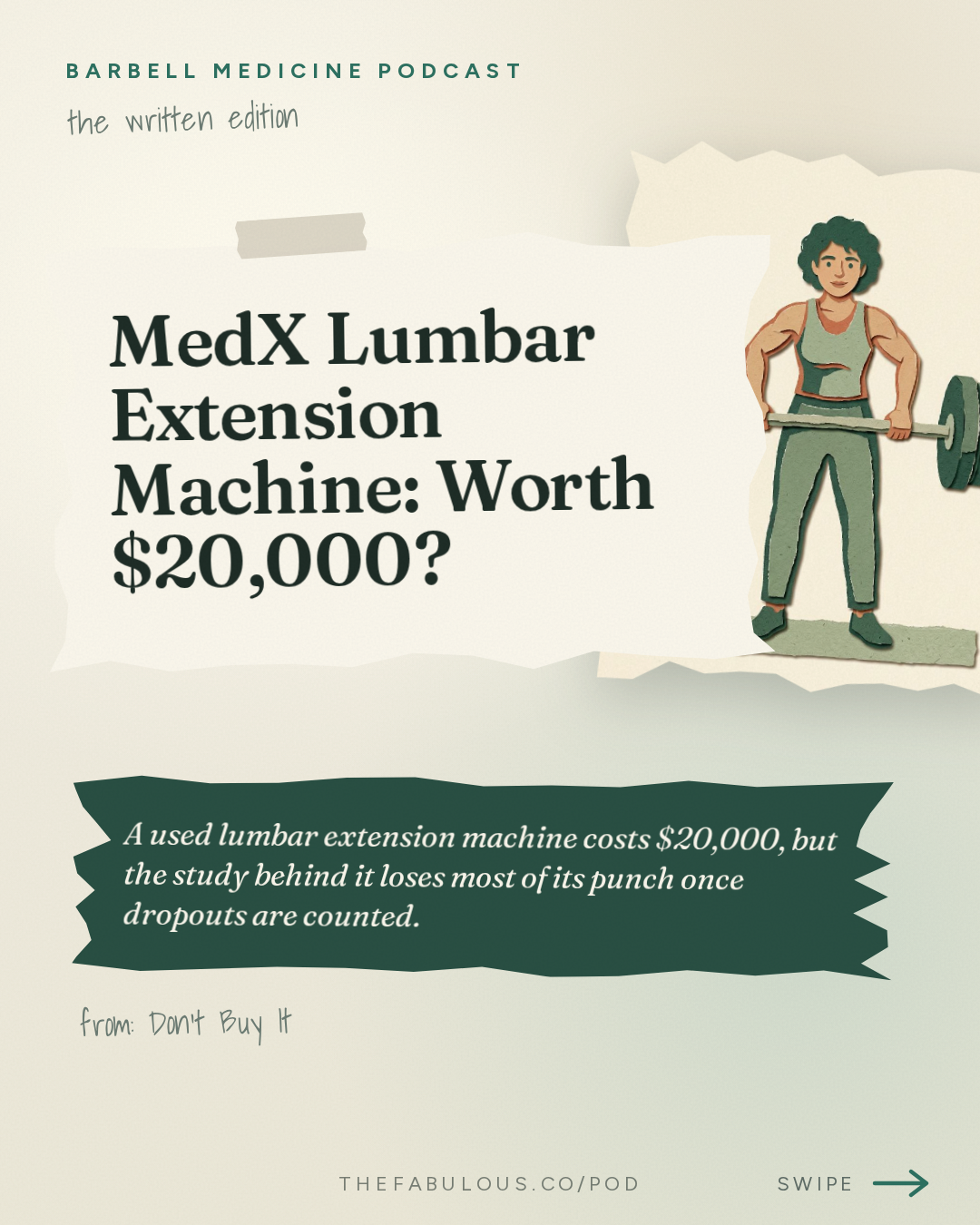
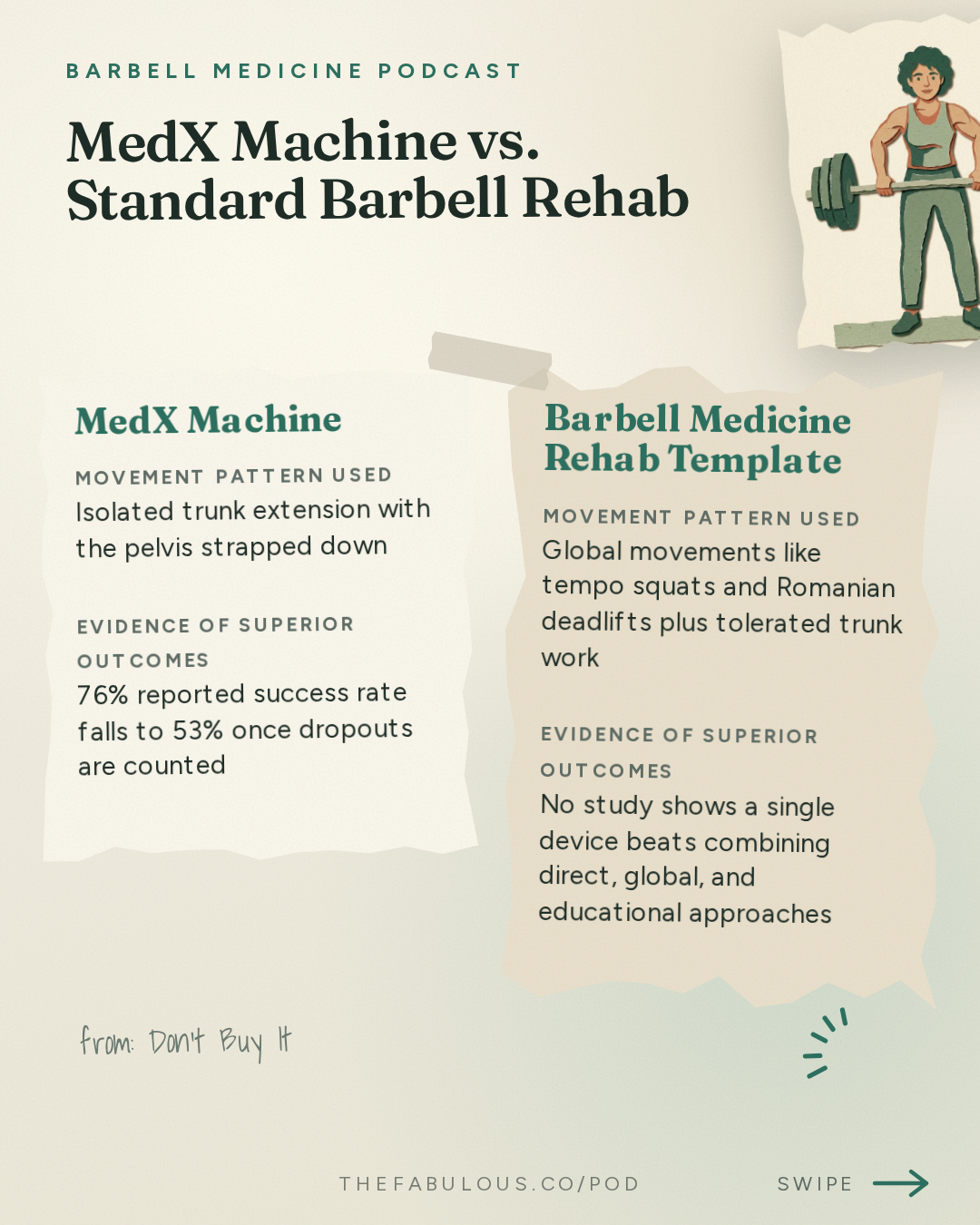
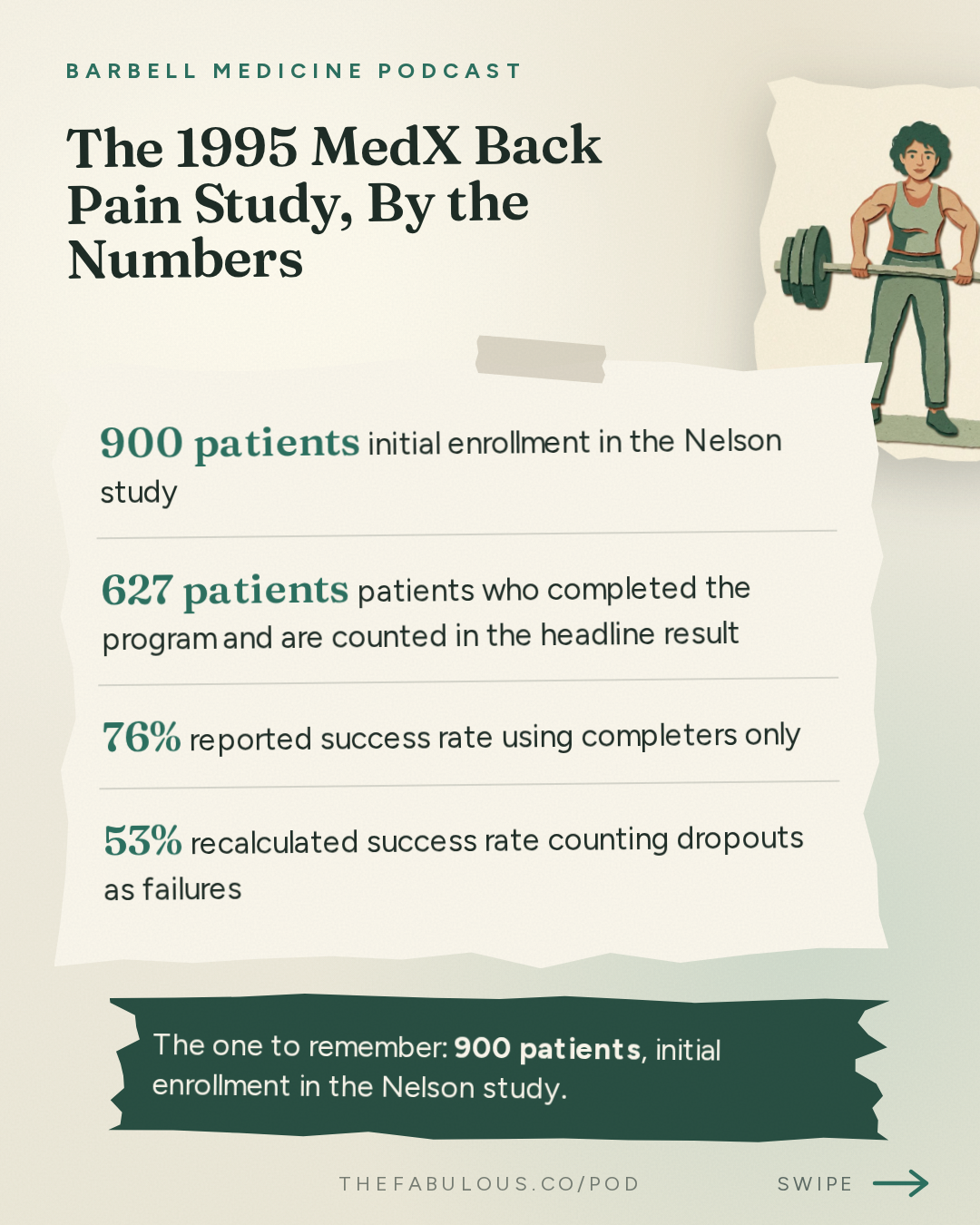
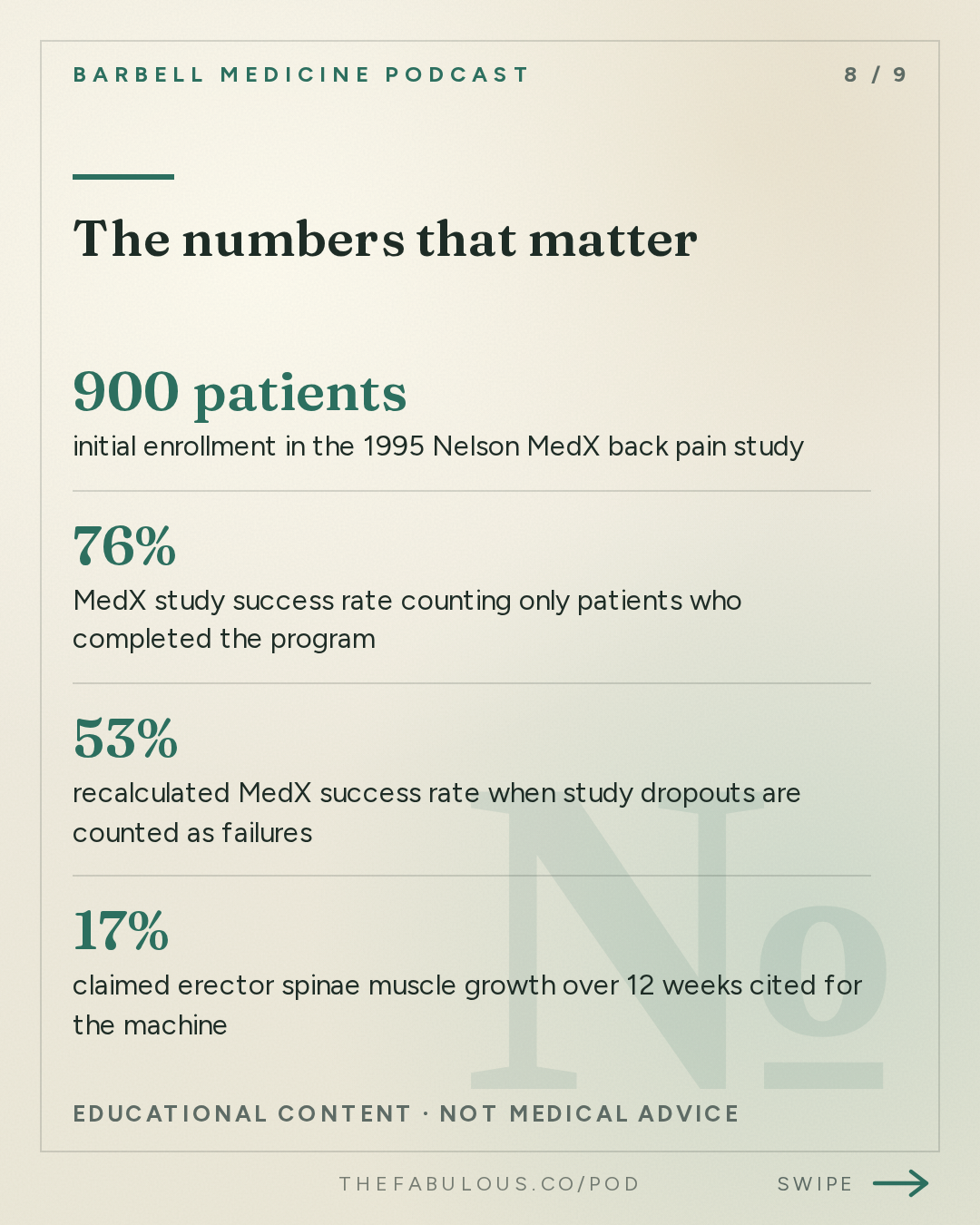
The MedX machine's reputation rests heavily on a 1995 study by Nelson and colleagues. Almost 900 patients entered a private clinic for the program (08:32). Of those, 627 finished, 161 started and quit partway through, and 107 were told to do the program but never started (08:52). The 76 percent good-to-excellent result that gets quoted in marketing comes only from the people who finished (09:37). The quitters are simply left out of the math, and as one host notes, "people quit rehab usually when it's not working" (09:37). Put the dropouts back in as failures, which is the more honest way to analyze a trial with this much attrition, and the success rate falls from 76 percent to 53 percent (09:37). A separate claim from newer research using the same machine, that it grew the erector spinae muscles 17 percent in twelve weeks, looks shakier once you notice the control group supposedly lost 10 percent of muscle over the same period while lifting weights (10:02, 10:23). Muscle tissue does not swing that fast in either direction; the more likely explanation is measurement noise from imaging tools that cannot detect such small, fast changes reliably.
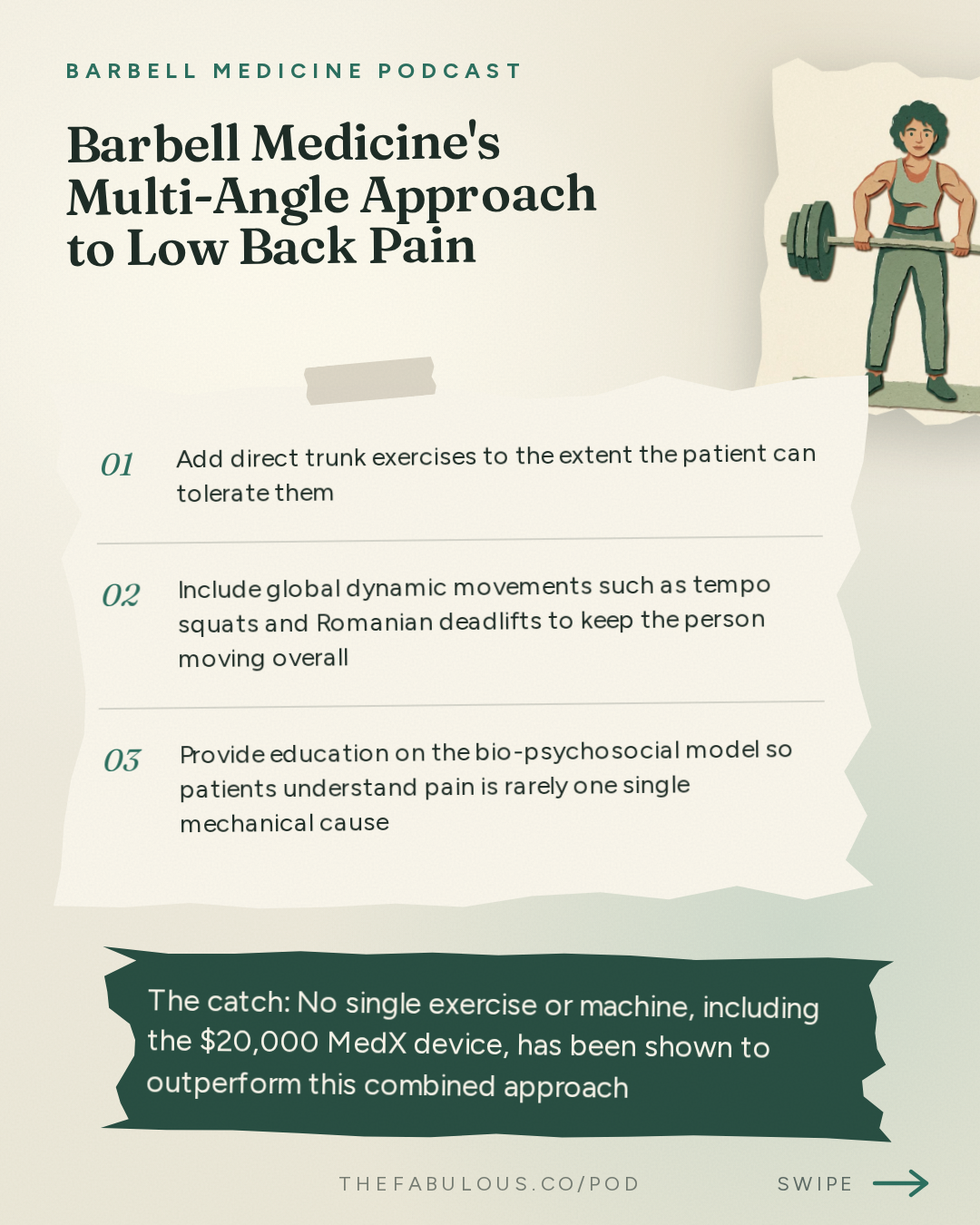
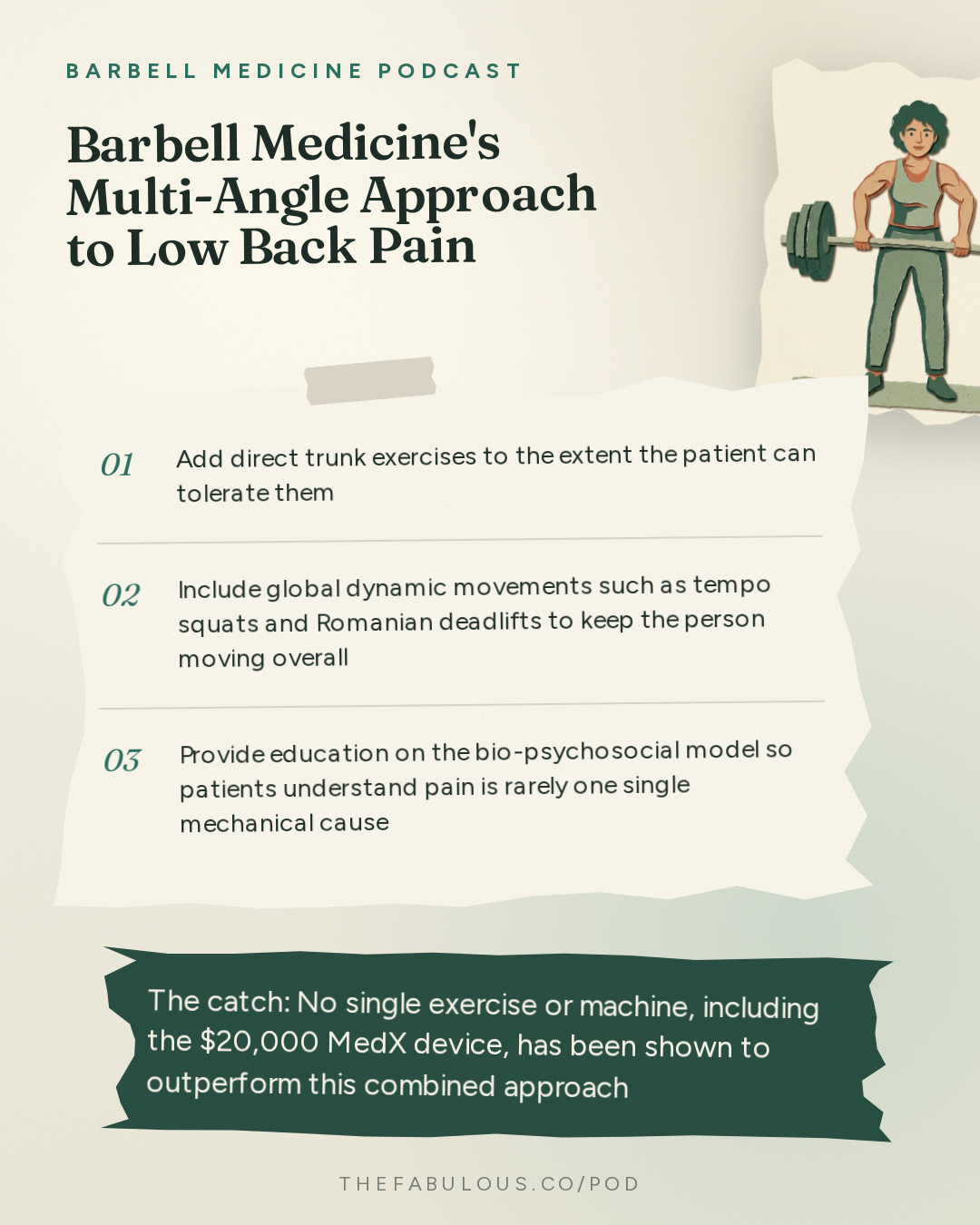
None of this means the machine is worthless. A newcomer to exercise who walks into a clinic and uses a machine that is nearly impossible to perform incorrectly may genuinely benefit, partly because any structured resistance work helps, and partly because the pain was likely to improve somewhat on its own (08:13). The hosts' actual recommendation for low back pain rehab is broader: direct trunk exercises to the extent a person can tolerate them, global dynamic movements like tempo squats and Romanian deadlifts, and patient education about the bio-psychosocial model, all progressing gradually toward unrestricted activity (11:01). No single device beats that combination, and nothing in the evidence suggests pelvic isolation is necessary to get there.
Flywheel trainers get a gentler but similarly skeptical treatment. These machines use a spinning wheel attached to a strap; pulling spins it up, and it pulls back harder on the way down, creating what's called eccentric overload, extra resistance during the lengthening phase of a muscle contraction, similar in principle to weight releasers or chains (13:02). The pitch is that muscles are naturally stronger eccentrically than concentrically, so overloading that phase unlocks extra adaptation. The largest research review comparing flywheel training to regular resistance training found the two produce about the same overall results (13:43). The hosts don't call it a scam so much as an expensive way to get an effect a barbell already delivers:
"You could also live a full and complete life and get very, very strong, very, very jacked, very, very fit without ever touching any of this stuff." — Jordan Feigenbaum (14:28)
A flywheel trainer earns its keep in a resource-limited home gym or for someone intimidated by a loaded barbell. It is not a gym replacement.
Blood Pressure Is a Proxy, Not the Goal
The third item is a handheld breathing device marketed around a study by researcher Craighead showing that high-resistance inspiratory muscle strength training, a method of breathing against resistance to strengthen the diaphragm, lowered systolic blood pressure and improved blood vessel function (15:15). The hosts don't dispute the finding so much as its relevance. Isometric training, simply holding a muscle contraction without moving, is already known from meta-analyses to be among the most effective ways to lower resting blood pressure (16:08). The underlying truth is almost comically broad: "basically any sort of activity, if you do it, will cause blood pressure to come down" if someone starts from doing very little (16:24). The real question is what else a person gets. Traditional resistance training and cardio also build strength, bone density, and improved insulin sensitivity, benefits a breathing device cannot touch. To the hosts' knowledge, inspiratory muscle training has only been tested once stacked on top of a regular exercise program, and it added nothing further (17:08). They compare it to isolating one muscle, like doing cable bicep curls, and noting it lowers blood pressure, too, without anyone seriously proposing it replace full-body training (18:32).
A detail in the Craighead trial sharpens the doubt. Systolic blood pressure, the top number, dropped, but diastolic pressure and 24-hour ambulatory readings did not change (18:51). That matters because blood pressure itself isn't the thing anyone actually cares about:
"Blood pressure's a proxy... that's what drives the risk, and the risk of cardiovascular disease." — Jordan Feigenbaum (19:38)
Chronically elevated blood pressure predicts cardiovascular disease over years, which is the real outcome anyone should want to prevent. If only one number moves, and only in people who were already far from normal, the benefit looks thinner than the marketing implies. Given fifteen free minutes, the hosts say they would recommend standard resistance training or cardio over the device, expecting the same or better blood pressure benefit plus everything else exercise provides (20:05).
Running through all three verdicts is the same instruction, stated plainly rather than as some grand unifying theory: an observed result is not proof of a claimed mechanism, and a narrow tool rarely beats a broad one. The twenty-thousand-dollar machine, the flywheel, and the breathing device each have a real study behind them, which is exactly how they get marketed so convincingly. What they don't have, according to this episode, is evidence that they beat the basics once someone actually does the arithmetic on the data.
Ask this episode anything
Pod's AI answers from the episode itself, with the minute mark so you can hear it yourself.
Or start with one of these
Ask this episode
Pod's AI listens to the whole episode to answer, and points you to the minute it comes from.
The rest of this answer, and any question after it
Answers come from the episode itself, never from a summary of it.
ContinueKey takeaways
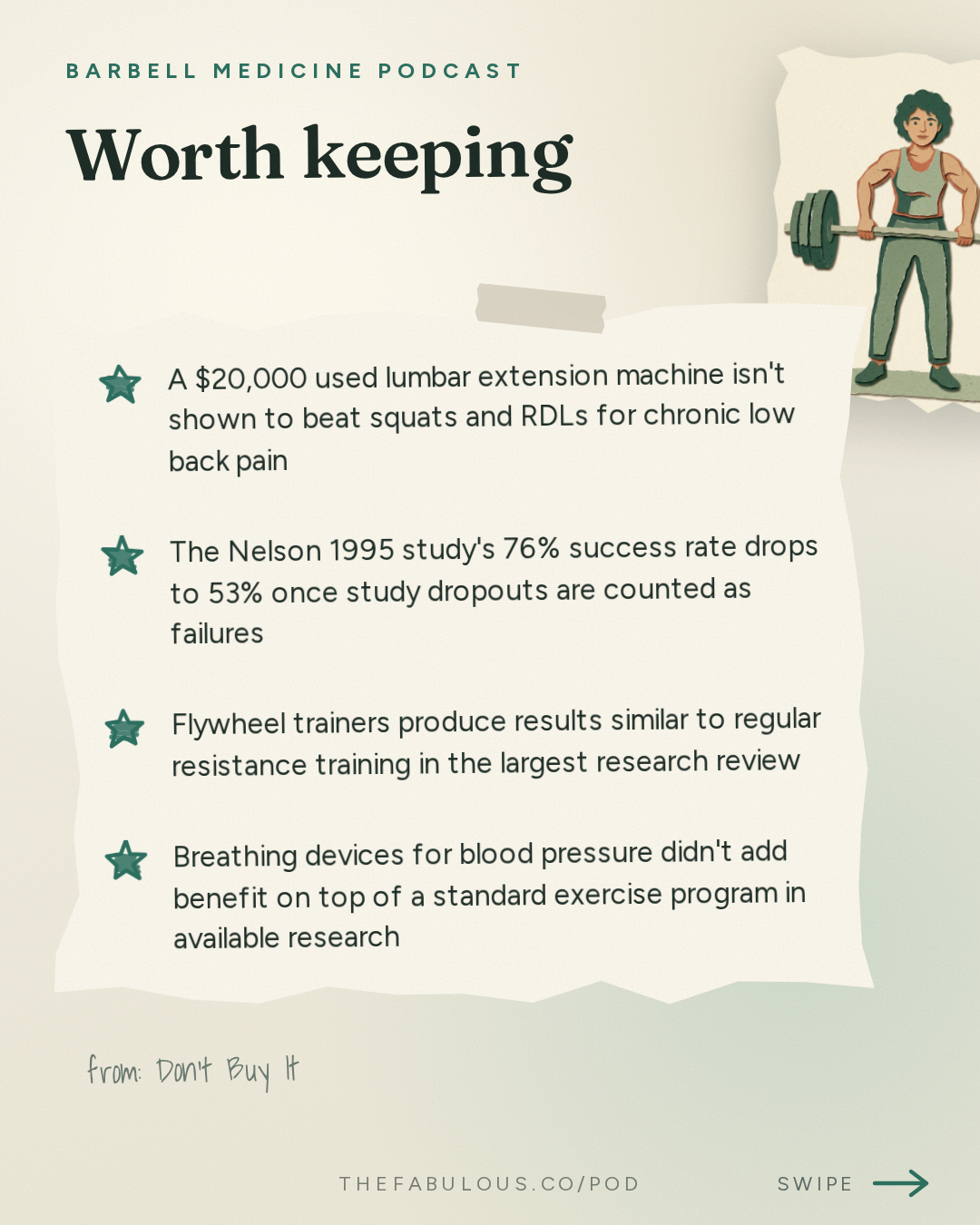
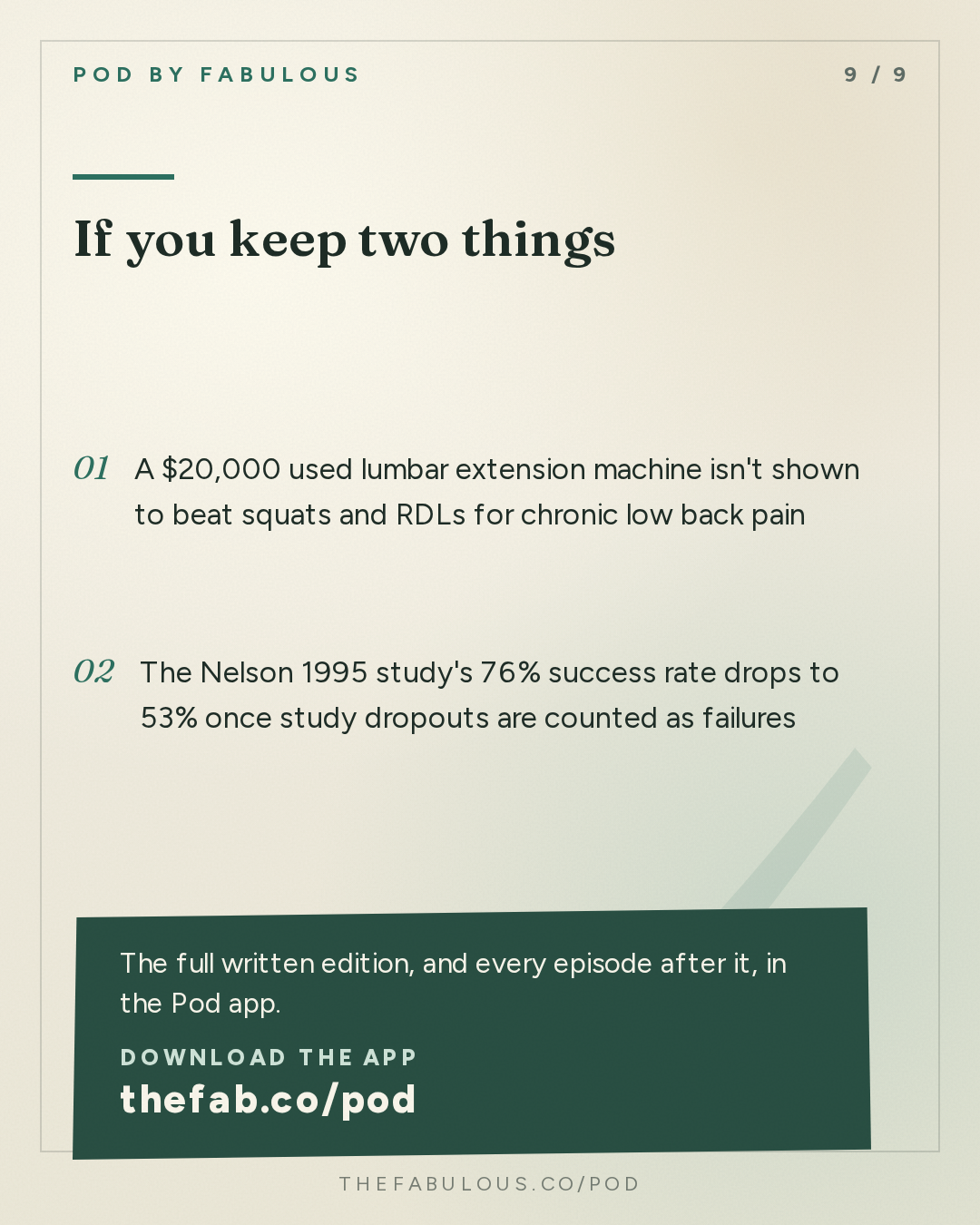
- A $20,000 used lumbar extension machine isn't shown to beat squats and RDLs for chronic low back pain
- The Nelson 1995 study's 76% success rate drops to 53% once study dropouts are counted as failures
- Flywheel trainers produce results similar to regular resistance training in the largest research review
- Breathing devices for blood pressure didn't add benefit on top of a standard exercise program in available research
- An observed result from any intervention never proves the mechanism its marketing claims
The episode in cards

By the numbers
- 900 patients initial enrollment in the 1995 Nelson MedX back pain study
- 76% MedX study success rate counting only patients who completed the program
- 53% recalculated MedX success rate when study dropouts are counted as failures
- 17% claimed erector spinae muscle growth over 12 weeks cited for the machine
In their words
“The effect, the result, the outcome is not proof of the mechanism.”
“It is a complex, multifactorial, bio-psychosocial phenomenon.”
“People quit rehab usually when it's not working.”
Protocols
-
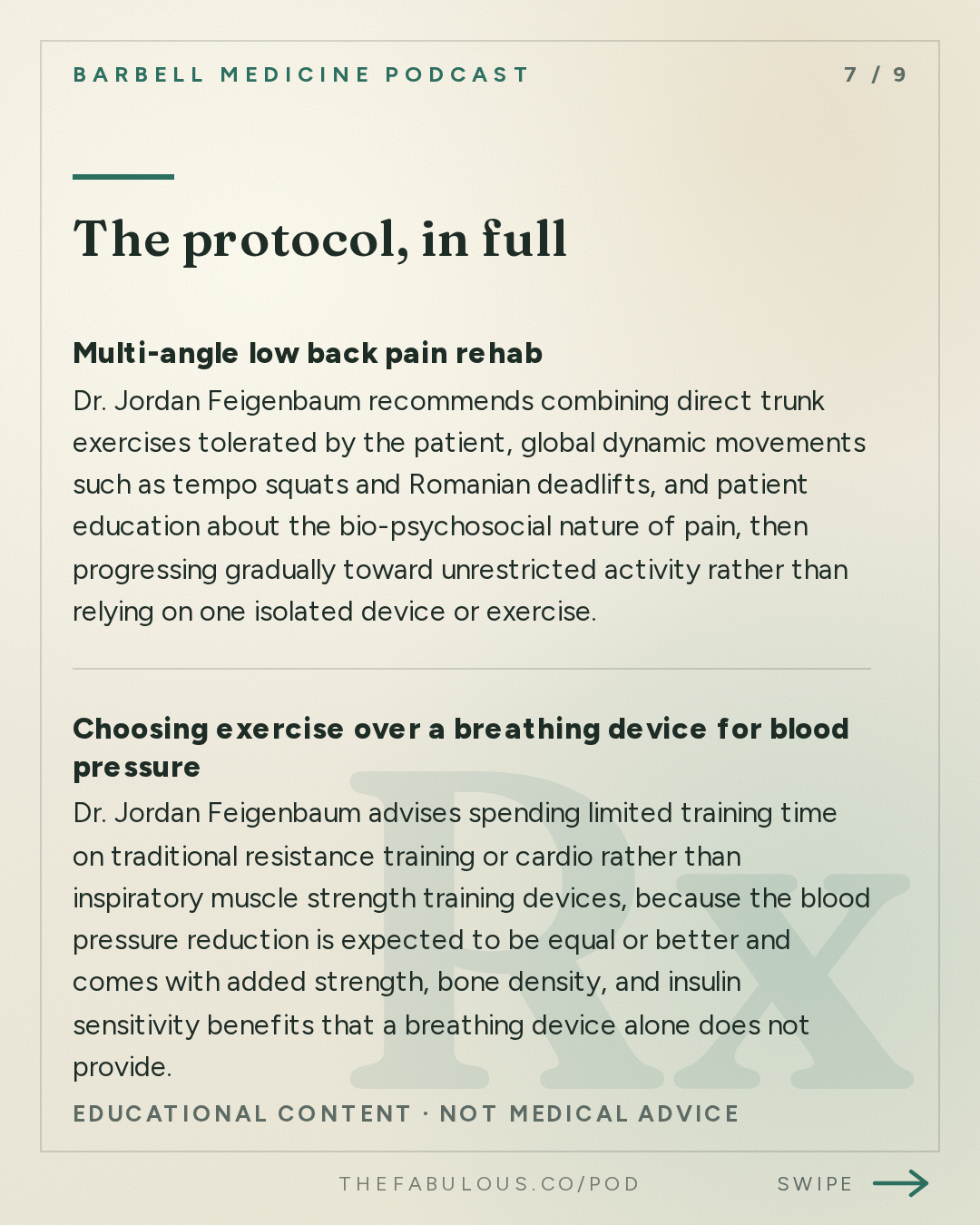
Multi-angle low back pain rehab
Dr. Jordan Feigenbaum recommends combining direct trunk exercises tolerated by the patient, global dynamic movements such as tempo squats and Romanian deadlifts, and patient education about the bio-psychosocial nature of pain, then progressing gradually toward unrestricted activity rather than relying on one isolated device or exercise.
ongoing through the course of rehab, progressed gradually
-
Choosing exercise over a breathing device for blood pressure
Dr. Jordan Feigenbaum advises spending limited training time on traditional resistance training or cardio rather than inspiratory muscle strength training devices, because the blood pressure reduction is expected to be equal or better and comes with added strength, bone density, and insulin sensitivity benefits that a breathing device alone does not provide.
whenever choosing between a 15-minute training option
Questions this episode answers
Does the MedX lumbar extension machine actually fix chronic low back pain?
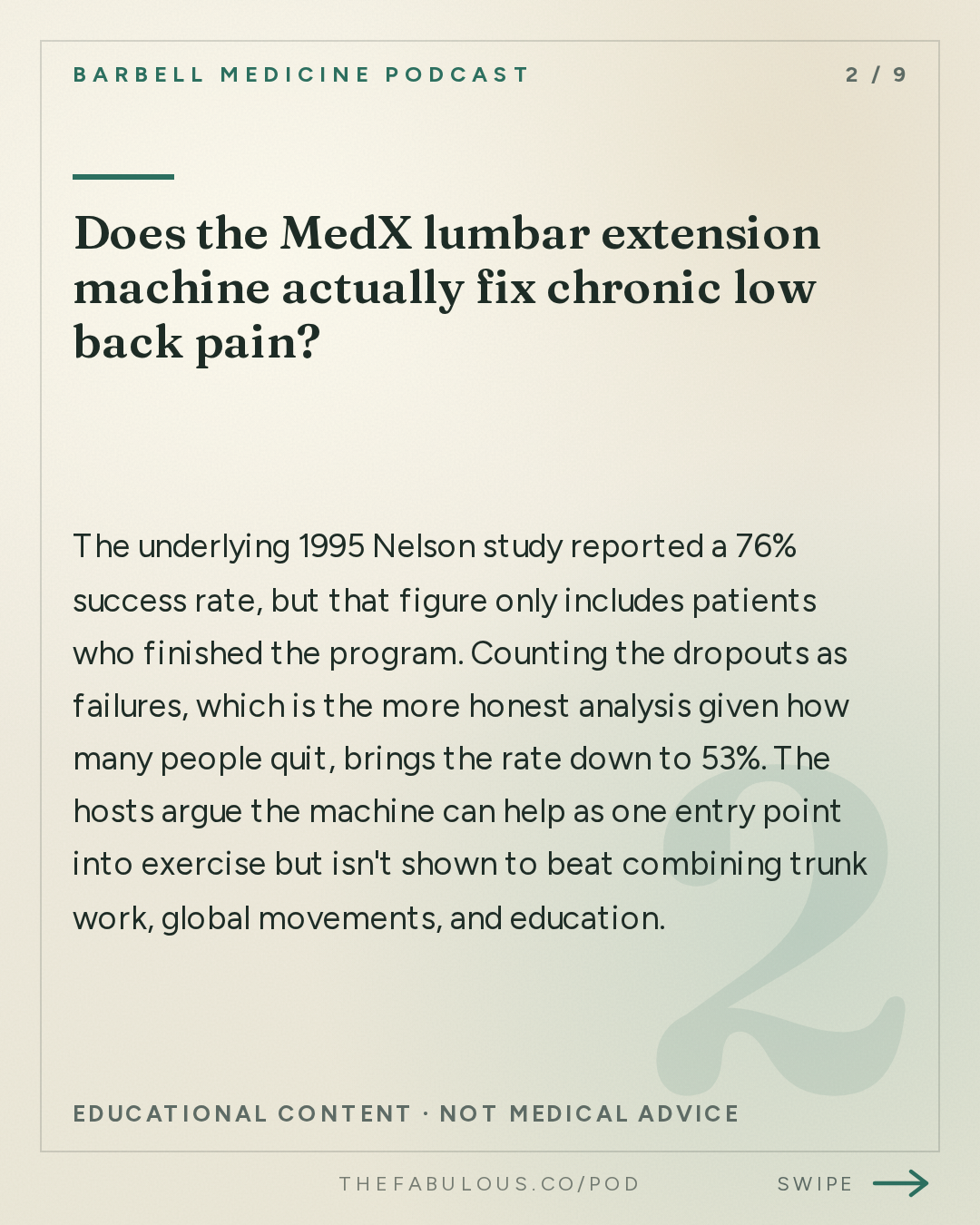
The underlying 1995 Nelson study reported a 76% success rate, but that figure only includes patients who finished the program (09:37). Counting the dropouts as failures, which is the more honest analysis given how many people quit, brings the rate down to 53% (09:37). The hosts argue the machine can help as one entry point into exercise but isn't shown to beat combining trunk work, global movements, and education.
Is flywheel resistance training better than regular weight training?
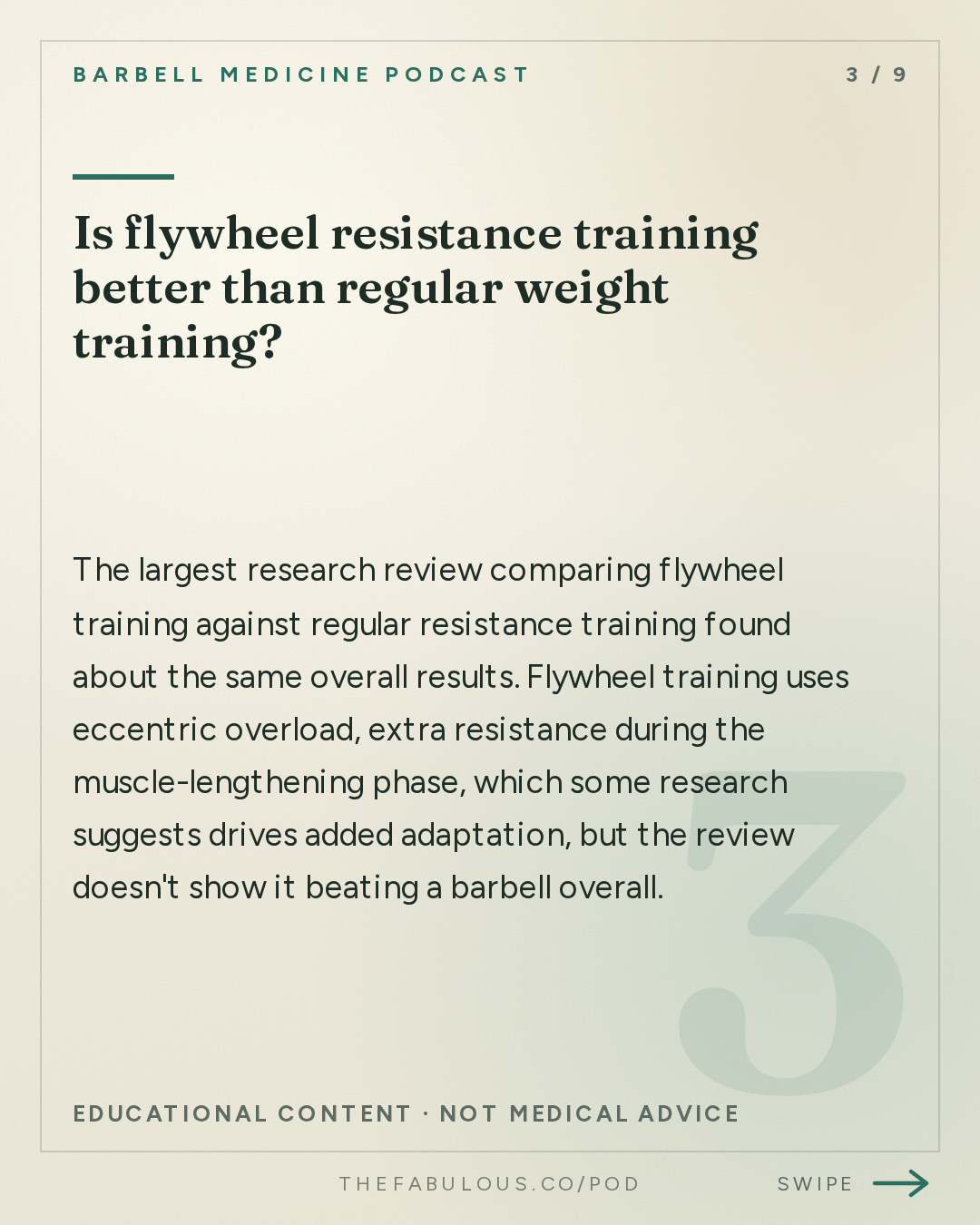
The largest research review comparing flywheel training against regular resistance training found about the same overall results (13:43). Flywheel training uses eccentric overload, extra resistance during the muscle-lengthening phase, which some research suggests drives added adaptation, but the review doesn't show it beating a barbell overall.
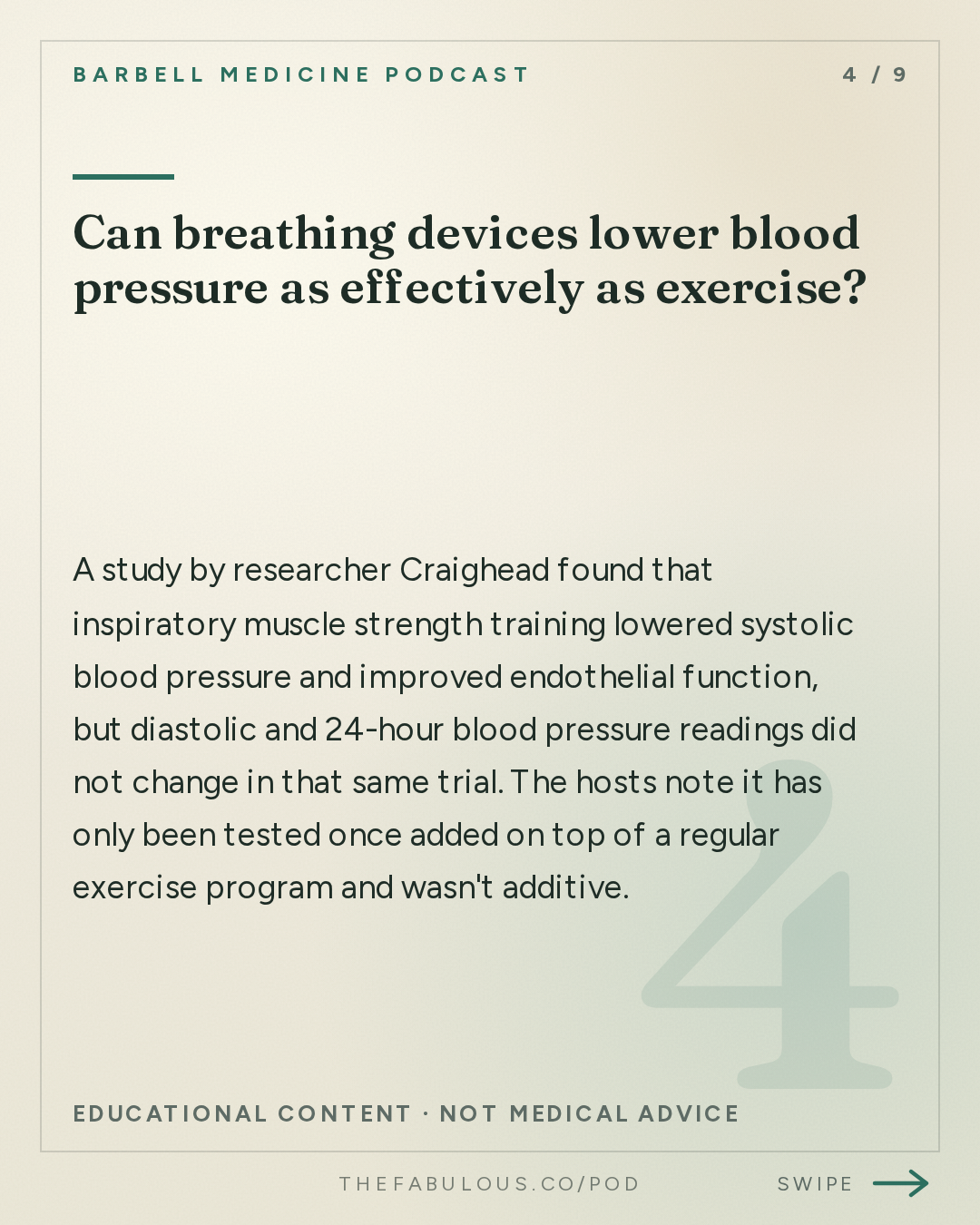
Can breathing devices lower blood pressure as effectively as exercise?
A study by researcher Craighead found that inspiratory muscle strength training lowered systolic blood pressure and improved endothelial function (15:15), but diastolic and 24-hour blood pressure readings did not change in that same trial (18:51). The hosts note it has only been tested once added on top of a regular exercise program and wasn't additive (17:08).
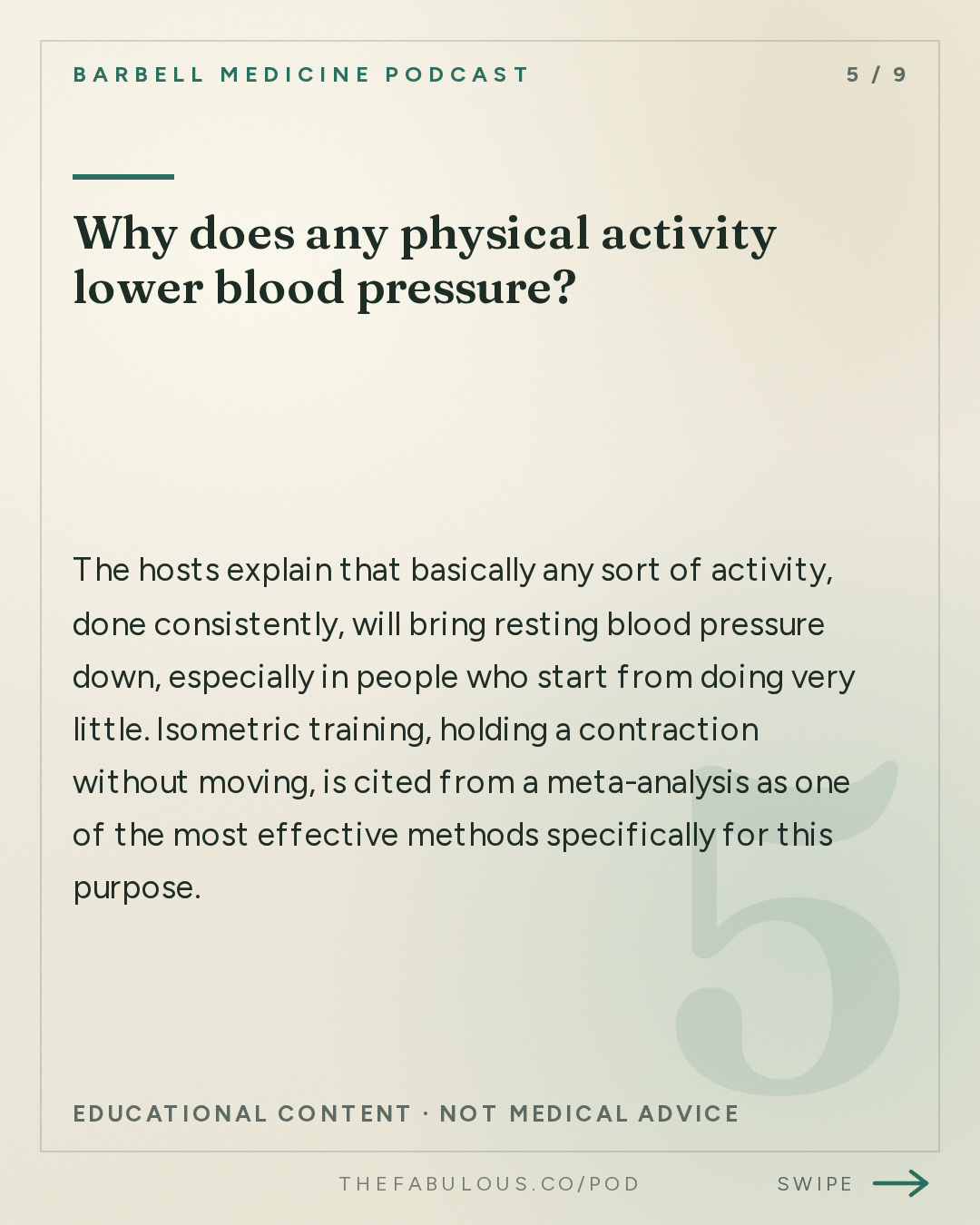
Why does any physical activity lower blood pressure?
The hosts explain that basically any sort of activity, done consistently, will bring resting blood pressure down, especially in people who start from doing very little (16:24). Isometric training, holding a contraction without moving, is cited from a meta-analysis as one of the most effective methods specifically for this purpose (16:08).
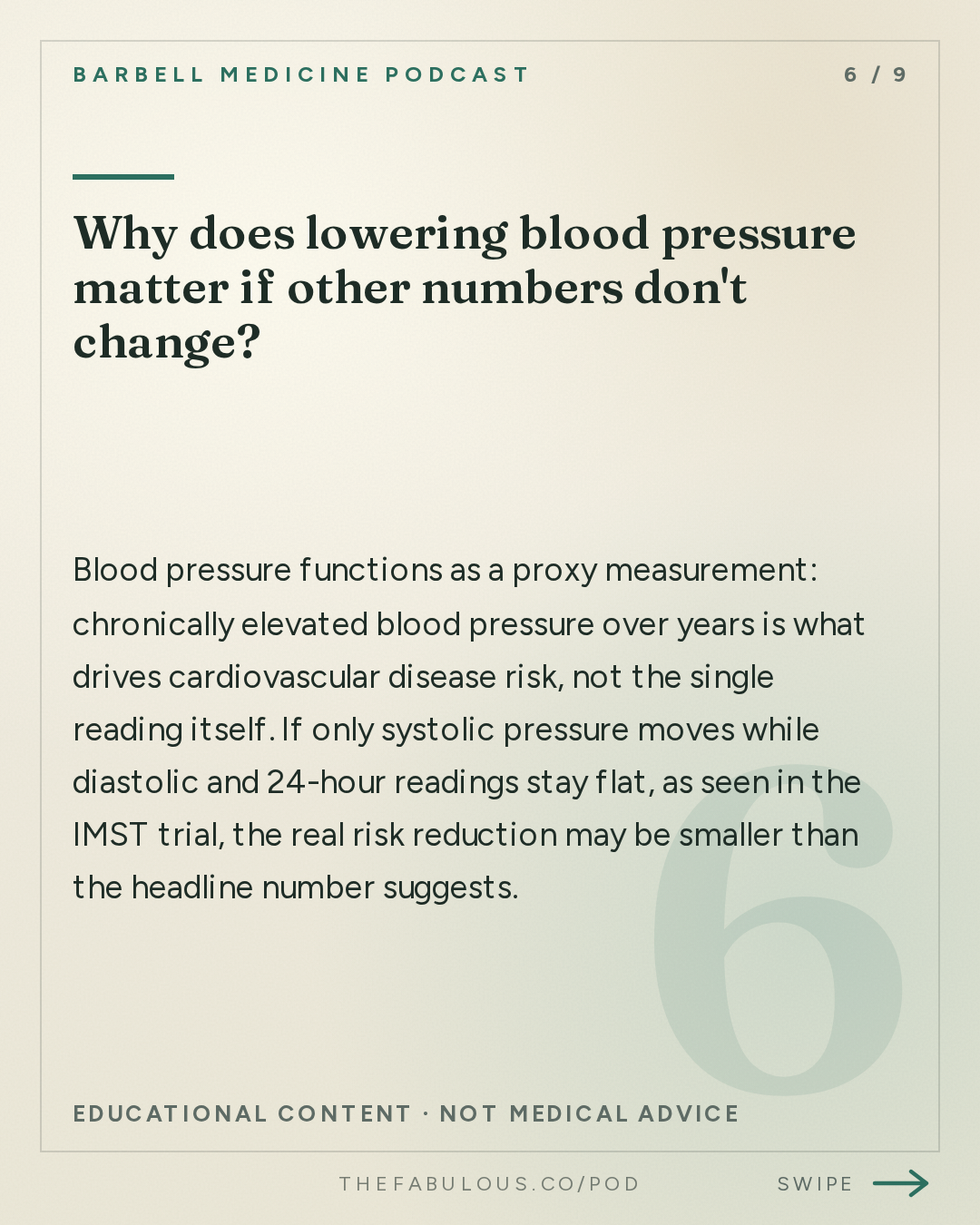
Why does lowering blood pressure matter if other numbers don't change?
Blood pressure functions as a proxy measurement: chronically elevated blood pressure over years is what drives cardiovascular disease risk, not the single reading itself (19:38). If only systolic pressure moves while diastolic and 24-hour readings stay flat, as seen in the IMST trial, the real risk reduction may be smaller than the headline number suggests (18:51).
The full read, in cards
Go deeper
- Nelson et al. 1995 study on isolated lumbar extension (MedX machine) for chronic low back pain — reported 76% success rate counting only program completers, which falls to 53% once dropouts are included as failures
- Research review comparing flywheel training to regular resistance training — found roughly similar overall results between flywheel and traditional resistance training
- Craighead study on high-resistance inspiratory muscle strength training (IMST) — found reduced systolic blood pressure and improved endothelial function but no change in diastolic or 24-hour blood pressure readings
- Meta-analysis on isometric training and blood pressure — concluded isometric training is one of the most effective ways to lower resting blood pressure
Mentioned
Nelson · MedX · Arthur Jones · Nautilus · Barbell Medicine · Craighead · Enhanced Games
More from this show and category

Should You Sleep in 90-Minute Cycles?
Sleep cycles are not a fixed 90 minutes, so timing an alarm around multiples of 90 doesn't work, Jordan Feigenbaum and Austin Baraki explain (02:08). The Barbell Medicine physicians also recommend seven to eight hours of sleep, mixing tofu into ground meat for protein volume, and bringing written questions to short doctor visits (06:12, 11:13, 16:27).
Knee Replacement vs. Conservative Treatment Explained
An MRI showing tricompartmental arthritis describes where damage sits, not how bad symptoms are. Barbell Medicine physicians Jordan Feigenbaum and Austin Baraki argue surgery should follow failed physical therapy, not imaging alone. Steroid shots buy short-term relief for rehab, not a cure, and open chain exercises like knee extensions are safe early in ACL recovery when properly dosed.
Stuart McGill's Deadlift Fracture Claim, Debunked
Barbell Medicine hosts debunk Stuart McGill's claim that deadlift PRs fracture spinal vertebrae, pointing to powerlifting's low injury rate (03:36). They also dismiss spinal engine theory and argue eccentric-overload machines like the Voltra do not add muscle mass beyond matched training load (19:52).
Does Creatine Actually Work? What the Science Shows
Creatine modestly boosts strength and muscle size, with effect sizes far smaller than lifting itself, and does not damage healthy kidneys. Claims about cognition, depression, Parkinson's, Huntington's, menopause, and bone density do not hold up in the best-run trials (14:24, 26:47, 48:26, 51:20).
