
Should You Sleep in 90-Minute Cycles?
Should You Sleep in 90-Minute Cycles? Plus Ground Beef, Doctor Visits, and Vacation Protein
The brief
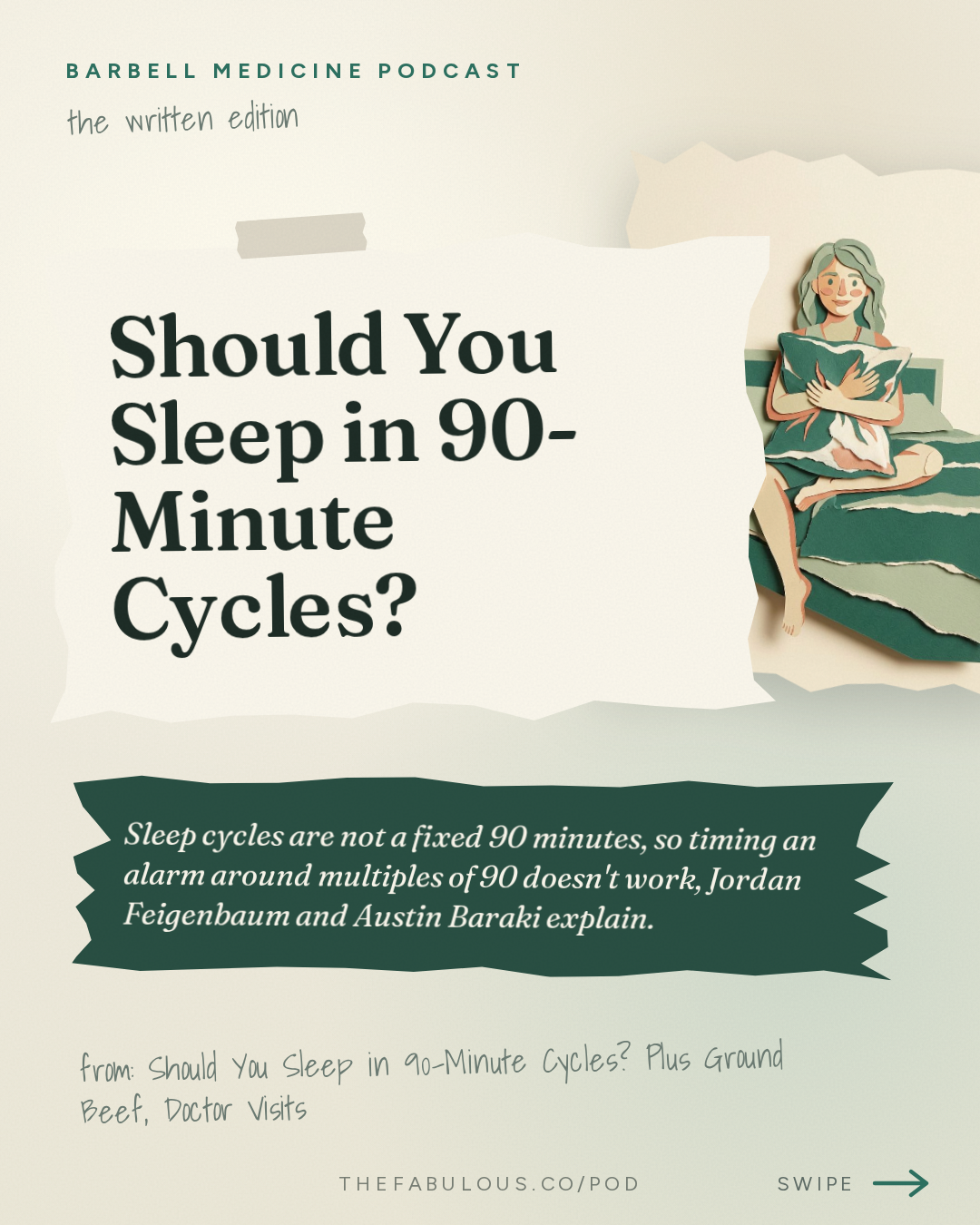
Sleep cycles are not a fixed 90 minutes, so timing an alarm around multiples of 90 doesn't work, Jordan Feigenbaum and Austin Baraki explain (02:08). The Barbell Medicine physicians also recommend seven to eight hours of sleep, mixing tofu into ground meat for protein volume, and bringing written questions to short doctor visits (06:12, 11:13, 16:27).
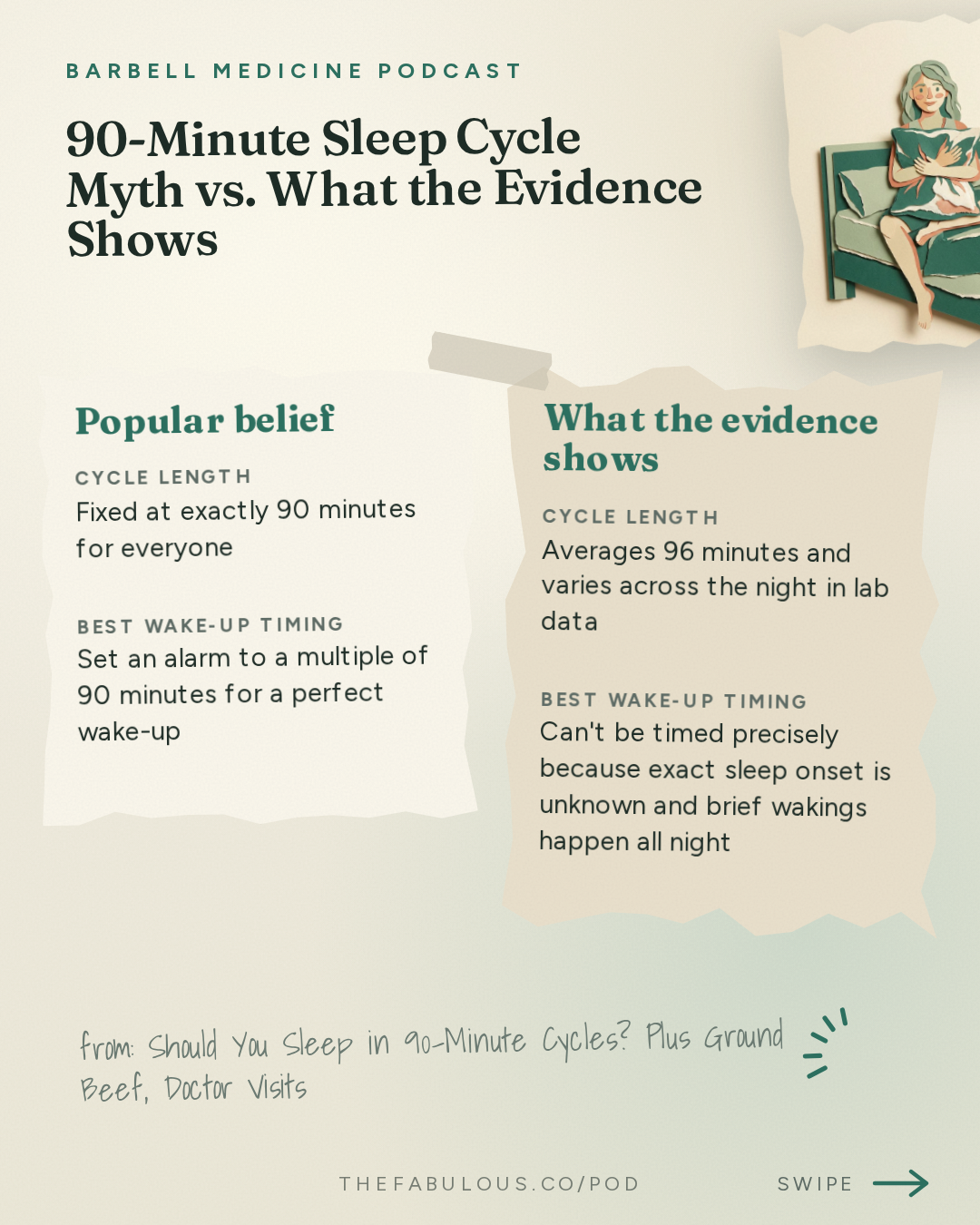
Somewhere along the way, sleep turned into arithmetic. The idea is simple enough to feel true: a sleep cycle runs about ninety minutes, so if a night's rest divides evenly into that number, a person wakes at the top of a cycle, light and alert, instead of being hauled up out of the deep end. Six hours becomes four clean cycles. Seven and a half becomes five. Set the alarm to the right multiple, the thinking goes, and grogginess disappears. It is a tidy theory, and tidy theories about the body are almost always wrong in an interesting way.
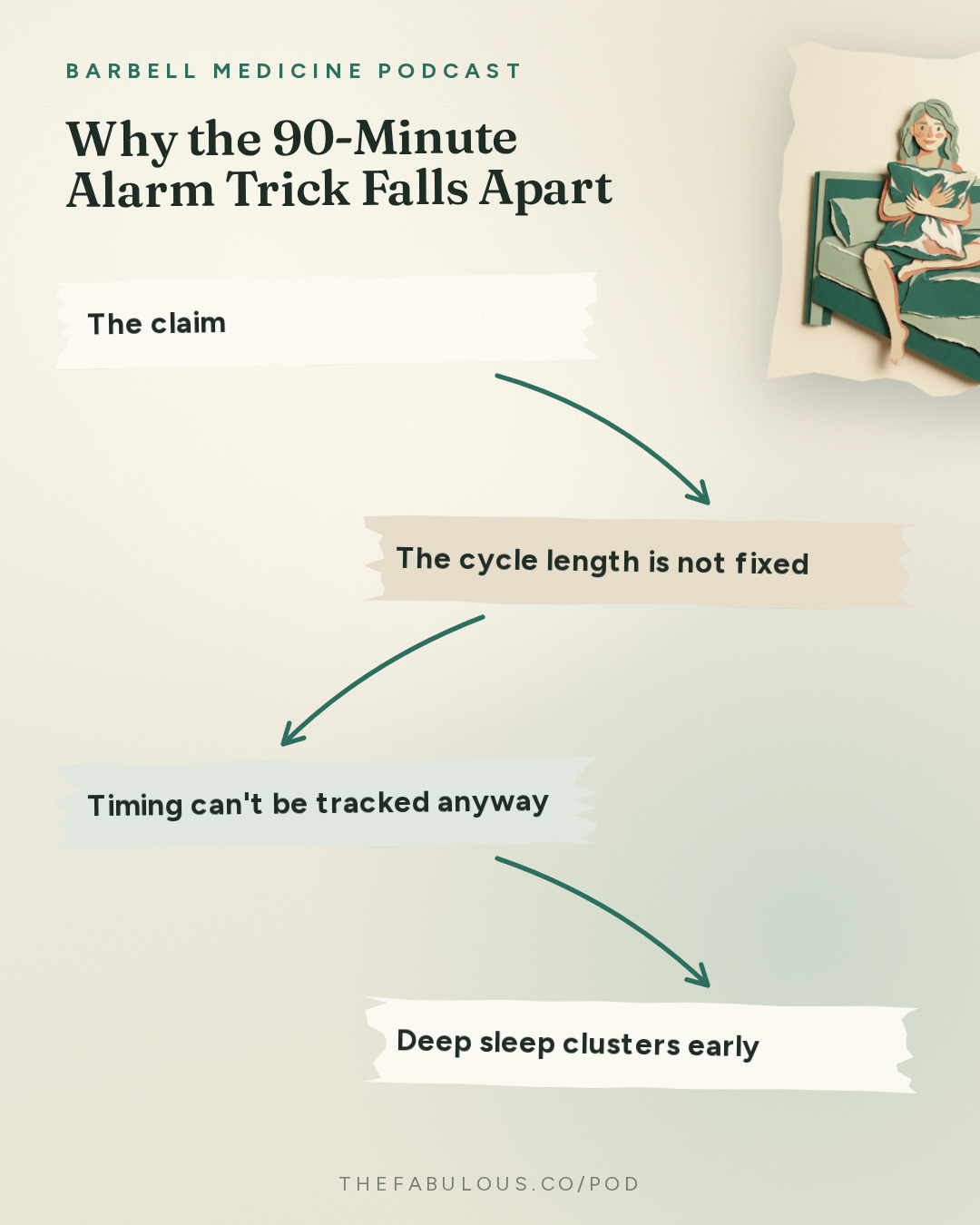
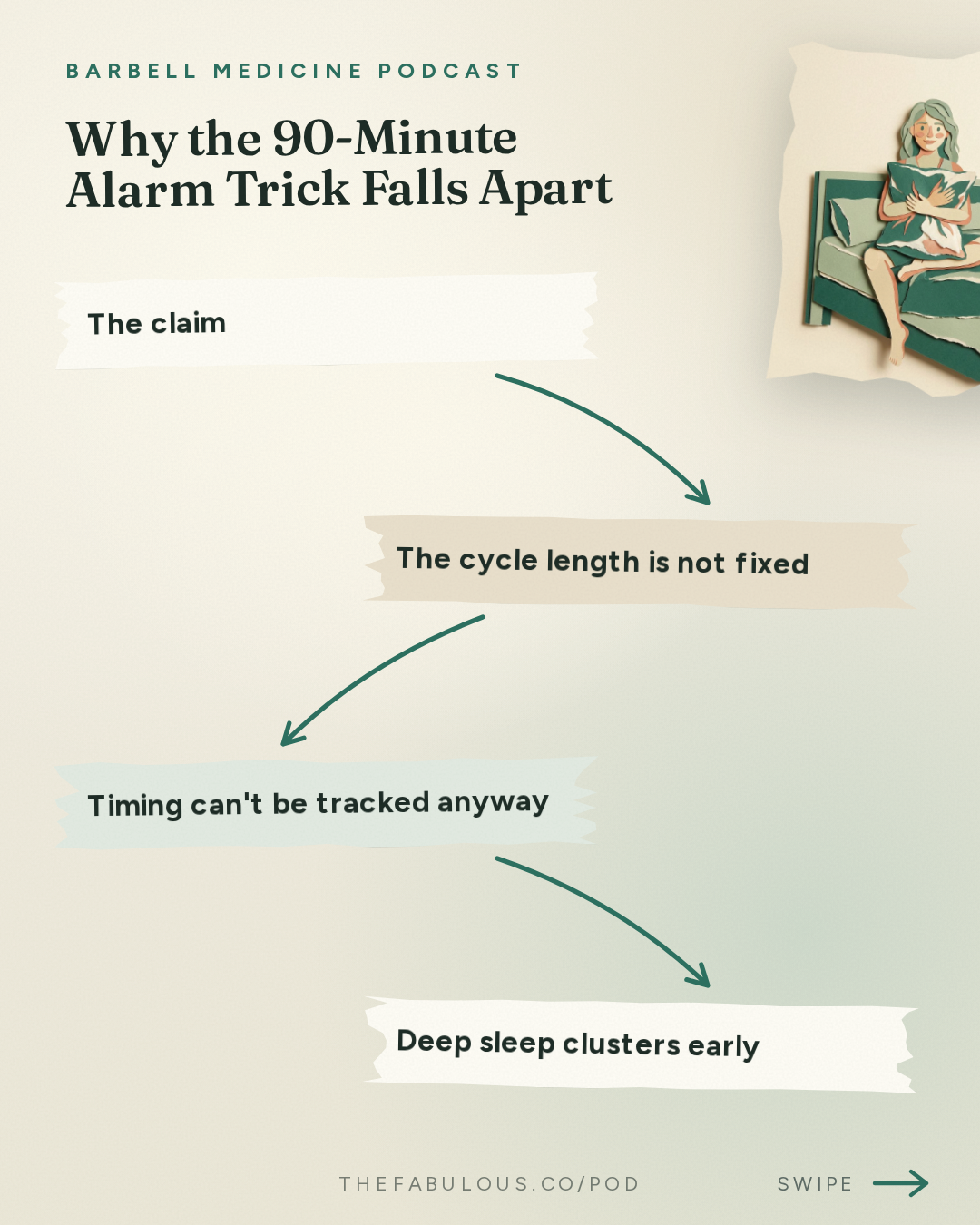
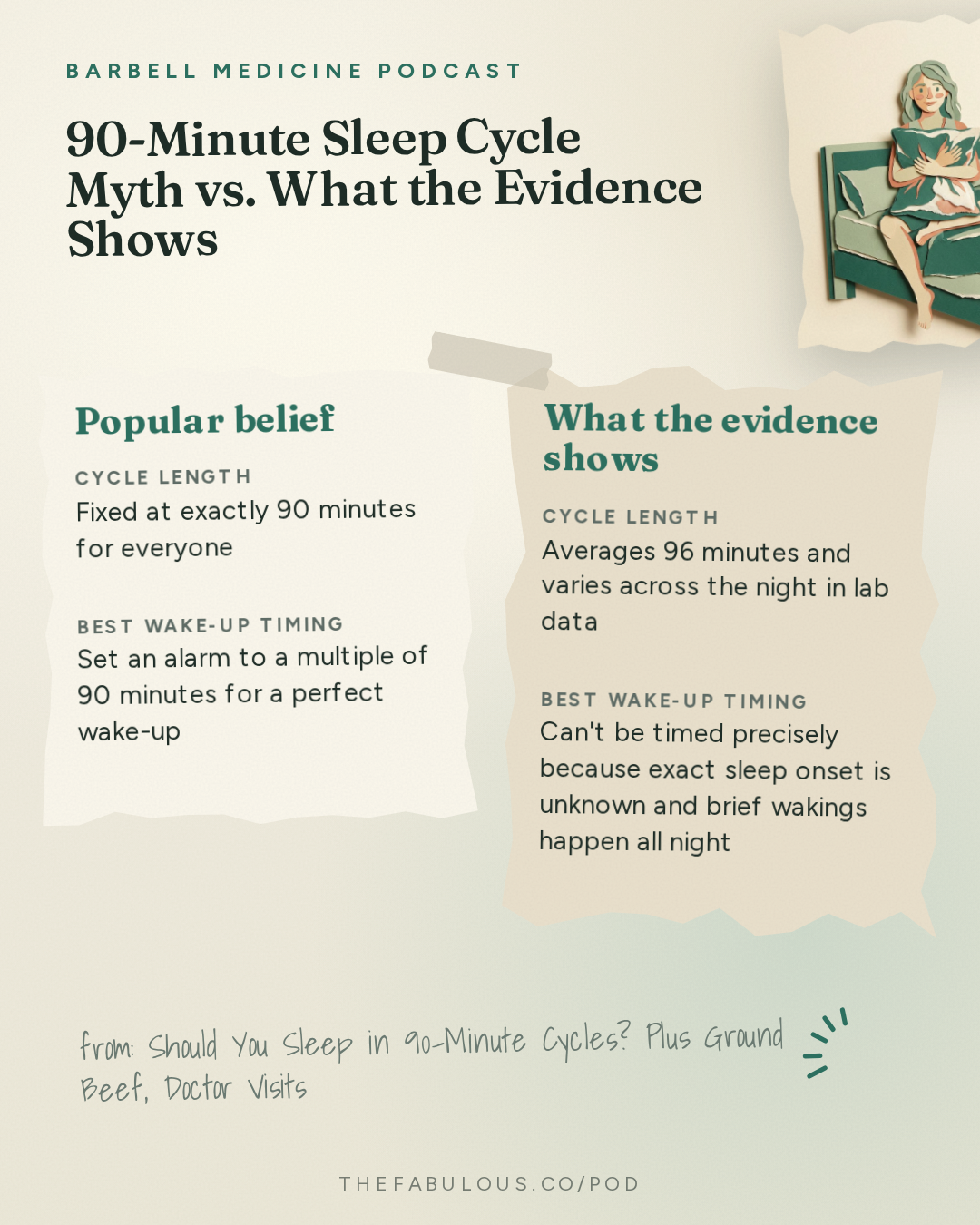
Barbell Medicine physicians Jordan Feigenbaum and Austin Baraki spend the early part of this episode taking the theory apart piece by piece. A sleep cycle, the loop through light sleep, deep sleep, and REM sleep (the stage where most dreaming happens), is not a metronome. It is an average, and a noisy one. In one large sleep lab's data set, the median cycle length was closer to ninety-six minutes, not ninety (02:08), and the very first cycle of the night tends to run shorter than the ones that follow (02:08). Add to that the fact that nobody knows the exact minute they fell asleep, and that everyone surfaces briefly several times a night without remembering it, and the whole premise of timing an alarm to a cycle boundary falls apart. As Feigenbaum puts it:
"The first problem here is that a sleep cycle isn't a fixed 90 minutes in length. That's an average, and it varies a lot from person to person across the night." — Jordan Feigenbaum [02:08]
There is a sliver of truth buried inside the myth, which is sleep inertia, the groggy fog right after waking. It really is worse when a person is pulled out of deep sleep. But deep sleep is loaded into the first half of the night (05:40), so by the time a morning alarm goes off, most people are already drifting through lighter sleep and REM anyway. The myth borrows a real phenomenon and points it in the wrong direction.
This is also where wearables enter the story, and not kindly. Smartwatches and rings are reasonably good at estimating total sleep time, but poor at identifying which stage a person is actually in (06:05). That gap matters because it feeds a condition with an actual name: orthosomnia, the anxiety that comes from fixating on sleep data. In one study the hosts cite, people who were simply told, at random, that their sleep had been below average performed worse on cognitive tests than people told their sleep was above average, regardless of what their sleep had actually been (05:58). The data itself did not change. The story a person told themselves about the data did.
"Worrying about your sleep can also become its own problem. We got a name for it, it's called orthosomnia." — Jordan Feigenbaum [05:58]
So what do the hosts actually recommend, once the cycle math is discarded? Something almost boring: seven to eight hours of sleep that feels restorative the next day (06:12), a range that lines up with guidance from the American Academy of Sleep Medicine and the Sleep Research Society. Quality, in their definition, is not a sleep-stage chart. It is whether someone wakes up rested and functions well during the day. Baraki adds a clinical filter on top of that: before chasing optimization, a physician has to characterize who is actually in front of them, whether the complaint points toward sleep apnea, restless leg syndrome, a medication side effect, or a hormonal transition, since a patient with a body mass index of 38 and morning grogginess puts sleep apnea at the top of a very different list than a patient with a BMI of 20 (08:38). Sleep science, in other words, resists the kind of precision the ninety-minute myth promises. The honest answer to "how should I optimize my sleep" is usually "what problem are you actually trying to solve."
A Dollar of Tofu and the Limits of Purity
The conversation then turns, with the kind of whiplash that only a holiday mailbag allows, to ground beef. A listener preparing lunches with lean ground beef, turkey, and chicken wants to know if that counts as processed food. Feigenbaum's answer is that grinding meat does not make it processed, and that the research linking red meat to poor health outcomes is mostly picking up a broader dietary pattern, one low in fiber and high in actually processed food, rather than red meat in isolation (09:40). Still, both hosts lean toward nudging people away from heavy red meat reliance and toward more plant-derived protein where it is easy to do.
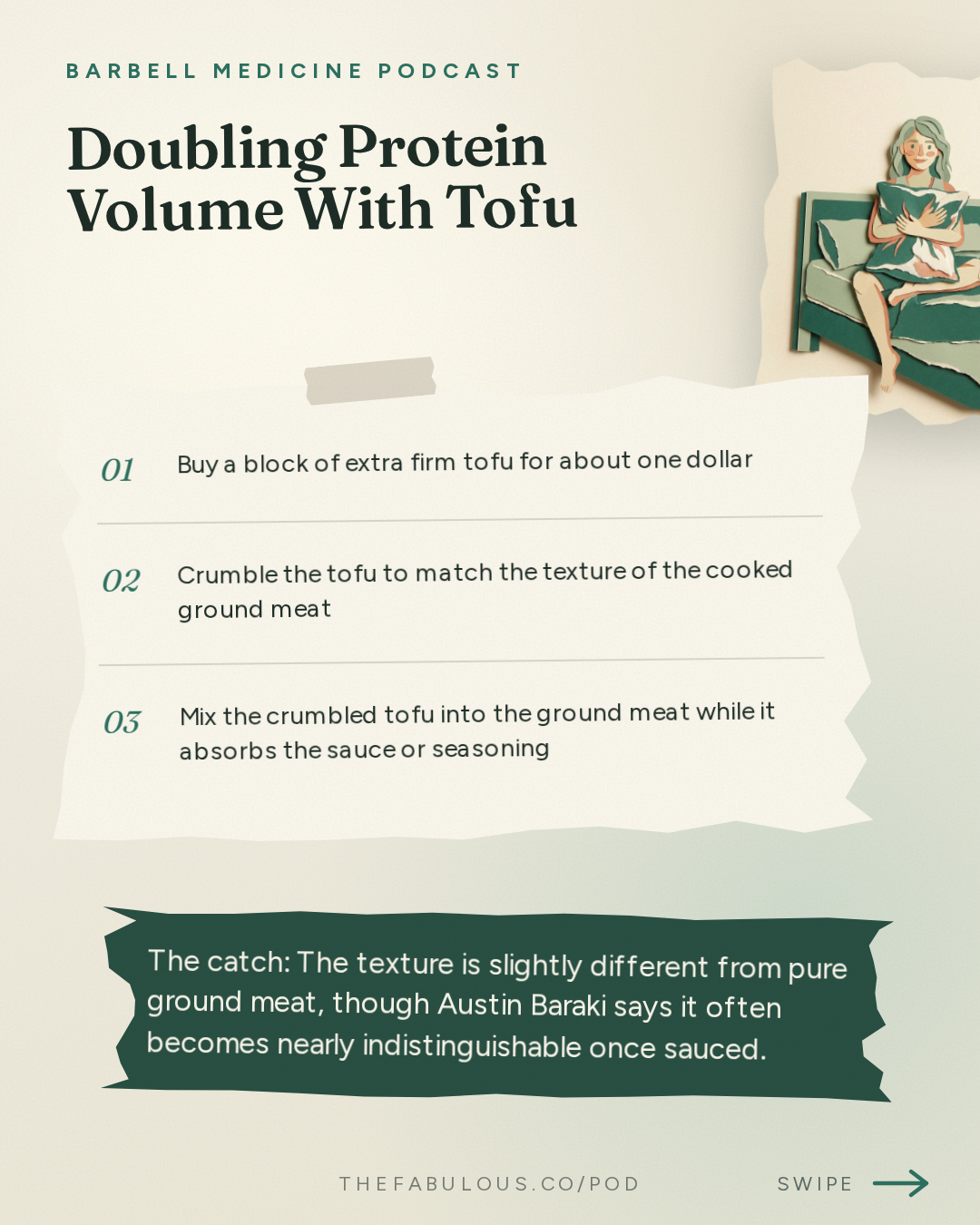
That nudge produces the episode's most useful piece of kitchen advice. Baraki's suggestion is almost absurdly simple: buy a block of extra firm tofu, which costs about a dollar, crumble it to match the texture of the cooked ground meat, and mix the two together in whatever sauced, seasoned dish is already being made.
"Go to the store, spend $1 on a block of extra firm tofu. Crumble that up to the same exact texture as your ground meat. Mix it in. It will double the volume." — Austin Baraki [11:13]
The tofu takes on whatever sauce is in the pan, the volume of the meal roughly doubles, the protein content goes up, and the cost per serving goes down. It is a small trick, but it captures something larger about how the hosts think: the goal is not purity, whether that means a perfect macro split or a cycle-timed alarm. The goal is a dietary pattern a person can actually sustain, nudged in a useful direction.
Fifteen Minutes, a Dozen Questions, and a Tofu-Adjacent Patient
The back half of the episode moves from the kitchen to the exam room, prompted by a listener's confession: faced with a doctor who only has fifteen to twenty minutes once or twice a year (13:50), the listener finds it easier to nod along with outdated fitness advice than to risk sounding like an "internet well-actually patient." Baraki's response strips the mystique out of bedside manner. Building rapport quickly, he argues, is not a special clinical gift so much as ordinary human competence: eye contact, a handshake, letting the patient talk, finding something in common, offering a genuine compliment. He points to Barbell Medicine's physical therapist, Derek Miles, as someone who does this unusually well because of a wide range of life experience outside medicine, not because of some secret clinical technique.
From the patient's side, the practical fix is preparation. Feigenbaum recommends walking into an appointment with a written list of questions, including if-then contingencies, and leaving with a follow-up already scheduled (16:27). That structure does two things: it keeps a short visit from drifting, and it replaces the post-appointment feeling of "wait, what happens now" with an actual plan. Neither host pretends every clinic allows for this kind of back-and-forth, but the asymmetry is real. A patient who shows up with a short, concrete list makes the physician's job of triage easier, and gets more out of a limited window of time.
Finding a good physical therapist runs into a similar structural problem. The listener's own question frames the difficulty bluntly: their region is heavy with therapists who default to passive modalities, heat packs, ultrasound, manual stretching, rather than evidence-based exercise programming.
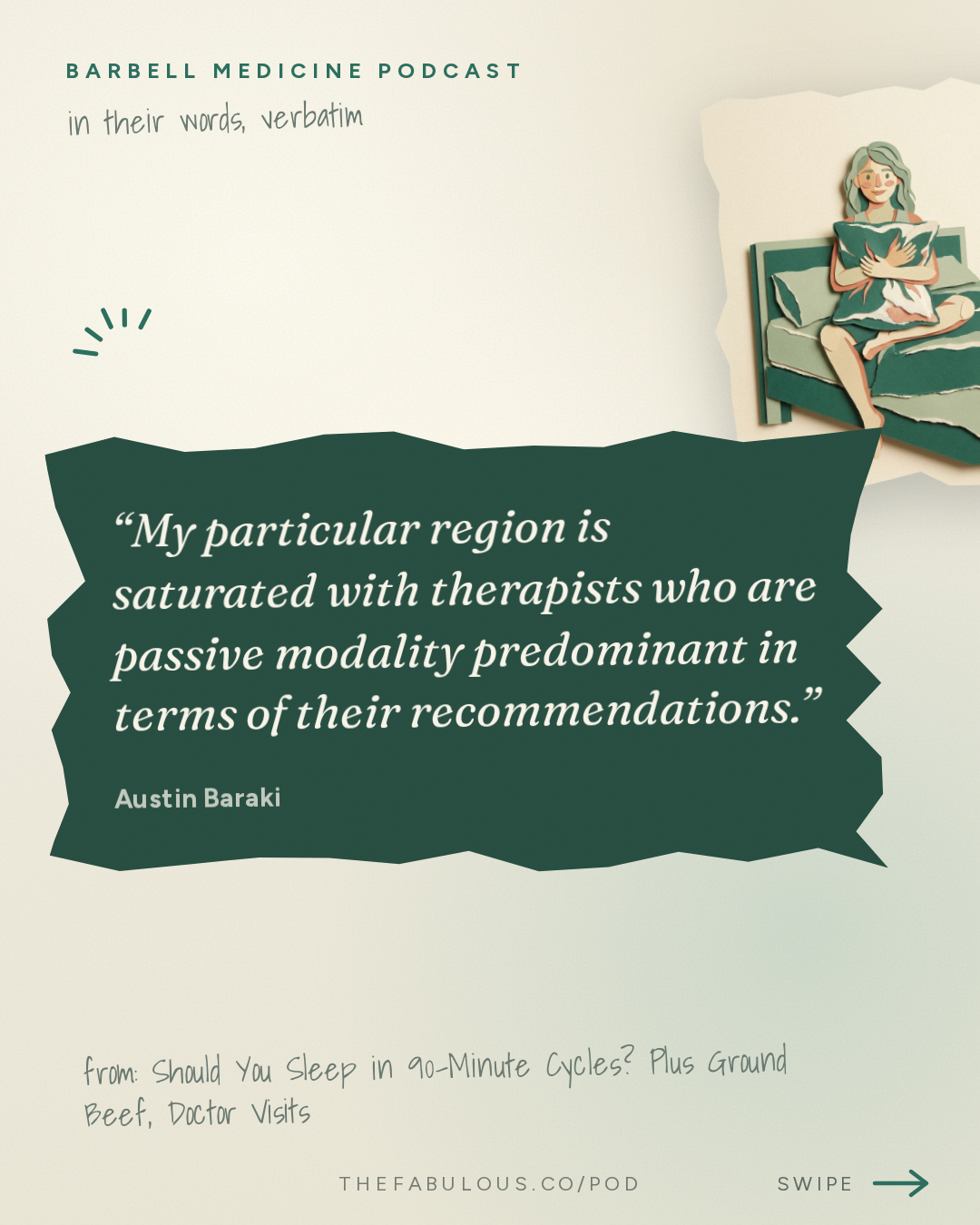
"My particular region is saturated with therapists who are passive modality predominant in terms of their recommendations." — Listener question, read by Jordan Feigenbaum [18:03]
His workaround is to treat the search like hiring: ask a prospective therapist directly what they would do for a specific complaint, and judge the answer against what the evidence actually supports. For a patient without that domain knowledge, word of mouth from a trusted clinician does the same job indirectly.
The episode closes on vacation protein, and the answer doubles as the show's quiet thesis. Taking one to two weeks off from strict protein targets will not meaningfully dent long-term muscle gain, because a person's baseline eating pattern rarely collapses just because they are at the beach, and because two weeks is a rounding error against years of training (21:09). The test the hosts apply, half-joking, half-serious, is to imagine looking back in a year and asking whether a slightly lower protein week on vacation actually mattered. If the honest answer is no, it is not worth the anxiety. Run that same test backward across the whole episode, the fixed ninety-minute cycle, the purity test on red meat, the fear of sounding uninformed in front of a doctor, and the pattern holds: precision is rarely the problem. Worrying about precision is.
Ask this episode anything
Pod's AI answers from the episode itself, with the minute mark so you can hear it yourself.
Or start with one of these
Ask this episode
Pod's AI listens to the whole episode to answer, and points you to the minute it comes from.
The rest of this answer, and any question after it
Answers come from the episode itself, never from a summary of it.
ContinueKey takeaways
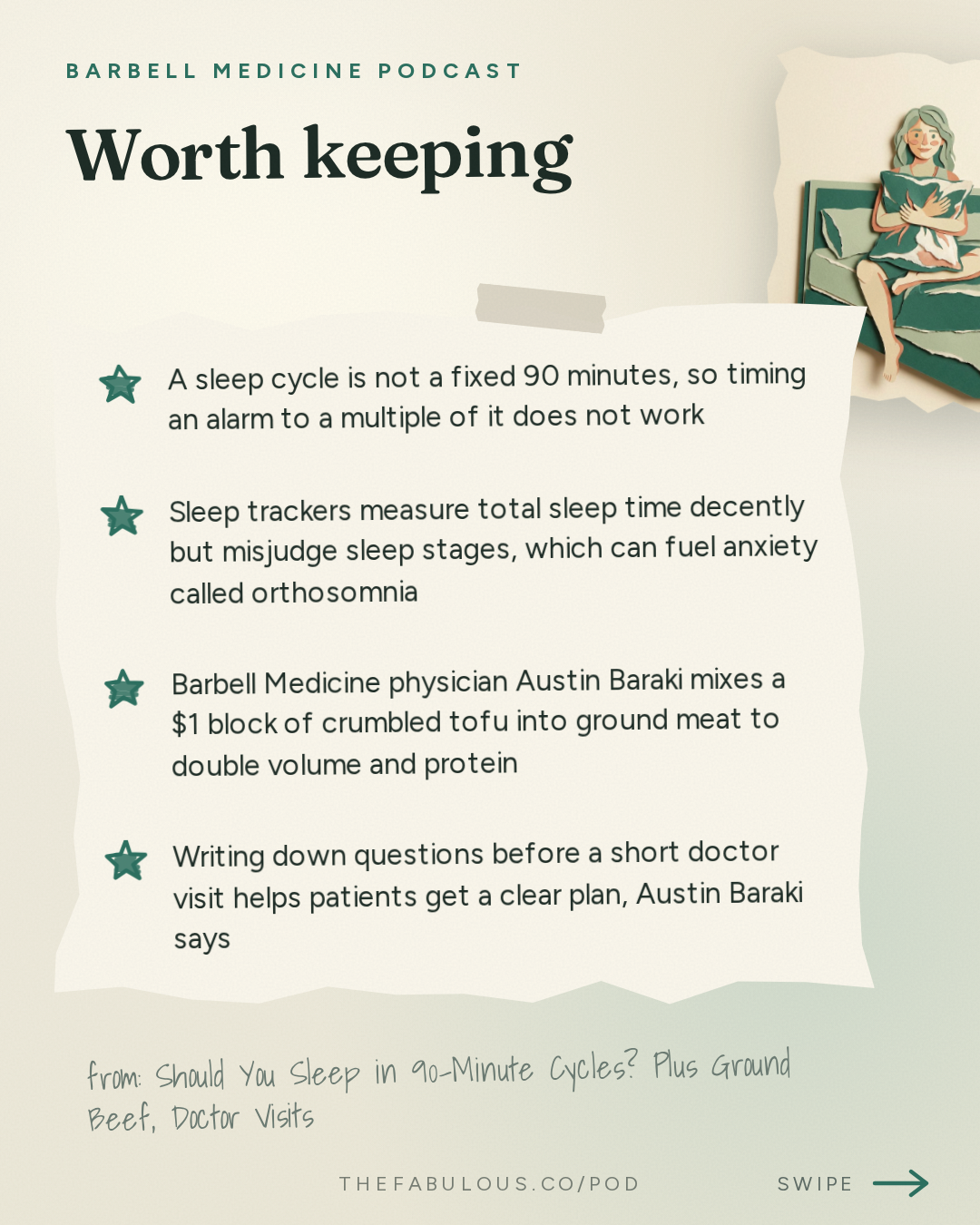
- A sleep cycle is not a fixed 90 minutes, so timing an alarm to a multiple of it does not work
- Sleep trackers measure total sleep time decently but misjudge sleep stages, which can fuel anxiety called orthosomnia
- Barbell Medicine physician Austin Baraki mixes a $1 block of crumbled tofu into ground meat to double volume and protein
- Writing down questions before a short doctor visit helps patients get a clear plan, Austin Baraki says
- One to two weeks of relaxed protein goals on vacation will not hurt long-term muscle gain, the hosts say
The episode in cards

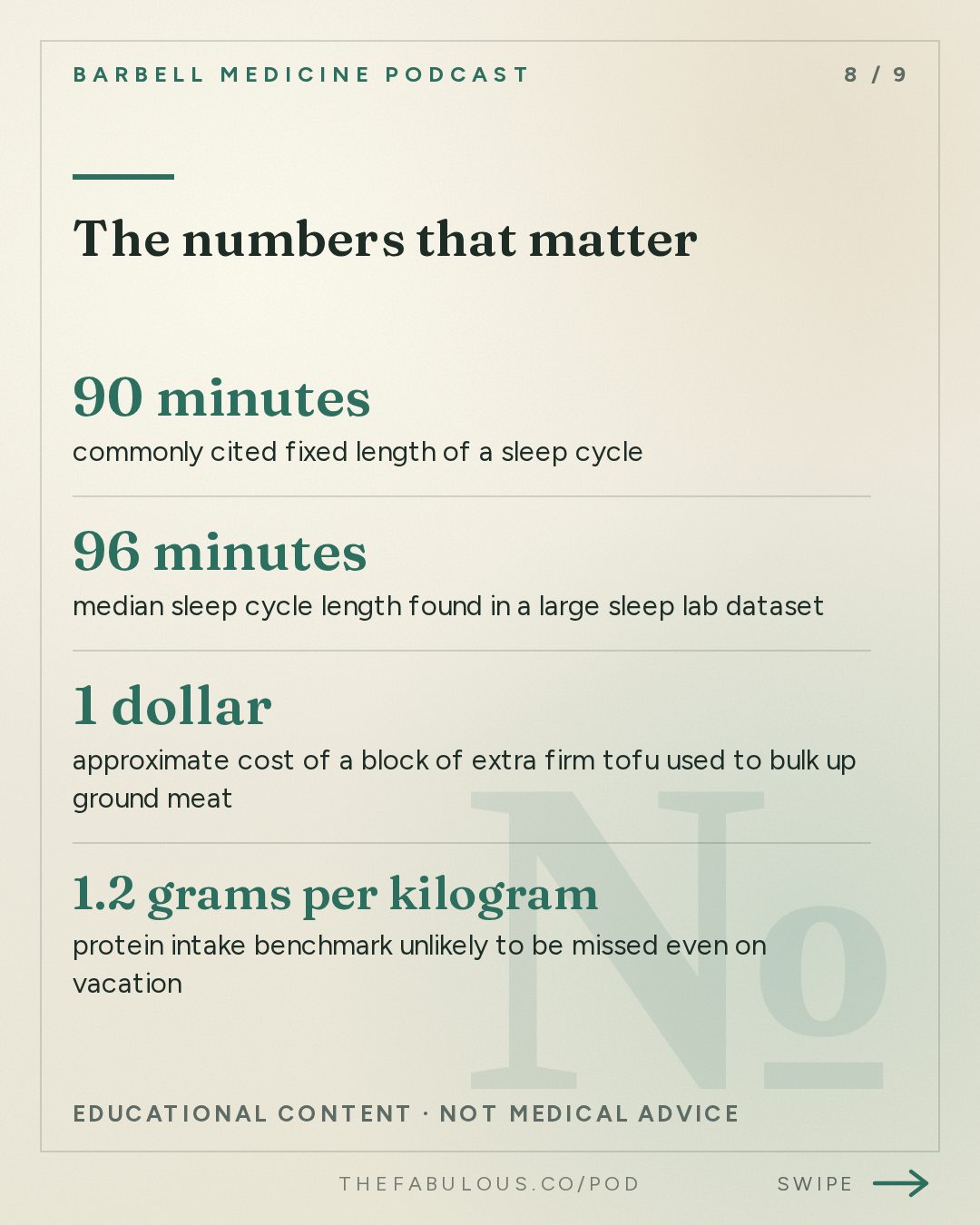
By the numbers
- 90 minutes commonly cited fixed length of a sleep cycle
- 96 minutes median sleep cycle length found in a large sleep lab dataset
- 1 dollar approximate cost of a block of extra firm tofu used to bulk up ground meat
- 1.2 grams per kilogram protein intake benchmark unlikely to be missed even on vacation
In their words
“The first problem here is that a sleep cycle isn't a fixed 90 minutes in length. That's an average, and it varies a lot from person to person across the night.”
“Worrying about your sleep can also become its own problem. We got a name for it, it's called orthosomnia.”
“Go to the store, spend $1 on a block of extra firm tofu. Crumble that up to the same exact texture as your ground meat. Mix it in. It will double the volume”
“My particular region is saturated with therapists who are passive modality predominant in terms of their recommendations.”
Protocols
-
Double protein volume with tofu
Austin Baraki recommends buying a one dollar block of extra firm tofu, crumbling it to match the texture of cooked ground meat, and mixing the two together so the tofu absorbs the same sauce and seasoning. He notes the texture is slightly different but says the blend often becomes nearly indistinguishable from pure ground meat.
Whenever preparing ground meat dishes such as sauced rice bowls
-
Target seven to eight hours of sleep
Jordan Feigenbaum and Austin Baraki recommend aiming for seven to eight hours of sleep that feels restorative the next day, in line with guidance from the American Academy of Sleep Medicine and the Sleep Research Society, rather than timing an alarm to a specific cycle length. They judge sleep quality by how rested a person feels upon waking rather than by a wearable's sleep-stage chart.
Nightly
-
Prepare written questions before a short doctor visit
Austin Baraki recommends that patients arrive at a fifteen to twenty minute appointment with a written list of questions and if-then contingency scenarios, and confirm a follow-up visit before leaving. He says this gives both patient and physician a clear roadmap when visit time is limited.
Before each appointment
-
Vet a physical therapist like a job candidate
Austin Baraki recommends asking a prospective physical therapist directly what their treatment plan would be for a specific complaint before committing to care, since he says a substantial share of therapists in his own region default to passive modalities rather than exercise-based treatment. He suggests sourcing names through trusted clinicians and word of mouth when direct vetting is not practical.
Before starting care with a new therapist
Questions this episode answers
Should you sleep in multiples of 90 minutes?
No. A sleep cycle averages 90 minutes but lab data shows a median closer to 96 minutes, and it varies from person to person and across the night, so timing an alarm to a multiple of 90 doesn't reliably reduce grogginess (02:08).
What is orthosomnia?
Orthosomnia is distress caused by worrying about sleep tracker data rather than actual sleep problems. In one cited study, people randomly told their sleep was below average scored worse on cognitive tests than those told it was above average, even though their actual sleep hadn't changed (05:58).
Are sleep trackers and wearables accurate?
They're reasonably good at estimating total sleep time but poor at identifying which sleep stage a person is in, according to Barbell Medicine physician Austin Baraki, which limits how actionable the sleep-stage charts really are (06:05).
Does mixing tofu into ground meat actually work for protein and cost?
Austin Baraki, a Barbell Medicine physician, says crumbling a one dollar block of extra firm tofu into ground meat doubles the dish's volume, keeps protein quality high, and absorbs the same sauce and seasoning as the meat (11:13).
How much sleep do experts actually recommend?
Seven to eight hours of high-quality sleep, judged by how rested a person feels the next day rather than by a precise cycle count, per guidance from the American Academy of Sleep Medicine and the Sleep Research Society cited in the episode (06:12).
The full read, in cards
Go deeper
- American Academy of Sleep Medicine sleep duration guidance — recommends seven to eight hours of high-quality sleep nightly
- Sleep Research Society sleep duration guidance — aligns with the seven to eight hour recommendation cited in the episode
- Large sleep lab dataset on cycle length — found a median sleep cycle length of 96 minutes rather than a fixed 90
- Study on perceived sleep quality and cognitive performance — people randomly told their sleep was below average performed worse on cognitive tests regardless of actual sleep
Mentioned
Jordan Feigenbaum · Austin Baraki · Gordon · Derek Miles · American Academy of Sleep Medicine · Sleep Research Society
More from this show and category

Knee Replacement vs. Conservative Treatment Explained
An MRI showing tricompartmental arthritis describes where damage sits, not how bad symptoms are. Barbell Medicine physicians Jordan Feigenbaum and Austin Baraki argue surgery should follow failed physical therapy, not imaging alone. Steroid shots buy short-term relief for rehab, not a cure, and open chain exercises like knee extensions are safe early in ACL recovery when properly dosed.

Stuart McGill's Deadlift Fracture Claim, Debunked
Barbell Medicine hosts debunk Stuart McGill's claim that deadlift PRs fracture spinal vertebrae, pointing to powerlifting's low injury rate (03:36). They also dismiss spinal engine theory and argue eccentric-overload machines like the Voltra do not add muscle mass beyond matched training load (19:52).

Does Creatine Actually Work? What the Science Shows
Creatine modestly boosts strength and muscle size, with effect sizes far smaller than lifting itself, and does not damage healthy kidneys. Claims about cognition, depression, Parkinson's, Huntington's, menopause, and bone density do not hold up in the best-run trials (14:24, 26:47, 48:26, 51:20).

Is Collagen Protein a Scam? What the Evidence Shows
Collagen counts as protein but scores zero on the standard protein quality test because it lacks the essential amino acid tryptophan entirely. Claims that it beats whey for muscle, tendons, joints, skin, or nails rely on flawed trials, mismatched placebos, and a statistical mix-up between standard error and standard deviation.
