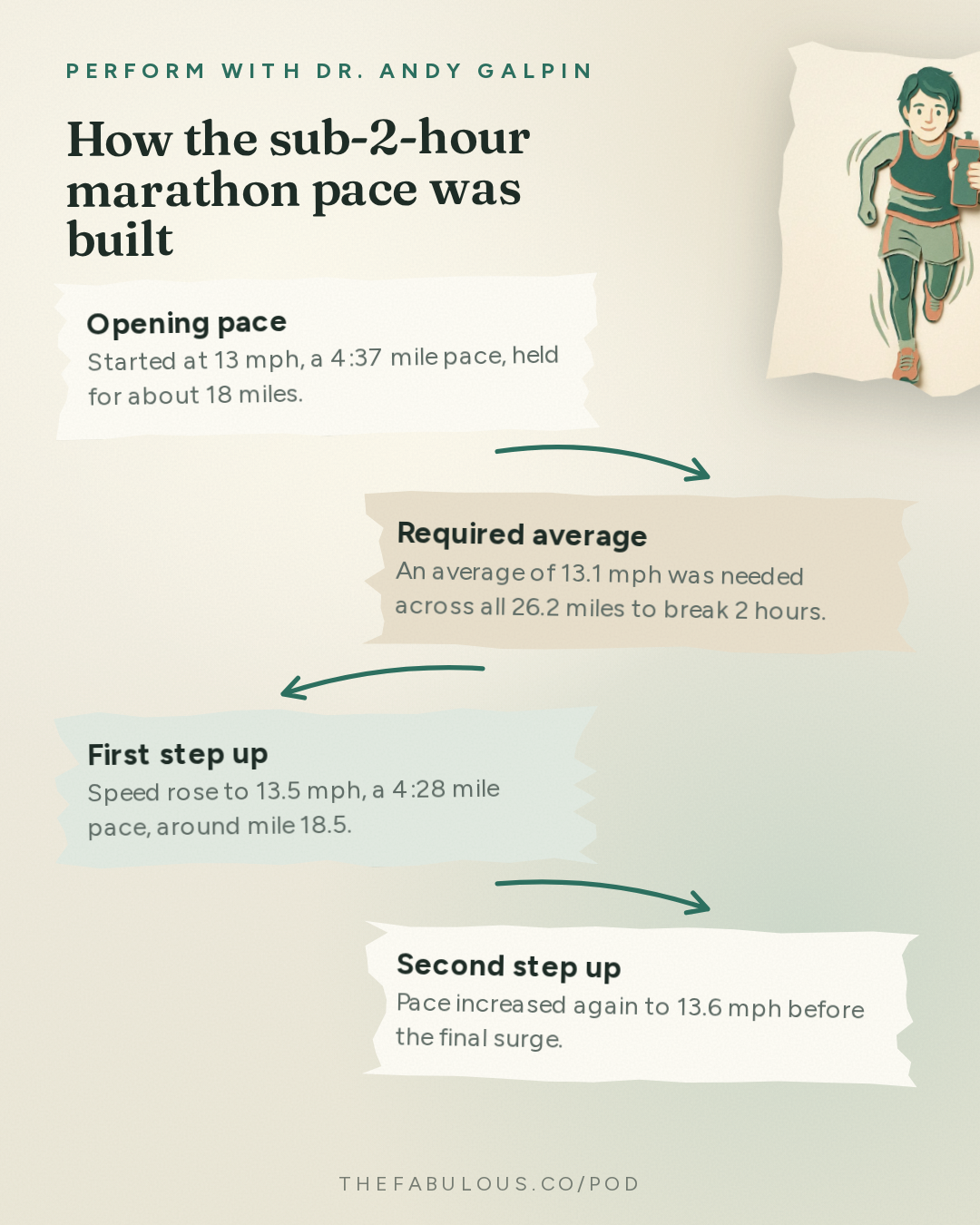
The Science Behind the Sub-2 Marathon
The Science Behind Going Sub-2 in the Marathon
▶ Listen to the full episode More from Perform with Dr. Andy Galpin
The brief
A new opinion paper breaks down the physics of a sub-two-hour marathon: the runner needed to sustain 13.1 mph, not just hit it once, while a separate dose-response study found trained cyclists needed roughly 107 grams of carbohydrate per hour to outperform a 10-gram control, not the 60-80 grams long assumed as the ceiling.
Most marathon runners slow down. Over the second half of a 26.2-mile race, the average finisher loses about ten percent of their pace (06:48). Fatigue builds, form breaks down, and the clock punishes it. So when a case-study runner identified in the episode as Sebastian ran the second half of his sub-two-hour marathon attempt two and a half percent faster than the first, the number itself was less startling than what it took to get there.
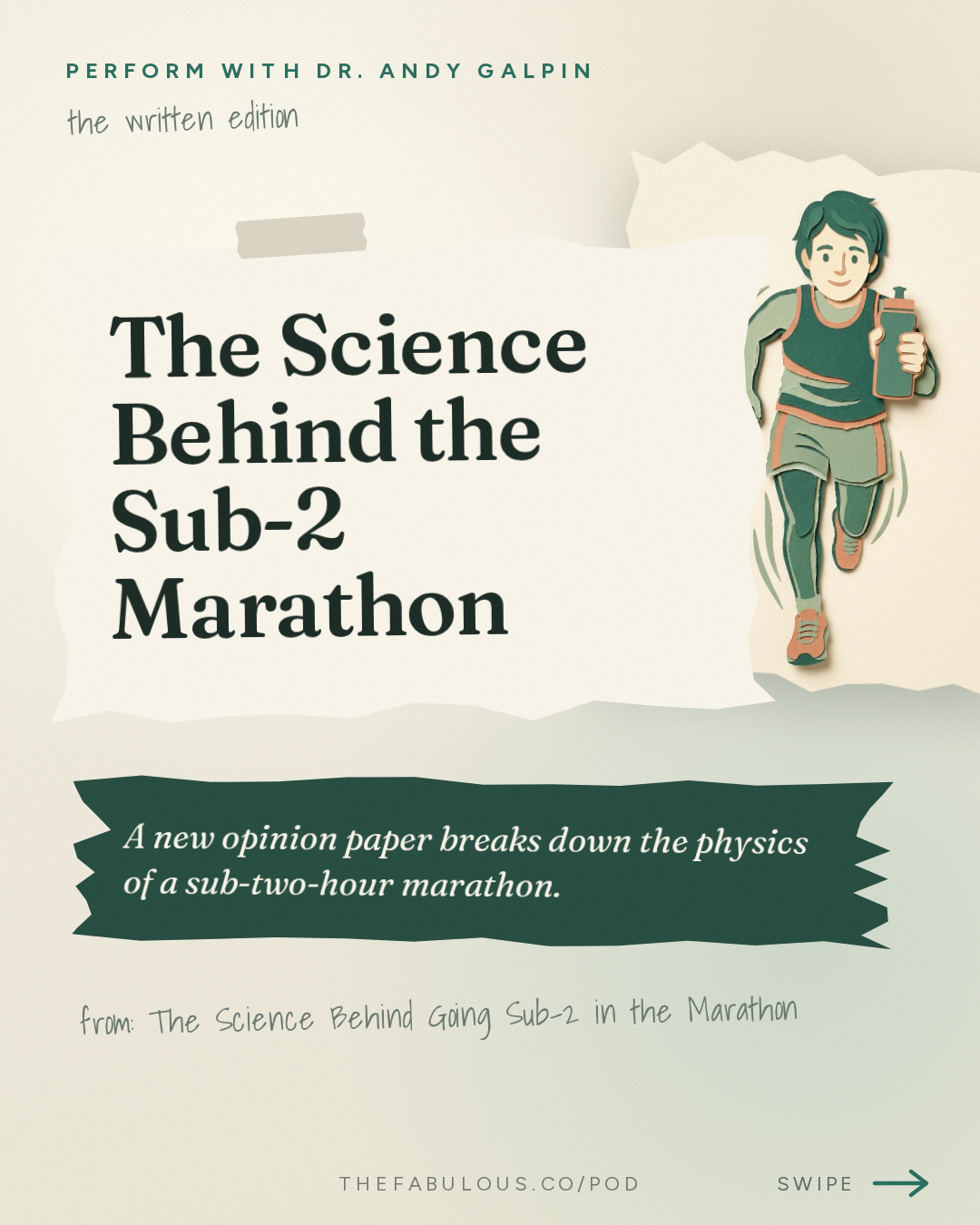
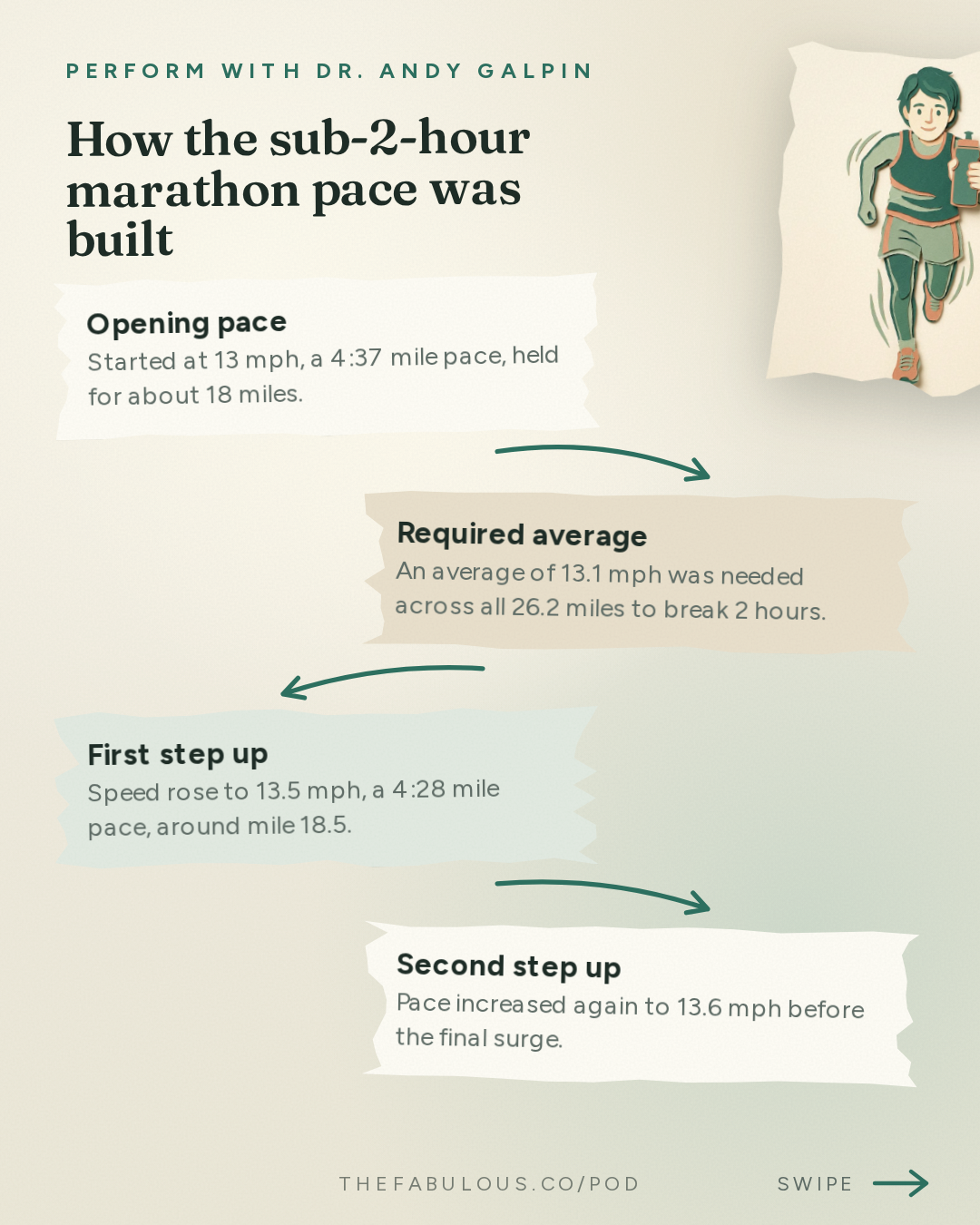
He started at 13 miles per hour, a four-minute-37-second mile pace that almost no recreational runner could hold for even a single lap (08:08). He held something close to that for eighteen miles. Then, because 13 mph is not quite fast enough to break two hours, he had to climb: 13.5 mph, then 13.6, then 14 mph for the final stretch, a four-minute-17-second mile run after 25 miles of fatigue (09:44). The whole race was a staircase, not a flat line.
For thirty years, exercise scientists explained endurance performance with three variables: VO2 max (how much oxygen the body can use), lactate threshold (how hard you can go before acid builds up too fast), and running economy (how efficiently you move). The newer framework asks a different question: how long can an athlete hold onto those three things once fatigue, heat, and pacing decisions start working against them. Scientists now call this durability.
"When you say durability in endurance sports, that's what we're talking about, is how long can those things survive into a race?" — Andy Galpin [12:04]
Durability showed up everywhere in the race's fueling strategy, too. Reports suggest Sebastian ingested about 115 grams of carbohydrate per hour (12:44), nearly double the 60-to-80-gram range that was considered the ceiling for decades. He likely also used sodium bicarbonate, which studies show can blunt acid buildup during intense exercise by three to eight percent (15:48). None of it would matter without the shoe technology or the training behind it, but the point stands: elite performance is a stack of small, rehearsed, individualized decisions, not one trick.
What the Carbohydrate Data Actually Show
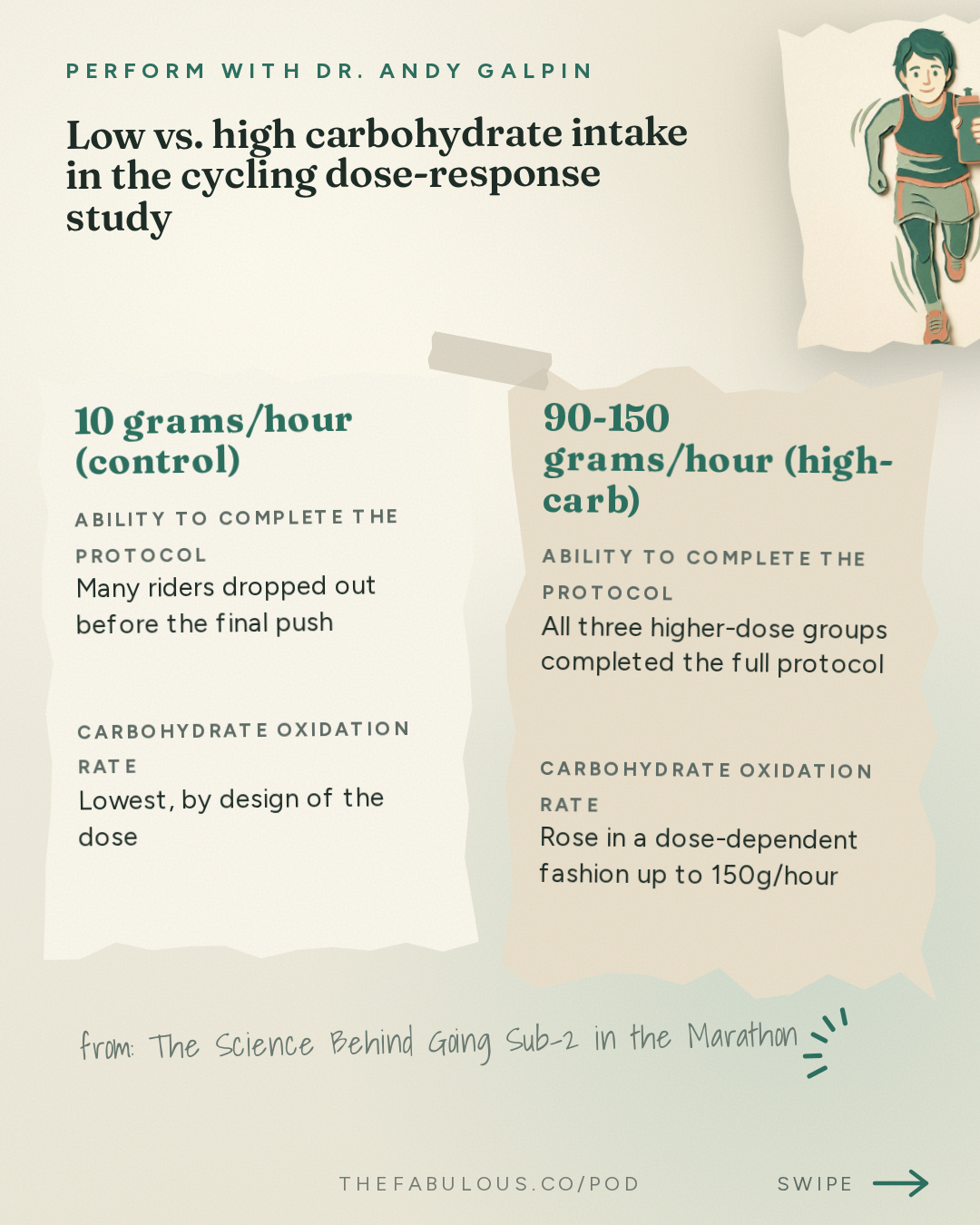
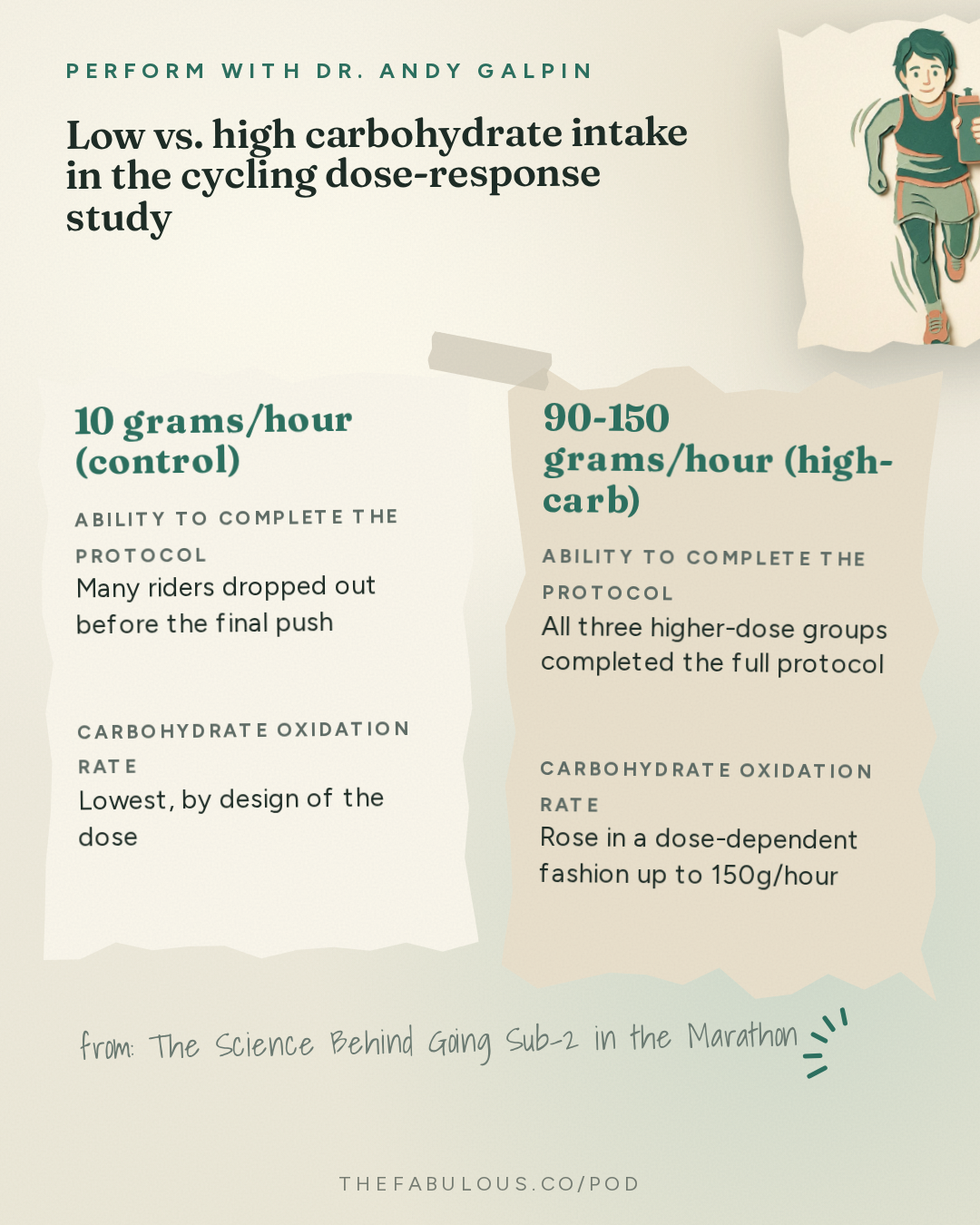
A separate, peer-reviewed study published around the same time tested that carbohydrate question directly, rather than inferring it from one athlete's race. Exercise scientist James Morton's lab put eight highly trained cyclists, averaging a VO2 max of 73 milliliters of oxygen per kilogram of body weight per minute, through a brutal three-hour ride followed by a flat-out effort to exhaustion (21:57). Each rider did the protocol four times, fueled with 10, 90, 120, or 150 grams of carbohydrate per hour.
The 10-gram dose, drawn from a prior review arguing that amount was sufficient, left riders unable to maintain blood glucose, and many couldn't even finish the three-hour ride before the final push (27:22). Carbohydrate burn rate rose in a dose-dependent way up through 150 grams per hour, meaning more consumed translated to more used (26:14), but performance gains leveled off: 150 grams never beat 120. The calculated optimal landed around 107 grams per hour (27:56), with the researchers reporting wide individual variation, some riders did best on less, some on more.
The takeaway isn't a universal number. It's that 10 grams an hour, an amount once defended in the literature, is clearly not enough for anyone chasing a personal best, while something in the 80-to-120-gram range is a reasonable starting point to experiment from.
Wearables, Recovery Tools, and the Limits of Data
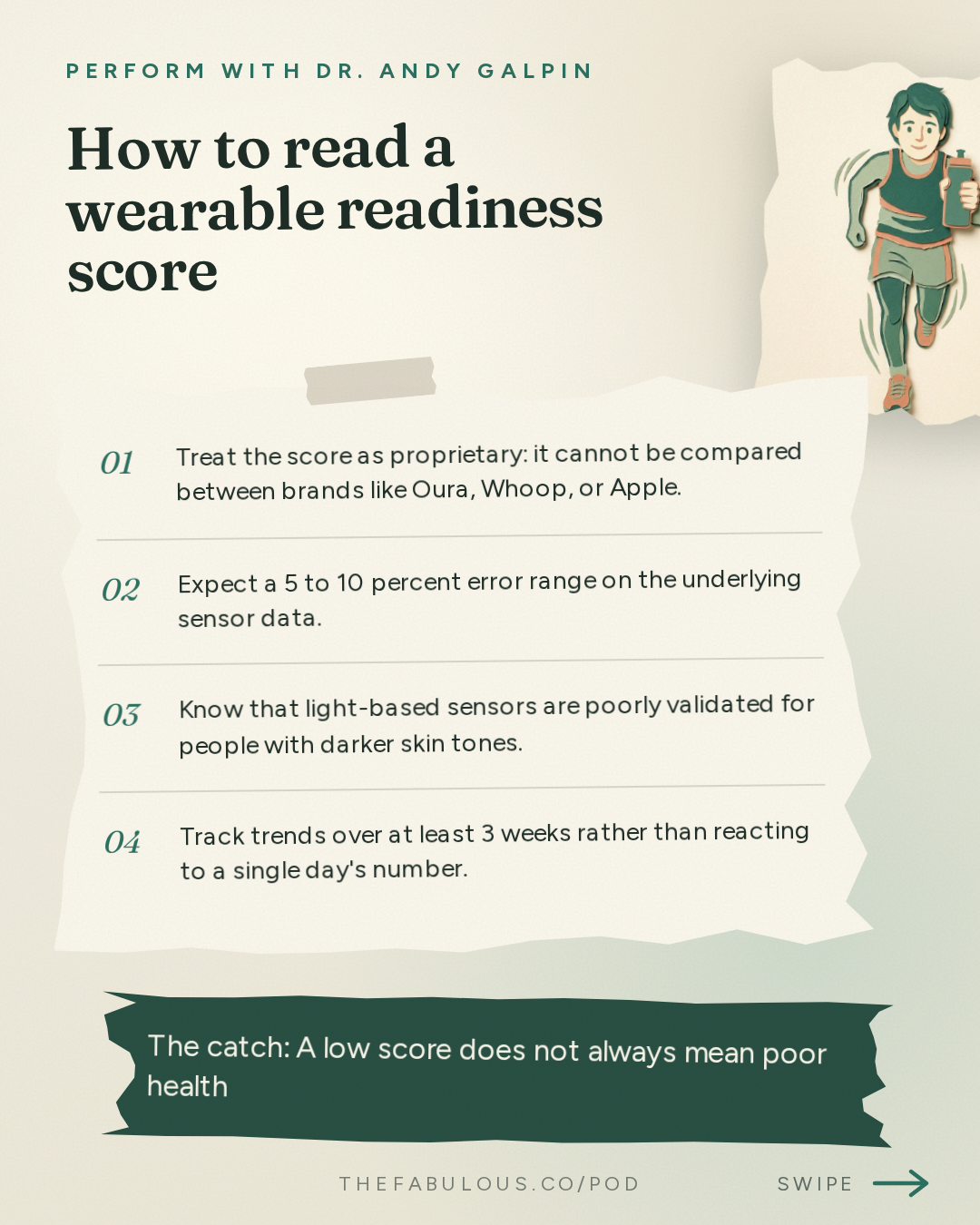
The same caution about chasing a single number applies to wearable readiness scores. These scores, whether Oura's "readiness," Whoop's "recovery," or Apple's newly announced version, are proprietary calculations built mostly from heart rate variability, or HRV, a measure of the natural variation in time between heartbeats (33:58). Because each company weighs the inputs differently, scores from different devices can't be compared to one another. Independent validation studies on devices like the Whoop 4.0 strap and Garmin Fenix 6 show typical error rates of five to ten percent (40:35), and the underlying light-based sensors are poorly validated in people with darker skin tones (41:12).
"Zero times do we recommend somebody look at their watch and change their training because of their score. Never happens." — Andy Galpin [46:04]
Instead, the guidance is to track trends over at least three weeks rather than reacting to any single day's reading (46:33), since a score can dip for reasons that have nothing to do with fitness: skin tone, sensor placement, or a proprietary formula that simply doesn't fit an individual's physiology.
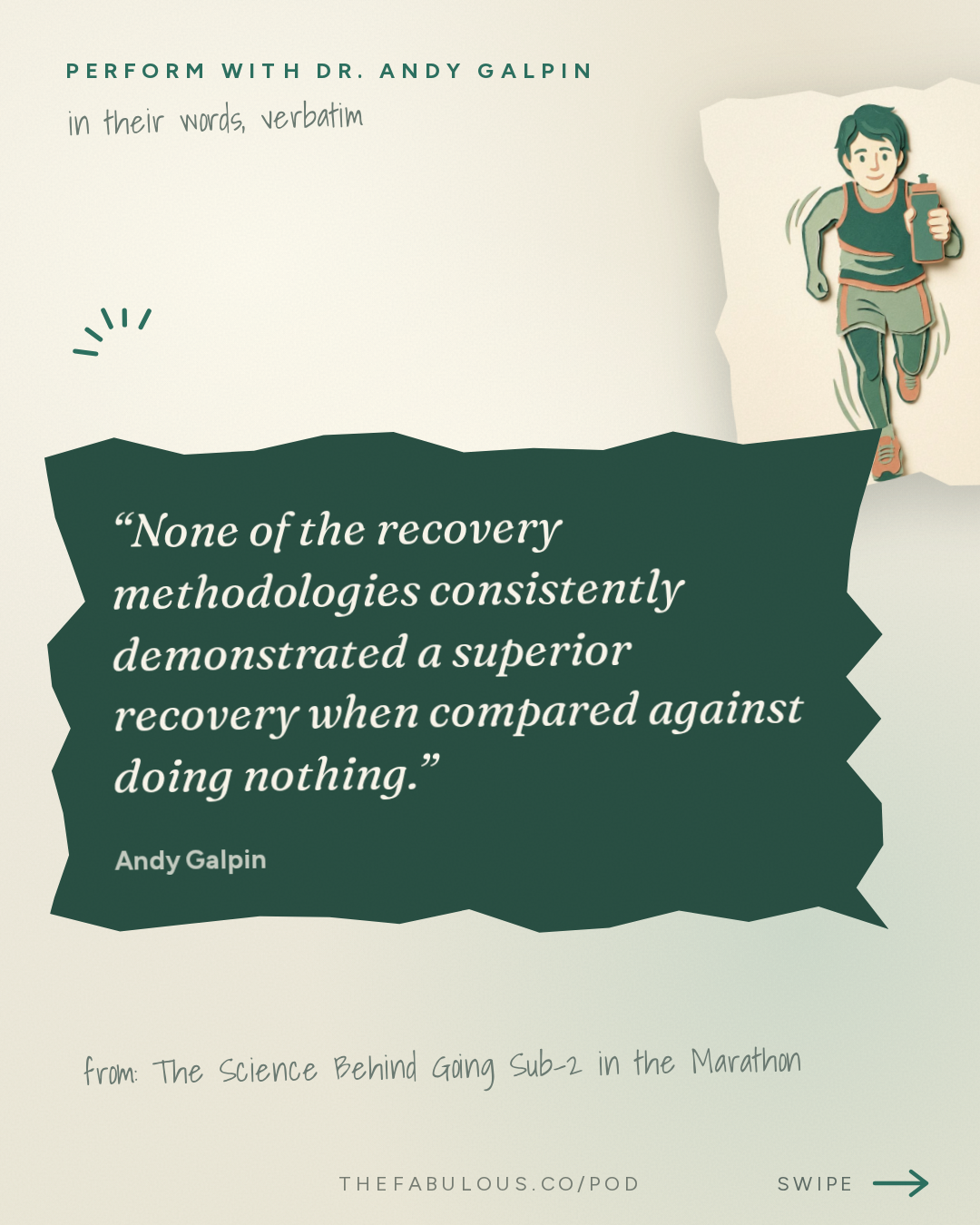
A similarly humbling result came from a September systematic review and meta-analysis of post-exercise recovery tools, covering roughly 40 performance studies, 30 biochemical studies, and more measuring perceived soreness. Performance and soreness markers generally returned to baseline within about 72 hours regardless of intervention (55:10), and across the board, no passive recovery method, including cold plunges, compression gear, or massage, consistently beat doing nothing (55:58). A smaller, related review of 11 studies on hyperbaric oxygen therapy, which pressurizes extra oxygen into the body, found it reliably sped up lactate clearance, but only produced a performance benefit when exercise happened inside the chamber itself, not after (62:14).
None of this means recovery tools are fraudulent. It means the research doesn't support treating any single tool as essential, and the better use of limited time and money is in finding the two or three things that work for a given person's actual routine.
The episode's final stretch turned to a paper from exercise physiologist Abbie Smith-Ryan's lab mapping female athlete health across four life stages: puberty, pregnancy and postpartum, perimenopause, and postmenopause. Young female athletes face ACL tears at 1.5 times the rate of their male peers (73:07) and are far more likely to develop RED-S, or Relative Energy Deficiency in Sport, a state of chronic under-fueling that affects somewhere between 25 and 80 percent of female athletes depending on the study (75:38). The paper also found that only 7 percent of orthopedic surgeons in the United States are women (67:36), a gap in a field now serving a rapidly growing population of female athletes since Title IX, the 1972 U.S. law requiring equal athletic opportunity for women, pushed female sports participation up sharply.
Later in life, the physiology shifts again: women lose an average of three kilograms of muscle mass per decade between ages 40 and 60 (80:27), bone loss accelerates to two to three percent a year during perimenopause (80:36), and 85 percent of women experience low back pain during pregnancy (79:15). The paper's argument, and Galpin's, is that these stages are connected: under-fueling at 16 can show up as bone fragility at 60.
"I think really our best longevity tool is being as healthy as possible for female athletes, especially in their younger years." — Andy Galpin [84:27]
What connects a sub-two-hour marathon, a carbohydrate trial, a wearable ring, and a sixteen-year-old gymnast's menstrual cycle is the same insistence on evidence over assumption. The old models, three physiological variables, a fixed carb ceiling, a single readiness number, a one-size female training plan, are giving way to something messier and more useful: individualized data, tracked over time, interpreted with humility about what any one number can actually tell a person about their body.
Ask this episode anything
Pod's AI answers from the episode itself, with the minute mark so you can hear it yourself.
Or start with one of these
Ask this episode
Pod's AI listens to the whole episode to answer, and points you to the minute it comes from.
The rest of this answer, and any question after it
Answers come from the episode itself, never from a summary of it.
ContinueKey takeaways
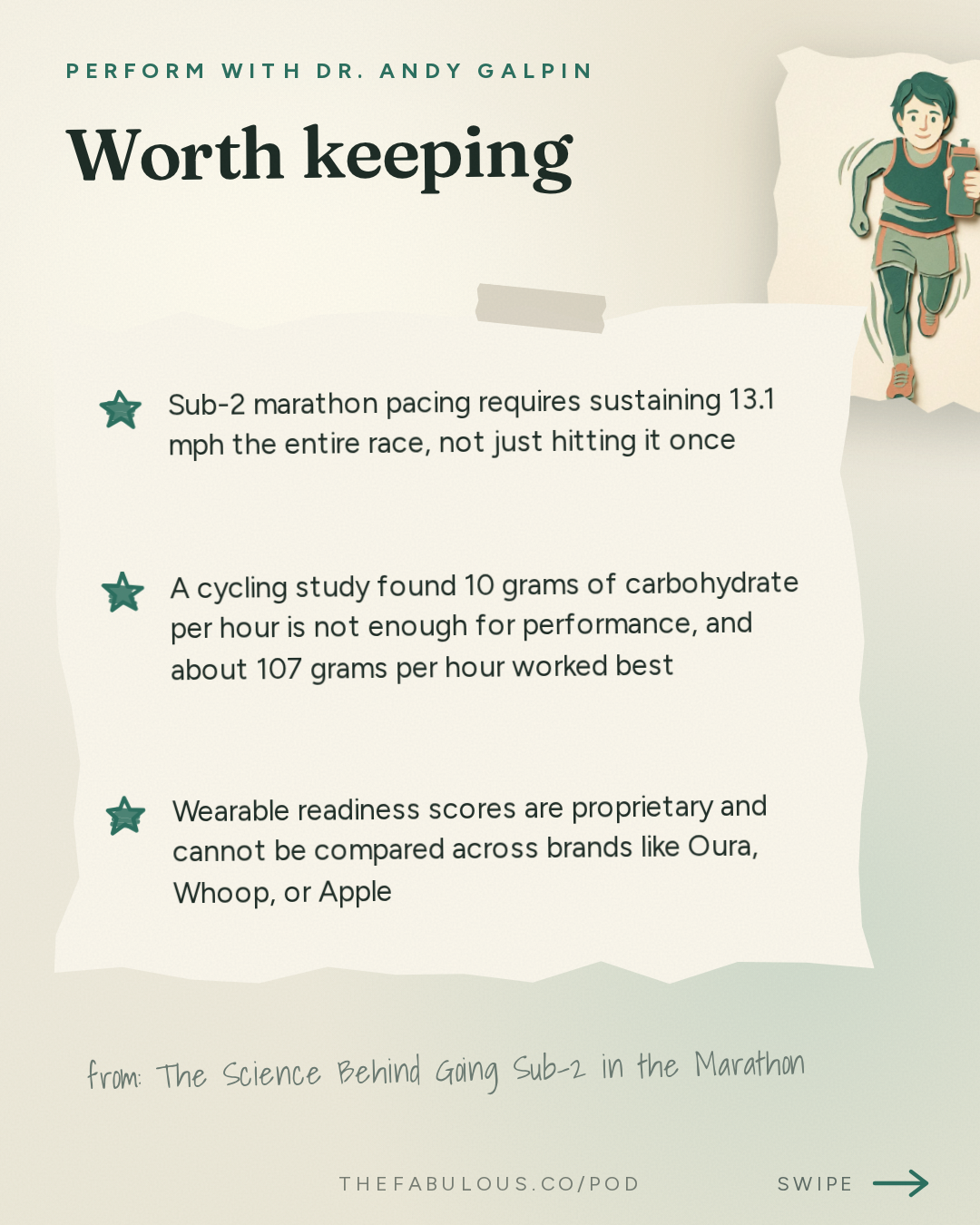
- Sub-2 marathon pacing requires sustaining 13.1 mph the entire race, not just hitting it once (08:55)
- A cycling study found 10 grams of carbohydrate per hour is not enough for performance, and about 107 grams per hour worked best (27:56)
- Wearable readiness scores are proprietary and cannot be compared across brands like Oura, Whoop, or Apple (33:58)
- A meta-analysis found no passive recovery tool, including cold or compression, consistently beats simple rest (55:58)
- RED-S, a state of chronic under-fueling, affects 25 to 80 percent of female athletes and can echo into bone health decades later (75:38)
The episode in cards

By the numbers
- 73 ml/kg/min average VO2 max of the highly trained cyclists in the carbohydrate study
In their words
“When you say durability in endurance sports, that's what we're talking about, is how long can those things survive into a race?”
“Zero times do we recommend somebody look at their watch and change their training because of their score. Never happens.”
“None of the recovery methodologies consistently demonstrated a superior recovery when compared against doing nothing.”
“I think really our best longevity tool is being as healthy as possible for female athletes, especially in their younger years.”
Protocols
-
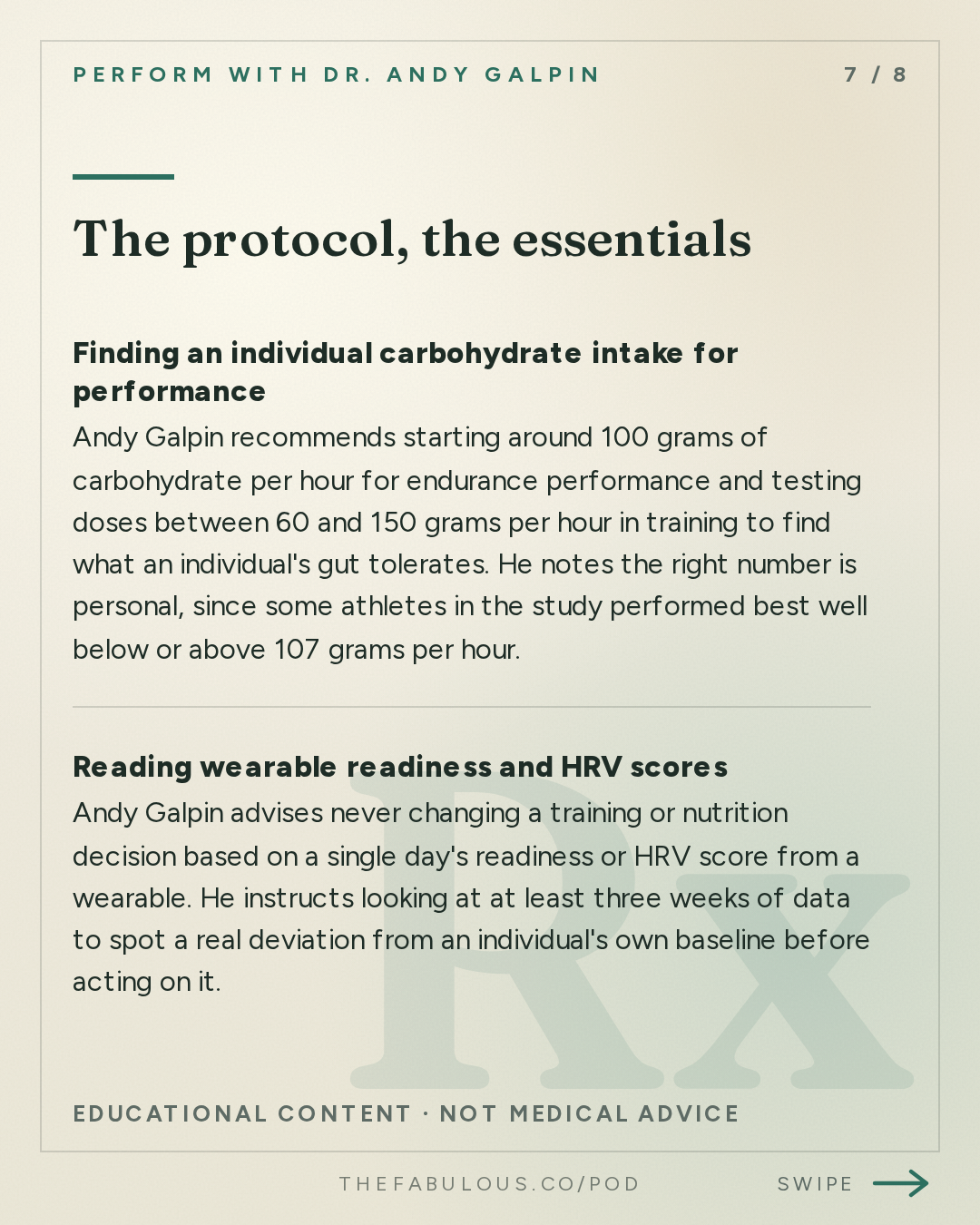
Finding an individual carbohydrate intake for performance
Andy Galpin recommends starting around 100 grams of carbohydrate per hour for endurance performance and testing doses between 60 and 150 grams per hour in training to find what an individual's gut tolerates. He notes the right number is personal, since some athletes in the study performed best well below or above 107 grams per hour.
tested during training sessions before race day
-
Reading wearable readiness and HRV scores
Andy Galpin advises never changing a training or nutrition decision based on a single day's readiness or HRV score from a wearable. He instructs looking at at least three weeks of data to spot a real deviation from an individual's own baseline before acting on it.
reviewed over rolling 3-week windows, not daily
-
Boosting a low readiness score acutely
Andy Galpin suggests using acute tools such as eating carbohydrate-containing food, cold exposure, breathwork, bright light, or light movement like stair sprints when feeling low energy, since these can shift HRV and readiness scores within minutes. He cautions that these give a short-term bump and are not substitutes for fixing sleep, stress, and nutrition long term.
as needed, acutely
-
Screening young female athletes for RED-S
Andy Galpin recommends that coaches, parents, or team staff monitor young female athletes for irregular or absent menstrual cycles as a warning sign of RED-S, Relative Energy Deficiency in Sport. He advises referring any suspected case to a qualified dietitian, physician, or sports medicine team rather than addressing it informally.
ongoing monitoring with formal referral when signs appear
Questions this episode answers
What pace is needed to run a sub-2-hour marathon?
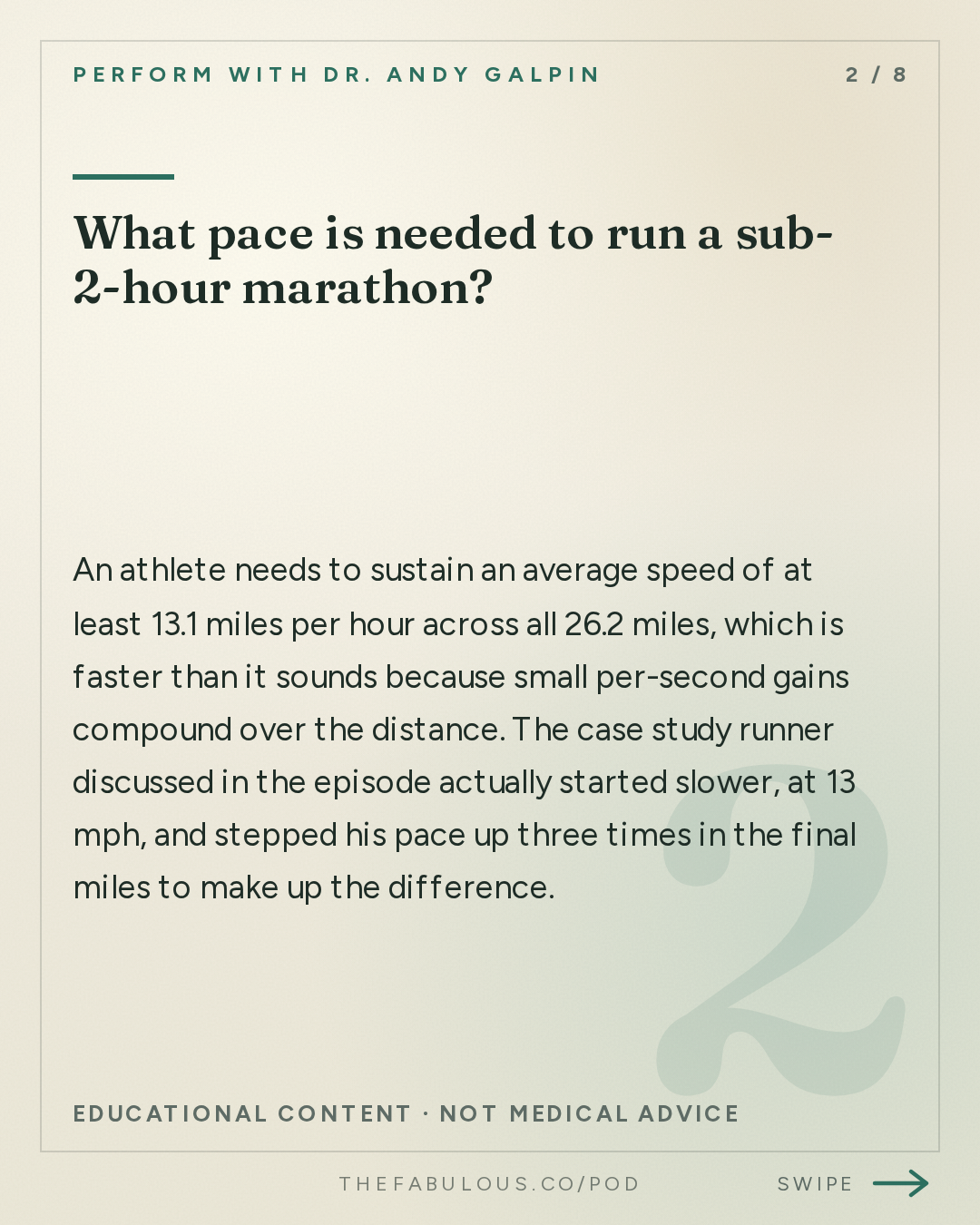
An athlete needs to sustain an average speed of at least 13.1 miles per hour across all 26.2 miles, which is faster than it sounds because small per-second gains compound over the distance (08:55). The case study runner discussed in the episode actually started slower, at 13 mph, and stepped his pace up three times in the final miles to make up the difference (09:07).
How much carbohydrate per hour is optimal for endurance performance?
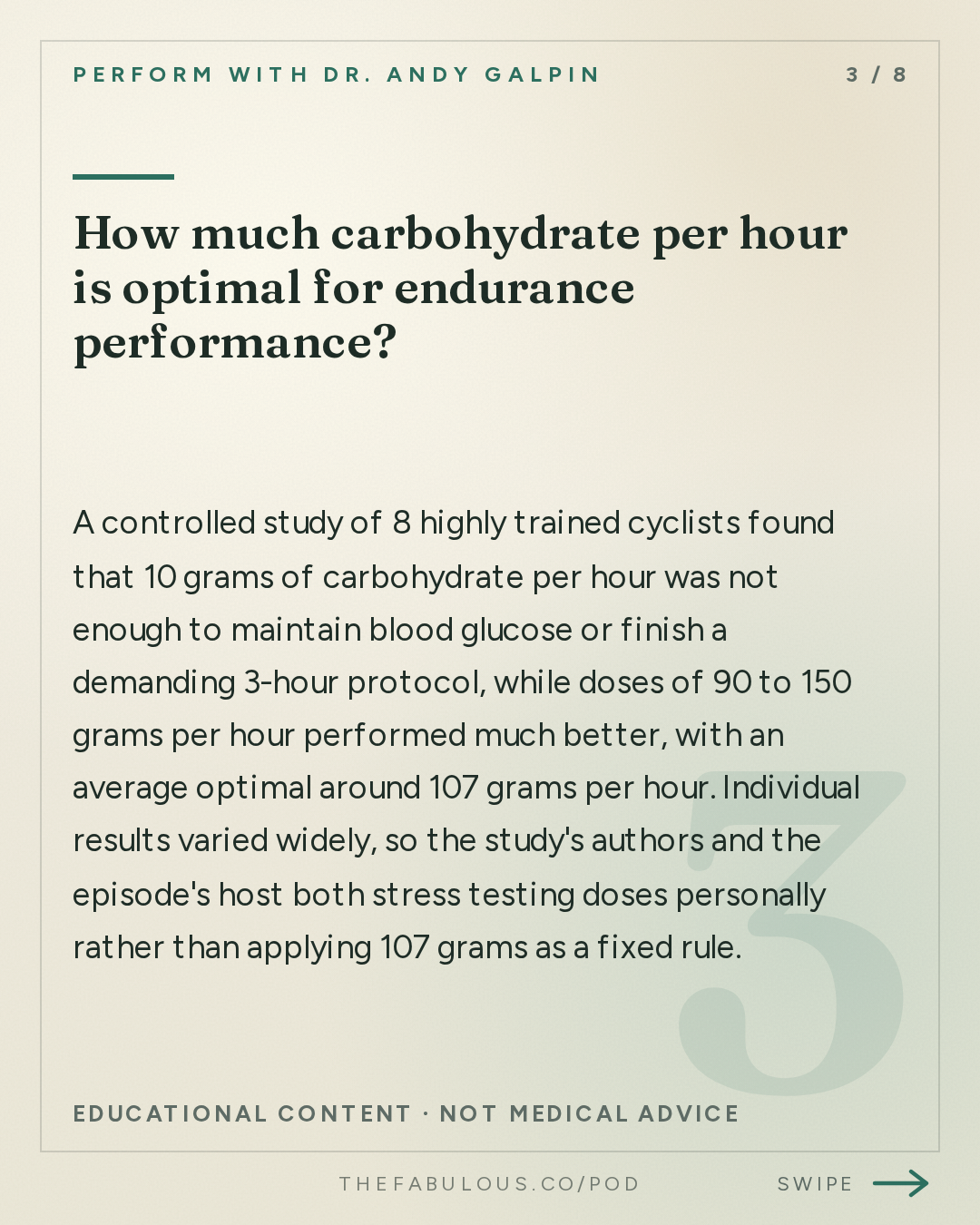
A controlled study of 8 highly trained cyclists found that 10 grams of carbohydrate per hour was not enough to maintain blood glucose or finish a demanding 3-hour protocol, while doses of 90 to 150 grams per hour performed much better, with an average optimal around 107 grams per hour (27:56). Individual results varied widely, so the study's authors and the episode's host both stress testing doses personally rather than applying 107 grams as a fixed rule (28:11).
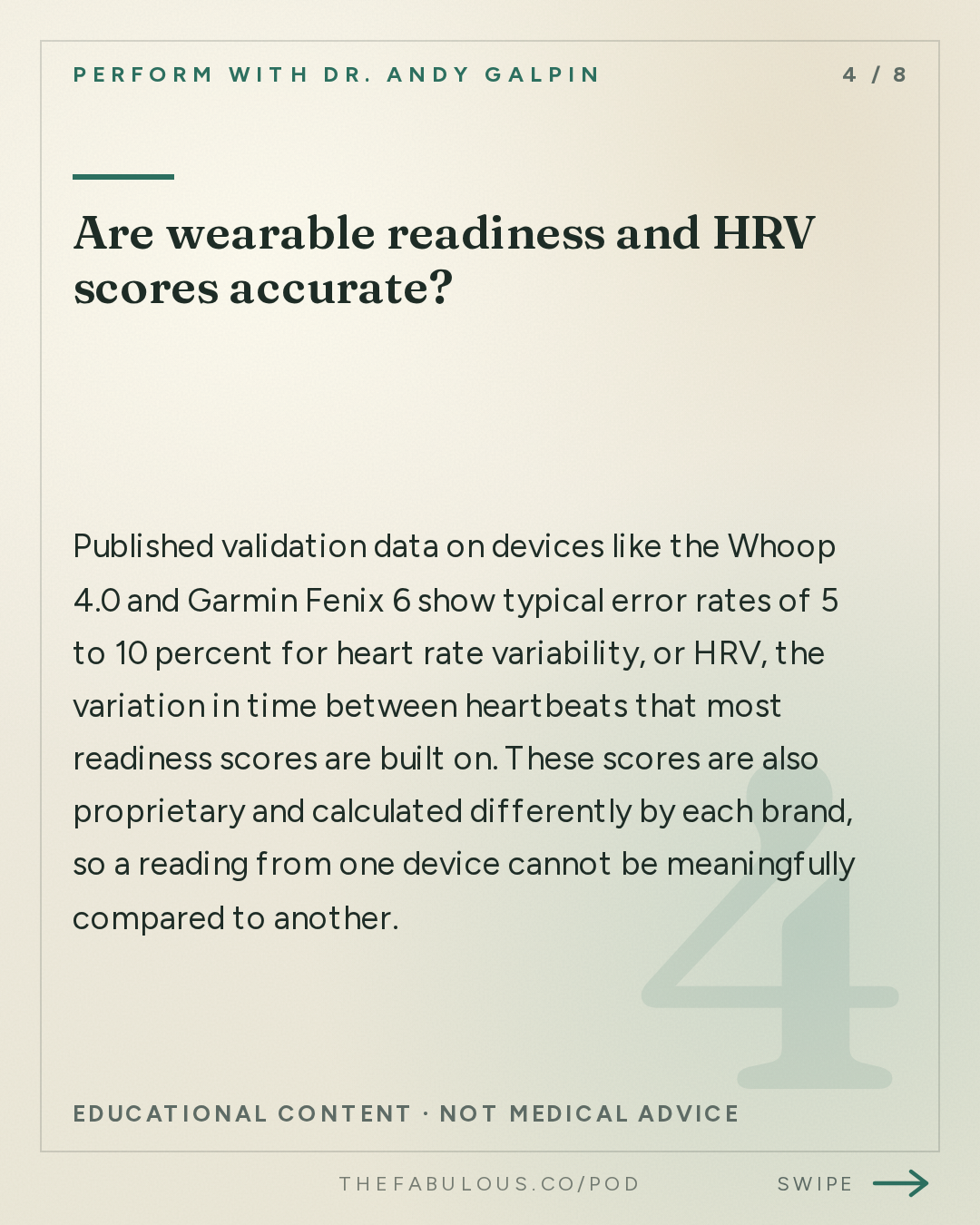
Are wearable readiness and HRV scores accurate?
Published validation data on devices like the Whoop 4.0 and Garmin Fenix 6 show typical error rates of 5 to 10 percent for heart rate variability, or HRV, the variation in time between heartbeats that most readiness scores are built on (40:35). These scores are also proprietary and calculated differently by each brand, so a reading from one device cannot be meaningfully compared to another (33:58).
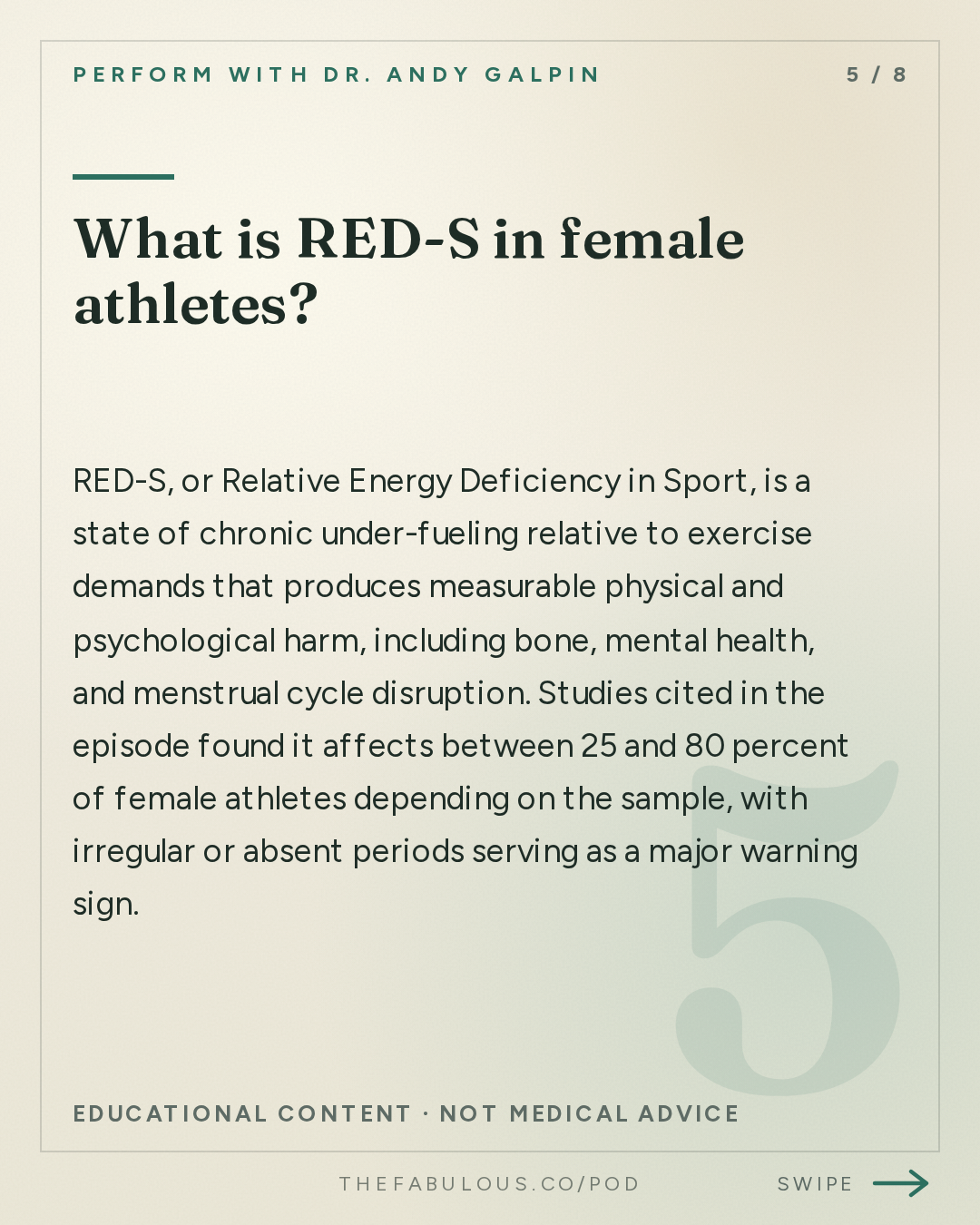
What is RED-S in female athletes?
RED-S, or Relative Energy Deficiency in Sport, is a state of chronic under-fueling relative to exercise demands that produces measurable physical and psychological harm, including bone, mental health, and menstrual cycle disruption. Studies cited in the episode found it affects between 25 and 80 percent of female athletes depending on the sample, with irregular or absent periods serving as a major warning sign (75:38).
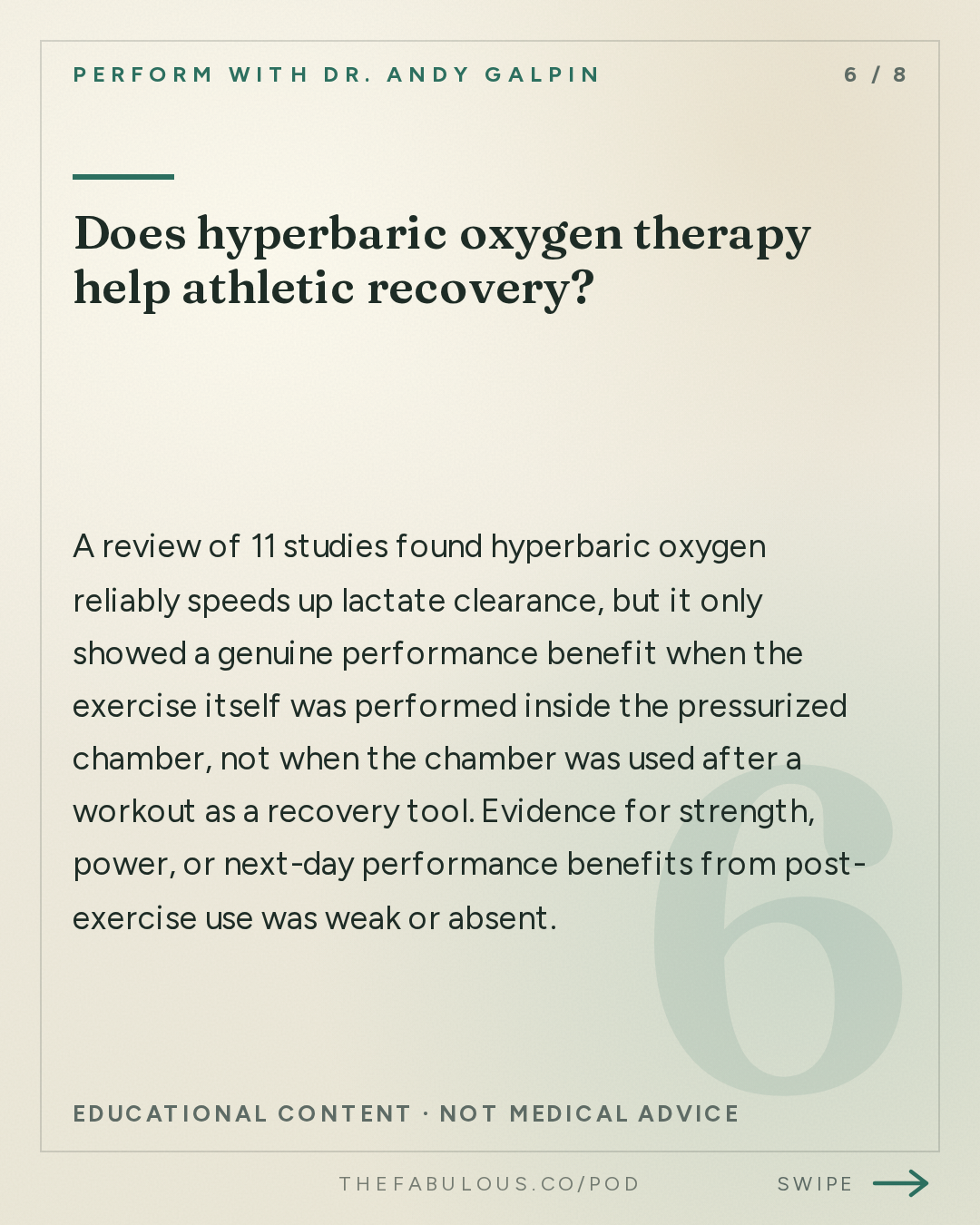
Does hyperbaric oxygen therapy help athletic recovery?
A review of 11 studies found hyperbaric oxygen reliably speeds up lactate clearance, but it only showed a genuine performance benefit when the exercise itself was performed inside the pressurized chamber, not when the chamber was used after a workout as a recovery tool (62:14). Evidence for strength, power, or next-day performance benefits from post-exercise use was weak or absent.
Do recovery tools like cold plunges and compression gear actually work?
A September 2025 systematic review and meta-analysis of recovery modalities, including cold, heat, compression, and massage, found that none consistently outperformed simple rest for restoring performance, biochemical markers, or perceived soreness (55:58). The host notes individual responses vary and recommends picking 2 to 3 tools based on personal preference rather than assuming any one method is essential (57:13).
The full read, in cards
Go deeper
- Opinion paper on the two-hour marathon — analyzed pacing and physiological data behind the sub-2-hour marathon attempt
- Carbohydrate dose-response cycling study, James Morton's lab — tested 10, 90, 120, and 150 grams of carbohydrate per hour in 8 trained cyclists
- Systematic review and meta-analysis of passive recovery tools — found no passive recovery method consistently beat rest alone
- Review of hyperbaric oxygen therapy for athletic recovery — across 11 studies, found benefit mainly when exercise occurred inside the chamber
- Female athletes across the lifespan, Abbie Smith-Ryan's lab — mapped injury and health risks across puberty, pregnancy, perimenopause, and postmenopause
Mentioned
Andy Galpin · James Morton · Abbie Smith-Ryan · Apple Health Watch · Oura Ring · Whoop · RED-S · Title IX
More from this show and category

Ross Edgley's Science of Extreme Endurance
Ultra-swimmer Ross Edgley details the physiology and fueling behind swimming 1,000 miles around Iceland in 114 days. He describes a 19,000 U/L creatine kinase spike, a 120-gram-per-hour carb protocol, and training ideas like strength reserve and reflexive eccentrics that keep his body and mind intact across months-long swims.

How to Get Faster: The Science of Speed Training
Speed can be trained like any other skill, and team-sport performance depends more on deceleration than on raw top speed. Speed coach Les Spellman explains how NFL receivers peak in the middle of the 40-yard dash pack (06:24), why 'stay low' sprint cues are wrong (75:58), and how a blood-flow-restriction recovery protocol (30:06) and a two-week speed-PR recovery window (120:15) shape elite training.

Testosterone, Age, and Metabolic Health Explained
Testosterone does not fall because someone gets older; Dr. Andy Galpin says the data show obesity and metabolic dysfunction, not age itself, drive almost all of the decline. Men who hit five basic metabolic health markers have under a 1% chance of low testosterone (34:38), while obesity alone raises the risk roughly 7.5-fold (33:18).

Testosterone Explained: Low T, TRT, and Muscle Myths
Low testosterone is usually a symptom, not the disease itself: obesity, poor sleep, extreme dieting, or a blocked vein cause most cases, not age alone (76:08, 95:06). Two PhDs argue for finding the cause before reaching for a syringe, and for treating any hormone therapy with real informed consent.
