
How to Get Faster: The Science of Speed Training
How to Get Faster (Acceleration, Deceleration, Agility & Strength) | Les Spellman
▶ Listen to the full episode More from Perform with Dr. Andy Galpin
The brief
Speed can be trained like any other skill, and team-sport performance depends more on deceleration than on raw top speed. Speed coach Les Spellman explains how NFL receivers peak in the middle of the 40-yard dash pack (06:24), why 'stay low' sprint cues are wrong (75:58), and how a blood-flow-restriction recovery protocol (30:06) and a two-week speed-PR recovery window (120:15) shape elite training.
On the home page of Aston Martin's website sits a line that has nothing to do with football and everything to do with it: "You're only as fast as your brakes." Speed coach Les Spellman, who has personally trained more than 100 professional athletes, found that sentence and built a career around it (14:43). His claim is that the ability to stop, not the ability to go, decides who survives in a sport that is, on close inspection, a four-hour sequence of collisions avoided.
Spellman opens by knocking down a stubborn myth: that speed is fixed at birth. He compares it to strength. Nobody doubts that progressive overload in a weight room makes a person stronger, yet people assume sprinting speed is just genetic luck. His counter is simple: most people have never once run at full, intentional effort (03:10). Add in force production, the ability to produce that force quickly, and symmetry between left and right sides, and, over time, a slow athlete gets faster. He has watched average high school kids reach the same 21 to 22 miles per hour that NFL "Next Gen Stats" flag as elite in-game speed (04:12).
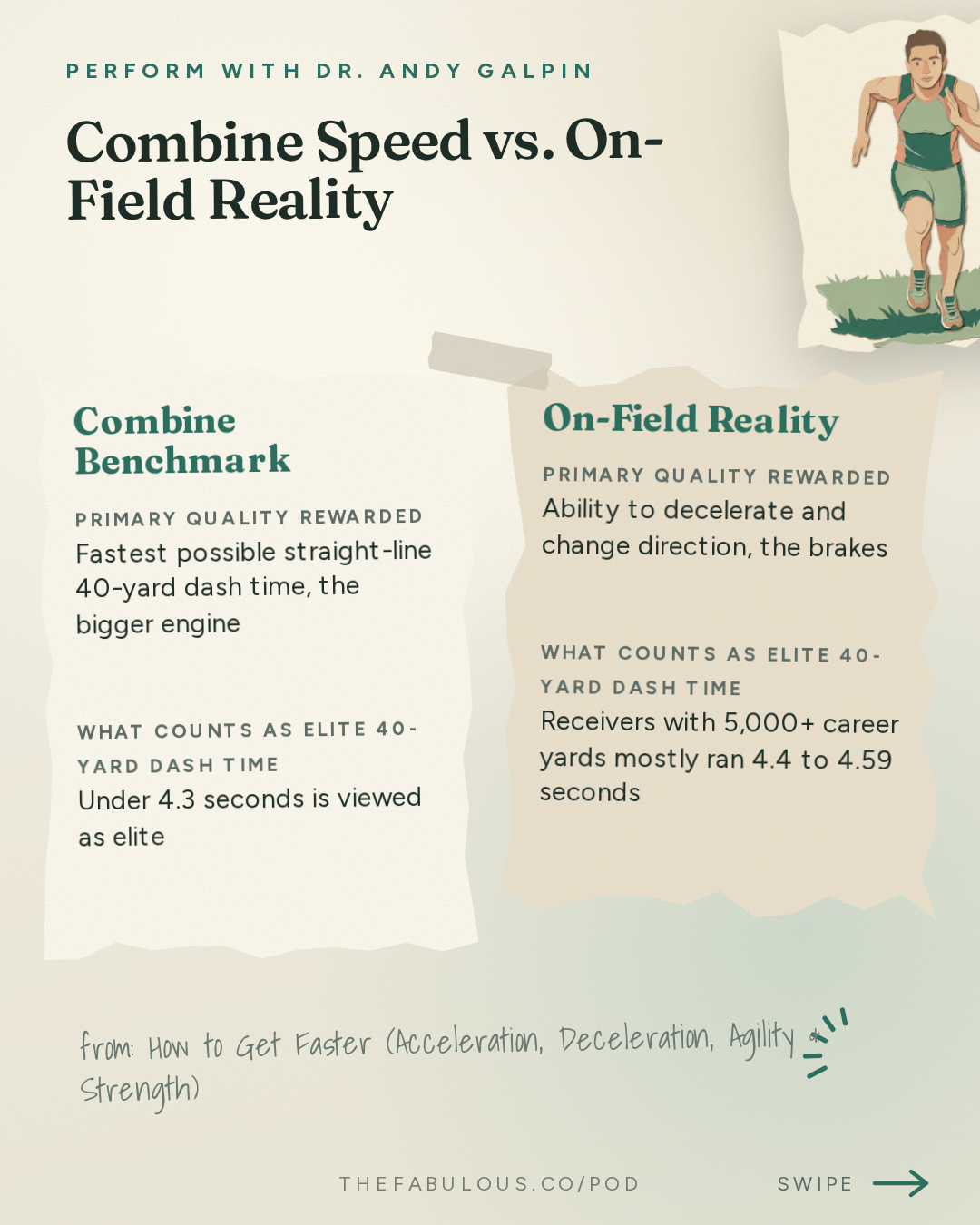
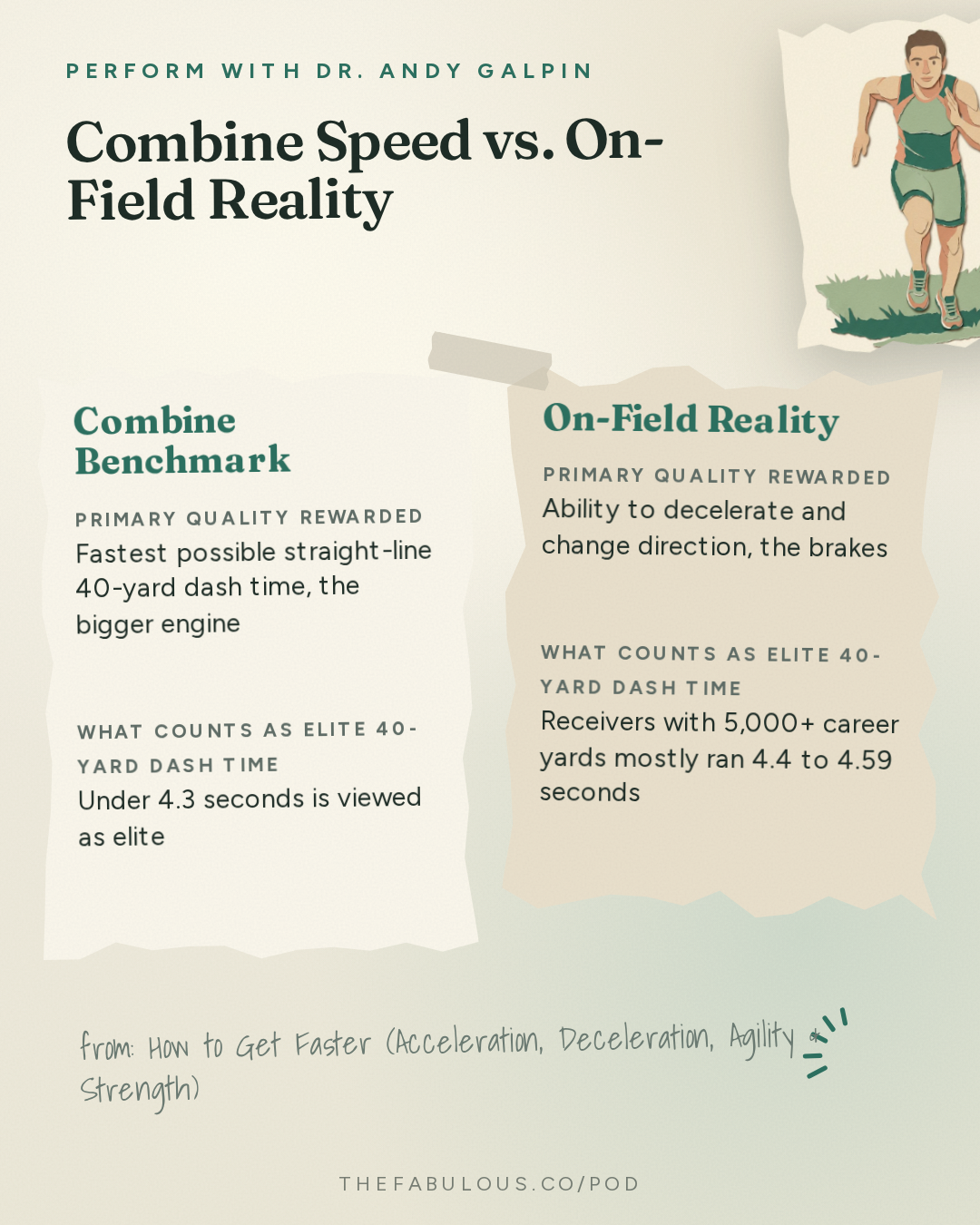
But raw speed, it turns out, predicts less than expected. Spellman pulled the numbers on every NFL receiver who has gained more than 5,000 career yards. Only one of them ever ran the 40-yard dash in under 4.3 seconds, a time regarded as blazing (10:54). The bulk of them ran between 4.4 and 4.59 seconds (06:24). The fastest players in football are not, as a rule, the most productive ones. That gap is the whole premise of the episode: a 40-yard dash measures the engine, and football, rugby, and basketball all reward the brakes.
Learning to Brake
Deceleration research is newer and smaller than acceleration research, which is part of why Spellman says most training programs ignore it. He points to the work of researcher Damian Harper, who found that the forces an athlete absorbs while stopping can reach four times body weight, both vertically and horizontally (43:05). A hard first braking step cuts an athlete's momentum by about 25 percent, and by the third step the athlete has shed roughly half of peak speed (43:30). None of that shows up to the naked eye. What a spectator notices is the final, sharp foot plant before a cut, not the three quiet steps of braking that made the cut possible.
That blind spot has safety consequences. When an athlete tries to decelerate and change direction on the same foot contact, instead of braking first and turning second, the stress concentrates in one place.
"Directional change and deceleration on the same contact is how a lot of people will tear their ACL." — Les Spellman [46:58]
Spellman treats agility, change of direction, and deceleration as three separate, stackable skills rather than one blur called "quickness." Change of direction is pre-planned, like running a cone drill. Agility adds a decision, reacting to a defender or a ball, which raises the intensity because the athlete has less time to respond (36:10). A tennis player gives away how specific this gets: because a tennis court surface allows sliding, a single step can cut a player's speed by 40 to 50 percent (38:46), while a football player, who cannot slide the same way, needs three or four steps to do the same braking.
Rebuilding the Weight Room
Spellman's second argument is that the weight room has been misunderstood as a place for loading bars, when its real job is producing force in whatever form gets an athlete there fastest. A depth drop off a 42-inch box, which uses gravity rather than a loaded bar, produces significantly more force than a heavy back squat (101:41). That reframes exercise selection: instead of asking how much weight is on the bar, Spellman asks whether an exercise builds high force, fast force, or symmetrical force.
"We're thinking of the weight room as a force center, and if we wanna produce high forces, fast forces, and symmetrical, our exercise selection is now gonna be based around force." — Les Spellman [104:03]
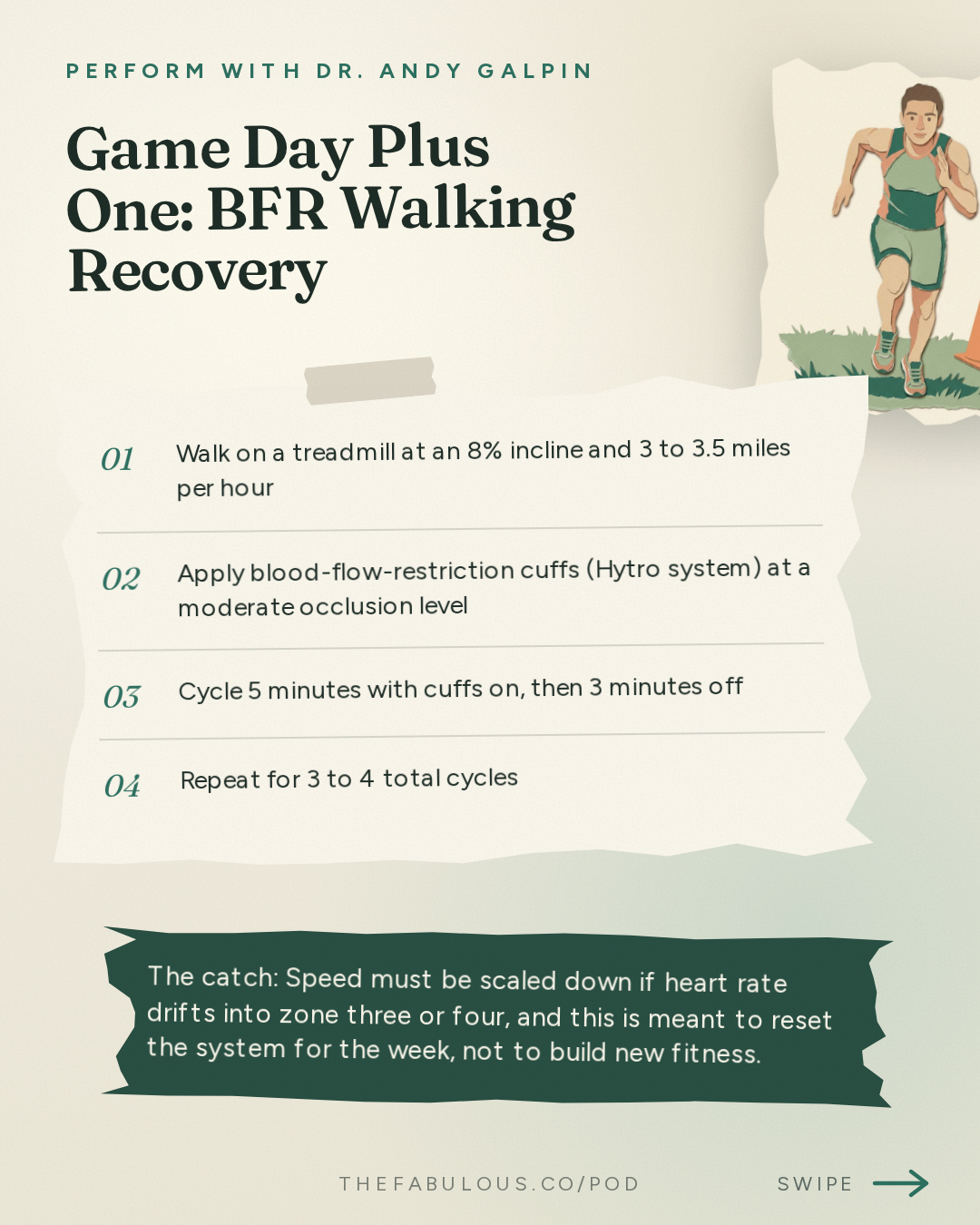
Recovery gets the same treatment. The day after an NFL game, Spellman does not give athletes a full day off. Instead they walk on a treadmill at an 8 percent incline and 3 to 3.5 miles per hour while wearing blood-flow-restriction cuffs, a compression tool that partially restricts blood flow to the limbs during low-intensity movement, cycling five minutes on and three minutes off for three or four rounds (30:06, 31:49, 32:13). He is candid that the fancier recovery tools his teams tried, hyperbaric chambers, IV drips, expensive light beds, did less for performance data than consistent bedtimes, morning sunlight, and that basic walking protocol (34:16).
One of the more pointed corrections in the episode targets a cue almost every young athlete has heard: stay low when you sprint. Spellman argues this is close to the worst advice a coach can give, because compressing the torso forward kills the athlete's ability to extend the hip, which is the primary driver of acceleration (75:58).
"The worst cue you could tell somebody is stay low. Project your body up and out like a rocket." — Les Spellman [75:58]
Elite sprinters do the opposite of staying low. Their torso rises a little with every step, and top Olympic sprinters keep rising and accelerating for 16 to 18 steps, covering roughly 30 meters, before reaching an upright position (77:40). An average high school athlete, by contrast, is usually upright after six to eight steps, so coaching that athlete to mimic Usain Bolt's extended low drive phase works against their own mechanics.
Peak speed itself has a cost that Spellman learned the hard way. He used to test athletes for top speed the week before the NFL Combine, only to watch them run faster in that testing than they did at the Combine itself. The reason is recovery time: once an athlete crosses roughly 95 percent of personal max speed, the nervous system needs about two weeks to "swing back" and repeat that effort (120:15).
"If you hit those percentages above 95%, I've found that it takes about two weeks to swing back to get to that point again." — Les Spellman [120:15]
That finding reshapes how he schedules a season. In the off-season, he builds two-week blocks that let an athlete hit a new top speed and recover before trying again. Once the season starts, the goal shifts to maintenance: a weekly dose of 90 to 95 percent of max speed, with true maximal efforts saved for the off-season (119:12).
The same logic of windows shows up in his youth data, drawn from what he says is a database of 1.2 million speed tests spanning ages nine to 65 (127:07). Boys and girls run at similar speeds until about age 12, when rising testosterone widens the gap; girls then plateau until around 14, when their own jump appears (124:34). Spellman's practical advice for parents is almost anti-coaching: resist the urge to correct a young athlete's form, because an awkward stride is often just a growing body, and over-teaching technique lowers the intensity of the session and the hormonal benefit of simply running hard (122:42).
For the far more common audience, the weekend marathoner or masters athlete who wants to shave minutes off a race, Spellman's advice has little to do with sprint mechanics. He argues that the thing most adults lose with age and desk work is the ability to extend the hip, quickly and with force, which is the engine behind every stride.
"Most adults lose their ability to extend their hip, and extend their hip far, extend their hip fast, and with force." — Les Spellman [131:46]
His fix is unglamorous: hip mobility work, split squats instead of only bilateral lifts, and a short, fast sprint worked into the warm-up before a slow run, rather than any attempt at full sprint training (131:46). It is the same idea that runs through the whole conversation, scaled down. Speed is not one gift handed out at birth. It is an engine, a set of brakes, and a steering system, and for almost everyone, the brakes are the part nobody ever thought to train.
Ask this episode anything
Pod's AI answers from the episode itself, with the minute mark so you can hear it yourself.
Or start with one of these
Ask this episode
Pod's AI listens to the whole episode to answer, and points you to the minute it comes from.
The rest of this answer, and any question after it
Answers come from the episode itself, never from a summary of it.
ContinueKey takeaways
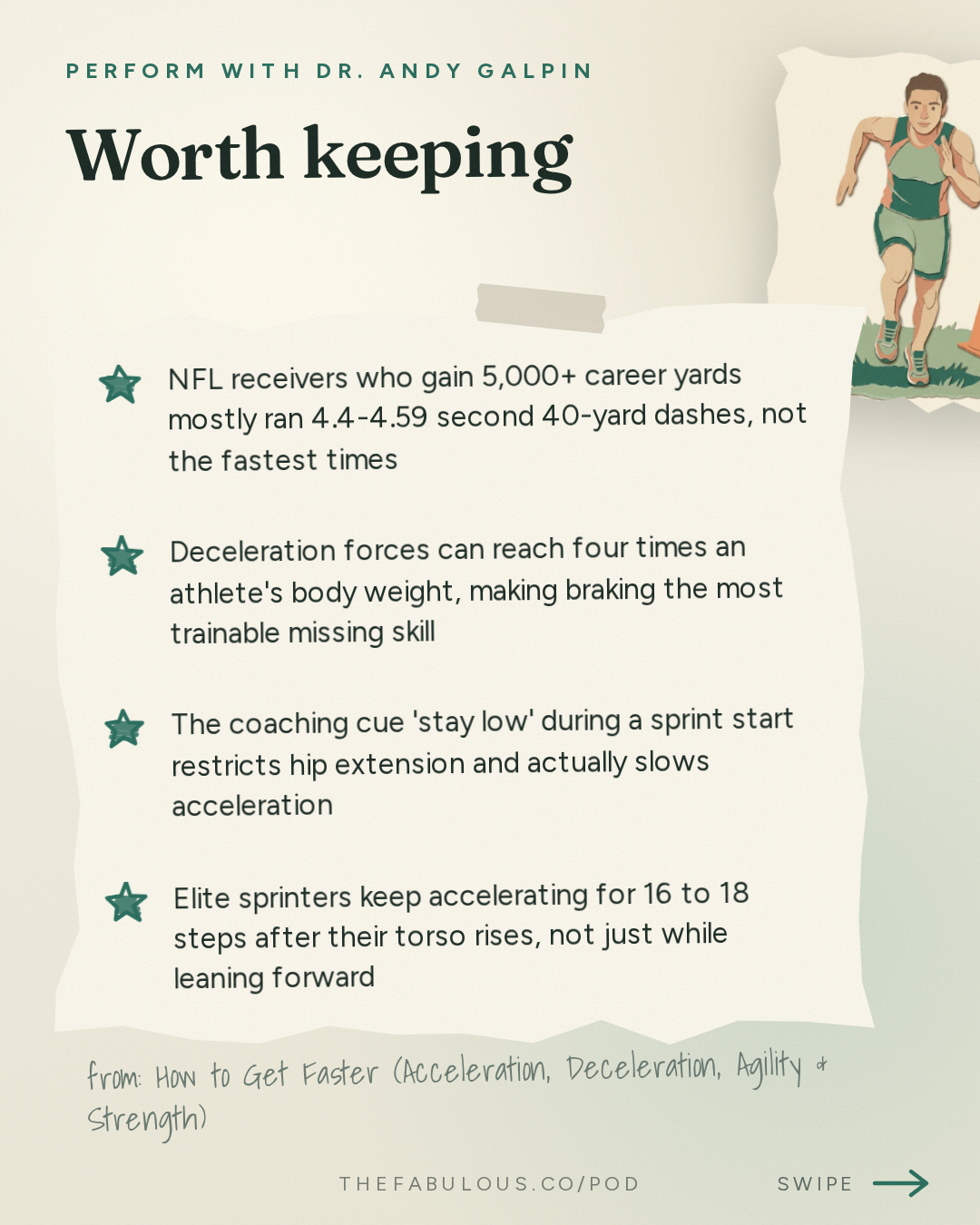
- NFL receivers who gain 5,000+ career yards mostly ran 4.4-4.59 second 40-yard dashes, not the fastest times
- Deceleration forces can reach four times an athlete's body weight, making braking the most trainable missing skill
- The coaching cue 'stay low' during a sprint start restricts hip extension and actually slows acceleration
- Elite sprinters keep accelerating for 16 to 18 steps after their torso rises, not just while leaning forward
- A speed personal record above 95% of max speed needs about two weeks for the nervous system to recover
The episode in cards

By the numbers
- 1.2 million tests Total speed tests in coach Les Spellman's youth and adult database
- 14 days days Recovery time needed before repeating a speed PR above 95% of max speed
In their words
“Okay, combine is building a bigger engine. Football is building really good brake system”
“Directional change and deceleration on the same contact is how a lot of people will tear their ACL.”
“The worst cue you could tell somebody is stay low. Project your body up and out like a rocket.”
“Most adults lose their ability to extend their hip, and extend their hip far, extend their hip fast, and with force.”
Protocols
-
Game Day Plus One Recovery Walk
Les Spellman has his NFL athletes walk on a treadmill at an 8% incline and 3 to 3.5 miles per hour the day after a game, wearing blood-flow-restriction cuffs through the Hytro compression system, cycling five minutes on and three minutes off for three to four rounds. He scales the speed down if the athlete's heart rate drifts into zone three or four during the walk.
Day after every game
-
Acceleration Posture Cue
Les Spellman coaches sprinters to let the torso rise incrementally with every step out of the start rather than staying low, because staying low restricts hip extension and slows the athlete down.
Every sprint rep during acceleration training
-
Weekly Speed Maintenance Dose
Les Spellman has in-season athletes hit 90% to 95% of their max speed once a week to maintain speed capacity, and reserves true maximal efforts above 95% for the off-season because those efforts take about two weeks to recover from before they can be repeated.
Weekly in-season, two-week blocks in the off-season
-
Hip Extension Work for Adult Runners
Les Spellman recommends adult distance runners improve hip extension range, speed, and force through split squats, banded hip mobility work before training, and a short fast sprint worked into the warm-up before a slow run, instead of attempting full maximal sprint training.
Before runs, ongoing
Questions this episode answers
Can speed actually be trained, or is it genetic?
Speed coach Les Spellman argues speed is trainable the same way strength is, through repeated maximal-effort sprinting combined with force production work. He has taken average high school athletes to 21-22 mph in-game speeds that match NFL benchmarks (04:12).
Why don't the fastest 40-yard dash runners become the best NFL receivers?
Only one receiver who has ever run sub-4.3 seconds in the 40-yard dash has reached 5,000 career receiving yards (10:54). Most 5,000-yard receivers ran between 4.4 and 4.59 seconds (06:24), because football rewards deceleration and route-running craft more than straight-line speed.
Why is the 'stay low' sprint start cue considered wrong?
Staying low while accelerating compresses the body forward and limits hip extension, the primary driver of acceleration, according to Les Spellman (75:58). He teaches athletes to let the torso rise incrementally with each step instead, matching how elite sprinters actually accelerate for 16 to 18 steps (77:40).
What is the BFR recovery protocol used by NFL teams the day after a game?
Les Spellman has his athletes walk on a treadmill at an 8% incline and 3 to 3.5 mph while wearing blood-flow-restriction cuffs, cycling 5 minutes on and 3 minutes off for 3 to 4 rounds (30:06, 31:49). He found this low-level movement beats a full rest day for recovery.
How long does it take to recover from a maximal speed personal record?
Les Spellman says that once an athlete crosses roughly 95% of their max speed, it takes about two weeks for the nervous system to recover enough to repeat that effort (120:15). This is why he schedules true max-speed testing in two-week blocks during the off-season rather than every week.
At what age should kids start speed training?
Les Spellman points to age 12 to 14 as the most trainable window for boys, and around age 10 for girls based on his training database (124:34). Before that window, he recommends unstructured multi-sport play over formal speed coaching.
The full read, in cards
Go deeper
- Damian Harper's deceleration research — Found early braking steps produce forces up to four times body weight and slow momentum by roughly 25% per step
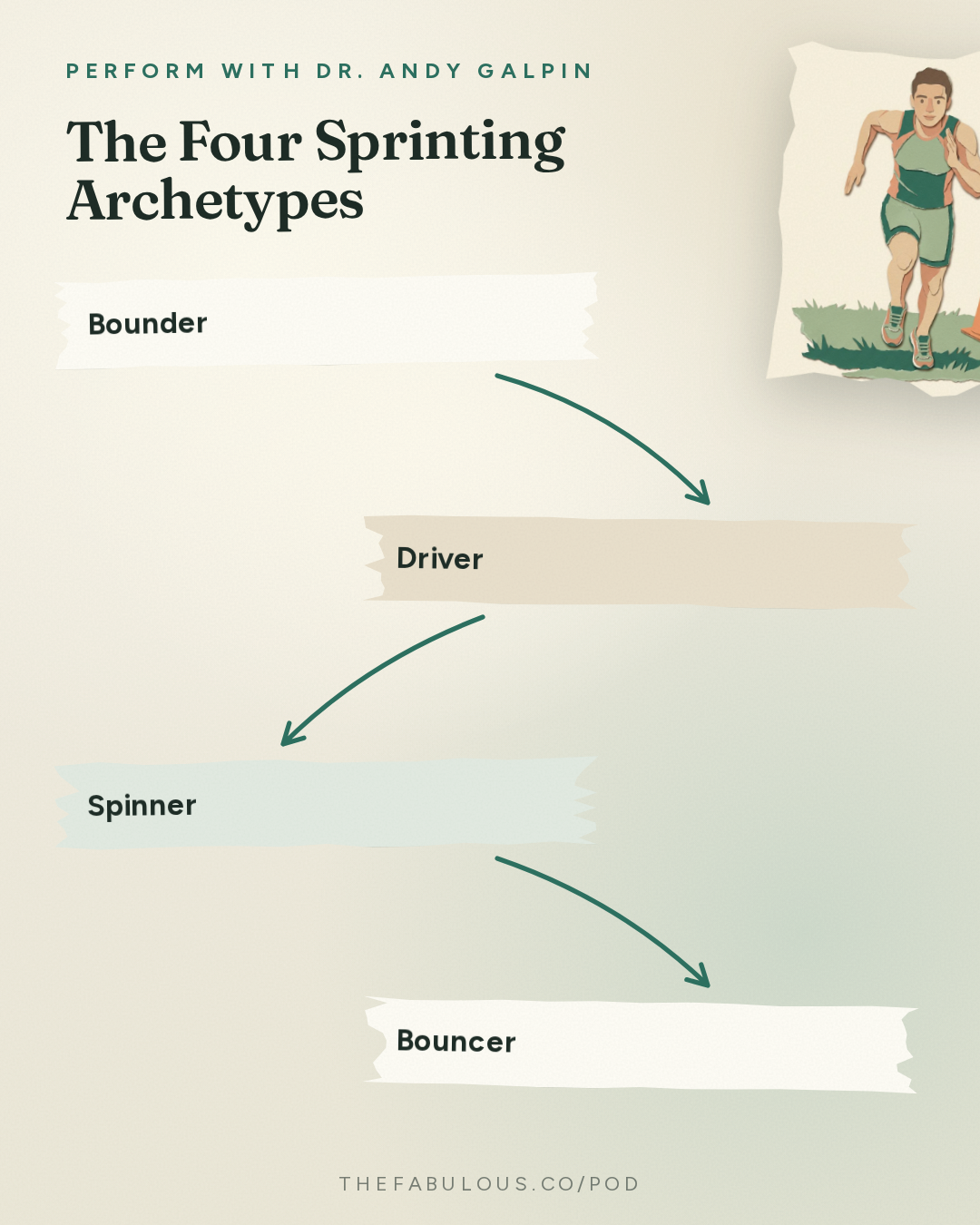
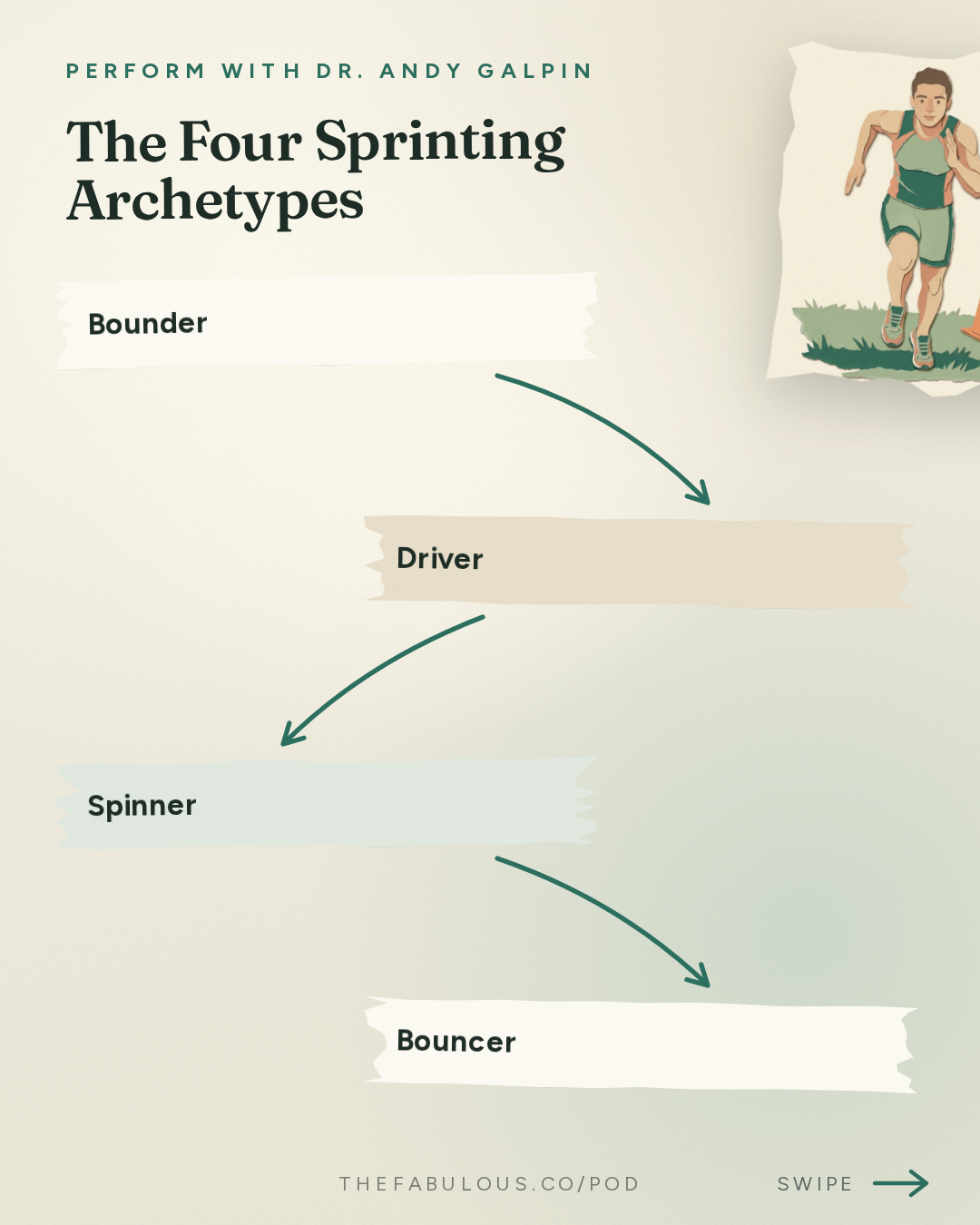
- James Wild's sprint archetype research — Classified sprinters into four strategies (bounder, driver, spinner, bouncer) based on step length, frequency, ground time, and air time
- Dr. Sophia Nimphius's agility research — Studied how manipulating space constraints progressively increases agility training intensity
- Tom Dos Santos's cutting-angle research — Mapped how deceleration demands change across cutting angles from 45 to 180 degrees
Mentioned
Les Spellman · Dan Pfaff · Stu McMillan · Carlin Isles · Tyreek Hill · Damian Harper · Sophia Nimphius · James Wild · Tom Dos Santos · Kelly Starrett · Hytro · Altus
More from this show and category

Testosterone, Age, and Metabolic Health Explained
Testosterone does not fall because someone gets older; Dr. Andy Galpin says the data show obesity and metabolic dysfunction, not age itself, drive almost all of the decline. Men who hit five basic metabolic health markers have under a 1% chance of low testosterone (34:38), while obesity alone raises the risk roughly 7.5-fold (33:18).

Testosterone Explained: Low T, TRT, and Muscle Myths
Low testosterone is usually a symptom, not the disease itself: obesity, poor sleep, extreme dieting, or a blocked vein cause most cases, not age alone (76:08, 95:06). Two PhDs argue for finding the cause before reaching for a syringe, and for treating any hormone therapy with real informed consent.

Dr. John Rusin's 6-Phase Dynamic Warmup Explained
Physical therapist and performance coach Dr. John Rusin lays out a diagnostic and warmup system for training around chronic pain without surgery or years off. His six-phase, 10 to 12 minute daily sequence (24:02) turns soft tissue work, stretching, and activation drills into deliberate, measurable steps rather than vague pre-workout ritual.

Dan Garner on Blood Work and Fitness Constraints
Dan Garner explains how blood work reveals the biological constraints, like low testosterone or vitamin D, that block fitness progress, and why lab noise often makes a rising or falling number meaningless. He also covers hypertrophy training splits, diet breaks, and why peptides like SS-31 sound impressive but lack real performance data.
