
Ross Edgley's Science of Extreme Endurance
The Science of Extreme Endurance (Fueling, Strength, Recovery & Mental Toughness) | Ross Edgley
▶ Listen to the full episode More from Perform with Dr. Andy Galpin
The brief
Ultra-swimmer Ross Edgley details the physiology and fueling behind swimming 1,000 miles around Iceland in 114 days. He describes a 19,000 U/L creatine kinase spike, a 120-gram-per-hour carb protocol, and training ideas like strength reserve and reflexive eccentrics that keep his body and mind intact across months-long swims.
Somewhere in the middle of Lake Trasimeno, in a heat wave that had drifted up from the Sahara, a man kept swimming back and forth between two islands while his body quietly began to destroy itself. He knew it was happening. He had a sports science degree and could narrate his own collapse in real time: the blood thickening like treacle, the kidneys taking a battering, the slow slide from heatstroke into hypothermia as his body dumped heat it no longer had. He kept going anyway. This is Ross Edgley's normal Tuesday.
Edgley is an ultra-endurance swimmer who has circled Great Britain (1,780 miles over 157 days, confirmed at 04:10), swum 510 kilometers down Canada's Yukon River without ever touching the support boat (02:24), and, most recently, swum roughly 1,000 miles around Iceland in 114 days (03:54). He is also, improbably, a trained exercise scientist, which means that when he talks to Andy Galpin, a professor and scientist of human performance who hosts the Perform podcast, the conversation reads less like a highlight reel and more like a field report from the outer edge of what a body can survive.
The brain as hypochondriac
The organizing idea of the conversation comes from South African scientist Tim Noakes, whose psychobiological model of fatigue, sometimes called the central governor theory, holds that exhaustion is not purely a muscular event. The brain intervenes before real damage occurs, pulling what Edgley calls a physiological handbrake.
"The brain's a hypochondriac. It's basically getting you to stop before you do damage to yourself." — Ross Edgley [00:00]
Edgley's trick, such as it is, is to argue with that handbrake. In Loch Ness and in Lake Trasimeno he says he simply tells himself he is more powerful than his mind allows him to believe and keeps swimming, a strategy that friends at Loughborough University have politely described as a personality defect, since most people's systems shut down at the handbrake while his pushes through it (18:38).
The cost shows up in blood work. A normal resting creatine kinase level, an enzyme marker of muscle breakdown, sits around 80 units per liter; a hard gym session might push it to 300 (07:09). After Lake Trasimeno, Edgley's hit 19,000 U/L (09:12), a number so extreme that doctors told him it was unusual for a swimmer, since suspension in water should reduce the mechanical damage that normally drives CK up. He also learned, through follow-up scans at Loughborough, that his body had triggered red bone marrow reconversion, reactivating a more metabolically active marrow his adult body had mostly phased out, apparently to manufacture more red blood cells under the chronic stress of these swims (12:52).
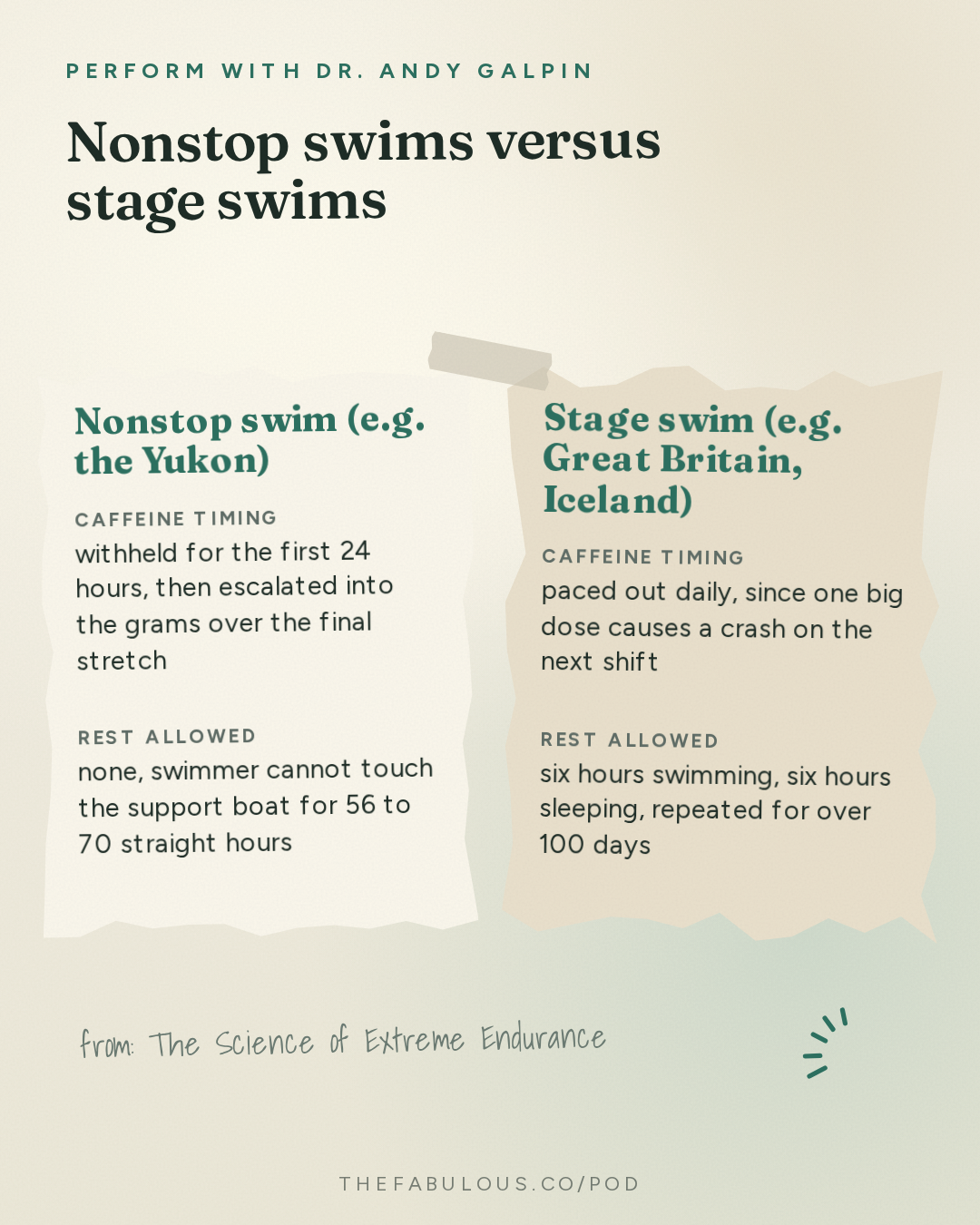
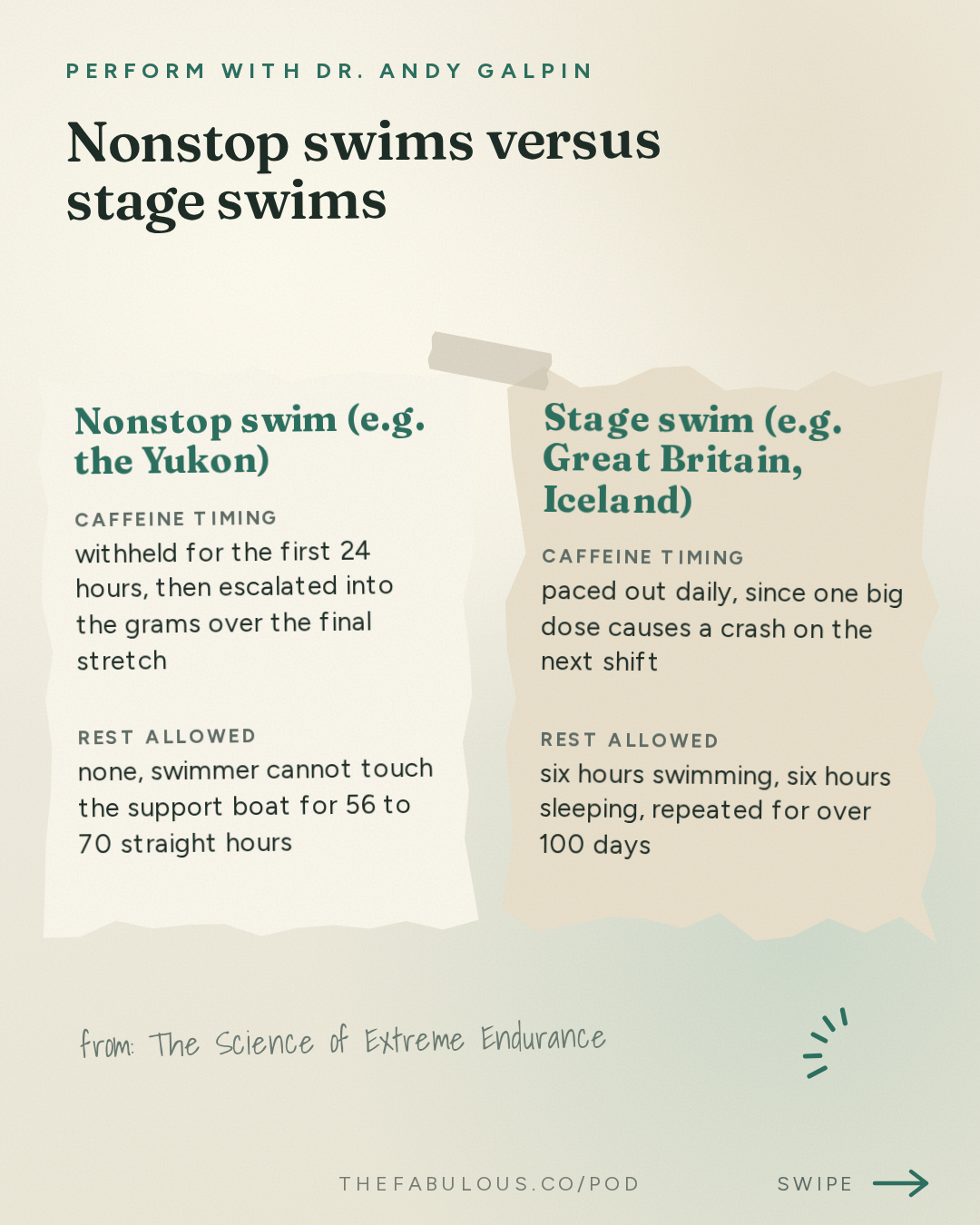
None of this is incidental color. It shapes how Edgley plans his two broad categories of swim. Nonstop swims, like the 56-to-70-hour Yukon crossing, are run like a long sprint: caffeine is deliberately withheld for the first 24 hours and then escalated into the grams over the final stretch, because front-loading it would blow out the nervous system before the real test even begins (24:40, 42:23). Stage swims, like Great Britain and Iceland, unfold over six-hours-on, six-hours-off tidal cycles for a hundred-plus days, which means performance has to share the stage with health; frying the immune system on day one guarantees missing the finish (27:51).
Fueling follows the same split. On the shorter, harder efforts, Edgley aims for about 120 grams of carbohydrate per hour, a figure he credits to a protocol developed by sports nutrition researcher James Morton's group at Liverpool John Moores University, built from fast-digesting glucose and fructose with no fiber, fat, or protein to slow things down (33:48). On the long stage swims, where that volume of carbs can't realistically be forced through the gut for months, he leans on dietary fat, including medium-chain triglycerides that behave more like carbohydrate than fat for quick fueling, and in Iceland's north, actual sticks of butter melted into soup (31:16, 31:56). Protein gets pushed to the rest periods entirely, after he found that eating it before getting in cold water left him nauseous, his body apparently refusing to split blood flow between digestion and swimming muscle (32:17). During the Iceland swim he estimates he was eating 10,000 to 15,000 calories a day (98:14), arriving in a deliberately fattened state at 103 kilograms, up roughly 12 kilograms from his usual walking weight, almost all of it insulating fat (46:30).
Building a body that can take a beating
Edgley's strength work borrows an idea from Australian sprint swimmer Cam McEvoy, the current world record holder in the 50-meter freestyle, who found a direct correlation between an athlete's one-rep max on weighted pull-ups and swim sprint speed (56:38). The concept is strength reserve: if a lifter can do a pull-up with 80 kilograms attached, then an unweighted pull-up, or a single freestyle stroke, uses a smaller fraction of total capacity. Edgley, whose own weighted pull-up sits at an ugly 60 kilograms, uses supra-maximal isometric holds, bracing against roughly 110 percent of his one-rep max for three seconds with a two-minute rest, to prime his nervous system before a heavy set (62:10).
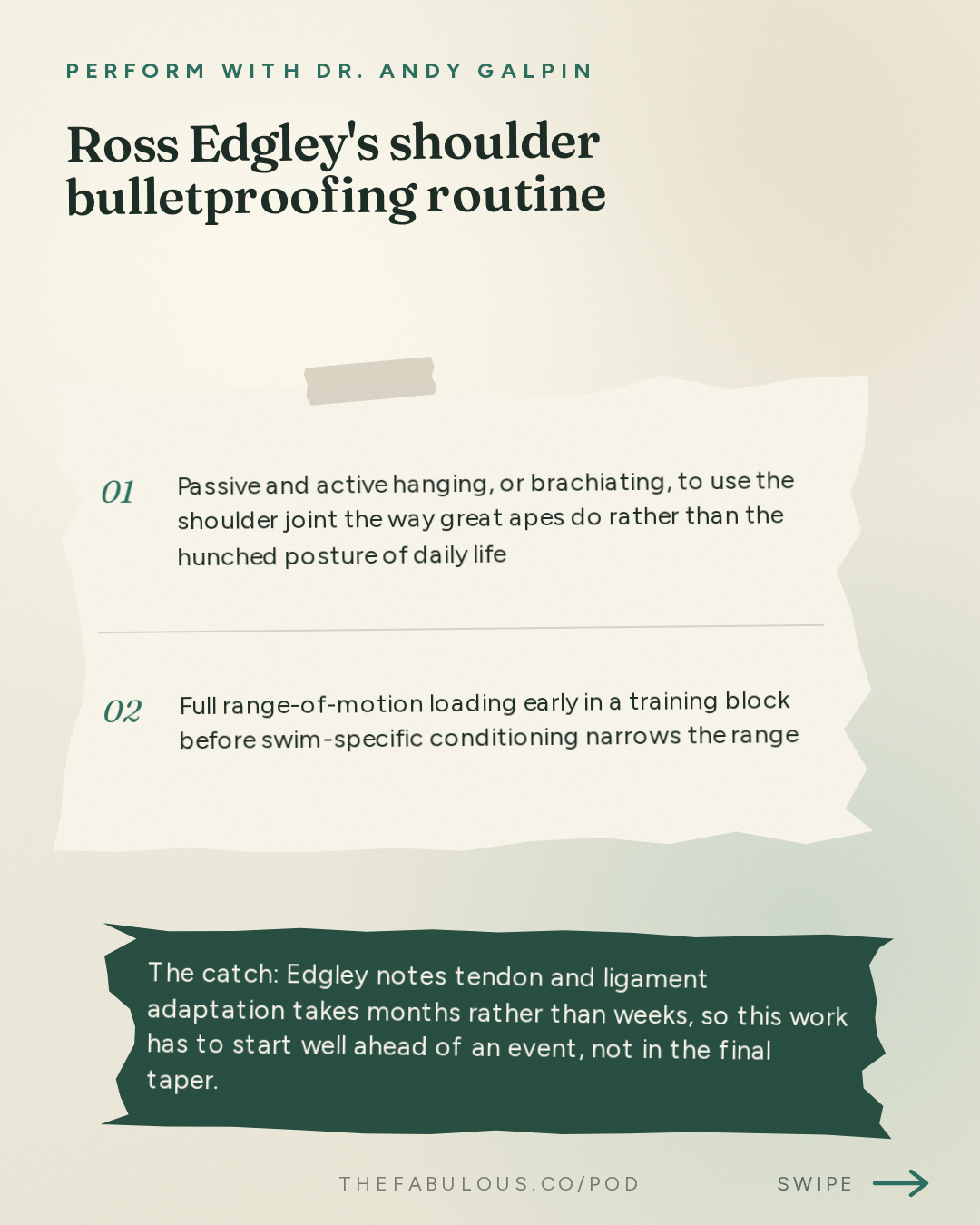
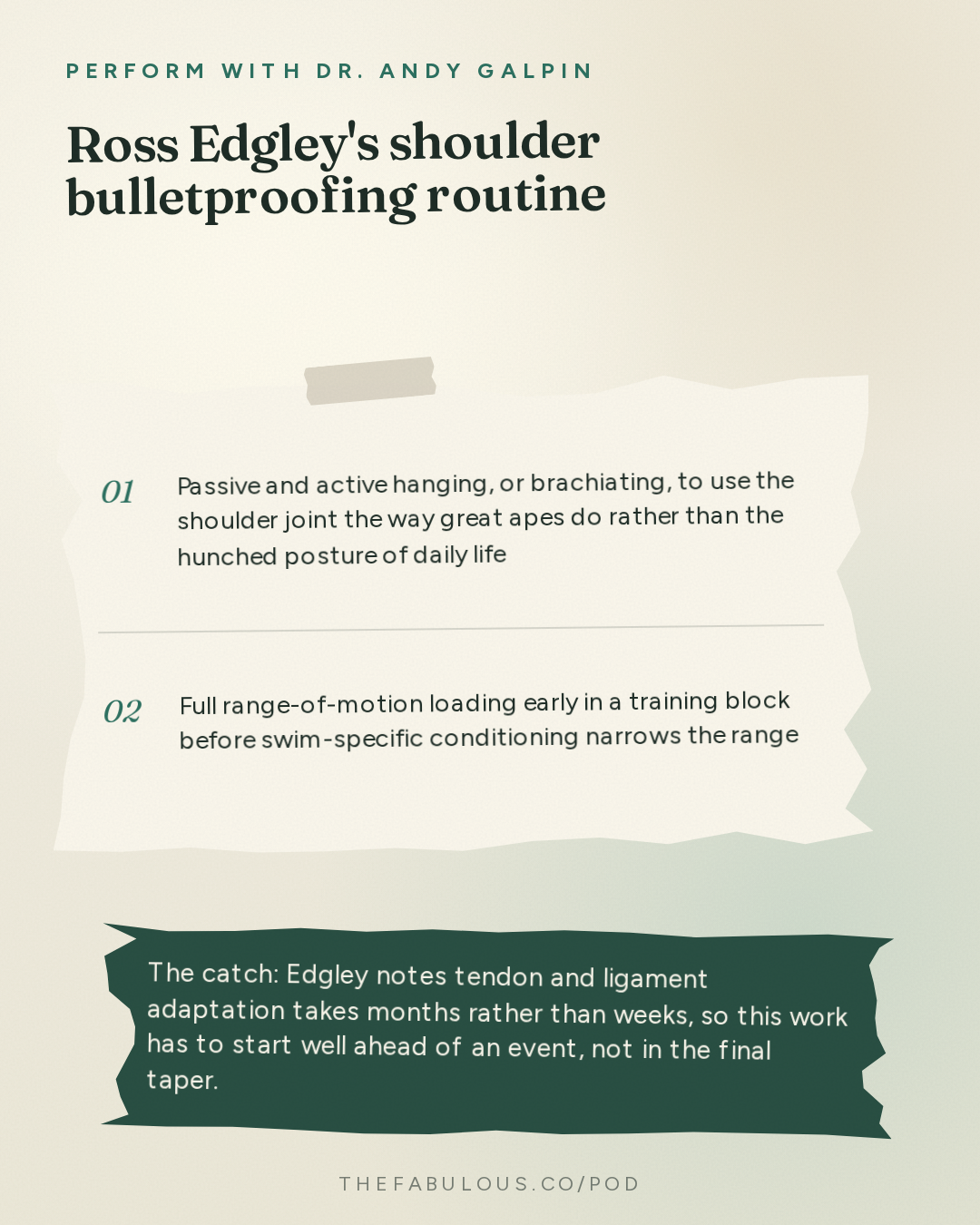
That same logic extends to connective tissue. Edgley leans on what exercise physiologists call mechanotransduction, the process by which mechanical loading strengthens tendons and ligaments, to keep his rotator cuff from tearing apart in an Arctic storm. One tool is reflexive eccentrics: lying on a bench and catching a dropped light object, training the shoulder to absorb sudden, unplanned force the way an ocean wave might try to wrench it out of socket (61:25). Galpin notes this is standard practice with throwing athletes in his own work, which suggests Edgley's self-designed program has converged on something genuinely useful rather than merely idiosyncratic (133:14). Edgley also credits old-fashioned bodybuilding movements, hammer curls and the like, with the connective tissue longevity he has needed across a career most swim coaches would consider reckless (135:38).
The psychology underneath all of it borrows from Special Forces training. Edgley describes a concept called dislocated expectation, in which Royal Marine recruits are told they are finished, driven toward warmth and food, and then driven straight past it with ten more miles to go (79:05). A Canadian Special Forces operative aboard his boat put the deeper point to him directly.
"Ross, in Special Forces training, we are not trying to test how well you can win. We're trying to test how well you can lose over and over again and keep going." — Ross Edgley, recounting his teammate Tom [80:27]
Edgley folds this into a broader framework borrowed from mythologist Joseph Campbell's hero's journey, which his friend, actor Chris Hemsworth, invoked after Edgley's second hospitalization to argue that rhabdomyolysis wasn't the end of the story but the third act. Edgley's new book is titled How to Hero rather than How to Be a Hero, precisely because he insists the point isn't to imitate him. Sleep deprivation during the longest swims produced hallucinations he describes as oddly gentle, apologizing to a lane rope he believed was a fellow swimmer, thanking waving tree branches he mistook for well-wishers on a cruise ship (119:16, 120:35). For actual rest, he uses cherry extract as a natural melatonin source, and avoids ashwagandha late in an expedition because it leaves him groggy the next morning, a cost he can't afford mid-swim (95:00).
What ties the science to the spectacle is Edgley's own account of why any of it matters to people who will never swim around an island.
"It is my calling to float far and eat lots." — Ross Edgley [139:34]
He means it half as a joke and half as a mission statement. The point, he tells Galpin near the end, isn't to be imitated but to move someone's personal sense of the possible by one degree, whatever their own version of dark water looks like.
Ask this episode anything
Pod's AI answers from the episode itself, with the minute mark so you can hear it yourself.
Or start with one of these
Ask this episode
Pod's AI listens to the whole episode to answer, and points you to the minute it comes from.
The rest of this answer, and any question after it
Answers come from the episode itself, never from a summary of it.
ContinueKey takeaways
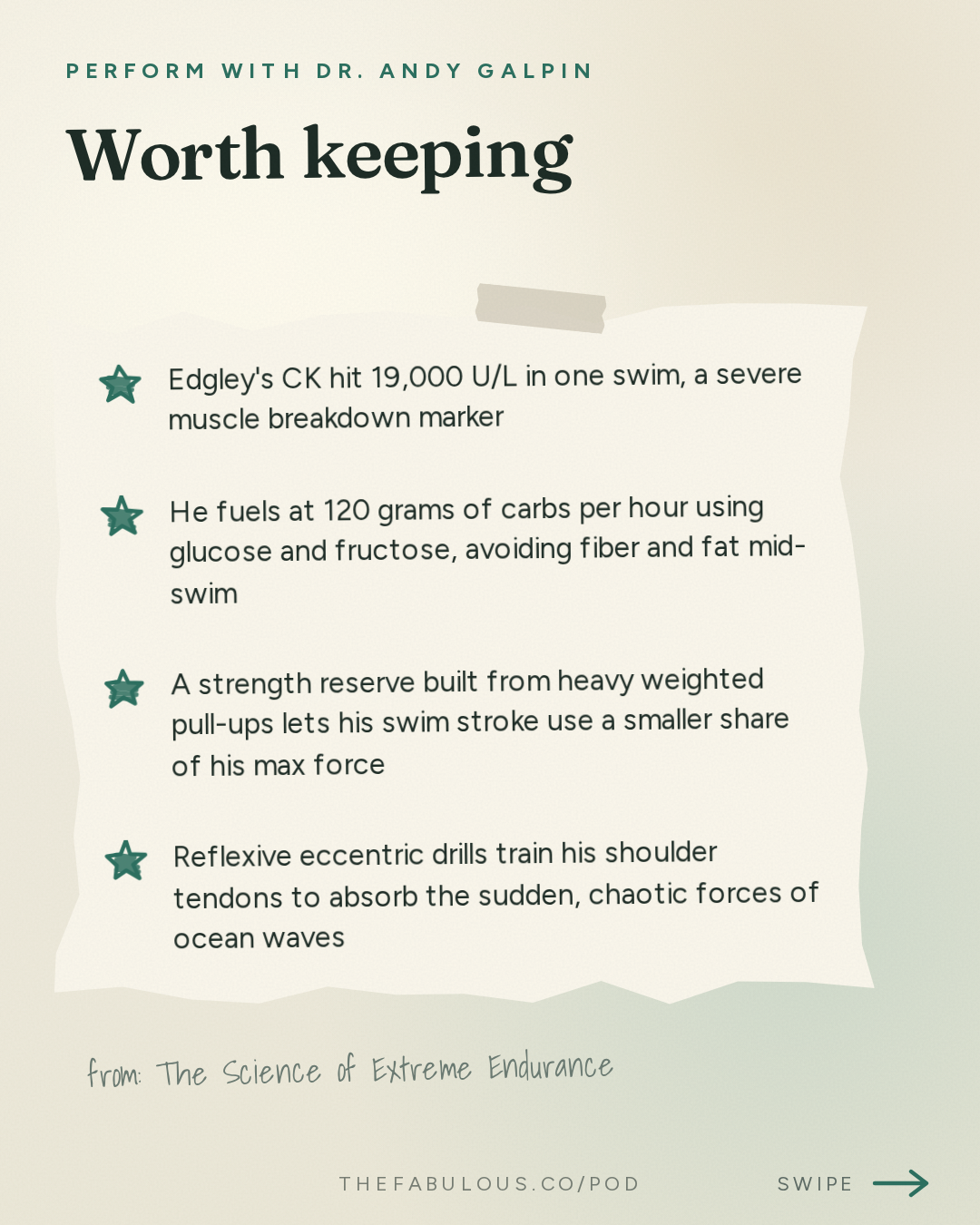
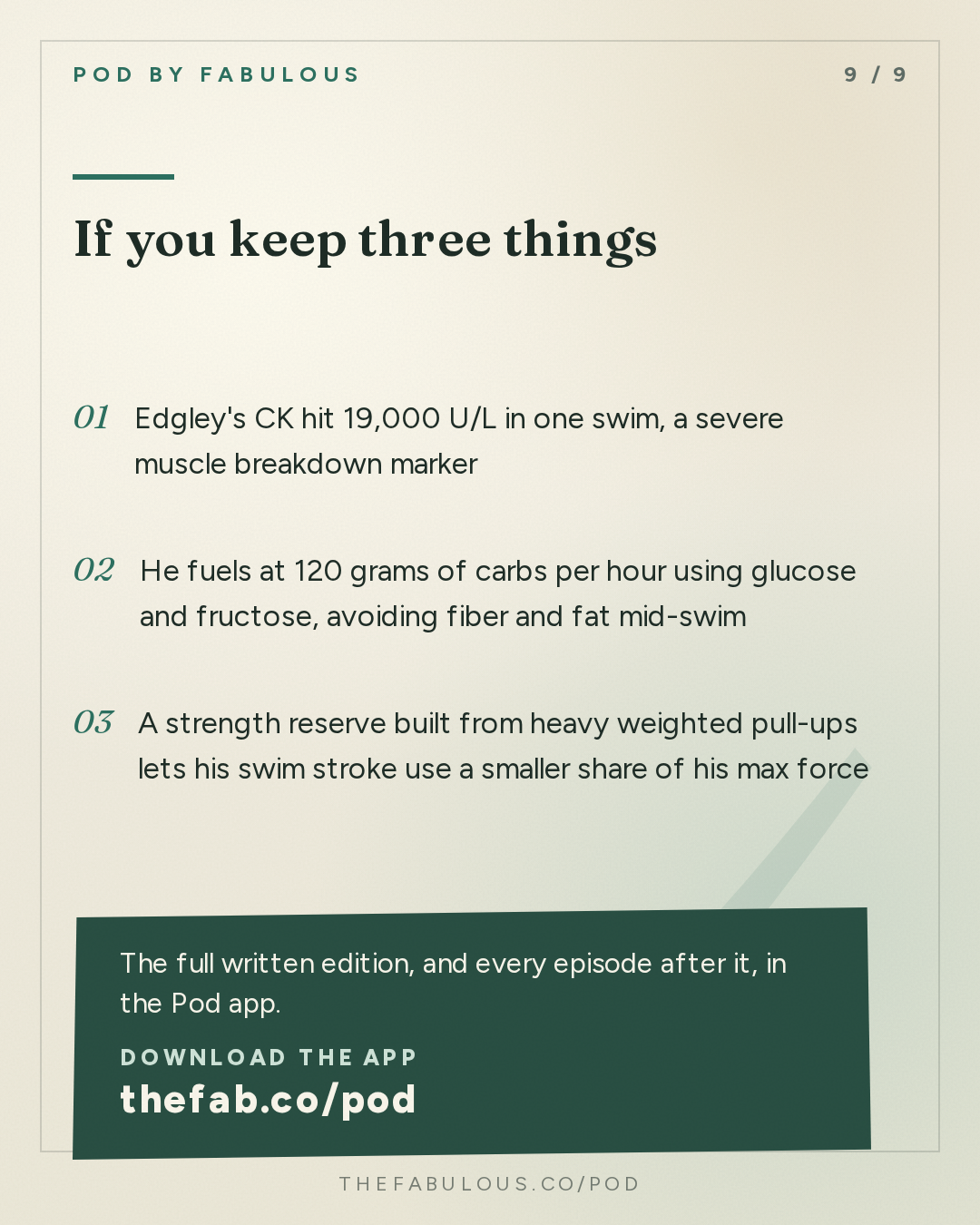
- Edgley's CK hit 19,000 U/L in one swim, a severe muscle breakdown marker
- He fuels at 120 grams of carbs per hour using glucose and fructose, avoiding fiber and fat mid-swim
- A strength reserve built from heavy weighted pull-ups lets his swim stroke use a smaller share of his max force
- Reflexive eccentric drills train his shoulder tendons to absorb the sudden, chaotic forces of ocean waves
- He treats mental fatigue as a brain-generated alarm rather than true physical failure during his longest swims
The episode in cards


By the numbers
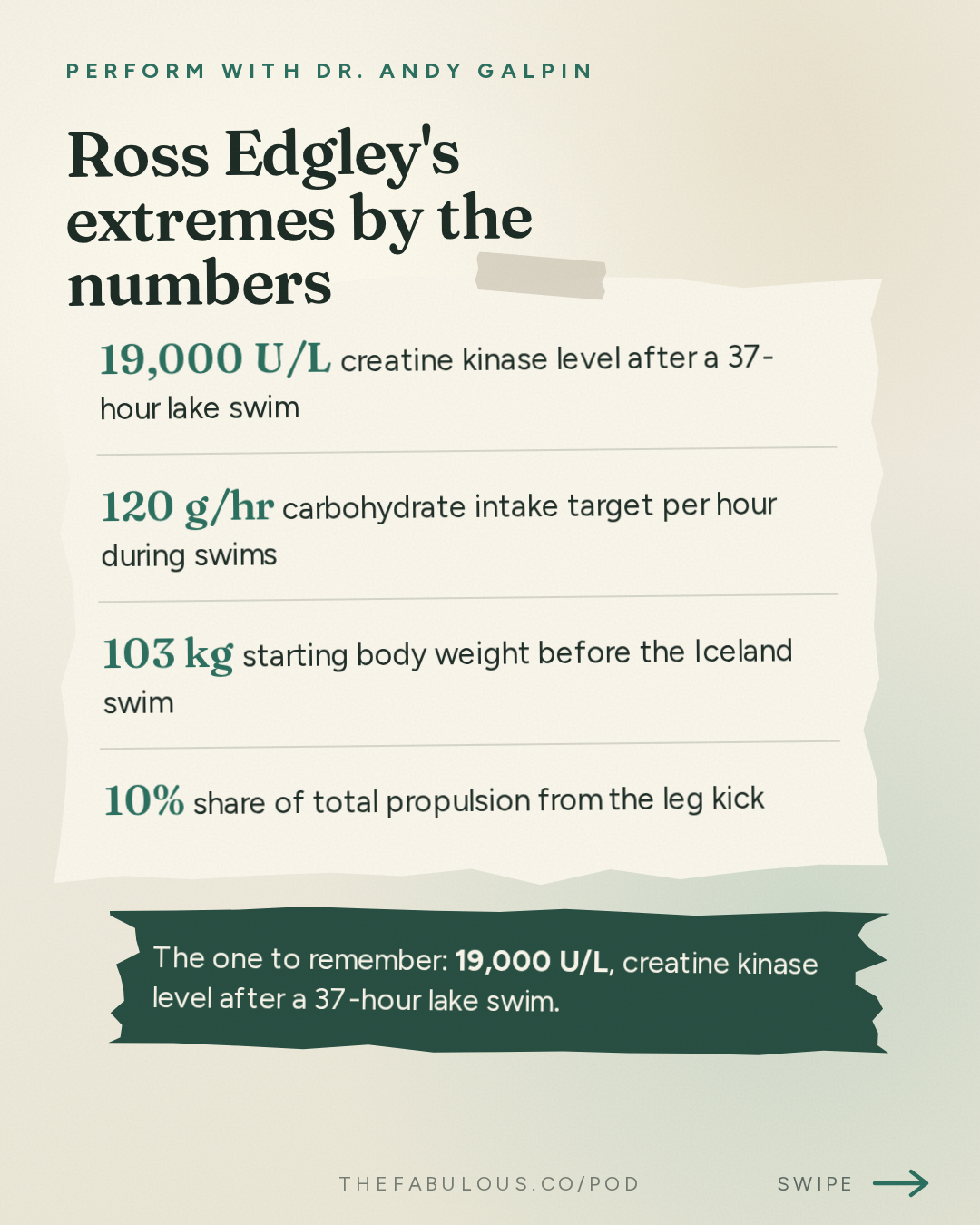
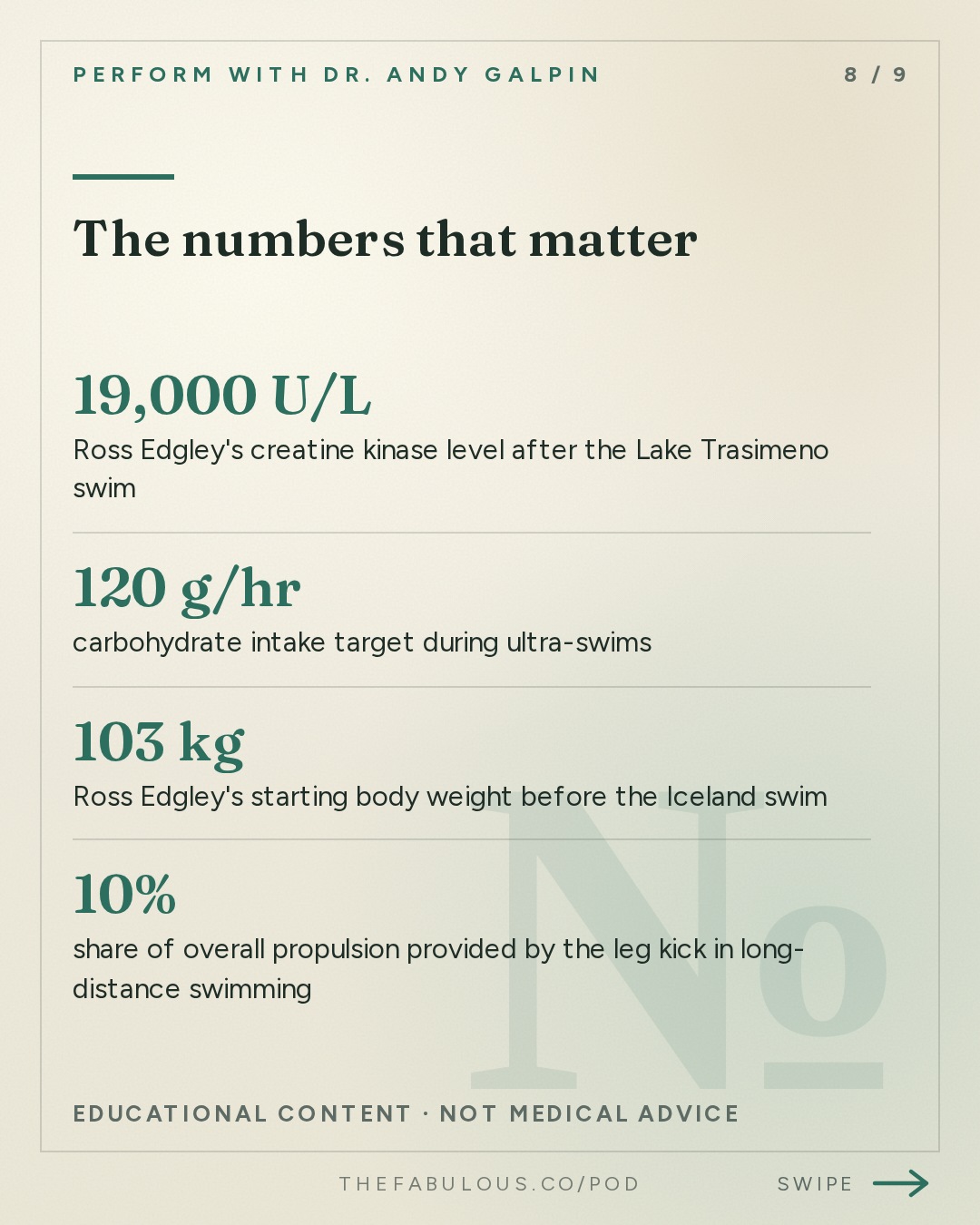
- 19,000 U/L Ross Edgley's creatine kinase level after the Lake Trasimeno swim
- 120 g/hr carbohydrate intake target during ultra-swims
- 103 kg Ross Edgley's starting body weight before the Iceland swim
- 10% percent share of overall propulsion provided by the leg kick in long-distance swimming
In their words
“The brain's a hypochondriac. It's basically getting you to stop before you do damage to yourself.”
“I have to outsource common sense because I know I can't trust myself.”
“I kicked my legs three times around Iceland, you know, potentially. That was”
“It is my calling to float far and eat lots.”
Protocols
-
120-gram carb fueling for ultra-swims
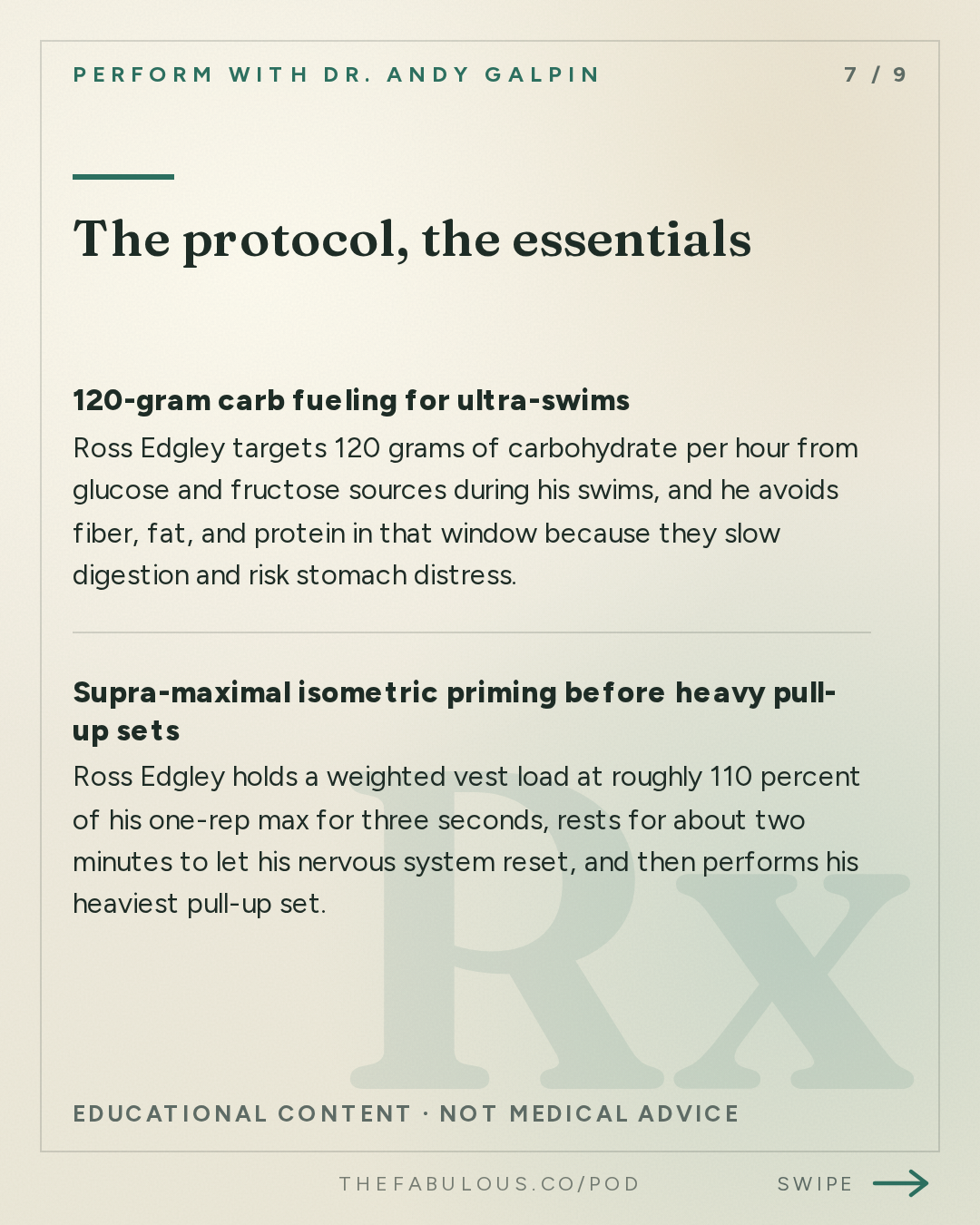
Ross Edgley targets 120 grams of carbohydrate per hour from glucose and fructose sources during his swims, and he avoids fiber, fat, and protein in that window because they slow digestion and risk stomach distress.
every hour during active swimming
-
Supra-maximal isometric priming before heavy pull-up sets
Ross Edgley holds a weighted vest load at roughly 110 percent of his one-rep max for three seconds, rests for about two minutes to let his nervous system reset, and then performs his heaviest pull-up set.
before heavy strength sessions in training blocks
-
Reflexive eccentric drills for shoulder resilience
Ross Edgley lies on a bench and catches a dropped light object, such as a small weight, to train his shoulder tendons to absorb sudden unplanned force before he encounters chaotic ocean waves.
built into weekly strength work ahead of an event
-
Sleep support stack for multi-day swims
Ross Edgley uses cherry extract as a natural melatonin source to help him fall asleep during round-the-clock swim shifts, and he avoids ashwagandha late in an expedition because it leaves him groggy the next morning.
nightly during stage swims lasting 100-plus days
Questions this episode answers
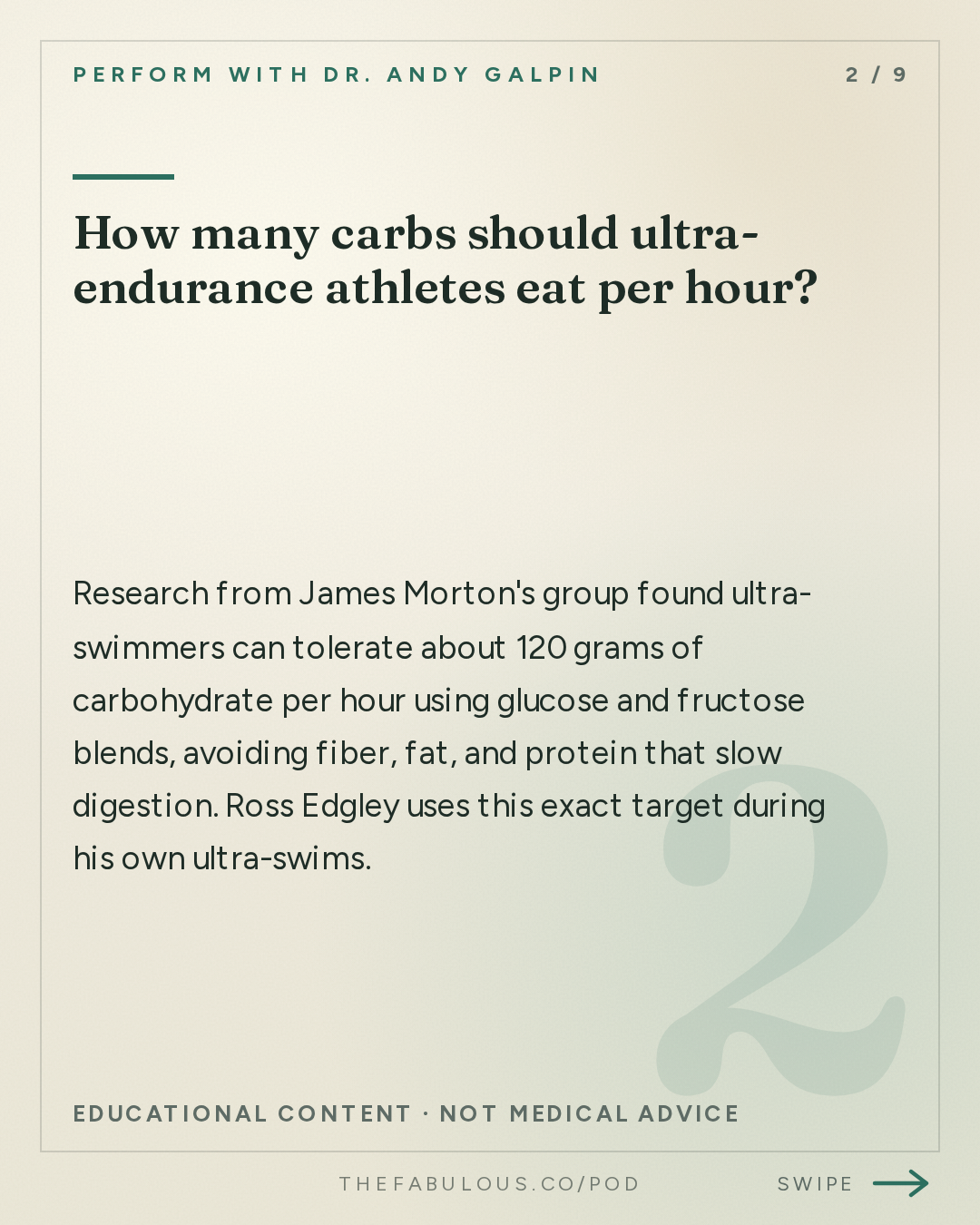
How many carbs should ultra-endurance athletes eat per hour?
Research from James Morton's group found ultra-swimmers can tolerate about 120 grams of carbohydrate per hour using glucose and fructose blends, avoiding fiber, fat, and protein that slow digestion. Ross Edgley uses this exact target during his own ultra-swims (33:48).
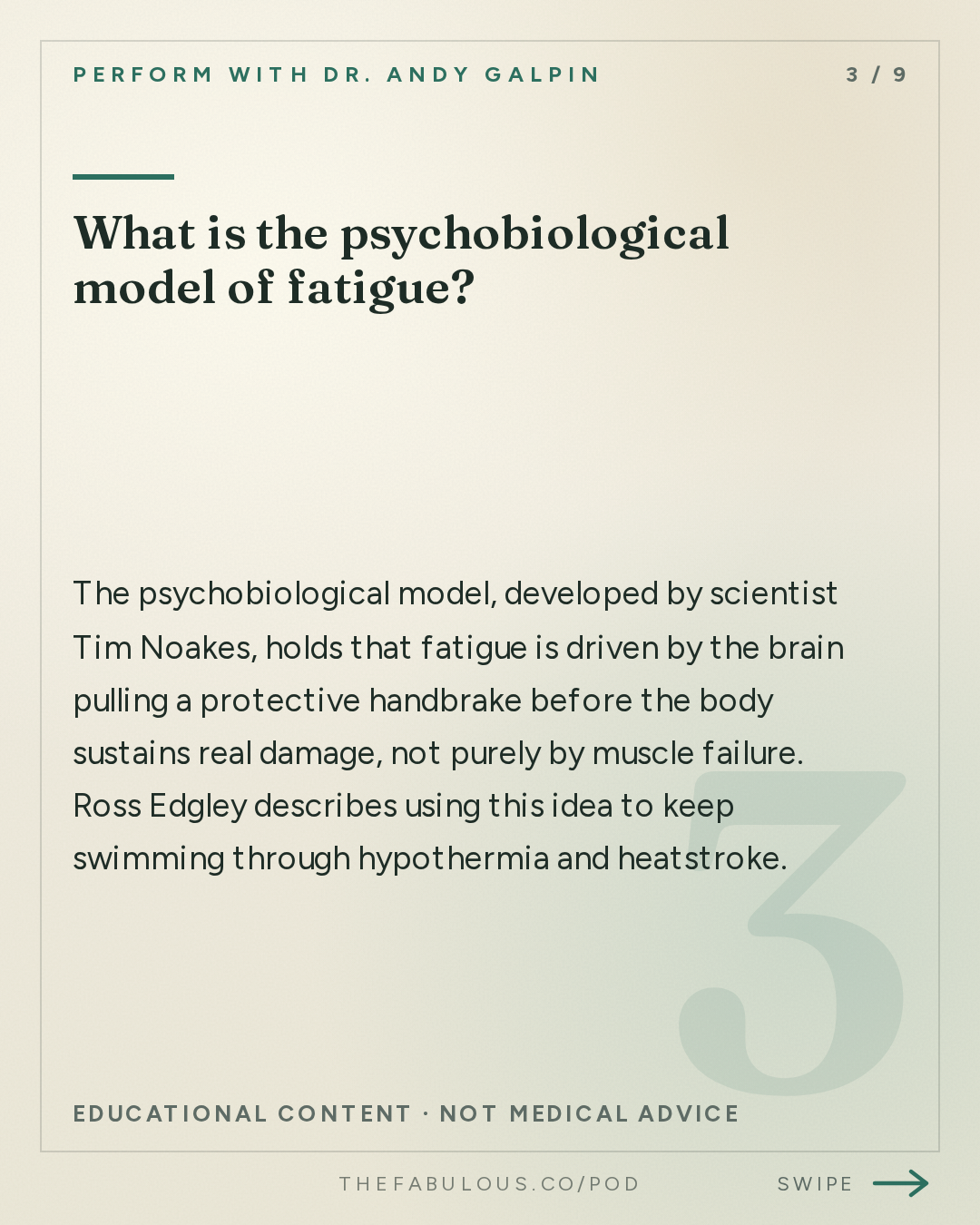
What is the psychobiological model of fatigue?
The psychobiological model, developed by scientist Tim Noakes, holds that fatigue is driven by the brain pulling a protective handbrake before the body sustains real damage, not purely by muscle failure. Ross Edgley describes using this idea to keep swimming through hypothermia and heatstroke (17:41).
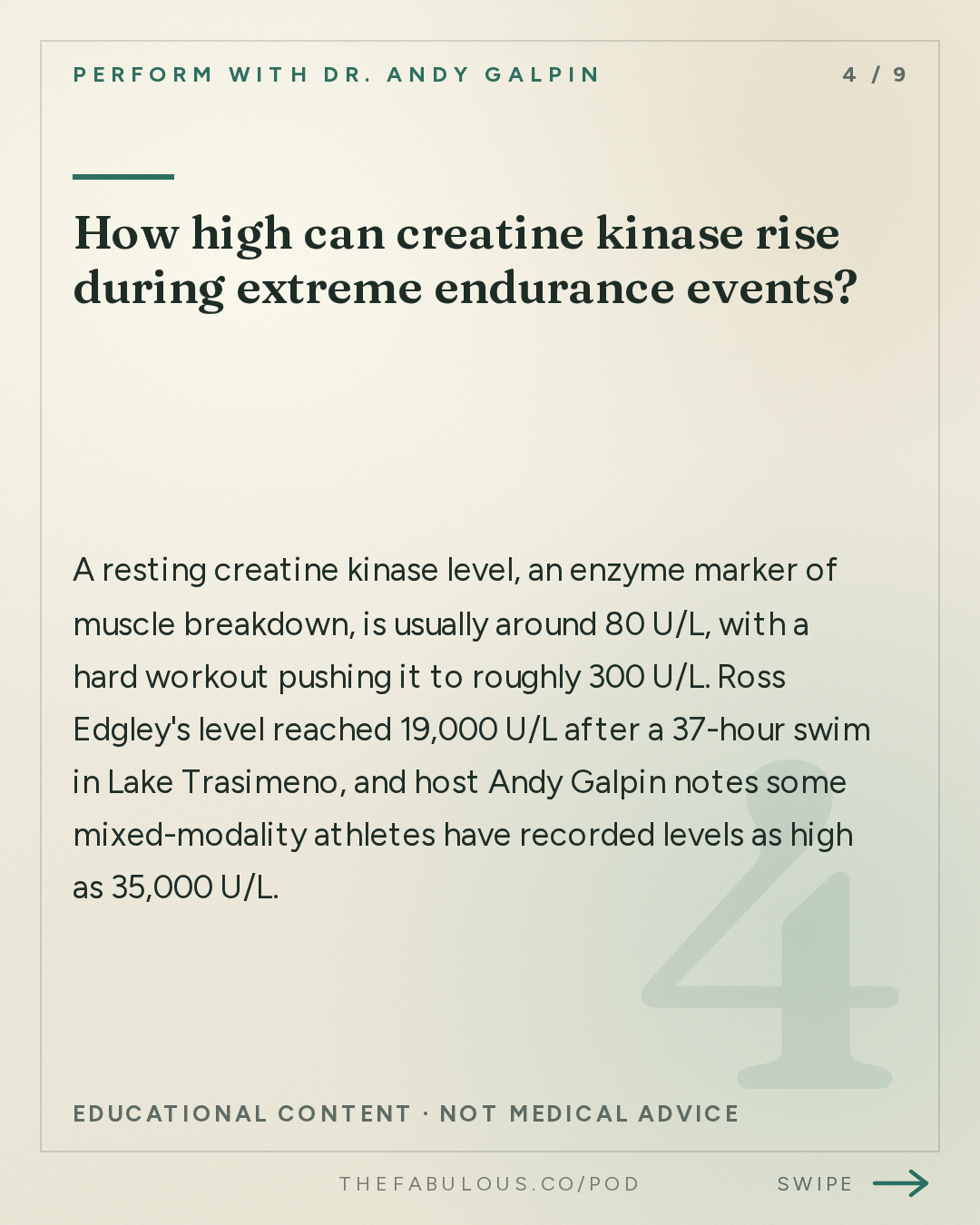
How high can creatine kinase rise during extreme endurance events?
A resting creatine kinase level, an enzyme marker of muscle breakdown, is usually around 80 U/L, with a hard workout pushing it to roughly 300 U/L. Ross Edgley's level reached 19,000 U/L after a 37-hour swim in Lake Trasimeno, and host Andy Galpin notes some mixed-modality athletes have recorded levels as high as 35,000 U/L (07:09, 09:12).
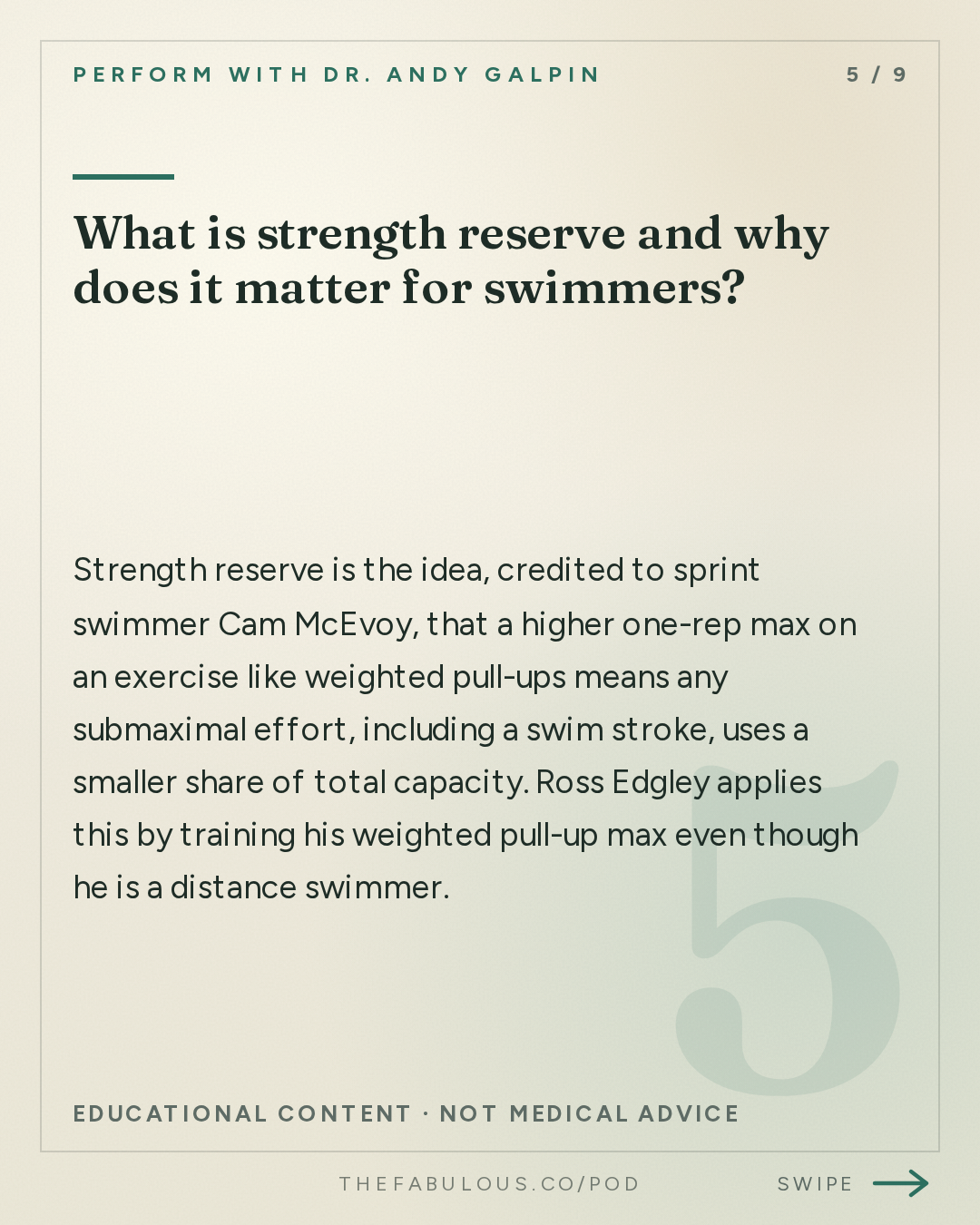
What is strength reserve and why does it matter for swimmers?
Strength reserve is the idea, credited to sprint swimmer Cam McEvoy, that a higher one-rep max on an exercise like weighted pull-ups means any submaximal effort, including a swim stroke, uses a smaller share of total capacity. Ross Edgley applies this by training his weighted pull-up max even though he is a distance swimmer (57:23).
Why do reflexive eccentric exercises help prevent shoulder injuries?
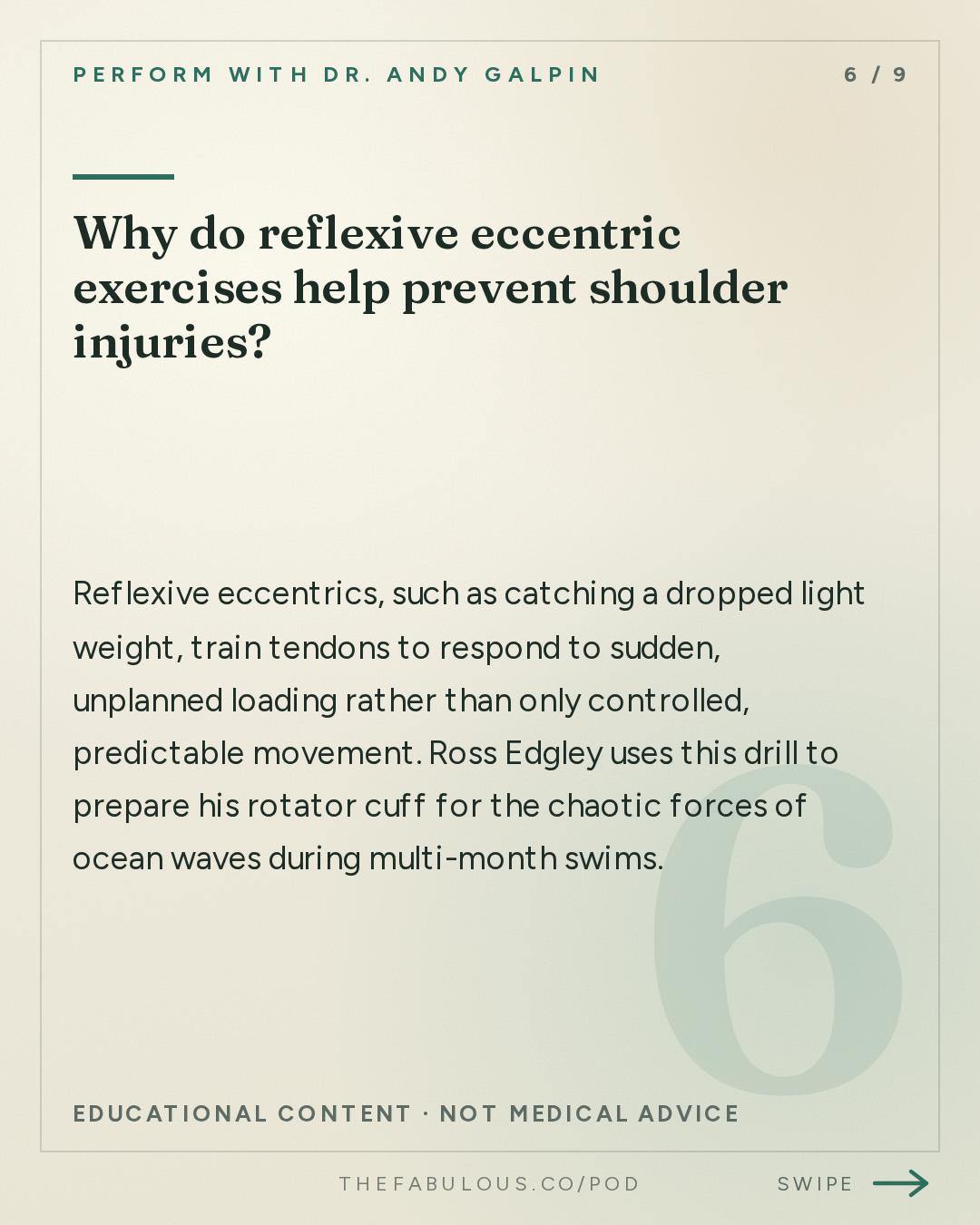
Reflexive eccentrics, such as catching a dropped light weight, train tendons to respond to sudden, unplanned loading rather than only controlled, predictable movement. Ross Edgley uses this drill to prepare his rotator cuff for the chaotic forces of ocean waves during multi-month swims (61:25).
The full read, in cards
Go deeper
- James Morton's carbohydrate fueling research — found ultra-endurance athletes can tolerate roughly 120 grams of carbohydrate per hour using glucose-fructose blends
- Robert Hickson's concurrent training research — argued in the 1980s that training strength and endurance at once dilutes the adaptive signal to muscle
- How to Hero — Ross Edgley's new book framing his endurance swims through Joseph Campbell's hero's journey structure
Mentioned
Ross Edgley · Andy Galpin · Tim Noakes · Cam McEvoy · James Morton · Chris Hemsworth · Joseph Campbell · Eddie Hall · Jordan Peterson · Loughborough University · Liverpool John Moores University
More from this show and category

How to Get Faster: The Science of Speed Training
Speed can be trained like any other skill, and team-sport performance depends more on deceleration than on raw top speed. Speed coach Les Spellman explains how NFL receivers peak in the middle of the 40-yard dash pack (06:24), why 'stay low' sprint cues are wrong (75:58), and how a blood-flow-restriction recovery protocol (30:06) and a two-week speed-PR recovery window (120:15) shape elite training.

Testosterone, Age, and Metabolic Health Explained
Testosterone does not fall because someone gets older; Dr. Andy Galpin says the data show obesity and metabolic dysfunction, not age itself, drive almost all of the decline. Men who hit five basic metabolic health markers have under a 1% chance of low testosterone (34:38), while obesity alone raises the risk roughly 7.5-fold (33:18).

Testosterone Explained: Low T, TRT, and Muscle Myths
Low testosterone is usually a symptom, not the disease itself: obesity, poor sleep, extreme dieting, or a blocked vein cause most cases, not age alone (76:08, 95:06). Two PhDs argue for finding the cause before reaching for a syringe, and for treating any hormone therapy with real informed consent.

Dr. John Rusin's 6-Phase Dynamic Warmup Explained
Physical therapist and performance coach Dr. John Rusin lays out a diagnostic and warmup system for training around chronic pain without surgery or years off. His six-phase, 10 to 12 minute daily sequence (24:02) turns soft tissue work, stretching, and activation drills into deliberate, measurable steps rather than vague pre-workout ritual.
