
The Overwhelm Recovery ProtocolWellness & Routines · ~5 min
About this template · Updated November 2026
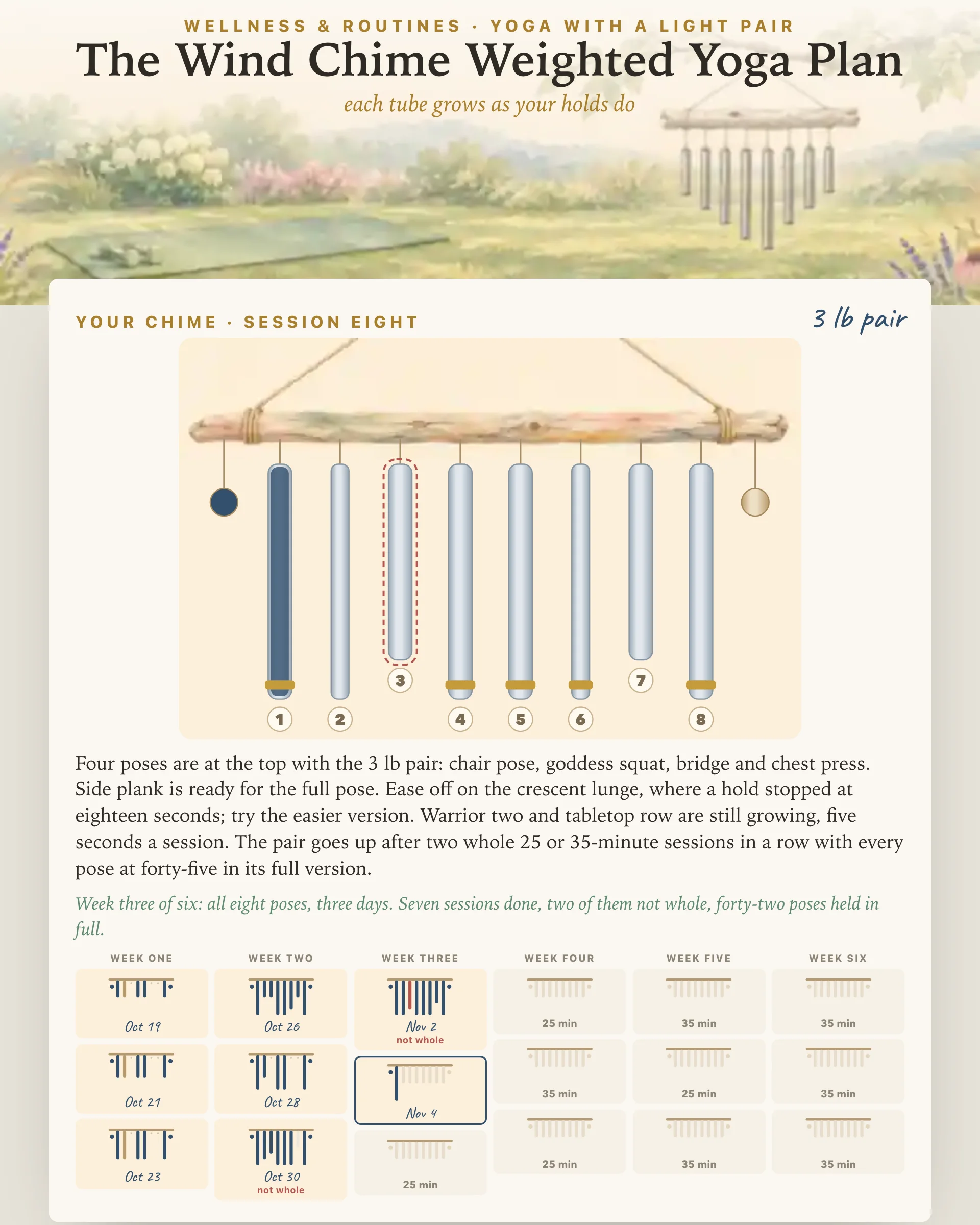
This is yoga with weights at its plainest: steady standing and floor poses, plus one pair of light dumbbells or two full water bottles. You hold each pose and move the weights slowly through it, three days a week for six weeks. Sessions run fifteen, twenty-five or thirty-five minutes.
Ask a doctor or physical therapist first if you have had a fall or dizzy spells, a joint replacement, a heart or blood pressure condition, osteoporosis, or pain in your wrists, shoulders, back or knees. Stop any pose that hurts, and keep breathing through every hold.
Three rules hold for every session:
Each pose has an easier version (a smaller bend, one arm at a time, or half the lift) and the same shape with no weights. A warm-up opens every session and a cool-down on the floor ends it, both without weights.
Pick a length and the card lists its parts, which always add up. Fifteen minutes is a two-minute warm-up, five poses of two one-minute rounds, and a three-minute cool-down. Twenty-five brings in all eight poses; thirty-five adds rounds.
Every round is one minute: five seconds to get set, a hold of thirty to forty-five seconds, and the rest of the minute to breathe or change sides. The clock reads real time since you tapped begin, minus any pause, so a locked phone neither steals nor adds seconds. A pose counts only when its last hold runs to the end. Stop partway and the page keeps your whole rounds and seconds, marked stopped early, and never counts them toward going heavier.
Each hold climbs five seconds a session while you finish it in full, and its tube grows with it. When the two latest sessions holding a pose both reach forty-five seconds, the tube wears a gold band: time for the full version, or for weights if you went without. Once two whole 25 or 35-minute sessions in a row hold every pose at forty-five in its full version, the page suggests the next pair up; a pose still in its easier version holds the pair back. A hold cut short under thirty asks you to ease off.
The mix itself is barely studied. A search of the medical literature turned up no trial of yoga poses with hand weights added, so this plan rests on two separate bodies of evidence.
Yoga on its own does build some strength. A review of 22 randomized trials by researchers in Scotland, covering adults with an average age of sixty or more, found yoga improved lower-body strength, balance and flexibility compared with no exercise, and lower-body strength compared with other activities such as walking. The trials used yoga without added load and left out people recruited for a health condition, and too few measured arm or grip strength for the authors to pool them.
Light loads can build muscle too, with a catch. An analysis of 28 studies with 747 healthy adults by an international team of exercise scientists found muscle grew about as much with light, moderate or heavy weights when every set went until another repetition was impossible. Strength rose more with heavier loads, which is why the pair is meant to climb. Those studies used ordinary lifting, not held poses.
The Physical Activity Guidelines for Americans, summarized by its authors at the US Department of Health and Human Services, ask adults for muscle-strengthening work on two or more days a week, and older adults to add balance training. The weights are what make these poses strength work. Nothing here promises toning, sculpting or weight loss.
The Yoga Mannequin teaches twelve poses with no weights, two new ones a week. The Pop-Up Book of Standing Poses is standing poses with a chair or wall to hold. The Eight-Arm Dumbbell Workout is gym-style arm sets counted in reps. This page sits between them: a light pair carried through held poses, timed rather than counted.
For many people it is a gentle way into strength work. Adding a light pair to steady poses asks more of your muscles than the same poses empty-handed, and the US guidelines ask adults for strength work on two or more days a week. Trials of the mix itself are hard to find, so the case rests on research about yoga and about lifting separately.
Light enough that you could raise them out to your sides ten times with good form. Many people start with 2 or 3 lb dumbbells, and a full 16-ounce water bottle weighs about a pound. Side raises and reaches feel heavier than curls or rows at the same weight, which is why every pose here also has an easier version.
Keep one-leg balance poses such as tree pose and warrior three, and upside-down poses such as downward dog, free of weights. A loaded arm makes a wobble harder to catch. Set the weights down before moving to the floor, then pick them up once you are lying or kneeling steady.
Three days a week with a rest day between sessions suits most beginners, for example Monday, Wednesday and Friday. The six-week plan on this page starts with fifteen-minute sessions and builds to thirty-five minutes by the last week.
Anyone who has had a fall or dizzy spells, a joint replacement, a heart or blood pressure condition, osteoporosis, or pain in the wrists, shoulders, back or knees. A doctor or physical therapist can say which poses and which weights suit you, and any pose that hurts should stop.
By the team behind Fabulous, the science-based self-care app used by over 30 million people.


