
The Overwhelm Recovery ProtocolWellness & Routines · ~5 min
About this template · Updated November 2026
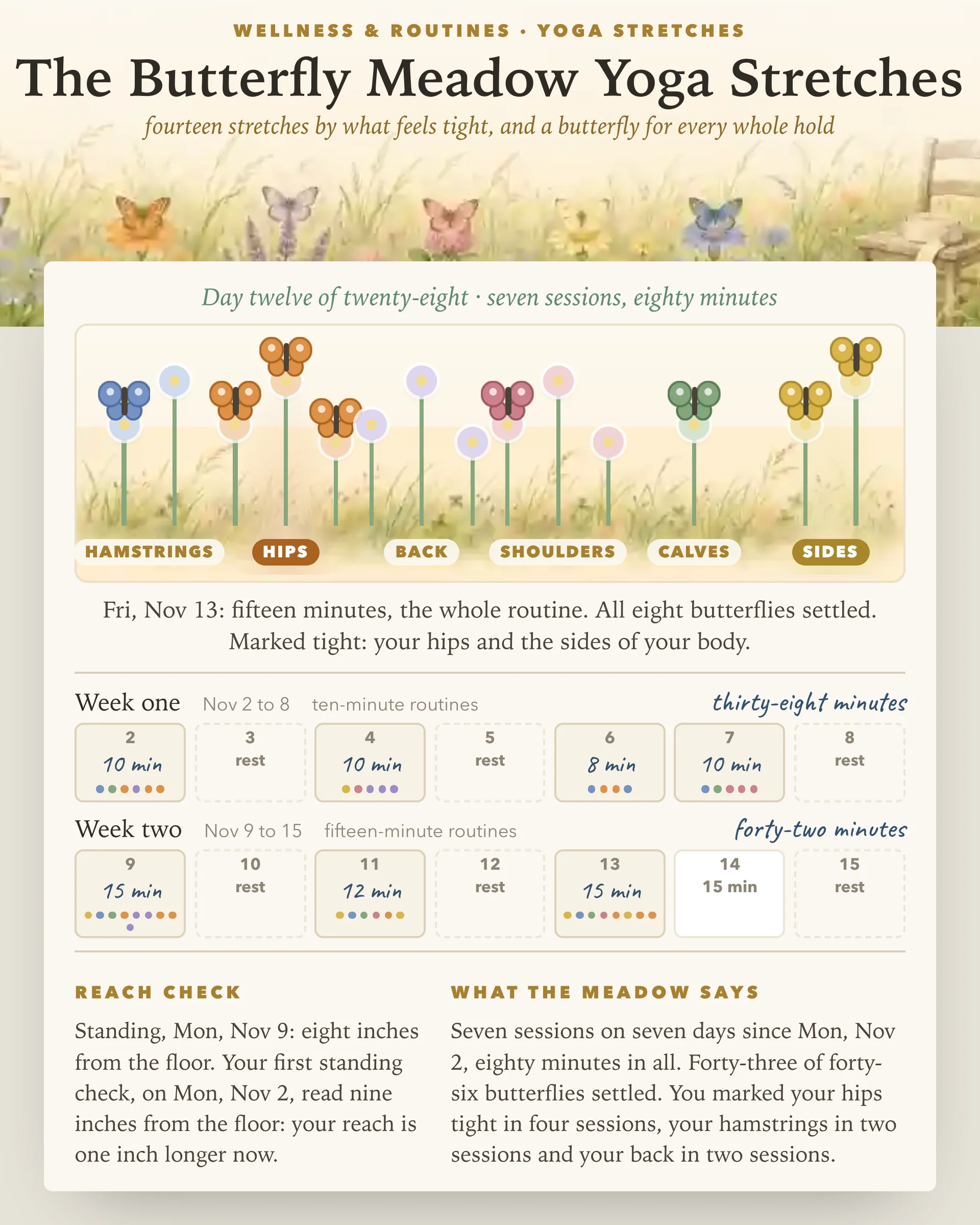
Most people look for yoga stretches with one place in mind: hamstrings that complain when you bend for the laundry basket, or hips that feel stuck after a long drive. So this page starts there. Tap the patch of the meadow that feels tight, and the routine gathers its stretches there first.
The fourteen stretches are classic yoga shapes held still for a while, and each has a way that leans on a chair, a wall or a strap:
Each stretch says where you should feel it, such as across the front of the back hip in the low lunge. A pinch in a joint instead of a pull along a muscle means ease off or take the supported way.
A routine runs ten, fifteen, twenty or twenty-five minutes. It opens with two minutes of walking or marching in place, then each stretch gets fifteen seconds to set up and a forty-five-second hold, one side at a time where it has two. The page takes one stretch from each patch you marked in turn, then fills the remaining minutes from the patches with the fewest butterflies so far. Mark a different patch or pick another length and the routine is built again.
While it runs, the butterfly over the current stretch hovers, and it settles on its flower only when every hold of that stretch has run its whole time. A skipped stretch's butterfly flies off, and an early stop logs only whole minutes. The timer reads the clock instead of keeping its own count, so a phone that locks mid-stretch still knows where you are.
The plan is four weeks of four routines a week: ten minutes the first week, then fifteen, twenty and finally twenty-five, which holds all fourteen stretches. Once a week, take a reach check, standing with your fingertips toward the floor or sitting on a chair reaching toward your toes. Each check is set beside your own earlier checks of the same kind and nothing else.
Regular stretching does widen how far your joints move. A 2024 meta-analysis of 77 studies, led by sport scientists in Austria and Canada, found a moderate gain in range of motion from stretch training compared with not stretching, with still holds doing better than bouncing. More minutes, more effort or more sessions a week showed no clear extra benefit, and women gained somewhat more than men. It pooled healthy people and sorted stretching by technique, so yoga was not tested on its own.
What changes is less dramatic than "lengthening" suggests. Researchers in Lisbon, Nantes and Niš reviewed 26 studies of three to eight weeks and found that the muscles and tendons themselves barely changed; people tolerated a deeper stretch.
Stretching is not armor, either. In an Australian trial with 1,538 male army recruits, a twenty-second stretch for six leg muscle groups in every warm-up for twelve weeks did not meaningfully lower leg injuries. Those were men in army training, so it says little about older adults at home, but nothing here should be treated as protection.
The sitting reach check is the chair sit-and-reach. Researchers at California State University, Fullerton, found it gave steady results from one day to the next in 76 men and women averaging about 70, and in 80 others it tracked a measured straight-leg raise reasonably well. Here it only compares you with yourself.
The Pop-Up Book of Standing Poses keeps you on your feet for twelve poses, balance work included. The Daily Stretch Mat is a short set of five stretches for a morning or a desk break. The Yin Yoga Water Clock holds a few floor poses for several minutes each. The meadow is for the day one place feels tight and you want a longer routine built around it.
Check with a doctor or physical therapist first if you have had a hip or knee replacement or back surgery, if you have osteoporosis (deep forward folds and twists may need changing), glaucoma or blood pressure that is not under control (skip downward dog on the floor), if you are pregnant, or if pain runs down a leg or an arm. Stop at anything sharp, tingling or numb, and keep a chair or a wall within reach whenever you stand.
Four days a week, after a day of sitting or whenever one spot keeps nagging. Mark what feels tight that day, not what felt tight last week.
Ones you can ease into with something to lean on: a forward fold with your hands on a chair seat, downward dog with your palms on a wall, figure four sitting in a chair, and a lying leg stretch with a strap looped around your foot. All fourteen here start on a supported way like these.
Forty-five seconds, after fifteen seconds to set up, so a stretch done on both sides at once takes a minute and one done side by side takes two. Longer routines add more stretches rather than longer holds.
Not by much, as far as trials show. In a twelve-week trial with 1,538 army recruits, short stretches added to the warm-up did not meaningfully change how many leg injuries happened. Stretch because you want to move more freely, and warm up for exercise by moving.
Over a few weeks, mostly not. A review of 26 studies lasting three to eight weeks found that the muscles and tendons themselves barely changed, while people could take a deeper stretch more comfortably. The extra range you gain seems to come mainly from that comfort.
Here the hip patch holds a low lunge for the front of the hip, figure four for the outer hip and butterfly for the inner thighs. Each has a chair or wall way, and if you have had a hip replacement, ask your surgeon or physical therapist which of these suit you.
By the team behind Fabulous, the science-based self-care app used by over 30 million people.


