
The Overwhelm Recovery ProtocolWellness & Routines · ~5 min
About this template · Updated November 2026
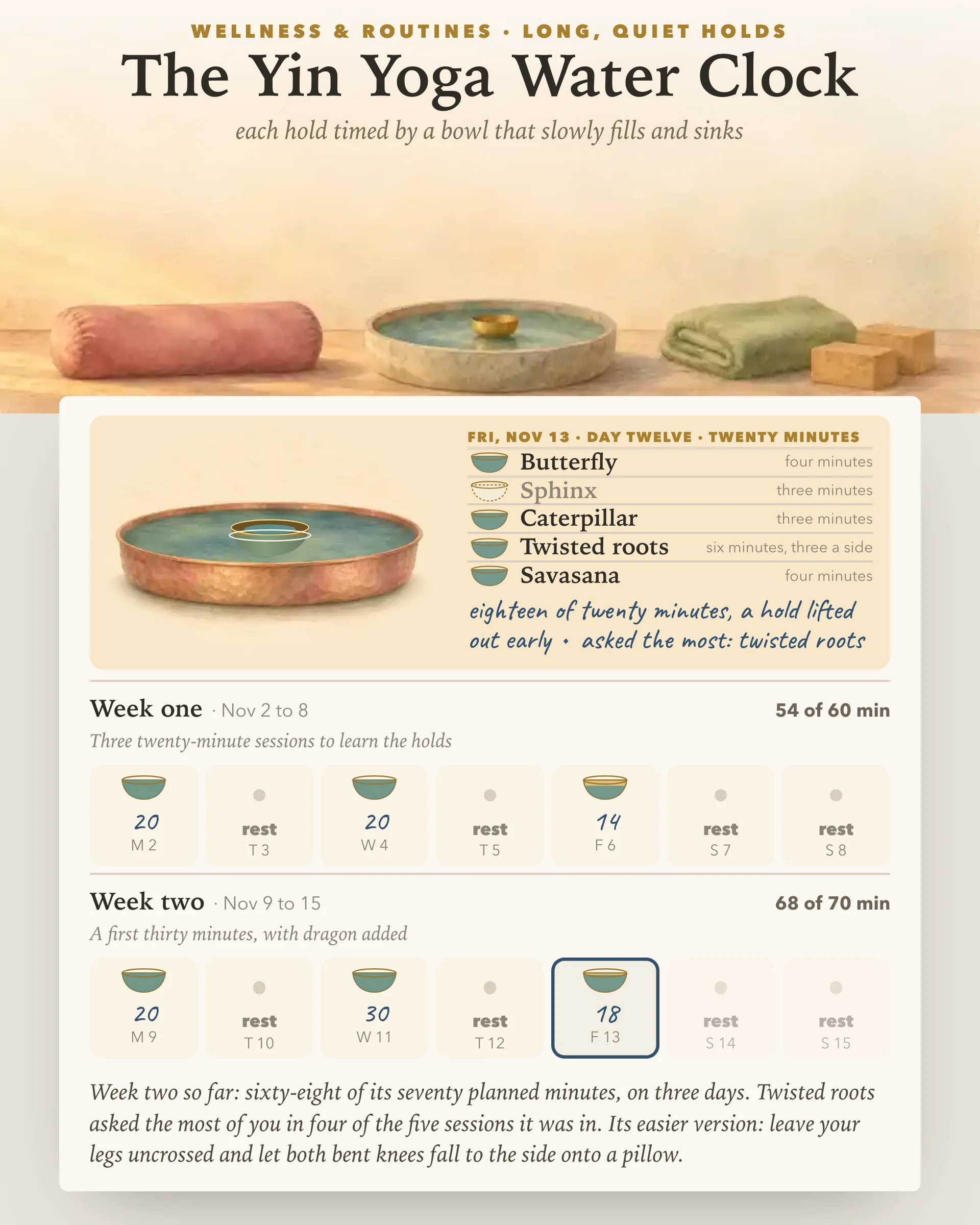
Credit first. The long, low holds of yin yoga reached students in North America in the late 1970s through Paulie Zink, a martial artist and teacher. Paul Grilley studied with him in the 1980s, joined those holds to his own study of anatomy and taught them widely, and Sarah Powers, one of Grilley's students, suggested the name yin yoga. The style's history traces that line in more detail. This sheet is a free, independent practice, and none of those teachers made it, checked it or approved it.
Most yoga classes keep you moving and your muscles working. Yin yoga does nearly the opposite. You come into a pose on the floor, find the point where you first feel a stretch, ease back a little, and stay there, usually for three to five minutes. Blankets, a bolster and blocks hold you up so your muscles can stop gripping. Over those minutes the stretch often changes by itself, and your job is to notice it and keep breathing.
You may read that yin yoga works on connective tissue or on the meridians of Chinese medicine. Neither idea is settled, and this page makes no claim either way.
The yin yoga poses here are butterfly, dragon, sphinx, caterpillar with a bolster under your chest, supported child's pose, twisted roots, legs up the wall, a reclined twist and savasana, the closing rest on your back. Each comes with its props, an easier version and a plain line on what to feel and when to ease out. Sharp, tingling or numb sensations always mean come out, whatever the clock says.
The plan runs three days a week for four weeks. Week one is three twenty-minute sessions of five gentle holds, a sensible start for yin yoga for beginners. Week two adds a thirty-minute session with dragon, a reclined twist and legs up the wall. Week three has two of those longer sessions, and the fourth week ends on forty-five minutes, with caterpillar and longer holds.
Choose twenty, thirty or forty-five minutes, with the plan's length for today already marked. Any hold can be swapped for another pose of the same kind, so a sore knee can trade dragon for a lying twist and keep the hold's minutes.
Press begin and a small brass bowl floats in the painted basin. As the hold runs it takes on water and rides lower, and through the last tenth it sinks: your soft cue to come out slowly. Poses done on both sides tell you when to switch at the halfway point. The clock reads real time, so a phone that dims mid-hold still knows where you are, and a pause stops it outright.
A bowl sinks only for a hold that runs its full time. If you come out early, the session moves to the next pose, that bowl stays up, and the skipped minutes are left out. End a session early and only its whole minutes go on the day. Afterward you can tap the hold that asked the most of you. Over the weeks, the page names the pose you mark most often and repeats its easier version.
The Bedtime Yoga Moon is a short, breath-paced routine for the half hour before sleep. The Bed Yoga Fan keeps every pose on the mattress for mornings when the floor feels far away. The Somatic Yoga Shell is built on slow, small movements. Yin yoga is the one built on stillness: fewer poses, held far longer, with props doing the holding.
Yin yoga has only a handful of trials. In a Swedish study of 105 stressed adults, most of them women with an average age of 53, five weeks of yin yoga eased anxiety and sleep problems compared with a group that added nothing new. A drop in perceived stress showed up only in the group that paired the yoga with mindfulness teaching. A Latvian trial of 48 women practicing online during the pandemic found lower state anxiety after ten weeks, with lower readings after each session, but no difference in trait anxiety, the steadier tendency to feel anxious.
Both studies were small and short, compared yoga with doing nothing rather than another activity, and relied on people rating themselves. Neither shows that yin yoga treats an anxiety disorder or makes you more flexible.
Ask a doctor or physical therapist before you begin if you have a joint replacement, a recent fall or injury, or a pregnancy. Osteoporosis calls for a specific question about deep forward folds and twists: a case series of nine people describes spine fractures that appeared after yoga poses that round the back. A case series cannot say how common that is, but it is reason to prop caterpillar and child's pose high, or swap them out, until your doctor says otherwise. Come down from legs up the wall if your feet tingle, and roll to your side before you sit up.
It suits an evening, or a rest day from harder exercise.
Yin yoga is a slow style practiced mostly on the floor, where you settle into a pose and stay there, usually for three to five minutes, while blankets, bolsters and blocks take your weight. Instead of pushing into a stretch, you let it arrive gradually and move very little between poses.
Many newcomers begin with about three minutes in each pose and work toward five as staying still gets easier. This plan keeps every hold between three and five minutes, and poses done one side at a time, such as dragon, get that long on each side.
Butterfly, sphinx, supported child's pose and a reclined twist are kind places to start, because each one can be propped until it feels easy. Dragon and caterpillar ask more of the hips and the backs of the legs, so the plan brings them in after the gentler holds feel familiar.
Paulie Zink taught long floor holds in North America from the late 1970s, Paul Grilley studied with him in the 1980s and spread the approach, and Sarah Powers, one of Grilley's students, suggested the name. This free page is independent, and none of them wrote, reviewed or endorsed it.
Most people can try it with props, but ask a doctor or physical therapist first if you have osteoporosis, a joint replacement, a recent injury or a pregnancy. With fragile bones, deep forward folds and twists are the poses to ask about, and sharp or tingling sensations always mean come out.
By the team behind Fabulous, the science-based self-care app used by over 30 million people.


