
The Overwhelm Recovery ProtocolWellness & Routines · ~5 min
About this template · Updated November 2026
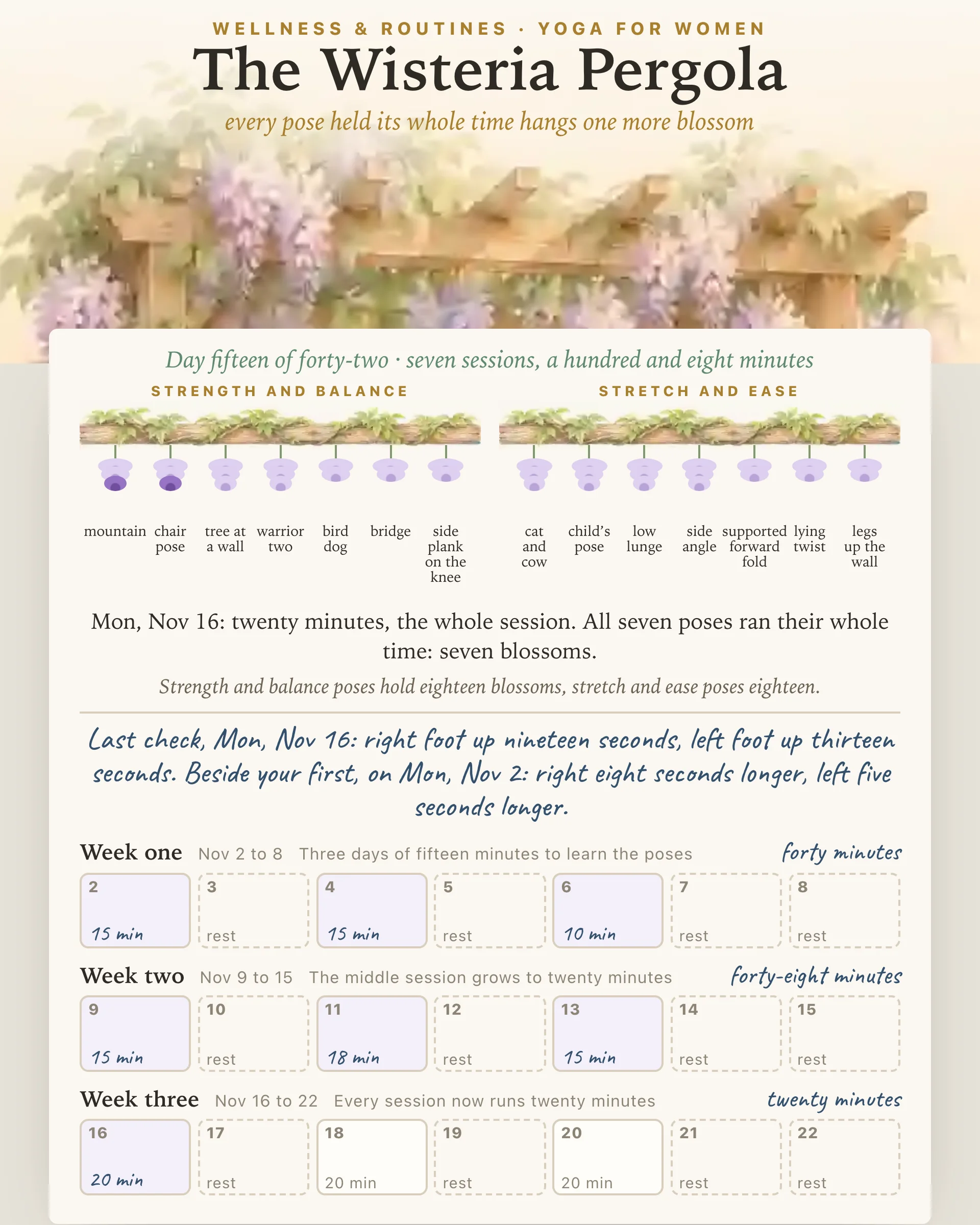
A lot of yoga aimed at women is all long stretches and slow breathing. That has its place, but stretching alone leaves leg strength and steady balance, which matter more with every decade, to chance. This page treats yoga for women as three jobs at once, strength, balance and stretch, at any age, and keeps count of each pose as a cluster of wisteria on a garden pergola.
The first beam holds strength and balance: mountain, chair pose, tree at a wall, warrior two, bird dog, bridge and side plank on the knee. The second holds stretch and ease: cat and cow, child's pose, low lunge, side angle, a supported forward fold, a lying twist and legs up the wall.
Every pose has two ways. The supported way uses a chair, a wall or a block, such as warrior two seated sideways on a chair. The classic way is the version a studio teacher would show, and you pick the way pose by pose. When your last two sessions with a pose both ran it whole the supported way, the page offers the classic way; a pose stopped partway breaks that run.
Choose fifteen, twenty, twenty-five or thirty minutes. Fifteen is a three-minute warm-up of marching, shoulder rolls and hip circles, five poses at two minutes each and two minutes of rest.
The page fills the session from the barest clusters, half from each beam, so neither strength nor stretch quietly takes over. Tap a cluster to ask for that pose today or to leave it out.
Most poses are held twice for five slow breaths, once on each side for a one-sided pose like warrior two. Child's pose and legs up the wall get one long hold of twelve breaths. A bar paces each breath, three seconds in and five out.
The clock keeps real time even if your phone locks, and a pause never counts. A pose hangs a blossom only when its whole hold time runs; stop partway and the page notes the seconds you held, with no blossom. Skipped minutes never count, and a session ended early logs only whole minutes. Pale blossoms come from the supported way and deep violet ones from the classic way.
Week one is three fifteen-minute days to learn the poses. In week two the middle session grows to twenty minutes, and in week three every session runs twenty. Week four adds a fifteen-minute fourth day, and days one and five grow to twenty-five minutes in week five and thirty in week six.
Once a week, stand side-on to a wall in tree pose, fingertips on it. After five seconds, lift your fingertips away and tap foot down when you touch the wall or your foot lowers, right foot and then left. Each check is set beside your own first one and nothing else: no target, no age chart, no score.
A controlled trial by a university medicine department in Hong Kong gave 173 adults, 109 of them women, with an average age of 52, twelve weeks of hatha yoga or a waiting list (Lau and colleagues, 2015). The yoga group did better on push-up, curl-up and flexibility tests. The authors note the groups were not randomized, and the comparison group did no exercise, so it cannot say yoga beats other training.
For balance, health researchers in Sydney pooled six trials of 307 people aged 60 and over (Youkhana and colleagues, 2016). Yoga gave small gains in balance and medium gains in mobility. Whether those gains prevent falls is not yet known, and younger women were not studied.
A randomized trial at three California sites gave 240 women aged 45 to 90 with daily leaking either twelve weeks of pelvic floor yoga or general stretching and strengthening (Huang and colleagues, 2024). Leaking dropped in both groups by similar amounts, so yoga was a reasonable choice rather than a better one.
The US physical activity guidelines ask adults for muscle-strengthening work on two or more days a week alongside aerobic activity, with balance training added for older adults (Piercy and colleagues, 2018). Holding poses that make your legs and trunk work is one way toward the strength part; walking still covers the rest.
Breathe out as you work and never bear down. Leaking, heaviness or a bulge low in your pelvis deserves a visit to a doctor or a pelvic floor physical therapist. If you are pregnant, follow a prenatal class and your midwife's or doctor's advice instead of this plan. Check with a doctor first if you have osteoporosis, recent surgery, a heart or blood pressure condition, glaucoma or pain that runs down a leg, and keep a wall or chair within reach for every standing pose.
The Tulip Rows builds each session around one aim for the day and plants a tulip per session; here every pose keeps its own record across six weeks, with a tree check beside it. The Yoga Mannequin teaches two new poses a week from zero, and The Morning Yoga Sundial is a short wake-up routine.
Pick poses that make muscles work while you hold them, such as chair pose, warrior two, bridge and side plank on the knee, and pair them with balance poses like tree. Stretching poses still belong in the mix, but a routine that only stretches leaves strength and balance to chance.
Three or four sessions a week is a realistic start, and that is how this six-week plan is set. The 2018 US physical activity guidelines ask adults for muscle-strengthening work on at least two days a week, with aerobic activity such as walking on top.
It can be part of caring for it, as long as you breathe out on the effort and never bear down. A 2024 trial in women with daily leaking found pelvic floor yoga helped about as much as general stretching and strengthening, not more. Leaking, heaviness or a bulge deserve a visit to a doctor or a pelvic floor physical therapist.
No. During pregnancy, use a prenatal class and the advice of your midwife or doctor, since poses such as lying on your back or deeper twists are often changed or left out then.
No. Every pose has a version with a chair, a wall or a block, and a thick book or firm cushion works as a block. You choose the supported or classic way pose by pose, and the classic way is offered only after two whole sessions in a row with the support.
By the team behind Fabulous, the science-based self-care app used by over 30 million people.


