
The Overwhelm Recovery ProtocolWellness & Routines · ~5 min
About this template · Updated November 2026
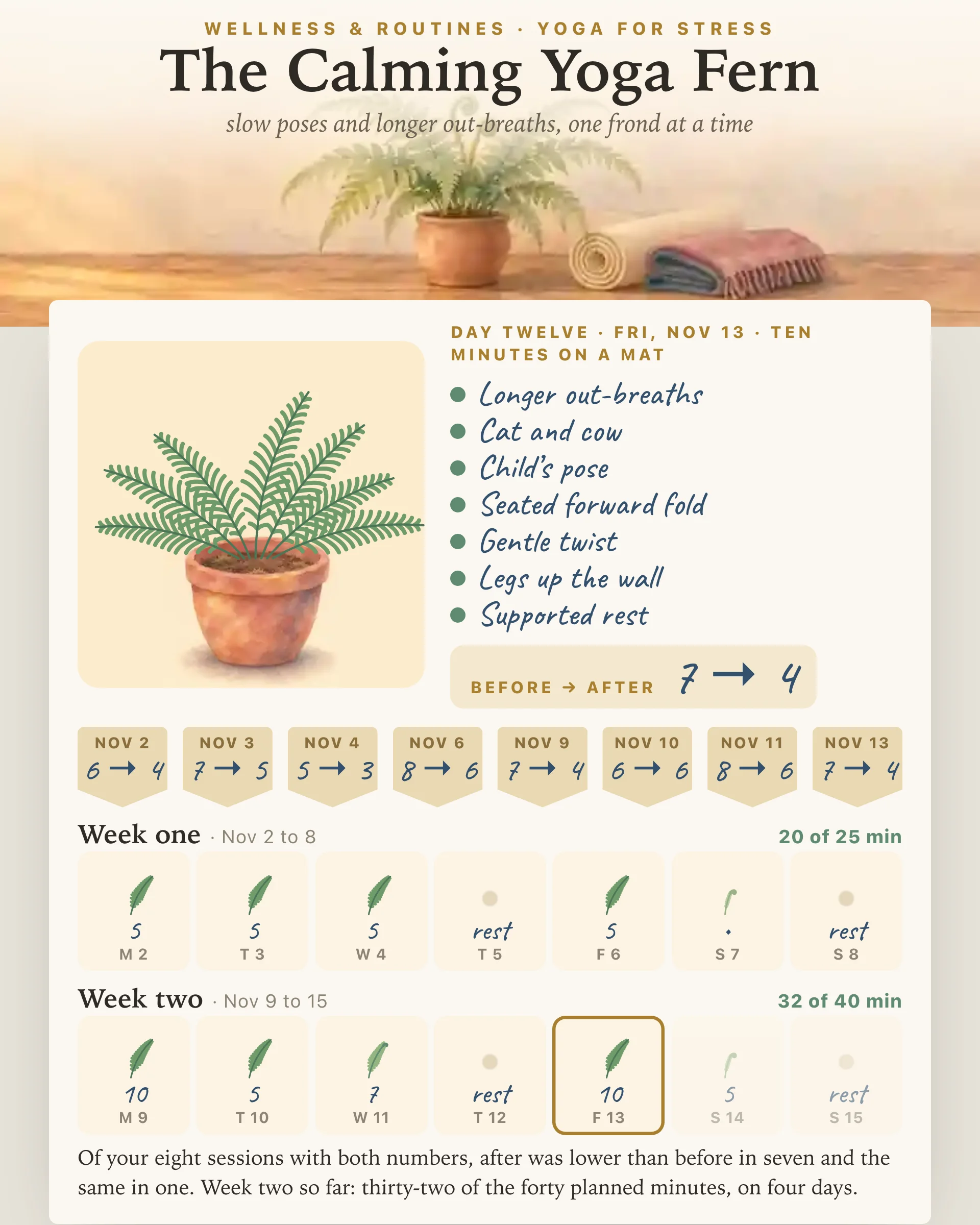
Stress usually shows up in the body before you name it: shoulders creeping toward your ears, a jaw that will not unclench, breath that stays high and quick. Yoga for stress relief works on that end of the problem. It will not move a deadline, but a few slow poses and a longer out-breath give your body a different signal for ten minutes.
This page builds the session. Choose five, ten or twenty minutes and where you are: on a mat, in a chair at your desk, or in bed. Each pose is drawn as a curled fern frond that opens while you hold it.
Every session starts with breathing and ends in stillness.
On the mat or the bed, every pose has a chair or wall option: child's pose at a table, the fold with your back against a wall, calves on a chair seat instead of legs up the wall. Switch it on for any pose your knees, hips or back dislike.
Tap a number from 0 to 10 for how stressed you feel right now, then press begin. A ring paces your breathing: a dot travels around it, and the center swells as you breathe in and shrinks on the slower breath out. The pose, how to do it and a countdown sit beside the ring while its frond uncurls.
The clock keeps real time, so a phone that locks mid-pose comes back to the right place. Pause holds everything, the breath included. A skipped pose leaves its frond curled and its seconds uncounted. End early and only whole minutes go on the day.
When the session ends, the page asks for your number again. The pair hangs on a small plant tag beside your earlier pairs. Nobody else's numbers appear, and the page puts no label on yours. Underneath, a four-week plan runs from five minutes on five days in week one to two twenty-minute days in week four, and each day grows a tiny frond.
The evidence for yoga and stress is real but modest. A 2017 meta-analysis of 42 randomized trials found that programs with yoga postures were linked with lower cortisol, resting heart rate and blood pressure than active comparison groups. Those are body measures, not how stressed people said they felt, and the programs varied so much that the review cannot say which style or how much practice helps whom.
The longer out-breath has a small evidence base of its own. In a month-long remote study of 108 adults, most of them university students, five minutes a day of breathing with a stretched exhale lifted mood more than the same time of mindfulness meditation. Participants rated their anxiety before and after each practice, much as this page asks you to. Their exercise used a double in-breath, so it is close to this pacer but not the same, and the study was small, not registered in advance and had no group that did nothing.
Yoga is not a treatment for anxiety or depression. A review of eight trials with 319 people found small, short-term drops in anxiety for people with raised anxiety, but no clear effect for those diagnosed with an anxiety disorder. In a trial of 226 adults with generalized anxiety disorder, twelve weeks of group yoga helped more people than stress education did, yet it did not match cognitive behavioral therapy, which the authors say should stay the first choice.
If stress is with you most days, keeps you from sleeping or working, or feels like more than you can carry, talk with a doctor or a mental health professional. A few poses can sit beside that help, never in its place. The National Center for Complementary and Integrative Health also asks people who are pregnant, older or living with a health condition to check with their provider first, and notes that glaucoma and severe high blood pressure can call for changes to a pose. Stop any pose that hurts, and come up slowly from folds.
Try the five-minute chair version in a tense afternoon, or the bed version before sleep. If what weighs on you is a pile of worries rather than tight shoulders, the Stress Relief Worksheet sorts them into what you can act on and what you can set down; this page is for the body. The Morning Yoga Sundial is for waking up rather than winding down. And if the breathing helps most, Belly Breathing practices it on its own.
For many people, a little. Trials that pair yoga postures with an active comparison find lower cortisol, resting heart rate and blood pressure on average, though the programs differ a lot. Tracking your own number before and after each session is the most direct way to see whether it helps you.
Slow, supported poses with a long out-breath suit stress better than fast or demanding ones. This page uses child's pose, cat and cow, a seated forward fold, a gentle twist, knees to chest, legs up the wall and a supported rest, always starting with a few minutes of slower breathing.
Five minutes can be enough to shift your breathing, and a month-long study of daily five-minute breathing practice found mood changes at that dose. Ten or twenty minutes gives each pose longer. The plan here starts at five minutes on five days a week and works up to two twenty-minute days in week four.
No. Yoga is not a treatment for either. Reviews find small, short-term easing of anxious feelings in people without a diagnosis, and in a trial of people with generalized anxiety disorder, yoga did less well than cognitive behavioral therapy. If stress is with you most days or feels overwhelming, see a doctor or a mental health professional.
Check with your doctor first if you are pregnant, have glaucoma, a heart or blood pressure condition, a joint replacement, dizziness or pain. Head-down folds and lying flat do not suit everyone, which is why every pose here has a chair or wall option. Stop any pose that hurts and come up slowly.
By the team behind Fabulous, the science-based self-care app used by over 30 million people.


