Leaves on a StreamEmotional Fitness · ~3 min
About this template · Updated August 2026
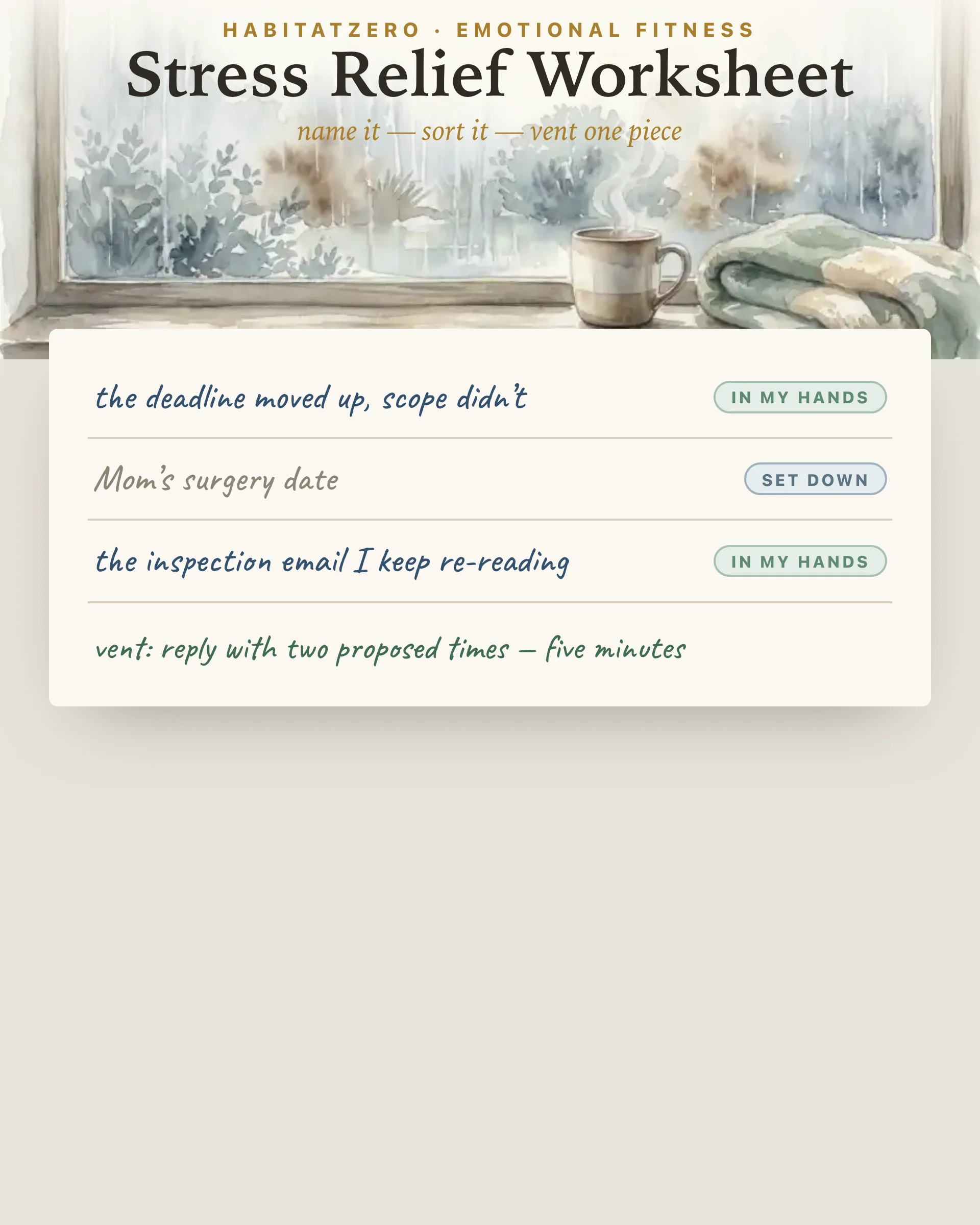
Stress rarely arrives as a list. It arrives as weather — a low-pressure front of deadline, inbox, family worry, and something you can't quite name, all pressing at once and therefore all unanswerable at once. This worksheet does one job: it turns the weather back into a list, sorts the list into the only two piles that matter, and sends you off to vent exactly one item. Seven minutes, three moves, and the front usually breaks.
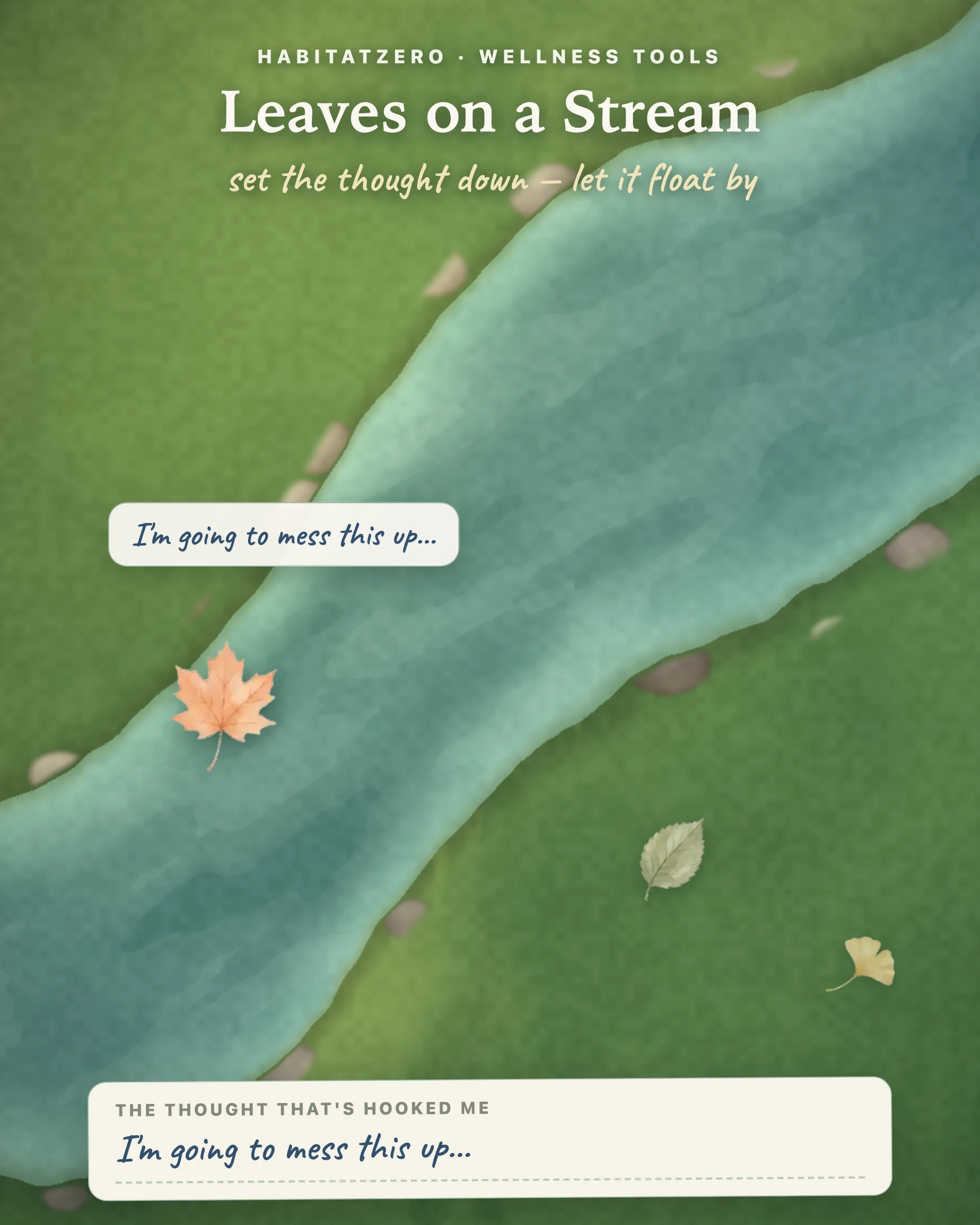
Each pressing thing gets its own plain line, up to ten. Not analyzed, not ranked — named. The deadline moved up and nobody adjusted the scope. Mom's surgery is scheduled. The inspection email I keep re-reading.
Getting worries out of your head and onto a surface isn't just tidying; it has measurable mechanics. In a field experiment with students facing a high-stakes exam, ten minutes of writing out their worries beforehand significantly improved performance compared with controls — the offload appears to free the working memory that unexpressed worry was quietly occupying (DOI: 10.1126/science.1199427). The inventory is that offload, generalized: every line you write is attention bought back.
Under every pressure sit two chips: in my hands and not mine to carry. Tap one. This is the oldest move in stress management — the control split — made mechanical, and it's where most of the relief actually lives.
The two piles have different correct responses, which is the entire point of separating them. In-my-hands items are disguised actions: the reply, the booking, the honest no. Not-mine items — other people's decisions, outcomes already in motion, the reorg that will land wherever it lands — were never assignments, but until they're sorted, you carry them as if they were. On the sheet, set-down lines soften visibly: still named, still real, no longer pretending to be your to-do list. Most people are surprised by the pile sizes. The unactionable pile is usually the bigger one, and hauling it around was the exhausting part.
The sheet ends with a single dashed line: the smallest action that releases some pressure from the loudest in-my-hands item. Reply to the inspection email with two proposed times — five minutes. Write it, go do it, come back and tap vented.
One, deliberately. A ten-point recovery plan is another item for the inventory; one completed valve is proof of motion, and proof of motion is what a pressurized week actually needs from you today.
If the pressure in your body needs settling before you can even sort — racing heart, shallow breath — a paced breathing exercise like the Box Breathing template pairs well before this sheet, and the Overwhelm Recovery Protocol template is the deeper companion for the days when everything is on fire at once. This worksheet is the middle tool: calmer than panic, lighter than a crisis protocol.
This page is a pressure valve, not a treatment. If stress is constant, heavy, or affecting your health or sleep, the strongest move on the whole sheet is a conversation with a doctor or mental-health professional. The inventory will still be here — and it sorts a lot better with support behind it.
A one-page triage for pressure: you name everything that is weighing on you, sort each item by whether it is actually yours to act on, and finish by venting one item with a small concrete action. It borrows the oldest move in stress management — separating what you control from what you do not — and makes it a tap.
Unnamed pressure behaves like background weather — everywhere and unanswerable. Externalizing it onto a page has measurable effects: in a classroom field experiment, students who spent ten minutes writing out their worries before a high-pressure exam performed significantly better than controls, apparently because the offload freed working memory the worry had been occupying. Ten honest lines buy back attention.
It splits your stress into the only two categories with different correct responses. In-my-hands items convert into actions; not-mine items convert into acceptance work — still real, but no longer pretending to be your to-do list. Most people find the pile sizes themselves are the relief: the unactionable pile is usually bigger than expected, and carrying it as assignments was the exhausting part.
The smallest real move that lowers the pressure of one item — replying to the email you keep re-reading, booking the appointment, saying one honest no. It should take minutes, not resolve your life. The worksheet asks for exactly one because a single completed valve teaches the nervous system more than a ten-point plan it never starts.
Whenever the blur returns — for some weeks that is daily, for others once. The inventory caps at ten lines on purpose: past ten, collecting pressures becomes its own stressor, and the useful work is sorting and venting what is already named.
Then treat this page as a valve, not the answer. Constant, heavy, or health-affecting stress deserves a professional conversation — a doctor or mental-health professional can do what no worksheet can. Sorting and venting still help alongside that support, but they are a supplement, never the substitute.
By the team behind Fabulous, the science-based self-care app used by over 30 million people.