
The Overwhelm Recovery ProtocolWellness & Routines · ~5 min
About this template · Updated November 2026
Yoga for men usually starts with a confession: I can't touch my toes. It is built for the man whose hamstrings pull when he ties a shoe, whose hips have set from years of sitting, and whose shoulders creep toward his ears. You don't need flexibility to begin. You build it by showing up three or four times a week and holding each pose its whole time.
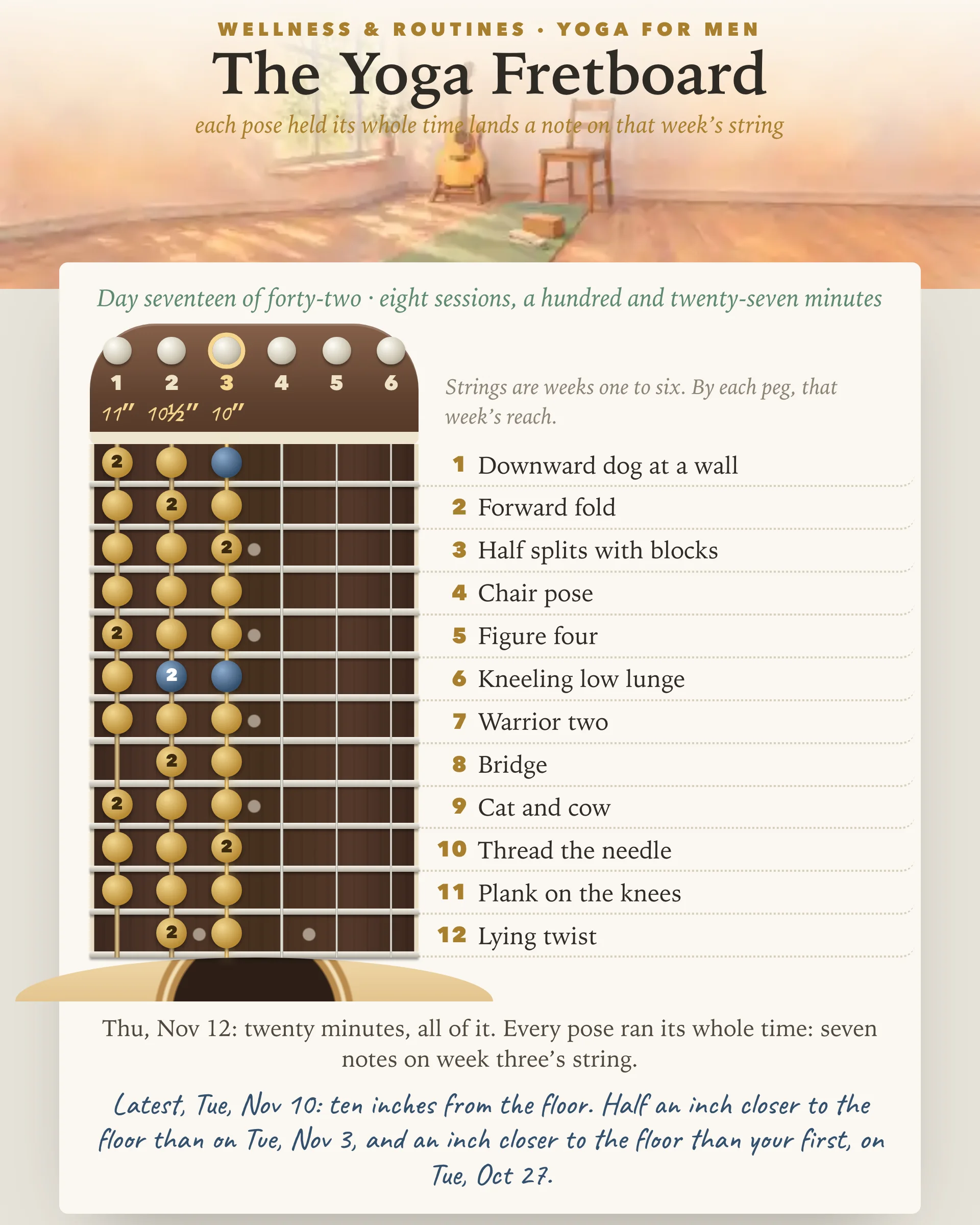
The page draws your practice as an upright guitar neck. Its six strings are the six weeks of the plan, thickest string first. Its twelve frets are the twelve poses in three groups of four: hamstrings and legs, then hips, then shoulders and back. Each time a pose runs its whole time, a note lands where its fret crosses that week's string, gold when you used the prop and blue for the fuller way. By week three the neck reads like a chord chart of what you actually did, and the frets you keep skipping stand out. Like a new player's stretch across four frets, the reach comes with weeks of practice.
Downward dog at a wall, forward fold, half splits with blocks and chair pose work the legs. Figure four, a kneeling low lunge, warrior two and bridge open the hips. Cat and cow, thread the needle, plank on the knees and a lying twist loosen the shoulders and back. Each has an eased way with a chair, a block or a strap and a fuller way for later, plus a plain cue that range comes with practice, because the urge to force a stretch is strongest on day one.
Choose fifteen, twenty, twenty-five or thirty minutes. A fifteen-minute session is a three-minute warm-up, five poses at two minutes each and two minutes resting on your back. Each pose gets ten seconds to settle, a forty-five-second hold of five slow breaths and five seconds to come out, done twice, once per side for a one-sided pose. The least-played poses fill the session first, and you can tap any fret to ask for a pose or leave it out. End early and only whole minutes are logged.
Weeks one to three hold three sessions, growing from fifteen minutes to twenty; a short fourth joins in week four, and one session reaches thirty by week six.
Once a week, stand with your feet together, fold forward slowly with your arms hanging and measure from your middle fingertips to the floor in inches. The figure sits by that week's tuning peg and is compared only with your own earlier checks. There is no target, and a cold morning reads further than a warm evening.
Most yoga research has been done on women. A bibliometric analysis of 312 randomized yoga trials by researchers at the University of Duisburg-Essen found the median trial was 67 percent female; 81 trials enrolled only women and 30 only men. The evidence for men is thinner, and some of what follows comes from small groups.
In a ten-week study of 26 male college athletes, a soccer team that added two hour-long yoga classes a week gained under two inches on the sit-and-reach test, while a baseball team without yoga did not. The teams were not randomly assigned, and these were twenty-year-old athletes, not stiff men of fifty.
Closer to that age, a trial of 150 veterans with chronic low back pain, averaging 53 years old and about three in four men, compared twelve weeks of twice-weekly yoga with waiting. Disability scores did not differ at twelve weeks but had improved more in the yoga group by six months, and pain eased a little more. It measured back pain, not flexibility.
The hold lengths here lean on a physical therapy trial of 93 adults with tight hamstrings, 61 of them men, aged 21 to 39. Stretching five days a week for six weeks gained more range than not stretching, and thirty-second holds did as well as sixty-second ones. None of this promises a number of inches, more muscle, better sport or any change in hormones. It suggests that regular, unhurried stretching tends to give back some range.
Talk to a doctor or physical therapist before starting if you have had back, hip, knee or shoulder surgery or a joint replaced, a heart or blood pressure condition, glaucoma, dizzy spells or a fall, or pain that does not settle. After a hip replacement, ask before figure four and the lying twist. Stretch to a firm pull, never to pain, and never bounce.
The Snow Pine keeps you in a chair for short routines; this page gets down to the floor and the wall over six weeks. The Yoga Mannequin teaches anyone two new poses a week, while this one is built around a stiff man's hamstrings, hips and shoulders and tracks his reach. If balance and leg strength matter more than range, The Tai Chi Horseshoe Board works on slow standing moves instead.
Evenings after a day of sitting work well, when muscles are warm. Keep the chair and blocks by the mat so starting takes one tap.
Yes. Yoga builds range rather than requiring it. Every pose here has an eased way with a chair, block or strap, and a reach that feels short in the first week tends to lengthen with a few sessions a week.
Slow poses held with support suit most men over 50: a chair for balance, blocks to bring the floor closer and holds of under a minute. Check with a doctor first after a joint replacement, a fall, or with a heart or blood pressure condition.
Three or four sessions a week is enough to notice a change over six weeks. Stretching research has found that a thirty-second hold loosens tight hamstrings about as well as a full minute, so long daily sessions are not needed.
This plan is about range and steadiness, not muscle size. Chair pose, plank on the knees and bridge do ask your legs, middle and shoulders to hold your weight, but if size or strength is your goal, pair yoga with a strength routine.
No. Plenty of stiff beginners stop well short of the floor, and that distance is exactly what the weekly reach check records. It is only ever compared with your own earlier checks.
By the team behind Fabulous, the science-based self-care app used by over 30 million people.


