
The Overwhelm Recovery ProtocolWellness & Routines · ~5 min
About this template · Updated November 2026
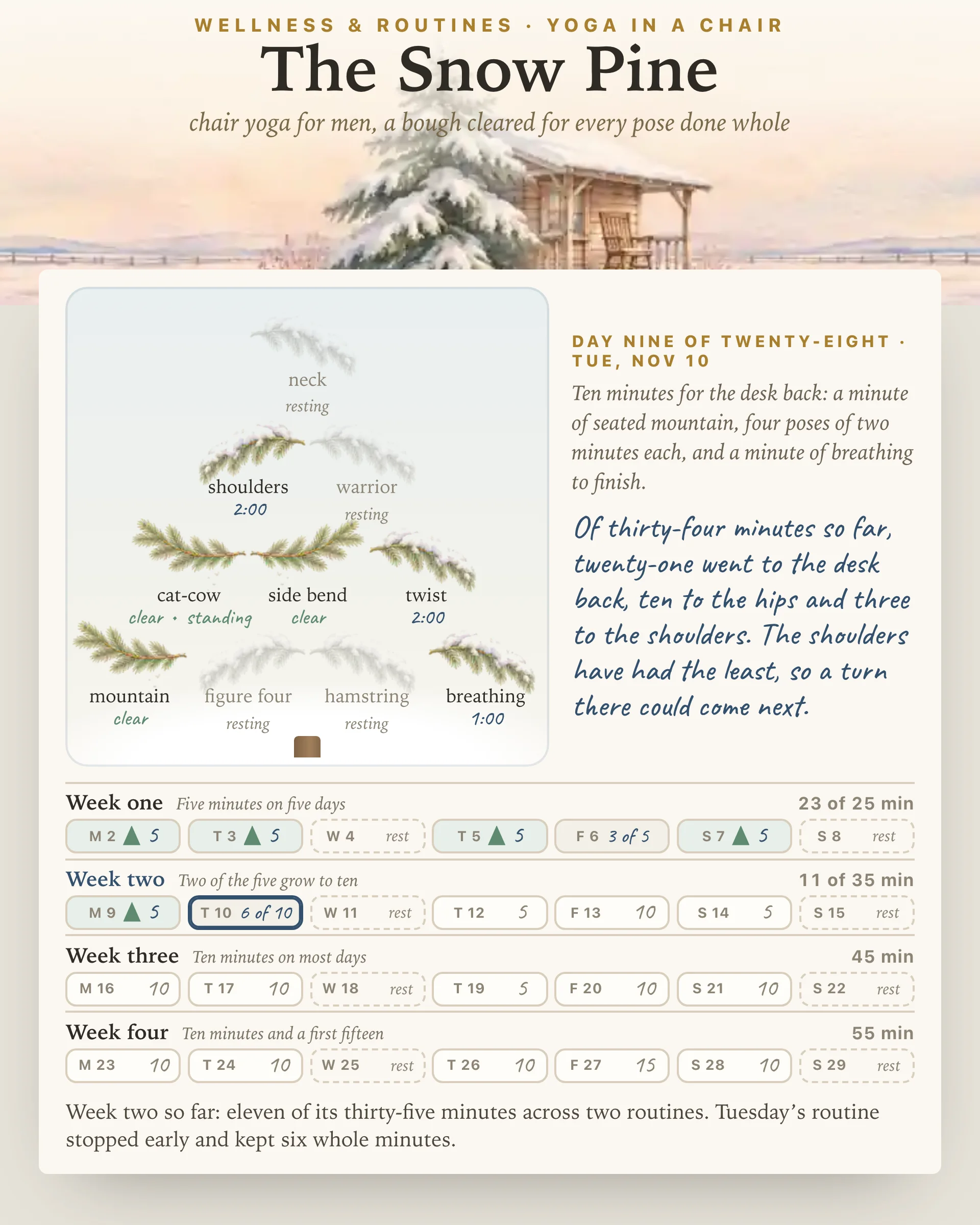
Chair yoga for men is ordinary yoga brought down to a seat: slow stretches and steady breathing in a sturdy chair, with no mat and no getting down to the floor. It suits a back that has set at a desk, hips gone tight from driving, and shoulders that creep toward your ears. You do not need to be flexible to begin.
This page draws the practice as a pine after a snowfall, each of its ten boughs one pose, placed about where you feel it: the neck at the top, the hips near the base. A bough sheds its snow only once its pose has run its whole time.
Talk to a doctor or physical therapist before you start if you have had a hip or knee replaced, surgery on your back or neck, a fall or dizzy spells, a heart or blood pressure condition, low bone density, or pain that does not settle. After a hip replacement, ask before crossing one leg over the other for the figure four; with low bone density, ask about twisting and leaning forward. Stop any pose that hurts, and keep breathing: it is easy to hold your breath without noticing when a stretch feels tight. Set the chair, one without wheels, on a floor that will not slide, and keep a hand on its back for every standing option.
Every routine opens with seated mountain, sitting tall with your feet planted, and closes with breathing to finish, in for about four counts and out for about six. Between them come seated cat-cow, a side bend, a seated twist, a figure-four hip stretch, a hamstring reach with a strap, shoulder rolls and eagle arms, a neck release and seated warrior arms. Tap a bough to read its pose, with a standing version at the chair.
Pick a length and the spot that feels stiffest: desk back, hips or shoulders. Five minutes gives a minute of seated mountain, three poses of a minute each and a minute of breathing; ten holds four poses of two minutes, and fifteen holds six, then two minutes of breathing. Your focus decides which poses come first, and a pose that does not suit you can be left out.
The clock follows real time, so a locked phone keeps your place, and a cue line names the side you are on and when to breathe. End early and only your whole minutes go in the log; skip a pose and its bough keeps its snow. A short reading above the pine shows where your minutes have gone, so you can tell when the hips are missing out.
Five days a week: five minutes each in week one, two of them growing to ten in week two, ten on most days in week three, and a first fifteen in week four.
Yoga research leans toward women. In a US survey of 34,525 adults, people who had tried yoga were more likely to be women. A 2022 Cochrane review of yoga for chronic low back pain pooled 21 trials and 2,223 people, most of them women in their 40s or 50s. Against no exercise, yoga brought small gains in back function and pain at three months, too small to count as clinically important, and it did about as well as other back exercise. Yoga groups also reported more side effects than groups doing no exercise, mostly flares of back pain.
One trial did enroll mostly men. Roseen and colleagues assigned 120 veterans with chronic low back pain, averaging 55 years old and 91 percent men, to twelve weekly yoga classes or a back pain book. At twelve weeks, pain and disability had eased by similar amounts in both groups, though more of the yoga group felt very much better.
Chair yoga has a small evidence base. Park and colleagues gave 112 older adults with osteoarthritis in the legs, three in four of them women and 75 years old on average, chair yoga classes of 45 minutes twice a week for eight weeks. Pain got in the way of daily life less, and that held for three months, but gains in walking speed and fatigue faded after the classes stopped, and balance did not change.
None of these studies tested short routines at home, so this page promises no fix for back pain or posture, only minutes of moving and breathing you can keep up.
The Chair by the Window walks one fixed 28-day path through seven poses, clearing a frosted pane each day. Here you choose the length and the stiff spot each time, every pose has a standing version, and the strap stretch, eagle arms and warrior arms join in. The Seven-Gear Seated Workout is a strength and cardio circuit with weights and a band, while this page is about loosening up. If most of your stiffness comes from the workday, The Paper Clip Chain has short moves for the desk itself.
Mid-afternoon at the desk, after a long drive, or in the evening. On a short day, pick five minutes rather than none.
It is a gentle way to loosen a stiff back, hips and shoulders without getting down to the floor. Most yoga trials enrolled mostly women, and the one sizable trial in mostly male veterans found yoga about as helpful for back pain as a self-help book, so treat it as a habit you can keep rather than a treatment.
The desk back focus puts cat-cow, a twist and a side bend first, which move the spine in several directions after hours of sitting still. Trials of yoga for low back pain show small gains at best, and none tested short routines at a desk, so expect a break from sitting rather than a cure.
Five to fifteen minutes is plenty. The four-week plan starts with five minutes on five days a week and works up to ten and fifteen minute days, and a short routine done most days beats a long one you keep putting off.
No. Every pose goes only as far as a gentle stretch, never pain, and each card offers an easier choice, such as keeping the foot down in the figure four or hugging your shoulders instead of wrapping into eagle arms.
Anyone who has had a hip or knee replaced, back or neck surgery, a fall or dizzy spells, a heart or blood pressure condition, low bone density, or pain that will not settle. Stop any pose that hurts, and keep breathing steadily rather than holding your breath.
By the team behind Fabulous, the science-based self-care app used by over 30 million people.


