
The Overwhelm Recovery ProtocolWellness & Routines · ~5 min
About this template · Updated November 2026
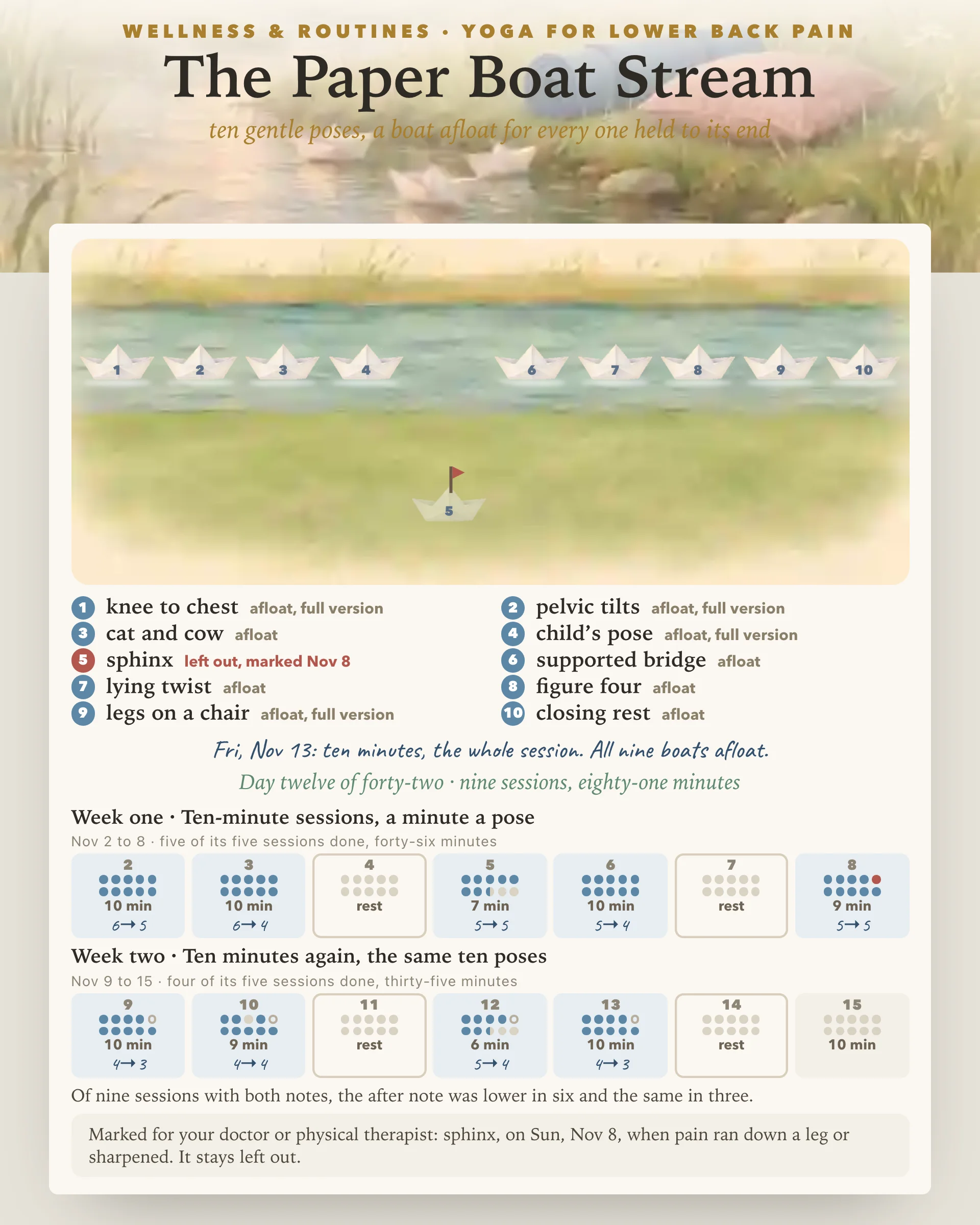
This page turns yoga for lower back pain into ten gentle floor poses, a timer that keeps real time and a six-week plan. It sits beside the care your doctor or physical therapist gives you, and it does not promise that your back will hurt less.
Call 911 or go to the emergency room now if you have numbness in the groin or buttocks, or new trouble with your bladder or bowels. See a doctor before trying any of these poses if you have weakness in a leg, a fever, pain that began with a fall or injury, weight loss you can't explain, a history of cancer, or pain that is worse at night or doesn't ease with rest. Yoga is not the answer to any of those.
Serious causes of back pain are rare. An international framework on red flags from a federation of physical therapists stresses that they still need catching early, and that most single warning signs lack strong evidence as tests on their own, which is why they belong with a clinician who can examine you.
If a pose sends pain down a leg, or makes your pain sharper, stop that pose. The red button stops it, keeps only the whole seconds you held, pauses the clock and marks the pose with the date for your clinician. A marked pose stays out of later sessions until you bring it back.
In session order: knee to chest one leg at a time, pelvic tilts, cat and cow, child's pose over a pillow, sphinx, a supported bridge resting on a cushion, a lying twist with the knees together, a lying figure four, legs resting on a chair, and a rest in which each breath out runs longer than the breath in. Every pose has an easier version, such as cat and cow on a chair or the closing rest on your side, and a line saying when to stop.
Ten paper boats wait on a riverbank, one for each pose, and a boat sets off only when its pose is held to the end. A pose cut short leaves its boat at the water's edge. The closing rest takes over the time of any pose you leave out, so a session keeps its length.
You choose ten, fifteen or twenty minutes, and each pose gets a tenth of it: fifteen seconds to settle in, then the hold, with five seconds to switch sides where a pose has two. The plan runs six weeks, five days a week, at ten minutes for two weeks, then fifteen, then twenty. Stop early and only whole minutes count; skipped time never does. A back number from 0 to 10 before and after each session sits only beside your own earlier numbers.
A 2022 Cochrane review, led by researchers at the University of Maryland's integrative medicine center, pooled 21 trials with 2,223 adults whose low back pain had lasted months without a clear cause, most of them women in their forties or fifties. At three months, compared with no exercise, pain fell by about four and a half points on a hundred-point scale, while the reviewers counted fifteen as the smallest change a person would notice. Function improved by a similarly small margin. Against physical therapy and other back exercise, yoga made little or no difference to daily function, and the pain results were too uncertain to call. Side effects, mostly a flare of back pain, were more common than with no exercise and about as common as with other exercise. No trial could blind people to their treatment.
One of the larger trials, run at a Boston safety-net hospital with 320 mostly low-income, racially diverse adults, compared twelve weekly yoga classes with fifteen physical therapy visits and with a self-care book. Yoga did about as well as physical therapy, yet it did no better than the book on pain or function. Both the yoga and therapy groups used less pain medicine than the book group.
The American College of Physicians guideline lists yoga among the drug-free options to try first for chronic low back pain, rating that evidence as low quality. None of these studies tested this sequence, a timer at home or pain that is recent, so read the six weeks as careful practice rather than treatment.
The Bell Tent Back Plan is seated or supported strength work for older backs. Swallows on the Wire opens the chest and upper back. The Piriformis Pretzel Tray stretches the deep buttock muscles, and The Sciatica Lemon Tree is built for pain that runs down a leg. This page stays on the floor for the low back, lets you pick the length, and asks how your back feels before and after.
Talk to your doctor or physical therapist before you start if you have had a fall, dizzy spells, a joint replacement, back surgery, a heart or blood pressure condition, or pain that is new or getting worse. Get down to the floor and back up slowly, keep a sturdy chair or counter within reach when you stand, and stop if anything hurts.
It can help a little. A 2022 Cochrane review of 21 trials in adults with long-lasting low back pain found gains in pain and daily function over no exercise that were too small for most people to notice, and results close to other back exercise. Some people found their pain flared, so start gently.
Gentle floor poses are the usual place to start: knee to chest, pelvic tilts, cat and cow, child’s pose over a pillow, sphinx, a supported bridge, a lying twist with the knees together, a lying figure four, legs resting on a chair and a quiet rest. No single pose has been shown to work best.
This page is built around the low back, though cat and cow, child’s pose and the sphinx also move the upper back. The trials summarized here studied low back pain only, so ask your doctor or physical therapist which poses suit a sore upper back.
Get emergency care instead for numbness in the groin or buttocks or new bladder or bowel trouble. See a doctor before starting for weakness in a leg, fever, a fall or injury, weight loss you can’t explain, a history of cancer, or pain that is worse at night or doesn’t ease with rest.
A mild stretch or easy effort is expected; sharp pain is not. Stop any pose that sends pain down a leg or makes the pain sharper, and tell your doctor or physical therapist which pose it was.
By the team behind Fabulous, the science-based self-care app used by over 30 million people.


