
The Overwhelm Recovery ProtocolWellness & Routines · ~5 min
About this template · Updated November 2026
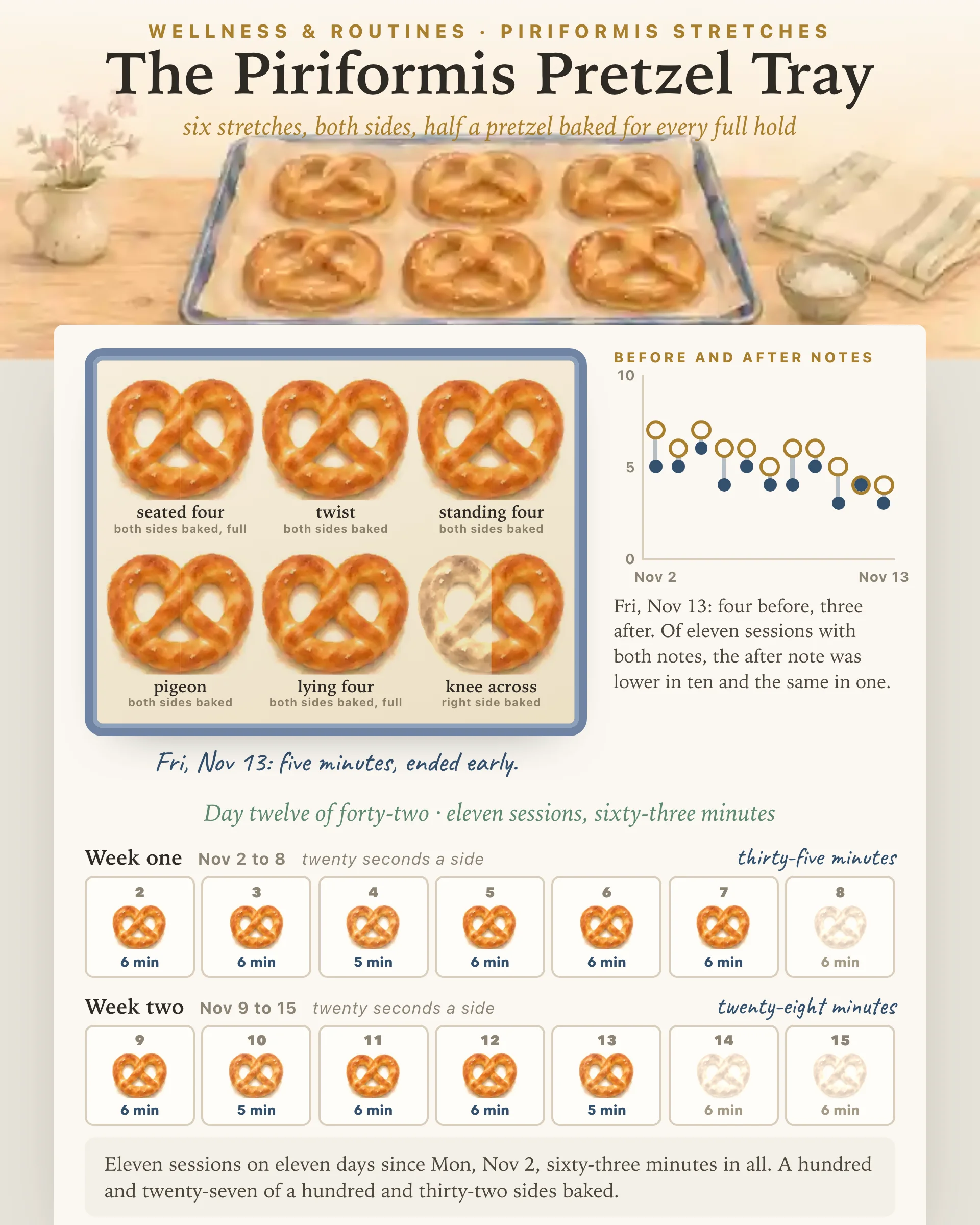
A deep ache in one buttock that flares when you sit often gets pinned on the piriformis, a small muscle under the bigger buttock muscles that helps turn your thigh outward. This page turns six piriformis stretches into a short daily routine, timed on both sides, with a six-week log and your own tightness notes. It sits alongside the care of your doctor or physical therapist and never replaces it.
See a doctor before you start if you have numbness or weakness in the buttock or leg, pain that shoots below the knee, or pain that began with a fall. Back pain with numbness between the legs, or any change in bladder or bowel control, needs care the same day. The MedlinePlus page on sciatica from the US National Library of Medicine lists these among the reasons to contact a provider right away, and suggests a call too when back pain lasts over four weeks.
The usual story is that a tight piriformis squeezes the sciatic nerve beside it, which is easier said than proved. A systematic review of its clinical features, led by primary care researchers at a UK university, gathered 55 studies, mostly reports of one patient or a small series, with details on 126 people. The features seen most were buttock pain, tenderness near the deep notch at the back of the pelvis, pain worse when sitting, and pain on movements that pull the muscle tight. The authors found no accepted test that confirms it, and specialists still disagree about whether it is a separate condition. So a tight piriformis is one possible source among several, the lower back included, and an examination beats any name you give the pain yourself.
Trials are few and small. In one randomized trial at a university clinic in western Iran, physiotherapy researchers treated 45 adults aged 18 to 60 with low back pain and deep buttock pain. All got ten sessions of heat and electrical nerve stimulation over about three and a half weeks; one group added a supervised figure four stretch, one added foam roller pressure, one added nothing. Pain fell about equally in all three. Disability scores dropped further with the stretch than with the foam roller, though not clearly further than with heat alone. There was no follow-up and no sham treatment.
For sciatica in general, a review of 18 physiotherapy trials with 2,699 people, by UK physiotherapy researchers, found no difference from comparison treatments for pain or disability, apart from a small edge on pain over advice alone at the longest follow-up. Every trial had a high or unclear risk of bias. None tested this routine. Gentle stretching is reasonable to try with your care team's agreement, and no routine can promise to clear up buttock pain or sciatica.
A seated figure four in a sturdy chair, a seated twist with a long back, a standing figure four with both hands on the counter, a pigeon with the shin across a bed or bench, a lying figure four, and a knee drawn toward the opposite shoulder. Each has an easier version, such as the ankle resting lower on the shin or the chest staying upright. Move one to full once its easier version is only a mild pull, and leave out any your doctor or physical therapist has ruled out.
Each stretch is a pretzel on a baking tray, with a half for each side; folded into a figure four, your legs make a shape a baker would recognize. Press start and the clock runs the session: a few seconds to get set, the right side held, ten seconds to switch, the left. A half turns golden only when its hold runs its whole time. A skipped side stays pale dough, and an early end keeps only whole minutes.
Holds grow from twenty seconds a side to thirty, then forty, so daily sessions run six, eight, then ten minutes over six weeks. A 0 to 10 tightness note before and after lands on a chart beside your own earlier notes only, with no label, since tightness shifts with sleep and sitting. Two weeks in, the page reminds you to check in with your doctor or physical therapist if the buttock is no easier or the pain has started to travel.
The Hip Flexor Clothesline opens the front of the hip after long sitting, and The Hip Compass moves the joint in every direction. This tray stays with the deep muscles behind the hip and puts warning signs first. If getting down to a bed is hard, The Stiffness Map keeps to a chair and a counter.
Check with your doctor or physical therapist first if you have had a fall, dizzy spells, a joint replacement, a heart or blood pressure condition, or pain that is new or worsening. After a hip replacement, ask your surgeon first, since the figure fours, the twist and the knee across take the hip toward the limits surgeons often set. Keep both hands on the counter when standing, go only to a mild pull, and stop at once for tingling, numbness or sharp pain.
This plan holds each side for twenty seconds in the first two weeks, thirty in weeks three and four, and forty in the last two, so a daily session grows from six minutes to ten. Ease into a mild pull and breathe; if your physical therapist gave you other timings, use theirs.
Sometimes the deep buttock is the source of pain that feels like sciatica, and gentle stretching is a reasonable thing to try with your care team. Most sciatica starts in the lower back, though, and reviews of physical therapy for sciatica found little or no difference in pain, so treat stretching as care, not a cure.
It is a name for buttock pain, sometimes running down the leg, thought to come from the piriformis muscle irritating the sciatic nerve. There is no agreed test for it, so doctors usually look for other causes, such as the lower back, before settling on it.
No. You should feel a mild pull deep in the buttock and nothing sharp. Stop straight away if a stretch brings tingling, numbness or pain down the leg, and tell your doctor or physical therapist.
Before stretching, if you have numbness or weakness in the buttock or leg, pain shooting below the knee, or pain that began with a fall. Back pain with numbness between the legs or any change in bladder or bowel control needs care the same day.
By the team behind Fabulous, the science-based self-care app used by over 30 million people.


