
The Overwhelm Recovery ProtocolWellness & Routines · ~5 min
About this template · Updated November 2026
With stiff fingers and knees that complain on the stairs, yoga can look like the last thing to try. Done slowly and with support, it is one of the ways people living with osteoarthritis or rheumatoid arthritis keep their joints moving. This page is a home practice meant to sit beside the care your doctor or physical therapist gives you, never to replace it. Ask them first if you have had a fall, dizzy spells, a joint replacement, a heart or blood pressure condition, or pain that is new or growing.
Every session opens with a minute of settling breath and closes with a minute of resting breath. In between come poses for five areas, in order: finger fans and fingertip touches for the hands, wrist circles and palm turns, shoulder rolls and arm raises, a slow march and hip circles, then leg extensions and heel slides for the knees.
Weeks one and two stay seated. From week three, a few poses are done standing behind a sturdy chair with a hand on its back, each with a seated version. Holds grow from a minute to ninety seconds, and the plan runs three sessions a week for eight weeks, from ten minutes to twenty-six. Breathe in as you open and out as you fold, never hold your breath, and move each joint only through the range it has today.
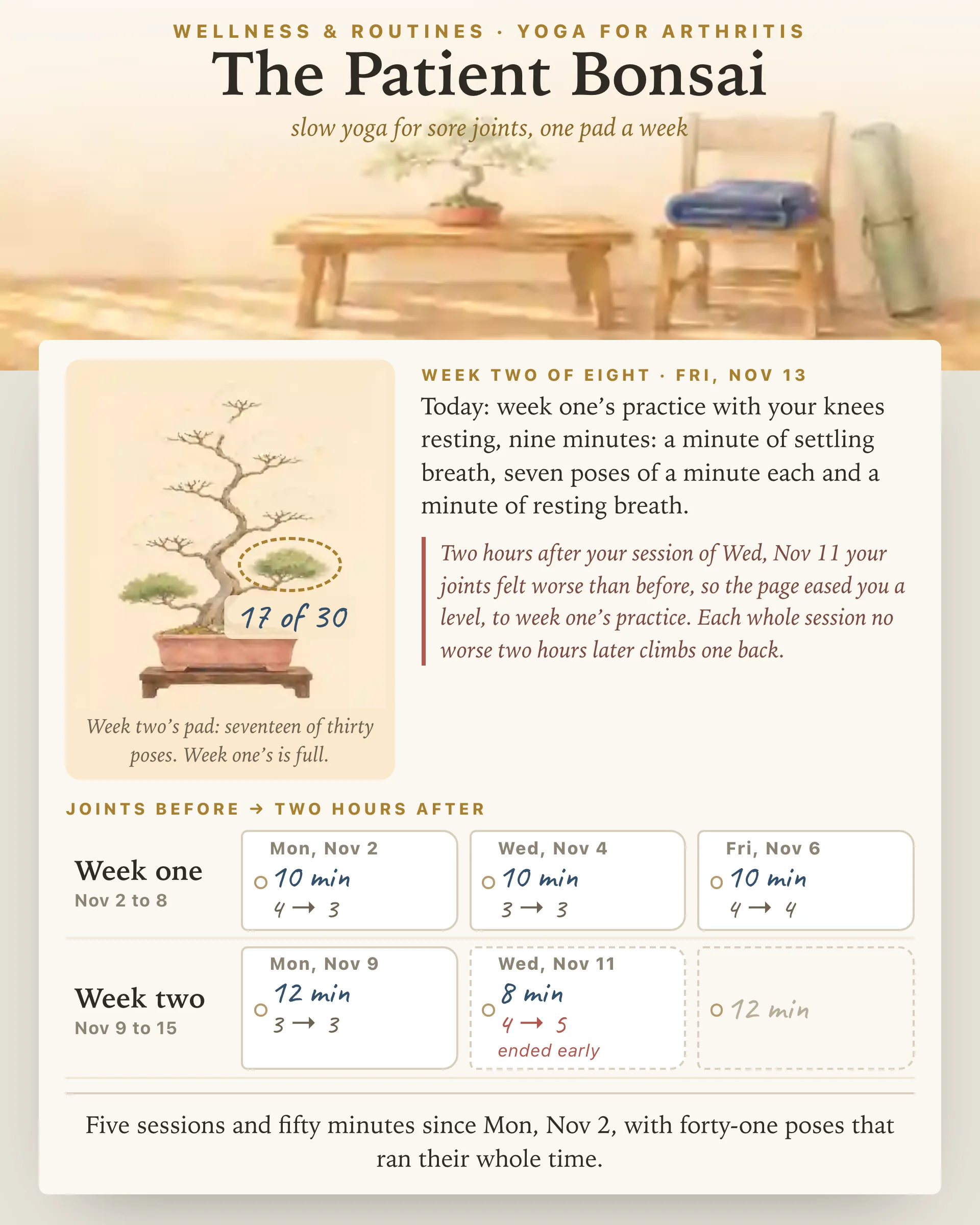
The tree has eight foliage pads, one for each week from the lowest branch up. A pose counts only when its full time runs, and then it grows that week's pad. Skip a pose that hurts and it adds nothing. Stop early and the log keeps only your whole minutes. The timer keeps true time even if your phone locks, and paused time never counts.
Mark an area as resting and its poses step out of that day's session, with the minutes shrinking to match.
Mark your joints from 0 to 10 just before a session begins. Two hours after it ends, the second note opens for another tap. Physical therapists who work with arthritis often put it plainly: more joint pain two hours after activity than before means you overdid it, so ease up next time, and see your doctor if the pain lasts more than a few days.
The page follows that rule. A higher second note on any session sets your next one a level gentler; a whole session at that gentler level, no higher two hours later, climbs one back, never past your week. Each session keeps its own second note for fourteen hours, so two sessions in a day are marked separately and an evening one after midnight, and your numbers sit only beside your own.
Talk with your rheumatologist or primary care doctor before you start, and never push a joint that is flaring. Rest a joint that is hot, red or newly swollen and ask your care team; call them the same day for a swollen, painful joint with a fever. Stop for sharp pain, faintness or sudden breathlessness, and call 911 or your local emergency number for chest pain that rest does not ease.
The 2019 US guideline for osteoarthritis of the hand, hip and knee conditionally recommends yoga for knee osteoarthritis, notes that it is far less studied than tai chi, and makes no recommendation for the hip because the data were too thin.
The trials are small. In a pragmatic trial in sedentary adults, 75 people with knee osteoarthritis or rheumatoid arthritis, 96 percent of them women and 52 on average, took two hour-long classes and one home practice a week for eight weeks. Compared with a waitlist, they reported better physical health and mood and walked farther in six minutes, but balance, grip and flexibility did not differ, and the first author trains yoga therapists.
A trial of online yoga gave 212 adults with knee osteoarthritis twelve weeks of unsupervised videos three times a week. Function improved a little more than with online education, though on average by less than people usually notice; knee pain while walking did not, and the gains were gone by week 24. A review of nine trials with 640 people, mostly women aged 50 to 80, rated the evidence for less pain and stiffness in knee osteoarthritis as very low quality and found nothing for the hands. For rheumatoid arthritis, a 2025 review of five small trials found yoga added to usual treatment improved disease activity scores and function, but not pain.
None of this shows that yoga repairs a joint or cures arthritis, and no trial tested this page, which offers regular, supported movement you adjust by how your joints answer.
The Three-Basin Fountain is the strength and low-impact cardio plan for the same joints, for the days between these sessions once your therapist agrees. The Woven Mat offers yoga for older adults with each pose done three ways, and The Chair by the Window stays seated for twenty-eight days; this page differs from both by building each session around sore joints, with areas you can rest for a day and a level that follows your two-hour notes.
It helps some people. The 2019 US osteoarthritis guideline conditionally recommends yoga for knee osteoarthritis, and small trials in knee osteoarthritis and rheumatoid arthritis found gains in function and well-being. The evidence is still thin, so treat yoga as one part of the care your doctor or physical therapist plans with you.
Slow, supported poses that move each joint through the range it has today: finger fans, wrist circles, shoulder rolls, a seated march, leg extensions and tree pose with one hand on a chair. Skip any pose that brings sharp pain, never force a joint, and keep breathing rather than holding your breath.
Rest a joint that is hot, red or newly swollen, and ask your care team what to do in a flare. On this page you can set that area aside for the day so its poses drop out of the session, and move the rest of you gently only if that feels right.
Compare how your joints feel before a session with how they feel two hours after it ends. Worse at two hours means you did a little too much, so do less next time. If the pain stays worse for more than a few days, call your doctor.
The trials behind this page ran two or three sessions a week for eight to twelve weeks. This plan asks for three a week, from ten minutes in week one to twenty-six in week eight, with a rest day after each session when you can.
By the team behind Fabulous, the science-based self-care app used by over 30 million people.


