
The Overwhelm Recovery ProtocolWellness & Routines · ~5 min
About this template · Updated November 2026
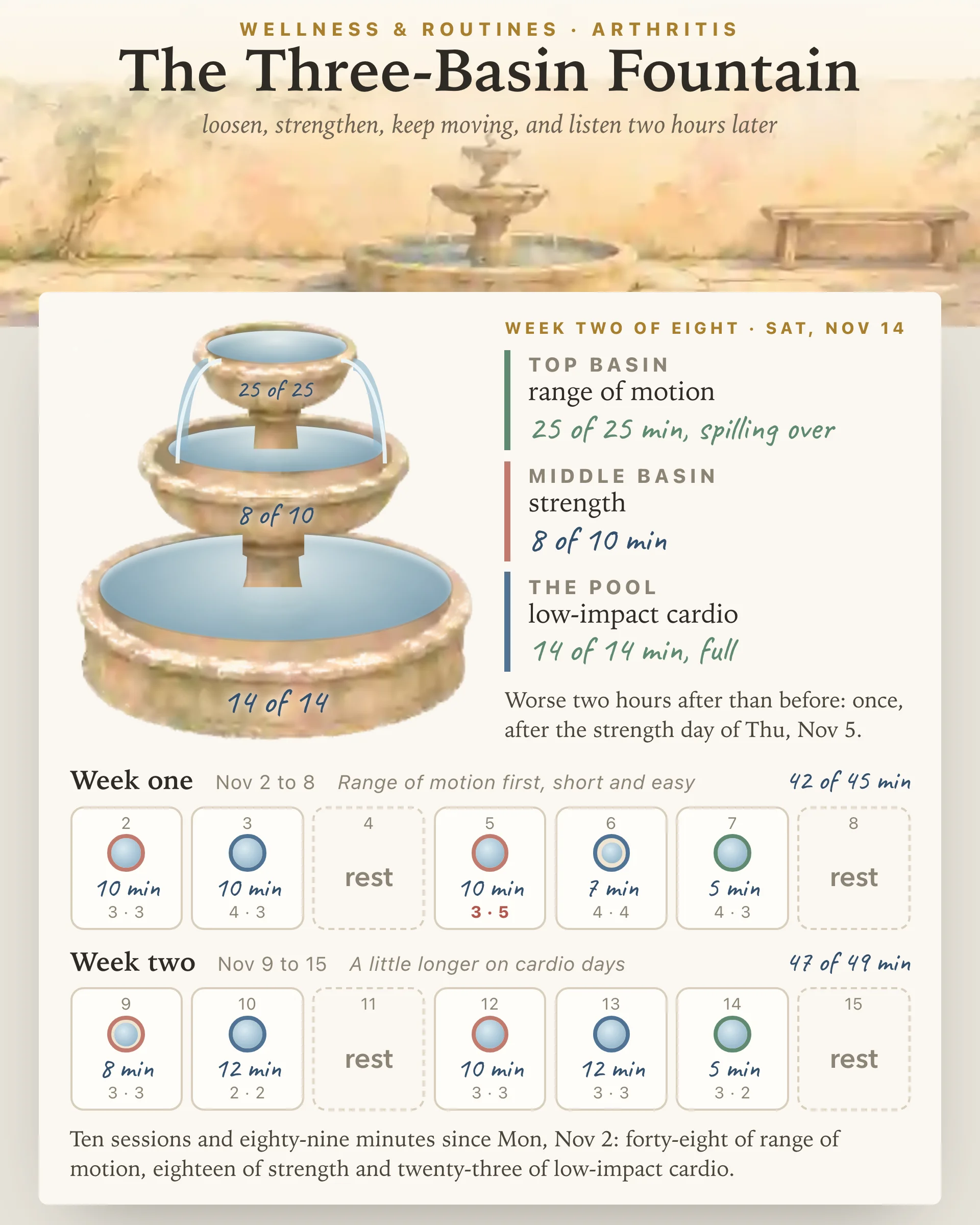
Moving with sore joints can feel like the wrong idea, yet arthritis guidance keeps pointing the same way: some steady, joint-friendly movement on most days. This page is a home plan for people living with osteoarthritis or rheumatoid arthritis, meant to sit beside the advice of your doctor and physical therapist, never in place of it. Ask them which moves suit your joints, and check in first if you have had a fall, dizziness, a joint replacement, a heart or blood pressure problem, or pain that is new or growing.
The plan mixes three kinds of movement, and every move has a seated or supported version.
The CDC's page on physical activity and arthritis suggests working up to 150 minutes a week of moderate activity and two days of muscle strengthening, and notes that five or ten minutes at a time is still worth doing. So this plan starts small, at about forty-five minutes over five days in week one, and grows to just over a hundred by week eight.
Each week is a painted three-tier fountain. The top basin fills with your range of motion minutes, the middle basin with strength and the pool with cardio, each against that week's plan, and a basin spills over once its share is done. Strength and cardio days open with three minutes of range of motion and close with two, so the top basin feeds the others.
The timer keeps true time even on a locked phone, paused time never counts, and an early end keeps only the whole minutes you moved. Below the fountain, eight weeks of small dishes record each day's minutes and notes.
Before each session, tap how your joints feel from 0 to 10. About two hours after it, tap again. The Arthritis Foundation puts the rule plainly in How Hard Should You Work Out?: more joint pain two hours after exercise than before it means you overdid it, so ease up next time.
The page applies that rule for you. When the second note is higher than the first, the next session of the same kind is set one step shorter; after a whole session that was no worse, it moves back up a step, never past the plan. It reads only your latest session of that kind, and only when it has both notes. Your notes sit only beside your own earlier ones, with no score or label.
The CDC notes that some new soreness, stiffness or swelling is normal with a new routine, and advises calling your provider if it is severe or does not ease.
Rest a joint that is hot, red or newly swollen, and during a rheumatoid flare, and ask your care team what to do. The Arthritis Foundation's tips for managing a flare suggest agreeing a flare plan with your doctor ahead of time, and MedlinePlus advises contacting a provider right away for joint pain and swelling with a fever. Stop for chest pain, dizziness or pain that keeps building as you move, and call 911 or your local emergency number for chest pain that does not ease with rest. Keep a sturdy chair or counter within reach for every standing move.
The 2019 American College of Rheumatology and Arthritis Foundation guideline strongly recommends exercise for osteoarthritis of the hand, hip and knee, and the 2018 EULAR recommendations make physical activity part of standard care for inflammatory arthritis and osteoarthritis.
The trials behind them are modest. A 2024 Cochrane review of 139 trials with 12,468 people with knee osteoarthritis found that land-based exercise probably improves pain and function a little by the end of a program, by amounts of uncertain importance, and most people in those trials knew which group they were in. A Cochrane review of pool exercise, 13 trials with 1,190 people with knee or hip osteoarthritis, average age 68 and mostly women, found small gains by the end of the programs and took no X-rays, so it says nothing about the joints themselves. A meta-analysis behind the EULAR advice pooled 49 trials with 3,909 people with rheumatoid arthritis, spondyloarthritis or hip and knee osteoarthritis: moderate gains in fitness and strength, no clear change in flexibility. For rheumatoid arthritis alone, a Cochrane review of eight trials found aerobic and strength training improved fitness and strength with no harmful effects reported, though every program in it was supervised.
None of this shows that exercise cures arthritis, repairs a joint or will lower your own pain, and no trial tested this page. The knee review also found, with low certainty, that people who exercised may report more side effects than those who did not. What the evidence supports is regular, well-paced movement, tried with your care team's blessing and adjusted by how your joints answer.
On pool days, The Poolside Card lays out a fuller water session, The Stiffness Map builds gentle stretches for whatever feels tight, and The Hip Lanterns adds hip strength once your therapist agrees.
There is no single best move. Most guidance pairs three kinds: gentle range of motion to keep each joint moving, strength work with a band, light weights or your own body, and low-impact cardio such as walking, cycling or exercise in warm water. Choose the ones your joints tolerate and that you will keep doing.
Reviews of trials in people with rheumatoid arthritis found that supervised aerobic and strength programs improved fitness and muscle strength, and found no harmful effects in the programs studied. Between flares, a mix of range of motion, light strength work and low-impact cardio is a common place to start, planned with your rheumatologist or physical therapist.
Moves done at a counter or from a sturdy chair, such as chair stands, heel raises with a hand on the counter, band rows and slow knee raises, plus walking, cycling or walking in a warm pool at an easy pace. Every standing move here has a seated or supported version, and a chair or counter should always be within reach.
Some aching is common, especially when you start. A useful check is the two-hour rule: if your joints hurt more two hours after a session than before it, do less next time. Rest a joint that is hot, red or newly swollen, or that is in a flare, and call your doctor promptly about a painful, swollen joint with a fever.
The CDC suggests working up to 150 minutes a week of moderate activity plus two days of muscle strengthening, and says five or ten minutes at a time still counts. This page starts at about forty-five minutes a week and grows to just over a hundred over eight weeks, so the full amount can come later.
By the team behind Fabulous, the science-based self-care app used by over 30 million people.


