
The Overwhelm Recovery ProtocolWellness & Routines · ~5 min
About this template · Updated November 2026
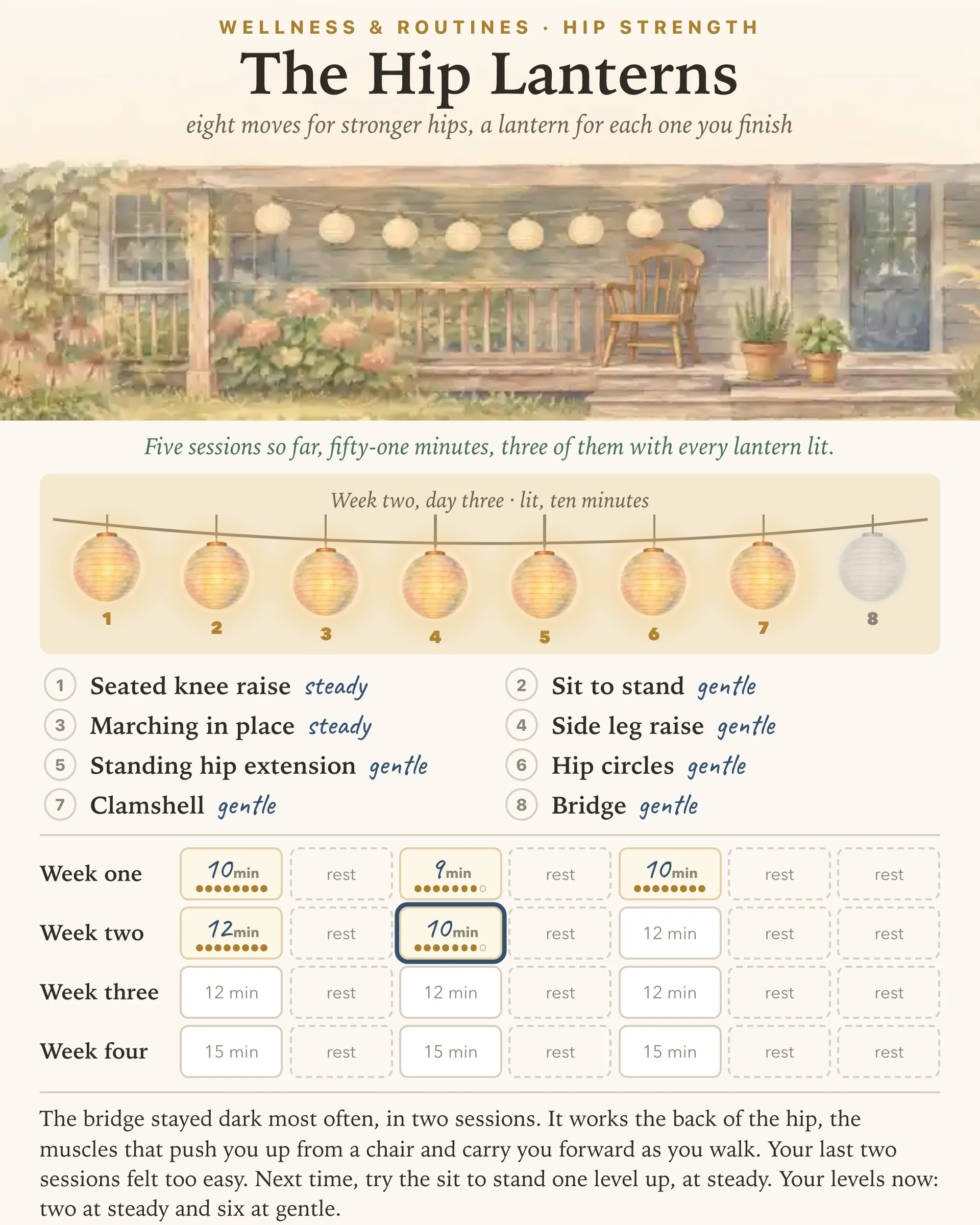
Your hips do quiet, constant work. They swing your leg up onto the curb, push you out of the armchair, and hold your pelvis level each time you stand on one foot, as you do with every step. Hip exercises for seniors train those three jobs with nothing more than a sturdy chair, the kitchen counter and your bed. This page strings eight of them into a timed session of ten to fifteen minutes and lights a painted lantern for each move you finish.
The session runs in the order you would walk through a house, so you change places only twice.
Every move comes in three levels. Gentle keeps the movement small and the support close. Steady adds a short hold at the top. Stronger asks for slower counts and a lighter grip, though every standing move keeps your fingertips on the counter. Begin everything at gentle: a move done carefully there is already doing its job.
Choose a level for each move, then press the button. The timer divides your session among the eight moves, gives the one-sided moves enough time for both legs, and allows a few seconds to get into position, a little longer when you walk to the counter or the bed. It names the leg that is working and tells you when to switch. Go slowly, roughly one repetition every three or four seconds, and rest whenever you want to.
The clock keeps real time, even while your phone is locked, and pause holds it still.
When a move's time runs out, its lantern lights. Skip a move and its lantern stays dark. If a move hurts, tap the button that says so: the move stops at once, its lantern gets a red ring, and it stays out of your sessions until you choose to put it back. At the end, the session lands on the four-week plan as a row of eight small dots, and you can mark whether the levels felt too easy, about right or too hard. Two sessions in a row that felt too easy bring a suggestion to take one move up a level, and two that felt too hard suggest taking one down.
The plan is three sessions a week with a rest day between them: ten minutes in the first week, twelve in the second and third, and fifteen in the fourth.
The strongest evidence for exercise in later life comes from research on falls. A Cochrane review of 108 trials found that exercise programs lowered the rate of falls among older people living at home by about a quarter. The programs with clear effects were built on balance and functional exercises, and those that added strength work probably did a little better. The same review was uncertain about programs made mostly of strength training, and about benefits beyond falls such as quality of life. So treat this routine as one useful piece rather than a whole falls program. The World Health Organization guidelines ask adults over 65 for varied activity that emphasizes balance and strength on three or more days a week.
If your hips ache from osteoarthritis, the picture is more modest still. The 2026 update of the Cochrane review on exercise for hip osteoarthritis found that, compared with no treatment, exercise probably eases pain and improves function slightly, though the authors judged those gains unlikely to feel meaningful on their own. That argues for honest expectations, not for staying in the chair.
Check with a doctor or physical therapist before you begin if you have fallen, had dizzy spells, had a joint replaced, live with a heart or blood pressure condition, or have pain in your hips, knees or back. Stop any move that hurts. Whenever you are on your feet, keep the counter or a sturdy chair close enough to grab.
After a hip replacement, your surgeon's or physical therapist's plan comes first. Early recovery often comes with positions to avoid, and what is safe depends on how your operation was done. The total hip replacement exercise guide from the American Academy of Orthopaedic Surgeons is written for that stage and still asks for your surgeon's go-ahead. Come to this page only once your care team agrees that general hip strengthening suits you.
If your hips feel stiff more than weak, The Hip Compass is a mobility routine that sits well on the days between these sessions. For steadiness on your feet, The Balance Ladder builds standing balance one rung at a time, and The Whole-House Strength Routine works the rest of your body around the home.
Pick moves that work the hip in every direction with support close by: seated knee raises and marching for the front, sit to stand, standing hip extension and the bridge for the back, side leg raises and clamshells for the side, and slow circles for the whole joint. Each one on this page comes in a gentle, a steady and a stronger version.
The ones that need only a chair, a kitchen counter and a bed. Sit to stand, side leg raises and hip extensions at the counter, clamshells and bridges on the bed all build hip strength without weights. Move slowly, about one repetition every three or four seconds, and make a move harder only once it feels easy two sessions running.
World Health Organization guidance asks people over 65 for balance and strength work on three or more days a week. This plan follows that with three sessions a week and a rest day between them, starting at ten minutes and reaching fifteen by the fourth week.
Only with your surgeon or physical therapist saying so. In the months after surgery there can be positions to avoid, and your own recovery plan always comes before a general routine like this one. Once they agree that general hip strengthening suits you, start every move at gentle.
Stop that move. Working muscles can feel tired or warm, but sharp pain, or pain in the joint itself, is a signal to stop. This page sets a move that hurt aside until you choose to try it again, and if the pain comes back or lingers, see a doctor or physical therapist.
By the team behind Fabulous, the science-based self-care app used by over 30 million people.


